Q1. The bond between phosphate and hydroxyl group of sugar in nucleic acid is _______.
Correct Answer: (c)
A phosphate group reacts with the hydroxyl group of the sugar to form an ester bond. In a chain, these are called phosphodiester bonds.
A phosphate group reacts with the hydroxyl group of the sugar to form an ester bond. In a chain, these are called phosphodiester bonds.
Q2. When a moist bread is kept exposed in air, it becomes mouldy and black because
Correct Answer: (c)
Fungal spores like those of Rhizopus (bread mould) are ubiquitous in the air and germinate when they land on a suitable moist substrate.
Fungal spores like those of Rhizopus (bread mould) are ubiquitous in the air and germinate when they land on a suitable moist substrate.
Q3. Which is the national aquatic animal of India?
Correct Answer: (b)
The Ganges River Dolphin (Platanista gangetica) is the national aquatic animal of India.
The Ganges River Dolphin (Platanista gangetica) is the national aquatic animal of India.
Q4. In terms of studying gene function, what is the main benefit that genome editing has over RNAi?
Correct Answer: (a)
RNA interference (RNAi) is a 'knockdown' technology that degrades mRNA or blocks translation, resulting in reduced protein levels but often leaving some function intact. Genome editing (like CRISPR/Cas9) creates permanent changes in the DNA sequence, allowing for a complete 'knockout' or total elimination of the gene's function.
RNA interference (RNAi) is a 'knockdown' technology that degrades mRNA or blocks translation, resulting in reduced protein levels but often leaving some function intact. Genome editing (like CRISPR/Cas9) creates permanent changes in the DNA sequence, allowing for a complete 'knockout' or total elimination of the gene's function.
Q5. Which of the following is a function of the kidneys?
Correct Answer: (d)
Kidneys perform multiple vital roles including removal of metabolic wastes, regulation of water balance, and maintenance of electrolyte (salt) levels. Therefore, all listed functions are correct.
Kidneys perform multiple vital roles including removal of metabolic wastes, regulation of water balance, and maintenance of electrolyte (salt) levels. Therefore, all listed functions are correct.
Q6. Match the characteristic feature/terms given in column I with the phylum to which they belong given in column II and choose the correct option.
| Column-I (Characteristic feature/term) | Column-II (Phylum) |
|---|---|
| A. Choanocytes | I. Platyhelminthes |
| B. Cnidoblasts | II. Ctenophora |
| C. Flame cells | III. Porifera |
| D. Nephridia | IV. Coelenterata |
| E. Comb plates | V. Annelida |
Correct Answer: (d)
A-III; B-IV; C-I; D-V; E-II.
A-III; B-IV; C-I; D-V; E-II.
Q7. Bananas can be prevented from over ripening by:
Correct Answer: (c)
Antioxidants like ascorbic acid can sometimes be used to slow down the oxidative processes associated with ripening and browning. (Wait, check Key: 71(c)).
Antioxidants like ascorbic acid can sometimes be used to slow down the oxidative processes associated with ripening and browning. (Wait, check Key: 71(c)).
Q8. A research student collected certain alga and found that its cells contained both chlorophyll a and chlorophyll d as well as phycoerythrin. On the basis of his observation, the students conclude that the alga belongs to
Correct Answer: (a)
Chlorophyll a, chlorophyll d, and phycoerythrin are characteristic pigments of Rhodophyceae (red algae).
Chlorophyll a, chlorophyll d, and phycoerythrin are characteristic pigments of Rhodophyceae (red algae).
Q9. Match the following for Male Glands:
| Gland | Count |
|---|---|
| A. Seminal vesicle | (I) Paired |
| B. Prostate | (II) Paired |
| C. Bulbourethral | (III) Single (Unpaired) |
Correct Answer: (a)
Prostate is single; others are paired.
Prostate is single; others are paired.
Q10. Viroids differ from viruses in having
Correct Answer: (c)
Viroids consist only of free RNA without a protein coat (capsid).
Viroids consist only of free RNA without a protein coat (capsid).
Q11. Unlike bee-pollinated flowers, bird-pollinated flowers
Correct Answer: (d)
Birds have highly developed color vision, particularly in the red portion of the spectrum, and a poor sense of smell. Consequently, bird-pollinated flowers are often red and lack the strong scents found in bee-pollinated flowers.
Birds have highly developed color vision, particularly in the red portion of the spectrum, and a poor sense of smell. Consequently, bird-pollinated flowers are often red and lack the strong scents found in bee-pollinated flowers.
Q12. In the Irish Setter, the overall red coat color is controlled by the melanocortin receptor. When this receptor is bound by MSH, dark eumelanin is produced. When bound by an antagonist, red pheomelanin is made. The red color is likely due to a mutation in the
Correct Answer: (b)
If the red coat color is caused by the antagonist successfully out-competing MSH or MSH failing to bind, a mutation that prevents the receptor from binding MSH would leave the receptor constantly available to the antagonist, leading to the permanent production of red pigment.
If the red coat color is caused by the antagonist successfully out-competing MSH or MSH failing to bind, a mutation that prevents the receptor from binding MSH would leave the receptor constantly available to the antagonist, leading to the permanent production of red pigment.
Q13. Sex determination in birds follows the ZW system, where males have two copies of the Z chromosome (ZZ) and females are heterozygous (ZW). A male bird (who is heterozygous for a trait on the Z chromosome) is mated with a female bird (who expresses the recessive phenotype for that trait). Which of the following best describes their most likely offspring?
Correct Answer: (a)
(A) The following Punnett square shows the cross between a heterozygous male (ZAZa) and a female with the recessive trait (ZaW):
So 1/4 of the offspring would be males with the dominant phenotype, 1/4 would be males with the recessive phenotype, 1/4 would be females with the dominant phenotype, and 1/4 would be females with the recessive phenotype.
(A) The following Punnett square shows the cross between a heterozygous male (ZAZa) and a female with the recessive trait (ZaW):
| ZA | Za | Results | |
| Za | ZAZa | ZaZa | 1/4 males with dominant phenotype, 1/4 males with recessive phenotype |
| W | ZAW | ZaW | 1/4 females with dominant phenotype, 1/4 females with recessive phenotype |
So 1/4 of the offspring would be males with the dominant phenotype, 1/4 would be males with the recessive phenotype, 1/4 would be females with the dominant phenotype, and 1/4 would be females with the recessive phenotype.
Q14. The Meselson and Stahl experiment used a density label to be able to
Correct Answer: (c)
By growing bacteria in heavy nitrogen (15N) and then switching them to light nitrogen (14N), Meselson and Stahl could distinguish original parental DNA from newly synthesized DNA based on their different densities when centrifuged in a cesium chloride gradient.
By growing bacteria in heavy nitrogen (15N) and then switching them to light nitrogen (14N), Meselson and Stahl could distinguish original parental DNA from newly synthesized DNA based on their different densities when centrifuged in a cesium chloride gradient.
Q15. A molecule of CO₂ that is generated in the cardiac muscle of the left ventricle would not pass through which of the following structures before leaving the body?
Correct Answer: (b)
CO₂ produced in the left ventricle enters the coronary circulation, returns to the right atrium, then passes through the right ventricle and lungs before being exhaled. It does not re-enter the left atrium before leaving the body.
CO₂ produced in the left ventricle enters the coronary circulation, returns to the right atrium, then passes through the right ventricle and lungs before being exhaled. It does not re-enter the left atrium before leaving the body.
Q16. The fluid-filled cavity characteristic of a tertiary follicle is the:
Correct Answer: (b)
The secondary follicle soon transforms into a tertiary follicle which is characterised by a fluid filled cavity called antrum.
The secondary follicle soon transforms into a tertiary follicle which is characterised by a fluid filled cavity called antrum.
Q17. Which of the following is not a step in understanding biodiversity?
Correct Answer: (d)
Understanding biodiversity involves taxonomy (naming), ecology (range), and evolution (relatedness), but quantifying the entire genome of every species is a task of genomics, not a primary step in ecological biodiversity assessment.
Understanding biodiversity involves taxonomy (naming), ecology (range), and evolution (relatedness), but quantifying the entire genome of every species is a task of genomics, not a primary step in ecological biodiversity assessment.
Q18. Specialised epidermal cells surrounding the guard cells are called
Correct Answer: (b)
Subsidiary cells are modified epidermal cells that assist in the opening and closing of the stomatal pore.
Subsidiary cells are modified epidermal cells that assist in the opening and closing of the stomatal pore.
Q19. Match the following and choose the correct option.
| Column-I | Column-II |
|---|---|
| A. Narrowly utilitarian argument | I. Conserving biodiversity for major ecosystem services |
| B. Broadly utilitarian argument | II. Conserving biodiversity for philosophical or spiritual need to realise that every species has intrinsic value |
| C. Ethical argument | III. Conserving biodiversity for direct economic benefits like food, medicine, industrial products etc. |
Correct Answer: (b)
Narrowly utilitarian = economic benefits (III). Broadly utilitarian = ecosystem services (I). Ethical = intrinsic value (II).
Narrowly utilitarian = economic benefits (III). Broadly utilitarian = ecosystem services (I). Ethical = intrinsic value (II).
Q20. Which of the following traits is not shared by both sea anemones and jellyfish?
Correct Answer: (a)
Sea anemones (polyps) do not have a medusa stage.
Sea anemones (polyps) do not have a medusa stage.
Q21. Which of the following is the most stable ecosystem ?
Correct Answer: (d)
Oceans are considered the most stable ecosystems because they are very large and have a high degree of environmental constancy compared to terrestrial ecosystems.
Oceans are considered the most stable ecosystems because they are very large and have a high degree of environmental constancy compared to terrestrial ecosystems.
Q22. Which of the following process helps in nutrient conservation?
Correct Answer: (b)
Nutrient immobilization occurs when inorganic nutrients are taken up by microbes and incorporated into their biomass, preventing them from being leached out.
Nutrient immobilization occurs when inorganic nutrients are taken up by microbes and incorporated into their biomass, preventing them from being leached out.
Q23. Fixation of CO2 molecule through Hatch and Slack pathway requires an enzyme called _________ .
Correct Answer: (a)
The enzyme PEP carboxylase (PEPcase) performs the initial CO2 fixation in C4 plants.
The enzyme PEP carboxylase (PEPcase) performs the initial CO2 fixation in C4 plants.
Q24. A functional reflex requires
Correct Answer: (a)
The simplest functional reflex arc is monosynaptic, consisting of a single sensory neuron and a single motor neuron. While many reflexes involve interneurons, the brain (cerebral cortex or thalamus) is not required for the basic execution of a reflex action.
The simplest functional reflex arc is monosynaptic, consisting of a single sensory neuron and a single motor neuron. While many reflexes involve interneurons, the brain (cerebral cortex or thalamus) is not required for the basic execution of a reflex action.
Q25. Which of the following statements are correct about phloem?
(i) Phloem transports food materials, usually from leaves to the other parts of the plant.
(ii) It is composed of sieve tube elements, companion cells, phloem parenchyma and phloem fibres.
(iii) The companion cells are specialised parenchymatous cells which are closely associated with phloem parenchyma.
(iv) The first formed primary phloem consists of narrow sieve tubes and referred to as protophloem and the later formed phloem has bigger sieve tubes and referred to as metaphloem.
(i) Phloem transports food materials, usually from leaves to the other parts of the plant.
(ii) It is composed of sieve tube elements, companion cells, phloem parenchyma and phloem fibres.
(iii) The companion cells are specialised parenchymatous cells which are closely associated with phloem parenchyma.
(iv) The first formed primary phloem consists of narrow sieve tubes and referred to as protophloem and the later formed phloem has bigger sieve tubes and referred to as metaphloem.
Correct Answer: (a)
Statements (i), (ii), and (iv) are correct. (iii) is wrong because companion cells are associated with sieve tube elements, not phloem parenchyma.
Statements (i), (ii), and (iv) are correct. (iii) is wrong because companion cells are associated with sieve tube elements, not phloem parenchyma.
Q26. Which one of the following vitamins serves as a coenzyme in transamination and decarboxylation of amino acid metabolism?
Correct Answer: (c)
Pyridoxine (Vitamin B6), in its active form pyridoxal phosphate, is the essential coenzyme for transamination and decarboxylation of amino acids.
Pyridoxine (Vitamin B6), in its active form pyridoxal phosphate, is the essential coenzyme for transamination and decarboxylation of amino acids.
Q27. Which of the following best describes hormones?
Correct Answer: (b)
Hormones are chemical signaling molecules produced by endocrine glands. Unlike local paracrine signals, hormones are secreted into the bloodstream to reach distant target organs and generally remain active in the body for a longer duration to regulate physiological processes.
Hormones are chemical signaling molecules produced by endocrine glands. Unlike local paracrine signals, hormones are secreted into the bloodstream to reach distant target organs and generally remain active in the body for a longer duration to regulate physiological processes.
Q28. Perennial plants are
Correct Answer: (c)
Perennials are plants that live for more than two years. This group includes both woody plants (like trees) and many herbaceous plants (where top growth dies back but roots survive).
Perennials are plants that live for more than two years. This group includes both woody plants (like trees) and many herbaceous plants (where top growth dies back but roots survive).
Q29. One of the following is in endangered list
Correct Answer: (c)
Choriotis nigriceps (Great Indian Bustard) is a critically endangered bird species.
Choriotis nigriceps (Great Indian Bustard) is a critically endangered bird species.
Q30. Genes that are on the same chromosome can show independent assortment
Correct Answer: (b)
If two genes are physically located very far apart on a single chromosome, the chance of multiple crossover events between them is so high (approaching 50%) that the alleles segregate into gametes as if they were on entirely separate chromosomes.
If two genes are physically located very far apart on a single chromosome, the chance of multiple crossover events between them is so high (approaching 50%) that the alleles segregate into gametes as if they were on entirely separate chromosomes.
Q31. Increased efficiency of gas exchange in vertebrates has been brought about by all of the following mechanisms except
Correct Answer: (d)
Cartilaginous rings in the trachea function to keep the airway open and prevent it from collapsing during pressure changes; however, they do not directly participate in or increase the efficiency of gas exchange at the respiratory surface. Cutaneous respiration, unidirectional flow, and crosscurrent systems all optimize oxygen uptake.
Cartilaginous rings in the trachea function to keep the airway open and prevent it from collapsing during pressure changes; however, they do not directly participate in or increase the efficiency of gas exchange at the respiratory surface. Cutaneous respiration, unidirectional flow, and crosscurrent systems all optimize oxygen uptake.
Q32. Which of the given pyramids represent the variation in biomass at different trophic levels in pond ecosystem?
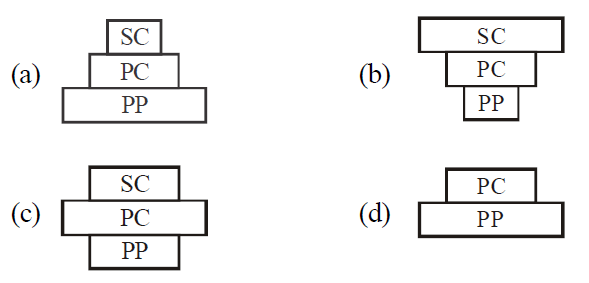
Correct Answer: (c)
In a pond/aquatic ecosystem, the pyramid of biomass is inverted (c).
In a pond/aquatic ecosystem, the pyramid of biomass is inverted (c).
Q33. Assertion: Organic farmers do not aim to completely eradicate pests.
Reason: Without pests, beneficial predatory and parasitic insects could not survive.
Correct Answer: (a)
The organic approach maintains an ecological balance rather than total eradication.
The organic approach maintains an ecological balance rather than total eradication.
Q34. Match column-I with column-II and choose the correct option.
| Column - I (Nutrients) | Column -II (Functions) |
|---|---|
| A. Mg2+ | I. Activator of dehydrogenase |
| B. Zn2+ | II. Activator for both RuBP carboxylase oxygenase and PEP are |
| C. K+ | III. Required for all Phosphorylation reactions |
| D. H2PO4– | IV. Plays an important role in opening and closing of stomata |
Correct Answer: (b)
Mg2+ activates Rubisco and PEPcase. Zn2+ activates alcohol dehydrogenase. K+ is for stomatal movement. Phosphate (H2PO4–) is essential for phosphorylation.
Mg2+ activates Rubisco and PEPcase. Zn2+ activates alcohol dehydrogenase. K+ is for stomatal movement. Phosphate (H2PO4–) is essential for phosphorylation.
Q35. Which of the following describes a population that could experience exponential growth?
Correct Answer: (c)
(C) Populations grow exponentially if there are no limiting resources or predators that would limit the population size. If the population was limited by density-dependent factors, its growth would be logistic, so choice (A) is incorrect. Choice (B) is incorrect because if the size of the population was beyond the carrying capacity of the environment, its numbers would be declining, not growing. K-selected populations experience logistic growth, so choice (D) is also incorrect.
(C) Populations grow exponentially if there are no limiting resources or predators that would limit the population size. If the population was limited by density-dependent factors, its growth would be logistic, so choice (A) is incorrect. Choice (B) is incorrect because if the size of the population was beyond the carrying capacity of the environment, its numbers would be declining, not growing. K-selected populations experience logistic growth, so choice (D) is also incorrect.
Q36. The enzyme ________ adds new nucleotides to both the lagging and leading strand, and the enzyme ________ joins the discontinuous segments synthesized on the lagging strand.
Correct Answer: (c)
(C) DNA polymerase adds new nucleotides to the growing DNA strand, and ligase joins the discontinuous segments of DNA on the lagging strand together. Choice (A) is incorrect because helicase unwinds the DNA double helix and topoisomerase relieves the supercoiling created by this unwinding. Since topoisomerase relieves supercoiling, choice (B) is also incorrect. Choice (D) is incorrect because helicase is responsible for unwinding the DNA double helix, not adding new nucleotides.
(C) DNA polymerase adds new nucleotides to the growing DNA strand, and ligase joins the discontinuous segments of DNA on the lagging strand together. Choice (A) is incorrect because helicase unwinds the DNA double helix and topoisomerase relieves the supercoiling created by this unwinding. Since topoisomerase relieves supercoiling, choice (B) is also incorrect. Choice (D) is incorrect because helicase is responsible for unwinding the DNA double helix, not adding new nucleotides.
Q37. In pea plants, smooth (S) pods are dominant and constricted (s) pods are recessive. Which of the following is a correct statement?
Correct Answer: (c)
A genotype of ss would result in the constricted pod phenotype. Choices (A) and (B) are incorrect because both SS and Ss would result in the smooth phenotype. Choice (D) is incorrect because smooth pods would not always have the SS genotype; smooth pods could also have the Ss genotype.
A genotype of ss would result in the constricted pod phenotype. Choices (A) and (B) are incorrect because both SS and Ss would result in the smooth phenotype. Choice (D) is incorrect because smooth pods would not always have the SS genotype; smooth pods could also have the Ss genotype.
Q38. One of the most notable differences between gamete formation in most animals and gamete formation in plants is that
Correct Answer: (b)
In animals, meiosis directly produces gametes. In plants, meiosis produces haploid spores; these spores grow into a haploid gametophyte, which then produces gametes through mitosis.
In animals, meiosis directly produces gametes. In plants, meiosis produces haploid spores; these spores grow into a haploid gametophyte, which then produces gametes through mitosis.
Q39. Parasitism differs from predation because
Correct Answer: (d)
All listed statements are incorrect: parasitism can drive strong defensive adaptations, involve coevolutionary arms races, and significantly affect host population dynamics.
All listed statements are incorrect: parasitism can drive strong defensive adaptations, involve coevolutionary arms races, and significantly affect host population dynamics.
Q40. Refer the given diagrammatic representation of trophic levels in an ecosystem some spaces are marked A, B, C and D. Identify A, B, C and D.
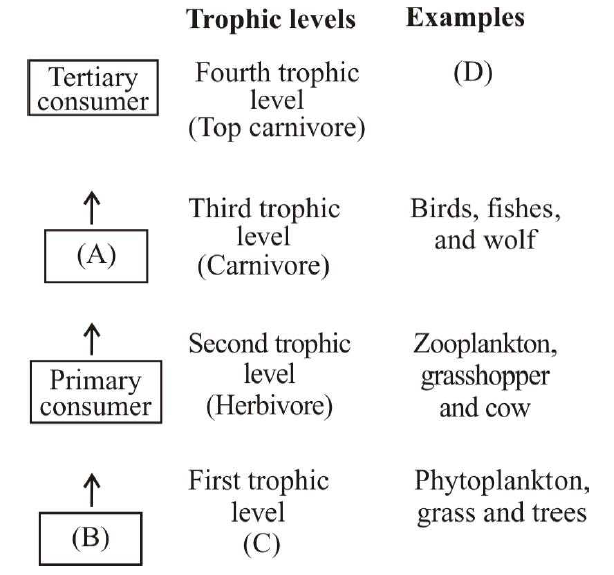
Correct Answer: (b)
A is the third trophic level (Secondary consumer). B is the first trophic level (Primary producer). C is the top level (Tertiary consumer: Man/Lion). D is a T1 example (Plants).
A is the third trophic level (Secondary consumer). B is the first trophic level (Primary producer). C is the top level (Tertiary consumer: Man/Lion). D is a T1 example (Plants).
Q41. Basal bodies are associated with the formation of
Correct Answer: (b)
Both the cilium and flagellum emerge from centriole-like structures called basal bodies.
Both the cilium and flagellum emerge from centriole-like structures called basal bodies.
Q42. Match the following for Female Genitalia:
| Part | Feature |
|---|---|
| A. Mons pubis | (I) Fleshy folds of tissue |
| B. Labia majora | (II) Tiny finger-like structure |
| C. Clitoris | (III) Cushion of fatty tissue |
Correct Answer: (a)
Based on Section 2.2 descriptions.
Based on Section 2.2 descriptions.
Q43. Which one of the following pairs is NOT correctly matched?
Correct Answer: (b)
The membrane surrounding the vacuole is the tonoplast. Plasmodesmata are cytoplasmic connections.
The membrane surrounding the vacuole is the tonoplast. Plasmodesmata are cytoplasmic connections.
Q44. The major cause of loss of numbers of migratory birds is
(i) Bad weather
(ii) Urbanization
(iii) Pesticides
(iv) Fragmentation
(v) Loss of habitat
(i) Bad weather
(ii) Urbanization
(iii) Pesticides
(iv) Fragmentation
(v) Loss of habitat
Correct Answer: (c)
For migratory birds, habitat loss (v) and urbanization/bad weather (i, ii) during their long journeys are significant factors. (Ref: Answer Key Page 8).
For migratory birds, habitat loss (v) and urbanization/bad weather (i, ii) during their long journeys are significant factors. (Ref: Answer Key Page 8).
Q45. Cell plate grows from
Correct Answer: (b)
In plant cells, cytokinesis begins with the formation of a cell plate in the center of the cell, which then grows centrifugally toward the lateral walls.
In plant cells, cytokinesis begins with the formation of a cell plate in the center of the cell, which then grows centrifugally toward the lateral walls.
Q46. Motor neurons stimulate muscle contraction via the release of
Correct Answer: (c)
Motor neurons release the neurotransmitter acetylcholine (ACh) into the synaptic cleft at the neuromuscular junction. ACh binds to receptors on the muscle fiber's sarcolemma, triggering an action potential that leads to contraction.
Motor neurons release the neurotransmitter acetylcholine (ACh) into the synaptic cleft at the neuromuscular junction. ACh binds to receptors on the muscle fiber's sarcolemma, triggering an action potential that leads to contraction.
Q47. A forensic scientist recovers a very small amount of evidence at a crime scene. The scientist would like to amplify the number of copies of DNA in the evidence sample. Which of the following techniques should the scientist use?
Correct Answer: (d)
Polymerase chain reaction is used to make multiple copies of (amplify) specific DNA sequences. Choice (A) is incorrect because bacterial transformation is the process in which bacteria absorb and express foreign DNA. CRISPR-Cas9 is used in gene editing, so choice (B) is incorrect. Gel electrophoresis is used to separate fragments of DNA by size, so choice (C) is incorrect.
Polymerase chain reaction is used to make multiple copies of (amplify) specific DNA sequences. Choice (A) is incorrect because bacterial transformation is the process in which bacteria absorb and express foreign DNA. CRISPR-Cas9 is used in gene editing, so choice (B) is incorrect. Gel electrophoresis is used to separate fragments of DNA by size, so choice (C) is incorrect.
Q48. Inhibitory neurotransmitters
Correct Answer: (a)
Inhibitory neurotransmitters typically open ligand-gated Cl– or K+ channels. This results in the membrane potential becoming more negative (hyperpolarization), which makes it more difficult for the postsynaptic neuron to reach the threshold for an action potential.
Inhibitory neurotransmitters typically open ligand-gated Cl– or K+ channels. This results in the membrane potential becoming more negative (hyperpolarization), which makes it more difficult for the postsynaptic neuron to reach the threshold for an action potential.
Q49. A scientist at a pharmaceutical company wants to create bacteria that will synthesize human growth hormone.
The scientist has successfully created a plasmid that contains the DNA code for the human growth hormone gene. Which technique should the scientist use to insert the plasmid into a cell?
The scientist has successfully created a plasmid that contains the DNA code for the human growth hormone gene. Which technique should the scientist use to insert the plasmid into a cell?
Correct Answer: (a)
Bacterial transformation inserts naked, foreign DNA into a bacterial cell. CRISPR-Cas9 is used for gene editing, not inserting plasmids into a cell, so choice (B) is incorrect. Choice (C) is incorrect because gel electrophoresis is used to separate DNA fragments according to their size. Polymerase chain reaction is used to amplify the number of copies of a specific DNA sequence, so choice (D) is incorrect.
Bacterial transformation inserts naked, foreign DNA into a bacterial cell. CRISPR-Cas9 is used for gene editing, not inserting plasmids into a cell, so choice (B) is incorrect. Choice (C) is incorrect because gel electrophoresis is used to separate DNA fragments according to their size. Polymerase chain reaction is used to amplify the number of copies of a specific DNA sequence, so choice (D) is incorrect.
Q50. FISH analysis of a breast tumor biopsy for HER2 gene reveals two spots of fluorescence in cells. What conclusion do these data support about the tumor?
Correct Answer: (d)
Fluorescence In Situ Hybridization (FISH) is used to visualize specific DNA sequences. Normal diploid cells have two copies of every gene. Since the analysis shows only two spots of fluorescence, the HER2 gene has not been duplicated or amplified. Because targeted therapies like Herceptin are only effective in tumors where the gene is amplified and overexpressing protein, these treatments would not be suitable for this patient.
Fluorescence In Situ Hybridization (FISH) is used to visualize specific DNA sequences. Normal diploid cells have two copies of every gene. Since the analysis shows only two spots of fluorescence, the HER2 gene has not been duplicated or amplified. Because targeted therapies like Herceptin are only effective in tumors where the gene is amplified and overexpressing protein, these treatments would not be suitable for this patient.
Q51. Diuretics are drugs that can be used to treat high blood pressure by increasing urinary output. Possible mechanisms of action in the kidney include
Correct Answer: (b)
Many diuretics work by inhibiting NaCl reabsorption in the loop of Henle or proximal tubule. Reduced salt reabsorption decreases water reabsorption, leading to increased urine output and lowered blood pressure.
Many diuretics work by inhibiting NaCl reabsorption in the loop of Henle or proximal tubule. Reduced salt reabsorption decreases water reabsorption, leading to increased urine output and lowered blood pressure.
Q52. Which one of the following hormone is used to eradicate dicotyledonous weeds, but does not have its effect on mature monocotyledonous plants?
Correct Answer: (a)
2, 4-D is a selective herbicide that kills broad-leaved (dicot) weeds while sparing cereal crops (monocots).
2, 4-D is a selective herbicide that kills broad-leaved (dicot) weeds while sparing cereal crops (monocots).
Q53. Prokaryotic and eukaryotic flagella differ in the
Correct Answer: (d)
Bacterial flagella are made of flagellin and have no 9+2 arrangement, while eukaryotic flagella are made of tubulin and have the 9+2 organization.
Bacterial flagella are made of flagellin and have no 9+2 arrangement, while eukaryotic flagella are made of tubulin and have the 9+2 organization.
Q54. Assertion: Amniocentesis is often misused.
Reason: It is used for sex-determination leading to female foeticide.
Correct Answer: (a)
Misuse for sex selection is the reason for the statutory ban.
Misuse for sex selection is the reason for the statutory ban.
Q55. Pyruvic acid, the key product of glycolysis can have many metabolic fates. Under aerobic condition it forms
Correct Answer: (c)
In the presence of oxygen, pyruvate enters the mitochondria and is converted into Acetyl CoA and CO2.
In the presence of oxygen, pyruvate enters the mitochondria and is converted into Acetyl CoA and CO2.
Q56. Imagine that you are doing an experiment on the movement of ions across neural membranes. Which of the following plays a role in determining the equilibrium concentration of ions across these membranes?
Correct Answer: (d)
The electrochemical gradient is the combined force of the chemical concentration gradient and the electrical gradient (charge difference) across a membrane. Together, these factors determine the direction and equilibrium of ion movement.
The electrochemical gradient is the combined force of the chemical concentration gradient and the electrical gradient (charge difference) across a membrane. Together, these factors determine the direction and equilibrium of ion movement.
Q57. Ray florets have
Correct Answer: (d)
In Compositae (sunflower family), the ray florets are typically epigynous with an inferior ovary.
In Compositae (sunflower family), the ray florets are typically epigynous with an inferior ovary.
Q58. Identify the correct phylum/group being described:
(i) They are narrow-spectrum insecticidal agents.
(ii) Belong to the genus Nucleopolyhedrovirus.
(iii) Desirable for Integrated Pest Management.
(i) They are narrow-spectrum insecticidal agents.
(ii) Belong to the genus Nucleopolyhedrovirus.
(iii) Desirable for Integrated Pest Management.
Correct Answer: (a)
Specific features of baculoviruses.
Specific features of baculoviruses.
Q59. Homologous structures
Correct Answer: (a)
Homology refers to structural similarities that result from shared ancestry. For example, the forelimbs of humans, cats, and bats are homologous because they are derived from the same ancestral limb structure, even if they have evolved to serve different purposes (grasping, walking, flying).
Homology refers to structural similarities that result from shared ancestry. For example, the forelimbs of humans, cats, and bats are homologous because they are derived from the same ancestral limb structure, even if they have evolved to serve different purposes (grasping, walking, flying).
Q60. In the given figure of electron transport chain - identify P, Q, R, S and T.
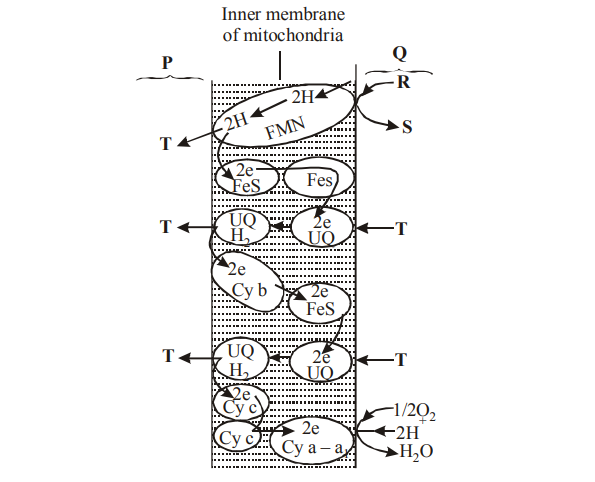
Correct Answer: (b)
P is the intermembrane space. Q is the matrix. R is NADH + H+ donating electrons. S is the oxidized NAD+. T represents the protons (2H+) pumped across.
P is the intermembrane space. Q is the matrix. R is NADH + H+ donating electrons. S is the oxidized NAD+. T represents the protons (2H+) pumped across.
Q61. You are provided with floral buds of Chrysanthemum in your class and are asked to count the chromosomes, then which of the following stages would you prefer to look into?
Correct Answer: (b)
Metaphase is universally the best stage for chromosome counting because they are at their maximum state of condensation.
Metaphase is universally the best stage for chromosome counting because they are at their maximum state of condensation.
Q62. Two bacteria found to be very useful in genetic engineering experiments are
Correct Answer: (a)
E. coli is a primary host for gene cloning, and Agrobacterium tumefaciens is used as a vector for plant genetic engineering.
E. coli is a primary host for gene cloning, and Agrobacterium tumefaciens is used as a vector for plant genetic engineering.
Q63. Every CO2 molecule entering the Calvin cycle needs:
Correct Answer: (a)
To fix one CO2 molecule, the cycle requires 3 ATPs and 2 NADPHs.
To fix one CO2 molecule, the cycle requires 3 ATPs and 2 NADPHs.
Q64. Orchids that belong to the genus Dendrobium will flower in response to certain weather stimuli. One species of Dendrobium flowers on the 8th day and closes on the 9th day after the weather stimuli, while another species of Dendrobium flowers on the 10th day and closes on the 11th day after the weather stimuli. This is an example of which type of reproductive isolation?
Correct Answer: (c)
(C) Temporal isolation is separation by time. Since the two species flower and are ready for pollination at different times, this is an example of temporal isolation. Habitat isolation is separation by area, so choice (A) is incorrect. Choice (B) is incorrect because mechanical isolation occurs when the male and female genitalia are incompatible. Hybrid breakdown occurs when two species can produce a viable and fertile offspring but each successive generation of the hybrid becomes weaker and weaker, so choice (D) is incorrect.
(C) Temporal isolation is separation by time. Since the two species flower and are ready for pollination at different times, this is an example of temporal isolation. Habitat isolation is separation by area, so choice (A) is incorrect. Choice (B) is incorrect because mechanical isolation occurs when the male and female genitalia are incompatible. Hybrid breakdown occurs when two species can produce a viable and fertile offspring but each successive generation of the hybrid becomes weaker and weaker, so choice (D) is incorrect.
Q65. In order for mimicry to be effective in protecting a species from predation, it must
Correct Answer: (a)
In Batesian mimicry, a palatable species gains protection by resembling a distasteful or dangerous model, thereby avoiding predation.
In Batesian mimicry, a palatable species gains protection by resembling a distasteful or dangerous model, thereby avoiding predation.
Q66. In prokaryotes, control of gene expression usually occurs at the
Correct Answer: (c)
In prokaryotic organisms, the most efficient point of regulation is the initiation of transcription. By controlling whether or not an RNA polymerase can bind to a promoter and begin synthesis, the cell avoids the metabolic cost of producing unnecessary mRNA and protein molecules.
In prokaryotic organisms, the most efficient point of regulation is the initiation of transcription. By controlling whether or not an RNA polymerase can bind to a promoter and begin synthesis, the cell avoids the metabolic cost of producing unnecessary mRNA and protein molecules.
Q67. In Iowa, a company called Team Corn works to ensure that fields of seed corn outcross... you would like to develop genetically engineered corn plants that
Correct Answer: (b)
By introducing S genes (self-incompatibility genes), the plants would naturally reject their own pollen, making the manual removal of staminate flowers (detasseling) unnecessary and making the process more efficient.
By introducing S genes (self-incompatibility genes), the plants would naturally reject their own pollen, making the manual removal of staminate flowers (detasseling) unnecessary and making the process more efficient.
Q68. Alternate type of phyllotaxy is found in
Correct Answer: (d)
In alternate type of phyllotaxy, a single leaf arises at each node in alternate manner, as in china rose, mustard and sunflower plants.
In alternate type of phyllotaxy, a single leaf arises at each node in alternate manner, as in china rose, mustard and sunflower plants.
Q69. Match the following stem modifications given in column I with their examples given in column II and select the correct combination from the options given below.
| Column-I (Stem Modifications) | Column-II (Found in) |
|---|---|
| A. Underground stem | I. Euphorbia |
| B. Stem tendril | II. Opuntia |
| C. Stem thorns | III. Potato |
| D. Flattened stem | IV. Citrus |
| E. Fleshy cylindrical stem | V. Cucumber |
Correct Answer: (d)
Potato is an underground stem. Cucumber has stem tendrils. Citrus has thorns. Opuntia has flattened stems. Euphorbia has fleshy cylindrical stems.
Potato is an underground stem. Cucumber has stem tendrils. Citrus has thorns. Opuntia has flattened stems. Euphorbia has fleshy cylindrical stems.
Q70. Which of the following statement of a bacterial cell is/are correct?
(i) Mesosome is formed by the extensions of plasma membrane into the cell.
(ii) The pili are elongated tubular structures made up of a protein.
(iii) Flagellum is composed of filament, hook and basal body.
(iv) Ribosomes are about 30 nm by 50 nm in size.
(i) Mesosome is formed by the extensions of plasma membrane into the cell.
(ii) The pili are elongated tubular structures made up of a protein.
(iii) Flagellum is composed of filament, hook and basal body.
(iv) Ribosomes are about 30 nm by 50 nm in size.
Correct Answer: (a)
Statement (iv) is incorrect; prokaryotic ribosomes are about 15 nm by 20 nm in size.
Statement (iv) is incorrect; prokaryotic ribosomes are about 15 nm by 20 nm in size.
Q71. Select the correctly matched pair.
I. S phase – DNA replication
II. Zygotene – Synapsis
III. Diplotene – Crossing over
IV. Meiosis – Both haploid and diploid cells
I. S phase – DNA replication
II. Zygotene – Synapsis
III. Diplotene – Crossing over
IV. Meiosis – Both haploid and diploid cells
Correct Answer: (a)
S-phase is for DNA replication and Zygotene is for Synapsis. Crossing over occurs in Pachytene.
S-phase is for DNA replication and Zygotene is for Synapsis. Crossing over occurs in Pachytene.
Q72. In which group of organisms the cell walls form two thin overlapping shells which fit together?
Correct Answer: (d)
In Chrysophytes (specifically diatoms), the cell walls form two thin overlapping shells that fit together like a soap box.
In Chrysophytes (specifically diatoms), the cell walls form two thin overlapping shells that fit together like a soap box.
Q73. Convergent evolution
Correct Answer: (b)
Convergent evolution occurs when unrelated or distantly related organisms independently evolve similar traits because they are subjected to similar selective pressures in their environments, such as the streamlined bodies of dolphins (mammals) and sharks (fish).
Convergent evolution occurs when unrelated or distantly related organisms independently evolve similar traits because they are subjected to similar selective pressures in their environments, such as the streamlined bodies of dolphins (mammals) and sharks (fish).
Q74. The elimination of a predator by humans
Correct Answer: (c)
If a prey population was regulated by predation, removing the predator can allow prey numbers to increase, though other limiting factors may eventually constrain growth.
If a prey population was regulated by predation, removing the predator can allow prey numbers to increase, though other limiting factors may eventually constrain growth.
Q75. G protein–coupled receptors are involved in the nervous system by
Correct Answer: (d)
G protein–coupled receptors (metabotropic receptors) act as postsynaptic receptors that, upon binding neurotransmitters, initiate complex intracellular signaling cascades. These are distinct from ionotropic receptors, which are ligand-gated ion channels themselves.
G protein–coupled receptors (metabotropic receptors) act as postsynaptic receptors that, upon binding neurotransmitters, initiate complex intracellular signaling cascades. These are distinct from ionotropic receptors, which are ligand-gated ion channels themselves.
Q76. White matter is ________, and gray matter is ________.
Correct Answer: (d)
White matter consists primarily of myelinated axons, giving it a white appearance. Gray matter consists of neuronal cell bodies, dendrites, and unmyelinated axons. Both are essential components of the central nervous system (CNS).
White matter consists primarily of myelinated axons, giving it a white appearance. Gray matter consists of neuronal cell bodies, dendrites, and unmyelinated axons. Both are essential components of the central nervous system (CNS).
Q77. A patient with a pituitary tumor exhibits fatigue, weight loss, and low blood sugar. This is probably due to a lack of production of
Correct Answer: (b)
Adrenocorticotropic hormone (ACTH) triggers the adrenal cortex to release glucocorticoids like cortisol. Cortisol is vital for maintaining blood glucose levels. A lack of ACTH leads to low cortisol, causing hypoglycemia (low blood sugar) and chronic fatigue.
Adrenocorticotropic hormone (ACTH) triggers the adrenal cortex to release glucocorticoids like cortisol. Cortisol is vital for maintaining blood glucose levels. A lack of ACTH leads to low cortisol, causing hypoglycemia (low blood sugar) and chronic fatigue.
Q78. You and your study partner want to draw the pathway that controls the reabsorption of sodium ions when blood pressure falls. Which of the following is the correct sequence of events? 1. Aldosterone is released. 2. Kidney tubules reabsorb Na+. 3. Renin is released. 4. Juxtaglomerular apparatus recognizes a drop in blood pressure. 5. Angiotensin II is produced.
Correct Answer: (c)
A drop in blood pressure is detected by the juxtaglomerular apparatus (4), which releases renin (3). Renin leads to the production of angiotensin II (5), which stimulates aldosterone release (1). Aldosterone then increases Na⁺ reabsorption in kidney tubules (2).
A drop in blood pressure is detected by the juxtaglomerular apparatus (4), which releases renin (3). Renin leads to the production of angiotensin II (5), which stimulates aldosterone release (1). Aldosterone then increases Na⁺ reabsorption in kidney tubules (2).
Q79. A forensic scientist cuts DNA from a crime scene and DNA from a suspect with the same enzyme. Which tool should the scientist use to separate the DNA fragments according to their size?
Correct Answer: (c)
Gel electrophoresis separates fragments of DNA according to their size. Bacterial transformation involves the uptake and expression of foreign DNA by bacteria, so choice (A) is incorrect. CRISPR-Cas9 is used for gene editing, so choice (B) is incorrect. PCR amplifies specific sequences of DNA, so choice (D) is also incorrect.
Gel electrophoresis separates fragments of DNA according to their size. Bacterial transformation involves the uptake and expression of foreign DNA by bacteria, so choice (A) is incorrect. CRISPR-Cas9 is used for gene editing, so choice (B) is incorrect. PCR amplifies specific sequences of DNA, so choice (D) is also incorrect.
Q80. Assertion: Periodic abstinence is a natural method of birth control.
Reason: Couples avoid coitus from day 10 to 17 of the menstrual cycle.
Correct Answer: (a)
The method is defined by avoiding the most fertile window.
The method is defined by avoiding the most fertile window.
Q81. The following diagram shows four coleoptiles set up (I, II, III & IV) at the start of an experiment. Which two coleoptiles will both bend towards the light source?
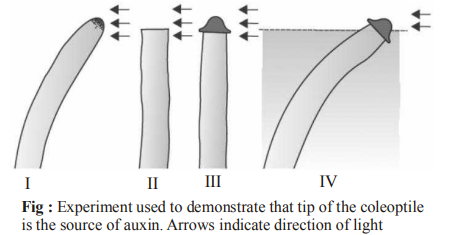
Correct Answer: (d)
Coleoptile III has an intact tip. IV has a tip separated by permeable agar, allowing auxin to diffuse. Both will sense light and bend.
Coleoptile III has an intact tip. IV has a tip separated by permeable agar, allowing auxin to diffuse. Both will sense light and bend.
Q82. Match the following
| Column-I (Classes) | Column-II (Examples) |
|---|---|
| A. Psilopsida | I. Dryopteris, Pteris, Adiantum |
| B. Lycopsida | II. Equisetum |
| C. Sphenopsida | III. Selaginella |
| D. Pteropsida | IV. Lycopodium |
| V. Psilotum |
Correct Answer: (a)
A-V (Psilotum); B-III (Selaginella and Lycopodium are Lycopsids); C-II (Equisetum); D-I (Ferns).
A-V (Psilotum); B-III (Selaginella and Lycopodium are Lycopsids); C-II (Equisetum); D-I (Ferns).
Q83. Exoskeletons and endoskeletons differ in that
Correct Answer: (d)
The fundamental structural difference is placement. An exoskeleton (like that of an arthropod) provides a hard outer covering for soft internal tissues, while an endoskeleton (like that of a human) is a framework located inside the body's soft tissues.
The fundamental structural difference is placement. An exoskeleton (like that of an arthropod) provides a hard outer covering for soft internal tissues, while an endoskeleton (like that of a human) is a framework located inside the body's soft tissues.
Q84. Among china rose, mustard, brinjal, potato, guava, cucumber, onion and tulip, how many plants have superior ovary?
Correct Answer: (a)
Superior ovary: China rose, Mustard, Brinjal, Potato, Onion, Tulip (Total = 6). Guava and cucumber have inferior ovaries.
Superior ovary: China rose, Mustard, Brinjal, Potato, Onion, Tulip (Total = 6). Guava and cucumber have inferior ovaries.
Q85. Mild vitamin D deficiency can lead to osteoporosis, or reduced bone mineral density. This is thought to be due to an association with increased levels of
Correct Answer: (b)
Vitamin D is necessary for calcium absorption from the gut. When Vitamin D is low, blood calcium drops, triggering the parathyroid glands to release more Parathyroid Hormone (PTH). PTH increases blood calcium by breaking down bone tissue, leading to a loss of bone density over time.
Vitamin D is necessary for calcium absorption from the gut. When Vitamin D is low, blood calcium drops, triggering the parathyroid glands to release more Parathyroid Hormone (PTH). PTH increases blood calcium by breaking down bone tissue, leading to a loss of bone density over time.
Q86. You study a gene known to be important in the early stages of heart development. Loss of the gene is also suspected to play a role in triggering lung cancer. What kind of transgenic mouse would you use to study your gene in vivo?
Correct Answer: (c)
A traditional knockout mouse lacks the gene from conception, which would likely result in embryonic lethality if the gene is essential for heart development. A conditional knockout allows the researcher to delete the gene at a specific time or in a specific tissue (such as the lungs of an adult mouse), allowing the study of its role in cancer without stopping development.
A traditional knockout mouse lacks the gene from conception, which would likely result in embryonic lethality if the gene is essential for heart development. A conditional knockout allows the researcher to delete the gene at a specific time or in a specific tissue (such as the lungs of an adult mouse), allowing the study of its role in cancer without stopping development.
Q87. Which of the following is an incorrect match of essential element and function?
Correct Answer: (a)
Magnesium (Mg), not manganese, is the central structural atom of the chlorophyll molecule.
Magnesium (Mg), not manganese, is the central structural atom of the chlorophyll molecule.
Q88. Photosynthesis is a/an:
Correct Answer: (a)
Photosynthesis is a physico-chemical process by which plants use light energy to drive the synthesis of organic compounds.
Photosynthesis is a physico-chemical process by which plants use light energy to drive the synthesis of organic compounds.
Q89. Humans excrete their excess nitrogenous wastes as
Correct Answer: (d)
Humans are ureotelic organisms, meaning they convert toxic ammonia into urea in the liver. Urea is less toxic and can be safely transported in the blood and excreted by the kidneys.
Humans are ureotelic organisms, meaning they convert toxic ammonia into urea in the liver. Urea is less toxic and can be safely transported in the blood and excreted by the kidneys.
Q90. Mountain climbers may have difficulty at high elevations because
Correct Answer: (a)
At high altitudes, the total atmospheric pressure is lower. Since oxygen still makes up about 21% of the air, its partial pressure (PO2) also decreases. This reduction in PO2 decreases the pressure gradient necessary to drive oxygen diffusion from the lungs into the blood.
At high altitudes, the total atmospheric pressure is lower. Since oxygen still makes up about 21% of the air, its partial pressure (PO2) also decreases. This reduction in PO2 decreases the pressure gradient necessary to drive oxygen diffusion from the lungs into the blood.