Q1. Which one of the following pairs, is not correctly matched?
Correct Answer: (b)
Gibberellic acid generally promotes growth and delays leaf fall/senescence; it does not cause it.
Gibberellic acid generally promotes growth and delays leaf fall/senescence; it does not cause it.
Q2. The charged molecule which is electrically neutral is known as
Correct Answer: (b)
A zwitterion is an ion that has separate positive and negative charges but a net charge of zero.
A zwitterion is an ion that has separate positive and negative charges but a net charge of zero.
Q3. Which of the following hormone is concerned with climacteric respiration?
Correct Answer: (a)
Ethylene induces a sharp rise in respiration rate, known as the respiratory climacteric, during the ripening of certain fruits like tomatoes and apples.
Ethylene induces a sharp rise in respiration rate, known as the respiratory climacteric, during the ripening of certain fruits like tomatoes and apples.
Q4. You are designing a pesticide to disrupt the endocrine systems of arthropods without harming mammals. Which of the following substances should be the target of your investigations?
Correct Answer: (c)
Juvenile hormone is a crucial regulator of development, molting, and metamorphosis specifically in insects and other arthropods. Because mammals do not utilize this hormone, targeting it allows for a pesticide that is highly specific to pests with minimal risk to humans.
Juvenile hormone is a crucial regulator of development, molting, and metamorphosis specifically in insects and other arthropods. Because mammals do not utilize this hormone, targeting it allows for a pesticide that is highly specific to pests with minimal risk to humans.
Q5. Arrange the following events into the correct order after a paper cut occurs.
Correct Answer: (b)
The correct sequence is: bacteria enter the cut, injured cells release histamine to initiate inflammation, macrophages engulf invading bacteria, and finally helper T cells are activated to initiate adaptive immunity.
The correct sequence is: bacteria enter the cut, injured cells release histamine to initiate inflammation, macrophages engulf invading bacteria, and finally helper T cells are activated to initiate adaptive immunity.
Q6. A scientist at a pharmaceutical company wants to create bacteria that will synthesize human growth hormone.
The scientist has successfully created a plasmid that contains the DNA code for the human growth hormone gene. Which technique should the scientist use to insert the plasmid into a cell?
The scientist has successfully created a plasmid that contains the DNA code for the human growth hormone gene. Which technique should the scientist use to insert the plasmid into a cell?
Correct Answer: (a)
Bacterial transformation inserts naked, foreign DNA into a bacterial cell. CRISPR-Cas9 is used for gene editing, not inserting plasmids into a cell, so choice (B) is incorrect. Choice (C) is incorrect because gel electrophoresis is used to separate DNA fragments according to their size. Polymerase chain reaction is used to amplify the number of copies of a specific DNA sequence, so choice (D) is incorrect.
Bacterial transformation inserts naked, foreign DNA into a bacterial cell. CRISPR-Cas9 is used for gene editing, not inserting plasmids into a cell, so choice (B) is incorrect. Choice (C) is incorrect because gel electrophoresis is used to separate DNA fragments according to their size. Polymerase chain reaction is used to amplify the number of copies of a specific DNA sequence, so choice (D) is incorrect.
Q7. Humans excrete their excess nitrogenous wastes as
Correct Answer: (d)
Humans are ureotelic organisms, meaning they convert toxic ammonia into urea in the liver. Urea is less toxic and can be safely transported in the blood and excreted by the kidneys.
Humans are ureotelic organisms, meaning they convert toxic ammonia into urea in the liver. Urea is less toxic and can be safely transported in the blood and excreted by the kidneys.
Q8. Cytotoxic T cells are characterized by the
Correct Answer: (b)
Cytotoxic T cells express the CD8 co-receptor, which allows them to recognize antigens presented on MHC-I molecules of infected or abnormal cells and directly kill those cells.
Cytotoxic T cells express the CD8 co-receptor, which allows them to recognize antigens presented on MHC-I molecules of infected or abnormal cells and directly kill those cells.
Q9. Which of the following pieces of evidence best supports the hypothesis that birds are more closely related to reptiles than to other animals?
Correct Answer: (d)
(D) DNA evidence strongly supports a degree of ancestry of organisms. The location of fossils in rock layers can change due to geological events, so choice (A) is not the best answer. Choice (B) is incorrect because habitats and trophic levels do not necessarily indicate common ancestry. Mammals also have amniotic eggs, so choice (C) is incorrect.
(D) DNA evidence strongly supports a degree of ancestry of organisms. The location of fossils in rock layers can change due to geological events, so choice (A) is not the best answer. Choice (B) is incorrect because habitats and trophic levels do not necessarily indicate common ancestry. Mammals also have amniotic eggs, so choice (C) is incorrect.
Q10. Match column I (category) with column II (secondary metabolites) and choose the correct option.
| Column I (Category) | Column II (Secondary metabolites) |
|---|---|
| A. Pigments | I. Concanavalin A |
| B. Terpenoides | II. Monoterpenes, Diterpenes |
| C. Alkaloids | III. Morphine, Codeine |
| D. Lectins | IV. Carotenoids, Anthocyanin |
Correct Answer: (a)
Carotenoids and anthocyanins are pigments. Monoterpenes and diterpenes are terpenoids. Morphine and codeine are alkaloids. Concanavalin A is a lectin.
Carotenoids and anthocyanins are pigments. Monoterpenes and diterpenes are terpenoids. Morphine and codeine are alkaloids. Concanavalin A is a lectin.
Q11. What is the amino acid sequence that would be translated from the following gene? (Use Figure 16.4 to answer this question.)
3′ AAT CGT TTC AAT CAA 5′
3′ AAT CGT TTC AAT CAA 5′
Correct Answer: (b)
(B) The mRNA transcribed from the DNA sequence in the problem would be 5′ UUA GCA AAG UUA GUU 3′. Using Figure 16.4 (a standard codon chart), the amino acid sequence that would be translated from that mRNA would be Leu-Ala-Lys-Leu-Val.
(B) The mRNA transcribed from the DNA sequence in the problem would be 5′ UUA GCA AAG UUA GUU 3′. Using Figure 16.4 (a standard codon chart), the amino acid sequence that would be translated from that mRNA would be Leu-Ala-Lys-Leu-Val.
Q12. Which of the following statement(s) is/are correct regarding class aves?
(i) The forelimbs are modified into wings and the hindlimbs generally have scales and are modified for walking, swimming or clasping the tree branches.
(ii) Heart is completely four-chambered.
(iii) They are warm-blooded (homoiothermous) animals i.e., they are able to maintain a constant body temperature.
(iv) They are oviparous and development is direct.
(i) The forelimbs are modified into wings and the hindlimbs generally have scales and are modified for walking, swimming or clasping the tree branches.
(ii) Heart is completely four-chambered.
(iii) They are warm-blooded (homoiothermous) animals i.e., they are able to maintain a constant body temperature.
(iv) They are oviparous and development is direct.
Correct Answer: (d)
All statements correctly describe Class Aves.
All statements correctly describe Class Aves.
Q13. Select the option which is not correct with respect to enzyme action:
Correct Answer: (b)
Competitive inhibition (like malonate vs succinate) is reversible; adding an excess of the substrate (succinate) will displace the inhibitor and restore activity.
Competitive inhibition (like malonate vs succinate) is reversible; adding an excess of the substrate (succinate) will displace the inhibitor and restore activity.
Q14. Identify the figure with its correct name and phylum.
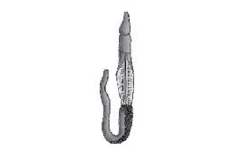
Correct Answer: (c)
Figure shows Balanoglossus (Acorn worm).
Figure shows Balanoglossus (Acorn worm).
Q15. Refer to the statement and answer the question. “They usually reproduce vegetatively by fragmentation and asexually by non - motile spores and sexually by non - motile gametes.” Identify the group of plants and its example.
Correct Answer: (b)
Red algae typically lack motile stages (no flagellated spores or gametes). Polysiphonia is a red alga.
Red algae typically lack motile stages (no flagellated spores or gametes). Polysiphonia is a red alga.
Q16. Select correct statements for 'Biogas':
(i) It is a mixture of gases containing predominantly methane.
(ii) It is inflammable.
(iii) It is used as a source of energy for cooking and lighting.
(i) It is a mixture of gases containing predominantly methane.
(ii) It is inflammable.
(iii) It is used as a source of energy for cooking and lighting.
Correct Answer: (a)
Properties and uses of biogas from section 8.4.
Properties and uses of biogas from section 8.4.
Q17. No. of carbons in the primary CO2 fixation product of C4 plant is
Correct Answer: (c)
The primary product of CO2 fixation in C4 plants is Oxaloacetic acid (OAA), which is a 4-carbon organic acid.
The primary product of CO2 fixation in C4 plants is Oxaloacetic acid (OAA), which is a 4-carbon organic acid.
Q18. A stamen contains a
Correct Answer: (c)
The stamen is the male reproductive organ of the flower and is comprised of an anther (pollen-bearing part) and a stalk known as the filament. Style and stigma are parts of the carpel.
The stamen is the male reproductive organ of the flower and is comprised of an anther (pollen-bearing part) and a stalk known as the filament. Style and stigma are parts of the carpel.
Q19. During seed germination, this hormone produces the signal for the aleurone to begin starch breakdown.
Correct Answer: (c)
Gibberellic acid (GA) is synthesized by the embryo and moves to the aleurone layer, where it triggers the production of α-amylase and other enzymes to hydrolyze stored starch.
Gibberellic acid (GA) is synthesized by the embryo and moves to the aleurone layer, where it triggers the production of α-amylase and other enzymes to hydrolyze stored starch.
Q20. You study a gene known to be important in the early stages of heart development. Loss of the gene is also suspected to play a role in triggering lung cancer. What kind of transgenic mouse would you use to study your gene in vivo?
Correct Answer: (c)
A traditional knockout mouse lacks the gene from conception, which would likely result in embryonic lethality if the gene is essential for heart development. A conditional knockout allows the researcher to delete the gene at a specific time or in a specific tissue (such as the lungs of an adult mouse), allowing the study of its role in cancer without stopping development.
A traditional knockout mouse lacks the gene from conception, which would likely result in embryonic lethality if the gene is essential for heart development. A conditional knockout allows the researcher to delete the gene at a specific time or in a specific tissue (such as the lungs of an adult mouse), allowing the study of its role in cancer without stopping development.
Q21. What is the basis of separation of different DNA fragments by gel electrophoresis?
Correct Answer: (b)
DNA molecules have a uniform negative charge-to-mass ratio, so they all migrate toward the positive electrode. The agarose gel acts as a molecular sieve; smaller DNA fragments move through the pores more easily and quickly than larger fragments, resulting in separation based strictly on length (size).
DNA molecules have a uniform negative charge-to-mass ratio, so they all migrate toward the positive electrode. The agarose gel acts as a molecular sieve; smaller DNA fragments move through the pores more easily and quickly than larger fragments, resulting in separation based strictly on length (size).
Q22. Match the following columns.
| Column I | Column II |
|---|---|
| A. Aleurone layer | I. Nutrition |
| B. Parthenocarpic fruit | II. Without fertilisation |
| C. Ovule | III. Seed |
| D. Endosperm | IV. Double fertilisation |
Correct Answer: (a)
Aleurone layer provides nutrition; Parthenocarpic fruit develops without fertilisation; Ovule becomes seed; Endosperm is a result of double fertilisation.
Aleurone layer provides nutrition; Parthenocarpic fruit develops without fertilisation; Ovule becomes seed; Endosperm is a result of double fertilisation.
Q23. A forensic scientist recovers a very small amount of evidence at a crime scene. The scientist would like to amplify the number of copies of DNA in the evidence sample. Which of the following techniques should the scientist use?
Correct Answer: (d)
Polymerase chain reaction is used to make multiple copies of (amplify) specific DNA sequences. Choice (A) is incorrect because bacterial transformation is the process in which bacteria absorb and express foreign DNA. CRISPR-Cas9 is used in gene editing, so choice (B) is incorrect. Gel electrophoresis is used to separate fragments of DNA by size, so choice (C) is incorrect.
Polymerase chain reaction is used to make multiple copies of (amplify) specific DNA sequences. Choice (A) is incorrect because bacterial transformation is the process in which bacteria absorb and express foreign DNA. CRISPR-Cas9 is used in gene editing, so choice (B) is incorrect. Gel electrophoresis is used to separate fragments of DNA by size, so choice (C) is incorrect.
Q24. The technology of biogas production in India was developed mainly due to the efforts of:
Correct Answer: (a)
Page 8 mentions the efforts of Indian Agricultural Research Institute (IARI) and Khadi and Village Industries Commission (KVIC).
Page 8 mentions the efforts of Indian Agricultural Research Institute (IARI) and Khadi and Village Industries Commission (KVIC).
Q25. Bone develops by one of two mechanisms depending on the underlying scaffold. Which pairing correctly describes these mechanisms?
Correct Answer: (d)
Intramembranous ossification occurs when bone forms directly from embryonic mesenchymal tissue (common in flat bones of the skull). Endochondral ossification occurs when bone replaces a pre-existing hyaline cartilage model (common in long bones like the femur).
Intramembranous ossification occurs when bone forms directly from embryonic mesenchymal tissue (common in flat bones of the skull). Endochondral ossification occurs when bone replaces a pre-existing hyaline cartilage model (common in long bones like the femur).
Q26. With regard to the mineral absorption, consider the following statements:
(1) The entry of ions to the symplast is an active process while exit from it is passive.
(2) The movement of ions into the apoplast occurs through the trans-membrane proteins.
(1) The entry of ions to the symplast is an active process while exit from it is passive.
(2) The movement of ions into the apoplast occurs through the trans-membrane proteins.
Correct Answer: (a)
Ion entry into the symplast is active. However, movement into the apoplast is primarily a passive process (diffusion/mass flow) through cell walls, not requiring trans-membrane proteins.
Ion entry into the symplast is active. However, movement into the apoplast is primarily a passive process (diffusion/mass flow) through cell walls, not requiring trans-membrane proteins.
Q27. Diuretics are drugs that can be used to treat high blood pressure by increasing urinary output. Possible mechanisms of action in the kidney include
Correct Answer: (b)
Many diuretics work by inhibiting NaCl reabsorption in the loop of Henle or proximal tubule. Reduced salt reabsorption decreases water reabsorption, leading to increased urine output and lowered blood pressure.
Many diuretics work by inhibiting NaCl reabsorption in the loop of Henle or proximal tubule. Reduced salt reabsorption decreases water reabsorption, leading to increased urine output and lowered blood pressure.
Q28. Synapsis occurs between
Correct Answer: (d)
Synapsis is the pairing of homologous chromosomes during the zygotene stage of prophase I.
Synapsis is the pairing of homologous chromosomes during the zygotene stage of prophase I.
Q29. An important function of the excretory system is to eliminate excess nitrogen produced by metabolic processes. Which of the following organisms is most efficient at packaging nitrogen for excretion?
Correct Answer: (c)
Iguanas excrete nitrogen primarily as uric acid, which is relatively non-toxic and requires very little water for elimination. This makes uric acid the most efficient form of nitrogen packaging among the options given.
Iguanas excrete nitrogen primarily as uric acid, which is relatively non-toxic and requires very little water for elimination. This makes uric acid the most efficient form of nitrogen packaging among the options given.
Q30. How many ATP molecules could maximally be generated from one molecule of glucose, if the complete oxidation of one mole of glucose to CO2 and H2O yields 686 kcal and the useful chemical energy available in the high energy phosphate bond of one mole of ATP is 12 kcal ?
Correct Answer: (b)
Theoretical maximum: 686 / 12 ≈ 57 ATP molecules. (Note: Biological efficiency is lower, yielding ~36-38 ATP).
Theoretical maximum: 686 / 12 ≈ 57 ATP molecules. (Note: Biological efficiency is lower, yielding ~36-38 ATP).
Q31. Which of the following is the primary method by which carbon dioxide is transported to the lungs?
Correct Answer: (d)
While some CO2 is dissolved in plasma or bound to hemoglobin (carbaminohemoglobin), approximately 70% of the carbon dioxide in the blood is transported in the form of bicarbonate ions (HCO3–), which are formed within red blood cells and then diffuse into the plasma.
While some CO2 is dissolved in plasma or bound to hemoglobin (carbaminohemoglobin), approximately 70% of the carbon dioxide in the blood is transported in the form of bicarbonate ions (HCO3–), which are formed within red blood cells and then diffuse into the plasma.
Q32. Flowers are unisexual in
Correct Answer: (a)
Cucumber (and other gourds) bears separate male and female flowers on the same plant (monoecious).
Cucumber (and other gourds) bears separate male and female flowers on the same plant (monoecious).
Q33. A plant lacking the WOODEN LEG gene will likely
Correct Answer: (c)
The WOODEN LEG mutation results in a failure of phloem differentiation. Without functional phloem, the plant is incapable of transporting the products of photosynthesis (photosynthate) to its roots and other sinks.
The WOODEN LEG mutation results in a failure of phloem differentiation. Without functional phloem, the plant is incapable of transporting the products of photosynthesis (photosynthate) to its roots and other sinks.
Q34. Identify the correct statements regarding India's population growth:
(i) MMR and IMR have declined.
(ii) World population was 2 billion in 1900.
(iii) The growth rate according to census 2011 was less than 2%.
(i) MMR and IMR have declined.
(ii) World population was 2 billion in 1900.
(iii) The growth rate according to census 2011 was less than 2%.
Correct Answer: (a)
All three statements are verified by the text in Section 3.2.
All three statements are verified by the text in Section 3.2.
Q35. The following figure depicts steps in the flow of genetic information in a eukaryotic cell.
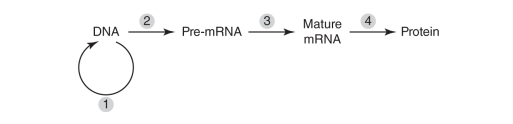
During which step will spliceosomes remove introns?
During which step will spliceosomes remove introns?
Correct Answer: (c)
(C) Introns are removed from the pre-mRNA to help form the mature mRNA, which is represented by step 3. Step 1 represents DNA replication, so choice (A) is incorrect. Transcription is represented by step 2, so choice (B) is incorrect. Choice (D) is incorrect because step 4 represents translation.
(C) Introns are removed from the pre-mRNA to help form the mature mRNA, which is represented by step 3. Step 1 represents DNA replication, so choice (A) is incorrect. Transcription is represented by step 2, so choice (B) is incorrect. Choice (D) is incorrect because step 4 represents translation.
Q36. Suppose that you stick your finger with a sharp pin. The area affected is very small and only one pain receptor fires. However, it fires repeatedly at a rapid rate (it hurts!). This is an example of
Correct Answer: (a)
Temporal summation occurs when a single presynaptic neuron (or receptor) fires multiple action potentials in rapid succession, resulting in the additive effect of postsynaptic potentials at the same location over time.
Temporal summation occurs when a single presynaptic neuron (or receptor) fires multiple action potentials in rapid succession, resulting in the additive effect of postsynaptic potentials at the same location over time.
Q37. Which of the following shows the correct graph of arithmetic growth?
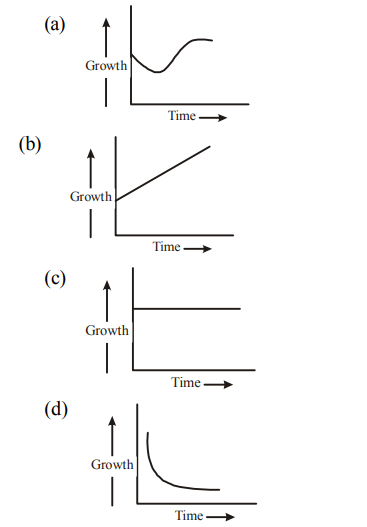
Correct Answer: (a)
Arithmetic growth produces a straight line (linear) when growth is plotted against time.
Arithmetic growth produces a straight line (linear) when growth is plotted against time.
Q38. Which of the following is NOT an ion homeostatically maintained in vertebrates?
Correct Answer: (d)
Vertebrates tightly regulate essential ions such as sodium (Na⁺), chloride (Cl⁻), and calcium (Ca²⁺) because they are critical for nerve conduction, muscle contraction, and cellular functions. Fluoride (Fl⁻) is not an essential ion that is homeostatically regulated by vertebrate excretory systems.
Vertebrates tightly regulate essential ions such as sodium (Na⁺), chloride (Cl⁻), and calcium (Ca²⁺) because they are critical for nerve conduction, muscle contraction, and cellular functions. Fluoride (Fl⁻) is not an essential ion that is homeostatically regulated by vertebrate excretory systems.
Q39. One of the earliest experiments on photosynthesis was done in 1770 by Joseph Priestley. He demonstrated that:
Correct Answer: (c)
Priestley's experiments with a bell jar, candle, mint plant, and mouse showed that plants restore to the air whatever breathing animals and burning candles remove.
Priestley's experiments with a bell jar, candle, mint plant, and mouse showed that plants restore to the air whatever breathing animals and burning candles remove.
Q40. Which of the following bacteria is correctly matched with their function?
I. Nitrosomonas – Nitrite to nitrate
II. Thiobacillus – Dentrification
III. Nostoc – Free-living nitrogen-fixer
IV. Azotobacter – Anaerobic nitrogen-fixer
I. Nitrosomonas – Nitrite to nitrate
II. Thiobacillus – Dentrification
III. Nostoc – Free-living nitrogen-fixer
IV. Azotobacter – Anaerobic nitrogen-fixer
Correct Answer: (c)
Statement II is correct (Thiobacillus denitrifiers). Statement III is correct (Nostoc is a free-living fixer). Statement I is wrong (Nitrobacter does nitrite to nitrate). Statement IV is wrong (Azotobacter is aerobic).
Statement II is correct (Thiobacillus denitrifiers). Statement III is correct (Nostoc is a free-living fixer). Statement I is wrong (Nitrobacter does nitrite to nitrate). Statement IV is wrong (Azotobacter is aerobic).
Q41. An alga which can be employed as food for human being is
Correct Answer: (b)
Chlorella and Spirulina are unicellular algae rich in proteins and used as food supplements by space travelers.
Chlorella and Spirulina are unicellular algae rich in proteins and used as food supplements by space travelers.
Q42. What potential problems must be considered in creating a transgenic bacterium with the human insulin gene isolated from genomic DNA to produce insulin?
Correct Answer: (b)
Human insulin is synthesized as a precursor (proinsulin) that requires eukaryotic-specific post-translational modifications, including the formation of disulfide bonds and the enzymatic cleavage of the C-peptide in the Golgi apparatus. Bacteria lack these organelles and specialized processing enzymes, so they cannot produce active insulin from a simple genomic gene sequence without additional engineering.
Human insulin is synthesized as a precursor (proinsulin) that requires eukaryotic-specific post-translational modifications, including the formation of disulfide bonds and the enzymatic cleavage of the C-peptide in the Golgi apparatus. Bacteria lack these organelles and specialized processing enzymes, so they cannot produce active insulin from a simple genomic gene sequence without additional engineering.
Q43. The Na+/K+ ATPase pump is
Correct Answer: (b)
While action potentials rely on the passive flow of ions through gated channels, the Na+/K+ ATPase pump is essential for maintaining the concentration gradients of sodium and potassium over the long term, ensuring the cell remains excitable.
While action potentials rely on the passive flow of ions through gated channels, the Na+/K+ ATPase pump is essential for maintaining the concentration gradients of sodium and potassium over the long term, ensuring the cell remains excitable.
Q44. Among the following where do you think the process of decomposition would be the fastest?
Correct Answer: (a)
Warm and moist environments are most favorable for the activity of decomposers.
Warm and moist environments are most favorable for the activity of decomposers.
Q45. Assertion: MTP is always a choice for birth control.
Reason: One is forced to use MTP to get rid of unwanted pregnancy due to casual coitus.
Correct Answer: (a)
MTP is not a regular birth control method; it is a last resort.
MTP is not a regular birth control method; it is a last resort.
Q46. Cytological information like chromosome number, structure, behaviour are related with
Correct Answer: (b)
Cytotaxonomy is based on cytological information such as chromosome number, structure, and behavior during meiosis.
Cytotaxonomy is based on cytological information such as chromosome number, structure, and behavior during meiosis.
Q47. Most carbon dioxide is
Correct Answer: (c)
Once carbon dioxide enters red blood cells, the enzyme carbonic anhydrase rapidly catalyzes the reaction between CO2 and H2O to form carbonic acid (H2CO3), which is a key intermediate step in the formation of bicarbonate for transport.
Once carbon dioxide enters red blood cells, the enzyme carbonic anhydrase rapidly catalyzes the reaction between CO2 and H2O to form carbonic acid (H2CO3), which is a key intermediate step in the formation of bicarbonate for transport.
Q48. Bacteria and yeast are similar in all the following features except that
Correct Answer: (b)
Bacteria are prokaryotes, whereas yeast (a fungus) is a eukaryote.
Bacteria are prokaryotes, whereas yeast (a fungus) is a eukaryote.
Q49. Which of the following is the correct sequence of events in the circulation of blood?
Correct Answer: (c)
Blood flows away from the heart through arteries, then arterioles, reaches capillaries for exchange, and returns via venules and veins back to the heart. The lymphatic system is separate and not part of the direct blood circulation sequence.
Blood flows away from the heart through arteries, then arterioles, reaches capillaries for exchange, and returns via venules and veins back to the heart. The lymphatic system is separate and not part of the direct blood circulation sequence.
Q50. When the flow of fluid is regulated both inwardly as well as outwardly, it is performed by the
Correct Answer: (b)
The endodermis acts as a biological checkpoint, regulating the passage of water and solutes into the vascular cylinder.
The endodermis acts as a biological checkpoint, regulating the passage of water and solutes into the vascular cylinder.
Q51. You experience a longer period than normal between meals. Your body’s response to this will be to produce
Correct Answer: (b)
During periods of fasting (between meals), blood glucose levels drop. The pancreas responds by secreting glucagon, which stimulates the liver to break down glycogen into glucose and release it into the blood, thereby raising blood sugar levels back to homeostatic levels.
During periods of fasting (between meals), blood glucose levels drop. The pancreas responds by secreting glucagon, which stimulates the liver to break down glycogen into glucose and release it into the blood, thereby raising blood sugar levels back to homeostatic levels.
Q52. Match the column-I with column-II and choose the correct option.
| Column-I (System of classification) | Column-II (Characteristics) |
|---|---|
| A. Artificial system of classification | I. Based on few morphological characters |
| B. Natural system of classification | II. Based on evolutionary relationships between the various organisms |
| C. Phylogenetic system of classification | III. Based on natural affinities among the organisms and consider external as well as internal features. |
Correct Answer: (b)
Artificial: basic morphology; Natural: natural affinities (Bentham & Hooker); Phylogenetic: evolution (Engler & Prantl).
Artificial: basic morphology; Natural: natural affinities (Bentham & Hooker); Phylogenetic: evolution (Engler & Prantl).
Q53. Botox, a derivative of the botulinum toxin that causes food poisoning, inhibits the release of acetylcholine at the neuromuscular junction. How could this strange-sounding treatment produce desired cosmetic effects?
Correct Answer: (c)
Acetylcholine is the primary neurotransmitter that signals skeletal muscles to contract. By blocking its release, Botox induces a temporary paralysis of the facial muscles responsible for creating frown lines and wrinkles, resulting in smoother skin.
Acetylcholine is the primary neurotransmitter that signals skeletal muscles to contract. By blocking its release, Botox induces a temporary paralysis of the facial muscles responsible for creating frown lines and wrinkles, resulting in smoother skin.
Q54. Match the following regarding contraceptive side effects:
| A. Nausea | Contraceptive side effect |
|---|---|
| B. Abdominal pain | Contraceptive side effect |
| C. Breakthrough bleeding | Contraceptive side effect |
Correct Answer: (a)
Side effects listed in Section 3.2 (Page 46).
Side effects listed in Section 3.2 (Page 46).
Q55. Respiratory organs of invertebrates and vertebrates are similar in that
Correct Answer: (c)
Regardless of the specific structure (gills, lungs, or tracheae), all respiratory organs have evolved to maximize the surface area (A) available for gas exchange. A larger surface area allows more molecules to diffuse across the respiratory membrane simultaneously.
Regardless of the specific structure (gills, lungs, or tracheae), all respiratory organs have evolved to maximize the surface area (A) available for gas exchange. A larger surface area allows more molecules to diffuse across the respiratory membrane simultaneously.
Q56. Second messengers are activated in response to
Correct Answer: (c)
Hydrophilic (water-soluble) hormones cannot cross the phospholipid bilayer of the cell membrane. To exert their effects, they bind to cell-surface receptors, which then trigger the production of intracellular second messengers (like cAMP) to relay the signal.
Hydrophilic (water-soluble) hormones cannot cross the phospholipid bilayer of the cell membrane. To exert their effects, they bind to cell-surface receptors, which then trigger the production of intracellular second messengers (like cAMP) to relay the signal.
Q57. Inhibitory neurotransmitters
Correct Answer: (a)
Inhibitory neurotransmitters typically open ligand-gated Cl– or K+ channels. This results in the membrane potential becoming more negative (hyperpolarization), which makes it more difficult for the postsynaptic neuron to reach the threshold for an action potential.
Inhibitory neurotransmitters typically open ligand-gated Cl– or K+ channels. This results in the membrane potential becoming more negative (hyperpolarization), which makes it more difficult for the postsynaptic neuron to reach the threshold for an action potential.
Q58. Japanese four o’clocks that are red and tall are crossed to white short ones, producing an F1 that is pink and tall. If these genes assort independently, and the F1 is self-crossed, what would you predict for the ratio of F2 phenotypes?
Correct Answer: (d)
Color shows incomplete dominance (1 red : 2 pink : 1 white) and height shows simple dominance (3 tall : 1 short). Using the product rule: (1 Red + 2 Pink + 1 White) × (3 Tall + 1 Short) = 3 Red Tall, 1 Red Short, 6 Pink Tall, 2 Pink Short, 3 White Tall, 1 White Short. Sorting these leads to choice D.
Color shows incomplete dominance (1 red : 2 pink : 1 white) and height shows simple dominance (3 tall : 1 short). Using the product rule: (1 Red + 2 Pink + 1 White) × (3 Tall + 1 Short) = 3 Red Tall, 1 Red Short, 6 Pink Tall, 2 Pink Short, 3 White Tall, 1 White Short. Sorting these leads to choice D.
Q59. Select the correctly matched pair.
I. S phase – DNA replication
II. Zygotene – Synapsis
III. Diplotene – Crossing over
IV. Meiosis – Both haploid and diploid cells
I. S phase – DNA replication
II. Zygotene – Synapsis
III. Diplotene – Crossing over
IV. Meiosis – Both haploid and diploid cells
Correct Answer: (a)
S-phase is for DNA replication and Zygotene is for Synapsis. Crossing over occurs in Pachytene.
S-phase is for DNA replication and Zygotene is for Synapsis. Crossing over occurs in Pachytene.
Q60. All forms of life should be conserved because
Correct Answer: (c)
Conservation is essential to maintain the ecological balance and stability of the biosphere.
Conservation is essential to maintain the ecological balance and stability of the biosphere.
Q61. Match the STIs with their curability status:
| Column-I (STI) | Column-II (Status) |
|---|---|
| A. Gonorrhoea | (I) Not completely curable |
| B. Syphilis | (II) Completely curable |
| C. Hepatitis-B | (III) Completely curable |
| D. HIV | (IV) Not completely curable |
Correct Answer: (a)
Based on section 3.4 (Hepatitis-B, herpes, HIV are not curable).
Based on section 3.4 (Hepatitis-B, herpes, HIV are not curable).
Q62. Leopard frogs from different geographic populations of the Rana pipiens complex
Correct Answer: (b)
Although they appear morphologically similar, the various populations within the Rana pipiens complex exhibit different mating calls (prezygotic isolation) and their hybrids often fail to develop properly (postzygotic isolation), classifying them as distinct biological species.
Although they appear morphologically similar, the various populations within the Rana pipiens complex exhibit different mating calls (prezygotic isolation) and their hybrids often fail to develop properly (postzygotic isolation), classifying them as distinct biological species.
Q63. Mendel’s principle of segregation states that
Correct Answer: (c)
The Law of Segregation states that every individual organism contains two alleles for each trait, and these alleles separate (segregate) during meiosis so that each gamete carries only one allele for each gene.
The Law of Segregation states that every individual organism contains two alleles for each trait, and these alleles separate (segregate) during meiosis so that each gamete carries only one allele for each gene.
Q64. Assertion: The middle piece of the sperm is called the powerhouse of the sperm.
Reason: It possesses numerous mitochondria which produce energy for the movement of the tail.
Correct Answer: (a)
Mitochondria in the middle piece provide the energy for motility.
Mitochondria in the middle piece provide the energy for motility.
Q65. Select correct statements for 'Organic Farming':
(i) Uses biofertilisers instead of chemical fertilisers.
(ii) Aim is to enrich the nutrient quality of soil.
(iii) Prevents environmental pollution.
(i) Uses biofertilisers instead of chemical fertilisers.
(ii) Aim is to enrich the nutrient quality of soil.
(iii) Prevents environmental pollution.
Correct Answer: (a)
Philosophy of biofertiliser use (section 8.6).
Philosophy of biofertiliser use (section 8.6).
Q66. For a genetic disease that appears in homozygous recessive (aa) individuals, individuals who are heterozygous (Aa) for the disease are resistant to infections by certain parasites. Over half of the individuals living in a population where a particular parasite is prevalent are heterozygous for a recessive allele (Aa). Further studies reveal that individuals who are heterozygous for the recessive allele are resistant to the parasite, while individuals who are homozygous dominant or homozygous recessive are susceptible to the parasite.
If the parasite was totally eliminated from this area, predict what would happen to the frequencies of the AA, Aa, and aa genotypes.
If the parasite was totally eliminated from this area, predict what would happen to the frequencies of the AA, Aa, and aa genotypes.
Correct Answer: (a)
(A) If the parasite was totally eliminated from this environment, there would no longer be any advantage to being heterozygous for the recessive allele. So over time, natural selection would increase the frequencies of the AA and aa genotypes and the frequency of the Aa genotype would decrease. Choice (B) is incorrect because the frequency of the AA genotype would increase (not decrease) and the frequency of the Aa genotype would decrease (not increase). If the parasite was eliminated, there would be no advantage to having the Aa genotype. So the frequency of the Aa genotype would no longer be favored and would be expected to decrease, not increase, and the frequencies of the AA and aa genotypes would increase. Thus, choice (C) is incorrect. While the frequency of the aa genotype would be expected to increase, the frequency of the AA genotype would also be expected to increase. So choice (D) is incorrect.
(A) If the parasite was totally eliminated from this environment, there would no longer be any advantage to being heterozygous for the recessive allele. So over time, natural selection would increase the frequencies of the AA and aa genotypes and the frequency of the Aa genotype would decrease. Choice (B) is incorrect because the frequency of the AA genotype would increase (not decrease) and the frequency of the Aa genotype would decrease (not increase). If the parasite was eliminated, there would be no advantage to having the Aa genotype. So the frequency of the Aa genotype would no longer be favored and would be expected to decrease, not increase, and the frequencies of the AA and aa genotypes would increase. Thus, choice (C) is incorrect. While the frequency of the aa genotype would be expected to increase, the frequency of the AA genotype would also be expected to increase. So choice (D) is incorrect.
Q67. Mendel’s law of independent assortment is a result of
Correct Answer: (c)
Each pair of chromosomes lines up independently in metaphase I of meiosis, leading to the independent assortment of the traits on those chromosomes. Choices (A) and (B) are incorrect because they do not lead to independent assortment (but they do contribute to increased genetic diversity). Choice (D) is incorrect because temperature does not affect independent assortment.
Each pair of chromosomes lines up independently in metaphase I of meiosis, leading to the independent assortment of the traits on those chromosomes. Choices (A) and (B) are incorrect because they do not lead to independent assortment (but they do contribute to increased genetic diversity). Choice (D) is incorrect because temperature does not affect independent assortment.
Q68. When a flower can be divided into two equal radial halves in any radial plane passing through the centre, it is known as
Correct Answer: (a)
Actinomorphic (radial) symmetry allows a flower to be divided into two identical halves by any plane passing through the center.
Actinomorphic (radial) symmetry allows a flower to be divided into two identical halves by any plane passing through the center.
Q69. Refer the figure and answer the question. Identify P, Q, R, and S.
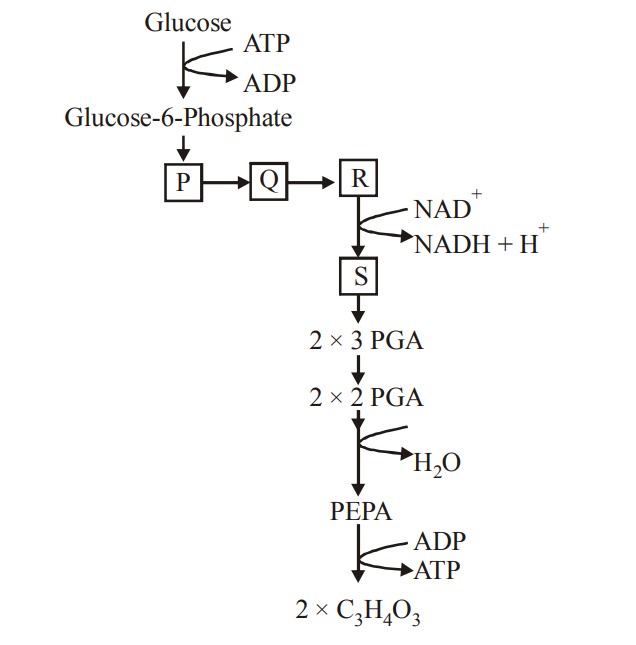
Correct Answer: (d)
P is Fructose 6-phosphate. Q is Fructose 1,6-bisphosphate. R is Glyceraldehyde 3-phosphate (3-PGAld). S is 1,3-bisphosphoglycerate (1,3-diPGA).
P is Fructose 6-phosphate. Q is Fructose 1,6-bisphosphate. R is Glyceraldehyde 3-phosphate (3-PGAld). S is 1,3-bisphosphoglycerate (1,3-diPGA).
Q70. The active chemical drug reserpine is obtained from
Correct Answer: (b)
Reserpine is an alkaloid extracted from the roots of Rauwolfia serpentina.
Reserpine is an alkaloid extracted from the roots of Rauwolfia serpentina.
Q71. The lymphatic system is like the circulatory system in that they both
Correct Answer: (c)
Both systems contain capillaries that facilitate exchange with tissues. However, the lymphatic system does not have arteries and is not a closed system; it drains lymph unidirectionally toward the heart.
Both systems contain capillaries that facilitate exchange with tissues. However, the lymphatic system does not have arteries and is not a closed system; it drains lymph unidirectionally toward the heart.
Q72. Which of the following statements is/are correct ?
(i) The endomembrane system includes plasma membrane, ER, Golgi complex, lysosomes and vacuoles.
(ii) ER helps in the transport of substances, synthesis of proteins, lipoproteins and glycogen.
(iii) Ribosomes are involved in protein synthesis.
(iv) Mitochondria help in oxidative phosphorylation and generation of ATP.
(i) The endomembrane system includes plasma membrane, ER, Golgi complex, lysosomes and vacuoles.
(ii) ER helps in the transport of substances, synthesis of proteins, lipoproteins and glycogen.
(iii) Ribosomes are involved in protein synthesis.
(iv) Mitochondria help in oxidative phosphorylation and generation of ATP.
Correct Answer: (a)
Statement (i) is incorrect because the plasma membrane is not considered part of the endomembrane system. (ii), (iii), and (iv) are correct functions of their respective organelles.
Statement (i) is incorrect because the plasma membrane is not considered part of the endomembrane system. (ii), (iii), and (iv) are correct functions of their respective organelles.
Q73. Assertion: Secondary sewage treatment is also called biological treatment.
Reason: It involves the use of heterotrophic aerobic microbes to consume organic matter.
Correct Answer: (a)
The reliance on living organisms for treatment is why it is termed 'biological'.
The reliance on living organisms for treatment is why it is termed 'biological'.
Q74. An association between roots of higher plants and fungi is called
Correct Answer: (c)
Mycorrhiza is a symbiotic association between a fungus and the roots of higher plants (e.g., Pinus).
Mycorrhiza is a symbiotic association between a fungus and the roots of higher plants (e.g., Pinus).
Q75. G protein–coupled receptors are involved in the nervous system by
Correct Answer: (d)
G protein–coupled receptors (metabotropic receptors) act as postsynaptic receptors that, upon binding neurotransmitters, initiate complex intracellular signaling cascades. These are distinct from ionotropic receptors, which are ligand-gated ion channels themselves.
G protein–coupled receptors (metabotropic receptors) act as postsynaptic receptors that, upon binding neurotransmitters, initiate complex intracellular signaling cascades. These are distinct from ionotropic receptors, which are ligand-gated ion channels themselves.
Q76. The affect of apical dominance can be overcome by which of the following hormone?
Correct Answer: (c)
While auxins promote apical dominance, cytokinins act antagonistically to promote the growth of lateral buds.
While auxins promote apical dominance, cytokinins act antagonistically to promote the growth of lateral buds.
Q77. Which of the following is not a cause for loss of biodiversity?
Correct Answer: (c)
Keeping animals in zoological parks is a method of ex-situ conservation, which helps protect species, not cause their loss.
Keeping animals in zoological parks is a method of ex-situ conservation, which helps protect species, not cause their loss.
Q78. FISH analysis of a breast tumor biopsy for HER2 gene reveals two spots of fluorescence in cells. What conclusion do these data support about the tumor?
Correct Answer: (d)
Fluorescence In Situ Hybridization (FISH) is used to visualize specific DNA sequences. Normal diploid cells have two copies of every gene. Since the analysis shows only two spots of fluorescence, the HER2 gene has not been duplicated or amplified. Because targeted therapies like Herceptin are only effective in tumors where the gene is amplified and overexpressing protein, these treatments would not be suitable for this patient.
Fluorescence In Situ Hybridization (FISH) is used to visualize specific DNA sequences. Normal diploid cells have two copies of every gene. Since the analysis shows only two spots of fluorescence, the HER2 gene has not been duplicated or amplified. Because targeted therapies like Herceptin are only effective in tumors where the gene is amplified and overexpressing protein, these treatments would not be suitable for this patient.
Q79. When a sphygmomanometer is used,
Correct Answer: (c)
When cuff pressure exceeds the maximum (systolic) arterial pressure, the artery is completely occluded and blood flow stops. As cuff pressure decreases below systolic pressure, blood flow resumes, producing audible pulses.
When cuff pressure exceeds the maximum (systolic) arterial pressure, the artery is completely occluded and blood flow stops. As cuff pressure decreases below systolic pressure, blood flow resumes, producing audible pulses.
Q80. The major events that occur during the anaphase of mitosis, which brings about the equal distribution of chromosome, is
Correct Answer: (c)
The physical separation of sister chromatids is triggered by the simultaneous splitting of the centromeres.
The physical separation of sister chromatids is triggered by the simultaneous splitting of the centromeres.
Q81. Which one of the following is not a method of in situ conservation of biodiversity?
Correct Answer: (c)
Botanical gardens are ex-situ facilities.
Botanical gardens are ex-situ facilities.
Q82. Plants requiring exposure to light for less than critical period in order to flower are called ________.
Correct Answer: (d)
Short-day plants (SDPs) require a light period shorter than a specific critical duration to initiate flowering.
Short-day plants (SDPs) require a light period shorter than a specific critical duration to initiate flowering.
Q83. Seminal plasma is rich in:
Correct Answer: (b)
Secretions of male accessory glands constitute the seminal plasma which is rich in fructose, calcium and certain enzymes.
Secretions of male accessory glands constitute the seminal plasma which is rich in fructose, calcium and certain enzymes.
Q84. A patient with a pituitary tumor exhibits fatigue, weight loss, and low blood sugar. This is probably due to a lack of production of
Correct Answer: (b)
Adrenocorticotropic hormone (ACTH) triggers the adrenal cortex to release glucocorticoids like cortisol. Cortisol is vital for maintaining blood glucose levels. A lack of ACTH leads to low cortisol, causing hypoglycemia (low blood sugar) and chronic fatigue.
Adrenocorticotropic hormone (ACTH) triggers the adrenal cortex to release glucocorticoids like cortisol. Cortisol is vital for maintaining blood glucose levels. A lack of ACTH leads to low cortisol, causing hypoglycemia (low blood sugar) and chronic fatigue.
Q85. An inversion will
Correct Answer: (b)
An inversion reverses the orientation of a segment of a chromosome. If the breaks that allow the inversion to happen occur between genes, the genes themselves remain intact and functional. However, if a breakpoint occurs within a coding sequence, it will disrupt the gene and likely result in a mutant phenotype.
An inversion reverses the orientation of a segment of a chromosome. If the breaks that allow the inversion to happen occur between genes, the genes themselves remain intact and functional. However, if a breakpoint occurs within a coding sequence, it will disrupt the gene and likely result in a mutant phenotype.
Q86. A scientist at a pharmaceutical company wants to create bacteria that will synthesize human growth hormone.
What should the scientist use to add the DNA code for human growth hormone to a plasmid?
What should the scientist use to add the DNA code for human growth hormone to a plasmid?
Correct Answer: (b)
DNA ligase attaches DNA fragments together, joining them with phosphodiester bonds. Choice (A) is incorrect because bacterial transformation is used to insert naked, foreign DNA into a cell. Gel electrophoresis separates DNA fragments by size, so choice (C) is incorrect. Polymerase chain reaction is used to amplify the number of copies of a specific sequence of DNA, so choice (D) is incorrect.
DNA ligase attaches DNA fragments together, joining them with phosphodiester bonds. Choice (A) is incorrect because bacterial transformation is used to insert naked, foreign DNA into a cell. Gel electrophoresis separates DNA fragments by size, so choice (C) is incorrect. Polymerase chain reaction is used to amplify the number of copies of a specific sequence of DNA, so choice (D) is incorrect.
Q87. Strobili or cones are found in
Correct Answer: (c)
In some pteridophytes like Equisetum and Selaginella, sporophylls form distinct compact structures called strobili or cones.
In some pteridophytes like Equisetum and Selaginella, sporophylls form distinct compact structures called strobili or cones.
Q88. Statement:
Drs. Peter and Rosemary Grant have studied the rate of evolutionary change in the finch populations of the Galápagos Islands. Beak size in these finches determines which types of seeds the finch populations feed on. Finches with larger beaks eat thick-walled seeds, while finches with smaller beaks eat thin-walled seeds. During a drought from 1981 to 1987, the number of plants that produced thin-walled seeds decreased. It was determined that the average beak size (both length and mass) of finches increased dramatically during the drought.
During the years 1988 to 1995, the average beak size of the finches decreased. Which of the following is the most likely explanation for this change?
Drs. Peter and Rosemary Grant have studied the rate of evolutionary change in the finch populations of the Galápagos Islands. Beak size in these finches determines which types of seeds the finch populations feed on. Finches with larger beaks eat thick-walled seeds, while finches with smaller beaks eat thin-walled seeds. During a drought from 1981 to 1987, the number of plants that produced thin-walled seeds decreased. It was determined that the average beak size (both length and mass) of finches increased dramatically during the drought.
During the years 1988 to 1995, the average beak size of the finches decreased. Which of the following is the most likely explanation for this change?
Correct Answer: (b)
(B) Before the drought, there were more thin-walled seeds and therefore more food available for finches with smaller beaks. Therefore, the end of the drought would increase food availability for finches with smaller beaks and allow more finches with smaller beaks to survive. There is no evidence in the question that suggests females have a mate preference that is dependent on beak size, so choice (A) is incorrect. Choice (C) is incorrect because there is no evidence for predators killing more finches of either beak size. The question does not give any information about disease susceptibility or resistance, so choice (D) is incorrect.
(B) Before the drought, there were more thin-walled seeds and therefore more food available for finches with smaller beaks. Therefore, the end of the drought would increase food availability for finches with smaller beaks and allow more finches with smaller beaks to survive. There is no evidence in the question that suggests females have a mate preference that is dependent on beak size, so choice (A) is incorrect. Choice (C) is incorrect because there is no evidence for predators killing more finches of either beak size. The question does not give any information about disease susceptibility or resistance, so choice (D) is incorrect.
Q89. Which of the following conditions is unrelated to the production of growth hormone?
Correct Answer: (a)
Blood calcium levels are regulated primarily by parathyroid hormone (PTH) and calcitonin. Growth hormone (GH) is associated with bone and tissue growth, and its imbalances lead to conditions like dwarfism or acromegaly.
Blood calcium levels are regulated primarily by parathyroid hormone (PTH) and calcitonin. Growth hormone (GH) is associated with bone and tissue growth, and its imbalances lead to conditions like dwarfism or acromegaly.
Q90. Keeping in view the fluid mosaic model for the structure of cell membrane, which one of the following statements is correct with respect to the movement of lipids and proteins from one lipid monolayer to the other (described as flipflop movement)?
Correct Answer: (b)
Lipid molecules can rarely flip-flop across the membrane bilayer, but proteins, being very large and polar in specific regions, are unable to flip.
Lipid molecules can rarely flip-flop across the membrane bilayer, but proteins, being very large and polar in specific regions, are unable to flip.