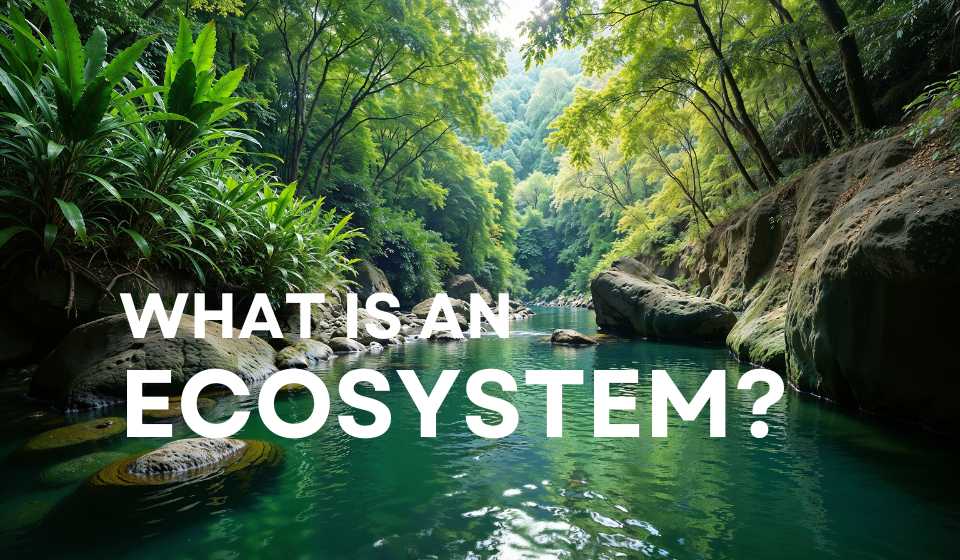
1. What is an Ecosystem?
An ecosystem is the fundamental unit of ecology and the cornerstone of life on Earth. It can be defined as a community of living organisms (biotic components) in conjunction with the non-living (abiotic) components of their environment, interacting as a system. These biotic and abiotic components are linked together through nutrient cycles and energy flows.
Think of it as a complex, interconnected web where every element, from the largest tree to the smallest bacterium, from the sunlight to the soil minerals, plays a role. The concept was first coined by British ecologist Sir Arthur Tansley in 1935 to emphasize that the living and non-living parts of nature are inseparable.
Key Characteristics of an Ecosystem:
- Structure: It has a physical structure defined by the arrangement of its biotic (living) and abiotic (non-living) components.
- Function: It performs essential functions, primarily the flow of energy (from sun to producers to consumers) and the cycling of nutrients (like carbon, nitrogen, and phosphorus).
- Interaction: Constant interactions occur both among organisms and between organisms and their physical environment.
- Sustainability: A healthy ecosystem is self-sustaining, meaning it can maintain its structure and function over time.
Examples of Ecosystems:
- A small, temporary puddle
- A decaying log in a forest
- A large grassland
- A coral reef
- A tropical rainforest
- A desert
Ecosystems can be of any size and are often nested within larger ones. For instance, a forest ecosystem contains a stream ecosystem, which itself contains a puddle ecosystem.
2. Ecosystem Patterns
Ecosystems are not randomly distributed across the globe. They form recognizable patterns based on the prevailing physical and climatic conditions. The two most significant patterns are Biomes and Zonation.
A. Biomes: The Global Pattern
A biome is a very large geographical area with a distinct climate (temperature and precipitation) that supports a characteristic community of plants and animals. Biomes are the world’s major life zones.
- Defining Factor: Climate is the primary driver. Similar climates in different parts of the world will produce similar biomes, even if the species are different (a phenomenon known as convergent evolution).
- Major Terrestrial Biomes:
- Tundra: Cold, treeless, with permafrost. Low-growing plants like mosses and lichens.
- Taiga (Boreal Forest): Coniferous forests with long, cold winters and short, moist summers.
- Temperate Deciduous Forest: Four distinct seasons, trees that lose their leaves in winter (e.g., oaks, maples).
- Tropical Rainforest: High temperature and rainfall year-round, immense biodiversity, layered structure.
- Grassland (Savanna/Prairie): Dominated by grasses, seasonal rainfall, supports large herbivores.
- Desert: Very low rainfall, specialized plants (cacti) and animals adapted to conserve water.
B. Zonation: The Local Pattern
Zonation refers to the spatial pattern of distribution of organisms and ecosystems in a gradient or band-like arrangement. This pattern is visible on a smaller, local scale.
- Causes: Zonation is driven by changes in an environmental factor over a relatively short distance.
- Examples:
- Altitudinal Zonation: As you climb a mountain, the ecosystem changes in a pattern similar to moving towards the poles. You might see a progression from tropical forest at the base, to temperate forest, to coniferous forest, to alpine tundra, and finally to bare rock and ice at the summit.
- Shoreline Zonation: On a rocky intertidal shore, different bands of organisms (barnacles, mussels, seaweeds) are found at different heights, each adapted to the specific duration of exposure to air and submersion in water.
3. Ecosystem Components
Every ecosystem, regardless of its size or location, is composed of two fundamental types of components that constantly interact.
A. Abiotic Components (The Non-Living Environment)
These are the chemical and physical factors that influence and shape the ecosystem. They determine what kinds of life can survive there.
- Inorganic Substances: Elements and compounds that cycle through the ecosystem (e.g., carbon, nitrogen, phosphorus, water, carbon dioxide, oxygen).
- Organic Compounds: The building blocks of life, such as carbohydrates, proteins, and lipids, which link the biotic and abiotic worlds (e.g., humus in soil).
- Climate Regime: The long-term weather patterns, including temperature, sunlight, precipitation, and wind.
- Physical Factors:
- Light: The primary source of energy for most ecosystems.
- Temperature: Affects the metabolic rates of organisms.
- Water: Essential for all life processes.
- Soil: Its texture, pH, and mineral content determine plant growth.
- Fire: A natural disturbance that can reshape ecosystems.
B. Biotic Components (The Living Community)
These are all the living organisms in the ecosystem, classified based on how they obtain their energy and nutrients. This classification defines their ecological niche—their role and position in the ecosystem.
- Producers (Autotrophs – “Self-feeders”):
- Role: They form the foundation of the ecosystem. They capture energy from a non-living source (usually the sun via photosynthesis, or chemicals via chemosynthesis) and convert it into organic matter (food).
- Examples: Green plants, algae, cyanobacteria.
- Consumers (Heterotrophs – “Other-feeders”):
- Role: They cannot make their own food and must consume other organisms for energy and nutrients.
- Types:
- Primary Consumers (Herbivores): Feed directly on producers (e.g., deer, grasshoppers, zooplankton).
- Secondary Consumers (Carnivores/Omnivores): Feed on primary consumers (e.g., frogs, foxes, small fish).
- Tertiary Consumers (Top Carnivores): Feed on secondary consumers (e.g., hawks, tigers, orcas).
- Detritivores: A special category that consumes dead organic matter (detritus) (e.g., earthworms, millipedes, woodlice).
- Decomposers (Saprotrophs):
- Role: The “recyclers” of the ecosystem. They break down complex dead organic matter (from producers and consumers) into simple inorganic substances (like CO₂ and minerals) that can be reused by producers.
- Process: They secrete digestive enzymes onto the dead matter and absorb the broken-down nutrients.
- Examples: Fungi (like mushrooms and molds) and bacteria.
The Connection: Energy Flow and Nutrient Cycling
The interaction of these components creates two critical ecosystem processes:
- Energy Flow is a one-way path. Energy enters as sunlight, flows from producers to various levels of consumers, and is eventually lost as heat at every transfer. It is not recycled.
- Nutrient Cycling is a closed loop. Nutrients like carbon and nitrogen are passed from the abiotic environment to producers, to consumers, to decomposers, and back to the abiotic environment, where they can be used again.
In summary, an ecosystem is a complex, functional unit where life and its physical environment are inextricably linked. They form global and local patterns (Biomes and Zonation) dictated by climate and geography, and are structured by the constant interaction between abiotic components (the non-living physical and chemical factors) and biotic components (producers, consumers, and decomposers) through the fundamental processes of energy flow and nutrient cycling.