Q1. Frog’s heart when taken out of the body continues to beat for sometime. Select the best option from the following statements.
(A) Frog is a poikilotherm.
(B) Frog does not have any coronary circulation.
(C) Heart is “myogenic” in nature.
(D) Heart is autoexcitable.
(A) Frog is a poikilotherm.
(B) Frog does not have any coronary circulation.
(C) Heart is “myogenic” in nature.
(D) Heart is autoexcitable.
Correct Answer: (c)
The vertebrates process myogenic heart which is self contractile system or autoexcitable; it will thus keep working outside the body for some time.
The vertebrates process myogenic heart which is self contractile system or autoexcitable; it will thus keep working outside the body for some time.
Q2. Consider the following four statements (A-D) related to the common frog Rana tigrina, and select the correct option stating which ones are true (T) and which ones are false (F)
(A) On dry land it would die due to lack of O2 its mouth is forcibly kept closed for a few days
(B) It has four- chambered heart
(C) On dry land it turns uricotelic from ureotelic
(D) Its life-history is carried out in pond water
(A) On dry land it would die due to lack of O2 its mouth is forcibly kept closed for a few days
(B) It has four- chambered heart
(C) On dry land it turns uricotelic from ureotelic
(D) Its life-history is carried out in pond water
Correct Answer: (a)
(A) Dry skin causes ceased cutaneous respiration (B) Three chambered heart. (C) Frog never becomes uricotelic (D) External fertilization occurs in water
(A) Dry skin causes ceased cutaneous respiration (B) Three chambered heart. (C) Frog never becomes uricotelic (D) External fertilization occurs in water
Q3. Cuboidal epithelium with brush border of microvilli is found in
Correct Answer: (b)
Cuboidal epithelium with brush border of microvilli is found in proximal convoluted tubule of nephron (PCT).
Cuboidal epithelium with brush border of microvilli is found in proximal convoluted tubule of nephron (PCT).
Q4. Histamine secreting cells are found in
Correct Answer: (a)
In connective tissues, histamine is an organic nitrogen compound involved in local immune responses and regulating physiological function in the gut and it acts as a neurotransmitter. Histamine is produced by basophils and mast cells found in nearby connective tissues.
In connective tissues, histamine is an organic nitrogen compound involved in local immune responses and regulating physiological function in the gut and it acts as a neurotransmitter. Histamine is produced by basophils and mast cells found in nearby connective tissues.
Q5. Which one of the following structures in Pheretima is correctly matched with its function?
Correct Answer: (a)
Clitellum secretes cocoon during breading season of earthworm. Gizzard is used for- grinding of food particles. Setae help in locomotion. Typhlosole increases the absorption area in intestine.
Clitellum secretes cocoon during breading season of earthworm. Gizzard is used for- grinding of food particles. Setae help in locomotion. Typhlosole increases the absorption area in intestine.
Q6. The cell junctions called tight, adhering and gap junctions are found in
Correct Answer: (b)
The cell junctions known as tight, adhering and gap junctions are found in epithelial tissue. Epithelial tissue covers the whole surface of the body.
The cell junctions known as tight, adhering and gap junctions are found in epithelial tissue. Epithelial tissue covers the whole surface of the body.
Q7. Protein present in the matrix of cartilage is known as
Correct Answer: (a)
Chondrin is a gelatin-like substance and can be obtained by boiling cartilage in water. The cartilage is a connective tissue that contains cells embedded in a matrix of chondrin.
Chondrin is a gelatin-like substance and can be obtained by boiling cartilage in water. The cartilage is a connective tissue that contains cells embedded in a matrix of chondrin.
Q8. The kind of tissue that forms the supportive structure in our pinna (external ears) is also found in:
Correct Answer: (c)
The kind of tissue that forms the supportive structure in our pinna (external ears) is also found in tip of the nose. External pinna is made up of elastic cartilage. It is the passage towards middle ear.
The kind of tissue that forms the supportive structure in our pinna (external ears) is also found in tip of the nose. External pinna is made up of elastic cartilage. It is the passage towards middle ear.
Q9. Basement membrane is made up of
Correct Answer: (d)
Basement membrane is a delicate noncellular layer made of extracellular material that lies below the epithelium in contact with its basal surface.
Basement membrane is a delicate noncellular layer made of extracellular material that lies below the epithelium in contact with its basal surface.
Q10. The ciliated columnar epithelial cells in humans are known to occur in :
Correct Answer: (b)
Ciliated epithelium is usually found in the respiratory tract of fallopian tubes. Ciliated epithelium is a thin tissue that has hair-like structures on it. These hairs, called cilia, move back and forth to help move particles out of our body.
Ciliated epithelium is usually found in the respiratory tract of fallopian tubes. Ciliated epithelium is a thin tissue that has hair-like structures on it. These hairs, called cilia, move back and forth to help move particles out of our body.
Q11. The body cells in cockroach discharge their nitrogenous waste in the haemolymph mainly in the form of :
Correct Answer: (a)
The body cells in cockroach discharge their nitrogenous waste in the haemolymph as a solution of sodium or potassium urate (a weak alkaline fluid).
The body cells in cockroach discharge their nitrogenous waste in the haemolymph as a solution of sodium or potassium urate (a weak alkaline fluid).
Q12. Which of the following is correctly stated as it happens in the common cockroach ?
Correct Answer: (d)
Cockroach intake the food after grounding it by its mandibles and gizzard.
Cockroach intake the food after grounding it by its mandibles and gizzard.
Q13. If a live earthworm is pricked with a needle on its outer surface without damaging its gut, the fluid that comes out is :
Correct Answer: (a)
If a live earthworm is pricked with a needle on its outer surface without damaging its gut, the fluid that comes out is coelomic fluid because coelomic fluid lies between body wall and alimentary canal. Earthworms are helpful to man as bait for fishing and loosen the soil for roots to grow as well. A earthworm’s wastes help to fertilize the soil.
If a live earthworm is pricked with a needle on its outer surface without damaging its gut, the fluid that comes out is coelomic fluid because coelomic fluid lies between body wall and alimentary canal. Earthworms are helpful to man as bait for fishing and loosen the soil for roots to grow as well. A earthworm’s wastes help to fertilize the soil.
Q14. Given below is the diagrammatic sketch of a certain type of connective tissue. Identify the parts labeled A, B, C and D, and select the correct answer from the given option.
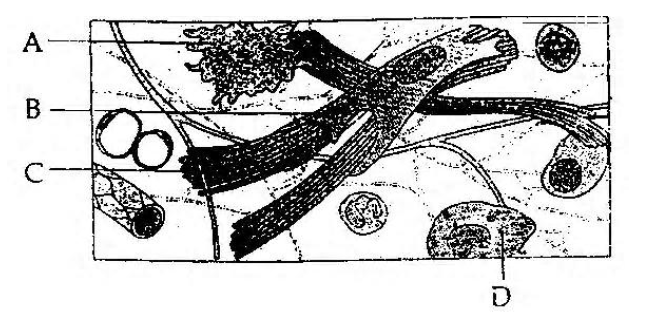
| Part-A | Part-B | Part-C | Part-D |
|---|---|---|---|
| (a) Macrophage | Fibroblast | Collagen fibres | Mast cells |
| (b) Mast cell | Macrophage | Fibroblast | Collagen fibres |
| (c) Macrophage | Collagen fibres | Fibroblast | Mast cell |
| (d) Mast cell | Collagen fibres | Fibroblast | Macrophage |
Correct Answer: (a)
Connective tissue is the most diverse of the four tissue types with a wide variety of functions. Connective tissue is made up of cells and fibers in a 'jelly-like' ground substance.
Connective tissue is the most diverse of the four tissue types with a wide variety of functions. Connective tissue is made up of cells and fibers in a 'jelly-like' ground substance.
Q15. One very special feature in the earthworm Pheretima is that
Correct Answer: (b)
The intestine of an earthworm has a peculiar fold of tissue that forms a pocket in the intestine that is visible when viewing a cross section. This space, which runs almost the whole length of the body dorsally is known as the typhlosole and it serves to increase the surface area of the intestine for absorption.
The intestine of an earthworm has a peculiar fold of tissue that forms a pocket in the intestine that is visible when viewing a cross section. This space, which runs almost the whole length of the body dorsally is known as the typhlosole and it serves to increase the surface area of the intestine for absorption.
Q16. The four sketches (1, 2, 3 and 4) given below, represent four different types of animal tissues. Which one of these is correctly identified in the options given, along with its correct location and function?
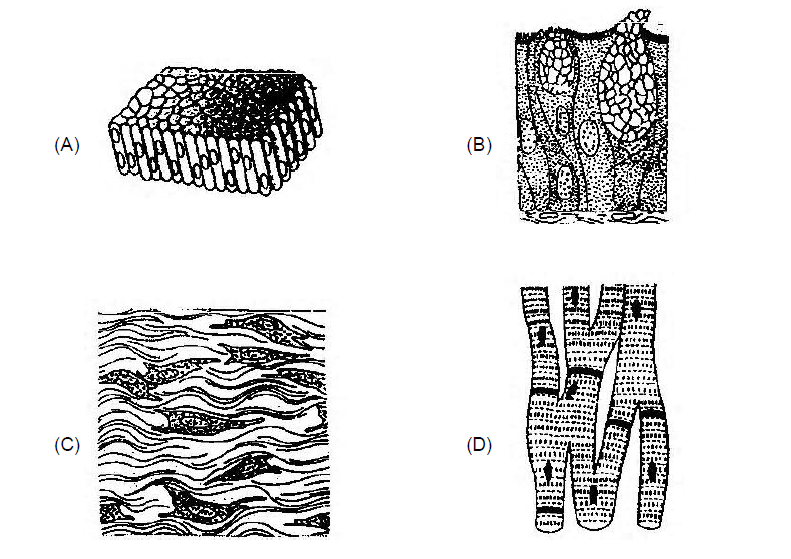
| Tissue | Location | Function | |
|---|---|---|---|
| (a) | (2) Glandular epithelium | Intestine | Secretion |
| (b) | (3) Collagen fibres | Cartilage | Attach skeletal muscles to bones |
| (c) | (4) Smooth muscle tissue | Heart | Heart contraction |
| (d) | (1) Columnar epithelium | Nephron | Secretion and absorption |
Correct Answer: (a)
Glandular epithelium invaginates epithelia into connective tissue which differentiate into secretory units.
Glandular epithelium invaginates epithelia into connective tissue which differentiate into secretory units.
Q17. A. Periplaneta americana is nocturnal, omnivorous, household pest.
R. It is because it acts as scavenger
R. It is because it acts as scavenger
Correct Answer: (c)
Periplaneta americana (cockroach) cannot act as a scavanger, it does not feed upon dead animals.
Periplaneta americana (cockroach) cannot act as a scavanger, it does not feed upon dead animals.
Q18. The type of muscles present in our :
Correct Answer: (c)
Thigh muscles are skeletal muscles that are striated and voluntary.
Thigh muscles are skeletal muscles that are striated and voluntary.
Q19. Earthworms have no skeleton but during burrowing, the anterior end becomes turgid and acts as a hydraulic skeleton. It is due to
Correct Answer: (a)
Earthworms have no skeleton but during burrowing, anterior end becomes turgid and acts as a hydraulic skeleton. It is due to coelomic fluid. The coelom is filled with an alkaline milky coelomic fluid. This coelomic fluid contains water, salts, proteins and 4 types of cells namely amoebocytes, mucocytes, circular cells and chloragogen cells.
Earthworms have no skeleton but during burrowing, anterior end becomes turgid and acts as a hydraulic skeleton. It is due to coelomic fluid. The coelom is filled with an alkaline milky coelomic fluid. This coelomic fluid contains water, salts, proteins and 4 types of cells namely amoebocytes, mucocytes, circular cells and chloragogen cells.
Q20. Hair present in the skin are
Correct Answer: (a)
Each hair is present in a tubular pit called hair follicle. Living cells are only present at the base of hair known as hair papilla, rest of the hair is dead and divisible into outer cuticle, middle cortex & inner medulla.
Each hair is present in a tubular pit called hair follicle. Living cells are only present at the base of hair known as hair papilla, rest of the hair is dead and divisible into outer cuticle, middle cortex & inner medulla.
Q21. Which one of the following contains the largest quantity of extracellular material?
Correct Answer: (c)
Areolar tissue is the least specialized connective tissue. It has a large amount of ground substance (extracellular material) and possesses rich blood and nerve supplies. It spreads extensively throughout the body, under the skin and epithelia, in between and around muscles, nerves and blood vessels and in the submucosa of respiratory and gastrointestinal tract.
Areolar tissue is the least specialized connective tissue. It has a large amount of ground substance (extracellular material) and possesses rich blood and nerve supplies. It spreads extensively throughout the body, under the skin and epithelia, in between and around muscles, nerves and blood vessels and in the submucosa of respiratory and gastrointestinal tract.
Q22. In which one of the following preparations are your likely to come across cell junctions most frequently ?
Correct Answer: (d)
It is ciliated epithelium which bears numerous delicate hair like outgrowths, the cilia, arising from basal granules. The cilia remains in rhythmic motion and creates current to transport the materials which comes in contact with them.
It is ciliated epithelium which bears numerous delicate hair like outgrowths, the cilia, arising from basal granules. The cilia remains in rhythmic motion and creates current to transport the materials which comes in contact with them.
Q23. Simple epithelium is a tissue in which the cells are
Correct Answer: (b)
Simple epithelium is a tissue made of a single layer of compactly arranged cells all of which rest over a noncellular basement membrane.
Simple epithelium is a tissue made of a single layer of compactly arranged cells all of which rest over a noncellular basement membrane.
Q24. Formation of cartilage bones involves
Correct Answer: (a)
Deposition of bony matter by osteoblasts and resorption chondroblasts occurs during formation of cartilage bones.
Deposition of bony matter by osteoblasts and resorption chondroblasts occurs during formation of cartilage bones.
Q25. Which cartilage is present at the end of long bones?
Correct Answer: (b)
Hyaline cartilage is present at the end of long articular bones. It provides a smooth articular surface to permit movement at joints.
Hyaline cartilage is present at the end of long articular bones. It provides a smooth articular surface to permit movement at joints.
Q26. The epithelial tissue present on the inner surface of bronchioles and fallopian tube is:
Correct Answer: (b)
Ciliated epithelium has simple columnar epithelial cells, but in addition, they posses fine hair-like outgrowths, cilia on their free surfaces. These cilia are capable of rapid, rhythmic, wavelike beatings in a certain direction.
Ciliated epithelium has simple columnar epithelial cells, but in addition, they posses fine hair-like outgrowths, cilia on their free surfaces. These cilia are capable of rapid, rhythmic, wavelike beatings in a certain direction.
Q27. Stratum germinativum is an example of which kind of epithelium?
Correct Answer: (c)
The simple cuboidal epithelium consists of a single layer of polygonal cells which appear cuboidal in vertical section. Cuboidal epithelium occurs in terminal respiratory bronchioles. Columnar epithelium is made of tall cylindrical cells and it occurs in the lining of stomach.
The simple cuboidal epithelium consists of a single layer of polygonal cells which appear cuboidal in vertical section. Cuboidal epithelium occurs in terminal respiratory bronchioles. Columnar epithelium is made of tall cylindrical cells and it occurs in the lining of stomach.
Q28. Male and female cockroaches can be distinguished externally through
Correct Answer: (a)
Sexual dimorphism is found in cockroach. A pair of anal style are present in male cockroach only. Female has broader abdominal segments.
Sexual dimorphism is found in cockroach. A pair of anal style are present in male cockroach only. Female has broader abdominal segments.
Q29. Which of the following is not exclusively supplied with involuntary muscles ?
Correct Answer: (d)
Voluntary muscles - under control of our will. Involuntary muscles - Not under the control of our will. Muscles of urethra also remain under voluntary control after infancy.
Voluntary muscles - under control of our will. Involuntary muscles - Not under the control of our will. Muscles of urethra also remain under voluntary control after infancy.
Q30. The polysaccharide present in the matrix of cartilage is known as
Correct Answer: (c)
The chief component of ground substance of cartilage is chondromuco protein which is formed of chondriotin sulphate, keratin sulphate and hyaluronic acid.
The chief component of ground substance of cartilage is chondromuco protein which is formed of chondriotin sulphate, keratin sulphate and hyaluronic acid.
Q31. Choose the correctly matched pair:
Correct Answer: (c)
Tendon is dense regular connective tissue. Adipose tissue is a type of loose connective tissue located mainly beneath the cells. Cartilage is a type of specialised connetive tissue.
Tendon is dense regular connective tissue. Adipose tissue is a type of loose connective tissue located mainly beneath the cells. Cartilage is a type of specialised connetive tissue.
Q32. The cells lining the blood vessels belong to the category of:
Correct Answer: (b)
The lining of a blood vessel is with simple squamous epithelium. Inner most lining of blood vessels is called endothelium. 'Squamous' refers to the fact that the cells are flat.
The lining of a blood vessel is with simple squamous epithelium. Inner most lining of blood vessels is called endothelium. 'Squamous' refers to the fact that the cells are flat.
Q33. Select the correct option with respect to cockroaches
Correct Answer: (c)
In cockroaches, males bear a pair of short, thread like anal styles which are absent in females.
In cockroaches, males bear a pair of short, thread like anal styles which are absent in females.
Q34. Which one of the following is correct pairing of a body part and the kind of muscle tissue that moves it ?
Correct Answer: (b)
The structure of the abdominal wall is similar in principle to the thoracic wall. There are three layers, an external, internal and innermost layer. The vessels and nerves lie between the internal and innermost layers. The abdomen can be divided into quadrants or nine abdominal regions.
The structure of the abdominal wall is similar in principle to the thoracic wall. There are three layers, an external, internal and innermost layer. The vessels and nerves lie between the internal and innermost layers. The abdomen can be divided into quadrants or nine abdominal regions.
Q35. Earthworm possesses hearts
Correct Answer: (b)
Earthworm has 4 pairs of heart i.e., 2 pairs- Lateral hearts and 2 pairs-Lateral oesophageal hearts present in 7th and 9th and 12th and 13th segments respectively.
Earthworm has 4 pairs of heart i.e., 2 pairs- Lateral hearts and 2 pairs-Lateral oesophageal hearts present in 7th and 9th and 12th and 13th segments respectively.
Q36. Mast cells secrete
Correct Answer: (b)
At the site of infection, the infectious organisms release some chemical to increase the flow of mast cells towards the inflammation site. Mast cell release histamine which increases the permeability of blood vessels at the site of inflammation so that more blood supply takes place. The site gets warm and red due to this.
At the site of infection, the infectious organisms release some chemical to increase the flow of mast cells towards the inflammation site. Mast cell release histamine which increases the permeability of blood vessels at the site of inflammation so that more blood supply takes place. The site gets warm and red due to this.
Q37. The layer of actively dividing cells of skin is termed as
Correct Answer: (c)
It is the innermost one celled thick layer made up of columnar epithelial cells. It lies on a basement. These cells are active & continuously produce new cells by mitotic division and is thus called germinative layer or stratum germinativum.
It is the innermost one celled thick layer made up of columnar epithelial cells. It lies on a basement. These cells are active & continuously produce new cells by mitotic division and is thus called germinative layer or stratum germinativum.
Q38. Which one of the following correctly describes the location of some body parts in the earthworm Pheretima ?
Correct Answer: (c)
In Pheretima two pairs of testes sacs are situated in the 10th and 11th segments. Each testes sac of the 10th segment encloses a testes and a seminal funnel. Each testes sac of the 11th segment encloses a testes, a seminal vesicle and a seminal funnel.
In Pheretima two pairs of testes sacs are situated in the 10th and 11th segments. Each testes sac of the 10th segment encloses a testes and a seminal funnel. Each testes sac of the 11th segment encloses a testes, a seminal vesicle and a seminal funnel.
Q39. Blood capillary consists of
Correct Answer: (a)
The wall of blood vessels (arteries & veins) are made up of mainly 3 layers – the outer most tunica externa has a loose connective tissue, collagen fibers, lymph vessels and the middle tunica media has circular smooth muscle fibres... If the arteries reach organs they form arterioles which are thinner and mainly consist smooth muscles and when they subdivide in the tissues they make capillaries. The wall of capillaries are very thin... and have only endothelium.
The wall of blood vessels (arteries & veins) are made up of mainly 3 layers – the outer most tunica externa has a loose connective tissue, collagen fibers, lymph vessels and the middle tunica media has circular smooth muscle fibres... If the arteries reach organs they form arterioles which are thinner and mainly consist smooth muscles and when they subdivide in the tissues they make capillaries. The wall of capillaries are very thin... and have only endothelium.
Q40. The supportive skeletal structures in the human external ears and in the nose tip are examples of
Correct Answer: (d)
Cartilage is a type of connective tissue which is present in external ears and in the nose tip of humans.
Cartilage is a type of connective tissue which is present in external ears and in the nose tip of humans.
Q41. Which of the following statements is INCORRECT ?
Correct Answer: (b)
Cockroaches receive several images of an object with the help of ommatidia. This kind of vision possessed by cockroaches is known as mosaic vision which has more sensitivity but less resolution.
Cockroaches receive several images of an object with the help of ommatidia. This kind of vision possessed by cockroaches is known as mosaic vision which has more sensitivity but less resolution.
Q42. Choose the correctly matched pair:
Correct Answer: (c)
Tubular parts of nephrons – Cuboidal epithelium. Inner lining of salivary ducts – Compound epithelium. Moist surface of buccal cavity – Compound epithelium. Inner surface of bronchioles – Ciliated epithelium.
Tubular parts of nephrons – Cuboidal epithelium. Inner lining of salivary ducts – Compound epithelium. Moist surface of buccal cavity – Compound epithelium. Inner surface of bronchioles – Ciliated epithelium.
Q43. The kind of epithelium which forms the inner walls of blood vessels is :
Correct Answer: (d)
Squamous epithelium is found in the walls of blood vessels, in the alveoli of lung for exchange of gas, and in Bowman’s capsule of nephron for ultra filtration.
Squamous epithelium is found in the walls of blood vessels, in the alveoli of lung for exchange of gas, and in Bowman’s capsule of nephron for ultra filtration.
Q44. A piece of bone such as femur of frog if kept in dilute HCl for about a week will
Correct Answer: (c)
When a bone is kept in dilute acids like HCl for a few days, the Ca2+ salts get dissolved leaving only the soft and flexible organic matrix. This process is called decalcification. If a bone is kept in KOH it remains unaffected and only the surrounding muscles and connective tissues get dissolved so that the bone now appears clean.
When a bone is kept in dilute acids like HCl for a few days, the Ca2+ salts get dissolved leaving only the soft and flexible organic matrix. This process is called decalcification. If a bone is kept in KOH it remains unaffected and only the surrounding muscles and connective tissues get dissolved so that the bone now appears clean.
Q45. Which of the following features is not present in Periplaneta americana ?
Correct Answer: (b)
Periplaneta americana shows spiral and determinate types of cleavage during embryonic development which is a feature of Protostomes.
Periplaneta americana shows spiral and determinate types of cleavage during embryonic development which is a feature of Protostomes.
Q46. What external changes are visible after the last moult of a cockroach nymph?
Correct Answer: (b)
The development of cockroach is paurometabolous meaning that their development is through nymphal stage. The nymphs look very much like adults. The nymph grows by moulting about 13 times to reach adult form. The last nymphal stage has wingpads while adult cockroaches have wings.
The development of cockroach is paurometabolous meaning that their development is through nymphal stage. The nymphs look very much like adults. The nymph grows by moulting about 13 times to reach adult form. The last nymphal stage has wingpads while adult cockroaches have wings.
Q47. Epithelial tissue with thin flat cells appearing like packed tiles occurs on
Correct Answer: (a)
Squamous epithelial cells have the appearance of thin, flat plates. The shape of the nucleus usually corresponds to the cell form and helps to identify the type of epithelium. Squamous cells, for example, tend to have horizontal flattened, elliptical nuclei.
Squamous epithelial cells have the appearance of thin, flat plates. The shape of the nucleus usually corresponds to the cell form and helps to identify the type of epithelium. Squamous cells, for example, tend to have horizontal flattened, elliptical nuclei.
Q48. During an injury nasal septum gets damaged and for its recovery which cartilage is preferred?
Correct Answer: (a)
Hyaline cartilage is firm but slightly elastic with clear matrix. It is present in larynx, trachea, bronchi, nose. Elastic cartilage occurs in external ear. Calcified cartilage occurs in suprascapula. Fibrous cartilage occurs in intervertebral discs.
Hyaline cartilage is firm but slightly elastic with clear matrix. It is present in larynx, trachea, bronchi, nose. Elastic cartilage occurs in external ear. Calcified cartilage occurs in suprascapula. Fibrous cartilage occurs in intervertebral discs.
Q49. Select the correct statement from the ones given below with respect to Periplaneta americana.
Correct Answer: (b)
The anal styles in males cockroaches help in copulation.
The anal styles in males cockroaches help in copulation.
Q50. Match the following cell structure with its characteristic feature :
| Column-I | Column-II |
|---|---|
| (a) Tight junctions | (i) Cement neighbouring cells together to form sheet. |
| (b) Adhering junctions | (ii) Transmit information through chemical to another cells. |
| (c) Gap junctions | (iii) Establish a barrier to prevent leakage of fluid across epithelial cells. |
| (d) Synaptic junctions | (iv) Cytoplasmic channels to facilitate communication between adjacent cells. |
Correct Answer: (d)
Tight junctions provide a barrier which prevents leakage of fluid across epithelial cells. Adherens junctions aid to cement adjacent cells to form a sheet. Gap junctions provide cytoplasmic channels to facilitate communication between adjacent cells. Synaptic junctions help in transmission of information through chemicals.
Tight junctions provide a barrier which prevents leakage of fluid across epithelial cells. Adherens junctions aid to cement adjacent cells to form a sheet. Gap junctions provide cytoplasmic channels to facilitate communication between adjacent cells. Synaptic junctions help in transmission of information through chemicals.
Q51. Areolar connective tissue joins
Correct Answer: (a)
Areolar connective tissue has rich supply of nerve fibres and blood vessels. It joins skin epithelia with muscles, nerves & blood vessels. Binding of body parts together is the main function of areolar connective tissue.
Areolar connective tissue has rich supply of nerve fibres and blood vessels. It joins skin epithelia with muscles, nerves & blood vessels. Binding of body parts together is the main function of areolar connective tissue.
Q52. Which cells do not form layer and remain structurally separate?
Correct Answer: (c)
Only nerve cells do not form layers. These also remain structurally separate from each other. Nerve cells or neurons are the cells specialized to conduct an electrochemical current. Nerve tissue is made up of these cells and supporting cells. Epithelial tissue is made of one or a few layers of compactly arranged cells overlying a basement membrane. Glands are epithelial cells specialized to elaborate and release chemicals for use in the body. Muscle tissue is made of elongated and contractile cells called myocytes.
Only nerve cells do not form layers. These also remain structurally separate from each other. Nerve cells or neurons are the cells specialized to conduct an electrochemical current. Nerve tissue is made up of these cells and supporting cells. Epithelial tissue is made of one or a few layers of compactly arranged cells overlying a basement membrane. Glands are epithelial cells specialized to elaborate and release chemicals for use in the body. Muscle tissue is made of elongated and contractile cells called myocytes.
Q53. Which type of tissue correctly matches with its location ?
Correct Answer: (a)
Wall of intestine is made of smooth muscle. Tendons consist of dense regular connective tissue fascicles encased in dense irregular connective tissue sheaths. Tip of nose consists of squamous epithelium. Lining of epithelium is made of columnar epithelium.
Wall of intestine is made of smooth muscle. Tendons consist of dense regular connective tissue fascicles encased in dense irregular connective tissue sheaths. Tip of nose consists of squamous epithelium. Lining of epithelium is made of columnar epithelium.
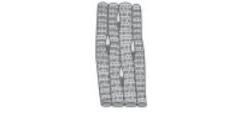
Q54. Identify the tissue shown in the diagram and match with its characteristcs and its location
Correct Answer: (a)
Skeletal muscle tissue is closely attached to skeletal bones. In a typical muscle such as the biceps, striated (striped) skeletal muscle fibres are bundled together in a parallel fashion.
Skeletal muscle tissue is closely attached to skeletal bones. In a typical muscle such as the biceps, striated (striped) skeletal muscle fibres are bundled together in a parallel fashion.
Q55. Compared to those of humans, the erythrocytes in frog are
Correct Answer: (b)
The erythrocytes or RBCs in frog are large, oval and biconvex nucleated cells with respiratory red pigment haemoglobin in its cytoplasm.
The erythrocytes or RBCs in frog are large, oval and biconvex nucleated cells with respiratory red pigment haemoglobin in its cytoplasm.
Q56. The terga, sterna and pleura of cockroach body are joined by :
Correct Answer: (b)
Between the various sclerite, a flexible membrane exists which is known as arthrodial membrane.
Between the various sclerite, a flexible membrane exists which is known as arthrodial membrane.