Q1. What is the role of NAD⁺ in cellular respiration?
Correct Answer: (b)
In cellular respiration, NAD⁺ act as an electron carrier.
In cellular respiration, NAD⁺ act as an electron carrier.
Q2. Maximum amount of energy/ATP is liberated on oxidation of
Correct Answer: (a)
Fats are used as respiratory substrates by a number of organisms because they contain more energy as compared to carbohydrates.
Fats are used as respiratory substrates by a number of organisms because they contain more energy as compared to carbohydrates.
Q3. The energy - releasing metabolic process in which substrate is oxidised without an external electron acceptor is called:
Correct Answer: (b)
The energy releasing metabolic process in which substrate is oxidised without an external electron acceptor is called fermentation.
The energy releasing metabolic process in which substrate is oxidised without an external electron acceptor is called fermentation.
Q4. In germinating seeds fatty acids are degraded exclusively in the
Correct Answer: (b)
In germinating seeds, fatty acids are degraded exclusively in the glyoxysomes. Glyoxylate cycle occurs in tissues rich in fats, such as those of germinating seeds; the enzymes involved in the cycle, which have not been found in mammals, are contained in organelles called glyoxysomes.
In germinating seeds, fatty acids are degraded exclusively in the glyoxysomes. Glyoxylate cycle occurs in tissues rich in fats, such as those of germinating seeds; the enzymes involved in the cycle, which have not been found in mammals, are contained in organelles called glyoxysomes.
Q5. Oxidative phosphorylation is production of
Correct Answer: (c)
Oxidative phosphorylation is the synthesis of energy rich ATP molecules with the help of energy liberated during oxidation of reduced co-enzymes produced in respiration. This process, which takes place in mitochondria, is the major source of ATP in aerobic organisms.
Oxidative phosphorylation is the synthesis of energy rich ATP molecules with the help of energy liberated during oxidation of reduced co-enzymes produced in respiration. This process, which takes place in mitochondria, is the major source of ATP in aerobic organisms.
Q6. In animal cells, the first stage of glucose breakdown is
Correct Answer: (b)
Glycolysis is the first step of respiration which occurs without requirement of O₂ and is common to both aerobic and anaerobic modes of respiration.
Glycolysis is the first step of respiration which occurs without requirement of O₂ and is common to both aerobic and anaerobic modes of respiration.
Q7. Incomplete oxidation of glucose into pyruvic acid with several intermediate steps is known as
Correct Answer: (b)
Glycolysis involves the process of partial oxidation of glucose or similar hexose sugar into two molecules of pyruvic acid through a series of ten enzyme mediated reactions.
Glycolysis involves the process of partial oxidation of glucose or similar hexose sugar into two molecules of pyruvic acid through a series of ten enzyme mediated reactions.
Q8. Fermentation products of Yeast are
Correct Answer: (d)
In alcoholic fermentation, the pyruvic acid from glycolysis loses one carbon in the form of carbon dioxide to form acetaldehyde, which is reduced to ethyl alcohol by NADH. This is the fermentation that commonly occurs in yeast.
In alcoholic fermentation, the pyruvic acid from glycolysis loses one carbon in the form of carbon dioxide to form acetaldehyde, which is reduced to ethyl alcohol by NADH. This is the fermentation that commonly occurs in yeast.
Q9. In which one of the following do the two names refer to one and the same thing ?
Correct Answer: (c)
TCA cycle is so called because the first stable product formed in the cycle is a tricarboxylic acid molecule, that is, citric acid. Hence, the name citric acid cycle. It is also called the Krebs cycle as it was discovered by Krebs.
TCA cycle is so called because the first stable product formed in the cycle is a tricarboxylic acid molecule, that is, citric acid. Hence, the name citric acid cycle. It is also called the Krebs cycle as it was discovered by Krebs.
Q10. Out of 38 ATP molecules produced per glucose, 32 ATP molecules are formed from NADH/ FADH₂ in
Correct Answer: (a)
Complete degradation of a molecule of glucose yields 38 ATP molecules. Out of these, 32 ATP molecules are produced through the electron transport system (respiratory chain).
Complete degradation of a molecule of glucose yields 38 ATP molecules. Out of these, 32 ATP molecules are produced through the electron transport system (respiratory chain).
Q11. R.Q. is ratio of
Correct Answer: (b)
Ratio of the volume of CO₂ produced to the volume of O₂ consumed in respiration over a period of time is known as respiratory quotient.
Ratio of the volume of CO₂ produced to the volume of O₂ consumed in respiration over a period of time is known as respiratory quotient.
Q12. The three boxes in this diagram represents the three major biosynthetic pathways in aerobic respiration. Arrows represents net reactants or products.
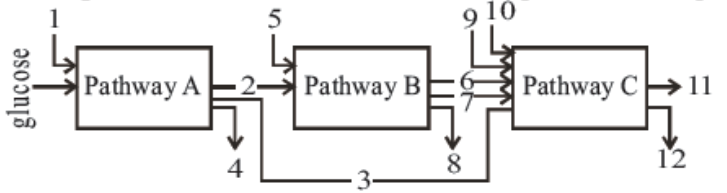
Arrows numbered 4, 8 and 12 can all be :
Arrows numbered 4, 8 and 12 can all be :
Correct Answer: (a)
Pathway A is glycolysis, pathway B is Kreb's cycle and pathway C is ETS , thus 4, 8 & 12 are ATP. ATP act as energy currency. The energy is trapped in form of ATP and it is broken down whenever and wherever it needs to be utilised.
Pathway A is glycolysis, pathway B is Kreb's cycle and pathway C is ETS , thus 4, 8 & 12 are ATP. ATP act as energy currency. The energy is trapped in form of ATP and it is broken down whenever and wherever it needs to be utilised.
Q13. The chemiosmotic coupling hypothesis of oxidative phosphorylation proposes that adenosine triphosphate (ATP) is formed because:
Correct Answer: (c)
Chemiosmotic theory states that as electrons are transferred along the electron carrier system in the inner mitochondrial membrane, hydrogen ions (protons) are actively transported into the space between the inner and outer mitochondrial membranes, which thus contains a higher concentration of protons than the matrix. This creates an electrochemical gradient, through which protons move back into the matrix. This releases energy, which is used to build ATP from ADP and inorganic phosphate.
Chemiosmotic theory states that as electrons are transferred along the electron carrier system in the inner mitochondrial membrane, hydrogen ions (protons) are actively transported into the space between the inner and outer mitochondrial membranes, which thus contains a higher concentration of protons than the matrix. This creates an electrochemical gradient, through which protons move back into the matrix. This releases energy, which is used to build ATP from ADP and inorganic phosphate.
Q14. Respiratory Quotient (RQ) value of tripalmitin is:
Correct Answer: (b)
Respiratory quotient may be defined as a ratio indicating the relation of the volume of carbon dioxide given off in respiration to that of the oxygen consumed. RQ for Tripalmitin = 102CO₂ / 145O₂ = 0.7
Respiratory quotient may be defined as a ratio indicating the relation of the volume of carbon dioxide given off in respiration to that of the oxygen consumed. RQ for Tripalmitin = 102CO₂ / 145O₂ = 0.7
Q15. Poisons like cyanide inhibit Na⁺ efflux and k⁺ influx during cellular transport. This inhibitory effect is reversed by an injection of ATP. This demonstrates that
Correct Answer: (a)
Active transport is the uphill movement of particles against their concentration gradient. Energy is utilised in the form of energy. Cyanide inhibits soluble absorption by lowering respiration rate leading to formation of less ATP.
Active transport is the uphill movement of particles against their concentration gradient. Energy is utilised in the form of energy. Cyanide inhibits soluble absorption by lowering respiration rate leading to formation of less ATP.
Q16. NADP⁺ is reduced to NADPH in
Correct Answer: (a)
Complete degradation of a molecule of glucose produces 12 molecules of NADPH₂ by HMP.
Complete degradation of a molecule of glucose produces 12 molecules of NADPH₂ by HMP.
Q17. The bacterium (Clostridium botulinum) that causes botulism is
Correct Answer: (a)
Clostridium botulinum is an obligate anaerobe i.e. it normally lives in the absence of oxygen. Facultative anaerobes are those who generally live in oxygen but may live without oxygen in special medium. Obligate aerobes can only live in the presence of oxygen while facultative aerobes generally live in oxygen but can also live without oxygen.
Clostridium botulinum is an obligate anaerobe i.e. it normally lives in the absence of oxygen. Facultative anaerobes are those who generally live in oxygen but may live without oxygen in special medium. Obligate aerobes can only live in the presence of oxygen while facultative aerobes generally live in oxygen but can also live without oxygen.
Q18. End product of citric acid/Krebs cycle is
Correct Answer: (d)
Krebs cycle (called after Hans Krebs) is also called as the citric acid cycle, and the tricarboxylic acid cycle (TCA cycle). It is the series of chemical reactions that produces two carbon dioxide molecules, one GTP/ATP, and reduced forms of NADH and FADH₂. It is used by all aerobic organisms to generate energy.
Krebs cycle (called after Hans Krebs) is also called as the citric acid cycle, and the tricarboxylic acid cycle (TCA cycle). It is the series of chemical reactions that produces two carbon dioxide molecules, one GTP/ATP, and reduced forms of NADH and FADH₂. It is used by all aerobic organisms to generate energy.
Q19. Terminal cytochrome of respiratory chain which donates electrons to oxygen is
Correct Answer: (d)
Terminal cytochrome is cyt a₃. It possesses two copper centres. It helps in transfer of electrons to oxygen.
Terminal cytochrome is cyt a₃. It possesses two copper centres. It helps in transfer of electrons to oxygen.
Q20. Net gain of ATP molecules during aerobic respiration is
Correct Answer: (a)
38 molecules of ATP are produced during aerobic respiration of 2 ATP are produced during link reaction. Hence net gain is of 36 ATP.
38 molecules of ATP are produced during aerobic respiration of 2 ATP are produced during link reaction. Hence net gain is of 36 ATP.
Q21. In Krebs cycle FAD participates as electron acceptor during the conversion of
Correct Answer: (c)
In the conversion of succinyl Co A to succinic acid, energy liberated during hydrolysis of succinyl Co A is used in synthesis of GTP. For the conversion of alfa-ketoglutarate to succinyl CoA, NAD⁺ and CoA are required. Conversion of fumaric acid to malic acid involves simple hydration. FAD participates in conversion of succinic acid to fumaric acid.
In the conversion of succinyl Co A to succinic acid, energy liberated during hydrolysis of succinyl Co A is used in synthesis of GTP. For the conversion of alfa-ketoglutarate to succinyl CoA, NAD⁺ and CoA are required. Conversion of fumaric acid to malic acid involves simple hydration. FAD participates in conversion of succinic acid to fumaric acid.
Q22. Conversion of glucose to glucose-6-phosphate, the first irreversible reaction of glycolysis, is catalysed by:
Correct Answer: (b)
Glycolysis is the anaerobic enzymatic conversion of glucose to lactate or pyruvate, resulting in energy stored in the form of ATP, as occurs in muscle. The two irreversible steps in Glycolysis are: (i) Conversion of glucose to glucose 6-phosphate, catalysed by hexokinase. It is the first step of activation phase of glycolysis. (ii) Conversion of fructose 6-phosphate to fructose 1,6 biphosphate catalysed by phosphofructokinase-1.
Glycolysis is the anaerobic enzymatic conversion of glucose to lactate or pyruvate, resulting in energy stored in the form of ATP, as occurs in muscle. The two irreversible steps in Glycolysis are: (i) Conversion of glucose to glucose 6-phosphate, catalysed by hexokinase. It is the first step of activation phase of glycolysis. (ii) Conversion of fructose 6-phosphate to fructose 1,6 biphosphate catalysed by phosphofructokinase-1.
Q23. In glycolysis, during oxidation electrons are removed by
Correct Answer: (c)
In glycolysis, during oxidation electrons are removed by NAD⁺. When 3-phosphoglyceraldehyde is converted into 1,3 diphosphoglyceric acid, two electrons and two protons are released which are utilised to convert NAD⁺ to NADH and one H⁺ NAD⁺ + 2H⁺ + 2e -> NADH + H⁺. ATP is the energy currency in all cells. Glyceraldehyde 3 - phosphate is reduced during glycolysis. Molecular oxygen is the terminal electron acceptor in ETS.
In glycolysis, during oxidation electrons are removed by NAD⁺. When 3-phosphoglyceraldehyde is converted into 1,3 diphosphoglyceric acid, two electrons and two protons are released which are utilised to convert NAD⁺ to NADH and one H⁺ NAD⁺ + 2H⁺ + 2e -> NADH + H⁺. ATP is the energy currency in all cells. Glyceraldehyde 3 - phosphate is reduced during glycolysis. Molecular oxygen is the terminal electron acceptor in ETS.
Q24. How many ATP molecules are produced by aerobic oxidation of one molecule of glucose?
Correct Answer: (c)
38 ATP molecules are produced by aerobic oxidation of glucose.
38 ATP molecules are produced by aerobic oxidation of glucose.
Q25. Krebs cycle occurs in
Correct Answer: (a)
Krebs cycle is the sequence of reactions by which most living cells generate energy during the process of aerobic respiration. It takes place in the mitochondria, using up oxygen and producing carbon dioxide and water as waste products, and ADP is converted to energy-rich ATP.
Krebs cycle is the sequence of reactions by which most living cells generate energy during the process of aerobic respiration. It takes place in the mitochondria, using up oxygen and producing carbon dioxide and water as waste products, and ADP is converted to energy-rich ATP.
Q26. End products of aerobic respiration are
Correct Answer: (c)
Aerobic respiration is an enzymatically controlled release of energy in a stepwise catabolic process of complete oxidation of organic substrate into CO₂ and H₂O with O₂ acting as the terminal oxidant.
Aerobic respiration is an enzymatically controlled release of energy in a stepwise catabolic process of complete oxidation of organic substrate into CO₂ and H₂O with O₂ acting as the terminal oxidant.
Q27. Where is the respiratory electron transport system (ETS) located in plants ?
Correct Answer: (d)
Electron transport system is located in inner mitochondrial membrane, where it serves as the site of oxidative phosphorylation through the action of ATP synthase.
Electron transport system is located in inner mitochondrial membrane, where it serves as the site of oxidative phosphorylation through the action of ATP synthase.
Q28. The energy-releasing process in which the substrate is oxidised without an external electron acceptor is called
Correct Answer: (a)
Aerobic respiration is the main energy-releasing pathway leading to ATP formation. It occurs in the mitochondria and yields thirty-six ATP.
Aerobic respiration is the main energy-releasing pathway leading to ATP formation. It occurs in the mitochondria and yields thirty-six ATP.
Q29. Respiratory substrate yielding maximum number of ATP molecule is
Correct Answer: (b)
Firstly, amylose and glycogen are converted to glucose. Deamination of ketogenic amino acids occur and these enter respiratory catabolism as intermediates.
Firstly, amylose and glycogen are converted to glucose. Deamination of ketogenic amino acids occur and these enter respiratory catabolism as intermediates.
Q30. Chemiosmotic theory of ATP synthesis in the chloroplasts and mitochondria is based on:
Correct Answer: (d)
Proton gradient is the product of the electron transport chain. Increased proton concentration is produced in the outer chamber of mitochondria or lumen of thylakoid.
Proton gradient is the product of the electron transport chain. Increased proton concentration is produced in the outer chamber of mitochondria or lumen of thylakoid.
Q31. When one glucose molecule is completely oxidised, it changes
Correct Answer: (b)
Complete oxidation of glucose produces 38 ATP molecules in aerobic respiration. The number of ATP molecules may however vary depending upon how NADH₂ enters mitochondria.
Complete oxidation of glucose produces 38 ATP molecules in aerobic respiration. The number of ATP molecules may however vary depending upon how NADH₂ enters mitochondria.
Q32. Fermentation is anaerobic production of
Correct Answer: (b)
Fermentation is referred to as the decomposition of organic compounds, anaerobically by enzymes yielding alcohol, organic acids; gases etc.
Fermentation is referred to as the decomposition of organic compounds, anaerobically by enzymes yielding alcohol, organic acids; gases etc.
Q33. Which of the metabolites is common to respiration mediated breakdown of fats, carbohydrates and proteins?
Correct Answer: (c)
Acetyl CoA is common to respiration mediated breakdown of fats, carbohydrates and proteins. Fats are broken down to fatty acid and glycerol and finally are degraded to acetyl Co - A. Protein first degraded by proteases to individual amino acids which are deaminated to pyruric acid and further decarboxylised to acetyl Co- A.
Acetyl CoA is common to respiration mediated breakdown of fats, carbohydrates and proteins. Fats are broken down to fatty acid and glycerol and finally are degraded to acetyl Co - A. Protein first degraded by proteases to individual amino acids which are deaminated to pyruric acid and further decarboxylised to acetyl Co- A.
Q34. All enzymes of TCA cycle are located in the mitochondrial matrix except one which is located in inner mitochondrial membranes in eukaryotes and in cytosol in prokaryotes. This enzyme is
Correct Answer: (c)
Succinate dehydrogenase (SDH) or succinate-coenzyme Q reductase (SQR) or respiratory Complex II is an enzyme complex, found in many bacterial cells and in the inner mitochondrial membrane of eukaryotes. It is the only enzyme that participates in both the citric acid cycle and the electron transport chain.
Succinate dehydrogenase (SDH) or succinate-coenzyme Q reductase (SQR) or respiratory Complex II is an enzyme complex, found in many bacterial cells and in the inner mitochondrial membrane of eukaryotes. It is the only enzyme that participates in both the citric acid cycle and the electron transport chain.
Q35. Site of respiration in bacteria is
Correct Answer: (c)
Mesosomes are the invaginations of the plasma membrane that can form into vesicles. They are found to be present in both gram-positive and gram-negative bacteria. Mesosomes play a major role in cell wall formation during cell division and/or chromosome replication and distribution and/or electron transfer systems of respiration.
Mesosomes are the invaginations of the plasma membrane that can form into vesicles. They are found to be present in both gram-positive and gram-negative bacteria. Mesosomes play a major role in cell wall formation during cell division and/or chromosome replication and distribution and/or electron transfer systems of respiration.
Q36. Which of these statements is incorrect?
Correct Answer: (c)
Oxidative phosphorylation takes place in inner mitochondrial membrane.
Oxidative phosphorylation takes place in inner mitochondrial membrane.
Q37. In which one of the following processes CO₂ is not released?
Correct Answer: (d)
Lactic acid fermentation occurs in lactic acid bacteria (Lactobacillus) and muscles (Human). Pyruvic acid produced in glycolysis is reduced by NADH₂ to form lactic acid without producing carbon dioxide. CH₃COCOOH + NADH₂ -> CH₃CHOHCOOH + NAD (Lactic acid)
Lactic acid fermentation occurs in lactic acid bacteria (Lactobacillus) and muscles (Human). Pyruvic acid produced in glycolysis is reduced by NADH₂ to form lactic acid without producing carbon dioxide. CH₃COCOOH + NADH₂ -> CH₃CHOHCOOH + NAD (Lactic acid)
Q38. The enzymes hexokinase which catalyses glucose to glucose-6-phosphate in glycolysis is inhibited by glucose-6-phosphate. This is an example of
Correct Answer: (c)
Competitive inhibition is the reversible inhibition of enzyme activity due to presence of substrate analogues. Allosteric inhibition is reversible noncompetitive inhibition occurring in case of allosteric enzymes. Herein, the inhibitors are the products or intermediates of reactions catalyzed by the enzymes. Hence, it is also called end product inhibition or feedback inhibition.
Competitive inhibition is the reversible inhibition of enzyme activity due to presence of substrate analogues. Allosteric inhibition is reversible noncompetitive inhibition occurring in case of allosteric enzymes. Herein, the inhibitors are the products or intermediates of reactions catalyzed by the enzymes. Hence, it is also called end product inhibition or feedback inhibition.
Q39. Which of the following is essential for conversion of pyruvic acid into acetyl Co-A?
Correct Answer: (d)
During aerobic oxidation of pyruvic acid, first of all there is activation of pyruvic acid in which NAD and coenzyme react with pyruvic acid and oxidative decarboxylation takes place leading to the formation of acetyl Co-A. In this process, lipoic acid amide (LAA), thiamine pyrophosphate (TPP) and NAD are essential to perform this reaction.
During aerobic oxidation of pyruvic acid, first of all there is activation of pyruvic acid in which NAD and coenzyme react with pyruvic acid and oxidative decarboxylation takes place leading to the formation of acetyl Co-A. In this process, lipoic acid amide (LAA), thiamine pyrophosphate (TPP) and NAD are essential to perform this reaction.
Q40. Phosphoenol Pyruvate (PEP) is the primary CO₂ acceptor in:
Correct Answer: (a)
In the mesophyll cells cytoplasm of C₄ plants like sugarcane, maize, sorghum etc. PEP is 3C compound which serves as primary CO₂ acceptor.
In the mesophyll cells cytoplasm of C₄ plants like sugarcane, maize, sorghum etc. PEP is 3C compound which serves as primary CO₂ acceptor.
Q41. The number of substrate level phosphorylations in one turn of citric acid cycle is
Correct Answer: (a)
One substrate level phosphorylation in one turn of citric acid cycle as per following reaction: Succinyl-CoA + GDP + Pi → Succinate + GTP.
One substrate level phosphorylation in one turn of citric acid cycle as per following reaction: Succinyl-CoA + GDP + Pi → Succinate + GTP.
Q42. Apparatus to measure rate of respiration and R.Q. is
Correct Answer: (c)
Respirometer is an instrument for measuring respiratory quotient as well as rate of respiration.
Respirometer is an instrument for measuring respiratory quotient as well as rate of respiration.
Q43. Aerobic respiratory pathway is appropriately termed:
Correct Answer: (b)
All energy-releasing pathways whether aerobic (requiring oxygen) or anaerobic (not requiring oxygen) begin with a pathway called glycolysis, which occurs in the cytoplasm (cytosol). Aerobic respiratory pathway is thus appropriately termed as amphibolic.
All energy-releasing pathways whether aerobic (requiring oxygen) or anaerobic (not requiring oxygen) begin with a pathway called glycolysis, which occurs in the cytoplasm (cytosol). Aerobic respiratory pathway is thus appropriately termed as amphibolic.
Q44. Which statement is wrong for Krebs' cycle ?
Correct Answer: (c)
Krebs cycle begins with condensation of acetyl CoA (2C) with oxaloacetic acid (4C) to form citric acid (6C).
Krebs cycle begins with condensation of acetyl CoA (2C) with oxaloacetic acid (4C) to form citric acid (6C).
Q45. During which stage in the complete oxidation of glucose are the greatest number of ATP molecules formed from ADP
Correct Answer: (d)
ATP molecules from ADP are generated in maximum number in electron transport chain.
ATP molecules from ADP are generated in maximum number in electron transport chain.
Q46. Which one of the following concerns photophosphorylation ?
Correct Answer: (c)
Photophosphorylation refers to addition of phosphate in the presence of light. (ADP + Inorganic PO₄ —Light energy→ ATP)
Photophosphorylation refers to addition of phosphate in the presence of light. (ADP + Inorganic PO₄ —Light energy→ ATP)
Q47. Respiratory quotient (R.Q.) for fatty acid is
Correct Answer: (b)
Respiratory quotient (R.Q.) is defined as the ratio of the molecules of carbon dioxide given out to the number of oxygen molecules taken in during respiration. Its value for fatty acids is always less than unity.
Respiratory quotient (R.Q.) is defined as the ratio of the molecules of carbon dioxide given out to the number of oxygen molecules taken in during respiration. Its value for fatty acids is always less than unity.
Q48. How many ATP molecules could maximally be generated from one molecule of glucose, if the complete oxidation of one mole of glucose to CO₂ and H₂O yields 686 kcal and the useful chemical energy available in the high energy phosphate bond of one mole of ATP is 12 kcal?
Correct Answer: (b)
12 kcal of energy present in one molecule of ATP & on oxidation of one mole of glucose into CO₂ and H₂O energy released is 686 kcal. So no. of ATP which can store this energy would be = 686/12 = 57.1 ≈ 57 ATPs.
12 kcal of energy present in one molecule of ATP & on oxidation of one mole of glucose into CO₂ and H₂O energy released is 686 kcal. So no. of ATP which can store this energy would be = 686/12 = 57.1 ≈ 57 ATPs.
Q49. Oxidative phosphorylation involves simultaneous oxidation and phosphorylation to finally form
Correct Answer: (d)
Oxidative phosphorylation is the synthesis of energy rich ATP from ADP and inorganic phosphate, that is related to oxidation of reduced coenzymes produced in cellular respiration.
Oxidative phosphorylation is the synthesis of energy rich ATP from ADP and inorganic phosphate, that is related to oxidation of reduced coenzymes produced in cellular respiration.
Q50. Life without air would be
Correct Answer: (d)
In anaerobic respiration, oxygen is not used in the breakdown of respiratory substrate.
In anaerobic respiration, oxygen is not used in the breakdown of respiratory substrate.
Q51. Maximum usable energy per mol of glucose metabolised will be generated during
Correct Answer: (a)
The energy yield during aerobic respiration (36 ATP) is 18 times of that during anaerobic respiration (2 ATP).
The energy yield during aerobic respiration (36 ATP) is 18 times of that during anaerobic respiration (2 ATP).
Q52. The overall goal of glycolysis, krebs cycle and the electron transport system is the formation of
Correct Answer: (d)
Glycolysis, Krebs cycle and electron transport system, they all give ATP which is the main energy currency of our body.
Glycolysis, Krebs cycle and electron transport system, they all give ATP which is the main energy currency of our body.
Q53. End product of glycolysis is
Correct Answer: (b)
The end product of glycolysis is pyruvic acid which is a three carbon compound.
The end product of glycolysis is pyruvic acid which is a three carbon compound.
Q54. The mechanism of ATP formation both in chloroplast and mitochondria is explained by
Correct Answer: (c)
According to the chemiosmotic theory the energy liberated during electron transport performs the osmotic work of accumulating H⁺ ions, conserving energy in building a proton gradient, which is used to build ATP from ADP and inorganic phosphate.
According to the chemiosmotic theory the energy liberated during electron transport performs the osmotic work of accumulating H⁺ ions, conserving energy in building a proton gradient, which is used to build ATP from ADP and inorganic phosphate.
Q55. During anaerobic digestion of organic waste, such as in producing biogas, which one of the following is left undegraded ?
Correct Answer: (c)
Lignin is a complex polymer of phenylpropane units, which are cross-linked to each other with a variety of different chemical bonds.
Lignin is a complex polymer of phenylpropane units, which are cross-linked to each other with a variety of different chemical bonds.
Q56. In alcoholic fermentation
Correct Answer: (b)
In alcohol fermentation triose phosphate is the electron donor while acetaldehyde is the electron acceptor.
In alcohol fermentation triose phosphate is the electron donor while acetaldehyde is the electron acceptor.
Q57. Connecting link between glycolysis and Krebs cycle is/before entering Krebs cycle pyruvate is changed to
Correct Answer: (d)
The end product of glycolysis is pyruvate. It enters mitochondria and is oxidatively decarboxylated to acetyl CoA before entering into Krebs cycle.
The end product of glycolysis is pyruvate. It enters mitochondria and is oxidatively decarboxylated to acetyl CoA before entering into Krebs cycle.
Q58. Out of 36 ATP molecules produced per glucose molecule during respiration
Correct Answer: (b)
2 ATP are produced during glycolysis (outside mitochondria). 34 ATP are produced by Krebs cycle, oxidative phosphorylation, and ETC inside the mitochondria.
2 ATP are produced during glycolysis (outside mitochondria). 34 ATP are produced by Krebs cycle, oxidative phosphorylation, and ETC inside the mitochondria.
Q59. R.Q. is
Correct Answer: (c)
Respiratory Quotient RQ = Volume of CO₂ evolved / Volume of O₂ absorbed. The current estimate is that about 30 molecules of ATP are produced when glucose is completely oxidised to CO₂.
Respiratory Quotient RQ = Volume of CO₂ evolved / Volume of O₂ absorbed. The current estimate is that about 30 molecules of ATP are produced when glucose is completely oxidised to CO₂.
Q60. EMP can produce a total of
Correct Answer: (b)
The net gain of energy in EMP pathway (glycolysis) is equal to 8 ATP in EMP pathway.
The net gain of energy in EMP pathway (glycolysis) is equal to 8 ATP in EMP pathway.