Q1. In case of a couple where the male is having a very low sperm count, which technique will be suitable for fertilisation?
Correct Answer: (b)
Artificial Insemination (AI) or Intrauterine Insemination (IUI) is chosen when the male partner suffers from oligospermia (low sperm count) or inability to inseminate the female partner.
Artificial Insemination (AI) or Intrauterine Insemination (IUI) is chosen when the male partner suffers from oligospermia (low sperm count) or inability to inseminate the female partner.
Q2. In which of the following techniques, the embryos are transferred to assist those females who cannot conceive?
Correct Answer: (d)
ZIFT (Zygote Intra Fallopian Transfer - embryo up to 8 blastomeres) and IUT (Intra Uterine Transfer - embryo with more than 8 blastomeres) are both Embryo Transfer (ET) procedures designed to assist infertile females.
ZIFT (Zygote Intra Fallopian Transfer - embryo up to 8 blastomeres) and IUT (Intra Uterine Transfer - embryo with more than 8 blastomeres) are both Embryo Transfer (ET) procedures designed to assist infertile females.
Q3. Which of the following sexually transmitted diseases do not specifically affect reproductive organs?
Correct Answer: (d)
AIDS affects the immune system by attacking T-helper cells, and Hepatitis B infects the liver causing hepatic damage. Neither produces primary lesions specifically localized to the reproductive organs.
AIDS affects the immune system by attacking T-helper cells, and Hepatitis B infects the liver causing hepatic damage. Neither produces primary lesions specifically localized to the reproductive organs.
Q4. Select the option including all sexually transmitted diseases.
Correct Answer: (d)
Gonorrhoea, Syphilis, and Genital herpes are all sexually transmitted diseases (STDs). Gonorrhoea is caused by the bacterium Neisseria gonorrhoeae, Syphilis is caused by Treponema pallidum, and Genital herpes is caused by Herpes simplex virus Type-II.
Gonorrhoea, Syphilis, and Genital herpes are all sexually transmitted diseases (STDs). Gonorrhoea is caused by the bacterium Neisseria gonorrhoeae, Syphilis is caused by Treponema pallidum, and Genital herpes is caused by Herpes simplex virus Type-II.
Q5. Medical Termination of Pregnancy (MTP) is considered safe up to how many weeks of pregnancy?
Correct Answer: (b)
MTP is considered relatively safe when performed during the first trimester, i.e., up to 12 weeks of pregnancy. It becomes significantly riskier during the second trimester.
MTP is considered relatively safe when performed during the first trimester, i.e., up to 12 weeks of pregnancy. It becomes significantly riskier during the second trimester.
Q6. Which one of the following statements is correct regarding Sexually Transmitted Diseases (STD)?
Correct Answer: (a)
Since STDs are primary transmitted through sexual contact, infected blood transfusions, or transplacental routes, a 5-year-old child has extremely minimal risk of acquiring an STD.
Since STDs are primary transmitted through sexual contact, infected blood transfusions, or transplacental routes, a 5-year-old child has extremely minimal risk of acquiring an STD.
Q7. Artificial insemination means:
Correct Answer: (b)
Artificial Insemination (AI) refers to the clinical procedure of collecting semen from a husband or healthy donor and manually introducing it into the vagina or uterus of the female.
Artificial Insemination (AI) refers to the clinical procedure of collecting semen from a husband or healthy donor and manually introducing it into the vagina or uterus of the female.
Q8. Assisted reproductive technology, IVF involves transfer of:
Correct Answer: (b)
In In-Vitro Fertilization (IVF), the zygote or early embryo (up to 8 blastomeres) is transferred directly into the fallopian tube (ZIFT).
In In-Vitro Fertilization (IVF), the zygote or early embryo (up to 8 blastomeres) is transferred directly into the fallopian tube (ZIFT).
Q9. Consider the statements given below regarding contraception and answer as directed thereafter:
(i) Medical Termination of Pregnancy (MTP) during first trimester is generally safe
(ii) Generally chances of conception are nil until mother breast-feeds the infant upto two years
(iii) Intrauterine devices like copper-T are effective contraceptives
(iv) Contraception pills may be taken upto one week after coitus to prevent conception
Which two of the above statements are correct?
(i) Medical Termination of Pregnancy (MTP) during first trimester is generally safe
(ii) Generally chances of conception are nil until mother breast-feeds the infant upto two years
(iii) Intrauterine devices like copper-T are effective contraceptives
(iv) Contraception pills may be taken upto one week after coitus to prevent conception
Which two of the above statements are correct?
Correct Answer: (c)
Statements (i) and (iii) are correct. MTP is safest in the first trimester (up to 12 weeks), and Copper-T is an effective IUD. Lactational amenorrhea is effective only up to maximum 6 months (not 2 years), and emergency contraceptive pills must be taken within 72 hours (not 1 week).
Statements (i) and (iii) are correct. MTP is safest in the first trimester (up to 12 weeks), and Copper-T is an effective IUD. Lactational amenorrhea is effective only up to maximum 6 months (not 2 years), and emergency contraceptive pills must be taken within 72 hours (not 1 week).
Q10. Which of the following sexually transmitted diseases is not completely curable?
Correct Answer: (c)
Genital herpes (caused by Herpes simplex virus), Hepatitis B, and HIV infections are viral STDs that are currently not completely curable.
Genital herpes (caused by Herpes simplex virus), Hepatitis B, and HIV infections are viral STDs that are currently not completely curable.
Q11. Select the hormone-releasing Intra-Uterine Devices.
Correct Answer: (c)
Progestasert and LNG-20 are hormone-releasing IUDs. They release synthetic progesterone to make the uterus unsuitable for implantation and the cervix hostile to sperms.
Progestasert and LNG-20 are hormone-releasing IUDs. They release synthetic progesterone to make the uterus unsuitable for implantation and the cervix hostile to sperms.
Q12. Hysterectomy is surgical removal of:
Correct Answer: (d)
Hysterectomy is the surgical procedure for the removal of the uterus. It is usually performed in cases of uterine fibroids, severe endometriosis, or cancers of the female reproductive tract.
Hysterectomy is the surgical procedure for the removal of the uterus. It is usually performed in cases of uterine fibroids, severe endometriosis, or cancers of the female reproductive tract.
Q13. The contraceptive 'SAHELI'
Correct Answer: (a)
Saheli is a non-steroidal oral contraceptive pill taken once a week. It contains centchroman, which acts as a selective estrogen receptor modulator (SERM) by blocking estrogen receptors in the uterus and preventing implantation.
Saheli is a non-steroidal oral contraceptive pill taken once a week. It contains centchroman, which acts as a selective estrogen receptor modulator (SERM) by blocking estrogen receptors in the uterus and preventing implantation.
Q14. In context of Amniocentesis, which of the following statement is incorrect?
Correct Answer: (d)
Amniocentesis is used for detecting chromosomal abnormalities (e.g., Down syndrome) and metabolic disorders in the fetus. Cleft palate is a anatomical/developmental defect which cannot be diagnosed by chromosomal analysis; it is detected using ultrasound imaging.
Amniocentesis is used for detecting chromosomal abnormalities (e.g., Down syndrome) and metabolic disorders in the fetus. Cleft palate is a anatomical/developmental defect which cannot be diagnosed by chromosomal analysis; it is detected using ultrasound imaging.
Q15. Which of the following approaches does not give the defined action of contraceptive?
Correct Answer: (d)
Vasectomy is a surgical method of male sterilization where the vas deferens is cut or tied to block sperm transport. It does not prevent spermatogenesis, as testes continue to produce sperms which are reabsorbed by the body.
Vasectomy is a surgical method of male sterilization where the vas deferens is cut or tied to block sperm transport. It does not prevent spermatogenesis, as testes continue to produce sperms which are reabsorbed by the body.
Q16. Ectopic pregnancies are referred to as:
Correct Answer: (a)
An ectopic pregnancy occurs when a fertilized egg implants and grows outside the uterine cavity, most commonly within the fallopian tubes.
An ectopic pregnancy occurs when a fertilized egg implants and grows outside the uterine cavity, most commonly within the fallopian tubes.
Q17. Test tube baby is one who
Correct Answer: (c)
A test-tube baby is produced by fertilizing an ovum with sperm outside the human body in vitro (laboratory glassware) and subsequently implanting the developing embryo into the mother's uterus.
A test-tube baby is produced by fertilizing an ovum with sperm outside the human body in vitro (laboratory glassware) and subsequently implanting the developing embryo into the mother's uterus.
Q18. The test-tube Baby Programme employs which one of the following techniques
Correct Answer: (d)
The Test-Tube Baby programme utilizes In-Vitro Fertilization (IVF) followed by Zygote Intra Fallopian Transfer (ZIFT) or Intra-Uterine Transfer (IUT).
The Test-Tube Baby programme utilizes In-Vitro Fertilization (IVF) followed by Zygote Intra Fallopian Transfer (ZIFT) or Intra-Uterine Transfer (IUT).
Q19. Which of the following is a hormone releasing Intra Uterine Device (IUD)?
Correct Answer: (b)
LNG-20 is a hormone-releasing Intra Uterine Device that secretes 20 μg of levonorgestrel per 24 hours, making the cervix hostile to sperms and endometrial lining unsuitable for implantation.
LNG-20 is a hormone-releasing Intra Uterine Device that secretes 20 μg of levonorgestrel per 24 hours, making the cervix hostile to sperms and endometrial lining unsuitable for implantation.
Q20. Which one of the following is the most widely accepted method of contraception in India, as at present?
Correct Answer: (d)
Intra Uterine Devices (IUDs) are currently the most widely accepted and popular method of contraception for females in India seeking to space children.
Intra Uterine Devices (IUDs) are currently the most widely accepted and popular method of contraception for females in India seeking to space children.
Q21. Given below are four methods (A-D) and their modes of action (a-d) in achieving contraception. Select their correct matching from the four options that follow:
| Method | Mode of Action |
|---|---|
| A. The pill | (a) Prevents sperms reaching cervix |
| B. Condom | (b) Prevents implantation |
| C. Vasectomy | (c) Prevents ovulation |
| D. Copper T | (d) Semen contains no sperms |
Correct Answer: (a)
Oral pills prevent ovulation and implantation; Condoms serve as physical barriers preventing sperm entry into the cervix; Vasectomy ensures semen contains no sperms; Copper-T increases sperm phagocytosis and prevents implantation.
Oral pills prevent ovulation and implantation; Condoms serve as physical barriers preventing sperm entry into the cervix; Vasectomy ensures semen contains no sperms; Copper-T increases sperm phagocytosis and prevents implantation.
Q22. The technique called gamete intrafallopian transfer (GIFT) is recommended for those females:
Correct Answer: (a)
GIFT is suitable for females who are unable to produce functional ova, but can provide a suitable internal environment for fertilization and embryonic development.
GIFT is suitable for females who are unable to produce functional ova, but can provide a suitable internal environment for fertilization and embryonic development.
Q23. Amniocentesis is a technique
Correct Answer: (b)
Amniocentesis involves withdrawing amniotic fluid containing fetal cells to analyze karyotypes for diagnosing chromosomal aberrations and fetal abnormalities.
Amniocentesis involves withdrawing amniotic fluid containing fetal cells to analyze karyotypes for diagnosing chromosomal aberrations and fetal abnormalities.
Q24. What is the figure given below showing in particular?
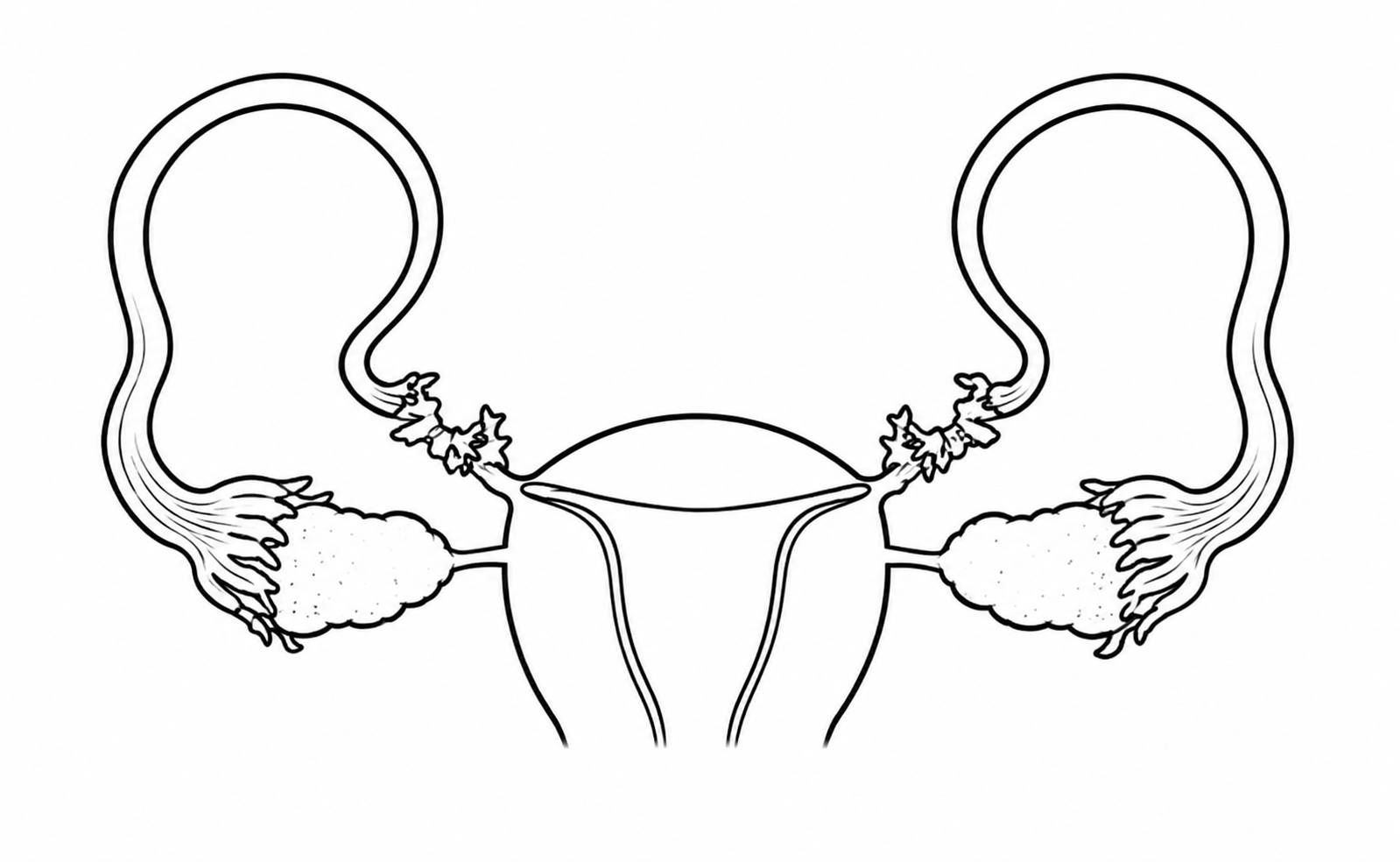
Correct Answer: (c)
The provided diagram illustrates tubectomy, where both fallopian tubes are cut and tied up to permanently prevent sperm from reaching the ovum.
The provided diagram illustrates tubectomy, where both fallopian tubes are cut and tied up to permanently prevent sperm from reaching the ovum.
Q25. Copper-T is a device that prevents
Correct Answer: (a)
Copper-T acts primarily by preventing fertilization through copper-ion toxicity to sperms, and secondarily by creating a local inflammatory response that inhibits implantation of the blastocyst.
Copper-T acts primarily by preventing fertilization through copper-ion toxicity to sperms, and secondarily by creating a local inflammatory response that inhibits implantation of the blastocyst.
Q26. A childless couple can be assisted to have a child through a technique called GIFT. The full form of this technique is :
Correct Answer: (a)
GIFT stands for Gamete Intra Fallopian Transfer, a technique where harvested ova and sperms are directly transferred into the fallopian tube of a female who cannot produce eggs.
GIFT stands for Gamete Intra Fallopian Transfer, a technique where harvested ova and sperms are directly transferred into the fallopian tube of a female who cannot produce eggs.
Q27. The function of copper ions in copper releasing IUD's is:
Correct Answer: (d)
Copper ions (Cu2+) released by non-medicated/copper-releasing IUDs (e.g., CuT, Multiload 375) suppress sperm motility and reduce the fertilising capacity of sperms.
Copper ions (Cu2+) released by non-medicated/copper-releasing IUDs (e.g., CuT, Multiload 375) suppress sperm motility and reduce the fertilising capacity of sperms.
Q28. The stage transferred into the uterus after induced fertilization of ova in the laboratory is
Correct Answer: (d)
During Intra-Uterine Transfer (IUT), embryos containing more than 8 blastomeres (such as a morula) are transferred directly into the uterine cavity.
During Intra-Uterine Transfer (IUT), embryos containing more than 8 blastomeres (such as a morula) are transferred directly into the uterine cavity.
Q29. One of the legal methods of birth control is:
Correct Answer: (d)
Medical Termination of Pregnancy (MTP) or induced abortion using prescribed medicines (like mifepristone and misoprostol) is a legal method of birth control under strict regulation in India.
Medical Termination of Pregnancy (MTP) or induced abortion using prescribed medicines (like mifepristone and misoprostol) is a legal method of birth control under strict regulation in India.
Q30. Which of the following cannot be detected in a developing foetus by amniocentesis?
Correct Answer: (c)
Amniocentesis samples fetal cells in amniotic fluid to analyze chromosomal patterns and genetic defects. Jaundice is a physiological condition involving liver dysfunction and bilirubin accumulation, not a genetic or chromosomal disorder.
Amniocentesis samples fetal cells in amniotic fluid to analyze chromosomal patterns and genetic defects. Jaundice is a physiological condition involving liver dysfunction and bilirubin accumulation, not a genetic or chromosomal disorder.
Q31. Cu ions released from copper - releasing Intra Uterine Devices (IUDs):
Correct Answer: (c)
Copper ions (Cu2+) continuously released from copper-releasing IUDs suppress sperm motility and impair their fertilising capacity within the female tract.
Copper ions (Cu2+) continuously released from copper-releasing IUDs suppress sperm motility and impair their fertilising capacity within the female tract.
Q32. Which of the following contraceptive methods do involve a role of hormone?
Correct Answer: (a)
Lactational amenorrhea relies on high prolactin levels during intense lactation to inhibit gonadotropins (and thus ovulation). Oral contraceptives (Pills) and Emergency contraceptives use progestogens or progestogen-estrogen combinations to prevent conception.
Lactational amenorrhea relies on high prolactin levels during intense lactation to inhibit gonadotropins (and thus ovulation). Oral contraceptives (Pills) and Emergency contraceptives use progestogens or progestogen-estrogen combinations to prevent conception.
Q33. Tubectomy is a method of sterilization in which:
Correct Answer: (a)
Tubectomy is a surgical contraceptive method for females where a small segment of each fallopian tube is cut and tied up to block egg transport and prevent fertilization.
Tubectomy is a surgical contraceptive method for females where a small segment of each fallopian tube is cut and tied up to block egg transport and prevent fertilization.
Q34. The permissible use of the technique amniocentesis is for
Correct Answer: (d)
Amniocentesis is legally permitted only for detecting chromosomal anomalies, genetic defects (such as Down syndrome, cystic fibrosis), or metabolic disorders in the unborn fetus.
Amniocentesis is legally permitted only for detecting chromosomal anomalies, genetic defects (such as Down syndrome, cystic fibrosis), or metabolic disorders in the unborn fetus.
Q35. One of the following is not a method of contraception—which one?
Correct Answer: (c)
Oxytocin stimulates uterine smooth muscle contractions during labor, and vasopressin (ADH) regulates water reabsorption in kidneys. Neither is used as a contraceptive agent.
Oxytocin stimulates uterine smooth muscle contractions during labor, and vasopressin (ADH) regulates water reabsorption in kidneys. Neither is used as a contraceptive agent.
Q36. Which of the following is a correct statement?
Correct Answer: (d)
IUDs (Intra Uterine Devices) act as foreign bodies in the uterus, inviting phagocytic cells that increase the phagocytosis of sperms. Additionally, Cu-releasing IUDs suppress sperm motility and fertilising capacity.
IUDs (Intra Uterine Devices) act as foreign bodies in the uterus, inviting phagocytic cells that increase the phagocytosis of sperms. Additionally, Cu-releasing IUDs suppress sperm motility and fertilising capacity.