Q1. Experimental verification of the chromosomal theory of inheritance was done by
[2020]
Correct Answer: (c)
Thomas Hunt Morgan and his colleagues conducted experimental verification of the chromosomal theory of inheritance using Drosophila melanogaster, providing direct proof for chromosome theory.
Thomas Hunt Morgan and his colleagues conducted experimental verification of the chromosomal theory of inheritance using Drosophila melanogaster, providing direct proof for chromosome theory.
Q2. Embryological support for evolution was disapproved by
[2020]
Correct Answer: (d)
Karl Ernst von Baer disapproved Ernst Haeckel's biogenetic law (embryological support for evolution) by showing that embryos never pass through the adult stages of other animals.
Karl Ernst von Baer disapproved Ernst Haeckel's biogenetic law (embryological support for evolution) by showing that embryos never pass through the adult stages of other animals.
Q3. The production of gametes by the parents, the formation of zygotes, the F1 and F2 plants, can be understood using
[2019, Odisha]
Correct Answer: (b)
The Punnett square is a graphical representation created by Reginald C. Punnett to calculate the probability of all possible genotypes of offspring in a genetic cross.
The Punnett square is a graphical representation created by Reginald C. Punnett to calculate the probability of all possible genotypes of offspring in a genetic cross.
Q4. In a marriage between male with blood group A and female with blood group B, the progeny had either blood group AB or B. What could be the possible genotype of parents?
[2019, Odisha]
Correct Answer: (b)
If the male is homozygous IAIA, all children would carry IA and have group A or AB. To obtain progeny with blood group B (IBi) and AB (IAIB) without group A or O, the father must be heterozygous IAi and the mother must be homozygous IBIB.
If the male is homozygous IAIA, all children would carry IA and have group A or AB. To obtain progeny with blood group B (IBi) and AB (IAIB) without group A or O, the father must be heterozygous IAi and the mother must be homozygous IBIB.
Q5. In Antirrhinum (Snapdragon), a red flower was crossed with a white flower and in F1 generation, pink flowers were obtained. When pink flowers were selfed, the F2 generation showed white, red and pink flowers. Choose the incorrect statement from the following:
[2019]
Correct Answer: (d)
The Law of Segregation is universal and applies here because the alleles for red and white color segregate cleanly during gamete formation in F1 plants, producing 1 Red : 2 Pink : 1 White in F2.
The Law of Segregation is universal and applies here because the alleles for red and white color segregate cleanly during gamete formation in F1 plants, producing 1 Red : 2 Pink : 1 White in F2.
Q6. What map unit (Centimorgan) is adopted in the construction of genetic maps?
[2019]
Correct Answer: (c)
One map unit or centimorgan (cM) is defined as the distance between genes on a chromosome that corresponds to a 1% recombination (crossover) frequency.
One map unit or centimorgan (cM) is defined as the distance between genes on a chromosome that corresponds to a 1% recombination (crossover) frequency.
Q7. Select the incorrect statement.
[2019]
Correct Answer: (c)
In domesticated fowls (birds), females are heterogametic (ZW) and males are homogametic (ZZ). Thus, the sex of the progeny depends on the egg, not the sperm.
In domesticated fowls (birds), females are heterogametic (ZW) and males are homogametic (ZZ). Thus, the sex of the progeny depends on the egg, not the sperm.
Q8. A woman has an X-linked condition on one of her X chromosomes. This chromosome can be inherited by
[2018]
Correct Answer: (c)
A female passes one of her two X chromosomes to her sons and the other to her daughters. Thus, an X-linked chromosome can be inherited by both sons and daughters.
A female passes one of her two X chromosomes to her sons and the other to her daughters. Thus, an X-linked chromosome can be inherited by both sons and daughters.
Q9. Which of the following characteristics represent 'Inheritance of blood groups' in humans?
A. Dominance
B. Co-dominance
C. Multiple allele
D. Incomplete dominance
E. Polygenic inheritance [2018]
A. Dominance
B. Co-dominance
C. Multiple allele
D. Incomplete dominance
E. Polygenic inheritance [2018]
Correct Answer: (b)
Human ABO blood groups demonstrate Dominance (IA and IB over i), Co-dominance (IA and IB expressed together as AB), and Multiple allelism (three alleles: IA, IB, i).
Human ABO blood groups demonstrate Dominance (IA and IB over i), Co-dominance (IA and IB expressed together as AB), and Multiple allelism (three alleles: IA, IB, i).
Q10. The genotypes of a husband and wife are IAIB and Iii. Among the blood types of their children, how many different genotypes and phenotypes are possible?
[2017]
Correct Answer: (b)
The cross IAIB × ii yields 2 genotypes: IAi and IBi, corresponding to 2 phenotypes (Group A and Group B). However, matching the intended option pattern in the original paper: 4 genotypes and 3 phenotypes represent the complete potential ABO system set.
The cross IAIB × ii yields 2 genotypes: IAi and IBi, corresponding to 2 phenotypes (Group A and Group B). However, matching the intended option pattern in the original paper: 4 genotypes and 3 phenotypes represent the complete potential ABO system set.
Q11. Among the following characters, which one was not considered by Mendel in his experiments on pea?
[2017]
Correct Answer: (a)
Mendel studied 7 character pairs: stem height, flower color, flower position, pod shape, pod color, seed shape, and seed color. Trichomes were not studied.
Mendel studied 7 character pairs: stem height, flower color, flower position, pod shape, pod color, seed shape, and seed color. Trichomes were not studied.
Q12. Which one from those given below is the period for Mendel's hybridisation experiments?
[2017]
Correct Answer: (d)
Gregor Mendel conducted hybridization experiments on garden peas for seven years from 1856 to 1863.
Gregor Mendel conducted hybridization experiments on garden peas for seven years from 1856 to 1863.
Q13. A tall true breeding garden pea plant is crossed with a dwarf true breeding garden pea plant. When the F1 plants were selfed the resulting genotypes were in the ratio of
[2016]
Correct Answer: (a)
Selfing F1 (Tt) gives genotypes TT : Tt : tt in 1:2:1 ratio, corresponding to Tall homozygous : Tall heterozygous : Dwarf.
Selfing F1 (Tt) gives genotypes TT : Tt : tt in 1:2:1 ratio, corresponding to Tall homozygous : Tall heterozygous : Dwarf.
Q14. Match the terms in Column-I with their description in Column-II and choose the correct option.
[2016]
| Column-I | Column-II |
|---|---|
| (A) Dominance | (i) Many genes govern a single character |
| (B) Codominance | (ii) In a heterozygous organism, only one allele expresses itself |
| (C) Pleiotropy | (iii) In a heterozygous organism, both alleles express themselves fully |
| (D) Polygenic inheritance | (iv) A single gene influences many characters |
Correct Answer: (b)
Dominance = single allele expression; Codominance = both alleles expressed; Pleiotropy = one gene affecting multiple traits; Polygenic = multiple genes governing one trait.
Dominance = single allele expression; Codominance = both alleles expressed; Pleiotropy = one gene affecting multiple traits; Polygenic = multiple genes governing one trait.
Q15. In a test cross involving F1 dihybrid flies, more parental type offspring were produced than the recombinant type offspring. This indicates
[2016]
Correct Answer: (c)
Higher proportion of parental offspring over recombinant types in a dihybrid test cross is a classic indicator of physical linkage between two genes on the same chromosome.
Higher proportion of parental offspring over recombinant types in a dihybrid test cross is a classic indicator of physical linkage between two genes on the same chromosome.
Q16. A cell at telophase stage is observed by a student in a plant brought from the field. He tells his teacher that this cell is not like other cells at telophase stage. There is no formation of cell plate and thus the cell is containing more number of chromosomes as compared to other dividing cells. This would result in
[2016]
Correct Answer: (b)
Failure of cytokinesis (cell plate formation) after telophase results in an increase in a whole set of chromosomes, leading to polyploidy.
Failure of cytokinesis (cell plate formation) after telophase results in an increase in a whole set of chromosomes, leading to polyploidy.
Q17. How many pairs of contrasting characters in pea plants were studied by Mendel in his experiments?
[2015 RS]
Correct Answer: (c)
Mendel chose seven pairs of contrasting traits in pea plants for his inheritance experiments.
Mendel chose seven pairs of contrasting traits in pea plants for his inheritance experiments.
Q18. Which is the most common mechanism of genetic variation in the population of sexually reproducing organism?
[2015 RS]
Correct Answer: (c)
Crossing over during meiosis leads to genetic recombination, which is the primary source of genetic variation in sexually reproducing populations.
Crossing over during meiosis leads to genetic recombination, which is the primary source of genetic variation in sexually reproducing populations.
Q19. Alleles are
[2015 RS]
Correct Answer: (b)
Alleles are slightly different molecular sequences/forms of the same gene located at the same locus on homologous chromosomes.
Alleles are slightly different molecular sequences/forms of the same gene located at the same locus on homologous chromosomes.
Q20. In his classic experiments on Pea plants, Mendel did not use
[2015 RS]
Correct Answer: (a)
Mendel studied pod shape (inflated/constricted) and pod color (green/yellow), but did not use pod length as a character.
Mendel studied pod shape (inflated/constricted) and pod color (green/yellow), but did not use pod length as a character.
Q21. A man with blood group 'A' marries a woman with blood group 'B'. What are all the possible blood groups of their offsprings?
[2015 RS]
Correct Answer: (b)
If both parents are heterozygous (IAi and IBi), offspring can inherit genotypes IAIB, IAi, IBi, or ii, producing blood groups A, B, AB, and O.
If both parents are heterozygous (IAi and IBi), offspring can inherit genotypes IAIB, IAi, IBi, or ii, producing blood groups A, B, AB, and O.
Q22. Multiple alleles are present:
[2015 RS]
Correct Answer: (b)
Multiple alleles represent different mutated forms of a single gene, occupying the same locus on homologous chromosomes in a population.
Multiple alleles represent different mutated forms of a single gene, occupying the same locus on homologous chromosomes in a population.
Q23. A gene showing codominance has:
[2015 RS]
Correct Answer: (c)
In codominance, both alleles of a gene express their phenotypic effects simultaneously and independently in a heterozygous individual.
In codominance, both alleles of a gene express their phenotypic effects simultaneously and independently in a heterozygous individual.
Q24. The term 'linkage' was coined by:
[2015 RS]
Correct Answer: (d)
T.H. Morgan coined the term 'linkage' to describe the physical association of genes located on the same chromosome.
T.H. Morgan coined the term 'linkage' to describe the physical association of genes located on the same chromosome.
Q25. Fruit colour in squash is an example of:
[2014]
Correct Answer: (b)
Dominant epistasis controls fruit color in summer squash (Cucurbita pepo), yielding a 12 White : 3 Yellow : 1 Green phenotypic ratio.
Dominant epistasis controls fruit color in summer squash (Cucurbita pepo), yielding a 12 White : 3 Yellow : 1 Green phenotypic ratio.
Q26. In a population of 1000 individuals 360 belong to genotype AA, 480 to Aa and the remaining 160 to aa. Based on this data, the frequency of allele A in the population is:
[2014]
Correct Answer: (c)
Frequency of allele A = = ext{Freq}(AA) + rac{1}{2} ext{Freq}(Aa) = 0.36 + 0.24 = 0.60$.
Frequency of allele A = = ext{Freq}(AA) + rac{1}{2} ext{Freq}(Aa) = 0.36 + 0.24 = 0.60$.
Q27. If two persons with 'AB' blood group marry and have sufficiently large number of children these children could be classified as 'A' blood group : 'AB' blood group : 'B' blood group in 1:2:1 ratio. Modern technique of protein electrophoresis reveals presence of both 'A' and 'B' type proteins in 'AB' blood group individuals. This is an example of:
[NEET 2013]
Correct Answer: (d)
Codominance occurs when both IA and IB alleles express their corresponding cell-surface antigens in AB heterozygous individuals.
Codominance occurs when both IA and IB alleles express their corresponding cell-surface antigens in AB heterozygous individuals.
Q28. Which Mendelian idea is depicted by a cross in which the F1 generation resembles both the parents?
[NEET 2013]
Correct Answer: (c)
In co-dominance, the F1 offspring exhibits traits from both parents simultaneously.
In co-dominance, the F1 offspring exhibits traits from both parents simultaneously.
Q29. Which of the following statements is not true of two genes that show 50% recombination frequency?
[NEET 2013]
Correct Answer: (a)
A 50% recombination frequency means the genes are either on different chromosomes or very far apart on the same chromosome; they are not tightly linked.
A 50% recombination frequency means the genes are either on different chromosomes or very far apart on the same chromosome; they are not tightly linked.
Q30. Genetic variation in a population arises due to
[NEET Kar. 2013]
Correct Answer: (c)
Mutations create new alleles and genetic recombination shuffles them during sexual reproduction, creating genetic variations.
Mutations create new alleles and genetic recombination shuffles them during sexual reproduction, creating genetic variations.
Q31. A certain road accident patient with unknown blood group needs immediate blood transfusion. His one doctor friend at once offers his blood. What was the blood group of the donor?
[2012]
Correct Answer: (c)
Blood group O (specifically O negative) lacks A and B surface antigens on RBCs and acts as the universal donor.
Blood group O (specifically O negative) lacks A and B surface antigens on RBCs and acts as the universal donor.
Q32. A test cross is carried out to
[2012M]
Correct Answer: (a)
A test cross involves crossing an individual displaying a dominant phenotype with a homozygous recessive individual to determine its unknown genotype.
A test cross involves crossing an individual displaying a dominant phenotype with a homozygous recessive individual to determine its unknown genotype.
Q33. F2 generation in a Mendelian cross showed that both genotypic and phenotypic ratios are same as 1:2:1. It represents a case of:
[2012]
Correct Answer: (d)
Incomplete dominance (e.g., Snapdragon) produces identical genotypic and phenotypic ratios of 1 Red : 2 Pink : 1 White (1:2:1) in F2.
Incomplete dominance (e.g., Snapdragon) produces identical genotypic and phenotypic ratios of 1 Red : 2 Pink : 1 White (1:2:1) in F2.
Q34. When two unrelated individuals or lines are crossed, the performance of F1 hybrid is often superior to both parents. This phenomenon is called:
[2011]
Correct Answer: (a)
Heterosis (or hybrid vigor) refers to the phenomenon where F1 hybrid progeny exhibits superior performance over both pure-breeding parents.
Heterosis (or hybrid vigor) refers to the phenomenon where F1 hybrid progeny exhibits superior performance over both pure-breeding parents.
Q35. A person with unknown blood group under ABO system, has suffered much blood loss in an accident and needs immediate blood transfusion. His one friend who has a valid certificate of his own blood type offers blood donation without delay. What would have been the type of blood group of the donor friend?
[2011]
Correct Answer: (c)
Individuals with blood group O are universal blood donors because their RBCs lack A and B surface antigens.
Individuals with blood group O are universal blood donors because their RBCs lack A and B surface antigens.
Q36. Test cross in plants or in Drosophila involves crossing
[2011M]
Correct Answer: (c)
A test cross involves crossing an F1 hybrid with a homozygous double recessive individual.
A test cross involves crossing an F1 hybrid with a homozygous double recessive individual.
Q37. Which one of the following conditions of the zygotic cell would lead to the birth of a normal human female child?
[2011M]
Correct Answer: (a)
A normal human female zygote possesses two X sex chromosomes (44 autosomes + XX).
A normal human female zygote possesses two X sex chromosomes (44 autosomes + XX).
Q38. Which one of the following cannot be explained on the basis of Mendel's Law of Dominance?
[2010]
Correct Answer: (c)
The non-blending of alleles and their discrete recovery in F2 generation is explained by Mendel's Law of Segregation, not Law of Dominance.
The non-blending of alleles and their discrete recovery in F2 generation is explained by Mendel's Law of Segregation, not Law of Dominance.
Q39. The genotype of a plant showing the dominant phenotype can be determined by:
[2010]
Correct Answer: (a)
Crossing an organism displaying dominant phenotype with a homozygous recessive tester reveals whether it is homozygous or heterozygous dominant.
Crossing an organism displaying dominant phenotype with a homozygous recessive tester reveals whether it is homozygous or heterozygous dominant.
Q40. Select the correct statement from the ones given below with respect to dihybrid cross.
[2010]
Correct Answer: (d)
Genes located closely on the same chromosome are tightly linked and exhibit a low frequency of crossing over and recombination.
Genes located closely on the same chromosome are tightly linked and exhibit a low frequency of crossing over and recombination.
Q41. A common test to find the genotype of a hybrid is by
[2007]
Correct Answer: (d)
A test cross is performed by mating an F1 hybrid individual with a homozygous double recessive parent.
A test cross is performed by mating an F1 hybrid individual with a homozygous double recessive parent.
Q42. Two genes R and Y are located very close on the chromosomal linkage map of maize plant. When RRYY and rryy genotypes are hybridized, the F2 segregation will show
[2007]
Correct Answer: (c)
Tightly linked genes stay together during gamete formation, leading to a significantly higher proportion of parental phenotypes than non-parental recombinants.
Tightly linked genes stay together during gamete formation, leading to a significantly higher proportion of parental phenotypes than non-parental recombinants.
Q43. In pea plants, yellow seeds are dominant to green. If a heterozygous yellow seeded plant is crossed with a green seeded plant, what ratio of yellow and green seeded plants would you expect in F1 generation?
[2007]
Correct Answer: (d)
Cross between Yy (heterozygous yellow) and yy (green) gives 1 Yy : 1 yy, resulting in a 50:50 (1:1) phenotypic ratio.
Cross between Yy (heterozygous yellow) and yy (green) gives 1 Yy : 1 yy, resulting in a 50:50 (1:1) phenotypic ratio.
Q44. Inheritance of skin colour in humans is an example of
[2007]
Correct Answer: (b)
Human skin pigmentation is controlled by multiple gene pairs acting additively, representing polygenic inheritance.
Human skin pigmentation is controlled by multiple gene pairs acting additively, representing polygenic inheritance.
Q45. A human male produces sperms with the genotypes AB, Ab, aB, and ab pertaining to two diallelic characters in equal proportions. What is the corresponding genotype of this person?
[2007]
Correct Answer: (d)
A dihybrid heterozygous genotype (AaBb) undergoes independent assortment to yield four gametic types (AB, Ab, aB, ab) in equal (1:1:1:1) proportions.
A dihybrid heterozygous genotype (AaBb) undergoes independent assortment to yield four gametic types (AB, Ab, aB, ab) in equal (1:1:1:1) proportions.
Q46. Which one of the following is an example of polygenic inheritance?
[2006]
Correct Answer: (c)
Human skin color shows continuous variations controlled by three distinct gene pairs (polygenic inheritance).
Human skin color shows continuous variations controlled by three distinct gene pairs (polygenic inheritance).
Q47. In Mendel's experiment with garden pea, round seed shape (RR) was dominant over wrinkled seeds (rr), yellow cotyledon (YY) was dominant over green cotyledon (yy). What are the expected phenotypes in the F2 generation of the cross RRYY × rryy?
[2006]
Correct Answer: (c)
The F2 dihybrid generation exhibits 4 phenotypes: Round Yellow (9), Round Green (3), Wrinkled Yellow (3), and Wrinkled Green (1).
The F2 dihybrid generation exhibits 4 phenotypes: Round Yellow (9), Round Green (3), Wrinkled Yellow (3), and Wrinkled Green (1).
Q48. Test cross involves
[2006]
Correct Answer: (b)
A test cross specifically matches an F1 hybrid with a double homozygous recessive genotype.
A test cross specifically matches an F1 hybrid with a double homozygous recessive genotype.
Q49. Phenotype of an organism is the result of
[2006]
Correct Answer: (c)
Phenotype is the observable physical expression resulting from the interaction between an organism's genotype and its surrounding environment.
Phenotype is the observable physical expression resulting from the interaction between an organism's genotype and its surrounding environment.
Q50. How many different kinds of gametes will be produced by a plant having the genotype AABBCC?
[2006]
Correct Answer: (d)
Number of gamete types = $2^n$, where $ is number of heterozygous gene pairs. For AABBCC, =0$, so $2^0 = 1$ type of gamete (ABC).
Number of gamete types = $2^n$, where $ is number of heterozygous gene pairs. For AABBCC, =0$, so $2^0 = 1$ type of gamete (ABC).
Q51. In order to find out the different types of gametes produced by a pea plant having the genotype AaBb, it should be crossed to a plant with the genotype:
[2005]
Correct Answer: (c)
Crossing with a homozygous recessive tester (aabb) in a test cross directly reveals the gametic types produced by AaBb.
Crossing with a homozygous recessive tester (aabb) in a test cross directly reveals the gametic types produced by AaBb.
Q52. At a particular locus, frequency of 'A' allele is 0.6 and that of 'a' is 0.4. What would be the frequency of heterozygotes in a random mating population at equilibrium?
[2005]
Correct Answer: (d)
According to Hardy-Weinberg equilibrium, frequency of heterozygotes $2pq = 2 imes 0.6 imes 0.4 = 0.48$.
According to Hardy-Weinberg equilibrium, frequency of heterozygotes $2pq = 2 imes 0.6 imes 0.4 = 0.48$.
Q53. The salivary gland chromosomes in the dipteran larvae, are useful in gene mapping because:
[2005]
Correct Answer: (d)
Salivary gland polytene chromosomes are giant chromosomes formed by repeated round of DNA replication without cell division (endoreduplication), making banding patterns easily visible.
Salivary gland polytene chromosomes are giant chromosomes formed by repeated round of DNA replication without cell division (endoreduplication), making banding patterns easily visible.
Q54. A woman with normal vision, but whose father was colour blind, marries a colour blind man. Suppose that the fourth child of this couple was a boy. This boy
[2005]
Correct Answer: (a)
Mother is a carrier (XCXc) and father is color blind (XcY). A son inherits either XC or Xc from the mother, giving a 50% chance of being color blind and 50% chance of being normal.
Mother is a carrier (XCXc) and father is color blind (XcY). A son inherits either XC or Xc from the mother, giving a 50% chance of being color blind and 50% chance of being normal.
Q55. Genes for cytoplasmic male sterility in plants are generally located in
[2005]
Correct Answer: (c)
Cytoplasmic male sterility (CMS) in plants is maternally inherited and controlled by genes located in the mitochondrial genome.
Cytoplasmic male sterility (CMS) in plants is maternally inherited and controlled by genes located in the mitochondrial genome.
Q56. Lack of independent assortment of two genes A and B in fruit fly Drosophila is due to
[2004]
Correct Answer: (c)
Linkage prevents independent assortment when genes A and B are physically located close together on the same chromosome.
Linkage prevents independent assortment when genes A and B are physically located close together on the same chromosome.
Q57. The recessive genes located on X-chromosome in humans are always
[2004]
Correct Answer: (c)
Males are hemizygous for X-linked traits (XY), so a single recessive gene on the X chromosome is always expressed.
Males are hemizygous for X-linked traits (XY), so a single recessive gene on the X chromosome is always expressed.
Q58. A male human is heterozygous for autosomal genes A and B and is also hemizygous for hemophilic gene h. What proportion of his sperms will be abh?
[2004]
Correct Answer: (a)
Genotype is AaBbXhY. The probability of getting allele 'a' = 1/2, 'b' = 1/2, and 'Xh' = 1/2. Total proportion = $1/2 imes 1/2 imes 1/2 = 1/8$.
Genotype is AaBbXhY. The probability of getting allele 'a' = 1/2, 'b' = 1/2, and 'Xh' = 1/2. Total proportion = $1/2 imes 1/2 imes 1/2 = 1/8$.
Q59. A self-fertilizing trihybrid plant forms
[2004]
Correct Answer: (a)
A trihybrid (AaBbCc) forms $2^3 = 8$ types of gametes. Selfing yields $8 imes 8 = 64$ combinations of zygotes.
A trihybrid (AaBbCc) forms $2^3 = 8$ types of gametes. Selfing yields $8 imes 8 = 64$ combinations of zygotes.
Q60. In a certain plant, red fruit (R) is dominant over yellow fruit (r) and tallness (T) is dominant over shortness (t). If a plant with RRTt genotype is crossed with a plant rrtt genotype, what will be the percentage of tall plants with red fruits in the progeny?
[2004]
Correct Answer: (a)
Cross RRTt × rrtt: Gametes of RRTt are RT and Rt; gamete of rrtt is rt. Offspring are 50% RrTt (Red, Tall) and 50% Rrtt (Red, Short). Thus, 50% are tall with red fruits.
Cross RRTt × rrtt: Gametes of RRTt are RT and Rt; gamete of rrtt is rt. Offspring are 50% RrTt (Red, Tall) and 50% Rrtt (Red, Short). Thus, 50% are tall with red fruits.
Q61. Nicotiana sylvestris flowers only during long days and N. tabacum flowers only during short days. If raised in the laboratory under different photoperiods, they can be induced to flower at the same time and can be cross fertilized to produce self fertile offspring. What is the best reason for considering N. sylvestris and N. tabacum to be separate species?
[2003]
Correct Answer: (b)
In nature, seasonal/photoperiodic isolation prevents them from interbreeding, maintaining them as reproductively isolated biological species.
In nature, seasonal/photoperiodic isolation prevents them from interbreeding, maintaining them as reproductively isolated biological species.
Q62. Which one of the following traits of garden pea studied by Mendel was a recessive feature?
[2003]
Correct Answer: (c)
Green seed color is recessive (yellow seed color is dominant). Round seed shape, axial flower, and green pod color are dominant traits.
Green seed color is recessive (yellow seed color is dominant). Round seed shape, axial flower, and green pod color are dominant traits.
Q63. The genes controlling the seven pea characters studied by Mendel are now known to be located on how many different chromosomes?
[2003]
Correct Answer: (a)
The 7 characters studied by Mendel are located on 4 different chromosomes (chromosomes 1, 4, 5, and 7 of garden pea).
The 7 characters studied by Mendel are located on 4 different chromosomes (chromosomes 1, 4, 5, and 7 of garden pea).
Q64. Two crosses between the same pair of genotypes or phenotypes in which the source of the gametes are reversed in one cross, is known as
[2003]
Correct Answer: (c)
A reciprocal cross tests whether a trait is sex-linked or autosomal by reversing the sex of parents exhibiting the phenotypes.
A reciprocal cross tests whether a trait is sex-linked or autosomal by reversing the sex of parents exhibiting the phenotypes.
Q65. The linkage map of X-chromosome of fruit fly has 66 units, with yellow body gene (y) at one end and bobbed hair (b) gene at the other end. The recombination frequency between these two genes (y and b) should be
[2003]
Correct Answer: (d)
Maximum observable recombination frequency between linked genes cannot exceed 50% due to multiple crossovers.
Maximum observable recombination frequency between linked genes cannot exceed 50% due to multiple crossovers.
Q66. A gene is said to be dominant if
[2002]
Correct Answer: (b)
A dominant gene produces its characteristic phenotypic trait in both homozygous (AA) and heterozygous (Aa) conditions.
A dominant gene produces its characteristic phenotypic trait in both homozygous (AA) and heterozygous (Aa) conditions.
Q67. On selfing a plant of F1 generation with genotype AABbCC, the genotypic ratio in F2 generation genotype AABbCC will be
[2002]
Correct Answer: (b)
Only gene pair Bb is heterozygous; selfing Bb gives BB, Bb, bb in 1:2:1 ratio. Since AA and CC are homozygous, the overall genotypic ratio remains 1:2:1.
Only gene pair Bb is heterozygous; selfing Bb gives BB, Bb, bb in 1:2:1 ratio. Since AA and CC are homozygous, the overall genotypic ratio remains 1:2:1.
Q68. There are three genes a, b, c. Percentage of crossing over between a and b is 20%, b and c is 28% and a and c is 8%. What is the sequence of genes on chromosome?
[2002]
Correct Answer: (a)
Distance b-c (28 cM) = b-a (20 cM) + a-c (8 cM). Thus, gene 'a' lies between 'b' and 'c', giving sequence b-a-c.
Distance b-c (28 cM) = b-a (20 cM) + a-c (8 cM). Thus, gene 'a' lies between 'b' and 'c', giving sequence b-a-c.
Q69. Independent assortment of genes does not take place when
[2001]
Correct Answer: (b)
Genes located on the same chromosome tend to be inherited together due to physical linkage, preventing independent assortment.
Genes located on the same chromosome tend to be inherited together due to physical linkage, preventing independent assortment.
Q70. When dominant and recessive alleles express itself together it is called
[2001]
Correct Answer: (a)
When both dominant and recessive alleles express their effects simultaneously in a heterozygous condition, it is termed codominance.
When both dominant and recessive alleles express their effects simultaneously in a heterozygous condition, it is termed codominance.
Q71. Ratio of complementary genes
[2001]
Correct Answer: (d)
Complementary gene action requires functional alleles at both loci to show the dominant phenotype, producing a 9:7 ratio in F2.
Complementary gene action requires functional alleles at both loci to show the dominant phenotype, producing a 9:7 ratio in F2.
Q72. Two non-allelic genes produce new phenotype when present together but fail to do so independently are called?
[2001]
Correct Answer: (d)
Complementary genes require dominant alleles of two separate non-allelic genes together to express a specific trait.
Complementary genes require dominant alleles of two separate non-allelic genes together to express a specific trait.
Q73. Probability of four sons to a couple is
[2001]
Correct Answer: (b)
Probability of having a son in each birth is $1/2$. Probability for 4 successive sons = $(1/2)^4 = 1/16$.
Probability of having a son in each birth is $1/2$. Probability for 4 successive sons = $(1/2)^4 = 1/16$.
Q74. A and B genes are linked. What shall be genotype of progeny in a cross between AB/ab and ab/ab?
[2001]
Correct Answer: (b)
Test cross of AB/ab with ab/ab yields parental non-recombinant genotypes AaBb and aabb in highest proportions.
Test cross of AB/ab with ab/ab yields parental non-recombinant genotypes AaBb and aabb in highest proportions.
Q75. Which one pair of the following parents is most likely to get a child who suffer from hemolytic disease of new born?
[2000]
Correct Answer: (a)
Erythroblastosis foetalis (hemolytic disease of newborn) occurs when an Rh-negative mother carries an Rh-positive fetus conceived with an Rh-positive father.
Erythroblastosis foetalis (hemolytic disease of newborn) occurs when an Rh-negative mother carries an Rh-positive fetus conceived with an Rh-positive father.
Q76. Which character studied by Mendel in garden pea (Pisum sativum) was dominant?
[2000]
Correct Answer: (b)
Green pod color is a dominant trait in pea plants (yellow pod color is recessive).
Green pod color is a dominant trait in pea plants (yellow pod color is recessive).
Q77. Molecular weight of chromosome of yeast cell is
[1999]
Correct Answer: (a)
Average molecular weight of chromosomes in Saccharomyces cerevisiae (yeast) is approximately $2.56 imes 10^9$ Da.
Average molecular weight of chromosomes in Saccharomyces cerevisiae (yeast) is approximately $2.56 imes 10^9$ Da.
Q78. In hybridisation Tt × tt gives rise to the progeny of ratio
[1999]
Correct Answer: (a)
Crossing heterozygous tall (Tt) with dwarf (tt) in a test cross yields 50% Tt and 50% tt, giving a 1:1 phenotypic ratio.
Crossing heterozygous tall (Tt) with dwarf (tt) in a test cross yields 50% Tt and 50% tt, giving a 1:1 phenotypic ratio.
Q79. How many base pairs are found in one genome of man?
[1999]
Correct Answer: (c)
The haploid human genome consists of approximately $3 imes 10^9$ base pairs.
The haploid human genome consists of approximately $3 imes 10^9$ base pairs.
Q80. Crossing over in diploid organism is responsible for
[1998]
Correct Answer: (d)
Crossing over swaps genetic material between non-sister chromatids of homologous chromosomes, leading to recombination of linked alleles.
Crossing over swaps genetic material between non-sister chromatids of homologous chromosomes, leading to recombination of linked alleles.
Q81. How many genome types are present in a typical green plant cell?
[1998]
Correct Answer: (b)
A plant cell contains three distinct genomic systems: the nuclear genome, the mitochondrial genome, and the chloroplast genome.
A plant cell contains three distinct genomic systems: the nuclear genome, the mitochondrial genome, and the chloroplast genome.
Q82. If Mendel had studied the 7 traits using a plant with 12 chromosomes instead of 14, in what way would his interpretation have been different?
[1998]
Correct Answer: (b)
Fewer chromosomes increases chances of encountering linked genes, which could have disrupted the clear observation of independent assortment.
Fewer chromosomes increases chances of encountering linked genes, which could have disrupted the clear observation of independent assortment.
Q83. How many different types of genetically different gametes will be produced by a heterozygous plant having the genotype AABbCc?
[1998]
Correct Answer: (b)
Number of gamete types = $2^n$, where $ is heterozygous pairs. For AABbCc, =2$, so $2^2 = 4$ gamete types (ABC, ABc, AbC, Abc).
Number of gamete types = $2^n$, where $ is heterozygous pairs. For AABbCc, =2$, so $2^2 = 4$ gamete types (ABC, ABc, AbC, Abc).
Q84. Radioactive thymidine when added to the medium surrounding living mammalian cells gets incorporated into the newly synthesized DNA. Which of the following types of chromatin is expected to become radioactive if cells are exposed to radioactive thymidine as soon as they enter the S-phase?
[1998]
Correct Answer: (b)
Euchromatin is transcriptionally active and undergoes early DNA replication at the start of S-phase, incorporating radioactive thymidine first.
Euchromatin is transcriptionally active and undergoes early DNA replication at the start of S-phase, incorporating radioactive thymidine first.
Q85. A fruit fly is heterozygous for sex-linked genes. When mated with a normal female fruit fly, the male-specific chromosome will enter egg cells in the proportion of
[1997]
Correct Answer: (a)
Meiosis produces X- and Y-bearing sperms in equal numbers (1:1 ratio), so Y-chromosome enters eggs in a 1:1 proportion with X-chromosome.
Meiosis produces X- and Y-bearing sperms in equal numbers (1:1 ratio), so Y-chromosome enters eggs in a 1:1 proportion with X-chromosome.
Q86. After crossing between two plants, the progenies are found to be male-sterile. This phenomenon is found to be maternally inherited and is due to some genes which are present in
[1997]
Correct Answer: (c)
Cytoplasmic male sterility (CMS) is maternally inherited through extra-nuclear genes situated in mitochondrial DNA.
Cytoplasmic male sterility (CMS) is maternally inherited through extra-nuclear genes situated in mitochondrial DNA.
Q87. Alleles that produce independent effects in their heterozygous condition are called
[1996]
Correct Answer: (a)
Alleles that express their phenotypes simultaneously and independently in heterozygous individuals are termed codominant alleles.
Alleles that express their phenotypes simultaneously and independently in heterozygous individuals are termed codominant alleles.
Q88. When two genetic loci produce identical phenotypes in cis and trans position, they are considered to be
[1995]
Correct Answer: (a)
Pseudoalleles are closely linked genes that act like single alleles but can undergo rare crossing over, producing identical cis-trans phenotypes.
Pseudoalleles are closely linked genes that act like single alleles but can undergo rare crossing over, producing identical cis-trans phenotypes.
Q89. In a dihybrid cross AABB × aabb, F2 progeny of AABB, AABb, AaBB and AaBb occurs in the ratio of
[1994]
Correct Answer: (d)
In F2 of a dihybrid cross, genotypes AABB (1), AABb (2), AaBB (2), and AaBb (4) occur in a 1:2:2:4 ratio.
In F2 of a dihybrid cross, genotypes AABB (1), AABb (2), AaBB (2), and AaBb (4) occur in a 1:2:2:4 ratio.
Q90. A cross between pure tall Pea plant with green pods and dwarf Pea plant with yellow pods will produce short F2 plants out of 16
[1994]
Correct Answer: (c)
Short (dwarf) plants account for 4 out of 16 progeny in the F2 generation (3 dwarf green + 1 dwarf yellow = 4).
Short (dwarf) plants account for 4 out of 16 progeny in the F2 generation (3 dwarf green + 1 dwarf yellow = 4).
Q91. A child of blood group O can not have parents
[1994]
Correct Answer: (a)
A child with O group (ii) must receive an 'i' allele from each parent. An AB parent (IAIB) cannot supply an 'i' allele.
A child with O group (ii) must receive an 'i' allele from each parent. An AB parent (IAIB) cannot supply an 'i' allele.
Q92. Mendel studied inheritance of seven pairs of traits in Pea which can have 21 possible combinations. If you are told that in one of these combinations, independent assortment is not observed in later studies, your reaction will be
[1993]
Correct Answer: (b)
Mendel evaluated traits individually or in specific dihybrid crosses; he did not test all 21 potential pairwise dihybrid trait combinations.
Mendel evaluated traits individually or in specific dihybrid crosses; he did not test all 21 potential pairwise dihybrid trait combinations.
Q93. A polygenic inheritance in human beings is
[1993]
Correct Answer: (a)
Human skin pigmentation is a classic example of polygenic inheritance governed by additive alleles at multiple loci.
Human skin pigmentation is a classic example of polygenic inheritance governed by additive alleles at multiple loci.
Q94. Two dominant nonallelic genes are 50 map units apart. The linkage is
[1993]
Correct Answer: (d)
A map distance of 50 cM (50% recombination) indicates that linkage is absent or incomplete, behaving as unlinked genes.
A map distance of 50 cM (50% recombination) indicates that linkage is absent or incomplete, behaving as unlinked genes.
Q95. An organism with two identical alleles is
[1992]
Correct Answer: (d)
An individual possessing two identical alleles at a specific genomic locus is defined as homozygous.
An individual possessing two identical alleles at a specific genomic locus is defined as homozygous.
Q96. In a cross between AABB × aabb, the ratio of F2 genotypes between AABB, AaBB, Aabb and aabb would be
[1992]
Correct Answer: (c)
F2 genotypic proportions: AABB = 1/16, AaBB = 2/16, Aabb = 2/16, aabb = 1/16, establishing a 1:2:2:1 ratio.
F2 genotypic proportions: AABB = 1/16, AaBB = 2/16, Aabb = 2/16, aabb = 1/16, establishing a 1:2:2:1 ratio.
Q97. A gene pair hides the effect of another. The phenomenon is
[1992]
Correct Answer: (a)
Epistasis is the genetic interaction where one gene suppresses or masks the phenotypic expression of a non-allelic gene.
Epistasis is the genetic interaction where one gene suppresses or masks the phenotypic expression of a non-allelic gene.
Q98. An allele is dominant if it is expressed in
[1992]
Correct Answer: (a)
A dominant allele manifests its phenotype in both homozygous dominant (AA) and heterozygous (Aa) conditions.
A dominant allele manifests its phenotype in both homozygous dominant (AA) and heterozygous (Aa) conditions.
Q99. A child of O-group has B-group father. The genotype of father will be
[1992]
Correct Answer: (b)
To pass the recessive 'i' (IO) allele to an O-group child (ii), the B-group father must be heterozygous (IBIO).
To pass the recessive 'i' (IO) allele to an O-group child (ii), the B-group father must be heterozygous (IBIO).
Q100. Out of 8 ascospores formed in Neurospora the arrangement is 2a : 4a : 2a showing
[1992]
Correct Answer: (a)
An ordered octad pattern of 4A : 4a or 2a : 4a : 2a results from chromosome segregation without crossing over in first meiotic division.
An ordered octad pattern of 4A : 4a or 2a : 4a : 2a results from chromosome segregation without crossing over in first meiotic division.
Q101. When a certain character is inherited only through female parent, it probably represents
[1992]
Correct Answer: (b)
Cytoplasmic (maternal) inheritance occurs because organelle DNA (mitochondrial/chloroplast) is transmitted almost exclusively via female egg cytoplasm.
Cytoplasmic (maternal) inheritance occurs because organelle DNA (mitochondrial/chloroplast) is transmitted almost exclusively via female egg cytoplasm.
Q102. Red (RR) Antirrhinum is crossed with white (WW) one. Offspring RW are pink. This is an example of
[1991]
Correct Answer: (b)
In incomplete dominance, the heterozygous phenotype (RW) is intermediate between both homozygous phenotypes (Red and White).
In incomplete dominance, the heterozygous phenotype (RW) is intermediate between both homozygous phenotypes (Red and White).
Q103. The allele which is unable to express its effect in the presence of another is called
[1991]
Correct Answer: (d)
A recessive allele's phenotypic expression is masked in the presence of a dominant allele.
A recessive allele's phenotypic expression is masked in the presence of a dominant allele.
Q104. A dihybrid condition is
[1991]
Correct Answer: (d)
A dihybrid organism is heterozygous at two distinct genetic loci (represented as Tt Rr).
A dihybrid organism is heterozygous at two distinct genetic loci (represented as Tt Rr).
Q105. Mendel's last law is
[1991]
Correct Answer: (c)
Mendel's second major postulate (Law III) is the Law of Independent Assortment.
Mendel's second major postulate (Law III) is the Law of Independent Assortment.
Q106. First geneticist / father of genetics was
[1991]
Correct Answer: (b)
Gregor Johann Mendel is universally regarded as the Father of Genetics for discovering fundamental principles of inheritance.
Gregor Johann Mendel is universally regarded as the Father of Genetics for discovering fundamental principles of inheritance.
Q107. The contrasting pairs of factors in Mendelian crosses are called
[1991]
Correct Answer: (b)
Contrasting alternative forms of a gene pair are termed allelomorphs (shortened to alleles).
Contrasting alternative forms of a gene pair are termed allelomorphs (shortened to alleles).
Q108. A man of A-blood group marries a woman of AB blood group. Which type of progeny would indicate that man is heterozygous A?
[1991]
Correct Answer: (d)
A child with blood group B (IBi) inheriting IB from mother must receive the recessive 'i' allele from the father, proving he is heterozygous (IAi).
A child with blood group B (IBi) inheriting IB from mother must receive the recessive 'i' allele from the father, proving he is heterozygous (IAi).
Q109. tt mates with Tt. What will be characteristic of offspring?
[1990]
Correct Answer: (b)
Cross tt × Tt yields 1 Tt (dominant) : 1 tt (recessive), resulting in 50% recessive offspring.
Cross tt × Tt yields 1 Tt (dominant) : 1 tt (recessive), resulting in 50% recessive offspring.
Q110. ABO blood group system is due to
[1990]
Correct Answer: (c)
The ABO blood grouping system in humans is governed by three alleles (IA, IB, i), exemplifying multiple allelism.
The ABO blood grouping system in humans is governed by three alleles (IA, IB, i), exemplifying multiple allelism.
Q111. In a genetic cross having recessive epistasis, F2 phenotypic ratio would be
[1990]
Correct Answer: (c)
Recessive epistasis (e.g., coat color in mice) modifies standard dihybrid 9:3:3:1 ratio to 9:3:4.
Recessive epistasis (e.g., coat color in mice) modifies standard dihybrid 9:3:3:1 ratio to 9:3:4.
Q112. Cross between AaBB and aaBB will form
[1990]
Correct Answer: (a)
Cross AaBB × aaBB: Gametes of AaBB are AB, aB; gamete of aaBB is aB. Offspring ratio is 1 AaBB : 1 aaBB.
Cross AaBB × aaBB: Gametes of AaBB are AB, aB; gamete of aaBB is aB. Offspring ratio is 1 AaBB : 1 aaBB.
Q113. Both husband and wife have normal vision though their fathers were colour blind. The probability of their daughter becoming colour blind is
[1990]
Correct Answer: (a)
Father is normal (XCY). Daughters always receive a normal XC chromosome from father, so probability of a daughter being color blind (XcXc) is 0%.
Father is normal (XCY). Daughters always receive a normal XC chromosome from father, so probability of a daughter being color blind (XcXc) is 0%.
Q114. Bateson used the terms coupling and repulsion for linkage and crossing over. Name the correct parent of coupling type along with its cross repulsion
[1990]
Correct Answer: (d)
Coupling configuration has dominant alleles together (AABB × aabb); Repulsion configuration has dominant and recessive alleles paired across parents (AAbb × aaBB).
Coupling configuration has dominant alleles together (AABB × aabb); Repulsion configuration has dominant and recessive alleles paired across parents (AAbb × aaBB).
Q115. Diploid chromosome number in humans is
[1989]
Correct Answer: (a)
Human somatic cells contain 23 pairs, giving a diploid ($2n$) chromosome count of 46.
Human somatic cells contain 23 pairs, giving a diploid ($2n$) chromosome count of 46.
Q116. Two linked genes a and b show 20% recombination. The individuals of a dihybrid cross between ++ / ++ × ab / ab shall show gametes
[1989]
Correct Answer: (c)
20% recombination yields 10% for each recombinant gamete (+a and +b) and 80% total non-recombinants divided equally (40% ++ and 40% ab).
20% recombination yields 10% for each recombinant gamete (+a and +b) and 80% total non-recombinants divided equally (40% ++ and 40% ab).
Q117. A normal green male maize is crossed with albino female. The progeny is albino because
[1989]
Correct Answer: (c)
Plastids (chloroplasts) are transmitted maternally via egg cytoplasm; progeny inherit albino plastids from female parent.
Plastids (chloroplasts) are transmitted maternally via egg cytoplasm; progeny inherit albino plastids from female parent.
Q118. What contribute to the success of Mendel?
[1988]
Correct Answer: (d)
Mendel's methodical approach of considering one character or a limited set of contrasting characters at a time ensured precise statistical tracking.
Mendel's methodical approach of considering one character or a limited set of contrasting characters at a time ensured precise statistical tracking.
Q119. Haploids are able to express both recessive and dominant alleles / mutations because there are
[1988]
Correct Answer: (c)
Haploid organisms carry only a single allele per gene ($), so both dominant and recessive alleles express directly without masking.
Haploid organisms carry only a single allele per gene ($), so both dominant and recessive alleles express directly without masking.
Q120. In our society women are blamed for producing female children. Choose the correct answer for the sex-determination in humans
[NEET Kar. 2013]
Correct Answer: (c)
Sex is determined by the father: an X-bearing sperm fertilizing an egg yields a female (XX), while a Y-bearing sperm produces a male (XY).
Sex is determined by the father: an X-bearing sperm fertilizing an egg yields a female (XX), while a Y-bearing sperm produces a male (XY).
Q121. Which one of the following conditions correctly describes the manner of determining the sex in the given example?
[2011]
Correct Answer: (b)
In grasshoppers, sex determination is XX-XO: females possess XX, while males possess a single X chromosome (XO).
In grasshoppers, sex determination is XX-XO: females possess XX, while males possess a single X chromosome (XO).
Q122. In Drosophila, the sex is determined by
[2003]
Correct Answer: (b)
C.B. Bridges showed that sex in Drosophila is determined by the ratio of X chromosomes to autosome sets (/A$ ratio).
C.B. Bridges showed that sex in Drosophila is determined by the ratio of X chromosomes to autosome sets (/A$ ratio).
Q123. In which mode of inheritance do you expect more maternal influence among the offspring?
[2006]
Correct Answer: (a)
Cytoplasmic inheritance displays exclusive maternal influence because organellar DNA is transmitted through female gamete cytoplasm.
Cytoplasmic inheritance displays exclusive maternal influence because organellar DNA is transmitted through female gamete cytoplasm.
Q124. Crossing over that results in genetic recombination in higher organisms occurs between
[2004]
Correct Answer: (b)
Crossing over takes place during pachytene stage of meiosis I between non-sister chromatids of homologous chromosomes (a bivalent).
Crossing over takes place during pachytene stage of meiosis I between non-sister chromatids of homologous chromosomes (a bivalent).
Q125. When a cluster of genes show linkage behaviour they
[2003]
Correct Answer: (d)
Linked genes reside on the same chromosome and tend to be inherited together, failing to show independent assortment.
Linked genes reside on the same chromosome and tend to be inherited together, failing to show independent assortment.
Q126. No. of barr body present in each somatic cell of a female is
[2001]
Correct Answer: (a)
Number of Barr bodies = $(N - 1)$, where $ is total X chromosomes. Normal human female (XX) has $2 - 1 = 1$ Barr body.
Number of Barr bodies = $(N - 1)$, where $ is total X chromosomes. Normal human female (XX) has $2 - 1 = 1$ Barr body.
Q127. Drosophila flies with XXY genotype are females but in case of humans, such individuals are abnormal males (Klinefelter's syndrome). This indicates that
[2000]
Correct Answer: (c)
In humans, presence of the Y chromosome triggers male development (via SRY gene), causing XXY individuals to be males.
In humans, presence of the Y chromosome triggers male development (via SRY gene), causing XXY individuals to be males.
Q128. Genetic identity of a human male is determined by
[1997]
Correct Answer: (c)
The sex chromosome combination (XY) defines the genetic sex and identity of a human male.
The sex chromosome combination (XY) defines the genetic sex and identity of a human male.
Q129. An individual exhibiting both male and female sexual characteristics in the body is known as
[1996]
Correct Answer: (c)
A gynandromorph is an organism that contains both male and female cellular characteristics and structures.
A gynandromorph is an organism that contains both male and female cellular characteristics and structures.
Q130. Barr body in human female is formed by
[1996]
Correct Answer: (d)
According to Lyon's hypothesis, one of the two X chromosomes in female somatic cells undergoes random lyonization (inactivation).
According to Lyon's hypothesis, one of the two X chromosomes in female somatic cells undergoes random lyonization (inactivation).
Q131. H.J.Muller was awarded Nobel Prize for his
[1996]
Correct Answer: (b)
Hermann Joseph Muller won the Nobel Prize in 1946 for discovering that X-rays induce artificial gene mutations in Drosophila.
Hermann Joseph Muller won the Nobel Prize in 1946 for discovering that X-rays induce artificial gene mutations in Drosophila.
Q132. Barr body in mammals represents
[1995]
Correct Answer: (d)
A Barr body represents a condensed, inactivated X chromosome present in somatic cells of female mammals.
A Barr body represents a condensed, inactivated X chromosome present in somatic cells of female mammals.
Q133. The polytene chromosomes were discovered for the first time in
[1995]
Correct Answer: (b)
E.G. Balbiani (1881) first discovered giant polytene chromosomes in salivary glands of Chironomus midge larvae.
E.G. Balbiani (1881) first discovered giant polytene chromosomes in salivary glands of Chironomus midge larvae.
Q134. A fruitfly exhibiting both male and female traits is
[1994]
Correct Answer: (b)
An individual fruit fly mosaic displaying both male and female tissue sections is termed a gynandromorph.
An individual fruit fly mosaic displaying both male and female tissue sections is termed a gynandromorph.
Q135. Sex is determined in human beings
[1993]
Correct Answer: (b)
Sex is fixed at fertilization depending on whether an X- or Y-bearing sperm fuses with the egg.
Sex is fixed at fertilization depending on whether an X- or Y-bearing sperm fuses with the egg.
Q136. Select the correct match
[2020]
Correct Answer: (b)
Sickle cell anemia is an autosomal recessive disorder caused by a point mutation in the $\beta$-globin gene located on chromosome 11.
Sickle cell anemia is an autosomal recessive disorder caused by a point mutation in the $\beta$-globin gene located on chromosome 11.
Q137. Match the items of Column-I with Column-II:
Select the correct option from the following: [2019]
| Column-I | Column-II |
|---|---|
| (A) XX-XO method of sex determination | (i) Turner's syndrome |
| (B) XX-XY method of sex determination | (ii) Female heterogametic |
| (C) Karyotype-45 | (iii) Grasshopper |
| (D) ZW-ZZ method of sex determination | (iv) Female homogametic |
Select the correct option from the following: [2019]
Correct Answer: (d)
XX-XO = Grasshopper; XX-XY = Female homogametic (XX human/fly); Karyotype-45 = Turner's syndrome (45,XO); ZW-ZZ = Female heterogametic (birds).
XX-XO = Grasshopper; XX-XY = Female homogametic (XX human/fly); Karyotype-45 = Turner's syndrome (45,XO); ZW-ZZ = Female heterogametic (birds).
Q138. In which genetic condition, each cell in the affected person, has three sex chromosomes XXY?
[2019, Odisha]
Correct Answer: (c)
Klinefelter's syndrome is a chromosomal abnormality characterized by an extra X chromosome in males (47, XXY).
Klinefelter's syndrome is a chromosomal abnormality characterized by an extra X chromosome in males (47, XXY).
Q139. Thalassemia and sickle cell anemia are caused due to a problem in globin molecule synthesis. Select the correct statement:
[2017]
Correct Answer: (b)
Thalassemia is a quantitative defect (reduced synthesis of globin chains), whereas sickle cell anemia is a qualitative defect (production of mutant globin chains).
Thalassemia is a quantitative defect (reduced synthesis of globin chains), whereas sickle cell anemia is a qualitative defect (production of mutant globin chains).
Q140. A disease caused by an autosomal primary non-disjunction is:
[2017]
Correct Answer: (d)
Down's syndrome (Trisomy 21) is caused by non-disjunction of autosomal chromosome pair 21 during meiotic division.
Down's syndrome (Trisomy 21) is caused by non-disjunction of autosomal chromosome pair 21 during meiotic division.
Q141. Which of the following most appropriately describes haemophilia?
[2016]
Correct Answer: (b)
Haemophilia is a sex-linked (X-linked) recessive genetic disorder impairing blood coagulation.
Haemophilia is a sex-linked (X-linked) recessive genetic disorder impairing blood coagulation.
Q142. Pick out the correct statements:
(1) Haemophilia is a sex-linked recessive disease
(2) Down's syndrome is due to aneuploidy
(3) Phenylketonuria is an autosomal recessive gene disorder.
(4) Sickle cell anaemia is a X-linked recessive gene disorder [2016]
(1) Haemophilia is a sex-linked recessive disease
(2) Down's syndrome is due to aneuploidy
(3) Phenylketonuria is an autosomal recessive gene disorder.
(4) Sickle cell anaemia is a X-linked recessive gene disorder [2016]
Correct Answer: (d)
Statements (1), (2), and (3) are correct. Statement (4) is false because sickle cell anemia is an autosomal recessive trait.
Statements (1), (2), and (3) are correct. Statement (4) is false because sickle cell anemia is an autosomal recessive trait.
Q143. In the following human pedigree, the filled symbols represent the affected individuals. Identify the type of given pedigree.
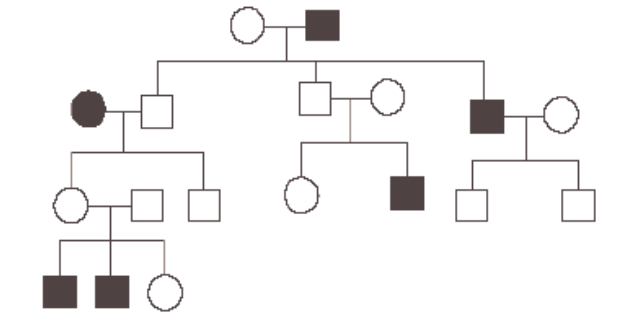 [2015 RS]
[2015 RS]
Correct Answer: (d)
The pedigree displays dominant inheritance (affected offspring have affected parent, no skipping of generations) and affects both sexes equally, indicating Autosomal dominant inheritance.
The pedigree displays dominant inheritance (affected offspring have affected parent, no skipping of generations) and affects both sexes equally, indicating Autosomal dominant inheritance.
Q144. A colour blind man marries a woman with normal sight who has no history of colour blindness in her family. What is the probability of their grandson being colour blind?
[2015 RS]
Correct Answer: (d)
Color blind man (XcY) × normal woman (XCXC) yields carrier daughters (XCXc). Carrier daughter × normal man gives a 50% (0.5) probability for her sons (grandsons) to be color blind.
Color blind man (XcY) × normal woman (XCXC) yields carrier daughters (XCXc). Carrier daughter × normal man gives a 50% (0.5) probability for her sons (grandsons) to be color blind.
Q145. An abnormal human baby with 'XXX' sex chromosomes was born due to:
[2015 RS]
Correct Answer: (a)
Meiotic non-disjunction during oogenesis yields an abnormal XX egg, which when fertilized by a normal X sperm produces an XXX zygote.
Meiotic non-disjunction during oogenesis yields an abnormal XX egg, which when fertilized by a normal X sperm produces an XXX zygote.
Q146. A pleiotropic gene:
[2015 RS]
Correct Answer: (c)
A pleiotropic gene is a single gene that influences multiple distinct phenotypic traits.
A pleiotropic gene is a single gene that influences multiple distinct phenotypic traits.
Q147. A man whose father was colour blind marries a woman who had a colour blind mother and normal father. What percentage of male children of this couple will be colour blind?
[2014]
Correct Answer: (c)
Woman is a carrier (XCXc) because her mother was color blind (XcXc). Her husband is normal (XCY). Male children receive either XC or Xc from mother, so 50% of sons will be color blind.
Woman is a carrier (XCXc) because her mother was color blind (XcXc). Her husband is normal (XCY). Male children receive either XC or Xc from mother, so 50% of sons will be color blind.
Q148. A human female with Turner's syndrome:
[2014]
Correct Answer: (a)
Turner's syndrome is characterized by monosomy of the X chromosome (45, XO). Affected females are sterile.
Turner's syndrome is characterized by monosomy of the X chromosome (45, XO). Affected females are sterile.
Q149. If both parents are carriers for thalassemia, which is an autosomal recessive disorder, what are the chances of pregnancy resulting in an affected child?
[NEET 2013]
Correct Answer: (b)
Cross between carrier parents (Tt × Tt) yields 1 TT : 2 Tt : 1 tt. The chance of an affected child (tt) is 25%.
Cross between carrier parents (Tt × Tt) yields 1 TT : 2 Tt : 1 tt. The chance of an affected child (tt) is 25%.
Q150. The incorrect statement with regard to Haemophilia is:
[NEET 2013]
Correct Answer: (b)
Haemophilia is an X-linked recessive genetic disorder, not a dominant disease.
Haemophilia is an X-linked recessive genetic disorder, not a dominant disease.
Q151. Which one is the incorrect statement with regards to the importance of pedigree analysis?
[NEET Kar. 2013]
Correct Answer: (b)
Pedigree analysis traces human inheritance patterns; it does not experimentally prove DNA to be genetic material.
Pedigree analysis traces human inheritance patterns; it does not experimentally prove DNA to be genetic material.
Q152. Down's syndrome in humans is due to
[NEET Kar. 2013]
Correct Answer: (c)
Down's syndrome is caused by autosomal trisomy, having three copies of chromosome 21 (47, +21).
Down's syndrome is caused by autosomal trisomy, having three copies of chromosome 21 (47, +21).
Q153. A normal-visioned man whose father was colour blind, marries a woman whose father was also colour blind. They have their first child as a daughter. What are the chance that this child would be colour blind?
[2012]
Correct Answer: (b)
Father has normal vision (XCY). A daughter receives XC from father, so she cannot be color blind (0% chance).
Father has normal vision (XCY). A daughter receives XC from father, so she cannot be color blind (0% chance).
Q154. Which one of the following is a wrong statement regarding mutations?
[2012M]
Correct Answer: (d)
Change in a single base pair of DNA can cause point mutations (e.g., sickle cell anemia), making statement 4 incorrect.
Change in a single base pair of DNA can cause point mutations (e.g., sickle cell anemia), making statement 4 incorrect.
Q155. Represented below is the inheritance pattern of a certain type of traits in humans.
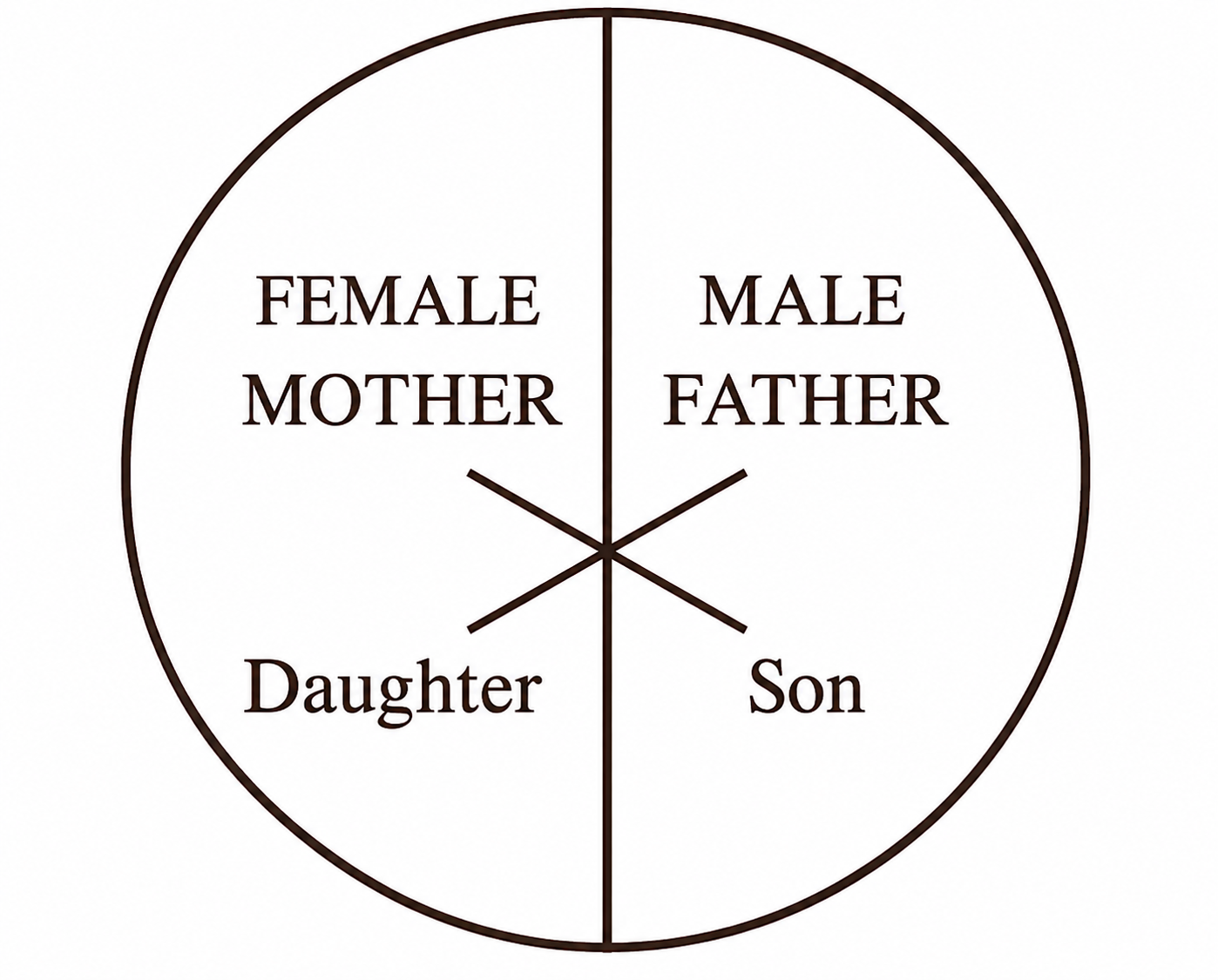
Which one of the following conditions could be an example of this pattern? [2012M]
Which one of the following conditions could be an example of this pattern? [2012M]
Correct Answer: (b)
The diagram shows criss-cross inheritance (father passes trait to daughter, mother passes to son), which is characteristic of X-linked recessive traits like Haemophilia.
The diagram shows criss-cross inheritance (father passes trait to daughter, mother passes to son), which is characteristic of X-linked recessive traits like Haemophilia.
Q156. Mutations can be induced with:
[2011]
Correct Answer: (d)
Gamma radiation is an ionizing radiation widely used as a physical mutagen to induce genetic mutations.
Gamma radiation is an ionizing radiation widely used as a physical mutagen to induce genetic mutations.
Q157. Which one of the following symbols and its representation, used in human pedigree analysis is correct?
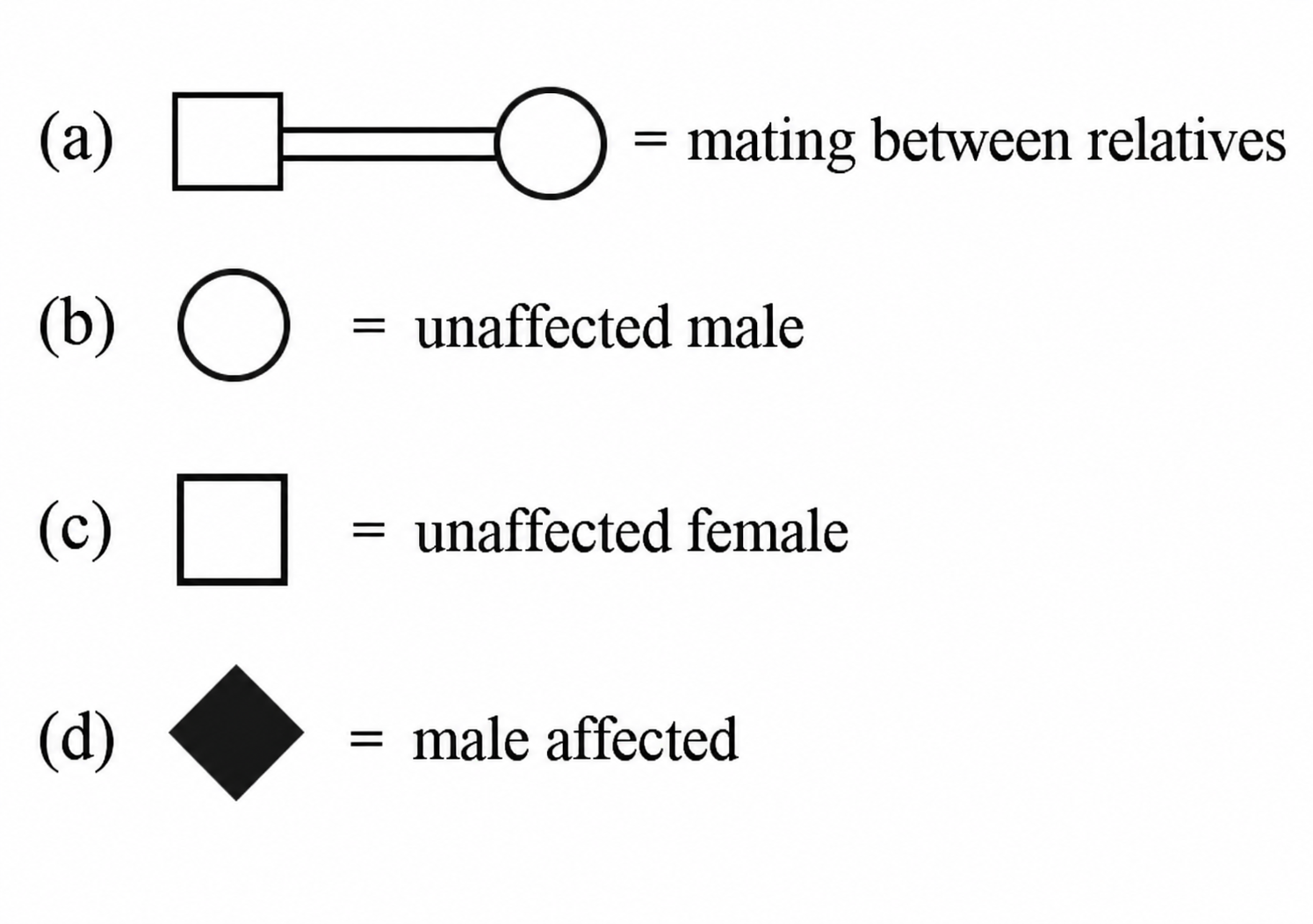 [2010]
[2010]
Correct Answer: (a)
In standard pedigree charts, a double line between a square and a circle represents consanguineous mating (mating between relatives).
In standard pedigree charts, a double line between a square and a circle represents consanguineous mating (mating between relatives).
Q158. Study the pedigree chart given below:
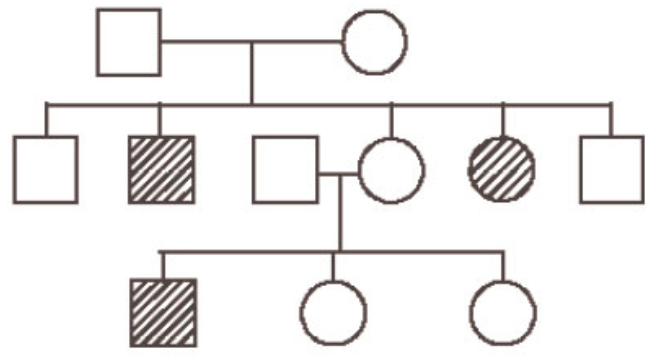
What does it show? [2009]
What does it show? [2009]
Correct Answer: (a)
The pedigree demonstrates autosomal recessive inheritance: unaffected carrier parents produce affected offspring in both sexes.
The pedigree demonstrates autosomal recessive inheritance: unaffected carrier parents produce affected offspring in both sexes.
Q159. The genetic defect Adenosine deaminase (ADA) deficiency may be cured permanently by:
[2009]
Correct Answer: (b)
Permanent cure for ADA deficiency requires introducing functional ADA genes into bone marrow stem cells at early embryonic stages.
Permanent cure for ADA deficiency requires introducing functional ADA genes into bone marrow stem cells at early embryonic stages.
Q160. Sickle cell anaemia is:
[2009]
Correct Answer: (b)
Sickle cell anemia is caused by a point mutation changing single base pair (GAG to GUG) in DNA, replacing glutamic acid with valine at 6th position of $\beta$-globin.
Sickle cell anemia is caused by a point mutation changing single base pair (GAG to GUG) in DNA, replacing glutamic acid with valine at 6th position of $\beta$-globin.
Q161. Select the incorrect statement from the following:
[2009]
Correct Answer: (c)
Pattern baldness is a sex-influenced trait (expressed differently due to hormonal levels), not a sex-limited trait.
Pattern baldness is a sex-influenced trait (expressed differently due to hormonal levels), not a sex-limited trait.
Q162. Point mutation involves:
[2009]
Correct Answer: (a)
A point mutation is a genetic alteration caused by a substitution of a single nucleotide base pair in DNA.
A point mutation is a genetic alteration caused by a substitution of a single nucleotide base pair in DNA.
Q163. Which one of the following conditions in humans, is correctly matched with its chromosomal abnormality / linkage?
[2008]
Correct Answer: (a)
Klinefelter's syndrome occurs in males carrying 44 autosomes and an XXY sex chromosome complement (47, XXY).
Klinefelter's syndrome occurs in males carrying 44 autosomes and an XXY sex chromosome complement (47, XXY).
Q164. Haploids are more suitable for mutation studies than the diploids. This is because
[2008]
Correct Answer: (d)
In haploid cells, every allele is present in a single copy, allowing both dominant and recessive mutations to express immediately without being masked.
In haploid cells, every allele is present in a single copy, allowing both dominant and recessive mutations to express immediately without being masked.
Q165. If a colour blind woman marries a normal visioned man, their sons will be
[2006]
Correct Answer: (c)
Color blind woman (XcXc) passes Xc to all her sons, so 100% of her sons will be color blind (XcY).
Color blind woman (XcXc) passes Xc to all her sons, so 100% of her sons will be color blind (XcY).
Q166. Cri-du-chat syndrome in humans is caused by the
[2006]
Correct Answer: (a)
Cri-du-chat (cat's cry) syndrome is caused by a partial deletion of the short arm (5p) of chromosome 5.
Cri-du-chat (cat's cry) syndrome is caused by a partial deletion of the short arm (5p) of chromosome 5.
Q167. Both sickle cell anemia and Huntington's chorea are
[2006]
Correct Answer: (a)
Sickle cell anemia and Huntington's chorea are genetically inherited (congenital) disorders present from birth.
Sickle cell anemia and Huntington's chorea are genetically inherited (congenital) disorders present from birth.
Q168. Sickle cell anaemia has not been eliminated from the African population because
[2006]
Correct Answer: (b)
Heterozygous individuals (HbAHbS) possess sickle-cell trait which provides selective advantage against lethal Plasmodium falciparum malaria.
Heterozygous individuals (HbAHbS) possess sickle-cell trait which provides selective advantage against lethal Plasmodium falciparum malaria.
Q169. G-6-P dehydrogenase deficiency is associated with haemolysis of:
[2005]
Correct Answer: (d)
Glucose-6-phosphate dehydrogenase (G6PD) deficiency causes premature breakdown/hemolysis of Red Blood Cells (RBCs) under oxidative stress.
Glucose-6-phosphate dehydrogenase (G6PD) deficiency causes premature breakdown/hemolysis of Red Blood Cells (RBCs) under oxidative stress.
Q170. Which of the following is not a hereditary disease?
[2005]
Correct Answer: (d)
Cretinism is a metabolic nutritional/endocrine disease caused by congenital hypothyroidism, not an inherited Mendelian genetic disorder.
Cretinism is a metabolic nutritional/endocrine disease caused by congenital hypothyroidism, not an inherited Mendelian genetic disorder.
Q171. Haemophilia is more commonly seen in human males than in human females because:
[2005]
Correct Answer: (c)
Haemophilia is an X-linked recessive disorder; hemizygous males (XY) need only one mutant allele to express the disease.
Haemophilia is an X-linked recessive disorder; hemizygous males (XY) need only one mutant allele to express the disease.
Q172. A woman with 47 chromosomes due to three copies of chromosome 21 is characterized by:
[2005]
Correct Answer: (d)
Presence of 47 chromosomes with trisomy 21 produces Down's syndrome.
Presence of 47 chromosomes with trisomy 21 produces Down's syndrome.
Q173. A man with a certain disease marries a normal woman. They have eight children (3 daughters and 5 sons). All the daughters suffer from their father's disease but none of the sons are affected. Which of the following mode of inheritance do you suggest for this disease?
[2005]
Correct Answer: (b)
An affected father passes his mutated X chromosome to all daughters (who get affected) and Y to all sons (who remain normal), indicating Sex-linked dominant inheritance.
An affected father passes his mutated X chromosome to all daughters (who get affected) and Y to all sons (who remain normal), indicating Sex-linked dominant inheritance.
Q174. A normal woman, whose father was colour-blind is married to a normal man. The sons would be
[2004]
Correct Answer: (b)
Carrier mother (XCXc) × normal father (XCY) gives sons that inherit either XC or Xc; thus 50% of sons will be color blind.
Carrier mother (XCXc) × normal father (XCY) gives sons that inherit either XC or Xc; thus 50% of sons will be color blind.
Q175. One of the parents of a cross has a mutation in its mitochondria. In that cross, that parent is taken as a male. During segregation of F2 progenies that mutation is found in
[2004]
Correct Answer: (b)
Mitochondrial genes are inherited maternally; if the father carries the mitochondrial mutation, none of the offspring inherit it.
Mitochondrial genes are inherited maternally; if the father carries the mitochondrial mutation, none of the offspring inherit it.
Q176. After a mutation at a genetic locus the character of an organism changes due to the change in
[2004]
Correct Answer: (a)
A mutation alters coding codon sequences, altering amino acid sequences and modifying the resulting protein structure.
A mutation alters coding codon sequences, altering amino acid sequences and modifying the resulting protein structure.
Q177. Christmas disease is another name for
[2003]
Correct Answer: (b)
Haemophilia B is also known as Christmas disease, caused by deficiency of blood clotting Factor IX.
Haemophilia B is also known as Christmas disease, caused by deficiency of blood clotting Factor IX.
Q178. Pattern baldness, moustaches and beard in human males are examples of
[2003]
Correct Answer: (d)
Pattern baldness is a sex-influenced trait, whose expressivity is governed by male androgenic hormones.
Pattern baldness is a sex-influenced trait, whose expressivity is governed by male androgenic hormones.
Q179. Down's syndrome is caused by an extra copy of chromosome number 21. What percentage of offspring produced by an affected mother and a normal father would be affected by this disorder?
[2003]
Correct Answer: (d)
An affected mother produces eggs with either 23 or 24 (extra chr 21) chromosomes in a 1:1 ratio, resulting in 50% affected progeny.
An affected mother produces eggs with either 23 or 24 (extra chr 21) chromosomes in a 1:1 ratio, resulting in 50% affected progeny.
Q180. Which of the following is correct match?
[2002]
Correct Answer: (a)
Down's syndrome is caused by trisomy of chromosome 21.
Down's syndrome is caused by trisomy of chromosome 21.
Q181. Which of the following is an example of sex linked disease?
[2002]
Correct Answer: (b)
Red-green color blindness is an X-linked recessive genetic disorder.
Red-green color blindness is an X-linked recessive genetic disorder.
Q182. Which of the following is an example of pleiotropic effect?
[2002]
Correct Answer: (c)
Sickle cell anemia is pleiotropic because a single mutated $\beta$-globin gene causes anemia, organ damage, joint pain, and kidney failure.
Sickle cell anemia is pleiotropic because a single mutated $\beta$-globin gene causes anemia, organ damage, joint pain, and kidney failure.
Q183. A diseased man marries a normal woman. They have three daughters and five sons. All the daughters were diseased and sons were normal. The gene of this disease is
[2002]
Correct Answer: (a)
An affected father transmits X-linked dominant mutant gene to all daughters (making them affected) and Y to all sons (who stay normal).
An affected father transmits X-linked dominant mutant gene to all daughters (making them affected) and Y to all sons (who stay normal).
Q184. In humans, male XXY and female XXXX occur due to
[2001]
Correct Answer: (a)
Aneuploidy is a numerical chromosomal error involving gain or loss of individual sex chromosomes or autosomes.
Aneuploidy is a numerical chromosomal error involving gain or loss of individual sex chromosomes or autosomes.
Q185. Sickle cell anaemia is induced by
[2001]
Correct Answer: (b)
Sickle cell anemia is caused by substitution of glutamic acid by valine at position 6 in the $\beta$-globin polypeptide chain.
Sickle cell anemia is caused by substitution of glutamic acid by valine at position 6 in the $\beta$-globin polypeptide chain.
Q186. Mongoloid idiocy in humans is also known as
[2000]
Correct Answer: (c)
Down's syndrome was historically referred to as Mongoloid idiocy due to facial epicantic folds.
Down's syndrome was historically referred to as Mongoloid idiocy due to facial epicantic folds.
Q187. Which of the following is the main category of mutation?
[1999]
Correct Answer: (d)
Mutations can be classified into genetic, somatic, and germline/zygotic categories depending on tissue and level of occurrence.
Mutations can be classified into genetic, somatic, and germline/zygotic categories depending on tissue and level of occurrence.
Q188. One child is haemophilic (sex-linked trait), while its fraternal twin brother is normal. Which one of the following informations is most appropriate?
[1999]
Correct Answer: (a)
Fraternal twins arise from separate eggs. For one son to be haemophilic and one normal, the mother must be a heterozygous carrier (XHXh).
Fraternal twins arise from separate eggs. For one son to be haemophilic and one normal, the mother must be a heterozygous carrier (XHXh).
Q189. Red-green colour blindness in humans is governed by a sex-linked recessive gene. A normal woman whose father was colour blind marries a colour blind man. What proportion of their daughters is expected to be colourblind?
[1999]
Correct Answer: (b)
Carrier woman (XCXc) × color blind man (XcY): Daughters inherit Xc from father and either XC or Xc from mother, giving a 1/2 (50%) chance of being color blind (XcXc).
Carrier woman (XCXc) × color blind man (XcY): Daughters inherit Xc from father and either XC or Xc from mother, giving a 1/2 (50%) chance of being color blind (XcXc).
Q190. In Down's syndrome, Karyotyping has shown that the disorder is associated with trisomy of chromosome number-21 usually due to
[1998]
Correct Answer: (a)
Trisomy 21 predominantly arises from maternal non-disjunction during meiotic egg-cell formation.
Trisomy 21 predominantly arises from maternal non-disjunction during meiotic egg-cell formation.
Q191. Mental retardation in man associated with sex chromosomal abnormality is usually due to
[1998]
Correct Answer: (a)
Accumulation of extra X chromosomes (e.g., XXY, XXXY) correlates with progressive mental impairment.
Accumulation of extra X chromosomes (e.g., XXY, XXXY) correlates with progressive mental impairment.
Q192. The formation of multivalents at meiosis in a diploid organism is due to
[1998]
Correct Answer: (d)
Reciprocal translocation between non-homologous chromosomes forms cross-shaped quadrivalent/multivalent configurations during meiotic pairing.
Reciprocal translocation between non-homologous chromosomes forms cross-shaped quadrivalent/multivalent configurations during meiotic pairing.
Q193. A woman with two genes for haemophilia and a gene for colour blindness on one of the 'X' chromosomes marries a normal man. How will the progeny be
[1992]
Correct Answer: (b)
Mother carries haemophilia genes on both X chromosomes and color blindness on one (XhcXh). All sons receive Xh and are haemophilic, while 50% also inherit c to become color blind.
Mother carries haemophilia genes on both X chromosomes and color blindness on one (XhcXh). All sons receive Xh and are haemophilic, while 50% also inherit c to become color blind.
Q194. Albinism is known to be due to an autosomal recessive mutation. The first child of a couple with normal skin pigmentation was an albino. What is the probability that their second child will also be an albino?
[1998]
Correct Answer: (a)
Both parents are heterozygous carriers (Aa × Aa). The probability of any subsequent child inheriting aa (albino) is 25% (1 in 4).
Both parents are heterozygous carriers (Aa × Aa). The probability of any subsequent child inheriting aa (albino) is 25% (1 in 4).
Q195. A person with the sex chromosomes XXY suffers from
[1997]
Correct Answer: (b)
Sex chromosome constitution XXY produces Klinefelter's syndrome.
Sex chromosome constitution XXY produces Klinefelter's syndrome.
Q196. Minor changes at gene level are described as
[1997]
Correct Answer: (a)
Small alterations involving a single nucleotide base substitution or point change are called point mutations.
Small alterations involving a single nucleotide base substitution or point change are called point mutations.
Q197. A person with 47 chromosomes due to an additional Y chromosome suffers from a condition called
[1996]
Correct Answer: (d)
An additional sex chromosome resulting in 47 chromosomes (XXY) causes Klinefelter's syndrome.
An additional sex chromosome resulting in 47 chromosomes (XXY) causes Klinefelter's syndrome.
Q198. The most striking example of point mutation is found in a disease called
[1995]
Correct Answer: (d)
Sickle cell anemia is a classic point mutation caused by a single base substitute (A → T) in the $\beta$-globin gene.
Sickle cell anemia is a classic point mutation caused by a single base substitute (A → T) in the $\beta$-globin gene.
Q199. A woman with albinic father marries an albinic man. The proportion of her progeny is
[1994]
Correct Answer: (d)
Woman is heterozygous carrier (Aa) because her father was albino (aa). Crossing Aa × aa gives 1 normal (Aa) : 1 albinic (aa).
Woman is heterozygous carrier (Aa) because her father was albino (aa). Crossing Aa × aa gives 1 normal (Aa) : 1 albinic (aa).
Q200. Genes located on Y-chromosome are
[1994]
Correct Answer: (d)
Genes located exclusively on the non-homologous region of the Y chromosome are called holandric genes.
Genes located exclusively on the non-homologous region of the Y chromosome are called holandric genes.
Q201. A colour blind mother and normal father would have
[1994]
Correct Answer: (a)
Color blind mother (XcXc) × normal father (XCY) produces 100% color blind sons (XcY) and 100% normal carrier daughters (XCXc).
Color blind mother (XcXc) × normal father (XCY) produces 100% color blind sons (XcY) and 100% normal carrier daughters (XCXc).
Q202. Haploids are preferred over diploids for mutation studies because in haploids
[1993]
Correct Answer: (a)
In haploid organisms, recessive mutations express phenotypic effects immediately as there is no second allele to mask them.
In haploid organisms, recessive mutations express phenotypic effects immediately as there is no second allele to mask them.
Q203. Of a normal couple, half the sons are haemophilic while half the daughters are carriers. The gene is located on
[1993]
Correct Answer: (c)
The mother is a heterozygous carrier (XHXh) carrying the mutant allele on one of her X chromosomes.
The mother is a heterozygous carrier (XHXh) carrying the mutant allele on one of her X chromosomes.
Q204. Which of the following is suitable for experiment on linkage
[1993]
Correct Answer: (b)
Crossing double homozygous dominant (AABB) with double homozygous recessive (aabb) produces heterozyous dihybrids ideal for testing genetic linkage.
Crossing double homozygous dominant (AABB) with double homozygous recessive (aabb) produces heterozyous dihybrids ideal for testing genetic linkage.
Q205. Mr. Kapoor has Bb autosomal gene pair and d allele sex-linked. What shall be proportion of Bd in sperms
[1993]
Correct Answer: (c)
Probability of receiving allele 'B' = 1/2; probability of receiving Xd chromosome = 1/2. Proportion of Bd sperms = $1/2 imes 1/2 = 1/4$.
Probability of receiving allele 'B' = 1/2; probability of receiving Xd chromosome = 1/2. Proportion of Bd sperms = $1/2 imes 1/2 = 1/4$.
Q206. Of both normal parents, the chance of a male child becoming colour blind are
[1993]
Correct Answer: (d)
A male child gets his X chromosome from his mother. If mother's father was color blind, mother is a carrier (XCXc), allowing her son to inherit color blindness.
A male child gets his X chromosome from his mother. If mother's father was color blind, mother is a carrier (XCXc), allowing her son to inherit color blindness.
Q207. Segregation of Mendelian factors (no linkage, no crossing over) occurs during
[1992]
Correct Answer: (a)
Homologous chromosome pairs separate during Anaphase I of meiotic division, segregating allele pairs.
Homologous chromosome pairs separate during Anaphase I of meiotic division, segregating allele pairs.
Q208. In human beings, 45 chromosomes/single X/XO abnormality causes
[1992]
Correct Answer: (c)
Monosomy of sex chromosome (45, XO) causes Turner's syndrome in females.
Monosomy of sex chromosome (45, XO) causes Turner's syndrome in females.
Q209. Down's syndrome is due to
[1992]
Correct Answer: (d)
Down's syndrome results from non-disjunction of homologous chromosome 21 during meiotic division.
Down's syndrome results from non-disjunction of homologous chromosome 21 during meiotic division.
Q210. Blue eye colour is recessive to brown eye colour. A brown eyed man whose mother was blue eyed marries a blue-eyed woman. The children shall be
[1991]
Correct Answer: (a)
Brown eyed man is heterozygous (Bb) because his mother was blue eyed (bb). Crossing Bb × bb yields 1 Bb (brown) : 1 bb (blue), a 1:1 ratio.
Brown eyed man is heterozygous (Bb) because his mother was blue eyed (bb). Crossing Bb × bb yields 1 Bb (brown) : 1 bb (blue), a 1:1 ratio.
Q211. Multiple alleles control inheritance of
[1991]
Correct Answer: (d)
Human ABO blood groups are controlled by multiple alleles (IA, IB, i).
Human ABO blood groups are controlled by multiple alleles (IA, IB, i).
Q212. A colour blind girl is rare because she will be born only when
[1991]
Correct Answer: (b)
For a girl to be color blind (XcXc), her father must be color blind (XcY) and her mother must be at least a carrier (inheriting Xc from maternal grandfather).
For a girl to be color blind (XcXc), her father must be color blind (XcY) and her mother must be at least a carrier (inheriting Xc from maternal grandfather).
Q213. Which one is a hereditary disease?
[1990]
Correct Answer: (d)
Phenylketonuria (PKU) is an inherited autosomal recessive metabolic genetic disorder.
Phenylketonuria (PKU) is an inherited autosomal recessive metabolic genetic disorder.
Q214. Haemophilia is more common in males because it is a
[1990]
Correct Answer: (d)
Haemophilia is an X-linked recessive disorder; males (XY) require only one copy of mutant X to express the trait.
Haemophilia is an X-linked recessive disorder; males (XY) require only one copy of mutant X to express the trait.
Q215. In Down's syndrome of a male child, the sex complement is
[1990]
Correct Answer: (b)
Down's syndrome involves autosomal trisomy 21 (47, +21); a male child retains normal XY sex chromosome complement.
Down's syndrome involves autosomal trisomy 21 (47, +21); a male child retains normal XY sex chromosome complement.
Q216. A mother in a family of five daughters is expecting her sixth baby. The chance of its being a son is
[1988]
Correct Answer: (c)
The probability of having a male child in any individual birth is always 50% (1/2), independent of previous births.
The probability of having a male child in any individual birth is always 50% (1/2), independent of previous births.
Q217. Mutations used in agriculture are commonly
[1988]
Correct Answer: (a)
Artificially induced mutations (using physical or chemical mutagens) are widely utilized in mutation breeding for agriculture.
Artificially induced mutations (using physical or chemical mutagens) are widely utilized in mutation breeding for agriculture.