Q1. Floridean starch is found in
Correct Answer: (b)
Reserve food in red algae (Rhodophyceae) is floridean starch.
Reserve food in red algae (Rhodophyceae) is floridean starch.
Q2. Prothallus (gametophyte) gives rise to fern plant (sporophyte) without fertilization. It is
Correct Answer: (b)
When prothallus of a fern gives rise to sporophyte directly from somatic cell without forming gametes it is apogamy.
When prothallus of a fern gives rise to sporophyte directly from somatic cell without forming gametes it is apogamy.
Q3. Pinus seed cannot germinate and establish without fungal association. This is because:
Correct Answer: (b)
Fungus associated with roots of Pinus increases minerals and water absorption for the plant. Mycorrhizal association is obligatory for Pinus seed germination.
Fungus associated with roots of Pinus increases minerals and water absorption for the plant. Mycorrhizal association is obligatory for Pinus seed germination.
Q4. Isogamous condition with non-flagellated gametes is found in :
Correct Answer: (a)
In Spirogyra, sexual reproduction occurs through conjugation. Gametes are non-flagellated, morphologically similar (isogamy).
In Spirogyra, sexual reproduction occurs through conjugation. Gametes are non-flagellated, morphologically similar (isogamy).
Q5. Which one of the following shows isogamy with non-flagellated gametes?
Correct Answer: (d)
In Spirogyra, sexual reproduction occurs through conjugation. Gametes are non-flagellated, morphologically similar (isogamy).
In Spirogyra, sexual reproduction occurs through conjugation. Gametes are non-flagellated, morphologically similar (isogamy).
Q6. Selaginella and Salvinia are considered to represent a significant step towards evolution of seed habit because:
Correct Answer: (d)
The heterosporous plants produce two types of spores. The female gametophytes are retained on the parent sporophytes for variable periods.
The heterosporous plants produce two types of spores. The female gametophytes are retained on the parent sporophytes for variable periods.
Q7. Phloem in gymnosperms lacks:
Correct Answer: (d)
Phloem in gymnosperms lacks both sieve tube and companion cells.
Phloem in gymnosperms lacks both sieve tube and companion cells.
Q8. Plants reproducing by spores such as mosses and ferns are grouped under the general term
Correct Answer: (b)
The plants which reproduce by spores and do not produce seeds are called cryptogams.
The plants which reproduce by spores and do not produce seeds are called cryptogams.
Q9. Read the following five statements (A to E) and select the option with all correct statements :
(A) Mosses and Lichens are the first organisms to colonise a bare rock.
(B) Selaginella is a homosporous pteridophyte
(C) Coralloid roots in Cycas have VAM
(D) Main plant body in bryophytes is gametophytic, whereas in pteridophytes it is sporophytic
(E) In gymnosperms, male and female gametophytes are present within sporangia located on sporophyte
(A) Mosses and Lichens are the first organisms to colonise a bare rock.
(B) Selaginella is a homosporous pteridophyte
(C) Coralloid roots in Cycas have VAM
(D) Main plant body in bryophytes is gametophytic, whereas in pteridophytes it is sporophytic
(E) In gymnosperms, male and female gametophytes are present within sporangia located on sporophyte
Correct Answer: (d)
(B) Selaginella is heterosporous. (C) Coralloid roots have cyanobacteria (Not VAM). Statements A, D, E are correct.
(B) Selaginella is heterosporous. (C) Coralloid roots have cyanobacteria (Not VAM). Statements A, D, E are correct.
Q10. In which of the following gametophyte is not independent free living ?
Correct Answer: (c)
Pinus belongs to gymnosperms in which male and female gametophytes do not have an independent free living existence.
Pinus belongs to gymnosperms in which male and female gametophytes do not have an independent free living existence.
Q11. Which one of the following is a living fossil?
Correct Answer: (c)
Ginkgo biloba is a living fossil.
Ginkgo biloba is a living fossil.
Q12. In Pinus, the pollen grain has 6 chromosomes then in its endosperm will have
Correct Answer: (c)
Pollen grains are haploid (n). If n=6, Endosperm in Pinus is also haploid (n) because it is formed before fertilisation. So it will have 6 chromosomes.
Pollen grains are haploid (n). If n=6, Endosperm in Pinus is also haploid (n) because it is formed before fertilisation. So it will have 6 chromosomes.
Q13. Consider the following four statements whether they are correct or wrong?
(A) The sporophyte in liverworts is more elaborate than that in mosses
(B) Salvinia is heterosporous
(C) The life cycle in all seed-bearing plants is diplontic
(D) In Pinus male and female cones are borne on different trees.
The two wrong statements together are
(A) The sporophyte in liverworts is more elaborate than that in mosses
(B) Salvinia is heterosporous
(C) The life cycle in all seed-bearing plants is diplontic
(D) In Pinus male and female cones are borne on different trees.
The two wrong statements together are
Correct Answer: (b)
(A) is wrong because moss sporophytes are more elaborate. (D) is wrong because Pinus is monoecious (cones on same tree).
(A) is wrong because moss sporophytes are more elaborate. (D) is wrong because Pinus is monoecious (cones on same tree).
Q14. Which of the following cannot fix nitrogen?
Correct Answer: (c)
Spirogyra is a member of green algae which cannot fix atmospheric nitrogen.
Spirogyra is a member of green algae which cannot fix atmospheric nitrogen.
Q15. In Pinus/gymnosperms, the haploid structure are
Correct Answer: (b)
In Pinus, endosperm produced before fertilization is haploid. Megaspore and pollen grain are initial structures of gametophyte hence are haploid.
In Pinus, endosperm produced before fertilization is haploid. Megaspore and pollen grain are initial structures of gametophyte hence are haploid.
Q16. Which of the following is not correctly matched for the organism and its cell wall degrading enzyme?
Correct Answer: (b)
Algae is a plant and so its cell wall is made up of cellulose. Cellulase enzyme is needed for degradation of its cell wall.
Algae is a plant and so its cell wall is made up of cellulose. Cellulase enzyme is needed for degradation of its cell wall.
Q17. Select the mismatch
Correct Answer: (d)
Pinus is monoecious plant comprising of both male and female cones on same plant.
Pinus is monoecious plant comprising of both male and female cones on same plant.
Q18. Cycas and Adiantum resemble each other in having
Correct Answer: (b)
Cycas (a gymnosperm) and Adiantum (a pteridophyte) resemble each other in having motile sperm.
Cycas (a gymnosperm) and Adiantum (a pteridophyte) resemble each other in having motile sperm.
Q19. In bryophytes and pteridophytes, transport of male gametes requires
Correct Answer: (d)
Bryophytes neither have pollen nor flowers and rely on water to carry the male gametes (sperm) to the female gametes (eggs).
Bryophytes neither have pollen nor flowers and rely on water to carry the male gametes (sperm) to the female gametes (eggs).
Q20. The gametophyte is not an independent, free living generation in :
Correct Answer: (d)
Unlike bryophytes and pteridophytes, in gymnosperms (Pinus) the male and female gametophytes do not have an independent free-living existence.
Unlike bryophytes and pteridophytes, in gymnosperms (Pinus) the male and female gametophytes do not have an independent free-living existence.
Q21. Which one of the following is wrongly matched?
Correct Answer: (b)
In Spirogyra gametes are non-flagellated (non-motile) but similar in size.
In Spirogyra gametes are non-flagellated (non-motile) but similar in size.
Q22. Which one of the following is heterosporous?
Correct Answer: (b)
Salvinia is an heterosporous aquatic fern with both annual and perennial species.
Salvinia is an heterosporous aquatic fern with both annual and perennial species.
Q23. In angiosperms, microsporogenesis and megasporogenesis :
Correct Answer: (b)
In meiosis, the number of chromosomes are reduced by half producing haploid daughter cells. Both processes involve meiosis.
In meiosis, the number of chromosomes are reduced by half producing haploid daughter cells. Both processes involve meiosis.
Q24. Algae have cell wall made up of:
Correct Answer: (a)
Algae possess a definite cell wall containing cellulose, galactans and mannans.
Algae possess a definite cell wall containing cellulose, galactans and mannans.
Q25. Turpentine is obtained from
Correct Answer: (c)
Turpentine is extracted from the wood (xylem) of Pinus (Gymnosperm).
Turpentine is extracted from the wood (xylem) of Pinus (Gymnosperm).
Q26. Which one has the largest gametophyte?
Correct Answer: (d)
As one moves from thallophyta -> Pteridophyta -> Gymnosperm -> Angiosperms, there is reduction in the gametophyte and elaboration of sporophyte. Hence, moss has largest gametophyte.
As one moves from thallophyta -> Pteridophyta -> Gymnosperm -> Angiosperms, there is reduction in the gametophyte and elaboration of sporophyte. Hence, moss has largest gametophyte.
Q27. Brown algae is characterised by the presence of
Correct Answer: (c)
Fucoxanthin is a carotenoid pigment present besides chlorophyll in brown algae.
Fucoxanthin is a carotenoid pigment present besides chlorophyll in brown algae.
Q28. Cycas has two cotyledons but not included in angiosperms because of
Correct Answer: (a)
In Cycas (gymnosperm) the seed does not occur inside a fruit but lies naked or exposed on the surface of megasporophyll.
In Cycas (gymnosperm) the seed does not occur inside a fruit but lies naked or exposed on the surface of megasporophyll.
Q29. Which one of the following is common to multicellular fungi, filamentous algae and protonema of mosses
Correct Answer: (d)
Multiplication by fragmentation takes place in the multicellular fungi, filamentous algae and protonema of mosses.
Multiplication by fragmentation takes place in the multicellular fungi, filamentous algae and protonema of mosses.
Q30. A plant having seeds but lacking flowers and fruits belongs to
Correct Answer: (d)
Gymnosperms are vascular land plants having naked ovules i.e., ovules are not enclosed in a ovary hence, flower is absent.
Gymnosperms are vascular land plants having naked ovules i.e., ovules are not enclosed in a ovary hence, flower is absent.
Q31. Male and female gametophytes are independent and free-living in:
Correct Answer: (d)
Sphagnum is a bryophyte in which male and female gametophytes are independent and free living. In Pinus (gymnosperm), mustard and castor (angiosperms), the main plant body is sporophytic.
Sphagnum is a bryophyte in which male and female gametophytes are independent and free living. In Pinus (gymnosperm), mustard and castor (angiosperms), the main plant body is sporophytic.
Q32. In the prothallus of a vascular cryptogam, the antherozoids and eggs mature at different times. As a result
Correct Answer: (c)
In the prothallus of a vascular cryptogams the antherozoids and eggs mature at different times (protandry or protogyny) which facilitates cross fertilization and self-fertilization is prevented.
In the prothallus of a vascular cryptogams the antherozoids and eggs mature at different times (protandry or protogyny) which facilitates cross fertilization and self-fertilization is prevented.
Q33. The plant group that produces spores and embryo but lacks vascular tissues and seeds is
Correct Answer: (c)
Bryophytes are the plants which produces spores and embryo but no vascular tissues.
Bryophytes are the plants which produces spores and embryo but no vascular tissues.
Q34. Sexual reproduction in Spirogyra is an advanced feature because it shows
Correct Answer: (a)
Sexual reproduction in Spirogyra occurs by conjugation. The fusing gametes are similar but one is more active and passes onto the other cell. This differentiation of gametes is called physiological anisogamy.
Sexual reproduction in Spirogyra occurs by conjugation. The fusing gametes are similar but one is more active and passes onto the other cell. This differentiation of gametes is called physiological anisogamy.
Q35. Which one of the following is not common between Funaria and Selaginella?
Correct Answer: (d)
Funaria is a moss (Bryophyte) and lacks roots (has rhizoids). Selaginella has roots.
Funaria is a moss (Bryophyte) and lacks roots (has rhizoids). Selaginella has roots.
Q36. In a moss the sporophyte
Correct Answer: (d)
In moss, sporophyte is partially parasitic on gametophyte. It depends on gametophyte for water and minerals.
In moss, sporophyte is partially parasitic on gametophyte. It depends on gametophyte for water and minerals.
Q37. Which one is the most advanced from evolutionary point of view
Correct Answer: (d)
Pinus is a conifer, a member of gymnosperm which has well developed conducting tissue and presence of seed.
Pinus is a conifer, a member of gymnosperm which has well developed conducting tissue and presence of seed.
Q38. In which of the following would you place the plants having vascular tissue lacking seeds?
Correct Answer: (c)
Pteridophytes are primitive seedless vascular plants.
Pteridophytes are primitive seedless vascular plants.
Q39. Bryophytes are amphibians because
Correct Answer: (a)
Bryophytes are amphibians because they complete their vegetative phase on land but water is necessary for their reproductive phase.
Bryophytes are amphibians because they complete their vegetative phase on land but water is necessary for their reproductive phase.
Q40. Which of the following is responsible for peat formation?
Correct Answer: (d)
Sphagnum, a moss, provides peat that has long been used as fuel.
Sphagnum, a moss, provides peat that has long been used as fuel.
Q41. Which one of the following plants is monoecious?
Correct Answer: (a)
Pinus plant is monoecious i.e. both male and female cones are borne on different branches of the same plant.
Pinus plant is monoecious i.e. both male and female cones are borne on different branches of the same plant.
Q42. Zygotic meiosis is characteristic of:
Correct Answer: (c)
Chlamydomonas has haplontic life cycle hence shows zygotic meiosis.
Chlamydomonas has haplontic life cycle hence shows zygotic meiosis.
Q43. Which of the following plants produces seeds but not flowers?
Correct Answer: (d)
Pinus is a gymnosperm in which seeds are produced but flowers are not produced or seeds are not enclosed in flowers.
Pinus is a gymnosperm in which seeds are produced but flowers are not produced or seeds are not enclosed in flowers.
Q44. Seed-habit first originated in
Correct Answer: (a)
Seed habit originated in Cycadophiles or pteridosperms.
Seed habit originated in Cycadophiles or pteridosperms.
Q45. Which one of the following statements about Cycas is incorrect?
Correct Answer: (c)
In Cycas, conducting part of xylem consists of tracheids (vessels absent).
In Cycas, conducting part of xylem consists of tracheids (vessels absent).
Q46. Life cycle of Ectocarpus and Fucus respectively are
Correct Answer: (b)
Ectocarpus exhibits haplodiplontic life cycle while Fucus has diplontic life cycle.
Ectocarpus exhibits haplodiplontic life cycle while Fucus has diplontic life cycle.
Q47. The plant body of moss (Funaria) is
Correct Answer: (d)
The gametophytic generation represents the dominant phase in the life cycle of bryophytes. The sporophyte phase is dependent.
The gametophytic generation represents the dominant phase in the life cycle of bryophytes. The sporophyte phase is dependent.
Q48. Pinus differs from mango in having
Correct Answer: (c)
Pinus is a member of gymnosperm i.e. naked seed, whereas mango is a typical angiosperm whose ovules are enclosed in ovary.
Pinus is a member of gymnosperm i.e. naked seed, whereas mango is a typical angiosperm whose ovules are enclosed in ovary.
Q49. Which one of the following is a living fossil?
Correct Answer: (a)
Cycas revoluta is a living fossil.
Cycas revoluta is a living fossil.
Q50. Ulothrix can be described as a
Correct Answer: (d)
Ulothrix is a genus of filamentous green algae that reproduces by motile quadriflagellate spores.
Ulothrix is a genus of filamentous green algae that reproduces by motile quadriflagellate spores.
Q51. In Ferns meiosis occurs when
Correct Answer: (c)
In sporic meiosis the sporophyte produces sporangia where as meiosis occurs producing haploid spores.
In sporic meiosis the sporophyte produces sporangia where as meiosis occurs producing haploid spores.
Q52. Multicellular branched rhizoids and leafy gametophytes are characteristic of
Correct Answer: (b)
In bryophytes, the gametophyte is leafy (in mosses/some bryophytes) with multicellular branched rhizoids.
In bryophytes, the gametophyte is leafy (in mosses/some bryophytes) with multicellular branched rhizoids.
Q53. The product of conjugation in Spirogyra or fertilization of Chlamydomonas is
Correct Answer: (a)
In both, gametes fuse to form zygote which develops into a thick walled resting zygospore.
In both, gametes fuse to form zygote which develops into a thick walled resting zygospore.
Q54. In which one of these the elaters are present along with mature spores in the capsule (to help in spore dispersal)?
Correct Answer: (b)
In Marchantia, capsule elaters are present which help in dispersal of spores.
In Marchantia, capsule elaters are present which help in dispersal of spores.
Q55. The ‘wing’ of Pinus seed is derived from
Correct Answer: (c)
The upper surface of ovuliferous scale forms the membranous wing of the seed which helps in dispersal.
The upper surface of ovuliferous scale forms the membranous wing of the seed which helps in dispersal.
Q56. Agar is commercially obtained from
Correct Answer: (a)
Agar is obtained from several members of red algae such as Gracilaria, Gelidium.
Agar is obtained from several members of red algae such as Gracilaria, Gelidium.
Q57. The plant body is thalloid in
Correct Answer: (d)
The plant body of a liverwort is haploid (n), gametophytic, small, dorsoventrally flattened, thalloid (e.g., Marchantia).
The plant body of a liverwort is haploid (n), gametophytic, small, dorsoventrally flattened, thalloid (e.g., Marchantia).
Q58. Resin and turpentine are obtained from
Correct Answer: (b)
Pinus species -> Resins and turpentine. Cedrus -> Timber. Abies -> Paper. Cycas -> Ornamental.
Pinus species -> Resins and turpentine. Cedrus -> Timber. Abies -> Paper. Cycas -> Ornamental.
Q59. An alga which can be employed as food for human being is:
Correct Answer: (b)
Chlorella and Spirulina are unicellular algae, rich in proteins and are used as food supplements by space travellers.
Chlorella and Spirulina are unicellular algae, rich in proteins and are used as food supplements by space travellers.
Q60. Compared with the gametophytes of the bryophytes the gametophytes of vascular plant are
Correct Answer: (a)
The gametophyte of bryophytes are smaller but have large sex organs.
The gametophyte of bryophytes are smaller but have large sex organs.
Q61. The “walking” fern is so named because
Correct Answer: (b)
Adiantum is also called the walking fern because of its ability to form new ferns whenever the leaf tip happens to come in contact with soil.
Adiantum is also called the walking fern because of its ability to form new ferns whenever the leaf tip happens to come in contact with soil.
Q62. Sunken stomata is the characteristic feature of
Correct Answer: (c)
Sunken stomata is the characteristic feature of xerophytes which help in reducing loss of water from leaf surface.
Sunken stomata is the characteristic feature of xerophytes which help in reducing loss of water from leaf surface.
Q63. The largest ovules, largest male and female gametes and largest plants are found among
Correct Answer: (c)
Egg of Cycas (Gymnosperms) and its nucleus are the largest in the plant kingdom.
Egg of Cycas (Gymnosperms) and its nucleus are the largest in the plant kingdom.
Q64. Which one of the following is considered important in the development of seed habit?
Correct Answer: (a)
Heterospory is considered important in the development of seed habit.
Heterospory is considered important in the development of seed habit.
Q65. Which one pair of examples will correctly represent the grouping Spermatophyta according to one of the schemes of classifying plants ?
Correct Answer: (a)
Spermatophytes are the seed plants. Ginkgo belongs to group gymnosperms and Pisum belongs to group angiosperms.
Spermatophytes are the seed plants. Ginkgo belongs to group gymnosperms and Pisum belongs to group angiosperms.
Q66. Sexual reproduction involving fusion of two cells in Chlamydomonas is
Correct Answer: (a)
Isogamy refers to a form of sexual reproduction involving gametes of the same size.
Isogamy refers to a form of sexual reproduction involving gametes of the same size.
Q67. Which one of the following is wrong about Chara?
Correct Answer: (c)
Chara belongs to chlorophyceae. Oogonium is borne at the top and antheridium at the bottom of the four celled filament.
Chara belongs to chlorophyceae. Oogonium is borne at the top and antheridium at the bottom of the four celled filament.
Q68. The antherozoids of Funaria are
Correct Answer: (b)
Antherozoids of Funaria bear two flagella at anterior end and is spirally coiled.
Antherozoids of Funaria bear two flagella at anterior end and is spirally coiled.
Q69. An example of colonial alga is :
Correct Answer: (a)
Volvox is a motile colonial fresh water green alga. It forms spherical colonies.
Volvox is a motile colonial fresh water green alga. It forms spherical colonies.
Q70. Select the correct statement:
Correct Answer: (c)
Sequoia sempervirans is one of the tallest trees.
Sequoia sempervirans is one of the tallest trees.
Q71. Which one of the following is a vascular cryptogam?
Correct Answer: (d)
Equisetum is a vascular cryptogam. It is the only living genus in Equisetaceae (horse tails).
Equisetum is a vascular cryptogam. It is the only living genus in Equisetaceae (horse tails).
Q72. In gymnosperms, the pollen chamber represents
Correct Answer: (a)
In gymnosperms, the pollen chamber represents a cavity in the ovule in which pollen grains are stored after pollination within the pollen chamber.
In gymnosperms, the pollen chamber represents a cavity in the ovule in which pollen grains are stored after pollination within the pollen chamber.
Q73. Select one of the following pairs of important features distinguishing Gnetum from Cycas and Pinus and showing affinities with angiosperms
Correct Answer: (b)
The important features distinguishing Gnetum from Cycas and Pinus and showing affinities with angiosperms are presence of vessel elements and absence of archegonia.
The important features distinguishing Gnetum from Cycas and Pinus and showing affinities with angiosperms are presence of vessel elements and absence of archegonia.
Q74. The ‘amphibians’ of plant kingdom are
Correct Answer: (c)
Bryophytes are terrestrial plants but they require a thin film of water on the surface of their substratum during sexual reproduction.
Bryophytes are terrestrial plants but they require a thin film of water on the surface of their substratum during sexual reproduction.
Q75. Male gametophyte in angiosperms produces
Correct Answer: (d)
Two sperms and a vegetative cell are produced by male gametophyte in angiosperms.
Two sperms and a vegetative cell are produced by male gametophyte in angiosperms.
Q76. The absence of chlorophyll, in the lowermost cell of Ulothrix, shows
Correct Answer: (d)
The plant body of Ulothrix is divided into three regions. Basal cell forms a holdfast and lacks chlorophyll, showing beginning of labour division.
The plant body of Ulothrix is divided into three regions. Basal cell forms a holdfast and lacks chlorophyll, showing beginning of labour division.
Q77. Moss peristome takes part in
Correct Answer: (a)
Peristomes are a ring of tooth like structure... help in the dispersal of the spores due to hygroscopic nature.
Peristomes are a ring of tooth like structure... help in the dispersal of the spores due to hygroscopic nature.
Q78. Largest sperms in the plant world are found in
Correct Answer: (c)
The sperms of Cycas are the largest in the plant kingdom reaching a size of 300 mm.
The sperms of Cycas are the largest in the plant kingdom reaching a size of 300 mm.
Q79. In which one of the following, male and female gametophytes do not have free living independent existence?
Correct Answer: (d)
Cedrus belongs to conifer (Gymnosperm). Male and female gametophytes do not have free living independent existence.
Cedrus belongs to conifer (Gymnosperm). Male and female gametophytes do not have free living independent existence.
Q80. In Chlorophyceae, sexual reproduction occurs by
Correct Answer: (b)
In chlorophyceae, sexual reproduction takes place by all the three processes: Isogamy, Anisogamy and Oogamy.
In chlorophyceae, sexual reproduction takes place by all the three processes: Isogamy, Anisogamy and Oogamy.
Q81. Which one of the following pairs is wrongly matched?
Correct Answer: (a)
Statement (a) is marked as the answer in the key, possibly implying 'Ginkgo - Archegonia' is the mismatch, although Ginkgo does possess archegonia. However, 'Salvinia - Prothallus' is also a potential mismatch as heterosporous ferns do not form a true free-living prothallus.
Statement (a) is marked as the answer in the key, possibly implying 'Ginkgo - Archegonia' is the mismatch, although Ginkgo does possess archegonia. However, 'Salvinia - Prothallus' is also a potential mismatch as heterosporous ferns do not form a true free-living prothallus.
Q82. Select the wrong statement :
Correct Answer: (d)
Pseudopodia are locomotory structures in sarcodines (amoeboid). Sporozoans lack locomotory structures.
Pseudopodia are locomotory structures in sarcodines (amoeboid). Sporozoans lack locomotory structures.
Q83. Sperms of both Funaria and Pteris were released together near the archegonia of Pteris. Only its sperms enter the archegonia as
Correct Answer: (d)
Archegonia of a particular species recognises antherozoids (sperms) of the same species through release of chemical (malic acid in Pteris).
Archegonia of a particular species recognises antherozoids (sperms) of the same species through release of chemical (malic acid in Pteris).
Q84. Which of the following is without exception in angiosperms?
Correct Answer: (b)
Double fertilisation is characteristic of all angiosperms.
Double fertilisation is characteristic of all angiosperms.
Q85. Mannitol is the stored food in:
Correct Answer: (b)
Mannitol is a food stored in Fucus (Phaeophyceae).
Mannitol is a food stored in Fucus (Phaeophyceae).
Q86. Which one of the following has haplontic life cycle?
Correct Answer: (b)
Ustilago has a haplontic life cycle. It is a simplest and most primitive type of life cycle.
Ustilago has a haplontic life cycle. It is a simplest and most primitive type of life cycle.
Q87. What is common in all the three, Funaria, Dryopteris and Ginkgo?
Correct Answer: (b)
The female sex organ archegonium is formed in bryophytes (Funaria), pteridophytes (Dryopteris) and gymnosperms (Ginkgo).
The female sex organ archegonium is formed in bryophytes (Funaria), pteridophytes (Dryopteris) and gymnosperms (Ginkgo).
Q88. Ulothrix filaments produce
Correct Answer: (a)
Sexual reproduction in Ulothrix is isogamous type. Only similar type of gametes called isogametes are produced.
Sexual reproduction in Ulothrix is isogamous type. Only similar type of gametes called isogametes are produced.
Q89. Chloroplast of Chlamydomonas is
Correct Answer: (b)
Chlamydomonas has cup shaped chloroplast.
Chlamydomonas has cup shaped chloroplast.
Q90. Apophysis in the capsule of Funaria is
Correct Answer: (a)
Apophysis is basal portion of capsule in continuation with seta. The outer layer of apophysis is epidermis which has stomata.
Apophysis is basal portion of capsule in continuation with seta. The outer layer of apophysis is epidermis which has stomata.
Q91. Bryophytes comprise
Correct Answer: (d)
In bryophytes, the dominant and independent living phase is gametophyte. Sporophyte is always attached and dependent upon the gametophyte.
In bryophytes, the dominant and independent living phase is gametophyte. Sporophyte is always attached and dependent upon the gametophyte.
Q92. If you are asked to classify the various algae into distinct groups, which of the following characters you should choose?
Correct Answer: (d)
Algae are classified on the basis of types of pigment present in the cell, like Rhodophyceae shows presence of phycoerythrin.
Algae are classified on the basis of types of pigment present in the cell, like Rhodophyceae shows presence of phycoerythrin.
Q93. Which of the following propagates through leaf-tip?
Correct Answer: (a)
Walking fern Adiantum propagates through leaf tip.
Walking fern Adiantum propagates through leaf tip.
Q94. Floridean starch has structure similar to
Correct Answer: (a)
Floridean starch is stored food material in red algae. Its structure is similar to amylopectin and glycogen in structure.
Floridean starch is stored food material in red algae. Its structure is similar to amylopectin and glycogen in structure.
Q95. Besides paddy fields cyanobacteria are also found inside vegetative part of :
Correct Answer: (a)
In Cycas specialised root called coralloid roots are associated with N2-fixing cyanobacteria - Anabaena.
In Cycas specialised root called coralloid roots are associated with N2-fixing cyanobacteria - Anabaena.
Q96. Which one is wrongly matched?
Correct Answer: (a)
Polysiphonia is a genus of red algae, where asexual spores and gametes are non-motile or non-flagellated.
Polysiphonia is a genus of red algae, where asexual spores and gametes are non-motile or non-flagellated.
Q97. Flagellated male gametes are present in all the three of which one of the following sets?
Correct Answer: (c)
The male gametes of bryophytes (Riccia) are biflagellate and those of pteridophytes (Dryopteris) are multiflagellate. Cycas also has multiciliate gametes.
The male gametes of bryophytes (Riccia) are biflagellate and those of pteridophytes (Dryopteris) are multiflagellate. Cycas also has multiciliate gametes.
Q98. Bryophytes can be separated from algae because they
Correct Answer: (c)
Archegonium in bryophytes have jacketed sex organs (outer layer of sterile cells), unlike algae.
Archegonium in bryophytes have jacketed sex organs (outer layer of sterile cells), unlike algae.
Q99. In gymnosperms like Pinus and Cycas, the endosperm is
Correct Answer: (b)
In gymnosperms like Cycas/Pinus, endosperms are female gametophyte is haploid and formed before fertilisation.
In gymnosperms like Cycas/Pinus, endosperms are female gametophyte is haploid and formed before fertilisation.
Q100. Read the following five statements (A - E) and answer the question.
(A) In Equisetum the female gametophyte is retained on the parent sporophyte.
(B) In Ginkgo male gametophyte is not independent.
(C) The sporophyte in Riccia is more developed than that in Polytrichum.
(D) Sexual reproduction in Volvox is isogamous.
(E) The spores of slime molds lack cell walls.
How many of the above statements are correct?
(A) In Equisetum the female gametophyte is retained on the parent sporophyte.
(B) In Ginkgo male gametophyte is not independent.
(C) The sporophyte in Riccia is more developed than that in Polytrichum.
(D) Sexual reproduction in Volvox is isogamous.
(E) The spores of slime molds lack cell walls.
How many of the above statements are correct?
Correct Answer: (a)
Statements A and B are correct. C is incorrect (Riccia sporophyte is simplest). D is incorrect (Volvox is oogamous). E is incorrect (spores possess cell walls).
Statements A and B are correct. C is incorrect (Riccia sporophyte is simplest). D is incorrect (Volvox is oogamous). E is incorrect (spores possess cell walls).
Q101. Which one of the following statements is wrong?
Correct Answer: (c)
Mannitol is the stored food in Phaeophyceae (brown algae). Rhodophyceae stores Floridean starch.
Mannitol is the stored food in Phaeophyceae (brown algae). Rhodophyceae stores Floridean starch.
Q102. Conifers differ from grasses in the
Correct Answer: (c)
Conifers (Gymnosperms) differ from grasses (angiosperms) because in gymnosperms the female gametophyte is actually endosperm which is made before fertilisation (haploid).
Conifers (Gymnosperms) differ from grasses (angiosperms) because in gymnosperms the female gametophyte is actually endosperm which is made before fertilisation (haploid).
Q103. Dichotomous branching is found in
Correct Answer: (d)
Marchantia is a dorsiventral dichotomously branched thalloid liverwort.
Marchantia is a dorsiventral dichotomously branched thalloid liverwort.
Q104. Some hyperthermophilic organisms that grow in highly acidic (pH2) habitats belong to the two groups:
Correct Answer: (a)
Hyperthermophilic organisms that grow in highly acidic habitats belong to eubacteria and archae groups.
Hyperthermophilic organisms that grow in highly acidic habitats belong to eubacteria and archae groups.
Q105. Peat Moss is used as a packing material for sending flowers and live plants to distant places because
Correct Answer: (a)
Peat moss (Sphagnum) is hygroscopic in nature and absorbs moisture.
Peat moss (Sphagnum) is hygroscopic in nature and absorbs moisture.
Q106. Protonema occurs in the life cycle of
Correct Answer: (b)
In Funaria, the spore germinates to form a green multicellular structure called as protonema.
In Funaria, the spore germinates to form a green multicellular structure called as protonema.
Q107. In Ulothrix/Spirogyra, reduction division (meiosis) occurs at the time of
Correct Answer: (c)
Plant body of Ulothrix and Spirogyra is gametophyte (haploid). Zygospore (2n) undergoes meiosis to produce zoospores.
Plant body of Ulothrix and Spirogyra is gametophyte (haploid). Zygospore (2n) undergoes meiosis to produce zoospores.
Q108. Which of the following pairs is of unicellular algae?
Correct Answer: (c)
Chlorella and Spirulina are unicellular algae. Gelidium, Gracilaria, Laminaria and Sargassum are multicellular. Volvox is colonial.
Chlorella and Spirulina are unicellular algae. Gelidium, Gracilaria, Laminaria and Sargassum are multicellular. Volvox is colonial.
Q109. The common mode of sexual reproduction in Chlamydomonas is
Correct Answer: (a)
Most common mode is isogamy.
Most common mode is isogamy.
Q110. A well developed archegonium with neck consisting of 4-6 rows of neck canal cells, characterises
Correct Answer: (b)
Archegonium is the female sex organ of bryophytes and pteridophytes. Its neck region is made up of 4-6 vertical rows of cells.
Archegonium is the female sex organ of bryophytes and pteridophytes. Its neck region is made up of 4-6 vertical rows of cells.
Q111. An alga very rich in protein is
Correct Answer: (d)
Chlorella can be grown to provide human food rich in protein, lipid, carbohydrates, vitamins and minerals.
Chlorella can be grown to provide human food rich in protein, lipid, carbohydrates, vitamins and minerals.
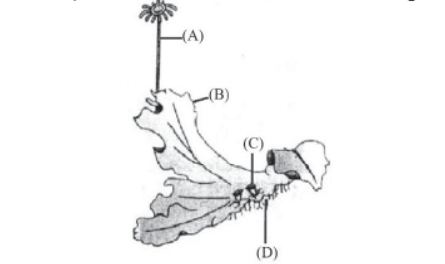
Q112. Examine the figure given below and select the right option giving all the four parts (a, b, c and d) correctly identified.
Correct Answer: (a)
The figure represents female thallus of Marchantia. Structures are: (A) Archegoniophore, (B) Female thallus, (C) Gemma cup, (D) Rhizoids.
The figure represents female thallus of Marchantia. Structures are: (A) Archegoniophore, (B) Female thallus, (C) Gemma cup, (D) Rhizoids.
Q113. Blue-green algae belong to
Correct Answer: (b)
Blue green algae or cyanobacteria are prokaryotes.
Blue green algae or cyanobacteria are prokaryotes.
Q114. In angiosperms, functional megaspore develops into
Correct Answer: (a)
During megagametogenesis functional megaspore gives rise to embryo sac.
During megagametogenesis functional megaspore gives rise to embryo sac.
Q115. Bryophytes are dependent on water because
Correct Answer: (c)
Bryophytes require a thin film of water on the surface of their substratum during sexual reproduction for swimming of sperms to reach the archegonia.
Bryophytes require a thin film of water on the surface of their substratum during sexual reproduction for swimming of sperms to reach the archegonia.
Q116. Which one is wrong statement ?
Correct Answer: (a)
The spores are non-motile in Mucor.
The spores are non-motile in Mucor.
Q117. Which one of the following pairs of plants are not seed producers?
Correct Answer: (b)
Pteridophytes (fern) and bryophytes (Funaria) are seedless plants.
Pteridophytes (fern) and bryophytes (Funaria) are seedless plants.
Q118. Match items in Column I with those in Column II:
| Column I | Column II |
|---|---|
| (A) Peritrichous flagellation | (J) Ginkgo |
| (B) Living fossil | (K) Macrocystis |
| (C) Rhizophore | (L) Escherichia coli |
| (D) Smallest flowering plant | (M) Selaginella |
| (E) Largest perennial alga | (N) Wolffia |
Correct Answer: (a)
Peritrichous flagellation: E.coli; Living fossil: Ginkgo; Rhizophore: Selaginella; Smallest flowering plant: Wolffia; Largest perennial alga: Macrocystis.
Peritrichous flagellation: E.coli; Living fossil: Ginkgo; Rhizophore: Selaginella; Smallest flowering plant: Wolffia; Largest perennial alga: Macrocystis.
Q119. A plant in which sporophytic generation is represented by zygote
Correct Answer: (c)
The plant body of Chlamydomonas is gametophyte (haploid). It reproduces asexually by zoospore... diploid zygote is the only structure representing sporophytic generation.
The plant body of Chlamydomonas is gametophyte (haploid). It reproduces asexually by zoospore... diploid zygote is the only structure representing sporophytic generation.
Q120. Read the following statements (A-E) and answer the question which follows them.
A. In liverworts, mosses and ferns gametophytes are free-living
B. Gymnosperms and some ferns are heterosporous.
C. Sexual reproduction in Fucus, Volvox and Albugo is oogamous
D. The sporophyte in liverworts is more elaborate than that in mosses
E. Both, Pinus and Marchantia are dioecious
How many of the above statements are correct?
A. In liverworts, mosses and ferns gametophytes are free-living
B. Gymnosperms and some ferns are heterosporous.
C. Sexual reproduction in Fucus, Volvox and Albugo is oogamous
D. The sporophyte in liverworts is more elaborate than that in mosses
E. Both, Pinus and Marchantia are dioecious
How many of the above statements are correct?
Correct Answer: (b)
Statements (A), (B) and (C) are correct. (D) is wrong (Moss sporophyte is more elaborate). (E) is wrong (Pinus is monoecious).
Statements (A), (B) and (C) are correct. (D) is wrong (Moss sporophyte is more elaborate). (E) is wrong (Pinus is monoecious).
Q121. Strobili or cones are found in
Correct Answer: (c)
Strobili or cones are the dense and compact structure present on non flowering plants. They contain sporangia. Found in Equisetum.
Strobili or cones are the dense and compact structure present on non flowering plants. They contain sporangia. Found in Equisetum.
Q122. Pteridophytes differ from mosses/bryophytes in possessing
Correct Answer: (b)
Well developed vascular system is present in the members of Pteridophytes but absent in mosses.
Well developed vascular system is present in the members of Pteridophytes but absent in mosses.
Q123. Archegoniophore is present in :
Correct Answer: (a)
Archegoniophore is the female sex organ of bryophytes (Marchantia).
Archegoniophore is the female sex organ of bryophytes (Marchantia).
Q124. Double fertilization is exhibited by :
Correct Answer: (c)
Double fertilization is a unique feature exhibited only by angiosperms. It involves both syngamy and triple fusion.
Double fertilization is a unique feature exhibited only by angiosperms. It involves both syngamy and triple fusion.
Q125. Evolutionary important character of Selaginella is
Correct Answer: (a)
Presence of two types of spores microspores and megaspores (heterospory) is the evolutionary characteristic feature in the life cycle of Selaginella.
Presence of two types of spores microspores and megaspores (heterospory) is the evolutionary characteristic feature in the life cycle of Selaginella.
Q126. Spore dissemination in some liverworts is aided by
Correct Answer: (d)
Elater is an elongated, spirally thickened cell in the capsule of a liverwort, derived from sporogenous tissue and assist in spore dispersal.
Elater is an elongated, spirally thickened cell in the capsule of a liverwort, derived from sporogenous tissue and assist in spore dispersal.
Q127. Which one of the following is a correct statement?
Correct Answer: (d)
Origin of seed habit started in pteridophyte Selaginella.
Origin of seed habit started in pteridophyte Selaginella.
Q128. Which of the following is true about bryophytes?
Correct Answer: (d)
Bryophytes are non-vascular embryophytes characterised by the presence of an independent gametophyte, archegonia, and chloroplasts.
Bryophytes are non-vascular embryophytes characterised by the presence of an independent gametophyte, archegonia, and chloroplasts.
Q129. After karyogamy followed by meiosis, spores are produced exogenously in
Correct Answer: (d)
In Agaricus (a genus of basidiomycetes), basidiospores or meiospores are produced exogenously. Neurospora produces ascospores endogenously.
In Agaricus (a genus of basidiomycetes), basidiospores or meiospores are produced exogenously. Neurospora produces ascospores endogenously.
Q130. A research student collected certain algae and found that its cells contained both chlorophyll a and chlorophyll b as well as phycoerythrin. The alga belongs to
Correct Answer: (a)
Phycoerythrin gives red colour to Rhodophyceae.
Phycoerythrin gives red colour to Rhodophyceae.
Q131. Male gametes are flagellated in :
Correct Answer: (b)
Male gametes are flagellated in Ectocarpus belonging to Phaeophyceae. In Spirogyra gametes are non-flagellated. Polysiphonia lacks flagella.
Male gametes are flagellated in Ectocarpus belonging to Phaeophyceae. In Spirogyra gametes are non-flagellated. Polysiphonia lacks flagella.
Q132. Pyrenoids are the centres for formation of
Correct Answer: (d)
Pyrenoids are the centres for the formation of starch. It is a seat of synthesis and storage of starch present in the chloroplast of algae.
Pyrenoids are the centres for the formation of starch. It is a seat of synthesis and storage of starch present in the chloroplast of algae.
Q133. Columella is a specialised structure found in the sporangium of
Correct Answer: (b)
Columella is located on the tip of long erect stalk known as sporangiophore, present in the Rhizopus.
Columella is located on the tip of long erect stalk known as sporangiophore, present in the Rhizopus.
Q134. Unique features of Bryophytes is that they
Correct Answer: (b)
Sporophyte remains attached to the gametophyte and produces spores.
Sporophyte remains attached to the gametophyte and produces spores.