Q1. Match Column-I with Column-II.
| Column-I | Column-II |
|---|---|
| (A) Saprophyte | (i) Symbiotic association of fungi with plant roots |
| (B) Parasite | (ii) Decomposition of dead organic materials |
| (C) Lichens | (iii) Living on living plants or animals |
| (D) Mycorrhiza | (iv) Symbiotic association of algae and fungi |
Correct Answer: (d)
Saprophytes decompose dead matter; parasites live on living hosts; lichens are algae-fungus associations; mycorrhizae associate fungi with roots.
Saprophytes decompose dead matter; parasites live on living hosts; lichens are algae-fungus associations; mycorrhizae associate fungi with roots.
Q2. Vivipary is characteristic of
Correct Answer: (d)
Vivipary, as in mangroves, is an adaptation of halophytes growing in saline, waterlogged habitats.
Vivipary, as in mangroves, is an adaptation of halophytes growing in saline, waterlogged habitats.
Q3. Xeric environment is characterised by
Correct Answer: (b)
A xeric habitat is dry; low atmospheric humidity is a defining feature and increases water-loss stress.
A xeric habitat is dry; low atmospheric humidity is a defining feature and increases water-loss stress.
Q4. A sedentary sea anemone gets attached to the shell lining of hermit crab. The association is
Correct Answer: (b)
The anemone gains transport and food scraps while the hermit crab is not significantly affected; this is commensalism in the exam context.
The anemone gains transport and food scraps while the hermit crab is not significantly affected; this is commensalism in the exam context.
Q5. Carnivorous animals - lions and leopards - occupy the same niche, but lions predate mostly larger animals and leopards take smaller ones. This mechanism of competition is referred to as
Correct Answer: (d)
They reduce direct competition by using different prey-size resources; this is resource partitioning.
They reduce direct competition by using different prey-size resources; this is resource partitioning.
Q6. Praying mantis is a good example of
Correct Answer: (c)
The praying mantis blends with surrounding leaves and stems, an adaptation known as camouflage.
The praying mantis blends with surrounding leaves and stems, an adaptation known as camouflage.
Q7. The semilog of per minute growing bacteria is plotted against time. What will be the shape of graph?
Correct Answer: (c)
During exponential growth, log population size increases linearly with time; a semilog plot is an ascending straight line.
During exponential growth, log population size increases linearly with time; a semilog plot is an ascending straight line.
Q8. Geometric representation of age structure is a characteristic of
Correct Answer: (a)
Age pyramids graphically represent the age structure of a population.
Age pyramids graphically represent the age structure of a population.
Q9. In which one of the following is nitrogen not a constituent?
Correct Answer: (b)
Idioblast is a specialised plant cell, not a nitrogen-containing chemical compound. Proteins/enzymes and bacteriochlorophyll contain nitrogen.
Idioblast is a specialised plant cell, not a nitrogen-containing chemical compound. Proteins/enzymes and bacteriochlorophyll contain nitrogen.
Q10. Which one of the following is not a parasitic adaptation?
Correct Answer: (d)
Parasites commonly have reduced sense or digestive organs and specialised attachment structures, but they have high reproductive capacity.
Parasites commonly have reduced sense or digestive organs and specialised attachment structures, but they have high reproductive capacity.
Q11. What is true about isolated small tribal populations?
Correct Answer: (a)
Small isolated populations have a restricted mating pool; inbreeding and limited mate availability can contribute to population decline.
Small isolated populations have a restricted mating pool; inbreeding and limited mate availability can contribute to population decline.
Q12. In India, human population is heavily weighted towards the younger age groups as a result of
Correct Answer: (c)
A high birth rate continually adds many young individuals, and a shorter average life span reduces the older proportion.
A high birth rate continually adds many young individuals, and a shorter average life span reduces the older proportion.
Q13. A biologist found average natality 250, mortality 240, immigration 20 and emigration 30 in a rat population. The net increase in population is
Correct Answer: (c)
Net change = natality + immigration − mortality − emigration = 250 + 20 − 240 − 30 = 0.
Net change = natality + immigration − mortality − emigration = 250 + 20 − 240 − 30 = 0.
Q14. Mycorrhizae are the example of
Correct Answer: (c)
In mycorrhizae, the fungus receives sugars while the plant gains improved water and mineral uptake; both benefit.
In mycorrhizae, the fungus receives sugars while the plant gains improved water and mineral uptake; both benefit.
Q15. Which type of association is found between an entomophilous flower and its pollinating agent?
Correct Answer: (a)
The flower gains pollination and the insect obtains nectar or pollen; this beneficial interaction is mutualism.
The flower gains pollination and the insect obtains nectar or pollen; this beneficial interaction is mutualism.
Q16. Plants such as Prosopis, Acacia and Capparis represent examples of tropical
Correct Answer: (a)
These drought-adapted, thorny shrubs and trees are characteristic of tropical thorn forests.
These drought-adapted, thorny shrubs and trees are characteristic of tropical thorn forests.
Q17. In a population, unrestricted reproductive capacity is called
Correct Answer: (a)
Biotic potential is the maximum reproductive capacity of a population under ideal, unrestricted conditions.
Biotic potential is the maximum reproductive capacity of a population under ideal, unrestricted conditions.
Q18. Animals that can tolerate a narrow range of salinity are
Correct Answer: (a)
Stenohaline organisms tolerate only a narrow salinity range; euryhaline organisms tolerate a broad range.
Stenohaline organisms tolerate only a narrow salinity range; euryhaline organisms tolerate a broad range.
Q19. Which of the following is a correct pair?
Correct Answer: (a)
Cuscuta is a parasitic plant. Dischidia is epiphytic, Opuntia is xerophytic and Capsella is not a hydrophyte.
Cuscuta is a parasitic plant. Dischidia is epiphytic, Opuntia is xerophytic and Capsella is not a hydrophyte.
Q20. Which of the following is not an attribute of a population?
Correct Answer: (c)
Natality, mortality and sex ratio are measurable population attributes. Species interaction describes relationships between populations.
Natality, mortality and sex ratio are measurable population attributes. Species interaction describes relationships between populations.
Q21. Tropical forests occur in India in
Correct Answer: (c)
Kerala and Assam have warm, high-rainfall regions that support tropical forests.
Kerala and Assam have warm, high-rainfall regions that support tropical forests.
Q22. Which one of the following pairs is mismatched?
Correct Answer: (c)
Prairies are temperate grasslands, not habitats characterised by epiphytes; the other biome-feature pairs are correct.
Prairies are temperate grasslands, not habitats characterised by epiphytes; the other biome-feature pairs are correct.
Q23. The maximum growth rate occurs in
Correct Answer: (d)
The exponential (log) phase is the phase of maximum cell division and maximum population growth rate.
The exponential (log) phase is the phase of maximum cell division and maximum population growth rate.
Q24. Consider the following conditions (i)-(iv) and select the correct pair as adaptations to environment in desert lizards:
(i) Burrowing in soil to escape high temperature
(ii) Losing heat rapidly from the body during high temperature
(iii) Basking in sun when temperature is low
(iv) Insulating body due to thick fatty dermis.
(i) Burrowing in soil to escape high temperature
(ii) Losing heat rapidly from the body during high temperature
(iii) Basking in sun when temperature is low
(iv) Insulating body due to thick fatty dermis.
Correct Answer: (b)
Desert lizards behaviourally thermoregulate: they burrow to avoid heat and bask when temperatures are low.
Desert lizards behaviourally thermoregulate: they burrow to avoid heat and bask when temperatures are low.
Q25. A country with a high rate of population growth took measures to reduce it. The figures below show age-sex pyramids of populations A and B twenty years apart.
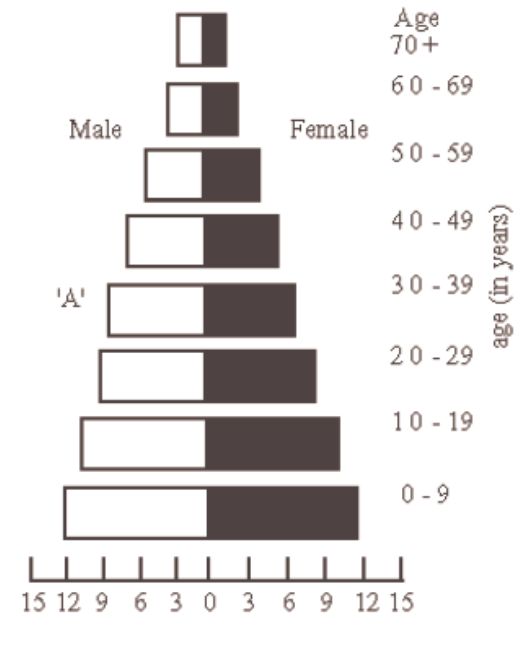
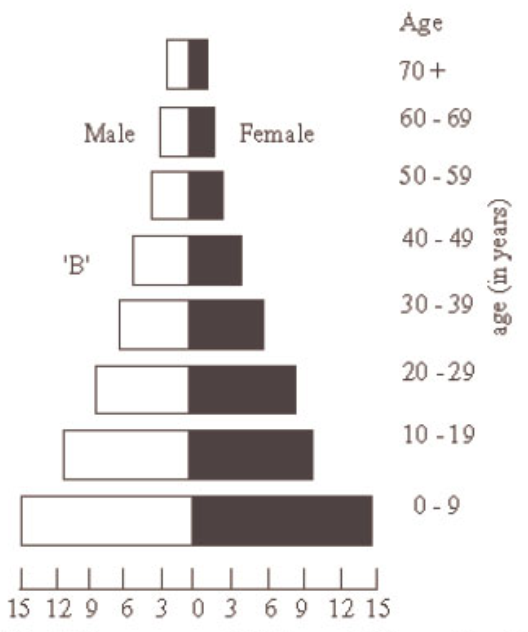
Select the correct interpretation.
Select the correct interpretation.
Correct Answer: (d)
Pyramid A has a relatively narrower young base than B, indicating it is the more recent population and that growth has been reduced slightly.
Pyramid A has a relatively narrower young base than B, indicating it is the more recent population and that growth has been reduced slightly.
Q26. Niche overlap indicates
Correct Answer: (b)
A niche includes resource use; overlap means two species use one or more of the same resources.
A niche includes resource use; overlap means two species use one or more of the same resources.
Q27. All of the following statements concerning the actinomycete Frankia are correct except that Frankia
Correct Answer: (b)
Frankia can fix nitrogen both in symbiosis and as a free-living organism; therefore statement (b) is incorrect.
Frankia can fix nitrogen both in symbiosis and as a free-living organism; therefore statement (b) is incorrect.
Q28. People living at sea level have around 5 million RBC per mm³ of blood, whereas those at 5400 m have around 8 million. This is because at high altitude
Correct Answer: (a)
At high altitude the partial pressure of oxygen is low; increased RBC production improves oxygen transport.
At high altitude the partial pressure of oxygen is low; increased RBC production improves oxygen transport.
Q29. An orchid flower resembles the female of an insect species, inducing a male to attempt copulation and thereby pollinate the flower. This phenomenon is called
Correct Answer: (a)
The orchid imitates the female insect; this deceptive resemblance is mimicry, which results in pollination.
The orchid imitates the female insect; this deceptive resemblance is mimicry, which results in pollination.
Q30. Competition for light, nutrients and space is most severe between
Correct Answer: (b)
Closely related organisms in the same niche have the greatest resource overlap, so competition is most intense.
Closely related organisms in the same niche have the greatest resource overlap, so competition is most intense.
Q31. Diffuse porous woods are characteristic of plants growing in
Correct Answer: (a)
Tropical trees often grow under relatively uniform conditions through the year and typically form diffuse-porous wood.
Tropical trees often grow under relatively uniform conditions through the year and typically form diffuse-porous wood.
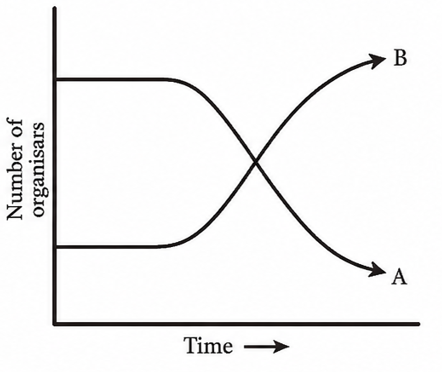
Q32. The following graph depicts changes in two populations (A and B) of herbivores in a grassy field. A possible reason for these changes is that
Correct Answer: (a)
B increases as A decreases, consistent with B being the superior competitor for the same food resource.
B increases as A decreases, consistent with B being the superior competitor for the same food resource.
Q33. Which one of the following is one of the characteristics of a biological community?
Correct Answer: (a)
Stratification is a community-level feature. Natality, mortality and sex ratio are population attributes.
Stratification is a community-level feature. Natality, mortality and sex ratio are population attributes.
Q34. Which of the following is not true for a species?
Correct Answer: (b)
Gene flow can occur between populations of the same species when individuals or gametes move and interbreed.
Gene flow can occur between populations of the same species when individuals or gametes move and interbreed.
Q35. Desert plants are generally
Correct Answer: (b)
Many xerophytes are succulent; their fleshy tissues store water for dry conditions.
Many xerophytes are succulent; their fleshy tissues store water for dry conditions.
Q36. Cause of mimicry is
Correct Answer: (a)
Mimicry enables an organism to resemble another object or organism, chiefly helping it avoid detection (concealment).
Mimicry enables an organism to resemble another object or organism, chiefly helping it avoid detection (concealment).
Q37. Most animals are tree dwellers in a
Correct Answer: (c)
The dense, vertically layered vegetation of tropical rain forests provides abundant arboreal habitats and food.
The dense, vertically layered vegetation of tropical rain forests provides abundant arboreal habitats and food.
Q38. Which one of the following statements is correct for secondary succession?
Correct Answer: (b)
Secondary succession begins where a community existed previously, such as a deforested area, and soil is already present.
Secondary succession begins where a community existed previously, such as a deforested area, and soil is already present.
Q39. Homeostasis is
Correct Answer: (b)
Homeostasis is the maintenance of a relatively stable internal environment despite external fluctuations.
Homeostasis is the maintenance of a relatively stable internal environment despite external fluctuations.
Q40. Which of the following pairs is correctly matched?
Correct Answer: (d)
A streamlined body reduces resistance while moving through water and is a key aquatic adaptation.
A streamlined body reduces resistance while moving through water and is a key aquatic adaptation.
Q41. In which of the following interactions are both partners adversely affected?
Correct Answer: (d)
Competition is a −/− interaction because each competitor is harmed by reduced access to shared resources.
Competition is a −/− interaction because each competitor is harmed by reduced access to shared resources.
Q42. Which of the following shows whorled phyllotaxy?
Correct Answer: (d)
Alstonia has whorled phyllotaxy, with more than two leaves arising at a node.
Alstonia has whorled phyllotaxy, with more than two leaves arising at a node.
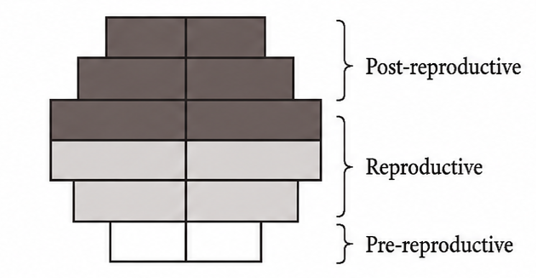
Q43. What type of human population is represented by the following age pyramid?
Correct Answer: (c)
The narrow pre-reproductive base indicates fewer young individuals than reproductive groups, which characterises a declining population.
The narrow pre-reproductive base indicates fewer young individuals than reproductive groups, which characterises a declining population.
Q44. Between which among the following, the relationship is not an example of commensalism?
Correct Answer: (a)
The female fig wasp and fig have an obligate mutualism: both benefit. The others are standard examples of commensalism.
The female fig wasp and fig have an obligate mutualism: both benefit. The others are standard examples of commensalism.
Q45. A pair of insectivorous plants is
Correct Answer: (b)
Nepenthes and bladderwort (Utricularia) trap insects; Rafflesia and Viscum are parasitic plants.
Nepenthes and bladderwort (Utricularia) trap insects; Rafflesia and Viscum are parasitic plants.
Q46. World Ozone Day is celebrated on
Correct Answer: (d)
16 September commemorates the Montreal Protocol and is observed as World Ozone Day.
16 September commemorates the Montreal Protocol and is observed as World Ozone Day.
Q47. Large woody vines are more commonly found in
Correct Answer: (c)
Lianas are especially abundant in tropical rain forests, where they climb tall trees to reach light.
Lianas are especially abundant in tropical rain forests, where they climb tall trees to reach light.
Q48. Benthic organisms are affected most by
Correct Answer: (d)
Benthic organisms live on or in the bottom substrate; hence the nature of sediments directly governs their habitat.
Benthic organisms live on or in the bottom substrate; hence the nature of sediments directly governs their habitat.
Q49. Cuscuta is an example of
Correct Answer: (a)
Cuscuta remains externally attached to its host and draws nutrients through haustoria, so it is an ectoparasite.
Cuscuta remains externally attached to its host and draws nutrients through haustoria, so it is an ectoparasite.
Q50. The figure below is a diagrammatic representation of responses of organisms to abiotic factors. What do a, b and c represent respectively?
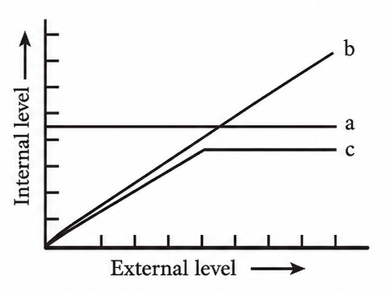
| (i) | (ii) | (iii) | |
|---|---|---|---|
| (a) | conformer | regulator | partial regulator |
| (b) | regulator | partial regulator | conformer |
| (c) | partial regulator | regulator | conformer |
| (d) | regulator | conformer | partial regulator |
Correct Answer: (d)
Line a remains constant despite external change (regulator); b tracks external conditions (conformer); c regulates only over part of the range (partial regulator).
Line a remains constant despite external change (regulator); b tracks external conditions (conformer); c regulates only over part of the range (partial regulator).
Q51. Choose the correct match of insectivorous plants.
Correct Answer: (c)
Utricularia, Drosera and Dionaea are insectivorous plants; Trapa and Vanda are not.
Utricularia, Drosera and Dionaea are insectivorous plants; Trapa and Vanda are not.
Q52. Which one is true?
Correct Answer: (b)
Symbiosis in this context refers to a mutually beneficial association. In commensalism, one benefits while the other is unaffected.
Symbiosis in this context refers to a mutually beneficial association. In commensalism, one benefits while the other is unaffected.
Q53. Asymptote in a logistic growth curve is obtained when
Correct Answer: (a)
At N = K, population size equals carrying capacity and net growth becomes zero; the curve approaches its asymptote.
At N = K, population size equals carrying capacity and net growth becomes zero; the curve approaches its asymptote.
Q54. The present population of the world is about
Correct Answer: (c)
The question is dated 1997; its keyed contemporary estimate was about 6 billion.
The question is dated 1997; its keyed contemporary estimate was about 6 billion.
Q55. The formula for exponential population growth is
Correct Answer: (c)
In exponential growth, the rate of population increase is proportional to population size: dN/dt = rN.
In exponential growth, the rate of population increase is proportional to population size: dN/dt = rN.
Q56. Species occurring in different geographical areas are called
Correct Answer: (c)
Allopatric populations/species occur in geographically separated areas.
Allopatric populations/species occur in geographically separated areas.
Q57. The sum total of the populations of the same kind of organisms constitute
Correct Answer: (d)
A species comprises populations of similar organisms that can interbreed and share a common gene pool.
A species comprises populations of similar organisms that can interbreed and share a common gene pool.
Q58. The population of an insect species shows an explosive increase during rainy season followed by disappearance at the end of the season. What does this show?
Correct Answer: (b)
Explosive increase under temporarily favourable conditions is characteristic of exponential, J-shaped growth.
Explosive increase under temporarily favourable conditions is characteristic of exponential, J-shaped growth.
Q59. Soil particles determine its
Correct Answer: (a)
The relative proportions of sand, silt and clay particles define soil texture.
The relative proportions of sand, silt and clay particles define soil texture.
Q60. In increasing order of organisational complexity, which one of the following is the correct sequence?
Correct Answer: (a)
Population consists of members of one species; communities contain populations, and ecosystems include communities plus their abiotic environment.
Population consists of members of one species; communities contain populations, and ecosystems include communities plus their abiotic environment.
Q61. Certain characteristic demographic features of developing countries are
Correct Answer: (a)
Developing countries commonly show high fertility, falling mortality, rapid growth and a high proportion of young people.
Developing countries commonly show high fertility, falling mortality, rapid growth and a high proportion of young people.
Q62. Which two statements are true for desert animals such as kangaroo rat?
(1) They have dark colour, high reproduction rate and excrete solid urine.
(2) They do not drink water, breathe slowly to conserve water and have thick hair.
(3) They feed on dry seeds and do not require drinking water.
(4) They excrete very concentrated urine and do not use water to regulate body temperature.
(1) They have dark colour, high reproduction rate and excrete solid urine.
(2) They do not drink water, breathe slowly to conserve water and have thick hair.
(3) They feed on dry seeds and do not require drinking water.
(4) They excrete very concentrated urine and do not use water to regulate body temperature.
Correct Answer: (a)
Kangaroo rats obtain metabolic water from dry seeds, excrete very concentrated urine and minimise water loss; statements 3 and 4 are correct.
Kangaroo rats obtain metabolic water from dry seeds, excrete very concentrated urine and minimise water loss; statements 3 and 4 are correct.
Q63. Which one of the following plants shows a very close relationship with a species of moth, where none can complete its life cycle without the other?
Correct Answer: (b)
Yucca and its moth are an obligate mutualistic pair: the moth pollinates the flower and uses it for reproduction.
Yucca and its moth are an obligate mutualistic pair: the moth pollinates the flower and uses it for reproduction.
Q64. Exponential growth of cells is a characteristic feature of
Correct Answer: (a)
Cells maintained in favourable tissue-culture conditions can divide exponentially without the usual whole-organism constraints.
Cells maintained in favourable tissue-culture conditions can divide exponentially without the usual whole-organism constraints.
Q65. Deep black soil is productive due to high proportion of
Correct Answer: (c)
Clay retains water and nutrients, while humus improves fertility; together they make soil highly productive.
Clay retains water and nutrients, while humus improves fertility; together they make soil highly productive.
Q66. Which one of these animals is not a homeotherm?
Correct Answer: (b)
Chelone (turtle) is an ectotherm and its body temperature varies with surroundings. The others are mammals or birds and are homeothermic.
Chelone (turtle) is an ectotherm and its body temperature varies with surroundings. The others are mammals or birds and are homeothermic.
Q67. Two plants can be conclusively said to belong to the same species if they
Correct Answer: (d)
Under the biological species concept, members of a species interbreed freely and produce viable, fertile offspring (seeds in plants).
Under the biological species concept, members of a species interbreed freely and produce viable, fertile offspring (seeds in plants).
Q68. Which of the following communities is more vulnerable to invasion by outside animals and plants?
Correct Answer: (b)
Island communities are isolated and often have species with limited defences against introduced competitors, predators or pathogens.
Island communities are isolated and often have species with limited defences against introduced competitors, predators or pathogens.
Q69. Which one of the following population interactions is widely used in medical science for production of antibiotics?
Correct Answer: (c)
Antibiosis is a form of amensalism in which one microorganism inhibits another by producing an antibiotic.
Antibiosis is a form of amensalism in which one microorganism inhibits another by producing an antibiotic.
Q70. The logistic population growth is expressed by the equation
Correct Answer: (b)
Logistic growth is dN/dt = rN[(K − N)/K], where K is carrying capacity and the bracketed term represents environmental resistance.
Logistic growth is dN/dt = rN[(K − N)/K], where K is carrying capacity and the bracketed term represents environmental resistance.
Q71. When does the growth rate of a population following the logistic model equal zero? The logistic model is dN/dt = rN(1 − N/K).
Correct Answer: (a)
For the stated model, dN/dt becomes exactly zero when N/K = 1, i.e. N = K.
For the stated model, dN/dt becomes exactly zero when N/K = 1, i.e. N = K.
Q72. A mutually beneficial association necessary for survival of both partners is
Correct Answer: (a)
An obligate mutualistic (symbiotic) association benefits both partners and may be essential to their survival.
An obligate mutualistic (symbiotic) association benefits both partners and may be essential to their survival.
Q73. Gause's principle of competitive exclusion states that
Correct Answer: (c)
Two species competing indefinitely for the same limiting resource cannot coexist in the same niche.
Two species competing indefinitely for the same limiting resource cannot coexist in the same niche.
Q74. Which part of the world has a high density of organisms?
Correct Answer: (d)
Warm, wet, productive tropical rain forests support the greatest density and diversity of organisms.
Warm, wet, productive tropical rain forests support the greatest density and diversity of organisms.
Q75. The process of growth is maximum during
Correct Answer: (d)
During the log (exponential) phase, cells divide at their maximum rate; therefore population growth is greatest.
During the log (exponential) phase, cells divide at their maximum rate; therefore population growth is greatest.
Q76. What is a keystone species?
Correct Answer: (a)
A keystone species has a disproportionately large ecological effect relative to its abundance or biomass.
A keystone species has a disproportionately large ecological effect relative to its abundance or biomass.
Q77. What is the most important factor for the success of animal population?
Correct Answer: (c)
Adaptability enables a population to survive and reproduce across changing environmental conditions.
Adaptability enables a population to survive and reproduce across changing environmental conditions.
Q78. Secondary metabolites such as nicotine, strychnine and caffeine are produced by plants for their
Correct Answer: (b)
These compounds deter herbivores and other enemies, so they primarily function in defence.
These compounds deter herbivores and other enemies, so they primarily function in defence.
Q79. Association of animals when both partners are benefitted is
Correct Answer: (b)
Mutualism is a +/+ interaction in which both associated partners benefit.
Mutualism is a +/+ interaction in which both associated partners benefit.
Q80. The concept that population tends to increase geometrically while food supply increases arithmetically was put forward by
Correct Answer: (d)
Thomas Malthus proposed that populations can increase faster than food supply, creating resource limitation.
Thomas Malthus proposed that populations can increase faster than food supply, creating resource limitation.
Q81. Human population growth in India
Correct Answer: (d)
Population growth is regulated ethically through informed, voluntary family-planning programmes, not by allowing disasters.
Population growth is regulated ethically through informed, voluntary family-planning programmes, not by allowing disasters.
Q82. A fertile agricultural soil appears deep coloured at the surface compared with soil one metre down. The reason for colour of topsoil is
Correct Answer: (b)
Topsoil contains humus from decomposed organic matter, which makes it darker and increases fertility.
Topsoil contains humus from decomposed organic matter, which makes it darker and increases fertility.
Q83. Presence of plants arranged into well-defined vertical layers depending on their height can be seen best in
Correct Answer: (a)
Tropical rain forests have pronounced stratification, with emergent trees, canopy, understorey and ground layers.
Tropical rain forests have pronounced stratification, with emergent trees, canopy, understorey and ground layers.
Q84. Keystone species in an ecosystem are those
Correct Answer: (d)
Keystone species contribute disproportionately to ecosystem structure and properties, irrespective of their abundance.
Keystone species contribute disproportionately to ecosystem structure and properties, irrespective of their abundance.
Q85. In which habitat does the diurnal temperature of soil surface vary most?
Correct Answer: (c)
Deserts have sparse vegetation and little moisture, so the exposed soil heats strongly by day and cools rapidly at night.
Deserts have sparse vegetation and little moisture, so the exposed soil heats strongly by day and cools rapidly at night.
Q86. Soil best suited for plant growth is
Correct Answer: (b)
Loam provides a balanced mixture of sand, silt and clay, giving both drainage and water/nutrient retention.
Loam provides a balanced mixture of sand, silt and clay, giving both drainage and water/nutrient retention.
Q87. Choose the correct sequence of stages of growth curve for bacteria.
Correct Answer: (a)
A typical bacterial growth curve proceeds through lag, log/exponential, stationary and decline phases.
A typical bacterial growth curve proceeds through lag, log/exponential, stationary and decline phases.
Q88. A high density of elephant population in an area can result in
Correct Answer: (a)
Individuals of the same elephant species compete for limited food, water and space; this is intraspecific competition.
Individuals of the same elephant species compete for limited food, water and space; this is intraspecific competition.
Q89. The high boiling point of water is advantageous to living organisms because
Correct Answer: (d)
Water can absorb considerable heat before boiling, so it buffers organisms against abrupt temperature changes.
Water can absorb considerable heat before boiling, so it buffers organisms against abrupt temperature changes.
Q90. Two opposite forces operate in the growth and development of every population. One relates to ability to reproduce at a given rate. The force opposing it is called
Correct Answer: (a)
Biotic potential favours increase; environmental resistance comprises limiting factors that oppose this potential.
Biotic potential favours increase; environmental resistance comprises limiting factors that oppose this potential.
Q91. In a growing population of a country,
Correct Answer: (a)
A growing population has a broad base in its age pyramid: pre-reproductive individuals outnumber reproductive individuals.
A growing population has a broad base in its age pyramid: pre-reproductive individuals outnumber reproductive individuals.