Q1. Anesthetics reduce pain by blocking the transmission of nerve impulses. The kind of chemicals working as anesthetics are those that block
Correct Answer: (d)
Anesthetics interrupt nerve signal transmission by targeting and blocking ion movement through voltage-gated Na⁺/K⁺ channels as well as post-synaptic neurotransmitter receptors.
Anesthetics interrupt nerve signal transmission by targeting and blocking ion movement through voltage-gated Na⁺/K⁺ channels as well as post-synaptic neurotransmitter receptors.
Q2. During the transmission of nerve impulse through a nerve fibre, the potential on the inner side of the plasma membrane has which type of electric charge?
Correct Answer: (d)
At rest, the inner membrane potential is negative (–70 mV); during depolarization, Na⁺ influx turns it positive (+30 mV); during repolarization/hyperpolarization, K⁺ efflux returns it to negative.
At rest, the inner membrane potential is negative (–70 mV); during depolarization, Na⁺ influx turns it positive (+30 mV); during repolarization/hyperpolarization, K⁺ efflux returns it to negative.
Q3. Third ventricle of brain is also known as
Correct Answer: (d)
The cavity within the diencephalon of the forebrain is named the 3rd ventricle or diacoel.
The cavity within the diencephalon of the forebrain is named the 3rd ventricle or diacoel.
Q4. In mammalian eye, the 'fovea' is the center of the visual field, where:
Correct Answer: (d)
The fovea centralis is a thinned-out central pit in the macula lutea packed exclusively with densely packed cone photoreceptors, providing maximum visual acuity.
The fovea centralis is a thinned-out central pit in the macula lutea packed exclusively with densely packed cone photoreceptors, providing maximum visual acuity.
Q5. Afferent nerve fibres carry impulses from
Correct Answer: (b)
Afferent (sensory) nerve fibers convey sensory input from peripheral sensory receptors toward the Central Nervous System (CNS).
Afferent (sensory) nerve fibers convey sensory input from peripheral sensory receptors toward the Central Nervous System (CNS).
Q6. Four healthy people in their twenties got involved in injuries resulting in damage and death of a few cells of the following. Which of the cells are least likely to be replaced by new cells?
Correct Answer: (b)
Mature neurons lack centrioles and remain arrested in the G₀ phase of the cell cycle, giving them virtually no capability for mitotic division or regeneration.
Mature neurons lack centrioles and remain arrested in the G₀ phase of the cell cycle, giving them virtually no capability for mitotic division or regeneration.
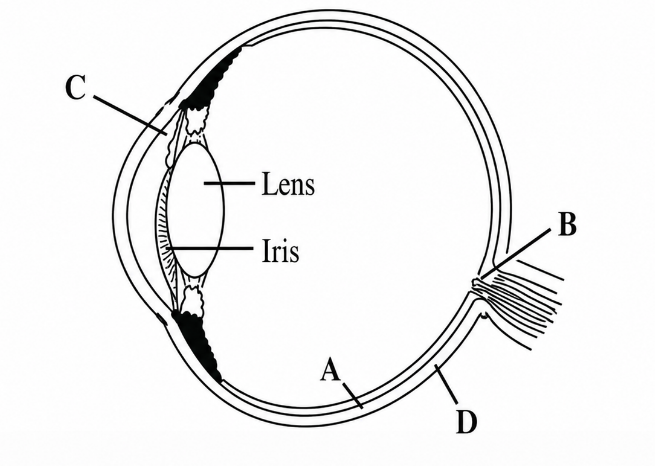
Q7. Parts A, B, C and D of the human eye are shown in the diagram. Select the option which gives correct identification along with its functions/characteristics:
Correct Answer: (d)
In the structure of the eye: A represents the Retina, which forms the inner neurosensory layer containing rod and cone photoreceptor cells.
In the structure of the eye: A represents the Retina, which forms the inner neurosensory layer containing rod and cone photoreceptor cells.
Q8. Which of the following statements is correct for 'nodes of Ranvier' of nerve?
Correct Answer: (b)
Nodes of Ranvier are periodic gaps along a myelinated axon where the insulating myelin sheath is discontinuous, exposing the axonal membrane to extracellular fluid.
Nodes of Ranvier are periodic gaps along a myelinated axon where the insulating myelin sheath is discontinuous, exposing the axonal membrane to extracellular fluid.
Q9. The transparent lens in the human eye is held in its place by
Correct Answer: (a)
The crystalline lens is anchored suspended in place behind the pupil by suspensory ligaments (zonules of Zinn) attached to the ciliary body.
The crystalline lens is anchored suspended in place behind the pupil by suspensory ligaments (zonules of Zinn) attached to the ciliary body.
Q10. When a neuron is in resting state i.e., not conducting any impulse, the axonal membrane is:
Correct Answer: (d)
At resting potential (–70 mV), the axonal membrane is significantly more permeable to potassium ions (K⁺) and virtually impermeable to sodium ions (Na⁺) and negatively charged proteins.
At resting potential (–70 mV), the axonal membrane is significantly more permeable to potassium ions (K⁺) and virtually impermeable to sodium ions (Na⁺) and negatively charged proteins.
Q11. Cornea transplantation is outstandingly successful because
Correct Answer: (b)
Because the cornea lacks blood supply, it is exempt from graft rejection caused by immune cell transport via the vascular system.
Because the cornea lacks blood supply, it is exempt from graft rejection caused by immune cell transport via the vascular system.
Q12. Function of iris is to
Correct Answer: (d)
Smooth muscle fibers of the iris contract and dilate to alter the diameter of the pupil, regulating the amount of light entering the eye.
Smooth muscle fibers of the iris contract and dilate to alter the diameter of the pupil, regulating the amount of light entering the eye.
Q13. Injury to vagus nerve in humans is not likely to affect
Correct Answer: (a)
Tongue movements are controlled by the hypoglossal nerve (12th cranial nerve). The vagus nerve (10th cranial nerve) regulates thoracic and abdominal visceral organs (heart, stomach, pancreas).
Tongue movements are controlled by the hypoglossal nerve (12th cranial nerve). The vagus nerve (10th cranial nerve) regulates thoracic and abdominal visceral organs (heart, stomach, pancreas).
Q14. Injury localized to the hypothalamus would most likely disrupt:
Correct Answer: (d)
The hypothalamus houses important autonomic control centers that regulate thermoregulation (body temperature), urge for eating (hunger), and drinking (thirst).
The hypothalamus houses important autonomic control centers that regulate thermoregulation (body temperature), urge for eating (hunger), and drinking (thirst).
Q15. Eye lens is formed from
Correct Answer: (a)
The crystalline lens of the eye develops embryologically from the surface ectoderm (lens placode).
The crystalline lens of the eye develops embryologically from the surface ectoderm (lens placode).
Q16. The human hind brain comprises three parts, one of which is:
Correct Answer: (c)
The human hindbrain (rhombencephalon) consists of three major anatomical structures: the pons, cerebellum, and medulla oblongata.
The human hindbrain (rhombencephalon) consists of three major anatomical structures: the pons, cerebellum, and medulla oblongata.
Q17. Myelin sheath is produced by:
Correct Answer: (d)
In the Peripheral Nervous System (PNS), the myelin sheath is produced by Schwann cells, whereas in the Central Nervous System (CNS), it is synthesized by Oligodendrocytes.
In the Peripheral Nervous System (PNS), the myelin sheath is produced by Schwann cells, whereas in the Central Nervous System (CNS), it is synthesized by Oligodendrocytes.
Q18. Ivan Pavlov performed experiments on
Correct Answer: (b)
Ivan Pavlov demonstrated classical conditioning and conditioned reflexes by training dogs to salivate in response to auditory cues (bell chime) associated with food.
Ivan Pavlov demonstrated classical conditioning and conditioned reflexes by training dogs to salivate in response to auditory cues (bell chime) associated with food.
Q19. In humans, visceral organs are innervated by
Correct Answer: (d)
Internal visceral organs receive dual autonomic innervation (sympathetic and parasympathetic) that operates involuntarily without conscious control.
Internal visceral organs receive dual autonomic innervation (sympathetic and parasympathetic) that operates involuntarily without conscious control.
Q20. Good vision depends on adequate intake of carotene rich food.
Select the best option from the following statements:
(i) Vitamin A derivatives are formed from carotene
(ii) The photopigments are embedded in the membrane discs of the inner segment
(iii) Retinal is a derivative of Vitamin A
(iv) Retinal is a light absorbing part of all the visual photopigments
Select the best option from the following statements:
(i) Vitamin A derivatives are formed from carotene
(ii) The photopigments are embedded in the membrane discs of the inner segment
(iii) Retinal is a derivative of Vitamin A
(iv) Retinal is a light absorbing part of all the visual photopigments
Correct Answer: (a)
Beta-carotene synthesizes Vitamin A, whose aldehyde derivative is retinal (the light-absorbing chromophore component of opsin photopigments located in outer segment membrane discs).
Beta-carotene synthesizes Vitamin A, whose aldehyde derivative is retinal (the light-absorbing chromophore component of opsin photopigments located in outer segment membrane discs).
Q21. The purplish red pigment rhodopsin contained in the rods type of photoreceptor cells of the human eye, is a derivative of:
Correct Answer: (d)
Rhodopsin (visual purple) consists of opsin protein bound to 11-cis-retinal, which is a chemical derivative of Vitamin A.
Rhodopsin (visual purple) consists of opsin protein bound to 11-cis-retinal, which is a chemical derivative of Vitamin A.
Q22. Which one of the following statements is not correct?
Correct Answer: (c)
Retinal is an aldehyde derivative of Vitamin A (not Vitamin C).
Retinal is an aldehyde derivative of Vitamin A (not Vitamin C).
Q23. Which of the following regions of the brain is incorrectly paired with its function?
Correct Answer: (a)
Language comprehension is governed by Wernicke's area situated in the cerebral cortex, whereas the cerebellum is primarily responsible for maintaining posture, body balance, and neuromuscular coordination.
Language comprehension is governed by Wernicke's area situated in the cerebral cortex, whereas the cerebellum is primarily responsible for maintaining posture, body balance, and neuromuscular coordination.
Q24. Alzheimer disease in humans is associated with the deficiency of:
Correct Answer: (b)
Alzheimer's disease is a neurodegenerative disorder characterized by progressive loss of cholinergic neurons and severe deficiency of acetylcholine in the brain.
Alzheimer's disease is a neurodegenerative disorder characterized by progressive loss of cholinergic neurons and severe deficiency of acetylcholine in the brain.
Q25. What is intensity of sound in normal conversation?
Correct Answer: (b)
Normal conversational speech produces sound intensities typically ranging between 35 and 60 decibels (dB).
Normal conversational speech produces sound intensities typically ranging between 35 and 60 decibels (dB).
Q26. Which of the following is an example of negative feedback loop in humans?
Correct Answer: (d)
In response to cold exposure, negative feedback mechanisms trigger peripheral vasoconstriction and shivering muscle contractions to generate heat and restore normal body temperature.
In response to cold exposure, negative feedback mechanisms trigger peripheral vasoconstriction and shivering muscle contractions to generate heat and restore normal body temperature.
Q27. Which part of human brain is concerned with the regulation of body temperature?
Correct Answer: (c)
The hypothalamus serves as the master thermostat of the human body, coordinating homeostatic responses to maintain body temperature around 37 °C.
The hypothalamus serves as the master thermostat of the human body, coordinating homeostatic responses to maintain body temperature around 37 °C.
Q28. In which animal nerve cell is present but brain is absent?
Correct Answer: (d)
Cnidarians like Hydra possess a primitive non-polarized apolar nerve net, but lack a centralized brain or ganglionated control center.
Cnidarians like Hydra possess a primitive non-polarized apolar nerve net, but lack a centralized brain or ganglionated control center.
Q29. Given below is a diagrammatic cross section of a single loop of human cochlea:
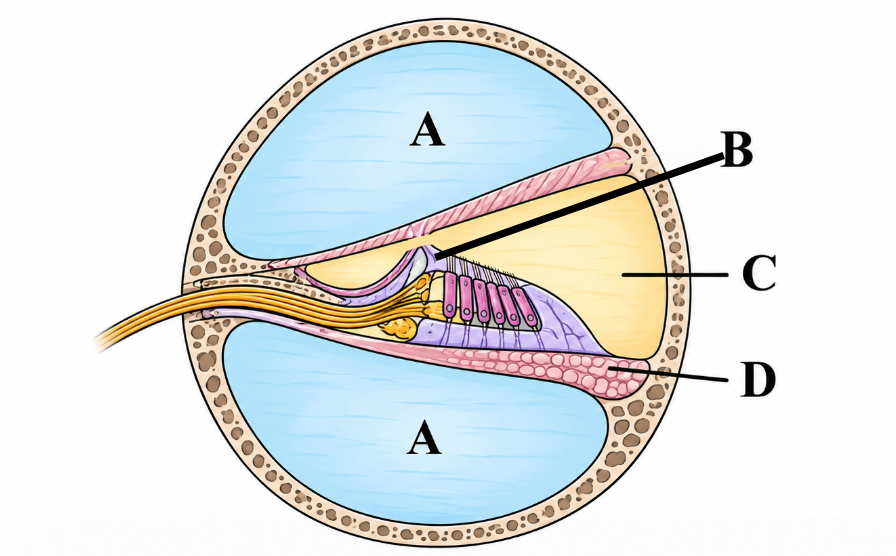
Which one of the following options correctly represents the names of three different parts?
Which one of the following options correctly represents the names of three different parts?
Correct Answer: (d)
In the cross-section of the cochlea, the scala vestibuli and scala tympani contain perilymph (A), whereas the scala media (cochlear duct) contains endolymph (C). The tectorial membrane (B) overlies the sensory hair cells (D) of the Organ of Corti. Vibrations transmitted through the cochlea bend these hair cells against the tectorial membrane, converting sound waves into nerve impulses.
In the cross-section of the cochlea, the scala vestibuli and scala tympani contain perilymph (A), whereas the scala media (cochlear duct) contains endolymph (C). The tectorial membrane (B) overlies the sensory hair cells (D) of the Organ of Corti. Vibrations transmitted through the cochlea bend these hair cells against the tectorial membrane, converting sound waves into nerve impulses.
Q30. The sympathetic nerves in mammals arise from
Correct Answer: (c)
The sympathetic division of the autonomic nervous system originates from the thoracic and lumbar segments of the spinal cord (thoracolumbar outflow: T1 to L2).
The sympathetic division of the autonomic nervous system originates from the thoracic and lumbar segments of the spinal cord (thoracolumbar outflow: T1 to L2).
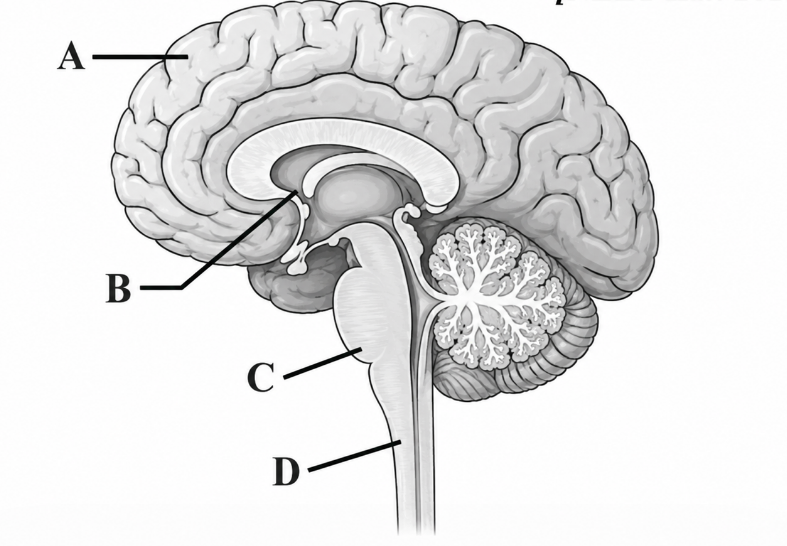
Q31. A sagittal section of human-brain is shown here. Identify at least two labels from A-D.
Correct Answer: (c)
The cerebrum (A) is the largest part of the brain and is responsible for intelligence, memory, learning, and voluntary actions. The hypothalamus (B) regulates homeostasis and controls the endocrine system through the pituitary gland. The pons (C) acts as a bridge between different parts of the brain and helps regulate respiration. The medulla oblongata (D) controls vital involuntary activities such as breathing, heartbeat, and blood pressure.
The cerebrum (A) is the largest part of the brain and is responsible for intelligence, memory, learning, and voluntary actions. The hypothalamus (B) regulates homeostasis and controls the endocrine system through the pituitary gland. The pons (C) acts as a bridge between different parts of the brain and helps regulate respiration. The medulla oblongata (D) controls vital involuntary activities such as breathing, heartbeat, and blood pressure.
Q32. CNS is mostly made of
Correct Answer: (c)
The Central Nervous System (CNS) consists primarily of interneurons (association neurons) that process and integrate incoming sensory signals and generate motor responses.
The Central Nervous System (CNS) consists primarily of interneurons (association neurons) that process and integrate incoming sensory signals and generate motor responses.
Q33. Destruction of the anterior horn cell of the spinal cord would result in loss of:
Correct Answer: (a)
The anterior (ventral) horn cells of the spinal cord contain cell bodies of motor neurons that transmit efferent/motor impulses to skeletal muscles; their destruction leads to loss of voluntary motor function.
The anterior (ventral) horn cells of the spinal cord contain cell bodies of motor neurons that transmit efferent/motor impulses to skeletal muscles; their destruction leads to loss of voluntary motor function.
Q34. Cornea transplant in humans is almost never rejected. This is because
Correct Answer: (b)
The cornea is an avascular tissue devoid of blood vessels, making it an immunologically privileged site isolated from circulating immune cells.
The cornea is an avascular tissue devoid of blood vessels, making it an immunologically privileged site isolated from circulating immune cells.
Q35. Light rays entering the eye is controlled by
Correct Answer: (a)
The pupil serves as the central aperture that expands or constricts to control the quantity of light rays entering the eye.
The pupil serves as the central aperture that expands or constricts to control the quantity of light rays entering the eye.
Q36. Afferent nerve fibre carries impulses from
Correct Answer: (b)
Afferent (sensory) fibers transmit sensory nerve impulses inward from sensory receptors to the Central Nervous System.
Afferent (sensory) fibers transmit sensory nerve impulses inward from sensory receptors to the Central Nervous System.
Q37. Neuroglia consist of cells found in the
Correct Answer: (c)
Neuroglial cells (astrocytes, oligodendrocytes, microglia, and Schwann cells) are non-neuronal supporting cells located throughout the central nervous system (CNS) and peripheral ganglia.
Neuroglial cells (astrocytes, oligodendrocytes, microglia, and Schwann cells) are non-neuronal supporting cells located throughout the central nervous system (CNS) and peripheral ganglia.
Q38. When we migrate from dark to light, we fail to see for sometime but after a time visibility becomes normal. It is an example of
Correct Answer: (b)
Light adaptation is the physiological process where photoreceptor sensitivity adjusts and rhodopsin bleaching normalizes visual perception upon moving from dark to bright environments.
Light adaptation is the physiological process where photoreceptor sensitivity adjusts and rhodopsin bleaching normalizes visual perception upon moving from dark to bright environments.
Q39. In vertebrates, simple reflex action is
Correct Answer: (d)
A simple monosynaptic reflex arc involves direct synaptic communication between a single afferent (sensory) neuron and a single efferent (motor) neuron without interneurons.
A simple monosynaptic reflex arc involves direct synaptic communication between a single afferent (sensory) neuron and a single efferent (motor) neuron without interneurons.
Q40. One of the examples of the action of the autonomous nervous system is
Correct Answer: (c)
Peristaltic movements of the gastrointestinal tract are involuntary actions regulated automatically by the autonomic nervous system (sympathetic and parasympathetic divisions).
Peristaltic movements of the gastrointestinal tract are involuntary actions regulated automatically by the autonomic nervous system (sympathetic and parasympathetic divisions).
Q41. Suspensory ligament is part of
Correct Answer: (b)
Suspensory ligaments (zonules) are structural components of the eye that hold the crystalline lens suspended from the ciliary body.
Suspensory ligaments (zonules) are structural components of the eye that hold the crystalline lens suspended from the ciliary body.
Q42. One function of parasympathetic nervous system is
Correct Answer: (d)
Parasympathetic stimulation (via oculomotor nerve) contracts the pupillary sphincter muscle, bringing about constriction of the pupil (miosis).
Parasympathetic stimulation (via oculomotor nerve) contracts the pupillary sphincter muscle, bringing about constriction of the pupil (miosis).
Q43. Retina is most sensitive at
Correct Answer: (d)
The fovea centralis, situated at the center of macula lutea, contains the highest concentration of tightly packed cones, forming the area of sharpest visual resolution.
The fovea centralis, situated at the center of macula lutea, contains the highest concentration of tightly packed cones, forming the area of sharpest visual resolution.
Q44. Which of the following cranial nerves can regulate heart beat?
Correct Answer: (a)
The 10th cranial nerve (Vagus nerve) provides parasympathetic cardiac innervation that slows down the heart rate.
The 10th cranial nerve (Vagus nerve) provides parasympathetic cardiac innervation that slows down the heart rate.
Q45. Photosensitive compound in human eye is made up of
Correct Answer: (b)
Visual photopigments (such as rhodopsin) consist of opsin (a apoprotein) conjugated with retinal (an aldehyde of vitamin A).
Visual photopigments (such as rhodopsin) consist of opsin (a apoprotein) conjugated with retinal (an aldehyde of vitamin A).
Q46. In the chemistry of vision in mammals, the photosensitive substance is called
Correct Answer: (c)
Rhodopsin (visual purple) is the light-sensitive photopigment present in the rod cells of the mammalian retina.
Rhodopsin (visual purple) is the light-sensitive photopigment present in the rod cells of the mammalian retina.
Q47. A gymnast is able to balance his body upside down even in the total darkness because of:
Correct Answer: (a)
The vestibular apparatus of the inner ear maintains spatial orientation, equilibrium, and postural balance independently of visual input.
The vestibular apparatus of the inner ear maintains spatial orientation, equilibrium, and postural balance independently of visual input.
Q48. Match the following columns and select the correct option.
| Column-I | Column-II |
|---|---|
| (a) Organ of Corti | (i) Connects middle ear and pharynx |
| (b) Cochlea | (ii) Coiled part of the labyrinth |
| (c) Eustachian tube | (iii) Attached to the oval window |
| (d) Stapes | (iv) Located on the basilar membrane |
Correct Answer: (b)
The organ of Corti is situated on the basilar membrane; Cochlea is the coiled labyrinth; Eustachian tube connects the middle ear cavity with the nasopharynx; Stapes attaches to the oval window.
The organ of Corti is situated on the basilar membrane; Cochlea is the coiled labyrinth; Eustachian tube connects the middle ear cavity with the nasopharynx; Stapes attaches to the oval window.
Q49. Which one of the following pairs of structures distinguishes a nerve cell from other types of cells?
Correct Answer: (d)
Perikaryon (soma/cell body containing Nissl granules) and dendrites (branched sensory processes) are morphological features unique to neurons.
Perikaryon (soma/cell body containing Nissl granules) and dendrites (branched sensory processes) are morphological features unique to neurons.
Q50. Which part of the human ear plays no role in hearing as such but is otherwise very much required?
Correct Answer: (c)
The vestibular apparatus (semicircular canals and otolith organs) functions strictly in equilibrium and body balance, not hearing.
The vestibular apparatus (semicircular canals and otolith organs) functions strictly in equilibrium and body balance, not hearing.
Q51. Stimulation of a muscle fiber by a motor neuron occurs at:
Correct Answer: (a)
The junction or synapse formed between an efferent (motor) neuron axon terminal and the sarcolemma of a muscle fiber is termed the neuromuscular junction (or motor end-plate).
The junction or synapse formed between an efferent (motor) neuron axon terminal and the sarcolemma of a muscle fiber is termed the neuromuscular junction (or motor end-plate).
Q52. The most abundant intracellular cation is:
Correct Answer: (c)
Potassium ions (K⁺) are the primary, most abundant intracellular cations inside neural and animal cells, whereas sodium ions (Na⁺) predominate in the extracellular fluid (ECF).
Potassium ions (K⁺) are the primary, most abundant intracellular cations inside neural and animal cells, whereas sodium ions (Na⁺) predominate in the extracellular fluid (ECF).
Q53. Which of the following statements is not correct?
Correct Answer: (d)
Rods contain rhodopsin and function in twilight/dim-light (scotopic) vision, whereas cones mediate daylight (photopic) and color vision.
Rods contain rhodopsin and function in twilight/dim-light (scotopic) vision, whereas cones mediate daylight (photopic) and color vision.
Q54. A person entering an empty room suddenly finds a snake right in front on opening the door. Which one of the following is likely to happen in his neuro-hormonal control system?
Correct Answer: (a)
Emergency or fight-or-flight situations trigger the sympathetic nervous system, causing the adrenal medulla to secrete catecholamines (epinephrine and norepinephrine) into circulation.
Emergency or fight-or-flight situations trigger the sympathetic nervous system, causing the adrenal medulla to secrete catecholamines (epinephrine and norepinephrine) into circulation.
Q55. Characteristic feature of human cornea
Correct Answer: (c)
The human cornea is entirely avascular (lacks blood vessels) and receives nutrients via diffusion from the aqueous humor and tear film.
The human cornea is entirely avascular (lacks blood vessels) and receives nutrients via diffusion from the aqueous humor and tear film.
Q56. Sensitive pigmented layer of eye is
Correct Answer: (b)
The retina is the inner photosensitive, neurosensory pigmented coat of the eye that contains photoreceptors.
The retina is the inner photosensitive, neurosensory pigmented coat of the eye that contains photoreceptors.
Q57. In a man, abducens nerve is injured. Which one of the following functions will be affected?
Correct Answer: (a)
The abducens nerve (6th cranial nerve) is a motor nerve that innervates the lateral rectus muscle of the eye, controlling lateral movement/abduction of the eyeball.
The abducens nerve (6th cranial nerve) is a motor nerve that innervates the lateral rectus muscle of the eye, controlling lateral movement/abduction of the eyeball.
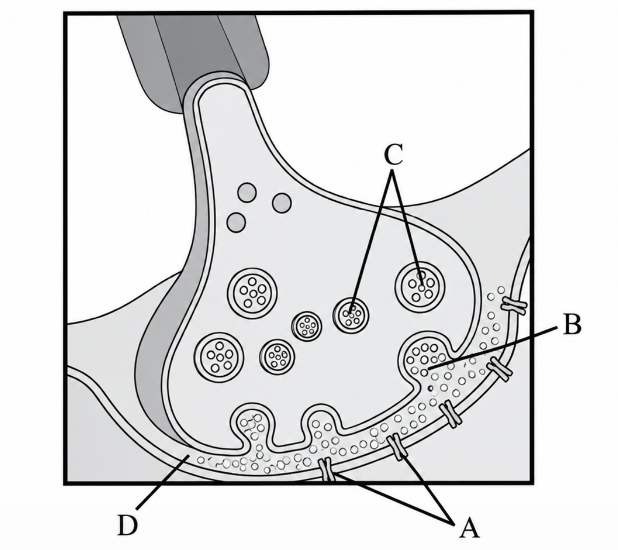
Q58. A diagram showing axon terminal and synapse is given. Identify correctly at least two of A-D.
Correct Answer: (d)
Synaptic vesicles (C) present in the presynaptic axon terminal store neurotransmitters. Upon arrival of a nerve impulse, these neurotransmitters are released into the synaptic cleft (D). The released neurotransmitter molecules (B) then diffuse across the synaptic cleft and bind to postsynaptic receptors (A), thereby transmitting the nerve impulse to the next neuron.
Synaptic vesicles (C) present in the presynaptic axon terminal store neurotransmitters. Upon arrival of a nerve impulse, these neurotransmitters are released into the synaptic cleft (D). The released neurotransmitter molecules (B) then diffuse across the synaptic cleft and bind to postsynaptic receptors (A), thereby transmitting the nerve impulse to the next neuron.
Q59. Nissl bodies are mainly composed of
Correct Answer: (c)
Nissl bodies are prominent granular structures found in the soma/cyton and dendrites of neurons. Under an electron microscope, they are revealed to be composed of free ribosomes and Rough Endoplasmic Reticulum (RER), actively serving in protein synthesis.
Nissl bodies are prominent granular structures found in the soma/cyton and dendrites of neurons. Under an electron microscope, they are revealed to be composed of free ribosomes and Rough Endoplasmic Reticulum (RER), actively serving in protein synthesis.
Q60. The figure shows an axon terminal and synapse. Select the option giving correct identifications of labels A-D.
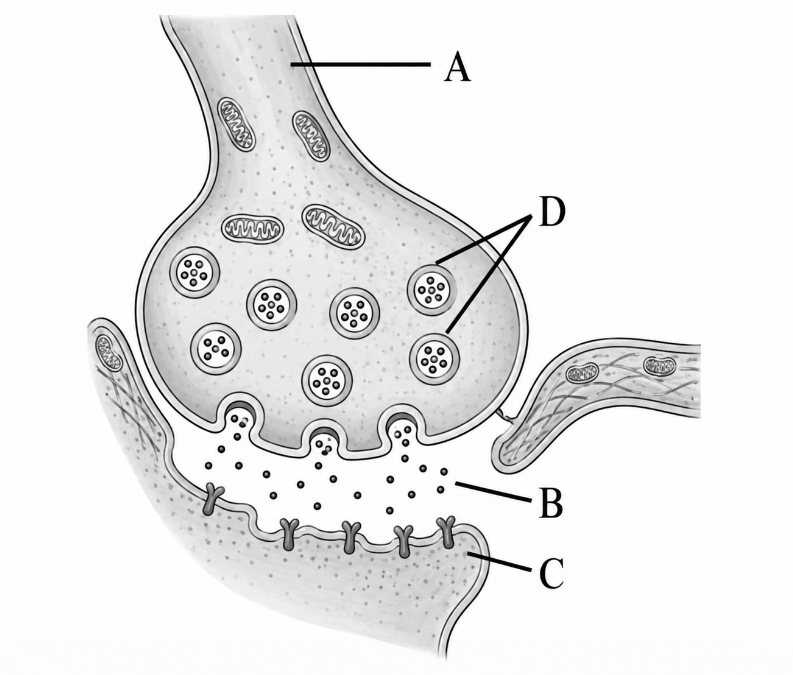
Correct Answer: (a)
A – Axon, B – Synaptic cleft, C – Receptors, D – Synaptic vesicles.
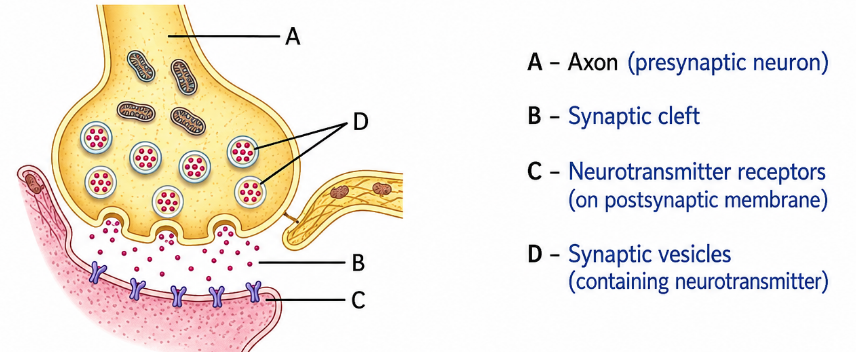
A – Axon, B – Synaptic cleft, C – Receptors, D – Synaptic vesicles.
Q61. The nerve centres which control the body temperature and the urge for eating are contained in:
Correct Answer: (a)
The hypothalamus contains discrete neural centers that strictly govern body thermoregulation, hunger (feeding center), and satiety.
The hypothalamus contains discrete neural centers that strictly govern body thermoregulation, hunger (feeding center), and satiety.
Q62. The Nissl's granules of nerve cells are made up of
Correct Answer: (a)
Nissl's granules are composed of clusters of ribosomes and rough endoplasmic reticulum (RER), serving as active sites for cellular protein synthesis.
Nissl's granules are composed of clusters of ribosomes and rough endoplasmic reticulum (RER), serving as active sites for cellular protein synthesis.
Q63. Which of the following receptors are specifically responsible for maintenance of balance of body and posture?
Correct Answer: (a)
The vestibular apparatus contains crista ampullaris (in semicircular canals for dynamic equilibrium) and macula (in saccule/utricle for static equilibrium/posture).
The vestibular apparatus contains crista ampullaris (in semicircular canals for dynamic equilibrium) and macula (in saccule/utricle for static equilibrium/posture).
Q64. Respiratory centre is situated in
Correct Answer: (b)
The primary medullary respiratory center regulating rhythmicity of breathing is located in the medulla oblongata.
The primary medullary respiratory center regulating rhythmicity of breathing is located in the medulla oblongata.
Q65. During the propagation of a nerve impulse, the action potential results from the movement of:
Correct Answer: (d)
Depolarization and initiation of an action potential result from the sudden opening of voltage-gated Na⁺ channels, causing rapid influx of Na⁺ ions from the extracellular fluid into the axoplasm.
Depolarization and initiation of an action potential result from the sudden opening of voltage-gated Na⁺ channels, causing rapid influx of Na⁺ ions from the extracellular fluid into the axoplasm.
Q66. Receptor sites for neurotransmitters are present on:
Correct Answer: (c)
Neurotransmitters are released from pre-synaptic vesicles into the synaptic cleft and bind specifically to specific receptor protein sites present on the post-synaptic membrane.
Neurotransmitters are released from pre-synaptic vesicles into the synaptic cleft and bind specifically to specific receptor protein sites present on the post-synaptic membrane.
Q67. Which one of the following is the correct difference between Rod Cells and Cone Cells of our retina?
Correct Answer: (c)
Rod cells function in scotopic (dim light) vision without color differentiation, whereas cone cells mediate photopic (bright light), high-acuity, and color vision.
Rod cells function in scotopic (dim light) vision without color differentiation, whereas cone cells mediate photopic (bright light), high-acuity, and color vision.
Q68. Which of the following structures or regions is incorrectly paired with its functions?
Correct Answer: (b)
The limbic system (emotional brain) is responsible for the regulation of sexual behavior, expression of emotional reactions (e.g., excitement, pleasure, rage, and fear), and motivation, not motor movement control.
The limbic system (emotional brain) is responsible for the regulation of sexual behavior, expression of emotional reactions (e.g., excitement, pleasure, rage, and fear), and motivation, not motor movement control.
Q69. Acute vision is present in
Correct Answer: (a)
Vultures possess exceptionally acute, high-resolution vision due to retinal foveas densely packed with photoreceptor cones.
Vultures possess exceptionally acute, high-resolution vision due to retinal foveas densely packed with photoreceptor cones.
Q70. Vagus nerve is
Correct Answer: (a)
The vagus nerve is designated as the 10th (X) pair of cranial nerves in human anatomy.
The vagus nerve is designated as the 10th (X) pair of cranial nerves in human anatomy.
Q71. Iris is part of
Correct Answer: (b)
The iris is the anterior extension of the middle vascular tunic (uveal tract / choroid) of the eyeball.
The iris is the anterior extension of the middle vascular tunic (uveal tract / choroid) of the eyeball.
Q72. In the resting state of the neural membrane, diffusion due to concentration gradients, if allowed, would drive
Correct Answer: (c)
Because Na⁺ concentration is significantly higher outside the neuron (ECF) than inside, passive chemical diffusion drives Na⁺ into the cell.
Because Na⁺ concentration is significantly higher outside the neuron (ECF) than inside, passive chemical diffusion drives Na⁺ into the cell.