Q1. In operon concept, regulator gene functions as
Correct Answer: (a)
The regulator gene ('i' gene) produces repressor protein.
The regulator gene ('i' gene) produces repressor protein.
Q2. The experimental proof for semiconservative replication of DNA was first shown in a
Correct Answer: (b)
Meselson and Stahl demonstrated semi-conservative replication first in the bacterium Escherichia coli using 15N.
Meselson and Stahl demonstrated semi-conservative replication first in the bacterium Escherichia coli using 15N.
Q3. Which enzymes will be produced in a cell in which there is a nonsense mutation in the lac Y gene?
Correct Answer: (d)
The lac operon gene order is Promoter-Operator-z-y-a. A nonsense mutation in 'y' stops translation at 'y'. Therefore, 'z' gene (β-galactosidase) translates normally.
The lac operon gene order is Promoter-Operator-z-y-a. A nonsense mutation in 'y' stops translation at 'y'. Therefore, 'z' gene (β-galactosidase) translates normally.
Q4. Which of the following RNAs should be most abundant in animal cell?
Correct Answer: (d)
Ribosomal RNA (rRNA) is the most abundant type of RNA in animal cells, constituting about 80% of total cellular RNA.
Ribosomal RNA (rRNA) is the most abundant type of RNA in animal cells, constituting about 80% of total cellular RNA.
Q5. Read the following four statements (A-D):
(A) In transcription, adenosine pairs with uracil.
(B) Regulation of lac operon by repressor is referred to as positive regulation.
(C) The human genome has approximately 50,000 genes.
(D) Haemophilia is a sex-linked recessive disease.
How many of the above statements are correct?
(A) In transcription, adenosine pairs with uracil.
(B) Regulation of lac operon by repressor is referred to as positive regulation.
(C) The human genome has approximately 50,000 genes.
(D) Haemophilia is a sex-linked recessive disease.
How many of the above statements are correct?
Correct Answer: (a)
Statements A and D are correct. Statement B is incorrect (Lac repressor provides negative regulation). Statement C is incorrect (~30,000 genes).
Statements A and D are correct. Statement B is incorrect (Lac repressor provides negative regulation). Statement C is incorrect (~30,000 genes).
Q6. The final proof for DNA as the genetic material came from the experiments of:
Correct Answer: (a)
While Avery, MacLeod, and McCarty purified the transforming principle, the final unequivocal proof came from Hershey and Chase's bacteriophage experiments.
While Avery, MacLeod, and McCarty purified the transforming principle, the final unequivocal proof came from Hershey and Chase's bacteriophage experiments.
Q7. Genes that are involved in turning on or off the transcription of a set of structural genes are called
Correct Answer: (a)
Operator genes control transcription directly by acting as binding sites for repressor/activator proteins.
Operator genes control transcription directly by acting as binding sites for repressor/activator proteins.
Q8. Okazaki fragments are seen during
Correct Answer: (c)
Okazaki fragments form during discontinuous synthesis on the lagging DNA strand in DNA replication.
Okazaki fragments form during discontinuous synthesis on the lagging DNA strand in DNA replication.
Q9. In which direction mRNA is synthesised on DNA template?
Correct Answer: (a)
RNA synthesis always occurs strictly in the 5' → 3' direction.
RNA synthesis always occurs strictly in the 5' → 3' direction.
Q10. Out of 64 codons, 61 codons code for 20 types of amino acid. It is called
Correct Answer: (a)
The presence of multiple codons specifying a single amino acid is defined as degeneracy.
The presence of multiple codons specifying a single amino acid is defined as degeneracy.
Q11. During transcription, RNA polymerase holoenzyme binds to a gene promoter and assumes a saddle-like structure, what is its DNA-binding sequence?
Correct Answer: (c)
The TATA box (Pribnow box in prokaryotes, Goldberg-Hogness box in eukaryotes) is the promoter sequence rich in T and A bases where RNA polymerase binds.
The TATA box (Pribnow box in prokaryotes, Goldberg-Hogness box in eukaryotes) is the promoter sequence rich in T and A bases where RNA polymerase binds.
Q12. In a DNA percentage of thymine is 20% then what will be the percentage of guanine?
Correct Answer: (c)
%T = 20%, so %A = 20%. %A + %T = 40%. Total G + C = 100 - 40 = 60%. Since %G = %C, %G = 30%.
%T = 20%, so %A = 20%. %A + %T = 40%. Total G + C = 100 - 40 = 60%. Since %G = %C, %G = 30%.
Q13. DNA elements which can switch their position are called
Correct Answer: (d)
Transposons (jumping genes) are mobile genetic elements that change location within a genome.
Transposons (jumping genes) are mobile genetic elements that change location within a genome.
Q14. One of the most frequently used techniques in DNA fingerprinting is
Correct Answer: (b)
Variable Number of Tandem Repeats (VNTR) forms the minisatellite baseline for DNA profiling.
Variable Number of Tandem Repeats (VNTR) forms the minisatellite baseline for DNA profiling.
Q15. Given below is a sample of a portion of DNA strand. What is so special shown in it?
5' GAATTC 3'
3' CTTAAG 5'
5' GAATTC 3'
3' CTTAAG 5'
Correct Answer: (d)
It reads identically on both strands in the 5' → 3' direction (EcoRI recognition palindromic sequence).
It reads identically on both strands in the 5' → 3' direction (EcoRI recognition palindromic sequence).
Q16. In the process of transcription in Eukaryotes, the RNA polymerase I transcribes
Correct Answer: (d)
Eukaryotic RNA Pol I transcribes rRNAs (28S, 18S, 5.8S); Pol II transcribes hnRNA/mRNA; Pol III transcribes tRNA, 5S rRNA, and snRNA.
Eukaryotic RNA Pol I transcribes rRNAs (28S, 18S, 5.8S); Pol II transcribes hnRNA/mRNA; Pol III transcribes tRNA, 5S rRNA, and snRNA.
Q17. Gene and cistron words are sometimes used synonymously because
Correct Answer: (c)
In monocistronic units, a gene corresponds directly to a single functional cistron coding for one polypeptide.
In monocistronic units, a gene corresponds directly to a single functional cistron coding for one polypeptide.
Q18. Extra-nuclear inheritance occurs in
Correct Answer: (a)
Kappa particles in Paramecium (Killer strain) are cytoplasmically inherited extranuclear elements.
Kappa particles in Paramecium (Killer strain) are cytoplasmically inherited extranuclear elements.
Q19. Jacob and Monod studied lactose metabolism in E. coli and proposed operon concept. Operon concept is applicable for
Correct Answer: (b)
Operons are universal in prokaryotes and present in select simple eukaryotes (e.g., C. elegans).
Operons are universal in prokaryotes and present in select simple eukaryotes (e.g., C. elegans).
Q20. The first phase of translation is
Correct Answer: (b)
Before translation initiates, amino acids are activated by ATP and bound to their cognate tRNA; this is termed charging or aminoacylation of tRNA.
Before translation initiates, amino acids are activated by ATP and bound to their cognate tRNA; this is termed charging or aminoacylation of tRNA.
Q21. The two polynucleotide chains in DNA are
Correct Answer: (b)
The two chains of a DNA double helix run in opposite directions; one runs 5' → 3' and the other 3' → 5'.
The two chains of a DNA double helix run in opposite directions; one runs 5' → 3' and the other 3' → 5'.
Q22. If one strand of DNA has the nitrogenous base sequence at ATCTG, what would be the complementary RNA strand sequence?
Correct Answer: (b)
In RNA transcription, Adenine pairs with Uracil (A→U), Thymine with Adenine (T→A), Cytosine with Guanine (C→G), and Guanine with Cytosine (G→C). DNA: 5'-ATCTG-3' → RNA: 3'-UAGAC-5'.
In RNA transcription, Adenine pairs with Uracil (A→U), Thymine with Adenine (T→A), Cytosine with Guanine (C→G), and Guanine with Cytosine (G→C). DNA: 5'-ATCTG-3' → RNA: 3'-UAGAC-5'.
Q23. The wild type E. coli cells are growing in normal medium with glucose. They are transferred to a medium containing only lactose as sugar. Which of the following changes takes place?
Correct Answer: (c)
Presence of lactose induces the lac operon.
Presence of lactose induces the lac operon.
Q24. The number of base substitution possible in amino acid codons is
Correct Answer: (d)
There are 61 sense codons. Each codon has 3 positions, and each position can substitute to 3 alternative bases (3 × 3 = 9 possible substitutions per codon). Total = 61 × 9 = 549.
There are 61 sense codons. Each codon has 3 positions, and each position can substitute to 3 alternative bases (3 × 3 = 9 possible substitutions per codon). Total = 61 × 9 = 549.
Q25. Which of the following is not required for any of the techniques of DNA fingerprinting available at present?
Correct Answer: (b)
Zinc finger analysis is used for gene editing and transcription research, not DNA profiling.
Zinc finger analysis is used for gene editing and transcription research, not DNA profiling.
Q26. Binding of specific protein on regulatory DNA sequence can be studied by means of
Correct Answer: (d)
X-ray crystallography reveals protein-DNA structural complexes.
X-ray crystallography reveals protein-DNA structural complexes.
Q27. An octamer of 4 histones complexed with DNA forms
Correct Answer: (b)
DNA wrapped around a core octamer of histones forms a nucleosome.
DNA wrapped around a core octamer of histones forms a nucleosome.
Q28. How many base pairs (bp) are found in the haploid genome of humans?
Correct Answer: (d)
The human haploid genome contains approximately 3 × 10⁹ base pairs (or 3.3 × 10⁹ bp).
The human haploid genome contains approximately 3 × 10⁹ base pairs (or 3.3 × 10⁹ bp).
Q29. T.O. Diener discovered a:
Correct Answer: (d)
T.O. Diener (1971) discovered viroids, which are free, low-molecular-weight infectious RNA molecules lacking a protein coat.
T.O. Diener (1971) discovered viroids, which are free, low-molecular-weight infectious RNA molecules lacking a protein coat.
Q30. Initiation codon of protein synthesis (in eukaryotes) is
Correct Answer: (d)
AUG is the universal start codon.
AUG is the universal start codon.
Q31. The lac operon is an example of
Correct Answer: (b)
Lac operon is a classic inducible system.
Lac operon is a classic inducible system.
Q32. In eukaryotes, after transcription of mRNA, some of its nucleotides are removed before it is translated into polypeptide. The nucleotides which are removed from mRNA are called
Correct Answer: (d)
Introns are non-coding intervening segments spliced out prior to translation.
Introns are non-coding intervening segments spliced out prior to translation.
Q33. The translation termination triplet is
Correct Answer: (b)
UAA is a stop/termination codon.
UAA is a stop/termination codon.
Q34. Which is not involved in protein synthesis?
Correct Answer: (a)
Transcription is RNA synthesis from DNA. Translation (protein synthesis) specifically consists of Initiation, Elongation, and Termination.
Transcription is RNA synthesis from DNA. Translation (protein synthesis) specifically consists of Initiation, Elongation, and Termination.
Q35. Which scientist experimentally proved that DNA is the sole genetic material in bacteriophage?
Correct Answer: (d)
Alfred Hershey and Martha Chase (1952) conducted experiments on T2 bacteriophage infecting E. coli using radioactive isotopes 35S (proteins) and 32P (DNA), giving unequivocal proof that DNA is the genetic material.
Alfred Hershey and Martha Chase (1952) conducted experiments on T2 bacteriophage infecting E. coli using radioactive isotopes 35S (proteins) and 32P (DNA), giving unequivocal proof that DNA is the genetic material.
Q36. One gene-one enzyme relationship was established for the first time in
Correct Answer: (d)
Beadle and Tatum established the One Gene-One Enzyme hypothesis using red bread mold Neurospora crassa.
Beadle and Tatum established the One Gene-One Enzyme hypothesis using red bread mold Neurospora crassa.
Q37. Non-membranous nucleoplasmic structures in nucleus are the site for active synthesis of
Correct Answer: (d)
The nucleolus is a non-membrane-bound sub-nuclear site for active rRNA synthesis and ribosomal assembly.
The nucleolus is a non-membrane-bound sub-nuclear site for active rRNA synthesis and ribosomal assembly.
Q38. Which one of the following is the starter codon?
Correct Answer: (a)
AUG is the universal start codon coding for methionine (fMet in bacteria). UGA, UAA, and UAG are stop codons.
AUG is the universal start codon coding for methionine (fMet in bacteria). UGA, UAA, and UAG are stop codons.
Q39. Satellite DNA is important because it :
Correct Answer: (a)
Satellite DNA exhibits hypervariable polymorphism inherited from parents, serving as basis of DNA fingerprinting.
Satellite DNA exhibits hypervariable polymorphism inherited from parents, serving as basis of DNA fingerprinting.
Q40. Which one of the following triplet codes, is correctly matched with its specificity for an amino acid in protein synthesis or as 'start' or 'stop' codon?
Correct Answer: (a)
UAC codes for Tyrosine. (UUU = Phenylalanine, UCG = Serine, UGU = Cysteine).
UAC codes for Tyrosine. (UUU = Phenylalanine, UCG = Serine, UGU = Cysteine).
Q41. Nucleosome core is made of
Correct Answer: (d)
The nucleosome core octamer consists of two copies each of H2A, H2B, H3, and H4 histones. H1 acts as linker histone.
The nucleosome core octamer consists of two copies each of H2A, H2B, H3, and H4 histones. H1 acts as linker histone.
Q42. In the genetic dictionary, there are 64 codons as
Correct Answer: (d)
Since base code is a triplet of 4 bases, total combinations = 43 = 64 codons.
Since base code is a triplet of 4 bases, total combinations = 43 = 64 codons.
Q43. During DNA replication, the strands separate by
Correct Answer: (c)
DNA Helicase (unwindase) breaks H-bonds between strands to open the helix.
DNA Helicase (unwindase) breaks H-bonds between strands to open the helix.
Q44. Which one of the following is not applicable to RNA?
Correct Answer: (c)
Chargaff's rule applies strictly to double-stranded DNA molecules. Since RNA is typically single-stranded, base ratios like A=U and G=C do not hold true.
Chargaff's rule applies strictly to double-stranded DNA molecules. Since RNA is typically single-stranded, base ratios like A=U and G=C do not hold true.
Q45. The unequivocal proof of DNA as the genetic material came from the studies on a
Correct Answer: (d)
Hershey and Chase proved DNA as genetic material using bacteriophages (bacterial viruses T2).
Hershey and Chase proved DNA as genetic material using bacteriophages (bacterial viruses T2).
Q46. The process of translation is
Correct Answer: (b)
Translation refers to decoding mRNA to build proteins.
Translation refers to decoding mRNA to build proteins.
Q47. Transformation experiment was first performed on which bacteria?
Correct Answer: (b)
Griffith performed transformation experiments on Diplococcus pneumoniae (now Streptococcus pneumoniae).
Griffith performed transformation experiments on Diplococcus pneumoniae (now Streptococcus pneumoniae).
Q48. Nucleotide arrangement in DNA can be seen by
Correct Answer: (a)
Wilkins and Franklin used X-ray crystallography to analyze the helical geometry and nucleotide arrangement of DNA.
Wilkins and Franklin used X-ray crystallography to analyze the helical geometry and nucleotide arrangement of DNA.
Q49. The diagram shows an important concept in the genetic implication of DNA. Fill in the blanks A to C.

Correct Answer: (b)
A is Transcription, B is Translation, and C is Francis Crick.
A is Transcription, B is Translation, and C is Francis Crick.
Q50. What initiation and termination factors are involved in transcription in Prokaryotes/Eukaryotes?
Correct Answer: (b)
In bacterial transcription, Initiation factor = Sigma (σ) factor, Termination factor = Rho (ρ) factor.
In bacterial transcription, Initiation factor = Sigma (σ) factor, Termination factor = Rho (ρ) factor.
Q51. In E. coli during lactose metabolism repressor binds to
Correct Answer: (b)
The lac repressor protein binds to the Operator gene to block RNA polymerase.
The lac repressor protein binds to the Operator gene to block RNA polymerase.
Q52. Exon part of mRNAs have code for
Correct Answer: (a)
Exons are coding nucleotide sequences that carry genetic code for protein synthesis.
Exons are coding nucleotide sequences that carry genetic code for protein synthesis.
Q53. Select the correct option:
| Direction of RNA synthesis | Direction of reading of the template DNA strand |
|---|
Correct Answer: (a)
RNA Polymerase synthesizes RNA in the 5' → 3' direction while moving along/reading template DNA in the 3' → 5' direction.
RNA Polymerase synthesizes RNA in the 5' → 3' direction while moving along/reading template DNA in the 3' → 5' direction.
Q54. At time of organogenesis genes regulate the process at different levels and at different time due to
Correct Answer: (b)
Regulator genes control temporal and spatial activation of structural genes during development.
Regulator genes control temporal and spatial activation of structural genes during development.
Q55. What would happen if in a gene encoding a polypeptide of 50 amino acids, 25th codon (UAU) is mutated to UAA?
Correct Answer: (b)
UAA is a stop codon. If codon 25 becomes UAA, translation terminates after incorporating the 24th amino acid, producing a 24-amino-acid peptide.
UAA is a stop codon. If codon 25 becomes UAA, translation terminates after incorporating the 24th amino acid, producing a 24-amino-acid peptide.
Q56. Different mutations referable to the same locus of a chromosome give rise to
Correct Answer: (a)
Multiple alleles result from different mutational variations occurring at a single gene locus.
Multiple alleles result from different mutational variations occurring at a single gene locus.
Q57. E. coli cells with a mutated z gene of the lac operon cannot grow in medium containing only lactose as the source of energy because:
Correct Answer: (b)
The 'z' gene encodes β-galactosidase, which hydrolyzes lactose into glucose and galactose.
The 'z' gene encodes β-galactosidase, which hydrolyzes lactose into glucose and galactose.
Q58. DNA template sequence of CTGATAGC is transcribed over mRNA as
Correct Answer: (b)
Template: C-T-G-A-T-A-G-C → mRNA transcript: G-A-C-U-A-U-C-G.
Template: C-T-G-A-T-A-G-C → mRNA transcript: G-A-C-U-A-U-C-G.
Q59. Which one of the following does not follow the central dogma of molecular biology?
Correct Answer: (d)
HIV is a retrovirus possessing RNA as its genetic material. It uses reverse transcriptase to synthesize DNA from RNA, acting as an exception to standard Central Dogma.
HIV is a retrovirus possessing RNA as its genetic material. It uses reverse transcriptase to synthesize DNA from RNA, acting as an exception to standard Central Dogma.
Q60. Which form of RNA has a structure resembling clover leaf?
Correct Answer: (d)
Transfer RNA (tRNA) secondary structure resembles a clover leaf, while its 3D tertiary structure appears L-shaped.
Transfer RNA (tRNA) secondary structure resembles a clover leaf, while its 3D tertiary structure appears L-shaped.
Q61. Genetic code consists of
Correct Answer: (d)
RNA codons are formed from four nitrogenous bases: A, U, G, and C.
RNA codons are formed from four nitrogenous bases: A, U, G, and C.
Q62. In transgenics, expression of transgene in target tissue is determined by
Correct Answer: (d)
Reporter genes (like GUS, GFP) report and verify tissue-specific transgene expression.
Reporter genes (like GUS, GFP) report and verify tissue-specific transgene expression.
Q63. The telomeres of eukaryotic chromosomes consist of short sequences of
Correct Answer: (d)
Telomeres contain tandem guanine-rich repeated sequences (e.g., TTAGGG in vertebrates).
Telomeres contain tandem guanine-rich repeated sequences (e.g., TTAGGG in vertebrates).
Q64. Which one of the following also acts as a catalyst in a bacterial cell?
Correct Answer: (d)
23S rRNA acts as peptidyl transferase (ribozyme) in bacterial ribosome cells.
23S rRNA acts as peptidyl transferase (ribozyme) in bacterial ribosome cells.
Q65. The association of histone H1 with a nucleosome indicates:
Correct Answer: (b)
Histone H1 binds to the linker DNA and seals the entry/exit points of the DNA strand around the octamer core, facilitating higher-order condensation into chromatin fibers.
Histone H1 binds to the linker DNA and seals the entry/exit points of the DNA strand around the octamer core, facilitating higher-order condensation into chromatin fibers.
Q66. A DNA with unequal nitrogen bases would most probably be
Correct Answer: (a)
If purines do not equal pyrimidines (A ≠ T, G ≠ C), the molecule lacks complementary base pairing, proving it is single-stranded.
If purines do not equal pyrimidines (A ≠ T, G ≠ C), the molecule lacks complementary base pairing, proving it is single-stranded.
Q67. Satellite DNA is useful tool in:
Correct Answer: (c)
Polymorphism in satellite DNA solves paternity and criminal cases in Forensic Science.
Polymorphism in satellite DNA solves paternity and criminal cases in Forensic Science.
Q68. Infectious proteins are present in:
Correct Answer: (b)
Prions are infectious pathogens consisting solely of abnormally folded proteins without any nucleic acids.
Prions are infectious pathogens consisting solely of abnormally folded proteins without any nucleic acids.
Q69. If there are 999 bases in an RNA that codes for a protein with 333 amino acids, and the base at position 901 is deleted such that the length of the RNA becomes 998 bases, how many codons will be altered?
Correct Answer: (b)
Bases 1 to 900 code for the first 300 codons/amino acids and remain unchanged. The deletion at base 901 alters all subsequent bases from 901 to 998 (99 bases total), which affects 99 / 3 = 33 codons.
Bases 1 to 900 code for the first 300 codons/amino acids and remain unchanged. The deletion at base 901 alters all subsequent bases from 901 to 998 (99 bases total), which affects 99 / 3 = 33 codons.
Q70. The process of transfer of genetic information from DNA to RNA/formation of RNA from DNA is
Correct Answer: (b)
Transcription is the synthesis of RNA from a DNA template.
Transcription is the synthesis of RNA from a DNA template.
Q71. In split genes, the coding sequences are called
Correct Answer: (c)
Exons are the expressed, coding regions of eukaryotic split genes.
Exons are the expressed, coding regions of eukaryotic split genes.
Q72. The following ratio is generally constant for a given species:
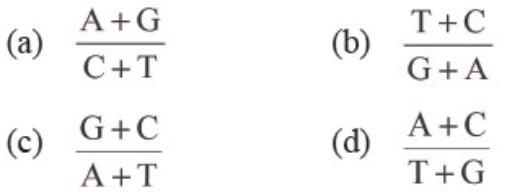
Correct Answer: (c)
The ratio (G + C) / (A + T) is species-specific and constant for a given organism, whereas (A + G) / (T + C) always equals 1 due to Chargaff's rules.
The ratio (G + C) / (A + T) is species-specific and constant for a given organism, whereas (A + G) / (T + C) always equals 1 due to Chargaff's rules.
Q73. The eukaryotic genome differs from the prokaryotic genome because
Correct Answer: (c)
Eukaryotic genomes contain vast amounts of repetitive non-coding DNA sequences (satellites, introns), whereas prokaryotic genomes rarely have repetitive sequences.
Eukaryotic genomes contain vast amounts of repetitive non-coding DNA sequences (satellites, introns), whereas prokaryotic genomes rarely have repetitive sequences.
Q74. From the following, identify the correct combination of salient features of Genetic Code.
Correct Answer: (a)
Genetic code features: Universal, Degenerate (multiple codons for 1 amino acid), Non-overlapping, Non-ambiguous (1 codon = 1 amino acid), and Commaless.
Genetic code features: Universal, Degenerate (multiple codons for 1 amino acid), Non-overlapping, Non-ambiguous (1 codon = 1 amino acid), and Commaless.
Q75. Transformation was discovered by:
Correct Answer: (c)
Frederick Griffith (1928) discovered bacterial transformation using Streptococcus pneumoniae strains in mice.
Frederick Griffith (1928) discovered bacterial transformation using Streptococcus pneumoniae strains in mice.
Q76. The transforming principle of Pneumococcus as found out by Avery, MacLeod and McCarty was
Correct Answer: (b)
Avery, MacLeod, and McCarty purified transforming principle components and found that only DNase enzyme destroyed transformation, proving it was DNA.
Avery, MacLeod, and McCarty purified transforming principle components and found that only DNase enzyme destroyed transformation, proving it was DNA.
Q77. Gene regulation governing lactose operon of E. coli that involves the lac I gene product is:
Correct Answer: (a)
The lac I gene encodes a repressor (negative control) which is inactivated in the presence of inducer lactose (inducible system).
The lac I gene encodes a repressor (negative control) which is inactivated in the presence of inducer lactose (inducible system).
Q78. Which one of the following pairs of nitrogenous bases of nucleic acids, is wrongly matched with the category mentioned against it?
Correct Answer: (d)
Adenine is a Purine, whereas Thymine is a Pyrimidine. Thus, grouping Adenine and Thymine both as Purines is wrong.
Adenine is a Purine, whereas Thymine is a Pyrimidine. Thus, grouping Adenine and Thymine both as Purines is wrong.
Q79. The figure gives an important concept in the genetic implication of DNA. Fill the blanks A, B and C.

Correct Answer: (a)
Central Dogma was proposed by Francis Crick (A). DNA → mRNA is transcription (C), and mRNA → Protein is translation (B).
Central Dogma was proposed by Francis Crick (A). DNA → mRNA is transcription (C), and mRNA → Protein is translation (B).
Q80. Which step of translation does not consume a high energy phosphate bond?
Correct Answer: (c)
Peptidyl transferase reaction forms peptide bonds spontaneously utilizing ribozyme catalytic energy without direct ATP/GTP hydrolysis.
Peptidyl transferase reaction forms peptide bonds spontaneously utilizing ribozyme catalytic energy without direct ATP/GTP hydrolysis.
Q81. Which one of the following makes use of RNA as a template to synthesize DNA?
Correct Answer: (c)
Reverse transcriptase utilizes RNA template to synthesize complementary DNA (cDNA).
Reverse transcriptase utilizes RNA template to synthesize complementary DNA (cDNA).
Q82. Escherichia coli fully labelled with 15N is allowed to grow in 14N medium. The two strands of DNA molecule of the first generation bacteria have
Correct Answer: (c)
In Gen 1, every hybrid molecule has one 15N strand and one 14N strand, giving all molecules the exact same intermediate density.
In Gen 1, every hybrid molecule has one 15N strand and one 14N strand, giving all molecules the exact same intermediate density.
Q83. Which one of the following is not a part of a transcription unit in DNA?
Correct Answer: (a)
A transcription unit in DNA consists of three regions: A promoter, the structural gene, and a terminator. An inducer is a regulatory molecule in operons.
A transcription unit in DNA consists of three regions: A promoter, the structural gene, and a terminator. An inducer is a regulatory molecule in operons.
Q84. Molecular basis of organ differentiation depends on the modulation in transcription by
Correct Answer: (b)
Specific transcription factors regulate localized gene expression needed for cell and organ differentiation.
Specific transcription factors regulate localized gene expression needed for cell and organ differentiation.
Q85. Protein helping in opening of DNA double helix in form of replication fork is
Correct Answer: (a)
DNA gyrase (topoisomerase) reduces torsional strain during helical unwinding.
DNA gyrase (topoisomerase) reduces torsional strain during helical unwinding.
Q86. DNA fragments are:
Correct Answer: (a)
DNA is negatively charged due to the presence of phosphate groups (PO43-) in its sugar-phosphate backbone.
DNA is negatively charged due to the presence of phosphate groups (PO43-) in its sugar-phosphate backbone.
Q87. A sequential expression of a set of human genes
Correct Answer: (b)
The functional sequence of human genes in DNA determines the sequential expression of genetic traits.
The functional sequence of human genes in DNA determines the sequential expression of genetic traits.
Q88. Reverse transcriptase is
Correct Answer: (d)
Reverse transcriptase synthesizes DNA using an RNA template.
Reverse transcriptase synthesizes DNA using an RNA template.
Q89. Whose experiments cracked the DNA and discovered unequivocally that a genetic code is a 'triplet'?
Correct Answer: (d)
Marshall Nirenberg and Heinrich Matthaei used cell-free translation systems to crack codon triplets.
Marshall Nirenberg and Heinrich Matthaei used cell-free translation systems to crack codon triplets.
Q90. In a mutational event, when adenine is replaced by guanine, it is a case of
Correct Answer: (c)
Substitution of a purine by another purine (A ↔ G) or pyrimidine by pyrimidine is a transition mutation.
Substitution of a purine by another purine (A ↔ G) or pyrimidine by pyrimidine is a transition mutation.
Q91. Removal of introns and joining the exons in a defined order in a transcription unit is called:
Correct Answer: (d)
Splicing removes non-coding introns and connects exons together.
Splicing removes non-coding introns and connects exons together.
Q92. Spliceosomes are not found in cells of:
Correct Answer: (c)
Spliceosomes process non-coding introns in eukaryotes. Bacteria (prokaryotes) lack split genes/introns and spliceosomes.
Spliceosomes process non-coding introns in eukaryotes. Bacteria (prokaryotes) lack split genes/introns and spliceosomes.
Q93. Uridine, present only in RNA is a
Correct Answer: (b)
Uridine is a nucleoside formed by the covalent linkage of uracil (pyrimidine) to ribose sugar. (Uridylic acid is the nucleotide).
Uridine is a nucleoside formed by the covalent linkage of uracil (pyrimidine) to ribose sugar. (Uridylic acid is the nucleotide).
Q94. Degeneration of a genetic code is attributed to
Correct Answer: (a)
According to Wobble hypothesis, degeneracy is mostly caused by flexibility at the 3rd nucleotide position of the codon.
According to Wobble hypothesis, degeneracy is mostly caused by flexibility at the 3rd nucleotide position of the codon.
Q95. Experimental material in the study of DNA replication has been
Correct Answer: (a)
Escherichia coli was used by Meselson and Stahl in proof of semi-conservative replication.
Escherichia coli was used by Meselson and Stahl in proof of semi-conservative replication.
Q96. A mutation at one base of the first codon, of a gene, produces a non-functional protein. Such a mutation is called
Correct Answer: (b)
A point mutation that replaces one amino acid with another, altering protein functionality, is a missense mutation.
A point mutation that replaces one amino acid with another, altering protein functionality, is a missense mutation.
Q97. If the distance between two consecutive base pairs is 0.34 nm and the total number of base pairs of a DNA double helix in a typical mammalian cell is 6.6 × 10⁹ bp, then the length of the DNA is approximately
Correct Answer: (b)
Length of DNA = Total number of base pairs × Distance between consecutive base pairs = 6.6 × 109 bp × 0.34 × 10-9 m/bp = 2.244 meters ≈ 2.2 meters.
Length of DNA = Total number of base pairs × Distance between consecutive base pairs = 6.6 × 109 bp × 0.34 × 10-9 m/bp = 2.244 meters ≈ 2.2 meters.
Q98. In negative operon
Correct Answer: (a)
In repressible systems (e.g., trp operon), co-repressor binds repressor to activate operator binding.
In repressible systems (e.g., trp operon), co-repressor binds repressor to activate operator binding.
Q99. A nucleotide is formed of
Correct Answer: (c)
A nucleotide = Nitrogenous Base + Pentose Sugar + Phosphate Group.
A nucleotide = Nitrogenous Base + Pentose Sugar + Phosphate Group.
Q100. The RNA that picks up specific amino acids from the amino acid pool in the cytoplasm to ribosome during protein synthesis is called
Correct Answer: (b)
tRNA (transfer RNA) acts as adapter to transport specific amino acids to ribosomes.
tRNA (transfer RNA) acts as adapter to transport specific amino acids to ribosomes.
Q101. During transcription holoenzyme RNA polymerase binds to a DNA sequence and the DNA assumes a saddle like structure at that point. What is that sequence called?
Correct Answer: (b)
RNA polymerase binds promoter TATA box region.
RNA polymerase binds promoter TATA box region.
Q102. Match the following RNA polymerases with their transcribed products:
| Column I | Column II |
|---|---|
| (A) RNA polymerase I | (i) tRNA |
| (B) RNA polymerase II | (ii) rRNA |
| (C) RNA polymerase III | (iii) hnRNA |
Correct Answer: (d)
RNA Pol I → rRNA (ii); RNA Pol II → hnRNA (iii); RNA Pol III → tRNA (i).
RNA Pol I → rRNA (ii); RNA Pol II → hnRNA (iii); RNA Pol III → tRNA (i).
Q103. In Escherichia coli, lac operon is induced by
Correct Answer: (a)
Lactose acts as the natural inducer.
Lactose acts as the natural inducer.
Q104. What base is responsible for hot spots for spontaneous point mutations?
Correct Answer: (c)
5-Methylcytosine easily deaminates spontaneously to form Thymine, creating mutational hot spots.
5-Methylcytosine easily deaminates spontaneously to form Thymine, creating mutational hot spots.
Q105. Which antibiotic inhibits interaction between tRNA and mRNA during bacterial protein synthesis?
Correct Answer: (a)
Neomycin interferes with translation by causing misreading of codons and inhibiting normal tRNA-mRNA interaction on ribosomes.
Neomycin interferes with translation by causing misreading of codons and inhibiting normal tRNA-mRNA interaction on ribosomes.
Q106. Reverse transcriptase is
Correct Answer: (d)
Reverse transcriptase synthesizes cDNA using RNA as a template; hence it is an RNA-dependent DNA polymerase.
Reverse transcriptase synthesizes cDNA using RNA as a template; hence it is an RNA-dependent DNA polymerase.
Q107. One function of the telomeres in a chromosome is to
Correct Answer: (c)
Telomeres seal chromosome ends to prevent degradation and end-to-end chromosome fusion.
Telomeres seal chromosome ends to prevent degradation and end-to-end chromosome fusion.
Q108. In the DNA molecule
Correct Answer: (d)
DNA consists of two antiparallel polynucleotide chains held by base pairing.
DNA consists of two antiparallel polynucleotide chains held by base pairing.
Q109. Match the following genes of the Lac operon with their respective products:
| Gene | Product |
|---|---|
| (A) i gene | (i) β-galactosidase |
| (B) z gene | (ii) Permease |
| (C) a gene | (iii) Repressor |
| (D) y gene | (iv) Transacetylase |
Correct Answer: (c)
i gene = Repressor (iii); z gene = β-galactosidase (i); a gene = Transacetylase (iv); y gene = Permease (ii).
i gene = Repressor (iii); z gene = β-galactosidase (i); a gene = Transacetylase (iv); y gene = Permease (ii).
Q110. During translation initiation in prokaryotes, a GTP molecule is needed in
Correct Answer: (a)
Joining of the 50S ribosomal subunit to the 30S initiation complex requires GTP hydrolysis.
Joining of the 50S ribosomal subunit to the 30S initiation complex requires GTP hydrolysis.
Q111. Removal of RNA polymerase III from nucleoplasm will affect the synthesis of:
Correct Answer: (a)
RNA Polymerase III is responsible for synthesizing tRNA, 5S rRNA, and snRNA.
RNA Polymerase III is responsible for synthesizing tRNA, 5S rRNA, and snRNA.
Q112. Telomerase is an enzyme which is a
Correct Answer: (c)
Telomerase consists of protein and a structural RNA template, making it a reverse transcriptase ribonucleoprotein.
Telomerase consists of protein and a structural RNA template, making it a reverse transcriptase ribonucleoprotein.
Q113. Mutation generally produces
Correct Answer: (c)
Random mutations usually impair normal gene function, creating recessive alleles.
Random mutations usually impair normal gene function, creating recessive alleles.
Q114. In an inducible operon, the genes are
Correct Answer: (b)
Inducible operons stay 'off' default by repressor binding, turning 'on' only when an inducer molecule signal is present.
Inducible operons stay 'off' default by repressor binding, turning 'on' only when an inducer molecule signal is present.
Q115. Which of the following statements is correct?
Correct Answer: (d)
According to Watson-Crick base pairing rules and Chargaff's rules, Adenine pairs with Thymine via two hydrogen bonds (A = T), and Guanine pairs with Cytosine via three hydrogen bonds (G ≡ C).
According to Watson-Crick base pairing rules and Chargaff's rules, Adenine pairs with Thymine via two hydrogen bonds (A = T), and Guanine pairs with Cytosine via three hydrogen bonds (G ≡ C).
Q116. A complex of ribosomes attached to a single strand of RNA is known as
Correct Answer: (a)
Multiple ribosomes attached simultaneously to a single mRNA molecule translating it into proteins form a polyribosome or polysome.
Multiple ribosomes attached simultaneously to a single mRNA molecule translating it into proteins form a polyribosome or polysome.
Q117. In DNA, when AGCT occurs, their association is as per which of the following pairs?
Correct Answer: (c)
Complementary base pairing pairs Adenine with Thymine (A-T) and Guanine with Cytosine (G-C).
Complementary base pairing pairs Adenine with Thymine (A-T) and Guanine with Cytosine (G-C).
Q118. Which one of the following pairs of codons is correctly matched with their function or the signal for the particular amino acid?
Correct Answer: (b)
UAG (Amber) and UGA (Opal) are chain termination (stop) codons.
UAG (Amber) and UGA (Opal) are chain termination (stop) codons.
Q119. DNA fingerprinting refers to
Correct Answer: (a)
DNA fingerprinting involves identifying unique molecular profiles of VNTR tandem repeats.
DNA fingerprinting involves identifying unique molecular profiles of VNTR tandem repeats.
Q120. In sea urchin DNA, which is double stranded, 17% of the bases were shown to be cytosine. The percentages of the other three bases expected to be present in this DNA are:
Correct Answer: (b)
According to Chargaff's rule, %C = %G = 17%. Total G + C = 34%. Remaining A + T = 100 - 34 = 66%. Since %A = %T, %A = 33% and %T = 33%.
According to Chargaff's rule, %C = %G = 17%. Total G + C = 34%. Remaining A + T = 100 - 34 = 66%. Since %A = %T, %A = 33% and %T = 33%.
Q121. Three codons causing chain termination are
Correct Answer: (d)
UAG (amber), UGA (opal), and UAA (ochre) are RNA stop codons.
UAG (amber), UGA (opal), and UAA (ochre) are RNA stop codons.
Q122. All of the following are part of an operon except
Correct Answer: (d)
Enhancers are eukaryotic regulatory regions, whereas operons consist of promoter, operator, and structural genes in prokaryotes.
Enhancers are eukaryotic regulatory regions, whereas operons consist of promoter, operator, and structural genes in prokaryotes.
Q123. During transcription, the DNA site at which RNA polymerase binds is called
Correct Answer: (b)
RNA polymerase binds specifically to the Promoter region.
RNA polymerase binds specifically to the Promoter region.
Q124. Under which of the following conditions will there be no change in the reading frame of following mRNA?
5' AACAGCGGUGCUAUU 3'
5' AACAGCGGUGCUAUU 3'
Correct Answer: (d)
Insertion or deletion of bases in multiples of three (like deleting full codon GGU at positions 7-9) removes an amino acid without altering the downstream reading frame.
Insertion or deletion of bases in multiples of three (like deleting full codon GGU at positions 7-9) removes an amino acid without altering the downstream reading frame.
Q125. During development of an organism, the product of one gene is required to activate another gene. Such gene products are called
Correct Answer: (a)
Transcription factors bind regulatory DNA sequences to activate or repress structural expression.
Transcription factors bind regulatory DNA sequences to activate or repress structural expression.
Q126. In the genetic code dictionary, how many codons are used to code for all the 20 essential amino acids?
Correct Answer: (d)
Out of 64 total codons, 3 are stop codons (UAA, UAG, UGA), leaving 61 sense codons that code for amino acids.
Out of 64 total codons, 3 are stop codons (UAA, UAG, UGA), leaving 61 sense codons that code for amino acids.
Q127. DNA replication is
Correct Answer: (c)
DNA replication is semi-conservative (each daughter double helix retains one parent strand) and semi-discontinuous (continuous on leading, discontinuous on lagging strand).
DNA replication is semi-conservative (each daughter double helix retains one parent strand) and semi-discontinuous (continuous on leading, discontinuous on lagging strand).
Q128. The one aspect which is not a salient feature of genetic code, is its being:
Correct Answer: (b)
The genetic code is strictly unambiguous.
The genetic code is strictly unambiguous.
Q129. Which of the following is not a property of the genetic code?
Correct Answer: (c)
Genetic code is unambiguous (unspecific: one codon specifies strictly one amino acid).
Genetic code is unambiguous (unspecific: one codon specifies strictly one amino acid).
Q130. If a completely radioactive double stranded DNA molecule undergoes two rounds of replication in a non-radioactive medium, what will be the radioactive status of the four resulting molecules?
Correct Answer: (a)
Original strands: R1 and R2 (both radioactive). Round 1 → 2 hybrid molecules (R1-N, R2-N). Round 2 in cold medium → R1-N, N-N, R2-N, N-N. Thus, 2 out of 4 (50%) contain no radioactivity.
Original strands: R1 and R2 (both radioactive). Round 1 → 2 hybrid molecules (R1-N, R2-N). Round 2 in cold medium → R1-N, N-N, R2-N, N-N. Thus, 2 out of 4 (50%) contain no radioactivity.
Q131. What is not true for genetic code?
Correct Answer: (d)
Codons in mRNA are read in a continuous (commaless) fashion without punctuation.
Codons in mRNA are read in a continuous (commaless) fashion without punctuation.
Q132. Out of A-T, G-C pairing, bases of DNA may exist in alternate valency state owing to arrangement called
Correct Answer: (b)
Spontaneous proton shifts between amino/imino or keto/enol forms lead to tautomerisation.
Spontaneous proton shifts between amino/imino or keto/enol forms lead to tautomerisation.
Q133. In history of biology, human genome project led to the development of:
Correct Answer: (c)
Managing vast sequence databases from HGP initiated Bioinformatics.
Managing vast sequence databases from HGP initiated Bioinformatics.
Q134. Who proved that DNA is basic genetic material?
Correct Answer: (d)
Hershey and Chase unequivocally demonstrated DNA as the genetic material using radioactive bacteriophages.
Hershey and Chase unequivocally demonstrated DNA as the genetic material using radioactive bacteriophages.
Q135. What will be the sequence of mRNA produced by the following stretch of DNA?
3' ATGCATGCATGCATG 5' TEMPLATE STRAND
5' TACGTACGTACGTAC 3' CODING STRAND
3' ATGCATGCATGCATG 5' TEMPLATE STRAND
5' TACGTACGTACGTAC 3' CODING STRAND
Correct Answer: (c)
mRNA matches the sequence of the coding strand (5' to 3'), replacing Thymine (T) with Uracil (U). Thus, 5' UACGUACGUACGUAC 3'.
mRNA matches the sequence of the coding strand (5' to 3'), replacing Thymine (T) with Uracil (U). Thus, 5' UACGUACGUACGUAC 3'.
Q136. Khorana first deciphered the triplet codons of
Correct Answer: (b)
Har Gobind Khorana synthesized copolymers (UGUGUG...) to decipher codons for Cysteine and Valine.
Har Gobind Khorana synthesized copolymers (UGUGUG...) to decipher codons for Cysteine and Valine.
Q137. Due to discovery of which of the following in 1980 the evolution was termed as RNA world?
Correct Answer: (c)
Discovery of ribozymes (catalytic RNA) by Cech and Altman proved RNA could store genetic info and catalyze chemical reactions.
Discovery of ribozymes (catalytic RNA) by Cech and Altman proved RNA could store genetic info and catalyze chemical reactions.
Q138. Expressed Sequence Tags (ESTs) refers to:
Correct Answer: (a)
ESTs are short cDNA sequences representing genes actively expressed as RNA transcripts.
ESTs are short cDNA sequences representing genes actively expressed as RNA transcripts.
Q139. Extranuclear inheritance occurs in
Correct Answer: (b)
Chloroplasts and mitochondria contain extranuclear organellar DNA and govern cytoplasmic inheritance.
Chloroplasts and mitochondria contain extranuclear organellar DNA and govern cytoplasmic inheritance.
Q140. Which one of the following is wrongly matched?
Correct Answer: (a)
Transcription is copying genetic information from DNA into RNA (primarily mRNA), not exclusively tRNA.
Transcription is copying genetic information from DNA into RNA (primarily mRNA), not exclusively tRNA.
Q141. Types of RNA polymerase required in nucleus for RNA synthesis?
Correct Answer: (c)
Eukaryotes contain 3 distinct RNA polymerases (RNA Pol I, II, and III).
Eukaryotes contain 3 distinct RNA polymerases (RNA Pol I, II, and III).
Q142. Polysome is formed by
Correct Answer: (a)
A polysome consists of a string of multiple ribosomes reading one mRNA strand.
A polysome consists of a string of multiple ribosomes reading one mRNA strand.
Q143. Anticodon is an unpaired triplet of bases in an exposed position of
Correct Answer: (c)
The anticodon loop of tRNA contains a triplet of bases that complementary pairs with mRNA codons.
The anticodon loop of tRNA contains a triplet of bases that complementary pairs with mRNA codons.
Q144. Semi-conservative replication of DNA was first demonstrated in:
Correct Answer: (a)
Meselson and Stahl demonstrated semi-conservative replication in E. coli.
Meselson and Stahl demonstrated semi-conservative replication in E. coli.
Q145. The transfer RNA molecule in 3D appears
Correct Answer: (a)
The 3D tertiary structure of tRNA determined by Kim et al. is inverted L-shaped.
The 3D tertiary structure of tRNA determined by Kim et al. is inverted L-shaped.
Q146. Select the two correct statements out of the four (i-iv) given below about lac operon:
(i) Glucose or galactose may bind with the repressor and inactivate it
(ii) In the absence of lactose the repressor binds with the operator region
(iii) The z-gene codes for permease
(iv) This was elucidated by Francois Jacob and Jacques Monod
(i) Glucose or galactose may bind with the repressor and inactivate it
(ii) In the absence of lactose the repressor binds with the operator region
(iii) The z-gene codes for permease
(iv) This was elucidated by Francois Jacob and Jacques Monod
Correct Answer: (c)
Statements (ii) and (iv) are correct. (i) is wrong because lactose/allolactose binds repressor. (iii) is wrong because 'z' codes for β-galactosidase.
Statements (ii) and (iv) are correct. (i) is wrong because lactose/allolactose binds repressor. (iii) is wrong because 'z' codes for β-galactosidase.
Q147. Select the correct match
Correct Answer: (c)
Francois Jacob and Jacques Monod elucidated the Lac Operon model in E. coli.
Francois Jacob and Jacques Monod elucidated the Lac Operon model in E. coli.
Q148. During replication of a bacterial chromosome DNA synthesis starts from a replication origin site and
Correct Answer: (d)
Bacterial replication initiates at oriC and proceeds bidirectionally around the circular chromosome.
Bacterial replication initiates at oriC and proceeds bidirectionally around the circular chromosome.
Q149. The length of DNA molecule greatly exceeds the dimensions of the nucleus in eukaryotic cells. How is this DNA accommodated?
Correct Answer: (a)
Long eukaryotic DNA molecules wrap around histone octamers forming nucleosomes, which further super-coil and condense into chromatin fibers.
Long eukaryotic DNA molecules wrap around histone octamers forming nucleosomes, which further super-coil and condense into chromatin fibers.
Q150. During DNA replication, Okazaki fragments are used to elongate:
Correct Answer: (c)
Okazaki fragments synthesize short DNA segments on the lagging template strand in the 5' → 3' direction, moving away from the advancing replication fork.
Okazaki fragments synthesize short DNA segments on the lagging template strand in the 5' → 3' direction, moving away from the advancing replication fork.
Q151. AGGTATCGCAT is a sequence from the coding strand of a gene. What will be the corresponding sequence of the transcribed mRNA?
Correct Answer: (a)
The transcript sequence is identical to the coding strand except with U in place of T: AGGUAUCGCAU.
The transcript sequence is identical to the coding strand except with U in place of T: AGGUAUCGCAU.
Q152. Removal of introns and joining of exons in a defined order during transcription is called:
Correct Answer: (d)
RNA splicing is the post-transcriptional process of removing non-coding introns and joining coding exons.
RNA splicing is the post-transcriptional process of removing non-coding introns and joining coding exons.
Q153. The basis for DNA fingerprinting is
Correct Answer: (a)
RFLP analysis identifies variable lengths of restriction fragments across individuals.
RFLP analysis identifies variable lengths of restriction fragments across individuals.
Q154. Which of the following forms the basis of DNA Fingerprinting?
Correct Answer: (b)
Highly repetitive, non-coding satellite DNA shows high individual-specific sequence variation.
Highly repetitive, non-coding satellite DNA shows high individual-specific sequence variation.
Q155. An environmental agent, which triggers transcription from an operon, is a
Correct Answer: (b)
Inducer switches on transcription of an operon.
Inducer switches on transcription of an operon.
Q156. The Okazaki fragments in DNA chain growth
Correct Answer: (c)
All DNA polymerization occurs in 5' → 3' direction; Okazaki fragments allow growth on 3' → 5' template.
All DNA polymerization occurs in 5' → 3' direction; Okazaki fragments allow growth on 3' → 5' template.
Q157. Which of the following is required as inducer(s) for the expression of Lac operon?
Correct Answer: (c)
Lactose (or allolactose) binds to the Lac repressor, causing conformational change that permits transcription.
Lactose (or allolactose) binds to the Lac repressor, causing conformational change that permits transcription.
Q158. The Pneumococcus experiment proves that
Correct Answer: (a)
Griffith's experiment demonstrated genetic transformation where non-virulent cells transformed into virulent ones via genetic material.
Griffith's experiment demonstrated genetic transformation where non-virulent cells transformed into virulent ones via genetic material.
Q159. Protein synthesis occurs
Correct Answer: (a)
Translation happens on cytosolic ribosomes as well as organellar ribosomes (mitochondria & chloroplasts).
Translation happens on cytosolic ribosomes as well as organellar ribosomes (mitochondria & chloroplasts).
Q160. Because most of the amino acids are represented by more than one codon, the genetic code is
Correct Answer: (c)
Degeneracy describes the phenomenon where multiple codons code for the same amino acid.
Degeneracy describes the phenomenon where multiple codons code for the same amino acid.
Q161. What does "lac" refer to in what we call the lac operon?
Correct Answer: (b)
'lac' stands for Lactose, the disaccharide substrate/inducer.
'lac' stands for Lactose, the disaccharide substrate/inducer.
Q162. One gene - one enzyme hypothesis was postulated by
Correct Answer: (c)
George Beadle and Edward Tatum postulated 'One gene-one enzyme'.
George Beadle and Edward Tatum postulated 'One gene-one enzyme'.