Q1. The estrous cycle is a characteristic of
Correct Answer: (d)
Estrous cycle occurs in non-primate female mammals (e.g., cows, dogs), where endometrium is reabsorbed rather than shed.
Estrous cycle occurs in non-primate female mammals (e.g., cows, dogs), where endometrium is reabsorbed rather than shed.
Q2. The growth of corpus luteum is initiated by
Correct Answer: (c)
Luteinizing Hormone (LH) secreted by the anterior pituitary stimulates transformation of ruptured follicular cells into the corpus luteum.
Luteinizing Hormone (LH) secreted by the anterior pituitary stimulates transformation of ruptured follicular cells into the corpus luteum.
Q3. In humans, at the end of the first meiotic division, the male germ cells differentiate into the
Correct Answer: (b)
Primary spermatocytes ($2n$) undergo Meiosis-I (reductional division) to form two haploid ($) secondary spermatocytes.
Primary spermatocytes ($2n$) undergo Meiosis-I (reductional division) to form two haploid ($) secondary spermatocytes.
Q4. The shared terminal duct of the reproductive and urinary system in the human male is:
Correct Answer: (a)
In human males, the urethra serves as a common urinogenital duct that conveys both urine from the bladder and semen from reproductive organs.
In human males, the urethra serves as a common urinogenital duct that conveys both urine from the bladder and semen from reproductive organs.
Q5. Meroblastic cleavage is division
Correct Answer: (b)
Meroblastic cleavage occurs in yolk-rich eggs where division is partial/incomplete, restricted to non-yolky protoplasm.
Meroblastic cleavage occurs in yolk-rich eggs where division is partial/incomplete, restricted to non-yolky protoplasm.
Q6. Which one of the following is not the function of placenta? It:
Correct Answer: (c)
Oxytocin is synthesized by the hypothalamus and released by the maternal posterior pituitary gland, not secreted by the placenta.
Oxytocin is synthesized by the hypothalamus and released by the maternal posterior pituitary gland, not secreted by the placenta.
Q7. Extrusion of second polar body from egg nucleus occurs:
Correct Answer: (a)
Sperm entry stimulates completion of Meiosis-II, resulting in the extrusion of the second polar body prior to actual amphimixis (fertilization).
Sperm entry stimulates completion of Meiosis-II, resulting in the extrusion of the second polar body prior to actual amphimixis (fertilization).
Q8. Given below is a diagrammatic sketch of a portion of human male reproductive system. Select the correct set of the names of the parts labelled A, B, C, D.
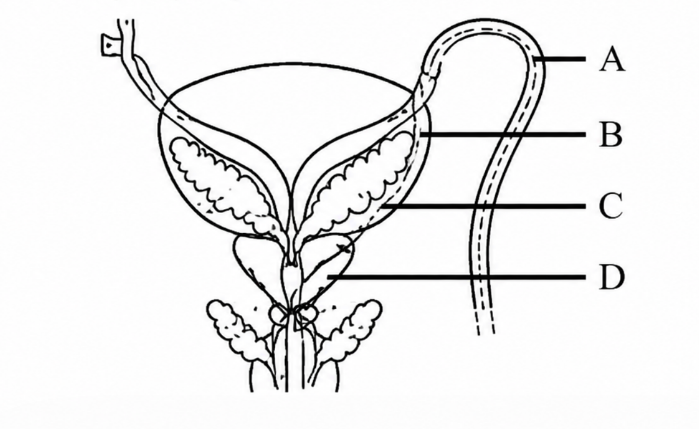
Correct Answer: (a)
A represents Vas deferens, B represents Seminal vesicle, C represents Prostate gland, and D represents Bulbourethral (Cowper's) gland.
A represents Vas deferens, B represents Seminal vesicle, C represents Prostate gland, and D represents Bulbourethral (Cowper's) gland.
Q9. Which one of the following is the correct matching of the events occurring during menstrual cycle?
Correct Answer: (b)
Formation of corpus luteum occurs in the secretory (luteal) phase, accompanied by marked secretion of progesterone.
Formation of corpus luteum occurs in the secretory (luteal) phase, accompanied by marked secretion of progesterone.
Q10. In 28 day human ovarian cycle, ovulation occurs on
Correct Answer: (c)
In a standard 28-day cycle, ovulation typically takes place at the midpoint, on Day 14.
In a standard 28-day cycle, ovulation typically takes place at the midpoint, on Day 14.
Q11. Which of these is not an important component of initiation of parturition in humans?
Correct Answer: (c)
Prolactin regulates synthesis and secretion of milk into alveoli post-birth, not the initiation of uterine labor contractions (parturition).
Prolactin regulates synthesis and secretion of milk into alveoli post-birth, not the initiation of uterine labor contractions (parturition).
Q12. Amount of yolk and its distribution are changed in the egg. Which one is affected?
Correct Answer: (a)
The quantity and distribution of yolk directly govern the plane and pattern of embryonic cleavage.
The quantity and distribution of yolk directly govern the plane and pattern of embryonic cleavage.
Q13. Which of the following cells during gametogenesis is normally diploid?
Correct Answer: (b)
Spermatogonia are diploid ($2n = 46$) undifferentiated male germ cells, whereas spermatids and polar bodies are haploid ( = 23$).
Spermatogonia are diploid ($2n = 46$) undifferentiated male germ cells, whereas spermatids and polar bodies are haploid ( = 23$).
Q14. Match the items given in Column I with those in Column II and select the correct option given below:
| Column I | Column II |
|---|---|
| A. Proliferative Phase | i. Breakdown of endometrial lining |
| B. Secretory Phase | ii. Follicular Phase |
| C. Menstruation | iii. Luteal Phase |
Correct Answer: (d)
Proliferative Phase is also called Follicular Phase; Secretory Phase is the Luteal Phase; Menstruation corresponds to the breakdown of endometrial lining.
Proliferative Phase is also called Follicular Phase; Secretory Phase is the Luteal Phase; Menstruation corresponds to the breakdown of endometrial lining.
Q15. Human eggs are
Correct Answer: (a)
Human eggs contain virtually no yolk, making them alecithal (or microlecithal).
Human eggs contain virtually no yolk, making them alecithal (or microlecithal).
Q16. Capacitation occurs in:
Correct Answer: (c)
Capacitation is the final functional maturation phase of spermatozoa that takes place inside the female reproductive tract, enabling the sperm to penetrate and fertilize the oocyte.
Capacitation is the final functional maturation phase of spermatozoa that takes place inside the female reproductive tract, enabling the sperm to penetrate and fertilize the oocyte.
Q17. In telolecithal egg the yolk is found
Correct Answer: (b)
In telolecithal eggs, yolk is concentrated near one end (vegetal pole), pushing cytoplasm to the animal pole.
In telolecithal eggs, yolk is concentrated near one end (vegetal pole), pushing cytoplasm to the animal pole.
Q18. Extrusion of second polar body from egg nucleus occurs
Correct Answer: (a)
Sperm penetration activates the egg cell cycle to complete Meiosis-II, extruding the second polar body prior to pronuclear fusion.
Sperm penetration activates the egg cell cycle to complete Meiosis-II, extruding the second polar body prior to pronuclear fusion.
Q19. The amnion of mammalian embryo is derived from
Correct Answer: (a)
Amnion is an extraembryonic membrane formed internally by ectoderm and externally by somatic mesoderm.
Amnion is an extraembryonic membrane formed internally by ectoderm and externally by somatic mesoderm.
Q20. How many sperms are formed from a secondary spermatocyte?
Correct Answer: (c)
One secondary spermatocyte undergoes Meiosis-II to produce 2 spermatids, which mature into 2 spermatozoa.
One secondary spermatocyte undergoes Meiosis-II to produce 2 spermatids, which mature into 2 spermatozoa.
Q21. Seminal plasma in humans is rich in
Correct Answer: (d)
Seminal plasma contains fructose (energy source for sperm), calcium ions, and enzymes such as acid phosphatase and clotting enzymes.
Seminal plasma contains fructose (energy source for sperm), calcium ions, and enzymes such as acid phosphatase and clotting enzymes.
Q22. Fertilization in humans is practically feasible only if
Correct Answer: (b)
Fertilization occurs efficiently only when both male and female gametes reach the ampullary-isthmic junction of the Fallopian tube simultaneously.
Fertilization occurs efficiently only when both male and female gametes reach the ampullary-isthmic junction of the Fallopian tube simultaneously.
Q23. Egg is liberated from ovary in
Correct Answer: (a)
At the time of ovulation, the egg is released from the Graafian follicle as a secondary oocyte suspended at metaphase-II.
At the time of ovulation, the egg is released from the Graafian follicle as a secondary oocyte suspended at metaphase-II.
Q24. Location and secretion of Leydig's cells are
Correct Answer: (c)
Leydig cells are located in the interstitial tissue of testes and secrete the androgen testosterone.
Leydig cells are located in the interstitial tissue of testes and secrete the androgen testosterone.
Q25. In human females, meiosis-II is not complete until?
Correct Answer: (a)
Secondary oocyte remains arrested at metaphase of Meiosis-II until entry of sperm triggers completion of division during fertilization.
Secondary oocyte remains arrested at metaphase of Meiosis-II until entry of sperm triggers completion of division during fertilization.
Q26. Which one of the following statements is incorrect about menstruation?
Correct Answer: (b)
Menstrual fluid normally does not clot because it contains fibrinolysin, an enzyme that dissolves fibrin clots.
Menstrual fluid normally does not clot because it contains fibrinolysin, an enzyme that dissolves fibrin clots.
Q27. Foetal ejection reflex in human female is induced by
Correct Answer: (b)
Signals originating from the fully developed fetus and placenta trigger the fetal ejection reflex.
Signals originating from the fully developed fetus and placenta trigger the fetal ejection reflex.
Q28. Grey crescent is the area
Correct Answer: (b)
The grey crescent forms on the surface of the egg opposite the point of sperm entry due to cortical rotation of cytoplasm.
The grey crescent forms on the surface of the egg opposite the point of sperm entry due to cortical rotation of cytoplasm.
Q29. If mammalian ovum fails to get fertilized, which one of the following is unlikely?
Correct Answer: (c)
If fertilization fails, estrogen secretion decreases initially but then begins to rise again during the subsequent follicular phase to foster new follicles; a continuous 'further decrease' is unlikely.
If fertilization fails, estrogen secretion decreases initially but then begins to rise again during the subsequent follicular phase to foster new follicles; a continuous 'further decrease' is unlikely.
Q30. Which one of the following statements about morula in humans is correct?
Correct Answer: (a)
Cleavage divisions increase cell number and total nuclear DNA without overall volume growth, keeping cytoplasm quantity similar to the original zygote.
Cleavage divisions increase cell number and total nuclear DNA without overall volume growth, keeping cytoplasm quantity similar to the original zygote.
Q31. Capacitation refers to changes in the:
Correct Answer: (d)
Capacitation involves biochemical and physiological modifications (such as removal of membrane cholesterol) that occur in the sperm before fertilization occurs.
Capacitation involves biochemical and physiological modifications (such as removal of membrane cholesterol) that occur in the sperm before fertilization occurs.
Q32. Match the following columns and select the correct option.
| Column-I | Column-II |
|---|---|
| (A) Placenta | (i) Androgens |
| (B) Zona pellucida | (ii) Human Chorionic Gonadotropin (hCG) |
| (C) Bulbo-urethral glands | (iii) Layer of the ovum |
| (D) Leydig cells | (iv) Lubrication of the Penis |
Correct Answer: (c)
Placenta produces hCG; Zona pellucida is an acellular layer around the ovum; Bulbo-urethral glands secrete lubricating fluid; Leydig cells produce Androgens.
Placenta produces hCG; Zona pellucida is an acellular layer around the ovum; Bulbo-urethral glands secrete lubricating fluid; Leydig cells produce Androgens.
Q33. In a normal pregnant woman, the amount of total gonadotropin activity was assessed. The result expected was
Correct Answer: (d)
Elevated levels of hCG maintain corpus luteum functionality, ensuring high continuous synthesis of estrogen and progesterone.
Elevated levels of hCG maintain corpus luteum functionality, ensuring high continuous synthesis of estrogen and progesterone.
Q34. Fertilizins are emitted by
Correct Answer: (b)
Fertilizin is a glycoprotein secreted by mature ovulated eggs to bind anti-fertilizin on sperm surfaces.
Fertilizin is a glycoprotein secreted by mature ovulated eggs to bind anti-fertilizin on sperm surfaces.
Q35. Signals for parturition originate from:
Correct Answer: (a)
Parturition signals originate jointly from the fully developed fetus and the placenta, triggering the fetal ejection reflex.
Parturition signals originate jointly from the fully developed fetus and the placenta, triggering the fetal ejection reflex.
Q36. Vasa efferentia are the ductules leading from
Correct Answer: (b)
Vasa efferentia connect the rete testis (which collects sperm from seminiferous tubules) to the head of the epididymis, which leads to the vas deferens.
Vasa efferentia connect the rete testis (which collects sperm from seminiferous tubules) to the head of the epididymis, which leads to the vas deferens.
Q37. Seminal plasma in human males is rich in :
Correct Answer: (a)
Seminal fluid produced by accessory glands (seminal vesicles, prostate, bulbourethral glands) is rich in fructose, calcium, and specific hydrolytic enzymes.
Seminal fluid produced by accessory glands (seminal vesicles, prostate, bulbourethral glands) is rich in fructose, calcium, and specific hydrolytic enzymes.
Q38. No new follicles develop in the luteal phase of the menstrual cycle because:
Correct Answer: (a)
High levels of progesterone and estrogen secreted by the corpus luteum exert negative feedback, keeping FSH and LH low and inhibiting new follicle development.
High levels of progesterone and estrogen secreted by the corpus luteum exert negative feedback, keeping FSH and LH low and inhibiting new follicle development.
Q39. Select the correct option describing gonadotropin activity in a normal pregnant female:
Correct Answer: (c)
Human Chorionic Gonadotropin (hCG) secreted by the trophoblast maintains the corpus luteum, stimulating continuous secretion of estrogen and progesterone.
Human Chorionic Gonadotropin (hCG) secreted by the trophoblast maintains the corpus luteum, stimulating continuous secretion of estrogen and progesterone.
Q40. Hormones secreted by the placenta to maintain pregnancy are
Correct Answer: (d)
Human placenta produces human Chorionic Gonadotropin (hCG), human Placental Lactogen (hPL), progestogens, and estrogens.
Human placenta produces human Chorionic Gonadotropin (hCG), human Placental Lactogen (hPL), progestogens, and estrogens.
Q41. The correct sequence of spermatogenetic stages leading to the formation of sperms in a mature human testes is:
Correct Answer: (a)
Germinal cells divide into spermatogonia, which grow into spermatocytes, divide meiotically into spermatids, and differentiate into mature sperms.
Germinal cells divide into spermatogonia, which grow into spermatocytes, divide meiotically into spermatids, and differentiate into mature sperms.
Q42. Which of the following hormones is responsible for both the milk ejection reflex and the foetal ejection reflex?
Correct Answer: (d)
Oxytocin stimulates uterine smooth muscle contractions during fetal ejection reflex and myoepithelial cell contraction in mammary glands for milk ejection.
Oxytocin stimulates uterine smooth muscle contractions during fetal ejection reflex and myoepithelial cell contraction in mammary glands for milk ejection.
Q43. At the end of first meiotic division, male sperm differentiates into
Correct Answer: (a)
The completion of Meiosis-I transforms a diploid primary spermatocyte into haploid secondary spermatocytes.
The completion of Meiosis-I transforms a diploid primary spermatocyte into haploid secondary spermatocytes.
Q44. A change in the amount of yolk and its distribution in the egg will affect
Correct Answer: (a)
The presence and localization of yolk determine whether cleavage is holoblastic or meroblastic and influence the cleavage plane.
The presence and localization of yolk determine whether cleavage is holoblastic or meroblastic and influence the cleavage plane.
Q45. Meiotic division of the secondary oocyte is completed
Correct Answer: (c)
Meiosis-II in the secondary oocyte is arrested at metaphase-II and completes only upon the entry/fusion of a sperm into the ovum.
Meiosis-II in the secondary oocyte is arrested at metaphase-II and completes only upon the entry/fusion of a sperm into the ovum.
Q46. Which extra-embryonic membrane in humans prevents desiccation of the embryo inside the uterus?
Correct Answer: (d)
Amnion encloses the amniotic fluid cavity, cushioning the embryo against mechanical shock and preventing desiccation.
Amnion encloses the amniotic fluid cavity, cushioning the embryo against mechanical shock and preventing desiccation.
Q47. After ovulation the collapsed ovarian follicle shrinks and becomes filled with cell to form
Correct Answer: (a)
Granulosa and theca cells of the ruptured follicle luteinize under LH influence to form the yellow corpus luteum.
Granulosa and theca cells of the ruptured follicle luteinize under LH influence to form the yellow corpus luteum.
Q48. Blastopore is
Correct Answer: (b)
The blastopore is the opening of the primitive gut/archenteron (gastrocoel) to the exterior during gastrulation.
The blastopore is the opening of the primitive gut/archenteron (gastrocoel) to the exterior during gastrulation.
Q49. Sperm and egg nuclei fuse due to
Correct Answer: (d)
Gamete nuclei fuse during karyogamy/amphimixis following mutual recognition and protoplasmic attraction.
Gamete nuclei fuse during karyogamy/amphimixis following mutual recognition and protoplasmic attraction.
Q50. Termination of gastrulation is indicated by
Correct Answer: (a)
Gastrulation completes when the three primary germ layers form and the original blastocoel cavity is obliterated by the expanding archenteron.
Gastrulation completes when the three primary germ layers form and the original blastocoel cavity is obliterated by the expanding archenteron.
Q51. During cleavage, what is true about cells?
Correct Answer: (b)
During cleavage, rapid mitotic cell divisions occur without growth phases; thus, overall size of the embryo does not increase.
During cleavage, rapid mitotic cell divisions occur without growth phases; thus, overall size of the embryo does not increase.
Q52. Which one of the following statements about human sperm is correct?
Correct Answer: (b)
The acrosome contains hydrolytic enzymes (sperm lysins like hyaluronidase and acrosin) that digest egg membranes to facilitate entry.
The acrosome contains hydrolytic enzymes (sperm lysins like hyaluronidase and acrosin) that digest egg membranes to facilitate entry.
Q53. The difference between spermiogenesis and spermiation is
Correct Answer: (c)
Spermiogenesis is the maturation of non-motile spermatids into spermatozoa; spermiation is the release of mature spermatozoa from Sertoli cells into the tubular lumen.
Spermiogenesis is the maturation of non-motile spermatids into spermatozoa; spermiation is the release of mature spermatozoa from Sertoli cells into the tubular lumen.
Q54. About which day in a normal human menstrual cycle does rapid secretion of LH (Popularly called LH-surge) normally occurs?
Correct Answer: (a)
LH reaches its peak concentration (LH surge) near the middle of a 28-day menstrual cycle, around day 14.
LH reaches its peak concentration (LH surge) near the middle of a 28-day menstrual cycle, around day 14.
Q55. Which of the following events is not associated with ovulation in human female?
Correct Answer: (d)
Ovulation is preceded by a peak (surge) in estradiol/estrogen levels, which triggers the LH surge; estradiol does not decrease prior to ovulation.
Ovulation is preceded by a peak (surge) in estradiol/estrogen levels, which triggers the LH surge; estradiol does not decrease prior to ovulation.
Q56. The figure given below depicts a diagrammatic sectional view of the female reproductive system of humans. Which one set of three parts out of I-VI have been correctly identified?
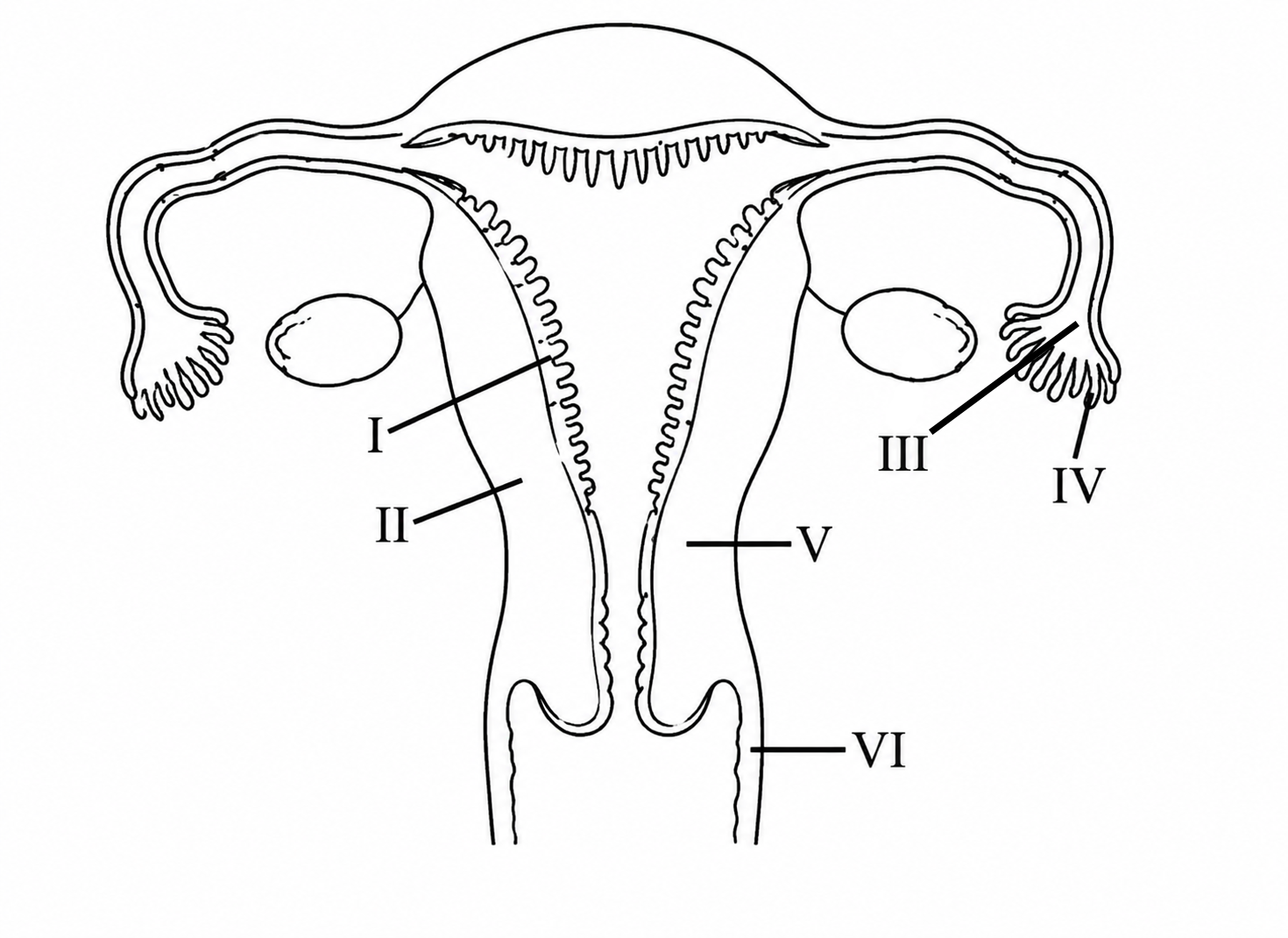
Correct Answer: (b)
III is the funnel-shaped Infundibulum, IV points to finger-like Fimbriae, and V indicates the Cervix.
III is the funnel-shaped Infundibulum, IV points to finger-like Fimbriae, and V indicates the Cervix.
Q57. The figure shows a section of human ovary. Select the option which gives the correct identification of A and B with function/characteristic
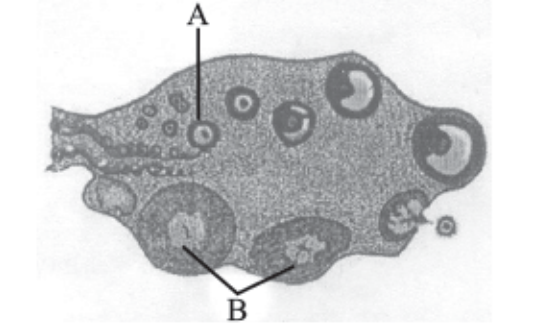
Correct Answer: (b)
Structure B represents the Corpus luteum, an endocrine structure that primarily secretes progesterone to maintain pregnancy.
Structure B represents the Corpus luteum, an endocrine structure that primarily secretes progesterone to maintain pregnancy.
Q58. Withdrawal of which of the following hormones is the immediate cause of menstruation?
Correct Answer: (c)
Progesterone supports the endometrial lining. Degeneration of the corpus luteum causes progesterone withdrawal, triggering menstruation.
Progesterone supports the endometrial lining. Degeneration of the corpus luteum causes progesterone withdrawal, triggering menstruation.
Q59. The part of fallopian tube closest to the ovary is
Correct Answer: (b)
The funnel-shaped infundibulum lies closest to the ovary and bears fimbriae to catch the ovulated egg.
The funnel-shaped infundibulum lies closest to the ovary and bears fimbriae to catch the ovulated egg.
Q60. What is the correct sequence of sperm formation?
Correct Answer: (c)
The sequence is Spermatogonia ($2n$) $ ightarrow$ Primary & Secondary Spermatocytes $ ightarrow$ Spermatids ($) $ ightarrow$ Spermatozoa ($).
The sequence is Spermatogonia ($2n$) $ ightarrow$ Primary & Secondary Spermatocytes $ ightarrow$ Spermatids ($) $ ightarrow$ Spermatozoa ($).
Q61. Freshly released human egg has
Correct Answer: (b)
Human females are homogametic ($44 + \text{XX}$); thus, every haploid egg carries 22 autosomes and one X chromosome.
Human females are homogametic ($44 + \text{XX}$); thus, every haploid egg carries 22 autosomes and one X chromosome.
Q62. Extra-embryonic membranes of the mammalian embryo are derived from
Correct Answer: (b)
The outer cell layer of the blastocyst, the trophoblast, gives rise to extra-embryonic structures including chorion and placenta.
The outer cell layer of the blastocyst, the trophoblast, gives rise to extra-embryonic structures including chorion and placenta.
Q63. In vitro fertilisation is a technique that involves transfer of which one of the following into the fallopian tube?
Correct Answer: (b)
ZIFT (Zygote Intra-Fallopian Transfer) involves transferring a zygote or an early embryo with up to 8 blastomeres into the Fallopian tube.
ZIFT (Zygote Intra-Fallopian Transfer) involves transferring a zygote or an early embryo with up to 8 blastomeres into the Fallopian tube.
Q64. If for some reason, the vasa efferentia in the human reproductive system gets blocked, the gametes will not be transported from
Correct Answer: (a)
Vasa efferentia carry sperm cells from the rete testis of the testes to the epididymis. Blocking these ducts prevents gamete passage into the epididymis.
Vasa efferentia carry sperm cells from the rete testis of the testes to the epididymis. Blocking these ducts prevents gamete passage into the epididymis.
Q65. Select the incorrect statement:
Correct Answer: (c)
During the follicular phase, gonadotropins (LH and FSH) increase gradually (not decrease) to stimulate follicular maturation and estrogen secretion.
During the follicular phase, gonadotropins (LH and FSH) increase gradually (not decrease) to stimulate follicular maturation and estrogen secretion.
Q66. Sertoli cells are found in
Correct Answer: (c)
Sertoli (nurse) cells reside within the seminiferous tubules of the testes, providing structural support and essential nutrients to developing germ cells.
Sertoli (nurse) cells reside within the seminiferous tubules of the testes, providing structural support and essential nutrients to developing germ cells.
Q67. The signals for parturition originate from
Correct Answer: (b)
Parturition neuroendocrine signals originate from both the fully developed fetus and the placenta.
Parturition neuroendocrine signals originate from both the fully developed fetus and the placenta.
Q68. The main function of mammalian corpus luteum is to produce:
Correct Answer: (b)
The corpus luteum acts as a temporary endocrine structure that predominantly secretes progesterone to maintain the uterine lining.
The corpus luteum acts as a temporary endocrine structure that predominantly secretes progesterone to maintain the uterine lining.
Q69. Middle piece of mammalian sperm possesses
Correct Answer: (a)
The middle piece of a mammalian sperm contains spirally arranged mitochondria (nebendkern) around the axial filament and proximal/distal centrioles near its base.
The middle piece of a mammalian sperm contains spirally arranged mitochondria (nebendkern) around the axial filament and proximal/distal centrioles near its base.
Q70. Which one of the following statements is false in respect of viability of mammalian sperm?
Correct Answer: (a)
Mammalian sperms generally retain fertilizing viability inside the female reproductive tract for about 48 to 72 hours, not just 24 hours.
Mammalian sperms generally retain fertilizing viability inside the female reproductive tract for about 48 to 72 hours, not just 24 hours.
Q71. The correct sequence in the process of development of human embryo is
Correct Answer: (a)
Sequential order of early development: Fertilisation → Zygote → Cleavage → Morula → Blastula → Gastrula.
Sequential order of early development: Fertilisation → Zygote → Cleavage → Morula → Blastula → Gastrula.
Q72. Which one of the following is the most likely root cause why menstruation is not taking place in regularly cycling human female?
Correct Answer: (d)
Fertilization of the ovum leads to implantation and continued hCG secretion, preventing endometrial breakdown and menstruation.
Fertilization of the ovum leads to implantation and continued hCG secretion, preventing endometrial breakdown and menstruation.
Q73. Select the correct sequence for transport of sperm cells in male reproductive system
Correct Answer: (b)
Sperm pathway: Seminiferous tubules $\rightarrow$ Rete testis $\rightarrow$ Vasa efferentia $\rightarrow$ Epididymis $\rightarrow$ Vas deferens $\rightarrow$ Ejaculatory duct $\rightarrow$ Urethra $\rightarrow$ Urethral meatus.
Sperm pathway: Seminiferous tubules $\rightarrow$ Rete testis $\rightarrow$ Vasa efferentia $\rightarrow$ Epididymis $\rightarrow$ Vas deferens $\rightarrow$ Ejaculatory duct $\rightarrow$ Urethra $\rightarrow$ Urethral meatus.
Q74. The first movements of the foetus and appearance of hair on its head are usually observed during which month of pregnancy?
Correct Answer: (b)
First fetal movements (quickening) and head hair growth are typically observed during the $5^{\text{th}}$ month of pregnancy.
First fetal movements (quickening) and head hair growth are typically observed during the $5^{\text{th}}$ month of pregnancy.
Q75. Which of the following hormone levels will cause release of ovum (ovulation) from the graffian follicle?
Correct Answer: (d)
High level of estrogen secreted by growing follicles triggers a positive feedback surge of LH (LH surge), causing ovulation.
High level of estrogen secreted by growing follicles triggers a positive feedback surge of LH (LH surge), causing ovulation.
Q76. In the human female, menstruation can be deferred by the administration of
Correct Answer: (b)
Administering progesterone and estrogen artificially maintains the hypertrophied endometrial lining, preventing menstruation.
Administering progesterone and estrogen artificially maintains the hypertrophied endometrial lining, preventing menstruation.
Q77. The testes in humans are situated outside the abdominal cavity inside a pouch called scrotum. The purpose served is for
Correct Answer: (a)
Spermatogenesis requires a temperature $2-2.5^\circ ext{C}$ lower than normal internal body temperature, which is provided by the extra-abdominal position of the scrotum.
Spermatogenesis requires a temperature $2-2.5^\circ ext{C}$ lower than normal internal body temperature, which is provided by the extra-abdominal position of the scrotum.
Q78. What is true about cleavage in fertilized egg of humans?
Correct Answer: (c)
The first cleavage of the human zygote starts while moving along the Fallopian tube toward the uterus.
The first cleavage of the human zygote starts while moving along the Fallopian tube toward the uterus.
Q79. Cleavage in mammalian egg is
Correct Answer: (c)
Mammalian eggs undergo microlecithal cleavage that complete divides the zygote (holoblastic), yielding slightly unequal blastomeres.
Mammalian eggs undergo microlecithal cleavage that complete divides the zygote (holoblastic), yielding slightly unequal blastomeres.
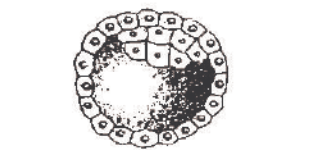
Q80. Identify the human developmental stage shown below as well as the related right place of its occurrence in a normal pregnant woman, and select the right option for the two together.
| Developmental stage | Site of occurrence |
|---|---|
| (a) Late morula | Middle part of fallopian tube |
| (b) Blastula | End part of fallopian tube |
| (c) Blastocyst | Uterine wall |
| (d) 8 celled morula | Starting point of fallopian tube |
Correct Answer: (c)
The image shows a Blastocyst (with outer trophoblast and inner cell mass), which attaches/implants into the Endometrium (Uterine wall).
The image shows a Blastocyst (with outer trophoblast and inner cell mass), which attaches/implants into the Endometrium (Uterine wall).
Q81. Gonads develop from
Correct Answer: (c)
Gonads (testes and ovaries) originate from the mesodermal germ layer during embryonic differentiation.
Gonads (testes and ovaries) originate from the mesodermal germ layer during embryonic differentiation.
Q82. Menstrual flow occurs due to lack of:
Correct Answer: (d)
Degeneration of corpus luteum leads to a abrupt fall in progesterone levels, resulting in shedding of the vascular endometrial lining.
Degeneration of corpus luteum leads to a abrupt fall in progesterone levels, resulting in shedding of the vascular endometrial lining.
Q83. The Leydig cells found in the human body are the secretory source of
Correct Answer: (d)
Leydig (interstitial) cells located between seminiferous tubules in the testes synthesize and secrete male sex hormones known as androgens (primarily testosterone).
Leydig (interstitial) cells located between seminiferous tubules in the testes synthesize and secrete male sex hormones known as androgens (primarily testosterone).
Q84. Acrosome reaction in sperm is triggered by
Correct Answer: (d)
Interactions between fertilizin (secreted by egg) and anti-fertilizin trigger the acrosomal reaction and adherence.
Interactions between fertilizin (secreted by egg) and anti-fertilizin trigger the acrosomal reaction and adherence.
Q85. The second maturation division of the mammalian ovum occurs
Correct Answer: (b)
Meiosis-II completes inside the Fallopian tube only after penetration of the secondary oocyte by a sperm.
Meiosis-II completes inside the Fallopian tube only after penetration of the secondary oocyte by a sperm.
Q86. The foetal ejection reflex in humans triggers release of
Correct Answer: (a)
Mild uterine contractions during fetal ejection reflex signal the maternal posterior pituitary to release oxytocin.
Mild uterine contractions during fetal ejection reflex signal the maternal posterior pituitary to release oxytocin.
Q87. During embryonic development, the establishment of polarity along anterior/posterior, dorsal/ventral or medial/lateral axis is called
Correct Answer: (b)
Organizer regions direct cell fates and body axes establishment through morphogenetic signaling (organizer phenomenon).
Organizer regions direct cell fates and body axes establishment through morphogenetic signaling (organizer phenomenon).
Q88. The secretory phase in the human menstrual cycle is also called
Correct Answer: (c)
The post-ovulatory secretory phase is also called the luteal phase and consistently lasts for about 13-14 days (days 15-28).
The post-ovulatory secretory phase is also called the luteal phase and consistently lasts for about 13-14 days (days 15-28).
Q89. Which of the following layers in an antral follicle is acellular?
Correct Answer: (c)
Zona pellucida is a non-cellular glycoprotein coat secreted directly around the secondary oocyte.
Zona pellucida is a non-cellular glycoprotein coat secreted directly around the secondary oocyte.
Q90. What happens during fertilisation in humans after many sperms reach close to the ovum?
Correct Answer: (a)
Acrosomal enzymes digest the zona pellucida, allowing a single sperm membrane to fuse with the oocyte plasma membrane.
Acrosomal enzymes digest the zona pellucida, allowing a single sperm membrane to fuse with the oocyte plasma membrane.
Q91. Select the correct sequence of events.
Correct Answer: (b)
Sequential developmental steps: Gametogenesis → Gamete transfer → Syngamy → Zygote formation → Cleavage → Cell differentiation → Organogenesis.
Sequential developmental steps: Gametogenesis → Gamete transfer → Syngamy → Zygote formation → Cleavage → Cell differentiation → Organogenesis.