Q1. A fall in glomerular filtration rate (GFR) activates
Correct Answer: (c)
A drop in glomerular blood pressure or GFR stimulates juxtaglomerular (JG) cells to release renin, initiating the RAAS pathway to restore GFR back to normal.
A drop in glomerular blood pressure or GFR stimulates juxtaglomerular (JG) cells to release renin, initiating the RAAS pathway to restore GFR back to normal.
Q2. Formation of concentrated (hyperosmotic) urine in vertebrates generally depends on
Correct Answer: (b)
The length of Henle's loop dictates the depth of the hyperosmolar gradient established in the renal medulla; longer loops yield higher concentrating capacity.
The length of Henle's loop dictates the depth of the hyperosmolar gradient established in the renal medulla; longer loops yield higher concentrating capacity.
Q3. Which one of the following statements in regard to the excretion by the human kidneys is correct?
Correct Answer: (c)
Out of ~180 L of glomerular filtrate produced daily, only ~1.5 L is excreted as urine, meaning approximately 99% of filtrate is reabsorbed along the renal tubules.
Out of ~180 L of glomerular filtrate produced daily, only ~1.5 L is excreted as urine, meaning approximately 99% of filtrate is reabsorbed along the renal tubules.
Q4. Which one of the following correctly explains the function of a specific part of a human nephron ?
Correct Answer: (a)
Podocytes are specialized epithelial cells of the visceral layer of Bowman's capsule that leave filtration slits (slit pores) through which blood plasma is ultrafiltered.
Podocytes are specialized epithelial cells of the visceral layer of Bowman's capsule that leave filtration slits (slit pores) through which blood plasma is ultrafiltered.
Q5. Human urine is usually acidic because:
Correct Answer: (c)
Tubular cells actively secrete hydrogen ions (H⁺), ammonium ions, and potassium ions into the filtrate to maintain ionic and acid-base balance, making human urine naturally acidic (pH ~6.0).
Tubular cells actively secrete hydrogen ions (H⁺), ammonium ions, and potassium ions into the filtrate to maintain ionic and acid-base balance, making human urine naturally acidic (pH ~6.0).
Q6. In Hydra waste material of food digestion and nitrogenous waste material removed from
Correct Answer: (a)
Hydra has a blind-sac body plan with a single opening (mouth) for ingestion and egestion. Nitrogenous wastes (ammonia) diffuse directly across the general body wall into surrounding water.
Hydra has a blind-sac body plan with a single opening (mouth) for ingestion and egestion. Nitrogenous wastes (ammonia) diffuse directly across the general body wall into surrounding water.
Q7. The principal nitrogenous excretory compound in humans is synthesised
Correct Answer: (d)
Urea is synthesized in liver hepatocytes via the urea cycle, transported in blood plasma, and primarily filtered and excreted by the kidneys.
Urea is synthesized in liver hepatocytes via the urea cycle, transported in blood plasma, and primarily filtered and excreted by the kidneys.
Q8. Which of the following factors is responsible for the formation of concentrated urine?
Correct Answer: (b)
The counter-current mechanism between the Loop of Henle and vasa recta creates an increasing hyperosmotic gradient towards the inner medullary interstitium (up to 1200 mOsmol/L), allowing water to be drawn out from the collecting tubule to form hypertonic concentrated urine.
The counter-current mechanism between the Loop of Henle and vasa recta creates an increasing hyperosmotic gradient towards the inner medullary interstitium (up to 1200 mOsmol/L), allowing water to be drawn out from the collecting tubule to form hypertonic concentrated urine.
Q9. Uricotelic mode of passing out nitrogenous wastes is found in
Correct Answer: (a)
Uricotelism is an adaptation for terrestrial life to conserve body water. Nitrogenous wastes are excreted as insoluble, non-toxic uric acid pellet or paste by reptiles, birds, land snails, and insects.
Uricotelism is an adaptation for terrestrial life to conserve body water. Nitrogenous wastes are excreted as insoluble, non-toxic uric acid pellet or paste by reptiles, birds, land snails, and insects.
Q10. Select the option which shows correct matching of animal with excretory organs and excretory product
| Animal | Excretory organs | Excretory product |
|---|---|---|
| (a) Housefly | Renal tubules | Uric acid |
| (b) Labeo (Rohu) | Nephridial tubes | Ammonia |
| (c) Salamander | Kidney | Urea |
| (d) Peacock | Kidney | Urea |
Correct Answer: (c)
Salamanders are amphibians that excrete urea through mesonephric kidneys. Aquatic organisms (like Labeo) are ammonotelic, while birds (peacock) and insects (housefly) excrete uric acid.
Salamanders are amphibians that excrete urea through mesonephric kidneys. Aquatic organisms (like Labeo) are ammonotelic, while birds (peacock) and insects (housefly) excrete uric acid.
Q11. Presence of which of the following conditions in urine are indicative of Diabetes Mellitus?
Correct Answer: (b)
Diabetes Mellitus is characterized by hyperglycemia, leading to glucose excretion in urine (Glycosuria) and breakdown of fats resulting in ketone body excretion (Ketonuria).
Diabetes Mellitus is characterized by hyperglycemia, leading to glucose excretion in urine (Glycosuria) and breakdown of fats resulting in ketone body excretion (Ketonuria).
Q12. Which of the following does not favour the formation of large quantities of dilute urine?
Correct Answer: (b)
Renin triggers the RAAS pathway to promote aldosterone release, increasing Na⁺ and water reabsorption, which conserves water and prevents the formation of dilute urine.
Renin triggers the RAAS pathway to promote aldosterone release, increasing Na⁺ and water reabsorption, which conserves water and prevents the formation of dilute urine.
Q13. Brush border is characteristic of
Correct Answer: (c)
Cells of the proximal convoluted tubule (PCT) are lined with dense microvilli forming a brush border that maximizes surface area for active tubular reabsorption.
Cells of the proximal convoluted tubule (PCT) are lined with dense microvilli forming a brush border that maximizes surface area for active tubular reabsorption.
Q14. The basic functional unit of the human kidney is
Correct Answer: (a)
The nephron is the structural and functional filtration unit of the mammalian kidney. Each human kidney contains approximately 1 million nephrons.
The nephron is the structural and functional filtration unit of the mammalian kidney. Each human kidney contains approximately 1 million nephrons.
Q15. Uric acid is nitrogenous waste in
Correct Answer: (b)
Birds and lizards are uricotelic organisms that eliminate nitrogenous waste as uric acid to reduce water loss.
Birds and lizards are uricotelic organisms that eliminate nitrogenous waste as uric acid to reduce water loss.
Q16. Which one of the following characteristics is common to both in humans and adult frogs?
Correct Answer: (d)
Both adult frogs and human beings are ureotelic organisms, excreting nitrogenous waste primarily in the form of urea.
Both adult frogs and human beings are ureotelic organisms, excreting nitrogenous waste primarily in the form of urea.
Q17. Part not belonging to uriniferous tubule is
Correct Answer: (a)
The uriniferous tubule consists of two structural parts: the nephron (Bowman's capsule, PCT, Loop of Henle, DCT) and collecting system. The glomerulus is a vascular tuft of capillaries, not a epithelial tubular structure.
The uriniferous tubule consists of two structural parts: the nephron (Bowman's capsule, PCT, Loop of Henle, DCT) and collecting system. The glomerulus is a vascular tuft of capillaries, not a epithelial tubular structure.
Q18. Nitrogenous waste products are eliminated mainly as
Correct Answer: (b)
Aquatic tadpoles are ammonotelic due to abundant environmental water, but metamorphose into adult frogs which are ureotelic on land.
Aquatic tadpoles are ammonotelic due to abundant environmental water, but metamorphose into adult frogs which are ureotelic on land.
Q19. The maximum amount of electrolytes and water (70-80 percent) from the glomerular filtrate is reabsorbed in which part of the nephron ?
Correct Answer: (c)
The Proximal Convoluted Tubule (PCT) is lined with simple cuboidal brush-border epithelium, providing maximum surface area for 70–80% electrolyte and water reabsorption.
The Proximal Convoluted Tubule (PCT) is lined with simple cuboidal brush-border epithelium, providing maximum surface area for 70–80% electrolyte and water reabsorption.
Q20. Match the items given in Column I with those in Column II and select the correct option given below:
| Column I | Column II |
|---|---|
| A. Glycosuria | i. Accumulation of uric acid in joints |
| B. Gout | ii. Mass of crystallised salts within the kidney |
| C. Renal calculi | iii. Inflammation in glomeruli |
| D. Glomerular nephritis | iv. Presence of glucose in urine |
Correct Answer: (c)
Glycosuria is presence of glucose in urine; Gout is uric acid crystal deposition in joints; Renal calculi are insoluble salt crystals (e.g. oxalates) in the kidney; Glomerular nephritis is inflammation of renal glomeruli.
Glycosuria is presence of glucose in urine; Gout is uric acid crystal deposition in joints; Renal calculi are insoluble salt crystals (e.g. oxalates) in the kidney; Glomerular nephritis is inflammation of renal glomeruli.
Q21. What will happen if the stretch receptors of the urinary bladder wall are totally removed?
Correct Answer: (a)
Without sensory stretch receptors to signal full bladder capacity to the CNS, voluntary inhibition and micturition reflex timing are lost, causing continuous involuntary voiding/dribbling of urine.
Without sensory stretch receptors to signal full bladder capacity to the CNS, voluntary inhibition and micturition reflex timing are lost, causing continuous involuntary voiding/dribbling of urine.
Q22. Proximal and distal convoluted tubules are parts of
Correct Answer: (b)
PCT and DCT are integral tubular segments of individual nephrons located within the renal cortex.
PCT and DCT are integral tubular segments of individual nephrons located within the renal cortex.
Q23. Figure shown human urinary system with structures labelled A to D. Select option which correctly identifies them and gives their characteristics and/or functions.
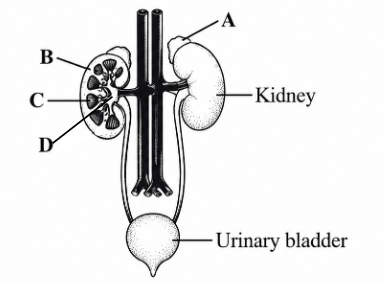
Correct Answer: (d)
The adrenal gland (A) lies on the superior aspect of each kidney. Its adrenal medulla secretes the catecholamines adrenaline (epinephrine) and noradrenaline (norepinephrine), which prepare the body for emergencies by increasing heart rate, blood pressure, and blood glucose through glycogenolysis. The renal cortex (B) contains the renal corpuscles and convoluted tubules, the renal medulla (C) contains the loops of Henle and collecting ducts, and the renal pelvis (D) is the funnel-shaped cavity that collects urine and drains it into the ureter.
The adrenal gland (A) lies on the superior aspect of each kidney. Its adrenal medulla secretes the catecholamines adrenaline (epinephrine) and noradrenaline (norepinephrine), which prepare the body for emergencies by increasing heart rate, blood pressure, and blood glucose through glycogenolysis. The renal cortex (B) contains the renal corpuscles and convoluted tubules, the renal medulla (C) contains the loops of Henle and collecting ducts, and the renal pelvis (D) is the funnel-shaped cavity that collects urine and drains it into the ureter.
Q24. If Henle's loop were absent from mammalian nephron, which of the following is to be expected?
Correct Answer: (a)
The Loop of Henle is responsible for maintaining the medullary osmotic gradient. In its absence, urine cannot be concentrated, resulting in production of copious dilute urine.
The Loop of Henle is responsible for maintaining the medullary osmotic gradient. In its absence, urine cannot be concentrated, resulting in production of copious dilute urine.
Q25. Which one of the following statements is correct with respect to kidney function regulation?
Correct Answer: (a)
Ingestion of large volumes of water dilutes blood osmolality, suppressing osmoreceptors and inhibiting ADH release from the posterior pituitary, increasing diuresis.
Ingestion of large volumes of water dilutes blood osmolality, suppressing osmoreceptors and inhibiting ADH release from the posterior pituitary, increasing diuresis.
Q26. Use of an artificial kidney during hemodialysis may result in:
(a) Nitrogenous waste build-up in the body.
(b) Non-elimination of excess potassium ions.
(c) Reduced absorption of calcium ions from gastro-intestinal tract.
(d) Reduced RBC production.
Which of the following options is the most appropriate?
(a) Nitrogenous waste build-up in the body.
(b) Non-elimination of excess potassium ions.
(c) Reduced absorption of calcium ions from gastro-intestinal tract.
(d) Reduced RBC production.
Which of the following options is the most appropriate?
Correct Answer: (c)
Long-term hemodialysis can lead to reduced renal hydroxylation of Vitamin D, lowering GI calcium absorption. Furthermore, damaged kidneys produce less erythropoietin, reducing RBC synthesis (anemia).
Long-term hemodialysis can lead to reduced renal hydroxylation of Vitamin D, lowering GI calcium absorption. Furthermore, damaged kidneys produce less erythropoietin, reducing RBC synthesis (anemia).
Q27. Reabsorption of useful substances from glomerular filtrate occurs in
Correct Answer: (c)
The proximal convoluted tubule (PCT) is the primary site for reabsorption of essential physiological substances, including glucose, amino acids, vitamins, and bulk electrolytes.
The proximal convoluted tubule (PCT) is the primary site for reabsorption of essential physiological substances, including glucose, amino acids, vitamins, and bulk electrolytes.
Q28. Consider the following four statements (i-iv) regarding kidney transplant and select the two correct ones out of these.
(i) Even if a kidney transplant is proper the recipient may need to take immune suppressants for a long time
(ii) The cell mediated immune response is responsible for the graft rejection
(iii) The B lymphocytes are responsible for rejection of the graft
(iv) The acceptance or rejection of a kidney transplant depends on specific interferons
The two correct statements are:
(i) Even if a kidney transplant is proper the recipient may need to take immune suppressants for a long time
(ii) The cell mediated immune response is responsible for the graft rejection
(iii) The B lymphocytes are responsible for rejection of the graft
(iv) The acceptance or rejection of a kidney transplant depends on specific interferons
The two correct statements are:
Correct Answer: (d)
Statements (i) and (ii) are accurate. Transplant recipients require immunosuppressants to prevent host-versus-graft rejection, which is driven primarily by T-cell mediated cellular immunity.
Statements (i) and (ii) are accurate. Transplant recipients require immunosuppressants to prevent host-versus-graft rejection, which is driven primarily by T-cell mediated cellular immunity.
Q29. Which of the following causes an increase in sodium reabsorption in the distal convoluted tubule?
Correct Answer: (a)
Aldosterone secreted by the adrenal cortex acts on the distal convoluted tubule (DCT) and collecting duct to stimulate reabsorption of Na⁺ and water into blood.
Aldosterone secreted by the adrenal cortex acts on the distal convoluted tubule (DCT) and collecting duct to stimulate reabsorption of Na⁺ and water into blood.
Q30. The net pressure gradient that causes the fluid to filter out of the glomeruli into the capsule is:
Correct Answer: (c)
Net Filtration Pressure (NFP) = Glomerular Hydrostatic Pressure (GHP ~45–60 mmHg) − [Blood Colloidal Osmotic Pressure (BCOP ~30 mmHg) + Capsular Hydrostatic Pressure (CHP ~10–15 mmHg)] ≈ 10 to 20 mmHg.
Net Filtration Pressure (NFP) = Glomerular Hydrostatic Pressure (GHP ~45–60 mmHg) − [Blood Colloidal Osmotic Pressure (BCOP ~30 mmHg) + Capsular Hydrostatic Pressure (CHP ~10–15 mmHg)] ≈ 10 to 20 mmHg.
Q31. In Ornithine cycle, which of the following wastes are removed from the blood?
Correct Answer: (c)
The Ornithine cycle removes toxic metabolic waste gases and nitrogenous compounds—specifically carbon dioxide (CO₂) and ammonia (NH₃)—from blood plasma to synthesize urea.
The Ornithine cycle removes toxic metabolic waste gases and nitrogenous compounds—specifically carbon dioxide (CO₂) and ammonia (NH₃)—from blood plasma to synthesize urea.
Q32. Glucose is taken back from glomerular filtrate through
Correct Answer: (a)
Glucose is completely reabsorbed from filtrate in the PCT via sodium-dependent glucose co-transporters (SGLT) through secondary active transport.
Glucose is completely reabsorbed from filtrate in the PCT via sodium-dependent glucose co-transporters (SGLT) through secondary active transport.
Q33. In ureotelic animals, urea is formed by the
Correct Answer: (c)
Urea synthesis occurs predominantly in the liver via the Ornithine cycle (urea cycle), where toxic ammonia combines with carbon dioxide.
Urea synthesis occurs predominantly in the liver via the Ornithine cycle (urea cycle), where toxic ammonia combines with carbon dioxide.
Q34. A terrestrial animal must be able to
Correct Answer: (b)
Water loss is a primary challenge for terrestrial animals; hence, physiological mechanisms are adapted to conserve body water and produce hypertonic urine.
Water loss is a primary challenge for terrestrial animals; hence, physiological mechanisms are adapted to conserve body water and produce hypertonic urine.
Q35. Bowman's glands are found in
Correct Answer: (d)
Bowman's glands (olfactory glands) are exocrine mucus-secreting glands situated in the lamina propria of the nasal olfactory epithelium.
Bowman's glands (olfactory glands) are exocrine mucus-secreting glands situated in the lamina propria of the nasal olfactory epithelium.
Q36. Removal of proximal convoluted tubule from the nephron will result in:
Correct Answer: (d)
The PCT reabsorbs 70–80% of electrolytes and water. If PCT is removed, selective reabsorption decreases dramatically, resulting in output of large volumes of diluted urine.
The PCT reabsorbs 70–80% of electrolytes and water. If PCT is removed, selective reabsorption decreases dramatically, resulting in output of large volumes of diluted urine.
Q37. Which one of the following options gives the correct categorization of six animals according to the type of nitrogenous wastes (A, B, C), they give out?
| A - Ammonotelic | B - Ureotelic | C - Uricotelic |
|---|---|---|
| (a) Pigeon, Humans | Aquatic Amphibia, Lizards | Cockroach, Frog |
| (b) Frog, Lizards | Aquatic Amphibia, Cockroach | Pigeon, Humans |
| (c) Aquatic Amphibia | Frog, Humans | Pigeon, Lizards, Cockroach |
| (d) Aquatic Amphibia | Cockroach, Humans | Frog, Pigeon, Lizards |
Correct Answer: (c)
Aquatic amphibians release highly toxic and water-soluble ammonia (Ammonotelic). Adult frogs and humans excrete urea (Ureotelic). Birds (Pigeon), reptiles (Lizards), and insects (Cockroach) conserve water by excreting uric acid (Uricotelic).
Aquatic amphibians release highly toxic and water-soluble ammonia (Ammonotelic). Adult frogs and humans excrete urea (Ureotelic). Birds (Pigeon), reptiles (Lizards), and insects (Cockroach) conserve water by excreting uric acid (Uricotelic).
Q38. A person is undergoing prolonged fasting. His urine will be found to contain abnormal quantities of:
Correct Answer: (d)
During prolonged starvation, body fats undergo extensive beta-oxidation to yield ketone bodies (acetoacetate, beta-hydroxybutyrate), which spill into urine (ketonuria).
During prolonged starvation, body fats undergo extensive beta-oxidation to yield ketone bodies (acetoacetate, beta-hydroxybutyrate), which spill into urine (ketonuria).
Q39. Which of the following would help in prevention of diuresis?
Correct Answer: (a)
Aldosterone promotes active reabsorption of Na⁺ followed by osmotic reabsorption of water in the distal nephron, decreasing urine volume and preventing diuresis.
Aldosterone promotes active reabsorption of Na⁺ followed by osmotic reabsorption of water in the distal nephron, decreasing urine volume and preventing diuresis.
Q40. In the renal tubules the permeability of the distal convoluted tubule and collecting duct to water is controlled by
Correct Answer: (a)
Vasopressin (Anti-Diuretic Hormone / ADH) inserts aquaporin water channels into apical membranes of DCT and collecting duct cells, increasing water reabsorption.
Vasopressin (Anti-Diuretic Hormone / ADH) inserts aquaporin water channels into apical membranes of DCT and collecting duct cells, increasing water reabsorption.
Q41. Uricotelism is found in
Correct Answer: (c)
Birds, reptiles, and insects excrete uric acid (uricotelism) to adapt to water conservation on land.
Birds, reptiles, and insects excrete uric acid (uricotelism) to adapt to water conservation on land.
Q42. Which one of the following is a matching pair?
Correct Answer: (b)
Evaporation of sweat produced by sudoriferous glands cools the skin surface, serving a primary role in human thermoregulation.
Evaporation of sweat produced by sudoriferous glands cools the skin surface, serving a primary role in human thermoregulation.
Q43. Which one of the following is not a part of a renal pelvis?
Correct Answer: (c)
Collecting ducts extend through the renal cortex and medulla to empty urine into minor and major calyces of the renal pelvis, but are structurally components of the nephron system/renal parenchyma, whereas collecting ducts empty into renal pelvis rather than being part of the pelvis proper.
Collecting ducts extend through the renal cortex and medulla to empty urine into minor and major calyces of the renal pelvis, but are structurally components of the nephron system/renal parenchyma, whereas collecting ducts empty into renal pelvis rather than being part of the pelvis proper.
Q44. Uric acid is the chief nitrogenous component of the excretory products of
Correct Answer: (b)
Cockroach (an insect) lives in dry terrestrial conditions and excretes uric acid via Malpighian tubules to minimize water loss.
Cockroach (an insect) lives in dry terrestrial conditions and excretes uric acid via Malpighian tubules to minimize water loss.
Q45. Match the following parts of a nephron with their function:
| Column-I | Column-II |
|---|---|
| (A) Descending limb of Henle's loop | (i) Reabsorption of salts only |
| (B) Proximal convoluted tubule | (ii) Reabsorption of water only |
| (C) Ascending limb of Henle's loop | (iii) Conditional reabsorption of sodium ions and water |
| (D) Distal convoluted tubule | (iv) Reabsorption of ions, water and organic nutrients |
Correct Answer: (c)
Descending limb of Henle's loop is permeable to water only. PCT reabsorbs ~70–80% of ions, water, and essential nutrients. Ascending limb is permeable to salts/electrolytes only. DCT carries out conditional reabsorption of Na⁺ and water.
Descending limb of Henle's loop is permeable to water only. PCT reabsorbs ~70–80% of ions, water, and essential nutrients. Ascending limb is permeable to salts/electrolytes only. DCT carries out conditional reabsorption of Na⁺ and water.
Q46. If kidney fail to reabsorb water, the effect on tissue would
Correct Answer: (b)
Failure of renal water reabsorption causes severe polyuria, leading to body dehydration. Fluid moves out of cells down the osmotic gradient, causing tissues to shrink and shrivel.
Failure of renal water reabsorption causes severe polyuria, leading to body dehydration. Fluid moves out of cells down the osmotic gradient, causing tissues to shrink and shrivel.
Q47. Earthworms are
Correct Answer: (c)
Earthworms show dual excretion behavior: they are ammonotelic in aquatic environments with abundant water, but become ureotelic on land under drier conditions.
Earthworms show dual excretion behavior: they are ammonotelic in aquatic environments with abundant water, but become ureotelic on land under drier conditions.
Q48. Ureters act as urogenital ducts in
Correct Answer: (d)
In male frogs, ureters carry both urine from the kidneys and spermatozoa from testes (via Bidder's canal), hence serving as urogenital ducts.
In male frogs, ureters carry both urine from the kidneys and spermatozoa from testes (via Bidder's canal), hence serving as urogenital ducts.
Q49. In Ornithine cycle, which one pair of the following wastes are removed from the blood?
Correct Answer: (b)
In the liver, one molecule of CO₂ combines with two molecules of NH₃ (ammonia) through the enzymatic steps of the Ornithine cycle to form urea.
In the liver, one molecule of CO₂ combines with two molecules of NH₃ (ammonia) through the enzymatic steps of the Ornithine cycle to form urea.
Q50. Solenocytes are the main excretory structures in
Correct Answer: (a)
Solenocytes (flame cells/protonephridia) serve as excretory and osmoregulatory structures in flatworms (Platyhelminthes).
Solenocytes (flame cells/protonephridia) serve as excretory and osmoregulatory structures in flatworms (Platyhelminthes).
Q51. Which of the following statements is correct?
Correct Answer: (d)
The descending limb of loop of Henle is permeable to water but impermeable to electrolytes, whereas the ascending limb is impermeable to water but permeable to electrolytes.
The descending limb of loop of Henle is permeable to water but impermeable to electrolytes, whereas the ascending limb is impermeable to water but permeable to electrolytes.
Q52. In mammals, which blood vessel would normally carry largest amount of urea?
Correct Answer: (c)
Urea is synthesized in the liver from ammonia via the urea cycle. Therefore, blood leaving the liver via the Hepatic Vein contains the highest concentration of urea.
Urea is synthesized in the liver from ammonia via the urea cycle. Therefore, blood leaving the liver via the Hepatic Vein contains the highest concentration of urea.
Q53. Under normal conditions which one is completely reabsorbed in the renal tubule?
Correct Answer: (d)
Under normal physiological blood glucose levels below the renal threshold (~180 mg/dL), 100% of filtered glucose is actively reabsorbed in the PCT.
Under normal physiological blood glucose levels below the renal threshold (~180 mg/dL), 100% of filtered glucose is actively reabsorbed in the PCT.