Q1. The biomass available for consumption by the herbivores and the decomposers is called:
Correct Answer: (a)
Net primary productivity (NPP = GPP - R) represents the biomass available for consumers (herbivores and decomposers).
Net primary productivity (NPP = GPP - R) represents the biomass available for consumers (herbivores and decomposers).
Q2. The second stage of hydrosere is occupied by plants like
Correct Answer: (d)
The sequence in hydrosere: Phytoplankton → Submerged plant stage (Vallisneria, Hydrilla) → Submerged free-floating → Reed-swamp → Marsh-meadow → Scrub → Forest.
The sequence in hydrosere: Phytoplankton → Submerged plant stage (Vallisneria, Hydrilla) → Submerged free-floating → Reed-swamp → Marsh-meadow → Scrub → Forest.
Q3. Study of inter-relationships between organisms and their environment is
Correct Answer: (a)
Ecology is defined as the scientific study of relationships between organisms and their surrounding physical/biotic environment.
Ecology is defined as the scientific study of relationships between organisms and their surrounding physical/biotic environment.
Q4. In a food chain, the largest population is that of
Correct Answer: (d)
Among consumer trophic levels in a classic food chain, primary consumers maintain the largest population compared to secondary/tertiary predators.
Among consumer trophic levels in a classic food chain, primary consumers maintain the largest population compared to secondary/tertiary predators.
Q5. Pyramid of numbers in a grassland/tree ecosystem is
Correct Answer: (b)
In grassland ecosystems, the number of grass blades exceeds herbivores, which outnumber carnivores, yielding an upright pyramid.
In grassland ecosystems, the number of grass blades exceeds herbivores, which outnumber carnivores, yielding an upright pyramid.
Q6. Food chain in which micro-organisms breakdown the food formed by primary producers is
Correct Answer: (b)
The detritus food chain begins with dead organic matter derived from primary producers and is acted upon by decomposer microorganisms.
The detritus food chain begins with dead organic matter derived from primary producers and is acted upon by decomposer microorganisms.
Q7. Which one of the following is not a function of an ecosystem?
Correct Answer: (d)
Stratification is a structural attribute of an ecosystem, whereas productivity, energy flow, decomposition, and nutrient cycling are functional aspects.
Stratification is a structural attribute of an ecosystem, whereas productivity, energy flow, decomposition, and nutrient cycling are functional aspects.
Q8. Identify the possible link 'A' in the following food chain:
Plant → insect → frog → 'A' → Eagle
Plant → insect → frog → 'A' → Eagle
Correct Answer: (c)
Frogs are eaten by snakes such as Cobras, which are subsequently preyed upon by eagles.
Frogs are eaten by snakes such as Cobras, which are subsequently preyed upon by eagles.
Q9. Identify the likely organisms (1), (2), (3) and (4) in the food web shown below:
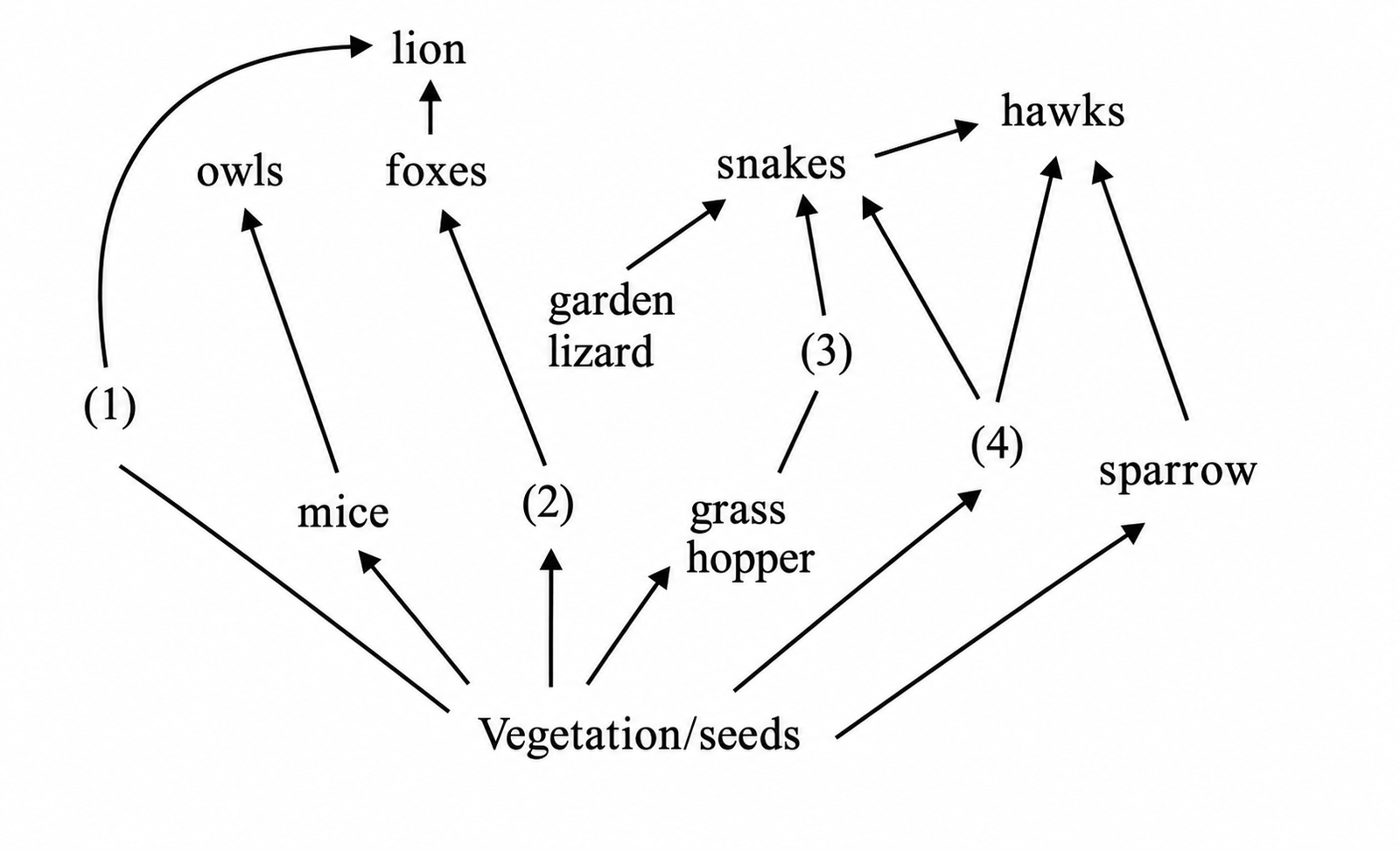
Correct Answer: (a)
Matching ecological roles in standard food webs: (1) Deer, (2) Rabbit, (3) Frog (eaten by snakes/lizards), (4) Rat.
Matching ecological roles in standard food webs: (1) Deer, (2) Rabbit, (3) Frog (eaten by snakes/lizards), (4) Rat.
Q10. In grass-deer-tiger food chain, grass biomass is one tonne. The tiger biomass shall be
Correct Answer: (b)
1 tonne = 1000 kg grass (T₁). Applying the 10% energy transfer rule: Deer (T₂) = 100 kg, Tiger (T₃) = 10 kg.
1 tonne = 1000 kg grass (T₁). Applying the 10% energy transfer rule: Deer (T₂) = 100 kg, Tiger (T₃) = 10 kg.
Q11. The upright pyramid of number is absent in
Correct Answer: (b)
In a forest ecosystem, a single large producer tree supports numerous insects, giving a spindle-shaped or partially inverted pyramid of numbers.
In a forest ecosystem, a single large producer tree supports numerous insects, giving a spindle-shaped or partially inverted pyramid of numbers.
Q12. Niche is
Correct Answer: (c)
The term ecological niche refers to the functional role played by an organism in its ecosystem, including its interactions with biotic and abiotic factors.
The term ecological niche refers to the functional role played by an organism in its ecosystem, including its interactions with biotic and abiotic factors.
Q13. Vertical distribution of different species occupying different levels in a biotic community is known as:
Correct Answer: (a)
Stratification is the vertical layering of a biological community into distinct horizontal layers (e.g., top canopy trees, shrubs, herbs, and grasses in a forest).
Stratification is the vertical layering of a biological community into distinct horizontal layers (e.g., top canopy trees, shrubs, herbs, and grasses in a forest).
Q14. The main role of bacteria in the carbon cycle involves
Correct Answer: (c)
Bacteria act as decomposers, breaking down complex dead organic compounds and returning carbon dioxide to the atmosphere.
Bacteria act as decomposers, breaking down complex dead organic compounds and returning carbon dioxide to the atmosphere.
Q15. In which of the following both pairs have correct combination?
Correct Answer: (d)
Carbon and Nitrogen cycles have gaseous reservoir pools (CO₂, N₂), whereas Phosphorus and Sulphur cycles have sedimentary reservoir pools.
Carbon and Nitrogen cycles have gaseous reservoir pools (CO₂, N₂), whereas Phosphorus and Sulphur cycles have sedimentary reservoir pools.
Q16. Which one of the following statements for pyramid of energy is incorrect, whereas the remaining three are correct?
Correct Answer: (c)
The pyramid of energy is strictly upright because energy is lost as heat at every trophic step during transfer.
The pyramid of energy is strictly upright because energy is lost as heat at every trophic step during transfer.
Q17. Of the total incident solar radiation the proportion of PAR is:
Correct Answer: (c)
Less than 50% of total incident solar radiation constitutes Photosynthetically Active Radiation (PAR).
Less than 50% of total incident solar radiation constitutes Photosynthetically Active Radiation (PAR).
Q18. Increase in concentration of the toxicant at successive trophic levels is known as:
Correct Answer: (d)
Biomagnification refers to the progressive accumulation and increase in concentration of non-biodegradable toxins at higher trophic levels.
Biomagnification refers to the progressive accumulation and increase in concentration of non-biodegradable toxins at higher trophic levels.
Q19. Greatest producers of organic matter are
Correct Answer: (d)
Oceanic phytoplankton collectively carry out the largest share of annual global photosynthesis.
Oceanic phytoplankton collectively carry out the largest share of annual global photosynthesis.
Q20. An ecosystem which can be easily damaged but can recover after some time if damaging effect stops will be having
Correct Answer: (a)
Easily damaged indicates low ecological stability, whereas quick recovery after disturbance indicates high resilience.
Easily damaged indicates low ecological stability, whereas quick recovery after disturbance indicates high resilience.
Q21. Bamboo plant is growing in a fir forest then what will be the trophic level of it?
Correct Answer: (a)
Bamboo is a photosynthetic green plant (producer), so it always occupies the First Trophic Level (T₁).
Bamboo is a photosynthetic green plant (producer), so it always occupies the First Trophic Level (T₁).
Q22. Which of the following is expected to have the highest value (gm/m²/yr) in a grassland ecosystem?
Correct Answer: (c)
Gross Production (GPP) is total energy fixed by autotrophs, which is always greater than Net Production or production at higher trophic levels.
Gross Production (GPP) is total energy fixed by autotrophs, which is always greater than Net Production or production at higher trophic levels.
Q23. Barophilic prokaryotes:
Correct Answer: (a)
Barophilic prokaryotes (piezophiles) are specialized organisms that thrive under extremely high hydrostatic pressures in deep marine benthic environments.
Barophilic prokaryotes (piezophiles) are specialized organisms that thrive under extremely high hydrostatic pressures in deep marine benthic environments.
Q24. The transfer of energy from one trophic level to another is governed by the 2nd law of thermodynamics. The average efficiency of energy transfer from herbivores to carnivores is
Correct Answer: (b)
According to Lindeman's 10% law, only about 10% of energy stored in one trophic level is transferred to the next.
According to Lindeman's 10% law, only about 10% of energy stored in one trophic level is transferred to the next.
Q25. Match the following and select the correct option:
| Column I | Column II |
|---|---|
| (A) Earthworm | (i) Pioneer species |
| (B) Succession | (ii) Detritivore |
| (C) Ecosystem service | (iii) Natality |
| (D) Population growth | (iv) Pollination |
Correct Answer: (d)
Earthworm-Detritivore; Succession-Pioneer species; Ecosystem service-Pollination; Population growth-Natality.
Earthworm-Detritivore; Succession-Pioneer species; Ecosystem service-Pollination; Population growth-Natality.
Q26. Which one of the following types of organisms occupy more than one trophic level in a pond ecosystem?
Correct Answer: (a)
Small fishes eat zooplankton (T₃), while large carnivorous fishes feed on smaller fishes (T₄). Thus, fish occupy multiple trophic levels.
Small fishes eat zooplankton (T₃), while large carnivorous fishes feed on smaller fishes (T₄). Thus, fish occupy multiple trophic levels.
Q27. Which one of the following is not a gaseous biogeochemical cycle in ecosystem?
Correct Answer: (b)
Phosphorus cycle is a classic sedimentary biogeochemical cycle, lacking a significant gas phase.
Phosphorus cycle is a classic sedimentary biogeochemical cycle, lacking a significant gas phase.
Q28. Bulk CO₂ fixation occurs in
Correct Answer: (b)
Oceans host vast surface areas populated by marine phytoplankton, responsible for fixing the majority of global carbon dioxide.
Oceans host vast surface areas populated by marine phytoplankton, responsible for fixing the majority of global carbon dioxide.
Q29. Given below is a simplified model of phosphorus cycling in a terrestrial ecosystem with four blanks (A-D). Identify the blanks:
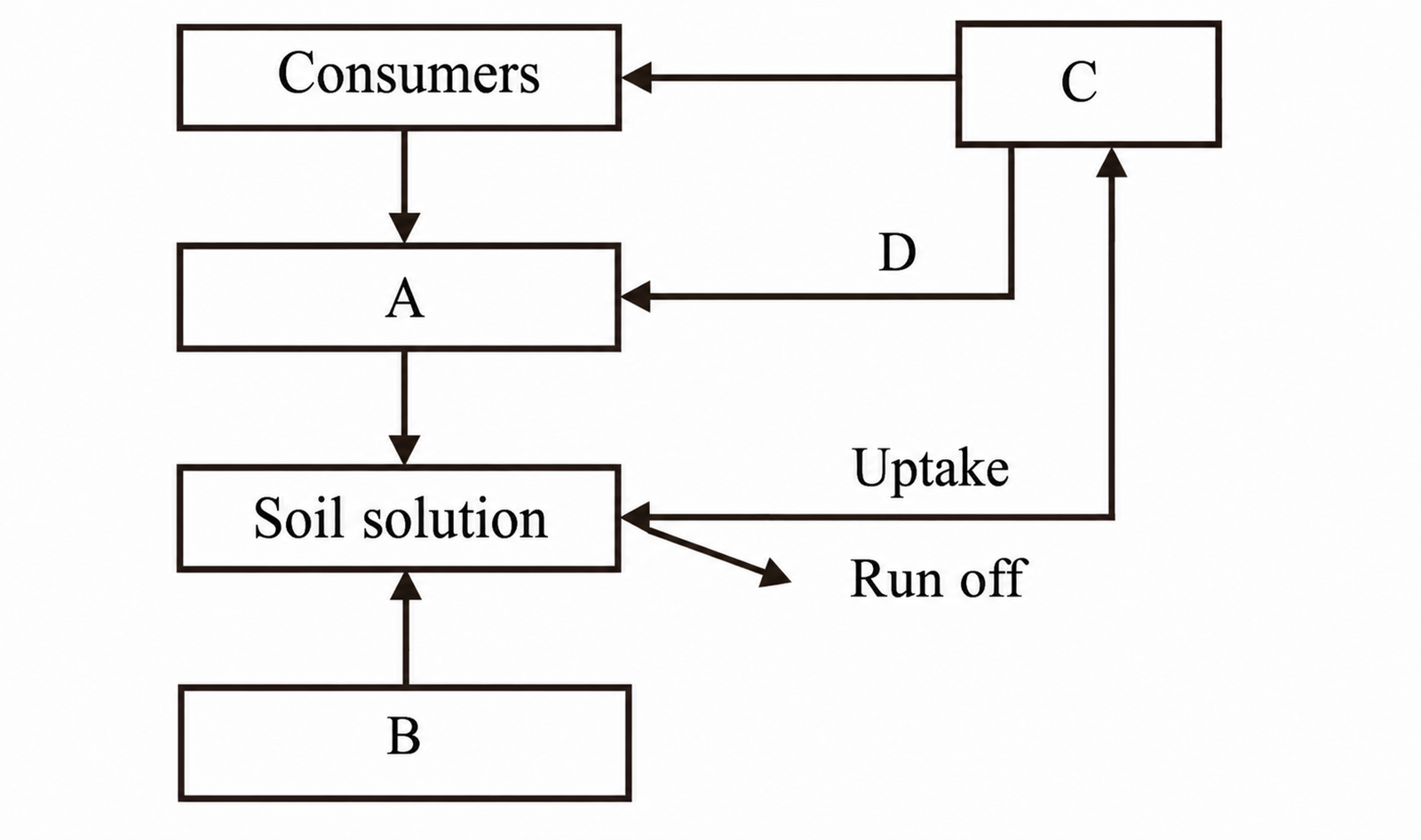
Correct Answer: (c)
In the terrestrial phosphorus cycle: Weathering of Rock minerals (B) adds phosphate to soil solution; Producers (C) absorb it; Litter fall (D) produces Detritus (A).
In the terrestrial phosphorus cycle: Weathering of Rock minerals (B) adds phosphate to soil solution; Producers (C) absorb it; Litter fall (D) produces Detritus (A).
Q30. When man eats fish which feeds on zooplankton which have eaten small plants, the producer in the chain is
Correct Answer: (b)
Small plants (phytoplankton) are photoautotrophs that synthesize organic food, acting as primary producers.
Small plants (phytoplankton) are photoautotrophs that synthesize organic food, acting as primary producers.
Q31. Which of the following does not have stomata?
Correct Answer: (d)
Submerged hydrophytes lack stomata completely; gas exchange occurs directly across their general body surface.
Submerged hydrophytes lack stomata completely; gas exchange occurs directly across their general body surface.
Q32. Pick up the correct food chain
Correct Answer: (c)
Phytoplankton (Producer) → Zooplankton (Primary Consumer) → Fish (Secondary Consumer) represents a correct aquatic grazing food chain.
Phytoplankton (Producer) → Zooplankton (Primary Consumer) → Fish (Secondary Consumer) represents a correct aquatic grazing food chain.
Q33. Which ecosystem has the maximum biomass?
Correct Answer: (d)
Forest ecosystems possess huge perennial woody trees, providing maximum accumulated standing biomass compared to grassland or aquatic habitats.
Forest ecosystems possess huge perennial woody trees, providing maximum accumulated standing biomass compared to grassland or aquatic habitats.
Q34. Natural reservoir of phosphorus is:
Correct Answer: (b)
Phosphate rocks contain phosphorus in the form of insoluble phosphates and serve as the main natural reservoir pool.
Phosphate rocks contain phosphorus in the form of insoluble phosphates and serve as the main natural reservoir pool.
Q35. In an ecosystem, which one shows one-way passage?
Correct Answer: (a)
Energy flows unidirectionally through trophic levels and is lost as heat, whereas mineral nutrients (C, N, K) cycle repeatedly.
Energy flows unidirectionally through trophic levels and is lost as heat, whereas mineral nutrients (C, N, K) cycle repeatedly.
Q36. Which one of the following processes during decomposition is correctly described?
Correct Answer: (d)
Fragmentation is the process where detritivores (like earthworms) break down detritus into smaller particles.
Fragmentation is the process where detritivores (like earthworms) break down detritus into smaller particles.
Q37. Consider the following statements concerning food chains:
(1) removal of 80% tigers from an area resulted in greatly increased growth of vegetation
(2) removal of most of the carnivores resulted in an increased population of deers
(3) the length of food chains is generally limited to 3-4 trophic levels due to energy loss
(4) the length of food chains may vary from 2 to 8 trophic levels
Which two of the above statements are correct?
(1) removal of 80% tigers from an area resulted in greatly increased growth of vegetation
(2) removal of most of the carnivores resulted in an increased population of deers
(3) the length of food chains is generally limited to 3-4 trophic levels due to energy loss
(4) the length of food chains may vary from 2 to 8 trophic levels
Which two of the above statements are correct?
Correct Answer: (a)
Removing carnivores increases herbivores (deer). Energy loss at each step restricts food chain length to 3-4 levels.
Removing carnivores increases herbivores (deer). Energy loss at each step restricts food chain length to 3-4 levels.
Q38. The slow rate of decomposition of fallen logs in nature is due to their
Correct Answer: (a)
Decomposition requires optimum moisture. Fallen logs have low moisture content and high lignin/cellulose, making their breakdown slow.
Decomposition requires optimum moisture. Fallen logs have low moisture content and high lignin/cellulose, making their breakdown slow.
Q39. Upper part of sea/aquatic ecosystem contains
Correct Answer: (a)
The euphotic surface water layer mainly contains plankton (phytoplankton and zooplankton) floating passively.
The euphotic surface water layer mainly contains plankton (phytoplankton and zooplankton) floating passively.
Q40. The primary succession refers to the development of communities on a
Correct Answer: (d)
Primary succession starts on pristine, previously uninhabited habitats devoid of organic soil (e.g., bare rock, newly exposed lava).
Primary succession starts on pristine, previously uninhabited habitats devoid of organic soil (e.g., bare rock, newly exposed lava).
Q41. Pheretima and its close relatives derive nourishment from:
Correct Answer: (b)
Pheretima (earthworm) is a detritivore that feeds on humus, soil organic matter, and decomposing plant leaf litter.
Pheretima (earthworm) is a detritivore that feeds on humus, soil organic matter, and decomposing plant leaf litter.
Q42. An association of individuals of different species living in the same habitat and having functional interactions is:
Correct Answer: (a)
An assemblage of interacting populations of different species coexisting in a common habitat is a biotic community.
An assemblage of interacting populations of different species coexisting in a common habitat is a biotic community.
Q43. The greatest biomass of autotrophs in the oceans is that of
Correct Answer: (b)
Microscopic phytoplankton (free-floating microalgae, cyanobacteria, and nanoplankton) account for the major ocean primary production biomass.
Microscopic phytoplankton (free-floating microalgae, cyanobacteria, and nanoplankton) account for the major ocean primary production biomass.
Q44. The rate at which light energy is converted to the chemical energy of organic molecules is the ecosystem's
Correct Answer: (b)
Gross Primary Productivity (GPP) is the rate at which radiant light energy is trapped and converted into chemical energy via photosynthesis.
Gross Primary Productivity (GPP) is the rate at which radiant light energy is trapped and converted into chemical energy via photosynthesis.
Q45. Which of the following pairs is a sedimentary type of biogeochemical cycle?
Correct Answer: (b)
Both phosphorus and sulphur cycles have Earth's crustal rocks as their major sedimentary reservoir pool.
Both phosphorus and sulphur cycles have Earth's crustal rocks as their major sedimentary reservoir pool.
Q46. Which of the following is a characteristic feature of cropland ecosystem?
Correct Answer: (b)
Croplands are man-made monoculture ecosystems characterized by very low genetic and species diversity.
Croplands are man-made monoculture ecosystems characterized by very low genetic and species diversity.
Q47. Given below is an imaginary pyramid of numbers. What could be one of the possibilities about certain organisms at some of the different levels?
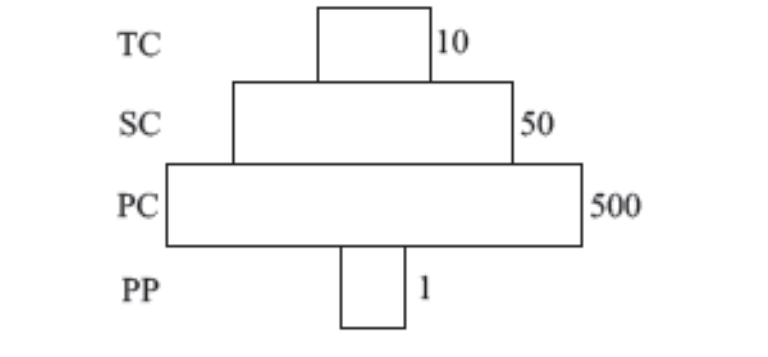
Correct Answer: (a)
A single tree (PP=1) can support 500 herbivorous insects (PC), which feed 50 small insectivorous birds (SC), which are preyed upon by 10 predatory birds (TC).
A single tree (PP=1) can support 500 herbivorous insects (PC), which feed 50 small insectivorous birds (SC), which are preyed upon by 10 predatory birds (TC).
Q48. Which of the following would appear as the pioneer organisms on bare rocks?
Correct Answer: (a)
Lichens act as pioneer organisms in primary xerarch succession by secreting organic acids to weather rocks into soil.
Lichens act as pioneer organisms in primary xerarch succession by secreting organic acids to weather rocks into soil.
Q49. Both, hydrarch and xerarch successions lead to:
Correct Answer: (a)
Both ecological successions progress towards mesic (medium moisture/water) climax vegetation.
Both ecological successions progress towards mesic (medium moisture/water) climax vegetation.
Q50. The rate of formation of new organic matter by rabbit in a grassland, is called
Correct Answer: (b)
Rabbit is a consumer (herbivore). The rate of organic matter formation at the consumer level is secondary productivity.
Rabbit is a consumer (herbivore). The rate of organic matter formation at the consumer level is secondary productivity.
Q51. If we completely remove the decomposers from an ecosystem, its functioning will be adversely affected, because
Correct Answer: (c)
Decomposers recycle essential plant nutrients from dead organic matter. Without them, biogeochemical cycling/mineral movement stops.
Decomposers recycle essential plant nutrients from dead organic matter. Without them, biogeochemical cycling/mineral movement stops.
Q52. The term ecosystem was coined by
Correct Answer: (b)
Sir Arthur George Tansley (A.G. Tansley) coined the term 'ecosystem' in 1935.
Sir Arthur George Tansley (A.G. Tansley) coined the term 'ecosystem' in 1935.
Q53. In a food chain, the largest population is that of
Correct Answer: (b)
In a standard stable ecosystem, primary producers constitute the largest numerical population and biomass base.
In a standard stable ecosystem, primary producers constitute the largest numerical population and biomass base.
Q54. Secondary Succession takes place on/in:
Correct Answer: (a)
Secondary succession occurs in areas where natural vegetation was destroyed or disturbed but where soil/organic substratum exists (e.g., degraded forest).
Secondary succession occurs in areas where natural vegetation was destroyed or disturbed but where soil/organic substratum exists (e.g., degraded forest).
Q55. Pedology is science of
Correct Answer: (b)
Pedology is the branch of earth science focusing on soil formation, morphology, and classification.
Pedology is the branch of earth science focusing on soil formation, morphology, and classification.
Q56. In an ecosystem the rate of production of organic matter during photosynthesis is termed as:
Correct Answer: (a)
Gross Primary Productivity (GPP) is the total rate at which organic matter/biomass is synthesized by autotrophs during photosynthesis.
Gross Primary Productivity (GPP) is the total rate at which organic matter/biomass is synthesized by autotrophs during photosynthesis.
Q57. In relation to Gross primary productivity and Net primary productivity of an ecosystem, which one of the following statements is correct?
Correct Answer: (a)
Gross primary productivity (GPP) is the total rate of production of organic matter during photosynthesis. Net primary productivity (NPP) is GPP minus respiration losses (NPP = GPP - R). Hence, GPP is always greater than NPP.
Gross primary productivity (GPP) is the total rate of production of organic matter during photosynthesis. Net primary productivity (NPP) is GPP minus respiration losses (NPP = GPP - R). Hence, GPP is always greater than NPP.
Q58. Match the trophic levels with their correct species examples in grassland ecosystem.
Select the correct option:
| Trophic Level | Species Example |
|---|---|
| (A) Fourth trophic level | (i) Crow |
| (B) Second trophic level | (ii) Vulture |
| (C) First trophic level | (iii) Rabbit |
| (D) Third trophic level | (iv) Grass |
Select the correct option:
Correct Answer: (d)
In grassland: First level (T₁) = Grass (Producer), Second level (T₂) = Rabbit (Primary Consumer), Third level (T₃) = Crow (Secondary Consumer), Fourth level (T₄) = Vulture (Tertiary Consumer).
In grassland: First level (T₁) = Grass (Producer), Second level (T₂) = Rabbit (Primary Consumer), Third level (T₃) = Crow (Secondary Consumer), Fourth level (T₄) = Vulture (Tertiary Consumer).
Q59. The mass of living material at a trophic level at a particular time is called:
Correct Answer: (c)
Standing crop refers to the total mass of living material (biomass) present in a trophic level at a given time.
Standing crop refers to the total mass of living material (biomass) present in a trophic level at a given time.
Q60. The correct sequence of plants in a hydrosere is:
Correct Answer: (a)
Hydrosere order: Phytoplankton (Volvox) → Submerged (Hydrilla) → Floating (Pistia) → Reed-swamp (Scirpus) → Scrub (Lantana) → Climax Forest (Oak).
Hydrosere order: Phytoplankton (Volvox) → Submerged (Hydrilla) → Floating (Pistia) → Reed-swamp (Scirpus) → Scrub (Lantana) → Climax Forest (Oak).
Q61. Decomposers are organisms that
Correct Answer: (d)
Decomposers (bacteria, fungi) process organic matter in succession, breaking complex organic compounds of dead organisms into inorganic molecules.
Decomposers (bacteria, fungi) process organic matter in succession, breaking complex organic compounds of dead organisms into inorganic molecules.
Q62. Niche of a species in an ecosystem refers to its
Correct Answer: (a)
Ecological niche defines the precise functional position and activities of a species in its habitat.
Ecological niche defines the precise functional position and activities of a species in its habitat.
Q63. The pyramid which cannot be inverted in a stable ecosystem is that of
Correct Answer: (c)
Energy pyramids are universally upright because energy decreases continuously as heat is lost at successive trophic transfers.
Energy pyramids are universally upright because energy decreases continuously as heat is lost at successive trophic transfers.
Q64. Which of the following ecological pyramids is generally inverted?
Correct Answer: (d)
In open sea ecosystems, the biomass of phytoplankton standing crop is smaller at any given time than that of long-lived zooplankton and fish, forming an inverted biomass pyramid.
In open sea ecosystems, the biomass of phytoplankton standing crop is smaller at any given time than that of long-lived zooplankton and fish, forming an inverted biomass pyramid.
Q65. If by radiation all nitrogenase enzymes are inactivated, then there will be no
Correct Answer: (a)
Nitrogenase is the core enzyme responsible for biological nitrogen fixation in symbiotic systems like legumes.
Nitrogenase is the core enzyme responsible for biological nitrogen fixation in symbiotic systems like legumes.
Q66. Pneumatophores are characteristic of plants growing in
Correct Answer: (c)
Pneumatophores (respiratory roots) are found in mangrove plants growing in saline, waterlogged, marshy places and salt lakes.
Pneumatophores (respiratory roots) are found in mangrove plants growing in saline, waterlogged, marshy places and salt lakes.
Q67. Which of the following is the most stable ecosystem?
Correct Answer: (d)
Oceans are massive, buffered, thermally stable aquatic biomes that experience minimal environmental fluctuations, making them highly stable.
Oceans are massive, buffered, thermally stable aquatic biomes that experience minimal environmental fluctuations, making them highly stable.
Q68. Second most important trophic level in a lake is
Correct Answer: (a)
Phytoplankton forms T₁ (first level). Zooplankton feeds on them, forming T₂ (second trophic level).
Phytoplankton forms T₁ (first level). Zooplankton feeds on them, forming T₂ (second trophic level).
Q69. Which of the following ecosystems has highest rate of gross primary production?
Correct Answer: (d)
Equatorial rain forests exhibit the maximum gross primary production due to optimal light, temperature, and moisture conditions.
Equatorial rain forests exhibit the maximum gross primary production due to optimal light, temperature, and moisture conditions.
Q70. What is true of ecosystem?
Correct Answer: (c)
In stable natural ecosystems, producers are greater in number and biomass than primary consumers.
In stable natural ecosystems, producers are greater in number and biomass than primary consumers.
Q71. During ecological succession:
Correct Answer: (d)
Ecological succession is the orderly, gradual, and predictable change in species composition of a given area over time.
Ecological succession is the orderly, gradual, and predictable change in species composition of a given area over time.
Q72. In a biotic community, the primary consumers are
Correct Answer: (d)
Primary consumers feed directly on autotrophic producers and are classified as herbivores.
Primary consumers feed directly on autotrophic producers and are classified as herbivores.
Q73. About 70% of total global carbon is found in
Correct Answer: (c)
Oceans contain approximately 71% of total global dissolved carbon and serve as the main carbon reservoir.
Oceans contain approximately 71% of total global dissolved carbon and serve as the main carbon reservoir.
Q74. Which one of the following is a primary consumer in maize field ecosystem?
Correct Answer: (b)
In a terrestrial field crop ecosystem, grasshoppers eat maize plants and thus function as primary consumers (herbivores).
In a terrestrial field crop ecosystem, grasshoppers eat maize plants and thus function as primary consumers (herbivores).
Q75. Which one of the following is not used for construction of ecological pyramids?
Correct Answer: (c)
Fresh weight fluctuates widely due to water content variations; therefore, dry weight, biomass energy, or individual numbers are used instead.
Fresh weight fluctuates widely due to water content variations; therefore, dry weight, biomass energy, or individual numbers are used instead.
Q76. Most animals that live in deep oceanic waters are:
Correct Answer: (c)
Deep ocean waters receive no sunlight, preventing primary production. Animals inhabiting these benthic environments mostly feed on organic detritus falling from above and are thus detritivores.
Deep ocean waters receive no sunlight, preventing primary production. Animals inhabiting these benthic environments mostly feed on organic detritus falling from above and are thus detritivores.
Q77. What type of ecological pyramid would be obtained with the following data?
Secondary consumer: 120 g
Primary consumer: 60 g
Primary producer: 10 g
Secondary consumer: 120 g
Primary consumer: 60 g
Primary producer: 10 g
Correct Answer: (a)
The producer biomass (10 g) < Primary consumer (60 g) < Secondary consumer (120 g). This inverted pattern represents an inverted pyramid of biomass.
The producer biomass (10 g) < Primary consumer (60 g) < Secondary consumer (120 g). This inverted pattern represents an inverted pyramid of biomass.
Q78. Secondary productivity is rate of formation of new organic matter by
Correct Answer: (b)
Secondary productivity is defined as the rate of formation of new organic matter by consumers.
Secondary productivity is defined as the rate of formation of new organic matter by consumers.
Q79. Which one of the following animals may occupy more than one trophic levels in the same ecosystem at the same time?
Correct Answer: (a)
A sparrow acts as a primary consumer (T₂) when eating seeds/grains and as a secondary consumer (T₃) when feeding on insects.
A sparrow acts as a primary consumer (T₂) when eating seeds/grains and as a secondary consumer (T₃) when feeding on insects.
Q80. The breakdown of detritus into smaller particles by earthworm is a process called
Correct Answer: (b)
Breakdown of detritus into smaller particles by detritivores like earthworms is called fragmentation.
Breakdown of detritus into smaller particles by detritivores like earthworms is called fragmentation.
Q81. In a biotic community, the most important factor for survival of an animal is
Correct Answer: (c)
Availability of green food (primary production) forms the essential foundation for sustaining animal consumer life.
Availability of green food (primary production) forms the essential foundation for sustaining animal consumer life.
Q82. Which one of the following ecosystem types has the highest annual net primary productivity?
Correct Answer: (d)
Tropical rain forests have ideal temperature and moisture conditions throughout the year, yielding the highest annual NPP among terrestrial ecosystems.
Tropical rain forests have ideal temperature and moisture conditions throughout the year, yielding the highest annual NPP among terrestrial ecosystems.
Q83. Pyramid of numbers in a pond ecosystem is
Correct Answer: (c)
In pond ecosystems, numerous microscopic phytoplankton support fewer zooplankton, which support even fewer small and large fishes, producing an upright pyramid.
In pond ecosystems, numerous microscopic phytoplankton support fewer zooplankton, which support even fewer small and large fishes, producing an upright pyramid.
Q84. Study the four statements (i-iv) given below and select the two correct ones out of them:
(i) A lion eating a deer and a sparrow feeding on grain are ecologically similar in being consumers.
(ii) Predator star fish Pisaster helps in maintaining species diversity of some invertebrates.
(iii) Predators ultimately lead to the extinction of prey species.
(iv) Production of chemicals such as nicotine, strychnine by the plants are metabolic disorders.
(i) A lion eating a deer and a sparrow feeding on grain are ecologically similar in being consumers.
(ii) Predator star fish Pisaster helps in maintaining species diversity of some invertebrates.
(iii) Predators ultimately lead to the extinction of prey species.
(iv) Production of chemicals such as nicotine, strychnine by the plants are metabolic disorders.
Correct Answer: (d)
Statements (i) and (ii) are true. Predators do not cause prey extinction (prudent behavior), and secondary metabolites like nicotine are anti-herbivore defenses, not disorders.
Statements (i) and (ii) are true. Predators do not cause prey extinction (prudent behavior), and secondary metabolites like nicotine are anti-herbivore defenses, not disorders.
Q85. Pyramid of numbers deals with number of
Correct Answer: (c)
A pyramid of numbers depicts the total count of individual organisms present at each successive trophic level.
A pyramid of numbers depicts the total count of individual organisms present at each successive trophic level.
Q86. Mass of living matter at a trophic level in an area at any time is called
Correct Answer: (a)
Standing crop is the mass of living material (biomass) present at a specific trophic level at any given time.
Standing crop is the mass of living material (biomass) present at a specific trophic level at any given time.