Q1. Which one of the following pairs of hormones are the examples of those that can easily pass through the cell membrane of the target cell and bind to a receptor inside it (Mostly in the nucleus)
Correct Answer: (d)
Cortisol and testosterone are lipid-soluble steroid hormones that readily diffuse across cell membranes and interact with intracellular or nuclear receptors.
Cortisol and testosterone are lipid-soluble steroid hormones that readily diffuse across cell membranes and interact with intracellular or nuclear receptors.
Q2. In human adult females oxytocin
Correct Answer: (d)
Oxytocin induces powerful contractions of uterine myometrium during childbirth (parturition).
Oxytocin induces powerful contractions of uterine myometrium during childbirth (parturition).
Q3. What is correct to say about the hormone action in humans?
Correct Answer: (c)
FSH is a water-soluble peptide hormone that cannot cross the cell membrane; it binds to specific extracellular receptors on ovarian cell plasma membranes.
FSH is a water-soluble peptide hormone that cannot cross the cell membrane; it binds to specific extracellular receptors on ovarian cell plasma membranes.
Q4. A pregnant female deliver a baby who suffers from stunted growth, mental retardation/low intelligence quotient and abnormal skin. This is the result of:
Correct Answer: (d)
Iodine deficiency during pregnancy leads to severe hypothyroidism causing cretinism in infants, characterized by stunted growth, mental retardation, abnormal skin, and deaf-mutism.
Iodine deficiency during pregnancy leads to severe hypothyroidism causing cretinism in infants, characterized by stunted growth, mental retardation, abnormal skin, and deaf-mutism.
Q5. Which of the following statements is correct in relation to the endocrine system?
Correct Answer: (b)
Hormones are non-nutrient chemical messengers produced in trace amounts that mediate intercellular communication. Heart, liver, kidney, and GI tract do secrete hormones.
Hormones are non-nutrient chemical messengers produced in trace amounts that mediate intercellular communication. Heart, liver, kidney, and GI tract do secrete hormones.
Q6. Progesterone, the component of the oral contraceptive pills, prevents pregnancy by
Correct Answer: (c)
Progesterone suppresses LH release from the pituitary via negative feedback, thereby blocking ovulation.
Progesterone suppresses LH release from the pituitary via negative feedback, thereby blocking ovulation.
Q7. Adrenaline directly affects on
Correct Answer: (a)
Adrenaline acts on β₁-adrenergic receptors on the Sinoatrial (S.A.) node to increase pacemaker depolarization rate and heart rate.
Adrenaline acts on β₁-adrenergic receptors on the Sinoatrial (S.A.) node to increase pacemaker depolarization rate and heart rate.
Q8. Chemically hormones are
Correct Answer: (b)
Hormones vary chemically: peptides/proteins (e.g., insulin), steroids (e.g., cortisol), and biogenic amine derivatives (e.g., epinephrine, thyroxine).
Hormones vary chemically: peptides/proteins (e.g., insulin), steroids (e.g., cortisol), and biogenic amine derivatives (e.g., epinephrine, thyroxine).
Q9. Which of the following radioactive isotope is used in the detection of thyroid cancer?
Correct Answer: (a)
Iodine-131 (¹³¹I) is selectively taken up by functional thyroid tissue and is used for diagnosing and treating thyroid carcinomas.
Iodine-131 (¹³¹I) is selectively taken up by functional thyroid tissue and is used for diagnosing and treating thyroid carcinomas.
Q10. Which one of the following statement is correct?
Correct Answer: (a)
Neuroendocrine integration exists in the body: neurohormones regulate endocrine glands, and hormones feedback to modulate neuronal activities.
Neuroendocrine integration exists in the body: neurohormones regulate endocrine glands, and hormones feedback to modulate neuronal activities.
Q11. Hypersecretion of Growth Hormone in adults does not cause further increase in height, because:
Correct Answer: (a)
Elongation of long bones occurs at epiphyseal plates made of cartilage. Epiphyseal plates fuse and close after adolescence, preventing further increase in height.
Elongation of long bones occurs at epiphyseal plates made of cartilage. Epiphyseal plates fuse and close after adolescence, preventing further increase in height.
Q12. Sertoli cells are regulated by the pituitary hormone known as
Correct Answer: (d)
Follicle Stimulating Hormone (FSH) acts directly on Sertoli cells in testis seminiferous tubules to stimulate androgen-binding protein secretion and support spermatogenesis.
Follicle Stimulating Hormone (FSH) acts directly on Sertoli cells in testis seminiferous tubules to stimulate androgen-binding protein secretion and support spermatogenesis.
Q13. When both ovaries are removed from rat then which hormone is decreased in blood?
Correct Answer: (c)
Ovaries are the main source of circulating estrogen. Bilateral ovariectomy drastically reduces blood levels of estrogen.
Ovaries are the main source of circulating estrogen. Bilateral ovariectomy drastically reduces blood levels of estrogen.
Q14. Which of the following represents the action of insulin?
Correct Answer: (c)
Insulin decreases blood glucose level (hypoglycemia) by accelerating cellular uptake and stimulating conversion of glucose into glycogen (glycogenesis) in hepatocytes and adipocytes.
Insulin decreases blood glucose level (hypoglycemia) by accelerating cellular uptake and stimulating conversion of glucose into glycogen (glycogenesis) in hepatocytes and adipocytes.
Q15. Toxic agents present in food which interfere with thyroxine synthesis lead to the development of:
Correct Answer: (c)
Goitrogens present in certain foods inhibit thyroid peroxidase or iodine uptake, impairing thyroxine synthesis and leading to compensatory enlargement of thyroid gland (simple goitre).
Goitrogens present in certain foods inhibit thyroid peroxidase or iodine uptake, impairing thyroxine synthesis and leading to compensatory enlargement of thyroid gland (simple goitre).
Q16. Which steroid is used for microbial transformation?
Correct Answer: (b)
Cholesterol and sterol structures are used as precursor substrates in industrial microbial biotransformations to yield therapeutic steroids.
Cholesterol and sterol structures are used as precursor substrates in industrial microbial biotransformations to yield therapeutic steroids.
Q17. Norepinephrine
(1) Is released by sympathetic fibres
(2) Is released by parasympathetic fibres
(3) Increases the heart rate
(4) Decreases blood pressure
Which of the above said statements are correct?
(1) Is released by sympathetic fibres
(2) Is released by parasympathetic fibres
(3) Increases the heart rate
(4) Decreases blood pressure
Which of the above said statements are correct?
Correct Answer: (b)
Norepinephrine is a postganglionic sympathetic neurotransmitter and emergency hormone that increases heart rate, cardiac contraction force, and blood pressure.
Norepinephrine is a postganglionic sympathetic neurotransmitter and emergency hormone that increases heart rate, cardiac contraction force, and blood pressure.
Q18. ADH or vasopressin is
Correct Answer: (b)
Antidiuretic hormone (ADH) promotes water reabsorption from distal convoluted tubules and collecting ducts of kidney nephrons into circulation.
Antidiuretic hormone (ADH) promotes water reabsorption from distal convoluted tubules and collecting ducts of kidney nephrons into circulation.
Q19. The blood calcium level is lowered by the deficiency of
Correct Answer: (a)
Parathormone (PTH) increases blood calcium levels (hypercalcemic hormone). Its deficiency lowers plasma calcium levels, causing hypocalcemia and tetany.
Parathormone (PTH) increases blood calcium levels (hypercalcemic hormone). Its deficiency lowers plasma calcium levels, causing hypocalcemia and tetany.
Q20. A chemical signal that has both endocrine and neural roles is?
Correct Answer: (b)
Epinephrine functions both as a hormone secreted by the adrenal medulla into the bloodstream and as a neurotransmitter in the sympathetic nervous system.
Epinephrine functions both as a hormone secreted by the adrenal medulla into the bloodstream and as a neurotransmitter in the sympathetic nervous system.
Q21. Match the source gland with respective hormone as well as the function correctly.
Correct Answer: (b)
Vasopressin (ADH) is released by neurohypophysis (posterior pituitary) and promotes water reabsorption in distal nephron tubules.
Vasopressin (ADH) is released by neurohypophysis (posterior pituitary) and promotes water reabsorption in distal nephron tubules.
Q22. Melanocyte stimulating hormone (MSH) is produced by
Correct Answer: (b)
Melanocyte stimulating hormone (MSH) is secreted by the middle lobe / pars intermedia of the pituitary gland.
Melanocyte stimulating hormone (MSH) is secreted by the middle lobe / pars intermedia of the pituitary gland.
Q23. A decrease in blood pressure / volume will not cause the release of:
Correct Answer: (a)
Atrial Natriuretic Factor (ANF) is secreted by heart atria in response to elevated blood pressure/volume to induce vasodilation and natriuresis; low BP triggers Renin, Aldosterone, and ADH instead.
Atrial Natriuretic Factor (ANF) is secreted by heart atria in response to elevated blood pressure/volume to induce vasodilation and natriuresis; low BP triggers Renin, Aldosterone, and ADH instead.
Q24. MSH of pars intermedia of middle pituitary is responsible for
Correct Answer: (a)
MSH causes dispersion of melanin granules in chromatophores of lower vertebrates (poikilotherms), resulting in skin darkening.
MSH causes dispersion of melanin granules in chromatophores of lower vertebrates (poikilotherms), resulting in skin darkening.
Q25. Which one of the following hormones is a modified amino acid?
Correct Answer: (a)
Epinephrine is an amine hormone synthesized by chemical modification of the amino acid tyrosine.
Epinephrine is an amine hormone synthesized by chemical modification of the amino acid tyrosine.
Q26. According to the "immunity theory" of ageing, the process starts with the gradual atrophy and disappearance of
Correct Answer: (c)
Age-related atrophy of the thymus reduces T-cell production, causing progressive immune decline (immunosenescence).
Age-related atrophy of the thymus reduces T-cell production, causing progressive immune decline (immunosenescence).
Q27. Ovulation occurs under the influence of
Correct Answer: (a)
LH surge from anterior pituitary triggers completion of meiotic division and ovulation.
LH surge from anterior pituitary triggers completion of meiotic division and ovulation.
Q28. Select the correct statement.
Correct Answer: (d)
Glucocorticoids stimulate gluconeogenesis, lipolysis, and proteolysis to increase blood glucose levels. Glucagon is associated with hyperglycemia (not hypoglycemia), and insulin promotes cellular uptake of glucose causing hypoglycemia.
Glucocorticoids stimulate gluconeogenesis, lipolysis, and proteolysis to increase blood glucose levels. Glucagon is associated with hyperglycemia (not hypoglycemia), and insulin promotes cellular uptake of glucose causing hypoglycemia.
Q29. Which of the following hormones is not a secretion product of human placenta?
Correct Answer: (b)
Prolactin is synthesized and secreted by anterior pituitary lactotrophs, whereas hCG, estrogen, and progesterone are secreted by the placenta.
Prolactin is synthesized and secreted by anterior pituitary lactotrophs, whereas hCG, estrogen, and progesterone are secreted by the placenta.
Q30. Which hormone causes dilation of blood vessels, increased oxygen consumption and glucogenesis?
Correct Answer: (b)
Adrenaline prepares the body for emergency responses by increasing metabolic rate, dilating blood vessels to skeletal muscles, and stimulating glycogenolysis/gluconeogenesis.
Adrenaline prepares the body for emergency responses by increasing metabolic rate, dilating blood vessels to skeletal muscles, and stimulating glycogenolysis/gluconeogenesis.
Q31. Which one of the following does not act as a neurotransmitter ?
Correct Answer: (c)
Cortisone is a glucocorticoid steroid hormone secreted by the adrenal cortex, whereas epinephrine, norepinephrine, and acetylcholine function as neurotransmitters.
Cortisone is a glucocorticoid steroid hormone secreted by the adrenal cortex, whereas epinephrine, norepinephrine, and acetylcholine function as neurotransmitters.
Q32. Select the option which correctly matches the endocrine gland with its hormone and its function
Correct Answer: (d)
Leydig cells (interstitial cells) of testes produce male sex hormones called androgens (mainly testosterone), which stimulate spermatogenesis.
Leydig cells (interstitial cells) of testes produce male sex hormones called androgens (mainly testosterone), which stimulate spermatogenesis.
Q33. Which hormone possesses anti-insulin effect?
Correct Answer: (a)
Cortisol stimulates gluconeogenesis and decreases peripheral cellular glucose uptake, opposing insulin's blood sugar-lowering action.
Cortisol stimulates gluconeogenesis and decreases peripheral cellular glucose uptake, opposing insulin's blood sugar-lowering action.
Q34. A steroid hormone which regulates glucose metabolism is
Correct Answer: (d)
Cortisol is the principal glucocorticoid secreted by the adrenal cortex that regulates carbohydrate/glucose metabolism.
Cortisol is the principal glucocorticoid secreted by the adrenal cortex that regulates carbohydrate/glucose metabolism.
Q35. Which of the following pairs of hormones are not antagonistic (having opposite effects) to each other?
Correct Answer: (d)
Relaxin softens pelvic ligaments during childbirth and Inhibin suppresses FSH secretion; they are not an antagonistic pair. PTH increases blood calcium while calcitonin lowers it; insulin lowers blood sugar while glucagon raises it; aldosterone increases blood pressure/salt retention while ANF decreases blood pressure.
Relaxin softens pelvic ligaments during childbirth and Inhibin suppresses FSH secretion; they are not an antagonistic pair. PTH increases blood calcium while calcitonin lowers it; insulin lowers blood sugar while glucagon raises it; aldosterone increases blood pressure/salt retention while ANF decreases blood pressure.
Q36. Match the following columns and select the correct option.
| Column-I | Column-II |
|---|---|
| (a) Pituitary gland | (i) Grave's disease |
| (b) Thyroid gland | (ii) Diabetes mellitus |
| (c) Adrenal gland | (iii) Diabetes insipidus |
| (d) Pancreas | (iv) Addison's disease |
Correct Answer: (a)
Pituitary gland hyposecretion of ADH causes Diabetes insipidus. Thyroid gland hypersecretion causes Grave's disease. Adrenal gland cortex hyposecretion causes Addison's disease. Pancreas hyposecretion of insulin causes Diabetes mellitus.
Pituitary gland hyposecretion of ADH causes Diabetes insipidus. Thyroid gland hypersecretion causes Grave's disease. Adrenal gland cortex hyposecretion causes Addison's disease. Pancreas hyposecretion of insulin causes Diabetes mellitus.
Q37. A person is having problems with calcium and phosphorus metabolism in his body. Which one of following glands may not be functioning properly?
Correct Answer: (d)
Parathyroid hormone (PTH) plays the primary role in mobilizing calcium and regulating phosphate excretion in the human body.
Parathyroid hormone (PTH) plays the primary role in mobilizing calcium and regulating phosphate excretion in the human body.
Q38. Parkinson's disease (characterized by tremors and progressive rigidity of limbs) is caused by degeneration of brain neurons that are involved in movement control and make use of neurotransmitter
Correct Answer: (c)
Parkinson's disease is a neurodegenerative movement disorder caused by progressive loss of dopaminergic neurons in the substantia nigra of the brain.
Parkinson's disease is a neurodegenerative movement disorder caused by progressive loss of dopaminergic neurons in the substantia nigra of the brain.
Q39. The gland that regresses with age is
Correct Answer: (c)
The thymus gland is prominent at birth and puberty, but undergoes progressive age-related involution (atrophy) thereafter.
The thymus gland is prominent at birth and puberty, but undergoes progressive age-related involution (atrophy) thereafter.
Q40. Mainly which type of hormones control the menstrual cycle in human beings?
Correct Answer: (c)
The menstrual cycle is orchestrated by complex feedback loops between pituitary gonadotropins (FSH, LH) and ovarian hormones (estrogen and progesterone).
The menstrual cycle is orchestrated by complex feedback loops between pituitary gonadotropins (FSH, LH) and ovarian hormones (estrogen and progesterone).
Q41. Insulin differs from growth hormone in that it
Correct Answer: (d)
Insulin inhibits hormone-sensitive lipase to prevent lipolysis (fat degradation), while Growth Hormone activates lipolysis and mobilizes fatty acids.
Insulin inhibits hormone-sensitive lipase to prevent lipolysis (fat degradation), while Growth Hormone activates lipolysis and mobilizes fatty acids.
Q42. Testosterone is produced by
Correct Answer: (b)
Leydig's interstitial cells located in testicular connective tissue produce testesterone.
Leydig's interstitial cells located in testicular connective tissue produce testesterone.
Q43. Acromegaly is caused by
Correct Answer: (a)
Hypersecretion of somatotropin/growth hormone (GH) in adults after epiphyseal closure leads to disfiguring skeletal enlargement called acromegaly.
Hypersecretion of somatotropin/growth hormone (GH) in adults after epiphyseal closure leads to disfiguring skeletal enlargement called acromegaly.
Q44. Which one of the following pairs of organs includes only the endocrine glands?
Correct Answer: (a)
Parathyroid and adrenal glands are purely endocrine glands. Pancreas, testes, and ovaries are dual composite (heterocrine) glands.
Parathyroid and adrenal glands are purely endocrine glands. Pancreas, testes, and ovaries are dual composite (heterocrine) glands.
Q45. Melatonin is produced by
Correct Answer: (d)
Melatonin is an indoleamine hormone synthesized and released by pinealocytes of the pineal gland.
Melatonin is an indoleamine hormone synthesized and released by pinealocytes of the pineal gland.
Q46. Injury to adrenal cortex is not likely to affect the secretion of which one of the following?
Correct Answer: (c)
Adrenaline is secreted by the adrenal medulla (not the cortex), so cortical injury does not directly impair adrenaline production.
Adrenaline is secreted by the adrenal medulla (not the cortex), so cortical injury does not directly impair adrenaline production.
Q47. Insulin is
Correct Answer: (c)
Insulin is a peptide hormone produced by the beta cells of the pancreatic islets of Langerhans that regulates glucose homeostasis.
Insulin is a peptide hormone produced by the beta cells of the pancreatic islets of Langerhans that regulates glucose homeostasis.
Q48. Which one of the following hormone stimulates the "let-down" (release) of milk from the mother's breasts when the baby is sucking?
Correct Answer: (b)
Oxytocin stimulates myoepithelial cell contraction around mammary alveoli triggering the milk let-down reflex in response to suckling.
Oxytocin stimulates myoepithelial cell contraction around mammary alveoli triggering the milk let-down reflex in response to suckling.
Q49. A temporary endocrine gland in the human body is:
Correct Answer: (b)
Corpus luteum is a temporary endocrine gland formed in the ovary from the ruptured Graafian follicle after ovulation. It secretes progesterone and estrogen.
Corpus luteum is a temporary endocrine gland formed in the ovary from the ruptured Graafian follicle after ovulation. It secretes progesterone and estrogen.
Q50. Calcitonin is a thyroid hormone which
Correct Answer: (a)
Calcitonin (secreted by parafollicular C-cells of thyroid) lowers plasma Ca²⁺ levels by inhibiting osteoclast activity and promoting bone calcium deposition.
Calcitonin (secreted by parafollicular C-cells of thyroid) lowers plasma Ca²⁺ levels by inhibiting osteoclast activity and promoting bone calcium deposition.
Q51. Which one of the following pairs correctly matches a hormone with a disease resulting from its deficiency?
Correct Answer: (a)
LH surge triggers ovulation. Lack of LH leads to failure of Graafian follicle rupture (failure of ovulation).
LH surge triggers ovulation. Lack of LH leads to failure of Graafian follicle rupture (failure of ovulation).
Q52. Which part of ovary in mammals acts as an endocrine gland after ovulation?
Correct Answer: (d)
After ovulation, the remnant ruptured Graafian follicle transforms into the temporary endocrine structure known as the corpus luteum.
After ovulation, the remnant ruptured Graafian follicle transforms into the temporary endocrine structure known as the corpus luteum.
Q53. Artificial light, extended work-time and reduced sleep-time disrupt the activity of -
Correct Answer: (c)
Pineal gland secretes melatonin which regulates the 24-hour (diurnal) sleep-wake cycle. Light inhibits melatonin secretion, while darkness stimulates it.
Pineal gland secretes melatonin which regulates the 24-hour (diurnal) sleep-wake cycle. Light inhibits melatonin secretion, while darkness stimulates it.
Q54. Which one of the following hormones is not involved in sugar metabolism?
Correct Answer: (a)
Aldosterone is a mineralocorticoid regulating electrolyte balance (Na⁺ and K⁺) and water volume in the body, whereas insulin, glucagon, and cortisone regulate carbohydrate metabolism.
Aldosterone is a mineralocorticoid regulating electrolyte balance (Na⁺ and K⁺) and water volume in the body, whereas insulin, glucagon, and cortisone regulate carbohydrate metabolism.
Q55. Which one of the following pairs correctly matches a hormone with a disease resulting from its deficiency?
Correct Answer: (d)
Parathyroid hormone (PTH) deficiency leads to low serum calcium, causing hyper-excitability of muscles and involuntary spasms (tetany).
Parathyroid hormone (PTH) deficiency leads to low serum calcium, causing hyper-excitability of muscles and involuntary spasms (tetany).
Q56. Which one of the following is not a second messenger in hormone action ?
Correct Answer: (b)
cAMP, cGMP, and Ca²⁺ act as intracellular secondary messengers for protein hormone pathways, whereas Sodium (Na⁺) does not serve as a second messenger.
cAMP, cGMP, and Ca²⁺ act as intracellular secondary messengers for protein hormone pathways, whereas Sodium (Na⁺) does not serve as a second messenger.
Q57. Which one of the following hormones though synthesised elsewhere is stored and released by the master gland?
Correct Answer: (d)
Antidiuretic hormone (ADH/Vasopressin) and Oxytocin are synthesized by neurosecretory cells in the hypothalamus and transported via axons to the posterior pituitary (master gland) for storage and release.
Antidiuretic hormone (ADH/Vasopressin) and Oxytocin are synthesized by neurosecretory cells in the hypothalamus and transported via axons to the posterior pituitary (master gland) for storage and release.
Q58. Melanin protects us from
Correct Answer: (a)
Melanin pigment produced by epidermal melanocytes absorbs ultraviolet (UV) radiation and shields cell DNA against radiative damage.
Melanin pigment produced by epidermal melanocytes absorbs ultraviolet (UV) radiation and shields cell DNA against radiative damage.
Q59. Identify the hormone with its correct matching of source and function:
Correct Answer: (b)
Melatonin is secreted by the pineal gland and regulates 24-hour diurnal rhythms like the sleep-wake cycle and body temperature.
Melatonin is secreted by the pineal gland and regulates 24-hour diurnal rhythms like the sleep-wake cycle and body temperature.
Q60. Select the answer which correctly matches the endocrine gland with the hormone it secretes and its function/deficiency symptom:
Correct Answer: (b)
Thyroid gland secretes thyroxine; dietary deficiency of iodine prevents its synthesis, leading to enlargement of the thyroid gland (goitre).
Thyroid gland secretes thyroxine; dietary deficiency of iodine prevents its synthesis, leading to enlargement of the thyroid gland (goitre).
Q61. Gastric secretion is stopped by hormone
Correct Answer: (a)
Enterogastrone released from duodenal mucosa inhibits gastric secretion and gastrointestinal motility.
Enterogastrone released from duodenal mucosa inhibits gastric secretion and gastrointestinal motility.
Q62. Feeling the tremors of an earthquake a scared resident of seventh floor of a multistored building starts climbing down the stairs rapidly. Which hormone initiated this action?
Correct Answer: (a)
Adrenaline (epinephrine) is released rapidly during fright and emergency situations to prepare the neuromuscular system for immediate action.
Adrenaline (epinephrine) is released rapidly during fright and emergency situations to prepare the neuromuscular system for immediate action.
Q63. Which of the following is an accumulation and release centre of neurohormones?
Correct Answer: (d)
Posterior pituitary (neurohypophysis/pars nervosa) stores and releases neurohormones (ADH and oxytocin) synthesized in hypothalamic nuclei.
Posterior pituitary (neurohypophysis/pars nervosa) stores and releases neurohormones (ADH and oxytocin) synthesized in hypothalamic nuclei.
Q64. Changes in GnRH pulse frequency in females is controlled by circulating levels of
Correct Answer: (a)
Feedback regulation of GnRH pulse frequency at the hypothalamic level in females is primarily exerted by circulating levels of estrogen and progesterone.
Feedback regulation of GnRH pulse frequency at the hypothalamic level in females is primarily exerted by circulating levels of estrogen and progesterone.
Q65. Male hormone is produced in the testis by cells of
Correct Answer: (d)
Leydig cells synthesize androgens under the direct stimulation of pituitary LH.
Leydig cells synthesize androgens under the direct stimulation of pituitary LH.
Q66. Identify the correct statement on 'inhibin'
Correct Answer: (b)
Inhibin is secreted by granulosa cells of ovarian follicles in females (and Sertoli cells in males); it selectively inhibits pituitary FSH secretion.
Inhibin is secreted by granulosa cells of ovarian follicles in females (and Sertoli cells in males); it selectively inhibits pituitary FSH secretion.
Q67. The 24 hour (diurnal) rhythm of our body such as the sleep-wake cycle is regulated by the hormone:
Correct Answer: (d)
Melatonin, secreted by the pineal gland, regulates circadian 24-hour diurnal biological rhythms like sleep-wake cycles.
Melatonin, secreted by the pineal gland, regulates circadian 24-hour diurnal biological rhythms like sleep-wake cycles.
Q68. Identify A, B and C in the diagrammatic representation of the mechanism of hormone action.
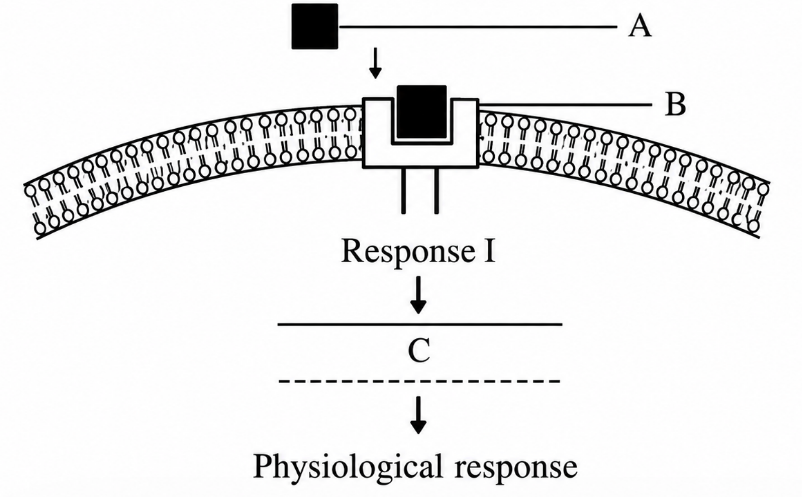
Select the correct option from the following:
Select the correct option from the following:
Correct Answer: (c)
Diagram illustrates protein hormone action where A is a peptide/protein hormone (like FSH), B is the cell-membrane Receptor, and C is the second messenger (like cAMP or Ca²⁺).
Diagram illustrates protein hormone action where A is a peptide/protein hormone (like FSH), B is the cell-membrane Receptor, and C is the second messenger (like cAMP or Ca²⁺).
Q69. The technique used for estimation of minute amounts of hormones and drugs is called
Correct Answer: (d)
Radioimmunoassay (RIA) is an extremely sensitive microanalytical in vitro assay technique used to measure micro-quantities of hormones and substances.
Radioimmunoassay (RIA) is an extremely sensitive microanalytical in vitro assay technique used to measure micro-quantities of hormones and substances.
Q70. Nicotine acts as a stimulant, because it mimics the effect of
Correct Answer: (b)
Nicotine binds specifically to nicotinic acetylcholine receptors (nAChRs), mimicking acetylcholine's action at autonomic ganglia and brain synapses.
Nicotine binds specifically to nicotinic acetylcholine receptors (nAChRs), mimicking acetylcholine's action at autonomic ganglia and brain synapses.
Q71. The most important component of the oral contraceptive pill is
Correct Answer: (d)
Progesterone (alone or in combination with estrogen) is the essential component that inhibits gonadotropin surges and prevents ovulation.
Progesterone (alone or in combination with estrogen) is the essential component that inhibits gonadotropin surges and prevents ovulation.
Q72. Occurrence of Leydig's cells and their secretion is
Correct Answer: (d)
Leydig cells are located in inter-tubular spaces of testes and secrete testosterone.
Leydig cells are located in inter-tubular spaces of testes and secrete testosterone.
Q73. How does steroid hormone influence the cellular activities?
Correct Answer: (b)
Lipid-soluble steroid hormones pass through cell membranes, bind to intracellular receptors, and interact directly with nuclear DNA (gene response elements) to regulate gene expression.
Lipid-soluble steroid hormones pass through cell membranes, bind to intracellular receptors, and interact directly with nuclear DNA (gene response elements) to regulate gene expression.
Q74. GnRH, a hypothalamic hormone, needed in reproduction, acts on:
Correct Answer: (a)
Gonadotropin Releasing Hormone (GnRH) from the hypothalamus acts on the adenohypophysis (anterior pituitary) to stimulate synthesis and secretion of gonadotropins (LH and FSH).
Gonadotropin Releasing Hormone (GnRH) from the hypothalamus acts on the adenohypophysis (anterior pituitary) to stimulate synthesis and secretion of gonadotropins (LH and FSH).
Q75. Which one of the following pairs is incorrectly matched?
Correct Answer: (a)
Glucagon is produced and secreted by Alpha cells (α-cells) of the islets of Langerhans, whereas Beta cells (β-cells) produce insulin.
Glucagon is produced and secreted by Alpha cells (α-cells) of the islets of Langerhans, whereas Beta cells (β-cells) produce insulin.
Q76. According to the accepted concept of hormone action, if receptor molecules are removed from target organs, then the target organ will
Correct Answer: (a)
Hormone action depends strictly on high-affinity binding to specific receptor molecules. Absence of target receptors renders the target organ non-responsive.
Hormone action depends strictly on high-affinity binding to specific receptor molecules. Absence of target receptors renders the target organ non-responsive.
Q77. A candidate vaccine for male contraception is based on
Correct Answer: (c)
Exogenous testosterone administration exerts negative feedback on pituitary LH and FSH release, inhibiting endogeneous spermatogenesis.
Exogenous testosterone administration exerts negative feedback on pituitary LH and FSH release, inhibiting endogeneous spermatogenesis.
Q78. Function of enterogastrone is
Correct Answer: (c)
Enterogastrone (duodenal peptide hormone) inhibits gastric motility and gastric acid secretion.
Enterogastrone (duodenal peptide hormone) inhibits gastric motility and gastric acid secretion.
Q79. Which of the following endocrine gland stores its secretion in the extracellular space before discharging it into the blood?
Correct Answer: (d)
Thyroid gland stores precursor hormone (thyroglobulin colloid) extracellularly within closed spherical thyroid follicles before release.
Thyroid gland stores precursor hormone (thyroglobulin colloid) extracellularly within closed spherical thyroid follicles before release.
Q80. A health disorder that results from the deficiency of thyroxine in adults and characterised by (i) a low metabolic rate, (ii) increase in body weight and (iii) tendency to retain water in tissues is:
Correct Answer: (b)
Myxoedema is caused by adult hypothyroidism, presenting with decreased BMR, weight gain, lethargy, and subcutaneous mucopolysaccharide accumulation holding water.
Myxoedema is caused by adult hypothyroidism, presenting with decreased BMR, weight gain, lethargy, and subcutaneous mucopolysaccharide accumulation holding water.
Q81. Addition of a trace of thyroxine or iodine in water containing tadpoles will
Correct Answer: (b)
Thyroxine containing iodine is essential for amphibian metamorphosis; adding it accelerates tadpole transformation into adult frogs.
Thyroxine containing iodine is essential for amphibian metamorphosis; adding it accelerates tadpole transformation into adult frogs.
Q82. Given below is an incomplete table about certain hormones, their source glands and one major effect of each on the body in humans. Identify the correct option for the three blanks A, B and C.
| Source gland | Hormone | Function |
|---|---|---|
| A | Oestrogen | Maintenance of secondary sexual characters |
| Alpha cells of islets of Langerhans | B | Raises blood sugar level |
| Anterior pituitary | C | Over secretion leads to gigantism |
Correct Answer: (a)
A is Ovary (secretes estrogen), B is Glucagon (secreted by alpha cells to raise blood sugar), and C is Growth hormone (oversecretion leads to gigantism).
A is Ovary (secretes estrogen), B is Glucagon (secreted by alpha cells to raise blood sugar), and C is Growth hormone (oversecretion leads to gigantism).
Q83. Match the following hormones with the respective disease:
| Hormone | Disease |
|---|---|
| (a) Insulin | (i) Addison's disease |
| (b) Thyroxine | (ii) Diabetes insipidus |
| (c) Corticoids | (iii) Acromegaly |
| (d) Growth hormone | (iv) Goitre |
| (v) Diabetes mellitus |
Correct Answer: (c)
Insulin deficiency causes Diabetes mellitus; Thyroxine deficiency leads to Goitre; Corticoids deficiency causes Addison's disease; Hypersecretion of Growth hormone in adults leads to Acromegaly.
Insulin deficiency causes Diabetes mellitus; Thyroxine deficiency leads to Goitre; Corticoids deficiency causes Addison's disease; Hypersecretion of Growth hormone in adults leads to Acromegaly.
Q84. The mammalian corpus luteum produces
Correct Answer: (b)
Corpus luteum primarily secretes progesterone to maintain the uterine mucosal lining for implantation and pregnancy.
Corpus luteum primarily secretes progesterone to maintain the uterine mucosal lining for implantation and pregnancy.
Q85. Mast cells of connective tissue contain
Correct Answer: (b)
Mast cell secretory granules release histamine (vasodilator involved in allergy) and heparin (anticoagulant).
Mast cell secretory granules release histamine (vasodilator involved in allergy) and heparin (anticoagulant).
Q86. Ovulation is stimulated by
Correct Answer: (a)
A sudden mid-cycle surge in Luteinizing Hormone (LH) induces rupture of mature Graafian follicle and releases the ovum.
A sudden mid-cycle surge in Luteinizing Hormone (LH) induces rupture of mature Graafian follicle and releases the ovum.
Q87. Which of the following is an amino acid derived hormone?
Correct Answer: (a)
Epinephrine (adrenaline) is a catecholamine hormone derived from the amino acid tyrosine. Ecdysone, estriol, and estradiol are steroid hormones.
Epinephrine (adrenaline) is a catecholamine hormone derived from the amino acid tyrosine. Ecdysone, estriol, and estradiol are steroid hormones.
Q88. Hormones, thyroxine, adrenaline and the pigment melanin are formed from
Correct Answer: (c)
Tyrosine is an aromatic amino acid precursor required for synthesis of thyroid hormones (T₃, T₄), catecholamines (adrenaline/noradrenaline), and melanin pigment.
Tyrosine is an aromatic amino acid precursor required for synthesis of thyroid hormones (T₃, T₄), catecholamines (adrenaline/noradrenaline), and melanin pigment.
Q89. Oxytocin helps in
Correct Answer: (b)
Oxytocin stimulates vigorous contraction of uterine smooth muscles during labour (childbirth) and induces milk ejection during lactation.
Oxytocin stimulates vigorous contraction of uterine smooth muscles during labour (childbirth) and induces milk ejection during lactation.
Q90. Fight-or-flight reactions cause activation of:
Correct Answer: (c)
Emergency situations trigger the sympathetic nervous system to activate the adrenal medulla, releasing fight-or-flight catecholamines (epinephrine and norepinephrine).
Emergency situations trigger the sympathetic nervous system to activate the adrenal medulla, releasing fight-or-flight catecholamines (epinephrine and norepinephrine).