Q1. Mitochondrial cristae are sites of
Correct Answer: (d)
Cristae contain the Electron Transport Chain, which involves oxidation-reduction reactions.
Cristae contain the Electron Transport Chain, which involves oxidation-reduction reactions.
Q2. In chloroplasts, chlorophyll is present in the
Correct Answer: (c)
Chlorophyll pigments are located in the thylakoid membranes.
Chlorophyll pigments are located in the thylakoid membranes.
Q3. Cellular organelles with membranes are :
Correct Answer: (c)
Lysosomes, Golgi, and Mitochondria have membranes. Ribosomes and Chromosomes (as distinct organelles) do not have membranes.
Lysosomes, Golgi, and Mitochondria have membranes. Ribosomes and Chromosomes (as distinct organelles) do not have membranes.
Q4. Which one of the following is not considered as a part of the endomembrane system ?
Correct Answer: (b)
Endomembrane system includes ER, Golgi, Lysosomes, and Vacuoles. Peroxisomes are distinct.
Endomembrane system includes ER, Golgi, Lysosomes, and Vacuoles. Peroxisomes are distinct.
Q5. Microtubules absent in
Correct Answer: (a)
Mitochondria do not contain microtubules. Centrioles, flagella, and spindle fibers are made of microtubules.
Mitochondria do not contain microtubules. Centrioles, flagella, and spindle fibers are made of microtubules.
Q6. Polyribosomes are aggregates of
Correct Answer: (d)
Polyribosomes (polysomes) are multiple ribosomes translating a single mRNA strand.
Polyribosomes (polysomes) are multiple ribosomes translating a single mRNA strand.
Q7. Select the wrong statement from the following
Correct Answer: (a)
Mitochondria do not have thylakoids; thylakoids are specific to chloroplasts.
Mitochondria do not have thylakoids; thylakoids are specific to chloroplasts.
Q8. Which of the following type of plastids does not contain stored food material?
Correct Answer: (b)
Chromoplasts contain pigments (carotenoids) for color and do not store food. Amyloplasts store starch, Elaioplasts store oil, Aleuroplasts store protein.
Chromoplasts contain pigments (carotenoids) for color and do not store food. Amyloplasts store starch, Elaioplasts store oil, Aleuroplasts store protein.
Q9. Keeping in view the fluid mosaic model for the structure of cell membrane, which one of the following statements is correct with respect to the movement of lipids and proteins from one lipid monolayer to the other (described as flipflop movement)?
Correct Answer: (b)
Lipids can occasionally flip-flop (move from one leaflet to another), but proteins are too large and polar to do so.
Lipids can occasionally flip-flop (move from one leaflet to another), but proteins are too large and polar to do so.
Q10. Cell wall is absent in :
Correct Answer: (b)
Mycoplasma are wall-less prokaryotes.
Mycoplasma are wall-less prokaryotes.
Q11. Ribosomes were discovered by
Correct Answer: (d)
George Palade discovered ribosomes.
George Palade discovered ribosomes.
Q12. Protein synthesis in an animal cell occurs
Correct Answer: (d)
Protein synthesis occurs on ribosomes in the cytoplasm (free and ER-bound) and also in mitochondria (which have their own ribosomes).
Protein synthesis occurs on ribosomes in the cytoplasm (free and ER-bound) and also in mitochondria (which have their own ribosomes).
Q13. According of fluid mosaic model, plasma membrane is composed of
Correct Answer: (d)
The model includes a phospholipid bilayer with both intrinsic (integral) and extrinsic (peripheral) proteins.
The model includes a phospholipid bilayer with both intrinsic (integral) and extrinsic (peripheral) proteins.
Q14. Which one of the following structures between two adjacent cells is an effective transport pathway?
Correct Answer: (a)
Plasmodesmata are channels traversing the cell walls of plant cells and some algal cells, enabling transport and communication between them.
Plasmodesmata are channels traversing the cell walls of plant cells and some algal cells, enabling transport and communication between them.
Q15. Why is a capsule advantageous to a bacterium?
Correct Answer: (d)
The capsule protects bacteria from phagocytosis by the host's immune cells.
The capsule protects bacteria from phagocytosis by the host's immune cells.
Q16. Match the columns and identify the correct option.
| Column-I | Column-II |
|---|---|
| (1) Thylakoids | (i) Disc-shaped sacs in Golgi apparatus |
| (2) Cristae | (ii) Condensed structure of DNA |
| (3) Cisternae | (iii) Flat membranous sacs in stroma |
| (4) Chromatin | (iv) Infoldings in mitochondria |
Correct Answer: (a)
Thylakoids are in stroma (iii). Cristae are mitochondrial infoldings (iv). Cisternae are in Golgi (i). Chromatin is condensed DNA (ii).
Thylakoids are in stroma (iii). Cristae are mitochondrial infoldings (iv). Cisternae are in Golgi (i). Chromatin is condensed DNA (ii).
Q17. Which of the following statements about inclusion bodies is incorrect?
Correct Answer: (a)
Inclusion bodies are non-membranous storage granules (e.g., glycogen, phosphate) and are not involved in ingestion of food.
Inclusion bodies are non-membranous storage granules (e.g., glycogen, phosphate) and are not involved in ingestion of food.
Q18. Hammerling’s experiments of Acetabularia involved exchanging
Correct Answer: (c)
He grafted stalks/rhizoids of different species to show the nucleus determines cap shape.
He grafted stalks/rhizoids of different species to show the nucleus determines cap shape.
Q19. Mitotic spindle is mainly composed of which protein?
Correct Answer: (c)
Spindle fibers are microtubules, which are polymers of tubulin protein.
Spindle fibers are microtubules, which are polymers of tubulin protein.
Q20. The main organelle involved in modification and routing of newly synthesized proteins to their destinations is
Correct Answer: (d)
The Endoplasmic Reticulum (and Golgi) is involved in modification and routing. Given the options and the key (d), ER is the intended answer for routing newly synthesized proteins (signal hypothesis).
The Endoplasmic Reticulum (and Golgi) is involved in modification and routing. Given the options and the key (d), ER is the intended answer for routing newly synthesized proteins (signal hypothesis).
Q21. Which of the following nucleic acids is present in an organism having 70S ribosomes only?
Correct Answer: (c)
Organisms with 70S ribosomes only are prokaryotes. They have double-stranded circular DNA that is not associated with histones (naked) and is not enclosed in a nuclear membrane.
Organisms with 70S ribosomes only are prokaryotes. They have double-stranded circular DNA that is not associated with histones (naked) and is not enclosed in a nuclear membrane.
Q22. Vacuole in a plant cell
Correct Answer: (b)
The plant vacuole is bound by a single membrane (tonoplast) and contains water, sap, excretory products, and other materials.
The plant vacuole is bound by a single membrane (tonoplast) and contains water, sap, excretory products, and other materials.
Q23. Stroma in the chloroplasts of higher plant contains:
Correct Answer: (d)
Stroma contains enzymes for the dark reaction (light-independent reaction), such as Rubisco.
Stroma contains enzymes for the dark reaction (light-independent reaction), such as Rubisco.
Q24. Which one of the following cell organelles is enclosed by a single membrane ?
Correct Answer: (c)
Lysosomes are single-membrane bound. Mitochondria, Chloroplasts, and Nuclei are double-membrane bound.
Lysosomes are single-membrane bound. Mitochondria, Chloroplasts, and Nuclei are double-membrane bound.
Q25. Cell recognition and adhesion occur due to biochemicals of cell membranes named
Correct Answer: (d)
Glycoproteins and glycolipids on the cell surface are key for recognition and adhesion.
Glycoproteins and glycolipids on the cell surface are key for recognition and adhesion.
Q26. In mitochondria, proteins accumulate in the
Correct Answer: (b)
Note: The question in the PDF says 'proteins', but the standard PYQ refers to 'protons' accumulating in the intermembrane space (c). However, according to the PDF's answer key, the answer is (b), which corresponds to the inner membrane. Electron transport chain proteins are accumulated in the inner membrane.
Note: The question in the PDF says 'proteins', but the standard PYQ refers to 'protons' accumulating in the intermembrane space (c). However, according to the PDF's answer key, the answer is (b), which corresponds to the inner membrane. Electron transport chain proteins are accumulated in the inner membrane.
Q27. Centromere is required for:
Correct Answer: (a)
The centromere is the attachment site for spindle fibers (via kinetochore), essential for chromosome movement during division.
The centromere is the attachment site for spindle fibers (via kinetochore), essential for chromosome movement during division.
Q28. Which one of the following structures is an organelle within an organelle?
Correct Answer: (a)
Ribosomes are found inside other organelles like mitochondria and chloroplasts.
Ribosomes are found inside other organelles like mitochondria and chloroplasts.
Q29. Cellulose is the major component of cell walls of
Correct Answer: (a)
Pythium is an Oomycete, which has cell walls made of cellulose. Bacteria have peptidoglycan; yeast has chitin.
Pythium is an Oomycete, which has cell walls made of cellulose. Bacteria have peptidoglycan; yeast has chitin.
Q30. The main arena of various types of activities of a cell is:
Correct Answer: (c)
Cytoplasm is the main arena for cellular activities.
Cytoplasm is the main arena for cellular activities.
Q31. Names of Schleiden and Schwann are associated with
Correct Answer: (b)
Schleiden and Schwann formulated the Cell Theory.
Schleiden and Schwann formulated the Cell Theory.
Q32. Which one of the following is not a constituent of cell membrane?
Correct Answer: (b)
Proline is an amino acid. While proteins are part of the membrane, free proline is not a structural constituent like phospholipids, glycolipids, or cholesterol.
Proline is an amino acid. While proteins are part of the membrane, free proline is not a structural constituent like phospholipids, glycolipids, or cholesterol.
Q33. Organelles can be separated from cell homogenate through
Correct Answer: (c)
Differential centrifugation is used to separate cell organelles based on their size and density.
Differential centrifugation is used to separate cell organelles based on their size and density.
Q34. Element necessary for middle lamella is
Correct Answer: (a)
Calcium (as calcium pectate) is the main component of the middle lamella.
Calcium (as calcium pectate) is the main component of the middle lamella.
Q35. Electron microscope has a high resolution power. This is due to
Correct Answer: (b)
The wavelength of the electron beam is much shorter than visible light, allowing for higher resolution.
The wavelength of the electron beam is much shorter than visible light, allowing for higher resolution.
Q36. Important site for formation of glycoproteins and glycolipids is
Correct Answer: (b)
Golgi apparatus performs glycosylation.
Golgi apparatus performs glycosylation.
Q37. The figure below shows the structure of a mitochondrion with its four parts labelled (A), (B), (C) and (D). Select the part correctly matched with its function.
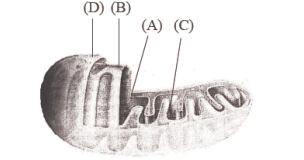
Correct Answer: (b)
Part (B) points to the inner membrane which infolds to form cristae. DNA is in the matrix, and respiratory chain enzymes are on the inner membrane.
Part (B) points to the inner membrane which infolds to form cristae. DNA is in the matrix, and respiratory chain enzymes are on the inner membrane.
Q38. Which of the following occurs more than one and less than five in a chromosome?
Correct Answer: (d)
A typical chromosome has two telomeres (one at each end), or four after replication. This fits 'more than one and less than five'.
A typical chromosome has two telomeres (one at each end), or four after replication. This fits 'more than one and less than five'.
Q39. Resolution power is the ability to
Correct Answer: (b)
Resolution is the ability to distinguish two closely spaced objects as separate entities.
Resolution is the ability to distinguish two closely spaced objects as separate entities.
Q40. Nuclear membrane is absent in
Correct Answer: (d)
Nostoc is a cyanobacterium (prokaryote) and lacks a nuclear membrane.
Nostoc is a cyanobacterium (prokaryote) and lacks a nuclear membrane.
Q41. The term ‘glycocalyx’ is used for
Correct Answer: (a)
Glycocalyx is the outermost mucilage layer of the cell envelope in bacteria, surrounding the cell wall.
Glycocalyx is the outermost mucilage layer of the cell envelope in bacteria, surrounding the cell wall.
Q42. Addition of new cell wall particles amongst the existing ones is
Correct Answer: (c)
Growth by intussusception involves adding new material within the existing wall.
Growth by intussusception involves adding new material within the existing wall.
Q43. Balbiani rings are sites of :
Correct Answer: (c)
Balbiani rings (puffs) on polytene chromosomes are sites of active transcription (RNA synthesis) and subsequent protein synthesis.
Balbiani rings (puffs) on polytene chromosomes are sites of active transcription (RNA synthesis) and subsequent protein synthesis.
Q44. A student wishes to study the cell structure under a light microscope having 10X eyepiece and 45X objective. He should illuminate the object by which one of the following colours of light so as to get the best possible resolution?
Correct Answer: (a)
Resolution is inversely proportional to the wavelength of light used. Blue light has the shortest wavelength in the visible spectrum, thus providing the best resolution.
Resolution is inversely proportional to the wavelength of light used. Blue light has the shortest wavelength in the visible spectrum, thus providing the best resolution.
Q45. In plant cells, peroxisomes are associated with
Correct Answer: (a)
Peroxisomes interact with chloroplasts and mitochondria in the photorespiration pathway.
Peroxisomes interact with chloroplasts and mitochondria in the photorespiration pathway.
Q46. Mitochondria and chloroplast are
(a) semi-autonomous organelles
(b) formed by division of pre-existing organelles and they contain DNA but lack protein synthesizing machinery.
Which one of the following options is correct?
(a) semi-autonomous organelles
(b) formed by division of pre-existing organelles and they contain DNA but lack protein synthesizing machinery.
Which one of the following options is correct?
Correct Answer: (c)
Mitochondria and chloroplasts are semi-autonomous (a is true). However, they contain both DNA and protein synthesizing machinery (ribosomes), so (b) is false.
Mitochondria and chloroplasts are semi-autonomous (a is true). However, they contain both DNA and protein synthesizing machinery (ribosomes), so (b) is false.
Q47. Which one of the following is not an inclusion body found in prokaryotes ?
Correct Answer: (c)
Polysome is a complex of mRNA and ribosomes, not an inclusion body (storage granule).
Polysome is a complex of mRNA and ribosomes, not an inclusion body (storage granule).
Q48. Ribosomes are produced in
Correct Answer: (a)
The nucleolus is the site of ribosome subunit assembly.
The nucleolus is the site of ribosome subunit assembly.
Q49. Inner membrane convolutions of a mito-chondrion are known as
Correct Answer: (d)
Infoldings of the inner mitochondrial membrane are called cristae.
Infoldings of the inner mitochondrial membrane are called cristae.
Q50. Which of the following organ has single membrane?
Correct Answer: (d)
Spherosomes are single-membrane bound organelles involved in lipid storage/synthesis. Nucleus and Mitochondria are double-membrane bound.
Spherosomes are single-membrane bound organelles involved in lipid storage/synthesis. Nucleus and Mitochondria are double-membrane bound.
Q51. A major site for synthesis of lipids is :
Correct Answer: (a)
Smooth Endoplasmic Reticulum (SER) is the major site for lipid synthesis.
Smooth Endoplasmic Reticulum (SER) is the major site for lipid synthesis.
Q52. Identify the correct order of organisation of genetic material from largest to smallest :
Correct Answer: (b)
Genome contains chromosomes, chromosomes contain genes, and genes are made of nucleotides.
Genome contains chromosomes, chromosomes contain genes, and genes are made of nucleotides.
Q53. Which of the following cell organelles is present in the highest number in secretory cells?
Correct Answer: (c)
Secretory cells require extensive Golgi complexes for packaging and secretion of materials.
Secretory cells require extensive Golgi complexes for packaging and secretion of materials.
Q54. The plasma membrane consists mainly of:
Correct Answer: (b)
The plasma membrane is a phospholipid bilayer with embedded proteins (fluid mosaic model).
The plasma membrane is a phospholipid bilayer with embedded proteins (fluid mosaic model).
Q55. A protoplast is a cell :
Correct Answer: (c)
A protoplast is a plant, bacterial or fungal cell that had its cell wall completely or partially removed using either mechanical or enzymatic means.
A protoplast is a plant, bacterial or fungal cell that had its cell wall completely or partially removed using either mechanical or enzymatic means.
Q56. Membranous bag with hydrolytic enzymes which is used for controlling intracellular digestion of macro -molecules is
Correct Answer: (c)
Lysosomes contain hydrolytic enzymes for digestion.
Lysosomes contain hydrolytic enzymes for digestion.
Q57. The cell organelle involved in glyco-sylation of protein is
Correct Answer: (c)
Initial glycosylation (N-linked) occurs in the Endoplasmic Reticulum. (Golgi does O-linked).
Initial glycosylation (N-linked) occurs in the Endoplasmic Reticulum. (Golgi does O-linked).
Q58. Which one of the following does not differ in E.coli and Chlamydomonas?
Correct Answer: (d)
The basic structure of the cell membrane (fluid mosaic model) is similar in both prokaryotes (E. coli) and eukaryotes (Chlamydomonas). Ribosomes (70S vs 80S), Chromosomes, and Cell wall composition differ.
The basic structure of the cell membrane (fluid mosaic model) is similar in both prokaryotes (E. coli) and eukaryotes (Chlamydomonas). Ribosomes (70S vs 80S), Chromosomes, and Cell wall composition differ.
Q59. Peptide synthesis inside a cell takes place in:
Correct Answer: (d)
Ribosomes are the site of protein (peptide) synthesis.
Ribosomes are the site of protein (peptide) synthesis.
Q60. The function of rough endoplasmic reticulum is
Correct Answer: (c)
RER has ribosomes and is involved in protein synthesis.
RER has ribosomes and is involved in protein synthesis.
Q61. According to widely accepted “fluid mosaic model” cell membranes are semi-fluid, where lipids and integral proteins can diffuse randomly. In recent years, this model has been modified in several respects. In this regard, which of the following statements is incorrect?
Correct Answer: (b)
Proteins cannot undergo flip-flop movements across the lipid bilayer.
Proteins cannot undergo flip-flop movements across the lipid bilayer.
Q62. Ribosomal RNA is actively synthesized in
Correct Answer: (b)
The nucleolus is the site of active rRNA synthesis.
The nucleolus is the site of active rRNA synthesis.
Q63. Flagella of prokaryotic and eukaryotic cells differ in
Correct Answer: (c)
Eukaryotic flagella have a 9+2 microtubule arrangement and tubulin, while prokaryotic flagella are made of flagellin and lack this arrangement. Their movement mechanisms also differ.
Eukaryotic flagella have a 9+2 microtubule arrangement and tubulin, while prokaryotic flagella are made of flagellin and lack this arrangement. Their movement mechanisms also differ.
Q64. Nuclear envelope is a derivative of :
Correct Answer: (c)
The nuclear envelope is derived from the Rough Endoplasmic Reticulum and is continuous with it.
The nuclear envelope is derived from the Rough Endoplasmic Reticulum and is continuous with it.
Q65. Which of the following statement regarding mitochondrial membrane is not correct ?
Correct Answer: (a)
Enzymes of the electron transport chain are embedded in the inner mitochondrial membrane, not the outer.
Enzymes of the electron transport chain are embedded in the inner mitochondrial membrane, not the outer.
Q66. Oxysomes of F0 – F1 particles occur on
Correct Answer: (c)
F0-F1 particles (ATP synthase) are located on the inner mitochondrial membrane (cristae).
F0-F1 particles (ATP synthase) are located on the inner mitochondrial membrane (cristae).
Q67. Select the alternative giving correct identification and function of the organelle ‘A’ in the diagram
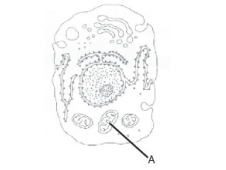
Correct Answer: (b)
The diagram represents a mitochondrion, which produces ATP.
The diagram represents a mitochondrion, which produces ATP.
Q68. All plastids have similar structure because they can
Correct Answer: (b)
Plastids (chloroplasts, chromoplasts, leucoplasts) are interconvertible.
Plastids (chloroplasts, chromoplasts, leucoplasts) are interconvertible.
Q69. Fluid mosaic model of cell membrane was put forward by
Correct Answer: (b)
Singer and Nicolson proposed the Fluid Mosaic Model in 1972.
Singer and Nicolson proposed the Fluid Mosaic Model in 1972.
Q70. Match the following and select the correct answer:
| (1) Centriole | (i) Infoldings in mitochondria |
| (2) Chlorophyll | (ii) Thylakoids |
| (3) Cristae | (iii) Nucleic acids |
| (4) Ribozymes | (iv) Basal body cilia or flagella |
Correct Answer: (a)
Centriole forms basal body (iv). Chlorophyll is in Thylakoids (ii). Cristae are mitochondrial infoldings (i). Ribozymes are RNA (Nucleic acids) (iii).
Centriole forms basal body (iv). Chlorophyll is in Thylakoids (ii). Cristae are mitochondrial infoldings (i). Ribozymes are RNA (Nucleic acids) (iii).
Q71. Which structures perform the function of mitochondria in bacteria?
Correct Answer: (d)
Mesosomes are infoldings of the plasma membrane in bacteria that contain respiratory enzymes, analogous to mitochondria.
Mesosomes are infoldings of the plasma membrane in bacteria that contain respiratory enzymes, analogous to mitochondria.
Q72. Acetabularia used in Hammerling’s nucleocytoplasmic experiments is
Correct Answer: (c)
Acetabularia is a giant unicellular, uninucleate green alga.
Acetabularia is a giant unicellular, uninucleate green alga.
Q73. Golgi apparatus is absent in
Correct Answer: (c)
Prokaryotes (bacteria and BGA) lack membrane-bound organelles like the Golgi apparatus.
Prokaryotes (bacteria and BGA) lack membrane-bound organelles like the Golgi apparatus.
Q74. Which of the following are not membrane-bound?
Correct Answer: (a)
Ribosomes are non-membranous granular structures.
Ribosomes are non-membranous granular structures.
Q75. An outer covering membrane is absent over
Correct Answer: (a)
The nucleolus is a non-membrane bound structure within the nucleus.
The nucleolus is a non-membrane bound structure within the nucleus.
Q76. Plasma membrane is made of
Correct Answer: (c)
Plasma membranes consist mainly of lipids and proteins, with some carbohydrates.
Plasma membranes consist mainly of lipids and proteins, with some carbohydrates.
Q77. What are those structures that appear as beads - on- string in the chromosomes when viewed under electron microscope ?
Correct Answer: (c)
Nucleosomes (DNA wrapped around histone octamers) appear as beads-on-a-string.
Nucleosomes (DNA wrapped around histone octamers) appear as beads-on-a-string.
Q78. Balbiani rings (puffs) are sites of
Correct Answer: (b)
Puffs are sites of high gene expression (transcription/RNA synthesis).
Puffs are sites of high gene expression (transcription/RNA synthesis).
Q79. Middle lamella is composed mainly of:
Correct Answer: (b)
The middle lamella is a layer that cements adjacent plant cells together, primarily made of calcium pectate.
The middle lamella is a layer that cements adjacent plant cells together, primarily made of calcium pectate.
Q80. Nucleoproteins are synthesised in
Correct Answer: (d)
Proteins are synthesized in the cytoplasm and transported into the nucleus to bind with DNA/RNA.
Proteins are synthesized in the cytoplasm and transported into the nucleus to bind with DNA/RNA.
Q81. The solid linear cytoskeletal elements having a diameter of 6 nm and made up of a single type of monomer are known as:
Correct Answer: (b)
Microfilaments are solid, made of actin monomers, and are about 6-7 nm in diameter.
Microfilaments are solid, made of actin monomers, and are about 6-7 nm in diameter.
Q82. Ribosomes are the centre for
Correct Answer: (c)
Ribosomes synthesize proteins.
Ribosomes synthesize proteins.
Q83. Cell wall shows
Correct Answer: (a)
The cell wall is permeable to water and small molecules.
The cell wall is permeable to water and small molecules.
Q84. Angstrom (Å) is equal to
Correct Answer: (c)
1 Å = 10⁻¹⁰ m. 1 µm = 10⁻⁶ m. Therefore, 1 Å = 10⁻⁴ µm = 0.0001 µm.
1 Å = 10⁻¹⁰ m. 1 µm = 10⁻⁶ m. Therefore, 1 Å = 10⁻⁴ µm = 0.0001 µm.
Q85. A major break through in the studies of cells came with the development of electron microscope. This is because
Correct Answer: (d)
The resolving power of an electron microscope is much higher (about 0.1 nm) compared to a light microscope (about 200 nm) due to the short wavelength of the electron beam.
The resolving power of an electron microscope is much higher (about 0.1 nm) compared to a light microscope (about 200 nm) due to the short wavelength of the electron beam.
Q86. Which one of the following organelle in the figure correctly matches with its function ?
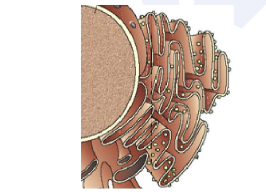
Correct Answer: (b)
The figure shows the Golgi apparatus. Its function is the formation of glycoproteins and glycolipids (glycosylation).
The figure shows the Golgi apparatus. Its function is the formation of glycoproteins and glycolipids (glycosylation).
Q87. Which of the following cell organelles is responsible for extracting energy from carbohydrates to form ATP?
Correct Answer: (c)
Mitochondria are the sites of aerobic respiration and ATP synthesis.
Mitochondria are the sites of aerobic respiration and ATP synthesis.
Q88. What is true about ribosomes?
Correct Answer: (b)
Ribosomes are composed of rRNA and proteins. Prokaryotic ribosomes are 70S. They are found in both prokaryotes and eukaryotes.
Ribosomes are composed of rRNA and proteins. Prokaryotic ribosomes are 70S. They are found in both prokaryotes and eukaryotes.
Q89. The osmotic expansion of a cell kept in water is chiefly regulated by:
Correct Answer: (b)
Vacuoles contribute to turgor pressure and osmotic expansion.
Vacuoles contribute to turgor pressure and osmotic expansion.
Q90. DNA is not present in :
Correct Answer: (a)
Ribosomes contain RNA, not DNA. Nucleus, Mitochondria, and Chloroplasts contain DNA.
Ribosomes contain RNA, not DNA. Nucleus, Mitochondria, and Chloroplasts contain DNA.
Q91. Experiments on Acetabularia by Hammerling proved the role of
Correct Answer: (b)
Hammerling's grafting experiments with Acetabularia demonstrated that the nucleus controls hereditary traits.
Hammerling's grafting experiments with Acetabularia demonstrated that the nucleus controls hereditary traits.
Q92. The proteins are synthesised at
Correct Answer: (a)
Ribosomes are the site of protein synthesis.
Ribosomes are the site of protein synthesis.
Q93. The Golgi complex plays a major role
Correct Answer: (c)
The Golgi complex is involved in post-translational modification (e.g., glycosylation) and packaging of materials.
The Golgi complex is involved in post-translational modification (e.g., glycosylation) and packaging of materials.
Q94. Which is the important site of formation of glycoproteins and glycolipids in eukaryotic cells?
Correct Answer: (b)
The Golgi apparatus is the major site for glycosylation of proteins and lipids to form glycoproteins and glycolipids.
The Golgi apparatus is the major site for glycosylation of proteins and lipids to form glycoproteins and glycolipids.
Q95. Magnification of compound microscope is not connected with
Correct Answer: (a)
Numerical aperture is primarily related to resolution, while magnification depends on the focal lengths of the lenses and the tube length.
Numerical aperture is primarily related to resolution, while magnification depends on the focal lengths of the lenses and the tube length.
Q96. Which of the following statements regarding cilia is not correct ?
Correct Answer: (d)
Ciliary movement is driven by ATP and dynein arms, not directly by Ca2+ fluxes across the membrane in the context of the basic mechanism described.
Ciliary movement is driven by ATP and dynein arms, not directly by Ca2+ fluxes across the membrane in the context of the basic mechanism described.
Q97. Select the correct matching in the following pairs:
Correct Answer: (a)
Smooth Endoplasmic Reticulum is the major site for lipid synthesis.
Smooth Endoplasmic Reticulum is the major site for lipid synthesis.
Q98. Which one is apparato reticolare?
Correct Answer: (a)
Camillo Golgi described the Golgi apparatus as 'apparato reticolare interno'.
Camillo Golgi described the Golgi apparatus as 'apparato reticolare interno'.
Q99. The function of the gap junction is to
Correct Answer: (a)
Gap junctions provide cytoplasmic channels between adjacent cells for transport.
Gap junctions provide cytoplasmic channels between adjacent cells for transport.
Q100. Select the correct statement from the following regarding cell membrane.
Correct Answer: (d)
Singer and Nicolson proposed the Fluid Mosaic Model. Na+/K+ transport is active. Proteins are usually ~50%. Polar heads are outer.
Singer and Nicolson proposed the Fluid Mosaic Model. Na+/K+ transport is active. Proteins are usually ~50%. Polar heads are outer.
Q101. Plasmodesmata are:
Correct Answer: (c)
Plasmodesmata are cytoplasmic connections between adjacent plant cells.
Plasmodesmata are cytoplasmic connections between adjacent plant cells.
Q102. Some of the enzymes,which are associated in converting fats into carbhoydrates, are present in
Correct Answer: (d)
Glyoxysomes contain enzymes for the glyoxylate cycle, which converts fats to carbohydrates in plants.
Glyoxysomes contain enzymes for the glyoxylate cycle, which converts fats to carbohydrates in plants.
Q103. The point, at which polytene chromosomes appears to be attached together, is called
Correct Answer: (d)
In polytene chromosomes, the centromeric regions of all chromosomes fuse to form a chromocentre.
In polytene chromosomes, the centromeric regions of all chromosomes fuse to form a chromocentre.
Q104. In fluid mosaic model of plasma membrane
Correct Answer: (c)
The membrane consists of a phospholipid bilayer with proteins embedded in it or associated with it.
The membrane consists of a phospholipid bilayer with proteins embedded in it or associated with it.
Q105. Which one of the following has its own DNA?
Correct Answer: (a)
Mitochondria (and Chloroplasts) are semi-autonomous and contain their own DNA.
Mitochondria (and Chloroplasts) are semi-autonomous and contain their own DNA.
Q106. Organelle having flattened membrane bound cisternae and lying near the nucleus is
Correct Answer: (a)
The Golgi apparatus consists of flattened cisternae and is often located near the nucleus.
The Golgi apparatus consists of flattened cisternae and is often located near the nucleus.
Q107. The two sub-units of ribosome remain united a critical ion level of
Correct Answer: (c)
Magnesium ions (Mg²⁺) are required for the association of ribosome subunits.
Magnesium ions (Mg²⁺) are required for the association of ribosome subunits.
Q108. The latest model for plasma membrane is
Correct Answer: (c)
The Fluid Mosaic Model is the currently accepted model.
The Fluid Mosaic Model is the currently accepted model.
Q109. Match the column I with column II.
| Column I | Column II |
|---|---|
| (a) Golgi apparatus | (i) Synthesis of protein |
| (b) Lysosomes | (ii) Trap waste and excretory products |
| (c) Vacuoles | (iii) Formation of glycoproteins and glycolipids |
| (d) Ribosomes | (iv) Digesting biomolecules |
Correct Answer: (b)
Golgi apparatus: Formation of glycoproteins (iii). Lysosomes: Digesting biomolecules (iv). Vacuoles: Trap waste (ii). Ribosomes: Synthesis of protein (i).
Golgi apparatus: Formation of glycoproteins (iii). Lysosomes: Digesting biomolecules (iv). Vacuoles: Trap waste (ii). Ribosomes: Synthesis of protein (i).
Q110. Which is correct about cell theory in view of current status of our knowledge about cell structure
Correct Answer: (c)
Viruses are an exception to the cell theory as they lack cellular organization.
Viruses are an exception to the cell theory as they lack cellular organization.
Q111. The prokaryotic flagella possess
Correct Answer: (d)
Prokaryotic flagella are made of the protein flagellin arranged helically and lack the 9+2 microtubule arrangement.
Prokaryotic flagella are made of the protein flagellin arranged helically and lack the 9+2 microtubule arrangement.
Q112. The desmosomes are concerned with
Correct Answer: (c)
Desmosomes are cell junctions that provide adhesion between adjacent cells.
Desmosomes are cell junctions that provide adhesion between adjacent cells.
Q113. A bivalent consists of
Correct Answer: (c)
A bivalent is a pair of homologous chromosomes, each with 2 chromatids, totaling 4 chromatids and 2 centromeres.
A bivalent is a pair of homologous chromosomes, each with 2 chromatids, totaling 4 chromatids and 2 centromeres.
Q114. Microtubules are the constituents of
Correct Answer: (b)
Microtubules form the structure of cilia, flagella, centrioles, and spindle fibres.
Microtubules form the structure of cilia, flagella, centrioles, and spindle fibres.
Q115. Which one of the following cellular parts is correctly described?
Correct Answer: (c)
Thylakoids are flattened sacs in chloroplasts. Lysosomes are acidic. Chloroplast ribosomes are 70S (smaller).
Thylakoids are flattened sacs in chloroplasts. Lysosomes are acidic. Chloroplast ribosomes are 70S (smaller).
Q116. Lysosomes have a high content of
Correct Answer: (a)
Lysosomes contain acid hydrolases (hydrolytic enzymes).
Lysosomes contain acid hydrolases (hydrolytic enzymes).
Q117. In salivary gland chromosomes/polytene chromosomes, pairing is
Correct Answer: (d)
Somatic pairing of homologous chromosomes occurs in polytene chromosomes.
Somatic pairing of homologous chromosomes occurs in polytene chromosomes.
Q118. Genes located on mitochondrial DNA
Correct Answer: (a)
Mitochondria are inherited from the cytoplasm of the egg, thus showing maternal inheritance.
Mitochondria are inherited from the cytoplasm of the egg, thus showing maternal inheritance.
Q119. Cytoskeleton is made up of:
Correct Answer: (c)
Cytoskeleton consists of microtubules, microfilaments, and intermediate filaments, which are proteinaceous.
Cytoskeleton consists of microtubules, microfilaments, and intermediate filaments, which are proteinaceous.