Q1. If you are provided with root-tips of onion in your class and are asked to count the chromosomes, which of the following stages can you most conveniently look into?
Correct Answer: (a)
Metaphase is the best stage to observe the number and morphology of chromosomes as they are most condensed and aligned.
Metaphase is the best stage to observe the number and morphology of chromosomes as they are most condensed and aligned.
Q2. Anaphase Promoting Complex (APC) is a protein degradation machinery necessary for proper mitosis of animal cells. If APC is defective in a human cell, which of the following is expected to occur?
Correct Answer: (b)
APC triggers the transition from metaphase to anaphase by tagging specific proteins for degradation, allowing sister chromatids to separate. If defective, chromosomes will not segregate.
APC triggers the transition from metaphase to anaphase by tagging specific proteins for degradation, allowing sister chromatids to separate. If defective, chromosomes will not segregate.
Q3. Genetic map is one that
Correct Answer: (b)
Genetic map shows the arrangement of genes on a chromosome.
Genetic map shows the arrangement of genes on a chromosome.
Q4. During the metaphase stage of mitosis spindle fibres attach to chromosomes at
Correct Answer: (b)
Spindle fibres attach to kinetochores.
Spindle fibres attach to kinetochores.
Q5. Meiosis is evolutionary significant because it result in
Correct Answer: (d)
Meiosis involves crossing over and independent assortment leading to genetic variations (recombinations), which is significant for evolution.
Meiosis involves crossing over and independent assortment leading to genetic variations (recombinations), which is significant for evolution.
Q6. Which of the following is not a characteristic feature during mitosis in somatic cells ?
Correct Answer: (b)
Synapsis (pairing of homologous chromosomes) occurs in Meiosis (Zygotene), not in Mitosis.
Synapsis (pairing of homologous chromosomes) occurs in Meiosis (Zygotene), not in Mitosis.
Q7. During gamete formation, the enzyme recombinase participates during
Correct Answer: (c)
Prophase I (Pachytene).
Prophase I (Pachytene).
Q8. Synapsis occurs between:
Correct Answer: (c)
Synapsis is the pairing of two homologous chromosomes during Zygotene of Prophase I.
Synapsis is the pairing of two homologous chromosomes during Zygotene of Prophase I.
Q9. During cell division, the spindle fibres attach to the chromosome at a region called
Correct Answer: (b)
Attachment site is kinetochore.
Attachment site is kinetochore.
Q10. Best material for the study of mitosis in laboratory is
Correct Answer: (b)
Onion root tip is the classic material for studying mitosis.
Onion root tip is the classic material for studying mitosis.
Q11. If a diploid cell is treated with colchicine then it becomes
Correct Answer: (b)
Colchicine inhibits spindle formation, preventing sister chromatid separation. The chromosomes replicate but cell doesn't divide, leading to doubling of chromosome number (2n -> 4n, tetraploid).
Colchicine inhibits spindle formation, preventing sister chromatid separation. The chromosomes replicate but cell doesn't divide, leading to doubling of chromosome number (2n -> 4n, tetraploid).
Q12. During meiosis I, the chromosomes start pairing at
Correct Answer: (b)
Pairing (Synapsis) starts at Zygotene.
Pairing (Synapsis) starts at Zygotene.
Q13. In meiosis, the daughter cells differ from parent cell as well as amongst themselves due to
Correct Answer: (a)
Crossing over produces recombination. Segregation and Independent assortment distribute alleles. All contribute to variation. Option (a) lists them.
Crossing over produces recombination. Segregation and Independent assortment distribute alleles. All contribute to variation. Option (a) lists them.
Q14. A stage of mitosis is shown in the diagram. Which stage is it and what are its characteristics?
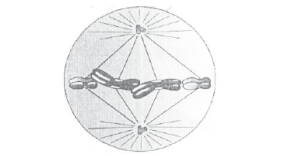
Correct Answer: (c)
The image shows chromosomes aligned at the equator, characteristic of Metaphase. Chromosomes are made of two sister chromatids.
The image shows chromosomes aligned at the equator, characteristic of Metaphase. Chromosomes are made of two sister chromatids.
Q15. After meiosis I, the resultant daughter cells have
Correct Answer: (c)
Parent in S phase has 4C. After Meiosis I, daughter cells have n chromosomes but 2C DNA (each chromosome has 2 chromatids). Haploid gamete has n chromosomes and 1C DNA. So daughter of Meiosis I has 2C, which is twice the gamete's 1C.
Parent in S phase has 4C. After Meiosis I, daughter cells have n chromosomes but 2C DNA (each chromosome has 2 chromatids). Haploid gamete has n chromosomes and 1C DNA. So daughter of Meiosis I has 2C, which is twice the gamete's 1C.
Q16. How many mitotic divisions are needed for a single cell to make 128 cells?
Correct Answer: (a)
2^n = 128. n = 7. So 7 divisions.
2^n = 128. n = 7. So 7 divisions.
Q17. Select the correct option with respect to mitosis.
Correct Answer: (d)
In metaphase, chromosomes align at the equatorial plate. Chromatids separate in anaphase and move to poles. Golgi/ER disappear in prophase.
In metaphase, chromosomes align at the equatorial plate. Chromatids separate in anaphase and move to poles. Golgi/ER disappear in prophase.
Q18. Mitotic anaphase differs from metaphase in possessing
Correct Answer: (d)
In anaphase, centromeres split. Each chromatid becomes a chromosome. So number of chromosomes doubles (temporarily in cell), but comparing specific entities: Metaphase chromosome has 2 chromatids. Anaphase chromosome (daughter) has 1 chromatid. The question phrasing is tricky. 'Differs from metaphase in possessing...'. Anaphase has separated chromatids. If we compare the cell state: Metaphase (46 chr, 92 chromatids). Anaphase (92 chr, 0 chromatids - as they are now chromosomes). Or maybe it refers to the chromosome structure. Metaphase chromosome = 2 chromatids. Anaphase chromosome = 1 chromatid (half number of chromatids). Same number of chromosomes? No. Let's look at option (d). 'Same number of chromosomes and half number of chromatids'. This likely refers to the fact that the 'chromosome' count is maintained in daughter cells relative to parent (conceptually) but physically splitting. Actually, standard logic: Anaphase has half the number of chromatids PER CHROMOSOME compared to Metaphase. Metaphase chr = 2 chromatids. Anaphase chr = 1 chromatid. This fits 'half number of chromatids'. 'Same number of chromosomes' per pole/daughter? Key says (d).
In anaphase, centromeres split. Each chromatid becomes a chromosome. So number of chromosomes doubles (temporarily in cell), but comparing specific entities: Metaphase chromosome has 2 chromatids. Anaphase chromosome (daughter) has 1 chromatid. The question phrasing is tricky. 'Differs from metaphase in possessing...'. Anaphase has separated chromatids. If we compare the cell state: Metaphase (46 chr, 92 chromatids). Anaphase (92 chr, 0 chromatids - as they are now chromosomes). Or maybe it refers to the chromosome structure. Metaphase chromosome = 2 chromatids. Anaphase chromosome = 1 chromatid (half number of chromatids). Same number of chromosomes? No. Let's look at option (d). 'Same number of chromosomes and half number of chromatids'. This likely refers to the fact that the 'chromosome' count is maintained in daughter cells relative to parent (conceptually) but physically splitting. Actually, standard logic: Anaphase has half the number of chromatids PER CHROMOSOME compared to Metaphase. Metaphase chr = 2 chromatids. Anaphase chr = 1 chromatid. This fits 'half number of chromatids'. 'Same number of chromosomes' per pole/daughter? Key says (d).
Q19. Microtubule is involved in the
Correct Answer: (a)
Microtubules form the spindle fibers essential for cell division.
Microtubules form the spindle fibers essential for cell division.
Q20. In meiosis crossing over is initiated at
Correct Answer: (a)
Crossing over initiates at Pachytene.
Crossing over initiates at Pachytene.
Q21. A stage in cell division is shown in the figure. Select the answer which gives correct identification of the stage with its characteristics.
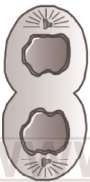
Correct Answer: (d)
The figure shows Telophase where nuclear envelope reforms around chromosome clusters at opposite poles. Nucleolus, golgi complex and ER reform.
The figure shows Telophase where nuclear envelope reforms around chromosome clusters at opposite poles. Nucleolus, golgi complex and ER reform.
Q22. Which one of the following structures will not be common to mitotic cells of higher plants?
Correct Answer: (b)
Centrioles are absent in higher plants (angiosperms).
Centrioles are absent in higher plants (angiosperms).
Q23. In ‘S’ phase of the cell cycle:
Correct Answer: (a)
During S phase or synthetic phase, replication or synthesis of DNA takes place. Amount of DNA per cell doubles.
During S phase or synthetic phase, replication or synthesis of DNA takes place. Amount of DNA per cell doubles.
Q24. During which phase(s) of cell cycle, amount of DNA in a cell remains at 4C level if the initial amount is denoted as 2C?
Correct Answer: (c)
DNA replication occurs in S phase (2C to 4C). So in G2 phase, DNA content is 4C. In M phase, it remains 4C until cytokinesis (or anaphase separation). However, strictly 'remains at 4C' often points to G2. Between options, 'Only G2' is a specific phase where replication is complete. 'G2 and M' is also correct until division completes. Given options, Only G2 is the best fit as M phase ends with reduction back to 2C.
DNA replication occurs in S phase (2C to 4C). So in G2 phase, DNA content is 4C. In M phase, it remains 4C until cytokinesis (or anaphase separation). However, strictly 'remains at 4C' often points to G2. Between options, 'Only G2' is a specific phase where replication is complete. 'G2 and M' is also correct until division completes. Given options, Only G2 is the best fit as M phase ends with reduction back to 2C.
Q25. Match the following with respect to meiosis
| (a) Zygotene | (i) Terminalization |
| (b) Pachytene | (ii) Chiasmata |
| (c) Diplotene | (iii) Crossing over |
| (d) Diakinesis | (iv) Synapsis |
Correct Answer: (a)
Same as Q15.
Same as Q15.
Q26. A somatic cell that has just completed the S phase of its cell cycle, as compared to gamete of the same species, has :
Correct Answer: (b)
Gamete has n chromosomes and 1C DNA. Somatic cell after S phase has 2n chromosomes (same as before S phase) and 4C DNA (doubled from 2C). Comparing to gamete: Chromosomes = 2n (twice of n). DNA = 4C (four times of 1C).
Gamete has n chromosomes and 1C DNA. Somatic cell after S phase has 2n chromosomes (same as before S phase) and 4C DNA (doubled from 2C). Comparing to gamete: Chromosomes = 2n (twice of n). DNA = 4C (four times of 1C).
Q27. Crossing over takes place between which chromatids and in which stage of the cell cycle?
Correct Answer: (c)
Crossing over occurs between non-sister chromatids of homologous chromosomes during Pachytene.
Crossing over occurs between non-sister chromatids of homologous chromosomes during Pachytene.
Q28. Colchicine is employed to diploidize a haploid cell as it
Correct Answer: (b)
Colchicine prevents polymerization of microtubules, thus inhibiting spindle formation.
Colchicine prevents polymerization of microtubules, thus inhibiting spindle formation.
Q29. Which of the following options gives the correct sequence of events during mitosis?
Correct Answer: (a)
Correct sequence: Prophase (Condensation, Nuclear membrane disassembly) -> Metaphase (Arrangement at equator) -> Anaphase (Centromere division, Segregation) -> Telophase.
Correct sequence: Prophase (Condensation, Nuclear membrane disassembly) -> Metaphase (Arrangement at equator) -> Anaphase (Centromere division, Segregation) -> Telophase.
Q30. Identify the meiotic stage in which the homologous chromosomes separate while the sister chromatids remain associated at their centromeres?
Correct Answer: (c)
In Anaphase I, homologous chromosomes separate, but sister chromatids remain attached.
In Anaphase I, homologous chromosomes separate, but sister chromatids remain attached.
Q31. Which stages of cell division do the following figures A and B represent respectively?
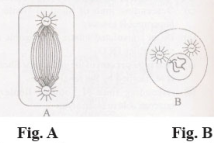
Correct Answer: (c)
Fig A shows chromatids moving to poles (Late Anaphase). Fig B shows chromatin condensing (Prophase).
Fig A shows chromatids moving to poles (Late Anaphase). Fig B shows chromatin condensing (Prophase).
Q32. Match the following with respect to meiosis
| (A) Zygotene | (i) Terminalization |
| (B) Pachytene | (ii) Chiasmata |
| (C) Diplotene | (iii) Crossing over |
| (D) Diakinesis | (iv) Synapsis |
Correct Answer: (a)
Zygotene: Synapsis (iv). Pachytene: Crossing over (iii). Diplotene: Chiasmata (ii). Diakinesis: Terminalization (i).
Zygotene: Synapsis (iv). Pachytene: Crossing over (iii). Diplotene: Chiasmata (ii). Diakinesis: Terminalization (i).
Q33. Which one of the following precedes reformation of the nuclear envelope during M phase of the cell cycle
Correct Answer: (a)
In telophase, chromosomes decondense and nuclear envelope reforms. Decondensation precedes full envelope reformation.
In telophase, chromosomes decondense and nuclear envelope reforms. Decondensation precedes full envelope reformation.
Q34. Some dividing cells exit the cell cycle and enter vegetative inactive stage. This is called quiescent stage (G0). This process occurs at the end of
Correct Answer: (a)
Some cells that do not divide further exit G1 phase to enter an inactive stage called quiescent stage (G0) of the cell cycle.
Some cells that do not divide further exit G1 phase to enter an inactive stage called quiescent stage (G0) of the cell cycle.
Q35. In cell cycle, DNA replication takes place in
Correct Answer: (d)
DNA replication occurs in S phase.
DNA replication occurs in S phase.
Q36. Given below is a schematic break-up of the phases / stages of cell cycle:
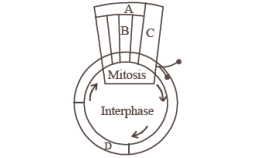
Which one of the following is the correct indication of the stage/phase in the cell cycle?
Which one of the following is the correct indication of the stage/phase in the cell cycle?
Correct Answer: (b)
In the diagram, A is Mitosis (M phase), specifically Karyokinesis? No, A is usually M phase. Interphase consists of G1, S, G2. D represents S phase (Synthetic phase) which comes after G1 (C) and before G2 (E). Wait, diagram usually goes G1->S->G2->M. If D is S-phase, then C is G1, E is G2. B is part of M phase. The question asks for correct indication. D - Synthetic phase is correct.
In the diagram, A is Mitosis (M phase), specifically Karyokinesis? No, A is usually M phase. Interphase consists of G1, S, G2. D represents S phase (Synthetic phase) which comes after G1 (C) and before G2 (E). Wait, diagram usually goes G1->S->G2->M. If D is S-phase, then C is G1, E is G2. B is part of M phase. The question asks for correct indication. D - Synthetic phase is correct.
Q37. At what stage of the cell cycle are histone proteins synthesized in a eukaryotic cell?
Correct Answer: (b)
Histone proteins are synthesized during S-phase of cell cycle to package the newly replicated DNA.
Histone proteins are synthesized during S-phase of cell cycle to package the newly replicated DNA.
Q38. At metaphase, chromosomes are attached to the spindle fibres by their:
Correct Answer: (c)
Spindle fibres attach to kinetochores.
Spindle fibres attach to kinetochores.
Q39. The exchange of genetic material between chromatids of paired homologous chromosomes during first meiotic division is called
Correct Answer: (c)
Exchange of genetic material is Crossing over.
Exchange of genetic material is Crossing over.
Q40. Meiosis II performs
Correct Answer: (d)
Meiosis II is equational division where sister chromatids separate.
Meiosis II is equational division where sister chromatids separate.
Q41. Given below is the representation of a certain event at a particular stage of a type of cell division. Which is this stage?
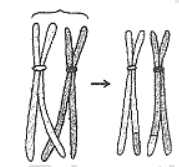
Correct Answer: (a)
The figure shows homologous chromosomes pairing/exchanging parts (crossing over), characteristic of Prophase I of meiosis.
The figure shows homologous chromosomes pairing/exchanging parts (crossing over), characteristic of Prophase I of meiosis.
Q42. Spindle fibres attach on to
Correct Answer: (b)
Spindle fibres attach to the kinetochores, which are disc-shaped structures present on the centromeres.
Spindle fibres attach to the kinetochores, which are disc-shaped structures present on the centromeres.
Q43. The complex formed by a pair of synapsed homologous chromosomes is called
Correct Answer: (b)
The complex formed by a pair of synapsed homologous chromosomes is called a bivalent or tetrad.
The complex formed by a pair of synapsed homologous chromosomes is called a bivalent or tetrad.
Q44. In the somatic cell cycle
Correct Answer: (b)
In somatic cell cycle, DNA replication takes place in S-phase.
In somatic cell cycle, DNA replication takes place in S-phase.
Q45. Lampbrush chromosomes occur during
Correct Answer: (b)
Lampbrush chromosomes are giant chromosomes found in the oocytes of vertebrates (except mammals) and invertebrates during the diplotene stage of meiotic prophase I.
Lampbrush chromosomes are giant chromosomes found in the oocytes of vertebrates (except mammals) and invertebrates during the diplotene stage of meiotic prophase I.
Q46. Meiosis I is reductional division. Meiosis II is equational division due to
Correct Answer: (c)
Meiosis II is equational because it involves separation of sister chromatids, similar to mitosis.
Meiosis II is equational because it involves separation of sister chromatids, similar to mitosis.
Q47. Dissolution of the synaptonemal complex occurs during
Correct Answer: (b)
Dissolution of synaptonemal complex occurs in Diplotene stage of Prophase I.
Dissolution of synaptonemal complex occurs in Diplotene stage of Prophase I.
Q48. The stage during which separation of the paired homologous chromosomes begins is
Correct Answer: (c)
Separation (desynapsis) begins in Diplotene.
Separation (desynapsis) begins in Diplotene.
Q49. A bacterium divides every 35 minutes. If a culture containing 10^5 cells per ml is grown for 175 minutes, what will be the cell concentration per ml after 175 minutes?
Correct Answer: (c)
Total time = 175 mins. Generation time = 35 mins. Number of generations (n) = 175/35 = 5. Final concentration = Initial 2^n = 10^5 2^5 = 32 * 10^5 cells/ml.
Total time = 175 mins. Generation time = 35 mins. Number of generations (n) = 175/35 = 5. Final concentration = Initial 2^n = 10^5 2^5 = 32 * 10^5 cells/ml.
Q50. During mitosis ER and nucleolus begin to disappear at:
Correct Answer: (d)
ER, nucleolus, nuclear envelope begin to disappear during early prophase and completely disappear by late prophase. (Note: Key says 'early prophase' d).
ER, nucleolus, nuclear envelope begin to disappear during early prophase and completely disappear by late prophase. (Note: Key says 'early prophase' d).
Q51. Number of chromatids at metaphase is
Correct Answer: (a)
At metaphase (mitosis and meiosis II), each chromosome consists of two chromatids. In meiosis I metaphase, homologous chromosomes pair, but each chromosome still has 2 chromatids.
At metaphase (mitosis and meiosis II), each chromosome consists of two chromatids. In meiosis I metaphase, homologous chromosomes pair, but each chromosome still has 2 chromatids.
Q52. Segregation of mendelian factor (Aa) occurs during
Correct Answer: (b)
Segregation of alleles (factors) occurs when homologous chromosomes separate in Anaphase I.
Segregation of alleles (factors) occurs when homologous chromosomes separate in Anaphase I.
Q53. During cell division in apical meristem the nuclear membrane appears in
Correct Answer: (c)
Nuclear membrane reforms in Telophase.
Nuclear membrane reforms in Telophase.
Q54. Identify the correct statement with regard to G1 phase (Gap 1) of interphase.
Correct Answer: (b)
During G1 phase the cell is metabolically active and continuously grows but does not replicate its DNA. DNA replication takes place in S phase.
During G1 phase the cell is metabolically active and continuously grows but does not replicate its DNA. DNA replication takes place in S phase.
Q55. Select the correct option :
| Column I | Column II |
|---|---|
| A. Synapsis aligns homologous chromosomes | (i) Anaphase-II |
| B. Synthesis of RNA and protein | (ii) Zygotene |
| C. Action of enzyme recombinase | (iii) G2-phase |
| D. Centromeres do not separate but chromatids move towards opposite poles | (iv) Anaphase-I |
| (v) Pachytene |
Correct Answer: (a)
A-Zygotene, B-G2 phase, C-Pachytene, D-Anaphase I.
A-Zygotene, B-G2 phase, C-Pachytene, D-Anaphase I.
Q56. Best stage to observe shape, size and number of chromosomes is
Correct Answer: (b)
Metaphase.
Metaphase.
Q57. Cells in G0 phase :
Correct Answer: (a)
Cells in G0 phase exit the cell cycle and enter a quiescent stage. They remain metabolically active but do not proliferate unless called on to do so.
Cells in G0 phase exit the cell cycle and enter a quiescent stage. They remain metabolically active but do not proliferate unless called on to do so.
Q58. The enzyme recombinase is required at which stage of meiosis:
Correct Answer: (a)
Recombinase is involved in crossing over during Pachytene.
Recombinase is involved in crossing over during Pachytene.
Q59. The correct sequence of phases of cell cycle is:
Correct Answer: (d)
The correct sequence of phases of cell cycle is G1 -> S -> G2 -> M.
The correct sequence of phases of cell cycle is G1 -> S -> G2 -> M.
Q60. DNA replication in bacteria occurs:
Correct Answer: (b)
In bacteria (prokaryotes), DNA replication occurs prior to fission.
In bacteria (prokaryotes), DNA replication occurs prior to fission.
Q61. Choose the correct option for the following events of meiosis in correct sequence:
(A) Crossing over
(B) Synapsis
(C) Terminalisation of chiasmata
(D) Disappearance of nucleolus
(A) Crossing over
(B) Synapsis
(C) Terminalisation of chiasmata
(D) Disappearance of nucleolus
Correct Answer: (a)
Sequence: Synapsis (Zygotene) -> Crossing over (Pachytene) -> Terminalisation (Diakinesis) -> Disappearance of nucleolus (End of Prophase I).
Sequence: Synapsis (Zygotene) -> Crossing over (Pachytene) -> Terminalisation (Diakinesis) -> Disappearance of nucleolus (End of Prophase I).
Q62. Meiotic division of the secondary oocyte is completed
Correct Answer: (c)
Meiosis II in secondary oocyte is arrested at Metaphase II and completes only after sperm entry (fertilization).
Meiosis II in secondary oocyte is arrested at Metaphase II and completes only after sperm entry (fertilization).