Q1. Carbonic anhydrase occurs in
Correct Answer: (c)
Red Blood Cells (RBCs) contain extremely high concentrations of the enzyme carbonic anhydrase, which catalyzes the reversible reaction CO₂ + H₂O ⇌ H₂CO₃.
Red Blood Cells (RBCs) contain extremely high concentrations of the enzyme carbonic anhydrase, which catalyzes the reversible reaction CO₂ + H₂O ⇌ H₂CO₃.
Q2. The majority of carbon dioxide produced by our body cells is transported to the lungs
Correct Answer: (a)
Around 70% of carbon dioxide is transported in the blood in the form of bicarbonate ions (HCO₃⁻). About 20-25% as carbamino-hemoglobin and 7% in dissolved state in plasma.
Around 70% of carbon dioxide is transported in the blood in the form of bicarbonate ions (HCO₃⁻). About 20-25% as carbamino-hemoglobin and 7% in dissolved state in plasma.
Q3. When CO₂ concentration in blood increases, breathing becomes
Correct Answer: (d)
Increased blood pCO₂ lowers blood pH, stimulating respiratory centers in the brainstem to increase both rate and depth of respiration (faster and deeper) to eliminate excess CO₂.
Increased blood pCO₂ lowers blood pH, stimulating respiratory centers in the brainstem to increase both rate and depth of respiration (faster and deeper) to eliminate excess CO₂.
Q4. The alveolar epithelium in the lungs is
Correct Answer: (b)
The walls of the alveoli are made up of simple non-ciliated squamous epithelium, which is extremely thin (0.2 µm) to facilitate rapid diffusion of oxygen and carbon dioxide.
The walls of the alveoli are made up of simple non-ciliated squamous epithelium, which is extremely thin (0.2 µm) to facilitate rapid diffusion of oxygen and carbon dioxide.
Q5. Air is breathed through
Correct Answer: (c)
The correct anatomical sequence of the human respiratory tract for inhaled air is: External nostrils → Nasal passage → Pharynx → Larynx → Trachea → Primary/Secondary/Tertiary Bronchi → Bronchioles → Alveolar ducts → Alveoli.
The correct anatomical sequence of the human respiratory tract for inhaled air is: External nostrils → Nasal passage → Pharynx → Larynx → Trachea → Primary/Secondary/Tertiary Bronchi → Bronchioles → Alveolar ducts → Alveoli.
Q6. Name the chronic respiratory disorder caused mainly by cigarette smoking
Correct Answer: (a)
Emphysema is a chronic disease in which alveolar walls are progressively damaged, drastically reducing the respiratory surface area available for gas exchange; cigarette smoking is its primary cause.
Emphysema is a chronic disease in which alveolar walls are progressively damaged, drastically reducing the respiratory surface area available for gas exchange; cigarette smoking is its primary cause.
Q7. The figure shows a diagrammatic view of human respiratory system with labels A, B, C and D. Select the option which gives correct identification and main function and/or characteristics.
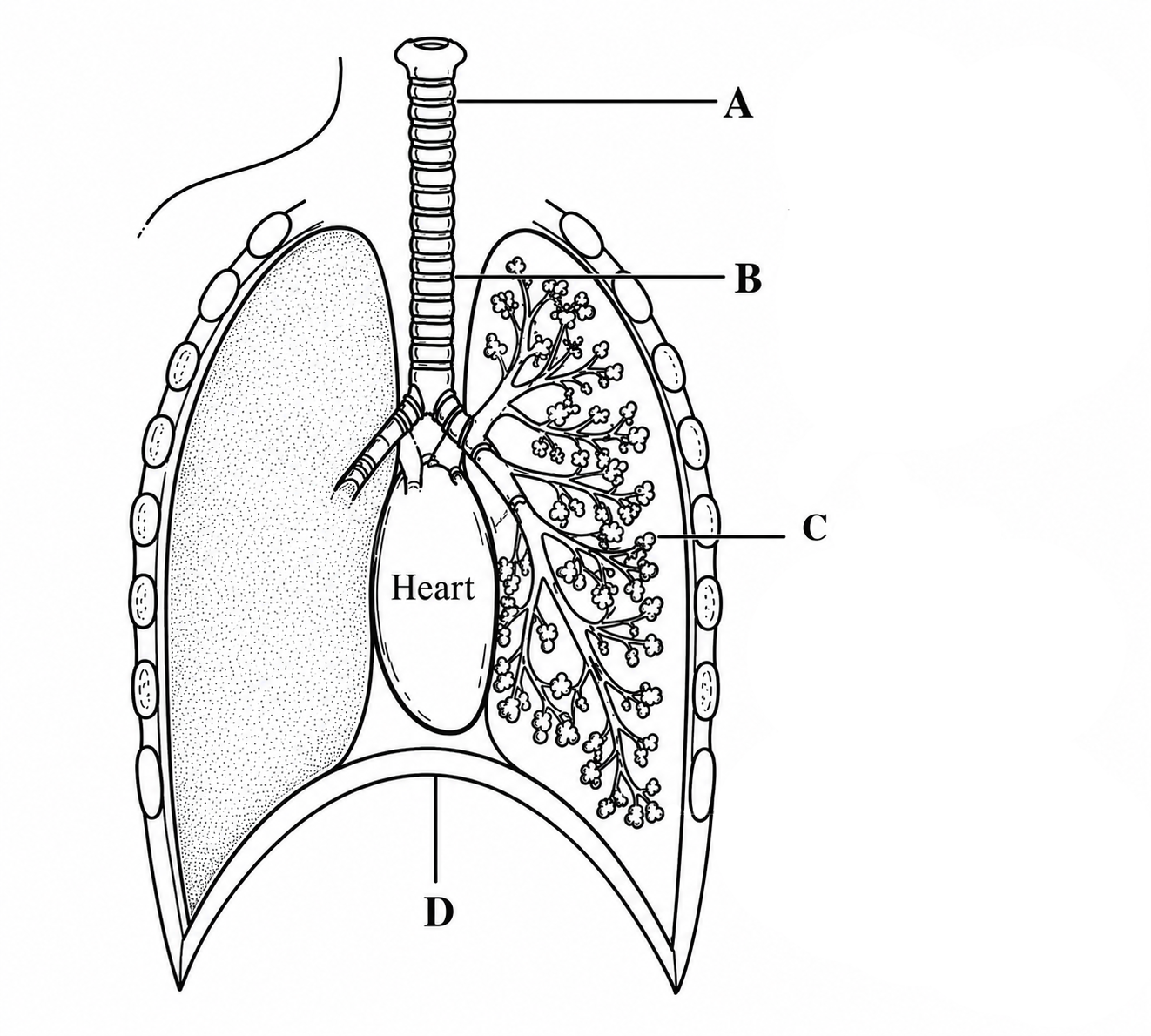
Correct Answer: (b)
Label C represents Alveoli, which are extremely thin-walled, vascularized, bag-like structures serving as the primary sites for gas exchange. (Note: Trachea has incomplete C-shaped cartilaginous rings, not complete rings).
Label C represents Alveoli, which are extremely thin-walled, vascularized, bag-like structures serving as the primary sites for gas exchange. (Note: Trachea has incomplete C-shaped cartilaginous rings, not complete rings).
Q8. Although much CO₂ is carried in blood, yet blood does not become acidic, because
Correct Answer: (b)
Blood plasma contains effective buffer systems (primarily bicarbonate buffer HCO₃⁻/H₂CO₃ and hemoglobin) that neutralize H⁺ ions and maintain blood pH near 7.4.
Blood plasma contains effective buffer systems (primarily bicarbonate buffer HCO₃⁻/H₂CO₃ and hemoglobin) that neutralize H⁺ ions and maintain blood pH near 7.4.
Q9. When you hold your breath, which of the following gas changes in blood would first lead to the urge to breathe?
Correct Answer: (a)
Chemoreceptors located in the carotid/aortic bodies and medulla oblongata are highly sensitive to changes in CO₂ and H⁺ concentrations. A rise in CO₂ concentration triggers the primary impulse/urge to breathe.
Chemoreceptors located in the carotid/aortic bodies and medulla oblongata are highly sensitive to changes in CO₂ and H⁺ concentrations. A rise in CO₂ concentration triggers the primary impulse/urge to breathe.
Q10. Which two of the following changes (i-iv) usually tend to occur in the plain dwellers when they move to high altitudes (3,500 m or more)?
(i) Increase in red blood cell size
(ii) Increase in red blood cell production
(iii) Increased breathing rate
(iv) Increase in thrombocyte count
Changes occurring are:
(i) Increase in red blood cell size
(ii) Increase in red blood cell production
(iii) Increased breathing rate
(iv) Increase in thrombocyte count
Changes occurring are:
Correct Answer: (a)
At high altitudes with low atmospheric pressure/pO₂, the body compensates for hypoxia by increasing the breathing rate (hyperventilation) and increasing RBC production (erythropoiesis) stimulated by erythropoietin.
At high altitudes with low atmospheric pressure/pO₂, the body compensates for hypoxia by increasing the breathing rate (hyperventilation) and increasing RBC production (erythropoiesis) stimulated by erythropoietin.
Q11. The maximum volume of air a person can breathe in after a forced expiration is known as:
Correct Answer: (c)
Vital Capacity (VC) is defined as the maximum volume of air a person can breathe in after a forced expiration (or the maximum volume of air a person can breathe out after a forced inspiration). VC = ERV + TV + IRV.
Vital Capacity (VC) is defined as the maximum volume of air a person can breathe in after a forced expiration (or the maximum volume of air a person can breathe out after a forced inspiration). VC = ERV + TV + IRV.
Q12. Figure shown schematic plan of blood circulation in humans with labels A to D. Identify the label and give its function's.
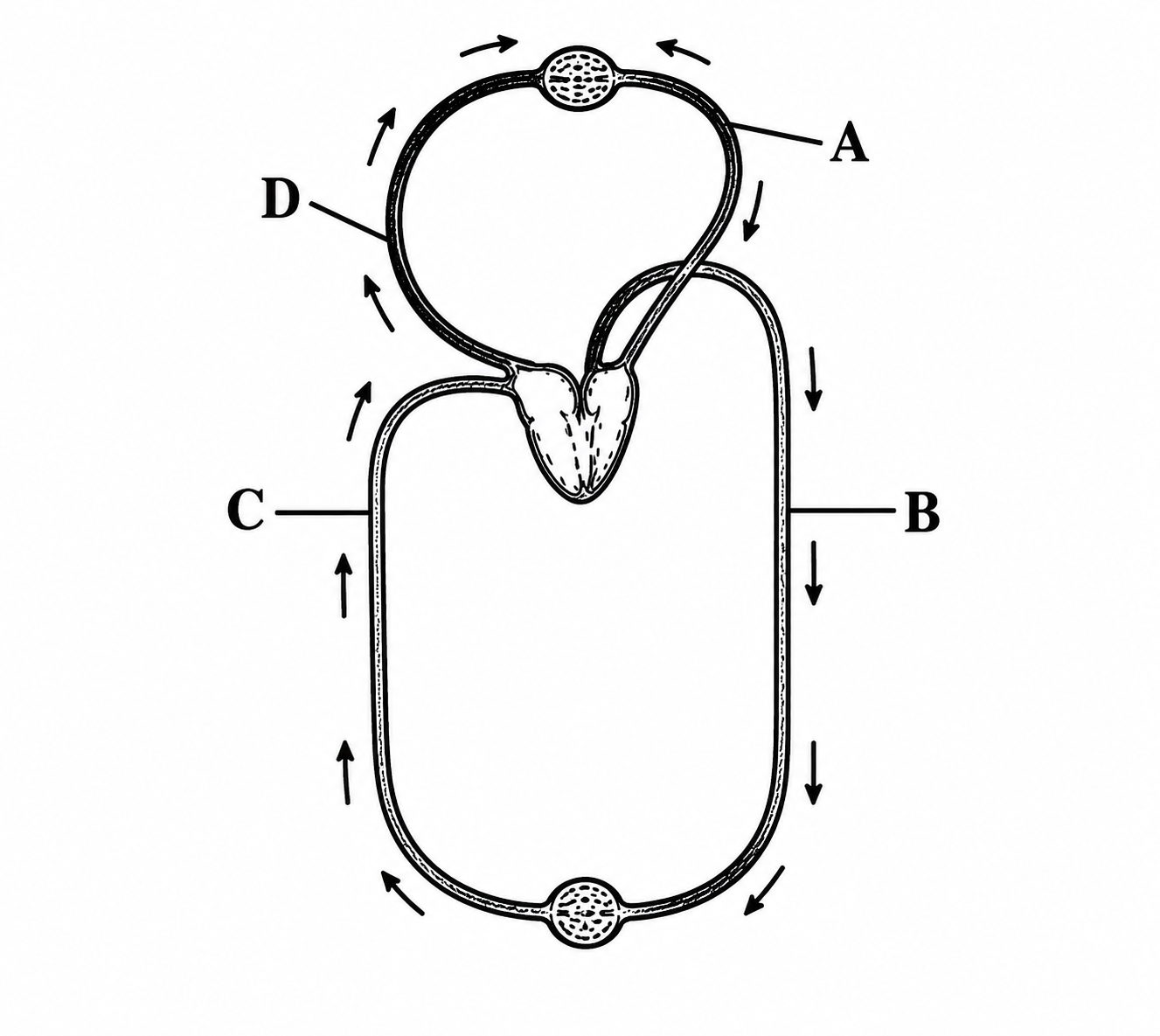
Correct Answer: (b)
Label C is Vena Cava, which carries deoxygenated (impure) blood from systemic body tissues back to the right atrium of the heart, having a pCO₂ of 45 mm Hg.
Label C is Vena Cava, which carries deoxygenated (impure) blood from systemic body tissues back to the right atrium of the heart, having a pCO₂ of 45 mm Hg.
Q13. Which of the following is an occupational respiratory disorder?
Correct Answer: (b)
Silicosis is an occupational respiratory disease caused by long-term inhalation of silica dust in stone-grinding, quarrying, and mining industries, leading to lung inflammation and fibrosis.
Silicosis is an occupational respiratory disease caused by long-term inhalation of silica dust in stone-grinding, quarrying, and mining industries, leading to lung inflammation and fibrosis.
Q14. Bulk of carbon dioxide (CO₂) released from body tissues into the blood is present as
Correct Answer: (a)
About 70% of CO₂ absorbed by the blood is transported in the form of bicarbonate ions (HCO₃⁻) dissolved in blood plasma and inside RBCs.
About 70% of CO₂ absorbed by the blood is transported in the form of bicarbonate ions (HCO₃⁻) dissolved in blood plasma and inside RBCs.
Q15. Intercostal muscles occur in
Correct Answer: (c)
Intercostal muscles (external and internal) are attached between adjacent ribs and assist in changing thoracic volume during breathing.
Intercostal muscles (external and internal) are attached between adjacent ribs and assist in changing thoracic volume during breathing.
Q16. Approximately seventy percent of carbon-dioxide absorbed by the blood will be transported to the lungs:
Correct Answer: (a)
70% of carbon dioxide is transported in blood as bicarbonate ions (HCO₃⁻), generated inside RBCs by carbonic anhydrase and released into plasma.
70% of carbon dioxide is transported in blood as bicarbonate ions (HCO₃⁻), generated inside RBCs by carbonic anhydrase and released into plasma.
Q17. The exchange of gases in the alveoli of the lungs takes place by
Correct Answer: (a)
Gaseous exchange across the respiratory membrane (alveolar-capillary barrier) occurs strictly by simple diffusion driven by partial pressure gradients.
Gaseous exchange across the respiratory membrane (alveolar-capillary barrier) occurs strictly by simple diffusion driven by partial pressure gradients.
Q18. Due to increasing air-borne allergens and pollutants, many people in urban areas are suffering from respiratory disorder causing wheezing due to:
Correct Answer: (b)
Asthma is an allergic condition characterized by inflammation and spasms of the smooth muscles of the bronchi and bronchioles, causing difficulty in breathing and wheezing.
Asthma is an allergic condition characterized by inflammation and spasms of the smooth muscles of the bronchi and bronchioles, causing difficulty in breathing and wheezing.
Q19. Select the correct statement.
Correct Answer: (c)
Inspiration occurs when there is a negative pressure in the lungs with respect to atmospheric pressure, meaning intrapulmonary pressure is lower than the atmospheric pressure.
Inspiration occurs when there is a negative pressure in the lungs with respect to atmospheric pressure, meaning intrapulmonary pressure is lower than the atmospheric pressure.
Q20. Carbon dioxide is transported from tissues to respiratory surface by only
Correct Answer: (a)
CO₂ is transported through blood via plasma (dissolved state and bicarbonate ions) and erythrocytes (carbamino-hemoglobin and internal bicarbonate processing).
CO₂ is transported through blood via plasma (dissolved state and bicarbonate ions) and erythrocytes (carbamino-hemoglobin and internal bicarbonate processing).
Q21. Lungs are made up of air-filled sacs, the alveoli. They do not collapse even after forceful expiration, because of:
Correct Answer: (d)
Residual Volume (RV) is the volume of air remaining in the lungs even after a forcible expiration (1100–1200 mL). This residual air prevents the lungs/alveoli from collapsing.
Residual Volume (RV) is the volume of air remaining in the lungs even after a forcible expiration (1100–1200 mL). This residual air prevents the lungs/alveoli from collapsing.
Q22. In alveoli of the lungs, the air at the site of gas exchange, is separated from the blood by
Correct Answer: (b)
The diffusion membrane consists of three layers: (1) thin squamous epithelium of alveoli, (2) endothelium of alveolar capillaries, and (3) non-cellular basement membrane between them.
The diffusion membrane consists of three layers: (1) thin squamous epithelium of alveoli, (2) endothelium of alveolar capillaries, and (3) non-cellular basement membrane between them.
Q23. Identify the wrong statement with reference to transport of oxygen.
Correct Answer: (b)
In the alveoli, high pO₂, low pCO₂, lower H⁺ concentration (higher pH), and lower temperature favor the formation of oxyhemoglobin. Higher H⁺ concentration in alveoli would promote dissociation (Bohr effect), making statement (b) wrong.
In the alveoli, high pO₂, low pCO₂, lower H⁺ concentration (higher pH), and lower temperature favor the formation of oxyhemoglobin. Higher H⁺ concentration in alveoli would promote dissociation (Bohr effect), making statement (b) wrong.
Q24. Skin is an accessory organ of respiration in
Correct Answer: (b)
Frogs exhibit cutaneous respiration where gas exchange takes place across their moist skin, making it a crucial accessory respiratory organ, especially during hibernation and aestivation.
Frogs exhibit cutaneous respiration where gas exchange takes place across their moist skin, making it a crucial accessory respiratory organ, especially during hibernation and aestivation.
Q25. Which one of the following organs in the human body is most affected due to shortage of oxygen?
Correct Answer: (d)
The brain relies exclusively on continuous aerobic metabolism. Irreversible brain damage and cell death occur within a few minutes of acute oxygen deprivation.
The brain relies exclusively on continuous aerobic metabolism. Irreversible brain damage and cell death occur within a few minutes of acute oxygen deprivation.
Q26. Select the correct events that occur during inspiration.
(i) Contraction of diaphragm
(ii) Contraction of external inter-costal muscles
(iii) Pulmonary volume decreases
(iv) Intra pulmonary pressure increases
(i) Contraction of diaphragm
(ii) Contraction of external inter-costal muscles
(iii) Pulmonary volume decreases
(iv) Intra pulmonary pressure increases
Correct Answer: (d)
Inspiration is initiated by the contraction of the diaphragm which increases the volume of the thoracic chamber in the antero-posterior axis. The contraction of external inter-costal muscles lifts up the ribs and the sternum causing an increase in the volume of the thoracic chamber in the dorso-ventral axis. An overall increase in thoracic volume increases pulmonary volume, decreasing intrapulmonary pressure below atmospheric pressure.
Inspiration is initiated by the contraction of the diaphragm which increases the volume of the thoracic chamber in the antero-posterior axis. The contraction of external inter-costal muscles lifts up the ribs and the sternum causing an increase in the volume of the thoracic chamber in the dorso-ventral axis. An overall increase in thoracic volume increases pulmonary volume, decreasing intrapulmonary pressure below atmospheric pressure.
Q27. Name the pulmonary disease in which alveolar surface area involved in gas exchange is drastically reduced due to damage in the alveolar walls.
Correct Answer: (a)
Emphysema is characterized by irreversible destruction of alveolar septa/walls leading to enlarged air spaces and severely diminished surface area for gas diffusion.
Emphysema is characterized by irreversible destruction of alveolar septa/walls leading to enlarged air spaces and severely diminished surface area for gas diffusion.
Q28. What is vital capacity of our lungs?
Correct Answer: (d)
Total Lung Capacity (TLC) = Vital Capacity (VC) + Residual Volume (RV). Therefore, Vital Capacity = Total lung capacity minus residual volume (VC = TLC - RV).
Total Lung Capacity (TLC) = Vital Capacity (VC) + Residual Volume (RV). Therefore, Vital Capacity = Total lung capacity minus residual volume (VC = TLC - RV).
Q29. Which of the following are the correct statement for respiration in human?
Correct Answer: (c)
In stone-grinding and breaking industries, excessive dust inhalation exceeds defense mechanisms, causing inflammation and extensive fibrous tissue growth (lung fibrosis). (Note: Pneumotaxic center reduces duration of inspiration; 20-25% CO₂ is carried by Hb).
In stone-grinding and breaking industries, excessive dust inhalation exceeds defense mechanisms, causing inflammation and extensive fibrous tissue growth (lung fibrosis). (Note: Pneumotaxic center reduces duration of inspiration; 20-25% CO₂ is carried by Hb).
Q30. Match the items given in Column I with those in Column II and select the correct option given below:
| Column I | Column II |
|---|---|
| A. Tidal volume | i. 2500-3000 mL |
| B. Inspiratory Reserve volume | ii. 1100-1200 mL |
| C. Expiratory Reserve volume | iii. 500-550 mL |
| D. Residual volume | iv. 1000-1100 mL |
Correct Answer: (b)
Standard respiratory volumes in humans: Tidal Volume (TV) = 500–550 mL; Inspiratory Reserve Volume (IRV) = 2500–3000 mL; Expiratory Reserve Volume (ERV) = 1000–1100 mL; Residual Volume (RV) = 1100–1200 mL.
Standard respiratory volumes in humans: Tidal Volume (TV) = 500–550 mL; Inspiratory Reserve Volume (IRV) = 2500–3000 mL; Expiratory Reserve Volume (ERV) = 1000–1100 mL; Residual Volume (RV) = 1100–1200 mL.
Q31. Tidal volume and Expiratory reserve volume of an athlete is 500 mL and 1000 mL respectively. What will be his Expiratory capacity if the residual volume is 1200 mL?
Correct Answer: (a)
Expiratory Capacity (EC) is the total volume of air a person can expire after a normal inspiration. EC = Tidal Volume (TV) + Expiratory Reserve Volume (ERV) = 500 mL + 1000 mL = 1500 mL.
Expiratory Capacity (EC) is the total volume of air a person can expire after a normal inspiration. EC = Tidal Volume (TV) + Expiratory Reserve Volume (ERV) = 500 mL + 1000 mL = 1500 mL.
Q32. Which part of poppy plant is used to obtain the drug "Smack"?
Correct Answer: (b)
Smack (Heroin / diacetylmorphine) is chemically synthesized from morphine, which is extracted from the dried latex of unripened capsules of the poppy plant (Papaver somniferum).
Smack (Heroin / diacetylmorphine) is chemically synthesized from morphine, which is extracted from the dried latex of unripened capsules of the poppy plant (Papaver somniferum).
Q33. Oxygen dissociation curve of haemoglobin is
Correct Answer: (a)
A plot of percentage saturation of hemoglobin against partial pressure of oxygen (pO₂) yields an S-shaped or Sigmoid curve due to cooperative binding of oxygen.
A plot of percentage saturation of hemoglobin against partial pressure of oxygen (pO₂) yields an S-shaped or Sigmoid curve due to cooperative binding of oxygen.
Q34. Listed below are four respiratory capacities (i-iv) and four jumbled respiratory volumes of a normal human adult:
Which one of the following is the correct matching of two capacities and volumes?
| Respiratory capacities | Respiratory volumes |
|---|---|
| (i) Residual volume | 2500 mL |
| (ii) Vital capacity | 3500 mL |
| (iii) Inspiratory reserve volume | 1200 mL |
| (iv) Inspiratory capacity | 4500 mL |
Correct Answer: (c)
Standard average physiological values: (i) Residual volume = 1200 mL; (ii) Vital capacity = 3500–4500 mL; (iii) Inspiratory reserve volume = 2500–3000 mL; (iv) Inspiratory capacity = 3500 mL (TV + IRV = 500 + 3000 mL). Thus, (iv) 3500 mL and (i) 1200 mL is correctly paired.
Standard average physiological values: (i) Residual volume = 1200 mL; (ii) Vital capacity = 3500–4500 mL; (iii) Inspiratory reserve volume = 2500–3000 mL; (iv) Inspiratory capacity = 3500 mL (TV + IRV = 500 + 3000 mL). Thus, (iv) 3500 mL and (i) 1200 mL is correctly paired.
Q35. The figure given below shows a small part of human lung where exchange of gases takes place. In which one of the options given below, the one part A, B, C or D is correctly identified along with its function?
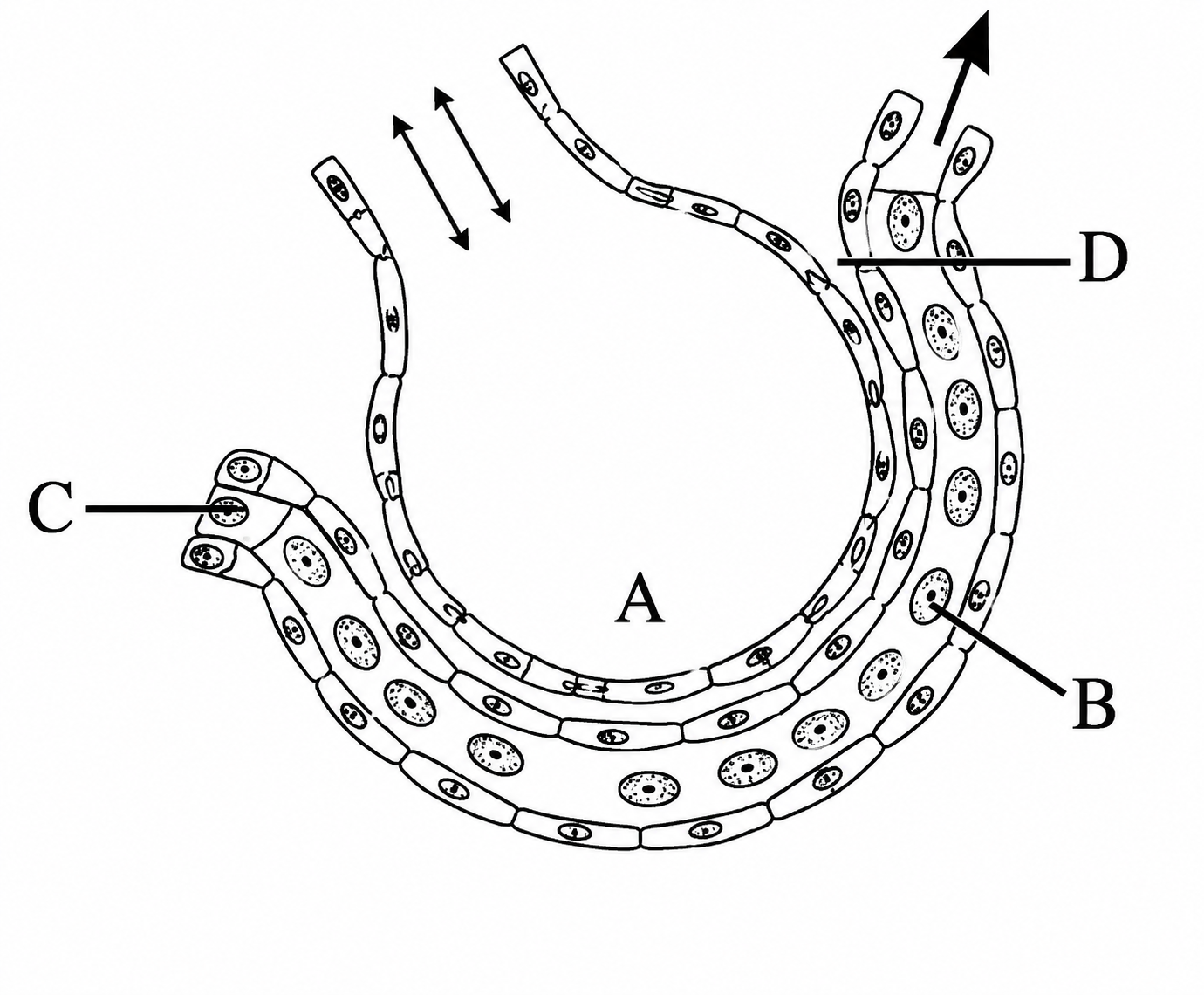
Correct Answer: (b)
Label A represents the Alveolar cavity, which is the primary structure/site where gas exchange between atmospheric air and pulmonary capillary blood takes place.
Label A represents the Alveolar cavity, which is the primary structure/site where gas exchange between atmospheric air and pulmonary capillary blood takes place.
Q36. The quantity 1500 ml in the respiratory volumes of a normal human adult refers to
Correct Answer: (b)
In standard physiological contexts of earlier literature, Residual Volume (RV) typically ranges between 1200 mL to 1500 mL (air remaining in lungs after maximal exhalation).
In standard physiological contexts of earlier literature, Residual Volume (RV) typically ranges between 1200 mL to 1500 mL (air remaining in lungs after maximal exhalation).
Q37. The process of migration of chloride ions from plasma to RBC and of carbonate ions from RBC to plasma is
Correct Answer: (a)
Chloride shift (also known as Hamburger phenomenon) is the exit of bicarbonate ions (HCO₃⁻) from RBCs into plasma balanced by the movement of chloride ions (Cl⁻) from plasma into RBCs to maintain electrical neutrality.
Chloride shift (also known as Hamburger phenomenon) is the exit of bicarbonate ions (HCO₃⁻) from RBCs into plasma balanced by the movement of chloride ions (Cl⁻) from plasma into RBCs to maintain electrical neutrality.
Q38. Blood analysis of a patient reveals an unusually high quantity of carboxyhaemoglobin content. Which of the following conclusions is most likely to be correct? The patient has been inhaling polluted air containing unusually high content of
Correct Answer: (d)
Carbon monoxide (CO) binds to hemoglobin with ~200 times greater affinity than oxygen to form carboxyhemoglobin, impairing oxygen delivery to body tissues.
Carbon monoxide (CO) binds to hemoglobin with ~200 times greater affinity than oxygen to form carboxyhemoglobin, impairing oxygen delivery to body tissues.
Q39. A large proportion of oxygen is left unused in the human blood even after its uptake by the body tissues. This O₂
Correct Answer: (a)
Under normal physiological conditions, arterial blood delivers about 5 mL of O₂ per 100 mL to tissues. The remaining oxygen bound to hemoglobin serves as a vital reserve that can be mobilized during strenuous physical exercise.
Under normal physiological conditions, arterial blood delivers about 5 mL of O₂ per 100 mL to tissues. The remaining oxygen bound to hemoglobin serves as a vital reserve that can be mobilized during strenuous physical exercise.
Q40. The carbon dioxide is transported via blood to lungs as
Correct Answer: (d)
Carbon dioxide is transported in blood predominantly as bicarbonate ions (formed via carbonic acid dissociation) and bound to hemoglobin as carbamino-hemoglobin.
Carbon dioxide is transported in blood predominantly as bicarbonate ions (formed via carbonic acid dissociation) and bound to hemoglobin as carbamino-hemoglobin.
Q41. Which one of the following is a possibility for most of us in regard to breathing, by making a conscious effort?
Correct Answer: (b)
The Eustachian tube connects the nasopharynx to the middle ear cavity. By closing both nose and mouth and increasing intrapulmonary pressure (Valsalva maneuver), air can be forced out through the Eustachian tubes.
The Eustachian tube connects the nasopharynx to the middle ear cavity. By closing both nose and mouth and increasing intrapulmonary pressure (Valsalva maneuver), air can be forced out through the Eustachian tubes.