Q1. An adult human with average health has systolic and diastolic pressures as
Correct Answer: (b)
Normal healthy resting arterial blood pressure in adult humans is ~120 mm Hg (systolic) over 80 mm Hg (diastolic).
Normal healthy resting arterial blood pressure in adult humans is ~120 mm Hg (systolic) over 80 mm Hg (diastolic).
Q2. Which one of the following statements is incorrect?
Correct Answer: (b)
In insects, oxygen is delivered directly to tissues via a tracheal system of air tubes, so the circulating body fluid (hemolymph) does not transport respiratory gases.
In insects, oxygen is delivered directly to tissues via a tracheal system of air tubes, so the circulating body fluid (hemolymph) does not transport respiratory gases.
Q3. Which of the following is not a granulocyte?
Correct Answer: (a)
Granulocytes contain visible cytoplasmic granules (neutrophils, eosinophils, basophils). Lymphocytes and monocytes lack prominent granules and are agranulocytes.
Granulocytes contain visible cytoplasmic granules (neutrophils, eosinophils, basophils). Lymphocytes and monocytes lack prominent granules and are agranulocytes.
Q4. Which one of the following mammalian cells is not capable of metabolising glucose to carbon-dioxide aerobically?
Correct Answer: (c)
Mature mammalian RBCs lack mitochondria and depend exclusively on anaerobic glycolysis for ATP synthesis.
Mature mammalian RBCs lack mitochondria and depend exclusively on anaerobic glycolysis for ATP synthesis.
Q5. Presence of RBC in urine is:
Correct Answer: (c)
Haematuria refers specifically to the abnormal presence of red blood cells (RBCs) in urine.
Haematuria refers specifically to the abnormal presence of red blood cells (RBCs) in urine.
Q6. The blood cancer is known as
Correct Answer: (a)
Leukemia is a malignant proliferation of WBC precursors in the bone marrow leading to abnormally high numbers of leukocytes.
Leukemia is a malignant proliferation of WBC precursors in the bone marrow leading to abnormally high numbers of leukocytes.
Q7. Child death may occur in the marriage between
Correct Answer: (b)
An Rh⁺ man and Rh⁻ woman carrying an Rh⁺ fetus can develop Rh incompatibility (erythroblastosis fetalis), causing severe fetal hemolysis or death in subsequent pregnancies.
An Rh⁺ man and Rh⁻ woman carrying an Rh⁺ fetus can develop Rh incompatibility (erythroblastosis fetalis), causing severe fetal hemolysis or death in subsequent pregnancies.
Q8. In mammals, histamine is secreted by
Correct Answer: (c)
Mast cells located in connective tissues (and basophils in circulation) secrete histamine in response to immune stimulation or injury.
Mast cells located in connective tissues (and basophils in circulation) secrete histamine in response to immune stimulation or injury.
Q9. RBCs do not occur in
Correct Answer: (d)
Cockroaches possess an open circulatory system filled with colorless hemolymph containing hemocytes, completely lacking red blood cells.
Cockroaches possess an open circulatory system filled with colorless hemolymph containing hemocytes, completely lacking red blood cells.
Q10. Match the items given in Column I with those in Column II and select the correct option given below:
| Column I | Column II |
|---|---|
| A. Fibrinogen | (i) Osmotic balance |
| B. Globulin | (ii) Blood clotting |
| C. Albumin | (iii) Defence mechanism |
Correct Answer: (c)
Fibrinogen is essential for blood coagulation (clotting). Globulins are immunoglobulins primarily involved in immune defence mechanisms. Albumin maintains the blood colloidal osmotic balance.
Fibrinogen is essential for blood coagulation (clotting). Globulins are immunoglobulins primarily involved in immune defence mechanisms. Albumin maintains the blood colloidal osmotic balance.
Q11. Cells formed in bone marrow include
Correct Answer: (b)
Hemopoiesis in adult human red bone marrow produces both red blood cells (erythrocytes) and white blood cells (leukocytes).
Hemopoiesis in adult human red bone marrow produces both red blood cells (erythrocytes) and white blood cells (leukocytes).
Q12. In a standard ECG which one of the following alphabets is the correct representation of the respective activity of the human heart?
Correct Answer: (c)
In a standard ECG tracing, the P-wave specifically represents atrial depolarization.
In a standard ECG tracing, the P-wave specifically represents atrial depolarization.
Q13. Arteries are best defined as the vessels which:
Correct Answer: (b)
Arteries carry blood away from the heart and divide into arterioles and capillaries within tissues, which re-collect into venules and veins.
Arteries carry blood away from the heart and divide into arterioles and capillaries within tissues, which re-collect into venules and veins.
Q14. Which one of the following vertebrate organs receives the oxygenated blood only?
Correct Answer: (d)
The spleen receives fully oxygenated arterial blood supplied directly via the splenic artery, unlike organs involved in re-oxygenating deoxygenated venous blood.
The spleen receives fully oxygenated arterial blood supplied directly via the splenic artery, unlike organs involved in re-oxygenating deoxygenated venous blood.
Q15. With respect to the ABO group, there are four major blood types because this blood group is determined by
Correct Answer: (c)
ABO blood grouping is governed by three alleles (Iᴬ, Iᴮ, and i). Alleles Iᴬ and Iᴮ are codominant with respect to each other, while allele i is recessive to both.
ABO blood grouping is governed by three alleles (Iᴬ, Iᴮ, and i). Alleles Iᴬ and Iᴮ are codominant with respect to each other, while allele i is recessive to both.
Q16. The most active phagocytic white blood cells are:
Correct Answer: (d)
Neutrophils and monocytes (which differentiate into tissue macrophages) are highly motile cells capable of rapid engulfment and destruction of invading foreign pathogens.
Neutrophils and monocytes (which differentiate into tissue macrophages) are highly motile cells capable of rapid engulfment and destruction of invading foreign pathogens.
Q17. Mineral found in red pigment of vertebrate blood is
Correct Answer: (b)
Iron (Fe²⁺) forms the prosthetic heme core inside hemoglobin, enabling reversible oxygen binding.
Iron (Fe²⁺) forms the prosthetic heme core inside hemoglobin, enabling reversible oxygen binding.
Q18. Which one of the following is correct?
Correct Answer: (c)
Blood is a special connective tissue consisting of a fluid matrix called plasma and formed elements including RBCs (erythrocytes), WBCs (leukocytes), and platelets (thrombocytes).
Blood is a special connective tissue consisting of a fluid matrix called plasma and formed elements including RBCs (erythrocytes), WBCs (leukocytes), and platelets (thrombocytes).
Q19. The diagram given here is the standard ECG of a normal person the P-wave represents the :
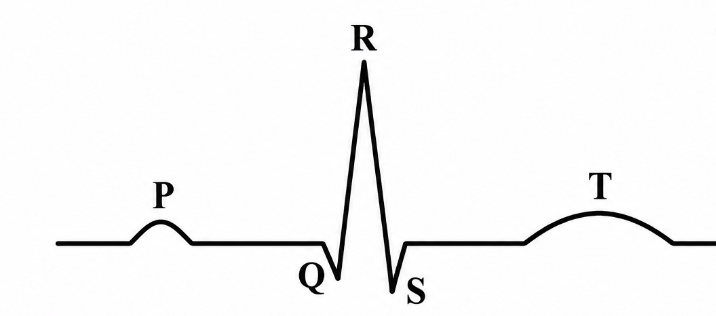
Correct Answer: (d)
The P-wave represents electrical excitation or depolarization of both atria, which directly initiates atrial contraction (atrial systole).
The P-wave represents electrical excitation or depolarization of both atria, which directly initiates atrial contraction (atrial systole).
Q20. Bundle of His is a network of
Correct Answer: (c)
The Bundle of His consists of specialized autoexcitable cardiac muscle fibers situated along the ventricular wall and septum.
The Bundle of His consists of specialized autoexcitable cardiac muscle fibers situated along the ventricular wall and septum.
Q21. Which one of the following human organs is often called the graveyard of RBCs?
Correct Answer: (c)
Old, worn-out, damaged red blood cells (after their lifespan of ~120 days) are trapped, broken down, and destroyed in the spleen, earning it the title 'graveyard of RBCs'.
Old, worn-out, damaged red blood cells (after their lifespan of ~120 days) are trapped, broken down, and destroyed in the spleen, earning it the title 'graveyard of RBCs'.
Q22. Lymph differs from blood in possessing
Correct Answer: (a)
Lymph contains fluid, plasma proteins, and leukocytes (primarily lymphocytes), but completely lacks red blood cells.
Lymph contains fluid, plasma proteins, and leukocytes (primarily lymphocytes), but completely lacks red blood cells.
Q23. Which one of the following statements about blood constituents and transport of respiratory gases is most accurate?
Correct Answer: (d)
Oxygen is transported bound to RBC hemoglobin (~97%) and dissolved in plasma (~3%). Carbon dioxide is carried by RBC hemoglobin (~20–25%), as bicarbonate ions (~70%), and dissolved in plasma (~7%).
Oxygen is transported bound to RBC hemoglobin (~97%) and dissolved in plasma (~3%). Carbon dioxide is carried by RBC hemoglobin (~20–25%), as bicarbonate ions (~70%), and dissolved in plasma (~7%).
Q24. ABO blood groups in humans are controlled by the gene I. It has three alleles - Iᴬ, Iᴮ and i. Since there are three different alleles, six different genotypes are possible. How many phenotypes can occur?
Correct Answer: (c)
The three alleles (Iᴬ, Iᴮ, i) produce six genotypes (IᴬIᴬ, Iᴬi, IᴮIᴮ, Iᴮi, IᴬIᴮ, ii) which express four distinct blood phenotypes: A, B, AB, and O.
The three alleles (Iᴬ, Iᴮ, i) produce six genotypes (IᴬIᴬ, Iᴬi, IᴮIᴮ, Iᴮi, IᴬIᴮ, ii) which express four distinct blood phenotypes: A, B, AB, and O.
Q25. Adult human RBCs are enucleated. Which of the following statement(s) is/are most appropriate explanation for this feature?
(1) They do not need to reproduce
(2) They are somatic cells
(3) They do not metabolize
(4) All their internal space is available for oxygen transport
(1) They do not need to reproduce
(2) They are somatic cells
(3) They do not metabolize
(4) All their internal space is available for oxygen transport
Correct Answer: (d)
During maturation, human RBCs degenerate their nucleus and other internal organelles to maximize internal space for hemoglobin, thereby optimizing oxygen transport capacity.
During maturation, human RBCs degenerate their nucleus and other internal organelles to maximize internal space for hemoglobin, thereby optimizing oxygen transport capacity.
Q26. Pacemaker of heart is
Correct Answer: (c)
The SA node acts as the primary pacemaker due to its intrinsically high rate of spontaneous depolarization.
The SA node acts as the primary pacemaker due to its intrinsically high rate of spontaneous depolarization.
Q27. A vein possesses a large lumen because
Correct Answer: (d)
Veins have a comparatively thin, less muscular tunica media layer than arteries, granting them a wider, highly distensible lumen.
Veins have a comparatively thin, less muscular tunica media layer than arteries, granting them a wider, highly distensible lumen.
Q28. Contraction of the ventricle in the heart begins by the command from
Correct Answer: (b)
The rhythmic impulse generated at the SA node propagates through atrial myocardium to the AV node, initiating cardiac contraction.
The rhythmic impulse generated at the SA node propagates through atrial myocardium to the AV node, initiating cardiac contraction.
Q29. What is correct for blood group 'O'?
Correct Answer: (a)
Blood group O lacks surface antigens A and B on erythrocytes, but its plasma contains both anti-a and anti-b antibodies.
Blood group O lacks surface antigens A and B on erythrocytes, but its plasma contains both anti-a and anti-b antibodies.
Q30. A person with blood group A requires blood. The blood group which can be given is
Correct Answer: (c)
A patient with group A blood can safely receive group A blood or universal donor group O blood (which lacks A and B surface antigens).
A patient with group A blood can safely receive group A blood or universal donor group O blood (which lacks A and B surface antigens).
Q31. Globulins contained in human blood plasma are primarily involved in:
Correct Answer: (d)
Globulins (specifically immunoglobulins or gamma globulins) function as circulating antibodies vital for humoral immune defence mechanisms.
Globulins (specifically immunoglobulins or gamma globulins) function as circulating antibodies vital for humoral immune defence mechanisms.
Q32. Systemic heart refers to:
Correct Answer: (c)
The left atrium and left ventricle together form the systemic heart, receiving oxygenated pulmonary blood and pumping it into the systemic circulation.
The left atrium and left ventricle together form the systemic heart, receiving oxygenated pulmonary blood and pumping it into the systemic circulation.
Q33. Which of the following substances, if introduced into the blood stream, would cause coagulation of blood at the site of its introduction?
Correct Answer: (c)
Thromboplastin (Tissue Factor / Factor III) converts prothrombin into active thrombin, triggering local blood clotting.
Thromboplastin (Tissue Factor / Factor III) converts prothrombin into active thrombin, triggering local blood clotting.
Q34. All the components of the nodal tissue are autoexcitable. Why does the SA node act as the normal pacemaker?
Correct Answer: (a)
The Sino-Atrial (SA) node initiates action potentials at the highest frequency (~70–75 times per minute) compared to other autorhythmic nodal tissue elements.
The Sino-Atrial (SA) node initiates action potentials at the highest frequency (~70–75 times per minute) compared to other autorhythmic nodal tissue elements.
Q35. 'Dup' sound is produced during closure of
Correct Answer: (a)
The second heart sound ('Dup') is produced by the closure of semilunar valves at the base of the aorta and pulmonary trunk.
The second heart sound ('Dup') is produced by the closure of semilunar valves at the base of the aorta and pulmonary trunk.
Q36. Sickle cell anaemia is characterised by
Correct Answer: (d)
Sickle cell anemia causes red blood cells to distort into rigid sickle shapes under low oxygen tension, resulting in premature erythrocyte destruction (hemolytic anemia).
Sickle cell anemia causes red blood cells to distort into rigid sickle shapes under low oxygen tension, resulting in premature erythrocyte destruction (hemolytic anemia).
Q37. A drop of each of the following, is placed separately on four slides. Which of them will not coagulate?
Correct Answer: (a)
Blood serum is blood plasma from which clotting factors (including fibrinogen and prothrombin) have been removed, making it incapable of coagulation.
Blood serum is blood plasma from which clotting factors (including fibrinogen and prothrombin) have been removed, making it incapable of coagulation.
Q38. The correct route through which pulse-making impulse travels in the heart is
Correct Answer: (d)
Cardiac conduction sequence: SA node → AV node → Bundle of His → Purkinje fibers → Ventricular myocardium.
Cardiac conduction sequence: SA node → AV node → Bundle of His → Purkinje fibers → Ventricular myocardium.
Q39. Impulse of heart beat originates from
Correct Answer: (a)
The Sino-Atrial (SA) node acts as the primary pacemaker where action potentials initiating normal heartbeats originate.
The Sino-Atrial (SA) node acts as the primary pacemaker where action potentials initiating normal heartbeats originate.
Q40. Which one of the following has an open circulatory system?
Correct Answer: (a)
Cockroaches (Periplaneta americana) possess an open circulatory system where hemolymph flows through open visceral sinuses (hemocoel).
Cockroaches (Periplaneta americana) possess an open circulatory system where hemolymph flows through open visceral sinuses (hemocoel).
Q41. Which type of white blood cells are concerned with the release of histamine and the natural anti-coagulant heparin?
Correct Answer: (b)
Basophils contain granules loaded with chemical mediators such as histamine (vasodilator) and heparin (anticoagulant).
Basophils contain granules loaded with chemical mediators such as histamine (vasodilator) and heparin (anticoagulant).
Q42. 'Bundle of His' is a part of which one of the following organs in humans?
Correct Answer: (b)
The Bundle of His is a specialized cardiac muscle fiber bundle that conducts electrical excitation from the AV node down the inter-ventricular septum to ventricles.
The Bundle of His is a specialized cardiac muscle fiber bundle that conducts electrical excitation from the AV node down the inter-ventricular septum to ventricles.
Q43. Blood group AB has
Correct Answer: (b)
Blood group AB features surface antigens A and B on red cells, but lacks anti-A or anti-B antibodies in the plasma.
Blood group AB features surface antigens A and B on red cells, but lacks anti-A or anti-B antibodies in the plasma.
Q44. The life span of human W.B.C. is approximately
Correct Answer: (a)
Most circulating white blood cells (especially granulocytes like neutrophils) have short lifespans ranging from a few hours to less than 10 days before destruction.
Most circulating white blood cells (especially granulocytes like neutrophils) have short lifespans ranging from a few hours to less than 10 days before destruction.
Q45. How do parasympathetic neural signals affect the working of the heart?
Correct Answer: (a)
Parasympathetic signals via the vagus nerve release acetylcholine, decreasing SA node action potential generation rate and reducing heart rate and cardiac output.
Parasympathetic signals via the vagus nerve release acetylcholine, decreasing SA node action potential generation rate and reducing heart rate and cardiac output.
Q46. Which one of the following animals has two separate circulatory pathways?
Correct Answer: (b)
Whales (mammals) possess a completely partitioned 4-chambered heart with complete separation of pulmonary and systemic double circulatory circuits.
Whales (mammals) possess a completely partitioned 4-chambered heart with complete separation of pulmonary and systemic double circulatory circuits.
Q47. Component of blood responsible for producing antibodies is
Correct Answer: (d)
B-lymphocytes differentiate into plasma cells that synthesize and secrete circulating antibody proteins.
B-lymphocytes differentiate into plasma cells that synthesize and secrete circulating antibody proteins.
Q48. A man with blood group A marries AB blood group woman. Which type of progeny indicate that the man is not homozygous?
Correct Answer: (b)
Homozygous group A father (IᴬIᴬ) × group AB mother (IᴬIᴮ) can yield only group A (IᴬIᴬ) or group AB (IᴬIᴮ) offspring. A group B offspring (Iᴮi) proves the father carried allele 'i' (Iᴬi).
Homozygous group A father (IᴬIᴬ) × group AB mother (IᴬIᴮ) can yield only group A (IᴬIᴬ) or group AB (IᴬIᴮ) offspring. A group B offspring (Iᴮi) proves the father carried allele 'i' (Iᴬi).
Q49. The genotype of B-group father of an O-group child is
Correct Answer: (d)
An O-group child (ii) receives one 'i' allele from each parent. Thus, a B-group father must be heterozygous carrying genotype Iᴮi.
An O-group child (ii) receives one 'i' allele from each parent. Thus, a B-group father must be heterozygous carrying genotype Iᴮi.
Q50. Reduction in pH of blood will
Correct Answer: (c)
A decrease in blood pH (increased acidity or CO₂ concentration) shifts the oxygen-hemoglobin dissociation curve to the right (Bohr effect), decreasing the affinity of hemoglobin for oxygen.
A decrease in blood pH (increased acidity or CO₂ concentration) shifts the oxygen-hemoglobin dissociation curve to the right (Bohr effect), decreasing the affinity of hemoglobin for oxygen.
Q51. Blood pressure in the mammalian aorta is maximum during:
Correct Answer: (b)
Peak systolic blood pressure occurs when the thick left ventricle contracts forcefully (left ventricular systole) to propel oxygenated blood into the systemic aorta.
Peak systolic blood pressure occurs when the thick left ventricle contracts forcefully (left ventricular systole) to propel oxygenated blood into the systemic aorta.
Q52. Removal of calcium from freshly collected blood would
Correct Answer: (b)
Calcium ions (Ca²⁺) are essential cofactors for multiple enzymatic steps in the clotting cascade; removing Ca²⁺ completely prevents coagulation.
Calcium ions (Ca²⁺) are essential cofactors for multiple enzymatic steps in the clotting cascade; removing Ca²⁺ completely prevents coagulation.
Q53. The most popularly known blood grouping is the ABO grouping. It is named ABO and not ABC, because 'O' in it refers to having:
Correct Answer: (c)
In ABO blood grouping, 'O' denotes the complete absence of both surface antigen A and surface antigen B on the erythrocyte membrane.
In ABO blood grouping, 'O' denotes the complete absence of both surface antigen A and surface antigen B on the erythrocyte membrane.
Q54. What would be the heart rate of a person if the cardiac output is 5 L, blood volume in the ventricles at the end of diastole is 100 mL and at the end of ventricular systole is 50 mL?
Correct Answer: (c)
Stroke Volume (SV) = End Diastolic Volume (100 mL) - End Systolic Volume (50 mL) = 50 mL. Since Cardiac Output = Stroke Volume × Heart Rate, 5000 mL = 50 mL × Heart Rate, yielding Heart Rate = 100 beats/min.
Stroke Volume (SV) = End Diastolic Volume (100 mL) - End Systolic Volume (50 mL) = 50 mL. Since Cardiac Output = Stroke Volume × Heart Rate, 5000 mL = 50 mL × Heart Rate, yielding Heart Rate = 100 beats/min.
Q55. Which one of the following plasma proteins is involved in the coagulation of blood?
Correct Answer: (d)
Fibrinogen is an inactive plasma protein synthesized by the liver that converts into insoluble fibrin threads to form blood clots during coagulation.
Fibrinogen is an inactive plasma protein synthesized by the liver that converts into insoluble fibrin threads to form blood clots during coagulation.
Q56. You are required to draw blood from a patient and to keep it in a test tube for analysis of blood corpuscles and plasma. You are also provided with the following four types of test tubes. Which of them will you not use for the purpose?
Correct Answer: (a)
Calcium ions (Ca²⁺) are indispensable factors in initiating blood clotting. Adding calcium bicarbonate increases Ca²⁺ concentrations, accelerating blood clotting rather than preventing it.
Calcium ions (Ca²⁺) are indispensable factors in initiating blood clotting. Adding calcium bicarbonate increases Ca²⁺ concentrations, accelerating blood clotting rather than preventing it.
Q57. Haemophilia is
Correct Answer: (c)
Haemophilia is an X-linked recessive genetic bleeding disorder impairing blood clotting; it is famously known as the 'Royal disease' due to its presence in European royal families.
Haemophilia is an X-linked recessive genetic bleeding disorder impairing blood clotting; it is famously known as the 'Royal disease' due to its presence in European royal families.
Q58. A child of blood group O cannot have parents of blood groups
Correct Answer: (a)
An O child requires genotype (ii), inheriting one 'i' allele from each parent. A parent with AB blood group (IᴬIᴮ) cannot pass an 'i' allele.
An O child requires genotype (ii), inheriting one 'i' allele from each parent. A parent with AB blood group (IᴬIᴮ) cannot pass an 'i' allele.
Q59. Erythropoiesis starts in:
Correct Answer: (c)
In adult humans, erythropoiesis (the process of red blood cell formation) primarily occurs in the red bone marrow of long and flat bones.
In adult humans, erythropoiesis (the process of red blood cell formation) primarily occurs in the red bone marrow of long and flat bones.
Q60. Arteries carry oxygenated blood except
Correct Answer: (a)
The pulmonary artery is an exception; it carries deoxygenated blood from the right ventricle to the lungs for oxygenation.
The pulmonary artery is an exception; it carries deoxygenated blood from the right ventricle to the lungs for oxygenation.
Q61. Match the following columns and select the correct option.
| Column-I | Column-II |
|---|---|
| (a) Eosinophils | (i) Immune response |
| (b) Basophils | (ii) Phagocytosis |
| (c) Neutrophils | (iii) Release histaminase, destructive enzymes |
| (d) Lymphocytes | (iv) Release granules containing histamine |
Correct Answer: (d)
Eosinophils release histaminase and destructive enzymes to combat parasitic infections and allergic reactions. Basophils release histamine and heparin during inflammatory reactions. Neutrophils are active phagocytic cells, and Lymphocytes are involved in immune responses.
Eosinophils release histaminase and destructive enzymes to combat parasitic infections and allergic reactions. Basophils release histamine and heparin during inflammatory reactions. Neutrophils are active phagocytic cells, and Lymphocytes are involved in immune responses.
Q62. The haemoglobin of a human foetus
Correct Answer: (d)
Fetal hemoglobin (HbF) binds 2,3-BPG less strongly than adult hemoglobin (HbA), giving it a significantly higher oxygen affinity to extract O₂ efficiently across the placenta.
Fetal hemoglobin (HbF) binds 2,3-BPG less strongly than adult hemoglobin (HbA), giving it a significantly higher oxygen affinity to extract O₂ efficiently across the placenta.
Q63. Antigens are present
Correct Answer: (b)
Antigens are surface markers (glycoproteins or glycolipids) anchored to outer plasma cell membranes.
Antigens are surface markers (glycoproteins or glycolipids) anchored to outer plasma cell membranes.
Q64. Examination of blood of a person suspected of having anaemia, shows large, immature, nucleated erythrocytes without haemoglobin. Supplementing his diet with which of the following, is likely to alleviate his symptoms?
Correct Answer: (a)
Megaloblastic anemia is caused by deficiency of vitamin B₁₂ (cobalamin) and folic acid, leading to impaired nuclear maturation and immature nucleated RBCs.
Megaloblastic anemia is caused by deficiency of vitamin B₁₂ (cobalamin) and folic acid, leading to impaired nuclear maturation and immature nucleated RBCs.
Q65. Closed circulatory system occurs in
Correct Answer: (b)
Vertebrates (including tadpoles and adult fish) possess closed circulatory systems where blood remains contained within blood vessels.
Vertebrates (including tadpoles and adult fish) possess closed circulatory systems where blood remains contained within blood vessels.
Q66. Match the items given in Column I with those in Column II and select the correct option given below:
| Column I | Column II |
|---|---|
| A. Tricuspid valve | i. Between left atrium and left ventricle |
| B. Bicuspid valve | ii. Between right ventricle and pulmonary artery |
| C. Semilunar valve | iii. Between right atrium and right ventricle |
Correct Answer: (a)
Tricuspid valve guards the right atrioventricular opening; Bicuspid (mitral) valve guards the left atrioventricular opening; Semilunar valves guard pulmonary artery and aortic orifices.
Tricuspid valve guards the right atrioventricular opening; Bicuspid (mitral) valve guards the left atrioventricular opening; Semilunar valves guard pulmonary artery and aortic orifices.
Q67. Which one of the following statements is correct regarding blood pressure?
Correct Answer: (d)
Severe hypertension (190/110 mmHg) causes acute end-organ damage, impairing essential tissues in brain, kidneys, and cardiac muscle.
Severe hypertension (190/110 mmHg) causes acute end-organ damage, impairing essential tissues in brain, kidneys, and cardiac muscle.
Q68. The lymph serves to
Correct Answer: (c)
The lymphatic system collects excess interstitial tissue fluid and drains it back into the venous circulation via the subclavian veins.
The lymphatic system collects excess interstitial tissue fluid and drains it back into the venous circulation via the subclavian veins.
Q69. What is true about RBCs in humans?
Correct Answer: (a)
About 97% of oxygen is transported by RBCs, while carbon dioxide is carried ~20–25% bound to RBC hemoglobin as carbamino-hemoglobin, 70% as bicarbonate ions, and ~7% in plasma solution.
About 97% of oxygen is transported by RBCs, while carbon dioxide is carried ~20–25% bound to RBC hemoglobin as carbamino-hemoglobin, 70% as bicarbonate ions, and ~7% in plasma solution.
Q70. Vitamin K is required for
Correct Answer: (d)
Vitamin K serves as an essential cofactor for hepatic gamma-carboxylation required in the synthesis of prothrombin (Factor II) and other clotting factors (VII, IX, X).
Vitamin K serves as an essential cofactor for hepatic gamma-carboxylation required in the synthesis of prothrombin (Factor II) and other clotting factors (VII, IX, X).
Q71. Which of the following statements is true for lymph?
Correct Answer: (b)
Lymph is formed by filtration of blood across capillaries; it contains water, soluble nutrients, electrolytes, and leukocytes, but lacks RBCs, platelets, and high-molecular-weight plasma proteins.
Lymph is formed by filtration of blood across capillaries; it contains water, soluble nutrients, electrolytes, and leukocytes, but lacks RBCs, platelets, and high-molecular-weight plasma proteins.
Q72. Match the Column-I with Column-II.
| Column-I | Column-II |
|---|---|
| (a) P-wave | (i) Depolarisation of ventricles |
| (b) QRS complex | (ii) Repolarisation of ventricles |
| (c) T-wave | (iii) Coronary ischemia |
| (d) Reduction in the size of T-wave | (iv) Depolarisation of atria |
Correct Answer: (a)
P-wave denotes atrial depolarization; QRS complex represents ventricular depolarization; T-wave corresponds to ventricular repolarization; flattened/reduced T-wave indicates coronary ischemia.
P-wave denotes atrial depolarization; QRS complex represents ventricular depolarization; T-wave corresponds to ventricular repolarization; flattened/reduced T-wave indicates coronary ischemia.
Q73. Person with blood group AB is considered as universal recipient because he has:
Correct Answer: (a)
Individuals with blood group AB express both A and B antigens on the surface of their RBCs and lack anti-A or anti-B antibodies in their plasma, preventing immune rejection of transfused blood.
Individuals with blood group AB express both A and B antigens on the surface of their RBCs and lack anti-A or anti-B antibodies in their plasma, preventing immune rejection of transfused blood.
Q74. Given below is the ECG of a normal human. Which one of its components in human is correctly interpreted below.
Correct Answer: (a)
By counting the frequency of QRS complexes over a given time interval, one can accurately measure the heart rate (pulse rate).
By counting the frequency of QRS complexes over a given time interval, one can accurately measure the heart rate (pulse rate).
Q75. In humans, blood passes from the post caval to the diastolic right atrium of heart due to
Correct Answer: (b)
During ventricular systole/early diastole, expanding atrial relaxation creates negative pressure (a suction pull) drawing vena caval blood into the right atrium.
During ventricular systole/early diastole, expanding atrial relaxation creates negative pressure (a suction pull) drawing vena caval blood into the right atrium.
Q76. Figure shows blood circulation in humans with labels A to D. Select the option which gives correct identification of label and functions of the part:
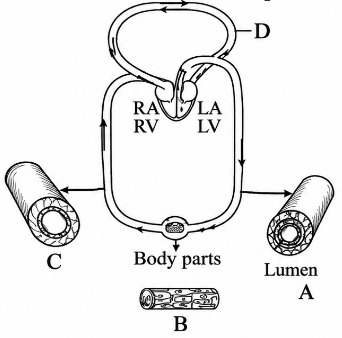
Correct Answer: (d)
Label D represents the pulmonary vein, which transports newly oxygenated blood from the lungs into the left atrium of the heart (PO₂ ≈ 95 mmHg).
Label D represents the pulmonary vein, which transports newly oxygenated blood from the lungs into the left atrium of the heart (PO₂ ≈ 95 mmHg).
Q77. In the ABO system of blood groups, if both antigens are present but no antibody, the blood group of the individual would be
Correct Answer: (c)
Blood group AB is characterized by the presence of both A and B surface antigens on red blood cells and complete absence of anti-A or anti-B plasma antibodies.
Blood group AB is characterized by the presence of both A and B surface antigens on red blood cells and complete absence of anti-A or anti-B plasma antibodies.
Q78. A specialised nodal tissue embedded in the lower corner of the right atrium, close to Atrio-ventricular septum, delays the spreading of impulses to heart apex for about 0.1 sec. This delay allows
Correct Answer: (a)
The AV nodal delay (~0.1 second) allows complete atrial depolarization and contraction, fully emptying atrial blood into ventricles before ventricular systole begins.
The AV nodal delay (~0.1 second) allows complete atrial depolarization and contraction, fully emptying atrial blood into ventricles before ventricular systole begins.
Q79. Wall of blood capillary is formed of
Correct Answer: (c)
Capillary walls are lined by thin, flattened endothelial cells forming a semi-permeable boundary for exchange of nutrients and gases.
Capillary walls are lined by thin, flattened endothelial cells forming a semi-permeable boundary for exchange of nutrients and gases.
Q80. Blood pressure in the pulmonary artery is
Correct Answer: (c)
Arteries receive high-pressure blood pumped directly from heart ventricles, whereas veins transport blood under significantly lower pressure. Thus, pulmonary artery pressure exceeds pulmonary vein pressure.
Arteries receive high-pressure blood pumped directly from heart ventricles, whereas veins transport blood under significantly lower pressure. Thus, pulmonary artery pressure exceeds pulmonary vein pressure.
Q81. The cardiac pacemaker in a patient fails to function normally. The doctors find that an artificial pacemaker is to be grafted in him. It is likely that it will be grafted at the site of
Correct Answer: (c)
An artificial electronic pacemaker replaces dysfunctional primary sinoatrial (SA) node tissue to restore regular rhythmic impulses.
An artificial electronic pacemaker replaces dysfunctional primary sinoatrial (SA) node tissue to restore regular rhythmic impulses.
Q82. There is no DNA in:
Correct Answer: (a)
Mature human red blood cells extrude their nuclei and mitochondria during maturation and therefore contain no nuclear or organellar DNA.
Mature human red blood cells extrude their nuclei and mitochondria during maturation and therefore contain no nuclear or organellar DNA.
Q83. Tricuspid valve is found in between
Correct Answer: (b)
The tricuspid valve consists of three muscular flaps located between the right atrium (auricle) and right ventricle.
The tricuspid valve consists of three muscular flaps located between the right atrium (auricle) and right ventricle.
Q84. The active molecule that helps initiate the inflammatory response when mast cells degranulate is
Correct Answer: (b)
Histamine released by degranulating mast cells promotes local vasodilation and increased capillary permeability, driving inflammation.
Histamine released by degranulating mast cells promotes local vasodilation and increased capillary permeability, driving inflammation.
Q85. The QRS complex in a standard ECG represents
Correct Answer: (b)
The QRS wave complex on an electrocardiogram represents rapid ventricular depolarization, triggering ventricular contraction (systole).
The QRS wave complex on an electrocardiogram represents rapid ventricular depolarization, triggering ventricular contraction (systole).
Q86. Blood capillaries are made of
Correct Answer: (d)
Capillaries consist of a simple single-layered endothelium resting on a basement membrane without outer tunica media (muscle) or externa (connective tissue) layers.
Capillaries consist of a simple single-layered endothelium resting on a basement membrane without outer tunica media (muscle) or externa (connective tissue) layers.
Q87. Which one engulfs pathogens rapidly?
Correct Answer: (d)
Neutrophils represent the primary, most abundant phagocytic leukocytes that rapidly respond to sites of infection.
Neutrophils represent the primary, most abundant phagocytic leukocytes that rapidly respond to sites of infection.
Q88. Pulmonary artery differs from pulmonary vein in having
Correct Answer: (d)
Arteries possess a thicker tunica media (smooth muscle and elastic tissue) and narrower lumen compared to veins.
Arteries possess a thicker tunica media (smooth muscle and elastic tissue) and narrower lumen compared to veins.
Q89. Compared to blood our lymph has:
Correct Answer: (b)
Lymph is interstitial tissue fluid that contains specialized leukocytes (predominantly lymphocytes) for immunity, but is devoid of RBCs, platelets, and large plasma proteins.
Lymph is interstitial tissue fluid that contains specialized leukocytes (predominantly lymphocytes) for immunity, but is devoid of RBCs, platelets, and large plasma proteins.
Q90. Splenic artery arises from
Correct Answer: (b)
The splenic artery branches off from the coeliac axis (coeliac artery), supplying oxygenated blood to the spleen.
The splenic artery branches off from the coeliac axis (coeliac artery), supplying oxygenated blood to the spleen.
Q91. Breakdown product of haemoglobin is
Correct Answer: (b)
Haemoglobin destruction in the spleen recovers iron (Fe) for reuse, while the heme ring degrades into bile pigments (biliverdin and bilirubin).
Haemoglobin destruction in the spleen recovers iron (Fe) for reuse, while the heme ring degrades into bile pigments (biliverdin and bilirubin).
Q92. What is true about leucocytes?
Correct Answer: (d)
Leukocytes (WBCs) are nucleated cells that can slip through thin capillary wall endothelial junctions via amoeboid movement, a process known as diapedesis.
Leukocytes (WBCs) are nucleated cells that can slip through thin capillary wall endothelial junctions via amoeboid movement, a process known as diapedesis.
Q93. If due to some injury the chordae tendinae of the tricuspid valve of the human heart is partially non functional, what will be the immediate effect?
Correct Answer: (d)
Impaired tricuspid chordae tendinae causes regurgitation of blood back into the right atrium during right ventricular contraction, reducing forward output into the pulmonary artery.
Impaired tricuspid chordae tendinae causes regurgitation of blood back into the right atrium during right ventricular contraction, reducing forward output into the pulmonary artery.
Q94. Doctors use stethoscope to hear the sounds produced during each cardiac cycle. The second sound is heard when:
Correct Answer: (b)
The second heart sound ('Dub') is caused by the sharp closure of semilunar valves (aortic and pulmonary) at the onset of ventricular diastole.
The second heart sound ('Dub') is caused by the sharp closure of semilunar valves (aortic and pulmonary) at the onset of ventricular diastole.
Q95. The figure shows a human blood cell. Identify it and give its characteristics.
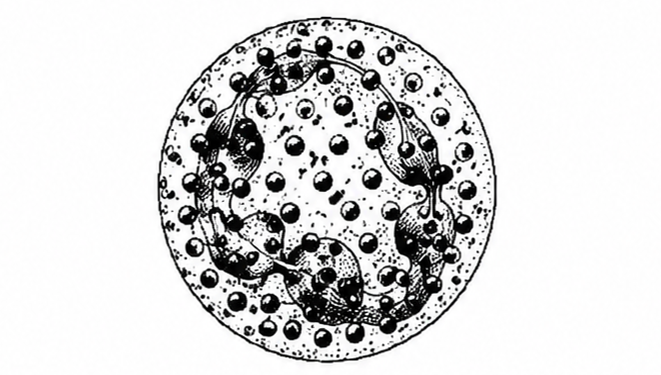
| Blood Cell | Characteristics |
|---|---|
| (a) Monocyte | Life span 3 days, produce antibodies |
| (b) Basophil | Secrete serotonin, inflammatory response |
| (c) B-lymphocyte | Form about 20% of blood cells involved in immune response |
| (d) Neutrophil | Most abundant blood cell, phagocytic |
Correct Answer: (b)
The diagram shows a basophil featuring a lobed nucleus and cytoplasmic granules. Basophils secrete histamine, serotonin, and heparin, playing a key role in inflammatory reactions.
The diagram shows a basophil featuring a lobed nucleus and cytoplasmic granules. Basophils secrete histamine, serotonin, and heparin, playing a key role in inflammatory reactions.
Continue in App
For the best quiz experience and detailed performance analytics, download the Master Biology App.
Open in Play Store