Q1. During isolation of DNA, chilled ethanol is added to
Correct Answer: (b)
DNA is insoluble in chilled ethanol and precipitates from solution.
DNA is insoluble in chilled ethanol and precipitates from solution.
Q2. Agarose extracted from seaweeds finds use in
Correct Answer: (d)
Agarose forms the sieving gel used for electrophoretic separation of nucleic acids.
Agarose forms the sieving gel used for electrophoretic separation of nucleic acids.
Q3. Which represents a palindromic sequence in DNA?
Correct Answer: (a)
GAATTC reads the same in the 5′→3′ direction on both strands.
GAATTC reads the same in the 5′→3′ direction on both strands.
Q4. Introduction of food plants developed by genetic engineering is not desirable because
Correct Answer: (d)
The stated concern is possible transfer or presence of allergenic/toxic agents.
The stated concern is possible transfer or presence of allergenic/toxic agents.
Q5. Which is commonly used to transfer foreign DNA into crop plants?
Correct Answer: (b)
The disarmed Ti plasmid of A. tumefaciens is widely used as a plant vector.
The disarmed Ti plasmid of A. tumefaciens is widely used as a plant vector.
Q6. Two bacteria found very useful in genetic-engineering experiments are
Correct Answer: (a)
E. coli is a standard cloning host and Agrobacterium is a useful plant vector.
E. coli is a standard cloning host and Agrobacterium is a useful plant vector.
Q7. DNA fragments separated on an agarose gel can be visualised after staining with
Correct Answer: (c)
Ethidium bromide intercalates with DNA and fluoresces under UV light.
Ethidium bromide intercalates with DNA and fluoresces under UV light.
Q8. DNA precipitation from a mixture of biomolecules can be achieved by treatment with
Correct Answer: (b)
Chilled ethanol precipitates DNA during isolation.
Chilled ethanol precipitates DNA during isolation.
Q9. The correct order of steps in polymerase chain reaction (PCR) is
Correct Answer: (c)
Each PCR cycle proceeds through denaturation, primer annealing, and extension.
Each PCR cycle proceeds through denaturation, primer annealing, and extension.
Q10. In vitro clonal propagation in plants is characterised by
Correct Answer: (a)
PCR and RAPD are used to characterise in vitro clonal propagation.
PCR and RAPD are used to characterise in vitro clonal propagation.
Q11. The cutting of DNA at specific locations became possible with the discovery of
Correct Answer: (d)
Restriction enzymes cut DNA at specific recognition sites.
Restriction enzymes cut DNA at specific recognition sites.
Q12. A gene whose expression helps to identify a transformed cell is known as
Correct Answer: (d)
A selectable marker distinguishes transformants from non-transformants.
A selectable marker distinguishes transformants from non-transformants.
Q13. Identify the wrong statement with regard to restriction enzymes.
Correct Answer: (c)
Restriction endonucleases inspect specific nucleotide sequences, not the length of DNA.
Restriction endonucleases inspect specific nucleotide sequences, not the length of DNA.
Q14. The organelle/organoid involved in genetic engineering is
Correct Answer: (a)
Plasmids are commonly used as cloning vectors in genetic engineering.
Plasmids are commonly used as cloning vectors in genetic engineering.
Q15. The plasmid
Correct Answer: (d)
Plasmids are extra-chromosomal genetic material in many micro-organisms.
Plasmids are extra-chromosomal genetic material in many micro-organisms.
Q16. The process of separation and purification of expressed protein before marketing is called
Correct Answer: (a)
Recovery and purification after biosynthesis are downstream processing.
Recovery and purification after biosynthesis are downstream processing.
Q17. Which of the following is a restriction endonuclease?
Correct Answer: (a)
Hind II is a restriction endonuclease.
Hind II is a restriction endonuclease.
Q18. Which is a true statement regarding DNA polymerase used in PCR?
Correct Answer: (d)
Thermostable Taq polymerase remains active during repeated high-temperature denaturation.
Thermostable Taq polymerase remains active during repeated high-temperature denaturation.
Q19. Biolistics (gene gun) is suitable for
Correct Answer: (c)
The gene gun directly introduces DNA into plant cells.
The gene gun directly introduces DNA into plant cells.
Q20. Gel electrophoresis is used for
Correct Answer: (b)
Agarose gel electrophoresis separates DNA fragments by size.
Agarose gel electrophoresis separates DNA fragments by size.
Q21. Match the enzymes with their functions.
Select the correct option.
| Column-I | Column-II |
|---|---|
| (A) Restriction endonuclease | (i) Joins DNA fragments |
| (B) Restriction exonuclease | (ii) Extends primers on genomic template |
| (C) DNA ligase | (iii) Cuts DNA at a specific position |
| (D) Taq polymerase | (iv) Removes nucleotides from DNA ends |
Correct Answer: (c)
Endonuclease cuts internally, exonuclease removes terminal nucleotides, ligase joins fragments, and Taq polymerase extends primers.
Endonuclease cuts internally, exonuclease removes terminal nucleotides, ligase joins fragments, and Taq polymerase extends primers.
Q22. The DNA molecule to which the gene of interest is integrated for cloning is called
Correct Answer: (a)
A vector carries the gene of interest into a host cell for cloning.
A vector carries the gene of interest into a host cell for cloning.
Q23. Given below are four statements pertaining to separation of DNA fragments using gel electrophoresis. Identify the incorrect statements.
(i) DNA is negatively charged and is loaded towards the anode terminal.
(ii) DNA fragments travel along the surface of the gel whose concentration does not affect movement of DNA.
(iii) Smaller DNA fragments travel a larger distance through the gel.
(iv) Pure DNA can be visualised directly by exposure to UV radiation.
Choose the correct answer.
(i) DNA is negatively charged and is loaded towards the anode terminal.
(ii) DNA fragments travel along the surface of the gel whose concentration does not affect movement of DNA.
(iii) Smaller DNA fragments travel a larger distance through the gel.
(iv) Pure DNA can be visualised directly by exposure to UV radiation.
Choose the correct answer.
Correct Answer: (a)
DNA is loaded near the cathode, gel concentration affects migration, and DNA needs ethidium bromide staining before UV visualisation.
DNA is loaded near the cathode, gel concentration affects migration, and DNA needs ethidium bromide staining before UV visualisation.
Q24. What is the criterion for DNA-fragment movement on agarose gel during gel electrophoresis?
Correct Answer: (a)
Smaller DNA fragments pass more readily through agarose pores.
Smaller DNA fragments pass more readily through agarose pores.
Q25. Which vector is commonly used for introducing a DNA fragment into human lymphocytes?
Correct Answer: (a)
Retroviruses are used as vectors for introducing genes into human lymphocytes.
Retroviruses are used as vectors for introducing genes into human lymphocytes.
Q26. Which equipment is essentially required for growing microbes on a large scale for industrial production of enzymes?
Correct Answer: (d)
Bioreactors maintain controlled conditions for large-scale microbial culture.
Bioreactors maintain controlled conditions for large-scale microbial culture.
Q27. The sequence that controls the copy number of linked DNA in a vector is termed
Correct Answer: (a)
The origin of replication (ori) initiates replication and controls copy number.
The origin of replication (ori) initiates replication and controls copy number.
Q28. Which vector can clone only a small fragment of DNA?
Correct Answer: (c)
Plasmids have a relatively small insert capacity compared with cosmids, BACs and YACs.
Plasmids have a relatively small insert capacity compared with cosmids, BACs and YACs.
Q29. Stirred-tank bioreactors have been designed for
Correct Answer: (d)
Stirring and sparging ensure uniform mixing and oxygen availability.
Stirring and sparging ensure uniform mixing and oxygen availability.
Q30. Polyethylene glycol method is used for
Correct Answer: (d)
PEG-mediated uptake introduces naked DNA into protoplasts without a vector.
PEG-mediated uptake introduces naked DNA into protoplasts without a vector.
Q31. Which palindromic base sequence in DNA can be easily cut about the middle by a particular restriction enzyme?
Correct Answer: (c)
The EcoRI recognition sequence GAATTC is palindromic.
The EcoRI recognition sequence GAATTC is palindromic.
Q32. Identify the incorrect statement about restriction endonuclease.
Correct Answer: (b)
Restriction endonucleases cleave both strands of double-stranded DNA.
Restriction endonucleases cleave both strands of double-stranded DNA.
Q33. Linking an antibiotic-resistance gene with a plasmid vector became possible with
Correct Answer: (a)
DNA ligase joins DNA fragments by forming phosphodiester bonds.
DNA ligase joins DNA fragments by forming phosphodiester bonds.
Q34. Plasmids present in bacterial cells are
Correct Answer: (a)
Bacterial plasmids are usually circular, double-stranded DNA molecules.
Bacterial plasmids are usually circular, double-stranded DNA molecules.
Q35. DNA fragments generated by restriction endonucleases in a chemical reaction can be separated by
Correct Answer: (b)
Gel electrophoresis separates restriction fragments by size.
Gel electrophoresis separates restriction fragments by size.
Q36. A single strand of nucleic acid tagged with a radioactive molecule is called
Correct Answer: (d)
A labelled single-stranded DNA or RNA probe detects complementary nucleic-acid sequences.
A labelled single-stranded DNA or RNA probe detects complementary nucleic-acid sequences.
Q37. A DNA or RNA segment tagged with a radioactive molecule is called
Correct Answer: (b)
A radioactive DNA or RNA segment used for hybridisation is a probe.
A radioactive DNA or RNA segment used for hybridisation is a probe.
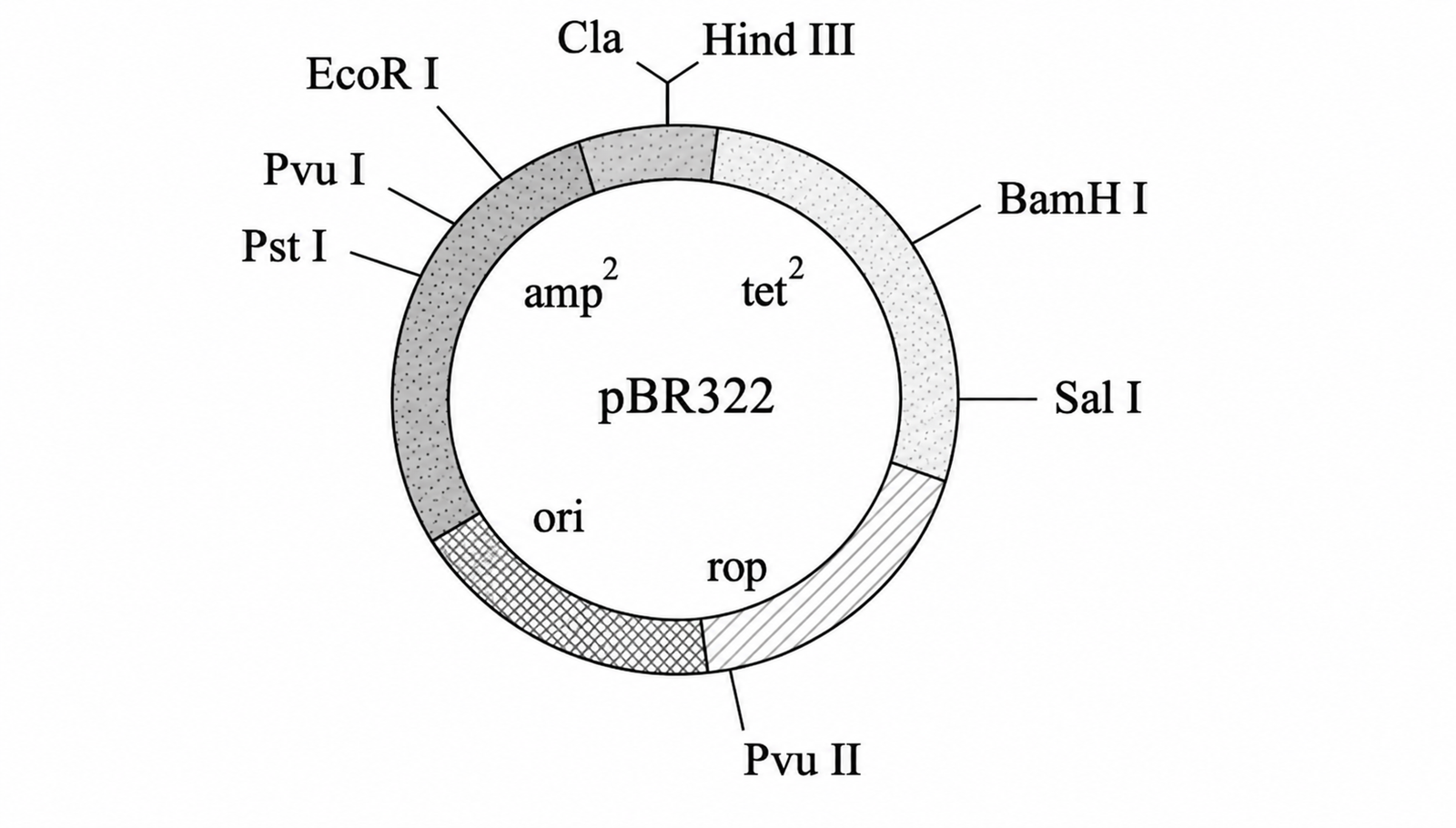
Q38. The figure below is the diagrammatic representation of the E. coli vector pBR322. Which option correctly identifies its component(s)?
Correct Answer: (d)
pBR322 contains ampicillin- and tetracycline-resistance genes; ori is the origin of replication and rop regulates replication.
pBR322 contains ampicillin- and tetracycline-resistance genes; ori is the origin of replication and rop regulates replication.
Q39. Recombinant bacterial colonies appear white in contrast to blue colonies of non-recombinant bacteria because of
Correct Answer: (d)
Insertional inactivation of the lacZ gene prevents β-galactosidase production, giving white recombinant colonies.
Insertional inactivation of the lacZ gene prevents β-galactosidase production, giving white recombinant colonies.
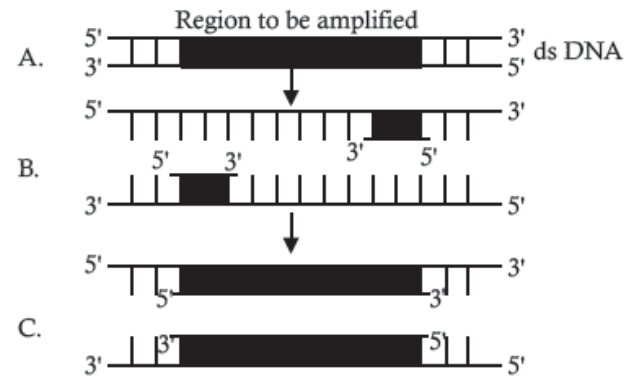
Q40. The figure shows three steps (A, B, C) of polymerase chain reaction (PCR). Select the option giving the correct identification together with what it represents.
Correct Answer: (c)
Step C is extension: a heat-stable DNA polymerase synthesises DNA from annealed primers, typically near 72°C.
Step C is extension: a heat-stable DNA polymerase synthesises DNA from annealed primers, typically near 72°C.
Q41. Commonly used vectors for human genome sequencing are
Correct Answer: (b)
BACs and YACs accommodate large DNA inserts required for genome sequencing.
BACs and YACs accommodate large DNA inserts required for genome sequencing.
Q42. The two antibiotic-resistance genes on vector pBR322 are for
Correct Answer: (b)
pBR322 carries ampR and tetR genes.
pBR322 carries ampR and tetR genes.
Q43. What is true for plasmid?
Correct Answer: (a)
Plasmids are valuable gene-transfer vectors and are extra-chromosomal DNA.
Plasmids are valuable gene-transfer vectors and are extra-chromosomal DNA.
Q44. Genes of interest can be selected from a genomic library by using
Correct Answer: (c)
A labelled DNA probe hybridises with the complementary target sequence.
A labelled DNA probe hybridises with the complementary target sequence.
Q45. An analysis of chromosomal DNA using Southern hybridisation technique does not use
Correct Answer: (d)
Southern blotting involves electrophoresis, transfer to a membrane and probe detection, not PCR.
Southern blotting involves electrophoresis, transfer to a membrane and probe detection, not PCR.
Q46. In genetic engineering, antibiotics are used
Correct Answer: (a)
Antibiotic-resistance genes function as selectable markers.
Antibiotic-resistance genes function as selectable markers.
Q47. In bacterial chromosomes, the nucleic-acid polymer is
Correct Answer: (b)
The bacterial chromosome is generally a circular DNA molecule.
The bacterial chromosome is generally a circular DNA molecule.
Q48. Bt cotton variety developed by introduction of the toxin gene of Bacillus thuringiensis (Bt) is resistant to
Correct Answer: (d)
Bt cotton expresses Cry proteins toxic to target insect pests such as bollworms.
Bt cotton expresses Cry proteins toxic to target insect pests such as bollworms.
Q49. Chromosomes in a bacterial cell can be 1-3 in number and
Correct Answer: (b)
Bacterial chromosomes are generally circular DNA molecules.
Bacterial chromosomes are generally circular DNA molecules.
Q50. Which of the following is not a feature of plasmids?
Correct Answer: (d)
Typical bacterial plasmids are circular double-stranded DNA molecules.
Typical bacterial plasmids are circular double-stranded DNA molecules.
Q51. The specific palindromic sequence recognised by EcoRI is
Correct Answer: (d)
EcoRI recognises the palindrome GAATTC and cleaves G/AATTC.
EcoRI recognises the palindrome GAATTC and cleaves G/AATTC.
Q52. Which technique made it possible to genetically engineer living organisms?
Correct Answer: (a)
Recombinant DNA technology joins DNA from different sources to create new genetic combinations.
Recombinant DNA technology joins DNA from different sources to create new genetic combinations.
Q53. Which is used as a vector for cloning genes into higher organisms?
Correct Answer: (d)
Retroviruses can deliver DNA into animal cells and are used as cloning vectors.
Retroviruses can deliver DNA into animal cells and are used as cloning vectors.
Q54. The Taq polymerase enzyme is obtained from
Correct Answer: (a)
Taq polymerase is isolated from the thermophilic bacterium Thermus aquaticus.
Taq polymerase is isolated from the thermophilic bacterium Thermus aquaticus.
Q55. Choose the correct pair.
Correct Answer: (a)
DNA ligases join DNA fragments by forming phosphodiester bonds.
DNA ligases join DNA fragments by forming phosphodiester bonds.
Q56. What is antisense technology?
Correct Answer: (c)
Antisense RNA base-pairs with target mRNA and blocks its expression.
Antisense RNA base-pairs with target mRNA and blocks its expression.
Q57. Restriction endonucleases are enzymes which
Correct Answer: (a)
Restriction endonucleases act as molecular scissors at specific recognition sequences.
Restriction endonucleases act as molecular scissors at specific recognition sequences.
Q58. PCR and restriction fragment length polymorphism (RFLP) are methods for
Correct Answer: (d)
PCR and RFLP generate polymorphism patterns used in DNA fingerprinting.
PCR and RFLP generate polymorphism patterns used in DNA fingerprinting.
Q59. For transformation, DNA-coated microparticles bombarded with a gene gun are made of
Correct Answer: (d)
Biolistic delivery uses gold or tungsten particles coated with DNA.
Biolistic delivery uses gold or tungsten particles coated with DNA.
Q60. In bacteria, a plasmid is
Correct Answer: (a)
A plasmid is an independently replicating extra-chromosomal DNA molecule.
A plasmid is an independently replicating extra-chromosomal DNA molecule.
Q61. There is a restriction endonuclease called EcoRI. What does “co” stand for?
Correct Answer: (d)
EcoRI is named from Escherichia coli; “co” denotes coli.
EcoRI is named from Escherichia coli; “co” denotes coli.
Q62. Match the organism with its use in biotechnology.
Select the correct option.
| Organism | Use |
|---|---|
| (a) Bacillus thuringiensis | (i) Cloning vector |
| (b) Thermus aquaticus | (ii) Construction of first rDNA molecule |
| (c) Agrobacterium tumefaciens | (iii) DNA polymerase |
| (d) Salmonella typhimurium | (iv) Cry proteins |
Correct Answer: (a)
Bt produces Cry proteins; Taq polymerase comes from T. aquaticus; A. tumefaciens is a cloning vector; and the first rDNA molecule used a plasmid of S. typhimurium.
Bt produces Cry proteins; Taq polymerase comes from T. aquaticus; A. tumefaciens is a cloning vector; and the first rDNA molecule used a plasmid of S. typhimurium.
Q63. In gel electrophoresis, separated DNA fragments can be visualised with the help of
Correct Answer: (a)
Ethidium bromide stains DNA and fluoresces under UV light.
Ethidium bromide stains DNA and fluoresces under UV light.
Q64. A selectable marker is used to
Correct Answer: (b)
Selectable markers permit transformant growth while eliminating non-transformants.
Selectable markers permit transformant growth while eliminating non-transformants.
Q65. An enzyme catalysing the removal of nucleotides from ends of DNA is
Correct Answer: (d)
Exonucleases remove nucleotides one at a time from DNA ends.
Exonucleases remove nucleotides one at a time from DNA ends.