Q1. Which is distributed more widely in a cell ?
Correct Answer: (b)
RNA is found in nucleus, cytoplasm, ribosomes, chloroplasts, and mitochondria.
RNA is found in nucleus, cytoplasm, ribosomes, chloroplasts, and mitochondria.
Q2. Genes are packed into a bacterial chromosome by
Correct Answer: (b)
In bacteria, the chromosome or nucleoid is a naked double stranded DNA. The coiling is stabilized with the help of non-histone polyamines and a number of positively charged ions. Eukaryotic DNA is associated with histone proteins that are helpful in its coiling to form chromatin fibres. (Key says basic proteins).
In bacteria, the chromosome or nucleoid is a naked double stranded DNA. The coiling is stabilized with the help of non-histone polyamines and a number of positively charged ions. Eukaryotic DNA is associated with histone proteins that are helpful in its coiling to form chromatin fibres. (Key says basic proteins).
Q3. An enzyme brings about
Correct Answer: (d)
Enzymes catalyze reactions by reducing the activation energy barrier.
Enzymes catalyze reactions by reducing the activation energy barrier.
Q4. A phosphoglycerate is always made up of :
Correct Answer: (b)
Phosphoglycerides are major structural components of cell membranes. They are, therefore, called membrane lipids. Lecithin is one such example.
Phosphoglycerides are major structural components of cell membranes. They are, therefore, called membrane lipids. Lecithin is one such example.
Q5. Which one is the most abundant protein in the animal world
Correct Answer: (c)
Collagen is the most abundant protein in the animal world. Rubisco is not only the most abundant protein in plants but also in the whole biosphere.
Collagen is the most abundant protein in the animal world. Rubisco is not only the most abundant protein in plants but also in the whole biosphere.
Q6. Select the option which is not correct with respect to enzyme action:
Correct Answer: (b)
Inhibitions of succinic dehydrogenase by malonate is an example of competitive inhibition. This can be reversed by increasing the concentration of the substrate succinate.
Inhibitions of succinic dehydrogenase by malonate is an example of competitive inhibition. This can be reversed by increasing the concentration of the substrate succinate.
Q7. Two free ribonucleotide units are interlinked with
Correct Answer: (d)
Phosphodiester bond links two nucleotides.
Phosphodiester bond links two nucleotides.
Q8. About 98 percent of the mass of every living organism is composed of just six elements including carbon, hydrogen, nitrogen, oxygen and
Correct Answer: (c)
Calcium and phosphorus are the remaining elements that, along with C, H, N, and O, make up about 98% of the mass of living organisms.
Calcium and phosphorus are the remaining elements that, along with C, H, N, and O, make up about 98% of the mass of living organisms.
Q9. Identify the substances having glycosidic bond and peptide bond, respectively in their structure
Correct Answer: (c)
Inulin is a polysaccharide of fructose where fructose units are linked by glycosidic bonds. Insulin is a polypeptide (protein) where amino acids are linked by peptide bonds.
Inulin is a polysaccharide of fructose where fructose units are linked by glycosidic bonds. Insulin is a polypeptide (protein) where amino acids are linked by peptide bonds.
Q10. Which of the following organic compounds is the main constituent of lecithin?
Correct Answer: (c)
Lecithin (phosphatidylcholine) a naturally occurring fatty substance referred to as phospholipid. It is important in cell structure and metabolism.
Lecithin (phosphatidylcholine) a naturally occurring fatty substance referred to as phospholipid. It is important in cell structure and metabolism.
Q11. Which one of the following hydrolyses internal phosphodiester bonds in a polynucleotide chain?
Correct Answer: (c)
Endonucleases hydrolyse internal phosphodiester bonds in a polynucleotide chain (DNA). While exonucleases hydrolyse terminal phosphodiester bonds in a polynucleotide chain (DNA).
Endonucleases hydrolyse internal phosphodiester bonds in a polynucleotide chain (DNA). While exonucleases hydrolyse terminal phosphodiester bonds in a polynucleotide chain (DNA).
Q12. Which is not consistent with double helical structure of DNA ?
Correct Answer: (c)
The ratio (A+G)/(T+C) is constant (=1) for double stranded DNA. The ratio (A+T)/(G+C) varies between species but is constant for a species. The statement 'is not constant' could be interpreted as correct if referring to inter-species comparison, but in the context of general DNA rules, this is the odd one out or the 'not consistent' option as typically presented in these questions.
The ratio (A+G)/(T+C) is constant (=1) for double stranded DNA. The ratio (A+T)/(G+C) varies between species but is constant for a species. The statement 'is not constant' could be interpreted as correct if referring to inter-species comparison, but in the context of general DNA rules, this is the odd one out or the 'not consistent' option as typically presented in these questions.
Q13. Which one of the following statements is incorrect?
Correct Answer: (c)
In competitive inhibition, Km increases while Vmax remains same. So, the statement 'decreases the Km' is incorrect.
In competitive inhibition, Km increases while Vmax remains same. So, the statement 'decreases the Km' is incorrect.
Q14. The two polypeptides of human insulin are linked together by
Correct Answer: (d)
Insulin is a hormone consisting of 2 polypeptide chains. Each chain is composed of a specific sequence of amino acid residues connected by peptide bonds. In humans, chain A has 21 amino acids, and chain B has 30. Post translational modifications result in the connection of these two chains by disulfide bridges.
Insulin is a hormone consisting of 2 polypeptide chains. Each chain is composed of a specific sequence of amino acid residues connected by peptide bonds. In humans, chain A has 21 amino acids, and chain B has 30. Post translational modifications result in the connection of these two chains by disulfide bridges.
Q15. In RNA, thymine is replaced by
Correct Answer: (d)
Uracil replaces Thymine in RNA.
Uracil replaces Thymine in RNA.
Q16. As the age advances, there is a gradual thinning of hair in human males. This is mainly because of lowered
Correct Answer: (b)
Hair is made of keratin protein. Reduced protein synthesis with age leads to thinning.
Hair is made of keratin protein. Reduced protein synthesis with age leads to thinning.
Q17. A segment of DNA has 120 adenine and 120 cytosine bases. The total number of nucleotides present in the segment is
Correct Answer: (d)
According to Chargaff's rule, A=T and G=C. A=120 means T=120. C=120 means G=120. Total = 120+120+120+120 = 480.
According to Chargaff's rule, A=T and G=C. A=120 means T=120. C=120 means G=120. Total = 120+120+120+120 = 480.
Q18. Enzymes having slightly different molecular structure but performing identical activity are
Correct Answer: (b)
Isoenzymes (Isozymes) are multiple forms of an enzyme that catalyze the same reaction but differ in amino acid sequence and physical properties.
Isoenzymes (Isozymes) are multiple forms of an enzyme that catalyze the same reaction but differ in amino acid sequence and physical properties.
Q19. A typical fat molecule is made up of
Correct Answer: (b)
Fat molecules are also called triglycerides. They contain one glycerol and 3 fatty acid molecules.
Fat molecules are also called triglycerides. They contain one glycerol and 3 fatty acid molecules.
Q20. One of the similarities between DNA and RNA is that both
Correct Answer: (a)
DNA and RNA are both polymers of nucleotides. DNA has deoxyribose sugar while RNA has ribose sugar. DNA has thymine while RNA has uracil in place of thymine.
DNA and RNA are both polymers of nucleotides. DNA has deoxyribose sugar while RNA has ribose sugar. DNA has thymine while RNA has uracil in place of thymine.
Q21. Amino acids are produced from
Correct Answer: (d)
An amino acid molecule consists of a central carbon bonded to an amino group and a carboxylic group. Alpha-keto acids are precursors.
An amino acid molecule consists of a central carbon bonded to an amino group and a carboxylic group. Alpha-keto acids are precursors.
Q22. Purines found both in DNA and RNA are:
Correct Answer: (b)
Purines are Adenine and Guanine. Pyrimidines are Cytosine, Thymine (DNA) and Uracil (RNA).
Purines are Adenine and Guanine. Pyrimidines are Cytosine, Thymine (DNA) and Uracil (RNA).
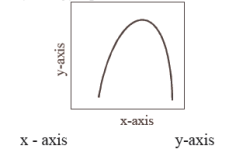
Q23. The curve given below shows enzymatic activity with relation to three conditions (pH, temperature and substrate concentration). What do the two axes (x and y) represent ?
Correct Answer: (b)
The bell-shaped curve is characteristic of enzyme activity vs temperature or pH. X-axis represents temperature/pH and Y-axis represents activity.
The bell-shaped curve is characteristic of enzyme activity vs temperature or pH. X-axis represents temperature/pH and Y-axis represents activity.
Q24. The enormous diversity of protein molecules is due mainly to the diversity of
Correct Answer: (c)
There are only 20 amino acids. These can be arranged in different order in the polypeptide chain to form a diverse array of proteins.
There are only 20 amino acids. These can be arranged in different order in the polypeptide chain to form a diverse array of proteins.
Q25. Which of the following is the simplest amino acid?
Correct Answer: (c)
Glycine is the simplest amino acid where the side chain R is a hydrogen atom.
Glycine is the simplest amino acid where the side chain R is a hydrogen atom.
Q26. Enzymes enhance the rate of reaction by
Correct Answer: (d)
Enzymes work by lowering the activation energy required for the reaction to proceed.
Enzymes work by lowering the activation energy required for the reaction to proceed.
Q27. Which one contains four pyrimidine bases ?
Correct Answer: (a)
GATCAATGC contains 4 pyrimidines: T, C, T, C. (T and C are pyrimidines).
GATCAATGC contains 4 pyrimidines: T, C, T, C. (T and C are pyrimidines).
Q28. DNA is composed of repeating units of
Correct Answer: (d)
DNA is a polymer of deoxyribonucleotides.
DNA is a polymer of deoxyribonucleotides.
Q29. In which one of the following groups, all the three are examples of polysaccharides?
Correct Answer: (a)
Starch, glycogen and cellulose are all polysaccharides.
Starch, glycogen and cellulose are all polysaccharides.
Q30. The essential chemical components of many coenzymes are :
Correct Answer: (c)
The essential chemical components of many coenzymes are vitamins, e.g., coenzyme nicotinamide adenine dinucleotide (NAD) and NADP contain vitamin niacin.
The essential chemical components of many coenzymes are vitamins, e.g., coenzyme nicotinamide adenine dinucleotide (NAD) and NADP contain vitamin niacin.
Q31. Length of one turn of the helix in a B-form DNA is approximately
Correct Answer: (a)
Length of one turn of DNA helix is 34Å. 1Å = 10^-1 nm. So 34Å = 3.4 nm.
Length of one turn of DNA helix is 34Å. 1Å = 10^-1 nm. So 34Å = 3.4 nm.
Q32. Conjugated proteins containing carbohydrates as prosthetic group are known as
Correct Answer: (b)
Besides polypeptides, conjugated proteins possess additional groups, metals or ions. Nucleoproteins are proteins associated with nucleic acids. Chromoproteins are proteins associated with pigments. Glycoproteins are proteins associated with lipids (Correction: carbohydrates).
Besides polypeptides, conjugated proteins possess additional groups, metals or ions. Nucleoproteins are proteins associated with nucleic acids. Chromoproteins are proteins associated with pigments. Glycoproteins are proteins associated with lipids (Correction: carbohydrates).
Q33. Lipids are insoluble in water because lipid molecules are
Correct Answer: (b)
Water attracting molecules are called hydrophilic. Water repelling molecules are called hydrophobic. Amino acids simultaneously carry positive and negative charges. Such substances are called zwitter ions.
Water attracting molecules are called hydrophilic. Water repelling molecules are called hydrophobic. Amino acids simultaneously carry positive and negative charges. Such substances are called zwitter ions.
Q34. Enzymes, vitamins and hormones can be classified into a single category of biological chemicals, because all of these
Correct Answer: (a)
Enzymes, vitamins and hormones regulate various metabolic activities of the body.
Enzymes, vitamins and hormones regulate various metabolic activities of the body.
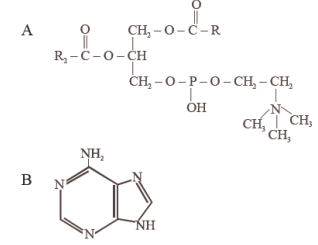
Q35. Which one of the following structural formulae of two organic compounds is correctly identified along with its related function?
Correct Answer: (d)
Lecithin is a fat like substance (phospholipid), which is a part of plasma membrane.
Lecithin is a fat like substance (phospholipid), which is a part of plasma membrane.
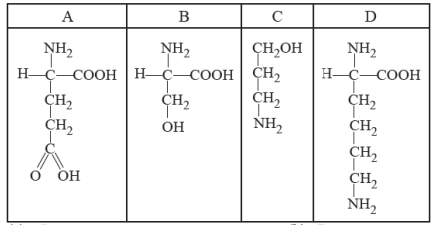
Q36. Which one out of A-D given below correctly represents the structural formula of the basic amino acid
Correct Answer: (b)
Lysine is an basic amino acid. It contains an amino group, an carboxylic acid group, and a side chain lysyl, classifying it as a basic, charged, aliphatic amino acid. Structure D represents Lysine.
Lysine is an basic amino acid. It contains an amino group, an carboxylic acid group, and a side chain lysyl, classifying it as a basic, charged, aliphatic amino acid. Structure D represents Lysine.
Q37. Cellulose, the most important constituent of plant cell wall is made of
Correct Answer: (c)
Cellulose is a linear polymer of beta-glucose linked by beta-1,4-glycosidic bonds.
Cellulose is a linear polymer of beta-glucose linked by beta-1,4-glycosidic bonds.
Q38. “Ramachandran plot” is used to confirm the structure of
Correct Answer: (c)
A Ramachandran plot is a way to visualise energetically allowed regions for backbone dihedral angles ψ against φ of amino acid residues to protein structure. It is used to analyse the structure of a protein.
A Ramachandran plot is a way to visualise energetically allowed regions for backbone dihedral angles ψ against φ of amino acid residues to protein structure. It is used to analyse the structure of a protein.
Q39. Antiparallel strands of a DNA molecule means that
Correct Answer: (b)
The antiparallel structure of DNA is important in DNA replication because it replicates the leading strand one way and the lagging strand the other way.
The antiparallel structure of DNA is important in DNA replication because it replicates the leading strand one way and the lagging strand the other way.
Q40. Concanavalin A is:
Correct Answer: (c)
Concanavalin A is a secondary metabolite, e.g. lectin. Lectin is a mannose/glucose-binding protein isolated from Jack beans.
Concanavalin A is a secondary metabolite, e.g. lectin. Lectin is a mannose/glucose-binding protein isolated from Jack beans.
Q41. A competitive inhibitor of succinic dehydrogenase is
Correct Answer: (a)
Malonate is a structural analogue of succinate and competitively inhibits succinic dehydrogenase.
Malonate is a structural analogue of succinate and competitively inhibits succinic dehydrogenase.
Q42. An organic substance bound to an enzyme and essential for its activity is called
Correct Answer: (d)
Coenzyme is an organic non-protein molecule that binds with the protein molecule (apoenzyme) to form the active enzyme (holoenzyme).
Coenzyme is an organic non-protein molecule that binds with the protein molecule (apoenzyme) to form the active enzyme (holoenzyme).
Q43. Most diverse macromolecules, found in the cell both physically and chemically are
Correct Answer: (a)
Proteins are polymers of amino acids. There are 20 amino acids which can be arranged in different orders in a polypeptide chain to form a wide array of proteins.
Proteins are polymers of amino acids. There are 20 amino acids which can be arranged in different orders in a polypeptide chain to form a wide array of proteins.
Q44. The amino acid Tryptophan is the precursor for the synthesis of
Correct Answer: (a)
Tryptophan is a precursor to neurotransmitters serotonin and melatonin. Thyroxine is produced by tyrosine.
Tryptophan is a precursor to neurotransmitters serotonin and melatonin. Thyroxine is produced by tyrosine.
Q45. The two functional groups characteristic of sugars are
Correct Answer: (c)
Sugar is a carbohydrate. These are polyhydroxy aldehyde, ketone or their derivatives, which means they have carbonyl and hydroxyl groups in its structure.
Sugar is a carbohydrate. These are polyhydroxy aldehyde, ketone or their derivatives, which means they have carbonyl and hydroxyl groups in its structure.
Q46. Which is an essential amino acid?
Correct Answer: (d)
Essential amino acids are those which cannot be synthesized in the body from precursors. These are valine, leucine, isoleucine, lysine, methionine, phenylalanine, tryptophan and threonine.
Essential amino acids are those which cannot be synthesized in the body from precursors. These are valine, leucine, isoleucine, lysine, methionine, phenylalanine, tryptophan and threonine.
Q47. The introduction of t-DNA into plants involves:
Correct Answer: (d)
Agrobacterium tumefaciens is a soil bacterium that has the ability to infect plant cells and transfer a defined sequence of its DNA (T-DNA) to the plant cell.
Agrobacterium tumefaciens is a soil bacterium that has the ability to infect plant cells and transfer a defined sequence of its DNA (T-DNA) to the plant cell.
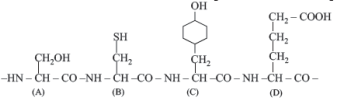
Q48. The figure shows a hypothetical tetrapeptide portion of a protein with parts labeled A-D. Which one of the following option is correct?
Correct Answer: (b)
Glutamic acid and aspartic acid are acidic amino acids with two carboxylic groups and one amino group. Part D represents the acidic amino acid glutamic acid.
Glutamic acid and aspartic acid are acidic amino acids with two carboxylic groups and one amino group. Part D represents the acidic amino acid glutamic acid.
Q49. Adenine is
Correct Answer: (a)
Adenine is a purine base.
Adenine is a purine base.
Q50. A nucleotide is formed of
Correct Answer: (c)
The nucleic acid (DNA and RNA) are repeating units of nucleotides i.e. polynucleotides. Each nucleotide comprises of nitrogenous heterocyclic bases viz. purines or pyrimidines, pentose sugar and phosphoric acid.
The nucleic acid (DNA and RNA) are repeating units of nucleotides i.e. polynucleotides. Each nucleotide comprises of nitrogenous heterocyclic bases viz. purines or pyrimidines, pentose sugar and phosphoric acid.
Q51. RNA does not possess
Correct Answer: (b)
RNA contains Uracil instead of Thymine.
RNA contains Uracil instead of Thymine.
Q52. Carbohydrates, the most abundant bio-molecules on earth, are produced by :
Correct Answer: (a)
Carbohydrates are produced by photo-synthetic organisms like some bacteria (Rhodopseudomonas), algae and green plants.
Carbohydrates are produced by photo-synthetic organisms like some bacteria (Rhodopseudomonas), algae and green plants.
Q53. Collagen is
Correct Answer: (a)
Collagen is a major fibrous protein of connective tissue occurring as white fibres produced by fibroblast.
Collagen is a major fibrous protein of connective tissue occurring as white fibres produced by fibroblast.
Q54. DNA synthesis can be specifically measured by estimating the incorporation of radio labelled
Correct Answer: (c)
Thymidine is used to assess DNA synthesis because thymine is unique to DNA.
Thymidine is used to assess DNA synthesis because thymine is unique to DNA.
Q55. Which of the following biomolecules does have phosphodiester bond ?
Correct Answer: (c)
Nucleic acids (DNA/RNA) are polymers of nucleotides linked by phosphodiester bonds.
Nucleic acids (DNA/RNA) are polymers of nucleotides linked by phosphodiester bonds.
Q56. Which is wrong about nucleic acids ?
Correct Answer: (c)
Length of one helix is 34Å in B-DNA, not 45Å.
Length of one helix is 34Å in B-DNA, not 45Å.
Q57. Protein synthesis in an animal cell takes place
Correct Answer: (c)
In the cytoplasm protein synthesis is restricted to the ribosomes. Mitochondria being a semiautonomous organelle, has its own genetic machinery to synthesize its proteins.
In the cytoplasm protein synthesis is restricted to the ribosomes. Mitochondria being a semiautonomous organelle, has its own genetic machinery to synthesize its proteins.
Q58. The secondary structure of that portion of an integral protein that is buried in the lipid bilayer of a cell membrane is
Correct Answer: (d)
Secondary structures are regular, recurring new steric relationships amongst the amino acid residues in a polypeptide chain. The most common secondary structures are alpha-helices and beta-structures.
Secondary structures are regular, recurring new steric relationships amongst the amino acid residues in a polypeptide chain. The most common secondary structures are alpha-helices and beta-structures.
Q59. Feedback inhibition of an enzymatic reaction is caused by
Correct Answer: (a)
In feedback inhibition, the end product of a metabolic pathway inhibits an upstream enzyme.
In feedback inhibition, the end product of a metabolic pathway inhibits an upstream enzyme.
Q60. Which one of the following is a non - reducing carbohydrate?
Correct Answer: (b)
Sucrose is a non-reducing sugar because the glycosidic bond links the reducing groups of both glucose and fructose.
Sucrose is a non-reducing sugar because the glycosidic bond links the reducing groups of both glucose and fructose.
Q61. The catalytic efficiency of two different enzymes can be compared by the
Correct Answer: (c)
Km (Michaelis constant) indicates the affinity of the enzyme for its substrate. Lower Km means higher affinity/efficiency.
Km (Michaelis constant) indicates the affinity of the enzyme for its substrate. Lower Km means higher affinity/efficiency.
Q62. The basic unit of nucleic acid is
Correct Answer: (d)
Nucleotide is the monomer of nucleic acids.
Nucleotide is the monomer of nucleic acids.
Q63. Which one of the following statements is wrong?
Correct Answer: (d)
Glycine is the simplest amino acid and does not contain sulphur. Cysteine and Methionine contain sulphur.
Glycine is the simplest amino acid and does not contain sulphur. Cysteine and Methionine contain sulphur.
Q64. The four elements making 99% of living system are
Correct Answer: (c)
Principal organic elements are C, H, O, N.
Principal organic elements are C, H, O, N.
Q65. Which of the following statements about enzymes is wrong?
Correct Answer: (c)
Enzymes are mostly proteins. Some are RNA (ribozymes). No lipid enzymes are known.
Enzymes are mostly proteins. Some are RNA (ribozymes). No lipid enzymes are known.
Q66. Macro molecule chitin is :
Correct Answer: (d)
Chitin is a polymer of N-acetylglucosamine, which contains nitrogen.
Chitin is a polymer of N-acetylglucosamine, which contains nitrogen.
Q67. Most abundant organic compound on earth is
Correct Answer: (b)
Cellulose is the most abundant organic compound, polysaccharide and biopolymer found on earth.
Cellulose is the most abundant organic compound, polysaccharide and biopolymer found on earth.
Q68. Which of the following is a reducing sugar?
Correct Answer: (a)
Galactose is a monosaccharide with a free aldehyde group, making it a reducing sugar.
Galactose is a monosaccharide with a free aldehyde group, making it a reducing sugar.
Q69. Which one of the following statements is correct,
Correct Answer: (a)
Holoenzyme is the conjugated enzyme which consists of a protein part called apoenzyme and a non-protein called cofactor (coenzyme).
Holoenzyme is the conjugated enzyme which consists of a protein part called apoenzyme and a non-protein called cofactor (coenzyme).
Q70. The nitrogenous organic base purine occurring in RNA is
Correct Answer: (c)
Purines are Adenine and Guanine. Pyrimidines are Cytosine, Uracil (in RNA) and Thymine (in DNA). Guanine is a purine present in RNA.
Purines are Adenine and Guanine. Pyrimidines are Cytosine, Uracil (in RNA) and Thymine (in DNA). Guanine is a purine present in RNA.
Q71. Which one of the following biomolecules is correctly characterized?
Correct Answer: (a)
Lecithin (phosphatidylcholine) is a phosphorylated glyceride. Palmitic acid is saturated with 16 carbons. Adenylic acid contains ribose, not glucose. Alanine has specific alpha-position groups.
Lecithin (phosphatidylcholine) is a phosphorylated glyceride. Palmitic acid is saturated with 16 carbons. Adenylic acid contains ribose, not glucose. Alanine has specific alpha-position groups.
Q72. Which of the following are not polymeric ?
Correct Answer: (c)
Lipids are not polymers; they are smaller molecules like triglycerides or phospholipids, not long chains of repeating monomers.
Lipids are not polymers; they are smaller molecules like triglycerides or phospholipids, not long chains of repeating monomers.
Q73. Consider the following statements:
(A) Coenzyme or metal ion that is tightly bound to enzyme protein is called prosthetic group.
(B) A complete catalytic active enzyme with its bound prosthetic group is called apoenzyme.
Select the correct option.
(A) Coenzyme or metal ion that is tightly bound to enzyme protein is called prosthetic group.
(B) A complete catalytic active enzyme with its bound prosthetic group is called apoenzyme.
Select the correct option.
Correct Answer: (b)
Statement (A) is correct. Statement (B) is incorrect because a complete catalytically active enzyme with its bound prosthetic group is called a Holoenzyme, not apoenzyme (which is the protein part only).
Statement (A) is correct. Statement (B) is incorrect because a complete catalytically active enzyme with its bound prosthetic group is called a Holoenzyme, not apoenzyme (which is the protein part only).
Q74. Living cell contains 60 – 75% water. Water present in human body is
Correct Answer: (d)
Water is the most abundant compound in the most majority of cells. About 65-70% of human body is water.
Water is the most abundant compound in the most majority of cells. About 65-70% of human body is water.
Q75. Which of the following statements regarding enzyme inhibition is correct?
Correct Answer: (b)
Competitive inhibition occurs when the inhibitor resembles the substrate and competes for the active site.
Competitive inhibition occurs when the inhibitor resembles the substrate and competes for the active site.
Q76. Transition state structure of the substrate formed during an enzymatic reaction is :
Correct Answer: (b)
Transition state structure of the substrate formed during an enzymatic reaction is transient and unstable.
Transition state structure of the substrate formed during an enzymatic reaction is transient and unstable.
Q77. Prosthetic groups differ from co-enzymes in that-
Correct Answer: (c)
Prosthetic groups are organic compounds and are distinguished from other cofactors in that they are tightly bound to the apoenzyme. For example, in peroxidase and catalase, which catalyze the breakdown of hydrogen peroxide to water and oxygen, haem is the prosthetic group and it is a part of the active site of the enzyme.
Prosthetic groups are organic compounds and are distinguished from other cofactors in that they are tightly bound to the apoenzyme. For example, in peroxidase and catalase, which catalyze the breakdown of hydrogen peroxide to water and oxygen, haem is the prosthetic group and it is a part of the active site of the enzyme.
Q78. Lactose is composed of
Correct Answer: (d)
Lactose is a disaccharide of Glucose and Galactose.
Lactose is a disaccharide of Glucose and Galactose.
Q79. Given below is the diagrammatic representation of one of the categories of small molecular weight organic compounds in the living tissues. Identify the category shown and the one blank component “X” in it.
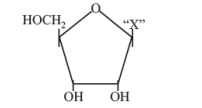
| Category | Component |
|---|---|
| (a) Cholesterol | Guanine |
| (b) Amino acid | NH2 |
| (c) Nucleotide | Adenine |
| (d) Nucleoside | Uracil |
Correct Answer: (d)
The structure shown is a nucleoside (base + sugar). If the answer key says (d) Nucleoside/Uracil, it implies the base 'X' is Uracil (though structure appears purine-like in some representations, usually U is single ring. The exam key accepted d).
The structure shown is a nucleoside (base + sugar). If the answer key says (d) Nucleoside/Uracil, it implies the base 'X' is Uracil (though structure appears purine-like in some representations, usually U is single ring. The exam key accepted d).
Q80. In which one of the following enzymes, is copper necessarily associated as an activator?
Correct Answer: (d)
Tyrosinase (polyphenol oxidase, catecholase) contains copper.
Tyrosinase (polyphenol oxidase, catecholase) contains copper.
Q81. Spoilage of oil can be detected by which fatty acid?
Correct Answer: (d)
Erucic acid is a monounsaturated omega-9 fatty acid. It is prevalent in rapeseed, wallflower seed, and mustard seed, making up 40 to 50 percent of their oils.
Erucic acid is a monounsaturated omega-9 fatty acid. It is prevalent in rapeseed, wallflower seed, and mustard seed, making up 40 to 50 percent of their oils.
Q82. Which of the following glucose transporters is insulin-dependent?
Correct Answer: (d)
GLUT IV is the insulin-regulated glucose transporter found primarily in adipose tissues and striated muscle.
GLUT IV is the insulin-regulated glucose transporter found primarily in adipose tissues and striated muscle.
Q83. In double helix of DNA, the two DNA strands are
Correct Answer: (a)
The two strands coil around a common axis to form a right-handed helix.
The two strands coil around a common axis to form a right-handed helix.
Q84. A polysaccharide, which is synthesized and stored in liver cells, is
Correct Answer: (d)
Glycogen is the storage polysaccharide in animals, stored primarily in the liver and muscles.
Glycogen is the storage polysaccharide in animals, stored primarily in the liver and muscles.
Q85. Which one of the following is the most abundant protein in the animals?
Correct Answer: (a)
Collagen is the most abundant protein in animal world. Collagen is the major insoluble fibrous protein found in the extracellular matrix and in connective tissue.
Collagen is the most abundant protein in animal world. Collagen is the major insoluble fibrous protein found in the extracellular matrix and in connective tissue.
Q86. Match the following
| (a) Inhibitor of catalytic activity | (i) Ricin |
| (b) Possess peptide bonds | (ii) Malonate |
| (c) Cell wall material in fungi | (iii) Chitin |
| (d) Secondary metabolite | (iv) Collagen |
Correct Answer: (d)
Inhibitor: Malonate. Peptide bonds: Collagen. Fungal wall: Chitin. Secondary metabolite: Ricin.
Inhibitor: Malonate. Peptide bonds: Collagen. Fungal wall: Chitin. Secondary metabolite: Ricin.