Q1. Which one occurs in Echinodermata?
Correct Answer: (b)
Adult Echinoderms have radial symmetry (specifically pentamerous).
Adult Echinoderms have radial symmetry (specifically pentamerous).
Q2. Which one of the following kinds of animals are triploblastic?
Correct Answer: (a)
Triploblastic condition can be seen in flat worms. Ctenophores, sponges and corals are diploblastic.
Triploblastic condition can be seen in flat worms. Ctenophores, sponges and corals are diploblastic.
Q3. Skin is a respiratory organ in
Correct Answer: (d)
Frog shows cutaneous respiration (through moist skin) during hibernation and in water.
Frog shows cutaneous respiration (through moist skin) during hibernation and in water.
Q4. Sycon belongs to a group of animals, which are best described as
Correct Answer: (c)
Sycon is a sponge. Sponges show cellular grade of organization. They do not have tissue system.
Sycon is a sponge. Sponges show cellular grade of organization. They do not have tissue system.
Q5. Organ Pipe Coral is
Correct Answer: (a)
Tubipora is organ pipe coral included in class Anthozia.
Tubipora is organ pipe coral included in class Anthozia.
Q6. Which of the following statements are true for the phylum-Chordata?
(i) In Urochordata notochord extends from head to tail and it is present throughout their life.
(ii) In Vertebrata notochord is present during the embryonic period only.
(iii) Central nervous system is dorsal and hollow.
(iv) Chordata is divided into 3 subphyla: Hemichordata, Tunicata and Cephalochordata.
(i) In Urochordata notochord extends from head to tail and it is present throughout their life.
(ii) In Vertebrata notochord is present during the embryonic period only.
(iii) Central nervous system is dorsal and hollow.
(iv) Chordata is divided into 3 subphyla: Hemichordata, Tunicata and Cephalochordata.
Correct Answer: (c)
In Urochordata, notochord is present only in larval tail. Statement (i) is false. Hemichordata is a separate phylum, not a subphylum of Chordata. Statement (iv) is false. (ii) and (iii) are correct.
In Urochordata, notochord is present only in larval tail. Statement (i) is false. Hemichordata is a separate phylum, not a subphylum of Chordata. Statement (iv) is false. (ii) and (iii) are correct.
Q7. Ascaris lumbricoides infection occurs through
Correct Answer: (b)
Ascaris enters into the human by eating semi-cooked (improperly) cooked pork or food contaminated with Ascaris eggs. (Note: Measly pork usually refers to Tapeworm, but given the options and key (b), it likely refers to contaminated food/water ingestion). Answer Key says (b).
Ascaris enters into the human by eating semi-cooked (improperly) cooked pork or food contaminated with Ascaris eggs. (Note: Measly pork usually refers to Tapeworm, but given the options and key (b), it likely refers to contaminated food/water ingestion). Answer Key says (b).
Q8. Frogs differ from humans in possessing:
Correct Answer: (c)
Frogs have nucleated RBCs. Humans have enucleated RBCs.
Frogs have nucleated RBCs. Humans have enucleated RBCs.
Q9. Classification of Porifera is based on
Correct Answer: (b)
The term porifera was given by Grant. Its classification is based on skeleton or spicules.
The term porifera was given by Grant. Its classification is based on skeleton or spicules.
Q10. A chordate character is
Correct Answer: (c)
Postanal tail is a diagnostic chordate character.
Postanal tail is a diagnostic chordate character.
Q11. Eutherians are characterised by
Correct Answer: (b)
Eutherians are placental mammals.
Eutherians are placental mammals.
Q12. Which one of the following statements about certain given animals is correct?
Correct Answer: (a)
Aschelminthes are pseudocoelomates. Molluscs and insects are coelomates. Flatworms are acoelomates.
Aschelminthes are pseudocoelomates. Molluscs and insects are coelomates. Flatworms are acoelomates.
Q13. Which one of the following is a matching set of a phylum and its three examples?
Correct Answer: (b)
Mollusca - Loligo, Teredo, Octopus is correct. Enterobius is Aschelminthes. Pennatula is Cnidaria. Bonellia is Annelida (Echiura).
Mollusca - Loligo, Teredo, Octopus is correct. Enterobius is Aschelminthes. Pennatula is Cnidaria. Bonellia is Annelida (Echiura).
Q14. A jawless fish, which lays eggs in fresh water and whose ammocoetes larvae after metamorphosis return to the ocean is:
Correct Answer: (c)
Petromyzon (Lamprey) is a migratory marine fish that migrates to fresh water for spawning (anadromous). Its larva is Ammocoetes.
Petromyzon (Lamprey) is a migratory marine fish that migrates to fresh water for spawning (anadromous). Its larva is Ammocoetes.
Q15. Adult Culex and Anopheles can be distinguished with the help of
Correct Answer: (b)
The body of an adult Anopheles lies at an angle of 45 degrees to the surface, while Culex sits parallel.
The body of an adult Anopheles lies at an angle of 45 degrees to the surface, while Culex sits parallel.
Q16. Metagenesis refers to:
Correct Answer: (a)
Metagenesis is defined as alternation of generation found in phylum cnidaria (eg. Obelia). In this phenomenon one generation of an organism reproduces asexually, followed by a sexually reproducing generation.
Metagenesis is defined as alternation of generation found in phylum cnidaria (eg. Obelia). In this phenomenon one generation of an organism reproduces asexually, followed by a sexually reproducing generation.
Q17. Kidney of adult rabbit is
Correct Answer: (b)
Adult reptiles, birds and mammals (rabbit) have Metanephric kidney.
Adult reptiles, birds and mammals (rabbit) have Metanephric kidney.
Q18. Which of the following animals does not undergo metamorphosis?
Correct Answer: (a)
Metamorphosis refers to transformation of larva into adult. Earthworm has direct development (no larva). Tunicates (retrogressive), Starfish and Moth have larval stages.
Metamorphosis refers to transformation of larva into adult. Earthworm has direct development (no larva). Tunicates (retrogressive), Starfish and Moth have larval stages.
Q19. Which among these is the correct combination of aquatic mammals?
Correct Answer: (b)
Whales, Dolphins and Seals are aquatic mammals. Trygon and Sharks are cartilaginous fishes.
Whales, Dolphins and Seals are aquatic mammals. Trygon and Sharks are cartilaginous fishes.
Q20. Which one of the following phyla is correctly matched with its two general characteristics?
Correct Answer: (d)
Mollusca is correctly matched. Arthropoda: not all have head/thorax/abdomen (e.g. arachnids). Chordata: not all have separate anal/urinary openings (cloaca exists). Echinodermata: fertilization is usually external.
Mollusca is correctly matched. Arthropoda: not all have head/thorax/abdomen (e.g. arachnids). Chordata: not all have separate anal/urinary openings (cloaca exists). Echinodermata: fertilization is usually external.
Q21. Flight muscles of birds are attached to
Correct Answer: (b)
Flight muscles are attached to the large sternum or keel.
Flight muscles are attached to the large sternum or keel.
Q22. Mucus helps frog in forming
Correct Answer: (d)
Mucus helps frog in forming moist skin as it is necessary for cutaneous respiration.
Mucus helps frog in forming moist skin as it is necessary for cutaneous respiration.
Q23. Bilaterally symmetrical and acoelomate animals are exemplified by
Correct Answer: (a)
Platyhelminthes are bilaterally symmetrical, triploblastic and acoelomate animals with organ level of organisation.
Platyhelminthes are bilaterally symmetrical, triploblastic and acoelomate animals with organ level of organisation.
Q24. Two common characters found in centipede, cockroach and crab are
Correct Answer: (a)
All are arthropods characterized by jointed appendages and chitinous exoskeleton.
All are arthropods characterized by jointed appendages and chitinous exoskeleton.
Q25. Both male and female pigeons secrete milk through
Correct Answer: (c)
Crop milk is secreted by the crop of both male and female pigeons to feed young ones.
Crop milk is secreted by the crop of both male and female pigeons to feed young ones.
Q26. An important characteristic that Hemichordates share with Chordates is :
Correct Answer: (b)
Pharyngeal gill slits are present in hemichordates and in chordates. Notochord is present in chordates only. Ventral nerve cord is non-chordate feature (Chordates have dorsal).
Pharyngeal gill slits are present in hemichordates and in chordates. Notochord is present in chordates only. Ventral nerve cord is non-chordate feature (Chordates have dorsal).
Q27. Metameric segmentation is the characteristic of
Correct Answer: (b)
Metameric segmentation is characteristic of Annelida, Arthropoda and Chordata.
Metameric segmentation is characteristic of Annelida, Arthropoda and Chordata.
Q28. Association between Sucker Fish (Remora) and Shark is
Correct Answer: (a)
Remora attaches to Shark for transport (Commensalism). Shark is neither benefited nor harmed.
Remora attaches to Shark for transport (Commensalism). Shark is neither benefited nor harmed.
Q29. Consider following features:
(a) Organ system level of organisation
(b) Bilateral symmetry
(c) True coelomates with segmentation of body
Select the correct option of animal groups which possess all the above characteristics.
(a) Organ system level of organisation
(b) Bilateral symmetry
(c) True coelomates with segmentation of body
Select the correct option of animal groups which possess all the above characteristics.
Correct Answer: (a)
Organ system of organisation, bilateral symmetry and true coelomates with segmented body are found in annelid, arthropoda and chordates. In mollusca, the body is unsegmented.
Organ system of organisation, bilateral symmetry and true coelomates with segmented body are found in annelid, arthropoda and chordates. In mollusca, the body is unsegmented.
Q30. What is common between Ascaris lumbricoides and Anopheles stephensi?
Correct Answer: (a)
Sexual dimorphism is common between Ascaris lumbricoides and Anopheles stephensi. Male and female round worms can be morphologically differentiated. Female Anopheles mosquito is sanguivorous whereas male Anopheles mosquito sucks nectar.
Sexual dimorphism is common between Ascaris lumbricoides and Anopheles stephensi. Male and female round worms can be morphologically differentiated. Female Anopheles mosquito is sanguivorous whereas male Anopheles mosquito sucks nectar.
Q31. In which one of the following the genus name, its two charcters and its phylum are not correctly matched, whereas the remaining three are correct?
| Genus name | Two characters | Phylum |
|---|---|---|
| (a) Pila | (a) Body Segmented Mouth with radula | Mollusca |
| (b) Asterias | (b) Spiny Skinned Water vascular system | Echinoermata |
| (c) Sycon | (c) Pore bearing Canal system | Porifera |
| (d) Periplaneta | (d) Jointed appendages Chitinous exoskeleton | Arthropoda |
Correct Answer: (a)
Molluscans are soft bodied animals. Body is unsegmented (except Neopilina). Pila has unsegmented body. So (a) is incorrect.
Molluscans are soft bodied animals. Body is unsegmented (except Neopilina). Pila has unsegmented body. So (a) is incorrect.
Q32. The organisms attached to the substratum, generally, possess
Correct Answer: (a)
The organisms, which are attached to substratum, generally, possess radial symmetry in all vertical planes.
The organisms, which are attached to substratum, generally, possess radial symmetry in all vertical planes.
Q33. Which one of the following pairs of animals comprises ‘jawless fishes’?
Correct Answer: (b)
Lampreys and hag fishes comprise jawless fishes (Cyclostomata).
Lampreys and hag fishes comprise jawless fishes (Cyclostomata).
Q34. Taenia saginata differs from Taenia solium in
Correct Answer: (a)
Taenia saginata lacks rostellum and scolex hooks.
Taenia saginata lacks rostellum and scolex hooks.
Q35. Radial symmetry is usually associated with
Correct Answer: (d)
Radial Symmetry is usually associated with sedentary mode of life (e.g. cnidarians). It permits an animal to detect food or danger approaching from any side.
Radial Symmetry is usually associated with sedentary mode of life (e.g. cnidarians). It permits an animal to detect food or danger approaching from any side.
Q36. The flightless bird Cassowary is found in
Correct Answer: (b)
Cassowary is found in Australia/New Guinea.
Cassowary is found in Australia/New Guinea.
Q37. The long bones are hollow and connected by air passages these are characteristics of
Correct Answer: (c)
Pneumatic bones (hollow/air filled) are characteristic of Aves (birds) to reduce weight for flight.
Pneumatic bones (hollow/air filled) are characteristic of Aves (birds) to reduce weight for flight.
Q38. Match the following genera with their respective phylum :
| Column-I | Column-II |
|---|---|
| (A) Ophiura | (i) Mollusca |
| (B) Physalia | (ii) Platyhelminthes |
| (C) Pinctada | (iii) Echinodermata |
| (D) Planaria | (iv) Coelenterata |
Correct Answer: (b)
Ophiura (Brittle star) - Echinodermata. Physalia (Portuguese man of war) - Coelenterata. Pinctada (Pearl oyster) - Mollusca. Planaria - Platyhelminthes.
Ophiura (Brittle star) - Echinodermata. Physalia (Portuguese man of war) - Coelenterata. Pinctada (Pearl oyster) - Mollusca. Planaria - Platyhelminthes.
Q39. Blastopore is the opening of
Correct Answer: (d)
Blastopore is the opening of archenteron (primitive gut) in gastrula.
Blastopore is the opening of archenteron (primitive gut) in gastrula.
Q40. An egg laying mammal is
Correct Answer: (b)
Platypus (Ornithorhynchus) is an egg laying mammal (Monotreme).
Platypus (Ornithorhynchus) is an egg laying mammal (Monotreme).
Q41. Most appropriate term to describe the life cycle of Obelia is
Correct Answer: (a)
Metagenesis is the alternation of generations seen in Obelia where asexual polypoid phase alternates with sexual medusoid phase.
Metagenesis is the alternation of generations seen in Obelia where asexual polypoid phase alternates with sexual medusoid phase.
Q42. Malpighian tubules are
Correct Answer: (a)
Malpighian tubules are excretory organs of insects.
Malpighian tubules are excretory organs of insects.
Q43. In contrast to Annelids the Platyhelminths show:
Correct Answer: (a)
Platyhelminthes includes flat worms. There is no body cavity (acoelomate). Annelids have bilateral symmetry. They are coelomate having a perivisceral cavity divided into compartments.
Platyhelminthes includes flat worms. There is no body cavity (acoelomate). Annelids have bilateral symmetry. They are coelomate having a perivisceral cavity divided into compartments.
Q44. Kala-azar and Oriental Sore are spread by
Correct Answer: (c)
Sand fly (Phlebotomus) is the vector of Kala azar (Leishmania).
Sand fly (Phlebotomus) is the vector of Kala azar (Leishmania).
Q45. Which of the following characteristics is mainly responsible for diversification of insects on land?
Correct Answer: (b)
The exoskeleton of insects consists of chitinous cuticle. It gets hardened due to deposition of calcium. It prevents dessication and gives protection.
The exoskeleton of insects consists of chitinous cuticle. It gets hardened due to deposition of calcium. It prevents dessication and gives protection.
Q46. Which is not a true amphibian animal?
Correct Answer: (c)
Tortoise is a Reptile (Class Reptilia).
Tortoise is a Reptile (Class Reptilia).
Q47. Bladderworm/cysticercus is the larval stage of
Correct Answer: (a)
Bladderworm or cysticercus larva forms in tapeworm (Taenia).
Bladderworm or cysticercus larva forms in tapeworm (Taenia).
Q48. During its life-cycle, Fasciola hepatica (liver fluke) infects its intermediate host and primary host at the following larval stages respectively:
Correct Answer: (b)
When in contact with water, the egg capsule form non feeding larva miracidium. Miracidium enters the body of snail (intermediate host). Redia form cercaria and come out of snail. They get encysted forming metacercaria which infects primary host (Sheep). Correction based on options and standard bio knowledge: Usually Miracidium infects Snail, Metacercaria infects Sheep. Option (a) fits best: Miracidium (intermediate) and Metacercaria (primary). Answer key says (b). Let's re-read carefully. 'infects its intermediate host... at ... larval stages'. Intermediate host is Snail, infected by Miracidium. Primary host is Sheep, infected by Metacercaria. Option (a) is Miracidium and Metacercaria. Option (b) is Redia and Miracidium. Wait, the answer key says (b). Why? Let's check the hint. Hint says 'Miracidium enters the body of snail... Redia form cercaria... They get encysted forming metacercaria'. Maybe the question implies the stage inside the host? No, 'infects... at'. The stage entering the host. Miracidium enters snail. Metacercaria is eaten by sheep. So (a) should be correct. However, standard books sometimes have variations. I will stick to the provided Answer Key (b) but note the potential discrepancy. Wait, if the question asks what stage infects the host, it's Miracidium (for snail) and Metacercaria (for sheep). If the answer key is (b) 'redia and miracidium', it might be interpreted differently or is an error in the book. I will follow the Answer Key provided in the PDF: Key for 25 is (b).
When in contact with water, the egg capsule form non feeding larva miracidium. Miracidium enters the body of snail (intermediate host). Redia form cercaria and come out of snail. They get encysted forming metacercaria which infects primary host (Sheep). Correction based on options and standard bio knowledge: Usually Miracidium infects Snail, Metacercaria infects Sheep. Option (a) fits best: Miracidium (intermediate) and Metacercaria (primary). Answer key says (b). Let's re-read carefully. 'infects its intermediate host... at ... larval stages'. Intermediate host is Snail, infected by Miracidium. Primary host is Sheep, infected by Metacercaria. Option (a) is Miracidium and Metacercaria. Option (b) is Redia and Miracidium. Wait, the answer key says (b). Why? Let's check the hint. Hint says 'Miracidium enters the body of snail... Redia form cercaria... They get encysted forming metacercaria'. Maybe the question implies the stage inside the host? No, 'infects... at'. The stage entering the host. Miracidium enters snail. Metacercaria is eaten by sheep. So (a) should be correct. However, standard books sometimes have variations. I will stick to the provided Answer Key (b) but note the potential discrepancy. Wait, if the question asks what stage infects the host, it's Miracidium (for snail) and Metacercaria (for sheep). If the answer key is (b) 'redia and miracidium', it might be interpreted differently or is an error in the book. I will follow the Answer Key provided in the PDF: Key for 25 is (b).
Q49. In Arthropoda, head and thorax are often fused to form cephalothorax, but in which one of the following classes, is the body divided into head, thorax and abdomen ?
Correct Answer: (a)
In Class Insecta, body is divided into head, thorax and abdomen.
In Class Insecta, body is divided into head, thorax and abdomen.
Q50. Fire bellied toad is
Correct Answer: (d)
Bombina is known as Fire bellied toad.
Bombina is known as Fire bellied toad.
Q51. Which of the following represents the correct combination without any exception?
| Characteristics | Class |
|---|---|
| (a) Mouth ventral, gills without operculum; skin with placoid scales; persistent notochord | Chondrichthyes |
| (b) Sucking and circular mouth; jaws absent, integument without scales; paired appendages | Cyclostomata |
| (c) Body covered with feathers; skin moist and glandular; fore-limbs form wings; lungs with air sacs | Aves |
| (d) Mammary gland; hair on body; pinnae; two pairs of Limbs | Mammalia |
Correct Answer: (a)
Chondrichthyes have ventral mouth, gills without operculum, placoid scales and persistent notochord. Cyclostomata lack paired appendages. Aves have dry skin (no glands except oil gland). Mammalia: whales/dolphins lack hair/pinnae.
Chondrichthyes have ventral mouth, gills without operculum, placoid scales and persistent notochord. Cyclostomata lack paired appendages. Aves have dry skin (no glands except oil gland). Mammalia: whales/dolphins lack hair/pinnae.
Q52. Functionwise, just as there are nephridia in an earthworm, so are
Correct Answer: (c)
Nephridia and Flame cells are excretory organs.
Nephridia and Flame cells are excretory organs.
Q53. Star fish belongs to
Correct Answer: (a)
Starfish belongs to class Asteroidea of phylum Echinodermata.
Starfish belongs to class Asteroidea of phylum Echinodermata.
Q54. Pneumatic bones are expected to be found in
Correct Answer: (a)
Pigeon (Bird) has pneumatic bones.
Pigeon (Bird) has pneumatic bones.
Q55. Typhlops is
Correct Answer: (c)
Typhlops is a genus of blind snakes.
Typhlops is a genus of blind snakes.
Q56. The characteristics of class Reptilia are:
Correct Answer: (a)
Reptiles have dry cornified skin with epidermal scales and lack external ears.
Reptiles have dry cornified skin with epidermal scales and lack external ears.
Q57. A marine cartilaginous fish that can produce electric current is:
Correct Answer: (b)
Torpedo (Electric ray) is a cartilaginous fish that has electric organs to produce electric current.
Torpedo (Electric ray) is a cartilaginous fish that has electric organs to produce electric current.
Q58. Which one of the following groups of animals is bilaterally symmetrical and triploblastic?
Correct Answer: (a)
Aschelminthes is bilaterally symmetrical and triploblastic. These are mostly aquatic, free living or parasitic. Their body is three layered which is ectoderm, mesoderm and endoderm.
Aschelminthes is bilaterally symmetrical and triploblastic. These are mostly aquatic, free living or parasitic. Their body is three layered which is ectoderm, mesoderm and endoderm.
Q59. Cell-tissue-body organisation is characteristic of
Correct Answer: (b)
Hydra (Cnidaria) has tissue level of organization.
Hydra (Cnidaria) has tissue level of organization.
Q60. All chordates possess
Correct Answer: (d)
All chordates possess notochord at some stage of life.
All chordates possess notochord at some stage of life.
Q61. Point out the non-parasite
Correct Answer: (d)
Sea anemone is a free living marine animal. Tapeworm, Mosquito and Leech are parasites/sanguivores.
Sea anemone is a free living marine animal. Tapeworm, Mosquito and Leech are parasites/sanguivores.
Q62. One of the following is a very unique feature of the mammalian body:
Correct Answer: (b)
Presence of diaphragm which separates thoracic cavity from abdominal cavity is characteristic of all mammals.
Presence of diaphragm which separates thoracic cavity from abdominal cavity is characteristic of all mammals.
Q63. Blood of Pheretima is
Correct Answer: (d)
In Pheretima (Earthworm), haemoglobin is dissolved in plasma (red colour). RBCs are absent.
In Pheretima (Earthworm), haemoglobin is dissolved in plasma (red colour). RBCs are absent.
Q64. Sharks and dogfishes differ from skates and rays by
Correct Answer: (a)
In sharks and dogfishes (cylindrical bodies), pectoral fins are distinct. In skates and rays, bodies are flattened and pectoral fins fuse with head/trunk.
In sharks and dogfishes (cylindrical bodies), pectoral fins are distinct. In skates and rays, bodies are flattened and pectoral fins fuse with head/trunk.
Q65. Metamorphosis of insects is regulated through hormone
Correct Answer: (c)
Metamorphosis of insects is regulated through ecdysone hormone.
Metamorphosis of insects is regulated through ecdysone hormone.
Q66. What will you look for to identify the sex of the following?
Correct Answer: (d)
Male shark has claspers on pelvic fins for copulation. Male Ascaris has curved posterior end. Male frog has copulatory pad on fore limb. Anal cerci are in both sexes of cockroach.
Male shark has claspers on pelvic fins for copulation. Male Ascaris has curved posterior end. Male frog has copulatory pad on fore limb. Anal cerci are in both sexes of cockroach.
Q67. From the following statements select the wrong one.
Correct Answer: (d)
Animals belonging to Phylum Porifera are mostly marine except a few which are found in fresh water- e.g. Spongilla.
Animals belonging to Phylum Porifera are mostly marine except a few which are found in fresh water- e.g. Spongilla.
Q68. Which one of the following groups of three animals each is correctly matched with their one characteristic morphological feature?
Correct Answer: (c)
Scorpion, Spider, Cockroach are Arthropods, which have ventral solid central nervous system. Sea anemone/Sea cucumber have radial symmetry. Taenia lacks metameric segmentation (pseudo-segmented).
Scorpion, Spider, Cockroach are Arthropods, which have ventral solid central nervous system. Sea anemone/Sea cucumber have radial symmetry. Taenia lacks metameric segmentation (pseudo-segmented).
Q69. Fish which can be used in biological control of mosquitoes/Larvicidal fish is
Correct Answer: (d)
Gambusia (Mosquito fish) eats mosquito larvae.
Gambusia (Mosquito fish) eats mosquito larvae.
Q70. True coelom is the space lying between the alimentary canal and body wall enclosed by the layers of
Correct Answer: (d)
Coelom is a fluid filled space between body wall and alimentary canal which is lined by parietal peritoneum (mesoderm) on the outer side and visceral peritoneum (mesoderm) on the inner side.
Coelom is a fluid filled space between body wall and alimentary canal which is lined by parietal peritoneum (mesoderm) on the outer side and visceral peritoneum (mesoderm) on the inner side.
Q71. Which of the following animals is not viviparous?
Correct Answer: (b)
Platypus is an oviparous mammal (egg laying).
Platypus is an oviparous mammal (egg laying).
Q72. The cervical vertebrae in humans is
Correct Answer: (a)
The number of cervical vertebrae are same in man and whale (and almost all mammals), which is 7.
The number of cervical vertebrae are same in man and whale (and almost all mammals), which is 7.
Q73. A wood boring mollusc/Shipworm is
Correct Answer: (b)
Teredo (shipworm) is the member of class Bivalvia, a wood boring mollusc.
Teredo (shipworm) is the member of class Bivalvia, a wood boring mollusc.
Q74. The animals with bilateral symmetry in young stage, and radial pentamerous symmetry in the adult stage, belong to the phylum
Correct Answer: (d)
Echinoderms show bilateral symmetry in larval stage and pentamerous radial symmetry in adult stage.
Echinoderms show bilateral symmetry in larval stage and pentamerous radial symmetry in adult stage.
Q75. Which one of the following groups of animals is correctly matched with its one characteristic feature without even a single exception?
Correct Answer: (c)
Chondrichthyes always have cartilaginous endoskeleton. Reptilia (Crocodile 4 chamber). Chordata (Agnatha no jaws). Mammalia (Platypus lays eggs).
Chondrichthyes always have cartilaginous endoskeleton. Reptilia (Crocodile 4 chamber). Chordata (Agnatha no jaws). Mammalia (Platypus lays eggs).
Q76. Hair occur in all mammals except those of
Correct Answer: (d)
Cetacea (Whales, Dolphins) have smooth hairless skin to reduce friction in water.
Cetacea (Whales, Dolphins) have smooth hairless skin to reduce friction in water.
Q77. A larval stage occurs in the life history of all members of the group
Correct Answer: (d)
Butterfly (Caterpillar), Frog (Tadpole), Mosquito (Wriggler) all have larval stages. Earthworm and Lizard have direct development.
Butterfly (Caterpillar), Frog (Tadpole), Mosquito (Wriggler) all have larval stages. Earthworm and Lizard have direct development.
Q78. Transfer of Taenia to secondary host occurs as
Correct Answer: (a)
The eggs of Taenia pass out through human faeces which is eaten by pigs, and develops into onchosphere.
The eggs of Taenia pass out through human faeces which is eaten by pigs, and develops into onchosphere.
Q79. Bull Frog of India is
Correct Answer: (a)
Rana tigrina is the common Indian Bull frog.
Rana tigrina is the common Indian Bull frog.
Q80. Which one of the following is a matching pair of an animal and a certain phenomenon it exhibits?
Correct Answer: (c)
Musca (Housefly) shows complete metamorphosis. Taenia does not show polymorphism. Pheretima is hermaphrodite. Chameleon shows camouflage/mimicry (Answer Key says (c), standard biology agrees on Musca. Chameleon also mimics but 'Complete metamorphosis' is a definitive biological term for Musca).
Musca (Housefly) shows complete metamorphosis. Taenia does not show polymorphism. Pheretima is hermaphrodite. Chameleon shows camouflage/mimicry (Answer Key says (c), standard biology agrees on Musca. Chameleon also mimics but 'Complete metamorphosis' is a definitive biological term for Musca).
Q81. Feet of kingfisher are modified for
Correct Answer: (a)
Feet of kingfisher are modified for wading (Hint says wading. Key says (a). Some sources say perching/syndactyl. I will follow the key).
Feet of kingfisher are modified for wading (Hint says wading. Key says (a). Some sources say perching/syndactyl. I will follow the key).
Q82. Tracheae of cockroach and mammal are similar in having
Correct Answer: (b)
Tracheae have non-collapsible walls (supported by chitinous rings in cockroach and cartilaginous rings in mammals).
Tracheae have non-collapsible walls (supported by chitinous rings in cockroach and cartilaginous rings in mammals).
Q83. What is true about Nereis, scorpion, cockroach and silver fish ?
Correct Answer: (a)
Nereis (Annelida) and Arthropods (Scorpion, Cockroach, Silver fish) are non-chordates, so they possess dorsal heart. Nereis is aquatic. They belong to different phyla.
Nereis (Annelida) and Arthropods (Scorpion, Cockroach, Silver fish) are non-chordates, so they possess dorsal heart. Nereis is aquatic. They belong to different phyla.
Q84. Budding is a normal mode of asexual reproduction in
Correct Answer: (b)
Budding is an asexual mode of reproduction in Hydra and Sponges.
Budding is an asexual mode of reproduction in Hydra and Sponges.
Q85. Jelly Fishes belongs to class
Correct Answer: (b)
Jelly fish (Aurelia) belongs to class Scyphozoa.
Jelly fish (Aurelia) belongs to class Scyphozoa.
Q86. What is correct about Taenia ?
Correct Answer: (d)
The body of Taenia is ribbon like and is divided into segments called proglottids. Each mature proglottid has one or two sets of male and female reproductive organs (hermaphrodite).
The body of Taenia is ribbon like and is divided into segments called proglottids. Each mature proglottid has one or two sets of male and female reproductive organs (hermaphrodite).
Q87. Which one of the following statements is totally wrong about the occurrence of notochord, while the other three are correct?
Correct Answer: (c)
Notochord is a flexible rod like structure that forms the main support of the body in the lowest chordates. It is present in embryonic stage in humans and gets changed or replaced by vertebral column in the adult. It is not 'absent from the very beginning'.
Notochord is a flexible rod like structure that forms the main support of the body in the lowest chordates. It is present in embryonic stage in humans and gets changed or replaced by vertebral column in the adult. It is not 'absent from the very beginning'.
Q88. What is common among silverfish, scorpion, crab and honey bee?
Correct Answer: (c)
All belong to Phylum Arthropoda, characterized by jointed legs.
All belong to Phylum Arthropoda, characterized by jointed legs.
Q89. Penguin occurs in
Correct Answer: (b)
Penguins are flightless birds found in colder regions like Antarctica.
Penguins are flightless birds found in colder regions like Antarctica.
Q90. Match the following organisms with their respective characteristics:
| (A) Pila | (i) Flame cells |
| (B) Bombyx | (ii) Comb plates |
| (C) Pleurobrachia | (iii) Radula |
| (D) Taenia | (iv) Malpighian tubules |
Correct Answer: (b)
Pila - Radula. Bombyx - Malpighian tubules. Pleurobrachia - Comb plates. Taenia - Flame cells.
Pila - Radula. Bombyx - Malpighian tubules. Pleurobrachia - Comb plates. Taenia - Flame cells.
Q91. Which of the following animals are true coelomates with bilateral symmetry ?
Correct Answer: (a)
Annelids exhibit bilateral symmetry with metameric segmentation where external segments correspond to internal segments. Adult echinoderms are radially symmetrical. Aschelminthes are pseudocoelomates and platyhelminthes are acoelomates.
Annelids exhibit bilateral symmetry with metameric segmentation where external segments correspond to internal segments. Adult echinoderms are radially symmetrical. Aschelminthes are pseudocoelomates and platyhelminthes are acoelomates.
Q92. What is common in Whale, Bat and Rat?
Correct Answer: (b)
Muscular diaphragm is present in all mammals (Whale, Bat, Rat). Whale lacks external ears and extra-abdominal testes.
Muscular diaphragm is present in all mammals (Whale, Bat, Rat). Whale lacks external ears and extra-abdominal testes.
Q93. Which one of the following animals possesses nerve cells but no nerves?
Correct Answer: (a)
Hydra has a nerve net (nerve cells) but no organized nerves or brain.
Hydra has a nerve net (nerve cells) but no organized nerves or brain.
Q94. Silk thread is obtained from Silk Moth during
Correct Answer: (a)
Hint says 'pupal state' in answer key (b) is mapped to 'larval state' in options? Wait. Options: (a) pupal state, (b) larval state. Answer Key: 96(b). Reason says 'Caterpillar larva...'. Silk is secreted by caterpillar larva to spin a cocoon around itself to become a pupa. The thread is obtained from the cocoon. The stage that produces it is larva. The stage from which it is obtained (cocoon) contains the pupa. Answer key (b) 'larval state' likely refers to the active spinner. Let's check hint: 'Caterpillar larva is a voracious eater... secreting silk thread...'. So larva produces it. I'll stick with (b).
Hint says 'pupal state' in answer key (b) is mapped to 'larval state' in options? Wait. Options: (a) pupal state, (b) larval state. Answer Key: 96(b). Reason says 'Caterpillar larva...'. Silk is secreted by caterpillar larva to spin a cocoon around itself to become a pupa. The thread is obtained from the cocoon. The stage that produces it is larva. The stage from which it is obtained (cocoon) contains the pupa. Answer key (b) 'larval state' likely refers to the active spinner. Let's check hint: 'Caterpillar larva is a voracious eater... secreting silk thread...'. So larva produces it. I'll stick with (b).
Q95. In which of the following, haemocyanin pigment is found ?
Correct Answer: (a)
Haemocyanin is a copper containing blue pigment found in Molluscs and some Arthropods.
Haemocyanin is a copper containing blue pigment found in Molluscs and some Arthropods.
Q96. Earthworms are
Correct Answer: (a)
Earthworms are useful as 'friends of farmers'.
Earthworms are useful as 'friends of farmers'.
Q97. Ascaris is characterized by
Correct Answer: (b)
Ascaris is a common parasite found in the large intestine of man. It has pseudocoelom (false coelom) and lacks metamerism.
Ascaris is a common parasite found in the large intestine of man. It has pseudocoelom (false coelom) and lacks metamerism.
Q98. Biradial symmetry and lack of cnidoblasts are the characteristics of
Correct Answer: (a)
Ctenoplana and Beroe belong to Ctenophora which shows biradial symmetry and lacks cnidoblasts (they have colloblasts).
Ctenoplana and Beroe belong to Ctenophora which shows biradial symmetry and lacks cnidoblasts (they have colloblasts).
Q99. Which group of animals belong to the same phylum?
Correct Answer: (b)
Prawn, Scorpion and Locusta belong to phylum Arthropoda.
Prawn, Scorpion and Locusta belong to phylum Arthropoda.
Q100. Which one of the following statements about all the four of Spongilla, Leech, Dolphin and Penguin is correct?
Correct Answer: (c)
Spongilla (Sponge) has choanocytes, unique to Porifera. Dolphin/Penguin are homeotherms. Spongilla is not bilaterally symmetrical.
Spongilla (Sponge) has choanocytes, unique to Porifera. Dolphin/Penguin are homeotherms. Spongilla is not bilaterally symmetrical.
Q101. In which one of the following sets of animals do all the four give birth to young ones?
Correct Answer: (c)
Kangaroo, Hedgehog, Dolphin, Loris are all viviparous mammals. Platypus, Penguin, Kiwi, Ostrich are oviparous.
Kangaroo, Hedgehog, Dolphin, Loris are all viviparous mammals. Platypus, Penguin, Kiwi, Ostrich are oviparous.
Q102. Besides annelida and arthropoda, the metamerism is exhibited by
Correct Answer: (b)
Metamerism is found in Annelida, Arthropoda and Chordata.
Metamerism is found in Annelida, Arthropoda and Chordata.
Q103. Which one of the following is NOT a characteristic of phylum Annelida?
Correct Answer: (c)
Annelids are coelomates (true coelom), not pseudocoelomates. Pseudocoelom is found in Aschelminthes.
Annelids are coelomates (true coelom), not pseudocoelomates. Pseudocoelom is found in Aschelminthes.
Q104. In desert grasslands which type of animals are relatively more abundant?
Correct Answer: (c)
Fossorial (burrowing) animals are more abundant in deserts to escape heat.
Fossorial (burrowing) animals are more abundant in deserts to escape heat.
Q105. Onchosphere occurs in
Correct Answer: (c)
Onchosphere is the larval stage in Taenia solium.
Onchosphere is the larval stage in Taenia solium.
Q106. The simplest type of canal system in Porifera is
Correct Answer: (a)
Ascon type of canal is simplest in Porifera which brings in food, oxygen and carries away CO2 and nitrogenous waste.
Ascon type of canal is simplest in Porifera which brings in food, oxygen and carries away CO2 and nitrogenous waste.
Q107. Which of the following featrues is not present in the Phylum - Arthropoda ?
Correct Answer: (c)
Parapodia are paired, lateral appendages extending from the body segments found in Annelids (e.g. Nereis), not Arthropoda. Arthropods have jointed appendages.
Parapodia are paired, lateral appendages extending from the body segments found in Annelids (e.g. Nereis), not Arthropoda. Arthropods have jointed appendages.
Q108. Closed circulatory system occurs in
Correct Answer: (c)
Closed circulatory system occurs in Cuttlefish (Cephalopod mollusc). Snail and Cockroach have open system.
Closed circulatory system occurs in Cuttlefish (Cephalopod mollusc). Snail and Cockroach have open system.
Q109. Gorilla, Chimpanzee, Monkeys and Humans belongs to the same
Correct Answer: (d)
They all belong to Order Primates.
They all belong to Order Primates.
Q110. In which one of the folllowing, the genus name, its two characters and its class/phylum are correctly matched?
| Genus name | Two characters | Class/phylum |
|---|---|---|
| (a) Ascaris | (i) Body segmented (ii) Males and females distinct | Annelida |
| (b) Salamandra | (i) A tympanum represents ear (ii) Fertilization is external | Amphibia |
| (c) Pteropus | (i) Skin possesses hair (ii) Oviparous | Mammalia |
| (d) Aurelia | (i) Cnidoblasts (ii) Organ level of organization | Coelenterata |
Correct Answer: (b)
Salamandra is Amphibia, Tympanum represents ear, Fertilization is external (some salamanders internal, but amphibians generally external/internal, key accepts b). Ascaris is Aschelminthes (Unsegmented). Pteropus is Viviparous. Aurelia is Tissue level.
Salamandra is Amphibia, Tympanum represents ear, Fertilization is external (some salamanders internal, but amphibians generally external/internal, key accepts b). Ascaris is Aschelminthes (Unsegmented). Pteropus is Viviparous. Aurelia is Tissue level.
Q111. Ascaris larva is called
Correct Answer: (b)
In the free-living cycle, Rhabditiform larvae are passed in the stool. Cysticercus is larva of Taenia.
In the free-living cycle, Rhabditiform larvae are passed in the stool. Cysticercus is larva of Taenia.
Q112. Planaria possesses high capacity of:
Correct Answer: (b)
Planaria is a flatworm which possesses a high capacity of regeneration.
Planaria is a flatworm which possesses a high capacity of regeneration.
Q113. Ecdysis is shedding of
Correct Answer: (a)
Stratum corneum is the outermost, partially cornified layer of scale like cells. Small fragments of this layer are periodically shed off from the body known as ecdysis.
Stratum corneum is the outermost, partially cornified layer of scale like cells. Small fragments of this layer are periodically shed off from the body known as ecdysis.
Q114. In which of the following notochord is present in embryonic stage?
Correct Answer: (a)
Notochord is a cartilaginous skeletal rod supporting the body in all embryonic and some adult chordate animals.
Notochord is a cartilaginous skeletal rod supporting the body in all embryonic and some adult chordate animals.
Q115. Sound box of birds is called
Correct Answer: (c)
Sound box or voice box in birds is syrinx.
Sound box or voice box in birds is syrinx.
Q116. Coelom derived from blastocoel is known as
Correct Answer: (c)
Coelom or body cavity, when derived from blastocoel is pseudocoelom as in nematodes, rotifers. In this type of cavity, mesoderm is lined by only one side i.e., towards the body wall.
Coelom or body cavity, when derived from blastocoel is pseudocoelom as in nematodes, rotifers. In this type of cavity, mesoderm is lined by only one side i.e., towards the body wall.
Q117. An insect regarded as greatest mechanical carrier of diseases is
Correct Answer: (c)
Musca domestica (Housefly) is the greatest mechanical carrier of diseases.
Musca domestica (Housefly) is the greatest mechanical carrier of diseases.
Q118. Which one of the following living organisms completely lacks a cell wall?
Correct Answer: (b)
Gorgonia (sea-fan) is an animal. All animals lack cell wall. Cyanobacteria, Saccharomyces (fungi) and Blue-green algae have cell walls.
Gorgonia (sea-fan) is an animal. All animals lack cell wall. Cyanobacteria, Saccharomyces (fungi) and Blue-green algae have cell walls.
Q119. Which of the following pairs are correctly matched?
| Animals | Morphological features |
|---|---|
| (i) Crocodile | 4-chambered heart |
| (ii) Sea urchin | Parapodia |
| (iii) Obelia | Thecodont |
| (iv) Lemur | Thecodont |
Correct Answer: (b)
Crocodile has 4-chambered heart. Lemur (Mammal) has thecodont teeth. Sea urchin (Echinoderm) has tube feet, not parapodia. Obelia (Cnidaria) does not have teeth.
Crocodile has 4-chambered heart. Lemur (Mammal) has thecodont teeth. Sea urchin (Echinoderm) has tube feet, not parapodia. Obelia (Cnidaria) does not have teeth.
Q120. Body having meshwork of cell, internal cavities lined with food filtering flagellated cells and indirect development are the characteristics of phylum.
Correct Answer: (a)
The given characteristic features define the phylum porifera.
The given characteristic features define the phylum porifera.
Q121. Annual migration does not occur in the case of
Correct Answer: (b)
Salamanders do not show annual migration. Siberian crane, Arctic tern and Salmon (anadromous) migrate.
Salamanders do not show annual migration. Siberian crane, Arctic tern and Salmon (anadromous) migrate.
Q122. Tube feet occur in
Correct Answer: (b)
Tube feet are the locomotory organs in Star fish (Echinodermata).
Tube feet are the locomotory organs in Star fish (Echinodermata).
Q123. Given below are four matchings of an animal and its kind of respiratory organ :
(A) Silver fish – trachea
(B) Scorpion – book lung
(C) Sea squirt – pharyngeal gills
(D) Dolphin – skin
The correct matchings are
(A) Silver fish – trachea
(B) Scorpion – book lung
(C) Sea squirt – pharyngeal gills
(D) Dolphin – skin
The correct matchings are
Correct Answer: (c)
Silver fish (Insect) - Trachea. Scorpion (Arachnid) - Book lung. Sea squirt (Urochordate) - Pharyngeal gills. Dolphin (Mammal) - Lungs (not skin). So A, B, C are correct.
Silver fish (Insect) - Trachea. Scorpion (Arachnid) - Book lung. Sea squirt (Urochordate) - Pharyngeal gills. Dolphin (Mammal) - Lungs (not skin). So A, B, C are correct.
Q124. Necturus is
Correct Answer: (c)
Necturus is commonly called Mud Puppy.
Necturus is commonly called Mud Puppy.
Q125. Radial symmetry is often exhibited by animals having
Correct Answer: (c)
In radial symmetry – body is cut longitudinally through any radius into two equal halves. Present in sessile animals i.e. star fish that live in the sea bottom.
In radial symmetry – body is cut longitudinally through any radius into two equal halves. Present in sessile animals i.e. star fish that live in the sea bottom.
Q126. Match the following columns and select the correct option.
| Column-I | Column-II |
|---|---|
| (a) 6-15 pairs of gill slits | (i) Trygon |
| (b) Heterocercal caudal fin | (ii) Cyclostomes |
| (c) Air Bladder | (iii) Chondrichthyes |
| (d) Poison sting | (iv) Osteichthyes |
Correct Answer: (a)
6-15 pairs of gill slits - Cyclostomes. Heterocercal caudal fin - Chondrichthyes. Air Bladder - Osteichthyes. Poison sting - Trygon.
6-15 pairs of gill slits - Cyclostomes. Heterocercal caudal fin - Chondrichthyes. Air Bladder - Osteichthyes. Poison sting - Trygon.
Q127. One of the representatives of phylum Arthropoda is :
Correct Answer: (a)
Silverfish (Lepisma) is a wingless insect belonging to Phylum Arthropoda. Pufferfish and Flying fish are Pisces. Cuttlefish is Mollusca.
Silverfish (Lepisma) is a wingless insect belonging to Phylum Arthropoda. Pufferfish and Flying fish are Pisces. Cuttlefish is Mollusca.
Q128. Which one of the following animals is correctly matched with its one characteristics and the taxon?
Correct Answer: (a)
Duckbilled platypus is an oviparous mammal. Sea anemone is diploblastic. Silverfish is an insect.
Duckbilled platypus is an oviparous mammal. Sea anemone is diploblastic. Silverfish is an insect.
Q129. Which one of the following pairs of animals are similar to each other pertaining to the feature stated against them?
Correct Answer: (d)
Sea horse and Flying fish are cold blooded. Ornithorhynchus is oviparous. Crocodile has 4 chambered heart. Ascaris lacks metamerism.
Sea horse and Flying fish are cold blooded. Ornithorhynchus is oviparous. Crocodile has 4 chambered heart. Ascaris lacks metamerism.
Q130. Indicate the correct statement
Correct Answer: (d)
Platypus is an oviparous mammal. Camel has oval RBCs. Bat has hair/wings, not feathers. Rat has separate openings.
Platypus is an oviparous mammal. Camel has oval RBCs. Bat has hair/wings, not feathers. Rat has separate openings.
Q131. Which of the following are correctly matched with respect to their taxonomic classification?
Correct Answer: (b)
House fly, butterfly, tse tse fly, silverfish belong to Insecta. Spider/Scorpion are Arachnida. Spiny anteater is Mammal. Cuttlefish is Mollusc. Silverfish is Insect.
House fly, butterfly, tse tse fly, silverfish belong to Insecta. Spider/Scorpion are Arachnida. Spiny anteater is Mammal. Cuttlefish is Mollusc. Silverfish is Insect.
Q132. Bird vertebrae are
Correct Answer: (b)
Bird vertebrae are heterocoelous (saddle shaped) to allow flexibility.
Bird vertebrae are heterocoelous (saddle shaped) to allow flexibility.
Q133. One example of animals having a single opening to the outside that serves both as mouth as well as anus is:
Correct Answer: (d)
Fasciola (flatworm) has a single body cavity to the outside that serves both as mouth for ingestion and anus for egestion (blind sac plan).
Fasciola (flatworm) has a single body cavity to the outside that serves both as mouth for ingestion and anus for egestion (blind sac plan).
Q134. Which one assists in locomotion?
Correct Answer: (d)
Posterior sucker in Hirudinaria (Leech) helps in locomotion.
Posterior sucker in Hirudinaria (Leech) helps in locomotion.
Q135. Which one of the following is the true description about an animal concerned?
Correct Answer: (d)
Cockroach has 10 pairs of spiracles. Earthworm: Gizzard comes before stomach. Frog: No neck. Rat: Right kidney is higher?
Cockroach has 10 pairs of spiracles. Earthworm: Gizzard comes before stomach. Frog: No neck. Rat: Right kidney is higher?
Q136. Special character of Coelenterates is
Correct Answer: (b)
Presence of nematocysts or stinging cells are the characteristic feature of the phylum Coelenterata.
Presence of nematocysts or stinging cells are the characteristic feature of the phylum Coelenterata.
Q137. Which one belongs to Platyhelminthes?
Correct Answer: (a)
Schistosoma (Blood fluke) – Platyhelminthes. Trypanosoma & Plasmodium – Protozoa. Wuchereria – Aschelminthes.
Schistosoma (Blood fluke) – Platyhelminthes. Trypanosoma & Plasmodium – Protozoa. Wuchereria – Aschelminthes.
Q138. Which one of the following characteristics is not shared by birds and mammals?
Correct Answer: (c)
Birds are oviparous. Mammals are mostly viviparous (except monotremes). Both have ossified endoskeleton, lungs and are warm blooded.
Birds are oviparous. Mammals are mostly viviparous (except monotremes). Both have ossified endoskeleton, lungs and are warm blooded.
Q139. Photoreceptors of earthworm occur on
Correct Answer: (c)
Light receptors are found on dorsal surface of Earthworm to differentiate light and dark.
Light receptors are found on dorsal surface of Earthworm to differentiate light and dark.
Q140. In case of poriferans, the spongocoel is lined with flagellated cells called:
Correct Answer: (b)
In poriferans (sponges) choanocytes (collar cells) form lining of spongocoel. Flagella present in collar cells provide circulation to water in water canal system.
In poriferans (sponges) choanocytes (collar cells) form lining of spongocoel. Flagella present in collar cells provide circulation to water in water canal system.
Q141. What is true about all sponges without exception?
Correct Answer: (b)
All sponges have choanocytes or flagellated collar cells lining the spongocoel or canals. Not all are marine (Spongilla is freshwater).
All sponges have choanocytes or flagellated collar cells lining the spongocoel or canals. Not all are marine (Spongilla is freshwater).
Q142. Pheretima posthuma is highly useful as
Correct Answer: (b)
Earthworms make the soil porous and increase fertility through worm casting.
Earthworms make the soil porous and increase fertility through worm casting.
Q143. What is true about Taenia saginata?
Correct Answer: (c)
Rostellum and hooks are absent in Taenia saginata (beef tapeworm).
Rostellum and hooks are absent in Taenia saginata (beef tapeworm).
Q144. In which of the following animal post anal tail is found?
Correct Answer: (d)
Post anal tail is a characteristic of Chordates (Cobra).
Post anal tail is a characteristic of Chordates (Cobra).
Q145. Which of the following characteristic features always holds true for the corresponding group of animals?
Correct Answer: (a)
Chondrichthyes always have cartilaginous endoskeleton. Mammals like Platypus are oviparous. Agnatha (Chordates) lack jaws. Crocodiles (Reptiles) have 4 chambered heart.
Chondrichthyes always have cartilaginous endoskeleton. Mammals like Platypus are oviparous. Agnatha (Chordates) lack jaws. Crocodiles (Reptiles) have 4 chambered heart.
Q146. If the head of cockroach is removed, it may live for few days because
Correct Answer: (b)
The head holds a small proportion of a nervous system while the rest is situated along the ventral part of its body. So it can live for a week without head.
The head holds a small proportion of a nervous system while the rest is situated along the ventral part of its body. So it can live for a week without head.
Q147. The excretory structures of flatworms/Taenia are
Correct Answer: (a)
Excretory system of Taenia consists of a pair of peculiar flame cells, which absorb the waste material from the body.
Excretory system of Taenia consists of a pair of peculiar flame cells, which absorb the waste material from the body.
Q148. Which one of the following is a matching pair of a body feature and the animal possessing it?
Correct Answer: (a)
Leech (Annelid) has ventral central nervous system. Chordates (Chameleon) have gill slits in embryo. Scorpion has dorsal heart. Octopus lacks tail.
Leech (Annelid) has ventral central nervous system. Chordates (Chameleon) have gill slits in embryo. Scorpion has dorsal heart. Octopus lacks tail.
Q149. Animals/organisms floating on the surface of water are
Correct Answer: (a)
Organisms passively floating on the surface of water are planktons.
Organisms passively floating on the surface of water are planktons.
Q150. Wish bone of birds is from
Correct Answer: (d)
Wish bone (Furcula) is formed by the fusion of two clavicles (pectoral girdle).
Wish bone (Furcula) is formed by the fusion of two clavicles (pectoral girdle).
Q151. Match the name of the animal (column I), with one characteristics (column II), and the phylum/class (column III) to which it belongs:
| Column I | Column II | Column III |
|---|---|---|
| (a) Ichthyophis | terrestrial | Reptilia |
| (b) Limulus | body covered by chitinous exoskeleton | Pisces |
| (c) Adamsia | radially symmetrical | Porifera |
| (d) Petromyzon | ectoparasite | Cyclostomata |
Correct Answer: (d)
Petromyzon is an ectoparasite on true fishes and belongs to Cyclostomata. Ichthyophis is Amphibian. Limulus is Arthropod. Adamsia is Cnidaria.
Petromyzon is an ectoparasite on true fishes and belongs to Cyclostomata. Ichthyophis is Amphibian. Limulus is Arthropod. Adamsia is Cnidaria.
Q152. All vertebrates possess
Correct Answer: (b)
Dorsal hollow nervous system is a characteristic of chordates (including vertebrates). Renal portal system is absent in mammals.
Dorsal hollow nervous system is a characteristic of chordates (including vertebrates). Renal portal system is absent in mammals.
Q153. Match the following columns and select the correct option.
| Column-I | Column-II |
|---|---|
| (a) Gregarious, polyphagous pest | (i) Asterias |
| (b) Adult with radial symmetry and larva with bilateral symmetry | (ii) Scorpion |
| (c) Book lungs | (iii) Ctenoplana |
| (d) Bioluminescence | (iv) Locusta |
Correct Answer: (b)
Gregarious pest - Locusta (iv). Adult radial/Larva bilateral - Asterias (Echinodermata) (i). Book lungs - Scorpion (ii). Bioluminescence - Ctenoplana (iii).
Gregarious pest - Locusta (iv). Adult radial/Larva bilateral - Asterias (Echinodermata) (i). Book lungs - Scorpion (ii). Bioluminescence - Ctenoplana (iii).
Q154. Select the Taxon mentioned that represents both marine and fresh water species:
Correct Answer: (d)
Members of Ctenophora, Cephalochordata and Echinodermata are exclusively marine. Cnidaria includes both marine (e.g. Obelia) and freshwater (e.g. Hydra) species.
Members of Ctenophora, Cephalochordata and Echinodermata are exclusively marine. Cnidaria includes both marine (e.g. Obelia) and freshwater (e.g. Hydra) species.
Q155. Which one of the following groups of animals reproduces only by sexual means?
Correct Answer: (a)
In Ctenophora, sexes are not separate. Reproduction takes place only by sexual means. In Cnidaria, Porifera and Protozoa, both sexual and asexual reproduction occur.
In Ctenophora, sexes are not separate. Reproduction takes place only by sexual means. In Cnidaria, Porifera and Protozoa, both sexual and asexual reproduction occur.
Q156. Eye of the molluscan group that resembles vertebrate eye is
Correct Answer: (d)
Class Cephalopoda (e.g. Octopus) has well developed eyes resembling vertebrate eyes.
Class Cephalopoda (e.g. Octopus) has well developed eyes resembling vertebrate eyes.
Q157. Which one of the following categories of animals, is correctly described with no single exception in it?
Correct Answer: (a)
Key says (a). Wait, Spongilla is freshwater. So (a) has exception. (b) Platypus is oviparous. (c) Some bony fish variations? (d) Crocodile has 4 chambered heart. Let's recheck Answer Key. Key for 121 is (a). Solution says: 'All sponges are marine...'. Wait, text says 'All sponges are marine and have collared cells... Sponges are animals of the phylum Porifera. They are multicellular...'. The solution hint ignores Spongilla? Or maybe the option text in the book meant 'Most'? No, it says 'All'. But Spongilla is freshwater. Let's check (c). Bony fishes (Osteichthyes) typically have 4 pairs of gills with operculum. Is there an exception? Maybe. Let's look at the options again. Actually, option (a) in the question says 'All sponges are marine...'. This is biologically incorrect due to Spongilla. However, if the exam board accepted (a), I should list (a). Wait, look at the hints section for 121. Hint 121: 'All sponges are marine and have collared cells without any exception. Sponges are animals... consisting of jelly-like mesohyl...'. The hint claims they are all marine without exception. This is a known error in some PYQ books/keys. I will stick to the provided key and text, but be aware it's factually disputed.
Key says (a). Wait, Spongilla is freshwater. So (a) has exception. (b) Platypus is oviparous. (c) Some bony fish variations? (d) Crocodile has 4 chambered heart. Let's recheck Answer Key. Key for 121 is (a). Solution says: 'All sponges are marine...'. Wait, text says 'All sponges are marine and have collared cells... Sponges are animals of the phylum Porifera. They are multicellular...'. The solution hint ignores Spongilla? Or maybe the option text in the book meant 'Most'? No, it says 'All'. But Spongilla is freshwater. Let's check (c). Bony fishes (Osteichthyes) typically have 4 pairs of gills with operculum. Is there an exception? Maybe. Let's look at the options again. Actually, option (a) in the question says 'All sponges are marine...'. This is biologically incorrect due to Spongilla. However, if the exam board accepted (a), I should list (a). Wait, look at the hints section for 121. Hint 121: 'All sponges are marine and have collared cells without any exception. Sponges are animals... consisting of jelly-like mesohyl...'. The hint claims they are all marine without exception. This is a known error in some PYQ books/keys. I will stick to the provided key and text, but be aware it's factually disputed.
Q158. A common characteristic of all vertebrates is
Correct Answer: (a)
Vertebrates are also known as Craniata due to presence of skull (cranium).
Vertebrates are also known as Craniata due to presence of skull (cranium).
Q159. Which one of the following have the highest number of species in nature?
Correct Answer: (b)
In nature insects have the highest number of species (30 million). Fungi have 100,000, angiosperms have 260000 and birds have 10,000 species.
In nature insects have the highest number of species (30 million). Fungi have 100,000, angiosperms have 260000 and birds have 10,000 species.
Q160. Aristotle’s lantern occurs in class
Correct Answer: (a)
Aristotle's lantern is a masticatory apparatus found in Class Echinoidea (Sea urchin).
Aristotle's lantern is a masticatory apparatus found in Class Echinoidea (Sea urchin).
Q161. Which one of the following characters is not typical of the class Mammalia?
Correct Answer: (c)
Mammals have 12 pairs of cranial nerves. 10 pairs are found in fish/amphibians.
Mammals have 12 pairs of cranial nerves. 10 pairs are found in fish/amphibians.
Q162. What is common between Ostrich, Penguin and Kiwi?
Correct Answer: (c)
Ostrich, Kiwi, Penguin are all flightless birds.
Ostrich, Kiwi, Penguin are all flightless birds.
Q163. The figure shows four animals (A), (B), (C) and (D). Select the correct answer with respect to a common characteristics of two of these animals.
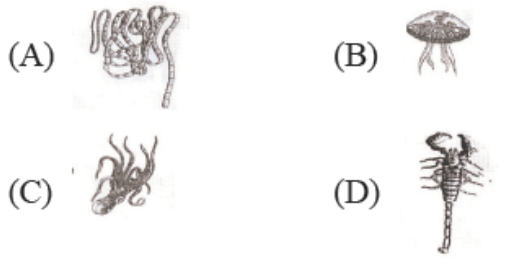
Correct Answer: (d)
(A) is Tapeworm (Acoelomate), (B) is Jellyfish (Cnidaria, Coelenterata), (C) is Octopus (Mollusca, Coelomate), (D) is Scorpion (Arthropoda, Coelomate). Hence (C) and (D) have a true coelom.
(A) is Tapeworm (Acoelomate), (B) is Jellyfish (Cnidaria, Coelenterata), (C) is Octopus (Mollusca, Coelomate), (D) is Scorpion (Arthropoda, Coelomate). Hence (C) and (D) have a true coelom.