Photosynthesis is the fundamental biological process by which green plants, algae, and some bacteria convert light energy into chemical energy, stored in the bonds of organic molecules like glucose. It is the primary source of organic matter and oxygen for almost all life on Earth, forming the base of nearly every food chain.
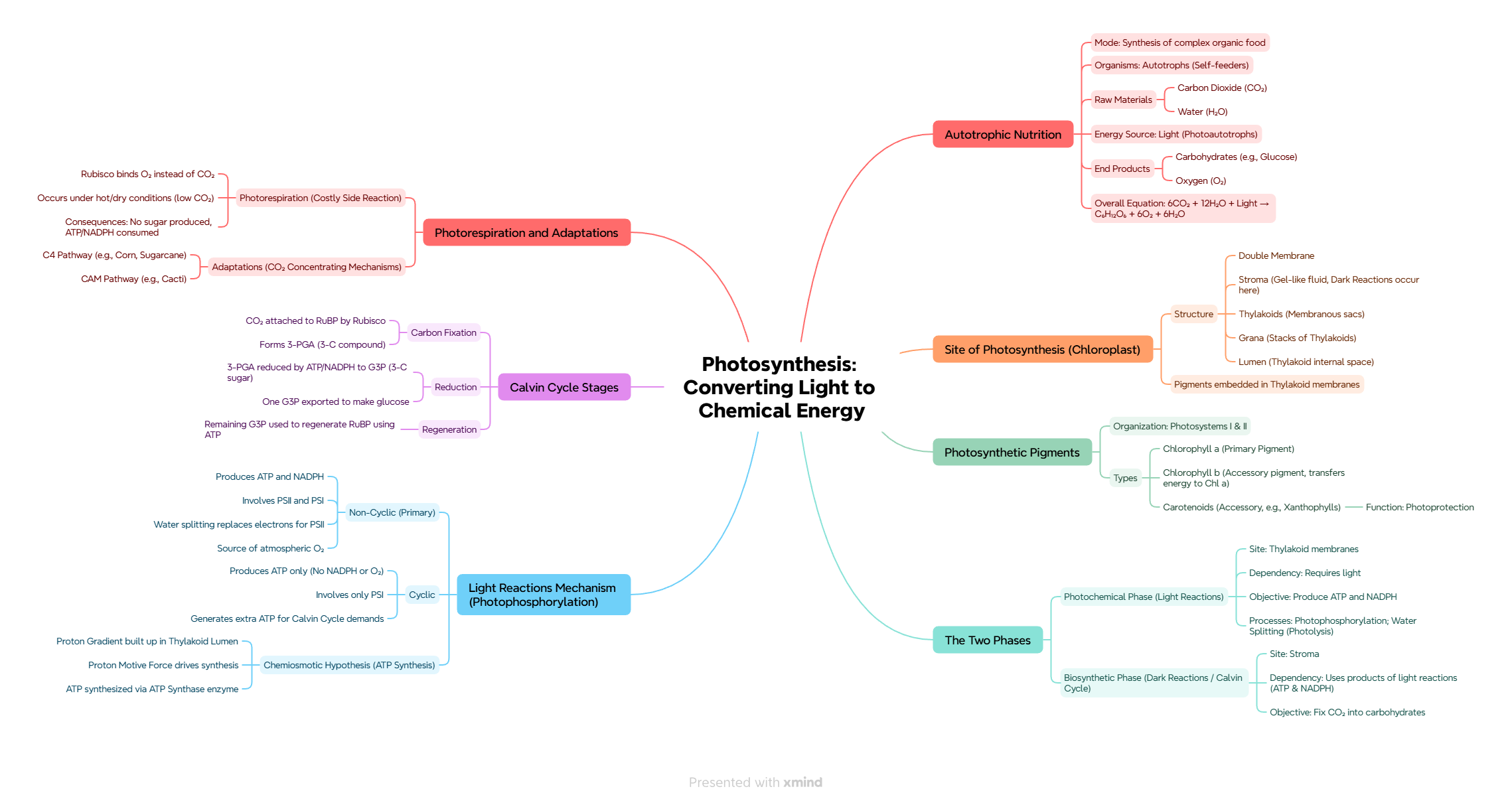
1. Photosynthesis as a Means of Autotrophic Nutrition
Autotrophic nutrition is the mode of nutrition where an organism synthesizes its own complex organic food from simple inorganic substances. Organisms that do this are called autotrophs (meaning “self-feeders”).
- Photosynthesis is the prime example of autotrophic nutrition.
- Raw Materials: Autotrophs use simple, inorganic molecules: Carbon Dioxide (CO₂) from the air and Water (H₂O) from the soil.
- Energy Source: They use a primary energy source to drive this synthesis. In the case of photoautotrophs, this energy is light.
- End Products: The process results in energy-rich carbohydrates (e.g., glucose) and releases Oxygen (O₂) as a byproduct.
The overall chemical equation for photosynthesis summarizes this process:
6CO₂ + 12H₂O + Light Energy → C₆H₁₂O₆ + 6O₂ + 6H₂O
This ability to “fix” carbon dioxide into sugar makes photosynthesis the bridge between the non-living (inorganic world) and the living (organic world).
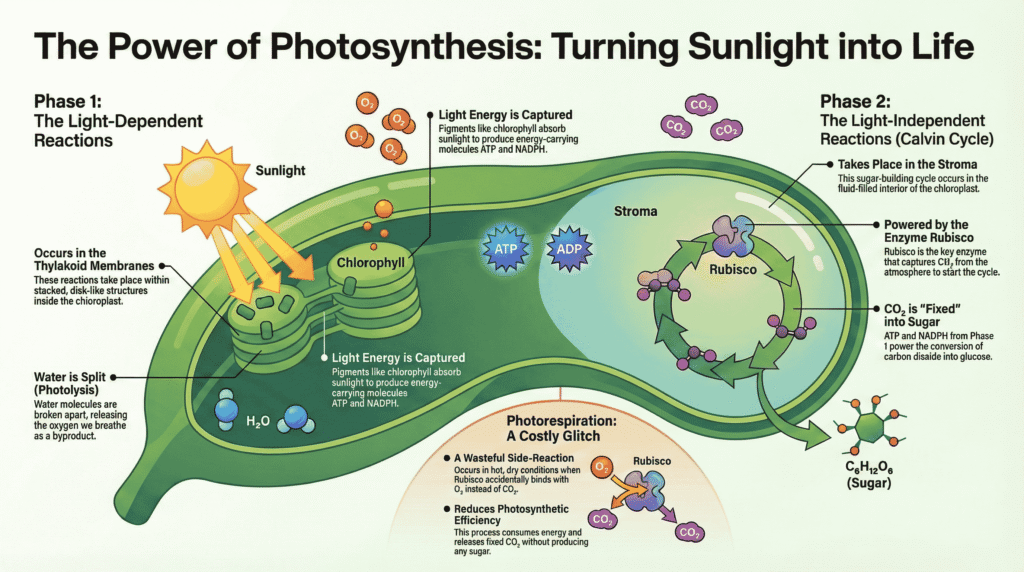
2. Site of Photosynthesis: The Chloroplast
In plants and algae, photosynthesis occurs within specialized organelles called chloroplasts.
- Structure of a Chloroplast:
- Double Membrane: An outer and inner envelope membrane.
- Stroma: A gel-like, protein-rich fluid that fills the interior of the chloroplast. The dark reactions (Calvin Cycle) occur here.
- Thylakoids: A system of flattened, membranous sacs suspended in the stroma.
- Grana (singular: Granum): Stacks of thylakoids resembling piles of coins.
- Lumen: The internal space within a thylakoid.
- Photosynthetic Pigments: Chlorophyll and other pigments are embedded in the thylakoid membranes, which act as the “solar panels” of the cell.
3. Pigments Involved in Photosynthesis
Pigments are molecules that absorb specific wavelengths of light. The primary photosynthetic pigments are organized in clusters called Photosystems (I and II) within the thylakoid membranes.
- Chlorophyll a: This is the primary photosynthetic pigment. It directly converts light energy to chemical energy and is found in all photosynthetic eukaryotes and cyanobacteria. It absorbs light best in the red and blue-violet regions of the spectrum and reflects green light, giving plants their color.
- Chlorophyll b: An accessory pigment that absorbs light in the blue and red-orange spectra. It transfers the absorbed energy to chlorophyll a, thereby broadening the range of light that can be used for photosynthesis.
- Carotenoids: Accessory pigments (e.g., beta-carotene, xanthophylls) that absorb light in the blue-green spectrum and appear yellow, orange, or red. They also play a crucial role in photoprotection—dissipating excess light energy that could otherwise damage chlorophyll.
4. The Two Phases of Photosynthesis
Photosynthesis is a complex process that can be divided into two interconnected phases:
A. The Photochemical Phase (Light Reactions)
- Site: Thylakoid membranes.
- Dependency: Requires light.
- Objective: To convert light energy into the short-term chemical energy carriers ATP and NADPH, while splitting water to release oxygen.
This phase involves two main processes: Photophosphorylation and the Water-Splitting (Photolysis) reaction.
B. The Biosynthetic Phase (Dark Reactions / Calvin Cycle)
- Site: Stroma of the chloroplast.
- Dependency: Does not directly require light (it uses the products of the light reactions).
- Objective: To use the chemical energy from ATP and the reducing power from NADPH to fix atmospheric CO₂ into stable carbohydrates (like glucose).
5. Photophosphorylation: Cyclic and Non-Cyclic
Photophosphorylation is the process of forming ATP from ADP and inorganic phosphate (Pi) using light energy. It occurs via two pathways:
A. Non-Cyclic Photophosphorylation (The Primary Pathway)
This is the linear flow of electrons that produces both ATP and NADPH.
- Photosystem II (PSII): Light energy excites electrons in chlorophyll a (P680). These high-energy electrons are captured by an electron acceptor.
- Photolysis of Water: To replace the lost electrons, PSII catalyzes the splitting of water: 2H₂O → 4H⁺ + 4e⁻ + O₂. This is the source of all atmospheric oxygen.
- Electron Transport Chain (ETC): The excited electrons travel down an ETC, losing energy. This energy is used to pump protons (H⁺) from the stroma into the thylakoid lumen, creating a proton gradient.
- Photosystem I (PSI): The de-energized electrons reach PSI (P700), where they are re-energized by light.
- NADPH Formation: The re-energized electrons are passed to a final acceptor, NADP⁺, reducing it to NADPH.
- ATP Synthesis: The proton gradient built up in the thylakoid lumen drives ATP synthesis via an enzyme called ATP synthase (chemiosmosis).
B. Cyclic Photophosphorylation
This is a cyclic flow of electrons that produces ATP only, but no NADPH or O₂.
- It involves only Photosystem I.
- Excited electrons from PSI are passed back to the Cytochrome b6f complex (the ETC) instead of being used to reduce NADP⁺.
- As they cycle, they still contribute to the proton gradient for ATP synthesis.
- Purpose: To generate extra ATP when the Calvin Cycle’s demand for ATP is higher than its demand for NADPH.
6. The Chemiosmotic Hypothesis
Proposed by Peter Mitchell, this hypothesis explains the mechanism of ATP generation in both chloroplasts and mitochondria.
- Proton Gradient: As electrons flow through the ETC in the thylakoid membrane, proton pumps actively transport protons (H⁺) from the stroma into the thylakoid lumen.
- Generation of a Gradient: This creates a high concentration of H⁺ in the lumen, resulting in both a pH gradient (lumen is more acidic) and an electrical gradient (lumen is more positive). Together, this is the proton motive force.
- ATP Synthesis via ATP Synthase: The H⁺ ions cannot diffuse back through the membrane. Their only path is through a channel protein called ATP synthase. As the protons flow down their gradient back into the stroma, they release energy that causes the ATP synthase enzyme to spin, catalyzing the formation of ATP from ADP and Pi.
7. The Biosynthetic Phase: The Calvin Cycle
This cycle uses the ATP and NADPH from the light reactions to fix CO₂. It occurs in three stages:
- Carbon Fixation: CO₂ is attached to a 5-carbon sugar, RuBP (Ribulose-1,5-bisphosphate), by the enzyme Rubisco. This forms an unstable 6-carbon intermediate that immediately splits into two molecules of a 3-carbon compound, 3-PGA.
- Reduction: The 3-PGA molecules are phosphorylated by ATP and then reduced by NADPH to form G3P (Glyceraldehyde-3-phosphate), a high-energy, 3-carbon sugar. For every 3 CO₂ molecules fixed, 6 molecules of G3P are produced.
- Regeneration: One of the 6 G3P molecules is exported to make glucose and other carbohydrates. The remaining 5 G3P molecules are used, with energy from more ATP, to regenerate the 3 molecules of RuBP to start the cycle again.
8. Photorespiration: A Costly Side Reaction
Photorespiration is a wasteful process that occurs when the enzyme Rubisco binds with Oxygen (O₂) instead of Carbon Dioxide (CO₂).
- When it happens: Under hot and dry conditions, plants close their stomata to conserve water. This causes CO₂ levels to drop and O₂ levels to rise inside the leaf, favoring photorespiration.
- The Consequences:
- No sugar is produced.
- ATP and NADPH are consumed.
- CO₂ is released, undoing the work of fixation.
- It significantly reduces photosynthetic efficiency (by up to 25%).
- Why does it exist? Rubisco evolved in an ancient atmosphere that was high in CO₂ and low in O₂. Photorespiration is likely an unavoidable evolutionary relic, though it may have some minor protective functions.
To combat this inefficiency, some plants (like corn and sugarcane) have evolved the C4 pathway, while others (like cacti) use the CAM pathway, both acting as CO₂-concentrating mechanisms to minimize photorespiration.
In summary, photosynthesis is a magnificent and complex symphony of processes. It begins with the capture of light energy by pigments in the thylakoids, which drives the photochemical production of ATP and NADPH. This energy is then used in the stroma to power the Calvin Cycle, which transforms inorganic CO₂ into life-sustaining sugar. While the process is highly efficient, its key enzyme, Rubisco, is hampered by photorespiration—a flaw that has driven the evolution of remarkable adaptations like the C4 and CAM pathways, allowing plants to conquer a diverse range of environments on our planet.