Q1. Graves' disease is caused due to
Correct Answer: (b)
Hyperthyroidism leads to Graves' disease.
Hyperthyroidism leads to Graves' disease.
Q2. Stirred-tank bioreactors have been designed for
Correct Answer: (c)
The stirrer ensures uniform mixing and aeration.
The stirrer ensures uniform mixing and aeration.
Q3. A few drops of sap were collected by cutting across a plant stem by a suitable method. The sap was tested chemically. Which one of the following test results indicates that it is phloem sap ?
Correct Answer: (b)
Phloem sap is alkaline (pH 7.5 - 8.5) and contains sucrose.
Phloem sap is alkaline (pH 7.5 - 8.5) and contains sucrose.
Q4. Genetic drift operates in
Correct Answer: (a)
Drift is significant in small, isolated populations.
Drift is significant in small, isolated populations.
Q5. Interspecific hybridization is the mating of
Correct Answer: (b)
Hybridization between different species (e.g., mule).
Hybridization between different species (e.g., mule).
Q6. You are given a tissue with its potential for differentiation in an artificial culture. Which of the following pairs of hormones would you add to the medium to secure shoots as well as roots?
Correct Answer: (b)
The balance of Auxin (roots) and Cytokinin (shoots) is essential for morphogenesis.
The balance of Auxin (roots) and Cytokinin (shoots) is essential for morphogenesis.
Q7. Which of the following is correct regarding AIDS causative agent HIV?
Correct Answer: (b)
HIV has 2 identical RNA strands and 2 Reverse Transcriptase enzymes.
HIV has 2 identical RNA strands and 2 Reverse Transcriptase enzymes.
Q8. Which is essential for the growth of root tip?
Correct Answer: (c)
Calcium is required for cell division and the formation of the cell plate.
Calcium is required for cell division and the formation of the cell plate.
Q9. Red List contains data or information on
Correct Answer: (c)
The IUCN Red List tracks the status of threatened and endangered species.
The IUCN Red List tracks the status of threatened and endangered species.
Q10. The mechanism that causes a gene to move from one linkage group to another is called
Correct Answer: (c)
Translocation is the movement of a gene segment to a non-homologous chromosome.
Translocation is the movement of a gene segment to a non-homologous chromosome.
Q11. The partial pressure of oxygen in the alveoli of the lungs is
Correct Answer: (b)
Alveolar pO2 (~104) is higher than blood pO2 (~40).
Alveolar pO2 (~104) is higher than blood pO2 (~40).
Q12. Conifers are adapted to tolerate extreme environmental conditions because of
Correct Answer: (c)
Thick cuticles and sunken stomata are key xerophytic adaptations in conifers.
Thick cuticles and sunken stomata are key xerophytic adaptations in conifers.
Q13. Methanogens belong to
Correct Answer: (b)
Methanogens are specialized Archaebacteria found in anaerobic habitats.
Methanogens are specialized Archaebacteria found in anaerobic habitats.
Q14. Serum differs from blood in
Correct Answer: (c)
Serum = Plasma minus Clotting factors.
Serum = Plasma minus Clotting factors.
Q15. The balloon-shaped structures called tyloses
Correct Answer: (c)
Tyloses are ingrowths of xylem parenchyma into vessel lumens, often blocking them.
Tyloses are ingrowths of xylem parenchyma into vessel lumens, often blocking them.
Q16. Match the stages of meiosis in Column-I to their characteristic features in Column-II and select the correct option using the codes given below :
| a. Pachytene | (i) Pairing of homologous chromosomes |
| b. Metaphase I | (ii) Terminalization of chiasmata |
| c. Diakinesis | (iii) Crossing-over takes place |
| d. Zygotene | (iv) Chromosomes align at equatorial plate |
Correct Answer: (a)
Matches: a-iii, b-iv, c-ii, d-i.
Matches: a-iii, b-iv, c-ii, d-i.
Q17. A molecule that can act as a genetic material must fulfill the traits given below, except
Correct Answer: (c)
Genetic material must be structurally and chemically stable.
Genetic material must be structurally and chemically stable.
Q18. Which of the following is not a component of downstream processing?
Correct Answer: (d)
Expression happens within the bioreactor, not as part of the harvesting/purification stages.
Expression happens within the bioreactor, not as part of the harvesting/purification stages.
Q19. Name the ion responsible for unmasking of active sites for myosin for cross-bridge activity during muscle contraction.
Correct Answer: (a)
Calcium binds to Troponin-C.
Calcium binds to Troponin-C.
Q20. In majority of angiosperms
Correct Answer: (c)
The megaspore mother cell (MMC) undergoes meiosis (reduction division).
The megaspore mother cell (MMC) undergoes meiosis (reduction division).
Q21. Several hormones like hCG, hPL, estrogen, progesterone are produced by
Correct Answer: (b)
Placenta acts as a temporary endocrine gland during pregnancy.
Placenta acts as a temporary endocrine gland during pregnancy.
Q22. The process which makes major difference between C3 and C4 plants is
Correct Answer: (c)
C4 plants have a specialized mechanism (Kranz anatomy) to suppress photorespiration.
C4 plants have a specialized mechanism (Kranz anatomy) to suppress photorespiration.
Q23. The equivalent of a structural gene is
Correct Answer: (b)
A cistron is the unit of DNA that codes for one polypeptide.
A cistron is the unit of DNA that codes for one polypeptide.
Q24. A foreign DNA and plasmid cut by the same restriction endonuclease can be joined to form a recombinant plasmid using
Correct Answer: (d)
DNA ligase joins the sugar-phosphate backbones.
DNA ligase joins the sugar-phosphate backbones.
Q25. Match Column-I with Column-II and select the correct option using the codes given below :
| a. Citric acid | (i) Trichoderma |
| b. Cyclosporin A | (ii) Clostridium |
| c. Statins | (iii) Aspergillus |
| d. Butyric acid | (iv) Monascus |
Correct Answer: (b)
a-iii, b-i, c-iv, d-ii.
a-iii, b-i, c-iv, d-ii.
Q26. A lake which is rich in organic waste may result in
Correct Answer: (d)
Eutrophication leads to oxygen depletion and fish kill.
Eutrophication leads to oxygen depletion and fish kill.
Q27. Which of the following restriction enzymes produces blunt ends?
Correct Answer: (b)
Eco RV cuts both strands squarely at the same point.
Eco RV cuts both strands squarely at the same point.
Q28. Which of the following depicts the correct pathway of transport of sperms?
Correct Answer: (a)
The correct anatomical sequence of sperm ducting.
The correct anatomical sequence of sperm ducting.
Q29. In Hardy-Weinberg equation, the frequency of heterozygous individual is represented by
Correct Answer: (b)
Heterozygote frequency is 2pq in (p+q)^2 = 1.
Heterozygote frequency is 2pq in (p+q)^2 = 1.
Q30. Which of the following sets of diseases is caused by bacteria?
Correct Answer: (a)
Vibrio cholerae and Clostridium tetani are bacteria.
Vibrio cholerae and Clostridium tetani are bacteria.
Q31. A cell organelle containing hydrolytic enzymes is
Correct Answer: (a)
Lysosomes contain a wide variety of hydrolytic (digestive) enzymes.
Lysosomes contain a wide variety of hydrolytic (digestive) enzymes.
Q32. Which hormones do stimulate the production of pancreatic juice and bicarbonate?
Correct Answer: (c)
CCK acts on enzymes; Secretin acts on bicarbonate.
CCK acts on enzymes; Secretin acts on bicarbonate.
Q33. Which of the following is hormone-releasing IUD?
Correct Answer: (a)
LNG-20 releases levonorgestrel.
LNG-20 releases levonorgestrel.
Q34. Name the blood cells, whose reduction in number can cause clotting disorder, leading to excessive loss of blood from the body.
Correct Answer: (d)
Thrombocytes (Platelets) are required for blood clotting.
Thrombocytes (Platelets) are required for blood clotting.
Q35. Which one of the following statements is not correct?
Correct Answer: (c)
Plantlets in potato and ginger arise from the 'nodes', not the internodes.
Plantlets in potato and ginger arise from the 'nodes', not the internodes.
Q36. Taylor conducted the experiments to prove semiconservative mode of chromosome replication on
Correct Answer: (b)
Taylor used radioactive thymidine on Vicia faba (Faba bean) roots.
Taylor used radioactive thymidine on Vicia faba (Faba bean) roots.
Q37. Smooth muscles are
Correct Answer: (a)
Smooth muscles are non-striated, involuntary, and spindle-shaped.
Smooth muscles are non-striated, involuntary, and spindle-shaped.
Q38. If '+' sign is assigned to beneficial interaction, '-' sign to detrimental and '0' sign to neutral interaction, then the population interaction represented by '+' '-' refers to
Correct Answer: (d)
Parasitism involves one winner (+) and one loser (-).
Parasitism involves one winner (+) and one loser (-).
Q39. The primary producers of the deep-sea hydrothermal vent ecosystem are
Correct Answer: (b)
Without light, chemosynthetic bacteria use chemical energy to produce organic matter.
Without light, chemosynthetic bacteria use chemical energy to produce organic matter.
Q40. Lungs do not collapse between breaths and some air always remains in the lungs which can never be expelled because
Correct Answer: (b)
The negative intrapleural pressure prevents collapse.
The negative intrapleural pressure prevents collapse.
Q41. Which of the following is the correct sequence of events in 'the origin of life' ?
I. Formation of protobionts
II. Synthesis of organic monomers
III. Synthesis of organic polymers
IV. Formation of DNA-based genetic systems
I. Formation of protobionts
II. Synthesis of organic monomers
III. Synthesis of organic polymers
IV. Formation of DNA-based genetic systems
Correct Answer: (c)
Standard chemical evolution sequence.
Standard chemical evolution sequence.
Q42. A non-proteinaceous enzyme is
Correct Answer: (b)
Ribozymes are catalytic RNA molecules.
Ribozymes are catalytic RNA molecules.
Q43. Which of the following is the least likely to be involved in stabilizing the three-dimensional folding of most proteins?
Correct Answer: (d)
Ester bonds are not typically involved in protein folding.
Ester bonds are not typically involved in protein folding.
Q44. If a colour-blind man marries a woman who is homozygous for normal colour vision, the probability of their son being colour-blind is
Correct Answer: (a)
Sons inherit the normal X from the mother.
Sons inherit the normal X from the mother.
Q45. Match Column-I with Column-II and select the correct option using the codes given below :
| a. Mons pubis | (i) Embryo formation |
| b. Antrum | (ii) Sperm |
| c. Trophectoderm | (iii) Female external genitalia |
| d. Nebenkern | (iv) Graafian follicle |
Correct Answer: (b)
Correct matches: a-iii, b-iv, c-i, d-ii.
Correct matches: a-iii, b-iv, c-i, d-ii.
Q46. The principle of competetive exclusion was stated by
Correct Answer: (b)
Gause's principle states two species can't occupy the same niche indefinitely.
Gause's principle states two species can't occupy the same niche indefinitely.
Q47. Select the wrong statement.
Correct Answer: (a)
The walls of diatoms are embedded with silica and are nearly indestructible.
The walls of diatoms are embedded with silica and are nearly indestructible.
Q48. The term 'polyadelphous' is related to
Correct Answer: (b)
Polyadelphous refers to stamens united into many bundles.
Polyadelphous refers to stamens united into many bundles.
Q49. The label of a herbarium sheet does not carry information on
Correct Answer: (d)
Herbarium sheets carry data about the collector, date, place, and names, but not the physical height of the specimen.
Herbarium sheets carry data about the collector, date, place, and names, but not the physical height of the specimen.
Q50. Which kind of therapy was given in 1990 to a four-year-old girl with adenosine deaminase (ADA) deficiency?
Correct Answer: (a)
The first clinical gene therapy trial was for ADA deficiency.
The first clinical gene therapy trial was for ADA deficiency.
Q51. Choose the correct statement.
Correct Answer: (c)
Rods and cones hyperpolarize when exposed to light.
Rods and cones hyperpolarize when exposed to light.
Q52. How many hot spots of biodiversity in the world have been identified till date by Norman Myers?
Correct Answer: (c)
Currently, there are 34 identified biodiversity hotspots globally.
Currently, there are 34 identified biodiversity hotspots globally.
Q53. The highest DDT concentration in aquatic food chain shall occur in
Correct Answer: (b)
Biomagnification is highest at the top trophic level (seagull).
Biomagnification is highest at the top trophic level (seagull).
Q54. Name a peptide hormone which acts mainly on hepatocytes, adipocytes and enhances cellular glucose uptake and utilization.
Correct Answer: (a)
Insulin is the primary hypoglycemic hormone.
Insulin is the primary hypoglycemic hormone.
Q55. Select the mismatch.
Correct Answer: (b)
Large central vacuoles are characteristic of plant cells; animal cells have small, temporary vacuoles.
Large central vacuoles are characteristic of plant cells; animal cells have small, temporary vacuoles.
Q56. Match Column-I with Column-II and select the correct option using the codes given below:
| a. Pistils fused together | (i) Gametogenesis |
| b. Formation of gametes | (ii) Pistillate |
| c. Hyphae of higher Ascomycetes | (iii) Syncarpous |
| d. Unisexual female flower | (iv) Dikaryotic |
Correct Answer: (d)
Syncarpous (fused pistils), Gametogenesis (gamete formation), Dikaryotic (Ascomycetes), Pistillate (female flower).
Syncarpous (fused pistils), Gametogenesis (gamete formation), Dikaryotic (Ascomycetes), Pistillate (female flower).
Q57. In male cockroaches, sperms are stored in which part of the reproductive system?
Correct Answer: (a)
Sperms are stored in seminal vesicles for maturation.
Sperms are stored in seminal vesicles for maturation.
Q58. Choose the correct statement.
Correct Answer: (b)
Cyclostomes lack jaws and paired fins (Agnatha).
Cyclostomes lack jaws and paired fins (Agnatha).
Q59. Phytochrome is a
Correct Answer: (d)
Phytochrome is a pigment-bearing protein (chromoprotein).
Phytochrome is a pigment-bearing protein (chromoprotein).
Q60. Embryo with more than 16 blastomeres formed due to in vitro fertilization is transferred into
Correct Answer: (a)
IUT transfers embryos with > 8 cells to the uterus.
IUT transfers embryos with > 8 cells to the uterus.
Q61. Osteoporosis, an age-related disease of skeletal system, may occur due to
Correct Answer: (c)
Post-menopausal estrogen deficiency leads to bone loss.
Post-menopausal estrogen deficiency leads to bone loss.
Q62. Biochemical Oxygen Demand (BOD) may not be a good index for pollution for water bodies receiving effluents from
Correct Answer: (c)
Petroleum effluents contain non-biodegradable chemicals that BOD doesn't capture.
Petroleum effluents contain non-biodegradable chemicals that BOD doesn't capture.
Q63. When cell has stalled DNA replication fork, which checkpoint should be predominantly activated?
Correct Answer: (b)
The G2/M checkpoint ensures DNA is correctly replicated before mitosis.
The G2/M checkpoint ensures DNA is correctly replicated before mitosis.
Q64. The part of nephron involved in active reabsorption of sodium is
Correct Answer: (b)
70-80% of electrolytes are reabsorbed in the PCT.
70-80% of electrolytes are reabsorbed in the PCT.
Q65. Which of the following biomolecules is common to respiration-mediated breakdown of fats, carbohydrates and proteins?
Correct Answer: (d)
Acetyl CoA is the common intermediate where various metabolic pathways converge into the Krebs cycle.
Acetyl CoA is the common intermediate where various metabolic pathways converge into the Krebs cycle.
Q66. How many plants among Indigofera, Sesbania, Salvia, Allium, Aloe, mustard, groundnut, radish, gram and turnip have stamens with different lengths in their flowers?
Correct Answer: (b)
Mustard, Radish, Turnip (tetradynamous) and Salvia have stamens of different lengths.
Mustard, Radish, Turnip (tetradynamous) and Salvia have stamens of different lengths.
Q67. Match Column-I with Column-II for housefly classification and select the correct option using the codes given below :
| a. Family | (i) Diptera |
| b. Order | (ii) Arthropoda |
| c. Class | (iii) Muscidae |
| d. Phylum | (iv) Insecta |
Correct Answer: (a)
Musca domestica: Family Muscidae, Order Diptera, Class Insecta, Phylum Arthropoda.
Musca domestica: Family Muscidae, Order Diptera, Class Insecta, Phylum Arthropoda.
Q68. A true breeding plant is
Correct Answer: (c)
True breeding implies homozygosity and stable inheritance of traits.
True breeding implies homozygosity and stable inheritance of traits.
Q69. Free-central placentation is found in
Correct Answer: (a)
Dianthus and Primrose exhibit free-central placentation.
Dianthus and Primrose exhibit free-central placentation.
Q70. During cell growth, DNA synthesis takes place in
Correct Answer: (a)
Replication of DNA occurs during the Synthesis (S) phase of the cell cycle.
Replication of DNA occurs during the Synthesis (S) phase of the cell cycle.
Q71. Select the wrong statement.
Correct Answer: (b)
Pili and fimbriae are involved in attachment; flagella are involved in motility.
Pili and fimbriae are involved in attachment; flagella are involved in motility.
Q72. Which of the following National Parks is home to the famous musk deer or hangul?
Correct Answer: (d)
Hangul is found specific to Dachigam.
Hangul is found specific to Dachigam.
Q73. DNA-dependent RNA polymerase catalyzes transcription on one strand of the DNA which is called the
Correct Answer: (a)
The mRNA is synthesized on the template strand.
The mRNA is synthesized on the template strand.
Q74. Which one of the following generates new genetic combinations leading to variation?
Correct Answer: (c)
Meiosis and fertilization in sexual reproduction lead to recombination and variation.
Meiosis and fertilization in sexual reproduction lead to recombination and variation.
Q75. Which of the following is correct for r-selected species?
Correct Answer: (a)
r-strategists maximize reproductive rate with many small offspring.
r-strategists maximize reproductive rate with many small offspring.
Q76. Cortex is the region found between
Correct Answer: (a)
Cortex represents the ground tissue between the epidermis and the stele.
Cortex represents the ground tissue between the epidermis and the stele.
Q77. Which one of the following is wrong for fungi?
Correct Answer: (b)
Fungal cell walls are mainly composed of chitin, not purely cellulose.
Fungal cell walls are mainly composed of chitin, not purely cellulose.
Q78. Study the four statements (A-D) given below and select the two correct ones out of them :
A. Definition of biological species was given by Ernst Mayr.
B. Photoperiod does not affect reproduction in plants.
C. Binomial nomenclature system was given by R. H. Whittaker.
D. In unicellular organisms, reproduction is synonymous with growth.
A. Definition of biological species was given by Ernst Mayr.
B. Photoperiod does not affect reproduction in plants.
C. Binomial nomenclature system was given by R. H. Whittaker.
D. In unicellular organisms, reproduction is synonymous with growth.
Correct Answer: (c)
A and D are correct; B is wrong (photoperiod is vital); C is wrong (Linnaeus).
A and D are correct; B is wrong (photoperiod is vital); C is wrong (Linnaeus).
Q79. Which of the following is Incorrect regarding vasectomy?
Correct Answer: (b)
Sperms are still present in the epididymis; they just can't exit via the duct.
Sperms are still present in the epididymis; they just can't exit via the duct.
Q80. Among the following edible fishes, which one is a marine fish having rich source of omega-3 fatty acids?
Correct Answer: (d)
Mackerel is a fatty sea fish rich in omega-3.
Mackerel is a fatty sea fish rich in omega-3.
Q81. Which of the following describes the given graph correctly?
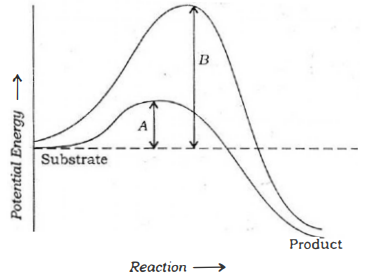
Correct Answer: (b)
Exothermic (product lower than substrate); A is catalyzed activation energy.
Exothermic (product lower than substrate); A is catalyzed activation energy.
Q82. Which of the following rRNAs acts as structural RNA as well as ribozyme in bacteria?
Correct Answer: (c)
23S rRNA acts as the peptidyl transferase ribozyme.
23S rRNA acts as the peptidyl transferase ribozyme.
Q83. Radial symmetry is found in the flowers of
Correct Answer: (a)
Brassica (Mustard) has actinomorphic (radial) symmetry.
Brassica (Mustard) has actinomorphic (radial) symmetry.
Q84. The ovule of an angiosperm is technically equivalent to
Correct Answer: (a)
The ovule is synonymous with the megasporangium.
The ovule is synonymous with the megasporangium.
Q85. Which of the following is correctly matched?
Correct Answer: (c)
Parthenium is an invasive species threatening native biodiversity.
Parthenium is an invasive species threatening native biodiversity.
Q86. Which one of the following statements is wrong ?
Correct Answer: (b)
Algin is obtained from brown algae (Phaeophyceae) and carrageenan from red algae (Rhodophyceae).
Algin is obtained from brown algae (Phaeophyceae) and carrageenan from red algae (Rhodophyceae).
Q87. The chronological order of human evolution from early to the recent is
Correct Answer: (b)
Rama (~15mya) -> Austra (~4mya) -> Habilis -> Erectus.
Rama (~15mya) -> Austra (~4mya) -> Habilis -> Erectus.
Q88. Oxidative phosphorylation is
Correct Answer: (d)
It uses energy from substrate oxidation to create an electrochemical gradient for ATP.
It uses energy from substrate oxidation to create an electrochemical gradient for ATP.
Q89. Pollination in water hyacinth and water lily is brought about by the agency of
Correct Answer: (b)
Despite being aquatic, these plants use wind or insects because flowers emerge above water level.
Despite being aquatic, these plants use wind or insects because flowers emerge above water level.
Q90. The posterior pituitary gland is not a 'true' endocrine gland because
Correct Answer: (b)
It stores/releases Oxytocin and ADH, synthesized in the hypothalamus.
It stores/releases Oxytocin and ADH, synthesized in the hypothalamus.