Q1. The movement of a gene from one linkage group to another is called :-
Correct Answer: (b)
Translocation is the movement of gene segments between non-homologous chromosomes.
Translocation is the movement of gene segments between non-homologous chromosomes.
Q2. Erythropoiesis starts in :
Correct Answer: (c)
In adults, red blood cells are produced in the red bone marrow.
In adults, red blood cells are produced in the red bone marrow.
Q3. Cryopreservation of gametes of threatened species in viable and fertile condition can be referred to as:-
Correct Answer: (a)
Cryopreservation is an advanced ex-situ method performed at very low temperatures.
Cryopreservation is an advanced ex-situ method performed at very low temperatures.
Q4. A major characteristic of the monocot root is the presence of :
Correct Answer: (b)
Monocot roots have closed vascular bundles (no cambium).
Monocot roots have closed vascular bundles (no cambium).
Q5. In an ecosystem the rate of production of organic matter during photosynthesis is termed as:
Correct Answer: (a)
GPP is the total rate of photosynthesis.
GPP is the total rate of photosynthesis.
Q6. Select the correct matching in the following pairs:
Correct Answer: (a)
SER is the major site for lipid and steroid synthesis.
SER is the major site for lipid and steroid synthesis.
Q7. Which of the following cells during gametogenesis is normally dipoid?
Correct Answer: (b)
Spermatogonia and Oogonia are diploid stem cells.
Spermatogonia and Oogonia are diploid stem cells.
Q8. Which one of the following statements is not true?
Correct Answer: (c)
Honey is made from nectar, not digested pollen.
Honey is made from nectar, not digested pollen.
Q9. The guts of cow and buffalo possess:
Correct Answer: (b)
Methanogenic bacteria help in cellulose digestion in ruminants.
Methanogenic bacteria help in cellulose digestion in ruminants.
Q10. Secondary Succession takes place on/in :
Correct Answer: (a)
Secondary succession occurs in areas where soil is already present (e.g. cleared forest).
Secondary succession occurs in areas where soil is already present (e.g. cleared forest).
Q11. Which of the following represents the correct combination without any exception?
| Characteristics | Class |
|---|---|
| (1) Mouth ventral, gills without operculum; skin with placoid scales; persistent notochord | Chondrichthyes |
| (2) Sucking and circular mouth; jaws absent, integument without scales; paired appendages | Cyclostomata |
| (3) Body covered with feathers; skin moist and glandular; fore-limbs form wings; lungs with air sacs | Aves |
| (4) Mammary gland; hair on body; pinnae; two pairs of Limbs | Mammalia |
Correct Answer: (a)
Chondrichthyes features listed are consistent for all members.
Chondrichthyes features listed are consistent for all members.
Q12. Which one of the following is correct ?
Correct Answer: (c)
Blood is composed of plasma and formed elements (RBCs, WBCs, Platelets).
Blood is composed of plasma and formed elements (RBCs, WBCs, Platelets).
Q13. Which of the following enhances or induces fusion of protoplasts ?
Correct Answer: (a)
PEG and sodium nitrate are commonly used as fusogens in protoplast culture.
PEG and sodium nitrate are commonly used as fusogens in protoplast culture.
Q14. In Bt cotton, the Bt toxin present in plant tissue as pro-toxin is converted into active toxin due to :-
Correct Answer: (d)
The alkaline pH of the insect midgut solubilizes the protein crystals into active toxin.
The alkaline pH of the insect midgut solubilizes the protein crystals into active toxin.
Q15. Multiple alleles are present :
Correct Answer: (b)
Multiple alleles occupy the same locus on homologous chromosomes.
Multiple alleles occupy the same locus on homologous chromosomes.
Q16. Which of the following does not favour the formation of large quantities of dilute urine ?
Correct Answer: (b)
Renin initiates the RAAS pathway to conserve water and increase BP, reducing urine dilution.
Renin initiates the RAAS pathway to conserve water and increase BP, reducing urine dilution.
Q17. How many pairs of contrasting characters in pea plants were studied by Mendel in his experiments ?
Correct Answer: (c)
Mendel studied 7 pairs of contrasting traits in Pisum sativum.
Mendel studied 7 pairs of contrasting traits in Pisum sativum.
Q18. DNA is not present in :-
Correct Answer: (a)
Ribosomes consist of RNA and proteins, they do not contain DNA.
Ribosomes consist of RNA and proteins, they do not contain DNA.
Q19. A somatic cell that has just completed the S phase of its cell cycle, as compared to gamete of the same species, has :
Correct Answer: (b)
Gamete is 'n, c'. Somatic cell after S phase is '2n, 4c'.
Gamete is 'n, c'. Somatic cell after S phase is '2n, 4c'.
Q20. Which of the following is not one of the prime health risks associated with greater UV radiation through the atmosphere due to depletion of stratospheric ozone ?
Correct Answer: (c)
Ozone depletion primarily increases skin cancer and eye cataracts, not liver cancer.
Ozone depletion primarily increases skin cancer and eye cataracts, not liver cancer.
Q21. Which of the following had the smallest brain capacity ?
Correct Answer: (c)
Homo habilis brain capacity was ~650-800cc, the smallest among the options.
Homo habilis brain capacity was ~650-800cc, the smallest among the options.
Q22. Glenoid cavity articulates :-
Correct Answer: (c)
The humerus head fits into the glenoid cavity of the scapula.
The humerus head fits into the glenoid cavity of the scapula.
Q23. A man with blood group 'A' marries a woman with blood group 'B'. What are all the possible blood groups of their offsprings ?
Correct Answer: (b)
If parents are heterozygous (Ai and Bi), all four groups are possible.
If parents are heterozygous (Ai and Bi), all four groups are possible.
Q24. Which of these is not an important component of initiation of parturition in humans ?
Correct Answer: (c)
Prolactin is involved in lactation, not in the initiation of labor/parturition.
Prolactin is involved in lactation, not in the initiation of labor/parturition.
Q25. The terga, sterna and pleura of cockroach body are joined by :
Correct Answer: (b)
Sclerites are joined by a flexible articular (arthrodial) membrane.
Sclerites are joined by a flexible articular (arthrodial) membrane.
Q26. Which of the following endoparasites of humans does show viviparity ?
Correct Answer: (b)
Trichinella spiralis is a viviparous nematode.
Trichinella spiralis is a viviparous nematode.
Q27. In sea urchin DNA, which is double stranded, 17% of the bases were shown to be cytosine. The percentages of the other three bases expected to be present in this DNA are :-
Correct Answer: (b)
By Chargaff's rule: C=G (17% each). A+T = 100 - 34 = 66%. So A=33% and T=33%.
By Chargaff's rule: C=G (17% each). A+T = 100 - 34 = 66%. So A=33% and T=33%.
Q28. Vertical distribution of different species occupying different levels in a biotic community is known as:
Correct Answer: (a)
Vertical layering is called stratification.
Vertical layering is called stratification.
Q29. Removal of proximal convoluted tubule from the nephron will result in:
Correct Answer: (d)
Since most water and salt are reabsorbed in the PCT, removing it leads to highly dilute urine.
Since most water and salt are reabsorbed in the PCT, removing it leads to highly dilute urine.
Q30. Most animals are tree dwellers in a:-
Correct Answer: (c)
Arboreal animals are most abundant in stratified tropical rain forests.
Arboreal animals are most abundant in stratified tropical rain forests.
Q31. A population will not exist in Hardy - Weinberg equilibrium if :
Correct Answer: (d)
Equilibrium requires random mating; selective mating causes evolutionary change.
Equilibrium requires random mating; selective mating causes evolutionary change.
Q32. The UN Conference of Parties on climate change in the year 2011 was held in :-
Correct Answer: (a)
COP 17 (2011) was held in Durban, South Africa.
COP 17 (2011) was held in Durban, South Africa.
Q33. Which is the most common mechanism of genetic variation in the population of sexually reproducing organism?
Correct Answer: (c)
Recombination during meiosis is the primary source of variation.
Recombination during meiosis is the primary source of variation.
Q34. Leaves become modified into spines in :-
Correct Answer: (d)
In Opuntia, leaves are modified into spines to reduce water loss.
In Opuntia, leaves are modified into spines to reduce water loss.
Q35. When you hold your breath, which of the following gas changes in blood would first lead to the urge to breathe?
Correct Answer: (a)
Hypercapnia (high CO2) is the primary trigger for the respiratory center.
Hypercapnia (high CO2) is the primary trigger for the respiratory center.
Q36. Which of the following statements is not correct ?
Correct Answer: (d)
Brunner's glands are located in the duodenum (submucosa), not the stomach, and they secrete alkaline mucus.
Brunner's glands are located in the duodenum (submucosa), not the stomach, and they secrete alkaline mucus.
Q37. The hilum is a scar on the :
Correct Answer: (d)
The hilum marks the attachment point of the seed to the stalk (funicle).
The hilum marks the attachment point of the seed to the stalk (funicle).
Q38. A chemical signal that has both endocrine and neural roles is ?
Correct Answer: (b)
Epinephrine (Adrenaline) acts as both a hormone and a neurotransmitter.
Epinephrine (Adrenaline) acts as both a hormone and a neurotransmitter.
Q39. Which of the following are the important floral rewards to the animal pollinators?
Correct Answer: (a)
Nectar and pollen are the primary nutritional rewards.
Nectar and pollen are the primary nutritional rewards.
Q40. The active from of Entamoeba histolytica feeds upon:
Correct Answer: (d)
Trophozoites feed on tissues and blood in the large intestine.
Trophozoites feed on tissues and blood in the large intestine.
Q41. Select the correct option :-
| I | II |
|---|---|
| (a) Synapsis aligns homologous chromosomes | (i) Anaphase-II |
| (b) Synthesis of RNA and protein | (ii) Zygotene |
| (c) Action of enzyme recombinase | (iii) G2-phase |
| (d) Centromeres do not separate but chromatids move towards opposite poles | (iv) Anaphase-I |
Correct Answer: (a)
Synapsis-Zygotene, Synthesis-G2, Recombinase-Pachytene(v), No centromere separation-Anaphase I.
Synapsis-Zygotene, Synthesis-G2, Recombinase-Pachytene(v), No centromere separation-Anaphase I.
Q42. Transpiration and root pressure cause water to rise in plants by :
Correct Answer: (a)
Transpiration creates a 'pull' (tension) while root pressure provides a 'push'.
Transpiration creates a 'pull' (tension) while root pressure provides a 'push'.
Q43. Match each disease with its correct type of vaccine:
(a) tuberculosis (iii) killed bacteria
(b) whooping cough (iv) harmless bacteria
(c) diphtheria (ii) inactivated toxin
(d) polio (i) harmless virus
(a) tuberculosis (iii) killed bacteria
(b) whooping cough (iv) harmless bacteria
(c) diphtheria (ii) inactivated toxin
(d) polio (i) harmless virus
Correct Answer: (b)
TB (BCG-live/harmless), Whooping cough (killed), Diphtheria (toxoid), Polio (OPV-attenuated virus).
TB (BCG-live/harmless), Whooping cough (killed), Diphtheria (toxoid), Polio (OPV-attenuated virus).
Q44. Transmission tissue is characteristic feature of :-
Correct Answer: (a)
Transmission tissue allows pollen tubes to grow through a solid style.
Transmission tissue allows pollen tubes to grow through a solid style.
Q45. The structures that are formed by stacking of organized flattened membranous sacs in the chloroplasts are :
Correct Answer: (a)
Grana are stacks of thylakoids.
Grana are stacks of thylakoids.
Q46. Which one of the following may require pollinators, but is genetically similar to autogamy ?
Correct Answer: (d)
Geitonogamy uses a vector but transfers pollen within the same plant.
Geitonogamy uses a vector but transfers pollen within the same plant.
Q47. In which of the following gametophyte is not independent free living ?
Correct Answer: (c)
In Pinus (Gymnosperm), the gametophyte is highly reduced and dependent on the sporophyte.
In Pinus (Gymnosperm), the gametophyte is highly reduced and dependent on the sporophyte.
Q48. Which of the following characteristics is mainly responsible for diversification of insects on land ?
Correct Answer: (b)
The chitinous exoskeleton provides protection and prevents desiccation on land.
The chitinous exoskeleton provides protection and prevents desiccation on land.
Q49. In ginger vegetative propagation occurs through:
Correct Answer: (d)
Ginger propagates via an underground stem called a rhizome.
Ginger propagates via an underground stem called a rhizome.
Q50. Read the following five statements (A to E) and select the option with all correct statements :-
(A) Mosses and Lichens are the first organisms to colonise a bare rock.
(B) Selaginella is a homosporous pteridophyte
(C) Coralloid roots in Cycas have VAM
(D) Main plant body in bryophytes is gametophytic, whereas in pteridophytes it is sporophytic
(E) In gymnosperms, male and female gametophytes are present within sporangia located on sporophyte
(A) Mosses and Lichens are the first organisms to colonise a bare rock.
(B) Selaginella is a homosporous pteridophyte
(C) Coralloid roots in Cycas have VAM
(D) Main plant body in bryophytes is gametophytic, whereas in pteridophytes it is sporophytic
(E) In gymnosperms, male and female gametophytes are present within sporangia located on sporophyte
Correct Answer: (b)
A, D, and E are correct. Selaginella is heterosporous and Cycas roots have cyanobacteria, not VAM.
A, D, and E are correct. Selaginella is heterosporous and Cycas roots have cyanobacteria, not VAM.
Q51. The crops engineered for glyphosate are resistant/tolerant to :-
Correct Answer: (c)
Glyphosate is an active ingredient in many herbicides.
Glyphosate is an active ingredient in many herbicides.
Q52. Which one of the following is not an inclusion body found in prokaryotes ?
Correct Answer: (c)
Polysomes are chains of ribosomes on mRNA, not inert inclusion bodies.
Polysomes are chains of ribosomes on mRNA, not inert inclusion bodies.
Q53. HIV that causes AIDS, first starts destroying:
Correct Answer: (b)
HIV specifically targets and destroys CD4+ Helper T-cells.
HIV specifically targets and destroys CD4+ Helper T-cells.
Q54. This floral formula belongs to:
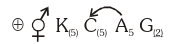
Correct Answer: (b)
This is the formula for family Solanaceae, to which Petunia belongs.
This is the formula for family Solanaceae, to which Petunia belongs.
Q55. In which of the following both pairs have correct combination :-
Correct Answer: (d)
National Parks are in-situ; Botanical Gardens are ex-situ.
National Parks are in-situ; Botanical Gardens are ex-situ.
Q56. Gene regulation governing lactose operon of E.coli that involves the lac I gene product is :
Correct Answer: (a)
The repressor (product of I gene) binds to the operator, making it negative. Lactose induces it.
The repressor (product of I gene) binds to the operator, making it negative. Lactose induces it.
Q57. Capacitation refers to changes in the :-
Correct Answer: (d)
Capacitation is the functional maturation of sperm occurring in the female reproductive tract.
Capacitation is the functional maturation of sperm occurring in the female reproductive tract.
Q58. Perigynous flowers are found in :-
Correct Answer: (c)
Rose, plum, and peach have perigynous flowers.
Rose, plum, and peach have perigynous flowers.
Q59. Minerals known to be required in large amounts for plant growth include :-
Correct Answer: (d)
P, K, S, and Ca are macronutrients required in large quantities.
P, K, S, and Ca are macronutrients required in large quantities.
Q60. Which one of the following statements in incorrect ?
Correct Answer: (c)
Competitive inhibitors *increase* the apparent Km, not decrease it.
Competitive inhibitors *increase* the apparent Km, not decrease it.
Q61. Keel is the characteristic feature of flower of :-
Correct Answer: (a)
Keel is found in Papilionaceous flowers like Indigofera (Fabaceae).
Keel is found in Papilionaceous flowers like Indigofera (Fabaceae).
Q62. The mass of living material at a trophic level at a particular time is called :
Correct Answer: (c)
The total mass of organisms in a trophic level is the standing crop.
The total mass of organisms in a trophic level is the standing crop.
Q63. Which of the following is not a sexually transmitted disease ?
Correct Answer: (c)
Encephalitis is an inflammation of the brain, usually caused by a virus or immune response, not an STD.
Encephalitis is an inflammation of the brain, usually caused by a virus or immune response, not an STD.
Q64. A technique of micropropagation is :-
Correct Answer: (a)
Somatic embryogenesis is used for rapid clonal propagation of plants.
Somatic embryogenesis is used for rapid clonal propagation of plants.
Q65. In a ring girdled plant:
Correct Answer: (a)
Girdling removes the phloem; since food cannot reach the roots, the root dies first.
Girdling removes the phloem; since food cannot reach the roots, the root dies first.
Q66. Gastric juice of infants contains :-
Correct Answer: (b)
Infants have rennin for milk protein digestion, alongside pepsinogen and lipase.
Infants have rennin for milk protein digestion, alongside pepsinogen and lipase.
Q67. True nucleus is absent in :-
Correct Answer: (d)
Anabaena is a prokaryotic cyanobacterium, thus lacks a true nucleus.
Anabaena is a prokaryotic cyanobacterium, thus lacks a true nucleus.
Q68. High value of BOD (Biochemical Oxygen Demand) indicates that :-
Correct Answer: (a)
Higher BOD indicates a high level of biodegradable organic waste and pollution.
Higher BOD indicates a high level of biodegradable organic waste and pollution.
Q69. Which one one of the following matches is correct ?
| Organism | Reproduction | Class |
|---|---|---|
| (1) Alternaria | Sexual reproduction absent | Deuteromycetes |
| (2) Mucor | Reproduction by Conjugation | Ascomycetes |
| (3) Agaricus | Parasitic fungus | Basidiomycetes |
| (4) Phytophthora | Aseptate mycelium | Basidiomycetes |
Correct Answer: (a)
Alternaria belongs to Deuteromycetes (Fungi Imperfecti) where the sexual stage is unknown.
Alternaria belongs to Deuteromycetes (Fungi Imperfecti) where the sexual stage is unknown.
Q70. Nuclear envelope is a derivative of :-
Correct Answer: (c)
The nuclear envelope re-forms during telophase from the RER.
The nuclear envelope re-forms during telophase from the RER.
Q71. Which of the following regions of the brain is incorrectly paired with its function?
Correct Answer: (a)
Language comprehension is handled by the cerebrum (Wernicke's area), not the cerebellum.
Language comprehension is handled by the cerebrum (Wernicke's area), not the cerebellum.
Q72. A gymnast is able to balance his body upside down even in the total darkness because of :-
Correct Answer: (a)
The vestibular apparatus (semicircular canals and otolith organs) is responsible for balance and posture.
The vestibular apparatus (semicircular canals and otolith organs) is responsible for balance and posture.
Q73. Typical growth curve in plants is :-
Correct Answer: (d)
Plant growth typically follows an S-shaped or Sigmoid curve.
Plant growth typically follows an S-shaped or Sigmoid curve.
Q74. Alleles are :
Correct Answer: (b)
Alleles are alternative forms of a gene occupying the same locus.
Alleles are alternative forms of a gene occupying the same locus.
Q75. Male gemetes are flagellated in :
Correct Answer: (b)
Ectocarpus (brown algae) has biflagellate gametes.
Ectocarpus (brown algae) has biflagellate gametes.
Q76. Hysteresctomy is surgical removal of :
Correct Answer: (d)
Hysterectomy is the surgical removal of the uterus.
Hysterectomy is the surgical removal of the uterus.
Q77. The chromosomes in which centromere is situated close to one end are:
Correct Answer: (a)
In acrocentric chromosomes, the centromere is near the end, making one arm very short.
In acrocentric chromosomes, the centromere is near the end, making one arm very short.
Q78. Vascular bundles in monocotyledons are considered closed because:
Correct Answer: (a)
Closed bundles lack lateral meristem (cambium) for secondary growth.
Closed bundles lack lateral meristem (cambium) for secondary growth.
Q79. Which of the following animals is not viviparous?
Correct Answer: (b)
Platypus is a monotreme (egg-laying mammal).
Platypus is a monotreme (egg-laying mammal).
Q80. Which one gives the most valid and recent explanation for stomatal movements ?
Correct Answer: (a)
The K+ pump theory is the most accepted modern explanation for stomatal opening and closing.
The K+ pump theory is the most accepted modern explanation for stomatal opening and closing.
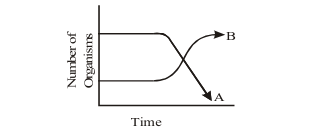
Q81. The following graph depicts changes in two populations (A and B) of herbivores in a grassy field. A possible reason for these changes is that:
Correct Answer: (a)
Competitive exclusion or superior competition leads to the rise of one and fall of another.
Competitive exclusion or superior competition leads to the rise of one and fall of another.
Q82. Rachel Carson's famous book "Silent Spring" is related to :-
Correct Answer: (d)
The book highlighted the environmental impacts of indiscriminate pesticide use (like DDT).
The book highlighted the environmental impacts of indiscriminate pesticide use (like DDT).
Q83. Blood pressure in the mammalian aorta is maximum during :
Correct Answer: (b)
The left ventricle pumps blood into the aorta during systole.
The left ventricle pumps blood into the aorta during systole.
Q84. An abnormal human baby with 'XXX' sex chromosomes was born due to :
Correct Answer: (a)
Non-disjunction during oogenesis results in an egg with XX joined by a normal X sperm.
Non-disjunction during oogenesis results in an egg with XX joined by a normal X sperm.
Q85. Which of the following viruses is not transferred through semen of an infected male?
Correct Answer: (b)
Chikungunya is transmitted primarily by mosquito bites, not semen.
Chikungunya is transmitted primarily by mosquito bites, not semen.
Q86. Sliding filament theory can be best explained as :-
Correct Answer: (b)
Filaments do not change length; they slide over each other to cause muscle contraction.
Filaments do not change length; they slide over each other to cause muscle contraction.
Q87. Which one of the following statements is wrong ?
Correct Answer: (c)
Mannitol is stored in brown algae (Phaeophyceae); red algae store Floridean starch.
Mannitol is stored in brown algae (Phaeophyceae); red algae store Floridean starch.
Q88. Which body of the Government of India regulates GM research and safety of introducing GM organisms for public services ?
Correct Answer: (b)
GEAC (Genetic Engineering Appraisal Committee) regulates GM issues in India.
GEAC (Genetic Engineering Appraisal Committee) regulates GM issues in India.
Q89. Cytochromes are found in :-
Correct Answer: (b)
Cytochromes are components of the Electron Transport Chain located on the inner mitochondrial membrane (cristae).
Cytochromes are components of the Electron Transport Chain located on the inner mitochondrial membrane (cristae).
Q90. What causes a green plant exposed to the light on only one side, to bend toward the source of light as it grows ?
Correct Answer: (c)
Auxin moves away from light to the shaded side, causing elongation and bending.
Auxin moves away from light to the shaded side, causing elongation and bending.