Q1. Which of the following parts of the plant constitute the chief sinks?
(1) Developing flowers (2) Storage organs
(3) Lateral meristems (4) Young leaves
(1) Developing flowers (2) Storage organs
(3) Lateral meristems (4) Young leaves
Correct Answer: (d)
Sinks are areas of growth or storage; all listed parts require sugars for development or accumulation.
Sinks are areas of growth or storage; all listed parts require sugars for development or accumulation.
Q2. Seed increase in its volume by the adsorption of water through
Correct Answer: (c)
This is a repetition of Q13; imbibition involves the surface adsorption of water molecules by hydrophilic colloids in the seed.
This is a repetition of Q13; imbibition involves the surface adsorption of water molecules by hydrophilic colloids in the seed.
Q3. Which of the following is the most acceptable theory for movement of water through plants?
Correct Answer: (a)
The Cohesion-Tension-Transpiration pull theory is currently the most widely accepted explanation for the ascent of sap in tall trees.
The Cohesion-Tension-Transpiration pull theory is currently the most widely accepted explanation for the ascent of sap in tall trees.
Q4. Who proposed that the upward and downward movement of materials take place?
Correct Answer: (d)
O.F. Curtis provided evidence that the phloem is the tissue responsible for the translocation of food materials both upwards and downwards.
O.F. Curtis provided evidence that the phloem is the tissue responsible for the translocation of food materials both upwards and downwards.
Q5. Water will move from the root hairs through cortex if the water potentials are -
Correct Answer: (b)
Water moves from a region of higher water potential (less negative) to a region of lower water potential (more negative). Thus, 0 -> -1 -> -2 is the correct gradient.
Water moves from a region of higher water potential (less negative) to a region of lower water potential (more negative). Thus, 0 -> -1 -> -2 is the correct gradient.
Q6. Match the followings and choose the correct option.
| Column I | Column II |
|---|---|
| A. Leaves | (i) Anti-transpirant |
| B. Seed | (ii) Transpiration |
| C. Roots potential | (iii) Negative osmotic |
| D. Aspirin | (iv) Imbibition |
| E. Plasmolysed cell | (v) Absorption |
Correct Answer: (a)
Leaves = Transpiration (ii); Seed = Imbibition (iv); Roots = Absorption (v); Aspirin = Anti-transpirant (i); Plasmolysed cell = negative pressure/osmotic status (iii).
Leaves = Transpiration (ii); Seed = Imbibition (iv); Roots = Absorption (v); Aspirin = Anti-transpirant (i); Plasmolysed cell = negative pressure/osmotic status (iii).
Q7. Which of the following statement is incorrect regarding stomata?
Correct Answer: (d)
The inner wall of the guard cell is actually thick and rigid, not thin. This structural asymmetry is what causes the cells to bow out when turgid.
The inner wall of the guard cell is actually thick and rigid, not thin. This structural asymmetry is what causes the cells to bow out when turgid.
Q8. The movement of water from one cell of the cortex to the adjacent one in roots is due to
Correct Answer: (a)
Cell-to-cell movement of water in the root cortex follows a water potential gradient, moving from cells with higher water potential to those with lower potential.
Cell-to-cell movement of water in the root cortex follows a water potential gradient, moving from cells with higher water potential to those with lower potential.
Q9. A cell swells up when kept in
Correct Answer: (a)
In a hypotonic solution, the external water potential is higher than inside the cell, causing water to enter the cell by endosmosis, making it swell.
In a hypotonic solution, the external water potential is higher than inside the cell, causing water to enter the cell by endosmosis, making it swell.
Q10. A Botanist discovered a mutant plant that was unable to produce materials that form casparian strip. This plant would:
Correct Answer: (d)
The casparian strip in the endodermis acts as a selective barrier that forces water and minerals into the symplast, allowing the plant to regulate solute uptake. Without it, control is lost.
The casparian strip in the endodermis acts as a selective barrier that forces water and minerals into the symplast, allowing the plant to regulate solute uptake. Without it, control is lost.
Q11. Stomata closes because
Correct Answer: (a)
Stomatal closure occurs when guard cells lose water to the surrounding subsidiary cells, causing them to lose turgidity and become flaccid.
Stomatal closure occurs when guard cells lose water to the surrounding subsidiary cells, causing them to lose turgidity and become flaccid.
Q12. A botanist discovered a mutant plant that was unable to produce materials that form casparian strip. This plant would be
Correct Answer: (d)
The lack of Casparian strip means the endodermis cannot check the entry of ions into the xylem, resulting in uncontrolled solute uptake.
The lack of Casparian strip means the endodermis cannot check the entry of ions into the xylem, resulting in uncontrolled solute uptake.
Q13. Choose the option which shows the correct labelling of the parts marked as A, B, C, D and E in the given figure of water movement in the leaf.
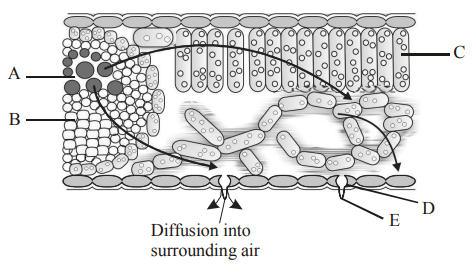
Correct Answer: (c)
In a cross-section of a leaf: A is Xylem (conducts water), B is Phloem, C is the Palisade mesophyll, D is the Guard cell, and E is the Stomatal pore through which water vapor diffuses.
In a cross-section of a leaf: A is Xylem (conducts water), B is Phloem, C is the Palisade mesophyll, D is the Guard cell, and E is the Stomatal pore through which water vapor diffuses.
Q14. Read the given statement and answer the question : “Osmosis is the diffusion of a solution of a weaker concentration when both are separated by semipermeable membrane”. What is the error in the statement ?
Correct Answer: (a)
In osmosis, it is the solvent (water) that diffuses, not the 'solution' itself. A solution consists of both solute and solvent.
In osmosis, it is the solvent (water) that diffuses, not the 'solution' itself. A solution consists of both solute and solvent.
Q15. Which ions accumulate in vacuoles of guard cells during stomatal opening?
Correct Answer: (a)
Stomatal opening is caused by the accumulation of solutes like K+ and Cl- ions and organic acids like malate in the guard cell vacuole, lowering their water potential.
Stomatal opening is caused by the accumulation of solutes like K+ and Cl- ions and organic acids like malate in the guard cell vacuole, lowering their water potential.
Q16. The force responsible for upward conduction of water against gravity comes from _______.
Correct Answer: (a)
The evaporation of water from leaves (transpiration) creates a tension or 'pull' that is transmitted down to the roots through the continuous water column in the xylem.
The evaporation of water from leaves (transpiration) creates a tension or 'pull' that is transmitted down to the roots through the continuous water column in the xylem.
Q17. Which of the following will affect the active uptake of water?
Correct Answer: (c)
Active uptake of water by roots is influenced by the negative pressure or tension created by transpiration in the leaves, which pulls water upwards through the xylem.
Active uptake of water by roots is influenced by the negative pressure or tension created by transpiration in the leaves, which pulls water upwards through the xylem.
Q18. A plant cell placed in pure water will
Correct Answer: (b)
In pure water (ψw = 0), water enters the cell until the developed turgor pressure (positive pressure potential) numerically balances the solute potential, resulting in ψw = 0.
In pure water (ψw = 0), water enters the cell until the developed turgor pressure (positive pressure potential) numerically balances the solute potential, resulting in ψw = 0.
Q19. Water in the adjacent xylem moves into the phloem by the process of
Correct Answer: (d)
As sugars are loaded into the phloem at the source, the water potential drops, causing water to move from the adjacent xylem into the phloem sieve tubes by osmosis.
As sugars are loaded into the phloem at the source, the water potential drops, causing water to move from the adjacent xylem into the phloem sieve tubes by osmosis.
Q20. Process by which water enters in the roots due to diffusion, is termed as
Correct Answer: (a)
Osmosis is the specific term used for the diffusion of water across a semi-permeable membrane.
Osmosis is the specific term used for the diffusion of water across a semi-permeable membrane.
Q21. Which one of the following is not related to guttation?
Correct Answer: (c)
Guttation typically occurs at night or early in the morning when root pressure is high and transpiration is very low.
Guttation typically occurs at night or early in the morning when root pressure is high and transpiration is very low.
Q22. What is required for the transport of substances, through a membrane, from a region of lower concentration to higher concentration?
Correct Answer: (a)
Transport against a concentration gradient (uphill transport) is called active transport and requires the input of energy in the form of ATP.
Transport against a concentration gradient (uphill transport) is called active transport and requires the input of energy in the form of ATP.
Q23. At which cell layer, water movement through the apoplast pathway is restricted and is facilitated towards symplast pathway?
Correct Answer: (d)
The suberized casparian strips in the endodermis block the apoplastic movement, forcing water to cross the cell membrane and enter the symplast pathway.
The suberized casparian strips in the endodermis block the apoplastic movement, forcing water to cross the cell membrane and enter the symplast pathway.
Q24. Which one gives the most valid and recent explanation for stomatal movements?
Correct Answer: (a)
Levitt's K+ pump theory is the most widely accepted modern explanation for stomatal opening (K+ influx) and closing (K+ efflux).
Levitt's K+ pump theory is the most widely accepted modern explanation for stomatal opening (K+ influx) and closing (K+ efflux).
Q25. The hypothesis accepted for the translocation of sugar from source to sink is________.
Correct Answer: (d)
The Pressure Flow Hypothesis (also known as the Mass Flow Hypothesis) explains the movement of sugar in phloem driven by a turgor pressure gradient.
The Pressure Flow Hypothesis (also known as the Mass Flow Hypothesis) explains the movement of sugar in phloem driven by a turgor pressure gradient.
Q26. Find out the incorrect statements.
Correct Answer: (a)
Plasmolysis is usually a reversible process; when a plasmolysed cell is placed in a hypotonic solution, water moves back into the cell, and it regains turgidity.
Plasmolysis is usually a reversible process; when a plasmolysed cell is placed in a hypotonic solution, water moves back into the cell, and it regains turgidity.
Q27. Identify the pair that is selective and specific in mode of transport?
Correct Answer: (c)
Both facilitated diffusion and active transport utilize specific carrier proteins, making them highly selective and specific compared to simple diffusion.
Both facilitated diffusion and active transport utilize specific carrier proteins, making them highly selective and specific compared to simple diffusion.
Q28. Which of the following statements is/are incorrect?
(i) Water, minerals and food are generally moved by a mass or bulk flow system.
(ii) Bulk flow can be achieved either through a positive hydrostatic pressure gradient or a negative hydrostatic pressure gradient.
(iii) The bulk movement of substances through the conducting tissues of plants is called translocation.
(iv) Xylem translocates organic and inorganic solutes, mainly from roots to the aerial parts of the plants.
(v) Phloem translocates water, mineral salts, some organic nitrogen and hormones, from the leaves to other parts of the plants.
(i) Water, minerals and food are generally moved by a mass or bulk flow system.
(ii) Bulk flow can be achieved either through a positive hydrostatic pressure gradient or a negative hydrostatic pressure gradient.
(iii) The bulk movement of substances through the conducting tissues of plants is called translocation.
(iv) Xylem translocates organic and inorganic solutes, mainly from roots to the aerial parts of the plants.
(v) Phloem translocates water, mineral salts, some organic nitrogen and hormones, from the leaves to other parts of the plants.
Correct Answer: (c)
Statements (iv) and (v) are generally considered correct descriptions. However, standard definitions say Xylem mainly translocates water and minerals. Phloem mainly translocates sucrose. In statement (v), Phloem primarily translocates organic solutes, while minerals can also be remobilized through it.
Statements (iv) and (v) are generally considered correct descriptions. However, standard definitions say Xylem mainly translocates water and minerals. Phloem mainly translocates sucrose. In statement (v), Phloem primarily translocates organic solutes, while minerals can also be remobilized through it.
Q29. In which method of transport in plasma membrane does not require carrier molecule?
Correct Answer: (c)
Simple diffusion is the movement of molecules directly through the phospholipid bilayer without the assistance of any specific protein carriers.
Simple diffusion is the movement of molecules directly through the phospholipid bilayer without the assistance of any specific protein carriers.
Q30. Water potential of pure water at standard temperature is equal to
Correct Answer: (c)
By convention, the water potential of pure water at standard temperature and pressure is assigned a value of zero.
By convention, the water potential of pure water at standard temperature and pressure is assigned a value of zero.
Q31. Which of the following statements is incorrect?
Correct Answer: (c)
Suction through a straw creates a vacuum or tension, which is an example of negative hydrostatic pressure, not positive.
Suction through a straw creates a vacuum or tension, which is an example of negative hydrostatic pressure, not positive.
Q32. Bidirectional translocation of minerals takes place in
Correct Answer: (b)
Phloem can transport organic and inorganic solutes in both upward and downward directions (source to sink), whereas xylem transport is strictly unidirectional.
Phloem can transport organic and inorganic solutes in both upward and downward directions (source to sink), whereas xylem transport is strictly unidirectional.
Q33. Which of the following helps in the absorption of water and mineral salts?
Correct Answer: (a)
Mycorrhiza is a symbiotic association of a fungus with a root system that provides a large surface area for the absorption of water and minerals from the soil.
Mycorrhiza is a symbiotic association of a fungus with a root system that provides a large surface area for the absorption of water and minerals from the soil.
Q34. The process of loading at the source produces a _________. condition in the phloem.
Correct Answer: (a)
Active loading of sucrose into phloem sieve elements creates a hypertonic (high solute concentration) environment.
Active loading of sucrose into phloem sieve elements creates a hypertonic (high solute concentration) environment.
Q35. When a plant undergoes senescence, the nutrients may be
Correct Answer: (c)
Before death/shedding (senescence) of older leaves, mobile minerals are translocated to younger parts of the plant.
Before death/shedding (senescence) of older leaves, mobile minerals are translocated to younger parts of the plant.
Q36. Consider the following statements:
(1) Cell Wall is a barrier to movement as it is not freely permeable to water and substances in solution.
(2) Affinity between the adsorbant and the liquid is not a pre-requisite for Imbibition.
Which of the statement(s) given above is/are correct?
(1) Cell Wall is a barrier to movement as it is not freely permeable to water and substances in solution.
(2) Affinity between the adsorbant and the liquid is not a pre-requisite for Imbibition.
Which of the statement(s) given above is/are correct?
Correct Answer: (d)
Cell walls are generally freely permeable, and affinity between the adsorbant and the liquid is a mandatory pre-requisite for imbibition to occur.
Cell walls are generally freely permeable, and affinity between the adsorbant and the liquid is a mandatory pre-requisite for imbibition to occur.
Q37. Which one of the following will not directly affect transpiration?
Correct Answer: (d)
Temperature, light, and wind speed are external environmental factors that directly control the rate of transpiration, while chlorophyll content is primarily related to photosynthesis.
Temperature, light, and wind speed are external environmental factors that directly control the rate of transpiration, while chlorophyll content is primarily related to photosynthesis.
Q38. A boy is studying transport of a certain type of molecules into cell. He finds that transport slows down when the cells are poisoned with a chemical that inhibits energy production. Under normal circumstances the molecules studied by the boy is probably transported by
Correct Answer: (c)
Active transport requires energy (ATP). If energy production is inhibited, the transport process will significantly slow down or stop.
Active transport requires energy (ATP). If energy production is inhibited, the transport process will significantly slow down or stop.
Q39. If a stem is girdled:
Correct Answer: (a)
Girdling (ringing) removes the phloem. This stops the downward movement of food, so the roots are deprived of nutrients and die first.
Girdling (ringing) removes the phloem. This stops the downward movement of food, so the roots are deprived of nutrients and die first.
Q40. Choose the correct option mycorrhiza is a symbiotic association of fungus with root system which helps in
A. absorption of water B. mineral nutrition
C. translocation D. gaseous exchange
A. absorption of water B. mineral nutrition
C. translocation D. gaseous exchange
Correct Answer: (c)
Mycorrhizal associations significantly enhance the plant's ability to absorb both water and vital minerals (especially phosphorus) from the soil.
Mycorrhizal associations significantly enhance the plant's ability to absorb both water and vital minerals (especially phosphorus) from the soil.
Q41. Which of the following statements is/are not incorrect?
(i) Water and minerals, and food are generally moved by a mass or bulk flow system.
(ii) Bulk flow can be achieved either through a positive hydrostatic pressure gradient or a negative hydrostatic pressure gradient.
(iii) The bulk movement of substances through the conducting tissues of plants is called translocation.
(iv) Xylem translocates organic and inorganic solutes, mainly from roots to the aerial parts of the plants.
(v) Phloem translocates water, mineral salts, some organic nitrogen and hormones, from the leaves to other parts of the plants.
(i) Water and minerals, and food are generally moved by a mass or bulk flow system.
(ii) Bulk flow can be achieved either through a positive hydrostatic pressure gradient or a negative hydrostatic pressure gradient.
(iii) The bulk movement of substances through the conducting tissues of plants is called translocation.
(iv) Xylem translocates organic and inorganic solutes, mainly from roots to the aerial parts of the plants.
(v) Phloem translocates water, mineral salts, some organic nitrogen and hormones, from the leaves to other parts of the plants.
Correct Answer: (c)
Standard biological facts from NCERT state that water, minerals, and organic solutes are moved via mass flow (translocation) using both positive and negative pressure systems.
Standard biological facts from NCERT state that water, minerals, and organic solutes are moved via mass flow (translocation) using both positive and negative pressure systems.
Q42. The type of transport of minerals through xylem and the energy requirement is:
Correct Answer: (a)
While water transport is passive, the initial loading of mineral ions into the root xylem is often an active process requiring ATP energy.
While water transport is passive, the initial loading of mineral ions into the root xylem is often an active process requiring ATP energy.
Q43. Water vapour comes out from the plant leaf through the stomatal opening. Through the same stomatal opening, carbon dioxide diffuses into the plant during photosynthesis. Reason out the above statements using one of following options
Correct Answer: (b)
Since water and CO2 are different molecules, their diffusion occurs independently according to their own partial pressure gradients through the same opening.
Since water and CO2 are different molecules, their diffusion occurs independently according to their own partial pressure gradients through the same opening.
Q44. Which one of the following doesn’t help in molecule transport?
Correct Answer: (c)
Diffusion, osmosis, and active transport are all established mechanisms for the movement of molecules across membranes, whereas surface tension is a physical property of liquids not directly involved in transport across membranes.
Diffusion, osmosis, and active transport are all established mechanisms for the movement of molecules across membranes, whereas surface tension is a physical property of liquids not directly involved in transport across membranes.
Q45. Which of the following factors affect transpiration?
(i) Number and distribution of stomata.
(ii) Percent of open stomata.
(iii) Water status of the plant.
(iv) Canopy structure.
(i) Number and distribution of stomata.
(ii) Percent of open stomata.
(iii) Water status of the plant.
(iv) Canopy structure.
Correct Answer: (d)
Transpiration is influenced by both environmental factors and plant-specific factors including stomatal count, distribution, water availability, and the arrangement of the canopy.
Transpiration is influenced by both environmental factors and plant-specific factors including stomatal count, distribution, water availability, and the arrangement of the canopy.
Q46. Starch is insoluble in water, yet it is accumulated in large quantities in potato tuber because
Correct Answer: (d)
Sugar is translocated from leaves to roots/tubers in the form of sucrose. Once it reaches the potato tuber, it is converted and stored as insoluble starch.
Sugar is translocated from leaves to roots/tubers in the form of sucrose. Once it reaches the potato tuber, it is converted and stored as insoluble starch.
Q47. A column of water within xylem vessels of tall trees does not break under its weight because of
Correct Answer: (a)
Water has high tensile strength (resistance to being pulled apart) and high cohesion, which maintains a continuous column even in very tall trees.
Water has high tensile strength (resistance to being pulled apart) and high cohesion, which maintains a continuous column even in very tall trees.
Q48. Which of the following statements is/are correct?
(i) The apoplastic movement of water occurs exclusively through the cell wall without crossing any membranes.
(ii) The apoplastic movement occurs from cell to cell through the plasmodesmata.
(iii) Endodermis is impervious to water because of a band of suberised matrix.
(iv) Symplastic movement may be aided by cytoplasmic streaming which occurs in Hydrilla leaf and chloroplast.
(i) The apoplastic movement of water occurs exclusively through the cell wall without crossing any membranes.
(ii) The apoplastic movement occurs from cell to cell through the plasmodesmata.
(iii) Endodermis is impervious to water because of a band of suberised matrix.
(iv) Symplastic movement may be aided by cytoplasmic streaming which occurs in Hydrilla leaf and chloroplast.
Correct Answer: (c)
Statement (ii) is incorrect because movement through plasmodesmata is part of the symplast, not the apoplast. Statements (i), (iii), and (iv) are all correct NCERT facts.
Statement (ii) is incorrect because movement through plasmodesmata is part of the symplast, not the apoplast. Statements (i), (iii), and (iv) are all correct NCERT facts.
Q49. Stomatal movement is not affected by
Correct Answer: (d)
Light, temperature, and CO2 levels are major regulators of stomatal opening and closing; O2 concentration has little to no direct effect.
Light, temperature, and CO2 levels are major regulators of stomatal opening and closing; O2 concentration has little to no direct effect.
Q50. Match the name of the activities given under column-I with the description of activity given under column-II and choose the correct option.
| Column-I | Column-II |
|---|---|
| A. Cohesion | I. The ability to rise in their tubes. |
| B. Adhesion | II. Loss of water vapour from plant parts. |
| C. Tensile strength | III. Mutual attraction between water molecules |
| D. Capillarity | IV. Attraction of water molecules to polar surfaces |
| V. An ability to resist a pulling force. |
Correct Answer: (a)
Cohesion is mutual attraction (III); Adhesion is attraction to polar surfaces (IV); Tensile strength is resistance to pulling (V); Capillarity is the ability to rise in thin tubes (I).
Cohesion is mutual attraction (III); Adhesion is attraction to polar surfaces (IV); Tensile strength is resistance to pulling (V); Capillarity is the ability to rise in thin tubes (I).
Q51. The process in which water moves out of the cell and the cell membrane of a plant cell shrinks away from its cell wall is known as
Correct Answer: (c)
This is the classic definition of plasmolysis, occurring when the cell is in a hypertonic environment.
This is the classic definition of plasmolysis, occurring when the cell is in a hypertonic environment.
Q52. Root pressure develops due to
Correct Answer: (d)
Root pressure is the result of the active transport of ions into the root xylem, which lowers the water potential and causes water to follow osmotically.
Root pressure is the result of the active transport of ions into the root xylem, which lowers the water potential and causes water to follow osmotically.
Q53. Which of the following is an example of imbibition?
Correct Answer: (c)
Dry seeds swell up when they come in contact with moisture through the physical process of water adsorption known as imbibition.
Dry seeds swell up when they come in contact with moisture through the physical process of water adsorption known as imbibition.
Q54. The movement of mineral ions into plant root cells as a result of diffusion is called
Correct Answer: (c)
Absorption of minerals along the concentration gradient through the process of diffusion without the expenditure of energy is called passive absorption.
Absorption of minerals along the concentration gradient through the process of diffusion without the expenditure of energy is called passive absorption.
Q55. Which of the following organism helps in the absorption of water and mineral ions from the soil?
Correct Answer: (c)
Fungal hyphae of mycorrhiza extend far into the soil, providing a much larger surface area for absorption than root hairs alone.
Fungal hyphae of mycorrhiza extend far into the soil, providing a much larger surface area for absorption than root hairs alone.
Q56. Bulk flow of substances over the longer distances through the vascular tissue is called
Correct Answer: (d)
Translocation is the term for the long-distance transport of water, minerals, and food through the xylem and phloem by mass flow.
Translocation is the term for the long-distance transport of water, minerals, and food through the xylem and phloem by mass flow.
Q57. Grass leaves curl inwards during very dry weather. Select the most appropriate reason from the following:
Correct Answer: (b)
In grasses, specialized bulliform cells lose turgidity during water stress, causing the leaves to curl or roll inwards to minimize water loss.
In grasses, specialized bulliform cells lose turgidity during water stress, causing the leaves to curl or roll inwards to minimize water loss.
Q58. The path of water from soil upto secondary xylem is
Correct Answer: (a)
Water enters through the root hairs and travels through the cortex, endodermis, and pericycle to reach the primary xylem (protoxylem followed by metaxylem).
Water enters through the root hairs and travels through the cortex, endodermis, and pericycle to reach the primary xylem (protoxylem followed by metaxylem).
Q59. Which of the following affects the transport of molecules, when carrier mediated facilitated diffusion is involved?
Correct Answer: (d)
The rate of facilitated diffusion depends on the concentration gradient, the solubility of the molecules in lipids (to pass through the membrane), and the number of available protein carriers (saturation point).
The rate of facilitated diffusion depends on the concentration gradient, the solubility of the molecules in lipids (to pass through the membrane), and the number of available protein carriers (saturation point).
Q60. In root endodermis there is one way active transport of ions because of presence of:
Correct Answer: (b)
The suberin layer (Casparian strip) in the endodermis prevents ions from leaking back out to the cortex, ensuring unidirectional (one-way) movement into the xylem.
The suberin layer (Casparian strip) in the endodermis prevents ions from leaking back out to the cortex, ensuring unidirectional (one-way) movement into the xylem.
Q61. During fruit development, photosynthesizing leaves would be the __________ and the fruit would be the __________
Correct Answer: (d)
Leaves produce sugar via photosynthesis (source) and Developing fruits consume or store it (sink).
Leaves produce sugar via photosynthesis (source) and Developing fruits consume or store it (sink).
Q62. Roots play insignificant role in absorption of water in
Correct Answer: (a)
Pistia is a free-floating aquatic plant; such plants absorb water from their entire surface, and roots are primarily used for balance, not major absorption.
Pistia is a free-floating aquatic plant; such plants absorb water from their entire surface, and roots are primarily used for balance, not major absorption.
Q63. Match the name of the activities given under column-I with the description of activity given under column-II and choose the correct option.
| Column-I | Column-II |
|---|---|
| A. Transpiration | I. Anaerobic respiration in yeast |
| B. Guttation | II. Active absorption of water |
| C. Exudation | III. Loss of water vapour from plant parts |
| D. Fermentation | IV. Loss of liquid water from leaves |
| V. Loss of water from injured plant parts |
Correct Answer: (a)
Transpiration = vapor loss (III); Guttation = liquid loss from intact plant (IV); Exudation = loss from injured parts (V); Fermentation = anaerobic respiration (I).
Transpiration = vapor loss (III); Guttation = liquid loss from intact plant (IV); Exudation = loss from injured parts (V); Fermentation = anaerobic respiration (I).
Q64. If a cell A with D.P.D. 4 bars is connected to cell B, C, D whose O.P. and T.P. are respectively 4 and 4, 10 and 5 and 7 and 3 bars, the flow of water will be:
Correct Answer: (c)
DPD = OP - TP. DPD of A=4. DPD of B=4-4=0. DPD of C=10-5=5. DPD of D=7-3=4. Water moves from low DPD to high DPD. Cell B has DPD 0, so water will flow from B to all other cells.
DPD = OP - TP. DPD of A=4. DPD of B=4-4=0. DPD of C=10-5=5. DPD of D=7-3=4. Water moves from low DPD to high DPD. Cell B has DPD 0, so water will flow from B to all other cells.
Q65. Based on Munch’s pressure-flow hypothesis shown in the given figure which of the following conditions would increase the rate of translocation?
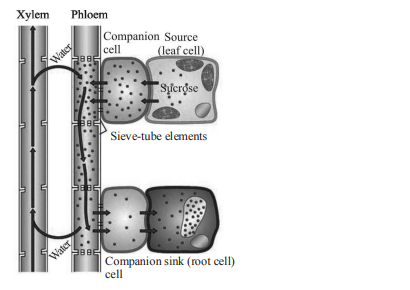
Correct Answer: (c)
More sucrose production at the source increases the osmotic concentration and turgor pressure, thereby increasing the pressure gradient and the rate of mass flow.
More sucrose production at the source increases the osmotic concentration and turgor pressure, thereby increasing the pressure gradient and the rate of mass flow.
Q66. A boy is studying transport of a certain type of molecules into cell. He finds that transport slows down when the cells are poisoned with a chemical that inhibits energy production. Under normal circumstances, the molecules studied by the boy is probably transported by:
Correct Answer: (c)
Repetition of Q33; active transport is directly dependent on cellular metabolic energy (ATP).
Repetition of Q33; active transport is directly dependent on cellular metabolic energy (ATP).
Q67. Guttation is loss of impure water which is the result of
Correct Answer: (c)
When transpiration is low and root pressure is high, water is forced out of specialized openings called hydathodes in the form of droplets, a process called guttation.
When transpiration is low and root pressure is high, water is forced out of specialized openings called hydathodes in the form of droplets, a process called guttation.
Q68. Casparian strip is made up of
Correct Answer: (c)
Casparian strips are composed of suberin, a waxy, water-impermeable material found in the endodermal cell walls of roots.
Casparian strips are composed of suberin, a waxy, water-impermeable material found in the endodermal cell walls of roots.
Q69. Cell A and cell B are adjacent plant cells. In cell A, ψₛ = – 20 bars and ψₚ = 8 bars. In cell B, ψₛ = – 12 bars and ψₚ = 2 bars. Then
Correct Answer: (c)
Water potential ψ = ψₛ + ψₚ. For cell A, ψ = -20 + 8 = -12 bars. For cell B, ψ = -12 + 2 = -10 bars. Water moves from higher potential (B, -10) to lower potential (A, -12).
Water potential ψ = ψₛ + ψₚ. For cell A, ψ = -20 + 8 = -12 bars. For cell B, ψ = -12 + 2 = -10 bars. Water moves from higher potential (B, -10) to lower potential (A, -12).
Q70. With regard to C3 and C4 plants, consider the following statements:
(1) C4 plants are twice as efficient as C3 plants in terms of fixing carbon.
(2) C4 plants lose double the amount of water than a C3 plant for the same amount of CO2 fixed.
Which of the statement(s) given above is/are correct?
(1) C4 plants are twice as efficient as C3 plants in terms of fixing carbon.
(2) C4 plants lose double the amount of water than a C3 plant for the same amount of CO2 fixed.
Which of the statement(s) given above is/are correct?
Correct Answer: (a)
C4 plants are more water-efficient and actually lose only half as much water as C3 plants for the same amount of CO2 fixed.
C4 plants are more water-efficient and actually lose only half as much water as C3 plants for the same amount of CO2 fixed.
Q71. With regard to the process of diffusion, consider the following statements:
(1) Substances having a hydrophilic moiety find it easy to pass through the membrane.
(2) In facilitated diffusion ATP energy facilitates movement of substances.
Which of the statement(s) given above is/are correct?
(1) Substances having a hydrophilic moiety find it easy to pass through the membrane.
(2) In facilitated diffusion ATP energy facilitates movement of substances.
Which of the statement(s) given above is/are correct?
Correct Answer: (d)
Both are incorrect. Hydrophilic substances find it difficult to pass through the lipid bilayer, and facilitated diffusion is a passive process that does not use ATP.
Both are incorrect. Hydrophilic substances find it difficult to pass through the lipid bilayer, and facilitated diffusion is a passive process that does not use ATP.
Q72. Translocation of food in flowering plants occurs in the form of
Correct Answer: (d)
Food is translocated in the phloem as sucrose because it is non-reducing and chemically stable for long-distance transport.
Food is translocated in the phloem as sucrose because it is non-reducing and chemically stable for long-distance transport.
Q73. Which type of transpiration continues throughout day and night?
Correct Answer: (d)
While stomatal transpiration occurs mainly when stomata are open (daytime), cuticular, lenticular, and bark transpiration are physical processes that continue regardless of stomatal closure.
While stomatal transpiration occurs mainly when stomata are open (daytime), cuticular, lenticular, and bark transpiration are physical processes that continue regardless of stomatal closure.
Q74. The properties, which make xylem suitable for the long distance transport of water & solutes are:
Correct Answer: (a)
Xylem vessels and tracheids are dead cells (no protoplasm) at maturity, forming continuous hollow tubes that offer minimal resistance to the mass flow of water.
Xylem vessels and tracheids are dead cells (no protoplasm) at maturity, forming continuous hollow tubes that offer minimal resistance to the mass flow of water.
Q75. Stomata in angiosperms open and close due to
Correct Answer: (c)
The opening and closing of stomata are primarily regulated by changes in the turgidity of the guard cells; when they are turgid, the pore opens, and when they are flaccid, it closes.
The opening and closing of stomata are primarily regulated by changes in the turgidity of the guard cells; when they are turgid, the pore opens, and when they are flaccid, it closes.
Q76. Which of the following elements is responsible for maintaining turgor in cells?
Correct Answer: (d)
Potassium ions (K+) are the main osmoticum in plants, regulating cell turgidity by controlling water entry.
Potassium ions (K+) are the main osmoticum in plants, regulating cell turgidity by controlling water entry.
Q77. Transpiration rate is measured in an apple plant on both surfaces of leaves. It will be higher on
Correct Answer: (a)
Apple leaves are dorsiventral, and most of their stomata are located on the lower epidermis; hence, transpiration is higher from the lower surface.
Apple leaves are dorsiventral, and most of their stomata are located on the lower epidermis; hence, transpiration is higher from the lower surface.
Q78. If the external solutions balance the osmotic pressure of cytoplasm, it is said to be
Correct Answer: (a)
An isotonic solution has the same osmotic concentration and water potential as the cell cytoplasm, resulting in no net movement of water.
An isotonic solution has the same osmotic concentration and water potential as the cell cytoplasm, resulting in no net movement of water.
Q79. Which of the following compound is used to study water loss from a leaf and turns colour on absorbing water?
Correct Answer: (c)
Cobalt chloride paper is blue when dry and turns pink when it absorbs moisture, making it useful for measuring transpiration rates on leaf surfaces.
Cobalt chloride paper is blue when dry and turns pink when it absorbs moisture, making it useful for measuring transpiration rates on leaf surfaces.
Q80. Seed increase in its volume by the absorption of water through
Correct Answer: (c)
Imbibition is a special type of diffusion where water is absorbed by solids (colloids) like seeds, causing them to increase significantly in volume.
Imbibition is a special type of diffusion where water is absorbed by solids (colloids) like seeds, causing them to increase significantly in volume.
Q81. The following statements are associated with translocation of mineral ions.
(i) Mineral ions are slowly remobilised.
(ii) Younger leaves export most of their minerals content to older leaves.
(iii) Elements most readily mobilised are P, S, N and K.
(iv) Some elements that are structural components like calcium are not remobilised.
(i) Mineral ions are slowly remobilised.
(ii) Younger leaves export most of their minerals content to older leaves.
(iii) Elements most readily mobilised are P, S, N and K.
(iv) Some elements that are structural components like calcium are not remobilised.
Correct Answer: (c)
Statement (ii) is incorrect because nutrients move from older, senescing leaves to younger developing parts. Statement (iv) is correct; calcium is part of the middle lamella and cannot be remobilized.
Statement (ii) is incorrect because nutrients move from older, senescing leaves to younger developing parts. Statement (iv) is correct; calcium is part of the middle lamella and cannot be remobilized.
Q82. Movement that is aided by cytoplasmic streaming and occurs from cell to cell through plasmodesmata is called ________.
Correct Answer: (b)
The symplastic system is the network of interconnected protoplasts via plasmodesmata, and water movement within it can be enhanced by cytoplasmic streaming.
The symplastic system is the network of interconnected protoplasts via plasmodesmata, and water movement within it can be enhanced by cytoplasmic streaming.
Q83. Mark the mismatched pair.
Correct Answer: (a)
Amyloplasts store starch, while protein granules are stored in aleuroplasts.
Amyloplasts store starch, while protein granules are stored in aleuroplasts.
Q84. A boy has taken fresh twig from a tree and then he placed it into a coloured water. After a few hours he cut the surface of the twig and examine it with a magnifying glass to study the path of water movement. This experiment demonstrates that movement of water occurs through
Correct Answer: (a)
The colored water will specifically be seen in the xylem vessels, confirming that xylem is the tissue responsible for the upward conduction of water.
The colored water will specifically be seen in the xylem vessels, confirming that xylem is the tissue responsible for the upward conduction of water.
Q85. Which of the following the statements regarding mycorrhizae is incorrect?
Correct Answer: (d)
Some plants, like Pinus, have an obligate association with mycorrhizae and their seeds cannot even germinate or establish themselves without this fungal partner.
Some plants, like Pinus, have an obligate association with mycorrhizae and their seeds cannot even germinate or establish themselves without this fungal partner.
Q86. Bacteria cannot survive in a highly salted pickle because
Correct Answer: (b)
The high salt concentration in a pickle creates a hypertonic environment, causing water to move out of the bacterial cells (exosmosis), leading to plasmolysis and death.
The high salt concentration in a pickle creates a hypertonic environment, causing water to move out of the bacterial cells (exosmosis), leading to plasmolysis and death.
Q87. Transpiration and root pressure cause water to rise in plants by
Correct Answer: (a)
Root pressure acts as a 'push' from the base, while transpiration provides a 'pull' from the top.
Root pressure acts as a 'push' from the base, while transpiration provides a 'pull' from the top.
Q88. Match column-I with column-II and find out the correct answer from the code given below.
| Column-I | Column -II |
|---|---|
| A. Diffusion | I. Hydrophilic substances |
| B. Osmosis | II. Shrinkage of protoplasm |
| C. Imbibition | III. Semipermeable membrane |
| D. Plasmolysis | IV. Free movement of ions and gases |
Correct Answer: (b)
Diffusion is free movement (IV); Osmosis involves a semipermeable membrane (III); Imbibition is by hydrophilic substances (I); Plasmolysis results in protoplasm shrinkage (II).
Diffusion is free movement (IV); Osmosis involves a semipermeable membrane (III); Imbibition is by hydrophilic substances (I); Plasmolysis results in protoplasm shrinkage (II).
Q89. The process of guttation takes place
Correct Answer: (a)
Guttation is driven by positive root pressure when conditions do not favor stomatal transpiration (e.g., high humidity at night).
Guttation is driven by positive root pressure when conditions do not favor stomatal transpiration (e.g., high humidity at night).
Q90. Based on the figure given below which of the following statements is not correct?
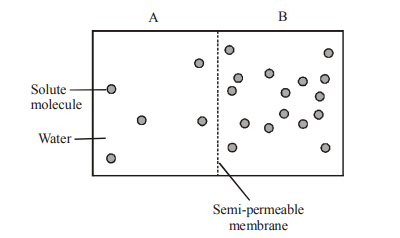
Correct Answer: (b)
In osmosis, it is the solvent (water) that moves through the semi-permeable membrane, not the solute.
In osmosis, it is the solvent (water) that moves through the semi-permeable membrane, not the solute.
Q91. Study the experiment shown below :
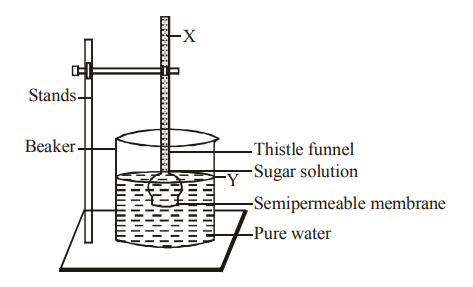
After a few days, which of the following will have occured?
After a few days, which of the following will have occured?
Correct Answer: (c)
Osmosis will occur as water moves from the beaker into the thistle funnel containing sugar solution, causing the level in the funnel (X) to rise and the level in the beaker (Y) to drop.
Osmosis will occur as water moves from the beaker into the thistle funnel containing sugar solution, causing the level in the funnel (X) to rise and the level in the beaker (Y) to drop.
Q92. The water potential of pure water is:
Correct Answer: (d)
Pure water at atmospheric pressure has the highest possible water potential, which is fixed as zero.
Pure water at atmospheric pressure has the highest possible water potential, which is fixed as zero.
Q93. Phloem tissue is composed of sieve tube cells, which form long columns with holes in their end walls called ______.
Correct Answer: (c)
Sieve tubes are continuous tubes whose end walls are perforated with pores, forming sieve plates.
Sieve tubes are continuous tubes whose end walls are perforated with pores, forming sieve plates.
Q94. Seeds when soaked in water, they imbibe because of
Correct Answer: (d)
Imbibition is driven by a steep water potential gradient between the dry seed and the liquid water.
Imbibition is driven by a steep water potential gradient between the dry seed and the liquid water.
Q95. Dry wooden stakes, if driven into a small crack in a rock and then soaked, can develop enough pressure to split the rock. Such a pressure is built up through the phenomenon of
Correct Answer: (a)
Similar to seeds, dry wood imbibes water, leading to a huge increase in volume and pressure, which has historically been used to split rocks.
Similar to seeds, dry wood imbibes water, leading to a huge increase in volume and pressure, which has historically been used to split rocks.
Q96. Guard cells help in
Correct Answer: (b)
Guard cells surround the stomatal pores and regulate their opening and closing, which is the primary mechanism for controlling transpiration.
Guard cells surround the stomatal pores and regulate their opening and closing, which is the primary mechanism for controlling transpiration.
Q97. The process responsible for facilitating loss of water in liquid form from the tip of grass blades at night and in early morning is
Correct Answer: (a)
This is describing guttation, which is caused by the positive root pressure built up when transpiration is inactive.
This is describing guttation, which is caused by the positive root pressure built up when transpiration is inactive.
Q98. _______is mainly water and sucrose, but other sugars, hormones and amino acids are also _______ through phloem.
Correct Answer: (b)
Phloem sap is the fluid found in phloem tissue, mainly consisting of sucrose and water, and its movement is called translocation.
Phloem sap is the fluid found in phloem tissue, mainly consisting of sucrose and water, and its movement is called translocation.
Q99. A cell is said to be flaccid when
Correct Answer: (c)
A cell is flaccid when it is in an isotonic environment, where the rate of water entering the cell equals the rate of water leaving the cell, resulting in no net pressure against the wall.
A cell is flaccid when it is in an isotonic environment, where the rate of water entering the cell equals the rate of water leaving the cell, resulting in no net pressure against the wall.
Q100. In the given figure, chamber A and B are separated by a semipermeable membrane. Study the given figure and choose the right option.
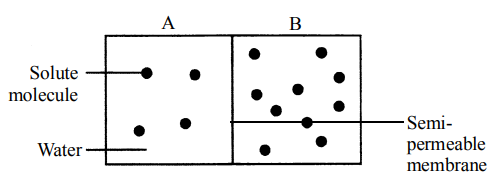
Correct Answer: (a)
Chamber A contains fewer solute molecules compared to Chamber B, hence A has a higher water potential (ψw). Water always moves from higher ψw to lower ψw.
Chamber A contains fewer solute molecules compared to Chamber B, hence A has a higher water potential (ψw). Water always moves from higher ψw to lower ψw.
Q101. When water moves through a semi-permeable membrane then which of the following pressure develops?
Correct Answer: (c)
As water enters the cell through osmosis, it builds up pressure against the cell wall, which is known as Turgor Pressure (T.P.).
As water enters the cell through osmosis, it builds up pressure against the cell wall, which is known as Turgor Pressure (T.P.).
Q102. A pressure that is responsible for pushing up water to small height in the stem is called
Correct Answer: (a)
Root pressure is a positive pressure developed in the xylem of roots due to active ion transport, which can push water up a short distance in the stem.
Root pressure is a positive pressure developed in the xylem of roots due to active ion transport, which can push water up a short distance in the stem.
Q103. Minerals are known to enter the plant root by means of a number of mechanisms, including all except one of the following. Which one of the following is NOT a mechanism for moving minerals into roots?
Correct Answer: (a)
Foliar feeding is a method of applying fertilizers to leaves, not a mechanism by which roots absorb minerals from the soil.
Foliar feeding is a method of applying fertilizers to leaves, not a mechanism by which roots absorb minerals from the soil.
Q104. Transpiration facilitates
Correct Answer: (b)
Transpiration pull is the main force that drives the absorption of water and dissolved minerals from the soil by the roots.
Transpiration pull is the main force that drives the absorption of water and dissolved minerals from the soil by the roots.
Q105. Sinks are related to
Correct Answer: (a)
In phloem transport, a 'sink' is the destination organ where sugars are utilized or stored, such as roots, developing fruits, or growing buds. Mineral ions are also transported to sinks.
In phloem transport, a 'sink' is the destination organ where sugars are utilized or stored, such as roots, developing fruits, or growing buds. Mineral ions are also transported to sinks.
Q106. Stomata opens when
Correct Answer: (b)
The accumulation of solutes (like K+ ions) in guard cells lowers their water potential, leading to endosmosis, which makes the cells swell and the stomata open.
The accumulation of solutes (like K+ ions) in guard cells lowers their water potential, leading to endosmosis, which makes the cells swell and the stomata open.
Q107. Which of the following statements does not apply to reverse osmosis?
Correct Answer: (c)
Reverse osmosis is not a passive process; it requires the application of external pressure greater than the osmotic pressure to force water through a membrane against its concentration gradient.
Reverse osmosis is not a passive process; it requires the application of external pressure greater than the osmotic pressure to force water through a membrane against its concentration gradient.
Q108. Which of the following statement(s), (i–v) regarding transpiration is/are correct?
(i) It creates transpiration pull for absorption and transport of plants.
(ii) It supplies water for photosynthesis.
(iii) It transports minerals from the soil to all parts of the plants.
(iv) It heats leaf surfaces, sometimes 10 to 15 degrees.
(v) It maintains the shape and structure of the plants by keeping cells turgid.
(i) It creates transpiration pull for absorption and transport of plants.
(ii) It supplies water for photosynthesis.
(iii) It transports minerals from the soil to all parts of the plants.
(iv) It heats leaf surfaces, sometimes 10 to 15 degrees.
(v) It maintains the shape and structure of the plants by keeping cells turgid.
Correct Answer: (c)
Statement (iv) is incorrect; transpiration actually cools leaf surfaces by as much as 10-15 degrees through evaporative cooling.
Statement (iv) is incorrect; transpiration actually cools leaf surfaces by as much as 10-15 degrees through evaporative cooling.
Q109. When a root absorbes minerals from a region of lower concentration to a region of higher concentration, and need energy then this type of absorption is called
Correct Answer: (c)
Movement against a concentration gradient using energy is defined as active absorption.
Movement against a concentration gradient using energy is defined as active absorption.
Q110. Which of the following pairs of the cell structures are important for determining the movement of molecules in or out of the plant cell?
Correct Answer: (b)
In plant cells, the cell membrane and the tonoplast (the membrane of the vacuole) together act as the primary selective barriers for solute movement.
In plant cells, the cell membrane and the tonoplast (the membrane of the vacuole) together act as the primary selective barriers for solute movement.
Q111. In a fully turgid cell
Correct Answer: (a)
In any living cell, the solute potential (ψₛ) is always negative. In a turgid cell, the pressure potential (ψₚ) is positive due to the water pressing against the cell wall.
In any living cell, the solute potential (ψₛ) is always negative. In a turgid cell, the pressure potential (ψₚ) is positive due to the water pressing against the cell wall.
Q112. Consider the following statements:
(1) Cytoplasmic streaming is an example of active transport.
(2) Diffusion is the only means for gaseous movement within the plant body.
Which of the statement(s) given above is/are correct?
(1) Cytoplasmic streaming is an example of active transport.
(2) Diffusion is the only means for gaseous movement within the plant body.
Which of the statement(s) given above is/are correct?
Correct Answer: (c)
Both statements are correct NCERT facts; cytoplasmic streaming assists in symplastic movement, and gases move only via diffusion in plants.
Both statements are correct NCERT facts; cytoplasmic streaming assists in symplastic movement, and gases move only via diffusion in plants.
Q113. The form of sugar transported through phloem is
Correct Answer: (c)
Sucrose is the preferred transport sugar in plants because it is chemically non-reactive (non-reducing) and soluble.
Sucrose is the preferred transport sugar in plants because it is chemically non-reactive (non-reducing) and soluble.
Q114. Phenomenon of plasmolysis occurs when
Correct Answer: (a)
Plasmolysis occurs when a cell is placed in a hypertonic solution, causing water to move out of the cell, leading to the shrinkage of the protoplast away from the cell wall.
Plasmolysis occurs when a cell is placed in a hypertonic solution, causing water to move out of the cell, leading to the shrinkage of the protoplast away from the cell wall.
Q115. Water will move from its region of higher chemical potential to its region of lower chemical potential until:
Correct Answer: (a)
Diffusion (and osmosis) continues until the system reaches a state of equilibrium where the water potential is uniform throughout.
Diffusion (and osmosis) continues until the system reaches a state of equilibrium where the water potential is uniform throughout.
Q116. Osmosis is a form of diffusion in which
Correct Answer: (a)
Osmosis is the diffusion of solvent (water) molecules from a region of its higher chemical/water potential to a region of its lower chemical/water potential through a semipermeable membrane.
Osmosis is the diffusion of solvent (water) molecules from a region of its higher chemical/water potential to a region of its lower chemical/water potential through a semipermeable membrane.
Q117. Stomatal movement is influenced by
Correct Answer: (a)
Stomatal opening and closing are influenced by various factors including light, temperature, and internal CO2 concentrations.
Stomatal opening and closing are influenced by various factors including light, temperature, and internal CO2 concentrations.
Q118. Match column-I with column-II and find out the correct option from the codes given below.
| Column - I | Column - II |
|---|---|
| A. Isotonic | I. External solution is more concentrated |
| B. Hypotonic | II. Shrinkage of protoplasm |
| C. Hypertonic | III. Solution is more dilute than the cytoplasm |
| D. Plasmolysis | IV Two solutions have the same osmolarity |
Correct Answer: (b)
Isotonic = same osmolarity (IV); Hypotonic = more dilute (III); Hypertonic = more concentrated (I); Plasmolysis = shrinkage of protoplasm (II).
Isotonic = same osmolarity (IV); Hypotonic = more dilute (III); Hypertonic = more concentrated (I); Plasmolysis = shrinkage of protoplasm (II).
Q119. A bottle filled with previously moistened mustard seeds and water was screw capped tightly and kept in a corner. It blew up suddenly after about half an hour. The phenomenon involved in this is
Correct Answer: (b)
The absorption of water by the dry mustard seeds via imbibition generated enormous pressure (imbibition pressure), causing the bottle to explode.
The absorption of water by the dry mustard seeds via imbibition generated enormous pressure (imbibition pressure), causing the bottle to explode.
Q120. Which of the following wall of guard cells is thick?
Correct Answer: (c)
In guard cells, the inner wall (facing the stomatal pore) is much thicker and less elastic than the outer wall, which is essential for stomatal movement.
In guard cells, the inner wall (facing the stomatal pore) is much thicker and less elastic than the outer wall, which is essential for stomatal movement.
Q121. Process of imbibition results in
Correct Answer: (d)
Imbibition leads to both an increase in the volume of the solid material (the imbibant) and the generation of significant pressure (imbibition pressure).
Imbibition leads to both an increase in the volume of the solid material (the imbibant) and the generation of significant pressure (imbibition pressure).
Q122. ‘X’ breaks the continuity of the ‘Y’ pathway and forces water and solutes to cross the endodermis by passing through the plasma membrane. Identify ‘X’ and ‘Y’.
Correct Answer: (d)
The Casparian strip (containing suberin) is located in the endodermis and acts as a barrier to the apoplastic (cell wall) pathway, forcing water into the symplast.
The Casparian strip (containing suberin) is located in the endodermis and acts as a barrier to the apoplastic (cell wall) pathway, forcing water into the symplast.
Q123. Which of the following is not true of the carrier molecules involved in facilitated diffusion?
Correct Answer: (b)
Facilitated diffusion is a passive process and cannot move molecules from a lower concentration to a higher concentration; therefore, it cannot concentrate solute molecules on one side of the membrane.
Facilitated diffusion is a passive process and cannot move molecules from a lower concentration to a higher concentration; therefore, it cannot concentrate solute molecules on one side of the membrane.
Q124. When a cell is plasmolysed, it becomes
Correct Answer: (a)
During plasmolysis, water leaves the vacuole, the cell loses its turgor, becomes flaccid, and the Turgor Pressure (TP) drops to zero.
During plasmolysis, water leaves the vacuole, the cell loses its turgor, becomes flaccid, and the Turgor Pressure (TP) drops to zero.
Q125. The given figure represents symplastic and apoplastic pathways of water & ion absorption & movement in roots. Few parts are marked as A, B, C & D. At the endodermis, water movement through the apoplast pathway is obstructed by which part (marked as A, B, C & D)?
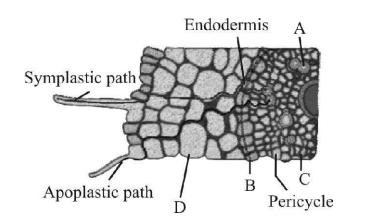
Correct Answer: (b)
Part B represents the Casparian strip in the endodermis, which is suberized and impermeable to water, thus blocking the apoplastic pathway.
Part B represents the Casparian strip in the endodermis, which is suberized and impermeable to water, thus blocking the apoplastic pathway.
Q126. Arrange the following events in a correct order that explains the mass flow of materials in the phloem?
(i) Water diffuses into the sieve tube elements.
(ii) Leaf cells produce sugar by photosynthesis.
(iii) Solutes are actively transported into the sieve elements.
(iv) Sugar is transported from cell to cell in the leaf.
(v) Sugar moves down the stem.
(i) Water diffuses into the sieve tube elements.
(ii) Leaf cells produce sugar by photosynthesis.
(iii) Solutes are actively transported into the sieve elements.
(iv) Sugar is transported from cell to cell in the leaf.
(v) Sugar moves down the stem.
Correct Answer: (a)
The sequence is: photosynthesis (ii) $ ightarrow$ movement through leaf (iv) $ ightarrow$ loading into phloem (iii) $ ightarrow$ water entry by osmosis (i) $ ightarrow$ bulk flow/movement (v).
The sequence is: photosynthesis (ii) $ ightarrow$ movement through leaf (iv) $ ightarrow$ loading into phloem (iii) $ ightarrow$ water entry by osmosis (i) $ ightarrow$ bulk flow/movement (v).
Q127. In part A of a plant, sugars are actively transported into the phloem tissue. In part B, sugars are actively transported out of the phloem. Which way will the phloem sap move under these conditions?
Correct Answer: (a)
Sugar loading at A (source) creates high pressure, and unloading at B (sink) creates low pressure; phloem sap moves along this pressure gradient from A to B.
Sugar loading at A (source) creates high pressure, and unloading at B (sink) creates low pressure; phloem sap moves along this pressure gradient from A to B.
Q128. What is the direction of movement of sugars in phloem?
Correct Answer: (d)
Phloem transport is bidirectional, moving nutrients from sources (like leaves) to sinks (like roots or fruits) either upwards or downwards.
Phloem transport is bidirectional, moving nutrients from sources (like leaves) to sinks (like roots or fruits) either upwards or downwards.
Q129. What facilitates the movement of K+ into epidermal cells of the root ?
Correct Answer: (c)
The uptake of mineral ions like K+ is facilitated by a combination of concentration gradients and electrical potential differences maintained by proton pumps.
The uptake of mineral ions like K+ is facilitated by a combination of concentration gradients and electrical potential differences maintained by proton pumps.
Q130. The lower surface of leaf will have more number of stomata in a
Correct Answer: (a)
In a dorsiventral (typically dicot) leaf, stomata are more numerous or exclusively present on the lower epidermis to reduce water loss.
In a dorsiventral (typically dicot) leaf, stomata are more numerous or exclusively present on the lower epidermis to reduce water loss.