Q1. Consider the following statements about frogs:
(1) Vass efferentia enter the kidneys and open into Bidder’s canal.
(2) Fertilisation is external and takes place in water.
Which of the statement(s) given above is/are correct?
(1) Vass efferentia enter the kidneys and open into Bidder’s canal.
(2) Fertilisation is external and takes place in water.
Which of the statement(s) given above is/are correct?
Correct Answer: (c)
In male frogs, sperm travels through vasa efferentia into the kidneys via Bidder's canal. Fertilization in frogs occurs outside the body in water.
In male frogs, sperm travels through vasa efferentia into the kidneys via Bidder's canal. Fertilization in frogs occurs outside the body in water.
Q2. Gizzard (proventriculus) in cockroach lies between
Correct Answer: (b)
In the digestive system of a cockroach, the food moves from the crop to the gizzard (for grinding) and then into the midgut (mesenteron).
In the digestive system of a cockroach, the food moves from the crop to the gizzard (for grinding) and then into the midgut (mesenteron).
Q3. Which of the following type of cell junction is not found in animal tissues ?
Correct Answer: (d)
Plasmodesmata are cytoplasmic bridges found only in plant cells. Adhering, tight, and gap junctions are common in animal epithelial tissues.
Plasmodesmata are cytoplasmic bridges found only in plant cells. Adhering, tight, and gap junctions are common in animal epithelial tissues.
Q4. To which one of the following categories does adipose tissue belong?
Correct Answer: (b)
Adipose tissue is a type of loose connective tissue specialized for fat storage and insulation.
Adipose tissue is a type of loose connective tissue specialized for fat storage and insulation.
Q5. The mouth parts of cockroach are
Correct Answer: (a)
Cockroaches possess mandibulate mouthparts designed for biting and chewing solid food.
Cockroaches possess mandibulate mouthparts designed for biting and chewing solid food.
Q6. The fibres of which of the following muscles are fusiform and do not show striations
Correct Answer: (d)
Smooth muscles are composed of spindle-shaped (fusiform) cells that lack the banding pattern (striations) found in skeletal or cardiac muscle.
Smooth muscles are composed of spindle-shaped (fusiform) cells that lack the banding pattern (striations) found in skeletal or cardiac muscle.
Q7. Which of the following statement(s) is/are correct regarding cockroaches ?
(i) The body of the cockroach is segmented and divisible into three distinct regions – head, thorax and abdomen.
(ii) Blood vascular system is of closed type.
(iii) They are monoecious and both sexes have well developed reproductive organs.
(iv) The development of P. americana is paurometabolus, meaning there is development through nymphal stage.
(i) The body of the cockroach is segmented and divisible into three distinct regions – head, thorax and abdomen.
(ii) Blood vascular system is of closed type.
(iii) They are monoecious and both sexes have well developed reproductive organs.
(iv) The development of P. americana is paurometabolus, meaning there is development through nymphal stage.
Correct Answer: (c)
Statements (i) and (iv) are correct. (ii) is wrong (open type), and (iii) is wrong (dioecious).
Statements (i) and (iv) are correct. (ii) is wrong (open type), and (iii) is wrong (dioecious).
Q8. The following figures A, B and C are types of muscle tissue. Identify A, B and C.
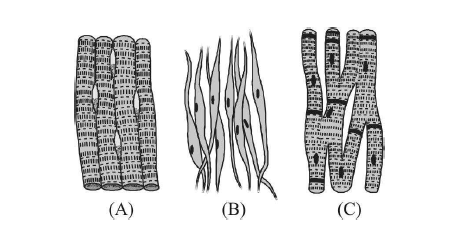
Correct Answer: (b)
In the diagrams: A shows striated, unbranched fibers (skeletal); B shows spindle-shaped fibers (smooth); C shows striated, branched fibers (cardiac).
In the diagrams: A shows striated, unbranched fibers (skeletal); B shows spindle-shaped fibers (smooth); C shows striated, branched fibers (cardiac).
Q9. Which of the following is the example of mucous connective tissue?
Correct Answer: (b)
Mucous connective tissue (Wharton's jelly-like) is found in the umbilical cord and also in the cock's comb.
Mucous connective tissue (Wharton's jelly-like) is found in the umbilical cord and also in the cock's comb.
Q10. About how many times does the nymph of the Periplaneta americana undergo moulting before becoming an adult?
Correct Answer: (d)
The development of Periplaneta americana is paurometabolous, with the nymph undergoing 13 molts to reach the adult stage.
The development of Periplaneta americana is paurometabolous, with the nymph undergoing 13 molts to reach the adult stage.
Q11. In earthworms four pairs of spermathecal apertures are situated on:
Correct Answer: (c)
The spermathecal apertures are located ventro-laterally in the intersegmental grooves of segments 5/6, 6/7, 7/8, and 8/9.
The spermathecal apertures are located ventro-laterally in the intersegmental grooves of segments 5/6, 6/7, 7/8, and 8/9.
Q12. What are the three basic components of connective tissues?
Correct Answer: (c)
All connective tissues consist of specialized cells, protein fibers (like collagen or elastin), and an amorphous ground substance (matrix).
All connective tissues consist of specialized cells, protein fibers (like collagen or elastin), and an amorphous ground substance (matrix).
Q13. Which of the following statement is/are correct regarding digestive system of cockroach ?
(i) Mouth opens into a short tubular pharynx, leading to a narrow tubular passage called oesophagus.
(ii) Gizzard helps in grinding the food particles.
(iii) A ring of 6-8 blind tubules called hepatic or gastric caecae is present at the junction of foregut and midgut, which secrete digestive juice.
(iv) At the junction of midgut and hindgut is present another ring of 100-150 yellow coloured thin filamentous malphigian tubules which help in removal of excretory products from haemolymph.
(i) Mouth opens into a short tubular pharynx, leading to a narrow tubular passage called oesophagus.
(ii) Gizzard helps in grinding the food particles.
(iii) A ring of 6-8 blind tubules called hepatic or gastric caecae is present at the junction of foregut and midgut, which secrete digestive juice.
(iv) At the junction of midgut and hindgut is present another ring of 100-150 yellow coloured thin filamentous malphigian tubules which help in removal of excretory products from haemolymph.
Correct Answer: (d)
All provided statements accurately describe various parts and functions of the cockroach's digestive and excretory systems.
All provided statements accurately describe various parts and functions of the cockroach's digestive and excretory systems.
Q14. Match the following and choose the correct answer.
A. Hermaphrodite (i) Produces blood cells and haemoglobin
B. Direct development (ii) Testis and ovary in the same animal
C. Chemoreceptor (iii) Larval form absent
D. Blood gland in earthworm (iv) Sense of chemical substances
A. Hermaphrodite (i) Produces blood cells and haemoglobin
B. Direct development (ii) Testis and ovary in the same animal
C. Chemoreceptor (iii) Larval form absent
D. Blood gland in earthworm (iv) Sense of chemical substances
Correct Answer: (a)
Hermaphrodite = both sexes in one (II); Direct = no larva (III); Chemoreceptor = chemical sense (IV); Blood gland = Hb production (I).
Hermaphrodite = both sexes in one (II); Direct = no larva (III); Chemoreceptor = chemical sense (IV); Blood gland = Hb production (I).
Q15. Lamina propria in the gut is the part of
Correct Answer: (c)
The mucosa of the alimentary canal is composed of the epithelium, the underlying connective tissue called lamina propria, and a thin muscular layer.
The mucosa of the alimentary canal is composed of the epithelium, the underlying connective tissue called lamina propria, and a thin muscular layer.
Q16. Read the following statements.
(i) It is a contractile tissue present only in the heart.
(ii) Cell junctions fuse the plasma membranes of these cells and make them stick together.
(iii) Communication juntions at some fusion points allow the cells to contract as a unit, i.e., when one cell receives a signal to contract, its neighbours are also stimulated to contract.
Which of the following type of tissue is being described by the above statements ?
(i) It is a contractile tissue present only in the heart.
(ii) Cell junctions fuse the plasma membranes of these cells and make them stick together.
(iii) Communication juntions at some fusion points allow the cells to contract as a unit, i.e., when one cell receives a signal to contract, its neighbours are also stimulated to contract.
Which of the following type of tissue is being described by the above statements ?
Correct Answer: (b)
Cardiac muscle is exclusive to the heart and features specialized junctions that allow it to function as a functional syncytium.
Cardiac muscle is exclusive to the heart and features specialized junctions that allow it to function as a functional syncytium.
Q17. What external changes are visible after the last moult of a cockroach nymph?
Correct Answer: (b)
Only adult cockroaches have fully developed wings; the last nymphal stage acquires wing pads, which become functional wings after the final molt.
Only adult cockroaches have fully developed wings; the last nymphal stage acquires wing pads, which become functional wings after the final molt.
Q18. The ciliated columnar epithelial cells in humans occur in
Correct Answer: (b)
Ciliated epithelium helps move particles or secretions. In humans, it lines the bronchioles of the respiratory tract and the fallopian tubes of the reproductive tract.
Ciliated epithelium helps move particles or secretions. In humans, it lines the bronchioles of the respiratory tract and the fallopian tubes of the reproductive tract.
Q19. Nervous tissue cells that play several supporting roles but do not transmit impulses are called
Correct Answer: (a)
Glial cells (neuroglia) are the non-neuronal cells of the nervous system that support and protect neurons without generating action potentials.
Glial cells (neuroglia) are the non-neuronal cells of the nervous system that support and protect neurons without generating action potentials.
Q20. Four healthy people in their twenties faced injuries resulting in damage and death of a few cells given below. Which of the cells are least likely to be replaced by new cells?
Correct Answer: (b)
Mature neurons generally do not undergo mitosis and are least likely to be replaced if damaged or killed.
Mature neurons generally do not undergo mitosis and are least likely to be replaced if damaged or killed.
Q21. Match the following with reference to cockroach and choose the correct option.
A. Phallomere (i) Chain of developing ova
B. Gonopore (ii) Bundles of sperm
C. Spermatophore (iii) Opening of the ejaculatory duct
D. Ovarioles (iv) The external genitalia
A. Phallomere (i) Chain of developing ova
B. Gonopore (ii) Bundles of sperm
C. Spermatophore (iii) Opening of the ejaculatory duct
D. Ovarioles (iv) The external genitalia
Correct Answer: (b)
Phallomere = external genitalia (IV); Gonopore = ejaculatory duct opening (III); Spermatophore = sperm bundle (II); Ovarioles = ova chain (I).
Phallomere = external genitalia (IV); Gonopore = ejaculatory duct opening (III); Spermatophore = sperm bundle (II); Ovarioles = ova chain (I).
Q22. Which of the following statement (s) is/are correct ?
Correct Answer: (d)
Statement (i) is correct; (iv) is correct. Adipose is loose tissue, and tendons/ligaments are dense regular tissue. Therefore (i) and (iv) are correct. (Answer Key: 37. d)
Statement (i) is correct; (iv) is correct. Adipose is loose tissue, and tendons/ligaments are dense regular tissue. Therefore (i) and (iv) are correct. (Answer Key: 37. d)
Q23. Which of the following statements is not correct about earthworms?
Correct Answer: (c)
Earthworms lack specialized respiratory organs like lungs or gills; gas exchange occurs directly through their moist skin.
Earthworms lack specialized respiratory organs like lungs or gills; gas exchange occurs directly through their moist skin.
Q24. The ciliated epithelial cells are required to move particles or mucus in a specific direction. In humans, these cells are mainly present in:
Correct Answer: (d)
Ciliated epithelium is located in the inner surface of hollow organs like the bronchioles (to move mucus) and fallopian tubes (to move the egg).
Ciliated epithelium is located in the inner surface of hollow organs like the bronchioles (to move mucus) and fallopian tubes (to move the egg).
Q25. Which of the following statement(s) is/are correct regarding excretory system of cockroach ?
(i) Excretion is performed by malphigian tubules.
(ii) They absorb nitrogenous waste products and convert them into uric acid which is excreted out through hindgut. Hence, this insect called ammonetelic.
(iii) In addition, fat body, nephrocytes and uricose glands also help in excretion.
(i) Excretion is performed by malphigian tubules.
(ii) They absorb nitrogenous waste products and convert them into uric acid which is excreted out through hindgut. Hence, this insect called ammonetelic.
(iii) In addition, fat body, nephrocytes and uricose glands also help in excretion.
Correct Answer: (c)
Statement (ii) is wrong because cockroaches are uricotelic, not ammonetelic. (i) and (iii) are correct regarding excretory organs.
Statement (ii) is wrong because cockroaches are uricotelic, not ammonetelic. (i) and (iii) are correct regarding excretory organs.
Q26. Which of the following statement(s) is/are correct regarding respiratory system of cockroach ?
(i) It consists of a network of trachea, that open through 12 pairs of small holes called spiracles present on the lateral side of the body.
(ii) Thin branching tubes carry oxygen from the air to all the parts.
(iii) The opening of the spiracles is regulated by sphincters.
(iv) Exchange of gases take place at the tracheoles by diffusion.
(i) It consists of a network of trachea, that open through 12 pairs of small holes called spiracles present on the lateral side of the body.
(ii) Thin branching tubes carry oxygen from the air to all the parts.
(iii) The opening of the spiracles is regulated by sphincters.
(iv) Exchange of gases take place at the tracheoles by diffusion.
Correct Answer: (c)
Statements (ii), (iii), and (iv) are correct. (i) is wrong because there are 10 pairs (2 thoracic, 8 abdominal) of spiracles, not 12.
Statements (ii), (iii), and (iv) are correct. (i) is wrong because there are 10 pairs (2 thoracic, 8 abdominal) of spiracles, not 12.
Q27. Which one of the following is one of the paths followed by air or O2 during respiration in the adult male Periplaneta Americana as it enters the animal body?
Correct Answer: (a)
In cockroaches, air enters through spiracles, travels through trachea and tracheoles, where oxygen directly diffuses into the tissues.
In cockroaches, air enters through spiracles, travels through trachea and tracheoles, where oxygen directly diffuses into the tissues.
Q28. Which one of the following is the most abundant protein in the animals?
Correct Answer: (a)
Collagen is the most abundant structural protein in the animal world, providing strength to connective tissues.
Collagen is the most abundant structural protein in the animal world, providing strength to connective tissues.
Q29. Consider the following statements regarding cockroach and mark the correct option.
(i) Head is formed by the fusion of 6-segments.
(ii) Mouth parts are biting and chewing type.
(iii) Crop is the part of mid gut.
(i) Head is formed by the fusion of 6-segments.
(ii) Mouth parts are biting and chewing type.
(iii) Crop is the part of mid gut.
Correct Answer: (c)
The head is a result of 6 fused segments, and mouthparts are mandibulate. The crop is part of the foregut (stomodeum), not the midgut.
The head is a result of 6 fused segments, and mouthparts are mandibulate. The crop is part of the foregut (stomodeum), not the midgut.
Q30. Frogs are:
Correct Answer: (d)
Frogs are cold-blooded (poikilothermal), meaning their body temperature fluctuates with the environment, and they are generally adapted to a range of temperatures (eurythermal). (Answer Key: d)
Frogs are cold-blooded (poikilothermal), meaning their body temperature fluctuates with the environment, and they are generally adapted to a range of temperatures (eurythermal). (Answer Key: d)
Q31. Which of the following is involved in the production of new blood cells ?
Correct Answer: (b)
The red bone marrow is the primary site for hematopoiesis (blood cell formation) in adults.
The red bone marrow is the primary site for hematopoiesis (blood cell formation) in adults.
Q32. Match the body structures of cockroach given in column I to their correct labelling given in column-II and choose the correct option.
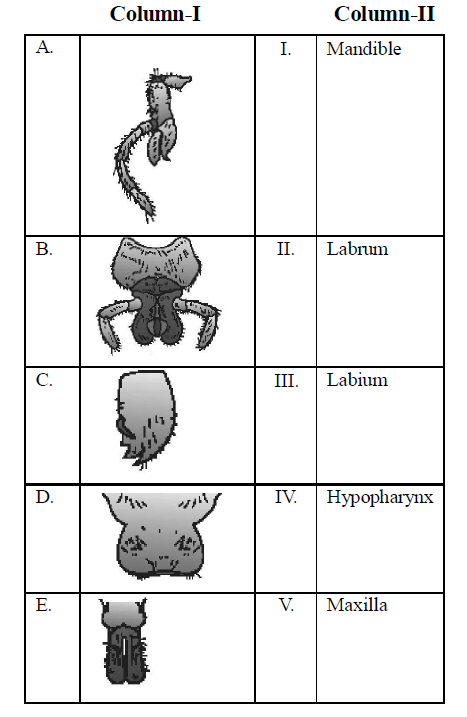
Correct Answer: (c)
Based on cockroach mouthparts: A is Maxilla (V), B is Labium (III), C is Mandible (I), D is Labrum (II), and E is Hypopharynx (IV). (Answer Key: c)
Based on cockroach mouthparts: A is Maxilla (V), B is Labium (III), C is Mandible (I), D is Labrum (II), and E is Hypopharynx (IV). (Answer Key: c)
Q33. Which type of tissue correctly matches with its location?
| Tissue | Location |
|---|---|
| (a) Smooth muscle | Wall of intestine |
| (b) Areolar tissue | Tendons |
| (c) Transitional epithelium | Nose-tip |
| (d) Cuboidal epithelium | Lining of stomach |
Correct Answer: (a)
Smooth muscles are found in the walls of hollow visceral organs like the intestine. Areolar tissue is found beneath skin; nose-tip has cartilage.
Smooth muscles are found in the walls of hollow visceral organs like the intestine. Areolar tissue is found beneath skin; nose-tip has cartilage.
Q34. The following are required for blood clotting in mammals
Correct Answer: (c)
Calcium ions (Ca2+) and Vitamin K (for the synthesis of clotting factors) are essential for the complex process of blood coagulation.
Calcium ions (Ca2+) and Vitamin K (for the synthesis of clotting factors) are essential for the complex process of blood coagulation.
Q35. Smooth muscles are______.
Correct Answer: (d)
Smooth muscles are involuntary, composed of spindle-shaped (tapered) cells with a single central nucleus.
Smooth muscles are involuntary, composed of spindle-shaped (tapered) cells with a single central nucleus.
Q36. Read the following statements and choose the correct option.
Statements:
(A) Blood cells secrete fibres of structural proteins called collagen or elastin.
(B) Neuroglial cells protect and support the nephrons.
(C) Osteocytes are present in spaces called lacunae.
(D) Striated muscle fibres are bundled together in a parallel fashion.
(E) Biceps are involuntary and striated.
Statements:
(A) Blood cells secrete fibres of structural proteins called collagen or elastin.
(B) Neuroglial cells protect and support the nephrons.
(C) Osteocytes are present in spaces called lacunae.
(D) Striated muscle fibres are bundled together in a parallel fashion.
(E) Biceps are involuntary and striated.
Correct Answer:
Statement (A) is wrong because blood cells do not secrete structural protein fibres such as collagen or elastin. Statement (B) is wrong because neuroglial cells support and protect neurons, not nephrons. Statement (C) is correct as osteocytes are present in spaces called lacunae. Statement (D) is correct because striated muscle fibres are arranged in parallel bundles. Statement (E) is wrong because biceps is a voluntary and striated muscle.
Statement (A) is wrong because blood cells do not secrete structural protein fibres such as collagen or elastin. Statement (B) is wrong because neuroglial cells support and protect neurons, not nephrons. Statement (C) is correct as osteocytes are present in spaces called lacunae. Statement (D) is correct because striated muscle fibres are arranged in parallel bundles. Statement (E) is wrong because biceps is a voluntary and striated muscle.
Q37. Epithelial tissue is distinguished from connective tissue, muscular, or nervous tissue by its
Correct Answer: (d)
The presence of a basement membrane is a defining characteristic of epithelial tissues, separating them from underlying connective tissue.
The presence of a basement membrane is a defining characteristic of epithelial tissues, separating them from underlying connective tissue.
Q38. Which one of the following pairs of structures distinguish a nerve cell from other types of cell ?
Correct Answer: (d)
While all cells have a body, neurons are uniquely characterized by their highly branched dendrites and long axons originating from the cell body.
While all cells have a body, neurons are uniquely characterized by their highly branched dendrites and long axons originating from the cell body.
Q39. Match the terms given in column-I with their feature given in column-II and choose the correct option.
| Column-I (Terms) | Column-II (Features) |
|---|---|
| A. Exocrine gland | I. They help to stop substances from leaking across a tissue |
| B. Endocrine gland | II. Hormones are secreted directly into the fluid bathing the gland |
| C. Tight junctions | III. They perform cementing to keep neighbouring cells together. |
| D. Adhering junctions | IV. Secretes mucus, saliva, earwax, oil, milk, digestive enzymes and other cell products |
Correct Answer: (a)
Exocrine glands have ducts (IV); Endocrine glands are ductless (II); Tight junctions prevent leakage (I); Adhering junctions provide structural support/cementing (III).
Exocrine glands have ducts (IV); Endocrine glands are ductless (II); Tight junctions prevent leakage (I); Adhering junctions provide structural support/cementing (III).
Q40. Cartilage tissues are likely to be slow in healing following an injury because
Correct Answer: (b)
Cartilage is avascular; it receives nutrients by diffusion through the matrix from the perichondrium, which limits its regenerative capacity and speed of healing.
Cartilage is avascular; it receives nutrients by diffusion through the matrix from the perichondrium, which limits its regenerative capacity and speed of healing.
Q41. Intercalated discs are the communication junctions between the cells of
Correct Answer: (a)
Intercalated discs are unique to cardiac muscle tissue, allowing rapid transmission of electrical impulses between cells for synchronized heartbeats.
Intercalated discs are unique to cardiac muscle tissue, allowing rapid transmission of electrical impulses between cells for synchronized heartbeats.
Q42. In polycythemia the number of red cells increases greatly. This causes adverse effects due to
Correct Answer: (c)
An excessive increase in red blood cells (polycythemia) increases blood viscosity, making it harder for the heart to pump blood and increasing the risk of clots.
An excessive increase in red blood cells (polycythemia) increases blood viscosity, making it harder for the heart to pump blood and increasing the risk of clots.
Q43. Select the correct statement regarding Periplaneta americana
Correct Answer: (c)
Statement (c) accurately describes the arthropod nervous system. Statement (a) is wrong (100-150 tubules), and (d) is correct but (c) is a more fundamental anatomical fact. (Answer Key: 74. c)
Statement (c) accurately describes the arthropod nervous system. Statement (a) is wrong (100-150 tubules), and (d) is correct but (c) is a more fundamental anatomical fact. (Answer Key: 74. c)
Q44. Male cockroach can be identified from the female by the presence of
Correct Answer: (d)
Anal styles are unique to males and serve as a diagnostic feature to distinguish them from females.
Anal styles are unique to males and serve as a diagnostic feature to distinguish them from females.
Q45. Read the following statements and answer the question.
(i) It is made of a single thin layer of flattened cells with irregular boundaries.
(ii) They are found in the walls of blood vessels and air sacs of lungs.
(iii) They are involved in functions like forming a diffusion boundary.
Which of the following characteristics of tissue is being described by the above statements ?
(i) It is made of a single thin layer of flattened cells with irregular boundaries.
(ii) They are found in the walls of blood vessels and air sacs of lungs.
(iii) They are involved in functions like forming a diffusion boundary.
Which of the following characteristics of tissue is being described by the above statements ?
Correct Answer: (a)
Simple squamous epithelium consists of a single layer of flat cells and is optimized for filtration and diffusion, as seen in lung alveoli and blood capillaries.
Simple squamous epithelium consists of a single layer of flat cells and is optimized for filtration and diffusion, as seen in lung alveoli and blood capillaries.
Q46. Three essential components of most neurons are
Correct Answer: (b)
A typical neuron consists of a cell body (soma), short dendrites for receiving signals, and a long axon for transmitting signals.
A typical neuron consists of a cell body (soma), short dendrites for receiving signals, and a long axon for transmitting signals.
Q47. Which of the following statement is incorrect regarding cuboidal epithelium ?
Correct Answer: (c)
Cuboidal epithelium is typically found in gland ducts and kidney tubules. Walls of blood vessels and lung air sacs are lined by squamous epithelium.
Cuboidal epithelium is typically found in gland ducts and kidney tubules. Walls of blood vessels and lung air sacs are lined by squamous epithelium.
Q48. Choose the correctly matched pair
Correct Answer: (c)
Areolar tissue is a classic example of loose connective tissue. Tendons are dense regular tissue, and cartilage is specialized tissue.
Areolar tissue is a classic example of loose connective tissue. Tendons are dense regular tissue, and cartilage is specialized tissue.
Q49. The given figure shows open circulatory system of cockroach with structure marked as A, B and C. Which structure is a 13 pair of wing shaped involuntary muscles and mantain blood circulation?
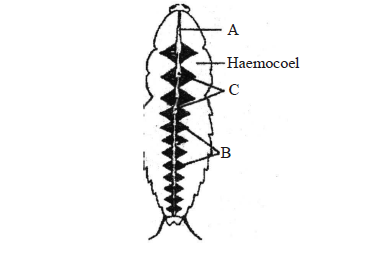
Correct Answer: (a)
Label 'A' points to the alary muscles (13 pairs) which are wing-shaped and contract to facilitate the flow of hemolymph into the heart chambers.
Label 'A' points to the alary muscles (13 pairs) which are wing-shaped and contract to facilitate the flow of hemolymph into the heart chambers.
Q50. Match the following and choose the correct option,
A. Adipose tissue (i) Nose
B. Stratified epithelium (ii) Blood
C. Hyaline cartilage (iii) Skin
D. Fluid connective tissue (iv) Fat storage
A. Adipose tissue (i) Nose
B. Stratified epithelium (ii) Blood
C. Hyaline cartilage (iii) Skin
D. Fluid connective tissue (iv) Fat storage
Correct Answer: (b)
Adipose = fat storage (IV); Stratified = skin (III); Hyaline = nose (I); Fluid = blood (II).
Adipose = fat storage (IV); Stratified = skin (III); Hyaline = nose (I); Fluid = blood (II).
Q51. The terga, sterna and pleura of cockroach body are joined by
Correct Answer: (b)
The hard chitinous plates (sclerites) of a cockroach's exoskeleton are connected by a flexible articular membrane called the arthrodial membrane.
The hard chitinous plates (sclerites) of a cockroach's exoskeleton are connected by a flexible articular membrane called the arthrodial membrane.
Q52. General function of gland is to
Correct Answer: (c)
Glands are specialized epithelial cells or organs that produce and secrete substances like hormones, enzymes, or sweat to regulate body functions.
Glands are specialized epithelial cells or organs that produce and secrete substances like hormones, enzymes, or sweat to regulate body functions.
Q53. The diagram given below represents the reproductive organ of male cockroach. Choose the correct labelling of the part of marked as A, B, C and D.
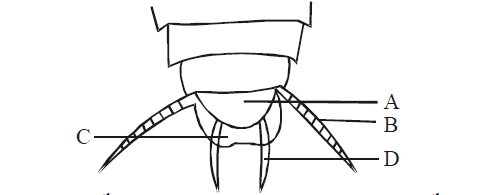
Correct Answer: (a)
In the posterior end of a male cockroach: A is the 8th sternum, B is the anal cercus (jointed), C is the 10th tergum (dorsal plate), and D is the anal style (present only in males).
In the posterior end of a male cockroach: A is the 8th sternum, B is the anal cercus (jointed), C is the 10th tergum (dorsal plate), and D is the anal style (present only in males).
Q54. Haversian system is present in:
Correct Answer: (b)
The Haversian system (osteon) is a characteristic structural feature of mammalian compact bone. The rabbit is a mammal.
The Haversian system (osteon) is a characteristic structural feature of mammalian compact bone. The rabbit is a mammal.
Q55. Ciliated simple columnar epithelium often contains _______, which increase the surface area for secretion and absorption.
Correct Answer: (c)
Microvilli are finger-like projections on the free surface of columnar or cuboidal cells that significantly increase the surface area for absorption and secretion.
Microvilli are finger-like projections on the free surface of columnar or cuboidal cells that significantly increase the surface area for absorption and secretion.
Q56. Which of the following statement(s) regarding cell junctions is/are correct ?
Correct Answer: (d)
All three types of junctions—tight (leak-proofing), adhering (stability), and gap (communication)—are essential components of many animal tissues.
All three types of junctions—tight (leak-proofing), adhering (stability), and gap (communication)—are essential components of many animal tissues.
Q57. Which one of the following types of cell is involved in making of the inner walls of large blood vessels?
Correct Answer: (c)
Simple squamous epithelium lines the inner surface of blood vessels (endothelium) to facilitate diffusion.
Simple squamous epithelium lines the inner surface of blood vessels (endothelium) to facilitate diffusion.
Q58. Frog takes water through which of the following organs?
Correct Answer: (b)
Frogs do not drink water through their mouth; they absorb it directly through their permeable skin from the environment.
Frogs do not drink water through their mouth; they absorb it directly through their permeable skin from the environment.
Q59. Which of the following is helpful for erythropoiesis?
Correct Answer: (a)
Iron (in ferrous form, Fe2+) is an essential component of hemoglobin and is necessary for the production of red blood cells (erythropoiesis).
Iron (in ferrous form, Fe2+) is an essential component of hemoglobin and is necessary for the production of red blood cells (erythropoiesis).
Q60. Neuroglia are
Correct Answer: (b)
Neuroglia are the non-excitable supporting cells of the nervous system that provide protection and maintenance for neurons.
Neuroglia are the non-excitable supporting cells of the nervous system that provide protection and maintenance for neurons.
Q61. Mesorchium in frogs is associated with:
Correct Answer: (a)
The mesorchium is a double fold of peritoneum that suspends the testes from the upper part of the kidneys in male frogs. (Answer Key: a)
The mesorchium is a double fold of peritoneum that suspends the testes from the upper part of the kidneys in male frogs. (Answer Key: a)
Q62. Which of the following statement(s) is/are correct regarding compound epithelium ?
Correct Answer: (d)
Compound (stratified) epithelium is multi-layered, specialized for protection rather than absorption/secretion, and covers surfaces like skin and the pharynx.
Compound (stratified) epithelium is multi-layered, specialized for protection rather than absorption/secretion, and covers surfaces like skin and the pharynx.
Q63. Which of the following vertebrate tissues would be an excellent source of collagen?
Correct Answer: (d)
Tendons are primarily composed of densely packed bundles of collagen fibers, making them a rich source of this structural protein.
Tendons are primarily composed of densely packed bundles of collagen fibers, making them a rich source of this structural protein.
Q64. Which of the follow statement is correct?
(i) The shape of the cells may vary with the function they perform
(ii) Human RBC is about 7.0 m in diameter
(iii) Cytoplasm is the main arena of cellular activities
(iv) Various chemical reactions occur in cytoplasm to keep the cell in the living state
(i) The shape of the cells may vary with the function they perform
(ii) Human RBC is about 7.0 m in diameter
(iii) Cytoplasm is the main arena of cellular activities
(iv) Various chemical reactions occur in cytoplasm to keep the cell in the living state
Correct Answer: (a)
All provided statements are basic biological truths regarding cell biology and physiology. (Note: Human RBC is ~7 $\mu).
All provided statements are basic biological truths regarding cell biology and physiology. (Note: Human RBC is ~7 $\mu).
Q65. Cuboidal epithelium with brush border of microvilli is found in
Correct Answer: (b)
The PCT of the nephron in the kidney is lined with simple cuboidal epithelium having a brush border of microvilli for maximum reabsorption.
The PCT of the nephron in the kidney is lined with simple cuboidal epithelium having a brush border of microvilli for maximum reabsorption.
Q66. In earthworms, setae are present in all segments except
Correct Answer: (a)
S-shaped chitinous setae are used for locomotion but are absent in the first segment, the last segment, and the clitellum. (Note: Answer key says a).
S-shaped chitinous setae are used for locomotion but are absent in the first segment, the last segment, and the clitellum. (Note: Answer key says a).
Q67. The given figure shows the digestive system of cockroach with few structures marked as A, B, C and D.
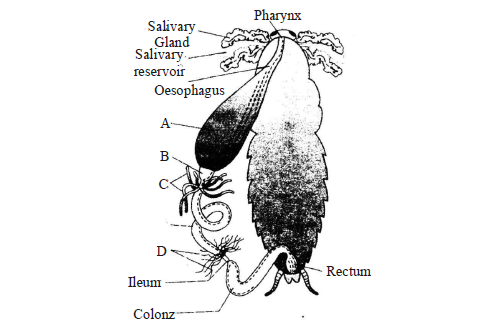
Identify structures A to D.
Identify structures A to D.
Correct Answer: (b)
In the cockroach digestive tract: A is the large crop (storage); B is the muscular gizzard (grinding); C is the ring of hepatic caecae; D is the bundle of malpighian tubules.
In the cockroach digestive tract: A is the large crop (storage); B is the muscular gizzard (grinding); C is the ring of hepatic caecae; D is the bundle of malpighian tubules.
Q68. Identify the figure with its correct function
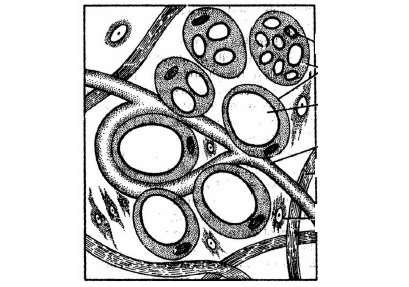
Correct Answer: (b)
The image shows adipose tissue, characterized by cells storing a large central droplet of fat, which serves as energy storage and insulation.
The image shows adipose tissue, characterized by cells storing a large central droplet of fat, which serves as energy storage and insulation.
Q69. Which of the following statements is not correct regarding neural tissue ?
Correct Answer: (b)
Neurons, not chondrocytes (which are cartilage cells), are the functional units of the nervous system.
Neurons, not chondrocytes (which are cartilage cells), are the functional units of the nervous system.
Q70. The major functions of loose connective tissue include
Correct Answer: (d)
Loose connective tissues like areolar and adipose tissue serve to support organs, provide insulation/storage, and offer structural frameworks for other tissues.
Loose connective tissues like areolar and adipose tissue serve to support organs, provide insulation/storage, and offer structural frameworks for other tissues.
Q71. Compound squamous epithelium is found in
Correct Answer: (d)
Compound (stratified) squamous epithelium provides protection and is found in areas subject to mechanical stress, such as the pharynx, buccal cavity, and esophagus.
Compound (stratified) squamous epithelium provides protection and is found in areas subject to mechanical stress, such as the pharynx, buccal cavity, and esophagus.
Q72. Which of the following is not a connective tissue?
Correct Answer: (d)
Muscles are a distinct type of tissue (muscular tissue) defined by contractility, whereas bone, cartilage, and blood are connective tissues.
Muscles are a distinct type of tissue (muscular tissue) defined by contractility, whereas bone, cartilage, and blood are connective tissues.
Q73. Goblet cells of alimentary canal are modified from
Correct Answer: (a)
Goblet cells are unicellular glands specialized for mucus secretion, modified from simple columnar epithelial cells.
Goblet cells are unicellular glands specialized for mucus secretion, modified from simple columnar epithelial cells.
Q74. The only type of cell seen in a tendon is
Correct Answer: (d)
Tendons are dense regular connective tissues primarily composed of parallel collagen fibers with fibroblasts (the cells that produce the fibers) arranged in rows.
Tendons are dense regular connective tissues primarily composed of parallel collagen fibers with fibroblasts (the cells that produce the fibers) arranged in rows.
Q75. Figure given below shows reproductive system of female cockroach. The correct labellings indicated by alphabets (A, B & C) are respectively
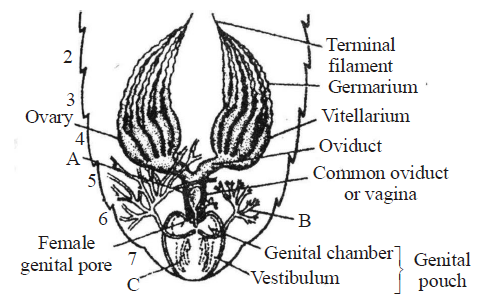
Correct Answer: (a)
In the female cockroach reproductive system: A is the spermatheca (for sperm storage); B are the collateral glands (for ootheca production); C are the gonapophyses (external genitalia).
In the female cockroach reproductive system: A is the spermatheca (for sperm storage); B are the collateral glands (for ootheca production); C are the gonapophyses (external genitalia).
Q76. Read the following statements and choose the correct answer.
I. Gap junctions cement adjacent cells together.
II. Aeolar tissue contains fibroblasts, macrophages and mast cells.
III. Tight junctions faciliate the cells to communicate with each other.
IV. Adhering junctions help to stop substances from leaking across tissues.
V. Cells of connective tissue except blood secrete fibres of structural proteins called elastin.
I. Gap junctions cement adjacent cells together.
II. Aeolar tissue contains fibroblasts, macrophages and mast cells.
III. Tight junctions faciliate the cells to communicate with each other.
IV. Adhering junctions help to stop substances from leaking across tissues.
V. Cells of connective tissue except blood secrete fibres of structural proteins called elastin.
Correct Answer: (b)
Gap junctions are for communication; Tight junctions prevent leakage; Adhering junctions cement cells together. Thus I, III, and IV are wrong definitions.
Gap junctions are for communication; Tight junctions prevent leakage; Adhering junctions cement cells together. Thus I, III, and IV are wrong definitions.
Q77. The camel’s hump is composed of a tissue which provides water when oxidized. It is:
Correct Answer: (c)
The hump of a camel consists mainly of adipose (fat) tissue. Metabolic oxidation of this fat produces significant amounts of metabolic water.
The hump of a camel consists mainly of adipose (fat) tissue. Metabolic oxidation of this fat produces significant amounts of metabolic water.
Q78. The sensory papillae in frogs are associated with
Correct Answer: (d)
Sensory papillae are cutaneous tactile receptors primarily associated with the sense of touch.
Sensory papillae are cutaneous tactile receptors primarily associated with the sense of touch.
Q79. A student was given a sample of tissue. He observes and concludes the following characters.
(i) The cells are composed of a single layer of tall and slender cells.
(ii) Their nuclei are located at the base.
(iii) Free surface may have microvilli.
(iv) It is found in the lining of stomach and intestine
(v) They help in secretion and absorption.
Based on the above features identify the epithelium.
(i) The cells are composed of a single layer of tall and slender cells.
(ii) Their nuclei are located at the base.
(iii) Free surface may have microvilli.
(iv) It is found in the lining of stomach and intestine
(v) They help in secretion and absorption.
Based on the above features identify the epithelium.
Correct Answer: (b)
Tall, slender cells with basal nuclei and often containing microvilli for absorption are characteristic of simple columnar epithelium.
Tall, slender cells with basal nuclei and often containing microvilli for absorption are characteristic of simple columnar epithelium.
Q80. If the head of cockroach is cut off, it will still be alive for as long as one week. Their is because of
Correct Answer: (b)
The cockroach's nervous system is ventral and decentralized; only a small part is in the head, while the rest is distributed in segments along the body.
The cockroach's nervous system is ventral and decentralized; only a small part is in the head, while the rest is distributed in segments along the body.
Q81. The protein present in the matrix of cartilage is
Correct Answer: (b)
The characteristic glycoprotein matrix of cartilage is called chondrin. Ossein is found in bone.
The characteristic glycoprotein matrix of cartilage is called chondrin. Ossein is found in bone.
Q82. Muscle tissue cells are contractile, which means they
Correct Answer: (b)
Contractility is the defining property of muscle cells, allowing them to shorten (contract) and lengthen (relax) to produce movement.
Contractility is the defining property of muscle cells, allowing them to shorten (contract) and lengthen (relax) to produce movement.
Q83. Male cockroach can be identified from the female by the presence of
Correct Answer: (d)
Anal styles are a pair of short, thread-like structures present only in the 9th sternum of male cockroaches.
Anal styles are a pair of short, thread-like structures present only in the 9th sternum of male cockroaches.
Q84. Which of the following type of tissue is being described by the given statements ?
(i) They are named because of their special function of linking and supporting other tissues/organs of the body.
(ii) They include cartilage, bone, adipose and blood.
(iii) They provide strength, elasticity and flexibility to the tissue.
(iv) They also secrete modified polysaccharides, which accumulate between cells and fibres and act as matrix.
(i) They are named because of their special function of linking and supporting other tissues/organs of the body.
(ii) They include cartilage, bone, adipose and blood.
(iii) They provide strength, elasticity and flexibility to the tissue.
(iv) They also secrete modified polysaccharides, which accumulate between cells and fibres and act as matrix.
Correct Answer: (b)
These features—support, variety (bone, blood), and an extensive extracellular matrix—are characteristic of connective tissues.
These features—support, variety (bone, blood), and an extensive extracellular matrix—are characteristic of connective tissues.
Q85. Which of the following statement(s) is/are correct about muscle tissue ?
Correct Answer: (d)
Muscle tissue is characterized by organized fibers that generate force through contraction to facilitate all bodily movements.
Muscle tissue is characterized by organized fibers that generate force through contraction to facilitate all bodily movements.
Q86. In earthworms, typhlosole has a role in:
Correct Answer: (d)
The typhlosole is an internal fold in the intestinal wall that increases the surface area for efficient absorption of nutrients.
The typhlosole is an internal fold in the intestinal wall that increases the surface area for efficient absorption of nutrients.
Q87. The figure given below shows the head region of cockroach. Identify A to F.
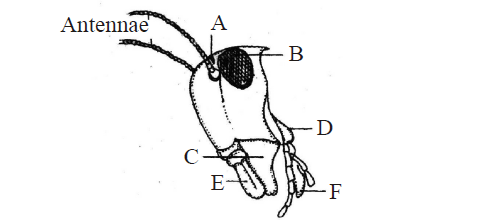
Correct Answer: (b)
In the cockroach head: A is the simple eye (ocellus), B is the compound eye, C is the mandible, D is the maxilla, E is the upper lip (labrum), and F is the lower lip (labium).
In the cockroach head: A is the simple eye (ocellus), B is the compound eye, C is the mandible, D is the maxilla, E is the upper lip (labrum), and F is the lower lip (labium).
Q88. Which one of the following statements is true for cockroach?
Correct Answer: (c)
Anal styles are a sexually dimorphic feature found only in male cockroaches. They are absent in females.
Anal styles are a sexually dimorphic feature found only in male cockroaches. They are absent in females.
Q89. Which of the following type of muscle tissue is being described on the basis of given statements ?
(i) These muscle fibres taper at both ends and do not show striations.
(ii) The wall of internal organs such as the blood vessels, stomach and intestine contain this type of muscle tissue.
(iii) They are ‘involuntary’ as their function cannot be directly controlled.
(i) These muscle fibres taper at both ends and do not show striations.
(ii) The wall of internal organs such as the blood vessels, stomach and intestine contain this type of muscle tissue.
(iii) They are ‘involuntary’ as their function cannot be directly controlled.
Correct Answer: (b)
Non-striated, involuntary, and spindle-shaped muscles found in the walls of visceral organs are smooth muscles.
Non-striated, involuntary, and spindle-shaped muscles found in the walls of visceral organs are smooth muscles.
Q90. Read the following statements and answer the question.
(i) They have a hard and non-pliable ground substance rich in calcium salts and collagen fibres.
(ii) They support and protect softer tissues and organs.
(iii) Osteocytes are present in the spaces called lacunae.
(iv) They also interact with skeletal muscles attached to them to bring about movements.
Which of the following type of tissue is being described by above statements ?
(i) They have a hard and non-pliable ground substance rich in calcium salts and collagen fibres.
(ii) They support and protect softer tissues and organs.
(iii) Osteocytes are present in the spaces called lacunae.
(iv) They also interact with skeletal muscles attached to them to bring about movements.
Which of the following type of tissue is being described by above statements ?
Correct Answer: (b)
The description of a mineralized matrix containing osteocytes in lacunae that works with muscles defines bone tissue.
The description of a mineralized matrix containing osteocytes in lacunae that works with muscles defines bone tissue.
Q91. Which of the following statement(s) is/are correct about nervous system of cockroach ?
(i) It consists of a series of fused segmentally arranged ganglia joined by paired longitudinal connectives on the ventral side.
(ii) There are six ganglia lie in the thorax, and three in the abdomen.
(iii) The sense organs are antennae, eyes, maxillary pulps, labial pulps and anal cerci etc.
(iv) Each eye consists of about 5000 hexagonal ommatidia.
(i) It consists of a series of fused segmentally arranged ganglia joined by paired longitudinal connectives on the ventral side.
(ii) There are six ganglia lie in the thorax, and three in the abdomen.
(iii) The sense organs are antennae, eyes, maxillary pulps, labial pulps and anal cerci etc.
(iv) Each eye consists of about 5000 hexagonal ommatidia.
Correct Answer: (a)
Statement (i) and (iii) are correct. (ii) is wrong (3 thoracic, 6 abdominal). (iv) is wrong (about 2000 ommatidia).
Statement (i) and (iii) are correct. (ii) is wrong (3 thoracic, 6 abdominal). (iv) is wrong (about 2000 ommatidia).
Q92. The secretions of endocrine glands are released directly
Correct Answer: (b)
Endocrine glands are ductless glands that secrete their products (hormones) directly into the interstitial fluid or bloodstream.
Endocrine glands are ductless glands that secrete their products (hormones) directly into the interstitial fluid or bloodstream.
Q93. Tendons and ligaments are the examples of
Correct Answer: (c)
In dense regular connective tissue, collagen fibers are oriented in regular parallel patterns. Tendons (muscle to bone) and ligaments (bone to bone) are key examples.
In dense regular connective tissue, collagen fibers are oriented in regular parallel patterns. Tendons (muscle to bone) and ligaments (bone to bone) are key examples.
Q94. Consider the following statements about earthworms:
(1) The cocoon holds the worm embryos.
(2) Development of earthworms is direct, i.e., there is no larva formed.
Which of the statement(s) given above is/are correct?
(1) The cocoon holds the worm embryos.
(2) Development of earthworms is direct, i.e., there is no larva formed.
Which of the statement(s) given above is/are correct?
Correct Answer: (c)
Fertilized eggs are deposited in cocoons where embryos develop directly into miniature worms without a larval stage.
Fertilized eggs are deposited in cocoons where embryos develop directly into miniature worms without a larval stage.
Q95. When cardiac muscle cells are damaged by a heart attack, they are usually replaced by
Correct Answer: (a)
Cardiac muscle has very limited regenerative power; damaged cells are typically replaced by non-contractile connective tissue (scarring).
Cardiac muscle has very limited regenerative power; damaged cells are typically replaced by non-contractile connective tissue (scarring).
Q96. Which of the following features is used to identify a male cockroach from a female cockroach?
Correct Answer: (b)
Caudal (anal) styles are thread-like appendages found only in male cockroaches on the 9th abdominal sternum.
Caudal (anal) styles are thread-like appendages found only in male cockroaches on the 9th abdominal sternum.
Q97. A student was given a sample of two tissues. He observes the tissues under the microscope and draws their figures (1 and 2) as shown below.
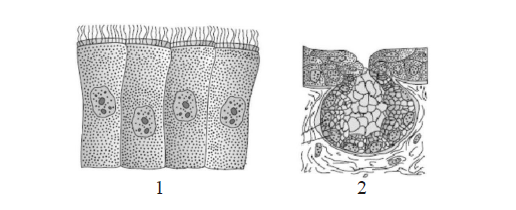
Identify the tissues (1 and 2).
Identify the tissues (1 and 2).
Correct Answer: (d)
Figure 1 shows tall columnar cells with cilia (ciliated epithelium). Figure 2 shows a cluster of secretory cells forming a multicellular gland.
Figure 1 shows tall columnar cells with cilia (ciliated epithelium). Figure 2 shows a cluster of secretory cells forming a multicellular gland.
Q98. What will happen if ligaments are cut or broken?
Correct Answer: (c)
Ligaments connect bone to bone at joints, stabilizing them. If broken, the joint loses stability and the bones may become 'unfixed' or dislocated.
Ligaments connect bone to bone at joints, stabilizing them. If broken, the joint loses stability and the bones may become 'unfixed' or dislocated.
Q99. Consider the following four statements (A-D) related to the common frog Rana tigrina and select the correct option starting which ones are true (T) and which ones are false (F).
Statements:
(A) On dry land it would die due to lack of O2 if its mouth is forcibly kept closed for a few days.
(B) It has four chambered heart.
(C) On dry land it turns uricotelic from ureotelic
(D) Its life-history is carried out in pond water.
Statements:
(A) On dry land it would die due to lack of O2 if its mouth is forcibly kept closed for a few days.
(B) It has four chambered heart.
(C) On dry land it turns uricotelic from ureotelic
(D) Its life-history is carried out in pond water.
Correct Answer: (d)
Frog use a buccal pump mechanism to draw air through their nostrils into the buccal cavity and then force it into the lungs. Rana tigrina has a three-chambered heart. Adult frogs are ureotelic (they excrete urea) to conserve water compared to the larval stage (tadpoles), which are ammonotelic (excreting ammonia)
Frog use a buccal pump mechanism to draw air through their nostrils into the buccal cavity and then force it into the lungs. Rana tigrina has a three-chambered heart. Adult frogs are ureotelic (they excrete urea) to conserve water compared to the larval stage (tadpoles), which are ammonotelic (excreting ammonia)
Q100. Match the epithetial tissue given in column-I with its location given in column-II and choose the correct option.
| Column I (Epithelial tissue) | Column II (Location) |
|---|---|
| A. Cuboidal | I. Epidermis of skin |
| B. Ciliated | II. Inner lining of blood vessels |
| C. Columnar | III. Inner surface of gall bladder |
| D. Squamous | IV. Inner lining of fallopian tube |
| E. Keratinized squamous | V. Lining of pancreatic duct |
Correct Answer: (c)
Matching: Cuboidal = pancreatic duct (V); Ciliated = fallopian tube (IV); Columnar = gall bladder (III); Squamous = blood vessels (II); Keratinized squamous = skin epidermis (I).
Matching: Cuboidal = pancreatic duct (V); Ciliated = fallopian tube (IV); Columnar = gall bladder (III); Squamous = blood vessels (II); Keratinized squamous = skin epidermis (I).
Q101. Lack of blood supply and presence of the non-cellular basement membrane are the characteristics of the
Correct Answer: (c)
Epithelial tissue is avascular (lacks blood vessels) and its cells rest on a non-cellular basement membrane.
Epithelial tissue is avascular (lacks blood vessels) and its cells rest on a non-cellular basement membrane.
Q102. The kind of epithelium which forms the inner walls of blood vessels is
Correct Answer: (d)
The inner lining of blood vessels, called endothelium, is composed of a single layer of simple squamous epithelium.
The inner lining of blood vessels, called endothelium, is composed of a single layer of simple squamous epithelium.
Q103. Match the types of connective tissue given in column-I with their examples given column-II and choose the correct option.
| Column-I (Types of connective) | Column-II (Examples) |
|---|---|
| A. Loose connective tissue | I. Tendons and ligaments |
| B. Dense regular tissue | II. Skin |
| C. Dense irregular tissue | III. Cartilage, bones, blood |
| D. Specialized connective tissue | IV. Fibroblasts, macrophages and mast cells |
Correct Answer: (c)
Matching: Loose connective contains fibroblasts/macrophages (IV); Dense regular = tendons (I); Dense irregular = skin (II); Specialized = bone/blood (III).
Matching: Loose connective contains fibroblasts/macrophages (IV); Dense regular = tendons (I); Dense irregular = skin (II); Specialized = bone/blood (III).
Q104. The supportive skeletal structures in the human external ears and in the nose tip are examples of
Correct Answer: (d)
The tip of the nose and the pinna of the ear are supported by flexible cartilage (hyaline and elastic respectively).
The tip of the nose and the pinna of the ear are supported by flexible cartilage (hyaline and elastic respectively).
Q105. In which one of the following preparations, cell junctions come across most frequently ?
Correct Answer: (d)
Cell junctions (tight, gap, adhering) are characteristic of epithelial tissues where cells are closely packed with little intercellular matrix.
Cell junctions (tight, gap, adhering) are characteristic of epithelial tissues where cells are closely packed with little intercellular matrix.
Q106. Which of the following features is not present in Periplaneta americana?
Correct Answer: (b)
Arthropods like cockroaches exhibit determinate and spiral cleavage, not indeterminate and radial (which is found in deuterostomes).
Arthropods like cockroaches exhibit determinate and spiral cleavage, not indeterminate and radial (which is found in deuterostomes).
Q107. In the given diagram of areolar connective tissue, the different cells and parts have been marked by alphabets (A, B, C & D). Choose the answer in which these alphabets correctly match with the parts and cells they indicate.
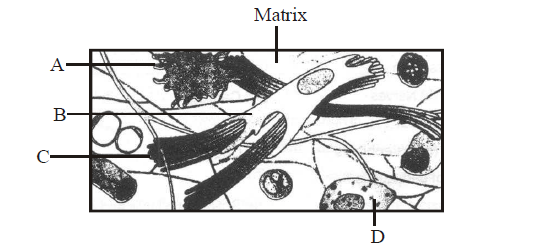
Correct Answer: (d)
In the standard diagram of areolar tissue: A is a macrophage, B is a fibroblast (cell producing fibers), C is a bundle of collagen fibers, and D is a mast cell.
In the standard diagram of areolar tissue: A is a macrophage, B is a fibroblast (cell producing fibers), C is a bundle of collagen fibers, and D is a mast cell.
Q108. In cockroach, the testes are present in
Correct Answer: (b)
The male reproductive system of a cockroach includes a pair of testes located laterally in the 4th to 6th abdominal segments.
The male reproductive system of a cockroach includes a pair of testes located laterally in the 4th to 6th abdominal segments.
Q109. In frogs, the cloaca is used to pass.
Correct Answer: (d)
The cloaca is a common chamber that serves the digestive (fecal matter), excretory (urine), and reproductive (sperms/ova) systems.
The cloaca is a common chamber that serves the digestive (fecal matter), excretory (urine), and reproductive (sperms/ova) systems.
Q110. Lack of blood supply and presence of the noncellular basement membrane are the characteristics of the
Correct Answer: (c)
This is a repeat of a previous question; epithelial tissues are avascular and rest on a basement membrane.
This is a repeat of a previous question; epithelial tissues are avascular and rest on a basement membrane.
Q111. Which exocrine glands are present in skin?
Correct Answer: (d)
The human skin contains sudoriferous (sweat) glands and sebaceous (oil) glands as its primary exocrine glands.
The human skin contains sudoriferous (sweat) glands and sebaceous (oil) glands as its primary exocrine glands.
Q112. The body cells in cockroach discharge their nitrogenous waste in the haemolymph mainly in the form of
Correct Answer: (a)
Excretory waste enters the malpighian tubules as soluble potassium urate, which is then processed into solid uric acid.
Excretory waste enters the malpighian tubules as soluble potassium urate, which is then processed into solid uric acid.
Q113. In frogs, RBC’s are:
Correct Answer: (a)
Unlike mammals, the mature red blood cells of frogs (and other amphibians) retain their nuclei.
Unlike mammals, the mature red blood cells of frogs (and other amphibians) retain their nuclei.
Q114. Match column-I with column-II and choose the correct option.
| Column-I | Column-II |
|---|---|
| A. Periplaneta americana | I. Hepatic caecae |
| B. A ring of 6-8 blind tubules | II. Phylum arthropoda |
| C. Vascular system | III. Spiracles |
| D. 10 pairs of small holes | IV. Malpighian tubules |
| E. Excretion | V. Open type |
Correct Answer: (b)
Matching: Periplaneta = Arthropoda (II); 6-8 tubules = Hepatic caecae (I); Vascular system = Open (V); 10 pairs holes = Spiracles (III); Excretion = Malpighian tubules (IV).
Matching: Periplaneta = Arthropoda (II); 6-8 tubules = Hepatic caecae (I); Vascular system = Open (V); 10 pairs holes = Spiracles (III); Excretion = Malpighian tubules (IV).
Q115. What type of cartilage forms the whole of the adult skeleton of cartilaginous fishes?
Correct Answer: (b)
Hyaline cartilage is the most abundant type of cartilage and provides the structural framework for the skeleton of Chondrichthyes (cartilaginous fishes).
Hyaline cartilage is the most abundant type of cartilage and provides the structural framework for the skeleton of Chondrichthyes (cartilaginous fishes).
Q116. The first body segment in earthworm is called the:
Correct Answer: (b)
The first true segment of an earthworm's body, which contains the mouth, is called the peristomium.
The first true segment of an earthworm's body, which contains the mouth, is called the peristomium.
Q117. The intercellular material of the given figure is solid and resists compression. Identify the figure and the label marked as A & B.
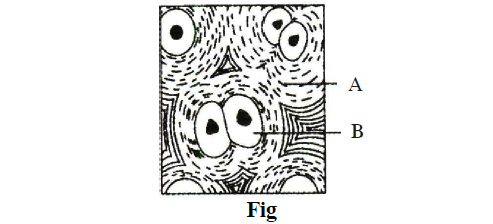
Correct Answer: (a)
The image shows cartilage tissue where 'A' represents the extracellular matrix (collagen fibers) and 'B' represents the chondrocytes (cells) located in lacunae.
The image shows cartilage tissue where 'A' represents the extracellular matrix (collagen fibers) and 'B' represents the chondrocytes (cells) located in lacunae.
Q118. The faecal deposits of earthworm are known as:
Correct Answer: (c)
Earthworms ingest soil and discharge the waste as nutrient-rich 'worm castings' on the soil surface.
Earthworms ingest soil and discharge the waste as nutrient-rich 'worm castings' on the soil surface.
Q119. Setae help in locomotion in earthworm but are not uniformly present in all the segments, They are absent in
Correct Answer: (c)
Locomotory setae are found in most segments but are characteristically missing from the first, last, and clitellar segments.
Locomotory setae are found in most segments but are characteristically missing from the first, last, and clitellar segments.
Q120. Choose the correctly matched pair
Correct Answer: (c)
The simple cuboidal epithelium lines the renal tubules (nephrons) and is specialized for secretion and absorption.
The simple cuboidal epithelium lines the renal tubules (nephrons) and is specialized for secretion and absorption.
Q121. The following figure shows the extarnal features of cockroach with few structures labelled as A, B, C, D, and E.
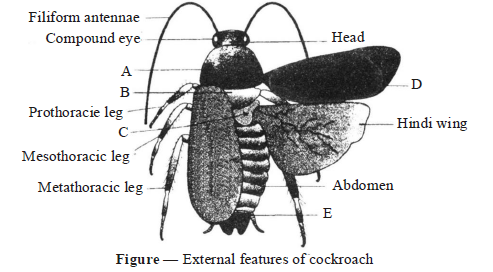
Identify A to E .
Identify A to E .
Correct Answer: (c)
A labels the pronotum (covering thorax); B is the mesothorax; C is the metathorax; D is the tegmina (forewing); E is the anal cerci (jointed appendages at the tail).
A labels the pronotum (covering thorax); B is the mesothorax; C is the metathorax; D is the tegmina (forewing); E is the anal cerci (jointed appendages at the tail).
Q122. Mammary gland is a modified
Correct Answer: (d)
Mammary glands are modified apocrine sweat glands. They secrete products along with portions of the cell cytoplasm.
Mammary glands are modified apocrine sweat glands. They secrete products along with portions of the cell cytoplasm.
Q123. Which of the following types of connective tissue is mismatched with its matrix ?
Correct Answer: (c)
Cartilage is avascular, meaning it lacks blood vessels in its matrix. The other descriptions are accurate.
Cartilage is avascular, meaning it lacks blood vessels in its matrix. The other descriptions are accurate.
Q124. Match the followings and choose the correct answer.
A. Touch (i) Nasal epithelium
B. Smell (ii) Foramen magnum
C. Cranial nerves (iii) Sensory papillae
D. Medulla oblongata (iv) Peripheral nervous system
A. Touch (i) Nasal epithelium
B. Smell (ii) Foramen magnum
C. Cranial nerves (iii) Sensory papillae
D. Medulla oblongata (iv) Peripheral nervous system
Correct Answer: (a)
Touch = sensory papillae (III); Smell = nasal epithelium (I); Cranial nerves = PNS (IV); Medulla = exits via foramen magnum (II).
Touch = sensory papillae (III); Smell = nasal epithelium (I); Cranial nerves = PNS (IV); Medulla = exits via foramen magnum (II).
Q125. Which of the following is/are common Indian Earthworm(s)?
Correct Answer: (d)
Pheretima and Lumbricus are the most common genera of earthworms found in India.
Pheretima and Lumbricus are the most common genera of earthworms found in India.
Q126. Identify figures-I and II.
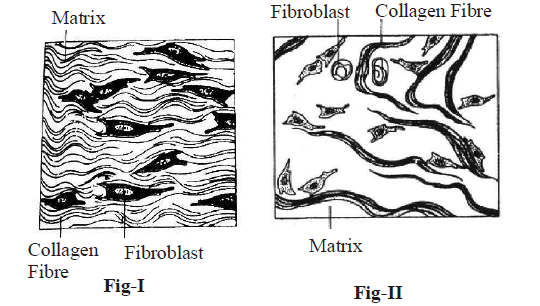
Correct Answer: (a)
Figure I shows collagen fibers arranged in parallel (dense regular), while Figure II shows fibers arranged randomly (dense irregular).
Figure I shows collagen fibers arranged in parallel (dense regular), while Figure II shows fibers arranged randomly (dense irregular).
Q127. Which statement regarding anal cerci and anal style in cockroach is correct?
Correct Answer: (d)
Both sexes have anal cerci (on the 10th segment), but only males have anal styles. Thus, anal styles are absent in females while cerci are present.
Both sexes have anal cerci (on the 10th segment), but only males have anal styles. Thus, anal styles are absent in females while cerci are present.
Q128. Prostomium is an important organ present in:
Correct Answer: (b)
The prostomium is the small lobe above the mouth in earthworms, used for sensory perception and digging.
The prostomium is the small lobe above the mouth in earthworms, used for sensory perception and digging.
Q129. The clitellum is a distinct part in the body of earthworm, it is found in?
Correct Answer: (b)
In a mature earthworm, segments 14 to 16 are covered by a prominent dark band of glandular tissue called the clitellum.
In a mature earthworm, segments 14 to 16 are covered by a prominent dark band of glandular tissue called the clitellum.
Q130. Frog’s heart when taken out of the body continues to beat for sometime. Select the best option from the following statements.
(A) Frog is a poikilotherm.
(B) Frog does not have any coronary circulation.
(C) Heart is “myogenic” in nature.
(D) Heart is autoexcitable
(A) Frog is a poikilotherm.
(B) Frog does not have any coronary circulation.
(C) Heart is “myogenic” in nature.
(D) Heart is autoexcitable
Correct Answer: (c)
The vertebrate heart, including a frog's, is myogenic and autoexcitable, meaning it can initiate its own contractions independently of the brain.
The vertebrate heart, including a frog's, is myogenic and autoexcitable, meaning it can initiate its own contractions independently of the brain.
Q131. Mast cells are associated with
Correct Answer: (c)
Mast cells are resident cells of loose connective tissue, such as areolar tissue, and are involved in inflammatory and allergic responses.
Mast cells are resident cells of loose connective tissue, such as areolar tissue, and are involved in inflammatory and allergic responses.
Q132. The longitudinal channels in the long bones are:
Correct Answer: (b)
Haversian canals are the longitudinal channels in mammalian compact bone that house blood vessels and nerves.
Haversian canals are the longitudinal channels in mammalian compact bone that house blood vessels and nerves.
Q133. The no. of digits in forelimbs & hind limbs of frong respectively are:
Correct Answer: (a)
A frog has 4 digits on its forelimbs and 5 digits on its hind limbs.
A frog has 4 digits on its forelimbs and 5 digits on its hind limbs.
Q134. Sweat (Sudoriferous) glands in mammals are
Correct Answer: (c)
Mammalian sweat glands are simple coiled tubular glands that open onto the skin surface.
Mammalian sweat glands are simple coiled tubular glands that open onto the skin surface.