Q1. Phosphoenol Pyruvate (PEP) is the primary CO2 acceptor in:
Correct Answer: (a)
In C4 plants, initial carbon fixation occurs in mesophyll cells where PEP is the acceptor.
In C4 plants, initial carbon fixation occurs in mesophyll cells where PEP is the acceptor.
Q2. Refer the given equation and answer the question: 2(C51H98O6) + 145O2 → 102CO2 + 98H2O + Energy. The R.Q of above reaction is
Correct Answer: (b)
RQ = CO2 produced / O2 consumed. 102 / 145 ≈ 0.7. This value is characteristic of fats (like tripalmitin).
RQ = CO2 produced / O2 consumed. 102 / 145 ≈ 0.7. This value is characteristic of fats (like tripalmitin).
Q3. In the conversion of pyruvic acid to acetyl coenzyme A, NAD+ is:
Correct Answer: (b)
During the oxidative decarboxylation of pyruvate, NAD+ acts as an electron acceptor and is reduced to NADH + H+.
During the oxidative decarboxylation of pyruvate, NAD+ acts as an electron acceptor and is reduced to NADH + H+.
Q4. Fermentation is represented by the equation:
Correct Answer: (b)
Alcoholic fermentation involves the anaerobic breakdown of glucose into ethanol and carbon dioxide with a small release of energy.
Alcoholic fermentation involves the anaerobic breakdown of glucose into ethanol and carbon dioxide with a small release of energy.
Q5. Total number of ATP consumed during Kreb’s cycle is
Correct Answer: (a)
The Krebs cycle is strictly an energy-producing pathway; no ATP is consumed within its enzymatic steps.
The Krebs cycle is strictly an energy-producing pathway; no ATP is consumed within its enzymatic steps.
Q6. Chemiosmotic theory of ATP synthesis in the chloroplasts and mitochondria is based on the:
Correct Answer: (d)
The driving force for ATP synthesis in both organelles is the electrochemical potential difference created by a concentration gradient of protons (H+).
The driving force for ATP synthesis in both organelles is the electrochemical potential difference created by a concentration gradient of protons (H+).
Q7. Conversion of phosphoglyceraldehyde to 1, 1-bisphosphoglyceric acid is a:
Correct Answer: (c)
This step involves both the addition of a phosphate group (phosphorylation) and the oxidation of PGAL (redox).
This step involves both the addition of a phosphate group (phosphorylation) and the oxidation of PGAL (redox).
Q8. In glycolysis, there is one step where NADH + H+ is formed from NAD+, this is when 3-phosphoglyceraldehyde (PGAL) is converted to 1, 3-bisphosphyglycerate (BPGA). This reaction shows
Correct Answer: (a)
This step involves the removal of hydrogen (dehydrogenation) from PGAL and its addition to NAD+ (oxidation of the substrate).
This step involves the removal of hydrogen (dehydrogenation) from PGAL and its addition to NAD+ (oxidation of the substrate).
Q9. If a starved plant is provided with glucose, the rate of respiration would:
Correct Answer: (b)
Starved plants have depleted their respiratory substrates. Providing glucose provides the necessary fuel for glycolysis and the TCA cycle, thereby increasing the respiration rate.
Starved plants have depleted their respiratory substrates. Providing glucose provides the necessary fuel for glycolysis and the TCA cycle, thereby increasing the respiration rate.
Q10. Which of the following is important in electron transport system?
Correct Answer: (a)
Ubiquinone (Coenzyme Q) is a mobile electron carrier located within the inner mitochondrial membrane that shuttles electrons between complexes.
Ubiquinone (Coenzyme Q) is a mobile electron carrier located within the inner mitochondrial membrane that shuttles electrons between complexes.
Q11. In the given figure of electron transport chain - identify P, Q, R, S and T.
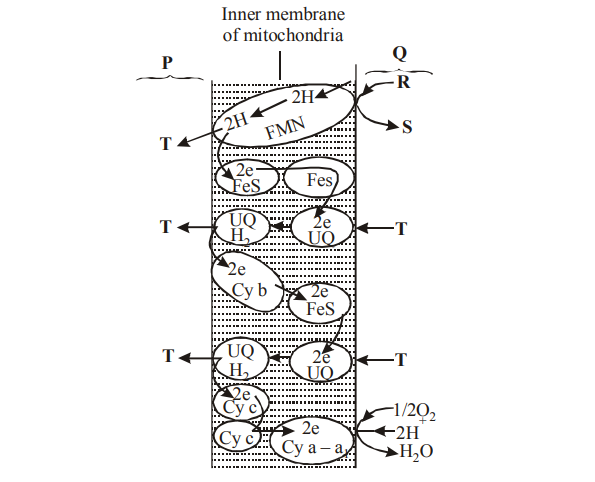
Correct Answer: (b)
P is the intermembrane space. Q is the matrix. R is NADH + H+ donating electrons. S is the oxidized NAD+. T represents the protons (2H+) pumped across.
P is the intermembrane space. Q is the matrix. R is NADH + H+ donating electrons. S is the oxidized NAD+. T represents the protons (2H+) pumped across.
Q12. Choose the correct statement:
Correct Answer: (b)
The conversion of succinyl-CoA to succinic acid is a substrate-level phosphorylation step producing ATP/GTP.
The conversion of succinyl-CoA to succinic acid is a substrate-level phosphorylation step producing ATP/GTP.
Q13. Which one of the following is essential for the respiration as well as photosynthesis?
Correct Answer: (b)
Cytochromes are iron-containing electron transfer proteins found in both the mitochondrial ETS and the chloroplast thylakoid membrane.
Cytochromes are iron-containing electron transfer proteins found in both the mitochondrial ETS and the chloroplast thylakoid membrane.
Q14. Respiration is a/an:
Correct Answer: (b)
Respiration is a catabolic process because it involves the breakdown of complex molecules like glucose into simpler ones, and it is exergonic because energy is released during the process.
Respiration is a catabolic process because it involves the breakdown of complex molecules like glucose into simpler ones, and it is exergonic because energy is released during the process.
Q15. In alcoholic fermentation, NAD+ is produced during the:
Correct Answer: (a)
NADH is oxidized back to NAD+ during the conversion of acetaldehyde to ethanol.
NADH is oxidized back to NAD+ during the conversion of acetaldehyde to ethanol.
Q16. The formation of acetyl coenzyme A from pyruvic acid produces (in addition to acetyl coenzyme A) one molecule of A, one molecule of B, and one molecule (ion) of C. Identify A, B and C respectively.
Correct Answer: (d)
The reaction is: Pyruvate + CoA + NAD+ → Acetyl CoA + CO2 + NADH + H+.
The reaction is: Pyruvate + CoA + NAD+ → Acetyl CoA + CO2 + NADH + H+.
Q17. ATP is:
Correct Answer: (d)
ATP (Adenosine Triphosphate) acts as the chemical energy currency of the cell, is structurally a nucleotide, and is synthesized during both photosynthesis (photophosphorylation) and respiration (oxidative phosphorylation).
ATP (Adenosine Triphosphate) acts as the chemical energy currency of the cell, is structurally a nucleotide, and is synthesized during both photosynthesis (photophosphorylation) and respiration (oxidative phosphorylation).
Q18. By which of the following complex, proton is pumped to reach ATP synthase to participate in ATP synthesis?
Correct Answer: (a)
Complex III (Cytochrome bc1) and other complexes in the ETS pump protons into the intermembrane space to create the gradient used by ATP synthase.
Complex III (Cytochrome bc1) and other complexes in the ETS pump protons into the intermembrane space to create the gradient used by ATP synthase.
Q19. The enzymes, involved in the chemical reactions of glycolysis are located:
Correct Answer: (a)
All steps of glycolysis take place in the cytosol (cytoplasm) of the cell.
All steps of glycolysis take place in the cytosol (cytoplasm) of the cell.
Q20. Life without air would be:
Correct Answer: (d)
Anaerobic organisms (obligate or facultative) can live and produce energy without the presence of oxygen.
Anaerobic organisms (obligate or facultative) can live and produce energy without the presence of oxygen.
Q21. The overall goal of glycolysis, Kreb’s cycle and the electron transport system is the formation of:
Correct Answer: (d)
The stepwise breakdown of glucose allows the cell to capture energy efficiently in manageable units of ATP rather than releasing it all as heat in a single burst.
The stepwise breakdown of glucose allows the cell to capture energy efficiently in manageable units of ATP rather than releasing it all as heat in a single burst.
Q22. Which of these statements is incorrect?
Correct Answer: (c)
Oxidative phosphorylation occurs on the inner mitochondrial membrane, not the outer membrane.
Oxidative phosphorylation occurs on the inner mitochondrial membrane, not the outer membrane.
Q23. The reasons for the involvement of different enzyme in each step of glycolysis is that:
Correct Answer: (c)
Enzymes are highly specific to their substrates and the specific chemical transformations (isomerization, phosphorylation, etc.) they catalyze.
Enzymes are highly specific to their substrates and the specific chemical transformations (isomerization, phosphorylation, etc.) they catalyze.
Q24. Which of the following process occurs in glycolysis?
Correct Answer: (a)
Glycolysis involves the oxidation of glyceraldehyde 3-phosphate to 1,3-bisphosphoglycerate, which reduces NAD+ to NADH.
Glycolysis involves the oxidation of glyceraldehyde 3-phosphate to 1,3-bisphosphoglycerate, which reduces NAD+ to NADH.
Q25. Hexose monophosphate shunt does not take place when:
Correct Answer: (a)
The HMP shunt (Pentose Phosphate Pathway) is an aerobic pathway. It requires sufficient oxygen to proceed; otherwise, the cell relies purely on anaerobic glycolysis.
The HMP shunt (Pentose Phosphate Pathway) is an aerobic pathway. It requires sufficient oxygen to proceed; otherwise, the cell relies purely on anaerobic glycolysis.
Q26. Refer the figure and answer the question. Identify P, Q, R, and S.
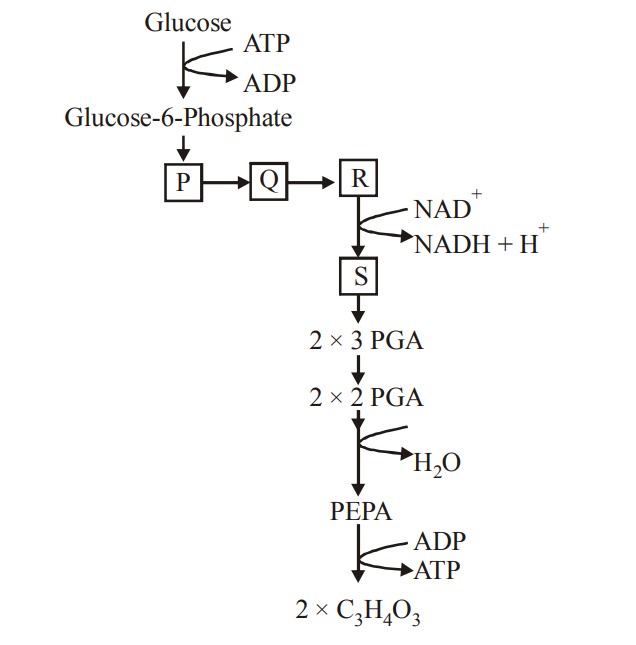
Correct Answer: (d)
P is Fructose 6-phosphate. Q is Fructose 1,6-bisphosphate. R is Glyceraldehyde 3-phosphate (3-PGAld). S is 1,3-bisphosphoglycerate (1,3-diPGA).
P is Fructose 6-phosphate. Q is Fructose 1,6-bisphosphate. R is Glyceraldehyde 3-phosphate (3-PGAld). S is 1,3-bisphosphoglycerate (1,3-diPGA).
Q27. Which is correct link reaction:
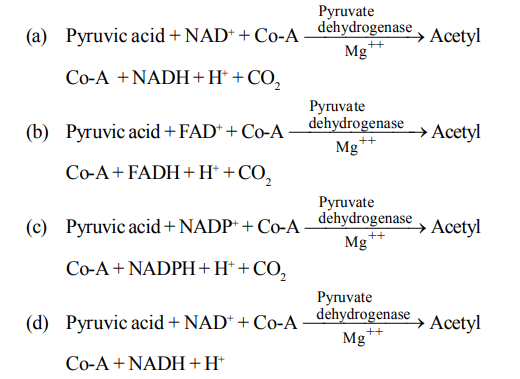
Correct Answer: (a)
Option (a) correctly shows Pyruvate + NAD+ + CoA $\xrightarrow[Mg^{2+}]{PDH}$ Acetyl CoA + NADH + H+ + CO2.
Option (a) correctly shows Pyruvate + NAD+ + CoA $\xrightarrow[Mg^{2+}]{PDH}$ Acetyl CoA + NADH + H+ + CO2.
Q28. By which of the following complex, proton is pumped to reach ATP synthase to participate in ATP synthesis?
Correct Answer: (a)
While the terminology varies, Complex III (Cytochrome bc1) and other complexes are responsible for proton pumping. Option (a) Cytochrome b6f is the analogous complex in chloroplasts.
While the terminology varies, Complex III (Cytochrome bc1) and other complexes are responsible for proton pumping. Option (a) Cytochrome b6f is the analogous complex in chloroplasts.
Q29. Which of the following statements (i to v) regarding glycolysis are correct?
(i) It is ten enzymatic reactions that convert a six-carbon molecule to a three carbon pyruvate and result in a net gain of 2 ATP molecules.
(ii) Glucose undergoes partial oxidation to form one molecule of pyruvic acid.
(iii) Glucose is phosphorylated to give rise to glucose - 6 - phosphate by the activity of the enzyme phosphofructokinase.
(iv) The scheme of glycolysis was given by Gustav Embden, Otto Morrison, and J. Parnas and is often referred to as the EMP pathway.
(v) ATP is utilized at two steps: first in the conversion of glucose into glucose 6-phosphate & second in the conversion of fructose - 6- phosphate to fructose 1,6-disphosphate.
(i) It is ten enzymatic reactions that convert a six-carbon molecule to a three carbon pyruvate and result in a net gain of 2 ATP molecules.
(ii) Glucose undergoes partial oxidation to form one molecule of pyruvic acid.
(iii) Glucose is phosphorylated to give rise to glucose - 6 - phosphate by the activity of the enzyme phosphofructokinase.
(iv) The scheme of glycolysis was given by Gustav Embden, Otto Morrison, and J. Parnas and is often referred to as the EMP pathway.
(v) ATP is utilized at two steps: first in the conversion of glucose into glucose 6-phosphate & second in the conversion of fructose - 6- phosphate to fructose 1,6-disphosphate.
Correct Answer: (a)
Statement (ii) is wrong (2 molecules of pyruvate are formed). (iii) is wrong (hexokinase phosphorylates glucose). (i), (iv), and (v) are correct.
Statement (ii) is wrong (2 molecules of pyruvate are formed). (iii) is wrong (hexokinase phosphorylates glucose). (i), (iv), and (v) are correct.
Q30. In mitochondria, protons accumulate in the:
Correct Answer: (c)
Protons are pumped from the matrix across the inner membrane into the intermembrane space to establish the electrochemical gradient.
Protons are pumped from the matrix across the inner membrane into the intermembrane space to establish the electrochemical gradient.
Q31. During the process of respiration, which of the followings are released as products?
Correct Answer: (d)
The complete combustion of glucose in aerobic respiration yields carbon dioxide, water, and energy.
The complete combustion of glucose in aerobic respiration yields carbon dioxide, water, and energy.
Q32. Which statement is wrong for Krebs’ cycle?
Correct Answer: (c)
Krebs cycle starts with the condensation of Acetyl CoA with Oxaloacetic acid, not pyruvic acid.
Krebs cycle starts with the condensation of Acetyl CoA with Oxaloacetic acid, not pyruvic acid.
Q33. In which of the following reaction of glycolysis, a molecule of water is removed from the substrate?
Correct Answer: (d)
The enzyme enolase catalyzes the dehydration of 2-phosphoglycerate to form phosphoenolpyruvate (PEP), releasing a water molecule.
The enzyme enolase catalyzes the dehydration of 2-phosphoglycerate to form phosphoenolpyruvate (PEP), releasing a water molecule.
Q34. The main purpose of electron transport chain is to:
Correct Answer: (a)
The ETS oxidizes NADH and FADH2 to replenish the pool of NAD+ and FAD required for glycolysis and the TCA cycle to continue.
The ETS oxidizes NADH and FADH2 to replenish the pool of NAD+ and FAD required for glycolysis and the TCA cycle to continue.
Q35. If hexokinase, an enzyme that catalyzes the first step in glycolysis is blocked what will be its impact on glycolytic pathway?
Correct Answer: (c)
Hexokinase is essential for the initial phosphorylation of glucose. If it is blocked, the entire downstream pathway cannot function.
Hexokinase is essential for the initial phosphorylation of glucose. If it is blocked, the entire downstream pathway cannot function.
Q36. A major site for synthesis of ATP from ADP and Pi is
Correct Answer: (a)
ATP synthesis specifically occurs at the F1 headpiece of the ATP synthase complex, which protrudes into the mitochondrial matrix.
ATP synthesis specifically occurs at the F1 headpiece of the ATP synthase complex, which protrudes into the mitochondrial matrix.
Q37. Which one of the following reactions is an example of oxidative decarboxylation?
Correct Answer: (c)
The conversion of pyruvate to Acetyl-CoA involves both the loss of CO2 (decarboxylation) and the reduction of NAD+ (oxidation of the substrate).
The conversion of pyruvate to Acetyl-CoA involves both the loss of CO2 (decarboxylation) and the reduction of NAD+ (oxidation of the substrate).
Q38. Conversion of glucose to glucose-6-phosphate, the first irreversible reaction of glycolysis, is catalysed by:
Correct Answer: (b)
Hexokinase catalyzes the irreversible first step of glycolysis.
Hexokinase catalyzes the irreversible first step of glycolysis.
Q39. How many ATP molecules can be produced through oxidative phosphorylation of 2NADH2 and 3 FADH2?
Correct Answer: (d)
1 NADH produces 3 ATP (2 x 3 = 6). 1 FADH2 produces 2 ATP (3 x 2 = 6). Total = 12 ATP.
1 NADH produces 3 ATP (2 x 3 = 6). 1 FADH2 produces 2 ATP (3 x 2 = 6). Total = 12 ATP.
Q40. In which of the following process 36 ATP molecules are produced by per hexose molecule?
Correct Answer: (c)
The 'Direct oxidation pathway' or aerobic respiration (Glycolysis + TCA + ETS) typically yields a net of 36 or 38 ATP per glucose molecule.
The 'Direct oxidation pathway' or aerobic respiration (Glycolysis + TCA + ETS) typically yields a net of 36 or 38 ATP per glucose molecule.
Q41. The chemiosmotic coupling hypothesis of oxidative phosphorylation proposes that adenosine triphosphate (ATP) is formed because:
Correct Answer: (c)
ATP synthesis is driven by the energy released as protons flow back into the matrix down their electrochemical gradient through ATP synthase.
ATP synthesis is driven by the energy released as protons flow back into the matrix down their electrochemical gradient through ATP synthase.
Q42. Which of the following statements (i to v) regarding glycolysis are correct?
(i) It is ten enzymatic reactions that convert a six-carbon molecule to a three carbon pyruvate and result in a net gain of 2 ATP molecules.
(ii) Glucose undergoes partial oxidation to form one molecule of pyruvic acid.
(iii) Glucose is phosphorylated to give rise to glucose - 6 - phosphate by the activity of the enzyme phosphofructokinase.
(iv) The scheme of glycolysis was given by Gustav Embden, Otto Meyerheff, and J. Parnas and is often referred as the EMP pathway.
(v) ATP is utilized at two steps: first in the conversion of glucose into glucose 6-phosphate & second in the conversion of fructose - 6- phosphate to fructose 1,6-disphosphate.
(i) It is ten enzymatic reactions that convert a six-carbon molecule to a three carbon pyruvate and result in a net gain of 2 ATP molecules.
(ii) Glucose undergoes partial oxidation to form one molecule of pyruvic acid.
(iii) Glucose is phosphorylated to give rise to glucose - 6 - phosphate by the activity of the enzyme phosphofructokinase.
(iv) The scheme of glycolysis was given by Gustav Embden, Otto Meyerheff, and J. Parnas and is often referred as the EMP pathway.
(v) ATP is utilized at two steps: first in the conversion of glucose into glucose 6-phosphate & second in the conversion of fructose - 6- phosphate to fructose 1,6-disphosphate.
Correct Answer: (a)
Statements (i), (iv), and (v) are correct. (ii) is wrong because 2 pyruvates are formed. (iii) is wrong because hexokinase phosphorylates glucose.
Statements (i), (iv), and (v) are correct. (ii) is wrong because 2 pyruvates are formed. (iii) is wrong because hexokinase phosphorylates glucose.
Q43. Which of the following statement(s) concerning ATP synthesis is/are correct?
Correct Answer: (d)
All statements correctly describe various aspects and mechanisms of cellular ATP production.
All statements correctly describe various aspects and mechanisms of cellular ATP production.
Q44. Respiration substrates are
Correct Answer: (a)
Respiratory substrates (carbs, fats, proteins) are organic compounds that are oxidized within the cell to provide chemical energy in the form of ATP.
Respiratory substrates (carbs, fats, proteins) are organic compounds that are oxidized within the cell to provide chemical energy in the form of ATP.
Q45. Conversion of phosphenol pyruvic acid to pyruvic acid and ADP to ATP are examples of:
Correct Answer: (d)
When a phosphate group is transferred directly from a substrate (PEP) to ADP to form ATP, it is called substrate-level phosphorylation.
When a phosphate group is transferred directly from a substrate (PEP) to ADP to form ATP, it is called substrate-level phosphorylation.
Q46. Cytochrome oxidase is a/an
Correct Answer: (b)
Cytochrome oxidase (Complex IV) is an integral membrane protein found inside the mitochondrial membrane, making it an endoenzyme.
Cytochrome oxidase (Complex IV) is an integral membrane protein found inside the mitochondrial membrane, making it an endoenzyme.
Q47. Match the number of carbon atoms given in column - I with that of the compounds given in column - II and select the correct option.
| Column - I | Column - II |
|---|---|
| A. 4C compound | I. Acetyl CoA |
| B. 2C compound | II. Pyruvate |
| C. 5C compound | III. Citric acid |
| D. 3C compound | IV. alpha-ketoglutaric acid |
| V. Malic acid |
Correct Answer: (b)
4C: Malic acid/OAA. 2C: Acetyl CoA. 5C: alpha-ketoglutaric acid. 3C: Pyruvate.
4C: Malic acid/OAA. 2C: Acetyl CoA. 5C: alpha-ketoglutaric acid. 3C: Pyruvate.
Q48. In some succulent plants like Opuntia the R. Q. is zero because
Correct Answer: (b)
CAM plants like Opuntia fix CO2 into organic acids (malate) during the night when stomata are open; thus, CO2 is not evolved during the respiration process at that time.
CAM plants like Opuntia fix CO2 into organic acids (malate) during the night when stomata are open; thus, CO2 is not evolved during the respiration process at that time.
Q49. What is the function of molecular oxygen in cellular respiration?
Correct Answer: (d)
Oxygen is the terminal electron acceptor; it picks up electrons and protons (hydrogen) at the end of the ETS to form water.
Oxygen is the terminal electron acceptor; it picks up electrons and protons (hydrogen) at the end of the ETS to form water.
Q50. The ultimate electron acceptor of respiration in an aerobic organism is:
Correct Answer: (b)
Oxygen is the terminal electron acceptor in the electron transport chain, forming water.
Oxygen is the terminal electron acceptor in the electron transport chain, forming water.
Q51. Inside an active mitochondrion, most electrons follow which pathway ?
Correct Answer: (d)
Electrons are stripped from substrates in the Krebs cycle, carried by NADH to the ETS, and finally passed to oxygen.
Electrons are stripped from substrates in the Krebs cycle, carried by NADH to the ETS, and finally passed to oxygen.
Q52. Select the incorrect statement about NADH during cellular respiration.
Correct Answer: (d)
NADH is the reduced form; it is oxidized to NAD+ when it donates its electrons to the ETS.
NADH is the reduced form; it is oxidized to NAD+ when it donates its electrons to the ETS.
Q53. Which of the following representation correctly explain the function of mitochondrion?
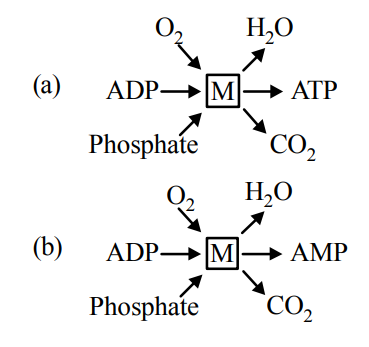
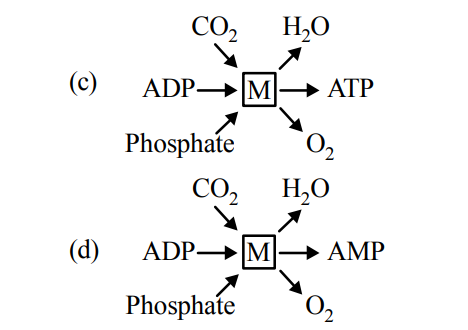
Correct Answer: (c)
Diagram (c) is correct: O2 and Pyruvate go in; CO2, H2O and ATP come out.
Diagram (c) is correct: O2 and Pyruvate go in; CO2, H2O and ATP come out.
Q54. Which of the following is incorrect regarding the Kreb’s cycle?
Correct Answer: (d)
The Krebs cycle involves two major decarboxylation steps (conversion of isocitrate to α-ketoglutarate and α-ketoglutarate to succinyl-CoA).
The Krebs cycle involves two major decarboxylation steps (conversion of isocitrate to α-ketoglutarate and α-ketoglutarate to succinyl-CoA).
Q55. In the given columns, column-I contain complexes and column-II contain their alternative names. Select the correct match from the option given below.
| Column - I | Column - II |
|---|---|
| A. Complex I | I. Cytochrome bc1 complex |
| B. Complex II | II. NADH dehydrogenase |
| C. Complex III | III. ATP synthetase |
| D. Complex IV | IV. FADH2 dehydrogenase |
| E. Complex V | V. Cytochrome c oxidase |
Correct Answer: (a)
Complex I: NADH Dehydrogenase. II: FADH2 Dehydrogenase (Succinate Dehydrogenase). III: bc1 complex. IV: Cyt c oxidase. V: ATP synthase.
Complex I: NADH Dehydrogenase. II: FADH2 Dehydrogenase (Succinate Dehydrogenase). III: bc1 complex. IV: Cyt c oxidase. V: ATP synthase.
Q56. Out of 38 ATP molecules produced per glucose, 32 ATP molecules are formed from NADH/FADH2 in:
Correct Answer: (a)
The majority of ATP in aerobic respiration is generated via the electron transport system (respiratory chain) through oxidative phosphorylation.
The majority of ATP in aerobic respiration is generated via the electron transport system (respiratory chain) through oxidative phosphorylation.
Q57. Cytochrome oxidase contain
Correct Answer: (d)
Cytochrome c oxidase (Complex IV) contains two copper centers (CuA and CuB) in addition to iron-containing hemes.
Cytochrome c oxidase (Complex IV) contains two copper centers (CuA and CuB) in addition to iron-containing hemes.
Q58. The given figure shows the few major steps of the pathway of anaerobic respiration as indicated by P, Q, R and S. Identify P, Q, R and S.
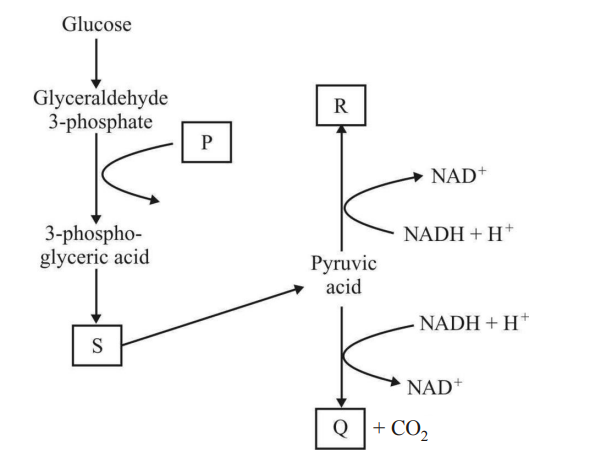
Correct Answer: (a)
P is the regenerated NAD+. Q is Ethanol (alcoholic fermentation product). R is Lactic acid (lactic fermentation product). S is PEP (an intermediate in glycolysis).
P is the regenerated NAD+. Q is Ethanol (alcoholic fermentation product). R is Lactic acid (lactic fermentation product). S is PEP (an intermediate in glycolysis).
Q59. Respiration is the breakdown of
Correct Answer: (a)
Respiration involves the breaking of the C-C bonds of complex organic compounds through oxidation within the cells, leading to the release of a considerable amount of energy.
Respiration involves the breaking of the C-C bonds of complex organic compounds through oxidation within the cells, leading to the release of a considerable amount of energy.
Q60. In which one of the following do the two names refer to tricarboxylic acid cycle?
Correct Answer: (c)
The TCA cycle is also known as the Citric Acid Cycle (after the first product) or the Krebs Cycle (after its discoverer Hans Krebs).
The TCA cycle is also known as the Citric Acid Cycle (after the first product) or the Krebs Cycle (after its discoverer Hans Krebs).
Q61. Initial step of TCA cycle to yield citric acid starts with the condensation of:
Correct Answer: (a)
The cycle begins with the reaction of the 2-carbon Acetyl group with the 4-carbon Oxaloacetic Acid (OAA) and water to form the 6-carbon Citric Acid.
The cycle begins with the reaction of the 2-carbon Acetyl group with the 4-carbon Oxaloacetic Acid (OAA) and water to form the 6-carbon Citric Acid.
Q62. Which of the following exhibits the highest rate of respiration?
Correct Answer: (b)
Germinating seeds have extremely high metabolic activity and energy requirements, leading to the highest respiration rates among the choices.
Germinating seeds have extremely high metabolic activity and energy requirements, leading to the highest respiration rates among the choices.
Q63. Which of the following statement is/are the correct about the events in aerobic respiration?
(i) The complete oxidation of pyruvate by the stepwise removal of all the hydrogen atoms, leaving three molecules of O2.
(ii) The complete oxidation of pyruvate by the stepwise removal of all the hydrogen atoms, leaving three molecules of CO2.
(iii) The passing on of the electrons removed as part of the hydrogen atoms to molecular O2 with simultaneous synthesis of ATP.
(iv) The passing on of the electrons removed as part of the hydrogen atoms to molecular O2 with simultaneous synthesis of ADP.
(i) The complete oxidation of pyruvate by the stepwise removal of all the hydrogen atoms, leaving three molecules of O2.
(ii) The complete oxidation of pyruvate by the stepwise removal of all the hydrogen atoms, leaving three molecules of CO2.
(iii) The passing on of the electrons removed as part of the hydrogen atoms to molecular O2 with simultaneous synthesis of ATP.
(iv) The passing on of the electrons removed as part of the hydrogen atoms to molecular O2 with simultaneous synthesis of ADP.
Correct Answer: (c)
Aerobic respiration involves the complete oxidation of pyruvate to three molecules of CO2 and the transfer of electrons to O2 to drive ATP synthesis.
Aerobic respiration involves the complete oxidation of pyruvate to three molecules of CO2 and the transfer of electrons to O2 to drive ATP synthesis.
Q64. Refer the figure and answer the question. Choose the correct names of P, Q, R, and S.
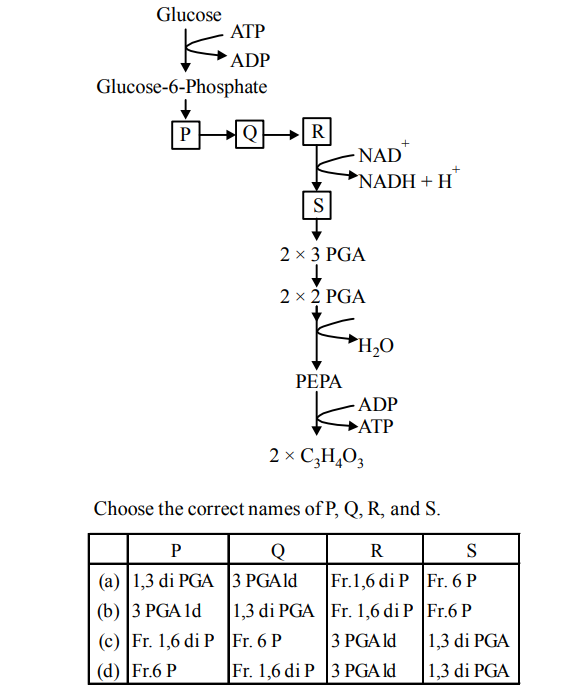
Correct Answer: (b)
P: Fructose 6-P. Q: Fructose 1,6-bisP. R: 3-PGAld. S: 1,3-bisPGA.
P: Fructose 6-P. Q: Fructose 1,6-bisP. R: 3-PGAld. S: 1,3-bisPGA.
Q65. Fermentation takes place
Correct Answer: (a)
Fermentation is an anaerobic process used by various prokaryotes and unicellular eukaryotes (like yeast) to regenerate NAD+ in the absence of oxygen.
Fermentation is an anaerobic process used by various prokaryotes and unicellular eukaryotes (like yeast) to regenerate NAD+ in the absence of oxygen.
Q66. Which of the following is correct sequence in Kreb’s cycle?
Correct Answer: (a)
Isocitrate is oxidized to oxalosuccinate, which is then decarboxylated to form α-ketoglutarate.
Isocitrate is oxidized to oxalosuccinate, which is then decarboxylated to form α-ketoglutarate.
Q67. Single turn of citric acid cycle yields:
Correct Answer: (d)
One turn of the TCA cycle (per Acetyl CoA) produces 3 NADH, 1 FADH2, 1 GTP/ATP, and releases 2 CO2.
One turn of the TCA cycle (per Acetyl CoA) produces 3 NADH, 1 FADH2, 1 GTP/ATP, and releases 2 CO2.
Q68. Respiratory Quotient (RQ) value of tripalmitin is:
Correct Answer: (b)
Tripalmitin is a fat; fats generally have an RQ of approximately 0.7.
Tripalmitin is a fat; fats generally have an RQ of approximately 0.7.
Q69. Electron Transport System (ETS) is present in a eukaryotic cell in the:
Correct Answer: (a)
The carriers of the ETS are embedded in the inner mitochondrial membrane (cristae).
The carriers of the ETS are embedded in the inner mitochondrial membrane (cristae).
Q70. Acceptor of acetyl Co-A in Kreb’s cycle is:
Correct Answer: (d)
Acetyl CoA (2C) combines with Oxaloacetic Acid (4C) to initiate the cycle by forming Citric Acid (6C).
Acetyl CoA (2C) combines with Oxaloacetic Acid (4C) to initiate the cycle by forming Citric Acid (6C).
Q71. Which one of the following process releases a carbon dioxide molecule?
Correct Answer: (c)
Alcohol fermentation involves the decarboxylation of pyruvate to acetaldehyde, releasing CO2.
Alcohol fermentation involves the decarboxylation of pyruvate to acetaldehyde, releasing CO2.
Q72. How many ATP will be produced during the production of 1 molecule of acetyl CoA from 1 molecule of pyruvic acid?
Correct Answer: (a)
The oxidative decarboxylation of 1 pyruvate yields 1 NADH. In the ETS, 1 NADH produces 3 ATP molecules.
The oxidative decarboxylation of 1 pyruvate yields 1 NADH. In the ETS, 1 NADH produces 3 ATP molecules.
Q73. Consider the following statements:
(1) Cytochrome c is a large protein complex attached to the inner surface of the outer membrane
(2) It transfers electrons between complex III and IV.
(1) Cytochrome c is a large protein complex attached to the inner surface of the outer membrane
(2) It transfers electrons between complex III and IV.
Correct Answer: (b)
Statement (1) is wrong: Cytochrome c is a small protein attached to the outer surface of the inner membrane. Statement (2) correctly identifies its shuttle role.
Statement (1) is wrong: Cytochrome c is a small protein attached to the outer surface of the inner membrane. Statement (2) correctly identifies its shuttle role.
Q74. Which of the following types of mammalian cell does not carry out oxidative phosphorylation?
Correct Answer: (b)
Mature mammalian erythrocytes (RBCs) lack mitochondria and therefore cannot perform the TCA cycle or oxidative phosphorylation; they rely solely on glycolysis.
Mature mammalian erythrocytes (RBCs) lack mitochondria and therefore cannot perform the TCA cycle or oxidative phosphorylation; they rely solely on glycolysis.
Q75. Which of the following is amphibolic in nature?
Correct Answer: (c)
The TCA cycle is amphibolic because it functions in both catabolism (breaking down acetyl groups) and anabolism (providing precursors for amino acid and fatty acid synthesis).
The TCA cycle is amphibolic because it functions in both catabolism (breaking down acetyl groups) and anabolism (providing precursors for amino acid and fatty acid synthesis).
Q76. Pyruvic acid, the key product of glycolysis can have many metabolic fates. Under aerobic condition it forms
Correct Answer: (c)
In the presence of oxygen, pyruvate enters the mitochondria and is converted into Acetyl CoA and CO2.
In the presence of oxygen, pyruvate enters the mitochondria and is converted into Acetyl CoA and CO2.
Q77. In Kreb’s cycle, the conversion of succinyl CoA to succinic acid requires:
Correct Answer: (d)
This step is a substrate-level phosphorylation where the thioester bond energy of Succinyl-CoA is used to phosphorylate GDP to GTP (or ADP to ATP in some tissues).
This step is a substrate-level phosphorylation where the thioester bond energy of Succinyl-CoA is used to phosphorylate GDP to GTP (or ADP to ATP in some tissues).
Q78. Which of the following statement regarding the process of glycolysis is correct?
Correct Answer: (d)
Glycolysis is the partial oxidation of one molecule of glucose (6C) into two molecules of pyruvic acid (3C).
Glycolysis is the partial oxidation of one molecule of glucose (6C) into two molecules of pyruvic acid (3C).
Q79. Cellular respiration includes the various pathways by which carbohydrates and other metabolites are broken down with the consecutive buildup of:
Correct Answer: (a)
The primary purpose of the catabolic pathways in cellular respiration is to capture the energy released from substrates to synthesize ATP.
The primary purpose of the catabolic pathways in cellular respiration is to capture the energy released from substrates to synthesize ATP.
Q80. All of the following processes can release CO2 except:
Correct Answer: (c)
Oxidative phosphorylation is the synthesis of ATP using energy from the ETS; it does not involve carbon release. Decarboxylation occurs in the other listed stages.
Oxidative phosphorylation is the synthesis of ATP using energy from the ETS; it does not involve carbon release. Decarboxylation occurs in the other listed stages.
Q81. In respiration, largest amount of energy is produced in:
Correct Answer: (b)
The Krebs cycle coupled with the ETS (aerobic respiration) produces significantly more ATP (36-38) compared to glycolysis or fermentation (2).
The Krebs cycle coupled with the ETS (aerobic respiration) produces significantly more ATP (36-38) compared to glycolysis or fermentation (2).
Q82. How many ATP molecules could maximally be generated from one molecule of glucose, if the complete oxidation of one mole of glucose to CO2 and H2O yields 686 kcal and the useful chemical energy available in the high energy phosphate bond of one mole of ATP is 12 kcal ?
Correct Answer: (b)
Theoretical maximum: 686 / 12 ≈ 57 ATP molecules. (Note: Biological efficiency is lower, yielding ~36-38 ATP).
Theoretical maximum: 686 / 12 ≈ 57 ATP molecules. (Note: Biological efficiency is lower, yielding ~36-38 ATP).
Q83. Which one of the following is complex V of the ETS of inner mitochondrial membrane?
Correct Answer: (b)
Complex V is ATP synthase, the enzyme that utilizes the proton motive force to synthesize ATP from ADP and inorganic phosphate.
Complex V is ATP synthase, the enzyme that utilizes the proton motive force to synthesize ATP from ADP and inorganic phosphate.
Q84. With regard to the role of oxygen in the aerobic respiration, consider the following statements:
(1) The aerobic process of respiration takes place only in the presence of oxygen.
(2) Role of oxygen is limited to the terminal stage of the process.
(3) Due to the presence of oxygen the process is called oxidative phosphorylation.
(1) The aerobic process of respiration takes place only in the presence of oxygen.
(2) Role of oxygen is limited to the terminal stage of the process.
(3) Due to the presence of oxygen the process is called oxidative phosphorylation.
Correct Answer: (d)
All statements correctly describe the essential yet terminal role of oxygen in driving aerobic energy production.
All statements correctly describe the essential yet terminal role of oxygen in driving aerobic energy production.
Q85. Which of the following statement regarding pyruvate during aerobic respiration is incorrect?
Correct Answer: (a)
Pyruvate is formed by glycolysis in the cytosol, not the mitochondrial matrix. It only enters the matrix afterwards.
Pyruvate is formed by glycolysis in the cytosol, not the mitochondrial matrix. It only enters the matrix afterwards.
Q86. How many net molecules of ATP are produced during glycolysis?
Correct Answer: (a)
While 4 ATP are produced in the payoff phase, 2 ATP are consumed in the preparatory phase, resulting in a net gain of 2 ATP per glucose molecule.
While 4 ATP are produced in the payoff phase, 2 ATP are consumed in the preparatory phase, resulting in a net gain of 2 ATP per glucose molecule.
Q87. Which of the following statement about cellular energy-harvesting pathway is incorrect?
Correct Answer: (c)
Fermentation is an anaerobic process that occurs in the absence of oxygen.
Fermentation is an anaerobic process that occurs in the absence of oxygen.
Q88. The formation of acetyl coenzyme-A from pyruvic acid is the result of its:
Correct Answer: (d)
Pyruvate undergoes oxidative decarboxylation (removal of CO2 and oxidation) catalyzed by pyruvate dehydrogenase to form acetyl CoA.
Pyruvate undergoes oxidative decarboxylation (removal of CO2 and oxidation) catalyzed by pyruvate dehydrogenase to form acetyl CoA.
Q89. Consider the following statements:
(1) It is the first member of the TCA cycle.
(2) It condenses with Acetyl CoA to form citric acid
(3) It is produced from malic acid in the TCA cycle.
Which of the following molecules represented by the information given above?
(1) It is the first member of the TCA cycle.
(2) It condenses with Acetyl CoA to form citric acid
(3) It is produced from malic acid in the TCA cycle.
Which of the following molecules represented by the information given above?
Correct Answer: (b)
Oxaloacetate (OAA) is the 4-carbon starting acceptor that condenses with Acetyl CoA and is regenerated at the end of the cycle from malate.
Oxaloacetate (OAA) is the 4-carbon starting acceptor that condenses with Acetyl CoA and is regenerated at the end of the cycle from malate.
Q90. In which one of the following reactions, substrate level phosphorylation does not occur?
Correct Answer: (b)
The conversion of G6P to F6P is a simple isomerization reaction catalyzed by phosphoglucoisomerase; it does not involve ATP synthesis or phosphate transfer.
The conversion of G6P to F6P is a simple isomerization reaction catalyzed by phosphoglucoisomerase; it does not involve ATP synthesis or phosphate transfer.
Q91. Which of the following statement is correct in relation to the ETS?
Correct Answer: (c)
Oxygen is the terminal acceptor, combining with electrons and protons (H+) to form water.
Oxygen is the terminal acceptor, combining with electrons and protons (H+) to form water.
Q92. Reduced form of ubiquinone is:
Correct Answer: (b)
When ubiquinone (Q) accepts two electrons and two protons, it is reduced to ubiquinol (QH2).
When ubiquinone (Q) accepts two electrons and two protons, it is reduced to ubiquinol (QH2).
Q93. The end product of oxidative phosphorylation is
Correct Answer: (d)
Oxidative phosphorylation uses the ETS to produce ATP and water as the final products.
Oxidative phosphorylation uses the ETS to produce ATP and water as the final products.
Q94. Electron Transport System (ETS) is located in mitochondrial
Correct Answer: (c)
The ETS components are embedded in the inner mitochondrial membrane.
The ETS components are embedded in the inner mitochondrial membrane.
Q95. In alcoholic fermentation, NAD+ is produced during the
Correct Answer: (a)
The reduction of acetaldehyde to ethanol by alcohol dehydrogenase uses NADH, thereby regenerating NAD+.
The reduction of acetaldehyde to ethanol by alcohol dehydrogenase uses NADH, thereby regenerating NAD+.
Q96. Match the column-I with column-II and choose the correct combination from the options given below.
| Column-I | Column-II |
|---|---|
| A. Inner mitochondrial membrane | I. Krebs cycle |
| B. Pyruvic acid is converted into CO2 and ethanol. | II. ETC |
| C. Cytoplasm | III. Fermentation |
| D. Mitochondrial matrix | IV. Glycolysis |
Correct Answer: (d)
Inner membrane: ETC. Pyruvate to ethanol: Fermentation. Cytoplasm: Glycolysis. Matrix: Krebs Cycle.
Inner membrane: ETC. Pyruvate to ethanol: Fermentation. Cytoplasm: Glycolysis. Matrix: Krebs Cycle.
Q97. Consider the following statements about conversion of succinyl-CoA to succinic acid in the TCA cycle:
(1) During this step, a molecule of ATP is synthesised.
(2) In a coupled reaction ATP is converted to ADP with the simmultaneous synthesis of GTP from GDP.
(1) During this step, a molecule of ATP is synthesised.
(2) In a coupled reaction ATP is converted to ADP with the simmultaneous synthesis of GTP from GDP.
Correct Answer: (a)
Statement (1) is correct. Statement (2) is nonsensical; the synthesis of GTP is the primary reaction, often coupled with converting ADP to ATP.
Statement (1) is correct. Statement (2) is nonsensical; the synthesis of GTP is the primary reaction, often coupled with converting ADP to ATP.
Q98. Energy accumulate in ATP in
Correct Answer: (c)
The energy released during oxidation in respiration is trapped in the form of chemical bonds, specifically the high-energy terminal phosphate bonds of ATP.
The energy released during oxidation in respiration is trapped in the form of chemical bonds, specifically the high-energy terminal phosphate bonds of ATP.
Q99. Which of the following are the reasons why plants can get along without respiratory organs?
(1) Each plant part takes care of its own gas-exchange needs.
(2) There is very little transport of gases from one plant part to another.
(3) Plants do not present great demands for gas exchange.
(4) The distance that gases must diffuse even in large, bulky plants is not great.
(1) Each plant part takes care of its own gas-exchange needs.
(2) There is very little transport of gases from one plant part to another.
(3) Plants do not present great demands for gas exchange.
(4) The distance that gases must diffuse even in large, bulky plants is not great.
Correct Answer: (d)
Plants lack complex respiratory systems because their needs are local, gas transport is minimal, and most living cells are located close to the surface.
Plants lack complex respiratory systems because their needs are local, gas transport is minimal, and most living cells are located close to the surface.
Q100. Refer the figure and identify X, Y and Z.
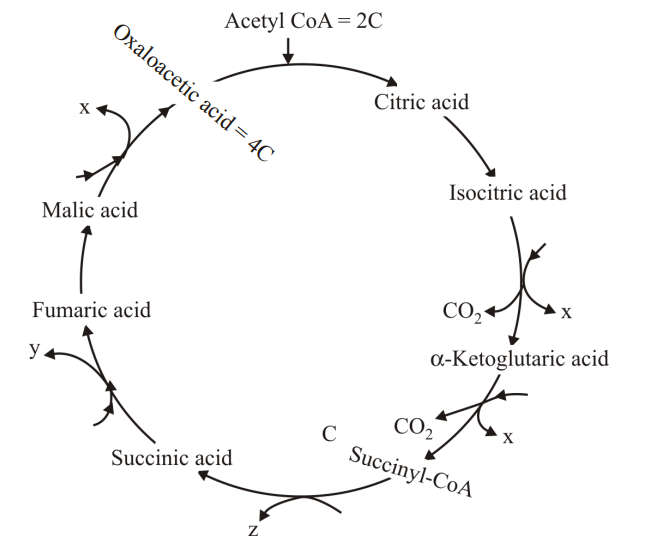
Correct Answer: (b)
X represents FADH2 (produced from succinate). Y is NADH2 (produced from malate). Z is GTP/ATP produced via substrate-level phosphorylation.
X represents FADH2 (produced from succinate). Y is NADH2 (produced from malate). Z is GTP/ATP produced via substrate-level phosphorylation.
Q101. The expressions given below shows the summary equations I, II and III. Categorise the summary equations under respective phases.
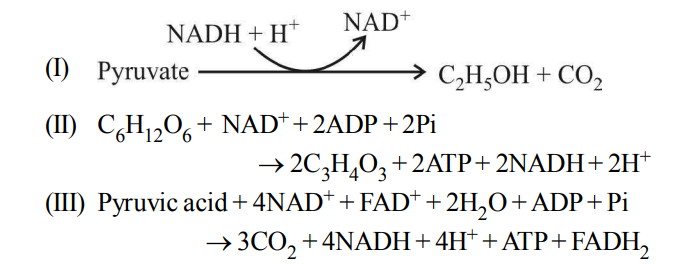
Correct Answer: (d)
Eq I: Ethanol production (Fermentation). Eq II: Glucose to pyruvate (Glycolysis). Eq III: Pyruvate oxidation (Krebs cycle).
Eq I: Ethanol production (Fermentation). Eq II: Glucose to pyruvate (Glycolysis). Eq III: Pyruvate oxidation (Krebs cycle).
Q102. Which of the following is not an intermediate of Krebs cycle?
Correct Answer: (d)
Lactic acid is a product of anaerobic fermentation in the cytosol; it is never an intermediate in the aerobic TCA cycle within the mitochondria.
Lactic acid is a product of anaerobic fermentation in the cytosol; it is never an intermediate in the aerobic TCA cycle within the mitochondria.
Q103. Glycolysis occurs in the ________ and produces________, which in the presence of O2 enters the____________.
Correct Answer: (a)
Glycolysis happens in the cytosol. The pyruvate produced then enters the mitochondrial matrix for the TCA cycle if oxygen is present.
Glycolysis happens in the cytosol. The pyruvate produced then enters the mitochondrial matrix for the TCA cycle if oxygen is present.
Q104. What is the role of NAD+ in cellular respiration?
Correct Answer: (b)
NAD+ acts as a coenzyme that accepts and transfers electrons/protons during metabolic redox reactions.
NAD+ acts as a coenzyme that accepts and transfers electrons/protons during metabolic redox reactions.
Q105. Match the following columns.
| Column I | Column II |
|---|---|
| A. Molecular oxygen | 1. alpha-ketoglutaric acid |
| B. Electron acceptor | 2. Hydrogen acceptor |
| C. Pyruvate dehydrogenase | 3. Cytochrome-c |
| D. Decarboxylation | 4. Acetyl Co-A |
Correct Answer: (a)
Oxygen is the hydrogen acceptor. Cyt-c is an electron carrier. PDH produces Acetyl CoA. alpha-ketoglutaric acid is formed after a decarboxylation.
Oxygen is the hydrogen acceptor. Cyt-c is an electron carrier. PDH produces Acetyl CoA. alpha-ketoglutaric acid is formed after a decarboxylation.
Q106. Consider the following statements comparing fermentation and aerobic respiration:
(1) Fermentation accounts for only a partial breakdown of glucose whereas in aerobic respiration it is completely degraded to CO2 and H2O.
(2) In fermentation there is a net gain of only one molecules of ATP for each molecule of glucose, whereas many molecules of ATP are generated under aerobic conditions.
(3) NADH is oxidised to NAD+ rather quickly in fermentation, however the reaction is very slow in case of aerobic respiration.
(1) Fermentation accounts for only a partial breakdown of glucose whereas in aerobic respiration it is completely degraded to CO2 and H2O.
(2) In fermentation there is a net gain of only one molecules of ATP for each molecule of glucose, whereas many molecules of ATP are generated under aerobic conditions.
(3) NADH is oxidised to NAD+ rather quickly in fermentation, however the reaction is very slow in case of aerobic respiration.
Correct Answer: (a)
Statement (1) is correct. (2) is wrong (2 ATP, not 1). (3) is wrong (NADH oxidation is slow in fermentation but fast/vigorous in aerobic respiration).
Statement (1) is correct. (2) is wrong (2 ATP, not 1). (3) is wrong (NADH oxidation is slow in fermentation but fast/vigorous in aerobic respiration).
Q107. The given figure represents the interelationship among metabolic pathways showing the respiration mediated breakdown of different organic molecules to CO2 and H2O. Now identify A to D.
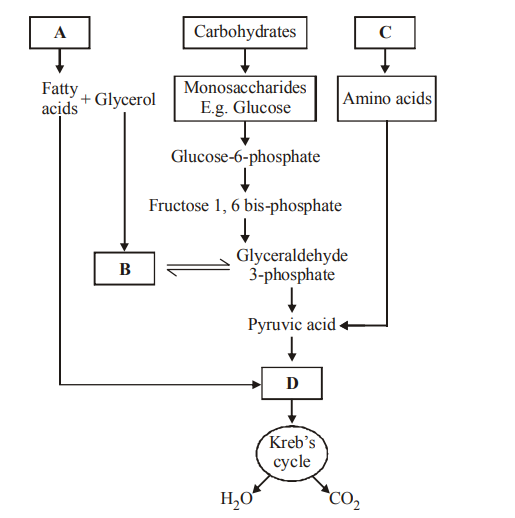
Correct Answer: (b)
A is Fat (breaks to glycerol + fatty acids). B is DHAP (glycerol enters here). C is Protein (breaks to amino acids). D is Acetyl CoA (fatty acids/amino acids enter here).
A is Fat (breaks to glycerol + fatty acids). B is DHAP (glycerol enters here). C is Protein (breaks to amino acids). D is Acetyl CoA (fatty acids/amino acids enter here).
Q108. The number of substrate level phosphorylations in one turn of citric acid cycle is
Correct Answer: (a)
Each turn of the TCA cycle (per acetyl CoA) has exactly one substrate-level phosphorylation step (Succinyl-CoA to Succinate).
Each turn of the TCA cycle (per acetyl CoA) has exactly one substrate-level phosphorylation step (Succinyl-CoA to Succinate).
Q109. The correct sequence of electron acceptor in ATP synthesis is:
Correct Answer: (b)
The sequence of carriers in the mitochondrial ETS is Cytochrome b → c1 → c → a → a3.
The sequence of carriers in the mitochondrial ETS is Cytochrome b → c1 → c → a → a3.
Q110. Which of the following can be considered as respiratory substrates?
(1) Proteins (2) Fats (3) Organic Acids (4) Carbohydrates
(1) Proteins (2) Fats (3) Organic Acids (4) Carbohydrates
Correct Answer: (d)
Carbohydrates are the primary substrates, but fats, proteins, and even organic acids can be oxidized to produce energy.
Carbohydrates are the primary substrates, but fats, proteins, and even organic acids can be oxidized to produce energy.
Q111. Phosphorylation of glucose during glycolysis is catalysed by:
Correct Answer: (c)
Hexokinase is the enzyme that catalyzes the first step of glycolysis, converting glucose to glucose-6-phosphate.
Hexokinase is the enzyme that catalyzes the first step of glycolysis, converting glucose to glucose-6-phosphate.
Q112. End products of Krebs cycle from one molecule of glucose is:
Correct Answer: (b)
One glucose = 2 pyruvates = 2 turns of TCA cycle. Total yield: 6 NADH (plus 2 from link reaction = 8), 2 FADH2, 2 ATP/GTP, and CO2.
One glucose = 2 pyruvates = 2 turns of TCA cycle. Total yield: 6 NADH (plus 2 from link reaction = 8), 2 FADH2, 2 ATP/GTP, and CO2.
Q113. Enzymes related with cristae are related with:
Correct Answer: (b)
The cristae of the inner mitochondrial membrane house the components of the electron transport system (ETS) and ATP synthase, which are essential for aerobic respiration.
The cristae of the inner mitochondrial membrane house the components of the electron transport system (ETS) and ATP synthase, which are essential for aerobic respiration.
Q114. The common phase between aerobic and anaerobic respiration is called
Correct Answer: (c)
Glycolysis (EMP pathway) is the universal first step in the breakdown of glucose, occurring in the cytoplasm of all living cells regardless of oxygen presence.
Glycolysis (EMP pathway) is the universal first step in the breakdown of glucose, occurring in the cytoplasm of all living cells regardless of oxygen presence.
Q115. In citric acid cycle, energy bond (GTP) is produced as a result of conversion of:
Correct Answer: (c)
The conversion of Succinyl-CoA to Succinic Acid is a substrate-level phosphorylation step that yields one GTP (or ATP).
The conversion of Succinyl-CoA to Succinic Acid is a substrate-level phosphorylation step that yields one GTP (or ATP).
Q116. Which one of the following is not included in glycolysis ?
Correct Answer: (b)
Glycolysis ends with the formation of two molecules of pyruvic acid. CO2 and H2O are end products of the subsequent TCA cycle and ETS, not glycolysis.
Glycolysis ends with the formation of two molecules of pyruvic acid. CO2 and H2O are end products of the subsequent TCA cycle and ETS, not glycolysis.
Q117. Terminal cytochrome of respiratory chain which donates electrons to oxygen is:
Correct Answer: (d)
Cytochrome a3 (part of Complex IV) is the final component that transfers electrons directly to molecular oxygen.
Cytochrome a3 (part of Complex IV) is the final component that transfers electrons directly to molecular oxygen.
Q118. Acetyl CoA is formed by the breakdown of:
Correct Answer: (b)
Fatty acids are broken down through beta-oxidation into 2-carbon Acetyl CoA units that enter the TCA cycle.
Fatty acids are broken down through beta-oxidation into 2-carbon Acetyl CoA units that enter the TCA cycle.
Q119. In which one of the following processes CO2 in not released?
Correct Answer: (d)
Lactate fermentation involves the direct reduction of pyruvate to lactic acid without any carbon loss; thus, no CO2 is produced.
Lactate fermentation involves the direct reduction of pyruvate to lactic acid without any carbon loss; thus, no CO2 is produced.
Q120. Which of the following processes make direct use of oxygen?
Correct Answer: (c)
Oxygen acts as the final electron acceptor at the very end of the electron transport chain (Complex IV), combining with electrons and protons to form water.
Oxygen acts as the final electron acceptor at the very end of the electron transport chain (Complex IV), combining with electrons and protons to form water.
Q121. For bacteria to continue growing rapidly when they are shifted from an environment containing O2 to an anaerobic environment, they must:
Correct Answer: (c)
Anaerobic respiration is much less efficient (2 ATP vs 36/38 ATP). To maintain the same energy levels, the rate of glucose consumption (glycolysis) must increase significantly (Pasteur effect).
Anaerobic respiration is much less efficient (2 ATP vs 36/38 ATP). To maintain the same energy levels, the rate of glucose consumption (glycolysis) must increase significantly (Pasteur effect).
Q122. Which of the metabolites is common to respiration mediated breakdown of fats, carbohydrates and proteins?
Correct Answer: (c)
Acetyl CoA is the universal convergent point. Fats enter as acetyl CoA or DHAP, proteins as pyruvate/acetyl CoA/cycle intermediates, and carbohydrates as pyruvate then acetyl CoA.
Acetyl CoA is the universal convergent point. Fats enter as acetyl CoA or DHAP, proteins as pyruvate/acetyl CoA/cycle intermediates, and carbohydrates as pyruvate then acetyl CoA.
Q123. Refer the figure of citric acid cycle and choose the correct combination of labelling (P, Q, R, S and T) indicating the number of carbon compounds in the substrate molecules, involved in the given figure.
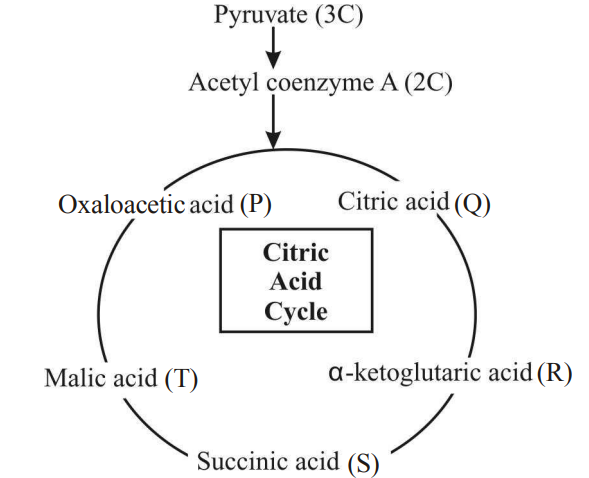
Correct Answer: (a)
P: OAA (4C). Q: Citrate (6C). R: alpha-ketoglutarate (5C). S: Succinate (4C). T: Malate (4C).
P: OAA (4C). Q: Citrate (6C). R: alpha-ketoglutarate (5C). S: Succinate (4C). T: Malate (4C).
Q124. Lactic acid is formed by the process of:
Correct Answer: (a)
Lactic acid fermentation occurs in some bacteria and in animal muscle cells under anaerobic conditions.
Lactic acid fermentation occurs in some bacteria and in animal muscle cells under anaerobic conditions.
Q125. Which of the following representation correctly explain the function of mitochondrion?
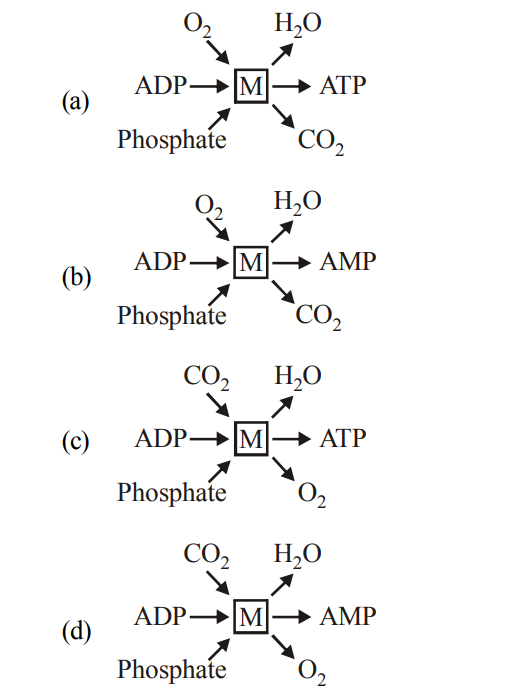
Correct Answer: (c)
Mitochondria take in Pyruvate (from glycolysis), O2, and ADP+Pi, and release CO2, H2O, and ATP. Diagram (c) correctly illustrates this aerobic respiration flux.
Mitochondria take in Pyruvate (from glycolysis), O2, and ADP+Pi, and release CO2, H2O, and ATP. Diagram (c) correctly illustrates this aerobic respiration flux.
Q126. During glycolysis, glucose split into:
Correct Answer: (a)
The end result of glycolysis is the breakdown of one 6-carbon glucose molecule into two 3-carbon pyruvic acid molecules.
The end result of glycolysis is the breakdown of one 6-carbon glucose molecule into two 3-carbon pyruvic acid molecules.
Q127. Mitochondria are called powerhouses of the cell. Which of the following observations support this statement?
Correct Answer: (a)
They are called powerhouses because they are the site of the majority of ATP (energy) production via aerobic respiration.
They are called powerhouses because they are the site of the majority of ATP (energy) production via aerobic respiration.
Q128. In the fermentation of one glucose molecule, there is a net gain of ______________ molecules of ATP.
Correct Answer: (b)
Fermentation only involves the 2 net ATP produced during glycolysis; no further ATP is generated in the subsequent steps.
Fermentation only involves the 2 net ATP produced during glycolysis; no further ATP is generated in the subsequent steps.
Q129. In the electron transport system, the final acceptor of electron is:
Correct Answer: (c)
Oxygen is the final electron acceptor of the entire aerobic respiratory pathway.
Oxygen is the final electron acceptor of the entire aerobic respiratory pathway.
Q130. Mineral activator needed for the enzyme carboxylase of TCA cycle is:
Correct Answer: (d)
Manganese (Mn2+) acts as an activator for many enzymes in the tricarboxylic acid cycle.
Manganese (Mn2+) acts as an activator for many enzymes in the tricarboxylic acid cycle.
Q131. In an anaerobic condition, yeast cells breakdown glucose into
Correct Answer: (b)
Yeast performs alcoholic fermentation, producing ethanol and carbon dioxide.
Yeast performs alcoholic fermentation, producing ethanol and carbon dioxide.
Q132. Citrate synthase, an enzyme of TCA cycle is located in:
Correct Answer: (c)
The TCA cycle enzymes are found in the cytosol of prokaryotes (who lack mitochondria) and in the mitochondrial matrix of eukaryotes.
The TCA cycle enzymes are found in the cytosol of prokaryotes (who lack mitochondria) and in the mitochondrial matrix of eukaryotes.
Q133. Decarboxylation is not involved in:
Correct Answer: (b)
Glycolysis (6C glucose → 2 x 3C pyruvate) does not involve the loss of carbon as CO2. TCA and fermentation do involve decarboxylation.
Glycolysis (6C glucose → 2 x 3C pyruvate) does not involve the loss of carbon as CO2. TCA and fermentation do involve decarboxylation.
Q134. Which of the following are not used in the conversion by pyruvate to acetyl CoA?
(i) Oxidative dehydrogenation
(ii) Oxidative dehydration
(iii) Oxidative phosphorylation
(iv) Oxidative decarboxylation
(i) Oxidative dehydrogenation
(ii) Oxidative dehydration
(iii) Oxidative phosphorylation
(iv) Oxidative decarboxylation
Correct Answer: (a)
The link reaction is specifically an 'oxidative decarboxylation'. It does not involve dehydration or phosphorylation.
The link reaction is specifically an 'oxidative decarboxylation'. It does not involve dehydration or phosphorylation.
Q135. Oxidative phosphorylation refers to
Correct Answer: (c)
Oxidative phosphorylation is the process where ATP is formed using energy derived from the redox reactions of the ETS, facilitated by a proton gradient (chemiosmosis).
Oxidative phosphorylation is the process where ATP is formed using energy derived from the redox reactions of the ETS, facilitated by a proton gradient (chemiosmosis).
Q136. Consider the following statements:
(1) In anaerobic organisms, glycolysis is the only process in respiration.
(2) The complete combustion of glucose, yields energy most of which is given out as ATP.
(1) In anaerobic organisms, glycolysis is the only process in respiration.
(2) The complete combustion of glucose, yields energy most of which is given out as ATP.
Correct Answer: (a)
Statement (1) is correct. Statement (2) is incorrect because most of the energy from complete combustion is actually released as heat, with only about 40% captured as ATP.
Statement (1) is correct. Statement (2) is incorrect because most of the energy from complete combustion is actually released as heat, with only about 40% captured as ATP.
Q137. In alcoholic fermentation:
Correct Answer: (b)
NADH produced during glycolysis (triose phosphate oxidation) donates electrons to acetaldehyde, reducing it to ethanol.
NADH produced during glycolysis (triose phosphate oxidation) donates electrons to acetaldehyde, reducing it to ethanol.