Q1. Root differs from stem in having
Correct Answer: (d)
Roots generally possess unicellular hairs (root hairs), whereas stems may have multicellular hairs (trichomes). Roots also lack nodes and internodes.
Roots generally possess unicellular hairs (root hairs), whereas stems may have multicellular hairs (trichomes). Roots also lack nodes and internodes.
Q2. Placenta and pericarp are both edible portions in
Correct Answer: (c)
Tomato is a berry where the entire pericarp and the placenta (to which seeds are attached) are fleshy and edible.
Tomato is a berry where the entire pericarp and the placenta (to which seeds are attached) are fleshy and edible.
Q3. Which of the following is not the characteristic features of Fabaceae?
Correct Answer: (b)
Fabaceae flowers are zygomorphic, have vexillary aestivation, and are polypetalous (except the keel which is slightly fused).
Fabaceae flowers are zygomorphic, have vexillary aestivation, and are polypetalous (except the keel which is slightly fused).
Q4. An example of edible underground stem is
Correct Answer: (d)
Potato is an underground stem (tuber). Carrot and sweet potato are modified roots.
Potato is an underground stem (tuber). Carrot and sweet potato are modified roots.
Q5. Given figures (A, B and C) show the position of floral parts on thalamus. Select the correct combination.
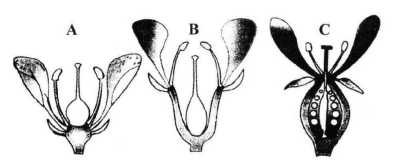
Correct Answer: (a)
A is hypogynous (I), B is perigynous (II), and C is epigynous (III).
A is hypogynous (I), B is perigynous (II), and C is epigynous (III).
Q6. Match column-I with column-II and choose the correct option.
| Column-I (Members of Fabaceae) | Column-II (Economic importance) |
|---|---|
| A. Gram, sem, moong, soyabean | I. Medicine |
| B. Soyabean, groundnut | II. Ornamental |
| C. Indigofera | III. Fodder |
| D. Sunhemp | IV. Fibres |
| E. Sesbania, Trifolium | V. Dye |
| F. Lupin, sweet potato | VI. Edible oil |
| G. Mulethi | VII. Pulses |
Correct Answer: (b)
Gram/Moong are pulses. Soyabean/Groundnut yield oil. Indigofera is a dye. Sunhemp yields fiber. Sesbania/Trifolium are fodder. Lupin is ornamental. Mulethi is medicinal.
Gram/Moong are pulses. Soyabean/Groundnut yield oil. Indigofera is a dye. Sunhemp yields fiber. Sesbania/Trifolium are fodder. Lupin is ornamental. Mulethi is medicinal.
Q7. The character of flower which is represented by floral formula but not by floral diagram is
Correct Answer: (c)
The position of the ovary (superior/inferior) is denoted in the formula (e.g., G) but cannot be clearly shown in a standard floral diagram.
The position of the ovary (superior/inferior) is denoted in the formula (e.g., G) but cannot be clearly shown in a standard floral diagram.
Q8. In flower (X), the gynoecium occupies the highest position while the other parts are situated below it. The ovary in such flowers is said to be Y. Identify X and Y and select the correct option.
Correct Answer: (c)
In hypogynous flowers, the gynoecium is at the top (highest position) and the ovary is superior.
In hypogynous flowers, the gynoecium is at the top (highest position) and the ovary is superior.
Q9. Which one of the following characteristics is not related to gynoecium?
Correct Answer: (b)
Gynoecium is composed of carpels or pistils, not stamens (which form the androecium).
Gynoecium is composed of carpels or pistils, not stamens (which form the androecium).
Q10. Leaves become modified into spines in
Correct Answer: (d)
In xerophytic plants like Opuntia, leaves are modified into spines to reduce water loss, and the stem becomes photosynthetic.
In xerophytic plants like Opuntia, leaves are modified into spines to reduce water loss, and the stem becomes photosynthetic.
Q11. Fibrous root system is better adopted than tap root system for
Correct Answer: (d)
Fibrous roots spread out extensively near the soil surface, providing very firm anchorage to the plant in the soil.
Fibrous roots spread out extensively near the soil surface, providing very firm anchorage to the plant in the soil.
Q12. The given figure (A, B, and C) shows different types of roots. Identify the root which is seen in wheat plant.
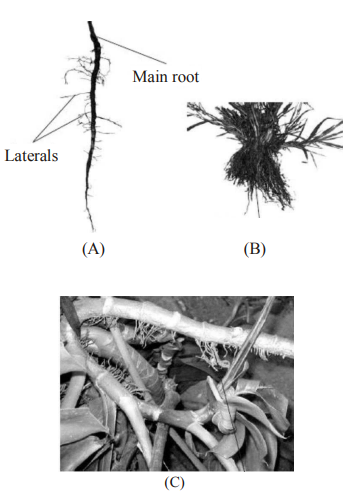
Correct Answer: (b)
Wheat is a monocot and possesses a fibrous root system, which is represented by figure 'B'.
Wheat is a monocot and possesses a fibrous root system, which is represented by figure 'B'.
Q13. Matching column I with column II and choose the correct option.
| Column I | Column II |
|---|---|
| A. Coleorhiza | I. Grapes |
| B. Food storing tissue | II. Mango |
| C. Parthenocarpic fruit | III. Maize |
| D. Single seeded fruit developing from monocarpellary superior ovary | IV. Radicle |
| E. Membranous seed coat | V. Endosperm |
Correct Answer: (d)
Coleorhiza protects the radicle. Endosperm stores food. Grapes can be parthenocarpic. Mango is a drupe from superior ovary. Maize has a membranous seed coat fused with fruit wall.
Coleorhiza protects the radicle. Endosperm stores food. Grapes can be parthenocarpic. Mango is a drupe from superior ovary. Maize has a membranous seed coat fused with fruit wall.
Q14. Read the following statements and answer the question.
(i) It is the pattern of arrangement of leaves on the stem or branch.
(ii) It is usually of three types - alternate, opposite and whorled.
(iii) It is meant for getting maximum amount of light.
Which condition of plant is being described by the above statements?
(i) It is the pattern of arrangement of leaves on the stem or branch.
(ii) It is usually of three types - alternate, opposite and whorled.
(iii) It is meant for getting maximum amount of light.
Which condition of plant is being described by the above statements?
Correct Answer: (a)
Phyllotaxy is the arrangement of leaves, categorized into alternate, opposite, and whorled types, optimized for light capture.
Phyllotaxy is the arrangement of leaves, categorized into alternate, opposite, and whorled types, optimized for light capture.
Q15. The wheat grain has an embryo with one, large, shield shaped cotyledon known as
Correct Answer: (b)
In the seeds of cereals like wheat and maize, the single large cotyledon is called the scutellum.
In the seeds of cereals like wheat and maize, the single large cotyledon is called the scutellum.
Q16. A sterile stamen is known as
Correct Answer: (a)
A staminode is a stamen that is sterile and does not produce fertile pollen grains.
A staminode is a stamen that is sterile and does not produce fertile pollen grains.
Q17. The given figure shows the parts of mango and coconut. Choose the option which shows the correct labelling of A, B, C and D marked in the figures.
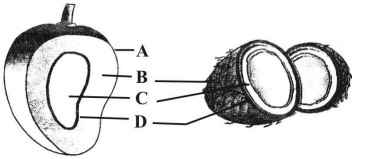
Correct Answer: (a)
In mango (left) and coconut (right): A - Epicarp, B - Mesocarp (fleshy in mango, fibrous in coconut), C - Seed, D - Endocarp (stony).
In mango (left) and coconut (right): A - Epicarp, B - Mesocarp (fleshy in mango, fibrous in coconut), C - Seed, D - Endocarp (stony).
Q18. Which of the following pairs is not correctly matched?
| Mode of reproduction | Example |
|---|---|
| (a) Rhizome | Banana |
| (b) Binary fission | Sargassum |
| (c) Conidia | Penicillium |
| (d) Offset | Water hyacinth |
Correct Answer: (b)
Binary fission is characteristic of unicellular organisms like Amoeba. Sargassum (a multicellular brown alga) reproduces vegetatively by fragmentation.
Binary fission is characteristic of unicellular organisms like Amoeba. Sargassum (a multicellular brown alga) reproduces vegetatively by fragmentation.
Q19. Fibrous root system is found in
Correct Answer: (a)
In monocotyledonous plants, the primary root is short-lived and is replaced by a large number of roots originating from the base of the stem, forming the fibrous root system.
In monocotyledonous plants, the primary root is short-lived and is replaced by a large number of roots originating from the base of the stem, forming the fibrous root system.
Q20. The region of the root-tip whose cells undergo rapid elongation and enlargement and are responsible for the growth of the root in length is called the:
Correct Answer: (b)
The cells proximal to the meristematic region undergo rapid elongation and enlargement, contributing to the increase in the length of the root.
The cells proximal to the meristematic region undergo rapid elongation and enlargement, contributing to the increase in the length of the root.
Q21. Many pulses of daily use belong to one of the families below.
Correct Answer: (b)
Fabaceae (formerly Papilionoideae) is the major source of pulses like gram, arhar, sem, moong, and soyabean.
Fabaceae (formerly Papilionoideae) is the major source of pulses like gram, arhar, sem, moong, and soyabean.
Q22. Which one is correct pair?
Correct Answer: (d)
In Date palm (Phoenix dactylifera), the edible part is the fleshy mesocarp.
In Date palm (Phoenix dactylifera), the edible part is the fleshy mesocarp.
Q23. Axile placentation is present in
Correct Answer: (a)
In Lemon and Tomato, the placenta is axial and the ovules are attached to it in a multilocular ovary.
In Lemon and Tomato, the placenta is axial and the ovules are attached to it in a multilocular ovary.
Q24. Match the following columns.
| Column I | Column II |
|---|---|
| A. Aleurone layer | I. Nutrition |
| B. Parthenocarpic fruit | II. Without fertilisation |
| C. Ovule | III. Seed |
| D. Endosperm | IV. Double fertilisation |
Correct Answer: (a)
Aleurone layer provides nutrition; Parthenocarpic fruit develops without fertilisation; Ovule becomes seed; Endosperm is a result of double fertilisation.
Aleurone layer provides nutrition; Parthenocarpic fruit develops without fertilisation; Ovule becomes seed; Endosperm is a result of double fertilisation.
Q25. The given figures (A & B) show two types of compound leaves. Choose the option which correctly identifies compound leaf and their example.
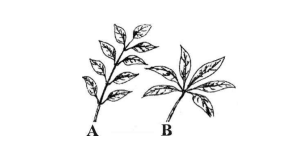
Correct Answer: (a)
Figure A shows leaflets on a common axis (rachis), which is a pinnately compound leaf as seen in Neem. Figure B is palmately compound leaf as in Silk cotton.
Figure A shows leaflets on a common axis (rachis), which is a pinnately compound leaf as seen in Neem. Figure B is palmately compound leaf as in Silk cotton.
Q26. Fibrous roots develop in maize from
Correct Answer: (b)
In plants like maize and sugarcane, supporting roots called stilt roots arise from the lower nodes of the stem.
In plants like maize and sugarcane, supporting roots called stilt roots arise from the lower nodes of the stem.
Q27. Leaves of dicotyledonous plants possess _________ venation, while _________ venation is the characteristic of most monocotyledons.
Correct Answer: (a)
Reticulate venation (network) is common in dicots; parallel venation is characteristic of monocots.
Reticulate venation (network) is common in dicots; parallel venation is characteristic of monocots.
Q28. Which of the following statements are correct about the leaf?
(i) Leaf is a lateral, generally flattened structure borne on the stem.
(ii) It develops at the node and bears a bud in its axil.
(iii) Leaves originate from root apical meristems and arranged in an acropetal order.
(iv) They are the most important vegetative organs for reproduction.
(i) Leaf is a lateral, generally flattened structure borne on the stem.
(ii) It develops at the node and bears a bud in its axil.
(iii) Leaves originate from root apical meristems and arranged in an acropetal order.
(iv) They are the most important vegetative organs for reproduction.
Correct Answer: (a)
Statement (iii) is wrong as leaves originate from shoot apical meristems. (iv) is generally wrong as they are primary organs for photosynthesis, though some can reproduce vegetatively.
Statement (iii) is wrong as leaves originate from shoot apical meristems. (iv) is generally wrong as they are primary organs for photosynthesis, though some can reproduce vegetatively.
Q29. Identify the inflorescence shown by the given figures A and B.
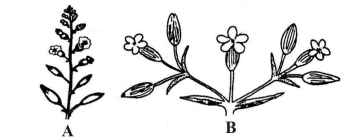
Correct Answer: (b)
Figure A shows younger flowers at the top (acropetal), which is Racemose. Figure B shows the main axis terminating in a flower (basipetal), which is Cymose.
Figure A shows younger flowers at the top (acropetal), which is Racemose. Figure B shows the main axis terminating in a flower (basipetal), which is Cymose.
Q30. Ray florets have
Correct Answer: (d)
In Compositae (sunflower family), the ray florets are typically epigynous with an inferior ovary.
In Compositae (sunflower family), the ray florets are typically epigynous with an inferior ovary.
Q31. The flower is the reproductive unit in the ___________ meant for ___________ reproduction.
Correct Answer: (a)
In angiosperms, the flower is the specialized structure meant for sexual reproduction.
In angiosperms, the flower is the specialized structure meant for sexual reproduction.
Q32. The mature seeds of plants such as gram and peas possess no endosperm, because
Correct Answer: (d)
In non-endospermic seeds (like pea and gram), the endosperm is completely consumed for nourishment by the developing embryo before seed maturation.
In non-endospermic seeds (like pea and gram), the endosperm is completely consumed for nourishment by the developing embryo before seed maturation.
Q33. Which one of the following statements is correct?
Correct Answer: (a)
In onion (Allium cepa), the stem is reduced to a disc-like bulb. Cloves are auxiliary buds. Colocasia is a modified stem. Tendril in Vitis is an apical bud modification.
In onion (Allium cepa), the stem is reduced to a disc-like bulb. Cloves are auxiliary buds. Colocasia is a modified stem. Tendril in Vitis is an apical bud modification.
Q34. Which one of the following structure is not associated with gynoecium?
Correct Answer: (d)
The filament is part of the stamen (androecium), whereas ovary, style, and stigma are parts of the gynoecium.
The filament is part of the stamen (androecium), whereas ovary, style, and stigma are parts of the gynoecium.
Q35. Stem tendrils are found in
Correct Answer: (d)
Stem tendrils, which develop from axillary buds, are slender and spirally coiled and help plants to climb as in gourds (cucumber, pumpkins, watermelon) and grapevines.
Stem tendrils, which develop from axillary buds, are slender and spirally coiled and help plants to climb as in gourds (cucumber, pumpkins, watermelon) and grapevines.
Q36. Which of the following statement(s) is/are correct about calyx?
Correct Answer: (d)
Calyx is the outermost whorl made of sepals that protect the bud. Statement (c) is inverted: gamosepalous means united and polysepalous means free.
Calyx is the outermost whorl made of sepals that protect the bud. Statement (c) is inverted: gamosepalous means united and polysepalous means free.
Q37. The given figure shows a typical structure of monocotyledonous seeds. Identify the parts A, B, C, D and E marked in the given figures.
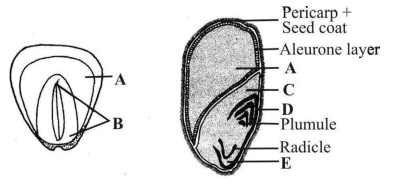
Correct Answer: (c)
In a maize seed: A - Endosperm, B - Embryo, C - Scutellum, D - Coleoptile (covering plumule), E - Coleorhiza (covering radicle).
In a maize seed: A - Endosperm, B - Embryo, C - Scutellum, D - Coleoptile (covering plumule), E - Coleorhiza (covering radicle).
Q38. Match the column I and II.
| Column I | Column II |
|---|---|
| (A) Apocarpous | (i) Papaver |
| (B) Syncarpous | (ii) Michelia |
| (C) Epiphyllous | (iii) Cashew |
| (D) Cotyledon | (iv) Aloe |
Correct Answer: (b)
Michelia has free carpels (apocarpous). Papaver has fused carpels (syncarpous). Aloe (Liliaceae) has epiphyllous stamens. Cashew has a large fleshy cotyledonary structure.
Michelia has free carpels (apocarpous). Papaver has fused carpels (syncarpous). Aloe (Liliaceae) has epiphyllous stamens. Cashew has a large fleshy cotyledonary structure.
Q39. In humid climate, presence of spines in shrubs is
Correct Answer: (b)
Spines in many plants act as defensive structures against browsing animals (herbivores).
Spines in many plants act as defensive structures against browsing animals (herbivores).
Q40. Starch is accumulated in large quantities in potato tuber because
Correct Answer: (d)
Sucrose produced in leaves is translocated to the underground stem (tuber) where it is converted and stored as starch (polymerized).
Sucrose produced in leaves is translocated to the underground stem (tuber) where it is converted and stored as starch (polymerized).
Q41. Identify the different types of aestivation (A, B, C and D) in corolla and select the correct option.
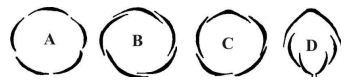
Correct Answer: (a)
A: petals touch without overlapping (Valvate); B: one margin overlaps next (Twisted); C: overlapping but not in direction (Imbricate); D: one large, two wings, two keel (Vexillary).
A: petals touch without overlapping (Valvate); B: one margin overlaps next (Twisted); C: overlapping but not in direction (Imbricate); D: one large, two wings, two keel (Vexillary).
Q42. An aggregate fruit is one which develops from
Correct Answer: (b)
Aggregate fruits develop from a single flower having multicarpellary, apocarpous (free) carpels, forming a cluster of fruitlets.
Aggregate fruits develop from a single flower having multicarpellary, apocarpous (free) carpels, forming a cluster of fruitlets.
Q43. Which of the following is the green expanded part of leaf with vein and veinlets?
Correct Answer: (d)
The lamina or leaf blade is the green expanded part of the leaf with veins and veinlets.
The lamina or leaf blade is the green expanded part of the leaf with veins and veinlets.
Q44. The X is small and situated in a groove at one end of the endosperm. It consists of one large and shield shaped cotyledon known as Y and a short axis with a plumule and a Z. Identify X, Y and Z.
Correct Answer: (c)
In monocots, the embryo (X) is small, the large cotyledon is the scutellum (Y), and the lower end of the axis is the radicle (Z).
In monocots, the embryo (X) is small, the large cotyledon is the scutellum (Y), and the lower end of the axis is the radicle (Z).
Q45. Venation is a term used to describe the pattern of arrangement of
Correct Answer: (c)
Venation is the arrangement of veins and the veinlets in the lamina of the leaf.
Venation is the arrangement of veins and the veinlets in the lamina of the leaf.
Q46. The standard petal of a papilionaceous corolla is also called
Correct Answer: (c)
In papilionaceous corolla, the largest posterior petal is called the standard or vexillum.
In papilionaceous corolla, the largest posterior petal is called the standard or vexillum.
Q47. Which of the following is correct with reference to floral character of the family Solanaceae?
Correct Answer: (d)
Solanaceae flowers are typically solitary or axillary, actinomorphic, bisexual, and have epipetalous stamens.
Solanaceae flowers are typically solitary or axillary, actinomorphic, bisexual, and have epipetalous stamens.
Q48. Cotyledons and testa respectively are edible parts in which of the following plant group?
Correct Answer: (a)
In Walnut, we eat the cotyledons. In Tamarind, the edible part is the pulp, but among these options, walnut (cotyledon) is the clearest match for edible cotyledon.
In Walnut, we eat the cotyledons. In Tamarind, the edible part is the pulp, but among these options, walnut (cotyledon) is the clearest match for edible cotyledon.
Q49. Match the following with correct combination.
| Column I | Column II |
|---|---|
| A. Cuscuta | I. Saprophyte |
| B. Eichhornia | II. Pneumatophore |
| C. Monotropa | III. Insectivorous plant |
| D. Rhizophora | IV. Parasite |
| E. Utricularia | V. Root pocket |
Correct Answer: (b)
Cuscuta is a parasite. Eichhornia (aquatic) has root pockets. Monotropa is a saprophyte. Rhizophora has pneumatophores. Utricularia is insectivorous.
Cuscuta is a parasite. Eichhornia (aquatic) has root pockets. Monotropa is a saprophyte. Rhizophora has pneumatophores. Utricularia is insectivorous.
Q50. Tricarpellary syncarpous gynoecium is found in flowers of
Correct Answer: (a)
The family Liliaceae is characterized by a tricarpellary, syncarpous gynoecium.
The family Liliaceae is characterized by a tricarpellary, syncarpous gynoecium.
Q51. Study the following statements and select the correct option
(i) Buds are present in the axil of leaflets of the compound leaf.
(ii) Pulvinus leaf-base is present in some leguminous plants.
(iii) In Alstonia, the petioles expand, become green and synthesize food.
(iv) Opposite phyllotaxy is seen in guava.
(i) Buds are present in the axil of leaflets of the compound leaf.
(ii) Pulvinus leaf-base is present in some leguminous plants.
(iii) In Alstonia, the petioles expand, become green and synthesize food.
(iv) Opposite phyllotaxy is seen in guava.
Correct Answer: (a)
Statement (i) is wrong because buds are in the axil of the leaf, not leaflets. (iii) is wrong because Alstonia has whorled phyllotaxy; expansion of petiole (phyllode) occurs in Australian Acacia.
Statement (i) is wrong because buds are in the axil of the leaf, not leaflets. (iii) is wrong because Alstonia has whorled phyllotaxy; expansion of petiole (phyllode) occurs in Australian Acacia.
Q52. Perigynous flowers are found in
Correct Answer: (c)
In Rose, Plum, and Peach, the flower is perigynous with a half-inferior ovary.
In Rose, Plum, and Peach, the flower is perigynous with a half-inferior ovary.
Q53. Match the following
| List-I | List-II |
|---|---|
| A. Coleorhiza | I. Development of sporophyte directly from gametophyte without intervention of gametes |
| B. Apogamy | II. Development of gametophyte directly from sporophyte without the involvement of reduction division. |
| C. Indusium | III. An unbranched columnar stem with a crown of leaves. |
| D. Caudex | IV. Protective covering of radicle |
| V. Protective structure of a sorus. |
Correct Answer: (b)
Coleorhiza is the protective sheath of the radicle. Apogamy is development of sporophyte from gametophyte. Indusium is a sorus covering. Caudex is an unbranched stem with leaves at the top.
Coleorhiza is the protective sheath of the radicle. Apogamy is development of sporophyte from gametophyte. Indusium is a sorus covering. Caudex is an unbranched stem with leaves at the top.
Q54. How many plants in the list given below have marginal placentation?
Mustard, Gram, Tulip, Asparagus, Arhar, Sunhemp, Chilli, Colchicine, Onion, Moong, Pea, Tobacco, Lupin
Mustard, Gram, Tulip, Asparagus, Arhar, Sunhemp, Chilli, Colchicine, Onion, Moong, Pea, Tobacco, Lupin
Correct Answer: (c)
Marginal placentation is characteristic of Fabaceae. From the list: Gram, Arhar, Sunhemp, Moong, Pea, and Lupin (6 plants) belong to this family.
Marginal placentation is characteristic of Fabaceae. From the list: Gram, Arhar, Sunhemp, Moong, Pea, and Lupin (6 plants) belong to this family.
Q55. Rearrange the following zones as seen in the root in vertical section and choose the correct option.
A. Root hair zone B. Zone of meristems C. Root cap zone D. Zone of maturation E. Zone of elongation
A. Root hair zone B. Zone of meristems C. Root cap zone D. Zone of maturation E. Zone of elongation
Correct Answer: (a)
From tip to base: Root cap (C) → Meristematic zone (B) → Elongation zone (E) → Root hair/Maturation zone (A, D).
From tip to base: Root cap (C) → Meristematic zone (B) → Elongation zone (E) → Root hair/Maturation zone (A, D).
Q56. 'X' is the outermost whorl of the flower and contains 'Y'. Y is green, leaf like and protect the other whorls of the flower. Identify X and Y.
Correct Answer: (a)
The calyx (X) is the outermost whorl made of sepals (Y), which are typically green and protective.
The calyx (X) is the outermost whorl made of sepals (Y), which are typically green and protective.
Q57. Seeds are adaptively important because
1. they maintain dormancy
2. they protect young plants during vulnerable stages
3. they store food for young plants, and facilitate dispersal
1. they maintain dormancy
2. they protect young plants during vulnerable stages
3. they store food for young plants, and facilitate dispersal
Correct Answer: (d)
Seeds provide survival advantages by allowing embryo survival during harsh conditions (dormancy), protection (seed coat), and nutrient supply until the seedling becomes autotrophic.
Seeds provide survival advantages by allowing embryo survival during harsh conditions (dormancy), protection (seed coat), and nutrient supply until the seedling becomes autotrophic.
Q58. Identify the kind of phyllotaxy shown in the given figures A, B, and C.
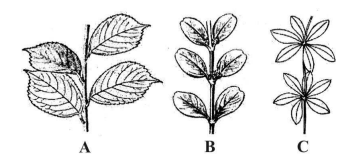
Correct Answer: (a)
A shows one leaf per node (alternate). B shows two leaves per node (opposite). C shows more than two leaves per node (whorled).
A shows one leaf per node (alternate). B shows two leaves per node (opposite). C shows more than two leaves per node (whorled).
Q59. Pneumatophores occur in
Correct Answer: (a)
Pneumatophores are specialized respiratory roots that grow upwards to get oxygen in halophytic (salt-marsh) plants.
Pneumatophores are specialized respiratory roots that grow upwards to get oxygen in halophytic (salt-marsh) plants.
Q60. Proximal end of the filament of stamen is attached to the
Correct Answer: (d)
The proximal end of the stamen's filament is attached to the thalamus of the flower or to the petals (in epipetalous condition).
The proximal end of the stamen's filament is attached to the thalamus of the flower or to the petals (in epipetalous condition).
Q61. Match the following stem modifications given in column I with their examples given in column II and select the correct combination from the options given below.
| Column-I (Stem Modifications) | Column-II (Found in) |
|---|---|
| A. Underground stem | I. Euphorbia |
| B. Stem tendril | II. Opuntia |
| C. Stem thorns | III. Potato |
| D. Flattened stem | IV. Citrus |
| E. Fleshy cylindrical stem | V. Cucumber |
Correct Answer: (d)
Potato is an underground stem. Cucumber has stem tendrils. Citrus has thorns. Opuntia has flattened stems. Euphorbia has fleshy cylindrical stems.
Potato is an underground stem. Cucumber has stem tendrils. Citrus has thorns. Opuntia has flattened stems. Euphorbia has fleshy cylindrical stems.
Q62. Match the following placentation types given in column I with their examples given in column II and choose the correct combination from the options given below.
| Column-I (Placentation Types) | Column-II (Examples) |
|---|---|
| A. Basal | I. Dianthus |
| B. Free central | II. Pea |
| C. Parietal | III. Lemon |
| D. Axile | IV. Marigold |
| E. Marginal | V. Argemone |
Correct Answer: (b)
Basal: Marigold; Free central: Dianthus; Parietal: Argemone; Axile: Lemon; Marginal: Pea.
Basal: Marigold; Free central: Dianthus; Parietal: Argemone; Axile: Lemon; Marginal: Pea.
Q63. Match the column I with column II and choose the correct option.
| Column I | Column II |
|---|---|
| A. Placentation | I. Arrangement of flowers on the rachis |
| B. Aestivation | II. Modified shoot for sexual reproduction |
| C. Inflorescence | III. Arrangement of various whorls in the bud |
| D. Flower | IV. Arrangement of ovules within an ovary |
Correct Answer: (d)
Placentation is ovule arrangement; Aestivation is whorl arrangement in bud; Inflorescence is flower arrangement on axis; Flower is a modified shoot.
Placentation is ovule arrangement; Aestivation is whorl arrangement in bud; Inflorescence is flower arrangement on axis; Flower is a modified shoot.
Q64. Which of the following is an example of pinnately compound leaf ?
Correct Answer: (d)
In a pinnately compound leaf, a number of leaflets are present on a common axis, the rachis, as in neem.
In a pinnately compound leaf, a number of leaflets are present on a common axis, the rachis, as in neem.
Q65. Sweet potato is a modified
Correct Answer: (b)
Sweet potato (Ipomoea batatas) is an adventitious root modified for food storage.
Sweet potato (Ipomoea batatas) is an adventitious root modified for food storage.
Q66. Cotyledon of maize grain is called
Correct Answer: (d)
In monocot seeds like maize, the large shield-shaped cotyledon is specifically named the scutellum.
In monocot seeds like maize, the large shield-shaped cotyledon is specifically named the scutellum.
Q67. Seeds are regarded as products of sexual reproduction because they
Correct Answer: (c)
Sexual reproduction involves the fusion of male and female gametes (syngamy), which results in the zygote that develops into an embryo within the seed.
Sexual reproduction involves the fusion of male and female gametes (syngamy), which results in the zygote that develops into an embryo within the seed.
Q68. Ginger is an underground stem. It is distinguished from root because
Correct Answer: (c)
The presence of nodes and internodes is a definitive characteristic that identifies ginger as a stem.
The presence of nodes and internodes is a definitive characteristic that identifies ginger as a stem.
Q69. Which of the following statements are correct?
(i) From the region of elongation, some of the epidermal cells form root hairs.
(ii) Pneumatophores are seen in Rhizophora.
(iii) Adventitious roots are seen in the banyan tree.
(iv) Maize and sugarcane have prop roots.
(i) From the region of elongation, some of the epidermal cells form root hairs.
(ii) Pneumatophores are seen in Rhizophora.
(iii) Adventitious roots are seen in the banyan tree.
(iv) Maize and sugarcane have prop roots.
Correct Answer: (d)
Statement (ii) is correct (Rhizophora has pneumatophores) and (iii) is correct (banyan has prop roots, which are adventitious). Statement (i) is wrong as root hairs form in the maturation zone. Statement (iv) is wrong as maize has stilt roots, not prop roots.
Statement (ii) is correct (Rhizophora has pneumatophores) and (iii) is correct (banyan has prop roots, which are adventitious). Statement (i) is wrong as root hairs form in the maturation zone. Statement (iv) is wrong as maize has stilt roots, not prop roots.
Q70. Root hairs develop from
Correct Answer: (a)
In the region of maturation, some of the epidermal cells form very fine and delicate, thread-like structures called root hairs.
In the region of maturation, some of the epidermal cells form very fine and delicate, thread-like structures called root hairs.
Q71. Which one of the following fruits is parthenocarpic?
Correct Answer: (c)
Banana is a common example of a parthenocarpic fruit which develops without fertilization and is seedless.
Banana is a common example of a parthenocarpic fruit which develops without fertilization and is seedless.
Q72. Pneumatophores are found in
Correct Answer: (a)
Pneumatophores are respiratory roots found in plants growing in swampy/marshy areas (halophytes) like Rhizophora to help get oxygen for respiration.
Pneumatophores are respiratory roots found in plants growing in swampy/marshy areas (halophytes) like Rhizophora to help get oxygen for respiration.
Q73. Diadelphous stamens are the characteristic features of
Correct Answer: (b)
In Fabaceae (pea family), stamens are diadelphous, meaning they are united in two bundles (usually 9+1).
In Fabaceae (pea family), stamens are diadelphous, meaning they are united in two bundles (usually 9+1).
Q74. Why is vivipary an undesirable character for annual crop plants?
Correct Answer: (b)
Vivipary involves seed germination while still attached to the parent plant. Such seeds cannot be harvested and stored as dry grains for the next sowing season.
Vivipary involves seed germination while still attached to the parent plant. Such seeds cannot be harvested and stored as dry grains for the next sowing season.
Q75. Alternate type of phyllotaxy is found in
Correct Answer: (d)
In alternate type of phyllotaxy, a single leaf arises at each node in alternate manner, as in china rose, mustard and sunflower plants.
In alternate type of phyllotaxy, a single leaf arises at each node in alternate manner, as in china rose, mustard and sunflower plants.
Q76. Endosperm, a product of double fertilisation in angiosperms is absent in the seeds of
Correct Answer: (b)
Orchids are monocots that lack endosperm in their mature seeds.
Orchids are monocots that lack endosperm in their mature seeds.
Q77. Which one of the following statements is not correct?
Correct Answer: (b)
Actinomorphic flowers can be divided into equal halves by any radial plane passing through the centre. Statement (d) is also technically slightly wrong as attachment to petals is 'epipetalous'; 'epiphyllous' is attachment to perianth.
Actinomorphic flowers can be divided into equal halves by any radial plane passing through the centre. Statement (d) is also technically slightly wrong as attachment to petals is 'epipetalous'; 'epiphyllous' is attachment to perianth.
Q78. When the margins of sepals or petals overlap one another without any particular direction, the condition is termed as
Correct Answer: (b)
In imbricate aestivation, the margins overlap but not in any specific uniform direction, unlike twisted aestivation.
In imbricate aestivation, the margins overlap but not in any specific uniform direction, unlike twisted aestivation.
Q79. Which of the following statement (s) is/are not correct?
(i) Calyx and corolla are reproductive organs of a flower.
(ii) Zygomorphic flower can be divided into two equal radial halves in any radial plane.
(iii) Flowers without bracts are termed as bracteate.
(iv) Parthenocarpic fruit is formed after fertilization of the ovary.
(v) In legumes, seed is non-endospermic.
(vi) Radical buds develop on roots.
(i) Calyx and corolla are reproductive organs of a flower.
(ii) Zygomorphic flower can be divided into two equal radial halves in any radial plane.
(iii) Flowers without bracts are termed as bracteate.
(iv) Parthenocarpic fruit is formed after fertilization of the ovary.
(v) In legumes, seed is non-endospermic.
(vi) Radical buds develop on roots.
Correct Answer: (a)
Calyx/corolla are accessory organs. Zygomorphic is bilateral symmetry (only one plane). Flowers without bracts are ebracteate. Parthenocarpic fruits form without fertilization.
Calyx/corolla are accessory organs. Zygomorphic is bilateral symmetry (only one plane). Flowers without bracts are ebracteate. Parthenocarpic fruits form without fertilization.
Q80. Match column I with column II and choose the correct combination from the options given below.
| Column-I (Position of floral parts on thalamus) | Column-II (Represented in) |
|---|---|
| A. Hypogynous | I. Ray florets of sunflower |
| B. Perigynous | II. Brinjal |
| C. Epigynous | III Peach |
Correct Answer: (d)
Hypogynous: Brinjal; Perigynous: Peach; Epigynous: Ray florets of sunflower.
Hypogynous: Brinjal; Perigynous: Peach; Epigynous: Ray florets of sunflower.
Q81. Which of the following plant parts elongates directly and leads to the formation of primary roots?
Correct Answer: (b)
The radicle of the embryo elongates directly to form the primary root in dicotyledonous plants.
The radicle of the embryo elongates directly to form the primary root in dicotyledonous plants.
Q82. Prop roots of banyan tree are meant for
Correct Answer: (c)
Prop roots are modified adventitious roots that grow vertically downwards from heavy horizontal branches to provide mechanical support.
Prop roots are modified adventitious roots that grow vertically downwards from heavy horizontal branches to provide mechanical support.
Q83. In an inflorescence where flowers are borne laterally in an acropetal succession, the position of the youngest floral bud shall be
Correct Answer: (b)
In acropetal succession (Racemose), the youngest flowers or buds are found at the apex (distal end).
In acropetal succession (Racemose), the youngest flowers or buds are found at the apex (distal end).
Q84. Stems modified into flat green organs performing the functions of leaves are known as
Correct Answer: (c)
Phylloclades are flattened or cylindrical green stems of unlimited growth that perform photosynthesis (e.g., Opuntia).
Phylloclades are flattened or cylindrical green stems of unlimited growth that perform photosynthesis (e.g., Opuntia).
Q85. Which of the following option shows the correct labelling of the parts of leaf marked as A, B, C and D.
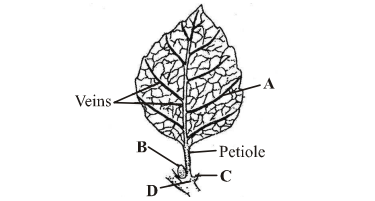
Correct Answer: (a)
Label A is the broad lamina, B is the bud in the axil, C is the small leaf-like stipule, and D is the leaf base where it attaches to the stem.
Label A is the broad lamina, B is the bud in the axil, C is the small leaf-like stipule, and D is the leaf base where it attaches to the stem.
Q86. Below is the floral formula of
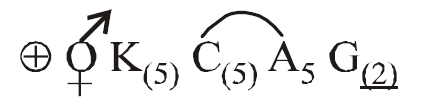
Correct Answer: (b)
This is the floral formula for Solanaceae. Petunia belongs to this family.
This is the floral formula for Solanaceae. Petunia belongs to this family.
Q87. Coconut water from a tender coconut is
Correct Answer: (a)
The liquid inside a tender coconut is the free-nuclear endosperm (thousands of nuclei), while the white kernel is the cellular endosperm.
The liquid inside a tender coconut is the free-nuclear endosperm (thousands of nuclei), while the white kernel is the cellular endosperm.
Q88. In Bougainvillea, thorns are the modifications of
Correct Answer: (b)
Thorns in Bougainvillea and Citrus are modified axillary buds, which are part of the shoot/stem system.
Thorns in Bougainvillea and Citrus are modified axillary buds, which are part of the shoot/stem system.
Q89. The given figure shows the parts of flowering plant. Which parts of the given figure is involved in all of the following given functions:
(i) Storing reserve food material
(ii) Synthesis of plant growth regulators.
(iii) Absorption of water and minerals from the soil.
(iv) Providing a proper anchorage to the plant parts
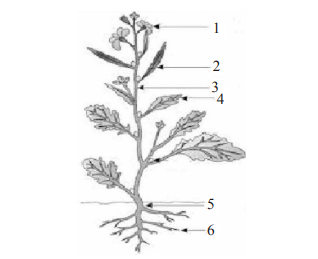
(i) Storing reserve food material
(ii) Synthesis of plant growth regulators.
(iii) Absorption of water and minerals from the soil.
(iv) Providing a proper anchorage to the plant parts
Correct Answer: (a)
The root system (represented by 5 and 6) is responsible for anchorage, absorption of water/minerals, storage of food, and synthesis of plant growth regulators.
The root system (represented by 5 and 6) is responsible for anchorage, absorption of water/minerals, storage of food, and synthesis of plant growth regulators.
Q90. The ovary is half inferior in :
Correct Answer: (c)
Plum, Rose, and Peach have perigynous flowers where the ovary is half-inferior.
Plum, Rose, and Peach have perigynous flowers where the ovary is half-inferior.
Q91. Which one of the following is correct explanation for the given floral formula ?
% ⚥ K(5) C1+2+(2) A(9)+1 G1
% ⚥ K(5) C1+2+(2) A(9)+1 G1
Correct Answer: (c)
The formula represents Fabaceae: Zygomorphic (%), bisexual (♀), fused sepals (K(5)), papilionaceous petals (1+2+(2)), diadelphous stamens ((9)+1), and superior monocarpellary ovary (G1).
The formula represents Fabaceae: Zygomorphic (%), bisexual (♀), fused sepals (K(5)), papilionaceous petals (1+2+(2)), diadelphous stamens ((9)+1), and superior monocarpellary ovary (G1).
Q92. Flowers are unisexual in
Correct Answer: (a)
Cucumber (and other gourds) bears separate male and female flowers on the same plant (monoecious).
Cucumber (and other gourds) bears separate male and female flowers on the same plant (monoecious).
Q93. Pollen grains are produced within the _________of stamen.
Correct Answer: (b)
The anther is the part of the stamen where pollen grains are produced within pollen sacs.
The anther is the part of the stamen where pollen grains are produced within pollen sacs.
Q94. Coconut fruit is a
Correct Answer: (d)
Coconut is a drupe because it develops from a monocarpellary superior ovary and has a stony endocarp.
Coconut is a drupe because it develops from a monocarpellary superior ovary and has a stony endocarp.
Q95. Match column I to column II and choose the correct option:
| Column-I | Column-II |
|---|---|
| A. Coleorhiza | I. Development of sporophyte directly from gametophyte without intervention of gametes |
| B. Apogamy | II. Development of gametophyte directly from sporophyte without the involvement of reduction division. |
| C. Indusium | III. An unbranched columnar stem with a crown of leaves. |
| D. Caudex | IV. Protective covering of radicle |
Correct Answer: (b)
Coleorhiza (IV) is radicle cover. Apogamy (I) is sporophyte from gametophyte. Indusium (V) protects sorus. Caudex (III) is an unbranched columnar stem.
Coleorhiza (IV) is radicle cover. Apogamy (I) is sporophyte from gametophyte. Indusium (V) protects sorus. Caudex (III) is an unbranched columnar stem.
Q96. Which one of the following is correctly matched?
Correct Answer: (a)
Onion is a modified underground stem called a bulb. Ginger is a rhizome, not a sucker.
Onion is a modified underground stem called a bulb. Ginger is a rhizome, not a sucker.
Q97. Match column-I with column-II and choose the option which shows their correct combination.
| Column-I | Column-II |
|---|---|
| A. Gamosepalous | I. Flower of lily |
| B. Polysepalous | II. Sterile anther |
| C. Gamopetalous | III. Free petals |
| D. Polypetalous | IV. Free sepals |
| E. Epiphyllous | V. Fused petals |
| F. Staminode | VI. Fused sepals |
Correct Answer: (c)
Gamosepalous = fused sepals; Polysepalous = free sepals; Gamopetalous = fused petals; Polypetalous = free petals; Epiphyllous = stamens attached to perianth (lily); Staminode = sterile anther.
Gamosepalous = fused sepals; Polysepalous = free sepals; Gamopetalous = fused petals; Polypetalous = free petals; Epiphyllous = stamens attached to perianth (lily); Staminode = sterile anther.
Q98. It is a proteinous layer and the outer covering of endosperm which separates the embryo. Identify the layer.
Correct Answer: (d)
In monocot seeds like maize, the endosperm is surrounded by a proteinous layer called the aleurone layer.
In monocot seeds like maize, the endosperm is surrounded by a proteinous layer called the aleurone layer.
Q99. The morphological nature of the edible part of coconut is
Correct Answer: (b)
The edible part of the coconut is the endosperm, which is available in both liquid (free-nuclear) and solid (cellular) forms.
The edible part of the coconut is the endosperm, which is available in both liquid (free-nuclear) and solid (cellular) forms.
Q100. Plantation, in which ovules develop on the inner wall of the ovary or in peripheral part is:
Correct Answer: (c)
This describes parietal placentation, as seen in Mustard and Argemone.
This describes parietal placentation, as seen in Mustard and Argemone.
Q101. The given figures (A and B) show the modification of roots. Which of the following statements regarding the figures is correct ?
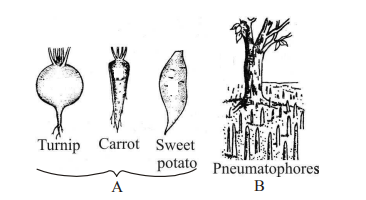
Correct Answer: (a)
Figure A shows storage roots. Carrot and turnip are modified tap roots, while sweet potato is a modified adventitious root, all of which store food.
Figure A shows storage roots. Carrot and turnip are modified tap roots, while sweet potato is a modified adventitious root, all of which store food.
Q102. A scar on the seed coat through which the developing seeds are attached to the fruit is called as ________.
Correct Answer: (c)
The hilum is the point of attachment between the seed and the fruit wall (funiculus).
The hilum is the point of attachment between the seed and the fruit wall (funiculus).
Q103. When the anthers mature earlier than the stigma of ones own flower, the condition is known as
Correct Answer: (b)
Protandry is the condition where anthers mature before the stigma of the same flower, preventing self-pollination.
Protandry is the condition where anthers mature before the stigma of the same flower, preventing self-pollination.
Q104. Which of the following statements is correct?
Correct Answer: (b)
Statement (b) is correct. Papilionaceous flowers have vexillary aestivation. Cymose growth is limited. Parietal placentation has false septum (replum).
Statement (b) is correct. Papilionaceous flowers have vexillary aestivation. Cymose growth is limited. Parietal placentation has false septum (replum).
Q105. When a flower has both androecium and gynoecium, it is known as__________.
Correct Answer: (b)
A bisexual flower contains both male (androecium) and female (gynoecium) reproductive parts.
A bisexual flower contains both male (androecium) and female (gynoecium) reproductive parts.
Q106. Match column I with column II and choose the correct option.
| Column-I | Column-II |
|---|---|
| A. Bud in the axil of leaf | I. Pitcher plant and venus fly trap |
| B. Outer layer of seed coat | II. Cacti |
| C. Spines (modified leaves) | III. Testa |
| D. Leaves modified to catch insects | IV. Simple leaf |
| E. Fleshy leaves with stored food | V. Garlic and onion |
Correct Answer: (d)
Simple leaves have buds in their axils. Testa is the outer seed coat. Spines are modified leaves in cacti. Insectivorous plants have leaf traps. Onion/Garlic have fleshy storage leaves.
Simple leaves have buds in their axils. Testa is the outer seed coat. Spines are modified leaves in cacti. Insectivorous plants have leaf traps. Onion/Garlic have fleshy storage leaves.
Q107. Read the following statements and answer the question.
(i) Gynoecium is situated in the centre, and other parts of the flower are located on the rim of the thalamus almost at the same level.
(ii) Ovary is half-inferior.
(iii) Examples are plum, rose and peach.
Which condition of flowers is being described by the above statements ?
(i) Gynoecium is situated in the centre, and other parts of the flower are located on the rim of the thalamus almost at the same level.
(ii) Ovary is half-inferior.
(iii) Examples are plum, rose and peach.
Which condition of flowers is being described by the above statements ?
Correct Answer: (b)
These characteristics define perigynous flowers where the ovary is half-inferior and other whorls are at the rim of the thalamus.
These characteristics define perigynous flowers where the ovary is half-inferior and other whorls are at the rim of the thalamus.
Q108. Which one of the following options shows the correct labelling of the structure marked as A, B, C & D?
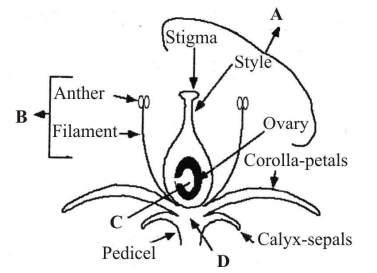
Correct Answer: (d)
A is the female part (Gynoecium), B is the male part (Stamen), C is the ovule inside the ovary, and D is the base (Thalamus).
A is the female part (Gynoecium), B is the male part (Stamen), C is the ovule inside the ovary, and D is the base (Thalamus).
Q109. A branch in which each node bearing a rossette of leaves and a tuft of roots is found in aquatic plants like _________ and _________.
Correct Answer: (c)
In aquatic plants like Pistia and Eichhornia, a lateral branch with short internodes bears a rosette of leaves and a tuft of roots at each node (offsets).
In aquatic plants like Pistia and Eichhornia, a lateral branch with short internodes bears a rosette of leaves and a tuft of roots at each node (offsets).
Q110. Endosperm, a product of double fertilization in angiosperms is absent in the seeds of
Correct Answer: (b)
In most monocots, seeds are endospermic, but orchids are a notable exception where seeds are non-endospermic.
In most monocots, seeds are endospermic, but orchids are a notable exception where seeds are non-endospermic.
Q111. Among china rose, mustard, brinjal, potato, guava, cucumber, onion and tulip, how many plants have superior ovary?
Correct Answer: (a)
Superior ovary: China rose, Mustard, Brinjal, Potato, Onion, Tulip (Total = 6). Guava and cucumber have inferior ovaries.
Superior ovary: China rose, Mustard, Brinjal, Potato, Onion, Tulip (Total = 6). Guava and cucumber have inferior ovaries.
Q112. Albuminous seeds are found in–
Correct Answer: (c)
Albuminous (endospermic) seeds retain endosperm. Examples include wheat, barley, maize, and castor.
Albuminous (endospermic) seeds retain endosperm. Examples include wheat, barley, maize, and castor.
Q113. Roots developed from parts of the plant other than radicle are called
Correct Answer: (c)
Adventitious roots are those that arise from any part of the plant (stem, leaf, etc.) other than the radicle of the embryo.
Adventitious roots are those that arise from any part of the plant (stem, leaf, etc.) other than the radicle of the embryo.
Q114. Which of the following statement(s) is /are correct?
(i) Many plants belonging to the family Fabaceae are good ornamentals (Tulip, Gloriosa), source of medicine (Aloe) and vegetables (Asparagus).
(ii) The plumule and radicle are enclosed in sheaths which are called coleorhiza and coleoptile respectively.
(iii) A flower having either stamens or carpels is unisexual.
(iv) Basal, alternate, linear, exstipulate with parallel venation types of leaves is found in the family Liliaceae.
(i) Many plants belonging to the family Fabaceae are good ornamentals (Tulip, Gloriosa), source of medicine (Aloe) and vegetables (Asparagus).
(ii) The plumule and radicle are enclosed in sheaths which are called coleorhiza and coleoptile respectively.
(iii) A flower having either stamens or carpels is unisexual.
(iv) Basal, alternate, linear, exstipulate with parallel venation types of leaves is found in the family Liliaceae.
Correct Answer: (c)
Statement (i) lists Liliaceae plants, not Fabaceae. (ii) is swapped; plumule is in coleoptile, radicle in coleorhiza. (iii) and (iv) are correct definitions.
Statement (i) lists Liliaceae plants, not Fabaceae. (ii) is swapped; plumule is in coleoptile, radicle in coleorhiza. (iii) and (iv) are correct definitions.
Q115. Which of the following groups of plants have underground stems?
Correct Answer: (b)
Potato (tuber), ginger (rhizome), turmeric (rhizome), zaminkand (corm) and Colocasia (corm) are all examples of underground stems modified to store food.
Potato (tuber), ginger (rhizome), turmeric (rhizome), zaminkand (corm) and Colocasia (corm) are all examples of underground stems modified to store food.
Q116. Plants which produce characteristic pneumatophores and show vivipary belong to
Correct Answer: (a)
Halophytes (plants in salty/marshy areas) like Rhizophora show these adaptations to survive in anaerobic soil conditions.
Halophytes (plants in salty/marshy areas) like Rhizophora show these adaptations to survive in anaerobic soil conditions.
Q117. Which type of function is performed by the fleshy leaves of onion and garlic?
Correct Answer: (a)
In onion and garlic, the fleshy leaves store food material.
In onion and garlic, the fleshy leaves store food material.
Q118. The regions of the stem where leaves are borne are called _______ while ____________ are the portions between two ____________.
Correct Answer: (b)
The regions of the stem where leaves are borne are called nodes while internodes are the portions between two nodes.
The regions of the stem where leaves are borne are called nodes while internodes are the portions between two nodes.
Q119. The main purpose of phyllotaxy for the leaves is to provide sufficient_______.
Correct Answer: (d)
Phyllotaxy is the pattern of arrangement of leaves on the stem, intended to ensure that all leaves receive maximum sunlight for photosynthesis.
Phyllotaxy is the pattern of arrangement of leaves on the stem, intended to ensure that all leaves receive maximum sunlight for photosynthesis.
Q120. Match column - I, II and III and choose the correct option.
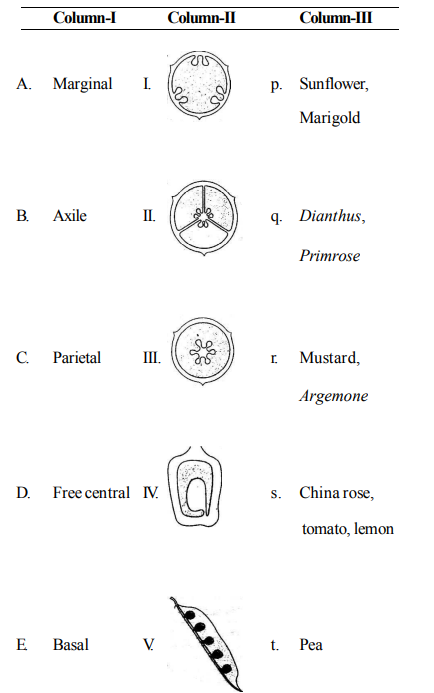
Correct Answer: (a)
Marginal: V (Pea, t); Axile: II (China rose/Tomato/Lemon, s); Parietal: I (Mustard/Argemone, r); Free central: III (Dianthus/Primrose, q); Basal: IV (Sunflower/Marigold, p).
Marginal: V (Pea, t); Axile: II (China rose/Tomato/Lemon, s); Parietal: I (Mustard/Argemone, r); Free central: III (Dianthus/Primrose, q); Basal: IV (Sunflower/Marigold, p).
Q121. Match the androecium formula (given in column II) with their family (given in column I) and choose the correct combination from the options given below.
| Column-I (Family) | Column-II (Androecium formula) |
|---|---|
| A. Brassicaceae | I. A3 + 3 |
| B. Fabaceae | II. A(5) |
| C. Solanaceae | III. A(9) + 1 |
| D. Liliaceae | IV. A2 + 4 |
Correct Answer: (a)
Brassicaceae is tetradynamous (2+4). Fabaceae is diadelphous ((9)+1). Solanaceae has 5 stamens. Liliaceae has 6 stamens in two whorls (3+3).
Brassicaceae is tetradynamous (2+4). Fabaceae is diadelphous ((9)+1). Solanaceae has 5 stamens. Liliaceae has 6 stamens in two whorls (3+3).
Q122. The placenta is attached to the developing seed near the
Correct Answer: (b)
The hilum is the scar on the seed coat through which it was attached to the placenta via the funiculus.
The hilum is the scar on the seed coat through which it was attached to the placenta via the funiculus.
Q123. Floral formula of tomato/tobacco is
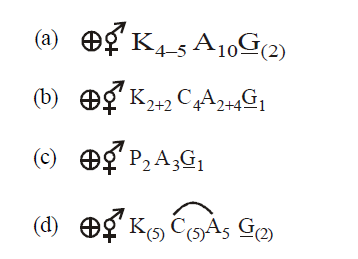
Correct Answer: (d)
Tomato and Tobacco belong to Solanaceae. Their formula is actinomorphic, bisexual, with 5 fused sepals, 5 fused petals, 5 epipetalous stamens, and bicarpellary syncarpous superior ovary.
Tomato and Tobacco belong to Solanaceae. Their formula is actinomorphic, bisexual, with 5 fused sepals, 5 fused petals, 5 epipetalous stamens, and bicarpellary syncarpous superior ovary.
Q124. The primary roots and its branches constitute the
Correct Answer: (b)
In dicotyledonous plants, the direct elongation of the radicle leads to the formation of the primary root which bears lateral roots, together constituting the tap root system.
In dicotyledonous plants, the direct elongation of the radicle leads to the formation of the primary root which bears lateral roots, together constituting the tap root system.
Q125. When a flower can be divided into two equal radial halves in any radial plane passing through the centre, it is known as
Correct Answer: (a)
Actinomorphic (radial) symmetry allows a flower to be divided into two identical halves by any plane passing through the center.
Actinomorphic (radial) symmetry allows a flower to be divided into two identical halves by any plane passing through the center.
Q126. The given figure shows the regions of root tip with labelling as A, B and C. Choose the option which shows the correct labelling of A, B and C.
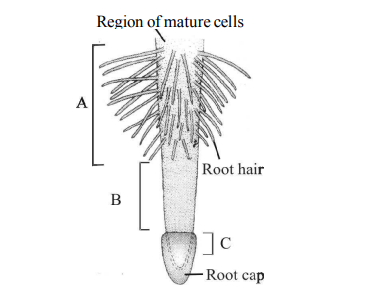
Correct Answer: (d)
In the root tip, 'A' represents the region of maturation (with root hairs), 'B' represents the region of elongation, and 'C' represents the region of meristematic activity.
In the root tip, 'A' represents the region of maturation (with root hairs), 'B' represents the region of elongation, and 'C' represents the region of meristematic activity.
Q127. Which of the following is a modified stem for the protection of plants from browsing animals?
Correct Answer: (b)
Axillary buds of stems may get modified into woody, straight and pointed thorns to protect plants from browsing animals (e.g., Citrus, Bougainvillea).
Axillary buds of stems may get modified into woody, straight and pointed thorns to protect plants from browsing animals (e.g., Citrus, Bougainvillea).
Q128. In floral formula, ‘G’ and ‘G’ is respectively used for
Correct Answer: (a)
A line below 'G' (G) indicates a superior ovary, while a line above 'G' indicates an inferior ovary.
A line below 'G' (G) indicates a superior ovary, while a line above 'G' indicates an inferior ovary.
Q129. Which of the following plant parts is generally green when young and later often becomes woody and dark brown?
Correct Answer: (a)
The stem is the ascending part of the axis bearing branches, leaves, flowers and fruits. It is generally green when young and later often becomes woody and dark brown.
The stem is the ascending part of the axis bearing branches, leaves, flowers and fruits. It is generally green when young and later often becomes woody and dark brown.
Q130. Match column-I containing types of aestivation with their examples given in column-II and choose the correct option.
| Column-I (Type of aestivation) | Column-II (Examples) |
|---|---|
| A. Valvate | I. Cotton |
| B. Twisted | II. Calotropis |
| C. Imbricate | III. Bean |
| D. Vexillary | IV. Gulmohar |
Correct Answer: (b)
Valvate: Calotropis; Twisted: Cotton; Imbricate: Gulmohar; Vexillary: Bean.
Valvate: Calotropis; Twisted: Cotton; Imbricate: Gulmohar; Vexillary: Bean.
Q131. Ginger is a stem which can be differentiated from root because it
Correct Answer: (d)
Stems are characterized by the presence of nodes and internodes, which are absent in roots.
Stems are characterized by the presence of nodes and internodes, which are absent in roots.
Q132. Trimerous flower, superior ovary and axile placentation is characteristics of
Correct Answer: (a)
Liliaceae is defined by trimerous flowers (parts in threes) and a tricarpellary, syncarpous superior ovary with axile placentation.
Liliaceae is defined by trimerous flowers (parts in threes) and a tricarpellary, syncarpous superior ovary with axile placentation.
Q133. Which of the following plants is used to extract the blue dye?
Correct Answer: (b)
Indigofera tinctoria is a member of Fabaceae widely used for extracting natural indigo dye.
Indigofera tinctoria is a member of Fabaceae widely used for extracting natural indigo dye.
Q134. Which of the following statement(s) is/are correct about the fruit?
(i) Fruit is a mature or ripened ovary, developed before fertilization.
(ii) It consists of a wall or pericarp and seeds.
(iii) When pericarp is thick and fleshy, it is differentiated into outer mesocarp, middle epicarp and inner endocarp.
(iv) In mango and coconut, the fruit is known as a berry.
(i) Fruit is a mature or ripened ovary, developed before fertilization.
(ii) It consists of a wall or pericarp and seeds.
(iii) When pericarp is thick and fleshy, it is differentiated into outer mesocarp, middle epicarp and inner endocarp.
(iv) In mango and coconut, the fruit is known as a berry.
Correct Answer: (b)
Statement (i) is wrong as it develops after fertilization. (iii) is wrong because epicarp is outer, mesocarp middle. (iv) is wrong as mango/coconut are drupes. Therefore, only (ii) is correct.
Statement (i) is wrong as it develops after fertilization. (iii) is wrong because epicarp is outer, mesocarp middle. (iv) is wrong as mango/coconut are drupes. Therefore, only (ii) is correct.
Q135. Which one of the following statements is correct?
Correct Answer: (c)
In maize (a grass), the outer layer of the endosperm is a protein-rich aleurone layer. Statement (d) is wrong; a sterile stamen is a staminode, a sterile pistil is a pistillode.
In maize (a grass), the outer layer of the endosperm is a protein-rich aleurone layer. Statement (d) is wrong; a sterile stamen is a staminode, a sterile pistil is a pistillode.
Q136. Which one of the following are not true for parietal placentation?
Correct Answer: (a)
In parietal placentation, ovules develop on the inner wall of the ovary or on peripheral parts, not on a central axis.
In parietal placentation, ovules develop on the inner wall of the ovary or on peripheral parts, not on a central axis.
Q137. In which of the following plants, a slender lateral branch arises from the base of the main axis, and after growing aerially arch downwards to touch the ground?
Correct Answer: (a)
In plants like mint and jasmine, a slender lateral branch arises from the base of the main axis and after growing aerially for some time arch downwards to touch the ground (stolon).
In plants like mint and jasmine, a slender lateral branch arises from the base of the main axis and after growing aerially for some time arch downwards to touch the ground (stolon).
Q138. Consider the following statements regarding the root system of angiosperms and choose the correct option given below.
(i) In monocots, the fibrous root system arises from the base of the stem.
(ii) The region of elongation is called the root hair region.
(iii) In sweet potato, the adventitious roots get swollen and store food.
(iv) The stems of maize and sugarcane have supporting roots called prop roots.
(i) In monocots, the fibrous root system arises from the base of the stem.
(ii) The region of elongation is called the root hair region.
(iii) In sweet potato, the adventitious roots get swollen and store food.
(iv) The stems of maize and sugarcane have supporting roots called prop roots.
Correct Answer: (d)
Statements (i) and (iii) are correct. (ii) is wrong because the maturation region is the root hair region. (iv) is wrong because maize/sugarcane have stilt roots.
Statements (i) and (iii) are correct. (ii) is wrong because the maturation region is the root hair region. (iv) is wrong because maize/sugarcane have stilt roots.
Q139. Which of the following statement(s) is/are correct about venation?
(i) The arrangement of veins and the veinlets in the lamina of leaf is called venation.
(ii) Reticulate venation is the characteristic of monocots.
(iii) When the veinlets form a network, the venation is termed as reticulate venation.
(iv) When the veins run parallel to each other within a lamina, the venation is termed as parallel venation.
(i) The arrangement of veins and the veinlets in the lamina of leaf is called venation.
(ii) Reticulate venation is the characteristic of monocots.
(iii) When the veinlets form a network, the venation is termed as reticulate venation.
(iv) When the veins run parallel to each other within a lamina, the venation is termed as parallel venation.
Correct Answer: (c)
Statement (ii) is incorrect because reticulate venation is characteristic of dicots, not monocots. All other statements are standard definitions.
Statement (ii) is incorrect because reticulate venation is characteristic of dicots, not monocots. All other statements are standard definitions.
Q140. During the post-fertilization period, the ovules develop into ___A_____ and the ovary matures into a ___B____.
Correct Answer: (a)
Following fertilization, ovules mature into seeds and the ovary develops into the fruit.
Following fertilization, ovules mature into seeds and the ovary develops into the fruit.
Q141. Gynoecium in the members of family—Leguminosae is composed of
Correct Answer: (b)
Family Leguminosae (Fabaceae) is characterized by a monocarpellary (single carpel) gynoecium.
Family Leguminosae (Fabaceae) is characterized by a monocarpellary (single carpel) gynoecium.
Q142. Which is not a stem modification ?
Correct Answer: (c)
The pitcher of Nepenthes (pitcher plant) is a modification of the leaf, not the stem.
The pitcher of Nepenthes (pitcher plant) is a modification of the leaf, not the stem.
Q143. The part of the root which is most active in water absorption is called
Correct Answer: (b)
The maturation zone contains root hairs which increase the surface area for efficient absorption of water and minerals from the soil.
The maturation zone contains root hairs which increase the surface area for efficient absorption of water and minerals from the soil.
Q144. Keel is the characteristic feature of flower of
Correct Answer: (a)
Indigofera belongs to Fabaceae, which has papilionaceous corolla with a 'keel' (two fused anterior petals).
Indigofera belongs to Fabaceae, which has papilionaceous corolla with a 'keel' (two fused anterior petals).
Q145. Identify the correct families of the given plant species (A, B and C)
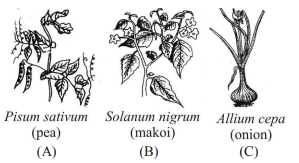
Correct Answer: (b)
A is Pea (Pisum sativum - Fabaceae). B is Makoi (Solanum nigrum - Solanaceae). C is Onion (Allium cepa - Liliaceae).
A is Pea (Pisum sativum - Fabaceae). B is Makoi (Solanum nigrum - Solanaceae). C is Onion (Allium cepa - Liliaceae).