Q1. In angiosperms, microsporogenesis and megasporogenesis
Correct Answer: (b)
Both processes involve the meiotic division of mother cells to produce haploid spores (microspores and megaspores).
Both processes involve the meiotic division of mother cells to produce haploid spores (microspores and megaspores).
Q2. Which of the following group of plant is being described by the given statements?
(i) They are plants in which the ovules are not enclosed by any ovary wall and remain exposed before and after fertilization.
(ii) The giant red wood tree Sequoia is one of the tallest tree species of the group.
(iii) The roots are generally tap roots.
(iv) They are heterosporous and they produce haploid microspores and megaspores.
(i) They are plants in which the ovules are not enclosed by any ovary wall and remain exposed before and after fertilization.
(ii) The giant red wood tree Sequoia is one of the tallest tree species of the group.
(iii) The roots are generally tap roots.
(iv) They are heterosporous and they produce haploid microspores and megaspores.
Correct Answer: (c)
These are characteristic features of the Kingdom Gymnosperms.
These are characteristic features of the Kingdom Gymnosperms.
Q3. Refer to the following statement(s) and identify the group of plant which is being described by the given statements?
(i) They include various mosses and liverworts that are found commonly growing in moist shaded areas in the hills.
(ii) They lack true roots, stem or leaves.
(iii) The main plant body is haploid.
(iv) They produce a multicellular body sporophyte which is not free living but attached to the photosynthetic gametophyte and derives nourishment from it.
(i) They include various mosses and liverworts that are found commonly growing in moist shaded areas in the hills.
(ii) They lack true roots, stem or leaves.
(iii) The main plant body is haploid.
(iv) They produce a multicellular body sporophyte which is not free living but attached to the photosynthetic gametophyte and derives nourishment from it.
Correct Answer: (c)
These statements collectively describe the life cycle and morphology of Bryophytes.
These statements collectively describe the life cycle and morphology of Bryophytes.
Q4. In bryophytes and pteridophytes, transport of male gametes requires
Correct Answer: (d)
Water is essential for the motile male gametes (antherozoids) to reach the female gametes in bryophytes and pteridophytes.
Water is essential for the motile male gametes (antherozoids) to reach the female gametes in bryophytes and pteridophytes.
Q5. The phenomenon of Alternation of Generation is shown by:
Correct Answer: (d)
Alternation of generations is fundamental to the life cycle of all sexually reproducing plants.
Alternation of generations is fundamental to the life cycle of all sexually reproducing plants.
Q6. The natural system of classification for flowering plants was given by
Correct Answer: (b)
George Bentham and Joseph Dalton Hooker gave the most famous natural system of classification for seed plants.
George Bentham and Joseph Dalton Hooker gave the most famous natural system of classification for seed plants.
Q7. Protonema is
Correct Answer: (a)
Protonema is the first stage of the haploid gametophytic generation in mosses.
Protonema is the first stage of the haploid gametophytic generation in mosses.
Q8. Mosses are of great ecological importance because of
Correct Answer: (d)
Mosses form dense mats that prevent soil erosion and are pioneer species in primary succession on bare rocks.
Mosses form dense mats that prevent soil erosion and are pioneer species in primary succession on bare rocks.
Q9. Which of the following statements is correct?
Correct Answer: (a)
Gymnosperms are naked-seeded plants. Salvinia is heterosporous. Cedrus is branched. Horsetails are pteridophytes.
Gymnosperms are naked-seeded plants. Salvinia is heterosporous. Cedrus is branched. Horsetails are pteridophytes.
Q10. Protonema
Correct Answer: (d)
In mosses, the spore germinates into a protonema stage, which is the first stage of the gametophyte. It is green, branched, and produces lateral buds.
In mosses, the spore germinates into a protonema stage, which is the first stage of the gametophyte. It is green, branched, and produces lateral buds.
Q11. An alga which can be employed as food for human being is
Correct Answer: (b)
Chlorella and Spirulina are unicellular algae rich in proteins and used as food supplements by space travelers.
Chlorella and Spirulina are unicellular algae rich in proteins and used as food supplements by space travelers.
Q12. Which of the following pairs is of unicellular algae?
Correct Answer: (c)
Both Chlorella and Spirulina are single-celled algae.
Both Chlorella and Spirulina are single-celled algae.
Q13. Consider the following statements regarding the major pigments and stored food in the different groups of algae and choose the correct option:
(i) In chlorophyceae, the stored food material is starch and the major pigments are chlorophyll-a and d.
(ii) In phaeophyceae, laminarian is the stored food and major pigments are chlorophyll-a and b.
(iii) In rhodophyceae, floridean starch is the stored food and the major pigments are chlorophyll-a, d and phycoerythrin.
(i) In chlorophyceae, the stored food material is starch and the major pigments are chlorophyll-a and d.
(ii) In phaeophyceae, laminarian is the stored food and major pigments are chlorophyll-a and b.
(iii) In rhodophyceae, floridean starch is the stored food and the major pigments are chlorophyll-a, d and phycoerythrin.
Correct Answer: (d)
Chlorophyceae has chl a and b. Phaeophyceae has chl a and c. Only statement (iii) is correct.
Chlorophyceae has chl a and b. Phaeophyceae has chl a and c. Only statement (iii) is correct.
Q14. Fruits are not formed in gymnosperms because of
Correct Answer: (d)
Gymnosperms (meaning 'naked seeds') have ovules that are not enclosed by an ovary wall; hence, no fruit is formed after fertilization.
Gymnosperms (meaning 'naked seeds') have ovules that are not enclosed by an ovary wall; hence, no fruit is formed after fertilization.
Q15. Mannitol is the stored food in
Correct Answer: (c)
Mannitol and laminarin are the complex carbohydrate storage products found in brown algae (Phaeophyceae), of which Fucus is a member.
Mannitol and laminarin are the complex carbohydrate storage products found in brown algae (Phaeophyceae), of which Fucus is a member.
Q16. Which of the following statement(s) is/are correct about gemmae?
(i) These are specialised structures by which asexual reproduction take place in liverworts.
(ii) They are green, multicellular and asexual buds.
(iii) They develop in small receptacles called gemma cups.
(iv) They detach from parent body and germinate to form new individuals.
(i) These are specialised structures by which asexual reproduction take place in liverworts.
(ii) They are green, multicellular and asexual buds.
(iii) They develop in small receptacles called gemma cups.
(iv) They detach from parent body and germinate to form new individuals.
Correct Answer: (d)
All points describe gemmae correctly as they occur in liverworts like Marchantia.
All points describe gemmae correctly as they occur in liverworts like Marchantia.
Q17. Match the column-I with column-II and choose the correct option.
| Column-I | Column-II |
|---|---|
| A. Smallest flowering plant | I. Eucalyptus |
| B. Male sex organ in flowering plant | II. Wolffia |
| C. Female sex organ in flowering plant | III. Stamen |
| D. Tallest tree | IV. Pistil |
Correct Answer: (c)
A-II (Wolffia); B-III (Stamen); C-IV (Pistil); D-I (Eucalyptus is one of the tallest).
A-II (Wolffia); B-III (Stamen); C-IV (Pistil); D-I (Eucalyptus is one of the tallest).
Q18. From evolutionary point of view, retention of the female gametophyte with developing young embryo on the parent sporophyte for some time, is first observed in:
Correct Answer: (c)
This is a precursor to the seed habit, first seen in heterosporous pteridophytes.
This is a precursor to the seed habit, first seen in heterosporous pteridophytes.
Q19. Which of the following pteridophytes belong to class pteropsida?
Correct Answer: (d)
Ferns like Pteris, Dryopteris, and Adiantum belong to the class Pteropsida.
Ferns like Pteris, Dryopteris, and Adiantum belong to the class Pteropsida.
Q20. Alginates (alginin), used as highly efficient gauze in internal operations are obtained from cell walls of
Correct Answer: (b)
Algin is a hydrocolloid obtained from the cell walls of brown algae (Phaeophyceae).
Algin is a hydrocolloid obtained from the cell walls of brown algae (Phaeophyceae).
Q21. The precursor to the seed habit, an important step in evolution of plants, is exhibited by:
Correct Answer: (b)
Heterospory and the retention of the female gametophyte in pteridophytes mark the beginning of the seed habit.
Heterospory and the retention of the female gametophyte in pteridophytes mark the beginning of the seed habit.
Q22. Select the correct statement
Correct Answer: (c)
All gymnosperms are heterosporous. Salvinia is a pteridophyte. Sequoia is indeed a record-holding tall tree.
All gymnosperms are heterosporous. Salvinia is a pteridophyte. Sequoia is indeed a record-holding tall tree.
Q23. Which of the following is responsible for peat formation?
Correct Answer: (d)
Sphagnum, a moss, provides peat that has long been used as fuel and packing material.
Sphagnum, a moss, provides peat that has long been used as fuel and packing material.
Q24. Select the mismatch
Correct Answer: (d)
Pinus is monoecious (male and female cones on the same tree).
Pinus is monoecious (male and female cones on the same tree).
Q25. Which of the following statement(s) is/are correct about pteridophytes?
(i) The main plant body is a sporophyte which is differentiated into true roots and leaves.
(ii) The leaves are small (microphylls) as in ferns or large (macrophylls) as in Selaginella.
(iii) Genera like Selaginella and Salvinia which produce two kinds of spores–macro (large) and micro (small) spores, are known as heterospores.
(iv) Common examples are Funaria, Polytrichum and Sphagnum.
(i) The main plant body is a sporophyte which is differentiated into true roots and leaves.
(ii) The leaves are small (microphylls) as in ferns or large (macrophylls) as in Selaginella.
(iii) Genera like Selaginella and Salvinia which produce two kinds of spores–macro (large) and micro (small) spores, are known as heterospores.
(iv) Common examples are Funaria, Polytrichum and Sphagnum.
Correct Answer: (c)
Statement (ii) is swapped (ferns have megaphylls, Selaginella has microphylls). Statement (iv) lists mosses, which are bryophytes.
Statement (ii) is swapped (ferns have megaphylls, Selaginella has microphylls). Statement (iv) lists mosses, which are bryophytes.
Q26. External fertilization occurs in majority of
Correct Answer: (a)
In most algae, fertilization occurs in the external medium (water), whereas bryophytes (liverworts and mosses) typically have specialized structures for internal fertilization.
In most algae, fertilization occurs in the external medium (water), whereas bryophytes (liverworts and mosses) typically have specialized structures for internal fertilization.
Q27. Pinus seed cannot germinate and establish without fungal association. This is because:
Correct Answer: (b)
Pinus has an obligate symbiotic relationship with mycorrhizal fungi for nutrient absorption.
Pinus has an obligate symbiotic relationship with mycorrhizal fungi for nutrient absorption.
Q28. Which one of the following statements is wrong?
Correct Answer: (c)
Mannitol is the stored food of brown algae (Phaeophyceae), not red algae (Rhodophyceae).
Mannitol is the stored food of brown algae (Phaeophyceae), not red algae (Rhodophyceae).
Q29. Which of the following statements with respect to gymnosperms and angiosperms is/are correct?
(i) The process of double fertilization is present in gymnosperms.
(ii) Angiosperms range in size from microscopic Wolffia to tall trees of Sequoia.
(iii) In gymnosperms, the seeds are not covered.
(iv) In gymnosperms, the male and female gametophytes have an independent free living existence.
(i) The process of double fertilization is present in gymnosperms.
(ii) Angiosperms range in size from microscopic Wolffia to tall trees of Sequoia.
(iii) In gymnosperms, the seeds are not covered.
(iv) In gymnosperms, the male and female gametophytes have an independent free living existence.
Correct Answer: (b)
Only statement (iii) is correct. Double fertilization is in angiosperms; Sequoia is a gymnosperm; and gymnosperm gametophytes are dependent on the sporophyte.
Only statement (iii) is correct. Double fertilization is in angiosperms; Sequoia is a gymnosperm; and gymnosperm gametophytes are dependent on the sporophyte.
Q30. Strobili or cones are found in
Correct Answer: (c)
In some pteridophytes like Equisetum and Selaginella, sporophylls form distinct compact structures called strobili or cones.
In some pteridophytes like Equisetum and Selaginella, sporophylls form distinct compact structures called strobili or cones.
Q31. Read the following statements and choose the correct option.
(i) In rhodophyceae, food is stored in the form of mannitol and laminarin.
(ii) The ovules of gymnosperms are not enclosed by ovary wall.
(iii) Salvinia is heterosporous.
(iv) In the diplontic life-cycle, the free living gametophyte represents the dominant phase.
(i) In rhodophyceae, food is stored in the form of mannitol and laminarin.
(ii) The ovules of gymnosperms are not enclosed by ovary wall.
(iii) Salvinia is heterosporous.
(iv) In the diplontic life-cycle, the free living gametophyte represents the dominant phase.
Correct Answer: (a)
Rhodophyceae store Floridean starch. Diplontic life cycle has a dominant diploid sporophyte. Statements (ii) and (iii) are correct.
Rhodophyceae store Floridean starch. Diplontic life cycle has a dominant diploid sporophyte. Statements (ii) and (iii) are correct.
Q32. Match the column-I with column-II and choose the correct option.
| Column-I | Column-II |
|---|---|
| A. Amphibian of the plant kingdom | I. Sphagnum |
| B. Specialized structures in liverworts for asexual reproduction | II. Angiosperms |
| C. Monocotyledons and dicotyledons | III. Bryophytes |
| D. A plant which has capacity to holding water | IV. Gemmae |
Correct Answer: (b)
Amphibian: Bryophytes; Gemmae: Liverworts; Classes: Angiosperms; Water-holding: Sphagnum.
Amphibian: Bryophytes; Gemmae: Liverworts; Classes: Angiosperms; Water-holding: Sphagnum.
Q33. Algin, carrageen and proteins are obtained from
Correct Answer: (b)
Algin is from brown algae; Carrageen is from red algae; certain green algae (Chlorella) are rich in proteins.
Algin is from brown algae; Carrageen is from red algae; certain green algae (Chlorella) are rich in proteins.
Q34. Which of the following group(s) of plants show(s) presence of well-differentiated vascular tissue?
Correct Answer: (b)
While pteridophytes have vascular tissue, 'well-differentiated' (vessels and companion cells) is more characteristic of angiosperms, but both are vascular groups. However, the key provided indicates choice (b) as the logical extension of seed plants.
While pteridophytes have vascular tissue, 'well-differentiated' (vessels and companion cells) is more characteristic of angiosperms, but both are vascular groups. However, the key provided indicates choice (b) as the logical extension of seed plants.
Q35. Protonema and leafy stage are the predominant stage of the life cycle of
Correct Answer: (a)
The gametophyte of a moss consists of two stages: the first stage is protonema and the second is the leafy stage.
The gametophyte of a moss consists of two stages: the first stage is protonema and the second is the leafy stage.
Q36. Fern plant is a
Correct Answer: (c)
In pteridophytes like ferns, the main plant body is the sporophyte, which is diploid (2n).
In pteridophytes like ferns, the main plant body is the sporophyte, which is diploid (2n).
Q37. A research student collected certain alga and found that its cells contained both chlorophyll a and chlorophyll d as well as phycoerythrin. On the basis of his observation, the students conclude that the alga belongs to
Correct Answer: (a)
Chlorophyll a, chlorophyll d, and phycoerythrin are characteristic pigments of Rhodophyceae (red algae).
Chlorophyll a, chlorophyll d, and phycoerythrin are characteristic pigments of Rhodophyceae (red algae).
Q38. Match the following columns.
| Column-I | Column-II |
|---|---|
| A. Anthoceros | I. Walking fern |
| B. Adiantum | II. Alga |
| C. Sargassum | III. Inferae |
| D. Prothallus | IV. Gametophyte |
| E. Asterales | V. Hornwort |
| VI. Liverwort |
Correct Answer: (c)
Anthoceros is a Hornwort; Adiantum is known as the Walking Fern; Sargassum is an Alga; Prothallus is the Pteridophyte gametophyte; Asterales is a taxon of plants (Inferae).
Anthoceros is a Hornwort; Adiantum is known as the Walking Fern; Sargassum is an Alga; Prothallus is the Pteridophyte gametophyte; Asterales is a taxon of plants (Inferae).
Q39. Which of the following statements is incorrect?
Correct Answer: (d)
Statement (d) usually describes the leaves of gymnosperms (conifers), which have thick cuticles and sunken stomata for extreme conditions.
Statement (d) usually describes the leaves of gymnosperms (conifers), which have thick cuticles and sunken stomata for extreme conditions.
Q40. A plant shows thallus level of organisation. It shows rhizoids and is haploid. It needs water to complete its life cycle because the male gametes are motile. Identify the group to which it belongs to
Correct Answer: (d)
Bryophytes are haploid, thalloid/foliose, use rhizoids for attachment, and require water for fertilization.
Bryophytes are haploid, thalloid/foliose, use rhizoids for attachment, and require water for fertilization.
Q41. Choose the corret statement(s):
Correct Answer: (c)
Most algae are haplontic and the gametophyte is the dominant stage in all bryophytes.
Most algae are haplontic and the gametophyte is the dominant stage in all bryophytes.
Q42. Pyrenoids in green algal cells are related to
Correct Answer: (a)
Pyrenoids are proteinaceous bodies found in the chloroplasts of green algae that are surrounded by starch plates and are involved in starch storage.
Pyrenoids are proteinaceous bodies found in the chloroplasts of green algae that are surrounded by starch plates and are involved in starch storage.
Q43. Which of the following statement(s) is/are correct?
(i) Agar, one of commercial products obtained from Laminaria and Sargassum are used to grow microbes and in preparations of ice-creams and jellies.
(ii) In phaeophyceae, major pigments are chl a, d and phycoerythrin.
(iii) Pteridophytes classified into four classes : Psilopsida, Lycopsida, Sphenopsida and Pteropsida.
(iv) Gemmae are green, multicellular, asexual buds, which develop in small receptacles called gemma cups located on the thalli.
(i) Agar, one of commercial products obtained from Laminaria and Sargassum are used to grow microbes and in preparations of ice-creams and jellies.
(ii) In phaeophyceae, major pigments are chl a, d and phycoerythrin.
(iii) Pteridophytes classified into four classes : Psilopsida, Lycopsida, Sphenopsida and Pteropsida.
(iv) Gemmae are green, multicellular, asexual buds, which develop in small receptacles called gemma cups located on the thalli.
Correct Answer: (c)
Agar is from Gelidium and Gracilaria. Phaeophyceae have chl a, c and fucoxanthin. Statements (iii) and (iv) are correct.
Agar is from Gelidium and Gracilaria. Phaeophyceae have chl a, c and fucoxanthin. Statements (iii) and (iv) are correct.
Q44. Classification of plants proposed by Carolus Linnaeus was artificial because it was based on
Correct Answer: (a)
Linnaeus's artificial system was based mainly on superficial morphological characters such as habit, color, and number of stamens (androecium structure).
Linnaeus's artificial system was based mainly on superficial morphological characters such as habit, color, and number of stamens (androecium structure).
Q45. How many of the following statements is/are correct ?
(i) In Equisetum, the female gametophyte is retained on the parent sporophyte.
(ii) In Ginkgo, male gametophyte is not independent.
(iii) The sporophyte in Riccia is more developed than that in Polytrichum.
(iv) Sexual reproduction in Volvox is isogamous.
(i) In Equisetum, the female gametophyte is retained on the parent sporophyte.
(ii) In Ginkgo, male gametophyte is not independent.
(iii) The sporophyte in Riccia is more developed than that in Polytrichum.
(iv) Sexual reproduction in Volvox is isogamous.
Correct Answer: (d)
Only statement (ii) is correct regarding Ginkgo (gymnosperm). Volvox is oogamous, Equisetum has independent gametophytes, and Polytrichum has a more complex sporophyte than Riccia.
Only statement (ii) is correct regarding Ginkgo (gymnosperm). Volvox is oogamous, Equisetum has independent gametophytes, and Polytrichum has a more complex sporophyte than Riccia.
Q46. Read the following five statements (A to E) and select the option with all correct statements:
(A) Mosses and lichens are the first organisms to colonise a bare rock.
(B) Selaginella is a homosporous pteridophyte
(C) Coralloid roots in Cycas have VAM
(D) Main plant body in bryophytes is gametophytic, whereas in pteridophytes it is sporophytic
(E) In gymnosperms, male and female gametophytes are present within sporangia located on sporophyte
(A) Mosses and lichens are the first organisms to colonise a bare rock.
(B) Selaginella is a homosporous pteridophyte
(C) Coralloid roots in Cycas have VAM
(D) Main plant body in bryophytes is gametophytic, whereas in pteridophytes it is sporophytic
(E) In gymnosperms, male and female gametophytes are present within sporangia located on sporophyte
Correct Answer: (d)
Selaginella is heterosporous, and Coralloid roots house cyanobacteria, not VAM (which is a fungus). (A), (D), and (E) are correct.
Selaginella is heterosporous, and Coralloid roots house cyanobacteria, not VAM (which is a fungus). (A), (D), and (E) are correct.
Q47. Which of the following statement(s) is/are correct about mosses?
Correct Answer: (d)
All listed statements are accurate descriptions of the moss life cycle and structure.
All listed statements are accurate descriptions of the moss life cycle and structure.
Q48. Mosses do not have ‘true leaves’ because their leaf-like structures lack
Correct Answer: (b)
True leaves, stems, and roots are defined by the presence of vascular tissues (xylem/phloem), which are absent in bryophytes.
True leaves, stems, and roots are defined by the presence of vascular tissues (xylem/phloem), which are absent in bryophytes.
Q49. Fusion of two motile gametes which are dissimilar in size is termed as
Correct Answer: (c)
Anisogamy is the fusion of two motile gametes of different sizes.
Anisogamy is the fusion of two motile gametes of different sizes.
Q50. Which one of the following is a correct statement?
Correct Answer: (d)
The evolution of heterospory in pteridophytes (like Selaginella) is considered an important step towards the development of the seed habit.
The evolution of heterospory in pteridophytes (like Selaginella) is considered an important step towards the development of the seed habit.
Q51. In which of the following gametophyte is not independent free living?
Correct Answer: (c)
In gymnosperms like Pinus, the gametophyte is highly reduced and remains dependent on the sporophyte.
In gymnosperms like Pinus, the gametophyte is highly reduced and remains dependent on the sporophyte.
Q52. Phloem in gymnosperms lacks:
Correct Answer: (d)
Gymnosperm phloem lacks true sieve tubes and companion cells; they have sieve cells and albuminous cells instead.
Gymnosperm phloem lacks true sieve tubes and companion cells; they have sieve cells and albuminous cells instead.
Q53. Match the following
| Column-I (Classes) | Column-II (Examples) |
|---|---|
| A. Psilopsida | I. Dryopteris, Pteris, Adiantum |
| B. Lycopsida | II. Equisetum |
| C. Sphenopsida | III. Selaginella |
| D. Pteropsida | IV. Lycopodium |
| V. Psilotum |
Correct Answer: (a)
A-V (Psilotum); B-III (Selaginella and Lycopodium are Lycopsids); C-II (Equisetum); D-I (Ferns).
A-V (Psilotum); B-III (Selaginella and Lycopodium are Lycopsids); C-II (Equisetum); D-I (Ferns).
Q54. The unique feature of bryophytes compared to other plant groups is that
Correct Answer: (d)
In bryophytes, the sporophyte is physically dependent on the dominant, photosynthetic gametophyte for its entire life.
In bryophytes, the sporophyte is physically dependent on the dominant, photosynthetic gametophyte for its entire life.
Q55. If the cells of root in wheat plant have 42 chromosomes, then the no. of chromosome in the cell of pollen grain is
Correct Answer: (b)
Root cells are diploid (2n = 42). Pollen grains are products of meiosis and are haploid (n), so 42 / 2 = 21.
Root cells are diploid (2n = 42). Pollen grains are products of meiosis and are haploid (n), so 42 / 2 = 21.
Q56. Double fertilization is exhibited by
Correct Answer: (c)
Double fertilization is a unique event found only in flowering plants (Angiosperms).
Double fertilization is a unique event found only in flowering plants (Angiosperms).
Q57. Which of the following pairs is incorrectly matched?
Correct Answer: (c)
In Rhodophyceae (red algae), the stored food is Floridean starch, not mannitol (which is found in brown algae).
In Rhodophyceae (red algae), the stored food is Floridean starch, not mannitol (which is found in brown algae).
Q58. Select the correct match of the feature present in column I with its respective terms given in column II.
| Column-I (features) | Column-II (term) |
|---|---|
| A. Presence of tap roots and coralloid roots | I. Bryophyte |
| B. The synergids and antipodal cells degenerates after fertilization | II. Pteridophytes |
| C. The food is stored as floridean starch which is very similar to amylopectin and glycogen in structure | III. Red algae |
| D. Presence of sporophyte which is not free living but attached to the photosynthetic gametophytes and derives nourishment from it | IV. Angiosperms |
| E. Members of this group are used for medicinal purposes, as soil binders and frequently grown as ornamentals | V. Gymnosperms |
Correct Answer: (d)
A-V (Gymnosperms); B-IV (Angiosperms); C-III (Red algae); D-I (Bryophyte); E-II (Pteridophytes).
A-V (Gymnosperms); B-IV (Angiosperms); C-III (Red algae); D-I (Bryophyte); E-II (Pteridophytes).
Q59. Deep in the tropical rain forest, a botanist discovered an unusual plant with vascular tissues, stomata, a cuticle, flagellated sperm, cone-like reproductive structures bearing seeds, and an alternation-of-generations life cycle. He was very excited about this discovery because it would be rather unusual for a plant to have both
Correct Answer: (c)
Seeds are characteristic of higher plants (gymnosperms/angiosperms) which typically use non-flagellated sperm (except in some primitive gymnosperms like Cycas). Flagellated sperm are usually found in lower plants.
Seeds are characteristic of higher plants (gymnosperms/angiosperms) which typically use non-flagellated sperm (except in some primitive gymnosperms like Cycas). Flagellated sperm are usually found in lower plants.
Q60. The first plants to appear after a forest fire are the ferns, this is because of the survival of their
Correct Answer: (d)
Ferns have underground stems called rhizomes which are often protected from surface fires and can regenerate the plant quickly.
Ferns have underground stems called rhizomes which are often protected from surface fires and can regenerate the plant quickly.
Q61. Which one of the following terms is correctly matched with their definition in Pinus ?
Correct Answer: (a)
Pinus is monoecious, meaning both male and female cones are found on the same individual tree.
Pinus is monoecious, meaning both male and female cones are found on the same individual tree.
Q62. In the alternation of generations the sporophytic generations is … A… and and gametophytic generation is … B Here A and B refer to
Correct Answer: (a)
Sporophyte is diploid (2n) and gametophyte is haploid (n).
Sporophyte is diploid (2n) and gametophyte is haploid (n).
Q63. Fusion of two gametes which are dissimilar in size is termed as _______.
Correct Answer: (c)
Anisogamy is the fusion of two gametes that differ in size, whereas isogamy involves identical sizes.
Anisogamy is the fusion of two gametes that differ in size, whereas isogamy involves identical sizes.
Q64. Chemotaxonomy is connected with
Correct Answer: (b)
Chemotaxonomy uses chemical constituents of plants (phytochemicals like DNA sequence, alkaloids, etc.) to resolve taxonomic confusion.
Chemotaxonomy uses chemical constituents of plants (phytochemicals like DNA sequence, alkaloids, etc.) to resolve taxonomic confusion.
Q65. Bryophytes are different from fungi in having
Correct Answer: (b)
A key distinction of land plants (including bryophytes) over fungi/algae is that their sex organs (antheridia/archegonia) are multicellular and protected by a sterile jacket of cells.
A key distinction of land plants (including bryophytes) over fungi/algae is that their sex organs (antheridia/archegonia) are multicellular and protected by a sterile jacket of cells.
Q66. Floridean starch has structure similar to
Correct Answer: (a)
Floridean starch found in red algae is structurally very similar to amylopectin and glycogen.
Floridean starch found in red algae is structurally very similar to amylopectin and glycogen.
Q67. Cytological information like chromosome number, structure, behaviour are related with
Correct Answer: (b)
Cytotaxonomy is based on cytological information such as chromosome number, structure, and behavior during meiosis.
Cytotaxonomy is based on cytological information such as chromosome number, structure, and behavior during meiosis.
Q68. Which one of the following statements concerning the algae is incorrect ?
Correct Answer: (c)
Not all algae are filamentous. Some are unicellular (Chlamydomonas), some are colonial (Volvox), and some are massive thalloid (Kelps).
Not all algae are filamentous. Some are unicellular (Chlamydomonas), some are colonial (Volvox), and some are massive thalloid (Kelps).
Q69. Which one is wrong statement?
Correct Answer: (a)
Mucor is a zygomycete fungus that typically produces non-motile aplanospores.
Mucor is a zygomycete fungus that typically produces non-motile aplanospores.
Q70. Male gametes are flagellated in
Correct Answer: (b)
Ectocarpus (brown algae) produces biflagellate motile gametes. Anabaena is a cyanobacterium, and red algae like Polysiphonia lack motile stages.
Ectocarpus (brown algae) produces biflagellate motile gametes. Anabaena is a cyanobacterium, and red algae like Polysiphonia lack motile stages.
Q71. Refer to the statement and answer the question. “They usually reproduce vegetatively by fragmentation and asexually by non - motile spores and sexually by non - motile gametes.” Identify the group of plants and its example.
Correct Answer: (b)
Red algae typically lack motile stages (no flagellated spores or gametes). Polysiphonia is a red alga.
Red algae typically lack motile stages (no flagellated spores or gametes). Polysiphonia is a red alga.
Q72. A bryophyte differs from pteridophytes in having
Correct Answer: (b)
Bryophytes are non-vascular plants, while pteridophytes are the first terrestrial plants to possess vascular tissues (xylem and phloem).
Bryophytes are non-vascular plants, while pteridophytes are the first terrestrial plants to possess vascular tissues (xylem and phloem).
Q73. Angiosperms have dominated the land flora primarily because of their
Correct Answer: (a)
Angiosperms have highly evolved vascular systems, seeds, and fruits, which allow them to inhabit nearly every environment on Earth.
Angiosperms have highly evolved vascular systems, seeds, and fruits, which allow them to inhabit nearly every environment on Earth.
Q74. Which of the following statement(s) about algae is/are correct?
(i) Algae are chlorophyll bearing simple, thalloid, heterotrophic and aquatic (both fresh water and marine) organisms.
(ii) Algae reproduce by vegetative means only.
(iii) Fusion of two gametes dissimilar in size is termed as oogamous.
(iv) A few of the massive forms of algae such as kelps, form massive plant bodies.
(i) Algae are chlorophyll bearing simple, thalloid, heterotrophic and aquatic (both fresh water and marine) organisms.
(ii) Algae reproduce by vegetative means only.
(iii) Fusion of two gametes dissimilar in size is termed as oogamous.
(iv) A few of the massive forms of algae such as kelps, form massive plant bodies.
Correct Answer: (c)
Only statement (iv) is correct. Algae are autotrophic (not heterotrophic), reproduce sexually/asexually as well, and oogamy is a specific type of anisogamy involving a large non-motile female and small motile male.
Only statement (iv) is correct. Algae are autotrophic (not heterotrophic), reproduce sexually/asexually as well, and oogamy is a specific type of anisogamy involving a large non-motile female and small motile male.
Q75. Which of the following groups of plants play an important role in plant succession on bare rocks/soil ?
Correct Answer: (b)
Mosses (bryophytes) along with lichens are the first organisms to colonize bare rocks.
Mosses (bryophytes) along with lichens are the first organisms to colonize bare rocks.
Q76. Phylogenetic classification system is based on the
Correct Answer: (d)
Phylogenetic systems are based on evolutionary relationships, assuming that organisms belonging to the same taxa share a common ancestor.
Phylogenetic systems are based on evolutionary relationships, assuming that organisms belonging to the same taxa share a common ancestor.
Q77. A prothallus is
Correct Answer: (c)
The prothallus is the inconspicuous, small, multicellular, free-living, mostly photosynthetic thalloid gametophyte of pteridophytes.
The prothallus is the inconspicuous, small, multicellular, free-living, mostly photosynthetic thalloid gametophyte of pteridophytes.
Q78. Male gametophyte in angiosperms produces
Correct Answer: (d)
The pollen grain germinates to produce a pollen tube containing one vegetative nucleus and two male gametes (sperms).
The pollen grain germinates to produce a pollen tube containing one vegetative nucleus and two male gametes (sperms).
Q79. With regard to the problems associated with the classification based on numerical taxonomy, which of the following statement(s) is/are correct?
A. observable characters are not given equal importance.
B. More than 20 characters can’t be studied at a time.
A. observable characters are not given equal importance.
B. More than 20 characters can’t be studied at a time.
Correct Answer: (d)
In numerical taxonomy, all observable characters are given equal importance and hundreds of characters can be studied simultaneously.
In numerical taxonomy, all observable characters are given equal importance and hundreds of characters can be studied simultaneously.
Q80. In class phaeophyceae, the plant body is usually attached to the substratum by a A and has a stalk, the B and leaf like photosynthetic organ-the C.
Correct Answer: (a)
In brown algae, the holdfast is the attachment structure, the stipe is the stalk, and the frond is the lamina/leaf-like part.
In brown algae, the holdfast is the attachment structure, the stipe is the stalk, and the frond is the lamina/leaf-like part.
Q81. Which one of the following is the major difference between mosses and ferns?
Correct Answer: (d)
In ferns (pteridophytes), the sporophyte is the dominant, independent, and long-lived phase, unlike in mosses where it is short-lived and dependent on the gametophyte.
In ferns (pteridophytes), the sporophyte is the dominant, independent, and long-lived phase, unlike in mosses where it is short-lived and dependent on the gametophyte.
Q82. The spreading of living pteridophytes is limited and restricted to narrow geographical region because
Correct Answer: (d)
Pteridophyte gametophytes require specific moist conditions to grow, and they rely on water for the motile sperm to reach the egg.
Pteridophyte gametophytes require specific moist conditions to grow, and they rely on water for the motile sperm to reach the egg.
Q83. The heterosporous pteridophyte belonging to the class lycopsida is
Correct Answer: (a)
Selaginella is a heterosporous (producing two types of spores) plant belonging to Lycopsida.
Selaginella is a heterosporous (producing two types of spores) plant belonging to Lycopsida.
Q84. Winged pollen grains are present in
Correct Answer: (c)
Pinus pollen grains have two wing-like structures for wind dispersal.
Pinus pollen grains have two wing-like structures for wind dispersal.
Q85. The given figure shows the life cycle of an angiosperm. Few plants are marked as A, B, C, D and E. Identify the correct labelling from the given options.
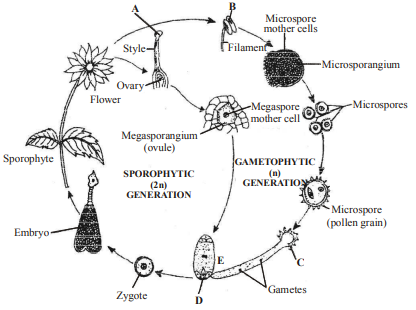
Correct Answer: (a)
In an angiosperm life cycle: A is Stigma, B is Anther, C is Male gametophyte (pollen tube), D is Egg cell, and E is Female gametophyte (embryo sac).
In an angiosperm life cycle: A is Stigma, B is Anther, C is Male gametophyte (pollen tube), D is Egg cell, and E is Female gametophyte (embryo sac).
Q86. An example of colonial alga is
Correct Answer: (a)
Volvox forms large spherical colonies.
Volvox forms large spherical colonies.
Q87. Which one is wrongly matched?
Correct Answer: (a)
Polysiphonia (red algae) has non-motile gametes (no flagella).
Polysiphonia (red algae) has non-motile gametes (no flagella).
Q88. Identify the plants (A, B, C and D) and choose their correct names from the options given below.
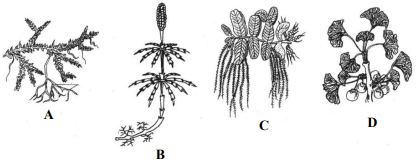
| S. No. | A | B | C | D |
|---|---|---|---|---|
| (a) | Equisetum | Ginkgo | Selaginella | Lycopodium |
| (b) | Selaginella | Equisetum | Salvinia | Ginkgo |
| (c) | Funaria | Adiantum | Salvinia | Riccia |
| (d) | Chara | Marchantia | Fucus | Pinus |
Correct Answer: (b)
A is Selaginella, B is Equisetum, C is Salvinia, and D is Ginkgo.
A is Selaginella, B is Equisetum, C is Salvinia, and D is Ginkgo.
Q89. Place the following groups of plants in order, beginning with those that first appeared on the earth and progressing toward those that appeared most recently in time.
Correct Answer: (b)
The evolutionary sequence is Algae (Thallophyta) → Mosses (Bryophyta) → Ferns (Pteridophyta) → Gymnosperms → Angiosperms.
The evolutionary sequence is Algae (Thallophyta) → Mosses (Bryophyta) → Ferns (Pteridophyta) → Gymnosperms → Angiosperms.
Q90. Which of the following statement(s) is/are correct about angiosperms?
(i) In angiosperms or flowering plants, the pollen grains and ovules are developed in specialised structure called flowers.
(ii) They are divided into two classes : the dicotyledons and the monocotyledons.
(iii) The male sex organ in a flower is the pistil or the carpel.
(iv) The female sex organ is the stamen.
(i) In angiosperms or flowering plants, the pollen grains and ovules are developed in specialised structure called flowers.
(ii) They are divided into two classes : the dicotyledons and the monocotyledons.
(iii) The male sex organ in a flower is the pistil or the carpel.
(iv) The female sex organ is the stamen.
Correct Answer: (b)
Statements (i) and (ii) are correct. (iii) and (iv) are swapped; stamen is male, pistil/carpel is female.
Statements (i) and (ii) are correct. (iii) and (iv) are swapped; stamen is male, pistil/carpel is female.
Q91. Which of the following statement(s) is/are correct?
(a) In angiosperms, each embryo sac has a three-celled egg apparatus – one egg cell and two synergids, three antipodal cells and two polar nuclei.
(b) All seed – bearing plants i.e., gymnosperms and angiosperms follow dipontic life patterns of plants.
(c) In gymosperms, roots in some genera have fungal association in the form of mycorrhiza (Pinus) while in some others (Cycas) small specialized roots called coralloid are associated with N2 – fixing cyanobacteria.
(d) All of the above
(a) In angiosperms, each embryo sac has a three-celled egg apparatus – one egg cell and two synergids, three antipodal cells and two polar nuclei.
(b) All seed – bearing plants i.e., gymnosperms and angiosperms follow dipontic life patterns of plants.
(c) In gymosperms, roots in some genera have fungal association in the form of mycorrhiza (Pinus) while in some others (Cycas) small specialized roots called coralloid are associated with N2 – fixing cyanobacteria.
(d) All of the above
Correct Answer: (d)
All listed statements are correct regarding the biology of angiosperms and gymnosperms.
All listed statements are correct regarding the biology of angiosperms and gymnosperms.
Q92. Life cycle of Ectocarpus and Fucus respectively are
Correct Answer: (b)
Ectocarpus is haplo-diplontic while Fucus is diplontic.
Ectocarpus is haplo-diplontic while Fucus is diplontic.
Q93. Read carefully the following statements about sexual fertilisation in angiosperms.
(i) Pollen tube carries the male gamete towards archegonia and discharge contents in the mouth of archegonium.
(ii) A zygote is obtained when a male gamete fuses with egg.
(iii) Zygote develops into embryo and embryo into seeds.
(iv) The seeds so obtained are naked.
Which of the statement given above are correct?
(i) Pollen tube carries the male gamete towards archegonia and discharge contents in the mouth of archegonium.
(ii) A zygote is obtained when a male gamete fuses with egg.
(iii) Zygote develops into embryo and embryo into seeds.
(iv) The seeds so obtained are naked.
Which of the statement given above are correct?
Correct Answer: (c)
Angiosperms do not have archegonia and their seeds are enclosed in fruit (not naked).
Angiosperms do not have archegonia and their seeds are enclosed in fruit (not naked).
Q94. Which of the given statement can be assigned to the gametophytic phase in the alternation of generation life cycle?
Correct Answer: (a)
The gametophyte is the haploid phase that produces gametes by mitosis.
The gametophyte is the haploid phase that produces gametes by mitosis.
Q95. Match the column-I with column-II and choose the correct option.
| Column-I (System of classification) | Column-II (Characteristics) |
|---|---|
| A. Artificial system of classification | I. Based on few morphological characters |
| B. Natural system of classification | II. Based on evolutionary relationships between the various organisms |
| C. Phylogenetic system of classification | III. Based on natural affinities among the organisms and consider external as well as internal features. |
Correct Answer: (b)
Artificial: basic morphology; Natural: natural affinities (Bentham & Hooker); Phylogenetic: evolution (Engler & Prantl).
Artificial: basic morphology; Natural: natural affinities (Bentham & Hooker); Phylogenetic: evolution (Engler & Prantl).
Q96. In bryophytes, male and female sex organs are called ______ and ______ respectively.
Correct Answer: (c)
Bryophyte male sex organs are antheridia and female sex organs are archegonia.
Bryophyte male sex organs are antheridia and female sex organs are archegonia.
Q97. Identify the diagrams.
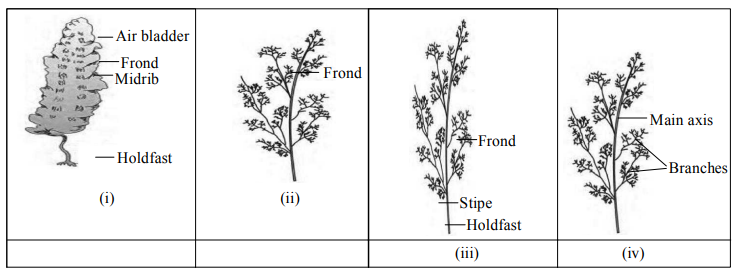
Correct Answer: (c)
Morphological identification: (i) is Fucus, (ii) is Porphyra, (iii) is Laminaria, and (iv) is Polysiphonia.
Morphological identification: (i) is Fucus, (ii) is Porphyra, (iii) is Laminaria, and (iv) is Polysiphonia.
Q98. Regarding general characteristics of plants, which statement is correct.
A. Some of these may be partially heterotrophic as in case of insectivorous plants like Venus fly trap.
B. They have distinct nucleus, chloroplast and chitinous cell wall.
A. Some of these may be partially heterotrophic as in case of insectivorous plants like Venus fly trap.
B. They have distinct nucleus, chloroplast and chitinous cell wall.
Correct Answer: (a)
Plant cell walls are primarily cellulosic, not chitinous (which is characteristic of fungi).
Plant cell walls are primarily cellulosic, not chitinous (which is characteristic of fungi).
Q99. The given figures represent the examples of bryophytes. In them few structures/parts are marked as A, B, C and D. Identify the option which shows the correct labelling of A, B, C and D.
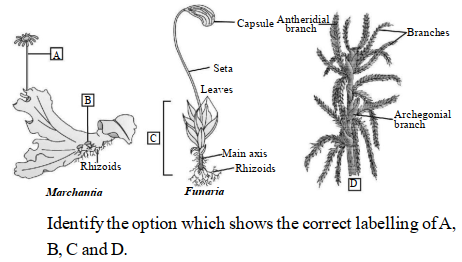
| S. No. | A | B | C | D |
|---|---|---|---|---|
| (a) | Gemma cup | Archegoniophore | Sporophyte | Sphagnum |
| (b) | Archegoniophore | Gemma cup | Gametophyte | Sphagnum |
| (c) | Archegonia | Antheridia | Gemma cup | Sphagnum |
| (d) | Antheridia | Archegonia | Gemma cup | Sphagnum |
Correct Answer: (b)
In Marchantia (left): A is Archegoniophore, B is Gemma cup. In Funaria (middle): C is the Gametophyte stage. D is the plant Sphagnum.
In Marchantia (left): A is Archegoniophore, B is Gemma cup. In Funaria (middle): C is the Gametophyte stage. D is the plant Sphagnum.
Q100. The embryo sac of an angiosperm is made up of
Correct Answer: (b)
A typical mature angiosperm embryo sac is 7-celled but contains 8 nuclei (the central cell has two polar nuclei).
A typical mature angiosperm embryo sac is 7-celled but contains 8 nuclei (the central cell has two polar nuclei).
Q101. What is the similarity between gymnosperms and angiosperms?
Correct Answer: (d)
Both are vascular plants (tracheophytes) with a diploid sporophyte body differentiated into true roots, stems, and leaves.
Both are vascular plants (tracheophytes) with a diploid sporophyte body differentiated into true roots, stems, and leaves.
Q102. In angiosperms, a mature male gametophyte is derived from a pollen mother cell by
Correct Answer: (b)
A pollen mother cell (2n) undergoes meiosis to produce 4 microspores (n). Each microspore then undergoes mitosis to form a generative cell and vegetative cell (pollen grain).
A pollen mother cell (2n) undergoes meiosis to produce 4 microspores (n). Each microspore then undergoes mitosis to form a generative cell and vegetative cell (pollen grain).
Q103. If there are 4 cells in an anther, what will be the number of pollen grains?
Correct Answer: (c)
Each pollen mother cell undergoes one meiosis to produce 4 pollen grains. So, 4 cells × 4 = 16 pollen grains.
Each pollen mother cell undergoes one meiosis to produce 4 pollen grains. So, 4 cells × 4 = 16 pollen grains.
Q104. You are given an unknown plant to study in the laboratory. You find that it has chlorophyll, no xylem. Its multicellullar sex organs are enclosed in a layer of jacket cells. Its gametophyte stage is free living. The plant probably belongs to
Correct Answer: (b)
The lack of xylem (vascular tissue) and presence of jacketed sex organs with a dominant free-living gametophyte are hallmark features of bryophytes.
The lack of xylem (vascular tissue) and presence of jacketed sex organs with a dominant free-living gametophyte are hallmark features of bryophytes.
Q105. Which of the following statement is incorrect?
Correct Answer: (a)
Double fertilization is a unique characteristic of Angiosperms only, not gymnosperms.
Double fertilization is a unique characteristic of Angiosperms only, not gymnosperms.
Q106. Zygotic meiosis is characteristic of
Correct Answer: (c)
In haplontic organisms like Chlamydomonas, the only diploid stage is the zygote, which undergoes meiosis immediately.
In haplontic organisms like Chlamydomonas, the only diploid stage is the zygote, which undergoes meiosis immediately.
Q107. The given figures (A, B, C, D) represent different algae. Identify the correct option for the given diagrams.
| S. No. | A | B | C | D |
|---|---|---|---|---|
| (a) | Porphyra | Fucus | Dictyota | Polysiphonia |
| (b) | Polysiphonia | Porphyra | Dictyota | Fucus |
| (c) | Fucus | Dictyota | Porphyra | Polysiphonia |
| (d) | Porphyra | Polysiphonia | Fucus | Dictyota |
Correct Answer: (a)
Based on morphological features in standard texts: A is Porphyra (Red), B is Fucus (Brown), C is Dictyota (Brown), and D is Polysiphonia (Red).
Based on morphological features in standard texts: A is Porphyra (Red), B is Fucus (Brown), C is Dictyota (Brown), and D is Polysiphonia (Red).
Q108. The giant redwood tree (Sequoia sempervirens) is a/an
Correct Answer: (d)
Sequoia is one of the tallest and most famous gymnosperms.
Sequoia is one of the tallest and most famous gymnosperms.
Q109. Ulothrix can be described as a
Correct Answer: (d)
Ulothrix is a filamentous green alga that produces flagellated zoospores for asexual reproduction and flagellated gametes for sexual reproduction.
Ulothrix is a filamentous green alga that produces flagellated zoospores for asexual reproduction and flagellated gametes for sexual reproduction.
Q110. Which one of the following is wrong about Chara?
Correct Answer: (c)
In Chara, the female organ (oogonium/nucule) is situated above the male organ (antheridium/globule).
In Chara, the female organ (oogonium/nucule) is situated above the male organ (antheridium/globule).
Q111. A bryophyte suddenly started reproducing parthenogenetically. The number of chromosomes of the second generation compared to parent plant will be
Correct Answer: (a)
Parthenogenesis is a form of asexual reproduction where offspring develop from unfertilized cells, maintaining the same chromosome count as the parent.
Parthenogenesis is a form of asexual reproduction where offspring develop from unfertilized cells, maintaining the same chromosome count as the parent.
Q112. If the diploid number of a flowering plant is 36. What would be the chromosome number in its endosperm?
Correct Answer: (c)
Endosperm in angiosperms is triploid (3n). If 2n = 36, then n = 18. Thus, 3n = 3 × 18 = 54.
Endosperm in angiosperms is triploid (3n). If 2n = 36, then n = 18. Thus, 3n = 3 × 18 = 54.
Q113. Which of the following branch of science is being described by the given statements ?
(i) It can easily done by using computers based on all observable characters.
(ii) Numbers and codes are assigned to all the characters and the data are then processed.
(iii) Each character is given equal weightage and at the same time hundred of characters can be considered.
(i) It can easily done by using computers based on all observable characters.
(ii) Numbers and codes are assigned to all the characters and the data are then processed.
(iii) Each character is given equal weightage and at the same time hundred of characters can be considered.
Correct Answer: (b)
These statements describe Numerical Taxonomy (Adansonian taxonomy), which uses mathematical methods and computers to analyze data.
These statements describe Numerical Taxonomy (Adansonian taxonomy), which uses mathematical methods and computers to analyze data.
Q114. Holdfast, stipe and frond constitutes the plant body in case of
Correct Answer: (c)
The plant body of brown algae (Phaeophyceae) is typically differentiated into a holdfast, stipe, and frond.
The plant body of brown algae (Phaeophyceae) is typically differentiated into a holdfast, stipe, and frond.
Q115. A student was given a sample to observe under the microscope. He observed and found that the sample is the most common type of spore involved in asexual reproduction in algae. Identify the spore.
Correct Answer: (a)
Zoospores are the most common asexual spores in algae; they are typically flagellated and motile.
Zoospores are the most common asexual spores in algae; they are typically flagellated and motile.
Q116. _______ represent the reproductive organs amongst gymnosperms.
Correct Answer: (d)
Gymnosperms produce reproductive structures called strobili or cones.
Gymnosperms produce reproductive structures called strobili or cones.
Q117. Flagellate isogametes and anisogametes are found in
Correct Answer: (d)
In Chlamydomonas, gametes can be flagellated isogametes or anisogametes. Spirogyra has non-flagellated gametes.
In Chlamydomonas, gametes can be flagellated isogametes or anisogametes. Spirogyra has non-flagellated gametes.
Q118. Bryophytes resemble algae in the following aspects
Correct Answer: (d)
Both algae and bryophytes have thalloid bodies (not differentiated into true roots/stems), lack vascular tissues, and are autotrophic.
Both algae and bryophytes have thalloid bodies (not differentiated into true roots/stems), lack vascular tissues, and are autotrophic.
Q119. Which of the following statements with respect to algae are correct.
(i) Fusion between one large, non-motile female gamete and a smaller, motile male gamete is termed as oogamous.
(ii) Fusion of two gametes dissimilar in size is termed as oogamous.
(iii) Fusion of two gametes similar in size is called anisogamous.
(iv) In chlorophyceae, the major pigments are chlorophyll a and b, and the food is stored as starch.
(v) In rhodophyceae, the major pigments are chlorophyll a and d, and the food is stored as mannitol.
(i) Fusion between one large, non-motile female gamete and a smaller, motile male gamete is termed as oogamous.
(ii) Fusion of two gametes dissimilar in size is termed as oogamous.
(iii) Fusion of two gametes similar in size is called anisogamous.
(iv) In chlorophyceae, the major pigments are chlorophyll a and b, and the food is stored as starch.
(v) In rhodophyceae, the major pigments are chlorophyll a and d, and the food is stored as mannitol.
Correct Answer: (d)
Statement (i) correctly defines oogamy. Statement (iv) correctly describes the pigments and storage of green algae. (v) is wrong as red algae store Floridean starch.
Statement (i) correctly defines oogamy. Statement (iv) correctly describes the pigments and storage of green algae. (v) is wrong as red algae store Floridean starch.
Q120. Cycas and Adiantum resemble each other in having
Correct Answer: (b)
Both Cycas (gymnosperm) and Adiantum (pteridophyte) possess motile flagellated male gametes.
Both Cycas (gymnosperm) and Adiantum (pteridophyte) possess motile flagellated male gametes.
Q121. Match column-I with column-II and choose the correct option.
| Column-I | Column-II |
|---|---|
| A. Phaeophyceae | I. Have an elaborate mechanism of spore dispersal |
| B. Rhodophyceae | II. first terrestrial plant with vascular tissue-phloem and xylem |
| C. Mosses | III. Asexual reproduction by biflagellate zoosposes |
| D. Pteridophytes | IV. Polysiphonia, Porphyra, Gracilaria |
Correct Answer: (a)
Phaeophyceae: zoospores (III); Rhodophyceae: red algae examples (IV); Mosses: spore dispersal (I); Pteridophytes: first vascular (II).
Phaeophyceae: zoospores (III); Rhodophyceae: red algae examples (IV); Mosses: spore dispersal (I); Pteridophytes: first vascular (II).
Q122. What is the number and position of insertions of flagella in rhodopyceae class of algae ?
Correct Answer: (d)
Members of Rhodophyceae (red algae) lack any flagellated stages in their life cycle; both spores and gametes are non-motile.
Members of Rhodophyceae (red algae) lack any flagellated stages in their life cycle; both spores and gametes are non-motile.
Q123. Match the column I with column II and choose the option which shows its correct combination.
| Column-I (Pattern of life cycle in plant) | Column-II (Examples) |
|---|---|
| A. Haplontic life cycle | I. Bryophytes, Pteridophytes, Ectocarpus, Polysiphonia, Kelps |
| B. Diplontic life cycle | II. Seed bearing plants (Gymnosperm and Angiosperm), Fucus |
| C. Haplo-diplontic life cycle | III. Many algae (Volvox, Spirogyra) and some species of Chlamydomonas |
Correct Answer: (a)
A-III (Haplontic in Volvox/Spirogyra); B-II (Diplontic in seed plants and Fucus); C-I (Haplo-diplontic in Bryo/Pterido and certain algae).
A-III (Haplontic in Volvox/Spirogyra); B-II (Diplontic in seed plants and Fucus); C-I (Haplo-diplontic in Bryo/Pterido and certain algae).
Q124. Which of the following statements is correct?
Correct Answer: (a)
Gymnosperms have naked seeds because ovules aren't enclosed. Salvinia is heterosporous. Cedrus is branched. Horsetails are pteridophytes.
Gymnosperms have naked seeds because ovules aren't enclosed. Salvinia is heterosporous. Cedrus is branched. Horsetails are pteridophytes.
Q125. Which one of the following options correctly represents the type of life cycle patterns?
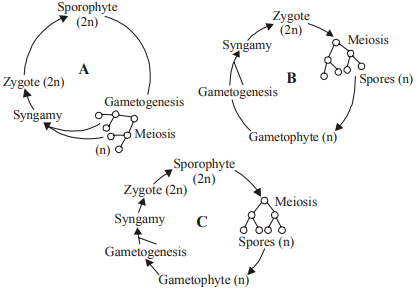
Correct Answer: (d)
Pattern A is Diplontic (dominant 2n), B is Haplontic (dominant n), and C is Haplo-diplontic (both n and 2n multicellular).
Pattern A is Diplontic (dominant 2n), B is Haplontic (dominant n), and C is Haplo-diplontic (both n and 2n multicellular).
Q126. Consider the following statements regarding gymnosperms and choose the correct option.
(i) In gymnosperms, the male and female gametophytes have an independent existence.
(ii) The multicellular female gametophyte is retained within the megasporangium.
(iii) The gymnosperms are heterosporous.
Of these statements
(i) In gymnosperms, the male and female gametophytes have an independent existence.
(ii) The multicellular female gametophyte is retained within the megasporangium.
(iii) The gymnosperms are heterosporous.
Of these statements
Correct Answer: (d)
In gymnosperms, gametophytes are not free-living; they remain within the sporangia on the sporophyte.
In gymnosperms, gametophytes are not free-living; they remain within the sporangia on the sporophyte.
Q127. Why rhodophyta exhibit a red colour ?
Correct Answer: (d)
Red algae contain the pigment r-phycoerythrin, which can absorb the shorter blue-green wavelengths that penetrate deepest into the water.
Red algae contain the pigment r-phycoerythrin, which can absorb the shorter blue-green wavelengths that penetrate deepest into the water.
Q128. Moss peat is used as a packing material for sending flowers and live plants to distant places because
Correct Answer: (d)
Sphagnum (peat moss) has a high water-holding capacity (hygroscopic) making it ideal for transporting live plants.
Sphagnum (peat moss) has a high water-holding capacity (hygroscopic) making it ideal for transporting live plants.
Q129. Match the column-I with column-II and select the correct answer using the codes given below.
| Column-I (Group of Plant Kindgdom) | Column-II (Examples) |
|---|---|
| A. Algae | I. Solanum tuberosum |
| B. Fungi | II. Equisetum |
| C. Angiosperm | III. Cycas |
| D. Pteridophyte | IV. Chlamydomonas |
| E. Gymnosperm | V. Rhizopus |
Correct Answer: (b)
A-IV (Chlamydomonas); B-V (Rhizopus); C-I (Solanum); D-II (Equisetum); E-III (Cycas).
A-IV (Chlamydomonas); B-V (Rhizopus); C-I (Solanum); D-II (Equisetum); E-III (Cycas).
Q130. Read the following statements and answer the question.
(i) Sporophytic generation is represented only by the one-celled zygote.
(ii) Meiosis in the zygote results in the formation of haploid spores.
(iii) The dominant, photosynthetic phase in such plants is free-living gametophyte.
(iv) Many algae such as Volvox, Spirogyra and some species of Chlamydomonas represent this pattern.
Which of the following pattern of life cycle of plant is described by the above statements?
(i) Sporophytic generation is represented only by the one-celled zygote.
(ii) Meiosis in the zygote results in the formation of haploid spores.
(iii) The dominant, photosynthetic phase in such plants is free-living gametophyte.
(iv) Many algae such as Volvox, Spirogyra and some species of Chlamydomonas represent this pattern.
Which of the following pattern of life cycle of plant is described by the above statements?
Correct Answer: (a)
These statements define the Haplontic life cycle, where the zygote is the only diploid stage.
These statements define the Haplontic life cycle, where the zygote is the only diploid stage.
Q131. Plants of this group are diploid and well adapted to extreme conditions. They grow bearing sporophylls in compact structures called cones. The group in reference is
Correct Answer: (d)
Gymnosperms are diploid sporophytes with needle-like leaves (adaptations) and produce seeds in cones.
Gymnosperms are diploid sporophytes with needle-like leaves (adaptations) and produce seeds in cones.
Q132. Which one of the following shows isogamy with non-flagellated gametes?
Correct Answer: (d)
In Spirogyra, sexual reproduction involves the fusion of two non-flagellated (non-motile) gametes that are similar in size (isogamy).
In Spirogyra, sexual reproduction involves the fusion of two non-flagellated (non-motile) gametes that are similar in size (isogamy).
Q133. Which of the following example belong to the same class of algae?
Correct Answer: (b)
Volvox, Spirogyra, and Chlamydomonas all belong to the class Chlorophyceae (green algae).
Volvox, Spirogyra, and Chlamydomonas all belong to the class Chlorophyceae (green algae).
Q134. If you are asked to classify the various algae into distinct groups then which of the following characters you should choose for the classification?
Correct Answer: (d)
The primary basis for the classification of algae into Chlorophyceae, Phaeophyceae, and Rhodophyceae is the type of pigments they contain.
The primary basis for the classification of algae into Chlorophyceae, Phaeophyceae, and Rhodophyceae is the type of pigments they contain.
Q135. Which of the following group(s) of plants show an independent existence of their gametophytes?
Correct Answer: (d)
In both bryophytes and pteridophytes, the gametophyte is free-living.
In both bryophytes and pteridophytes, the gametophyte is free-living.