Q1. Which one of the following pairs is not correctly matched?
Correct Answer: (b)
GA promotes growth and delays senescence (leaf fall); leaf fall is actually promoted by ABA and ethylene.
GA promotes growth and delays senescence (leaf fall); leaf fall is actually promoted by ABA and ethylene.
Q2. The graph given below shows a geometrical growth rate. Which of the following statement regarding the above graph is incorrect?
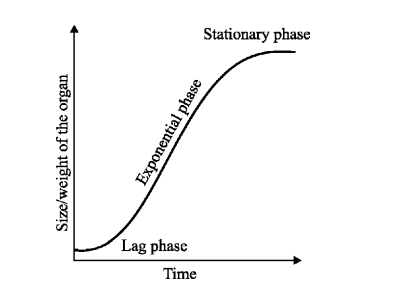
Correct Answer: (c)
The growth rate slows down (reaching stationary phase) when nutrient supply becomes limited, it doesn't increase rapidly.
The growth rate slows down (reaching stationary phase) when nutrient supply becomes limited, it doesn't increase rapidly.
Q3. ABA is antagonistic to:
Correct Answer: (a)
In many processes, particularly seed germination and bud growth, ABA and GA have opposite (antagonistic) effects.
In many processes, particularly seed germination and bud growth, ABA and GA have opposite (antagonistic) effects.
Q4. What type of plants will flower when short photoperiods are followed by long photoperiods?
Correct Answer: (b)
Short-long day plants require an initial period of short days followed by long days to initiate the flowering process.
Short-long day plants require an initial period of short days followed by long days to initiate the flowering process.
Q5. Which of the following statement regarding vernalisation is incorrect?
Correct Answer: (c)
Vernalisation is very common in biennial plants (e.g., sugar beet, cabbage, carrot), which require cold to flower in their second season.
Vernalisation is very common in biennial plants (e.g., sugar beet, cabbage, carrot), which require cold to flower in their second season.
Q6. Arithmetic growth includes all the following except:
Correct Answer: (c)
The characteristic graph of arithmetic growth is a straight line (linear), not a sigmoid curve, which is characteristic of geometric growth.
The characteristic graph of arithmetic growth is a straight line (linear), not a sigmoid curve, which is characteristic of geometric growth.
Q7. Which of the following statements on phytohormones & their action are correct?
(i) Cytokinins specially help in delaying senescence.
(ii) Auxins are involved in regulating apical dominance.
(iii) Ethylene is specially useful in enhancing seed germination.
(iv) Gibberellins are responsible for immature falling of leaves.
(i) Cytokinins specially help in delaying senescence.
(ii) Auxins are involved in regulating apical dominance.
(iii) Ethylene is specially useful in enhancing seed germination.
(iv) Gibberellins are responsible for immature falling of leaves.
Correct Answer: (c)
Statements (i) and (ii) are correct. Ethylene breaks seed dormancy (initiation) but isn't the primary 'germination enhancer'. Gibberellins prevent premature fall.
Statements (i) and (ii) are correct. Ethylene breaks seed dormancy (initiation) but isn't the primary 'germination enhancer'. Gibberellins prevent premature fall.
Q8. Auxin herbicide is
Correct Answer: (c)
2, 4-D (2, 4-dichlorophenoxyacetic acid) is a synthetic auxin widely used as a selective herbicide to kill dicotyledonous weeds.
2, 4-D (2, 4-dichlorophenoxyacetic acid) is a synthetic auxin widely used as a selective herbicide to kill dicotyledonous weeds.
Q9. Refer the following statements.
(i) Promotes flowering in pineapple.
(ii) Used to prepare weed free lawn.
(iii) Promotes the abscission of older mature leaves and fruits.
The above functions are carried out by
(i) Promotes flowering in pineapple.
(ii) Used to prepare weed free lawn.
(iii) Promotes the abscission of older mature leaves and fruits.
The above functions are carried out by
Correct Answer: (d)
All these are well-known commercial and physiological roles of auxins (like 2,4-D and NAA).
All these are well-known commercial and physiological roles of auxins (like 2,4-D and NAA).
Q10. Match Column-I (Discovery) and Column-II (Scientists) and select the correct option.
| Column-I (Discovery) | Column-II (Name of scientists) |
|---|---|
| A. Foolish seedling disease of rice | I. Cousins |
| B. Crystallized the Kinetic | II. F.W. Went |
| C. Release of ethylene gas | III. Skoog and Miller |
| D. Bioassay of Auxin | IV. E. Kurosawa |
Correct Answer: (c)
Kurosawa discovered GA in foolish rice. Skoog/Miller found kinetin. Cousins found ethylene in oranges. Went did the Avena test for auxin.
Kurosawa discovered GA in foolish rice. Skoog/Miller found kinetin. Cousins found ethylene in oranges. Went did the Avena test for auxin.
Q11. Which one of the following is not a mechanical method for breaking seed dormancy?
Correct Answer: (d)
While microbial action can break down seed coats, it is a biological/chemical process, not a 'mechanical' one like scarification with tools.
While microbial action can break down seed coats, it is a biological/chemical process, not a 'mechanical' one like scarification with tools.
Q12. Gibberellin was first extracted from:
Correct Answer: (a)
Gibberellins were discovered while studying the 'bakane' (foolish seedling) disease of rice caused by the fungal pathogen Gibberella fujikuroi.
Gibberellins were discovered while studying the 'bakane' (foolish seedling) disease of rice caused by the fungal pathogen Gibberella fujikuroi.
Q13. Which of the following statement is correct regarding ethylene?
Correct Answer: (c)
Ethylene is used to break seed and bud dormancy and initiate germination in peanut seeds and sprouting of potato tubers.
Ethylene is used to break seed and bud dormancy and initiate germination in peanut seeds and sprouting of potato tubers.
Q14. One set (I) of a plant was grown at 12 hours a day and 12 hours night period cycles and it flowered while in the other set (II) night phase was interrupted by flash of light and it did not produce flower. Under which one of the following categories will you place this plant (Set II)?
Correct Answer: (d)
Short-day plants (SDPs) actually require a continuous, uninterrupted long night. A flash of light during the night disrupts this and prevents flowering.
Short-day plants (SDPs) actually require a continuous, uninterrupted long night. A flash of light during the night disrupts this and prevents flowering.
Q15. Absolute growth rate is defined as the:
Correct Answer: (b)
Absolute growth rate is the actual increase in growth of a parameter (like size, weight, or area) per unit of time, regardless of the initial size.
Absolute growth rate is the actual increase in growth of a parameter (like size, weight, or area) per unit of time, regardless of the initial size.
Q16. Match the Column-I and Column-II.
| Column-I | Column-II |
|---|---|
| A. Auxin | I. Adenine derivatives |
| B. Gibberellin | II. Carotenoid derivatives |
| C. Cytokinin | III. Terpnes |
| D. ABA | IV. Indole compounds |
Correct Answer: (d)
Auxin = Indole. GA = Terpenes. Cytokinin = Adenine. ABA = Carotenoid derivatives.
Auxin = Indole. GA = Terpenes. Cytokinin = Adenine. ABA = Carotenoid derivatives.
Q17. It takes very long time for pineapple plants to produce flowers. Which combination of hormones can be applied to artificially induce flowering in pineapple plants throughout the year to increase yield?
Correct Answer: (a)
Both auxins (like NAA) and ethylene (like Ethephon) are highly effective in inducing synchronous flowering in pineapple.
Both auxins (like NAA) and ethylene (like Ethephon) are highly effective in inducing synchronous flowering in pineapple.
Q18. Which one of the following is chemically identical to ABA?
Correct Answer: (c)
Abscisic acid (ABA) was independently discovered as inhibitor-B, abscisin II, and dormin; they were later found to be chemically the same.
Abscisic acid (ABA) was independently discovered as inhibitor-B, abscisin II, and dormin; they were later found to be chemically the same.
Q19. Bananas can be prevented from over ripening by:
Correct Answer: (c)
Antioxidants like ascorbic acid can sometimes be used to slow down the oxidative processes associated with ripening and browning. (Wait, check Key: 71(c)).
Antioxidants like ascorbic acid can sometimes be used to slow down the oxidative processes associated with ripening and browning. (Wait, check Key: 71(c)).
Q20. Which of the following represents the correct sequence of the development process in a plant cell?
Correct Answer: (d)
The developmental sequence for a plant cell starts with division, followed by differentiation/elongation, then maturation, and finally senescence leading to death.
The developmental sequence for a plant cell starts with division, followed by differentiation/elongation, then maturation, and finally senescence leading to death.
Q21. Senescence in plants can be promoted by applying:
Correct Answer: (d)
Ethylene is the primary hormone associated with aging (senescence) and the falling of leaves and fruits (abscission).
Ethylene is the primary hormone associated with aging (senescence) and the falling of leaves and fruits (abscission).
Q22. 6-furfuryl amino purine, 2, 4-dichlorophenoxy acetic acid and indole-3 acetic acid are examples respectively for
Correct Answer: (d)
6-furfuryl amino purine is Kinetin (a cytokinin), 2, 4-D is a synthetic auxin, and IAA is the primary natural auxin.
6-furfuryl amino purine is Kinetin (a cytokinin), 2, 4-D is a synthetic auxin, and IAA is the primary natural auxin.
Q23. Skoog and Miller stimulated cell division in tobacco plant with degraded DNA. The active ingredient in stimulants, which resembles cytokinins, was modified
Correct Answer: (a)
Kinetin, the first cytokinin discovered, is an adenine derivative (6-furfurylaminopurine).
Kinetin, the first cytokinin discovered, is an adenine derivative (6-furfurylaminopurine).
Q24. Hormone responsible for bolting is:
Correct Answer: (d)
Bolting, the rapid elongation of the internodes just prior to flowering in rosette plants (like cabbage), is induced by gibberellins (GA).
Bolting, the rapid elongation of the internodes just prior to flowering in rosette plants (like cabbage), is induced by gibberellins (GA).
Q25. Which one of the following phytohormones is produced under water deficient condition and plays an important role in the tolerance response of plants to drought?
Correct Answer: (a)
Under drought stress, ABA synthesis increases in leaves, leading to stomatal closure and preventing excessive transpiration.
Under drought stress, ABA synthesis increases in leaves, leading to stomatal closure and preventing excessive transpiration.
Q26. Coconut water contains:
Correct Answer: (c)
Coconut water is a rich source of natural cytokinins (like zeatin), which promote rapid cell division.
Coconut water is a rich source of natural cytokinins (like zeatin), which promote rapid cell division.
Q27. The following diagram shows four coleoptiles set up (I, II, III & IV) at the start of an experiment. Which two coleoptiles will both bend towards the light source?
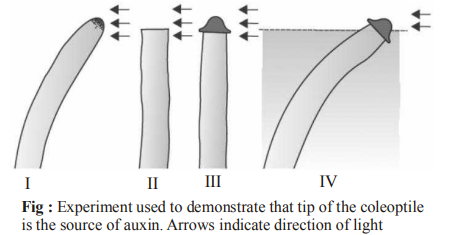
Correct Answer: (d)
Coleoptile III has an intact tip. IV has a tip separated by permeable agar, allowing auxin to diffuse. Both will sense light and bend.
Coleoptile III has an intact tip. IV has a tip separated by permeable agar, allowing auxin to diffuse. Both will sense light and bend.
Q28. Farmers in a particular region were concerned that premature yellowing of leaves of a pulse crop might cause a decrease in the yield. Which treatment could be most beneficial to obtain maximum seed yield?
Correct Answer: (c)
Cytokinins delay senescence (yellowing) and promote nutrient uptake, which helps maintain chlorophyll levels and yield.
Cytokinins delay senescence (yellowing) and promote nutrient uptake, which helps maintain chlorophyll levels and yield.
Q29. Gaseous hormone is
Correct Answer: (a)
Ethylene is the only phytohormone that exists as a gas at physiological temperatures, primarily regulating ripening and senescence.
Ethylene is the only phytohormone that exists as a gas at physiological temperatures, primarily regulating ripening and senescence.
Q30. Which one of the following hormone is used to eradicate dicotyledonous weeds, but does not have its effect on mature monocotyledonous plants?
Correct Answer: (a)
2, 4-D is a selective herbicide that kills broad-leaved (dicot) weeds while sparing cereal crops (monocots).
2, 4-D is a selective herbicide that kills broad-leaved (dicot) weeds while sparing cereal crops (monocots).
Q31. The exponential growth can be expressed as Wt = W0ert. What is ‘r’ in the expression ?
Correct Answer: (c)
In the geometric growth equation, '$' stands for the relative growth rate and represents the plant's efficiency in producing new material.
In the geometric growth equation, '$' stands for the relative growth rate and represents the plant's efficiency in producing new material.
Q32. Which one of the following statement regarding auxin is correct?
Correct Answer: (a)
IAA (Indole-3-acetic acid) and IBA (Indole butyric acid) occur naturally in plants, while NAA and 2, 4-D are man-made synthetic versions.
IAA (Indole-3-acetic acid) and IBA (Indole butyric acid) occur naturally in plants, while NAA and 2, 4-D are man-made synthetic versions.
Q33. Typical growth curve in plants is
Correct Answer: (d)
In a natural environment with limited resources, most plant organs and whole plants show an S-shaped or sigmoid growth curve.
In a natural environment with limited resources, most plant organs and whole plants show an S-shaped or sigmoid growth curve.
Q34. Climacteric in the plants means:
Correct Answer: (a)
The respiratory climacteric is a significant increase in respiration that immediately precedes fruit ripening, triggered by ethylene.
The respiratory climacteric is a significant increase in respiration that immediately precedes fruit ripening, triggered by ethylene.
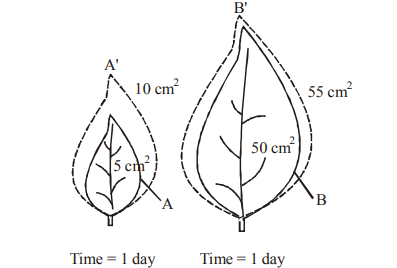
Q35. The given figure shows the comparison of growth rate of two leaves (A and B) over the period of one day. Both the leaves A and B have increased their area in a given time to produce A’ and B’ leaves respectively. If AGR = absolute growth rate and RGR = relative growth rate, then select the correct option.
| A-Leaf | B-Leaf | |||
|---|---|---|---|---|
| AGR | RGR | AGR | RGR | |
| (a) | 1% | 1 | 2% | 2 |
| (b) | 100% | 5 | 10% | 5 |
| (c) | 5 | 100% | 5 | 10% |
| (d) | 0.5 | 100% | 1.5 | 100% |
Correct Answer: (c)
Both leaves grew 5 cm$^2$ (AGR is 5). For A, RGR = (5/5)100 = 100%. For B, RGR = (5/50)100 = 10%.
Both leaves grew 5 cm$^2$ (AGR is 5). For A, RGR = (5/5)100 = 100%. For B, RGR = (5/50)100 = 10%.
Q36. A sigmoidal curve is obtained in geometrical growth because:
Correct Answer: (a)
Geometric growth typically follows an S-shaped (sigmoid) curve consisting of a slow lag phase, a rapid exponential (log) phase, and a declining stationary phase due to limited resources.
Geometric growth typically follows an S-shaped (sigmoid) curve consisting of a slow lag phase, a rapid exponential (log) phase, and a declining stationary phase due to limited resources.
Q37. Which of the following statements is incorrect regarding gibberellins?
Correct Answer: (c)
Statement (c) refers to ethylene, which promotes internode/petiole elongation in deep water rice to keep the foliage above water level.
Statement (c) refers to ethylene, which promotes internode/petiole elongation in deep water rice to keep the foliage above water level.
Q38. Auxin regulates cell growth by which of the following mechanisms?
Correct Answer: (b)
The 'Acid Growth Hypothesis' suggests auxins increase cell wall plasticity (extensibility) by triggering the pumping of H$^+$ ions into the wall.
The 'Acid Growth Hypothesis' suggests auxins increase cell wall plasticity (extensibility) by triggering the pumping of H$^+$ ions into the wall.
Q39. Photoperiodism is
Correct Answer: (b)
Photoperiodism is the physiological response of plants to the relative lengths of daylight and darkness.
Photoperiodism is the physiological response of plants to the relative lengths of daylight and darkness.
Q40. A young dicot seedling (e.g. soyabean) is laid horizontally on a surface and is subjected to gravity stimulus. Which out of the following is the possible reason for its movement?
Correct Answer: (a)
Gravity causes auxin to accumulate on the lower side. In shoots, high auxin stimulates growth (bending up); in roots, high auxin inhibits growth (bending down).
Gravity causes auxin to accumulate on the lower side. In shoots, high auxin stimulates growth (bending up); in roots, high auxin inhibits growth (bending down).
Q41. Which pigment involves in photoperiodic change in plants?
Correct Answer: (a)
Phytochrome is a blue-green photoreceptor protein that senses the quality and duration of light, mediating photoperiodic responses.
Phytochrome is a blue-green photoreceptor protein that senses the quality and duration of light, mediating photoperiodic responses.
Q42. The fruits can be left on the tree longer so as to extend the market period. This is due to which function of GA?
Correct Answer: (b)
Gibberellins extend the life of fruits on the plant by slowing down the aging/ripening processes.
Gibberellins extend the life of fruits on the plant by slowing down the aging/ripening processes.
Q43. Match the growth regulators given in column I with their action given in column II and choose the correct combination from the options given below.
| Column-I (Growth Regulator) | Column-II (Action) |
|---|---|
| A. Abscisic acid | I. Delays leaf senescence |
| B. Ethylene | II. Inhibits seed germination |
| C. Cytokinin | III. Herbicide |
| D. Auxin | IV. Hastens fruit ripening |
Correct Answer: (a)
ABA inhibits germination. Ethylene ripens fruit. Cytokinin delays senescence. Synthetic auxins like 2,4-D are herbicides.
ABA inhibits germination. Ethylene ripens fruit. Cytokinin delays senescence. Synthetic auxins like 2,4-D are herbicides.
Q44. Leaf abscission, fruit fall, bud dormancy occurs by which of the following phytohormone?
Correct Answer: (d)
Abscisic acid (ABA) acts as a general plant growth inhibitor, inducing seed and bud dormancy and promoting leaf abscission.
Abscisic acid (ABA) acts as a general plant growth inhibitor, inducing seed and bud dormancy and promoting leaf abscission.
Q45. Which of the following statement is not the characteristic of growth of an organism?
Correct Answer: (d)
Growth is defined as an irreversible, permanent increase in size, accompanied by metabolism, and is intrinsic to the organism. All options correctly describe growth.
Growth is defined as an irreversible, permanent increase in size, accompanied by metabolism, and is intrinsic to the organism. All options correctly describe growth.
Q46. Match the plant hormones given in column I with their function/other name given in column II and choose the correct combination.
| Column-I (Plant hormone) | Column-II (Function/other name) |
|---|---|
| A. Zeatin | I. Flowering hormone |
| B. Florigen | II. Synthetic auxin |
| C. IBA | III. Cytokinin |
| D. NAA | IV. Natural auxin |
Correct Answer: (d)
Zeatin is a cytokinin. Florigen is the hypothetical flowering hormone. IBA is a natural auxin. NAA is a synthetic auxin.
Zeatin is a cytokinin. Florigen is the hypothetical flowering hormone. IBA is a natural auxin. NAA is a synthetic auxin.
Q47. Which of the following synthetic phytohormone was discovered as a breakdown product of DNA?
Correct Answer: (a)
Kinetin (a modified adenine) was first isolated from autoclaved herring sperm DNA; it does not occur naturally in plants.
Kinetin (a modified adenine) was first isolated from autoclaved herring sperm DNA; it does not occur naturally in plants.
Q48. De-differentiation is:
Correct Answer: (a)
De-differentiation is the phenomenon where permanent, differentiated cells (like parenchyma) regain the capacity to divide under specific conditions.
De-differentiation is the phenomenon where permanent, differentiated cells (like parenchyma) regain the capacity to divide under specific conditions.
Q49. Identify the correct and incorrect statements from the following. (i) 17,500 new cells are produced per hour by a single maize root apical meristem. (ii) With the help of length, growth of pollen tube is measured. (iii) The growth of the leaf is measured in term of volume. (iv) Cells in a watermelon may increase in size by upto 3,500,000 times.
Correct Answer: (b)
Statement (iii) is wrong because leaf growth is typically measured in terms of surface area, not volume. The others are standard quantitative examples from NCERT.
Statement (iii) is wrong because leaf growth is typically measured in terms of surface area, not volume. The others are standard quantitative examples from NCERT.
Q50. Which one of the following promotes the abscission of older mature leaves and fruits?
Correct Answer: (a)
While auxins prevent abscission of young parts, they promote the abscission of older, mature leaves and fruits. (Wait, checking Key: 50(a). Indole compounds = Auxins).
While auxins prevent abscission of young parts, they promote the abscission of older, mature leaves and fruits. (Wait, checking Key: 50(a). Indole compounds = Auxins).
Q51. Ethylene is used for
Correct Answer: (b)
Ethylene is the primary hormone responsible for inducing fruit ripening in climacteric fruits like tomatoes and apples.
Ethylene is the primary hormone responsible for inducing fruit ripening in climacteric fruits like tomatoes and apples.
Q52. Which of the following points is shown by cell at the root or shoot apex?
Correct Answer: (d)
Meristematic cells at apices are characterized by dense protoplasm, large nuclei, primary thin cellulosic walls, and numerous plasmodesmatal connections.
Meristematic cells at apices are characterized by dense protoplasm, large nuclei, primary thin cellulosic walls, and numerous plasmodesmatal connections.
Q53. Highest concentration of cytokinin is found in:
Correct Answer: (a)
Natural cytokinins are synthesized in regions where rapid cell division occurs, such as root apices, developing shoot buds, and young fruits.
Natural cytokinins are synthesized in regions where rapid cell division occurs, such as root apices, developing shoot buds, and young fruits.
Q54. In which of the following process, the cell loose their protoplasm to form tracheary element?
Correct Answer: (c)
Differentiation is the process by which cells from the meristem undergo structural and functional changes. For example, to form tracheary elements, cells lose their protoplasm and develop strong lignocellulosic walls.
Differentiation is the process by which cells from the meristem undergo structural and functional changes. For example, to form tracheary elements, cells lose their protoplasm and develop strong lignocellulosic walls.
Q55. Which of the following shows the correct graph of arithmetic growth?
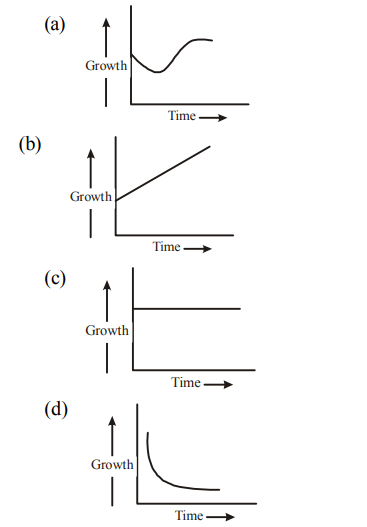
Correct Answer: (a)
Arithmetic growth produces a straight line (linear) when growth is plotted against time.
Arithmetic growth produces a straight line (linear) when growth is plotted against time.
Q56. Identify the three types of plants (P-I, P-II and P-III) which flower on the basis of their critical photoperiod.
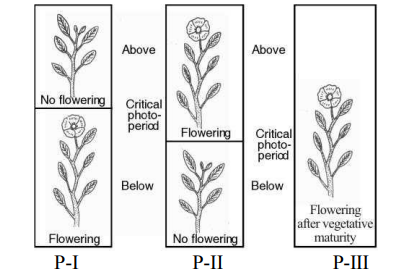
Correct Answer: (a)
P-I flowers when light is above critical (LDP). P-II flowers when light is below critical (SDP). P-III is unaffected by day length (DNP).
P-I flowers when light is above critical (LDP). P-II flowers when light is below critical (SDP). P-III is unaffected by day length (DNP).
Q57. Which of the following is not an inhibitory substance governing seed dormancy?
Correct Answer: (d)
Gibberellic acid is a growth promoter that breaks dormancy; the others are chemical inhibitors that induce it.
Gibberellic acid is a growth promoter that breaks dormancy; the others are chemical inhibitors that induce it.
Q58. Which of the following ability enables the phenomenon of heterophylly in cotton, coriander and larkspur?
Correct Answer: (d)
Plasticity is the ability of plants to follow different pathways in response to environment or life stages, resulting in different leaf forms (heterophylly).
Plasticity is the ability of plants to follow different pathways in response to environment or life stages, resulting in different leaf forms (heterophylly).
Q59. Which one of the following pairs, is not correctly matched?
Correct Answer: (b)
Gibberellic acid generally promotes growth and delays leaf fall/senescence; it does not cause it.
Gibberellic acid generally promotes growth and delays leaf fall/senescence; it does not cause it.
Q60. During differentiation of tracheary elements, cells
Correct Answer: (c)
To efficiently transport water, tracheary cells undergo programmed cell death (losing protoplasm) and reinforce their walls with lignin.
To efficiently transport water, tracheary cells undergo programmed cell death (losing protoplasm) and reinforce their walls with lignin.
Q61. Plants requiring exposure to light for less than critical period in order to flower are called ________.
Correct Answer: (d)
Short-day plants (SDPs) require a light period shorter than a specific critical duration to initiate flowering.
Short-day plants (SDPs) require a light period shorter than a specific critical duration to initiate flowering.
Q62. Match the growth regulators given in column-I with the processes given in column-II and choose the correct combination.
| Column-I (Growth regulators) | Column-II (Processes) |
|---|---|
| A. Auxin | I. Colouring test in lemon |
| B. Gibberellin | II. Cell division test in plants |
| C. Cytokinin | III. Avena curvature test |
| D. Ethylene | IV. Dwarf corn test |
Correct Answer: (a)
Avena curvature is the bioassay for auxin. Dwarf corn test is for GA. Cell division is for cytokinins. Colouring in fruit is for ethylene.
Avena curvature is the bioassay for auxin. Dwarf corn test is for GA. Cell division is for cytokinins. Colouring in fruit is for ethylene.
Q63. Which of the following statement is not correct about the conditions for plant growth?
Correct Answer: (d)
In cellular respiration, glucose is oxidized by oxygen, not water, to release energy for growth.
In cellular respiration, glucose is oxidized by oxygen, not water, to release energy for growth.
Q64. Match the plant hormones listed in column-I with their major role listed in column-II. Select the correct option from the codes given below.
| Column-I | Column-II |
|---|---|
| A. Auxin | I. Fruit ripening |
| B. Cytokinins | II. Apical dominance |
| C. Abscisic acid | III. Antagonistic to GAs |
| D. Ethylene | IV. Stomatal opening and closing |
| V. Growth of lateral buds |
Correct Answer: (c)
Auxin causes apical dominance. Cytokinins promote lateral bud growth. ABA is the GA antagonist. Ethylene ripens fruit.
Auxin causes apical dominance. Cytokinins promote lateral bud growth. ABA is the GA antagonist. Ethylene ripens fruit.
Q65. Seed dormancy:
Correct Answer: (a)
Seed dormancy is a temporary physiological state that prevents germination even under favorable conditions, ensuring seedlings emerge at the right time.
Seed dormancy is a temporary physiological state that prevents germination even under favorable conditions, ensuring seedlings emerge at the right time.
Q66. Which of the following hormone regulates the transition from juvenile to adult phases in conifers?
Correct Answer: (b)
Application of GAs to juvenile conifers can hasten the maturity period, leading to early seed production.
Application of GAs to juvenile conifers can hasten the maturity period, leading to early seed production.
Q67. Cytokinins and ethylene have opposite effects on
Correct Answer: (a)
Cytokinins delay leaf senescence, whereas ethylene promotes it.
Cytokinins delay leaf senescence, whereas ethylene promotes it.
Q68. Growth is accompanied by:
Correct Answer: (c)
Growth is an intrinsic property of living organisms, involving both anabolic (building up) and catabolic (breaking down) metabolic processes, which always require energy expenditure.
Growth is an intrinsic property of living organisms, involving both anabolic (building up) and catabolic (breaking down) metabolic processes, which always require energy expenditure.
Q69. The given diagram represents the germination and seedling development in beam. Identify A, B, C and D marked in the given figure.
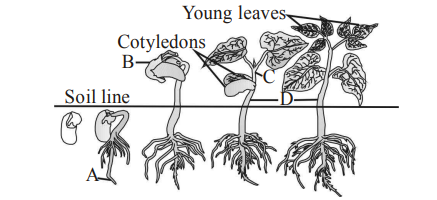
| A | B | C | D | |
|---|---|---|---|---|
| (a) | Plumule | Cotyledons | Hypocotyl | Epicotyl |
| (b) | Radicle | Seed coat | Epicotyl | Hypocotyl |
| (c) | Hypocotyl | Cotyledons | Epicotyl | Root hair |
| (d) | Root hair | Cotyledons | Plumule | Hypocotyl |
Correct Answer: (b)
A labels the first root (Radicle), B is the shed covering (Seed coat), C is the stem portion above cotyledons (Epicotyl), and D is below them (Hypocotyl).
A labels the first root (Radicle), B is the shed covering (Seed coat), C is the stem portion above cotyledons (Epicotyl), and D is below them (Hypocotyl).
Q70. Which of the following is not a function of cytokinin?
Correct Answer: (a)
Cytokinins actually help overcome apical dominance, which is promoted by auxins. They are known for promoting cell division, nutrient mobilization, and delaying senescence.
Cytokinins actually help overcome apical dominance, which is promoted by auxins. They are known for promoting cell division, nutrient mobilization, and delaying senescence.
Q71. The essential distinction between long-day and short-day plants is that flowering in long day plants is promoted only when the day length exceeds a certain duration, called the ______________.
Correct Answer: (a)
Critical day length is the specific threshold of light/dark duration that determines the flowering response in photoperiodic plants.
Critical day length is the specific threshold of light/dark duration that determines the flowering response in photoperiodic plants.
Q72. Which one of the following pairs is incorrectly matched?
Correct Answer: (c)
IAA (and IBA) are indole compounds. Gibberellins (GAs) and ABA are the hormones derived from terpenes/carotenoids.
IAA (and IBA) are indole compounds. Gibberellins (GAs) and ABA are the hormones derived from terpenes/carotenoids.
Q73. The Avena curvature is used for bioassay of
Correct Answer: (c)
The curvature of the Avena coleoptile is proportional to the concentration of the applied auxin (IAA).
The curvature of the Avena coleoptile is proportional to the concentration of the applied auxin (IAA).
Q74. A long day plant flowers only if exposed to a light period:
Correct Answer: (a)
Long-day plants (LDPs) require a photoperiod that exceeds their specific critical day length to trigger flowering.
Long-day plants (LDPs) require a photoperiod that exceeds their specific critical day length to trigger flowering.
Q75. Study the following statements and identify the correct names of hormones marked as ‘X’, ‘Y’ & ‘Z’. (i) “X” hormone promotes root growth and root hair formation. (ii) “Y” hormone induces flowering in mango and promotes rapid internode/petiole elongation in deep water rice. (iii) “Z” hormone inhibits seed germination, increase tolerance to stresses, play role in dormancy.
Correct Answer: (d)
Ethylene (X and Y) handles root hairs, mango flowering, and deep-water rice elongation. ABA (Z) handles stress and dormancy. (Wait, check Key: 108(d)).
Ethylene (X and Y) handles root hairs, mango flowering, and deep-water rice elongation. ABA (Z) handles stress and dormancy. (Wait, check Key: 108(d)).
Q76. Ethylene is not directly applied in the field as a gas due to its high diffusion rate. Which compound is used to overcome this limitation?
Correct Answer: (a)
Ethephon is an aqueous solution that is readily absorbed and slowly releases ethylene inside the plant tissues.
Ethephon is an aqueous solution that is readily absorbed and slowly releases ethylene inside the plant tissues.
Q77. Maximal size in terms of wall thickening and protoplasmic modification are achieved by:
Correct Answer: (b)
Cells in the zone of maturation undergo their final structural changes, reaching their maximum size and complexity to perform specific functions.
Cells in the zone of maturation undergo their final structural changes, reaching their maximum size and complexity to perform specific functions.
Q78. Cytokinin helps in delay of leaf senescence by:
Correct Answer: (c)
Cytokinins prevent senescence by promoting the mobilization of nutrients toward the treated parts, a phenomenon known as the Richmond-Lang effect.
Cytokinins prevent senescence by promoting the mobilization of nutrients toward the treated parts, a phenomenon known as the Richmond-Lang effect.
Q79. What causes a green plant exposed to the light on only one side, to bend toward the source of light as it grows?
Correct Answer: (c)
Phototropism is caused by the accumulation of auxin on the darker side of the stem, which stimulates cells on that side to elongate more than cells on the lighted side.
Phototropism is caused by the accumulation of auxin on the darker side of the stem, which stimulates cells on that side to elongate more than cells on the lighted side.
Q80. The hormones which was first isolated from human urine is.
Correct Answer: (a)
Auxins (specifically IAA) were the first plant hormones to be discovered and were initially isolated from human urine.
Auxins (specifically IAA) were the first plant hormones to be discovered and were initially isolated from human urine.
Q81. Pineapple can be made to flower in off season by
Correct Answer: (c)
Application of NAA (synthetic auxin) is a standard practice to induce flowering and fruit set in pineapple plantations.
Application of NAA (synthetic auxin) is a standard practice to induce flowering and fruit set in pineapple plantations.
Q82. Cytokinins are formed primarily in which area of the plant?
Correct Answer: (a)
The root apices are the primary sites of natural cytokinin synthesis in plants.
The root apices are the primary sites of natural cytokinin synthesis in plants.
Q83. Fruit and leaf drop at early stages can be prevented by the application of
Correct Answer: (b)
Auxins prevent the premature formation of the abscission layer, thus keeping young fruits and leaves on the plant.
Auxins prevent the premature formation of the abscission layer, thus keeping young fruits and leaves on the plant.
Q84. Refer the functions of the growth hormones given below: I. Cell division, II. Cell enlargement, III. Pattern formation, IV. Tropic growth, V Flowering, VI. Fruiting, VII. Seed germination, VIII.Response to wound, IX. Response to stresses of biotic and abiotic origin. Identify the functions of growth promoters and growth inhibitors from the above.
Correct Answer: (c)
Growth promoters (Auxin, GA, Cytokinin) handle division, flowering, etc. Growth inhibitors (ABA, Ethylene) handle stress responses and dormancy.
Growth promoters (Auxin, GA, Cytokinin) handle division, flowering, etc. Growth inhibitors (ABA, Ethylene) handle stress responses and dormancy.
Q85. Which of the following is not an influence of auxins?
Correct Answer: (d)
Fruit ripening is primarily regulated by ethylene, not auxins. Auxins are involved in apical dominance, tropisms, and inducing parthenocarpy.
Fruit ripening is primarily regulated by ethylene, not auxins. Auxins are involved in apical dominance, tropisms, and inducing parthenocarpy.
Q86. Flowering in pineapple is promoted by:
Correct Answer: (c)
While ethylene can also influence it, synthetic auxins like NAA are widely used to induce uniform flowering in pineapple crops.
While ethylene can also influence it, synthetic auxins like NAA are widely used to induce uniform flowering in pineapple crops.
Q87. Consider the following statements: (1) Development is the sum of two processes: Development and differentiation. (2) Growth, at a cellular level, is principally a consequence of increase in cell size. Which of the statement(s) given above is/are correct?
Correct Answer: (c)
NCERT defines development as the sum of growth and differentiation. Growth at the cellular level involves both increase in size (cell expansion) and division.
NCERT defines development as the sum of growth and differentiation. Growth at the cellular level involves both increase in size (cell expansion) and division.
Q88. Which of the following acids is a derivative of terpenes?
Correct Answer: (d)
Both Gibberellins (GAs) and Abscisic acid (ABA) are biosynthesized from terpene/carotenoid precursors. NAA is an indole/naphthalene derivative.
Both Gibberellins (GAs) and Abscisic acid (ABA) are biosynthesized from terpene/carotenoid precursors. NAA is an indole/naphthalene derivative.
Q89. Dwarfness can be controlled by treating the plant with
Correct Answer: (b)
Gibberellins promote internodal elongation and can be applied to genetically dwarf plants to induce normal height growth.
Gibberellins promote internodal elongation and can be applied to genetically dwarf plants to induce normal height growth.
Q90. Name the plant growth regulator which upon spraying on sugarcane crop, increases the length of stem, thus increasing the yield of sugarcane crop.
Correct Answer: (a)
Sugarcane stores sugar in its stem; spraying with gibberellins promotes internodal elongation, increasing the biomass and sugar yield.
Sugarcane stores sugar in its stem; spraying with gibberellins promotes internodal elongation, increasing the biomass and sugar yield.
Q91. Germination takes place when the:
Correct Answer: (a)
Seed germination marks the resumption of growth by the embryo after a period of dormancy, triggered by environmental factors like water, oxygen, and temperature.
Seed germination marks the resumption of growth by the embryo after a period of dormancy, triggered by environmental factors like water, oxygen, and temperature.
Q92. Which form of gibberellic acid is used to speed up the malting process in brewing industry?
Correct Answer: (c)
GA3 is used in the brewing industry to stimulate the production of $\alpha$-amylase in barley seeds, which speeds up the malting process.
GA3 is used in the brewing industry to stimulate the production of $\alpha$-amylase in barley seeds, which speeds up the malting process.
Q93. Which one of the following is not categorized as an extrinsic factor for plant development?
Correct Answer: (b)
Light, temperature, water, oxygen, and nutrients are extrinsic; PGRs and genetics are intrinsic factors.
Light, temperature, water, oxygen, and nutrients are extrinsic; PGRs and genetics are intrinsic factors.
Q94. The value of 2,4-D is 25 ppm. How many amount of 2,4-D should require for making its 5 litres, 15 litres and 25 litres solutions respectively?
Correct Answer: (d)
25 ppm = 25 mg/L. 5L requires $25 imes 5 = 125$ mg. 15L requires $25 imes 15 = 375$ mg. 25L requires $25 imes 25 = 625$ mg.
25 ppm = 25 mg/L. 5L requires $25 imes 5 = 125$ mg. 15L requires $25 imes 15 = 375$ mg. 25L requires $25 imes 25 = 625$ mg.
Q95. The chemicals from an unlabelled bottle of plant hormone when applied to a plant, a curvature induced by light is found in the stem. The chemical is most probably:
Correct Answer: (a)
The phototropic curvature response (bending toward light) is specifically mediated by the unequal distribution of auxin in the stem.
The phototropic curvature response (bending toward light) is specifically mediated by the unequal distribution of auxin in the stem.
Q96. Read the following statements (i-iv) regarding “ethephon” and answer the question which follows them.
(i) Ethephon is sprayed in aqueous solution and is readily absorbed and transported within the plant.
(ii) It hastens fruit ripening in tomatoes and apples.
(iii) It can be used to induce fruit thinning in cotton, cherry and walnut.
(iv) It is used to promote female sex expression in cucumber and increase yield.
How many of the above statement(s) is/ are correct?
(i) Ethephon is sprayed in aqueous solution and is readily absorbed and transported within the plant.
(ii) It hastens fruit ripening in tomatoes and apples.
(iii) It can be used to induce fruit thinning in cotton, cherry and walnut.
(iv) It is used to promote female sex expression in cucumber and increase yield.
How many of the above statement(s) is/ are correct?
Correct Answer: (d)
All four statements accurately describe the commercial applications of Ethephon as an ethylene-releasing agent.
All four statements accurately describe the commercial applications of Ethephon as an ethylene-releasing agent.
Q97. Which of the following hormones causes fruits like apple to elongate and improve its shape?
Correct Answer: (a)
Gibberellins are used to enhance the size and market quality of fruits like apples and grapes.
Gibberellins are used to enhance the size and market quality of fruits like apples and grapes.
Q98. The affect of apical dominance can be overcome by which of the following hormone?
Correct Answer: (c)
While auxins promote apical dominance, cytokinins act antagonistically to promote the growth of lateral buds.
While auxins promote apical dominance, cytokinins act antagonistically to promote the growth of lateral buds.
Q99. Arithmetic growth is expressed as
Correct Answer: (a)
The mathematical expression for arithmetic growth is = L_0 + rt$, where $ is length at time $, $ is initial length, and $ is the growth rate.
The mathematical expression for arithmetic growth is = L_0 + rt$, where $ is length at time $, $ is initial length, and $ is the growth rate.
Q100. Plant hormone which is translocated to other parts for growth of the plant is:
Correct Answer: (a)
Auxins (IAA) are primarily synthesized in shoot apices and are translocated (polar transport) to other parts to regulate growth.
Auxins (IAA) are primarily synthesized in shoot apices and are translocated (polar transport) to other parts to regulate growth.
Q101. Removal of apical (terminal) bud of a flowering plant (or pruning of a flowering plant) leads to
Correct Answer: (d)
Decapitation (pruning) removes the source of auxin, thereby breaking apical dominance and allowing the lateral buds to grow into branches.
Decapitation (pruning) removes the source of auxin, thereby breaking apical dominance and allowing the lateral buds to grow into branches.
Q102. The fruits can be left on the tree longer so as to extend the market period. This is due to which function of GA ?
Correct Answer: (b)
Gibberellins delay senescence, which allows fruits like citrus to remain on the tree longer before being harvested.
Gibberellins delay senescence, which allows fruits like citrus to remain on the tree longer before being harvested.
Q103. The term synergistic action of hormones refers to:
Correct Answer: (b)
Synergism occurs when multiple hormones work together in the same direction to enhance a specific physiological response.
Synergism occurs when multiple hormones work together in the same direction to enhance a specific physiological response.
Q104. Which hormone is used to induce rooting from cut end of the stem?
Correct Answer: (b)
Auxins like IBA and NAA are commonly used in horticulture to promote root formation on stem cuttings.
Auxins like IBA and NAA are commonly used in horticulture to promote root formation on stem cuttings.
Q105. Plant, deficient of element zinc, show its effect on the biosynthesis of which plant growth hormone?
Correct Answer: (a)
Zinc is an essential micronutrient for the synthesis of tryptophan, which is the precursor for auxin (IAA) biosynthesis.
Zinc is an essential micronutrient for the synthesis of tryptophan, which is the precursor for auxin (IAA) biosynthesis.
Q106. Which of the following types of phytohormones resemble the nucleic acids in some structural aspects?
Correct Answer: (b)
Cytokinins are derivatives of the purine base adenine, which is a key component of nucleic acids (DNA/RNA).
Cytokinins are derivatives of the purine base adenine, which is a key component of nucleic acids (DNA/RNA).
Q107. The picture given below shows a graph drawn on the parameters of growth versus time. Identify A, B, C marked in the given graph.
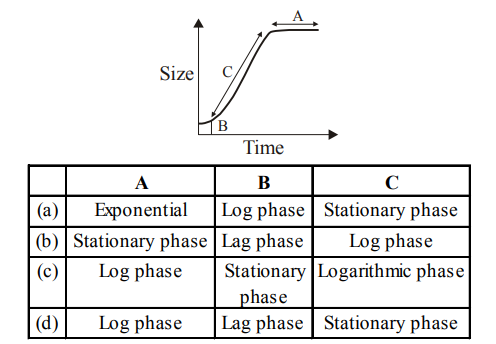
| A | B | C | |
|---|---|---|---|
| (a) | Exponential phase | Log phase | Stationary phase |
| (b) | Stationary phase | Lag phase | Log phase |
| (c) | Log phase | Stationary phase | Logarithmic phase |
| (d) | Log phase | Lag phase | Stationary phase |
Correct Answer: (b)
In a sigmoid curve, B is the initial slow growth (Lag phase), C is the rapid growth (Log or Exponential phase), and A is the final plateau (Stationary phase).
In a sigmoid curve, B is the initial slow growth (Lag phase), C is the rapid growth (Log or Exponential phase), and A is the final plateau (Stationary phase).
Q108. In arithmetic growth rate, when length of the organ is plotted against time, the nature of graph curve will be:
Correct Answer: (a)
Arithmetic growth follows the formula = L_0 + rt$, which is a linear equation, resulting in a straight line on a graph of length versus time.
Arithmetic growth follows the formula = L_0 + rt$, which is a linear equation, resulting in a straight line on a graph of length versus time.
Q109. Which one of the following is incorrectly matched?
Correct Answer: (d)
Ethylene ($) is a simple gaseous hydrocarbon. Adenine derivatives are cytokinins.
Ethylene ($) is a simple gaseous hydrocarbon. Adenine derivatives are cytokinins.
Q110. Which of the following hormone closes stomata in response to water stress?
Correct Answer: (b)
ABA is often called the 'stress hormone' because it triggers stomatal closure to minimize water loss during drought conditions.
ABA is often called the 'stress hormone' because it triggers stomatal closure to minimize water loss during drought conditions.
Q111. A primary root grows from 5 cm - 19 cm in a week. Calculate the relative growth rate over the period.
Correct Answer: (b)
Growth = 19 - 5 = 14 cm. Since this happens over 7 days, and growth is roughly linear, the relative growth is often measured against the initial value. (14/5)/7 ... wait, RGR in NCERT is typically (Growth / Initial) / Time. (14/5) / 7 = 0.4 or 40%.
Growth = 19 - 5 = 14 cm. Since this happens over 7 days, and growth is roughly linear, the relative growth is often measured against the initial value. (14/5)/7 ... wait, RGR in NCERT is typically (Growth / Initial) / Time. (14/5) / 7 = 0.4 or 40%.
Q112. Abscisic acid is a:
Correct Answer: (b)
ABA is called the stress hormone because it increases plant tolerance to various stresses, particularly by regulating water loss through stomata.
ABA is called the stress hormone because it increases plant tolerance to various stresses, particularly by regulating water loss through stomata.
Q113. The most abundant natural cytokinin that is isolated from corn kernels and coconut milk is:
Correct Answer: (d)
Zeatin was the first natural cytokinin isolated from maize (corn) kernels; it is also present in coconut milk.
Zeatin was the first natural cytokinin isolated from maize (corn) kernels; it is also present in coconut milk.
Q114. Which of the following is an incorrect statement?
Correct Answer: (d)
The statement is incorrect because day-neutral plants do flower; they just aren't dependent on day length to initiate it.
The statement is incorrect because day-neutral plants do flower; they just aren't dependent on day length to initiate it.
Q115. When a plant is not reproducing, most of the cytokinins are produced in its
Correct Answer: (c)
The roots are the major site of cytokinin synthesis, from where they are transported upward to the rest of the plant.
The roots are the major site of cytokinin synthesis, from where they are transported upward to the rest of the plant.
Q116. The measure of the ability of the plant to produce new plant material is referred as:
Correct Answer: (a)
The relative growth rate, which expresses the growth of a system per unit time as a percentage of the initial parameter, is often called the efficiency index.
The relative growth rate, which expresses the growth of a system per unit time as a percentage of the initial parameter, is often called the efficiency index.
Q117. Day neutral plants relate to:
Correct Answer: (b)
Day-neutral plants do not have a specific critical photoperiod requirement and can flower regardless of day length.
Day-neutral plants do not have a specific critical photoperiod requirement and can flower regardless of day length.
Q118. Which of the following hormone is concerned with climacteric respiration?
Correct Answer: (a)
Ethylene induces a sharp rise in respiration rate, known as the respiratory climacteric, during the ripening of certain fruits like tomatoes and apples.
Ethylene induces a sharp rise in respiration rate, known as the respiratory climacteric, during the ripening of certain fruits like tomatoes and apples.
Q119. Auxin can be bioassayed by
Correct Answer: (d)
The Avena (oat) coleoptile curvature test is the standard bioassay used to detect and quantify auxins.
The Avena (oat) coleoptile curvature test is the standard bioassay used to detect and quantify auxins.
Q120. A few normal seedlings of tomato were kept in a dark room. After a few days they were found to have become white-coloured like albinos. Which of the following terms will you use to describe them?
Correct Answer: (c)
Etiolation is the physiological response of plants grown in the dark, resulting in long, weak stems and pale/white color due to lack of chlorophyll.
Etiolation is the physiological response of plants grown in the dark, resulting in long, weak stems and pale/white color due to lack of chlorophyll.
Q121. Which one of the following growth regulators is known as 'stress hormone'?
Correct Answer: (a)
ABA is called the stress hormone because it increases plant tolerance to various environmental stresses, notably drought.
ABA is called the stress hormone because it increases plant tolerance to various environmental stresses, notably drought.
Q122. Dr. F. Went noted that if coleoptile tips were removed and placed on agar for one hour, the agar would produce a bending when placed on one side of freshly-cut coleoptile stumps. Of what significance is this experiment?
Correct Answer: (b)
The Avena curvature test developed by Went became the first quantitative bioassay used to measure the amount of active auxin in a sample.
The Avena curvature test developed by Went became the first quantitative bioassay used to measure the amount of active auxin in a sample.
Q123. Which of the following hormones can replace vernalization?
Correct Answer: (b)
Gibberellin application can substitute for the low-temperature (chilling) requirement in many vernalization-sensitive plants.
Gibberellin application can substitute for the low-temperature (chilling) requirement in many vernalization-sensitive plants.
Q124. Match the following: A. IAA, B. ABA, C. Ethylene, D. GA, E. Cytokinins with 1. Herring sperm DNA, 2. Bolting, 3. Stomatal closure, 4. Weed-free lawns, 5. Ripening of fruits.
Correct Answer: (a)
IAA-Weed free lawns. ABA-Stomatal closure. Ethylene-Ripening. GA-Bolting. Cytokinins-DNA source (Kinetin).
IAA-Weed free lawns. ABA-Stomatal closure. Ethylene-Ripening. GA-Bolting. Cytokinins-DNA source (Kinetin).
Q125. What is the site of perception of photoperiod necessary for induction of flowering in plants?
Correct Answer: (d)
Although the response occurs in the apex, the stimulus of light/dark is perceived by the leaves and then a chemical signal is sent to the shoot tip.
Although the response occurs in the apex, the stimulus of light/dark is perceived by the leaves and then a chemical signal is sent to the shoot tip.
Q126. Which one is the first Gibberellins to be discovered and remains the most intensively studied form?
Correct Answer: (c)
There are more than 100 gibberellins known, but GA3 was the first to be discovered and is the most common form used in research.
There are more than 100 gibberellins known, but GA3 was the first to be discovered and is the most common form used in research.
Q127. Experiments done by Charles Darwin and his son on plant phototropism showed that:
Correct Answer: (b)
The Darwins observed that the coleoptile of canary grass responds to unilateral light only if the tip is present, concluding the tip senses the light.
The Darwins observed that the coleoptile of canary grass responds to unilateral light only if the tip is present, concluding the tip senses the light.
Q128. Which of the following hormones causes fruits like apple to elongate and improve its shape?
Correct Answer: (a)
Gibberellins are used to increase the length of fruits like grapes and improve the shape/elongation of apples.
Gibberellins are used to increase the length of fruits like grapes and improve the shape/elongation of apples.
Q129. Differentiation of shoot is controlled by
Correct Answer: (c)
In plant tissue culture, a high ratio of cytokinin to auxin promotes shoot formation, while the reverse promotes root formation.
In plant tissue culture, a high ratio of cytokinin to auxin promotes shoot formation, while the reverse promotes root formation.
Q130. The formation of interfascicular cambium and cork cambium from mature parenchymatous cells is due to the process of:
Correct Answer: (b)
When fully differentiated cells (like cortical parenchyma) regain their meristematic capacity to divide, the process is called dedifferentiation.
When fully differentiated cells (like cortical parenchyma) regain their meristematic capacity to divide, the process is called dedifferentiation.
Q131. A phytohormone is:
Correct Answer: (b)
Plant growth regulators (PGRs) are small, simple molecules of diverse chemical groups, including indoles, adenine derivatives, terpenes, and gases.
Plant growth regulators (PGRs) are small, simple molecules of diverse chemical groups, including indoles, adenine derivatives, terpenes, and gases.
Q132. Which of the following effects is brought about by gibberellins but not by auxins?
Correct Answer: (d)
Gibberellins are uniquely effective in breaking dormancy of seeds and buds, whereas auxins generally promote apical dominance (maintaining bud inhibition).
Gibberellins are uniquely effective in breaking dormancy of seeds and buds, whereas auxins generally promote apical dominance (maintaining bud inhibition).
Q133. Maryland Mammoth Tobacco is a short day plant. Its critical duration of darkness is 10 hours. Under which of the following conditions will Maryland Mammoth tobacco not flower?
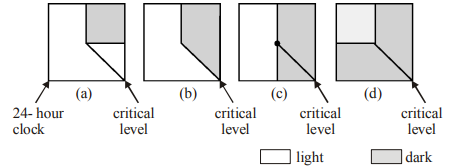
Correct Answer: (a)
Short-day plants like Maryland Mammoth tobacco require a long, continuous night. They will not flower if the light period exceeds the critical threshold or the dark period is interrupted.
Short-day plants like Maryland Mammoth tobacco require a long, continuous night. They will not flower if the light period exceeds the critical threshold or the dark period is interrupted.
Q134. Presence of which of the following compound accelerates abscission of flower and fruits?
Correct Answer: (b)
Ethephon is a widely used commercial source of ethylene; it is sprayed as an aqueous solution to induce ripening and accelerate abscission.
Ethephon is a widely used commercial source of ethylene; it is sprayed as an aqueous solution to induce ripening and accelerate abscission.