Q1. Main function of lenticel is
Correct Answer: (c)
Lenticels are lens-shaped openings in the bark that allow for gas exchange between the internal tissues and the atmosphere.
Lenticels are lens-shaped openings in the bark that allow for gas exchange between the internal tissues and the atmosphere.
Q2. During secondary growth of plants, stem phellogen cuts of cells on both sides. The outer cells get differentiated into A and the inner cells gets differentiated into B cortex. Choose the correct combination of A and B with reference to above statement.
Correct Answer: (d)
The phellogen (cork cambium) produces cork (phellem) toward the exterior and secondary cortex (phelloderm) toward the interior.
The phellogen (cork cambium) produces cork (phellem) toward the exterior and secondary cortex (phelloderm) toward the interior.
Q3. A tissue is a group of cells which are
Correct Answer: (d)
A tissue is defined as a group of cells having a common origin and usually performing a common function.
A tissue is defined as a group of cells having a common origin and usually performing a common function.
Q4. The vessel elements of angiosperms differ from other elements of xylem in having
Correct Answer: (d)
Vessel elements are uniquely characterized by the presence of perforation plates (perforations) on their end walls, which connect adjacent cells.
Vessel elements are uniquely characterized by the presence of perforation plates (perforations) on their end walls, which connect adjacent cells.
Q5. Match column-I with column-II and select the correct option from the codes given below.
| Column-I | Column-II |
|---|---|
| A. Stele | I. Innermost layer of cortex |
| B. Endodermis | II. Suberin |
| C. Casparian strips | III. All the tissues exterior to vascular cambium |
| D. Bark | IV. All the tissues inner to endodermis |
Correct Answer: (a)
Stele is the core inside endodermis; endodermis is the cortex's inner boundary; Casparian strips contain suberin; bark is everything outside vascular cambium.
Stele is the core inside endodermis; endodermis is the cortex's inner boundary; Casparian strips contain suberin; bark is everything outside vascular cambium.
Q6. Which of the following statements is correct?
Correct Answer: (a)
Lenticels are essential for gas exchange in the bark of most woody perennials. Cortex and pith are part of ground tissue, not vascular tissue.
Lenticels are essential for gas exchange in the bark of most woody perennials. Cortex and pith are part of ground tissue, not vascular tissue.
Q7. Specialised epidermal cells surrounding the guard cells are called
Correct Answer: (b)
Subsidiary cells are modified epidermal cells that assist in the opening and closing of the stomatal pore.
Subsidiary cells are modified epidermal cells that assist in the opening and closing of the stomatal pore.
Q8. What is true about a monocot leaf?
Correct Answer: (c)
Isobilateral (monocot) leaves typically have an undifferentiated mesophyll, unlike the dorsiventral leaves of dicots.
Isobilateral (monocot) leaves typically have an undifferentiated mesophyll, unlike the dorsiventral leaves of dicots.
Q9. The given figures are types of elements (A and B) which constitute one type of complex tissue (c) of a plant . Identify A, B and C.
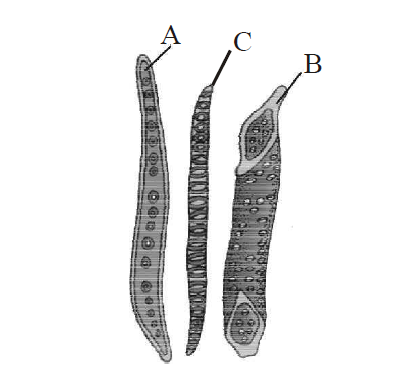
Correct Answer: (a)
A represents a tracheid with tapered ends, B is a vessel with wider lumen, both being parts of Xylem (C).
A represents a tracheid with tapered ends, B is a vessel with wider lumen, both being parts of Xylem (C).
Q10. Apical and intercalary meristems are primary meristems because
Correct Answer: (d)
Primary meristems are those present from the early stages of plant development that establish the primary plant body.
Primary meristems are those present from the early stages of plant development that establish the primary plant body.
Q11. Which of the statements given below is not true about formation of annual rings in trees?
Correct Answer: (d)
Annual rings are actually most prominent in temperate regions where seasonal changes (spring vs. autumn) are distinct.
Annual rings are actually most prominent in temperate regions where seasonal changes (spring vs. autumn) are distinct.
Q12. In stems, the protoxylem lies towards the__________ and the metaxylem lies towards the _________ of the organ.
Correct Answer: (a)
Primary xylem development in stems is endarch, with the oldest part (protoxylem) being closest to the center.
Primary xylem development in stems is endarch, with the oldest part (protoxylem) being closest to the center.
Q13. Identify types of vascular bundles in given figures A, B and C.
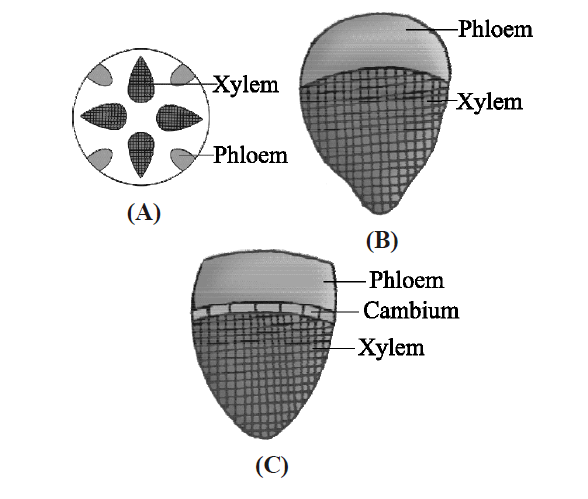
Correct Answer: (a)
A shows radial arrangement; B is conjoint closed (no cambium); C is conjoint open (with cambium).
A shows radial arrangement; B is conjoint closed (no cambium); C is conjoint open (with cambium).
Q14. An organised and differentiated cellular structure having cytoplasm but no nucleus is called _________.
Correct Answer: (c)
Mature sieve tube elements retain peripheral cytoplasm for metabolic activity but lack a nucleus to facilitate efficient translocation.
Mature sieve tube elements retain peripheral cytoplasm for metabolic activity but lack a nucleus to facilitate efficient translocation.
Q15. In a vertical section of a dorsiventral leaf, the protoxylem in its midrib bundle
Correct Answer: (a)
In dicot leaves, xylem is oriented towards the adaxial (dorsal/upper) side of the leaf.
In dicot leaves, xylem is oriented towards the adaxial (dorsal/upper) side of the leaf.
Q16. Which is not correct about sclereids?
Correct Answer: (a)
Sclereids are a type of sclerenchyma, which consists of dead cells with highly thickened lignified walls, not parenchyma.
Sclereids are a type of sclerenchyma, which consists of dead cells with highly thickened lignified walls, not parenchyma.
Q17. A major characteristic of the monocot root is the presence of
Correct Answer: (b)
Monocot roots are characterized by a lack of vascular cambium, meaning they do not undergo secondary thickening.
Monocot roots are characterized by a lack of vascular cambium, meaning they do not undergo secondary thickening.
Q18. Which of the following types of cells is/are present in Gymnosperms?
1. Sieve cells
2. Companion cells
3. Albuminous cells
4. Sieve tubes
1. Sieve cells
2. Companion cells
3. Albuminous cells
4. Sieve tubes
Correct Answer: (a)
Gymnosperms lack sieve tubes and companion cells; instead, they possess sieve cells and albuminous cells.
Gymnosperms lack sieve tubes and companion cells; instead, they possess sieve cells and albuminous cells.
Q19. A student was given a tissue to observe under the microscope. He observes the tissue and concludes that the tissue is a type of simple plant tissue and provides mechanical support to young stem and petiole of leaf. Identify the tissue.
Correct Answer: (b)
Collenchyma provides mechanical strength and flexibility to growing plant organs like young stems and petioles.
Collenchyma provides mechanical strength and flexibility to growing plant organs like young stems and petioles.
Q20. Transmission tissue is characteristic feature of
Correct Answer: (a)
In flowers with solid styles, the pollen tube grows through a specialized canal of cells called transmission tissue.
In flowers with solid styles, the pollen tube grows through a specialized canal of cells called transmission tissue.
Q21. Various functions like photosynthesis, storage, excretion performed by ____________.
Correct Answer: (b)
Parenchyma is a versatile simple tissue involved in primary metabolic processes like photosynthesis and storage.
Parenchyma is a versatile simple tissue involved in primary metabolic processes like photosynthesis and storage.
Q22. In one of the following the differentiation of rhytidome, sapwood and heartwood can’t be traced
Correct Answer: (c)
Phoenix (date palm) is a monocot and does not undergo secondary growth resulting in wood and bark formation.
Phoenix (date palm) is a monocot and does not undergo secondary growth resulting in wood and bark formation.
Q23. Which of the following statement(s) is/are correct about dorsiventral (dicotyledonous) leaf?
(i) The adaxial (upper surface) bears more stomata than the abaxial (lower surface) epidermis.
(ii) Mesophyll, which possesses chloroplasts and carry out photosynthesis, is made up of parenchyma.
(iii) Mesophyll is not differentiated into palisade and spongy parenchyma.
(i) The adaxial (upper surface) bears more stomata than the abaxial (lower surface) epidermis.
(ii) Mesophyll, which possesses chloroplasts and carry out photosynthesis, is made up of parenchyma.
(iii) Mesophyll is not differentiated into palisade and spongy parenchyma.
Correct Answer: (b)
Dorsiventral leaves have more stomata on the abaxial side and a mesophyll differentiated into palisade and spongy layers. Statement (ii) is the only correct one.
Dorsiventral leaves have more stomata on the abaxial side and a mesophyll differentiated into palisade and spongy layers. Statement (ii) is the only correct one.
Q24. Identify A, B and C in the given figure of shoot apical meristem
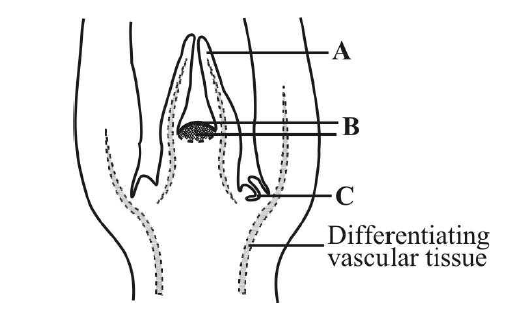
Correct Answer: (a)
A labels a young developing leaf (leaf primordium), B is the main meristematic tip, and C is the axillary bud in the leaf axil.
A labels a young developing leaf (leaf primordium), B is the main meristematic tip, and C is the axillary bud in the leaf axil.
Q25. Root hairs develop from the region of
Correct Answer: (d)
The maturation zone is where epidermal cells differentiate and produce root hairs for absorption.
The maturation zone is where epidermal cells differentiate and produce root hairs for absorption.
Q26. Stomata in grass leaf are
Correct Answer: (a)
In grasses (monocots), the guard cells are typically dumbbell-shaped rather than bean-shaped.
In grasses (monocots), the guard cells are typically dumbbell-shaped rather than bean-shaped.
Q27. With regard to phloem parenchyma, consider the following statements:
1. Plasmodesmatal connections exist between the cell walls.
2. It stores substances like resins, latex, and mucilage.
Which of the statement(s) given above is/are correct?
1. Plasmodesmatal connections exist between the cell walls.
2. It stores substances like resins, latex, and mucilage.
Which of the statement(s) given above is/are correct?
Correct Answer: (c)
Phloem parenchyma cells are connected by plasmodesmata and serve storage functions for various organic substances.
Phloem parenchyma cells are connected by plasmodesmata and serve storage functions for various organic substances.
Q28. Read the following statements and answer the questions.
(i) It is made up of elongated, tapering cylindrical cells which have dense cytoplasm and nucleus.
(ii) The cell wall is composed of cellulose and has pits through which plasmodesmatal connections exist between the cells.
(iii) It is absent in most of the monocotyledons.
Which part of plant tissue is being described by the above statements?
(i) It is made up of elongated, tapering cylindrical cells which have dense cytoplasm and nucleus.
(ii) The cell wall is composed of cellulose and has pits through which plasmodesmatal connections exist between the cells.
(iii) It is absent in most of the monocotyledons.
Which part of plant tissue is being described by the above statements?
Correct Answer: (c)
The description of thin-walled, nucleated, elongated cells that are generally absent in monocots matches phloem parenchyma.
The description of thin-walled, nucleated, elongated cells that are generally absent in monocots matches phloem parenchyma.
Q29. Which of the following are present in monocot root ?
Correct Answer: (d)
Monocot roots feature polyarch xylem (many bundles) and a large, significant pith, with an exodermis layer.
Monocot roots feature polyarch xylem (many bundles) and a large, significant pith, with an exodermis layer.
Q30. Removal of ring wood of tissue outside the vascular cambium from the tree trunk kills it because
Correct Answer: (b)
Girdling removes the phloem, preventing photosynthates from reaching the roots, leading to root starvation and plant death.
Girdling removes the phloem, preventing photosynthates from reaching the roots, leading to root starvation and plant death.
Q31. Consider the following statements
1. The regeneration of parts, grazed by the herbivores in grasses is by the activity of apical meristem.
2. The cells of parenchyma are generally isodiametric.
Which of the statements(s) given above is/are correct?
1. The regeneration of parts, grazed by the herbivores in grasses is by the activity of apical meristem.
2. The cells of parenchyma are generally isodiametric.
Which of the statements(s) given above is/are correct?
Correct Answer: (b)
Regeneration in grasses is primarily due to intercalary meristems. Parenchyma cells are typically isodiametric in shape.
Regeneration in grasses is primarily due to intercalary meristems. Parenchyma cells are typically isodiametric in shape.
Q32. In stems, the protoxylem lies towards the ____________ and the metaxylem lies towards the ____________ of the organ.
Correct Answer: (a)
Stems typically show an endarch arrangement where protoxylem is central (towards the pith) and metaxylem is peripheral.
Stems typically show an endarch arrangement where protoxylem is central (towards the pith) and metaxylem is peripheral.
Q33. Heartwood differs from sapwood in:
Correct Answer: (c)
Heartwood is the central, non-conducting wood characterized by depositions that make it dark and durable, and its elements are dead.
Heartwood is the central, non-conducting wood characterized by depositions that make it dark and durable, and its elements are dead.
Q34. Read the following statements and answer the question.
(i) It has a sclerenchymatous hypodermis, a large number of scattered vascular bundles and a large parenchymatous ground tissue.
(ii) Vascular bundles are conjoint and closed.
(iii) Peripheral vascular bundles are generally smaller than the centrally located ones.
(iv) Phloem parenchyma is absent, and water- containing cavities are present within the vascular bundles.
Which plant anatomy is being described by the above statements?
(i) It has a sclerenchymatous hypodermis, a large number of scattered vascular bundles and a large parenchymatous ground tissue.
(ii) Vascular bundles are conjoint and closed.
(iii) Peripheral vascular bundles are generally smaller than the centrally located ones.
(iv) Phloem parenchyma is absent, and water- containing cavities are present within the vascular bundles.
Which plant anatomy is being described by the above statements?
Correct Answer: (d)
The combination of scattered, closed bundles, sclerenchymatous hypodermis, and protoxylem cavities is unique to monocot stems.
The combination of scattered, closed bundles, sclerenchymatous hypodermis, and protoxylem cavities is unique to monocot stems.
Q35. Identify the given diagrams and mark the correct option:
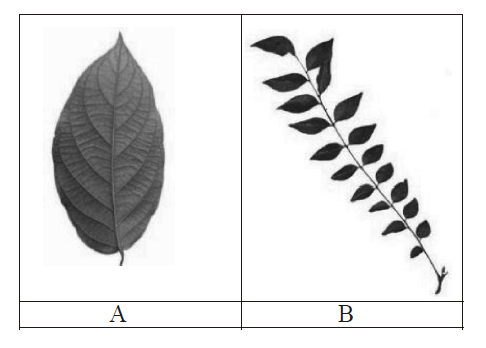
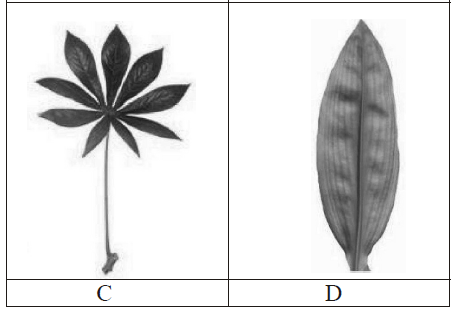
Correct Answer: (b)
Based on the visual evidence from the diagrams in the textbook context, simple leaves (B, D) have a single blade while compound leaves (A, C) have blades divided into leaflets.
Based on the visual evidence from the diagrams in the textbook context, simple leaves (B, D) have a single blade while compound leaves (A, C) have blades divided into leaflets.
Q36. One of the primary function of the ground tissue in a plant is
Correct Answer: (a)
Ground tissue includes the mesophyll of leaves, where the majority of photosynthesis takes place.
Ground tissue includes the mesophyll of leaves, where the majority of photosynthesis takes place.
Q37. Which of the following pair of match is not correct?
Correct Answer: (b)
Root hairs are primarily for absorbing water and minerals from the soil, not for preventing transpiration.
Root hairs are primarily for absorbing water and minerals from the soil, not for preventing transpiration.
Q38. Which of the following statement is correct about heart wood/duramen?
(i) It does not help in water and mineral conduction.
(ii) It is dark coloured but soft.
(iii) It has tracheary elements filled with tannins, resins, gums, oil, etc.
(iv) It is a peripheral part.
(v) They are sensitive to microbes and insects, hence least durable.
(i) It does not help in water and mineral conduction.
(ii) It is dark coloured but soft.
(iii) It has tracheary elements filled with tannins, resins, gums, oil, etc.
(iv) It is a peripheral part.
(v) They are sensitive to microbes and insects, hence least durable.
Correct Answer: (a)
Heartwood is non-conducting (i) and contains deposits like tannins and resins (iii). It is hard, central (not peripheral), and very resistant (durable).
Heartwood is non-conducting (i) and contains deposits like tannins and resins (iii). It is hard, central (not peripheral), and very resistant (durable).
Q39. When we peel the skin of a potato tuber, we remove
Correct Answer: (a)
The 'skin' of a mature potato is composed of periderm, which replaces the epidermis during the secondary growth of the tuber.
The 'skin' of a mature potato is composed of periderm, which replaces the epidermis during the secondary growth of the tuber.
Q40. Which anatomy of plants is being described by the statements given below ?
(i) The cortex consists of several layers of thin-walled parenchyma cells with intercellular spaces.
(ii) The tangential as well as radial walls of the endodermal cells have a depostion of water-impermeable, waxy material -suberin- in form of casparian strips.
(iii) Secondary growth takes place.
(iv) Pith is small or inconspicuous.
(i) The cortex consists of several layers of thin-walled parenchyma cells with intercellular spaces.
(ii) The tangential as well as radial walls of the endodermal cells have a depostion of water-impermeable, waxy material -suberin- in form of casparian strips.
(iii) Secondary growth takes place.
(iv) Pith is small or inconspicuous.
Correct Answer: (a)
These anatomical markers, specifically the presence of Casparian strips in the endodermis and secondary growth with small pith, characterize dicot roots.
These anatomical markers, specifically the presence of Casparian strips in the endodermis and secondary growth with small pith, characterize dicot roots.
Q41. Read the following statements and select the correct one(s).
(i) In flowering plants, tracheids and vessels are the main water transporting elements.
(ii) The presence of vessels is a characteristic feature of angiosperms.
(iii) Xylem fibres have highly thinned walls and their cell walls are made up of cellulose.
(iv) Xylem parenchyma store food materials in the form of starch or fat and other substances like tannins.
Which of the above statement(s) is/are correct?
(i) In flowering plants, tracheids and vessels are the main water transporting elements.
(ii) The presence of vessels is a characteristic feature of angiosperms.
(iii) Xylem fibres have highly thinned walls and their cell walls are made up of cellulose.
(iv) Xylem parenchyma store food materials in the form of starch or fat and other substances like tannins.
Which of the above statement(s) is/are correct?
Correct Answer: (d)
Statements (i), (ii), and (iv) accurately describe xylem components. Statement (iii) is wrong as xylem fibres have very thick walls and are lignified.
Statements (i), (ii), and (iv) accurately describe xylem components. Statement (iii) is wrong as xylem fibres have very thick walls and are lignified.
Q42. Phellogen and phellem respectively denote
Correct Answer: (b)
Phellogen is the scientific name for cork cambium, and its product toward the outside is phellem (cork).
Phellogen is the scientific name for cork cambium, and its product toward the outside is phellem (cork).
Q43. Meristematic tissue responsible for increase in girth of tree trunk is
Correct Answer: (c)
Lateral meristems are situated on the sides and facilitate the increase in diameter or girth through secondary growth.
Lateral meristems are situated on the sides and facilitate the increase in diameter or girth through secondary growth.
Q44. Which of the following statement(s) is/are not correct?
(i) Cork cambium is also called phellogen.
(ii) Cork is also called phellem.
(iii) Secondary cortex is also called periderm.
(iv) Cork cambium, cork and secondary cortex are collectively called phelloderm.
(i) Cork cambium is also called phellogen.
(ii) Cork is also called phellem.
(iii) Secondary cortex is also called periderm.
(iv) Cork cambium, cork and secondary cortex are collectively called phelloderm.
Correct Answer: (a)
Secondary cortex is phelloderm. Periderm is the collective term for phellogen, phellem, and phelloderm. Thus (iii) and (iv) are wrong.
Secondary cortex is phelloderm. Periderm is the collective term for phellogen, phellem, and phelloderm. Thus (iii) and (iv) are wrong.
Q45. Epiblema of roots is equivalent to
Correct Answer: (c)
Epiblema is the outermost piliferous layer of roots, performing the same protective and absorptive role as the epidermis in shoots.
Epiblema is the outermost piliferous layer of roots, performing the same protective and absorptive role as the epidermis in shoots.
Q46. Identify the wrong statement in context of heartwood
Correct Answer: (b)
Heartwood is non-functional for conduction; water transport is the role of the peripheral sapwood.
Heartwood is non-functional for conduction; water transport is the role of the peripheral sapwood.
Q47. Xylem functions as a conducting tissue for water and minerals from _________to the ______and__________.
Correct Answer: (a)
Xylem conducts water and minerals unidirectionally upwards from the roots to the stems and leaves.
Xylem conducts water and minerals unidirectionally upwards from the roots to the stems and leaves.
Q48. All the following statements regarding sieve tube elements are correct except that
Correct Answer: (a)
Sieve plates are cellulosic and not impregnated with lignin, as phloem is generally a non-lignified tissue.
Sieve plates are cellulosic and not impregnated with lignin, as phloem is generally a non-lignified tissue.
Q49. In conifers fibres are likely to be absent in
Correct Answer: (b)
Gymnosperm (conifer) wood is typically 'non-porous' and 'soft' because it lacks vessels and xylem fibres.
Gymnosperm (conifer) wood is typically 'non-porous' and 'soft' because it lacks vessels and xylem fibres.
Q50. Which of following helps bamboo and grasses to elongate?
Correct Answer: (d)
Intercalary meristems occur between mature tissues and are responsible for the elongation of internodes in plants like grasses and bamboo.
Intercalary meristems occur between mature tissues and are responsible for the elongation of internodes in plants like grasses and bamboo.
Q51. Lignin is the important constituent in the cell wall of
Correct Answer: (c)
Xylem elements, particularly tracheids and vessels, have cell walls heavily thickened with lignin to provide mechanical strength and facilitate water transport.
Xylem elements, particularly tracheids and vessels, have cell walls heavily thickened with lignin to provide mechanical strength and facilitate water transport.
Q52. In a ring girdled plant
Correct Answer: (a)
Girdling removes the phloem, blocking the transport of food to the roots. Consequently, roots starve and die first, eventually killing the whole plant.
Girdling removes the phloem, blocking the transport of food to the roots. Consequently, roots starve and die first, eventually killing the whole plant.
Q53. Bast fibres are made up of _____________cells.
Correct Answer: (a)
Phloem (bast) fibres are composed of elongated, thick-walled sclerenchymatous cells.
Phloem (bast) fibres are composed of elongated, thick-walled sclerenchymatous cells.
Q54. In which of the following pairs of parts of a flowering plant is epidermis absent?
Correct Answer: (a)
The apical regions (root and shoot tips) are actively dividing meristems that have not yet differentiated a mature epidermis layer.
The apical regions (root and shoot tips) are actively dividing meristems that have not yet differentiated a mature epidermis layer.
Q55. Match the elements of xylem given in column I with their character given in column II and choose the correct option.
| Column-I | Column-II |
|---|---|
| A. Xylem vessels | I. Store food materials |
| B. Xylem tracheids | II. Obliterated lumen |
| C. Xylem fibres | III. Perforated plates |
| D. Xylem parenchyma | IV. Chisel-like ends |
Correct Answer: (d)
Vessels have perforated plates; tracheids have chisel-like ends; xylem fibres have obliterated lumens; parenchyma stores food.
Vessels have perforated plates; tracheids have chisel-like ends; xylem fibres have obliterated lumens; parenchyma stores food.
Q56. Which one of the following option is correct about bulliform/motor cell?
Correct Answer: (d)
Bulliform cells are specialized epidermal cells in grasses that manage leaf curling to regulate transpiration.
Bulliform cells are specialized epidermal cells in grasses that manage leaf curling to regulate transpiration.
Q57. The trees growing in desert will
Correct Answer: (d)
Desert climates lack distinct seasonal changes, so cambial activity is relatively uniform, and distinct growth rings do not form.
Desert climates lack distinct seasonal changes, so cambial activity is relatively uniform, and distinct growth rings do not form.
Q58. Which of the following statement(s) is/are correct?
(i) Uneven thickening of cell wall is characteristic of sclerenchyma.
(ii) Periblem forms cortex of the stem and the root.
(iii) Tracheids are the chief water transporting elements in gymnosperms.
(iv) Companion cell is devoid of nucleus at maturity.
(v) The commercial cork is obtained from Quercus suber.
(i) Uneven thickening of cell wall is characteristic of sclerenchyma.
(ii) Periblem forms cortex of the stem and the root.
(iii) Tracheids are the chief water transporting elements in gymnosperms.
(iv) Companion cell is devoid of nucleus at maturity.
(v) The commercial cork is obtained from Quercus suber.
Correct Answer: (d)
Periblem forms the cortex, tracheids transport water in gymnosperms, and commercial cork comes from the cork oak. Sclerenchyma has even thickening (collenchyma is uneven) and companion cells retain their nuclei.
Periblem forms the cortex, tracheids transport water in gymnosperms, and commercial cork comes from the cork oak. Sclerenchyma has even thickening (collenchyma is uneven) and companion cells retain their nuclei.
Q59. How does autumn wood differ from spring wood ?
Correct Answer: (b)
In autumn, the cambium is less active and produces fewer xylary elements that have narrower vessels and tracheids compared to spring.
In autumn, the cambium is less active and produces fewer xylary elements that have narrower vessels and tracheids compared to spring.
Q60. A concentric amphivasal (leptocentric) vascular bundle is one in which
Correct Answer: (a)
In an amphivasal bundle, the xylem is located on the outside, surrounding a central core of phloem.
In an amphivasal bundle, the xylem is located on the outside, surrounding a central core of phloem.
Q61. Identify the types of simple tissue indicated by A, B, C and D and their function.
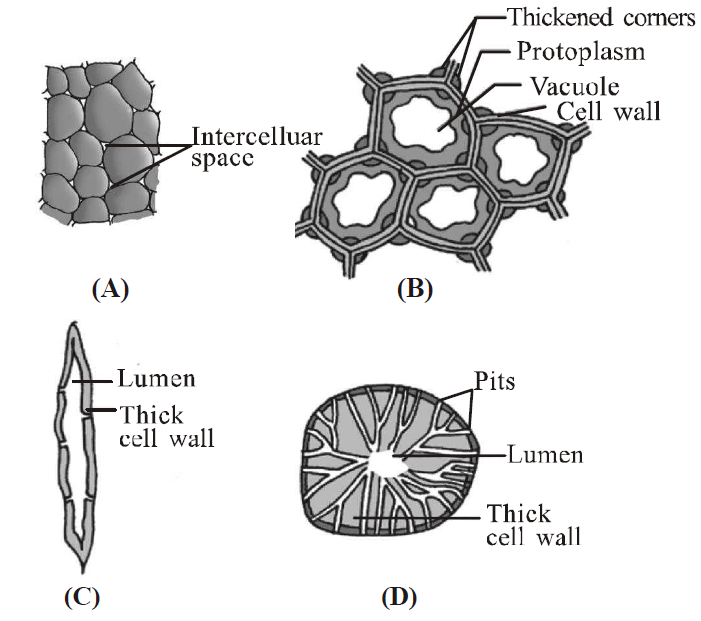
Correct Answer: (a)
Tissue A is Parenchyma, which typically performs storage and metabolic functions like photosynthesis.
Tissue A is Parenchyma, which typically performs storage and metabolic functions like photosynthesis.
Q62. Read the following statements and answer the question.
(i) Cambium is very active and produces a large number of xylary elements having vessels with wider cavities.
(ii) It is also called early wood.
(iii) It is lighter in colour and has lower density.
Which type of wood is described by the above statements?
(i) Cambium is very active and produces a large number of xylary elements having vessels with wider cavities.
(ii) It is also called early wood.
(iii) It is lighter in colour and has lower density.
Which type of wood is described by the above statements?
Correct Answer: (c)
These characteristics define spring wood (early wood), which is produced when environmental conditions favor vigorous growth.
These characteristics define spring wood (early wood), which is produced when environmental conditions favor vigorous growth.
Q63. Casparian strips occur in
Correct Answer: (c)
Casparian strips are waxy bands of suberin found in the radial and tangential walls of endodermal cells.
Casparian strips are waxy bands of suberin found in the radial and tangential walls of endodermal cells.
Q64. The length of different internodes in a culm of sugarcane is variable because of
Correct Answer: (b)
Intercalary meristems located at the nodes are responsible for the elongation of internodes in sugarcane.
Intercalary meristems located at the nodes are responsible for the elongation of internodes in sugarcane.
Q65. Which of the following statements are correct about phloem?
(i) Phloem transports food materials, usually from leaves to the other parts of the plant.
(ii) It is composed of sieve tube elements, companion cells, phloem parenchyma and phloem fibres.
(iii) The companion cells are specialised parenchymatous cells which are closely associated with phloem parenchyma.
(iv) The first formed primary phloem consists of narrow sieve tubes and referred to as protophloem and the later formed phloem has bigger sieve tubes and referred to as metaphloem.
(i) Phloem transports food materials, usually from leaves to the other parts of the plant.
(ii) It is composed of sieve tube elements, companion cells, phloem parenchyma and phloem fibres.
(iii) The companion cells are specialised parenchymatous cells which are closely associated with phloem parenchyma.
(iv) The first formed primary phloem consists of narrow sieve tubes and referred to as protophloem and the later formed phloem has bigger sieve tubes and referred to as metaphloem.
Correct Answer: (a)
Statements (i), (ii), and (iv) are correct. (iii) is wrong because companion cells are associated with sieve tube elements, not phloem parenchyma.
Statements (i), (ii), and (iv) are correct. (iii) is wrong because companion cells are associated with sieve tube elements, not phloem parenchyma.
Q66. The transverse section of a plant shows following anatomical features :
(i) Large number of scattered vascular bundles surrounded by bundle sheath
(ii) Large conspicuous parenchymatous ground tissue
(iii) Vascular bundles conjoint and closed
(iv) Phloem parenchyma absent
Identify the category of plant and its part :
(i) Large number of scattered vascular bundles surrounded by bundle sheath
(ii) Large conspicuous parenchymatous ground tissue
(iii) Vascular bundles conjoint and closed
(iv) Phloem parenchyma absent
Identify the category of plant and its part :
Correct Answer: (d)
Scattered vascular bundles that are closed (no cambium) and lack phloem parenchyma are characteristic of monocot stems.
Scattered vascular bundles that are closed (no cambium) and lack phloem parenchyma are characteristic of monocot stems.
Q67. The given figure shows T.S. of monocot stem. Identify the correct labelling of A to F marked in the given figure.
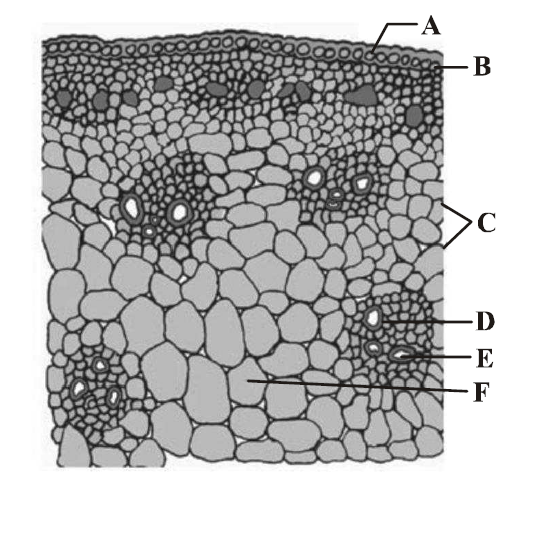
Correct Answer: (a)
A: Epidermis, B: Sclerenchymatous hypodermis, C: Scattered vascular bundles, D/E: vascular tissue, F: Massive parenchymatous ground tissue.
A: Epidermis, B: Sclerenchymatous hypodermis, C: Scattered vascular bundles, D/E: vascular tissue, F: Massive parenchymatous ground tissue.
Q68. Apical, intercalary and lateral meristems are differentiated on the basis of
Correct Answer: (c)
These meristems are classified based on their location in the plant body: apical at tips, intercalary between mature tissues, and lateral on the sides.
These meristems are classified based on their location in the plant body: apical at tips, intercalary between mature tissues, and lateral on the sides.
Q69. Tissue(s) present in an annual ring is/are
Correct Answer: (c)
An annual ring is specifically composed of layers of secondary xylem produced in spring and autumn.
An annual ring is specifically composed of layers of secondary xylem produced in spring and autumn.
Q70. Choose the correct labelling of (A – I) in the given figure of T.S. of monocot root.
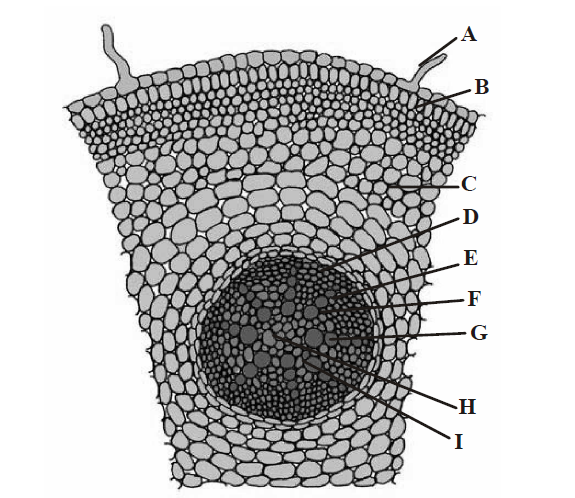
Correct Answer: (c)
Standard monocot root anatomy: outermost root hair/epiblema, followed by cortex, endodermis, pericycle, and vascular elements with protoxylem towards the edge (exarch).
Standard monocot root anatomy: outermost root hair/epiblema, followed by cortex, endodermis, pericycle, and vascular elements with protoxylem towards the edge (exarch).
Q71. A piece of wood having no vessels (trachea) must be belonged to
Correct Answer: (c)
Pine is a gymnosperm. Xylem of most gymnosperms lacks vessels, which are characteristic of angiosperms.
Pine is a gymnosperm. Xylem of most gymnosperms lacks vessels, which are characteristic of angiosperms.
Q72. Which of the following is made up of dead cells?
Correct Answer: (b)
Phellem (cork) cells become suberized and die at maturity to form a protective waterproof layer.
Phellem (cork) cells become suberized and die at maturity to form a protective waterproof layer.
Q73. A vascular bundle in which the protoxylem is pointing to the periphery is called __________.
Correct Answer: (b)
In an exarch arrangement, typical of roots, the protoxylem is located towards the periphery and metaxylem towards the center.
In an exarch arrangement, typical of roots, the protoxylem is located towards the periphery and metaxylem towards the center.
Q74. Which of the following group of cells make up the Conjuctive tissue?
Correct Answer: (a)
Conjunctive tissue consists of the parenchyma cells located between the xylem and phloem strands in the root cylinder.
Conjunctive tissue consists of the parenchyma cells located between the xylem and phloem strands in the root cylinder.
Q75. The __________ occurs in layers below the epidermis in dicotyledonous plants.
Correct Answer: (c)
Collenchyma usually forms the hypodermis (layers below the epidermis) in dicot stems to provide mechanical support.
Collenchyma usually forms the hypodermis (layers below the epidermis) in dicot stems to provide mechanical support.
Q76. Which type of plant tissue is being described by the given statements?
(i) It consists of long, narrow cells with thick and lignified cell walls having a few or numerous pits.
(ii) They are dead and without protoplasts.
(iii) On the basis of variation in form, structure, origin and development, it may be either fibres or sclereids.
(iv) It provides mechanical support to organs.
(i) It consists of long, narrow cells with thick and lignified cell walls having a few or numerous pits.
(ii) They are dead and without protoplasts.
(iii) On the basis of variation in form, structure, origin and development, it may be either fibres or sclereids.
(iv) It provides mechanical support to organs.
Correct Answer: (b)
Lignified walls, absence of protoplasm at maturity, and providing mechanical support are definitive traits of sclerenchyma.
Lignified walls, absence of protoplasm at maturity, and providing mechanical support are definitive traits of sclerenchyma.
Q77. Some vascular bundles are described as open because these
Correct Answer: (b)
Open vascular bundles possess vascular cambium, which allows them to produce secondary tissues during growth.
Open vascular bundles possess vascular cambium, which allows them to produce secondary tissues during growth.
Q78. How many shoot apical meritsems are likely to be present in a twig of a plant possessing, 4 branches and 26 leaves?
Correct Answer: (c)
There would be one main shoot apex plus four apical meristems at the tip of each branch, totaling 5.
There would be one main shoot apex plus four apical meristems at the tip of each branch, totaling 5.
Q79. Which of the following statements is not correct for stomatal apparatus?
Correct Answer: (c)
Stomatal apparatus typically includes guard cells that are often surrounded by specialized cells called subsidiary cells.
Stomatal apparatus typically includes guard cells that are often surrounded by specialized cells called subsidiary cells.
Q80. A common structural feature of vessel elements and sieve tube elements are
Correct Answer: (c)
Both mature vessel elements (which are dead) and mature sieve tube elements (which are living) lack a nucleus at maturity.
Both mature vessel elements (which are dead) and mature sieve tube elements (which are living) lack a nucleus at maturity.
Q81. When the flow of fluid is regulated both inwardly as well as outwardly, it is performed by the
Correct Answer: (b)
The endodermis acts as a biological checkpoint, regulating the passage of water and solutes into the vascular cylinder.
The endodermis acts as a biological checkpoint, regulating the passage of water and solutes into the vascular cylinder.
Q82. Cork is formed from
Correct Answer: (a)
The phellogen (cork cambium) divides to form cork (phellem) on its outer surface.
The phellogen (cork cambium) divides to form cork (phellem) on its outer surface.
Q83. Which of the following facilitates opening of stomatal aperture?
Correct Answer: (b)
The radial orientation of cellulose microfibrils allows the guard cells to expand longitudinally when turgid, bowing outward to open the pore.
The radial orientation of cellulose microfibrils allows the guard cells to expand longitudinally when turgid, bowing outward to open the pore.
Q84. Which one of the following cell types always divides by anticlinal cell division?
Correct Answer: (b)
Protoderm cells divide anticlinally to increase the surface area of the plant's outer layer without adding thickness.
Protoderm cells divide anticlinally to increase the surface area of the plant's outer layer without adding thickness.
Q85. Plants having little or no secondary growth are
Correct Answer: (a)
Monocots like grasses typically lack a vascular cambium and therefore do not show significant secondary growth.
Monocots like grasses typically lack a vascular cambium and therefore do not show significant secondary growth.
Q86. The given figure shows the secondary growth in a dicot stem. Their parts are marked as A, B, C, D, E & F. Choose the correct labelling of the parts marked as A to F.
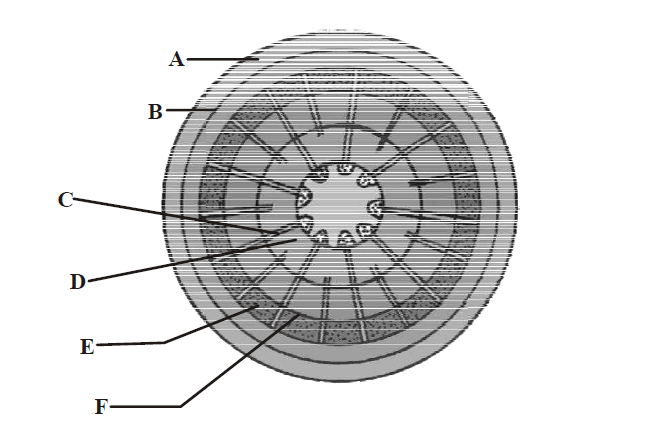
Correct Answer: (a)
Sequence from outside: phellem (cork), phellogen (cork cambium), then deeper layers including phloem, vascular cambium ring, and wood (secondary xylem).
Sequence from outside: phellem (cork), phellogen (cork cambium), then deeper layers including phloem, vascular cambium ring, and wood (secondary xylem).
Q87. Gymnosperms are also called soft wood spermatophytes because they lack
Correct Answer: (d)
Gymnosperm wood is termed 'soft wood' because it lacks xylem fibres, being composed almost entirely of tracheids.
Gymnosperm wood is termed 'soft wood' because it lacks xylem fibres, being composed almost entirely of tracheids.
Q88. Best method to determine the age of tree is to
Correct Answer: (c)
Annual rings, consisting of one spring wood and one autumn wood band per year, are counted to estimate a tree's age (dendrochronology).
Annual rings, consisting of one spring wood and one autumn wood band per year, are counted to estimate a tree's age (dendrochronology).
Q89. Tracheids differ from other tracheary elements in
Correct Answer: (b)
Tracheids are imperforate (lack perforation plates) and water moves between them through pits, whereas vessels are perforated.
Tracheids are imperforate (lack perforation plates) and water moves between them through pits, whereas vessels are perforated.
Q90. Which one of the followings option shows the correct labelling of the parts marked as A, B, C and D in the given figure of a lenticel?
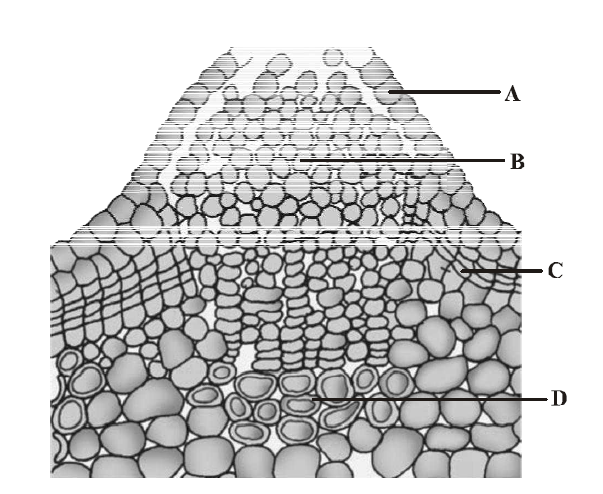
Correct Answer: (d)
In a lenticel: A is the broken epidermis, B labels the loosely arranged complimentary cells, C is the phellogen (cork cambium), and D is the phelloderm (secondary cortex).
In a lenticel: A is the broken epidermis, B labels the loosely arranged complimentary cells, C is the phellogen (cork cambium), and D is the phelloderm (secondary cortex).
Q91. The surface area of leaves in monocotyledon plant can be regulated by the help of
Correct Answer: (c)
Bulliform cells in grasses facilitate the rolling and unrolling of leaves to minimize water loss by reducing exposed surface area.
Bulliform cells in grasses facilitate the rolling and unrolling of leaves to minimize water loss by reducing exposed surface area.
Q92. Pericycle of roots produces
Correct Answer: (b)
In roots, the lateral roots originate from the pericycle, making it an endogenous formation.
In roots, the lateral roots originate from the pericycle, making it an endogenous formation.
Q93. Which of the following statement(s) is/are correct about epidermal tissue system?
Correct Answer: (d)
All given statements provide accurate characteristics of the epidermal tissue system in plants.
All given statements provide accurate characteristics of the epidermal tissue system in plants.
Q94. The vascular cambium normally gives rise to
Correct Answer: (b)
Vascular cambium produces secondary xylem towards the inside and secondary phloem towards the outside.
Vascular cambium produces secondary xylem towards the inside and secondary phloem towards the outside.
Q95. With regard to Sieve tube elements, consider the following statements:
1. A mature sieve element does not have cytoplasm
2. The nucleus and vacuole are absent in mature sieve element
Which of the statement(s) given above is/are correct?
1. A mature sieve element does not have cytoplasm
2. The nucleus and vacuole are absent in mature sieve element
Which of the statement(s) given above is/are correct?
Correct Answer: (d)
A mature sieve tube element has peripheral cytoplasm and a large vacuole, but it lacks a nucleus.
A mature sieve tube element has peripheral cytoplasm and a large vacuole, but it lacks a nucleus.
Q96. Cells that do not have power of cell division are produced by
Correct Answer: (d)
Meristems like primary meristem and cambium produce cells that eventually differentiate into permanent tissues, which lose the ability to divide.
Meristems like primary meristem and cambium produce cells that eventually differentiate into permanent tissues, which lose the ability to divide.
Q97. During the formation of leaves and elongation of stem, some cells ‘left behind’ from the shoot apical meristem, constitute the
Correct Answer: (b)
Axillary buds are formed from cells that were part of the shoot apical meristem but were left behind during primary growth of the stem.
Axillary buds are formed from cells that were part of the shoot apical meristem but were left behind during primary growth of the stem.
Q98. A conjoint and open vascular bundle will be observed in the transverse section of
Correct Answer: (d)
Conjoint open bundles (xylem and phloem on same radius with cambium) are the defining feature of dicot stems.
Conjoint open bundles (xylem and phloem on same radius with cambium) are the defining feature of dicot stems.
Q99. Read the following statements and answer the question.
(i) They are present on the stem as epidermal hairs.
(ii) They are usually multicellular.
(iii) They may be branched or unbranched and soft or stiff.
(iv) They help in preventing water loss due to transpiration.
Which part of epidermal tissue system is being described by the above statements?
(i) They are present on the stem as epidermal hairs.
(ii) They are usually multicellular.
(iii) They may be branched or unbranched and soft or stiff.
(iv) They help in preventing water loss due to transpiration.
Which part of epidermal tissue system is being described by the above statements?
Correct Answer: (d)
Trichomes are multicellular stem hairs that vary in shape and help reduce water loss through transpiration.
Trichomes are multicellular stem hairs that vary in shape and help reduce water loss through transpiration.
Q100. Identify the incorrect statement.
Correct Answer: (b)
Sapwood is the peripheral (outermost) part of the secondary xylem; heartwood is the innermost part.
Sapwood is the peripheral (outermost) part of the secondary xylem; heartwood is the innermost part.
Q101. Which of the following is responsible for the formation of an embryonic shoot called axillary bud?
Correct Answer: (b)
The shoot apical meristem is the source of cells that form axillary buds in the axils of leaves.
The shoot apical meristem is the source of cells that form axillary buds in the axils of leaves.
Q102. Which one of the following is well developed and present in hydrophytes?
Correct Answer: (a)
Aerenchyma provides buoyancy and allows internal air circulation, which is vital for aquatic plants (hydrophytes).
Aerenchyma provides buoyancy and allows internal air circulation, which is vital for aquatic plants (hydrophytes).
Q103. Which of the following statement(s) is/are correct about the ground tissue system?
(i) All tissues except epidermis and vascular bundles constitute the ground tissue.
(ii) It consists of xylem and phloem.
(iii) In leaves, it consists of thin–walled chloroplast containing cells called mesophyll.
(i) All tissues except epidermis and vascular bundles constitute the ground tissue.
(ii) It consists of xylem and phloem.
(iii) In leaves, it consists of thin–walled chloroplast containing cells called mesophyll.
Correct Answer: (b)
Ground tissue excludes dermal and vascular systems. In leaves, it is represented by the mesophyll.
Ground tissue excludes dermal and vascular systems. In leaves, it is represented by the mesophyll.
Q104. Cells of permanent tissues are specialized
Correct Answer: (c)
Permanent tissue cells have undergone differentiation and are specialized both in their structure and the specific functions they perform.
Permanent tissue cells have undergone differentiation and are specialized both in their structure and the specific functions they perform.
Q105. Which meristem helps in increasing girth?
Correct Answer: (a)
Lateral meristems, such as vascular cambium and cork cambium, are responsible for secondary growth which increases the girth (thickness) of the plant.
Lateral meristems, such as vascular cambium and cork cambium, are responsible for secondary growth which increases the girth (thickness) of the plant.
Q106. Which of the following process helps the trichomes in preventing water loss?
Correct Answer: (b)
The question phrasing is a bit disjointed, but trichomes physically hinder air movement and trap moisture near the leaf surface, reducing transpiration (the giving off of water vapor).
The question phrasing is a bit disjointed, but trichomes physically hinder air movement and trap moisture near the leaf surface, reducing transpiration (the giving off of water vapor).
Q107. T.S. of monocot leaf is given below, certain parts have been marked by alphabets (A – G). Which one is the option showing there correct labelling?
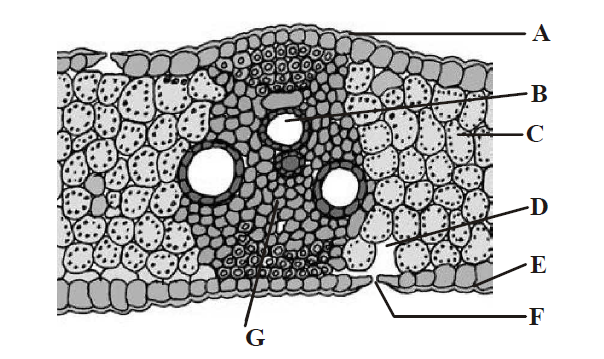
Correct Answer: (a)
A is upper (adaxial) epidermis; xylem is towards the upper surface; mesophyll is undifferentiated; abaxial epidermis is lower with stomata.
A is upper (adaxial) epidermis; xylem is towards the upper surface; mesophyll is undifferentiated; abaxial epidermis is lower with stomata.
Q108. The cross section of a trunk of tree shows 50 annual rings, the age of tree is
Correct Answer: (b)
Since each annual ring represents one year's growth, 50 rings correspond to 50 years.
Since each annual ring represents one year's growth, 50 rings correspond to 50 years.
Q109. Match column-I with column-II and choose the correct option.
Which of the following combination is correct ?
| Column-I | Column-II |
|---|---|
| A. Spring wood or early wood | I. Lighter in colour |
| B. Autumn wood or late wood | II. High density |
| III. Low density | |
| IV. Darker in colour | |
| V. Larger number of xylem elements | |
| VI. Vessels with wider cavity | |
| VII. Lesser number of xylem elements | |
| VIII. Vessels with small cavity |
Which of the following combination is correct ?
Correct Answer: (c)
Spring wood is light, low density, with many wide vessels. Autumn wood is dark, dense, with fewer narrow vessels.
Spring wood is light, low density, with many wide vessels. Autumn wood is dark, dense, with fewer narrow vessels.
Q110. Identify the simple tissue from among the following.
Correct Answer: (a)
Simple tissues like parenchyma consist of only one type of cell; xylem and phloem are complex tissues made of multiple cell types.
Simple tissues like parenchyma consist of only one type of cell; xylem and phloem are complex tissues made of multiple cell types.
Q111. What is the fate of primary xylem in a dicot root showing extensive secondary growth?
Correct Answer: (a)
In roots, the original primary xylem is situated at the very center (exarch) and remains intact at the core as secondary wood is added around it.
In roots, the original primary xylem is situated at the very center (exarch) and remains intact at the core as secondary wood is added around it.
Q112. In the given figure of phloem tissue, identify the marked part (A, B and C) which help in maintaining the pressure gradient in the sieve tubes.
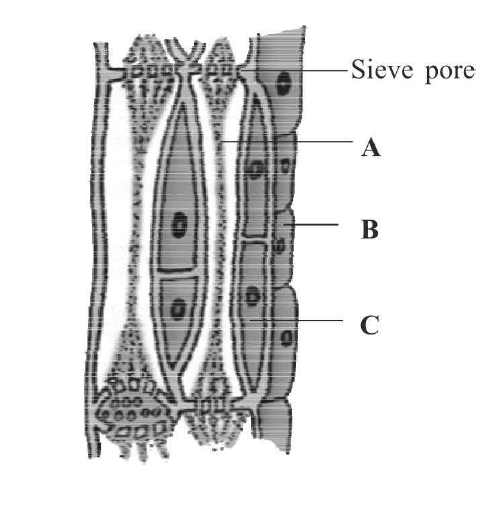
Correct Answer: (c)
Companion cells (marked C) are closely associated with sieve tube elements and maintain the pressure gradient needed for translocation.
Companion cells (marked C) are closely associated with sieve tube elements and maintain the pressure gradient needed for translocation.
Q113. With regard to vessels which of the following statement(s) is/are correct?
1. They are interconnected through perforations is their common walls.
2. The presence of vessels is a characteristic feature of angiosperms.
1. They are interconnected through perforations is their common walls.
2. The presence of vessels is a characteristic feature of angiosperms.
Correct Answer: (c)
Vessels are tube-like structures with perforated end-walls, and they are a diagnostic feature of the Angiosperm group.
Vessels are tube-like structures with perforated end-walls, and they are a diagnostic feature of the Angiosperm group.
Q114. Which of the following statement is correct regarding simple permanent tissue?
Correct Answer: (b)
Sclerenchyma is a dead tissue at maturity, characterized by thick, lignified walls and absence of protoplasm.
Sclerenchyma is a dead tissue at maturity, characterized by thick, lignified walls and absence of protoplasm.
Q115. As secondary growth proceeds, in a dicot stem, the thickness of
Correct Answer: (b)
Over time, the inner layers of sapwood are converted into heartwood, leading to an increase in heartwood thickness.
Over time, the inner layers of sapwood are converted into heartwood, leading to an increase in heartwood thickness.
Q116. Xylem translocates:
Correct Answer: (d)
Xylem primarily transports water and minerals, but also carries dissolved hormones and organic nitrogen compounds.
Xylem primarily transports water and minerals, but also carries dissolved hormones and organic nitrogen compounds.
Q117. In the given columns, column I contain structures of female reproductive system and column II contain its feature. Select the correct match.
| Column-I | Column-II |
|---|---|
| A. Lateral meristem | I. Fascicular vascular cambium, interfascicular cambium and cork cambium. |
| B. Apical meristem | II. Produces dermal tissue, ground tissues and vascular tissue. |
| C. Bast fibres | III. Generally absent in primary phloem but found in secondary phloem. |
| D. Sap wood | IV. Involved in the conduction of water and minerals from the root to leaf. |
Correct Answer: (a)
Lateral meristems include the cambia; apical meristem produces the primary tissue systems; bast fibres are characteristic of secondary phloem; sapwood conducts water.
Lateral meristems include the cambia; apical meristem produces the primary tissue systems; bast fibres are characteristic of secondary phloem; sapwood conducts water.
Q118. The given figure shows the T.S of dicot root. Some parts are marked as A, B, C, D, E, & F. Choose the option which shows the correct labelling of marked part.
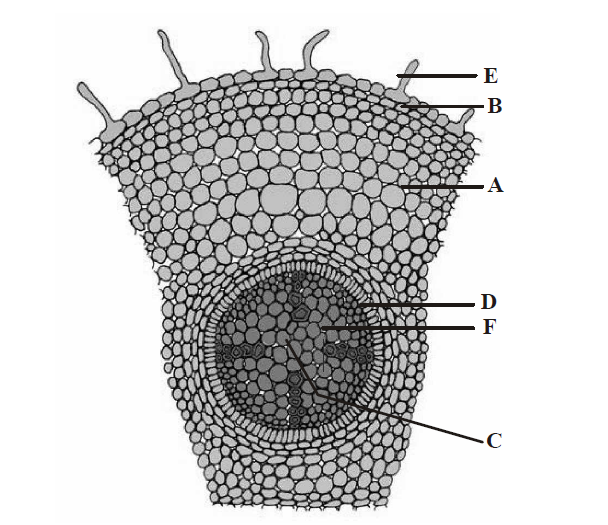
Correct Answer: (a)
A: Epiblema (outer layer), B: Root hair, C: Cortex, D: Endodermis, E: Small central pith, F: Pericycle.
A: Epiblema (outer layer), B: Root hair, C: Cortex, D: Endodermis, E: Small central pith, F: Pericycle.
Q119. A conjoint and open vascular bundle will be observed in the transverse section of
Correct Answer: (d)
Dicot stems are characterized by vascular bundles that are conjoint (xylem and phloem together) and open (containing cambium).
Dicot stems are characterized by vascular bundles that are conjoint (xylem and phloem together) and open (containing cambium).
Q120. Sclerenchyma are usually_________and__________protoplasts.
Correct Answer: (d)
Sclerenchyma cells are typically dead at maturity and lack protoplasm (protoplasts).
Sclerenchyma cells are typically dead at maturity and lack protoplasm (protoplasts).
Q121. Sieve tubes are suited for translocation of food because they possess
Correct Answer: (c)
Sieve tube elements have perforated end walls (sieve plates) and a continuous lumen which allows for the efficient mass flow of nutrients.
Sieve tube elements have perforated end walls (sieve plates) and a continuous lumen which allows for the efficient mass flow of nutrients.
Q122. A plant tissue when stained showed the presence of hemicellulose and pectin in cells wall of its cells. The tissue is called
Correct Answer: (a)
Collenchyma is characterized by cell walls thickened at the corners with cellulose, hemicellulose, and pectin.
Collenchyma is characterized by cell walls thickened at the corners with cellulose, hemicellulose, and pectin.
Q123. Vascular bundles in monocotyledons are considered closed because
Correct Answer: (a)
A 'closed' vascular bundle is one that lacks meristematic cambium tissue between the xylem and phloem.
A 'closed' vascular bundle is one that lacks meristematic cambium tissue between the xylem and phloem.
Q124. Match column-I with column-II and choose the correct option.
| Column -I | Column -II |
|---|---|
| A. Bulliform cells | I. Initiation of lateral roots |
| B. Pericycle | II. Root |
| C. Endarch xylem | III. Grasses |
| D. Exarch xylem | IV. Dicot leaf |
| E. Bundle sheath cells | V. Stem |
Correct Answer: (d)
Bulliform: grasses; Pericycle: lateral root initiation; Endarch: stem; Exarch: root; Bundle sheath: typical of leaves.
Bulliform: grasses; Pericycle: lateral root initiation; Endarch: stem; Exarch: root; Bundle sheath: typical of leaves.
Q125. Interfascicular cambium and cork cambium are formed due to
Correct Answer: (c)
These secondary meristems are formed when mature permanent cells regain the ability to divide through dedifferentiation.
These secondary meristems are formed when mature permanent cells regain the ability to divide through dedifferentiation.
Q126. The given diagram show stomatal apparatus in monocots. Which one is correct option for A, B and C?
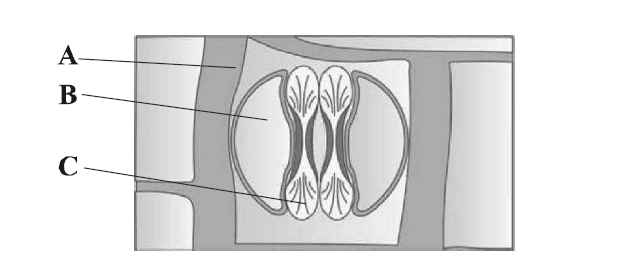
Correct Answer: (d)
In a monocot stoma, A labels the standard epidermal cells, B labels the subsidiary cells, and C labels the dumbbell-shaped guard cells.
In a monocot stoma, A labels the standard epidermal cells, B labels the subsidiary cells, and C labels the dumbbell-shaped guard cells.
Q127. The given figure shows apical meristem of root apex with few part marked as A, B and C. Identify the correct labelling of A, B and C.
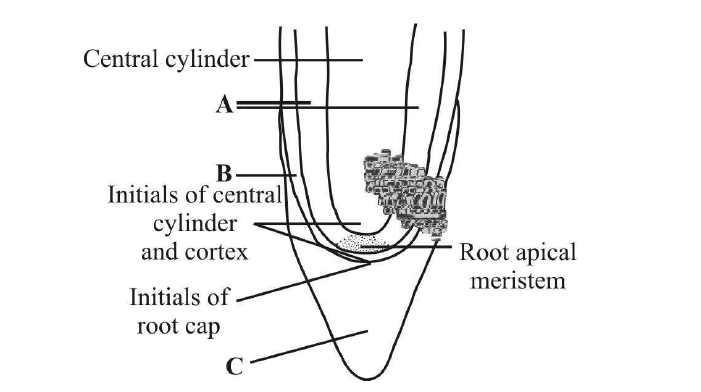
Correct Answer: (c)
In the root apex, A corresponds to the cortex, B is the protoderm (outer layer), and C is the protective root cap.
In the root apex, A corresponds to the cortex, B is the protoderm (outer layer), and C is the protective root cap.
Q128. Anatomically fairly old dicotyledonous root is distinguished from the dicotyledonous stem by
Correct Answer: (b)
Roots are exarch (protoxylem peripheral) while stems are endarch (protoxylem central), a distinction that persists even in older specimens.
Roots are exarch (protoxylem peripheral) while stems are endarch (protoxylem central), a distinction that persists even in older specimens.
Q129. A vessel less piece of stem possessing prominent sieve tubes would belong to
Correct Answer: (d)
Trochodendron is a primitive angiosperm that possesses phloem with sieve tubes but lacks vessels in its xylem.
Trochodendron is a primitive angiosperm that possesses phloem with sieve tubes but lacks vessels in its xylem.
Q130. Match the terms given in column I with their features given in column II and choose the correct option.
| Column-I (Terms) | Column-II (Features) |
|---|---|
| A. Fibres | I. Cells are living and thin walled with cellulosic cell wall, store food materials in the form of starch or fat |
| B. Sclereids | II. Main water conductive cells of the pteridophytes and the gymnosperms |
| C. Tracheids | III. Thick walled, elongated and pointed cells, generally occurring in groups |
| D. Vessels | IV. Long cylindrical tube like structure and cells are devoid of protoplasm. Characteristic feature of angiosperms |
| E. Xylem parenchyma | V. Reduced form of sclerenchyma cells with highly thickened lignified cellular walls that form small bundles of durable layers of tissue in most plants. |
Correct Answer: (b)
Fibres are pointed and grouped; Sclereids are highly thickened; Tracheids conduct in gymnosperms; Vessels are characteristic of angiosperms; Parenchyma is living and stores food.
Fibres are pointed and grouped; Sclereids are highly thickened; Tracheids conduct in gymnosperms; Vessels are characteristic of angiosperms; Parenchyma is living and stores food.
Q131. Secondary xylem and phloem in dicot stem are produced by
Correct Answer: (b)
The vascular cambium is the lateral meristem responsible for producing secondary vascular tissues in dicots.
The vascular cambium is the lateral meristem responsible for producing secondary vascular tissues in dicots.
Q132. Which one of the following statement is incorrect?
Correct Answer:
This is reversed: guard cells are bean-shaped in most dicots and dumbbell-shaped in many monocots like grasses.
This is reversed: guard cells are bean-shaped in most dicots and dumbbell-shaped in many monocots like grasses.
Q133. Cells of this tissue are living and show angular wall thickening. They also provide mechanical support. The tissue is
Correct Answer: (c)
Collenchyma is a living mechanical tissue distinguished by localized (angular) wall thickenings of pectin and cellulose.
Collenchyma is a living mechanical tissue distinguished by localized (angular) wall thickenings of pectin and cellulose.
Q134. T.S. of dicot stem is given below, certain parts have been marked by alphabets (A – I). Choose the option which shows their correct labelling.
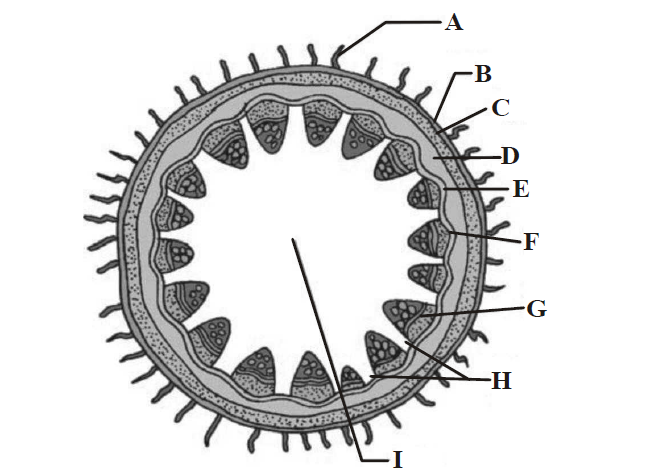
Correct Answer: (b)
The sequence represents dicot stem anatomy: epidermal hair, epidermis, hypodermis, general cortex, starch sheath (endodermis), pericycle, and vascular bundles with pith at the center.
The sequence represents dicot stem anatomy: epidermal hair, epidermis, hypodermis, general cortex, starch sheath (endodermis), pericycle, and vascular bundles with pith at the center.
Q135. Which one of the following have vessels as their characteristic feature?
Correct Answer: (a)
The presence of vessels in the xylem is a diagnostic and characteristic feature of the flowering plants (Angiosperms).
The presence of vessels in the xylem is a diagnostic and characteristic feature of the flowering plants (Angiosperms).
Q136. Consider the following statement :
1. Companion cells maintain the pressure gradient in the sieve tubes.
2. The functions of sieve tubes are controlled by the nucleus of companion cells.
Which of the statements(s) given above is/are correct?
1. Companion cells maintain the pressure gradient in the sieve tubes.
2. The functions of sieve tubes are controlled by the nucleus of companion cells.
Which of the statements(s) given above is/are correct?
Correct Answer: (c)
Since sieve tubes lack a nucleus, companion cells manage their metabolism and maintain the pressure needed for translocation.
Since sieve tubes lack a nucleus, companion cells manage their metabolism and maintain the pressure needed for translocation.
Q137. Which of the following statements are correct?
(i) Xylem transports water and minerals.
(ii) Gymnosperms lack sieve tubes and companion cells in phloem.
(iii) The first formed primary xylem is called metaxylem.
(iv) Phloem fibres (bast fibres) are made up of collenchymatous cells.
(i) Xylem transports water and minerals.
(ii) Gymnosperms lack sieve tubes and companion cells in phloem.
(iii) The first formed primary xylem is called metaxylem.
(iv) Phloem fibres (bast fibres) are made up of collenchymatous cells.
Correct Answer: (b)
Statements (i) and (ii) are true. First formed xylem is protoxylem, and phloem fibres are sclerenchymatous, not collenchymatous.
Statements (i) and (ii) are true. First formed xylem is protoxylem, and phloem fibres are sclerenchymatous, not collenchymatous.
Q138. Which one of the following option shows the correct labelling of the parts marked as A, B, C and D in the given figure of a typical dicot root?
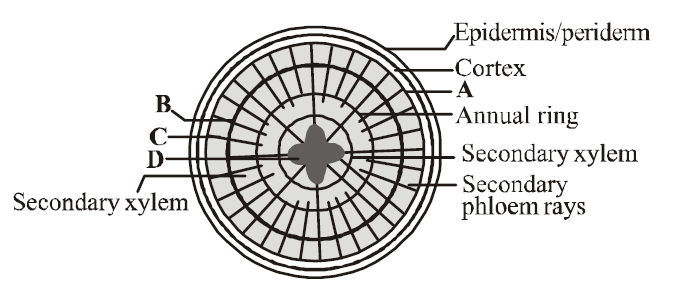
Correct Answer: (a)
In dicot root secondary growth: A is primary phloem (pushed out), B is the cambium ring, C is the new secondary phloem, and D is the original primary xylem at the center.
In dicot root secondary growth: A is primary phloem (pushed out), B is the cambium ring, C is the new secondary phloem, and D is the original primary xylem at the center.
Q139. A narrow layer of thin walled cells found between phloem/ bark and wood of a dicot is
Correct Answer: (b)
Vascular cambium is a meristematic layer situated between the wood (secondary xylem) and phloem/bark.
Vascular cambium is a meristematic layer situated between the wood (secondary xylem) and phloem/bark.
Q140. Match the followings and choose the correct option from below.
| A. Meristem | (i) photosynthesis, storage |
| B. Parenchyma | (ii) mechanical support |
| C. Collenchyma | (iii) actively dividing cells |
| D. Sclerenchyma | (iv) stomata |
| E. Epidermal tissue | (v) sclereids |
Correct Answer: (b)
Meristem divides; Parenchyma is metabolic; Collenchyma provides support; Sclerenchyma contains sclereids; Epidermis contains stomata.
Meristem divides; Parenchyma is metabolic; Collenchyma provides support; Sclerenchyma contains sclereids; Epidermis contains stomata.
Q141. The roots that originate from the base of the stem are
Correct Answer: (d)
In monocots, the primary root is short-lived and is replaced by many roots arising from the base of the stem, forming a fibrous root system.
In monocots, the primary root is short-lived and is replaced by many roots arising from the base of the stem, forming a fibrous root system.
Q142. In an experiment, a student cut a transverse section of young stem of a plant which he has taken from his school garden. After observing it under the microscope how would he ascertain whether it is a monocot stem or a dicot stem?
Correct Answer: (c)
Dicot stems have vascular bundles arranged in a ring; monocot stems have bundles scattered throughout the ground tissue.
Dicot stems have vascular bundles arranged in a ring; monocot stems have bundles scattered throughout the ground tissue.
Q143. A transverse section of stem is stained first with safranin and then with fast green following the usual schedule of double staining for the preparation of a permanent slide. What would be the colour of the stained xylem and phloem?
Correct Answer: (a)
Safranin is a basic dye that stains lignified tissues (xylem) red, whereas fast green is an acidic dye that stains non-lignified tissues (phloem) green.
Safranin is a basic dye that stains lignified tissues (xylem) red, whereas fast green is an acidic dye that stains non-lignified tissues (phloem) green.
Q144. In dicot root
Correct Answer: (c)
Dicot roots exhibit a radial arrangement where xylem and phloem are located on separate radii.
Dicot roots exhibit a radial arrangement where xylem and phloem are located on separate radii.
Q145. Read the different components from (A) to (D) in the list given below and tell the correct order of the components with reference to their arrangement from outer side to inner side in a woody dicot stem.
(A) Secondary cortex
(B) Wood
(C) Secondary phloem
(D) Phellem
(A) Secondary cortex
(B) Wood
(C) Secondary phloem
(D) Phellem
Correct Answer: (b)
The correct sequence from outside to inside is Phellem (cork), Phelloderm (secondary cortex), Secondary phloem, and finally Wood (secondary xylem).
The correct sequence from outside to inside is Phellem (cork), Phelloderm (secondary cortex), Secondary phloem, and finally Wood (secondary xylem).
Q146. Match the following and choose the correct option from below.
| A. Cuticle | (i) guard cells |
| B. Bulliform cells | (ii) single layer |
| C. Stomata | (iii) waxy layer |
| D. Epidermis | (iv) empty colourless cell |
Correct Answer: (a)
Cuticle is waxy; bulliform cells are empty and colorless; stomata have guard cells; epidermis is typically a single layer.
Cuticle is waxy; bulliform cells are empty and colorless; stomata have guard cells; epidermis is typically a single layer.
Q147. Monocot leaves possess
Correct Answer: (a)
Monocot leaves often have intercalary meristems at the base of the blade which allow for regrowth if the tip is damaged or eaten.
Monocot leaves often have intercalary meristems at the base of the blade which allow for regrowth if the tip is damaged or eaten.
Q148. Cambium is considered as a lateral meristem because
Correct Answer: (b)
Lateral meristems act parallel to the organ's circumference and cause thickening (girth increase) rather than elongation.
Lateral meristems act parallel to the organ's circumference and cause thickening (girth increase) rather than elongation.
Q149. Match the names of the structures given in column-I with the functions given in column-II, choose the answer which gives the correct combination of the two columns :
| Column-I (Structure) | Column-II (Function) |
|---|---|
| A. Stomata | I. Protection of stem |
| B. Bark | II. Plant movement |
| C. Cambium | III. Secondary growth |
| D. Cuticle | IV. Transpiration |
| V. Prevent the loss of water |
Correct Answer: (d)
Stomata facilitate transpiration; bark protects; cambium drives secondary growth; cuticle prevents water loss.
Stomata facilitate transpiration; bark protects; cambium drives secondary growth; cuticle prevents water loss.