Q1. Energy required for ATP synthesis in PS II comes from
Correct Answer: (a)
The energy for ATP synthesis is derived from the potential energy stored in the transmembrane proton gradient.
The energy for ATP synthesis is derived from the potential energy stored in the transmembrane proton gradient.
Q2. A plant in your garden avoids photorespiratory losses, has improved water use efficiency, shows high rates of photosynthesis at high temperatures and has improved efficiency of nitrogen utilisation. In which of the following physiological groups would you assign this plant?
Correct Answer: (b)
These characteristics are the defining physiological advantages of C4 plants over C3 plants.
These characteristics are the defining physiological advantages of C4 plants over C3 plants.
Q3. In photosynthesis, protons accumulate in the:
Correct Answer: (c)
Protons are pumped from the stroma into the thylakoid lumen during electron transport, creating a high concentration (low pH) in the lumen.
Protons are pumped from the stroma into the thylakoid lumen during electron transport, creating a high concentration (low pH) in the lumen.
Q4. Which is the primary CO2 fixation product in C4 plant?
Correct Answer: (b)
C4 plants are named so because the first stable product formed by CO2 fixation is the 4-carbon Oxaloacetic acid.
C4 plants are named so because the first stable product formed by CO2 fixation is the 4-carbon Oxaloacetic acid.
Q5. All of the following statements are incorrect for non-cyclic electron transport system, except:
Correct Answer: (b)
Photolysis of 2H2O → 4H+ + 4e– + O2. This oxidation happens in the Oxygen Evolving Complex associated with PSII.
Photolysis of 2H2O → 4H+ + 4e– + O2. This oxidation happens in the Oxygen Evolving Complex associated with PSII.
Q6. Photophosphorylation in chloroplast is most similar to the:
Correct Answer: (b)
Both processes utilize an electron transport chain to create a proton gradient that drives ATP synthesis through ATP synthase.
Both processes utilize an electron transport chain to create a proton gradient that drives ATP synthesis through ATP synthase.
Q7. Which light range is most effective in photosynthesis?
Correct Answer: (c)
While blue light is absorbed, red light is the most efficient wavelength for driving photosynthesis per unit of absorbed energy.
While blue light is absorbed, red light is the most efficient wavelength for driving photosynthesis per unit of absorbed energy.
Q8. Match the scientists given in column-1 with their work, given in column-II & select the correct answer using the codes given below.
| Column-I | Column-II |
|---|---|
| A. Priestley | I. Determined the action spectrum of chlorophyll |
| B. Jan Ingenhousz | II. Provided evidence that in green parts of plant glucose is made & stored as starch |
| C. Sachs | III. Plants purify air only in the presence of light |
| D. Engelmann | IV. Demonstrated that photosynthesis is essentially a light dependent reaction |
| E. Niel | V. Revealed the essential role of air in the growth of plants |
Correct Answer: (a)
Priestley (Air purification), Ingen-Housz (Sunlight requirement), Sachs (Glucose/Starch evidence), Engelmann (Action spectrum), Niel (Light dependent reaction/Hydrogen donor).
Priestley (Air purification), Ingen-Housz (Sunlight requirement), Sachs (Glucose/Starch evidence), Engelmann (Action spectrum), Niel (Light dependent reaction/Hydrogen donor).
Q9. Which range of wavelength (in nm) is called Photosynthetically Active Radiation (PAR)?
Correct Answer: (c)
PAR covers the visible spectrum from 400 nm to 700 nm, which plants use for photosynthesis.
PAR covers the visible spectrum from 400 nm to 700 nm, which plants use for photosynthesis.
Q10. Cyclic and non-cyclic flow of e– is used in plants to:
Correct Answer: (d)
Non-cyclic flow produces both ATP and NADPH, while cyclic flow produces only extra ATP, allowing the cell to maintain the correct ratio needed for carbon fixation.
Non-cyclic flow produces both ATP and NADPH, while cyclic flow produces only extra ATP, allowing the cell to maintain the correct ratio needed for carbon fixation.
Q11. Oxygen is not produced during photosynthesis by:
Correct Answer: (a)
Anoxygenic photosynthetic bacteria like green sulphur bacteria use H2S as a hydrogen donor, releasing sulphur instead of oxygen.
Anoxygenic photosynthetic bacteria like green sulphur bacteria use H2S as a hydrogen donor, releasing sulphur instead of oxygen.
Q12. Photosynthesis is important because:
(a) it is the primary source of food on earth.
(b) it is responsible for release of O2 into the atmosphere by green plants.
(c) it is responsible for release of water vapour into the atmosphere.
(a) it is the primary source of food on earth.
(b) it is responsible for release of O2 into the atmosphere by green plants.
(c) it is responsible for release of water vapour into the atmosphere.
Correct Answer: (d)
Photosynthesis is the basis of all life on earth as the primary food source and it releases oxygen, which is essential for aerobic respiration.
Photosynthesis is the basis of all life on earth as the primary food source and it releases oxygen, which is essential for aerobic respiration.
Q13. A student sets up an experiment on photosynthesis as follows: He takes soda water in a glass tumbler and add chlorophyll extracts into the contents and keeps the tumbler exposed to sunlight hoping that he has provided necessary ingredients for photosynthesis to proceed (viz., CO2, H2O, chlorophyll and light). What do you think what will happen after, few hours of exposure of light?
Correct Answer: (d)
Photosynthesis is not just a chemical mixture; it requires a highly organized membrane system (intact chloroplasts) to create the necessary proton gradients and light harvesting structures.
Photosynthesis is not just a chemical mixture; it requires a highly organized membrane system (intact chloroplasts) to create the necessary proton gradients and light harvesting structures.
Q14. With reference to factors affecting the rate of photosynthesis, which of the following statements is not correct ?
Correct Answer: (b)
Statement (b) is incorrect because C4 plants actually have a higher temperature optimum than C3 plants.
Statement (b) is incorrect because C4 plants actually have a higher temperature optimum than C3 plants.
Q15. The total requirement of ATP & NADPH for each molecule of CO2 fixed & reduced in photosynthesis in the Calvin cycle is
Correct Answer: (c)
Per CO2 molecule fixed, the Calvin cycle consumes 3 molecules of ATP (2 in reduction, 1 in regeneration) and 2 molecules of NADPH (in reduction).
Per CO2 molecule fixed, the Calvin cycle consumes 3 molecules of ATP (2 in reduction, 1 in regeneration) and 2 molecules of NADPH (in reduction).
Q16. No. of carbons in the primary CO2 fixation product of C4 plant is
Correct Answer: (c)
The primary product of CO2 fixation in C4 plants is Oxaloacetic acid (OAA), which is a 4-carbon organic acid.
The primary product of CO2 fixation in C4 plants is Oxaloacetic acid (OAA), which is a 4-carbon organic acid.
Q17. In an experiment, the CO2 available to a C4 plant was labelled with a radioactive isotope and the amount of radioactivity in the chloroplast was measured. As photosynthesis preceeded, in which of the following molecules did the radioactivity first appear?
Correct Answer: (a)
In C4 plants, the first stable organic compound to incorporate radioactive carbon is the 4-carbon oxaloacetic acid.
In C4 plants, the first stable organic compound to incorporate radioactive carbon is the 4-carbon oxaloacetic acid.
Q18. Assume a thylakoid is somehow punctured so that the interior of the thylakoid is no longer separated from the stroma. This damage will have the most direct effect on which of the following processes?
Correct Answer: (d)
ATP synthesis depends on the maintenance of a high proton concentration in the thylakoid lumen relative to the stroma. Puncturing the membrane allows protons to leak out, destroying the gradient and stopping ATP production.
ATP synthesis depends on the maintenance of a high proton concentration in the thylakoid lumen relative to the stroma. Puncturing the membrane allows protons to leak out, destroying the gradient and stopping ATP production.
Q19. Which of the following is not a product of light reaction of photosynthesis?
Correct Answer: (b)
The light reaction produces NADPH (the reduced form of NADP+). NADH is a carrier used in cellular respiration, not photosynthesis.
The light reaction produces NADPH (the reduced form of NADP+). NADH is a carrier used in cellular respiration, not photosynthesis.
Q20. Consider the following statements:
(1) In C4 plants, the mesophyll cells lack RuBisCO enzyme.
(2) The basic pathway in the formation of the sugars is common to the C3 and C4 plants.
(3) The C4 plants lack a process called photorespiration.
(1) In C4 plants, the mesophyll cells lack RuBisCO enzyme.
(2) The basic pathway in the formation of the sugars is common to the C3 and C4 plants.
(3) The C4 plants lack a process called photorespiration.
Correct Answer: (d)
All three statements are fundamental characteristics of C4 plants and their highly efficient metabolic pathway.
All three statements are fundamental characteristics of C4 plants and their highly efficient metabolic pathway.
Q21. With regard to the RuBisCO, which of the following statement(s) is/are correct?
(1) It has a similar affinity for both CO2 and O2.
(2) It is the most abundant protein present on earth.
(3) The relative concentration of O2 and CO2 determines which of the two will bind to the enzyme.
(1) It has a similar affinity for both CO2 and O2.
(2) It is the most abundant protein present on earth.
(3) The relative concentration of O2 and CO2 determines which of the two will bind to the enzyme.
Correct Answer: (b)
RuBisCO has a much higher affinity for CO2 than O2. It is the most abundant protein, and binding depends on relative gas concentrations.
RuBisCO has a much higher affinity for CO2 than O2. It is the most abundant protein, and binding depends on relative gas concentrations.
Q22. Which of the following statements given below is incorrect ?
Correct Answer: (d)
Water stress causes stomata to close, which reduces CO2 availability and lowers the rate of photosynthesis.
Water stress causes stomata to close, which reduces CO2 availability and lowers the rate of photosynthesis.
Q23. By looking at which internal structure of a plant can you tell whether a plant is C3 or C4?
Correct Answer: (a)
C4 plants exhibit a specialized leaf anatomy called Kranz anatomy, characterized by prominent bundle sheath cells arranged like a wreath around vascular bundles.
C4 plants exhibit a specialized leaf anatomy called Kranz anatomy, characterized by prominent bundle sheath cells arranged like a wreath around vascular bundles.
Q24. By which of the following complex, proton is pumped to reach ATP synthase, to participate in ATP synthesis?
Correct Answer: (a)
The cytochrome b6f complex uses energy from electron flow to pump protons from the stroma into the thylakoid lumen.
The cytochrome b6f complex uses energy from electron flow to pump protons from the stroma into the thylakoid lumen.
Q25. Bundle sheath cells:
Correct Answer: (a)
Bundle sheath cells contain high concentrations of RuBisCO to perform the Calvin cycle, but they lack PEPcase.
Bundle sheath cells contain high concentrations of RuBisCO to perform the Calvin cycle, but they lack PEPcase.
Q26. Which of the following is not concern with cyclic photophosphorylation?
Correct Answer: (a)
Oxygen is only liberated during non-cyclic photophosphorylation because that is where the water-splitting PSII is active.
Oxygen is only liberated during non-cyclic photophosphorylation because that is where the water-splitting PSII is active.
Q27. Chromatophores take part in:
Correct Answer: (d)
In prokaryotes, chromatophores are pigment-containing internal membrane structures that perform photosynthesis.
In prokaryotes, chromatophores are pigment-containing internal membrane structures that perform photosynthesis.
Q28. Match the column-1 with column II and choose the correct answer using the codes given below.
| Column-I | Column-II |
|---|---|
| A. Emerson effect | I. C4 cycle |
| B. Hill reaction | II. Photolysis |
| C. Calvin cycle | III. C3 cycle |
| D. Hatch & Slack cycle | IV. Photosystem I & II |
Correct Answer: (d)
Emerson effect (evidence for two photosystems), Hill reaction (photolysis of water), Calvin cycle (C3 pathway), Hatch & Slack (C4 pathway).
Emerson effect (evidence for two photosystems), Hill reaction (photolysis of water), Calvin cycle (C3 pathway), Hatch & Slack (C4 pathway).
Q29. In a chloroplast, the highest number of protons are found in
Correct Answer: (b)
During light reactions, protons are actively pumped into the thylakoid lumen, making it the area with the highest concentration and lowest pH.
During light reactions, protons are actively pumped into the thylakoid lumen, making it the area with the highest concentration and lowest pH.
Q30. Identify the correct statements for ATP synthase:
(i) This enzyme consists of two parts: hydrophobic membrane bound portion called F0 & a portion that sticks out into stroma called F1.
(ii) F0 appears to form a channel across the membrane through which proton can pass.
(iii) The conformational change in the F1 portion of the complex synthesizes ATP.
(iv) The proton motive force that drives the synthesis of ATP is associated with this enzyme.
(i) This enzyme consists of two parts: hydrophobic membrane bound portion called F0 & a portion that sticks out into stroma called F1.
(ii) F0 appears to form a channel across the membrane through which proton can pass.
(iii) The conformational change in the F1 portion of the complex synthesizes ATP.
(iv) The proton motive force that drives the synthesis of ATP is associated with this enzyme.
Correct Answer: (b)
Statement (iii) is slightly incomplete; it's the passage of protons through the channel and the resulting rotation/conformational change in the F1 head that leads to ATP synthesis from ADP and Pi.
Statement (iii) is slightly incomplete; it's the passage of protons through the channel and the resulting rotation/conformational change in the F1 head that leads to ATP synthesis from ADP and Pi.
Q31. In a crop field a weedicide is used to remove weeds in order to increase the yield. But the effect of this weedicide is that, it blocks electron transport from photosystem II to photosystem I. This will result in
Correct Answer: (d)
Blocking electron flow stops both the establishment of the proton gradient (no ATP) and the arrival of electrons at PSI (no NADPH).
Blocking electron flow stops both the establishment of the proton gradient (no ATP) and the arrival of electrons at PSI (no NADPH).
Q32. In C3 plant, when O2 concentration is more, the O2 binds to RuBisCo and RuBP gets changed to
Correct Answer: (d)
In the oxygenase reaction of RuBisCO, RuBP reacts with O2 to form one molecule of 3-PGA and one molecule of 2-phosphoglycolate.
In the oxygenase reaction of RuBisCO, RuBP reacts with O2 to form one molecule of 3-PGA and one molecule of 2-phosphoglycolate.
Q33. An energy diagram for the transfer of electrons in the light reactions of photosynthesis in plants is:
Correct Answer: (c)
The specific zigzag shape of the energy level diagram of electron transport in the light reaction is called the Z-scheme.
The specific zigzag shape of the energy level diagram of electron transport in the light reaction is called the Z-scheme.
Q34. Assume the thylakoid membrane within a chloroplast is punctured so that there is no separation between lumen & stroma of thylakoid. Which of these process would be most affected?
Correct Answer: (b)
Without a membrane barrier, a proton gradient cannot be maintained. Since the gradient drives ATP synthesis via chemiosmosis, ATP production will fail.
Without a membrane barrier, a proton gradient cannot be maintained. Since the gradient drives ATP synthesis via chemiosmosis, ATP production will fail.
Q35. Emerson’s enhancement effect and Red drop have been instrumental in the discovery of
Correct Answer: (b)
Emerson showed that photosynthesis rate is higher when two wavelengths of light are given together, proving the existence of two linked photosystems.
Emerson showed that photosynthesis rate is higher when two wavelengths of light are given together, proving the existence of two linked photosystems.
Q36. Cooperation of the two photosystems of the chloroplast is required for:
Correct Answer: (b)
Non-cyclic electron transport (Z-scheme) requires both PSII (to split water and start electron flow) and PSI (to ultimately reduce NADP+ to NADPH).
Non-cyclic electron transport (Z-scheme) requires both PSII (to split water and start electron flow) and PSI (to ultimately reduce NADP+ to NADPH).
Q37. Which of the following statement is incorrect regarding pigments?
Correct Answer: (b)
Chlorophyll a is the chief pigment of photosynthesis. Chlorophyll b is an accessory pigment.
Chlorophyll a is the chief pigment of photosynthesis. Chlorophyll b is an accessory pigment.
Q38. Which of the following statement(s) is/are correct about RuBisCO?
Correct Answer: (d)
RuBisCO (Ribulose-1,5-bisphosphate carboxylase-oxygenase) is a dual-function enzyme that is the most widespread and abundant protein globally.
RuBisCO (Ribulose-1,5-bisphosphate carboxylase-oxygenase) is a dual-function enzyme that is the most widespread and abundant protein globally.
Q39. A process that creates an important difference between C3 & C4 plants is called____________.
Correct Answer: (c)
The ability to minimize photorespiration is the primary physiological distinction that makes C4 plants more efficient than C3 plants.
The ability to minimize photorespiration is the primary physiological distinction that makes C4 plants more efficient than C3 plants.
Q40. Which of the following is incorrectly matched?
Correct Answer: (b)
P700 is the reaction center of Photosystem I. PSII uses P680.
P700 is the reaction center of Photosystem I. PSII uses P680.
Q41. Anoxygenic photosynthesis is characteristic of:
Correct Answer: (a)
Purple non-sulphur bacteria like Rhodospirillum perform photosynthesis using hydrogen from compounds other than water, so no oxygen is evolved.
Purple non-sulphur bacteria like Rhodospirillum perform photosynthesis using hydrogen from compounds other than water, so no oxygen is evolved.
Q42. The correct sequence of flow of electrons in the light reaction is:
Correct Answer: (a)
Electrons flow from water to PSII, then to Plastoquinone, through the Cytochrome b6f complex, to PSI, and finally to Ferredoxin/NADP+.
Electrons flow from water to PSII, then to Plastoquinone, through the Cytochrome b6f complex, to PSI, and finally to Ferredoxin/NADP+.
Q43. Dark reaction in photosynthesis is called so because:
Correct Answer: (b)
The dark reaction is called so because it is not directly light-driven, although it depends on the ATP and NADPH produced during the light reaction.
The dark reaction is called so because it is not directly light-driven, although it depends on the ATP and NADPH produced during the light reaction.
Q44. Which one of the following statement is incorrect in relation to photorespiration?
Correct Answer: (c)
Photorespiration does not produce ATP or NADPH; instead, it consumes ATP and releases CO2, making it a wasteful process.
Photorespiration does not produce ATP or NADPH; instead, it consumes ATP and releases CO2, making it a wasteful process.
Q45. Site of photosynthesis in C4 plant is:
Correct Answer: (c)
In C4 plants, the reactions are split between mesophyll cells (initial fixation) and bundle sheath cells (Calvin cycle).
In C4 plants, the reactions are split between mesophyll cells (initial fixation) and bundle sheath cells (Calvin cycle).
Q46. Match the parts given in column I with the events given in column II and choose the correct combination from the options given below.
| Column-I | Column-II |
|---|---|
| A. Grana of chloroplast | I. Kreb's cycle |
| B. Stroma of chloroplast | II. Light reaction |
| C. Cytoplasm | III. Dark reaction |
| D. Mitochondrial matrix | IV. Glycolysis |
Correct Answer: (d)
Grana (Light reaction), Stroma (Dark reaction), Cytoplasm (Glycolysis), Mitochondrial Matrix (Kreb's cycle).
Grana (Light reaction), Stroma (Dark reaction), Cytoplasm (Glycolysis), Mitochondrial Matrix (Kreb's cycle).
Q47. Which of the following is used as an experimental material for making rapid advances in tracing path of carbon in Calvin cycle & other photosynthetic research ?
Correct Answer: (a)
Calvin used unicellular green algae like Chlorella and Scenedesmus in his radioactive carbon labeling experiments.
Calvin used unicellular green algae like Chlorella and Scenedesmus in his radioactive carbon labeling experiments.
Q48. ATP synthesis, in photosynthesis involves the:
Correct Answer: (a)
ATP synthesis is coupled to the establishment of a proton (H+) gradient across the thylakoid membrane.
ATP synthesis is coupled to the establishment of a proton (H+) gradient across the thylakoid membrane.
Q49. During monsoon, the rice crop of eastern states of India shows lesser yield due to limiting factor of
Correct Answer: (b)
During the monsoon, cloudy skies reduce the amount of sunlight, making light the limiting factor for crop productivity.
During the monsoon, cloudy skies reduce the amount of sunlight, making light the limiting factor for crop productivity.
Q50. Which part of the plant do not perform photosynthesis?
Correct Answer: (d)
Typical epidermal cells of a leaf lack chloroplasts (except for guard cells) and therefore do not perform photosynthesis.
Typical epidermal cells of a leaf lack chloroplasts (except for guard cells) and therefore do not perform photosynthesis.
Q51. Which pigment acts directly to convert light energy to chemical energy ?
Correct Answer: (a)
Chlorophyll a is the only pigment capable of the primary photochemical event in the reaction center.
Chlorophyll a is the only pigment capable of the primary photochemical event in the reaction center.
Q52. Why, at higher light intensities, gradually photosynthesis rate does not show further increase?
Correct Answer: (d)
Once light is no longer the limiting factor, the rate is restricted by other variables such as CO2 concentration or temperature.
Once light is no longer the limiting factor, the rate is restricted by other variables such as CO2 concentration or temperature.
Q53. One of the earliest experiments on photosynthesis was done in 1770 by Joseph Priestley. He demonstrated that:
Correct Answer: (c)
Priestley's experiments with a bell jar, candle, mint plant, and mouse showed that plants restore to the air whatever breathing animals and burning candles remove.
Priestley's experiments with a bell jar, candle, mint plant, and mouse showed that plants restore to the air whatever breathing animals and burning candles remove.
Q54. Two groups of isolated thylakoids are placed in an acidic bathing solution so that H+ diffuses into the thylakoids. They are then transferred to a basic bathing solution, and one group is placed in the light, while the other group is kept in the dark. Select the choice given below that describes what you expect each group of thylakoids to produce.
| In Light | In Dark | |
|---|---|---|
| (a) | ATP only | Nothing |
| (b) | ATP, O2 | ATP only |
| (c) | ATP, O2, glucose | ATP, O2 |
| (d) | ATP, O2 | O2 |
Correct Answer: (b)
The pre-established pH gradient (acidic inside, basic outside) allows for ATP synthesis via chemiosmosis even in the dark. In light, the thylakoids will also split water and produce O2.
The pre-established pH gradient (acidic inside, basic outside) allows for ATP synthesis via chemiosmosis even in the dark. In light, the thylakoids will also split water and produce O2.
Q55. What is/are the function(s) of accessory pigments?
Correct Answer: (d)
Accessory pigments (chlorophyll b, xanthophylls, and carotenoids) broaden the absorption spectrum and protect the primary pigment, chlorophyll a, from damage by intense light.
Accessory pigments (chlorophyll b, xanthophylls, and carotenoids) broaden the absorption spectrum and protect the primary pigment, chlorophyll a, from damage by intense light.
Q56. Reduction of NADP+ into NADPH during light reaction occurs in stroma because:
Correct Answer: (a)
The NADP reductase enzyme is located on the stromal side of the thylakoid membrane, so the final reduction happens in the stroma.
The NADP reductase enzyme is located on the stromal side of the thylakoid membrane, so the final reduction happens in the stroma.
Q57. Which of the following statements (i-iv) regarding “Splitting of water” is/are correct?
(i) It is photolysis of water which provides H+ ions for synthesis of NADPH.
(ii) It provides electrons for photophosphorylation & activation of NADP+.
(iii) O2 is evolved during this process.
(iv) It replenishes O2 consumed by living beings and combustion.
(i) It is photolysis of water which provides H+ ions for synthesis of NADPH.
(ii) It provides electrons for photophosphorylation & activation of NADP+.
(iii) O2 is evolved during this process.
(iv) It replenishes O2 consumed by living beings and combustion.
Correct Answer: (d)
All given statements correctly describe the role and outcomes of the photolysis of water in photosynthesis.
All given statements correctly describe the role and outcomes of the photolysis of water in photosynthesis.
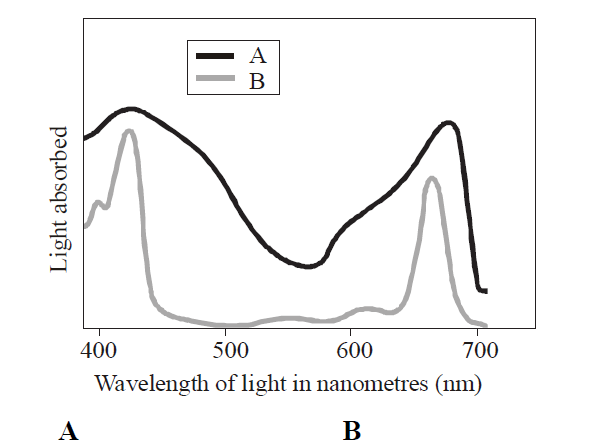
Q58. Study the given graph which shows the action spectrum of A. Superimposed on B spectrum of chlorophyll a. Identify A & B in the graph.
| A | B | |
|---|---|---|
| (a) | Rate of respiration | Action spectrum |
| (b) | Rate of respiration | Absorption |
| (c) | Rate of photosynthesis | Action spectrum |
| (d) | Rate of photosynthesis | Absorption |
Correct Answer: (c)
The graph shows that the rate of photosynthesis (A) closely follows the absorption spectrum (B) of pigments like chlorophyll a, creating the action spectrum.
The graph shows that the rate of photosynthesis (A) closely follows the absorption spectrum (B) of pigments like chlorophyll a, creating the action spectrum.
Q59. Water soluble pigments found in plant cell vacuoles are:
Correct Answer: (d)
Anthocyanins are water-soluble pigments (providing red/purple/blue colors) stored in the vacuole, unlike chlorophylls and carotenoids which are lipid-soluble and in plastids.
Anthocyanins are water-soluble pigments (providing red/purple/blue colors) stored in the vacuole, unlike chlorophylls and carotenoids which are lipid-soluble and in plastids.
Q60. With regard to the electron transport during photosynthesis, consider the following statements:
(1) The movement of electrons is downhill, in terms of redox potential scale.
(2) The electrons are used up as they pass through the electron transport chain.
(1) The movement of electrons is downhill, in terms of redox potential scale.
(2) The electrons are used up as they pass through the electron transport chain.
Correct Answer: (a)
Statement (1) is correct regarding movement between carriers. (2) is incorrect because electrons are eventually transferred to NADP+, not 'used up'.
Statement (1) is correct regarding movement between carriers. (2) is incorrect because electrons are eventually transferred to NADP+, not 'used up'.
Q61. Which of following ratio is correct for the production of one molecule of glucose through 6 rounds of Calvin cycle?
| CO2 | ATP | NADPH2 | |
|---|---|---|---|
| (a) | 1 | 2 | 2 |
| (b) | 6 | 18 | 12 |
| (c) | 6 | 12 | 18 |
| (d) | 5 | 6 | 9 |
Correct Answer: (b)
To produce 1 molecule of glucose (6C), 6 cycles are needed, consuming $6 imes 3 = 18$ ATP and $6 imes 2 = 12$ NADPH.
To produce 1 molecule of glucose (6C), 6 cycles are needed, consuming $6 imes 3 = 18$ ATP and $6 imes 2 = 12$ NADPH.
Q62. Which of the following statement is incorrect?
Correct Answer: (b)
In the Z-scheme, electron movement is both uphill (when excited by light) and downhill (along the ETC carriers) in terms of the redox potential scale.
In the Z-scheme, electron movement is both uphill (when excited by light) and downhill (along the ETC carriers) in terms of the redox potential scale.
Q63. At which wavelength cyclic phosphorylation occurs?
Correct Answer: (b)
Cyclic photophosphorylation only involves PSI, which can be activated by light of wavelengths longer than 680 nm where PSII (required for non-cyclic) is inactive.
Cyclic photophosphorylation only involves PSI, which can be activated by light of wavelengths longer than 680 nm where PSII (required for non-cyclic) is inactive.
Q64. During light reaction in photosynthesis the following are formed:
Correct Answer: (c)
The primary products are ATP, NADPH (the hydrogen donor), and oxygen (released as a byproduct).
The primary products are ATP, NADPH (the hydrogen donor), and oxygen (released as a byproduct).
Q65. The chemiosmotic mechanism mediates:
Correct Answer: (a)
Peter Mitchell's chemiosmotic theory explains how a proton gradient across the thylakoid membrane drives the synthesis of ATP.
Peter Mitchell's chemiosmotic theory explains how a proton gradient across the thylakoid membrane drives the synthesis of ATP.
Q66. The reaction that is responsible for the primary fixation of CO2 is catalysed by:
Correct Answer: (c)
Depending on the plant type (C3 or C4), the primary fixation is done by either RuBisCO or PEPcase.
Depending on the plant type (C3 or C4), the primary fixation is done by either RuBisCO or PEPcase.
Q67. In C4 plants, the process by which C4 acid is converted into C3 acid in the bundle sheath cell is known as
Correct Answer: (d)
C4 acids are decarboxylated in bundle sheath cells to release CO2 and a 3-carbon pyruvate.
C4 acids are decarboxylated in bundle sheath cells to release CO2 and a 3-carbon pyruvate.
Q68. Which one of the following statement correctly describes the cyclic photophosphorylation?
Correct Answer: (d)
In cyclic flow, electrons expelled from the reaction center of PSI are passed through carriers and eventually returned back to the same reaction center.
In cyclic flow, electrons expelled from the reaction center of PSI are passed through carriers and eventually returned back to the same reaction center.
Q69. Fixation of CO2 molecule through Hatch and Slack pathway requires an enzyme called _________ .
Correct Answer: (a)
The enzyme PEP carboxylase (PEPcase) performs the initial CO2 fixation in C4 plants.
The enzyme PEP carboxylase (PEPcase) performs the initial CO2 fixation in C4 plants.
Q70. With regard to the proton gradient associated with chloroplasts, consider the following statements:
(1) Within the chloroplast, protons in the stroma increase in number than the lumen.
(2) The gradient is broken down due to the movement of electrons across the membrane.
(1) Within the chloroplast, protons in the stroma increase in number than the lumen.
(2) The gradient is broken down due to the movement of electrons across the membrane.
Correct Answer: (d)
Both are incorrect. Protons increase in the lumen, and the gradient is broken down by the movement of protons through ATP synthase.
Both are incorrect. Protons increase in the lumen, and the gradient is broken down by the movement of protons through ATP synthase.
Q71. The given figure shows the diagrammatic representation of the Hatch & Slack pathway few labelling are marked as P, Q and R.
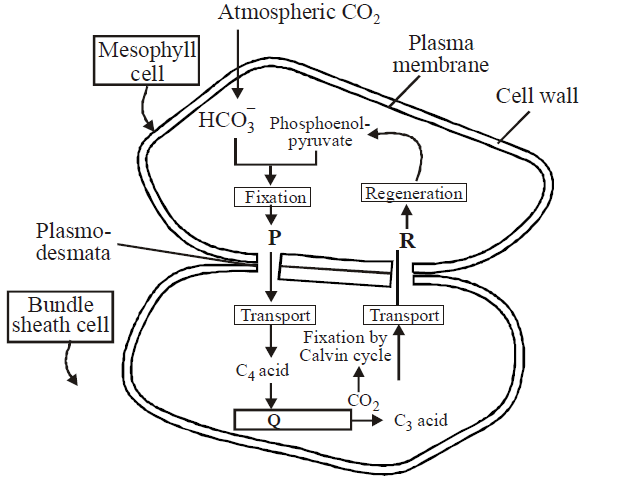
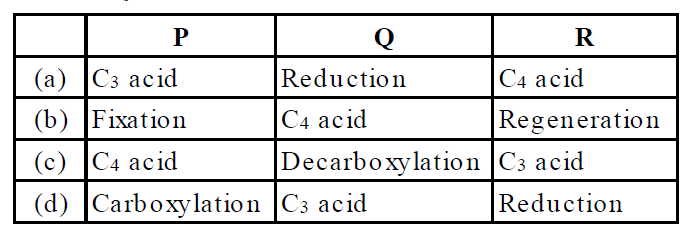
Which of the following option shows the correct labeling of P, Q, and R?
Which of the following option shows the correct labeling of P, Q, and R?
Correct Answer: (b)
In C4 plants: Atmospheric CO2 is fixed (P) into a C4 acid (Q). After transport and decarboxylation, the residue returns to complete regeneration (R).
In C4 plants: Atmospheric CO2 is fixed (P) into a C4 acid (Q). After transport and decarboxylation, the residue returns to complete regeneration (R).
Q72. Chlorophyll is suited for the capture of light energy because:
Correct Answer: (d)
Chlorophyll absorbs specific light energy, which excites its electrons, and its hydrophobic tail keeps it anchored in the thylakoid membrane.
Chlorophyll absorbs specific light energy, which excites its electrons, and its hydrophobic tail keeps it anchored in the thylakoid membrane.
Q73. Every CO2 molecule entering the Calvin cycle needs:
Correct Answer: (a)
To fix one CO2 molecule, the cycle requires 3 ATPs and 2 NADPHs.
To fix one CO2 molecule, the cycle requires 3 ATPs and 2 NADPHs.
Q74. Which one of the following is incorrect about the activities associated with PS-I and PS-II in non-cyclic photophosphorylation?
Correct Answer: (d)
In non-cyclic electron transport, NADPH is produced on the stroma side of the membrane associated with the electrons coming from Photosystem I.
In non-cyclic electron transport, NADPH is produced on the stroma side of the membrane associated with the electrons coming from Photosystem I.
Q75. The experiment material used by Van Niel, to prove that O2 comes out from water was studied on
Correct Answer: (c)
Cornelius van Niel's studies on purple and green sulphur bacteria demonstrated that photosynthesis is a light-dependent reaction where hydrogen from a suitable oxidizable compound reduces carbon dioxide to carbohydrates.
Cornelius van Niel's studies on purple and green sulphur bacteria demonstrated that photosynthesis is a light-dependent reaction where hydrogen from a suitable oxidizable compound reduces carbon dioxide to carbohydrates.
Q76. At low light intensities, the relation between the incident light and CO2 fixation rates is:
Correct Answer: (b)
At low light intensity, light is the limiting factor, and the rate of photosynthesis increases linearly with increasing light intensity.
At low light intensity, light is the limiting factor, and the rate of photosynthesis increases linearly with increasing light intensity.
Q77. Which metal ion is a constituent of chlorophyll?
Correct Answer: (c)
Chlorophyll has a magnesium atom at the center of its porphyrin ring structure.
Chlorophyll has a magnesium atom at the center of its porphyrin ring structure.
Q78. Which among the following sentence is incorrect about light reaction?
Correct Answer: (c)
The reaction center always consists of a specific chlorophyll a molecule (P680 for PSII or P700 for PSI), not chlorophyll b.
The reaction center always consists of a specific chlorophyll a molecule (P680 for PSII or P700 for PSI), not chlorophyll b.
Q79. In Calvin cycle, RuBisCO incorporates CO2 into ribulose, 1, 5-bisphosphate which rapidly splits into
Correct Answer: (a)
The reaction of 5C-RuBP and 1C-CO2 produces an unstable 6C intermediate that immediately breaks into two 3C molecules of 3-PGA.
The reaction of 5C-RuBP and 1C-CO2 produces an unstable 6C intermediate that immediately breaks into two 3C molecules of 3-PGA.
Q80. In light reaction, plastoquinone facilitates the transfer of electrons from
Correct Answer: (d)
Plastoquinone (PQ) receives electrons from PSII and passes them to the Cytochrome b6f complex.
Plastoquinone (PQ) receives electrons from PSII and passes them to the Cytochrome b6f complex.
Q81. How many molecules of RuBP & CO2 respectively are required for production of 6 molecules of 3-PGA?
Correct Answer: (c)
The reaction is: 3 RuBP (15 carbons) + 3 CO2 (3 carbons) → 6 PGA (18 carbons).
The reaction is: 3 RuBP (15 carbons) + 3 CO2 (3 carbons) → 6 PGA (18 carbons).
Q82. In non-cyclic reactions of photosynthesis, electrons from chlorophyll molecules in photosystem-I are used in the formation of NADPH. What is the source of such electrons?
Correct Answer: (d)
In the Z-scheme, electrons lost by PSI are replaced by electrons originating from water splitting at PSII and passed down the ETC.
In the Z-scheme, electrons lost by PSI are replaced by electrons originating from water splitting at PSII and passed down the ETC.
Q83. Which was the first CO2 fixation product formed, in the Calvin experiment, using radioactive labelled 14C in green algale?
Correct Answer: (b)
Melvin Calvin discovered that the first stable product after carbon fixation in the C3 cycle is 3-phosphoglyceric acid (3-PGA), a 3-carbon compound.
Melvin Calvin discovered that the first stable product after carbon fixation in the C3 cycle is 3-phosphoglyceric acid (3-PGA), a 3-carbon compound.
Q84. PEP is primary CO2 acceptor in:
Correct Answer: (a)
Phosphoenolpyruvate (PEP) is the initial CO2 acceptor in C4 plants, where it is converted into OAA.
Phosphoenolpyruvate (PEP) is the initial CO2 acceptor in C4 plants, where it is converted into OAA.
Q85. Chemosynthetic bacteria obtain energy from:
Correct Answer: (d)
Chemosynthetic bacteria oxidize various inorganic substances (nitrates, nitrites, ammonia) to obtain energy for their food production.
Chemosynthetic bacteria oxidize various inorganic substances (nitrates, nitrites, ammonia) to obtain energy for their food production.
Q86. Chloroplasts are disrupted and the stroma separated from the lamellae. The isolated stroma will fix CO2 if it is supplied with:
Correct Answer: (d)
Stroma contains the enzymes for the dark reaction (Calvin cycle). If provided with the products of light reaction (ATP and NADPH), it can perform carbon fixation in vitro.
Stroma contains the enzymes for the dark reaction (Calvin cycle). If provided with the products of light reaction (ATP and NADPH), it can perform carbon fixation in vitro.
Q87. ADP is phosphorylated and NADP is reduced, this happens during.
Correct Answer: (b)
The production of ATP (phosphorylation) and NADPH (reduction) are the primary results of the light-dependent reactions.
The production of ATP (phosphorylation) and NADPH (reduction) are the primary results of the light-dependent reactions.
Q88. Which of the following pair is mismatched?
Correct Answer: (d)
The dark reaction (Calvin cycle) takes place in the stroma, not the grana.
The dark reaction (Calvin cycle) takes place in the stroma, not the grana.
Q89. During the light stage of photosynthesis, the photoactivated pigment removes an electron from the hydroxyl radical derived from the water molecule. The fate of the free hydroxyl radical is that it:
Correct Answer: (a)
The splitting of water releases electrons, H+ ions, and oxygen gas as a byproduct.
The splitting of water releases electrons, H+ ions, and oxygen gas as a byproduct.
Q90. Splitting of water is associated with:
Correct Answer: (d)
The water-splitting complex is physically located on the inner side of the thylakoid membrane.
The water-splitting complex is physically located on the inner side of the thylakoid membrane.
Q91. Which one of the following event occurs both during cyclic and non-cyclic modes of photophosphorylation?
Correct Answer: (b)
The common goal and result of both types of photophosphorylation is the synthesis of ATP using light energy.
The common goal and result of both types of photophosphorylation is the synthesis of ATP using light energy.
Q92. Under water stress, the rate of photosynthesis declines because of
Correct Answer: (c)
Water stress triggers stomatal closure (less CO2) and causes wilting (less surface area), both of which inhibit photosynthesis.
Water stress triggers stomatal closure (less CO2) and causes wilting (less surface area), both of which inhibit photosynthesis.
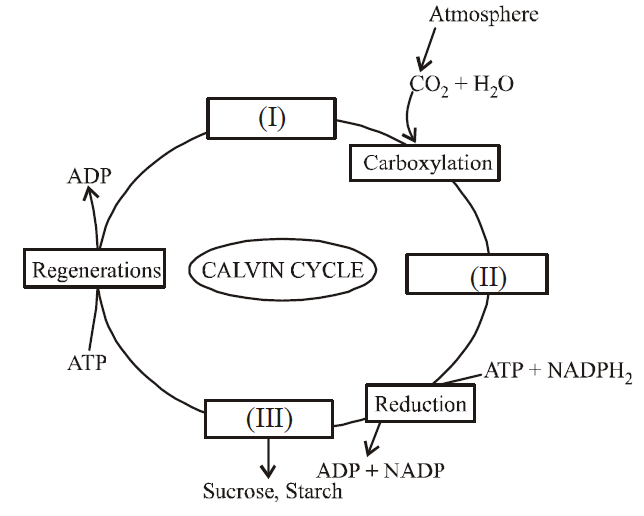
Q93. The given figure of calvin cycle shows the carbon assimilation in C3 plants. Choose the correct labelling of the carbohydrate molecule (Marked as I, II and III) involved in the Calvin cycle.
| (I) | (II) | (III) | |
|---|---|---|---|
| (a) | RuBP | Triose phosphate | PGA |
| (b) | PGA | RuBP | Triose phosphate |
| (c) | PGA | Triose phosphate | RuBP |
| (d) | RuBP | PGA | Triose phosphate |
Correct Answer: (b)
In the cycle: Fixation product is PGA (I). The 5-carbon acceptor is RuBP (II). Reduction leads to Triose phosphate (III).
In the cycle: Fixation product is PGA (I). The 5-carbon acceptor is RuBP (II). Reduction leads to Triose phosphate (III).
Q94. Breakdown of water during the photosynthesis molecule leads to release of:
Correct Answer: (d)
Photolysis of water results in the release of oxygen, protons (hydrogen ions), and electrons.
Photolysis of water results in the release of oxygen, protons (hydrogen ions), and electrons.
Q95. The light harvesting complex (LHC) is made up of
Correct Answer: (c)
The LHC consists of hundreds of pigment molecules (chlorophyll b, xanthophylls, carotenoids) associated with specific proteins.
The LHC consists of hundreds of pigment molecules (chlorophyll b, xanthophylls, carotenoids) associated with specific proteins.
Q96. Which of the following does participate in the process of photosynthesis?
Correct Answer: (d)
All these groups of algae contain photosynthetic pigments (like chlorophyll a) and perform photosynthesis.
All these groups of algae contain photosynthetic pigments (like chlorophyll a) and perform photosynthesis.
Q97. During photosynthesis, electrons are continuously lost from the reaction centre of PSII. By which process these electrons are replaced?
Correct Answer: (b)
Electrons needed by the PSII reaction center are supplied by the electrons released during the splitting of water.
Electrons needed by the PSII reaction center are supplied by the electrons released during the splitting of water.
Q98. The enzyme that is not found in a C3 plant is:
Correct Answer: (b)
C3 plants fix CO2 only through the Calvin cycle using RuBisCO; they do not have the specialized PEPcase mechanism of C4 plants.
C3 plants fix CO2 only through the Calvin cycle using RuBisCO; they do not have the specialized PEPcase mechanism of C4 plants.
Q99. Photorespiration:
Correct Answer: (a)
Photorespiration occurs when RuBisCO binds to O2 instead of CO2, leading to a wasteful process that releases CO2 and consumes energy.
Photorespiration occurs when RuBisCO binds to O2 instead of CO2, leading to a wasteful process that releases CO2 and consumes energy.
Q100. In C4 (sugarcane plant) plant, 14CO2 is fixed in malic acid. Which of the following enzymes is used to fix CO2?
Correct Answer: (c)
In C4 plants, the initial fixation of atmospheric CO2 is performed by PEP carboxylase (phosphoenol pyruvic acid carboxylase).
In C4 plants, the initial fixation of atmospheric CO2 is performed by PEP carboxylase (phosphoenol pyruvic acid carboxylase).
Q101. In the light reaction of photosynthesis electrons are picked up by an electron acceptor which passes them to an electron transport system consisting of:
Correct Answer: (b)
The electron transport chain in chloroplasts includes a series of carriers, notably the cytochromes.
The electron transport chain in chloroplasts includes a series of carriers, notably the cytochromes.
Q102. Which of the following pair(s) is/are matched correctly?
| Colour on the chromatogram | Pigment |
|---|---|
| (1) Blue green | Chlorophyll a |
| (2) Yellow green | Xanthophylls |
| (3) Yellow to yellow-orange | Carotenoids |
Correct Answer: (a)
Chlorophyll a (Blue green) and Carotenoids (Yellow to yellow-orange) are matched correctly. Xanthophylls are typically just yellow.
Chlorophyll a (Blue green) and Carotenoids (Yellow to yellow-orange) are matched correctly. Xanthophylls are typically just yellow.
Q103. The reactions of Calvin cycle not directly dependent on light, but they usually do not occur at night. Why?
Correct Answer: (d)
The Calvin cycle requires a continuous supply of ATP and NADPH, which are only generated during the light-dependent phase.
The Calvin cycle requires a continuous supply of ATP and NADPH, which are only generated during the light-dependent phase.
Q104. The correct sequence of Calvin cycle is:
Correct Answer: (d)
The Calvin cycle proceeds through three main stages: Carboxylation (fixation), Reduction (using ATP/NADPH), and Regeneration (of the CO2 acceptor RuBP).
The Calvin cycle proceeds through three main stages: Carboxylation (fixation), Reduction (using ATP/NADPH), and Regeneration (of the CO2 acceptor RuBP).
Q105. The oxygenation activity of RuBisCo enzyme in photorespiration leads to the formation of
Correct Answer: (a)
RuBisCO oxygenase activity splits RuBP into 1 molecule of 3-PGA (3-C) and 1 molecule of 2-phosphoglycolate (2-C).
RuBisCO oxygenase activity splits RuBP into 1 molecule of 3-PGA (3-C) and 1 molecule of 2-phosphoglycolate (2-C).
Q106. Which of the following statement(s) is/are incorrect ?
(a) H2S, not H2O, is involved in photosynthesis of purple sulphur bacteria.
(b) Light and dark reactions are stopped in the absence of light.
(c) Calvin cycle occurs in the grana of chloroplast.
(a) H2S, not H2O, is involved in photosynthesis of purple sulphur bacteria.
(b) Light and dark reactions are stopped in the absence of light.
(c) Calvin cycle occurs in the grana of chloroplast.
Correct Answer: (d)
The dark reaction occurs in the stroma, not grana. Both (b) and (c) are incorrect in this biological context.
The dark reaction occurs in the stroma, not grana. Both (b) and (c) are incorrect in this biological context.
Q107. C4 plants are special because:
(i) they have a special type of leaf anatomy.
(ii) they tolerate higher temperatures.
(iii) they show a response to high light intensities.
(iv) they lack a process called photorespiration.
(v) they have greater productivity of biomass.
(i) they have a special type of leaf anatomy.
(ii) they tolerate higher temperatures.
(iii) they show a response to high light intensities.
(iv) they lack a process called photorespiration.
(v) they have greater productivity of biomass.
Correct Answer: (d)
C4 plants are highly efficient due to all these anatomical and physiological adaptations.
C4 plants are highly efficient due to all these anatomical and physiological adaptations.
Q108. Photosynthesis is the transformation of
Correct Answer: (a)
In photosynthesis, solar (light) energy is captured and converted into chemical energy stored in the bonds of glucose.
In photosynthesis, solar (light) energy is captured and converted into chemical energy stored in the bonds of glucose.
Q109. Photosynthesis is a/an:
Correct Answer: (a)
Photosynthesis is a physico-chemical process by which plants use light energy to drive the synthesis of organic compounds.
Photosynthesis is a physico-chemical process by which plants use light energy to drive the synthesis of organic compounds.
Q110. Why are protons transported across the thylakoid membrane into the lumen?
Correct Answer: (d)
PQ (Plastoquinone) is a hydrogen carrier. As it accepts electrons on the stroma side, it also picks up protons. When it moves to the lumen side to pass electrons to the next carrier, it releases those protons into the lumen.
PQ (Plastoquinone) is a hydrogen carrier. As it accepts electrons on the stroma side, it also picks up protons. When it moves to the lumen side to pass electrons to the next carrier, it releases those protons into the lumen.
Q111. The primary CO2 acceptor in C4 plant is
Correct Answer: (b)
The CO2 acceptor in C4 plants is Phosphoenol pyruvate (PEP), a 3-carbon molecule located in the mesophyll cells.
The CO2 acceptor in C4 plants is Phosphoenol pyruvate (PEP), a 3-carbon molecule located in the mesophyll cells.
Q112. In maximum plants, stomata open during day and closed in night. Its exception is:
Correct Answer: (a)
CAM plants (like cacti) open their stomata at night to fix CO2 as organic acids and keep them closed during the day to minimize water loss.
CAM plants (like cacti) open their stomata at night to fix CO2 as organic acids and keep them closed during the day to minimize water loss.
Q113. The given diagram represents the Calvin cycle.
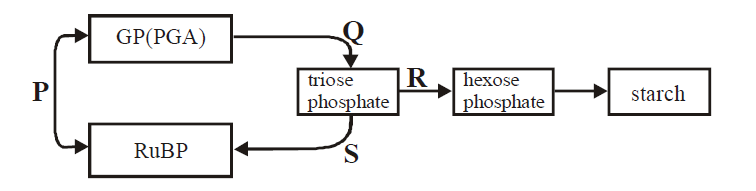
At which stage (inducated by P, Q, R and S) is CO2 incorporated?
At which stage (inducated by P, Q, R and S) is CO2 incorporated?
Correct Answer: (b)
CO2 is incorporated by reacting with RuBP (S) to form PGA (P) at stage Q (Carboxylation).
CO2 is incorporated by reacting with RuBP (S) to form PGA (P) at stage Q (Carboxylation).
Q114. Match column-I with column-II and choose the correct combination from the options given below.
| Column-I | Column-II |
|---|---|
| A. Oxygen evolving complex ferric oxalate | I. Pigments |
| B. Proton gradient concentration | II. High oxygen |
| C. Absorb light at specific wavelengths. | III. ATP synthesis |
| D. Photorespiration | IV. Photolysis of water |
Correct Answer: (a)
A-IV (OEC does photolysis), B-III (gradient drives ATP synthesis), C-I (Pigments absorb light), D-II (Photorespiration occurs at high O2 levels).
A-IV (OEC does photolysis), B-III (gradient drives ATP synthesis), C-I (Pigments absorb light), D-II (Photorespiration occurs at high O2 levels).
Q115. What will happen if the supply of oxygen is decreased to an illuminated wheat plant?
Correct Answer: (d)
Wheat is a C3 plant. Lowering oxygen concentration reduces photorespiration (competition for RuBisCO), thereby increasing the net rate of photosynthesis.
Wheat is a C3 plant. Lowering oxygen concentration reduces photorespiration (competition for RuBisCO), thereby increasing the net rate of photosynthesis.
Q116. Number of carbons in the primary CO2 fixation products in C3 plant is
Correct Answer: (a)
The first stable product of the Calvin cycle (C3 cycle) is 3-phosphoglyceric acid (3-PGA), which has 3 carbons.
The first stable product of the Calvin cycle (C3 cycle) is 3-phosphoglyceric acid (3-PGA), which has 3 carbons.
Q117. The pigment molecules responsible for photosynthesis are located in the:
Correct Answer: (c)
The light-harvesting complexes and reaction centers are embedded within the thylakoid membranes of the chloroplast.
The light-harvesting complexes and reaction centers are embedded within the thylakoid membranes of the chloroplast.
Q118. Accessory pigments:
Correct Answer: (d)
By absorbing different wavelengths of light, accessory pigments allow the plant to use more of the visible spectrum for photosynthesis.
By absorbing different wavelengths of light, accessory pigments allow the plant to use more of the visible spectrum for photosynthesis.
Q119. Correct equation that represents the photolysis of water is
Correct Answer: (a)
The splitting of water releases electrons, protons, and molecular oxygen: 2H2O → 4H+ + O2 + 4e–.
The splitting of water releases electrons, protons, and molecular oxygen: 2H2O → 4H+ + O2 + 4e–.
Q120. Which of the following pair is not correctly matched ?
Correct Answer: (a)
Maize is a C4 plant, not a C3 plant.
Maize is a C4 plant, not a C3 plant.
Q121. To make 100 molecules of glucose, how many molecules of ATP & NADPH are required?
Correct Answer: (a)
Synthesis of 1 glucose molecule requires 18 ATP and 12 NADPH. Therefore, 100 glucose molecules require $100 imes 18 = 1800$ ATP and $100 imes 12 = 1200$ NADPH.
Synthesis of 1 glucose molecule requires 18 ATP and 12 NADPH. Therefore, 100 glucose molecules require $100 imes 18 = 1800$ ATP and $100 imes 12 = 1200$ NADPH.
Q122. The light-driven synthesis of ATP & NADPH, provides energy and reducing power for the:
Correct Answer: (d)
ATP and NADPH produced in light reactions are the 'assimilatory power' used in the stroma to fix carbon dioxide into carbohydrates.
ATP and NADPH produced in light reactions are the 'assimilatory power' used in the stroma to fix carbon dioxide into carbohydrates.
Q123. The given figure shows the graph of light intensity (on x-axis) on the rate of photosynthesis (on y-axis). Few points are marked as A, B, C, D and E.
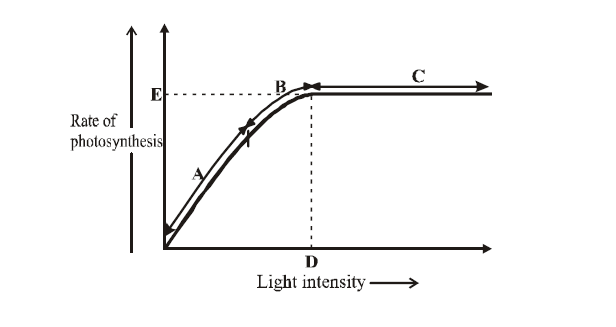
Match the marked alphabets given in column I with these correct interpretation given in column II.
Match the marked alphabets given in column I with these correct interpretation given in column II.
| Column - I | Column - II |
|---|---|
| A. Limiting factor in region A | I. Some factor other than light intensity is becoming the limiting factor |
| B. B represents | II. Light is no longer limiting factor |
| C. C represents | III. Light intensity |
| D D represents | IV. Maximum rate of photosynthesis |
| E. E represents | V. Saturation point for light intensity |
Correct Answer: (b)
In region A, light intensity (III) is limiting. B represents the transition where other factors (I) take over. C is where light is no longer limiting (II). D is the saturation point (V) and E is the max rate (IV).
In region A, light intensity (III) is limiting. B represents the transition where other factors (I) take over. C is where light is no longer limiting (II). D is the saturation point (V) and E is the max rate (IV).
Q124. Which of the following plant species have highest photosynthetic yield?
Correct Answer: (c)
C4 plants are more productive because they have a mechanism to concentrate CO2 and avoid wasteful photorespiration.
C4 plants are more productive because they have a mechanism to concentrate CO2 and avoid wasteful photorespiration.
Q125. In non-cyclic photophosphorylation, there is photolysis of 12 water molecules. How many H+ are formed ?
Correct Answer: (a)
Each molecule of water (H2O) split releases 2 protons (H+). Therefore, 12 molecules of water release 24 protons.
Each molecule of water (H2O) split releases 2 protons (H+). Therefore, 12 molecules of water release 24 protons.
Q126. The diagram given below shows ATP synthesis through chemiosmosis.
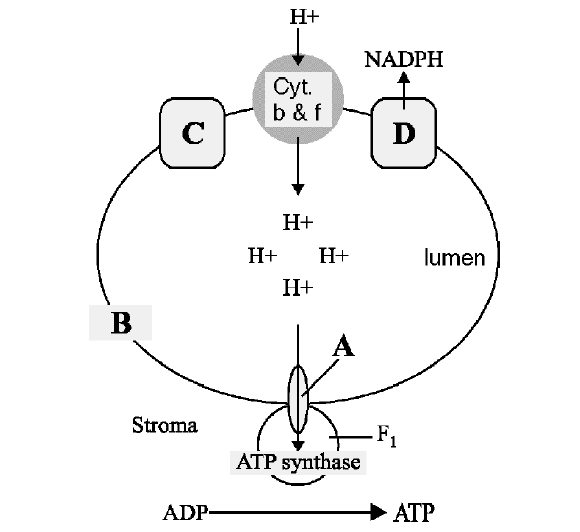
Which option shows the correct labelling of A, B, C and D in the diagram ?
Which option shows the correct labelling of A, B, C and D in the diagram ?
Correct Answer: (c)
A (F1 headpiece), B (Thylakoid membrane), C (Photosystem II - where water splitting occurs), D (Photosystem I).
A (F1 headpiece), B (Thylakoid membrane), C (Photosystem II - where water splitting occurs), D (Photosystem I).
Q127. When CO2 is added to PEP, the first stable product synthesised is:
Correct Answer: (d)
In C4 plants, the fixation of CO2 by PEP results in the 4-carbon oxaloacetate.
In C4 plants, the fixation of CO2 by PEP results in the 4-carbon oxaloacetate.
Q128. In the leaves of C4 plants, malic acid formation during CO2 fixation occurs in the cells of
Correct Answer: (d)
Initial CO2 fixation into C4 acids like malic or aspartic acid takes place in the mesophyll cells of C4 leaves.
Initial CO2 fixation into C4 acids like malic or aspartic acid takes place in the mesophyll cells of C4 leaves.
Q129. The function of water in photosynthesis is to:
Correct Answer: (b)
Water acts as the ultimate electron donor, replacing electrons lost from photosystems during light capture.
Water acts as the ultimate electron donor, replacing electrons lost from photosystems during light capture.
Q130. The given figure shows the diagrammatic representation of a section of chloroplast. Few parts are marked as A, B, C, D & E.
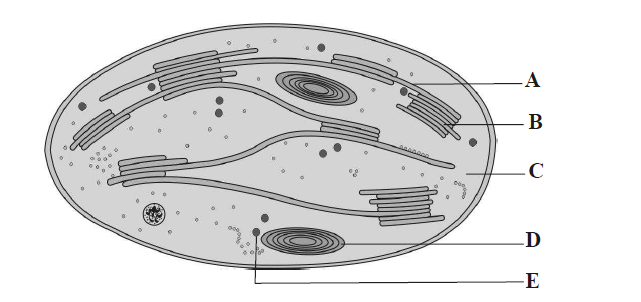
Combination of which parts is responsible for trapping the light energy & also the synthesis of ATP and NADPH?
Combination of which parts is responsible for trapping the light energy & also the synthesis of ATP and NADPH?
Correct Answer: (a)
A (Grana), B (Stroma lamellae), and C (Thylakoids) represent the membrane system of the chloroplast where the light reaction occurs.
A (Grana), B (Stroma lamellae), and C (Thylakoids) represent the membrane system of the chloroplast where the light reaction occurs.
Q131. The structures that are formed by stacking of organized flattened membranous sacs in the chloroplasts are :
Correct Answer: (a)
Stacks of individual thylakoid sacs are collectively called grana.
Stacks of individual thylakoid sacs are collectively called grana.
Q132. In photosynthesis the light-independent reactions take place at
Correct Answer: (c)
The dark reactions occur in the fluid matrix of the chloroplast, the stroma.
The dark reactions occur in the fluid matrix of the chloroplast, the stroma.
Q133. Which of the following statement best support the fact that photorespiration commonly occurs in C3 plants?
Correct Answer: (d)
In C3 plants, RuBisCO is exposed to oxygen and functions as an oxygenase when CO2 concentration is low or O2 is high.
In C3 plants, RuBisCO is exposed to oxygen and functions as an oxygenase when CO2 concentration is low or O2 is high.
Q134. The electrons that are released by the photolysis of water during non-cyclic photophosphorylation, ultimately end up in:
Correct Answer: (d)
In the non-cyclic pathway, electrons travel from water to PSII, then to PSI, and are finally accepted by NADP+ to form NADPH.
In the non-cyclic pathway, electrons travel from water to PSII, then to PSI, and are finally accepted by NADP+ to form NADPH.
Q135. Which one of the following correctly identifies X and Y and and their functions in the given figure of chloroplast ?
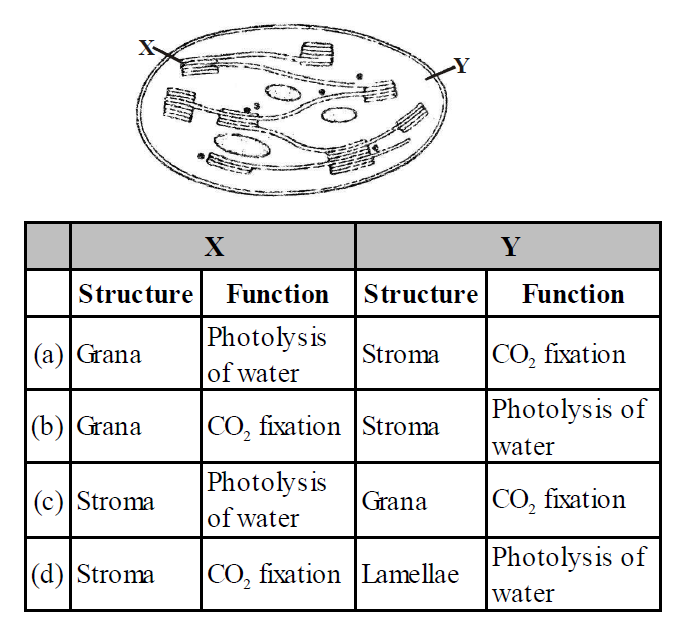
Correct Answer: (a)
In the chloroplast, grana (X) are the site of light reactions (including water splitting), and the stroma (Y) is the site of the dark reactions (carbon fixation).
In the chloroplast, grana (X) are the site of light reactions (including water splitting), and the stroma (Y) is the site of the dark reactions (carbon fixation).
Q136. Given below is the pathway (Z-scheme) of light reaction. Identify the blanks indicated by A, B, C and D.
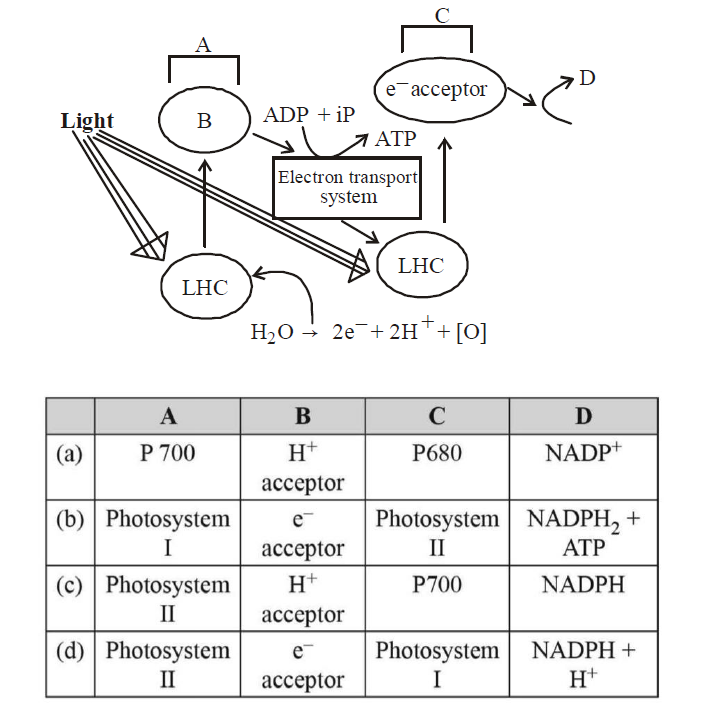
Correct Answer: (d)
The Z-scheme starts with PSII (A), which passes electrons to a primary acceptor (B), through an ETC to PSI (C), ultimately reducing NADP+ to NADPH (D).
The Z-scheme starts with PSII (A), which passes electrons to a primary acceptor (B), through an ETC to PSI (C), ultimately reducing NADP+ to NADPH (D).
Q137. During photosynthesis when PGA is changed into phosphoglyceraldehyde, which of the following reaction occur?
Correct Answer: (b)
The conversion of 3-PGA to triose phosphate (G-3-P) is a reduction reaction requiring NADPH and ATP.
The conversion of 3-PGA to triose phosphate (G-3-P) is a reduction reaction requiring NADPH and ATP.
Q138. The principle of limiting factors was proposed by
Correct Answer: (a)
F.F. Blackman proposed the Law of Limiting Factors in 1905, stating that if a process is influenced by multiple factors, its rate is limited by the factor nearest to its minimum value.
F.F. Blackman proposed the Law of Limiting Factors in 1905, stating that if a process is influenced by multiple factors, its rate is limited by the factor nearest to its minimum value.
Q139. Which of the following statement is incorrect?
Correct Answer: (c)
NADPH formation is associated with Photosystem I, where electrons are transferred to NADP+ via ferredoxin.
NADPH formation is associated with Photosystem I, where electrons are transferred to NADP+ via ferredoxin.
Q140. Which one represents the correct empirical equation of photosynthesis?
Correct Answer: (d)
The balanced chemical equation for photosynthesis highlights that 12 molecules of water are required to produce 6 molecules of oxygen and 1 molecule of glucose, with 6 molecules of water being re-formed.
The balanced chemical equation for photosynthesis highlights that 12 molecules of water are required to produce 6 molecules of oxygen and 1 molecule of glucose, with 6 molecules of water being re-formed.
Q141. Which of the following characteristics out of I, II and III are exhibited by C4 plants?
I. Kranz anatomy.
II. The product of photosynthesis is oxalo acetic acid.
III. Both PEP carboxylase and ribulose-bi phosphate carboxylase act as carboxylating enzyme.
I. Kranz anatomy.
II. The product of photosynthesis is oxalo acetic acid.
III. Both PEP carboxylase and ribulose-bi phosphate carboxylase act as carboxylating enzyme.
Correct Answer: (d)
C4 plants have Kranz anatomy (I), produce OAA as the first product (II), and utilize both PEPcase (in mesophyll) and RuBisCO (in bundle sheath) for carboxylation (III).
C4 plants have Kranz anatomy (I), produce OAA as the first product (II), and utilize both PEPcase (in mesophyll) and RuBisCO (in bundle sheath) for carboxylation (III).
Q142. Contribution of Ingen-Housz in elucidation of process of photosynthesis is that:
Correct Answer: (a)
Jan Ingen-Housz showed that sunlight is essential for the process that purifies air and that only the green parts of the plant release oxygen.
Jan Ingen-Housz showed that sunlight is essential for the process that purifies air and that only the green parts of the plant release oxygen.
Q143. The oxygen evolved during photosynthesis comes from water molecules. Which one of the following pairs of elements is involved in this reaction?
Correct Answer: (d)
Manganese and Chloride ions are essential cofactors for the water-splitting enzyme system in PSII.
Manganese and Chloride ions are essential cofactors for the water-splitting enzyme system in PSII.
Q144. Chloroplast movement is influenced by
Correct Answer: (a)
Chloroplasts align themselves according to light intensity to either maximize absorption (low light) or avoid damage (high light).
Chloroplasts align themselves according to light intensity to either maximize absorption (low light) or avoid damage (high light).
Q145. Which of the following combination is correct for C4 plants?
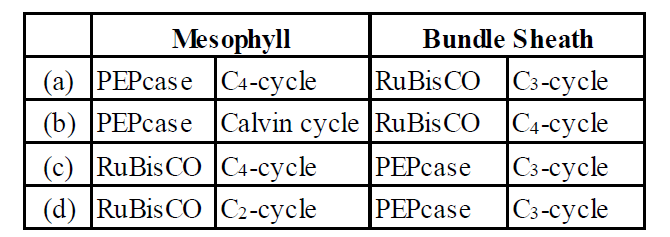
Correct Answer: (a)
In C4 plants, initial CO2 fixation occurs in the mesophyll cells via PEPcase (forming the C4 cycle), while the final fixation via the Calvin cycle (C3 cycle) occurs in the bundle sheath cells using RuBisCO.
In C4 plants, initial CO2 fixation occurs in the mesophyll cells via PEPcase (forming the C4 cycle), while the final fixation via the Calvin cycle (C3 cycle) occurs in the bundle sheath cells using RuBisCO.
Q146. According to Blackman’s law of limiting factor, at any given time, photosynthesis can be limited by:
Correct Answer: (d)
The process is always limited by the single specific factor that is in the shortest supply relative to requirements at that moment.
The process is always limited by the single specific factor that is in the shortest supply relative to requirements at that moment.
Q147. In a plant cell, which of the following pigments participates directly in the light reactions of photosynthesis?
Correct Answer: (a)
Chlorophyll a is the primary pigment that acts as the reaction center where the light energy is converted into chemical energy.
Chlorophyll a is the primary pigment that acts as the reaction center where the light energy is converted into chemical energy.
Q148. Consider the following statements:
(1) In Blackman’s Law, if a chemical process is affected by more than one factor, then its rate will be determined by the factor which is nearest to its minimal value.
(2) For photosynthesis, light is rarely a limiting factor in nature.
(1) In Blackman’s Law, if a chemical process is affected by more than one factor, then its rate will be determined by the factor which is nearest to its minimal value.
(2) For photosynthesis, light is rarely a limiting factor in nature.
Correct Answer: (c)
Both statements are correct. Blackman's law relies on the limiting (minimal) factor, and CO2 is usually the limiting factor in nature, not light.
Both statements are correct. Blackman's law relies on the limiting (minimal) factor, and CO2 is usually the limiting factor in nature, not light.
Q149. How can we separate leaf pigments of any green plant?
Correct Answer: (b)
Paper chromatography is a standard technique used to separate and identify the different pigments present in a leaf (chlorophyll a, chlorophyll b, xanthophylls, and carotenoids).
Paper chromatography is a standard technique used to separate and identify the different pigments present in a leaf (chlorophyll a, chlorophyll b, xanthophylls, and carotenoids).