Q1. Which of the following best explains the conditions under which the founder effect occurs?
Correct Answer: (c)
(C) The founder effect occurs when a small group of individuals from a large population leaves the larger group to colonize a new area and the small group does not possess the same allele frequencies as the larger group. Choice (A) is incorrect because the founder effect is not caused by random evolutionary change. The rapid reduction of a population’s size, leading to a group of survivors that is not representative of the original, larger population, is the bottleneck effect. Thus, choice (B) is incorrect. Choice (D) is incorrect because it describes the process of natural selection, not the founder effect.
(C) The founder effect occurs when a small group of individuals from a large population leaves the larger group to colonize a new area and the small group does not possess the same allele frequencies as the larger group. Choice (A) is incorrect because the founder effect is not caused by random evolutionary change. The rapid reduction of a population’s size, leading to a group of survivors that is not representative of the original, larger population, is the bottleneck effect. Thus, choice (B) is incorrect. Choice (D) is incorrect because it describes the process of natural selection, not the founder effect.
Q2. A scientist is studying the allele frequencies for a particular gene in a population of wild prairie dogs over a five-year period. The allele frequencies are shown in the table.
Which of the following is the most likely cause of the observed change in allele frequencies?
| Year | Frequency of Allele A1 | Frequency of Allele A2 |
|---|---|---|
| 1 | 0.00 | 1.00 |
| 2 | 0.00 | 1.00 |
| 3 | 0.10 | 0.90 |
| 4 | 0.13 | 0.87 |
| 5 | 0.15 | 0.85 |
Which of the following is the most likely cause of the observed change in allele frequencies?
Correct Answer: (d)
(D) Initially, the population of wild prairie dogs did not possess the A1 allele, so it is likely that it arrived in an individual prairie dog that migrated into the population sometime between years 2 and 3. Therefore, gene flow is the correct answer. Choice (A) is incorrect because these are wild prairie dogs, and there is no evidence of selective breeding of prairie dogs by humans. No information is given in the question about whether or not alleles A1 or A2 confer a survival advantage, so choice (B) is incorrect. No allele was lost in the population, so choice (C) is incorrect.
(D) Initially, the population of wild prairie dogs did not possess the A1 allele, so it is likely that it arrived in an individual prairie dog that migrated into the population sometime between years 2 and 3. Therefore, gene flow is the correct answer. Choice (A) is incorrect because these are wild prairie dogs, and there is no evidence of selective breeding of prairie dogs by humans. No information is given in the question about whether or not alleles A1 or A2 confer a survival advantage, so choice (B) is incorrect. No allele was lost in the population, so choice (C) is incorrect.
Q3. Which of the following describes a population that could experience exponential growth?
Correct Answer: (c)
(C) Populations grow exponentially if there are no limiting resources or predators that would limit the population size. If the population was limited by density-dependent factors, its growth would be logistic, so choice (A) is incorrect. Choice (B) is incorrect because if the size of the population was beyond the carrying capacity of the environment, its numbers would be declining, not growing. K-selected populations experience logistic growth, so choice (D) is also incorrect.
(C) Populations grow exponentially if there are no limiting resources or predators that would limit the population size. If the population was limited by density-dependent factors, its growth would be logistic, so choice (A) is incorrect. Choice (B) is incorrect because if the size of the population was beyond the carrying capacity of the environment, its numbers would be declining, not growing. K-selected populations experience logistic growth, so choice (D) is also incorrect.
Q4. For a genetic disease that appears in homozygous recessive (aa) individuals, individuals who are heterozygous (Aa) for the disease are resistant to infections by certain parasites. Over half of the individuals living in a population where a particular parasite is prevalent are heterozygous for a recessive allele (Aa). Further studies reveal that individuals who are heterozygous for the recessive allele are resistant to the parasite, while individuals who are homozygous dominant or homozygous recessive are susceptible to the parasite.
If the parasite was totally eliminated from this area, predict what would happen to the frequencies of the AA, Aa, and aa genotypes.
If the parasite was totally eliminated from this area, predict what would happen to the frequencies of the AA, Aa, and aa genotypes.
Correct Answer: (a)
(A) If the parasite was totally eliminated from this environment, there would no longer be any advantage to being heterozygous for the recessive allele. So over time, natural selection would increase the frequencies of the AA and aa genotypes and the frequency of the Aa genotype would decrease. Choice (B) is incorrect because the frequency of the AA genotype would increase (not decrease) and the frequency of the Aa genotype would decrease (not increase). If the parasite was eliminated, there would be no advantage to having the Aa genotype. So the frequency of the Aa genotype would no longer be favored and would be expected to decrease, not increase, and the frequencies of the AA and aa genotypes would increase. Thus, choice (C) is incorrect. While the frequency of the aa genotype would be expected to increase, the frequency of the AA genotype would also be expected to increase. So choice (D) is incorrect.
(A) If the parasite was totally eliminated from this environment, there would no longer be any advantage to being heterozygous for the recessive allele. So over time, natural selection would increase the frequencies of the AA and aa genotypes and the frequency of the Aa genotype would decrease. Choice (B) is incorrect because the frequency of the AA genotype would increase (not decrease) and the frequency of the Aa genotype would decrease (not increase). If the parasite was eliminated, there would be no advantage to having the Aa genotype. So the frequency of the Aa genotype would no longer be favored and would be expected to decrease, not increase, and the frequencies of the AA and aa genotypes would increase. Thus, choice (C) is incorrect. While the frequency of the aa genotype would be expected to increase, the frequency of the AA genotype would also be expected to increase. So choice (D) is incorrect.
Q5. In populations subjected to high levels of predation,
Correct Answer: (c)
High predation lowers the probability of surviving to future breeding seasons, favoring life-history strategies that emphasize high current reproductive effort.
High predation lowers the probability of surviving to future breeding seasons, favoring life-history strategies that emphasize high current reproductive effort.
Q6. A group of birds is flying south during their yearly migration when a hurricane with extremely strong winds occurs. Only 10% of the group survive the storm, reaching their winter nesting site and reproducing the next spring. This type of event is an example of
Correct Answer: (b)
(B) The bottleneck effect occurs when the majority of a population dies and the surviving individuals do not possess all of the alleles from the original population. Choice (A) is incorrect because survival after bottleneck events may be random and is not dependent on an organism’s fitness. The founder effect occurs when a small group of individuals leaves a larger population to colonize a new area. Since this scenario does not describe the founder effect, choices (C) and (D) are incorrect. Also, nothing in the question provides any information on the genetic diversity of the population before the hurricane, which further rules out choice (C). Choice (D) can be further ruled out because nothing in the question suggests that the birds never migrated back to their original habitat.
(B) The bottleneck effect occurs when the majority of a population dies and the surviving individuals do not possess all of the alleles from the original population. Choice (A) is incorrect because survival after bottleneck events may be random and is not dependent on an organism’s fitness. The founder effect occurs when a small group of individuals leaves a larger population to colonize a new area. Since this scenario does not describe the founder effect, choices (C) and (D) are incorrect. Also, nothing in the question provides any information on the genetic diversity of the population before the hurricane, which further rules out choice (C). Choice (D) can be further ruled out because nothing in the question suggests that the birds never migrated back to their original habitat.
Q7. Two species of lynx spiders, Peucetia rubrolineata and Peucetia flava, both inhabit the plant Trichogoniopsis adenantha, a type of sunflower found in Brazil. However, Peucetia rubrolineata inhabit plants in shaded areas, while Peucetia flava inhabit plants in open areas. This is an example of
Correct Answer: (c)
(C) Niche partitioning occurs when different species use a limited resource differently. The two species of spiders use the same species of plant, but one species of spiders only uses plants in the shade while the other only uses plants in open areas. So they partition the resource differently. Choice (A) is incorrect because the spiders are not in direct competition for the same resource. This is not a mutualistic relationship between the spiders because they do not provide a benefit to each other, so choice (B) is incorrect. Choice (D) is incorrect because the spiders do not prey on each other.
(C) Niche partitioning occurs when different species use a limited resource differently. The two species of spiders use the same species of plant, but one species of spiders only uses plants in the shade while the other only uses plants in open areas. So they partition the resource differently. Choice (A) is incorrect because the spiders are not in direct competition for the same resource. This is not a mutualistic relationship between the spiders because they do not provide a benefit to each other, so choice (B) is incorrect. Choice (D) is incorrect because the spiders do not prey on each other.
Q8. Species that are the first colonists in a habitat undergoing primary succession
Correct Answer: (c)
Pioneer species often modify harsh environments (e.g., soil formation), making conditions more suitable for later-successional species to invade.
Pioneer species often modify harsh environments (e.g., soil formation), making conditions more suitable for later-successional species to invade.
Q9. Parasitism differs from predation because
Correct Answer: (d)
All listed statements are incorrect: parasitism can drive strong defensive adaptations, involve coevolutionary arms races, and significantly affect host population dynamics.
All listed statements are incorrect: parasitism can drive strong defensive adaptations, involve coevolutionary arms races, and significantly affect host population dynamics.
Q10. If two species have very similar realized niches and are forced to coexist and share a limiting resource indefinitely,
Correct Answer: (a)
According to the competitive exclusion principle, when two species have very similar niches and compete for the same limiting resource, the more efficient species excludes the other over time.
According to the competitive exclusion principle, when two species have very similar niches and compete for the same limiting resource, the more efficient species excludes the other over time.
Q11. When ecologists talk about the cost of reproduction they mean
Correct Answer: (a)
The cost of reproduction refers to trade-offs in life history, where investment in current reproduction reduces an organism’s future survival or reproductive potential.
The cost of reproduction refers to trade-offs in life history, where investment in current reproduction reduces an organism’s future survival or reproductive potential.
Q12. Refer to the figure, which shows the population of wild rabbits on an island as time progresses.
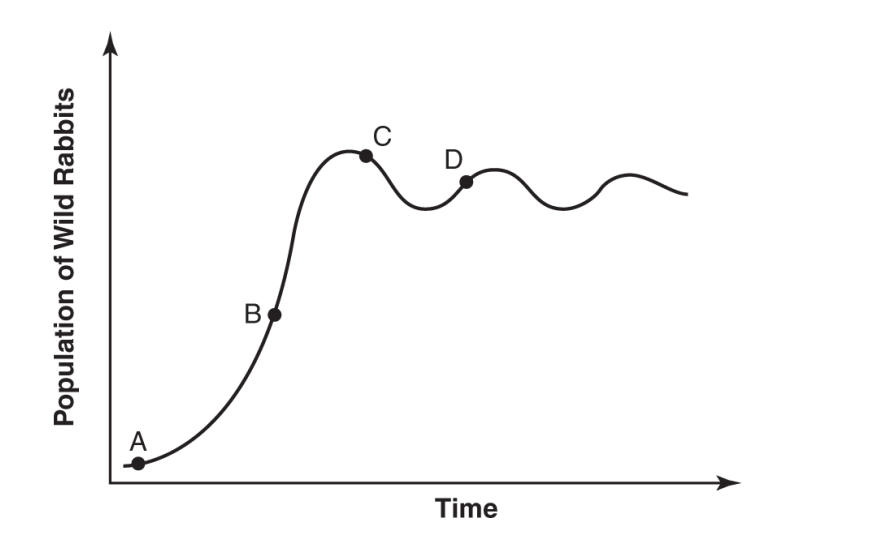
Which of the following best represents a time when the rabbit population was experiencing exponential growth?
Which of the following best represents a time when the rabbit population was experiencing exponential growth?
Correct Answer: (b)
(B) The most rapid population growth occurs during exponential growth, which is at point B. Choice (A) is incorrect because it represents growth during the lag phase. At point C, the population is starting to decline in numbers, so choice (C) is incorrect. Point D represents the carrying capacity, so choice (D) is also not the answer.
(B) The most rapid population growth occurs during exponential growth, which is at point B. Choice (A) is incorrect because it represents growth during the lag phase. At point C, the population is starting to decline in numbers, so choice (C) is incorrect. Point D represents the carrying capacity, so choice (D) is also not the answer.
Q13. Which of the following is a characteristic of a population that is in Hardy-Weinberg equilibrium?
Correct Answer: (d)
(D) The five conditions that are necessary for Hardy-Weinberg equilibrium are large population size, random mating, no selection of any kind, no gene flow, and no mutations. Choice (A) is incorrect because large populations, not small populations, are necessary for Hardy-Weinberg equilibrium. Migration (or gene flow) also violates one of the conditions necessary for Hardy-Weinberg equilibrium, so choice (B) is incorrect. Choice (C) is incorrect because in order for a population to be in Hardy-Weinberg equilibrium, no selection can occur.
(D) The five conditions that are necessary for Hardy-Weinberg equilibrium are large population size, random mating, no selection of any kind, no gene flow, and no mutations. Choice (A) is incorrect because large populations, not small populations, are necessary for Hardy-Weinberg equilibrium. Migration (or gene flow) also violates one of the conditions necessary for Hardy-Weinberg equilibrium, so choice (B) is incorrect. Choice (C) is incorrect because in order for a population to be in Hardy-Weinberg equilibrium, no selection can occur.
Q14. The presence of one species (A) in a community may benefit another species (B) if
Correct Answer: (d)
All listed scenarios describe direct or indirect positive effects of one species on another, demonstrating how complex interactions can benefit species within communities.
All listed scenarios describe direct or indirect positive effects of one species on another, demonstrating how complex interactions can benefit species within communities.
Q15. According to the idea of coevolution between predator and prey, when a prey species evolves a novel defense against a predator,
Correct Answer: (d)
Coevolution involves reciprocal evolutionary change. When prey evolve a new defense, natural selection favors predators that can overcome that defense, leading to evolutionary counter-adaptations.
Coevolution involves reciprocal evolutionary change. When prey evolve a new defense, natural selection favors predators that can overcome that defense, leading to evolutionary counter-adaptations.
Q16. Which of the following can cause the realized niche of a species to be smaller than its fundamental niche?
Correct Answer: (d)
Biotic interactions such as predation, competition, and parasitism restrict where a species can survive and reproduce, reducing the realized niche relative to the fundamental niche.
Biotic interactions such as predation, competition, and parasitism restrict where a species can survive and reproduce, reducing the realized niche relative to the fundamental niche.
Q17. The difference between exponential and logistic growth rates is that
Correct Answer: (d)
Logistic growth incorporates density-dependent factors through carrying capacity (K), which affect birth and death rates as population size increases. Exponential growth does not include such limits.
Logistic growth incorporates density-dependent factors through carrying capacity (K), which affect birth and death rates as population size increases. Exponential growth does not include such limits.
Q18. For a genetic disease that appears in homozygous recessive (aa) individuals, individuals who are heterozygous (Aa) for the disease are resistant to infections by certain parasites.
If 19% of the individuals in a population have the genetic disease, what is the frequency of individuals who are resistant to the parasites? Assume the population is in Hardy-Weinberg equilibrium.
If 19% of the individuals in a population have the genetic disease, what is the frequency of individuals who are resistant to the parasites? Assume the population is in Hardy-Weinberg equilibrium.
Correct Answer: (b)
(B) If 19% of the individuals have the recessive genetic disease, q2 = 0.19 and q = 0.436. Then since p + q = 1, p = 0.564. The heterozygous individuals are resistant to the parasites and have a frequency of 2pq = 2 × 0.564 × 0.436 = 0.492. Choice (A) is the frequency of the recessive allele and is incorrect. Choice (C) is the frequency of the dominant allele and is incorrect. The frequency of individuals who do not have the recessive disease (some of whom may be heterozygous and others who may be homozygous dominant) is 81%, so choice (D) is incorrect.
(B) If 19% of the individuals have the recessive genetic disease, q2 = 0.19 and q = 0.436. Then since p + q = 1, p = 0.564. The heterozygous individuals are resistant to the parasites and have a frequency of 2pq = 2 × 0.564 × 0.436 = 0.492. Choice (A) is the frequency of the recessive allele and is incorrect. Choice (C) is the frequency of the dominant allele and is incorrect. The frequency of individuals who do not have the recessive disease (some of whom may be heterozygous and others who may be homozygous dominant) is 81%, so choice (D) is incorrect.
Q19. A species whose effect on the composition of a community is greater than expected based on its abundance can be called a
Correct Answer: (d)
Keystone species exert a disproportionately large influence on community structure relative to their abundance, often shaping species diversity and interactions.
Keystone species exert a disproportionately large influence on community structure relative to their abundance, often shaping species diversity and interactions.
Q20. The following table shows the frequency of three genotypes (AA, Aa, and aa) in a population.
The environment of the population changes so that individuals with the Aa genotype are more likely to survive and reproduce. Predict what would most likely happen to the frequencies of the AA and aa genotypes after 10 generations in this environment.
| Genotype | Frequency |
|---|---|
| AA | 0.44 |
| Aa | 0.14 |
| aa | 0.42 |
The environment of the population changes so that individuals with the Aa genotype are more likely to survive and reproduce. Predict what would most likely happen to the frequencies of the AA and aa genotypes after 10 generations in this environment.
Correct Answer: (b)
(B) If individuals with the Aa genotype are more likely to survive and reproduce (heterozygote advantage), the frequency of the Aa genotype would increase over time and the frequencies of the AA and aa genotypes would both decrease.
(B) If individuals with the Aa genotype are more likely to survive and reproduce (heterozygote advantage), the frequency of the Aa genotype would increase over time and the frequencies of the AA and aa genotypes would both decrease.
Q21. Acacia ants (Pseudomyrmex ferruginea) live on acacia trees (Vachellia cornigera). The ants obtain food and shelter from the acacia trees, and the ants drive away animals that would otherwise eat the leaves of the acacia trees. Which of the following best describes the relationship between Pseudomyrmex ferruginea and Vachellia cornigera?
Correct Answer: (c)
(C) Since both the ants and the acacia trees benefit from the relationship, the symbiosis between them is mutualistic. Niche partitioning is using different parts of a resource, so choice (A) is incorrect. Choice (B) is incorrect because commensalism benefits one member of the symbiosis but the other member neither benefits nor is harmed. In parasitism, one member of the symbiosis benefits but the other is harmed, so choice (D) is incorrect.
(C) Since both the ants and the acacia trees benefit from the relationship, the symbiosis between them is mutualistic. Niche partitioning is using different parts of a resource, so choice (A) is incorrect. Choice (B) is incorrect because commensalism benefits one member of the symbiosis but the other member neither benefits nor is harmed. In parasitism, one member of the symbiosis benefits but the other is harmed, so choice (D) is incorrect.
Q22. Resource partitioning by sympatric species
Correct Answer: (d)
Herbivores often partition resources such as plant parts or feeding times more finely, making resource partitioning more commonly observed than in carnivores.
Herbivores often partition resources such as plant parts or feeding times more finely, making resource partitioning more commonly observed than in carnivores.
Q23. The elimination of a predator by humans
Correct Answer: (c)
If a prey population was regulated by predation, removing the predator can allow prey numbers to increase, though other limiting factors may eventually constrain growth.
If a prey population was regulated by predation, removing the predator can allow prey numbers to increase, though other limiting factors may eventually constrain growth.
Q24. An isolated population in the United States are descendants of approximately 200 immigrants who arrived in the 1700s. Some individuals in this group of immigrants carried the allele for Ellis-van Creveld syndrome. Today, this allele occurs at a much higher frequency in the descendants of this group than in the general population in the United States. This difference in the frequency of the Ellis-van Creveld allele is an example of
Correct Answer: (b)
(B) This scenario is an example of the founder effect. Choice (A) is incorrect because the original population did not undergo a rapid decrease in population size. There is no evidence in the question that Ellis-van Creveld syndrome leads to decreased survival, so choice (C) is incorrect. Choice (D) is incorrect because it would be extremely unlikely that random mutations over several generations would lead to the appearance of the allele that causes Ellis-van Creveld syndrome.
(B) This scenario is an example of the founder effect. Choice (A) is incorrect because the original population did not undergo a rapid decrease in population size. There is no evidence in the question that Ellis-van Creveld syndrome leads to decreased survival, so choice (C) is incorrect. Choice (D) is incorrect because it would be extremely unlikely that random mutations over several generations would lead to the appearance of the allele that causes Ellis-van Creveld syndrome.
Q25. Which of the following is an example of a density-dependent effect on population growth?
Correct Answer: (c)
Density-dependent effects intensify as population density increases. Limited access to cool burrows when population size is high directly links survival to population density.
Density-dependent effects intensify as population density increases. Limited access to cool burrows when population size is high directly links survival to population density.
Q26. A life history trade-off between clutch size and offspring size
Correct Answer: (b)
Parents have limited resources, so producing more offspring usually means each offspring receives fewer resources, resulting in smaller offspring size as clutch size increases.
Parents have limited resources, so producing more offspring usually means each offspring receives fewer resources, resulting in smaller offspring size as clutch size increases.
Q27. In a population in which individuals are uniformly distributed,
Correct Answer: (b)
Uniform distributions usually arise from strong competition among individuals for limited resources, favoring traits that enhance competitive ability.
Uniform distributions usually arise from strong competition among individuals for limited resources, favoring traits that enhance competitive ability.
Q28. As population size (N) approaches the carrying capacity (K) in the logistic growth model, dN/dt =
Correct Answer: (b)
When N approaches K, resources become limiting and population growth slows. At carrying capacity, births and deaths balance, so the growth rate (dN/dt) approaches zero.
When N approaches K, resources become limiting and population growth slows. At carrying capacity, births and deaths balance, so the growth rate (dN/dt) approaches zero.
Q29. In 1986, the quail population in Golden Gate Park in San Francisco was 140 birds. Hunting by feral cats reduced the number of quail to 32 birds by 2016. If the birth rate of quail over this period averaged 20.4 quail/year, what was the average death rate of quail during this period?
Correct Answer: (c)
(C) dN/dt = B (birth rate) – D (death rate). So the average death rate would be D = B – dN/dt. The death rate is D = 20.4 quail/year – ((32 – 140) quail / 30 years) = 20.4 – (–3.6) = 20.4 + 3.6 = 24 quail/year.
(C) dN/dt = B (birth rate) – D (death rate). So the average death rate would be D = B – dN/dt. The death rate is D = 20.4 quail/year – ((32 – 140) quail / 30 years) = 20.4 – (–3.6) = 20.4 + 3.6 = 24 quail/year.
Q30. Refer to the figure, which shows the population of wild rabbits on an island as time progresses.
Which of the following points best approximates the carrying capacity of the island for rabbits?
Which of the following points best approximates the carrying capacity of the island for rabbits?
Correct Answer: (d)
(D) Point D represents the carrying capacity because the population size is stabilizing at point D. Point A represents the lag phase, point B represents exponential growth, and point C represents a population that is starting to decline, so choices (A), (B), and (C) are incorrect.
(D) Point D represents the carrying capacity because the population size is stabilizing at point D. Point A represents the lag phase, point B represents exponential growth, and point C represents a population that is starting to decline, so choices (A), (B), and (C) are incorrect.
Q31. The presence of a predatory species
Correct Answer: (b)
Predators can indirectly benefit certain prey species by reducing populations of their competitors, a phenomenon known as a trophic or indirect effect.
Predators can indirectly benefit certain prey species by reducing populations of their competitors, a phenomenon known as a trophic or indirect effect.
Q32. The potential for social interactions among individuals should be maximized when individuals
Correct Answer: (c)
Clumped distributions bring individuals into close proximity, increasing encounters and thus maximizing opportunities for social interactions such as mating, cooperation, or competition.
Clumped distributions bring individuals into close proximity, increasing encounters and thus maximizing opportunities for social interactions such as mating, cooperation, or competition.
Q33. In which populations is genetic drift more likely to occur?
Correct Answer: (b)
(B) Genetic drift, the random loss of alleles, is more likely in small populations because in small populations, fewer individuals would have the opportunity to pass on a rare allele to the next generation than in a large population. Choice (A) is incorrect because it is the opposite of the correct answer. Greater diversity does not influence the chances of genetic drift, so choice (C) is incorrect. Choice (D) is incorrect because gene flow, or migration, does not necessarily cause genetic drift.
(B) Genetic drift, the random loss of alleles, is more likely in small populations because in small populations, fewer individuals would have the opportunity to pass on a rare allele to the next generation than in a large population. Choice (A) is incorrect because it is the opposite of the correct answer. Greater diversity does not influence the chances of genetic drift, so choice (C) is incorrect. Choice (D) is incorrect because gene flow, or migration, does not necessarily cause genetic drift.
Q34. If the size of a population is reduced due to a natural disaster such as a flood,
Correct Answer: (d)
A population reduction can lead to faster growth if density-dependent limits are relaxed, slower growth if mate finding becomes difficult, or no change if density was already low. All outcomes are possible.
A population reduction can lead to faster growth if density-dependent limits are relaxed, slower growth if mate finding becomes difficult, or no change if density was already low. All outcomes are possible.
Q35. A population of 190 jackrabbits lives in McInnis Park in San Rafael, California. The carrying capacity of the park for jackrabbits is approximately 200 rabbits. If the rmax for the jackrabbit population is 1.5 surviving jackrabbits per year, what is the estimated increase in the number of jackrabbits in one year?
Correct Answer: (b)
(B) Since there is a carrying capacity in this environment, use this equation: dN/dt = rmaxN((K – N)/K) = (1.5)(190)((200 – 190)/200) = 14.25. Choice (B) is the closest estimate to this number and is therefore the correct answer.
(B) Since there is a carrying capacity in this environment, use this equation: dN/dt = rmaxN((K – N)/K) = (1.5)(190)((200 – 190)/200) = 14.25. Choice (B) is the closest estimate to this number and is therefore the correct answer.
Q36. Which of the following is an example of commensalism?
Correct Answer: (b)
Commensalism occurs when one species benefits while the other is neither harmed nor helped. Clownfish gain protection among anemone tentacles, while the anemone is largely unaffected.
Commensalism occurs when one species benefits while the other is neither harmed nor helped. Clownfish gain protection among anemone tentacles, while the anemone is largely unaffected.
Q37. Source–sink metapopulations are distinct from other types of metapopulations because
Correct Answer: (b)
In source–sink metapopulations, some populations (sinks) have negative growth rates and would go extinct without immigration from source populations. This presence of populations with negative intrinsic growth distinguishes source–sink systems from other metapopulations.
In source–sink metapopulations, some populations (sinks) have negative growth rates and would go extinct without immigration from source populations. This presence of populations with negative intrinsic growth distinguishes source–sink systems from other metapopulations.
Q38. Wildlife management introduces 135 ducks to a reservoir in an effort to restore the duck population in the area. The growth rate of the population (rmax) is 0.074 ducks/year. Which of the following is the best estimate of the size of this duck population after one year?
Correct Answer: (c)
(C) dN/dt = rmaxN = (0.074)(135) = 10 ducks in one year. Since the starting population size is 135 ducks, after one year, there will be 135 + 10 = 145 ducks.
(C) dN/dt = rmaxN = (0.074)(135) = 10 ducks in one year. Since the starting population size is 135 ducks, after one year, there will be 135 + 10 = 145 ducks.
Q39. Cytisus scoparius, also known as Scotch broom, was introduced into California from England in the mid-1800s as an easy-to-grow plant that helped stabilize soil on the hillsides. One Scotch broom plant can produce over 12,000 seeds a year. Scotch broom forms a dense shade canopy that prevents seedlings of other plants from growing. There are no natural predators for Scotch broom in California since its leaves are toxic to most animal species. Which of the following most accurately describes Scotch broom’s role in the California ecosystem?
Correct Answer: (b)
(B) Scotch broom is not native to California. It outcompetes other plants and has no natural predators in California, so it is an invasive species. Choice (A) is incorrect because if a keystone species is removed, the entire ecosystem may collapse. Removing Scotch broom would most likely help the ecosystem, not cause it to collapse. Scotch broom does not benefit other organisms in this ecosystem; therefore, it is not a mutualistic species and choice (C) is incorrect. Choice (D) is incorrect because Scotch broom is not native to California.
(B) Scotch broom is not native to California. It outcompetes other plants and has no natural predators in California, so it is an invasive species. Choice (A) is incorrect because if a keystone species is removed, the entire ecosystem may collapse. Removing Scotch broom would most likely help the ecosystem, not cause it to collapse. Scotch broom does not benefit other organisms in this ecosystem; therefore, it is not a mutualistic species and choice (C) is incorrect. Choice (D) is incorrect because Scotch broom is not native to California.
Q40. Tidal marshland A, which is adjacent to the San Francisco airport, has a Simpson’s Diversity Index of 0.65. Tidal marshland B, which is two miles from the airport, has a Simpson’s Diversity Index of 0.80. An oil spill occurs at a location at the halfway point between the two marshlands. If both marshlands are equally contaminated by the oil spill, which marshland is more likely to recover from the oil spill?
Correct Answer: (b)
(B) Ecosystems with more biodiversity are more likely to be able to recover from ecological disturbances. Choice (A) is incorrect because a lower Simpson’s Diversity Index means less biodiversity and that ecosystem would be less likely to recover from a disturbance. The difference in the two marshlands’ biodiversity will result in different abilities to recover from the disturbance, so choice (C) is incorrect. Choice (D) is incorrect because while oil is toxic to all organisms, some organisms may be able to recover from exposure to oil.
(B) Ecosystems with more biodiversity are more likely to be able to recover from ecological disturbances. Choice (A) is incorrect because a lower Simpson’s Diversity Index means less biodiversity and that ecosystem would be less likely to recover from a disturbance. The difference in the two marshlands’ biodiversity will result in different abilities to recover from the disturbance, so choice (C) is incorrect. Choice (D) is incorrect because while oil is toxic to all organisms, some organisms may be able to recover from exposure to oil.
Q41. Studies that demonstrate that species living in an ecological community change independently of one another in space and time
Correct Answer: (b)
Independent changes of species across space and time imply that each species responds to different environmental factors. This supports the view that realized niches are regulated by different aspects of the environment rather than by a single controlling interaction.
Independent changes of species across space and time imply that each species responds to different environmental factors. This supports the view that realized niches are regulated by different aspects of the environment rather than by a single controlling interaction.
Q42. When a predator preferentially eats the superior competitor in a pair of competing species,
Correct Answer: (c)
By suppressing the superior competitor, predators reduce competitive pressure and allow the inferior competitor to persist, promoting coexistence.
By suppressing the superior competitor, predators reduce competitive pressure and allow the inferior competitor to persist, promoting coexistence.
Q43. In order for mimicry to be effective in protecting a species from predation, it must
Correct Answer: (a)
In Batesian mimicry, a palatable species gains protection by resembling a distasteful or dangerous model, thereby avoiding predation.
In Batesian mimicry, a palatable species gains protection by resembling a distasteful or dangerous model, thereby avoiding predation.
Q44. Ebony body color is an autosomal recessive trait in fruit flies. In a large, randomly mating population of fruit flies that is in Hardy-Weinberg equilibrium, the frequency of ebony body color is 21%. What is the percentage of the population with the homozygous dominant genotype?
Correct Answer: (a)
(A) If 21% of the population has the recessive phenotype, q2 = 0.21 and q = 0.458. Since p + q = 1, p = 1 – 0.458 = 0.542. The frequency of homozygous dominant individuals is p2 = (0.542)2 = 0.29, or 29%. Choice (B) is the frequency of the recessive allele and is incorrect. Choice (C) is incorrect because 54% is the frequency of the dominant allele, not the homozygous dominant genotype. The frequency of the dominant phenotype is 79%, so choice (D) is also incorrect.
(A) If 21% of the population has the recessive phenotype, q2 = 0.21 and q = 0.458. Since p + q = 1, p = 1 – 0.458 = 0.542. The frequency of homozygous dominant individuals is p2 = (0.542)2 = 0.29, or 29%. Choice (B) is the frequency of the recessive allele and is incorrect. Choice (C) is incorrect because 54% is the frequency of the dominant allele, not the homozygous dominant genotype. The frequency of the dominant phenotype is 79%, so choice (D) is also incorrect.