Q1. Which one of these do plants require for the formation of adenosine triphosphate?
Correct Answer: (c)
ATP (Adenosine Triphosphate) contains both nitrogen (in the adenine base) and phosphorus (in the phosphate groups).
ATP (Adenosine Triphosphate) contains both nitrogen (in the adenine base) and phosphorus (in the phosphate groups).
Q2. Match the element with its associated functions/roles and choose the correct option among given below.
| Element | Role |
|---|---|
| A. Boron | 1. Splitting of H2O to liberate O2 during photosynthesis |
| B. Manganese | 2. Needed for synthesis of auxins |
| C. Molybdenum | 3. Component of nitrogenase |
| D. Zinc | 4. Pollen germination |
| E. Iron | 5. Component of ferredoxin |
Correct Answer: (b)
Boron: Pollen germination. Manganese: Photolysis of water. Molybdenum: Nitrogenase. Zinc: Auxin synthesis. Iron: Ferredoxin.
Boron: Pollen germination. Manganese: Photolysis of water. Molybdenum: Nitrogenase. Zinc: Auxin synthesis. Iron: Ferredoxin.
Q3. Minerals known to be required in large amounts for plant growth include:
Correct Answer: (d)
P, K, S, and Ca are all macronutrients required in relatively large concentrations.
P, K, S, and Ca are all macronutrients required in relatively large concentrations.
Q4. All are free-living nitrogen fixers except
Correct Answer: (d)
Rhizobium is a symbiotic nitrogen fixer found in the root nodules of legumes; the others can fix nitrogen independently in the soil or water.
Rhizobium is a symbiotic nitrogen fixer found in the root nodules of legumes; the others can fix nitrogen independently in the soil or water.
Q5. White bud condition in maize is produced due to the deficiency of
Correct Answer: (a)
Zinc deficiency causes 'white bud' in maize due to stunted growth and loss of chlorophyll in young leaves.
Zinc deficiency causes 'white bud' in maize due to stunted growth and loss of chlorophyll in young leaves.
Q6. If a plant is deficient in __________, it will not be able to make DNA.
Correct Answer: (a)
Phosphorus is a fundamental component of the sugar-phosphate backbone of DNA and RNA molecules.
Phosphorus is a fundamental component of the sugar-phosphate backbone of DNA and RNA molecules.
Q7. Hydroponics refers to the plant development:
Correct Answer: (c)
Hydroponics is the technique of growing plants in a nutrient-rich water solution without the use of soil.
Hydroponics is the technique of growing plants in a nutrient-rich water solution without the use of soil.
Q8. Which of the following statements are correct?
(i) Magnesium competes with iron and manganese for uptake and with iron for binding with enzymes.
(ii) Magnesium inhibit calcium translocation in shoot apex.
(iii) Excess of manganese may induce deficiencies of iron, magnesium and calcium.
(iv) Symptoms of manganese toxicity may actually be the deficiency symptoms of iron, magnesium and calcium.
(i) Magnesium competes with iron and manganese for uptake and with iron for binding with enzymes.
(ii) Magnesium inhibit calcium translocation in shoot apex.
(iii) Excess of manganese may induce deficiencies of iron, magnesium and calcium.
(iv) Symptoms of manganese toxicity may actually be the deficiency symptoms of iron, magnesium and calcium.
Correct Answer: (c)
Manganese competes with iron and magnesium for uptake and with magnesium for enzyme binding. It also inhibits calcium translocation. Thus, Mn toxicity mimics Fe, Mg, and Ca deficiency.
Manganese competes with iron and magnesium for uptake and with magnesium for enzyme binding. It also inhibits calcium translocation. Thus, Mn toxicity mimics Fe, Mg, and Ca deficiency.
Q9. Match column-I with column-II and choose the correct option.
| Column - I (Nutrients) | Column -II (Functions) |
|---|---|
| A. Mg2+ | I. Activator of dehydrogenase |
| B. Zn2+ | II. Activator for both RuBP carboxylase oxygenase and PEP are |
| C. K+ | III. Required for all Phosphorylation reactions |
| D. H2PO4– | IV. Plays an important role in opening and closing of stomata |
Correct Answer: (b)
Mg2+ activates Rubisco and PEPcase. Zn2+ activates alcohol dehydrogenase. K+ is for stomatal movement. Phosphate (H2PO4–) is essential for phosphorylation.
Mg2+ activates Rubisco and PEPcase. Zn2+ activates alcohol dehydrogenase. K+ is for stomatal movement. Phosphate (H2PO4–) is essential for phosphorylation.
Q10. Which of the following statements about Rhizobium legume nodule formation is not correct?
Correct Answer: (d)
Statement (d) is incorrect; the infection thread carries the bacteria specifically to the inner cortex cells, not just any root cell.
Statement (d) is incorrect; the infection thread carries the bacteria specifically to the inner cortex cells, not just any root cell.
Q11. Which of the following bacteria can fix nitrogen for plants such as clover and beans?
Correct Answer: (b)
Rhizobium forms a symbiotic relationship with leguminous plants like clover, beans, alfalfa, and peas to fix nitrogen.
Rhizobium forms a symbiotic relationship with leguminous plants like clover, beans, alfalfa, and peas to fix nitrogen.
Q12. Reaction carried out by N2 fixing microbes include:
(a) 2NH3 + 3O2 → 2NO2– + 2H+ + 2H2O ...(i)
(b) 2NO2– + O2 → 2NO3– ...(ii)
Which of the following statements about these equations is not true?
(a) 2NH3 + 3O2 → 2NO2– + 2H+ + 2H2O ...(i)
(b) 2NO2– + O2 → 2NO3– ...(ii)
Which of the following statements about these equations is not true?
Correct Answer: (d)
The nitrifying bacteria (Nitrosomonas, Nitrobacter) are chemoautotrophs, meaning they derive energy from chemical reactions rather than light (photoautotrophs).
The nitrifying bacteria (Nitrosomonas, Nitrobacter) are chemoautotrophs, meaning they derive energy from chemical reactions rather than light (photoautotrophs).
Q13. The minerals involved in the synthesis of DNA and RNA, for maintenance of the turgidity of cells and for the activation of the enzyme catalase are respectively
Correct Answer: (d)
Mg is involved in nucleic acid synthesis. K regulates turgor pressure. Fe activates the enzyme catalase.
Mg is involved in nucleic acid synthesis. K regulates turgor pressure. Fe activates the enzyme catalase.
Q14. N2 + 8e– + 8H+ + 16 ATP → 2NH4 + H2 + 16ADP + 16Pi
The above equation refers to:
The above equation refers to:
Correct Answer: (c)
This is the balanced biochemical equation for biological nitrogen fixation catalyzed by the nitrogenase enzyme.
This is the balanced biochemical equation for biological nitrogen fixation catalyzed by the nitrogenase enzyme.
Q15. Active uptake of minerals by roots mainly depends on the
Correct Answer: (a)
Active uptake requires metabolic energy (ATP), which is generated through aerobic respiration in root cells; therefore, it depends on oxygen availability.
Active uptake requires metabolic energy (ATP), which is generated through aerobic respiration in root cells; therefore, it depends on oxygen availability.
Q16. Which of the given statements are correct?
(i) The deficiency of any element can cause multiple symptoms.
(ii) Same symptoms may be caused by the deficiency of one or several different elements.
(iii) The concentration of the essential element below which plant growth is retarded is termed as critical concentration.
(iv) Chlorosis is the loss of chlorophyll due to deficiency of N, K, Mg, Fe, S, Mn, Zn, Mo.
(v) Different plants respond differently to the deficiency of the same element.
(i) The deficiency of any element can cause multiple symptoms.
(ii) Same symptoms may be caused by the deficiency of one or several different elements.
(iii) The concentration of the essential element below which plant growth is retarded is termed as critical concentration.
(iv) Chlorosis is the loss of chlorophyll due to deficiency of N, K, Mg, Fe, S, Mn, Zn, Mo.
(v) Different plants respond differently to the deficiency of the same element.
Correct Answer: (d)
All statements correctly describe the complex and overlapping nature of mineral deficiency symptoms in plants.
All statements correctly describe the complex and overlapping nature of mineral deficiency symptoms in plants.
Q17. Which of the following is the mismatched pair?
| Mineral elements | Form that is absorbed by plant |
|---|---|
| (a) Nitrogen | NO3– |
| (b) Phosphorus | H2PO4– |
| (c) Sulphur | H2SO4 |
| (d) Iron | Fe3+ |
Correct Answer: (c)
Sulphur is absorbed by plants primarily as the sulfate ion (SO42–), not as sulfuric acid (H2SO4).
Sulphur is absorbed by plants primarily as the sulfate ion (SO42–), not as sulfuric acid (H2SO4).
Q18. Match the ions given in column-I to their enzymes given in column-II and choose the correct option.
| Column-I | Column-II |
|---|---|
| A. MoO2+2 | I. Alcoholic dehydrogenase |
| B. Mg+2 | II. Nitrogenase |
| C. Zn+2 | III. Catalase |
| D. Fe+3 | IV. PEP carboxylase |
Correct Answer: (d)
Mo is for Nitrogenase. Mg2+ is for PEPcase. Zn2+ is for Alcohol dehydrogenase. Fe3+ is for Catalase.
Mo is for Nitrogenase. Mg2+ is for PEPcase. Zn2+ is for Alcohol dehydrogenase. Fe3+ is for Catalase.
Q19. Which of the following element is necessary for translocation of sugars in plants?
Correct Answer: (a)
Boron is specifically involved in the translocation of carbohydrates (sugars) through the phloem.
Boron is specifically involved in the translocation of carbohydrates (sugars) through the phloem.
Q20. The term critical concentration means
Correct Answer: (b)
Critical concentration is the concentration of an essential element below which plant growth is visibly restricted or retarded.
Critical concentration is the concentration of an essential element below which plant growth is visibly restricted or retarded.
Q21. The major role of minor elements inside living organisms is to act as:
Correct Answer: (b)
Many micronutrients function as essential co-factors or activators for various enzymes (e.g., Zn2+ for alcohol dehydrogenase, Mo for nitrogenase).
Many micronutrients function as essential co-factors or activators for various enzymes (e.g., Zn2+ for alcohol dehydrogenase, Mo for nitrogenase).
Q22. Which of the following statement is incorrect?
Correct Answer: (d)
Statement (d) is incorrect because denitrification is indeed carried out by Pseudomonas and Thiobacillus.
Statement (d) is incorrect because denitrification is indeed carried out by Pseudomonas and Thiobacillus.
Q23. Pigment present in the root nodules of legume is:
Correct Answer: (d)
Root nodules contain a pinkish pigment called leghaemoglobin, which is structurally similar to animal hemoglobin.
Root nodules contain a pinkish pigment called leghaemoglobin, which is structurally similar to animal hemoglobin.
Q24. Which one of the following roles is not characteristic of an essential element?
Correct Answer: (b)
Essential elements are defined by their physiological roles within the plant, not by their ability to change soil chemistry, which is an external environmental effect.
Essential elements are defined by their physiological roles within the plant, not by their ability to change soil chemistry, which is an external environmental effect.
Q25. Which of the following element activate an enzyme, nitrogenase during nitrogen metabolism?
Correct Answer: (d)
Molybdenum (Mo) is a key component of the enzymes nitrogenase and nitrate reductase, which are vital for nitrogen metabolism.
Molybdenum (Mo) is a key component of the enzymes nitrogenase and nitrate reductase, which are vital for nitrogen metabolism.
Q26. An important essential element which is required by plants in the greatest amount is:
Correct Answer: (a)
Nitrogen is the essential nutrient element required by plants in the largest amount.
Nitrogen is the essential nutrient element required by plants in the largest amount.
Q27. Which of the following statements is incorrect?
Correct Answer: (b)
Ureides (and amides) actually have a very high Nitrogen to Carbon ratio, making them efficient transport forms for nitrogen.
Ureides (and amides) actually have a very high Nitrogen to Carbon ratio, making them efficient transport forms for nitrogen.
Q28. Which one of the following is free-living, anaerobic nitrogen-fixer?
Correct Answer: (b)
Azotobacter and Beijernickia are free-living aerobic fixers; Rhodospirillum is a free-living anaerobic nitrogen fixer.
Azotobacter and Beijernickia are free-living aerobic fixers; Rhodospirillum is a free-living anaerobic nitrogen fixer.
Q29. In the sieve elements, which one of the following is the most likely function of P- proteins?
Correct Answer: (d)
P-proteins (phloem proteins) are involved in sealing off damaged sieve tubes to prevent the loss of sap following injury.
P-proteins (phloem proteins) are involved in sealing off damaged sieve tubes to prevent the loss of sap following injury.
Q30. The given diagram shows hydroponic/soilless plant production. Plants are grown in a tube or trough placed on a slight incline. The arrows indicate the direction of flow of nutrient solution. Nutrient solution is sent to the elevated end of the tube from the reservoir by X and it flows back to the reservoir due to Y. Identify X and Y.
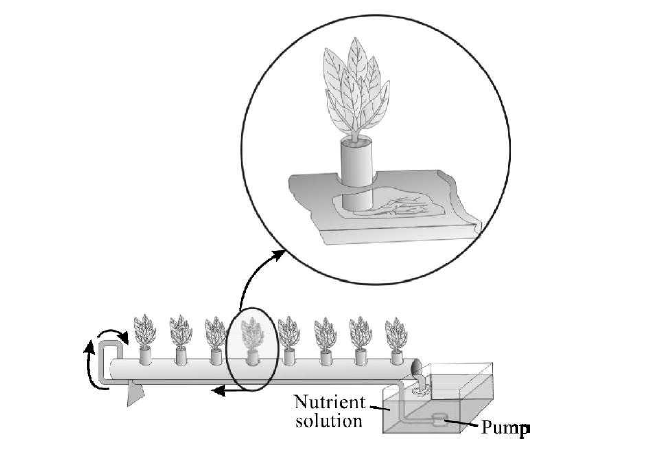
Correct Answer: (c)
In Nutrient Film Technique (NFT), a pump (X) lifts the nutrient solution to the high end of the trough, and it flows back to the reservoir via gravity (Y).
In Nutrient Film Technique (NFT), a pump (X) lifts the nutrient solution to the high end of the trough, and it flows back to the reservoir via gravity (Y).
Q31. Which of the following elements are constituents of protein?
Correct Answer: (a)
Nitrogen is a major constituent of amino acids and proteins. Phosphorus is present in certain proteins (phosphoproteins), though sulfur is also a common structural constituent of proteins (cysteine/methionine).
Nitrogen is a major constituent of amino acids and proteins. Phosphorus is present in certain proteins (phosphoproteins), though sulfur is also a common structural constituent of proteins (cysteine/methionine).
Q32. Denitrification is carried out by:
Correct Answer: (b)
Denitrification, the reduction of nitrate back to nitrogen gas, is performed by bacteria like Pseudomonas and Thiobacillus.
Denitrification, the reduction of nitrate back to nitrogen gas, is performed by bacteria like Pseudomonas and Thiobacillus.
Q33. Which of the following bacteria is correctly matched with their function?
I. Nitrosomonas – Nitrite to nitrate
II. Thiobacillus – Dentrification
III. Nostoc – Free-living nitrogen-fixer
IV. Azotobacter – Anaerobic nitrogen-fixer
I. Nitrosomonas – Nitrite to nitrate
II. Thiobacillus – Dentrification
III. Nostoc – Free-living nitrogen-fixer
IV. Azotobacter – Anaerobic nitrogen-fixer
Correct Answer: (c)
Statement II is correct (Thiobacillus denitrifiers). Statement III is correct (Nostoc is a free-living fixer). Statement I is wrong (Nitrobacter does nitrite to nitrate). Statement IV is wrong (Azotobacter is aerobic).
Statement II is correct (Thiobacillus denitrifiers). Statement III is correct (Nostoc is a free-living fixer). Statement I is wrong (Nitrobacter does nitrite to nitrate). Statement IV is wrong (Azotobacter is aerobic).
Q34. Refer the figure given below and select the option which gives correct labelling for all the four blanks A, B, C and D.
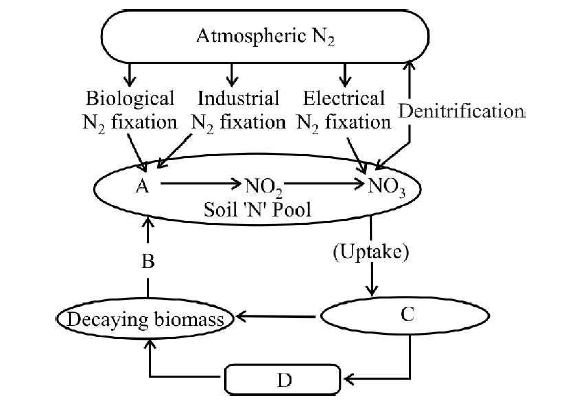
| A | B | C | D |
|---|
Correct Answer: (b)
In the nitrogen cycle: Fixation produces NH3 (A). Decaying biomass undergoes Ammonification (B). Plants assimilate it into Plant biomass (C), eaten by animals to form Animal biomass (D).
In the nitrogen cycle: Fixation produces NH3 (A). Decaying biomass undergoes Ammonification (B). Plants assimilate it into Plant biomass (C), eaten by animals to form Animal biomass (D).
Q35. Which of the following is the mismatched pair?
| Mineral elements | Form that is absorbed by plant |
|---|---|
| (a) Nitrogen | NO3– |
| (b) Phosphorus | H2PO4– |
| (c) Sulphur | H2SO4 |
| (d) Iron | Fe3+ |
Correct Answer: (c)
Repetition of Q79; Sulfur is absorbed as SO42–, not H2SO4.
Repetition of Q79; Sulfur is absorbed as SO42–, not H2SO4.
Q36. Which of the following statements is not correct about macro-nutrients?
Correct Answer: (a)
Macronutrients are defined as being present in plant tissues in concentrations greater than 10 mmole kg–1 of dry matter, not 100 mmole.
Macronutrients are defined as being present in plant tissues in concentrations greater than 10 mmole kg–1 of dry matter, not 100 mmole.
Q37. In an active process, the entry or exit of ions to and from the symplast requires:
Correct Answer: (a)
The movement of ions across membranes against their concentration gradient (active transport) is an energy-dependent process that requires ATP.
The movement of ions across membranes against their concentration gradient (active transport) is an energy-dependent process that requires ATP.
Q38. Legume’s roots have swellings called nodules that
Correct Answer: (d)
Root nodules are specialized structures that house symbiotic Rhizobium bacteria which convert atmospheric nitrogen into a form the plant can use.
Root nodules are specialized structures that house symbiotic Rhizobium bacteria which convert atmospheric nitrogen into a form the plant can use.
Q39. Rapid deterioration of root and shoot tip occurs due to the deficiency of
Correct Answer: (a)
Calcium is essential for meristematic activity; its deficiency leads to the death of root and shoot tips.
Calcium is essential for meristematic activity; its deficiency leads to the death of root and shoot tips.
Q40. Which of the following element is necessary in plants for protein synthesis and also it is a constituent of hormones and many of the vitamins?
Correct Answer: (c)
Nitrogen is required by all parts of a plant, particularly the meristematic tissues, and is a major constituent of proteins, nucleic acids, vitamins, and hormones.
Nitrogen is required by all parts of a plant, particularly the meristematic tissues, and is a major constituent of proteins, nucleic acids, vitamins, and hormones.
Q41. Which of the following statements about nitrification is not correct?
Correct Answer: (d)
Statement (d) is incorrect; autotrophic plants (the ones making their own food) are the ones directly dependent on nitrate produced by nitrifying bacteria.
Statement (d) is incorrect; autotrophic plants (the ones making their own food) are the ones directly dependent on nitrate produced by nitrifying bacteria.
Q42. Plants can be grown in (Tick the incorrect option):
Correct Answer: (d)
Plants cannot grow without essential nutrients, whether in soil or in a hydroponic water culture.
Plants cannot grow without essential nutrients, whether in soil or in a hydroponic water culture.
Q43. The given figure shows a typical set up with their parts marked as A, B and C. Identify A, B and C and determine which experiment is demonstrated in the given figure?
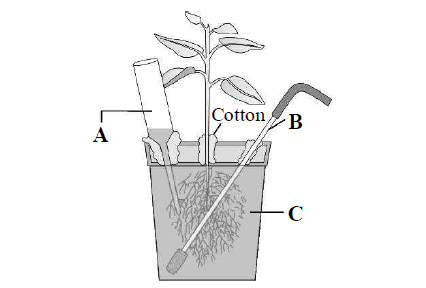
Correct Answer: (a)
A is the funnel for nutrients/water, B is the aerating tube to provide oxygen to roots, and C is the nutrient solution. This is a standard hydroponics setup.
A is the funnel for nutrients/water, B is the aerating tube to provide oxygen to roots, and C is the nutrient solution. This is a standard hydroponics setup.
Q44. Which of the following elements in plants are relatively immobile and are a part of the structural component of the cell?
Correct Answer: (a)
Calcium and sulfur are structural components (e.g., calcium pectate in the middle lamella) and are not easily remobilized from older tissues to younger ones.
Calcium and sulfur are structural components (e.g., calcium pectate in the middle lamella) and are not easily remobilized from older tissues to younger ones.
Q45. Which one of the following statements can best explain the term critical concentration of an essential element?
Correct Answer: (a)
Critical concentration is the point at which the supply of an essential element becomes so low that it limits the plant's growth rate.
Critical concentration is the point at which the supply of an essential element becomes so low that it limits the plant's growth rate.
Q46. Match the following concerning essential elements and their functions in plants
| (A) Iron | (i) Photolysis of water |
|---|---|
| (B) Zinc | (ii) Pollen germination |
| (C) Boron | (iii) Required for chlorophyll biosynthesis |
| (D) Manganese | (iv) IAA biosynthesis |
Correct Answer: (b)
Iron: Chlorophyll synthesis. Zinc: Auxin/IAA biosynthesis. Boron: Pollen germination. Manganese: Photolysis.
Iron: Chlorophyll synthesis. Zinc: Auxin/IAA biosynthesis. Boron: Pollen germination. Manganese: Photolysis.
Q47. Boron in green plants assists in
Correct Answer: (a)
Boron is essential for the translocation of sugars, cell elongation, cell differentiation, and calcium uptake.
Boron is essential for the translocation of sugars, cell elongation, cell differentiation, and calcium uptake.
Q48. With regard to the biological nitrogen fixation by Rhizobium in association with soyabean, which one of the following statement/ statements does not hold true.
Correct Answer: (a)
Nitrogenase is strictly anaerobic and is inhibited by the presence of oxygen.
Nitrogenase is strictly anaerobic and is inhibited by the presence of oxygen.
Q49. Nitrogen fixation by organisms requires conditions that are
Correct Answer: (b)
Nitrogen fixation requires anaerobic conditions because the nitrogenase enzyme is irreversibly inactivated by oxygen.
Nitrogen fixation requires anaerobic conditions because the nitrogenase enzyme is irreversibly inactivated by oxygen.
Q50. Nitrogen fixation is a process of:
Correct Answer: (a)
Nitrogen fixation is the conversion of relatively inert atmospheric nitrogen (N2) into ammonia (NH3) or other nitrogenous compounds usable by plants.
Nitrogen fixation is the conversion of relatively inert atmospheric nitrogen (N2) into ammonia (NH3) or other nitrogenous compounds usable by plants.
Q51. Find the incorrectly matched pair.
Correct Answer: (c)
Rhodospirillum is a free-living anaerobic nitrogen fixer, not aerobic.
Rhodospirillum is a free-living anaerobic nitrogen fixer, not aerobic.
Q52. Which of the given statement(s) is/are correct?
(1) Nitrogen is a limiting nutrient in agricultural esosystem but not is case of natural environment due to its abundance in the atmosphere.
(2) In nature, while lightning provides enough energy for nitrogen fixation same is not true for UV rays.
(1) Nitrogen is a limiting nutrient in agricultural esosystem but not is case of natural environment due to its abundance in the atmosphere.
(2) In nature, while lightning provides enough energy for nitrogen fixation same is not true for UV rays.
Correct Answer: (d)
Nitrogen is often a limiting nutrient in both agricultural and natural ecosystems. Both lightning and UV rays can provide energy for abiotic nitrogen fixation.
Nitrogen is often a limiting nutrient in both agricultural and natural ecosystems. Both lightning and UV rays can provide energy for abiotic nitrogen fixation.
Q53. Which of the following can fix atmospheric nitrogen?
Correct Answer: (d)
Anabaena is a cyanobacterium capable of nitrogen fixation, whereas the others are fungi.
Anabaena is a cyanobacterium capable of nitrogen fixation, whereas the others are fungi.
Q54. The given diagram shows the development of root nodule in soyabean. Thus structures are marked as A, B, C and D.
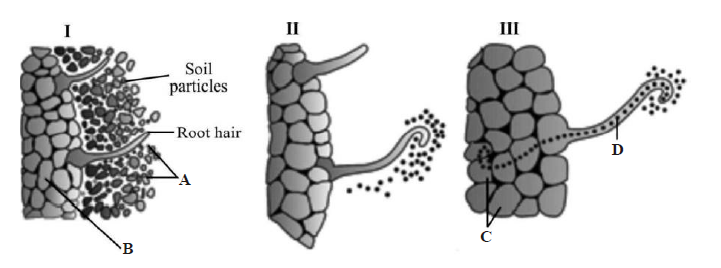
Identify the correct labelling of A, B, C & D.
Identify the correct labelling of A, B, C & D.
Correct Answer: (b)
Label A shows rhizobial bacteria near the root hair. B is a cortical cell. C shows division in inner cortex and pericycle. D is the infection thread carrying bacteria.
Label A shows rhizobial bacteria near the root hair. B is a cortical cell. C shows division in inner cortex and pericycle. D is the infection thread carrying bacteria.
Q55. The deficiencies of micronutrients, not only affects growth of plants but also vital functions such as photosynthetic and mitochondrial electron flow. Among the list given below, which group of three elements shall affect most, both photosynthetic and mitochondrial electron transport?
Correct Answer: (d)
Iron, Copper, and Manganese are essential components of redox carriers (cytochromes, plastocyanin) in both photosynthesis and respiration.
Iron, Copper, and Manganese are essential components of redox carriers (cytochromes, plastocyanin) in both photosynthesis and respiration.
Q56. Biological nitrogen fixation is the:
Correct Answer: (a)
Biological nitrogen fixation is specifically the reduction of atmospheric N2 to NH3 by certain living prokaryotes.
Biological nitrogen fixation is specifically the reduction of atmospheric N2 to NH3 by certain living prokaryotes.
Q57. Phosphorus is absorbed by the plants in the form of
(i) H2PO4–
(ii) HPO42–
(iii) HPO42–
(iv) H2PO4–
(i) H2PO4–
(ii) HPO42–
(iii) HPO42–
(iv) H2PO4–
Correct Answer: (c)
Phosphorus is absorbed from the soil by plants primarily as phosphate ions: H2PO4– or HPO42–.
Phosphorus is absorbed from the soil by plants primarily as phosphate ions: H2PO4– or HPO42–.
Q58. With regard to the mineral absorption, consider the following statements:
(1) The entry of ions to the symplast is an active process while exit from it is passive.
(2) The movement of ions into the apoplast occurs through the trans-membrane proteins.
(1) The entry of ions to the symplast is an active process while exit from it is passive.
(2) The movement of ions into the apoplast occurs through the trans-membrane proteins.
Correct Answer: (a)
Ion entry into the symplast is active. However, movement into the apoplast is primarily a passive process (diffusion/mass flow) through cell walls, not requiring trans-membrane proteins.
Ion entry into the symplast is active. However, movement into the apoplast is primarily a passive process (diffusion/mass flow) through cell walls, not requiring trans-membrane proteins.
Q59. Which of the following is not caused by deficiency of mineral nutrition?
Correct Answer: (c)
Etiolation is a physiological state in plants grown in the dark, characterized by weak stems and pale color; it is caused by lack of light, not mineral deficiency.
Etiolation is a physiological state in plants grown in the dark, characterized by weak stems and pale color; it is caused by lack of light, not mineral deficiency.
Q60. At physiological pH, for the formation of ammonium ion, ammonia is:
Correct Answer: (a)
At physiological pH, ammonia (NH3) picks up a proton (H+) to form the ammonium ion (NH4+).
At physiological pH, ammonia (NH3) picks up a proton (H+) to form the ammonium ion (NH4+).
Q61. Carnivorous plants are often found in acidic and nutrient-poor environments. The main selective pressure for carnivory is
Correct Answer: (a)
Carnivory in plants is an evolutionary adaptation to supplement nitrogen and phosphorus in environments where these key nutrients are scarce in the soil.
Carnivory in plants is an evolutionary adaptation to supplement nitrogen and phosphorus in environments where these key nutrients are scarce in the soil.
Q62. Which of the following is an incorrect match of essential element and function?
Correct Answer: (a)
Magnesium (Mg), not manganese, is the central structural atom of the chlorophyll molecule.
Magnesium (Mg), not manganese, is the central structural atom of the chlorophyll molecule.
Q63. With regard to the mineral deficiency and symptoms associated with them, consider the following statements:
(1) Inhibition of cell division results from Mo deficiency
(2) Copper deficiency is responsible for Necrosis.
(3) Zn deficiency is associated with chlarosis.
(1) Inhibition of cell division results from Mo deficiency
(2) Copper deficiency is responsible for Necrosis.
(3) Zn deficiency is associated with chlarosis.
Correct Answer: (d)
Deficiency of Mo, N, K, and S inhibits cell division. Necrosis is caused by Ca, Mg, Cu, and K deficiency. Chlorosis is caused by N, K, Mg, S, Fe, Mn, Zn, and Mo.
Deficiency of Mo, N, K, and S inhibits cell division. Necrosis is caused by Ca, Mg, Cu, and K deficiency. Chlorosis is caused by N, K, Mg, S, Fe, Mn, Zn, and Mo.
Q64. Frankia produces nitrogen fixing nodules on the roots of:
Correct Answer: (b)
Frankia is a filamentous bacterium that produces nitrogen-fixing nodules on the roots of non-leguminous plants like Alnus.
Frankia is a filamentous bacterium that produces nitrogen-fixing nodules on the roots of non-leguminous plants like Alnus.
Q65. In plant nutrition, elements are classified as major or minor nutrients depending on
Correct Answer: (c)
The classification into macronutrients (major) and micronutrients (minor) is based on the quantitative requirements of the plant.
The classification into macronutrients (major) and micronutrients (minor) is based on the quantitative requirements of the plant.
Q66. Match the column-I containing minerals with the functions given in column-II and choose the correct combination given.
| Column-I (Minerals) | Column-II (Functions) |
|---|---|
| A. K | I. Stomatal opening |
| B. Mo | II. Constituent of cell membrane |
| C. P | III. Photolysis of water |
| D. Mn | IV. Free ion |
| V. Component of nitrogenase and nitrate reductase |
Correct Answer: (a)
Potassium (K) exists as a free ion and controls stomatal opening. Mo is in nitrogenase. Phosphorus (P) is in phospholipids of cell membranes. Mn is for photolysis.
Potassium (K) exists as a free ion and controls stomatal opening. Mo is in nitrogenase. Phosphorus (P) is in phospholipids of cell membranes. Mn is for photolysis.
Q67. The amount of trace elements per kg dry matter is:
Correct Answer: (c)
Micronutrients or trace elements are needed in very small amounts (less than 10 mmole kg–1 of dry matter).
Micronutrients or trace elements are needed in very small amounts (less than 10 mmole kg–1 of dry matter).
Q68. Ion transport in root occurs:
(i) passively through channels.
(ii) actively through channels.
(iii) actively through carriers.
(iv) through both symplast and apoplast.
(i) passively through channels.
(ii) actively through channels.
(iii) actively through carriers.
(iv) through both symplast and apoplast.
Correct Answer: (c)
Ions move passively through channels or actively via carrier proteins (pumps), utilizing both apoplastic and symplastic pathways in the root.
Ions move passively through channels or actively via carrier proteins (pumps), utilizing both apoplastic and symplastic pathways in the root.
Q69. Plant need nutrients from their environment. Which of the following is a non-mineral nutrient obtained from the soil?
Correct Answer: (a)
Carbon is mainly obtained by plants from CO2 in the atmosphere, while others like N and P are primarily absorbed as minerals from the soil.
Carbon is mainly obtained by plants from CO2 in the atmosphere, while others like N and P are primarily absorbed as minerals from the soil.
Q70. The primary amino acid from which other 17 amino acids are formed through the process of transamination is:
Correct Answer: (c)
Glutamic acid acts as the main amino group donor for the synthesis of other amino acids via transamination.
Glutamic acid acts as the main amino group donor for the synthesis of other amino acids via transamination.
Q71. Consider the following statements:
(1) Deficiency of any element can cause multiple symptoms in plants.
(2) The same symptoms may be caused by the deficiency of several different elements.
(3) Different plants also respond similarly to the deficiency of the same element.
(1) Deficiency of any element can cause multiple symptoms in plants.
(2) The same symptoms may be caused by the deficiency of several different elements.
(3) Different plants also respond similarly to the deficiency of the same element.
Correct Answer: (a)
While (1) and (2) are fundamental rules of plant nutrition, statement (3) is incorrect because different plant species or even varieties can show very different responses/tolerances to the same nutrient deficiency.
While (1) and (2) are fundamental rules of plant nutrition, statement (3) is incorrect because different plant species or even varieties can show very different responses/tolerances to the same nutrient deficiency.
Q72. Which of the following represents the abiotic mode to convert nitrogen to nitrogen oxides into the soil?
Correct Answer: (a)
Lightning and UV radiation provide enough energy to convert atmospheric nitrogen into nitrogen oxides (NO, NO2, N2O) abiotically.
Lightning and UV radiation provide enough energy to convert atmospheric nitrogen into nitrogen oxides (NO, NO2, N2O) abiotically.
Q73. Deficiency symptoms of nitrogen and potassium are visible first in
Correct Answer: (a)
Elements like N and K are highly mobile and are translocated from old (senescent) leaves to young leaves during deficiency.
Elements like N and K are highly mobile and are translocated from old (senescent) leaves to young leaves during deficiency.
Q74. Which of the following element is involved in plants for protein synthesis?
Correct Answer: (a)
Potassium (K+) plays an important role in protein synthesis, the maintenance of turgidity of cells, and opening and closing of stomata.
Potassium (K+) plays an important role in protein synthesis, the maintenance of turgidity of cells, and opening and closing of stomata.
Q75. Which of the following statements are incorrect ?
(i) The morphological changes are indicative of certain element deficiencies and are called deficiency symptoms.
(ii) The part of plants that show the deficiency symptoms depend on the mobility of the element in the plant.
(iii) Deficiency symptoms appear first in the young tissues whenever the element are relatively mobile.
(iv) The deficiency symptoms of Cl, Z, N, O, are visible first in the senescent leaves.
(i) The morphological changes are indicative of certain element deficiencies and are called deficiency symptoms.
(ii) The part of plants that show the deficiency symptoms depend on the mobility of the element in the plant.
(iii) Deficiency symptoms appear first in the young tissues whenever the element are relatively mobile.
(iv) The deficiency symptoms of Cl, Z, N, O, are visible first in the senescent leaves.
Correct Answer: (a)
Symptoms appear first in older (senescent) leaves for mobile elements (N, K, Mg). For immobile elements (Fe, Ca), symptoms appear first in young tissues.
Symptoms appear first in older (senescent) leaves for mobile elements (N, K, Mg). For immobile elements (Fe, Ca), symptoms appear first in young tissues.
Q76. Which of the following is a free living aerobic non-photosynthetic nitrogen-fixer?
Correct Answer: (b)
Azotobacter is a classic example of a free-living, aerobic, heterotrophic (non-photosynthetic) nitrogen-fixing bacterium.
Azotobacter is a classic example of a free-living, aerobic, heterotrophic (non-photosynthetic) nitrogen-fixing bacterium.
Q77. The product(s) of reaction catalyzed by nitrogenase in root nodules of leguminous plants is/are
Correct Answer: (c)
The nitrogenase reaction reduces atmospheric nitrogen to ammonia while also producing molecular hydrogen as a byproduct.
The nitrogenase reaction reduces atmospheric nitrogen to ammonia while also producing molecular hydrogen as a byproduct.
Q78. In plants a common symptom caused by deficiency of P, K, Ca and Mg is the
Correct Answer: (d)
Deficiency of macroelements like P, K, Ca, and Mg often manifests as necrotic (dead) spots or areas on leaves.
Deficiency of macroelements like P, K, Ca, and Mg often manifests as necrotic (dead) spots or areas on leaves.
Q79. In which of the following, all three are macronutrients?
Correct Answer: (d)
Nitrogen, Calcium, and Phosphorus are all macronutrients. The other options contain micronutrients like Boron, Zn, Mn, Cu, and Mo.
Nitrogen, Calcium, and Phosphorus are all macronutrients. The other options contain micronutrients like Boron, Zn, Mn, Cu, and Mo.
Q80. Plant absorbs nitrogen from the soil in the form of
Correct Answer: (d)
Although plants can absorb ammonia or nitrite, the major form in which nitrogen is absorbed from the soil is nitrate (NO3–).
Although plants can absorb ammonia or nitrite, the major form in which nitrogen is absorbed from the soil is nitrate (NO3–).
Q81. The bond in molecular nitrogen (N2) is difficult to break, because it is a:
Correct Answer: (c)
Molecular nitrogen exists as two nitrogen atoms linked by a very strong triple covalent bond (N≡N).
Molecular nitrogen exists as two nitrogen atoms linked by a very strong triple covalent bond (N≡N).
Q82. The essential elements which are required by plants in large amounts are called________ and those required in very small amount by the plants are called_________.
Correct Answer: (c)
Macronutrients are required in large amounts (>10 mmole/kg), while micronutrients are required in trace amounts (<10 mmole/kg).
Macronutrients are required in large amounts (>10 mmole/kg), while micronutrients are required in trace amounts (<10 mmole/kg).
Q83. Soil can easily become deficient in_________ because these ions are negatively charged and do not stick to negatively charged clay particles:
Correct Answer: (a)
Clay particles are negatively charged and repel anions like nitrate (NO3–), making them prone to leaching from the soil.
Clay particles are negatively charged and repel anions like nitrate (NO3–), making them prone to leaching from the soil.
Q84. Which of the following scientist for the first time demonstrated the experiment on hydroponics?
Correct Answer: (a)
Julius von Sachs, a prominent German botanist, first demonstrated in 1860 that plants could be grown to maturity in a defined nutrient solution in the complete absence of soil.
Julius von Sachs, a prominent German botanist, first demonstrated in 1860 that plants could be grown to maturity in a defined nutrient solution in the complete absence of soil.
Q85. Which of the following mineral is associated with the characters/functions given below?
(i) Helps in formation of middle lamella.
(ii) Needed in mitotic spindle formation.
(iii) Accumulates in older leaves.
(iv) Involves in normal functioning of the cell membranes.
(v) Activate certain enzymes.
(vi) Plays an important role in regulating metabolic activities.
(i) Helps in formation of middle lamella.
(ii) Needed in mitotic spindle formation.
(iii) Accumulates in older leaves.
(iv) Involves in normal functioning of the cell membranes.
(v) Activate certain enzymes.
(vi) Plays an important role in regulating metabolic activities.
Correct Answer: (d)
Calcium (Ca2+) is used in synthesis of cell wall (calcium pectate in middle lamella), mitotic spindle formation, and regulates various metabolic processes.
Calcium (Ca2+) is used in synthesis of cell wall (calcium pectate in middle lamella), mitotic spindle formation, and regulates various metabolic processes.
Q86. In plants a common symptom caused by deficiencies of Cu, K, Ca and Mg is the
Correct Answer: (d)
Necrosis, or the death of tissue (particularly leaf tissue), is caused by the deficiency of Ca, Mg, Cu, and K.
Necrosis, or the death of tissue (particularly leaf tissue), is caused by the deficiency of Ca, Mg, Cu, and K.
Q87. Which of the following statements about nitrogen fixation is correct?
(i) Nitrogenase is only catalytic under anaerobic conditions.
(ii) The energy for nitrogen fixation can be provided by either photosynthesis or respiration only.
(iii) In nitrogen fixation, nitrogen is reduced by the addition of three successive pairs of hydrogen atoms.
(iv) Most nitrogen fixing microbes are aerobic.
(i) Nitrogenase is only catalytic under anaerobic conditions.
(ii) The energy for nitrogen fixation can be provided by either photosynthesis or respiration only.
(iii) In nitrogen fixation, nitrogen is reduced by the addition of three successive pairs of hydrogen atoms.
(iv) Most nitrogen fixing microbes are aerobic.
Correct Answer: (c)
Statement (i) is correct (nitrogenase is oxygen-sensitive) and (iii) is correct ($ → $ requires 6H). Most nitrogen fixers are not necessarily aerobic (many are anaerobic or symbiotic).
Statement (i) is correct (nitrogenase is oxygen-sensitive) and (iii) is correct ($ → $ requires 6H). Most nitrogen fixers are not necessarily aerobic (many are anaerobic or symbiotic).
Q88. Which of the following is an anaerobic N2 fixing bacterium?
Correct Answer: (c)
Rhodospirillum is a well-known example of a free-living anaerobic nitrogen-fixing bacterium.
Rhodospirillum is a well-known example of a free-living anaerobic nitrogen-fixing bacterium.
Q89. The functions given below are performed by which of the following mineral?
(i) An important constituent of proteins involved in ETS.
(ii) Activator of catalase.
(iii) Essential for chlorophyll synthesis.
(i) An important constituent of proteins involved in ETS.
(ii) Activator of catalase.
(iii) Essential for chlorophyll synthesis.
Correct Answer: (c)
Iron (Fe) is a constituent of proteins like cytochromes and ferredoxin involved in ETS, activates catalase, and is essential for the formation of chlorophyll.
Iron (Fe) is a constituent of proteins like cytochromes and ferredoxin involved in ETS, activates catalase, and is essential for the formation of chlorophyll.
Q90. In which of the following forms is iron absorbed by plants?
Correct Answer: (a)
Plants absorb iron primarily in the form of ferric ions (Fe3+).
Plants absorb iron primarily in the form of ferric ions (Fe3+).
Q91. Which of the following essential element is required for photochemical reaction involved in photolysis of water?
Correct Answer: (b)
Chlorine (Cl–) along with manganese (Mn2+) is essential for the water-splitting reaction (photolysis) in photosynthesis that leads to oxygen evolution.
Chlorine (Cl–) along with manganese (Mn2+) is essential for the water-splitting reaction (photolysis) in photosynthesis that leads to oxygen evolution.
Q92. Which of the following expression describes nitrogen fixation?
Correct Answer: (a)
Nitrogen fixation is chemically defined as the reduction of atmospheric nitrogen gas (N2) to ammonia (NH3).
Nitrogen fixation is chemically defined as the reduction of atmospheric nitrogen gas (N2) to ammonia (NH3).
Q93. Some bacteria such as ‘X’ and ‘Y’ occur in soil which reduce nitrate to nitrogen by the process of ‘Z’. Identify ‘X’, ‘Y’ and ‘Z’
Correct Answer: (d)
Denitrification (Z) is the process of reducing nitrate back to N2, performed by bacteria like Pseudomonas (X) and Thiobacillus (Y).
Denitrification (Z) is the process of reducing nitrate back to N2, performed by bacteria like Pseudomonas (X) and Thiobacillus (Y).
Q94. The nodule in a plant root where nitrogen fixing bacteria live forms from cells of the:
Correct Answer: (b)
Rhizobial bacteria stimulate division in the cortical and pericycle cells of the root to form the nodule.
Rhizobial bacteria stimulate division in the cortical and pericycle cells of the root to form the nodule.
Q95. A trace element essential for plant growth and radio isotope, which is used in cancer therapy is:
Correct Answer: (a)
Cobalt (Co) is a micronutrient (especially for $ fixers) and its isotope Cobalt-60 is widely used in radiotherapy for cancer treatment.
Cobalt (Co) is a micronutrient (especially for $ fixers) and its isotope Cobalt-60 is widely used in radiotherapy for cancer treatment.
Q96. Which pigment is essential for nitrogen fixation by leguminous plants?
Correct Answer: (b)
Leghaemoglobin is essential as it protects the nitrogenase enzyme from oxygen inhibition in legume nodules.
Leghaemoglobin is essential as it protects the nitrogenase enzyme from oxygen inhibition in legume nodules.
Q97. Read the following statements (i to v) and answer the following question.
(i) Nitrogen is very essential for the sustenance of life.
(ii) N2 - fixation requires a strong reducing agent.
(iii) N2 - fixation in leguenes is accomplished with the help of nitrogen fixing microbes, mainly Frankia.
(iv) The enzyme nitrogenase which plays an important role in biological N2 fixation is very sensitive to carbon dioxide.
(v) The energy, ATP, required is provided by the respiration of the host cells.
(i) Nitrogen is very essential for the sustenance of life.
(ii) N2 - fixation requires a strong reducing agent.
(iii) N2 - fixation in leguenes is accomplished with the help of nitrogen fixing microbes, mainly Frankia.
(iv) The enzyme nitrogenase which plays an important role in biological N2 fixation is very sensitive to carbon dioxide.
(v) The energy, ATP, required is provided by the respiration of the host cells.
Correct Answer: (c)
Statement (iii) is incorrect (it's Rhizobium, not Frankia for legumes). Statement (iv) is incorrect (nitrogenase is sensitive to oxygen, not CO2).
Statement (iii) is incorrect (it's Rhizobium, not Frankia for legumes). Statement (iv) is incorrect (nitrogenase is sensitive to oxygen, not CO2).
Q98. A boy notice that the young leaves of his tomato plants are very yellow. What type of deficiency does this suggest?
Correct Answer: (d)
Chlorosis in young leaves is typical of immobile element deficiencies like Iron (Fe), whereas nitrogen deficiency (mobile) appears first in older leaves.
Chlorosis in young leaves is typical of immobile element deficiencies like Iron (Fe), whereas nitrogen deficiency (mobile) appears first in older leaves.
Q99. Asparagine and glutamine are the two most important
Correct Answer: (b)
Asparagine and glutamine are amides formed from aspartic acid and glutamic acid respectively; they contain more nitrogen and are used for long-distance transport.
Asparagine and glutamine are amides formed from aspartic acid and glutamic acid respectively; they contain more nitrogen and are used for long-distance transport.
Q100. Conversion of N≡N to NH3 occurs in plant cell by:
Correct Answer: (d)
The actual conversion process (nitrogen fixation) within a cell is catalyzed by the specific enzyme complex called nitrogenase.
The actual conversion process (nitrogen fixation) within a cell is catalyzed by the specific enzyme complex called nitrogenase.
Q101. Read the following statement and answer the question: Infected thread carries the bacteria to the inner ‘X’ cells. The bacteria get modified into rod-shaped bacteroids and cause inner ‘X’ and ‘Y’ cells to divide. Division and growth of ‘X’ and ‘Y’ cells lead to nodule formation. Identify ‘X’ and ‘Y’:
Correct Answer: (b)
Rhizobial bacteria released from the infection thread cause division in both the cortical and pericycle cells of the root, leading to nodule formation.
Rhizobial bacteria released from the infection thread cause division in both the cortical and pericycle cells of the root, leading to nodule formation.
Q102. Match the items given in column-I with their examples given in column-II and choose the correct answer.
| Column-I | Column-II |
|---|---|
| A. Free living aerobic nitrogen fixers | I. Anabaena and Nostoc |
| B. Anaerobic nitrogen fixers | II. Pseudomonas and Thiobacillus |
| C. Nitrogen fixing cyanobacteria | III. Nitrosomonas and Nitrococcus |
| D. Denitrifying bacteria | IV. Azotobacter and Beijernickia |
| E. Nitrifying bacteria. | V. Rhodospirillum |
Correct Answer: (a)
A-IV (Azotobacter), B-V (Rhodospirillum), C-I (Nostoc), D-II (Pseudomonas), E-III (Nitrosomonas).
A-IV (Azotobacter), B-V (Rhodospirillum), C-I (Nostoc), D-II (Pseudomonas), E-III (Nitrosomonas).
Q103. Refer the given statements and answer the question:
(i) The element must be absolutely necessary for supporting normal growth and reproduction.
(ii) The requirement of the element must be specific and not replaceable by another element.
(iii) The element must be directly involved in the metabolism of the plant.
The above statements apply to
(i) The element must be absolutely necessary for supporting normal growth and reproduction.
(ii) The requirement of the element must be specific and not replaceable by another element.
(iii) The element must be directly involved in the metabolism of the plant.
The above statements apply to
Correct Answer: (b)
These are the three primary criteria established by Arnon and Stout to define the essentiality of a mineral element for plants.
These are the three primary criteria established by Arnon and Stout to define the essentiality of a mineral element for plants.
Q104. A small aquatic plant was put in each of the petridishes -X, Y & Z, containing different culture solutions. After six weeks the plant in dish X had the same number of leaves as it had previously & were all small and yellowish. Plant in dish Y had more leaves of normal size and dark green colour. Plants in dish Z had more leaves of normal size but very pale. Which of the following show the element missing in the culture?
| X | Y | Z |
|---|
Correct Answer: (a)
X (small/yellow) suggests Mg deficiency (chlorosis/stunted). Y (normal) has everything. Z (pale) suggests nitrogen deficiency.
X (small/yellow) suggests Mg deficiency (chlorosis/stunted). Y (normal) has everything. Z (pale) suggests nitrogen deficiency.
Q105. The most abundant gas in our atmosphere cannot be utilized by plants directly in its atmospheric form and is, therefore, captured by certain bacteria that live symbiotically in the nodules of roots. Identify the gas?
Correct Answer: (b)
Nitrogen (N2) makes up 78% of the atmosphere but must be fixed by bacteria to be used by plants.
Nitrogen (N2) makes up 78% of the atmosphere but must be fixed by bacteria to be used by plants.
Q106. The enzyme _______ which is capable of nitrogen reduction is present exclusively in prokaryotes. Such microbes are called_____.:
Correct Answer: (b)
The enzyme nitrogenase, which reduces nitrogen to ammonia, is found only in prokaryotic organisms known as nitrogen fixers.
The enzyme nitrogenase, which reduces nitrogen to ammonia, is found only in prokaryotic organisms known as nitrogen fixers.
Q107. Any mineral ion concentration in tissues that reduces the dry weight of tissues by about _______ is considered toxic.
Correct Answer: (a)
The concentration of a micronutrient that reduces the dry weight of tissues by about 10% is defined as the toxic concentration.
The concentration of a micronutrient that reduces the dry weight of tissues by about 10% is defined as the toxic concentration.
Q108. Leghaemoglobin helps in:
Correct Answer: (c)
Nitrogenase is highly sensitive to oxygen. Leghaemoglobin acts as an oxygen scavenger to maintain anaerobic conditions in the nodule.
Nitrogenase is highly sensitive to oxygen. Leghaemoglobin acts as an oxygen scavenger to maintain anaerobic conditions in the nodule.
Q109. Which one of the following symptoms is not due to manganese toxicity in plants?
Correct Answer: (b)
Manganese toxicity induces deficiency of Iron, Magnesium, and Calcium, but not Nitrogen.
Manganese toxicity induces deficiency of Iron, Magnesium, and Calcium, but not Nitrogen.
Q110. Thiobacillus is a group of bacteria helpful in carrying out:
Correct Answer: (d)
Thiobacillus and Pseudomonas are the primary bacteria responsible for the denitrification process in the nitrogen cycle.
Thiobacillus and Pseudomonas are the primary bacteria responsible for the denitrification process in the nitrogen cycle.
Q111. Deficiency symptoms of an element tend to appear first in young leaves. It indicates that the element is relatively immobile. Which one of the following elemental deficiency would show such symptoms?
Correct Answer: (a)
Sulphur and Calcium are structural components and immobile; therefore, their deficiency symptoms appear first in young, developing leaves.
Sulphur and Calcium are structural components and immobile; therefore, their deficiency symptoms appear first in young, developing leaves.
Q112. Which of the following statements are correct?
(i) Solution culture/hydroponics contains all essential minerals except one, the usefulness of which is to be determined.
(ii) Na, Si, Co and selenium are beneficial element required by higher plants.
(iii) Zn is the activator of nitrogenases while Mo is the activator of alcohol dehydrogenase.
(iv) Zn is needed for auxin synthesis.
(i) Solution culture/hydroponics contains all essential minerals except one, the usefulness of which is to be determined.
(ii) Na, Si, Co and selenium are beneficial element required by higher plants.
(iii) Zn is the activator of nitrogenases while Mo is the activator of alcohol dehydrogenase.
(iv) Zn is needed for auxin synthesis.
Correct Answer: (b)
Statement (iii) is incorrect; Mo is the activator of nitrogenase and Zn activates alcohol dehydrogenase. Others are correct.
Statement (iii) is incorrect; Mo is the activator of nitrogenase and Zn activates alcohol dehydrogenase. Others are correct.
Q113. Consider the following statements:
(1) Ammonium ions toxic to plants and hence cannot accumulate in them.
(2) In soyabean, the fixed nitrogen is exported as ureides.
(1) Ammonium ions toxic to plants and hence cannot accumulate in them.
(2) In soyabean, the fixed nitrogen is exported as ureides.
Correct Answer: (c)
NH4+ is indeed toxic at high levels and is quickly assimilated. Ureides are the primary transport form of fixed nitrogen in certain legumes like soybean.
NH4+ is indeed toxic at high levels and is quickly assimilated. Ureides are the primary transport form of fixed nitrogen in certain legumes like soybean.