Q1. During the process of spermatogenesis, a nondisjunction event that occurs during the second division would
Correct Answer: (b)
Nondisjunction in Meiosis I results in 100% aneuploid gametes (two n+1, two n-1). Nondisjunction in Meiosis II only affects one of the two secondary spermatocytes; thus, two gametes are normal (n), one is n+1, and one is n-1.
Nondisjunction in Meiosis I results in 100% aneuploid gametes (two n+1, two n-1). Nondisjunction in Meiosis II only affects one of the two secondary spermatocytes; thus, two gametes are normal (n), one is n+1, and one is n-1.
Q2. Sex determination in birds follows the ZW system, where males have two copies of the Z chromosome (ZZ) and females are heterozygous (ZW). A male bird (who is heterozygous for a trait on the Z chromosome) is mated with a female bird (who expresses the recessive phenotype for that trait). Which of the following best describes their most likely offspring?
Correct Answer: (a)
(A) The following Punnett square shows the cross between a heterozygous male (ZAZa) and a female with the recessive trait (ZaW):
So 1/4 of the offspring would be males with the dominant phenotype, 1/4 would be males with the recessive phenotype, 1/4 would be females with the dominant phenotype, and 1/4 would be females with the recessive phenotype.
(A) The following Punnett square shows the cross between a heterozygous male (ZAZa) and a female with the recessive trait (ZaW):
| ZA | Za | Results | |
| Za | ZAZa | ZaZa | 1/4 males with dominant phenotype, 1/4 males with recessive phenotype |
| W | ZAW | ZaW | 1/4 females with dominant phenotype, 1/4 females with recessive phenotype |
So 1/4 of the offspring would be males with the dominant phenotype, 1/4 would be males with the recessive phenotype, 1/4 would be females with the dominant phenotype, and 1/4 would be females with the recessive phenotype.
Q3. Rh positive (R) is a trait that is dominant over Rh negative (r). A woman, who is Rh positive, has a son, who is Rh negative.
Which of the following is a true statement about the mother?
Which of the following is a true statement about the mother?
Correct Answer: (c)
Since the mother is Rh positive, she must have at least one dominant R allele. Since she has a child who is Rh negative, she must have an r allele. Therefore, the mother must be heterozygous Rr. Choice (A) is incorrect because if the mother was rr, she would not be Rh positive. Choice (B) is incorrect because an RR mother could not produce an Rh negative child. Choice (D) is incorrect because since the mother is Rh positive and her son is Rh negative, they cannot have the same genotype.
Since the mother is Rh positive, she must have at least one dominant R allele. Since she has a child who is Rh negative, she must have an r allele. Therefore, the mother must be heterozygous Rr. Choice (A) is incorrect because if the mother was rr, she would not be Rh positive. Choice (B) is incorrect because an RR mother could not produce an Rh negative child. Choice (D) is incorrect because since the mother is Rh positive and her son is Rh negative, they cannot have the same genotype.
Q4. Two snowshoe hares (a type of rabbit) have the same genotype. During the winter, the hare that lives outdoors in the cold has white fur, but the hare that lives in a climate-controlled and warm environment has brown fur. This is an example of ________.
Correct Answer: (d)
(D) Phenotypic plasticity describes the ability of two individuals with the same genotype to produce different phenotypes, depending on the different environmental factors that affect each individual. Choice (A) is incorrect because sex-linkage involves traits found on the sex chromosomes. Multiple gene inheritance refers to multiple genes contributing to an individual’s phenotype, so choice (B) is incorrect. Nonnuclear inheritance refers to traits coded for by genes outside of the nucleus (in the mitochondria or chloroplast), so choice (C) is incorrect.
(D) Phenotypic plasticity describes the ability of two individuals with the same genotype to produce different phenotypes, depending on the different environmental factors that affect each individual. Choice (A) is incorrect because sex-linkage involves traits found on the sex chromosomes. Multiple gene inheritance refers to multiple genes contributing to an individual’s phenotype, so choice (B) is incorrect. Nonnuclear inheritance refers to traits coded for by genes outside of the nucleus (in the mitochondria or chloroplast), so choice (C) is incorrect.
Q5. When you cross true-breeding tall and short tobacco plants you get an F1 that is intermediate in height. When this F1 is self-crossed, it yields an F2 with a continuous distribution of heights. What is the best explanation for these data?
Correct Answer: (c)
If the trait were controlled by a single gene with incomplete dominance, the F2 would show only three discrete phenotypes. A continuous distribution (a wide range of heights) indicates that the trait is polygenic, meaning it is influenced by many genes acting additively.
If the trait were controlled by a single gene with incomplete dominance, the F2 would show only three discrete phenotypes. A continuous distribution (a wide range of heights) indicates that the trait is polygenic, meaning it is influenced by many genes acting additively.
Q6. If the two genes in the previous question showed complete linkage, what would you predict for an F2 phenotypic ratio?
Correct Answer: (d)
With complete linkage, the alleles on the same chromosome are inherited as a unit. If Red (R) is linked with Tall (T) and White (W) with Short (t), the F1 (RT/Wt) produces only RT and Wt gametes. The cross (RT, Wt) × (RT, Wt) yields 1 RRTT (red tall), 2 RWTt (pink tall), and 1 WWtt (white short).
With complete linkage, the alleles on the same chromosome are inherited as a unit. If Red (R) is linked with Tall (T) and White (W) with Short (t), the F1 (RT/Wt) produces only RT and Wt gametes. The cross (RT, Wt) × (RT, Wt) yields 1 RRTT (red tall), 2 RWTt (pink tall), and 1 WWtt (white short).
Q7. In pea plants, smooth (S) pods are dominant and constricted (s) pods are recessive. Which of the following is a correct statement?
Correct Answer: (c)
A genotype of ss would result in the constricted pod phenotype. Choices (A) and (B) are incorrect because both SS and Ss would result in the smooth phenotype. Choice (D) is incorrect because smooth pods would not always have the SS genotype; smooth pods could also have the Ss genotype.
A genotype of ss would result in the constricted pod phenotype. Choices (A) and (B) are incorrect because both SS and Ss would result in the smooth phenotype. Choice (D) is incorrect because smooth pods would not always have the SS genotype; smooth pods could also have the Ss genotype.
Q8. In peas, round (R) peas are dominant and wrinkled (r) peas are recessive. A plant with an unknown genotype for this trait has round peas. Which of the following results of a test cross would support the hypothesis that the genotype of the plant with the round peas is heterozygous?
Correct Answer: (c)
If the plant with round peas is heterozygous, its genotype is Rr. The definition of a test cross is to cross an individual with the dominant phenotype (but an unknown genotype) with a homozygous recessive individual. Thus, if the Rr plant was crossed with an rr plant, 50% of the offspring would be expected to be round and 50% would be expected to be wrinkled. Choice (A) is incorrect because it describes the expected results if the original round plant was homozygous dominant (RR). Choice (B) is incorrect because in order to produce that proportion of offspring, both parent plants would have to be heterozygous (Rr), but the plant used to do the test cross must be rr. In order to produce 100% wrinkled offspring, both parent plants would have to be homozygous recessive (rr), so choice (D) is incorrect.
If the plant with round peas is heterozygous, its genotype is Rr. The definition of a test cross is to cross an individual with the dominant phenotype (but an unknown genotype) with a homozygous recessive individual. Thus, if the Rr plant was crossed with an rr plant, 50% of the offspring would be expected to be round and 50% would be expected to be wrinkled. Choice (A) is incorrect because it describes the expected results if the original round plant was homozygous dominant (RR). Choice (B) is incorrect because in order to produce that proportion of offspring, both parent plants would have to be heterozygous (Rr), but the plant used to do the test cross must be rr. In order to produce 100% wrinkled offspring, both parent plants would have to be homozygous recessive (rr), so choice (D) is incorrect.
Q9. Down syndrome is the result of trisomy for chromosome 21. Why is this trisomy viable whereas trisomy for most other chromosomes is not?
Correct Answer: (c)
Viability of aneuploidy is generally linked to the amount of genetic imbalance. Chromosome 21 is the smallest human autosome with the lowest gene count. Extra copies of larger chromosomes create a 'gene dosage' imbalance so severe that the embryo typically cannot develop.
Viability of aneuploidy is generally linked to the amount of genetic imbalance. Chromosome 21 is the smallest human autosome with the lowest gene count. Extra copies of larger chromosomes create a 'gene dosage' imbalance so severe that the embryo typically cannot develop.
Q10. Two genes that are close together on the same chromosome are said to be ________ and are ________ likely to be inherited together than ________ genes.
Correct Answer: (b)
(B) Genes that are close together on the same chromosome are linked and are more likely to be inherited together (since they are close together on the same piece of DNA) than unlinked genes. Choice (A) is incorrect because linked genes are more, not less, likely to be inherited together. Choices (C) and (D) are incorrect because unlinked genes may be either on separate chromosomes or far apart on the same chromosome.
(B) Genes that are close together on the same chromosome are linked and are more likely to be inherited together (since they are close together on the same piece of DNA) than unlinked genes. Choice (A) is incorrect because linked genes are more, not less, likely to be inherited together. Choices (C) and (D) are incorrect because unlinked genes may be either on separate chromosomes or far apart on the same chromosome.
Q11. Bipolar disorder is a complex trait that shows high heritability in twin studies. The best way to analyze the genetics of this would be to use
Correct Answer: (b)
Bipolar disorder is polygenic, involving many genes with small individual effects. Genome-Wide Association Studies (GWAS) scan the entire genome of large populations to identify single nucleotide polymorphisms (SNPs) associated with complex conditions that family linkage studies might miss.
Bipolar disorder is polygenic, involving many genes with small individual effects. Genome-Wide Association Studies (GWAS) scan the entire genome of large populations to identify single nucleotide polymorphisms (SNPs) associated with complex conditions that family linkage studies might miss.
Q12. Sex-linked recessive traits in humans are ________ likely to be expressed in ________.
Correct Answer: (c)
(C) Sex-linked genes are more likely to be expressed in males since males have only one X chromosome. Choice (A) is incorrect because sex-linked genes are more likely, not less likely, to be expressed in males. Females have two X chromosomes, so a sex-linked recessive trait is less likely to be expressed in females because a female would have to inherit two copies of the allele while a male would only have to inherit one copy of the allele for it to be expressed. Thus, choices (B) and (D) are both incorrect.
(C) Sex-linked genes are more likely to be expressed in males since males have only one X chromosome. Choice (A) is incorrect because sex-linked genes are more likely, not less likely, to be expressed in males. Females have two X chromosomes, so a sex-linked recessive trait is less likely to be expressed in females because a female would have to inherit two copies of the allele while a male would only have to inherit one copy of the allele for it to be expressed. Thus, choices (B) and (D) are both incorrect.
Q13. What is the probability of obtaining an individual with the genotype bb from a cross between two individuals with the genotype Bb?
Correct Answer: (b)
A cross between two heterozygotes (Bb × Bb) produces a 1:2:1 genotypic ratio: 1/4 BB, 1/2 Bb, and 1/4 bb. Therefore, the probability of the homozygous recessive genotype is 25% or 1/4.
A cross between two heterozygotes (Bb × Bb) produces a 1:2:1 genotypic ratio: 1/4 BB, 1/2 Bb, and 1/4 bb. Therefore, the probability of the homozygous recessive genotype is 25% or 1/4.
Q14. A pea plant that is heterozygous for round peas and heterozygous for smooth pods is crossed with a pea plant that is heterozygous for round peas and has constricted pods. What fraction of the offspring are expected to have round peas and constricted pods? (Remember that round peas are dominant to wrinkled peas, and smooth pods are dominant to constricted pods.)
Correct Answer: (b)
The genotypes of the plants described in the problem are RrSs and Rrss. First, calculate the probability for each trait separately. The probability of two plants that are heterozygous for round peas producing an offspring with round peas is 3/4. The probability of a plant with heterozygous smooth pods crossed with a plant with constricted pods producing an offspring with constricted pods is 1/2. Multiplying the two probabilities together gives the probability of a plant with both round peas and constricted pods: 3/4 × 1/2 = 3/8.
The genotypes of the plants described in the problem are RrSs and Rrss. First, calculate the probability for each trait separately. The probability of two plants that are heterozygous for round peas producing an offspring with round peas is 3/4. The probability of a plant with heterozygous smooth pods crossed with a plant with constricted pods producing an offspring with constricted pods is 1/2. Multiplying the two probabilities together gives the probability of a plant with both round peas and constricted pods: 3/4 × 1/2 = 3/8.
Q15. In an organism’s genome, autosomes are
Correct Answer: (d)
Autosomes are the non-sex chromosomes that are present in pairs in both males and females. They carry the majority of an organism's genetic information and follow standard Mendelian inheritance patterns, unlike sex chromosomes which determine the individual's sex.
Autosomes are the non-sex chromosomes that are present in pairs in both males and females. They carry the majority of an organism's genetic information and follow standard Mendelian inheritance patterns, unlike sex chromosomes which determine the individual's sex.
Q16. In the cross AaBbCc × AaBbCc, what is the probability of producing an offspring with the AABBCc genotype?
Correct Answer: (d)
Remember to break this down one trait at a time, find the probability of the outcomes for each trait, and then multiply the probabilities together. Aa × Aa would produce AA 1/4 of the time. Similarly, Bb × Bb would produce BB 1/4 of the time. Cc × Cc would produce Cc 1/2 of the time. Multiply all three probabilities together: 1/4 × 1/4 × 1/2 = 1/32.
Remember to break this down one trait at a time, find the probability of the outcomes for each trait, and then multiply the probabilities together. Aa × Aa would produce AA 1/4 of the time. Similarly, Bb × Bb would produce BB 1/4 of the time. Cc × Cc would produce Cc 1/2 of the time. Multiply all three probabilities together: 1/4 × 1/4 × 1/2 = 1/32.
Q17. Phenotypes like height in humans, which show a continuous distribution, are usually the result of
Correct Answer: (d)
Continuous variation, where traits do not fall into discrete categories but show a range (like a bell curve), is typically caused by polygenic inheritance. This occurs when multiple independent genes have an additive effect on a single phenotypic character.
Continuous variation, where traits do not fall into discrete categories but show a range (like a bell curve), is typically caused by polygenic inheritance. This occurs when multiple independent genes have an additive effect on a single phenotypic character.
Q18. How does maternal inheritance of mitochondrial genes differ from sex linkage?
Correct Answer: (c)
Mitochondria are found in the cytoplasm and are passed to offspring through the egg, not the sperm. Consequently, every child (male or female) inherits their mitochondria exclusively from their mother. In contrast, sex-linked traits show different inheritance ratios between sons and daughters.
Mitochondria are found in the cytoplasm and are passed to offspring through the egg, not the sperm. Consequently, every child (male or female) inherits their mitochondria exclusively from their mother. In contrast, sex-linked traits show different inheritance ratios between sons and daughters.
Q19. In a cross of Aa Bb cc × Aa Bb Cc, what is the probability of obtaining an individual with the genotype AA Bb Cc?
Correct Answer: (a)
Using the product rule for independent assortment: the probability of AA from Aa × Aa is 1/4; the probability of Bb from Bb × Bb is 1/2; the probability of Cc from cc × Cc is 1/2. 1/4 × 1/2 × 1/2 = 1/16.
Using the product rule for independent assortment: the probability of AA from Aa × Aa is 1/4; the probability of Bb from Bb × Bb is 1/2; the probability of Cc from cc × Cc is 1/2. 1/4 × 1/2 × 1/2 = 1/16.
Q20. The A and B genes are 10 cM apart on a chromosome. If an A B/a b heterozygote is testcrossed to a b/a b, how many of each progeny class would you expect out of 100 total progeny?
Correct Answer: (d)
A 10 cM distance indicates a 10% recombination frequency. For 100 progeny, 10 will be recombinants (5 A b and 5 a B). The remaining 90 will be parentals, split equally between the non-recombinant types (45 A B and 45 a b).
A 10 cM distance indicates a 10% recombination frequency. For 100 progeny, 10 will be recombinants (5 A b and 5 a B). The remaining 90 will be parentals, split equally between the non-recombinant types (45 A B and 45 a b).
Q21. Which of the following genotypes due to nondisjunction of sex chromosomes is lethal?
Correct Answer: (c)
The X chromosome contains over 1,000 genes, many of which are essential for basic cellular function and survival. An 'OY' zygote (lacking an X chromosome) cannot survive, whereas 'XO' (Turner syndrome) results in a viable, though affected, individual because they possess at least one X.
The X chromosome contains over 1,000 genes, many of which are essential for basic cellular function and survival. An 'OY' zygote (lacking an X chromosome) cannot survive, whereas 'XO' (Turner syndrome) results in a viable, though affected, individual because they possess at least one X.
Q22. Why is the white-eye phenotype always observed in males carrying the white-eye allele?
Correct Answer: (c)
In species with XY sex determination, such as Drosophila or humans, males are hemizygous for genes located on the X chromosome. Because they possess only one X, any allele present—whether dominant or recessive—will be expressed in the phenotype since there is no second allele to mask it.
In species with XY sex determination, such as Drosophila or humans, males are hemizygous for genes located on the X chromosome. Because they possess only one X, any allele present—whether dominant or recessive—will be expressed in the phenotype since there is no second allele to mask it.
Q23. Mendel’s model assumes that each trait is determined by a single factor with alternate forms. We now know that this is too simplistic and that
Correct Answer: (d)
Mendel's laws provide the foundation for genetics, but we now recognize pleiotropy (where one gene affects multiple phenotypic traits) and polygenic inheritance (where multiple genes determine a single trait), showing that the relationship between genes and traits is complex.
Mendel's laws provide the foundation for genetics, but we now recognize pleiotropy (where one gene affects multiple phenotypic traits) and polygenic inheritance (where multiple genes determine a single trait), showing that the relationship between genes and traits is complex.
Q24. The F1 plants from the previous question are allowed to self-fertilize. The phenotypic ratio for the F2 should be
Correct Answer: (c)
In the F2 generation of a monohybrid cross (Pp × Pp), the genotypes produced are 1 PP, 2 Pp, and 1 pp. Because the dominant allele (P) masks the recessive allele (p), the resulting phenotypic ratio is 3 dominant (purple) to 1 recessive (white).
In the F2 generation of a monohybrid cross (Pp × Pp), the genotypes produced are 1 PP, 2 Pp, and 1 pp. Because the dominant allele (P) masks the recessive allele (p), the resulting phenotypic ratio is 3 dominant (purple) to 1 recessive (white).
Q25. Cats with two X chromosomes are female, and cats with one X and one Y chromosome are male. The gene for fur color in cats is on the X chromosome: XB is the black allele and XO is the orange allele. Cats who are heterozygous express the calico phenotype, with patches of black fur and patches of orange fur. A female calico cat is mated with a black male cat. Which of the following best describes the predicted ratios of their offspring?
Correct Answer: (b)
(B) As shown in the figure, 1/4 of the offspring would be black female cats, 1/4 would be calico female cats, 1/4 would be black male cats, and 1/4 would be orange male cats.
(B) As shown in the figure, 1/4 of the offspring would be black female cats, 1/4 would be calico female cats, 1/4 would be black male cats, and 1/4 would be orange male cats.
| XB | XO | Results | |
| XB | XBXB | XBXO | 1/4 black female cats, 1/4 calico female cats |
| Y | XBY | XOY | 1/4 black male cats, 1/4 orange male cats |
Q26. Mendel’s principle of segregation states that
Correct Answer: (c)
The Law of Segregation states that every individual organism contains two alleles for each trait, and these alleles separate (segregate) during meiosis so that each gamete carries only one allele for each gene.
The Law of Segregation states that every individual organism contains two alleles for each trait, and these alleles separate (segregate) during meiosis so that each gamete carries only one allele for each gene.
Q27. Genetic mapping and GWAS
Correct Answer: (a)
Forward genetics starts with a phenotype (the observable trait) and works to identify the responsible gene or genomic location. Both genetic mapping (linkage analysis) and Genome-Wide Association Studies (GWAS) are primary tools in this approach.
Forward genetics starts with a phenotype (the observable trait) and works to identify the responsible gene or genomic location. Both genetic mapping (linkage analysis) and Genome-Wide Association Studies (GWAS) are primary tools in this approach.
Q28. In humans, the gene for polydactyly (extra fingers or toes) is dominant over the gene for the typical number of fingers and toes. If a person who is heterozygous for polydactyly has children with a person with the typical number of fingers and toes, what is the probability that their first child will have polydactyly?
Correct Answer: (b)
A person who is heterozygous for polydactyly would have the Ff genotype. A person with the typical number of fingers and toes would have the ff genotype, so the chances their first child will have polydactyly is 50%. (Whether this is their first child, second child, etc., is irrelevant because each is an independent event.)
A person who is heterozygous for polydactyly would have the Ff genotype. A person with the typical number of fingers and toes would have the ff genotype, so the chances their first child will have polydactyly is 50%. (Whether this is their first child, second child, etc., is irrelevant because each is an independent event.)
Q29. The F1 generation of the monohybrid cross purple (PP) × white (pp) flower pea plants should
Correct Answer: (c)
The cross between a homozygous dominant individual (PP) and a homozygous recessive individual (pp) produces 100% heterozygous offspring (Pp). Since purple is completely dominant over white in Mendel's peas, all F1 plants will express the purple phenotype.
The cross between a homozygous dominant individual (PP) and a homozygous recessive individual (pp) produces 100% heterozygous offspring (Pp). Since purple is completely dominant over white in Mendel's peas, all F1 plants will express the purple phenotype.
Q30. What cellular process is responsible for genetic recombination?
Correct Answer: (d)
Recombination is the physical exchange of genetic material between non-sister chromatids of homologous chromosomes during prophase I of meiosis. This 'crossing over' creates new combinations of alleles on a single chromosome that were not present in either parent.
Recombination is the physical exchange of genetic material between non-sister chromatids of homologous chromosomes during prophase I of meiosis. This 'crossing over' creates new combinations of alleles on a single chromosome that were not present in either parent.
Q31. In Drosophila (fruit flies), females have two X chromosomes, and males have one X chromosome and one Y chromosome. The eye color gene is located on the X chromosome, and the red-eyed allele is dominant to the white-eyed allele. A heterozygous, red-eyed female is mated with a white-eyed male. Which of the following is the most likely result in their offspring?
Correct Answer: (d)
(D) A heterozygous, red-eyed female fly would have the genotype XRXr, and a white-eyed male fly would have the XrY genotype. The Punnett square for this cross is shown below:
The most likely result would be 50% of both sexes would have red eyes and 50% of both sexes would have white eyes.
(D) A heterozygous, red-eyed female fly would have the genotype XRXr, and a white-eyed male fly would have the XrY genotype. The Punnett square for this cross is shown below:
| XR | Xr | Results | |
| Xr | XRXr | XrXr | 1/4 red-eyed females, 1/4 white-eyed females |
| Y | XRY | XrY | 1/4 red-eyed males, 1/4 white-eyed males |
The most likely result would be 50% of both sexes would have red eyes and 50% of both sexes would have white eyes.
Q32. How many map units separate two alleles if the recombination frequency is 0.07?
Correct Answer: (c)
In genetic mapping, 1 map unit (also called a centimorgan, cM) is defined as a 1% recombination frequency. A recombination frequency of 0.07 is equal to 7%, which translates directly to 7 cM or 7 map units.
In genetic mapping, 1 map unit (also called a centimorgan, cM) is defined as a 1% recombination frequency. A recombination frequency of 0.07 is equal to 7%, which translates directly to 7 cM or 7 map units.
Q33. Genes that are on the same chromosome can show independent assortment
Correct Answer: (b)
If two genes are physically located very far apart on a single chromosome, the chance of multiple crossover events between them is so high (approaching 50%) that the alleles segregate into gametes as if they were on entirely separate chromosomes.
If two genes are physically located very far apart on a single chromosome, the chance of multiple crossover events between them is so high (approaching 50%) that the alleles segregate into gametes as if they were on entirely separate chromosomes.
Q34. Mendel’s law of independent assortment is a result of
Correct Answer: (c)
Each pair of chromosomes lines up independently in metaphase I of meiosis, leading to the independent assortment of the traits on those chromosomes. Choices (A) and (B) are incorrect because they do not lead to independent assortment (but they do contribute to increased genetic diversity). Choice (D) is incorrect because temperature does not affect independent assortment.
Each pair of chromosomes lines up independently in metaphase I of meiosis, leading to the independent assortment of the traits on those chromosomes. Choices (A) and (B) are incorrect because they do not lead to independent assortment (but they do contribute to increased genetic diversity). Choice (D) is incorrect because temperature does not affect independent assortment.
Q35. A recessive sex-linked gene in humans leads to a loss of sweat glands. A woman heterozygous for this will
Correct Answer: (c)
This occurs due to random X-inactivation (Lyonization) during female embryonic development. In each cell, one X is silenced. A heterozygote becomes a genetic mosaic, where some patches of skin express the functional allele (normal glands) and others express the mutant allele (no glands).
This occurs due to random X-inactivation (Lyonization) during female embryonic development. In each cell, one X is silenced. A heterozygote becomes a genetic mosaic, where some patches of skin express the functional allele (normal glands) and others express the mutant allele (no glands).
Q36. Refer to the figure, which shows a pedigree of an inherited trait.
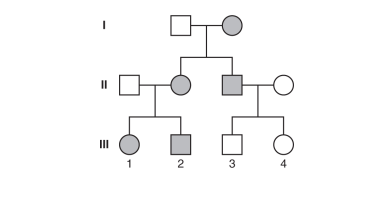
Based on this pedigree, which of the following most likely describes the inheritance of this trait?
Based on this pedigree, which of the following most likely describes the inheritance of this trait?
Correct Answer: (d)
(D) In this pedigree, both females and males are affected, but only females appear to be able to pass the trait on to the next generation—these are hallmarks of mitochondrial inheritance. Autosomal traits are equally likely in both sexes, so choices (A) and (B) are incorrect. Sex-linked traits are more likely to appear in males than females, so choice (C) is incorrect.
(D) In this pedigree, both females and males are affected, but only females appear to be able to pass the trait on to the next generation—these are hallmarks of mitochondrial inheritance. Autosomal traits are equally likely in both sexes, so choices (A) and (B) are incorrect. Sex-linked traits are more likely to appear in males than females, so choice (C) is incorrect.
Q37. Japanese four o’clocks that are red and tall are crossed to white short ones, producing an F1 that is pink and tall. If these genes assort independently, and the F1 is self-crossed, what would you predict for the ratio of F2 phenotypes?
Correct Answer: (d)
Color shows incomplete dominance (1 red : 2 pink : 1 white) and height shows simple dominance (3 tall : 1 short). Using the product rule: (1 Red + 2 Pink + 1 White) × (3 Tall + 1 Short) = 3 Red Tall, 1 Red Short, 6 Pink Tall, 2 Pink Short, 3 White Tall, 1 White Short. Sorting these leads to choice D.
Color shows incomplete dominance (1 red : 2 pink : 1 white) and height shows simple dominance (3 tall : 1 short). Using the product rule: (1 Red + 2 Pink + 1 White) × (3 Tall + 1 Short) = 3 Red Tall, 1 Red Short, 6 Pink Tall, 2 Pink Short, 3 White Tall, 1 White Short. Sorting these leads to choice D.
Q38. What property distinguished Mendel’s investigation from previous studies?
Correct Answer: (b)
While hybridization experiments existed before him, Mendel’s unique contribution was the application of mathematical logic and statistical analysis to his findings. By quantifying his results over large sample sizes, he was able to identify predictable patterns of inheritance that others had overlooked.
While hybridization experiments existed before him, Mendel’s unique contribution was the application of mathematical logic and statistical analysis to his findings. By quantifying his results over large sample sizes, he was able to identify predictable patterns of inheritance that others had overlooked.
Q39. Refer to the figure, which shows a pedigree of an inherited trait.
If individual III-3 has a child with a woman who does not have the allele, what is the most likely probability that their child will have the trait?
If individual III-3 has a child with a woman who does not have the allele, what is the most likely probability that their child will have the trait?
Correct Answer: (a)
(A) This is most likely a mitochondrial trait (see the explanation for Question 9). Individual III-3 does not have the trait, so he does not carry the allele. Even if he did carry the allele, males cannot pass on mitochondrial traits to the next generation. If he has a child with a woman who also does not have the allele, there is 0% chance of them having a child with the trait since neither of them have the allele for the trait. Choices (B), (C), and (D) are incorrect because if the woman does not have the allele for a mitochondrial trait, her offspring will not have the allele for the trait.
(A) This is most likely a mitochondrial trait (see the explanation for Question 9). Individual III-3 does not have the trait, so he does not carry the allele. Even if he did carry the allele, males cannot pass on mitochondrial traits to the next generation. If he has a child with a woman who also does not have the allele, there is 0% chance of them having a child with the trait since neither of them have the allele for the trait. Choices (B), (C), and (D) are incorrect because if the woman does not have the allele for a mitochondrial trait, her offspring will not have the allele for the trait.
Q40. Rh positive (R) is a trait that is dominant over Rh negative (r). A woman, who is Rh positive, has a son, who is Rh negative.
Which of the following is a true statement about the father of the woman’s son?
Which of the following is a true statement about the father of the woman’s son?
Correct Answer: (d)
Since the son is Rh negative, his genotype must be rr. He must have inherited one r allele from each parent. So the father (whose Rh phenotype is unknown) could be either Rr or rr. Choice (A) is incorrect because an RR father would not be able to pass on an r allele to his offspring. Choices (B) and (C) are incorrect because while both are possible genotypes for the father, it is not possible to say with certainty which genotype the father has without knowing the father’s phenotype.
Since the son is Rh negative, his genotype must be rr. He must have inherited one r allele from each parent. So the father (whose Rh phenotype is unknown) could be either Rr or rr. Choice (A) is incorrect because an RR father would not be able to pass on an r allele to his offspring. Choices (B) and (C) are incorrect because while both are possible genotypes for the father, it is not possible to say with certainty which genotype the father has without knowing the father’s phenotype.
Q41. An example of a trait that involves multiple gene inheritance in plants is seed size. If seed size involves three genes (A, B, and C), in which each dominant allele contributes to increased seed size, which of the following genotypes would result in the smallest seed?
Correct Answer: (d)
(D) AaBbCc has the least number of dominant alleles (three) out of all the answer choices given. So the additive effect of the alleles in that genotype would be the least, and this genotype would result in the smallest seed. Since each dominant allele contributes to increased seed size, choice (A) is incorrect because it has the highest number of dominant alleles out of all the answer choices given. So it would produce the largest seeds. Choices (B) and (C) are incorrect because they both have four dominant alleles, so they both would produce larger seeds than choice (D).
(D) AaBbCc has the least number of dominant alleles (three) out of all the answer choices given. So the additive effect of the alleles in that genotype would be the least, and this genotype would result in the smallest seed. Since each dominant allele contributes to increased seed size, choice (A) is incorrect because it has the highest number of dominant alleles out of all the answer choices given. So it would produce the largest seeds. Choices (B) and (C) are incorrect because they both have four dominant alleles, so they both would produce larger seeds than choice (D).
Q42. An organism’s ________ is/are determined by its ________.
Correct Answer: (b)
An organism's phenotype is its observable physical or physiological traits, which are the direct result of the specific combination of alleles it possesses, known as its genotype.
An organism's phenotype is its observable physical or physiological traits, which are the direct result of the specific combination of alleles it possesses, known as its genotype.
Q43. Which of the following statements best explains the difference between nonnuclear inheritance and sex-linked inheritance?
Correct Answer: (b)
(B) Females may pass on sex-linked traits to the next generation through their X chromosomes and nonnuclear traits through their mitochondrial DNA. Since mitochondrial DNA is passed on through eggs and not sperm, males cannot pass on nonnuclear traits to the next generation, but females may pass on nonnuclear traits to the next generation. Therefore, the only true statement is choice (B), and choices (A), (C), and (D) are incorrect.
(B) Females may pass on sex-linked traits to the next generation through their X chromosomes and nonnuclear traits through their mitochondrial DNA. Since mitochondrial DNA is passed on through eggs and not sperm, males cannot pass on nonnuclear traits to the next generation, but females may pass on nonnuclear traits to the next generation. Therefore, the only true statement is choice (B), and choices (A), (C), and (D) are incorrect.
Q44. The term hybrid can also mean __________.
Correct Answer: (b)
Hybrid refers to heterozygous genotypes. Choice (A) is the opposite of the correct answer. Choices (C) and (D) are both incorrect because haploid and diploid are terms that refer to the number of chromosomes in a cell, not genotypes.
Hybrid refers to heterozygous genotypes. Choice (A) is the opposite of the correct answer. Choices (C) and (D) are both incorrect because haploid and diploid are terms that refer to the number of chromosomes in a cell, not genotypes.
Q45. Round peas are dominant to wrinkled peas. Smooth pea pods are dominant to constricted pea pods. Two pea plants that are heterozygous for both traits are crossed, and 800 offspring are produced. How many of the offspring are expected to have round peas and constricted pods?
Correct Answer: (b)
The chances of this cross producing a plant with round peas is 3/4. The chances of this cross producing a plant with constricted pods is 1/4. So the chances of producing a plant with both round peas and constricted pods is the product of their individual probabilities: 3/4 × 1/4 = 3/16. Given a total number of 800 offspring, 800 × 3/16 = 150. Choice (A) is incorrect because it is the expected number of offspring with round peas and smooth pods. Choice (C) is incorrect because it is the expected number of offspring with wrinkled peas and constricted pods. Choice (D) is incorrect because 3/4 of the offspring are expected to be round and 1/4 are expected to be constricted, so some of the offspring must be both round and constricted and thus the answer cannot be 0.
The chances of this cross producing a plant with round peas is 3/4. The chances of this cross producing a plant with constricted pods is 1/4. So the chances of producing a plant with both round peas and constricted pods is the product of their individual probabilities: 3/4 × 1/4 = 3/16. Given a total number of 800 offspring, 800 × 3/16 = 150. Choice (A) is incorrect because it is the expected number of offspring with round peas and smooth pods. Choice (C) is incorrect because it is the expected number of offspring with wrinkled peas and constricted pods. Choice (D) is incorrect because 3/4 of the offspring are expected to be round and 1/4 are expected to be constricted, so some of the offspring must be both round and constricted and thus the answer cannot be 0.