Q1. Which of the following include(s) ecosystem services ?
(i) Purification of air and water by forests.
(ii) Forests mitigate droughts and flood.
(iii) Forests act as store house of carbon.
(iv) Forests influence hydrological cycle.
(i) Purification of air and water by forests.
(ii) Forests mitigate droughts and flood.
(iii) Forests act as store house of carbon.
(iv) Forests influence hydrological cycle.
Correct Answer: (d)
All listed are vital functional benefits (services) provided by healthy ecosystems to human society.
All listed are vital functional benefits (services) provided by healthy ecosystems to human society.
Q2. During ecological succession [AIPMT 2015, C]
Correct Answer: (d)
The basic definition of ecological succession is the gradual and predictable change in the species composition of a given area.
The basic definition of ecological succession is the gradual and predictable change in the species composition of a given area.
Q3. Match the trophic levels with their correct species examples in grassland ecosystem. [NEET 2020, S]
| (A) Fourth trophic level | (i) Crow |
|---|---|
| (B) Second trophic level | (ii) Vulture |
| (C) First trophic level | (iii) Rabbit |
| (D) Third trophic level | (iv) Grass |
Correct Answer: (d)
In a grassland chain: Grass (T1) → Rabbit (T2) → Crow (T3) → Vulture (T4). Thus A-ii, B-iii, C-iv, D-i.
In a grassland chain: Grass (T1) → Rabbit (T2) → Crow (T3) → Vulture (T4). Thus A-ii, B-iii, C-iv, D-i.
Q4. Perturbation of which of the following cycles contributes most to global warming?
Correct Answer: (a)
The release of excessive CO2 from the carbon cycle is the main driver of global warming.
The release of excessive CO2 from the carbon cycle is the main driver of global warming.
Q5. Which one of the following is not used for construction of ecological pyramids?
Correct Answer: (c)
Ecological pyramids are built based on numbers, energy, or biomass. For biomass, dry weight is preferred over fresh weight because fresh weight varies with water content.
Ecological pyramids are built based on numbers, energy, or biomass. For biomass, dry weight is preferred over fresh weight because fresh weight varies with water content.
Q6. Which two of the following statements regarding food chains are correct ?
(i) Removal of 80% tigers resulted in increased growth of vegetation.
(ii) Removal of most carnivores resulted in increased population of deer.
(iii) Length of food chain is limited to 3 – 4 trophic levels due to energy loss.
(iv) Length of food chain may vary from 2 – 3 trophic levels.
(i) Removal of 80% tigers resulted in increased growth of vegetation.
(ii) Removal of most carnivores resulted in increased population of deer.
(iii) Length of food chain is limited to 3 – 4 trophic levels due to energy loss.
(iv) Length of food chain may vary from 2 – 3 trophic levels.
Correct Answer: (c)
(ii) is true due to release from predation. (iii) is true because of energy loss at each step (10% law), there's rarely enough energy to support more than 4-5 levels.
(ii) is true due to release from predation. (iii) is true because of energy loss at each step (10% law), there's rarely enough energy to support more than 4-5 levels.
Q7. Which of the following is a characteristic feature of cropland ecosystem? [NEET 2016, C]
Correct Answer: (b)
Croplands are man-made ecosystems focused on a single crop, thus they have much lower genetic and species diversity compared to natural systems.
Croplands are man-made ecosystems focused on a single crop, thus they have much lower genetic and species diversity compared to natural systems.
Q8. Which of the following is/are example(s) of man-made ecosystem?
Correct Answer: (d)
Crop fields and aquaria are artificial ecosystems created and maintained by humans.
Crop fields and aquaria are artificial ecosystems created and maintained by humans.
Q9. Productivity is the rate of production of biomass expressed in terms of
(i) (kcal m–3) yr–1 (ii) g–2yr–1 (iii) g–1yr–1 (iv) (kcal m–2) yr–1
(i) (kcal m–3) yr–1 (ii) g–2yr–1 (iii) g–1yr–1 (iv) (kcal m–2) yr–1
Correct Answer: (c)
Productivity is biomass production per unit area per unit time ( m^{-2} yr^{-1}$ or m^{-2} yr^{-1}$).
Productivity is biomass production per unit area per unit time ( m^{-2} yr^{-1}$ or m^{-2} yr^{-1}$).
Q10. What is true about the phosphorus cycle?
A. Rocks are the natural reservoirs of phosphorus.
B. Weathering of sedimentary rocks makes phosphate available to the soil.
C. Nitrosomonas play a key role in fixing phosphorus to the soil.
D. Herbivores and carnivores obtain phosphorus from plant directly or indirectly.
A. Rocks are the natural reservoirs of phosphorus.
B. Weathering of sedimentary rocks makes phosphate available to the soil.
C. Nitrosomonas play a key role in fixing phosphorus to the soil.
D. Herbivores and carnivores obtain phosphorus from plant directly or indirectly.
Correct Answer: (d)
A, B, and D are correct. Statement C is incorrect because Nitrosomonas is a nitrogen-fixing bacterium involved in the nitrogen cycle.
A, B, and D are correct. Statement C is incorrect because Nitrosomonas is a nitrogen-fixing bacterium involved in the nitrogen cycle.
Q11. Most animals that live in deep oceanic waters are [AIPMT 2015, C]
Correct Answer: (c)
Deep sea ecosystems have no sunlight for primary production, so animals rely on dead organic matter (detritus) falling from above.
Deep sea ecosystems have no sunlight for primary production, so animals rely on dead organic matter (detritus) falling from above.
Q12. If CO2 is removed totally from the biosphere, which organisms will be affected first ?
Correct Answer: (c)
Producers (green plants) require CO2 for photosynthesis. If CO2 is gone, they cannot make food, affecting the whole chain starting from them.
Producers (green plants) require CO2 for photosynthesis. If CO2 is gone, they cannot make food, affecting the whole chain starting from them.
Q13. The primary difference between sedimentary and atmospheric cycles is that in _____ cycles the nutrient does not _____
Correct Answer: (d)
In sedimentary cycles, there is no significant gaseous phase, so the nutrient does not enter the atmosphere.
In sedimentary cycles, there is no significant gaseous phase, so the nutrient does not enter the atmosphere.
Q14. Energy pyramids are used to represent energy transfer in an ecosystem because energy is ______ between each trophic level.
Correct Answer: (b)
Energy is lost as heat during transfer and through respiration at each level, which is why energy pyramids are always upright and never inverted.
Energy is lost as heat during transfer and through respiration at each level, which is why energy pyramids are always upright and never inverted.
Q15. In a food web, each successive trophic level has
Correct Answer: (b)
Following the 10% law of energy transfer, energy always decreases at each successive trophic level.
Following the 10% law of energy transfer, energy always decreases at each successive trophic level.
Q16. Which of the following most often limits the primary productivity of the ecosystem ?
Correct Answer: (a)
Primary productivity depends on the amount of solar radiation available to the primary producers for photosynthesis.
Primary productivity depends on the amount of solar radiation available to the primary producers for photosynthesis.
Q17. Among the following bio-geo-chemical cycles which one does not have losses due to respiration?
Correct Answer: (d)
Respiration releases carbon as CO2. Mineral cycles like phosphorus, nitrogen, and sulfur do not involve respiratory loss.
Respiration releases carbon as CO2. Mineral cycles like phosphorus, nitrogen, and sulfur do not involve respiratory loss.
Q18. Which of the following does not possess Rhizobium containing nodules?
Correct Answer: (d)
Pinus is a gymnosperm; it forms mycorrhizal associations but does not have Rhizobium nodules (found in legumes).
Pinus is a gymnosperm; it forms mycorrhizal associations but does not have Rhizobium nodules (found in legumes).
Q19. In ecological succession from pioneer to climax community, the biomass shall
Correct Answer: (d)
As succession proceeds, the complexity of the community and the total standing crop biomass increase until a stable climax is reached.
As succession proceeds, the complexity of the community and the total standing crop biomass increase until a stable climax is reached.
Q20. How much of the net primary productivity of a terrestrial ecosystem is eaten and digested by herbivores?
Correct Answer: (b)
Following the 10% law, only about 10% of the energy produced by plants is typically transferred to the next trophic level (herbivores).
Following the 10% law, only about 10% of the energy produced by plants is typically transferred to the next trophic level (herbivores).
Q21. Which one of the following is a primary consumer in maize field ecosystem?
Correct Answer: (b)
Maize is the producer, and the grasshopper is the herbivore (primary consumer) that feeds on it.
Maize is the producer, and the grasshopper is the herbivore (primary consumer) that feeds on it.
Q22. Which one is the correct food chain ?
Correct Answer: (d)
Producer (Grass) → Primary Consumer (Grasshopper) → Secondary Consumer (Frog) → Tertiary Consumer (Snake) → Top Consumer (Eagle).
Producer (Grass) → Primary Consumer (Grasshopper) → Secondary Consumer (Frog) → Tertiary Consumer (Snake) → Top Consumer (Eagle).
Q23. Which one of the following statement is correct?
Correct Answer: (a)
Decomposition is largely an oxygen-requiring process. Warmth and moisture are optimal for microbial activity, while cold and lack of oxygen slow it down.
Decomposition is largely an oxygen-requiring process. Warmth and moisture are optimal for microbial activity, while cold and lack of oxygen slow it down.
Q24. Climax community is in a state of
Correct Answer: (b)
A climax community is the final stage of succession, existing in near-equilibrium with the local environment.
A climax community is the final stage of succession, existing in near-equilibrium with the local environment.
Q25. An association of individuals of different species living in the same habitat and having functional interactions is [AIPMT 2015, C]
Correct Answer: (a)
A biotic community is composed of all the interacting populations of different species in a given geographical area.
A biotic community is composed of all the interacting populations of different species in a given geographical area.
Q26. The correct order of the process of decomposition is
Correct Answer: (d)
The steps are fragmentation of detritus, leaching, catabolism, humification, and mineralization.
The steps are fragmentation of detritus, leaching, catabolism, humification, and mineralization.
Q27. Which of the following statement(s) is/are correct about biogeochemical cycle?
(i) Gaseous exchanges of phosphorus between organism and environment are negligible
(ii) All biogeochemical cycles include both organisms and non-living components.
(iii) Most elements remain longest in the living portion of their cycle.
(iv) The chemical elements used by organisms in large quantities cycle back and forth between organisms and environment.
(i) Gaseous exchanges of phosphorus between organism and environment are negligible
(ii) All biogeochemical cycles include both organisms and non-living components.
(iii) Most elements remain longest in the living portion of their cycle.
(iv) The chemical elements used by organisms in large quantities cycle back and forth between organisms and environment.
Correct Answer: (b)
Statements (i), (ii) and (iv) are correct. (iii) is false because reservoirs (soil/air/rock) usually hold nutrients for much longer periods than the biotic phase.
Statements (i), (ii) and (iv) are correct. (iii) is false because reservoirs (soil/air/rock) usually hold nutrients for much longer periods than the biotic phase.
Q28. Choose the correct statements regarding ecological pyramids.
(i) The relationship between organisms at different trophic levels is expressed in terms of number, biomass and energy.
(ii) Any calculations of energy content, biomass or number has to include one group of organism at that trophic level.
(iii) In most ecosystems, all the pyramids of number, biomass and energy are upright.
(iv) The pyramid of biomass in sea is generally inverted.
(v) Pyramid of energy is always inverted and can never be upright.
(i) The relationship between organisms at different trophic levels is expressed in terms of number, biomass and energy.
(ii) Any calculations of energy content, biomass or number has to include one group of organism at that trophic level.
(iii) In most ecosystems, all the pyramids of number, biomass and energy are upright.
(iv) The pyramid of biomass in sea is generally inverted.
(v) Pyramid of energy is always inverted and can never be upright.
Correct Answer: (a)
(i), (iii), and (iv) are correct. (ii) is false as it must include all organisms at a level. (v) is false because energy pyramids are always upright.
(i), (iii), and (iv) are correct. (ii) is false as it must include all organisms at a level. (v) is false because energy pyramids are always upright.
Q29. Vertical distribution of different species occupying different levels in a biotic community is known as [AIPMT 2015 RS, C]
Correct Answer: (a)
Stratification is the vertical layering of plants or animal species within an ecosystem.
Stratification is the vertical layering of plants or animal species within an ecosystem.
Q30. In the given food web few organisms are marked as (1), (2), (3) and (4). Identify (1), (2), (3) and (4).
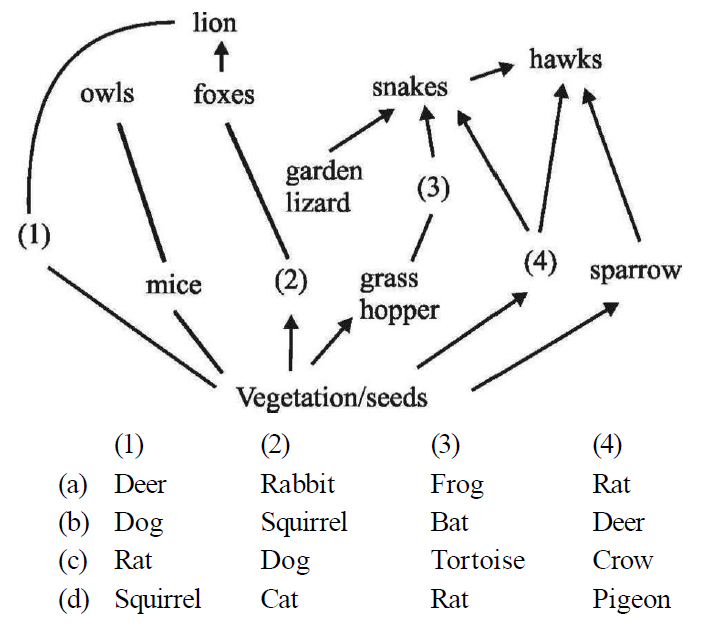
Correct Answer: (a)
(1) is Deer, (2) is Rabbit, (4) is Rat (all feed on vegetation). (3) is Frog which feeds on the grasshopper.
(1) is Deer, (2) is Rabbit, (4) is Rat (all feed on vegetation). (3) is Frog which feeds on the grasshopper.
Q31. Which of the given pyramids represent the variation in biomass at different trophic levels in pond ecosystem?
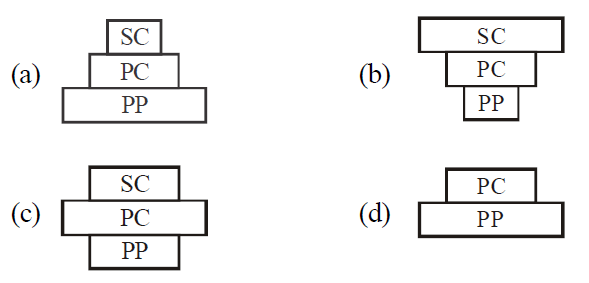
Correct Answer: (c)
In a pond/aquatic ecosystem, the pyramid of biomass is inverted (c).
In a pond/aquatic ecosystem, the pyramid of biomass is inverted (c).
Q32. How much portion of the photosynthetically active radiation (PAR) is captured by the plants?
Correct Answer: (d)
Of the incident solar radiation, less than 50% is PAR. Plants capture only 2-10% of this PAR for photosynthesis.
Of the incident solar radiation, less than 50% is PAR. Plants capture only 2-10% of this PAR for photosynthesis.
Q33. Which statement is true corresponding to the given food chain?
Grass → Rabbits → Snakes → Hawks
Grass → Rabbits → Snakes → Hawks
Correct Answer: (b)
In a typical terrestrial grazing food chain, the pyramid of biomass is upright, meaning the biomass of producers > herbivores > primary carnivores, etc.
In a typical terrestrial grazing food chain, the pyramid of biomass is upright, meaning the biomass of producers > herbivores > primary carnivores, etc.
Q34. Which of the following is not true for a pyramid of productivity?
Correct Answer: (c)
Pyramids of productivity (energy) are always upright and can never be inverted. Pyramids of biomass can be inverted in aquatic systems.
Pyramids of productivity (energy) are always upright and can never be inverted. Pyramids of biomass can be inverted in aquatic systems.
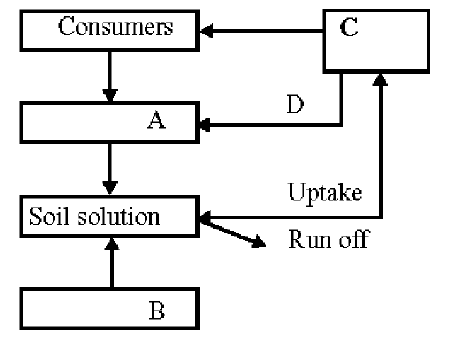
Q35. Refer the given nutrient cycle in a terrestrial ecosystem with few labels marked as A, B, C and D. Identify A, B, C and D.
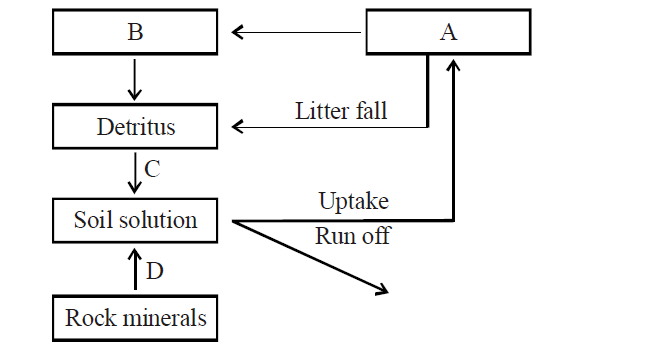
Correct Answer: (d)
A eats Producers so A is Consumer. B is the Producer. C breaks down dead matter so C is Decomposition. D enters from rocks so D is Weathering.
A eats Producers so A is Consumer. B is the Producer. C breaks down dead matter so C is Decomposition. D enters from rocks so D is Weathering.
Q36. Which of the following is/are trend(s) in from ecological succession ?
(i) An increase in complexity of species.
(ii) An increase in productivity.
(iii) An increase in community stability and species diversity.
(iv) A decrease in non-living organic materials.
(i) An increase in complexity of species.
(ii) An increase in productivity.
(iii) An increase in community stability and species diversity.
(iv) A decrease in non-living organic materials.
Correct Answer: (c)
Succession leads to higher diversity, stability, and productivity. Non-living organic matter actually increases as more biomass decomposes over time.
Succession leads to higher diversity, stability, and productivity. Non-living organic matter actually increases as more biomass decomposes over time.
Q37. Which of the following is not a producer?
Correct Answer: (b)
Agaricus is a fungus (decomposer), while the others are photosynthetic organisms.
Agaricus is a fungus (decomposer), while the others are photosynthetic organisms.
Q38. Which of the following is the most stable ecosystem ?
Correct Answer: (d)
Oceans are considered the most stable ecosystems because they are very large and have a high degree of environmental constancy compared to terrestrial ecosystems.
Oceans are considered the most stable ecosystems because they are very large and have a high degree of environmental constancy compared to terrestrial ecosystems.
Q39. Which of the food chain directly depends on solar radiations?
Correct Answer: (b)
The grazing food chain (GFC) starts with green plants (producers) which capture solar energy through photosynthesis.
The grazing food chain (GFC) starts with green plants (producers) which capture solar energy through photosynthesis.
Q40. Which of the following ecological pyramids is generally inverted? [NEET 2019, C]
Correct Answer: (d)
In the sea, the standing crop of phytoplankton is often less than that of the fish that consume them, resulting in an inverted pyramid of biomass.
In the sea, the standing crop of phytoplankton is often less than that of the fish that consume them, resulting in an inverted pyramid of biomass.
Q41. In which of the following both pairs have correct combination? [AIPMT 2015 RS, C]
Correct Answer: (d)
The Carbon and Nitrogen cycles are gaseous (atmospheric reservoir), whereas Phosphorus and Sulfur are primarily sedimentary.
The Carbon and Nitrogen cycles are gaseous (atmospheric reservoir), whereas Phosphorus and Sulfur are primarily sedimentary.
Q42. In an ecosystem the rate of production of organic matter during photosynthesis is termed as [AIPMT 2015 RS, C]
Correct Answer: (a)
Gross Primary Productivity (GPP) is the total amount of organic matter produced per unit area by photosynthesis.
Gross Primary Productivity (GPP) is the total amount of organic matter produced per unit area by photosynthesis.
Q43. Which of the following is an ecosystem service provided by a natural ecosystem?
Correct Answer: (d)
Natural ecosystems provide multiple essential functional benefits (services) to the biosphere and humans.
Natural ecosystems provide multiple essential functional benefits (services) to the biosphere and humans.
Q44. Which of the given below pyramids represents the variation in biomass at different trophic levels in pond ecosystem?
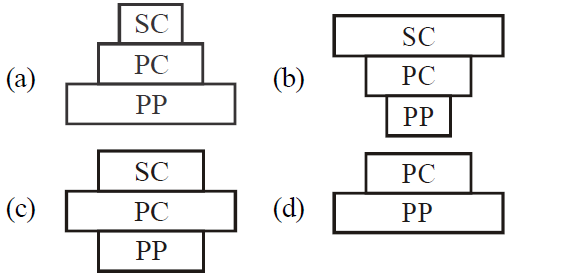
Correct Answer: (a)
Pyramid (a) represents an upright pyramid which usually denotes number or biomass in terrestrial systems, however, if referring to a specific pond model with large aquatic plants, it could be upright. (Ref: Answer Key says a).
Pyramid (a) represents an upright pyramid which usually denotes number or biomass in terrestrial systems, however, if referring to a specific pond model with large aquatic plants, it could be upright. (Ref: Answer Key says a).
Q45. The statement, 'Tiger is the apex of food chain', indicates
Correct Answer: (d)
As a top carnivore, the tiger sits at the highest trophic level and its existence depends on the health and abundance of the lower trophic levels (herbivores and producers).
As a top carnivore, the tiger sits at the highest trophic level and its existence depends on the health and abundance of the lower trophic levels (herbivores and producers).
Q46. Consider the following statements.
(i) An ecosystem is a functional unit of nature and comprises abiotic and biotic components.
(ii) Abiotic components are organic materials.
(iii) Biotic components are producers, consumers and decomposers.
(iv) Energy flow is bidirectional.
which two statements are correct ?
(i) An ecosystem is a functional unit of nature and comprises abiotic and biotic components.
(ii) Abiotic components are organic materials.
(iii) Biotic components are producers, consumers and decomposers.
(iv) Energy flow is bidirectional.
which two statements are correct ?
Correct Answer: (d)
Biotic components are indeed producers, consumers, and decomposers. (i) correctly defines an ecosystem. (ii) is false as abiotic are non-living; (iv) is false as flow is unidirectional.
Biotic components are indeed producers, consumers, and decomposers. (i) correctly defines an ecosystem. (ii) is false as abiotic are non-living; (iv) is false as flow is unidirectional.
Q47. The term ecosystem was coined by [NEET 2016, C]
Correct Answer: (b)
Arthur Tansley coined the term 'ecosystem' in 1935.
Arthur Tansley coined the term 'ecosystem' in 1935.
Q48. Which of the following ecosystems is most productive in terms of net primary production?
Correct Answer: (b)
Tropical rain forests have ideal temperature and moisture conditions, resulting in the highest annual net primary productivity.
Tropical rain forests have ideal temperature and moisture conditions, resulting in the highest annual net primary productivity.
Q49. Each trophic level has a certain mass of living material at a particular time is known as
Correct Answer: (b)
Each trophic level has a certain mass of living material at a particular time called as the standing crop.
Each trophic level has a certain mass of living material at a particular time called as the standing crop.
Q50. Match the following and select the correct option [AIPMT 2014, C]
| Column I | Column II |
|---|---|
| A. Earthworm | I. Pioneer species |
| B. Succession | II. Detritivore |
| C. Ecosystem service | III. Natality |
| D. Population growth | IV Pollination |
Correct Answer: (d)
Earthworm: Detritivore; Succession: Pioneer species; Service: Pollination; Population: Natality.
Earthworm: Detritivore; Succession: Pioneer species; Service: Pollination; Population: Natality.
Q51. Which of the following process helps in nutrient conservation?
Correct Answer: (b)
Nutrient immobilization occurs when inorganic nutrients are taken up by microbes and incorporated into their biomass, preventing them from being leached out.
Nutrient immobilization occurs when inorganic nutrients are taken up by microbes and incorporated into their biomass, preventing them from being leached out.
Q52. Identification and enumeration of plant and animal species of an ecosystem gives its
Correct Answer: (c)
Species composition is defined by the variety and number of different species present in an ecosystem.
Species composition is defined by the variety and number of different species present in an ecosystem.
Q53. The rate at which light energy is converted into chemical energy of organic molecules is the ecosystem’s
Correct Answer: (d)
Gross primary productivity (GPP) is the rate of production of organic matter during photosynthesis.
Gross primary productivity (GPP) is the rate of production of organic matter during photosynthesis.
Q54. If the carbon atoms fixed by producers already have passed through three species, the trophic level of the last species would be
Correct Answer: (c)
Producer → 1st species (Primary Consumer) → 2nd species (Secondary Consumer) → 3rd species (Tertiary Consumer).
Producer → 1st species (Primary Consumer) → 2nd species (Secondary Consumer) → 3rd species (Tertiary Consumer).
Q55. Refer the given diagrammatic representation of trophic levels in an ecosystem some spaces are marked A, B, C and D. Identify A, B, C and D.
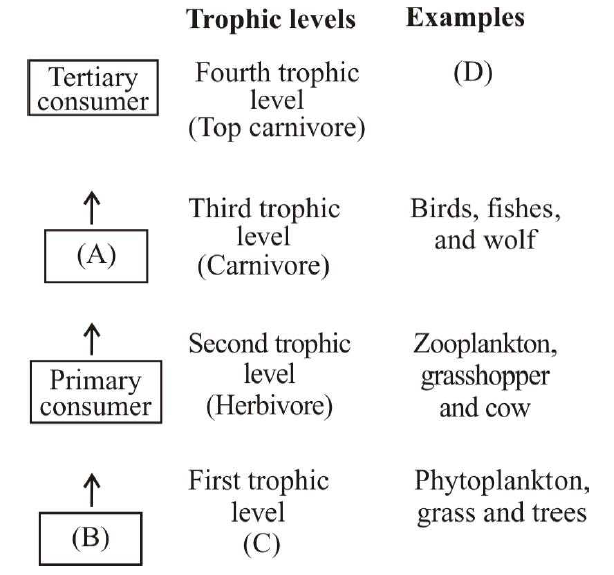
Correct Answer: (b)
A is the third trophic level (Secondary consumer). B is the first trophic level (Primary producer). C is the top level (Tertiary consumer: Man/Lion). D is a T1 example (Plants).
A is the third trophic level (Secondary consumer). B is the first trophic level (Primary producer). C is the top level (Tertiary consumer: Man/Lion). D is a T1 example (Plants).
Q56. First link in any food chain is a plant because
Correct Answer: (a)
All food chains must start with autotrophs (producers) because they are the only ones capable of fixing solar energy into organic food.
All food chains must start with autotrophs (producers) because they are the only ones capable of fixing solar energy into organic food.
Q57. Which one of the following is not a function of an ecosystem?
Correct Answer: (d)
Productivity, decomposition, energy flow, and nutrient cycling are the four basic functional components. Stratification is a structural feature.
Productivity, decomposition, energy flow, and nutrient cycling are the four basic functional components. Stratification is a structural feature.
Q58. Productivity at the second trophic level is always
Correct Answer: (b)
According to Lindeman's 10% law, only about 10% of energy is transferred to the next level; thus, secondary productivity (herbivores) is always significantly less than primary productivity (producers).
According to Lindeman's 10% law, only about 10% of energy is transferred to the next level; thus, secondary productivity (herbivores) is always significantly less than primary productivity (producers).
Q59. The graph below shows the changes in two populations of herbivores in a grassy field. A possible reason for these changes is that:
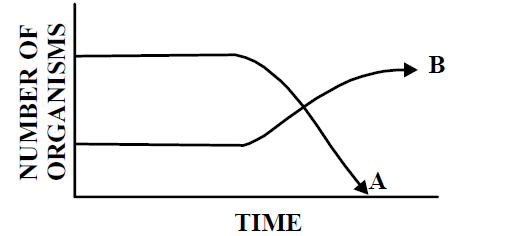
Correct Answer: (b)
Population B increases while A decreases over time, suggesting that B outcompeted A for the same food resource.
Population B increases while A decreases over time, suggesting that B outcompeted A for the same food resource.
Q60. Which of the following pair is not correctly matched ?
Correct Answer: (a)
Fungi are heterotrophs (decomposers/saprotrophs), not autotrophs. Autotrophs are mostly green plants.
Fungi are heterotrophs (decomposers/saprotrophs), not autotrophs. Autotrophs are mostly green plants.
Q61. Grasslands can support greater grazing rates by herbivores than forests because
Correct Answer: (d)
In grasslands, a much higher percentage of the total primary production is available for grazing because they lack the large proportion of inedible, woody biomass found in forests.
In grasslands, a much higher percentage of the total primary production is available for grazing because they lack the large proportion of inedible, woody biomass found in forests.
Q62. Which of the following type of ecosystem is expected in an area where evaporation exceeds precipitation, and mean annual rainfall is bellow 100mm
Correct Answer: (c)
Deserts are characterized by extremely low precipitation and high evaporation rates.
Deserts are characterized by extremely low precipitation and high evaporation rates.
Q63. The sequence of communites of primary succession in water is
Correct Answer: (d)
The correct hydrarch sequence is: Phytoplankton → Submerged → Floating → Reed-swamp → Marsh-meadow → Scrub → Forest.
The correct hydrarch sequence is: Phytoplankton → Submerged → Floating → Reed-swamp → Marsh-meadow → Scrub → Forest.
Q64. Which one of the following animals may occupy more than one trophic levels in the same ecosystem at the same time?
Correct Answer: (a)
A sparrow is a primary consumer when it eats seeds/fruits and a secondary consumer when it eats insects/worms.
A sparrow is a primary consumer when it eats seeds/fruits and a secondary consumer when it eats insects/worms.
Q65. Increase in concentration of the toxicant at successive trophic levels is known as [AIPMT 2015, C]
Correct Answer: (d)
Biomagnification is the increase in the concentration of non-biodegradable pollutants as they move up the food chain.
Biomagnification is the increase in the concentration of non-biodegradable pollutants as they move up the food chain.
Q66. Approximately how much of the solar energy that falls on the leaves of a plant is converted to chemical enegry by photosynthesis?
Correct Answer: (b)
Plants capture only 2-10% of Photosynthetically Active Radiation (PAR) for conversion into chemical energy.
Plants capture only 2-10% of Photosynthetically Active Radiation (PAR) for conversion into chemical energy.
Q67. In an upright pyramid of biomass, the herbivores generally occupy which of the following position ?
Correct Answer: (b)
In an upright pyramid, Producers are at the first position (base), and Herbivores occupy the second position.
In an upright pyramid, Producers are at the first position (base), and Herbivores occupy the second position.
Q68. The reservoir for the gaseous type of bio-geochemical cycle exists in
Correct Answer: (b)
Gaseous biogeochemical cycles have their primary nutrient reservoir in the atmosphere or hydrosphere.
Gaseous biogeochemical cycles have their primary nutrient reservoir in the atmosphere or hydrosphere.
Q69. Energy flow in an ecosystem is
Correct Answer: (a)
Energy flows through the food chain in one direction only, from producers to various levels of consumers.
Energy flows through the food chain in one direction only, from producers to various levels of consumers.
Q70. Which one of the following pairs is a sedimentary type of biogeochemical cycle ?
Correct Answer: (d)
Phosphorus and sulfur have their main reservoirs in the Earth's crust (lithosphere), classifying them as sedimentary cycles.
Phosphorus and sulfur have their main reservoirs in the Earth's crust (lithosphere), classifying them as sedimentary cycles.
Q71. Which one of the following statement is correct about decomposition ?
Correct Answer: (a)
Lignin and chitin are hard to break down, whereas nitrogen and sugars are easily utilized by microbes.
Lignin and chitin are hard to break down, whereas nitrogen and sugars are easily utilized by microbes.
Q72. Primary productivity is
A. is 10% less than secondary productivity.
B. is the rate of formation of new organic matter by consumers.
C. is expressed in terms of weight or energy.
D. is the amount of biomass produced per unit area in a time period by plants during photosynthesis.
Which of the statements given above are correct?
A. is 10% less than secondary productivity.
B. is the rate of formation of new organic matter by consumers.
C. is expressed in terms of weight or energy.
D. is the amount of biomass produced per unit area in a time period by plants during photosynthesis.
Which of the statements given above are correct?
Correct Answer: (c)
Primary productivity is the biomass produced per unit area over a time period by plants (D) and is measured in terms of weight or energy (C).
Primary productivity is the biomass produced per unit area over a time period by plants (D) and is measured in terms of weight or energy (C).
Q73. Edaphic factor refers to
Correct Answer: (b)
Edaphic factors relate specifically to the physical and chemical characteristics of the soil.
Edaphic factors relate specifically to the physical and chemical characteristics of the soil.
Q74. A peacock eats snakes which eat frogs. Frogs which in turn thrive on leaves of the plants. The peacock is
Correct Answer: (d)
Plants (Producer) → Frogs (Primary Consumer) → Snakes (Secondary Consumer) → Peacock (Tertiary/Top Consumer). The top consumer occupies the apex of the food pyramid.
Plants (Producer) → Frogs (Primary Consumer) → Snakes (Secondary Consumer) → Peacock (Tertiary/Top Consumer). The top consumer occupies the apex of the food pyramid.
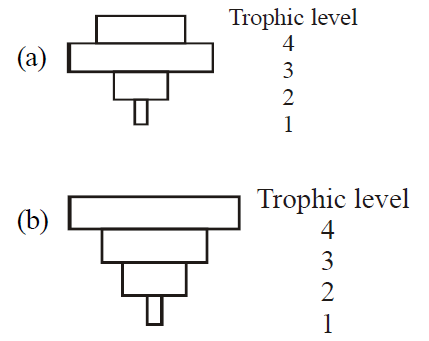
Q75. Two food chains are given below.
(i) Tree → aphid → insectivorous bird → prey feed on bird
(ii) Phytoplankton → zooplankton → plankton feeding fish → carnivorous fish
Which diagram is a pyramid of energy representing both food chains?
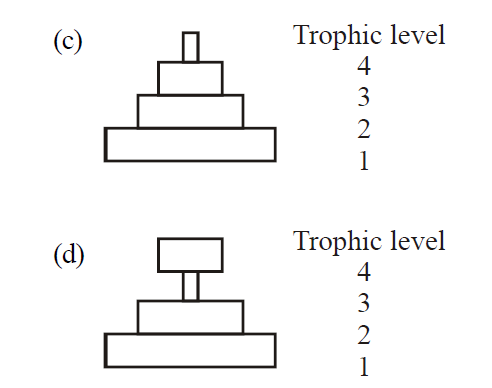
(i) Tree → aphid → insectivorous bird → prey feed on bird
(ii) Phytoplankton → zooplankton → plankton feeding fish → carnivorous fish
Which diagram is a pyramid of energy representing both food chains?
Correct Answer: (a)
Ecological pyramids of energy (a) are always upright, regardless of whether the ecosystem is terrestrial or aquatic.
Ecological pyramids of energy (a) are always upright, regardless of whether the ecosystem is terrestrial or aquatic.
Q76. Given below is an imaginary pyramid of numbers. What could be one of the possibilities about certain organisms at some of the different levels ?
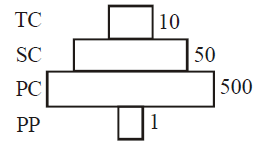
Correct Answer: (a)
This is a spindle-shaped pyramid. A single tree (PP) supports many herbivorous insects (PC), which are eaten by fewer small birds (SC), followed by a few larger predators (TC).
This is a spindle-shaped pyramid. A single tree (PP) supports many herbivorous insects (PC), which are eaten by fewer small birds (SC), followed by a few larger predators (TC).
Q77. Food chains differ from food webs in that
(i) food chains are single sequence of who eats whom in a community.
(ii) food chains better represent the entire community.
(iii) food webs represent the complex interaction among food chains.
(iv) food chain is the flow of energy in a population.
(i) food chains are single sequence of who eats whom in a community.
(ii) food chains better represent the entire community.
(iii) food webs represent the complex interaction among food chains.
(iv) food chain is the flow of energy in a population.
Correct Answer: (a)
Food chains are linear sequences of organisms (i), while food webs show the interconnected, complex nature of energy transfer in an entire community (iii).
Food chains are linear sequences of organisms (i), while food webs show the interconnected, complex nature of energy transfer in an entire community (iii).
Q78. Match the following and choose the correct option.
| Column - I | Column - II |
|---|---|
| A. Phosphorus | I. Atmosphere |
| B. Carbon | II. Producers |
| C. Goat | III. Rock |
| D. Grasses | IV. T2 |
Correct Answer: (b)
A-III: Phosphorus reservoir is Rock; B-I: Carbon reservoir is Atmosphere; C-IV: Goat is at the second trophic level (T2); D-II: Grasses are Producers.
A-III: Phosphorus reservoir is Rock; B-I: Carbon reservoir is Atmosphere; C-IV: Goat is at the second trophic level (T2); D-II: Grasses are Producers.
Q79. Given below is a simplified model of phosphorus cycling in a terrestrial ecosystem with four blanks (A-D). Identify the blanks:- [AIPMT 2014, C]
Correct Answer: (c)
In the P-cycle: A-Detritus, B-Rock minerals (weathering source), C-Producer, D-Litter fall.
In the P-cycle: A-Detritus, B-Rock minerals (weathering source), C-Producer, D-Litter fall.
Q80. Decomposers like fungi and bacteria are
(i) autotrophs (ii) heterotrophs
(iii) saprotrophs (iv) chemo-autotrophs
(i) autotrophs (ii) heterotrophs
(iii) saprotrophs (iv) chemo-autotrophs
Correct Answer: (c)
Decomposers are heterotrophic organisms that feed by absorbing nutrients from dead organic matter (saprotrophs).
Decomposers are heterotrophic organisms that feed by absorbing nutrients from dead organic matter (saprotrophs).
Q81. If an ecosystem is composed of only three trophic levels, then how much energy will be conserved at the IIIrd trophic level?
Correct Answer: (d)
According to the 10% law: $100\% (T1) → 10\% (T2) → 1\% (T3)$.
According to the 10% law: $100\% (T1) → 10\% (T2) → 1\% (T3)$.
Q82. An inverted pyramid of biomass can be found in which ecosystem?
Correct Answer: (b)
In marine ecosystems, the biomass of phytoplankton (producers) is often less than that of the fish (consumers) that feed on them at any point in time.
In marine ecosystems, the biomass of phytoplankton (producers) is often less than that of the fish (consumers) that feed on them at any point in time.
Q83. Secondary Succession takes place on/in [AIPMT 2015 RS, C]
Correct Answer: (a)
Secondary succession occurs in areas where a biological community once existed but was removed, leaving soil behind (like a degraded forest).
Secondary succession occurs in areas where a biological community once existed but was removed, leaving soil behind (like a degraded forest).
Q84. Two main structural features of an ecosystem are
Correct Answer: (a)
Identification and enumeration of plant and animal species of an ecosystem gives its species composition. Vertical distribution of different species occupying different levels is called stratification.
Identification and enumeration of plant and animal species of an ecosystem gives its species composition. Vertical distribution of different species occupying different levels is called stratification.
Q85. In relation to Gross primary productivity and Net primary productivity of an ecosystem, which one of the following statements is correct? [NEET 2020, S]
Correct Answer: (a)
Since = GPP - Respiration$, and respiration is a loss, GPP is always greater than NPP.
Since = GPP - Respiration$, and respiration is a loss, GPP is always greater than NPP.
Q86. The transfer of energy from one trophic level to another is governed by the 2nd law of thermodynamics. The average efficiency of energy transfer from herbivores to carnivores is
Correct Answer: (b)
On average, only 10% of the energy available at one trophic level is transferred to the next level.
On average, only 10% of the energy available at one trophic level is transferred to the next level.
Q87. The primary succession refers to the development of communities on a
Correct Answer: (d)
Primary succession occurs in areas where no living organisms ever existed, like bare rocks or newly cooled lava.
Primary succession occurs in areas where no living organisms ever existed, like bare rocks or newly cooled lava.
Q88. Arrange the following ecosystems in increasing order of mean NPP (Tonnes / ha / year)
A. Tropical deciduous forest
B. Temperate coniferous forest
C. Tropical rain forest
D. Temperate deciduous forest
A. Tropical deciduous forest
B. Temperate coniferous forest
C. Tropical rain forest
D. Temperate deciduous forest
Correct Answer: (d)
Productivity typically follows the order: Temperate Coniferous (B) < Temperate Deciduous (D) < Tropical Deciduous (A) < Tropical Rain Forest (C).
Productivity typically follows the order: Temperate Coniferous (B) < Temperate Deciduous (D) < Tropical Deciduous (A) < Tropical Rain Forest (C).
Q89. The given diagram shows (I, II, III, and IV) the flow of materials between different trophic levels. Which arrow is incorrect?
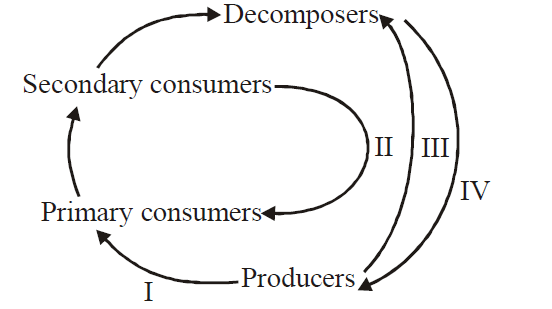
Correct Answer: (c)
Arrow III shows flow from Decomposers to Secondary Consumers, which is incorrect in a general material cycling model; materials from all levels (Producers, Primary, Secondary) eventually go to Decomposers (Arrow IV).
Arrow III shows flow from Decomposers to Secondary Consumers, which is incorrect in a general material cycling model; materials from all levels (Producers, Primary, Secondary) eventually go to Decomposers (Arrow IV).
Q90. The given statements (i - iv) are the characteristics of productivity.
(i) The rate of biomass production is called productivity and is expressed in terms of a kcal m–2.
(ii) Net primary productivity is rate of production of biomass during photosynthesis.
(iii) Gross primary productivity minus respiration loss is called net primary productivity.
(iv) Primary productivity depends only on the plant species inhabiting a particular area.
Identify the correct statements.
(i) The rate of biomass production is called productivity and is expressed in terms of a kcal m–2.
(ii) Net primary productivity is rate of production of biomass during photosynthesis.
(iii) Gross primary productivity minus respiration loss is called net primary productivity.
(iv) Primary productivity depends only on the plant species inhabiting a particular area.
Identify the correct statements.
Correct Answer: (a)
(i) is a standard definition. (iii) Net Primary Productivity (NPP) = Gross Primary Productivity (GPP) - Respiration (R) is correct.
(i) is a standard definition. (iii) Net Primary Productivity (NPP) = Gross Primary Productivity (GPP) - Respiration (R) is correct.
Q91. Match the following and choose the correct option.
| Column - I | Column - II |
|---|---|
| A. Standing state | I. Nitrogen, Carbon |
| B. Gaseous cycles | II. Amount of nutrients |
| C. Standing crop | III. Sulphur, Phosphorus |
| D. Sedimentary cycles | IV. Living matter at different trophic levels |
Correct Answer: (a)
Standing state is nutrient amount (II). Gaseous cycles are C, N (I). Standing crop is living biomass (IV). Sedimentary cycles are P, S (III).
Standing state is nutrient amount (II). Gaseous cycles are C, N (I). Standing crop is living biomass (IV). Sedimentary cycles are P, S (III).
Q92. An ecosystem is a
Correct Answer: (c)
An ecosystem is a functional unit of nature, where living organisms interact among themselves and also with the surrounding physical environment.
An ecosystem is a functional unit of nature, where living organisms interact among themselves and also with the surrounding physical environment.
Q93. If 20 J of energy is trapped at producer level, then how much energy will be available to peacock as food in the following chain?
plant → mice → snake → peacock
plant → mice → snake → peacock
Correct Answer: (a)
According to the 10% law: 20J (Producer) → 2J (Mice) → 0.2J (Snake) → 0.02J (Peacock).
According to the 10% law: 20J (Producer) → 2J (Mice) → 0.2J (Snake) → 0.02J (Peacock).
Q94. Given below is one of the types of ecological pyramids. This type represents

Correct Answer: (c)
An inverted pyramid of biomass is characteristic of aquatic ecosystems (like a lake) where producers (phytoplankton) have a low standing crop but high turnover.
An inverted pyramid of biomass is characteristic of aquatic ecosystems (like a lake) where producers (phytoplankton) have a low standing crop but high turnover.
Q95. Match the following and choose the correct option.
| Column - I | Column - II |
|---|---|
| A. Pioneer community on lithosphere | I. Crustose lichens |
| B. Ecological succession | II. Mesophytes |
| C. Climax community | III. Ecosystem development |
| D. Ecological pyramid | IV. Elton |
Correct Answer: (c)
Pioneers on rock are Lichens (I). Succession is overall ecosystem development (III). Climax species are often Mesophytes (II). Elton described ecological pyramids (IV).
Pioneers on rock are Lichens (I). Succession is overall ecosystem development (III). Climax species are often Mesophytes (II). Elton described ecological pyramids (IV).
Q96. Match column-I with column-II and choose the correct option.
| Column - I | Column - II |
|---|---|
| A. Primary succession | I. Autotrophs |
| B. Climax community | II. Community that has completed succession |
| C. Consumer | III. Colonization of a new environment |
| D. Producer | IV. Animals |
Correct Answer: (a)
Primary succession starts in a new environment (III). Climax is the stable end-community (II). Consumers are animals (IV). Producers are autotrophs (I).
Primary succession starts in a new environment (III). Climax is the stable end-community (II). Consumers are animals (IV). Producers are autotrophs (I).
Q97. There is no difference between
Correct Answer: (b)
Herbivores feed directly on producers, thus they occupy the second trophic level and are the primary consumers.
Herbivores feed directly on producers, thus they occupy the second trophic level and are the primary consumers.
Q98. During the process of ecological succession the changes that take place in communities are
Correct Answer: (a)
Ecological succession is the gradual, predictable, and orderly change in the species composition of a given area.
Ecological succession is the gradual, predictable, and orderly change in the species composition of a given area.
Q99. Among the following where do you think the process of decomposition would be the fastest?
Correct Answer: (a)
Warm and moist environments are most favorable for the activity of decomposers.
Warm and moist environments are most favorable for the activity of decomposers.
Q100. Sedimentary cycle having a small gaseous component is found in
Correct Answer: (d)
Sulfur is primarily sedimentary but has gaseous forms like SO2 and H2S in its cycle. Phosphorus has no significant gaseous phase.
Sulfur is primarily sedimentary but has gaseous forms like SO2 and H2S in its cycle. Phosphorus has no significant gaseous phase.
Q101. Which one of the following is not an abiotic component?
Correct Answer: (b)
Abiotic components are non-living parts like temperature, water, and soil. Decomposers are biotic (living) components.
Abiotic components are non-living parts like temperature, water, and soil. Decomposers are biotic (living) components.
Q102. The mass of living material at a trophic level at a particular time is called [AIPMT 2015 RS, C]
Correct Answer: (c)
Standing crop is the total weight (biomass) of living organisms at a specific trophic level at a given time.
Standing crop is the total weight (biomass) of living organisms at a specific trophic level at a given time.
Q103.
Correct Answer: (a)
Both successions ultimately lead to a stable mesic (medium water) condition.
Both successions ultimately lead to a stable mesic (medium water) condition.
Q104. The phosphorus cycle differs from the carbon cycle in that
Correct Answer: (b)
Carbon has a major gaseous reservoir in the atmosphere; phosphorus cycling is strictly between soil, water, and living organisms without a significant gaseous phase.
Carbon has a major gaseous reservoir in the atmosphere; phosphorus cycling is strictly between soil, water, and living organisms without a significant gaseous phase.
Q105. The process of mineralisation by microorganisms helps in the release of
Correct Answer: (a)
Mineralization is the final step where inorganic nutrients are released back into the soil from the decomposed organic matter (humus).
Mineralization is the final step where inorganic nutrients are released back into the soil from the decomposed organic matter (humus).
Q106. Which ecosystem has the maximum biomass?
Correct Answer: (d)
Forests house massive woody trees, resulting in the highest standing crop biomass compared to grasslands or aquatic systems.
Forests house massive woody trees, resulting in the highest standing crop biomass compared to grasslands or aquatic systems.
Q107. Consider the following statements on succession of plants. Choose the option with the combination of correct statements.
A. In hydrarch succession progress is observed from hydric to the mesic condition.
B. In xerarch succession progress is observed from xerarch to the mesic condition.
C. Xerarch succession if started on bare rock, pioneer species is lichens.
D. In hydrarch and xerarch succession progress is observed from mesarch to xerarch condition.
A. In hydrarch succession progress is observed from hydric to the mesic condition.
B. In xerarch succession progress is observed from xerarch to the mesic condition.
C. Xerarch succession if started on bare rock, pioneer species is lichens.
D. In hydrarch and xerarch succession progress is observed from mesarch to xerarch condition.
Correct Answer: (d)
Statements A, B, and C are correct. D is false as both move towards mesic conditions, not xerarch.
Statements A, B, and C are correct. D is false as both move towards mesic conditions, not xerarch.
Q108. Pyramid of numbers is
Correct Answer: (c)
Pyramids of numbers are usually upright but can be inverted (e.g., a single tree supporting numerous insects).
Pyramids of numbers are usually upright but can be inverted (e.g., a single tree supporting numerous insects).
Q109. Which of the following would appear as the pioneer organisms on bare rocks? [NEET 2016, C]
Correct Answer: (a)
Lichens are the typical pioneer species on bare rock; they initiate soil formation by secreting acids.
Lichens are the typical pioneer species on bare rock; they initiate soil formation by secreting acids.
Q110. Which of the following compartments of the global ecosystem would be characterized by very slow movement of materials within the compartment?
Correct Answer: (a)
Deep ocean sediments act as long-term sinks where nutrients move and cycle extremely slowly.
Deep ocean sediments act as long-term sinks where nutrients move and cycle extremely slowly.
Q111. What type of ecological pyramid would be obtained with the following data? [NEET 2018, C]
Secondary consumer : 120 g
Primary consumer : 60 g
Primary producer : 10 g
Secondary consumer : 120 g
Primary consumer : 60 g
Primary producer : 10 g
Correct Answer: (a)
Since biomass increases at each successive level ($10 < 60 < 120$), the resulting pyramid is inverted.
Since biomass increases at each successive level ($10 < 60 < 120$), the resulting pyramid is inverted.
Q112. Which one of the following process help the water-soluble inorganic nutrients go down into the soil horizon and get precipitated as unavailable salts?
Correct Answer: (b)
By the process of leaching, water-soluble inorganic nutrients go down into the soil horizon and get precipitated as unavailable salts.
By the process of leaching, water-soluble inorganic nutrients go down into the soil horizon and get precipitated as unavailable salts.
Q113. Changes in the global carbon cycle are important because
Correct Answer: (d)
CO2 acts as a greenhouse gas, absorbing infrared radiation and contributing to the stability (and currently, the warming) of Earth's temperature.
CO2 acts as a greenhouse gas, absorbing infrared radiation and contributing to the stability (and currently, the warming) of Earth's temperature.
Q114. The zone at the edge of a lake or ocean which is alternatively exposed to air and immersed in water is called
Correct Answer: (d)
The littoral zone is the near-shore area where sunlight reaches the bottom and which is influenced by water level changes.
The littoral zone is the near-shore area where sunlight reaches the bottom and which is influenced by water level changes.
Q115. Which of the following could not be considered an ecosystem?
Correct Answer: (b)
An ecosystem must include both biotic communities and their abiotic environment. 'All the fish' represents only a part of the biotic component without the abiotic surroundings.
An ecosystem must include both biotic communities and their abiotic environment. 'All the fish' represents only a part of the biotic component without the abiotic surroundings.