Q1. Identify the components labelled as A, B, C, D and E in the diagram given below from the list (i) to (viii).
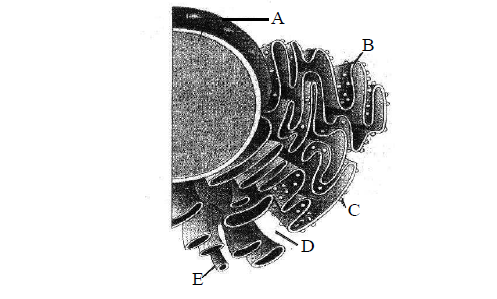
(i) Cristae of mitochondria (ii) Inner membrane of mitochondria (iii) Cytoplasm (iv) Smooth ER (v) Rough ER (vi) Mitochondrial matrix (vii) Ribosome (viii) Nucleus
(i) Cristae of mitochondria (ii) Inner membrane of mitochondria (iii) Cytoplasm (iv) Smooth ER (v) Rough ER (vi) Mitochondrial matrix (vii) Ribosome (viii) Nucleus
Correct Answer: (d)
A points to Rough ER (with ribosomes); B points to a crista (mitochondrial fold); C is the surrounding cytoplasm; D is the inner membrane of the mitochondrion; E is the Smooth ER.
A points to Rough ER (with ribosomes); B points to a crista (mitochondrial fold); C is the surrounding cytoplasm; D is the inner membrane of the mitochondrion; E is the Smooth ER.
Q2. The Golgi complex participates in
Correct Answer: (b)
The Golgi processes and packages proteins/lipids into secretory vesicles for transport.
The Golgi processes and packages proteins/lipids into secretory vesicles for transport.
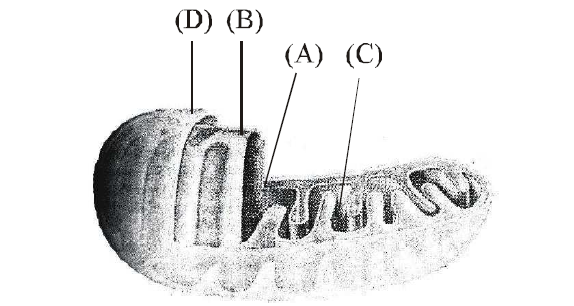
Q3. The figure below shows the structure of a mitochondrion with its four parts labelled (A), (B), (C) and (D). Select the part correctly matched with its function.
Correct Answer: (b)
The inner membrane (B) folds inwards to form cristae, increasing the surface area for aerobic respiration enzymes.
The inner membrane (B) folds inwards to form cristae, increasing the surface area for aerobic respiration enzymes.
Q4. Which of the following pair lack the unit membrane?
Correct Answer: (c)
Ribosomes and nucleoli are non-membrane bound structures within the cell.
Ribosomes and nucleoli are non-membrane bound structures within the cell.
Q5. Match the following and select the correct answer:
| Column I | Column II |
|---|---|
| A. Centriole | I. Infoldings in mitochondria |
| B. Chlorophyll | II. Thylakoids |
| C. Cristae | III. Nucleic acids |
| D. Ribozymes | IV. Basal body cilia or flagella |
Correct Answer: (a)
Centriole forms basal bodies; Chlorophyll is in thylakoids; Cristae are mitochondrial folds; Ribozymes are catalytic RNA (nucleic acids).
Centriole forms basal bodies; Chlorophyll is in thylakoids; Cristae are mitochondrial folds; Ribozymes are catalytic RNA (nucleic acids).
Q6. Beet root if kept in cold water anthocyanin does not come out due to plasma membrane which is
Correct Answer: (b)
Anthocyanins are large water-soluble pigments kept inside the vacuole; the plasma membrane is impermeable to them unless it is damaged or heated.
Anthocyanins are large water-soluble pigments kept inside the vacuole; the plasma membrane is impermeable to them unless it is damaged or heated.
Q7. Which of the following observations most strongly support the view that mitochondria contain electron transport enzymes aggregated into compact association?
Correct Answer: (a)
The ability of isolated membrane fragments (submitochondrial particles) to still synthesize ATP proves the respiratory enzymes are compactly associated within that membrane.
The ability of isolated membrane fragments (submitochondrial particles) to still synthesize ATP proves the respiratory enzymes are compactly associated within that membrane.
Q8. What is a tonoplast?
Correct Answer: (c)
The plant vacuole is bounded by a single membrane called tonoplast.
The plant vacuole is bounded by a single membrane called tonoplast.
Q9. Lysosomes contain
Correct Answer: (d)
Lysosomes are rich in almost all types of hydrolytic enzymes (hydrolases - lipases, proteases, carbohydrases).
Lysosomes are rich in almost all types of hydrolytic enzymes (hydrolases - lipases, proteases, carbohydrases).
Q10. The membrane of the erythrocytes has approximately ___% of proteins and ___% lipids.
Correct Answer: (b)
In human beings, the membrane of the erythrocyte has approximately 52 per cent protein and 40 per cent lipids.
In human beings, the membrane of the erythrocyte has approximately 52 per cent protein and 40 per cent lipids.
Q11. Which of the following statements is not correct?
Correct Answer: (d)
Lysosomes are formed by the process of packaging in the Golgi apparatus, not the ER directly.
Lysosomes are formed by the process of packaging in the Golgi apparatus, not the ER directly.
Q12. Which of the following statements about inclusion bodies is incorrect?
Correct Answer: (a)
Inclusion bodies in prokaryotes are for storage (reserve material) like phosphate granules; they are not involved in phagocytosis.
Inclusion bodies in prokaryotes are for storage (reserve material) like phosphate granules; they are not involved in phagocytosis.
Q13. In prokaryotes, the mitochondria are absent. Even then Krebs cycle takes place. What is the site of Krebs cycle in bacteria?
Correct Answer: (c)
In the absence of mitochondria, the enzymes for the Krebs cycle are located in the cytosol (cytoplasm) of the bacterial cell.
In the absence of mitochondria, the enzymes for the Krebs cycle are located in the cytosol (cytoplasm) of the bacterial cell.
Q14. Study the following statements on cilium or flagellum and answer the question.
(i) Cilium / Flagellum contains an outer ring of nine doublet microtubules surrounding two singlet microtubules.
(ii) Cilia are smaller which work like oars, causing the movement of either the cells or surrounding fluid.
(iii) Flagella are comparatively longer and responsible for cell movement.
(iv) Cilium and flagellum are covered with plasma membrane.
(i) Cilium / Flagellum contains an outer ring of nine doublet microtubules surrounding two singlet microtubules.
(ii) Cilia are smaller which work like oars, causing the movement of either the cells or surrounding fluid.
(iii) Flagella are comparatively longer and responsible for cell movement.
(iv) Cilium and flagellum are covered with plasma membrane.
Correct Answer: (b)
All given statements are correct. They describe the structure (9+2), function (oars/motility), and envelope (plasma membrane) of eukaryotic cilia/flagella.
All given statements are correct. They describe the structure (9+2), function (oars/motility), and envelope (plasma membrane) of eukaryotic cilia/flagella.
Q15. Which one of the following cell organelles is enclosed by a single membrane?
Correct Answer: (c)
Mitochondria, chloroplasts, and nuclei are double-membrane bound. Lysosomes have a single membrane.
Mitochondria, chloroplasts, and nuclei are double-membrane bound. Lysosomes have a single membrane.
Q16. The concept of "Omnis cellula-e cellula" regarding cell division was first proposed by:
Correct Answer: (a)
Virchow added this principle to the cell theory in 1855.
Virchow added this principle to the cell theory in 1855.
Q17. Which of the following organelles is directly connected to the outer membrane of the nucleus in a eukaryotic cell?
Correct Answer: (d)
The ER is often continuous with the outer membrane of the nuclear envelope.
The ER is often continuous with the outer membrane of the nuclear envelope.
Q18. Polysome is a chain of
Correct Answer: (c)
Several ribosomes may attach to a single mRNA and form a chain called polyribosomes or polysome.
Several ribosomes may attach to a single mRNA and form a chain called polyribosomes or polysome.
Q19. Cellular organelles with membranes are
Correct Answer: (c)
Ribosomes are non-membrane bound, ruling out (a), (b), and (d).
Ribosomes are non-membrane bound, ruling out (a), (b), and (d).
Q20. Axoneme with 9 + 2 microtubular arrangement occurs in
Correct Answer: (c)
The core of both cilia and flagella, called the axoneme, possesses nine pairs of peripheral doublets and one pair of central microtubules (9+2).
The core of both cilia and flagella, called the axoneme, possesses nine pairs of peripheral doublets and one pair of central microtubules (9+2).
Q21. Organelle important in spindle formation during nuclear division is
Correct Answer: (c)
Centrioles form the basal body of cilia and flagella and spindle fibers that give rise to the spindle apparatus during cell division in animal cells.
Centrioles form the basal body of cilia and flagella and spindle fibers that give rise to the spindle apparatus during cell division in animal cells.
Q22. Which of the following constitutes 10-20 percent of total cellular RNA?
Correct Answer: (c)
rRNA is the most abundant (~80%), tRNA is about 10-15%, and mRNA is the least (~5%).
rRNA is the most abundant (~80%), tRNA is about 10-15%, and mRNA is the least (~5%).
Q23. Match column-I with column-II and select the correct option.
| Column-I | Column-II |
|---|---|
| A. RER | I. Intracellular and extracellular digestion |
| B. Cell wall | II. Provide structural support to the cell |
| C. Flagella | III. Protein synthesis and secretion |
| D. Lysosomes | IV Responsible for cell movement |
Correct Answer: (a)
RER synthesizes proteins; Cell wall supports; Flagella move the cell; Lysosomes digest.
RER synthesizes proteins; Cell wall supports; Flagella move the cell; Lysosomes digest.
Q24. What would happen if lysosomes get ruptured in a cell?
Correct Answer: (a)
Lysosomes contain powerful digestive enzymes; if they rupture, the enzymes digest the cell's own contents, leading to cell death (autolysis).
Lysosomes contain powerful digestive enzymes; if they rupture, the enzymes digest the cell's own contents, leading to cell death (autolysis).
Q25. Which of the following pair of organelles does not contain DNA?
Correct Answer: (c)
Lysosomes and vacuoles are part of the endomembrane system and do not contain genetic material.
Lysosomes and vacuoles are part of the endomembrane system and do not contain genetic material.
Q26. Choose the wrong statements regarding bacterial cell
(i) Glycocalyx is the outermost envelope in bacteria.
(ii) The glycocalyx could be a loose sheath called capsule.
(iii) The glycocalyx may be thick and tough called slime layer.
(iv) A special structure formed by the plasma membrane is called mesosome.
(v) Small bristle like fibres sprouting out of the cell are called fimbriae.
(i) Glycocalyx is the outermost envelope in bacteria.
(ii) The glycocalyx could be a loose sheath called capsule.
(iii) The glycocalyx may be thick and tough called slime layer.
(iv) A special structure formed by the plasma membrane is called mesosome.
(v) Small bristle like fibres sprouting out of the cell are called fimbriae.
Correct Answer: (c)
The description is swapped: a loose sheath is called a slime layer, and a thick, tough layer is called a capsule.
The description is swapped: a loose sheath is called a slime layer, and a thick, tough layer is called a capsule.
Q27. DNA is not present in
Correct Answer: (a)
Ribosomes are made of rRNA and protein; they do not contain DNA. Mitochondria and chloroplasts contain their own genome.
Ribosomes are made of rRNA and protein; they do not contain DNA. Mitochondria and chloroplasts contain their own genome.
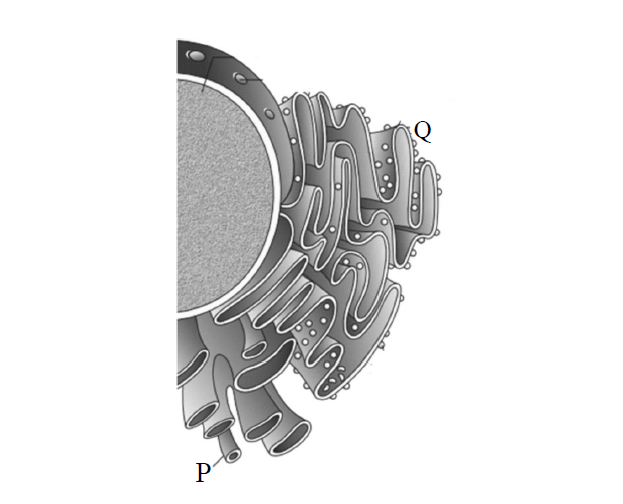
Q28. P and Q are the major sites for the synthesis of ________, _________ respectively.
Correct Answer: (a)
P is pointing to the Rough ER (studded with ribosomes) which synthesizes proteins. Q is pointing to the Smooth ER which is the site of lipid synthesis.
P is pointing to the Rough ER (studded with ribosomes) which synthesizes proteins. Q is pointing to the Smooth ER which is the site of lipid synthesis.
Q29. Nuclear envelope is a derivative of
Correct Answer: (c)
The nuclear envelope is physically continuous with the RER and reforms from RER fragments after cell division.
The nuclear envelope is physically continuous with the RER and reforms from RER fragments after cell division.
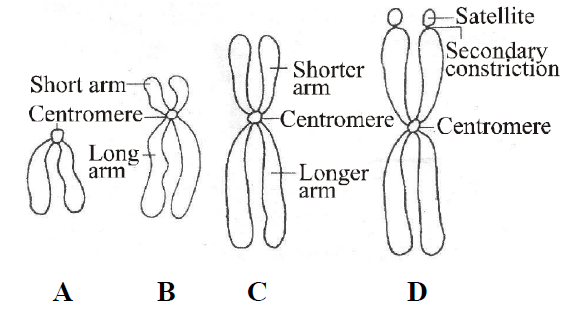
Q30. The given diagram shows the types of chromosomes (labelled as A, B, C & D) based on the position of centromere. Which one is the correct option for the labelled chromosomes. A, B, C and D ?
Correct Answer: (d)
A: Centromere in middle (Metacentric). B: Near middle (Submetacentric). C: Near the end (Acrocentric). D: At the very end (Telocentric).
A: Centromere in middle (Metacentric). B: Near middle (Submetacentric). C: Near the end (Acrocentric). D: At the very end (Telocentric).
Q31. Which of the following is not a function of cytoskeleton in a cell?
Correct Answer: (a)
While it provides the track, 'intracellular transport' itself is usually assigned to membrane systems like the ER/Golgi or motor proteins, but NCERT emphasizes support, motility, and shape.
While it provides the track, 'intracellular transport' itself is usually assigned to membrane systems like the ER/Golgi or motor proteins, but NCERT emphasizes support, motility, and shape.
Q32. Match the columns and identify the correct option.
| Column-I | Column-II |
|---|---|
| A. Thylakoids | I. Disc-shaped sacs in Golgi apparatus |
| B. Cristae | II. Condensed structure of DNA |
| C. Cisternae | III. Flat membranous sacs in stroma |
| D. Chromatin | IV. Infoldings in mitochondria |
Correct Answer: (a)
Thylakoids: sacs in chloroplast; Cristae: folds in mitochondria; Cisternae: Golgi sacs; Chromatin: genetic material.
Thylakoids: sacs in chloroplast; Cristae: folds in mitochondria; Cisternae: Golgi sacs; Chromatin: genetic material.
Q33. In prokaryotes, chromatophores are
Correct Answer: (d)
Chromatophores are pigment-containing membranous extensions in photosynthetic prokaryotes like cyanobacteria.
Chromatophores are pigment-containing membranous extensions in photosynthetic prokaryotes like cyanobacteria.
Q34. Which of the following statements is/are correct ?
(i) The endomembrane system includes plasma membrane, ER, Golgi complex, lysosomes and vacuoles.
(ii) ER helps in the transport of substances, synthesis of proteins, lipoproteins and glycogen.
(iii) Ribosomes are involved in protein synthesis.
(iv) Mitochondria help in oxidative phosphorylation and generation of ATP.
(i) The endomembrane system includes plasma membrane, ER, Golgi complex, lysosomes and vacuoles.
(ii) ER helps in the transport of substances, synthesis of proteins, lipoproteins and glycogen.
(iii) Ribosomes are involved in protein synthesis.
(iv) Mitochondria help in oxidative phosphorylation and generation of ATP.
Correct Answer: (a)
Statement (i) is incorrect because the plasma membrane is not considered part of the endomembrane system. (ii), (iii), and (iv) are correct functions of their respective organelles.
Statement (i) is incorrect because the plasma membrane is not considered part of the endomembrane system. (ii), (iii), and (iv) are correct functions of their respective organelles.
Q35. The RER in the cell, synthesised a protein which would be later used in building the plasma membrane. But it is observed that the protein in the membrane slightly different from the protein made in the another cell organelle. Identify that organelle in the diagram given below.
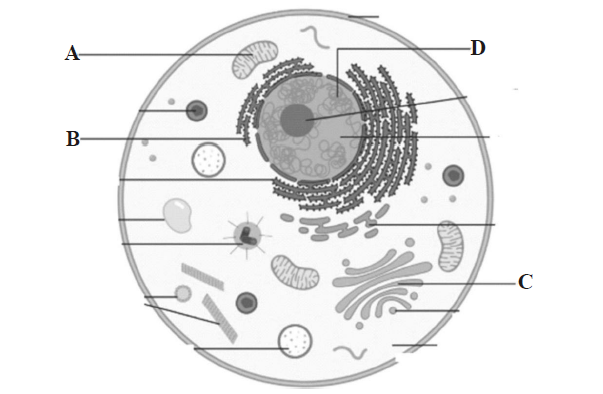
Correct Answer: (b)
The Golgi apparatus (C) is responsible for modifying proteins synthesized in the RER before they are shipped to their final destination like the plasma membrane.
The Golgi apparatus (C) is responsible for modifying proteins synthesized in the RER before they are shipped to their final destination like the plasma membrane.
Q36. You are asked to examine a cell using a powerful light microscope. The image you see has a clearly defined nucleus and mitochondria. It also has a large central vacuole and chloroplasts. From what group of organisms did this cell most likely come?
Correct Answer: (d)
A large central vacuole and chloroplasts are diagnostic features of plant cells.
A large central vacuole and chloroplasts are diagnostic features of plant cells.
Q37. Match column-I (scientists) with column-II (discovery) and select the correct option.
| Column-I | Column-II |
|---|---|
| A. Leeuwenhoek | I. First saw and described a living cell |
| B. Robert Brown | II. Presence of cell wall is unique to plant cells |
| C. Schleiden | III. Discovered the nucleus |
| D. Schwann | IV. All plants are composed of different kind of cells |
Correct Answer: (a)
Leeuwenhoek first saw living cells; Robert Brown discovered the nucleus; Schleiden concluded all plants are made of cells; Schwann identified the unique nature of cell walls in plants.
Leeuwenhoek first saw living cells; Robert Brown discovered the nucleus; Schleiden concluded all plants are made of cells; Schwann identified the unique nature of cell walls in plants.
Q38. The shorter and longer arms of a submetacentric chromosome are referred to as:
Correct Answer: (b)
In submetacentric chromosomes, the shorter arm is the p-arm (petite) and the longer arm is the q-arm.
In submetacentric chromosomes, the shorter arm is the p-arm (petite) and the longer arm is the q-arm.
Q39. Which one of the following is not considered as part of the endomembrane system?
Correct Answer: (b)
The endomembrane system includes ER, Golgi, lysosomes and vacuoles because their functions are coordinated. Peroxisomes are not part of this system.
The endomembrane system includes ER, Golgi, lysosomes and vacuoles because their functions are coordinated. Peroxisomes are not part of this system.
Q40. Match column-I with column-II and choose the correct option.
| Column-I | Column-II |
|---|---|
| A. Tonoplast | I. Contain digestive enzyme |
| B. Contractile vacuole | II. Store metabolic gases |
| C. Food vacuole | III. Excretion |
| D. Air vacuole | IV. Transport of ions in plants |
Correct Answer: (a)
Tonoplast transports ions against gradients in plants. Contractile vacuole is for excretion/osmoregulation. Food vacuoles contain enzymes for digestion. Air vacuoles store gases in prokaryotes.
Tonoplast transports ions against gradients in plants. Contractile vacuole is for excretion/osmoregulation. Food vacuoles contain enzymes for digestion. Air vacuoles store gases in prokaryotes.
Q41. Percentage of mitochondrial DNA in the cell is
Correct Answer: (b)
Most cellular DNA is in the nucleus; mitochondrial DNA accounts for a very small fraction, typically around 1%.
Most cellular DNA is in the nucleus; mitochondrial DNA accounts for a very small fraction, typically around 1%.
Q42. Satellite DNA is important because it
Correct Answer: (a)
Satellite DNA consists of highly repetitive sequences showing high polymorphism, used in DNA fingerprinting.
Satellite DNA consists of highly repetitive sequences showing high polymorphism, used in DNA fingerprinting.
Q43. The lipid component of the membrane mainly consists of __________.
Correct Answer: (b)
The lipid component of the cell membrane mainly consists of phosphoglycerides (phospholipids).
The lipid component of the cell membrane mainly consists of phosphoglycerides (phospholipids).
Q44. According to widely accepted "fluid mosaic model" cell membranes are semi-fluid, where lipids and integral proteins can diffuse randomly. In recent years, this model has been modified in several respects. In this regard, which of the following statements is incorrect?
Correct Answer: (b)
Lipids frequently undergo flip-flop (transverse) movement, but proteins rarely do so because it is energetically unfavorable to move their hydrophilic regions through the hydrophobic core.
Lipids frequently undergo flip-flop (transverse) movement, but proteins rarely do so because it is energetically unfavorable to move their hydrophilic regions through the hydrophobic core.
Q45. Mitochondria are numerous and densely packed in
Correct Answer: (c)
The number of mitochondria per cell varies depending on the physiological activity of the cells; more active cells require more energy (ATP).
The number of mitochondria per cell varies depending on the physiological activity of the cells; more active cells require more energy (ATP).
Q46. Which of the following cell organelles is responsible for extracting energy from carbohydrates to form ATP?
Correct Answer: (c)
Mitochondria are the sites of aerobic respiration where ATP is produced.
Mitochondria are the sites of aerobic respiration where ATP is produced.
Q47. Mitochondrial cristae are sites of
Correct Answer: (d)
The cristae of the inner mitochondrial membrane contain the components of the electron transport chain where redox reactions occur to generate ATP.
The cristae of the inner mitochondrial membrane contain the components of the electron transport chain where redox reactions occur to generate ATP.
Q48. Match column I (cell type) with column II (size) and choose the correct option.
| Column-I (Cell type) | Column-II (Size) |
|---|---|
| A. Viruses | I. 1-2 μm |
| B. PPLO | II. 10-20 μm |
| C. Eukaryotic cell | III. About 0.1 μm |
| D. Bacterium | IV. 0.02 - 0.2 μm |
Correct Answer: (b)
Viruses: 0.02-0.2 μm; PPLO: ~0.1 μm; Bacteria: 1-2 μm (or 3-5); Eukaryotic cells: 10-20 μm.
Viruses: 0.02-0.2 μm; PPLO: ~0.1 μm; Bacteria: 1-2 μm (or 3-5); Eukaryotic cells: 10-20 μm.
Q49. Which of the following lacks cell wall?
Correct Answer: (d)
Mycoplasma are organisms that completely lack a cell wall. Animal cells like Amoeba and gametes also lack cell walls.
Mycoplasma are organisms that completely lack a cell wall. Animal cells like Amoeba and gametes also lack cell walls.
Q50. Lysosomes are single membrane bound organelles. Which of the following statements is correct?
Correct Answer: (a)
Lysosomes contain many types of acid hydrolases. Their internal pH is acidic (~5), not alkaline. The membrane is resistant to self-digestion due to heavy glycosylation.
Lysosomes contain many types of acid hydrolases. Their internal pH is acidic (~5), not alkaline. The membrane is resistant to self-digestion due to heavy glycosylation.
Q51. Which one of the following organelle given below is correctly matched with its function ?
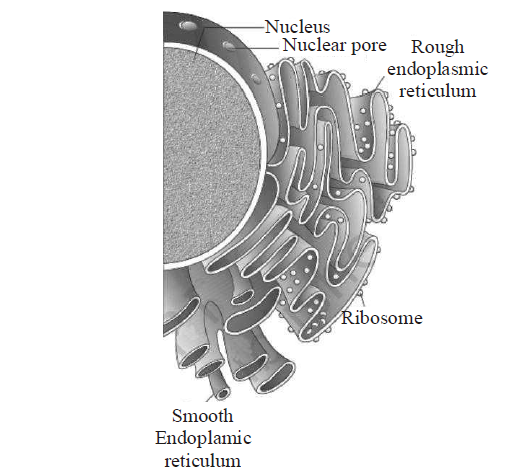
Correct Answer: (c)
The diagram shows Rough ER with ribosomes attached, which is the primary site of protein synthesis. (Note: Key says (c), but (b) is also correct for Golgi. ER diagram is the focus).
The diagram shows Rough ER with ribosomes attached, which is the primary site of protein synthesis. (Note: Key says (c), but (b) is also correct for Golgi. ER diagram is the focus).
Q52. Select the statements which are related to Schwann.
(i) He reported that cells have a thin outer layer which is today known as plasma membrane
(ii) Cell wall is a unique character of the plant cell.
(iii) Body of plants and animals are composed of cells and products of cells.
(i) He reported that cells have a thin outer layer which is today known as plasma membrane
(ii) Cell wall is a unique character of the plant cell.
(iii) Body of plants and animals are composed of cells and products of cells.
Correct Answer: (d)
Theodore Schwann, a British Zoologist, observed that animal cells had a thin outer layer (plasma membrane) and concluded that the presence of a cell wall is a unique character of plant cells. He also proposed the hypothesis that animal and plant bodies are composed of cells and products of cells.
Theodore Schwann, a British Zoologist, observed that animal cells had a thin outer layer (plasma membrane) and concluded that the presence of a cell wall is a unique character of plant cells. He also proposed the hypothesis that animal and plant bodies are composed of cells and products of cells.
Q53. Keeping in view the fluid mosaic model for the structure of cell membrane, which one of the following statements is correct with respect to the movement of lipids and proteins from one lipid monolayer to the other (described as flipflop movement)?
Correct Answer: (b)
Lipid molecules can rarely flip-flop across the membrane bilayer, but proteins, being very large and polar in specific regions, are unable to flip.
Lipid molecules can rarely flip-flop across the membrane bilayer, but proteins, being very large and polar in specific regions, are unable to flip.
Q54. Which one of the following cellular parts is correctly matched with their characters ?
Correct Answer: (c)
Thylakoids are organized into stacks called grana. Lysosomes need acid pH (~5). Organellar ribosomes are 70S; cytoplasmic are 80S.
Thylakoids are organized into stacks called grana. Lysosomes need acid pH (~5). Organellar ribosomes are 70S; cytoplasmic are 80S.
Q55. When the chromosome has a centromere nearer to one end of the chromosome resulting into one shorter and one longer arm, the chromosome is termed as
Correct Answer: (b)
In metacentric, arms are equal; in sub-metacentric, one arm is slightly shorter than the other.
In metacentric, arms are equal; in sub-metacentric, one arm is slightly shorter than the other.
Q56. Match column-I with column-II and select the correct option.
| Column-I | Column-II |
|---|---|
| A. Golgi apparatus | I. Storage |
| B. Mitochondria | II. Photosynthesis |
| C. Vacuoles | III. Transport |
| D. Grana | IV. Secretion |
Correct Answer: (a)
Golgi secretes; Mitochondria respire (V - not shown in some headers but in key); Vacuoles store; Grana do photosynthesis.
Golgi secretes; Mitochondria respire (V - not shown in some headers but in key); Vacuoles store; Grana do photosynthesis.
Q57. Which of the following is true for nucleolus?
Correct Answer: (c)
The nucleolus is a non-membrane bound site for the synthesis of rRNA.
The nucleolus is a non-membrane bound site for the synthesis of rRNA.
Q58. The function of the gap junction is to
Correct Answer: (a)
Gap junctions allow for chemical and electrical communication between adjacent animal cells.
Gap junctions allow for chemical and electrical communication between adjacent animal cells.
Q59. Different cells have different sizes. Arrange the following cells in an ascending order of their size and select the correct option.
(i) Mycoplasma (ii) Ostrich eggs (iii) Human RBCs (iv) Bacteria
(i) Mycoplasma (ii) Ostrich eggs (iii) Human RBCs (iv) Bacteria
Correct Answer: (a)
Mycoplasma (0.3 μm) < Bacteria (3-5 μm) < Human RBC (~7 μm) < Ostrich egg (cm range).
Mycoplasma (0.3 μm) < Bacteria (3-5 μm) < Human RBC (~7 μm) < Ostrich egg (cm range).
Q60. Who proposed the theory that "Cells arise only from the pre-existing cells"?
Correct Answer: (b)
Rudolf Virchow (1855) first explained that cells divided and new cells are formed from pre-existing cells (Omnis cellula-e cellula).
Rudolf Virchow (1855) first explained that cells divided and new cells are formed from pre-existing cells (Omnis cellula-e cellula).
Q61. Difference between the prokaryotic and eukaryotic cells in having
Correct Answer: (b)
Prokaryotic cells lack a well-defined nucleus and membrane-bound organelles, meaning they do not have a nuclear membrane.
Prokaryotic cells lack a well-defined nucleus and membrane-bound organelles, meaning they do not have a nuclear membrane.
Q62. Match the following column I and II for organismic respiration.
| Column-I | Column-II |
|---|---|
| A. Respiration in bacteria | I. Mitochondria |
| B. Respiration in cyanobacteria | II. Cytoplasmic Membrane |
| C. Respiration in eukaryotic cell | III. Mesosomes |
Correct Answer: (b)
Bacteria use mesosomes; cyanobacteria often use the cell membrane; eukaryotes use mitochondria for aerobic respiration.
Bacteria use mesosomes; cyanobacteria often use the cell membrane; eukaryotes use mitochondria for aerobic respiration.
Q63. A researcher isolated the plasma membrane from animal cells and them put them in a solution that contains chemical to stabilised the membranes. When he added a small amount of salt solution in it, he discovered that although the membranes seemed intact, the amount of protein in the stabilising solution had increased. These new proteins in the stabilising solution were probably
Correct Answer: (d)
Peripheral proteins are loosely bound to the membrane surface by ionic interactions; adding a salt solution disrupts these charges, releasing the proteins without destroying the lipid bilayer.
Peripheral proteins are loosely bound to the membrane surface by ionic interactions; adding a salt solution disrupts these charges, releasing the proteins without destroying the lipid bilayer.
Q64. Select the correct matching in the following pairs
Correct Answer: (a)
The SER is specialized for lipid and steroid synthesis.
The SER is specialized for lipid and steroid synthesis.
Q65. Given below are some characters of a cell organelle. Identify the correct organelle which shows all the characters described above.
(i) It is a membrane bound space found in the cytoplasm.
(ii) It is bound by a single membrane called tonoplast.
(iii) It contains water, sap, excretory products and other materials not useful to the cell.
(iv) It has higher concentration of sap than the cytoplasm.
(i) It is a membrane bound space found in the cytoplasm.
(ii) It is bound by a single membrane called tonoplast.
(iii) It contains water, sap, excretory products and other materials not useful to the cell.
(iv) It has higher concentration of sap than the cytoplasm.
Correct Answer: (d)
These are defining characteristics of the plant vacuole.
These are defining characteristics of the plant vacuole.
Q66. Which one of the following structures between two adjacent cells is an effective transport pathway?
Correct Answer: (a)
The cell wall and middle lamellae may be traversed by plasmodesmata which connect the cytoplasm of neighbouring cells.
The cell wall and middle lamellae may be traversed by plasmodesmata which connect the cytoplasm of neighbouring cells.
Q67. Extension of plasma membrane in prokaryotic cell is
Correct Answer: (a)
The mesosome is a specialized differentiated form of cell membrane; it is an extension of the plasma membrane into the cell.
The mesosome is a specialized differentiated form of cell membrane; it is an extension of the plasma membrane into the cell.
Q68. A common characteristic feature of plant sieve tube cells and most of mammalian erythrocytes is
Correct Answer: (d)
Both mature sieve tube elements and mature mammalian RBCs lack a nucleus to perform their specific transport functions efficiently.
Both mature sieve tube elements and mature mammalian RBCs lack a nucleus to perform their specific transport functions efficiently.
Q69. Which of the following pair are correctly matched ?
I. Amyloplasts - Store proteins
II. Mitochondrion - 'Power house' of the cell
III. Stroma - Chlorophyll pigment
IV. Axoneme - 9 + 2 array
I. Amyloplasts - Store proteins
II. Mitochondrion - 'Power house' of the cell
III. Stroma - Chlorophyll pigment
IV. Axoneme - 9 + 2 array
Correct Answer: (d)
II is correct (Mitochondria produce ATP). IV is correct (Cilia/Flagella core). Amyloplasts store starch; Stroma does not contain chlorophyll (it is in thylakoids).
II is correct (Mitochondria produce ATP). IV is correct (Cilia/Flagella core). Amyloplasts store starch; Stroma does not contain chlorophyll (it is in thylakoids).
Q70. Mitochondria and chloroplast are
1. semi-autonomous organelles
2. formed by division of pre-existing organelles and they contain DNA but lack protein synthesizing machinery
Which one of the following options is correct?
1. semi-autonomous organelles
2. formed by division of pre-existing organelles and they contain DNA but lack protein synthesizing machinery
Which one of the following options is correct?
Correct Answer: (c)
They are semi-autonomous (1 is true). 2 is false because they do possess their own protein synthesizing machinery (70S ribosomes).
They are semi-autonomous (1 is true). 2 is false because they do possess their own protein synthesizing machinery (70S ribosomes).
Q71. Satellite means
Correct Answer: (a)
A few chromosomes have non-staining secondary constrictions at a constant location, giving the appearance of a small fragment called the satellite.
A few chromosomes have non-staining secondary constrictions at a constant location, giving the appearance of a small fragment called the satellite.
Q72. Nucleolus is
Correct Answer: (b)
The nucleolus is a non-membrane bound spherical structure within the nucleoplasm that is the site for active ribosomal RNA synthesis.
The nucleolus is a non-membrane bound spherical structure within the nucleoplasm that is the site for active ribosomal RNA synthesis.
Q73. Chromosomes having equal or almost equal arms are called
Correct Answer: (a)
The metacentric chromosome has a middle centromere forming two equal arms of the chromosome.
The metacentric chromosome has a middle centromere forming two equal arms of the chromosome.
Q74. Match column-I with column-II and choose the correct option.
| Column-I (Chromosome) | Column-II (Position of Centromere) |
|---|---|
| A. Metacentric | I. At the tip |
| B. Submetacentric | II. Almost near the tip |
| C. Acrocentric | III. At the middle |
| D. Telocentric | IV. Slightly away from the middle |
Correct Answer: (a)
Metacentric = middle; Submetacentric = slightly away from middle; Acrocentric = near the tip; Telocentric = at the tip.
Metacentric = middle; Submetacentric = slightly away from middle; Acrocentric = near the tip; Telocentric = at the tip.
Q75. Which of the following is not the function of cell wall?
Correct Answer: (d)
The cell wall is typically permeable and does not act as a primary barrier to macromolecules; that is the role of the semi-permeable plasma membrane. (Note: Statement (iv) is listed as a function in NCERT, check key). Answer: None of these if all are functions.
The cell wall is typically permeable and does not act as a primary barrier to macromolecules; that is the role of the semi-permeable plasma membrane. (Note: Statement (iv) is listed as a function in NCERT, check key). Answer: None of these if all are functions.
Q76. Microtubules are the constituents of
Correct Answer: (b)
Microtubules form the structural basis of centrioles, cilia, flagella, and spindle fibers.
Microtubules form the structural basis of centrioles, cilia, flagella, and spindle fibers.
Q77. What are those structures that appear as beads-on-string in the chromosomes when viewed under electron microscope?
Correct Answer: (c)
The basic unit of chromatin packaging is the nucleosome, which appears as 'beads-on-a-string' structure.
The basic unit of chromatin packaging is the nucleosome, which appears as 'beads-on-a-string' structure.
Q78. Enzyme found functional in lysosome is
Correct Answer: (a)
Lysosomal enzymes are called acid hydrolases because they function optimally at an acidic pH (~5). Acid phosphatase is a marker enzyme.
Lysosomal enzymes are called acid hydrolases because they function optimally at an acidic pH (~5). Acid phosphatase is a marker enzyme.
Q79. Which of the following events does not occur in rough endoplasmic reticulum?
Correct Answer: (c)
Lipid and phospholipid synthesis is the primary function of the Smooth ER (SER).
Lipid and phospholipid synthesis is the primary function of the Smooth ER (SER).
Q80. A component of cytoskeleton is
Correct Answer: (a)
The cytoskeleton is an elaborate network of filamentous proteinaceous structures consisting of microtubules, microfilaments, and intermediate filaments.
The cytoskeleton is an elaborate network of filamentous proteinaceous structures consisting of microtubules, microfilaments, and intermediate filaments.
Q81. Plastids are found in
Correct Answer: (d)
Plastids are found in all plant cells and in euglenoides like Euglena.
Plastids are found in all plant cells and in euglenoides like Euglena.
Q82. Identify the components labelled A, B, C and D in the given section of cilia/flagella showing different parts. Choose the option which shows the correct labelling of parts.
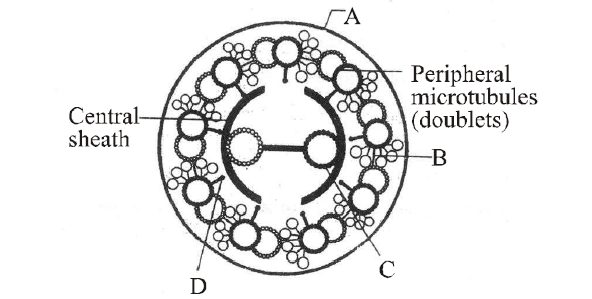
Correct Answer: (a)
In the axoneme cross section: A is the enclosing plasma membrane, B is the bridge between peripheral doublets, C is the central microtubule pair, and D is the radial spoke connecting doublets to the center.
In the axoneme cross section: A is the enclosing plasma membrane, B is the bridge between peripheral doublets, C is the central microtubule pair, and D is the radial spoke connecting doublets to the center.
Q83. Which of the following is responsible for the origin of lysosome?
Correct Answer: (c)
Lysosomes are formed by the process of packaging in the Golgi apparatus.
Lysosomes are formed by the process of packaging in the Golgi apparatus.
Q84. The diagram given below represent a fluid mosaic model of plasma membrane. Match the components marked as A, B, C, D and E in the diagram below from the list (i) to (vii).
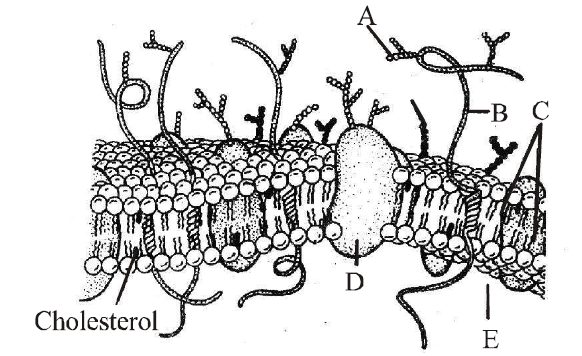
(i) Sugar (ii) Protein (iii) Lipid bilayer (iv) Integral protein (v) Cytoplasm (vi) Cell wall (vii) External protein
(i) Sugar (ii) Protein (iii) Lipid bilayer (iv) Integral protein (v) Cytoplasm (vi) Cell wall (vii) External protein
Correct Answer: (a)
A: Carbohydrate chains (Sugar); B: Peripheral membrane component (Protein); C: The double layer of phospholipids (Lipid bilayer); D: Protein spanning the membrane (Integral protein); E: Internal region (Cytoplasm).
A: Carbohydrate chains (Sugar); B: Peripheral membrane component (Protein); C: The double layer of phospholipids (Lipid bilayer); D: Protein spanning the membrane (Integral protein); E: Internal region (Cytoplasm).
Q85. _______________ is the important site of formation of glycoproteins and golycolipids.
Correct Answer: (c)
The Golgi apparatus is the primary site for the post-translational modification of proteins and lipids into glycoproteins and glycolipids.
The Golgi apparatus is the primary site for the post-translational modification of proteins and lipids into glycoproteins and glycolipids.
Q86. Scavenging of worn out cell parts and denatured proteins in the cells is done by
Correct Answer: (c)
Lysosomes digest foreign materials as well as worn-out cell organelles, acting as the 'scavengers' or 'garbage disposal' of the cell.
Lysosomes digest foreign materials as well as worn-out cell organelles, acting as the 'scavengers' or 'garbage disposal' of the cell.
Q87. Where does glycosylation of protein occur?
Correct Answer: (a)
Glycosylation (addition of sugars to proteins) begins in the RER and is completed in the Golgi apparatus.
Glycosylation (addition of sugars to proteins) begins in the RER and is completed in the Golgi apparatus.
Q88. The solid linear cytoskeletal elements having a diameter of 6 nm and made up of a single type of monomer are known as
Correct Answer: (b)
Microfilaments are made of actin subunits and have a diameter of about 6-7 nm.
Microfilaments are made of actin subunits and have a diameter of about 6-7 nm.
Q89. In polytene chromosomes dark bands are visible. These bands are formed by
Correct Answer: (b)
Polytene chromosomes show characteristic patterns of dark bands (chromomeres) and interbands.
Polytene chromosomes show characteristic patterns of dark bands (chromomeres) and interbands.
Q90. Which one of these is not a eukaryote?
Correct Answer: (b)
Anabaena is a cyanobacterium (prokaryote). Euglena is a protist; Spirogyra is an alga; Agaricus is a fungus.
Anabaena is a cyanobacterium (prokaryote). Euglena is a protist; Spirogyra is an alga; Agaricus is a fungus.
Q91. The main organelle involved in modification and routing of newly synthesized proteins to their destinations is
Correct Answer: (d)
The ER (specifically RER) is involved in protein synthesis and initial processing; it routes them to the Golgi for further modification and targeting.
The ER (specifically RER) is involved in protein synthesis and initial processing; it routes them to the Golgi for further modification and targeting.
Q92. Select the option which arranges the following steps in a correct sequence as per Gram's staining technique:
Treatment with 0.5% iodine solution (1), washing with water (2), treatment with absolute alcohol/ acetate (3), staining with weak alkaline solution of crystal violet (4).
Treatment with 0.5% iodine solution (1), washing with water (2), treatment with absolute alcohol/ acetate (3), staining with weak alkaline solution of crystal violet (4).
Correct Answer: (a)
The correct sequence is: Crystal Violet (4) -> Iodine (1) -> Water wash (2) -> Alcohol/Decolorizer (3).
The correct sequence is: Crystal Violet (4) -> Iodine (1) -> Water wash (2) -> Alcohol/Decolorizer (3).
Q93. If all the ribosomes of a cell are destroyed
Correct Answer: (d)
Ribosomes are the site of protein synthesis; without them, the cell cannot translate mRNA into polypeptides.
Ribosomes are the site of protein synthesis; without them, the cell cannot translate mRNA into polypeptides.
Q94. Which of the following statements are correct ?
(i) In prokaryotic cells, a special membranous structure formed by the extension of the plasma membrane into the cell is known as polysome.
(ii) The smooth endoplasmic reticulum is the major site for synthesis of glycoproteins.
(iii) RuBisCO is the most abundant protein in the whole biosphere.
(iv) Mitochondria, chloroplasts and peroxisomes are not considered as part of endomembrane system.
(i) In prokaryotic cells, a special membranous structure formed by the extension of the plasma membrane into the cell is known as polysome.
(ii) The smooth endoplasmic reticulum is the major site for synthesis of glycoproteins.
(iii) RuBisCO is the most abundant protein in the whole biosphere.
(iv) Mitochondria, chloroplasts and peroxisomes are not considered as part of endomembrane system.
Correct Answer: (a)
Statement (i) is wrong (it is mesosome). Statement (ii) is wrong (RER/Golgi do glycosylation). Statements (iii) and (iv) are correct.
Statement (i) is wrong (it is mesosome). Statement (ii) is wrong (RER/Golgi do glycosylation). Statements (iii) and (iv) are correct.
Q95. Which of the following option correctly match A, B, C, and D indicated in the given sectional view of chloroplasts.
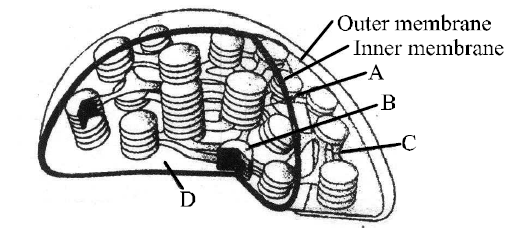
Correct Answer: (a)
A is a single flattened sac (Thylakoid), B is the connecting membrane (Stromal lamella), C is the matrix (Stroma), and D is the stack (Granum).
A is a single flattened sac (Thylakoid), B is the connecting membrane (Stromal lamella), C is the matrix (Stroma), and D is the stack (Granum).
Q96. Basal bodies are associated with the formation of
Correct Answer: (b)
Both the cilium and flagellum emerge from centriole-like structures called basal bodies.
Both the cilium and flagellum emerge from centriole-like structures called basal bodies.
Q97. Plastids storing fat are called
Correct Answer: (a)
Elaioplasts store oils and fats; aleuroplasts store proteins, and amyloplasts store carbohydrates.
Elaioplasts store oils and fats; aleuroplasts store proteins, and amyloplasts store carbohydrates.
Q98. Synthesis of lipids & carbohydrates is regulated by-
Correct Answer: (a)
The Smooth Endoplasmic Reticulum (SER) is the major site for synthesis of lipids and, in some cells, carbohydrate metabolism.
The Smooth Endoplasmic Reticulum (SER) is the major site for synthesis of lipids and, in some cells, carbohydrate metabolism.
Q99. The best material for study of structure of cell membrane is
Correct Answer: (a)
Human RBCs are easily available and lack internal membranes (no nucleus/organelles), making the plasma membrane easy to isolate and study.
Human RBCs are easily available and lack internal membranes (no nucleus/organelles), making the plasma membrane easy to isolate and study.
Q100. Which of the following statement regarding mitochondrial membrane is not correct ?
Correct Answer: (a)
The respiratory chain/ETC enzymes are located in the inner mitochondrial membrane.
The respiratory chain/ETC enzymes are located in the inner mitochondrial membrane.
Q101. Which one of the following structures between two adjacent cells is an effective transport pathway?
Correct Answer: (a)
Plasmodesmata provide cytoplasmic channels between adjacent plant cells for communication and transport.
Plasmodesmata provide cytoplasmic channels between adjacent plant cells for communication and transport.
Q102. Integral proteins of cell membrane occur on/in
Correct Answer: (d)
Integral proteins are partially or totally buried in the membrane, often spanning from the inner to the outer surface.
Integral proteins are partially or totally buried in the membrane, often spanning from the inner to the outer surface.
Q103. Golgi apparatus is absent in
Correct Answer: (c)
The Golgi apparatus is a membrane-bound organelle, which is absent in prokaryotes like bacteria and cyanobacteria (blue-green algae).
The Golgi apparatus is a membrane-bound organelle, which is absent in prokaryotes like bacteria and cyanobacteria (blue-green algae).
Q104. Microtubules, motor proteins, and actin filaments are all part of the
Correct Answer: (c)
These are all fundamental components of the eukaryotic cytoskeleton.
These are all fundamental components of the eukaryotic cytoskeleton.
Q105. Choose the incorrect match.
Correct Answer: (b)
Lysosomes are involved in digestion, not protein synthesis (which is the role of ribosomes).
Lysosomes are involved in digestion, not protein synthesis (which is the role of ribosomes).
Q106. Cell wall is absent in
Correct Answer: (b)
Mycoplasma are the smallest known living cells and are unique in having no cell wall.
Mycoplasma are the smallest known living cells and are unique in having no cell wall.
Q107. Which of the following statements are incorrect ?
(i) Plant cells have centrioles which are absent in almost all animal cells.
(ii) Ribosomes are the site of protein synthesis.
(iii) The middle lamella is a layer mainly of calcium carbonate which holds the different neighbouring cells together.
(iv) In animal cell, steroidal hormones are synthesized by smooth endoplasmic reticulum.
(i) Plant cells have centrioles which are absent in almost all animal cells.
(ii) Ribosomes are the site of protein synthesis.
(iii) The middle lamella is a layer mainly of calcium carbonate which holds the different neighbouring cells together.
(iv) In animal cell, steroidal hormones are synthesized by smooth endoplasmic reticulum.
Correct Answer: (a)
Statement (i) is reversed: animal cells have centrioles. Statement (iii) is incorrect; middle lamella is made of calcium pectate, not carbonate.
Statement (i) is reversed: animal cells have centrioles. Statement (iii) is incorrect; middle lamella is made of calcium pectate, not carbonate.
Q108. Which of the following options is true for a secretory cell?
Correct Answer: (b)
Secretory cells require protein synthesis; RER is abundant in cells actively involved in protein synthesis and secretion.
Secretory cells require protein synthesis; RER is abundant in cells actively involved in protein synthesis and secretion.
Q109. Protein synthesis in an animal cell occurs
Correct Answer: (a)
Proteins are synthesized on ribosomes in the cytoplasm (free or ER-bound) and also within semi-autonomous organelles like mitochondria.
Proteins are synthesized on ribosomes in the cytoplasm (free or ER-bound) and also within semi-autonomous organelles like mitochondria.
Q110. Which of the following statement of a bacterial cell is/are correct?
(i) Mesosome is formed by the extensions of plasma membrane into the cell.
(ii) The pili are elongated tubular structures made up of a protein.
(iii) Flagellum is composed of filament, hook and basal body.
(iv) Ribosomes are about 30 nm by 50 nm in size.
(i) Mesosome is formed by the extensions of plasma membrane into the cell.
(ii) The pili are elongated tubular structures made up of a protein.
(iii) Flagellum is composed of filament, hook and basal body.
(iv) Ribosomes are about 30 nm by 50 nm in size.
Correct Answer: (a)
Statement (iv) is incorrect; prokaryotic ribosomes are about 15 nm by 20 nm in size.
Statement (iv) is incorrect; prokaryotic ribosomes are about 15 nm by 20 nm in size.
Q111. The following diagram represents a structure chromosome. Identify the structures marked as A, B and C.
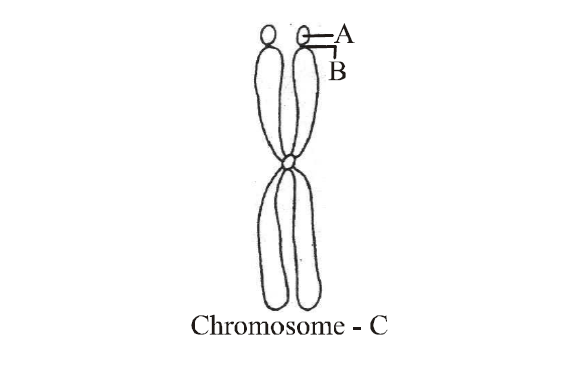
Correct Answer: (d)
A is the satellite, B is the centromere (primary constriction). In this diagram C represents a chromosome where one arm is slightly shorter than the other (Submetacentric).
A is the satellite, B is the centromere (primary constriction). In this diagram C represents a chromosome where one arm is slightly shorter than the other (Submetacentric).
Q112. Which of the following stains is not used for staining chromosomes?
Correct Answer: (b)
Safranin is used for staining plant tissues (lignified walls), not specifically for chromosomes. Acetocarmine and Basic Fuchsin are typical chromosomal stains.
Safranin is used for staining plant tissues (lignified walls), not specifically for chromosomes. Acetocarmine and Basic Fuchsin are typical chromosomal stains.
Q113. Centrioles and centrosomes occur in the cells of
Correct Answer: (b)
Centrosomes and centrioles are characteristic of animal cells; they are absent in higher plants.
Centrosomes and centrioles are characteristic of animal cells; they are absent in higher plants.
Q114. The osmotic expansion of a cell kept in water is chiefly regulated by
Correct Answer: (b)
In plant cells, the large central vacuole contains cell sap which exerts osmotic pressure and regulates water entry.
In plant cells, the large central vacuole contains cell sap which exerts osmotic pressure and regulates water entry.
Q115. Read the statements given below with regard to the functions performed by Golgi apparatus ?
(i) Transport and chemically modify the materials contained within it.
(ii) Performs the function of packaging materials.
(iii) Important site of formation of glycoproteins and glycolipids.
(i) Transport and chemically modify the materials contained within it.
(ii) Performs the function of packaging materials.
(iii) Important site of formation of glycoproteins and glycolipids.
Correct Answer: (d)
The Golgi apparatus is involved in processing (modification), packaging, and glycosylation.
The Golgi apparatus is involved in processing (modification), packaging, and glycosylation.
Q116. Select the incorrect statement about prokaryotic ribosomes.
Correct Answer: (b)
A polysome consists of a single mRNA strand along with multiple ribosomes, not ribosomes only.
A polysome consists of a single mRNA strand along with multiple ribosomes, not ribosomes only.
Q117. Both the membranes of mitochondrion are
Correct Answer: (b)
The outer membrane is smooth and porous, while the inner membrane is folded into cristae and contains the enzymes for the electron transport chain.
The outer membrane is smooth and porous, while the inner membrane is folded into cristae and contains the enzymes for the electron transport chain.
Q118. Which of the following is not true for a eukaryotic cell?
Correct Answer: (a)
Mitochondria in eukaryotes have 70S ribosomes, not 80S.
Mitochondria in eukaryotes have 70S ribosomes, not 80S.
Q119. Which of the following features is common to prokaryotes and many eukaryotes?
Correct Answer: (b)
Cell walls are found in prokaryotes and in many eukaryotes like plants, fungi, and algae.
Cell walls are found in prokaryotes and in many eukaryotes like plants, fungi, and algae.
Q120. Read the following statements and identify the correct option.
(i) Contractile vacuole takes part in osmoregulation and excretion.
(ii) Food vacuole is formed by engulfing the food particles.
(iii) The vacuole is bound by a double membrane called tonoplast.
(iv) Vacuole can occupy upto 90 percent of the volume of the cell.
(i) Contractile vacuole takes part in osmoregulation and excretion.
(ii) Food vacuole is formed by engulfing the food particles.
(iii) The vacuole is bound by a double membrane called tonoplast.
(iv) Vacuole can occupy upto 90 percent of the volume of the cell.
Correct Answer: (c)
Statement (iii) is incorrect; the tonoplast is a single membrane.
Statement (iii) is incorrect; the tonoplast is a single membrane.
Q121. The following diagram shows some of the missing structures in a plant cell marked as A, B, C, D and E. Choose the option with their correct names.
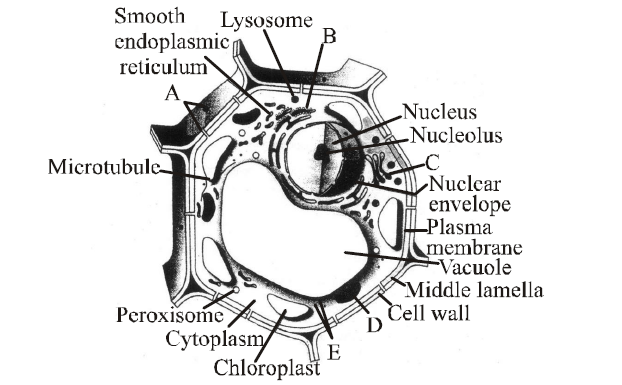
Correct Answer: (a)
A: Connections between cells (Plasmodesmata); B: ER with dots (Rough ER); C: Stacked cisternae (Golgi); D: Powerhouse (Mitochondrion); E: Small dots (Ribosomes).
A: Connections between cells (Plasmodesmata); B: ER with dots (Rough ER); C: Stacked cisternae (Golgi); D: Powerhouse (Mitochondrion); E: Small dots (Ribosomes).
Q122. Which of the following pair are correctly matched?
I. Microtubules - Structural components of cilia
II. Centrioles - Store hydrolytic enzymes
III. Amyloplasts - Store oil protein and starch in plants
I. Microtubules - Structural components of cilia
II. Centrioles - Store hydrolytic enzymes
III. Amyloplasts - Store oil protein and starch in plants
Correct Answer: (c)
I is correct. II is wrong (lysosomes store enzymes). III is wrong (amyloplasts store starch only; elaioplasts store oil; aleuroplasts store protein).
I is correct. II is wrong (lysosomes store enzymes). III is wrong (amyloplasts store starch only; elaioplasts store oil; aleuroplasts store protein).
Q123. Proteins are transported around the cell in membranous vesicles. These vesicles:
I. form when a section of membrane protrudes and buds off.
II. have a layer of coat protein on the inside of the vesicle membrane.
III. use their protein coat to find their target membrane.
IV. are uncoated after they reach their target.
I. form when a section of membrane protrudes and buds off.
II. have a layer of coat protein on the inside of the vesicle membrane.
III. use their protein coat to find their target membrane.
IV. are uncoated after they reach their target.
Correct Answer: (c)
Statement II is wrong because coat proteins assemble on the outside of the budding vesicle. I, III and IV are correct mechanics of vesicle trafficking.
Statement II is wrong because coat proteins assemble on the outside of the budding vesicle. I, III and IV are correct mechanics of vesicle trafficking.
Q124. Which of the following is incorrect ?
Correct Answer: (d)
Nerve cells are among the longest cells in the body, not the smallest.
Nerve cells are among the longest cells in the body, not the smallest.
Q125. Which of the following terms is NOT correctly matched with its feature?
Correct Answer: (c)
Mesosomes are characteristic of prokaryotes (bacteria), not eukaryotes.
Mesosomes are characteristic of prokaryotes (bacteria), not eukaryotes.
Q126. Active transport across biomembrane involves
Correct Answer: (b)
Active transport moves molecules against a concentration gradient and thus requires energy (ATP).
Active transport moves molecules against a concentration gradient and thus requires energy (ATP).
Q127. The main organelle involved in modification and routing of newly synthesized proteins to their destinations is
Correct Answer: (d)
The Endoplasmic Reticulum acts as the primary manufacturing and routing center for proteins.
The Endoplasmic Reticulum acts as the primary manufacturing and routing center for proteins.
Q128. Explain why the samples were belonged to eukaryotic cell and not prokaryotic cell? Because,
Correct Answer: (a)
The defining feature of eukaryotes is the presence of a true nucleus and membrane-bound organelles like mitochondria and chloroplasts.
The defining feature of eukaryotes is the presence of a true nucleus and membrane-bound organelles like mitochondria and chloroplasts.
Q129. An organelle devoid of membrane covering is
Correct Answer: (b)
Ribosomes are non-membrane bound organelles found in both prokaryotic and eukaryotic cells.
Ribosomes are non-membrane bound organelles found in both prokaryotic and eukaryotic cells.
Q130. Golgi apparatus is concerned with
Correct Answer: (b)
The Golgi apparatus principally performs the function of packaging materials to be delivered to intracellular targets or secreted outside the cell.
The Golgi apparatus principally performs the function of packaging materials to be delivered to intracellular targets or secreted outside the cell.
Q131. Which one of the following pairs is NOT correctly matched?
Correct Answer: (b)
The membrane surrounding the vacuole is the tonoplast. Plasmodesmata are cytoplasmic connections.
The membrane surrounding the vacuole is the tonoplast. Plasmodesmata are cytoplasmic connections.
Q132. Identify the correct order of organisation of genetic material from largest to smallest
Correct Answer: (b)
Genome (total DNA) > Chromosome > Gene (segment) > Nucleotide (unit).
Genome (total DNA) > Chromosome > Gene (segment) > Nucleotide (unit).
Q133. Grana are
Correct Answer: (c)
Thylakoids are arranged in stacks like the piles of coins called grana.
Thylakoids are arranged in stacks like the piles of coins called grana.
Q134. Microtubules are absent in
Correct Answer: (a)
Microtubules form the structure of centrioles, flagella, and spindle fibers, but are not a structural component of mitochondria.
Microtubules form the structure of centrioles, flagella, and spindle fibers, but are not a structural component of mitochondria.
Q135. Which of the following statements is not true for the cell membrane?
Correct Answer: (d)
Cell membranes contain a small amount of carbohydrates (as glycoproteins and glycolipids).
Cell membranes contain a small amount of carbohydrates (as glycoproteins and glycolipids).
Q136. Plastids differ from mitochondria on the basis of which of the following features?
Correct Answer: (c)
Thylakoids are unique to chloroplasts (a type of plastid); mitochondria do not have them.
Thylakoids are unique to chloroplasts (a type of plastid); mitochondria do not have them.
Q137. Membranous extensions in blue green algae are known as
Correct Answer: (b)
In cyanobacteria (blue green algae), there are other membranous extensions into the cytoplasm called chromatophores which contain pigments.
In cyanobacteria (blue green algae), there are other membranous extensions into the cytoplasm called chromatophores which contain pigments.
Q138. Choose the incorrect about mitochondria -
Correct Answer: (a)
Mitochondria possess 70S ribosomes, similar to those found in prokaryotes, not 80S ribosomes.
Mitochondria possess 70S ribosomes, similar to those found in prokaryotes, not 80S ribosomes.
Q139. If we separate the cell organelles of a living cell, then which part should be alive?
Correct Answer: (b)
While no organelle is truly 'alive' in isolation, membrane systems like the ER can maintain metabolic activity for a time. However, based on provided keys for similar papers, ER or Protoplast is often the intended answer.
While no organelle is truly 'alive' in isolation, membrane systems like the ER can maintain metabolic activity for a time. However, based on provided keys for similar papers, ER or Protoplast is often the intended answer.
Q140. Cell adhesion and cell recognition occur due to biochemicals of cell membrane named
Correct Answer: (c)
The carbohydrate chains attached to proteins and lipids (glycocalyx) on the outer surface of the membrane are involved in cell-to-cell recognition and adhesion.
The carbohydrate chains attached to proteins and lipids (glycocalyx) on the outer surface of the membrane are involved in cell-to-cell recognition and adhesion.
Q141. The fluidity of membranes in a plant in cold weather may be maintained by
Correct Answer: (a)
Unsaturated fatty acid tails have 'kinks' that prevent tight packing, keeping the membrane fluid at lower temperatures.
Unsaturated fatty acid tails have 'kinks' that prevent tight packing, keeping the membrane fluid at lower temperatures.
Q142. Match the items given in column-I with their role given in column-II and choose the correct option.
| Column-I | Column-II |
|---|---|
| A. SER | I. Increase the surface area |
| B. Golgi apparatus | II. Store oils or fats |
| C. Cristae | III. Excretion |
| D. Peroxisome | IV. Photorespiration |
| E. Elaioplasts | V. Synthesis of lipid |
Correct Answer: (a)
SER: lipids; Golgi: (lysosomes/excretion link); Cristae: surface area; Peroxisome: photorespiration; Elaioplasts: oils.
SER: lipids; Golgi: (lysosomes/excretion link); Cristae: surface area; Peroxisome: photorespiration; Elaioplasts: oils.
Q143. Which of the following cell organelles were discovered after the introduction of electron microscope?
Correct Answer: (d)
Very small organelles like ER and ribosomes (first observed by George Palade) could only be detailed after the invention of the electron microscope.
Very small organelles like ER and ribosomes (first observed by George Palade) could only be detailed after the invention of the electron microscope.
Q144. Which of the following occurs more than one and less than five in a chromosome?
Correct Answer: (a)
A replicated chromosome consists of two sister chromatids (between 1 and 5). Note: A chromosome has one centromere and two telomeres typically.
A replicated chromosome consists of two sister chromatids (between 1 and 5). Note: A chromosome has one centromere and two telomeres typically.
Q145. Which of the following are not membrane-bound?
Correct Answer: (a)
Ribosomes are universally non-membrane bound organelles.
Ribosomes are universally non-membrane bound organelles.
Q146. Match column-I and column-II and select the correct answer
| Column-I | Column-II |
|---|---|
| A. Bacteria without walls | I. Lysosome |
| B. Small circular DNA | II. Mycoplasma cells |
| C. Flattened sacs in a chloroplast | III. Thylakoid |
| D. A vesicle in which hydrolytic enzymes are stored | IV. Plasmid |
Correct Answer: (b)
Mycoplasma has no wall; Plasmids are small circular DNA; Thylakoids are flattened sacs; Lysosomes store enzymes.
Mycoplasma has no wall; Plasmids are small circular DNA; Thylakoids are flattened sacs; Lysosomes store enzymes.
Q147. The stain used to visualise mitochondria is
Correct Answer: (d)
Janus Green B is a vital stain specifically used for mitochondria because it is colored in oxidized state by cytochrome oxidase.
Janus Green B is a vital stain specifically used for mitochondria because it is colored in oxidized state by cytochrome oxidase.
Q148. Prokaryotic and eukaryotic flagella differ in the
Correct Answer: (d)
Bacterial flagella are made of flagellin and have no 9+2 arrangement, while eukaryotic flagella are made of tubulin and have the 9+2 organization.
Bacterial flagella are made of flagellin and have no 9+2 arrangement, while eukaryotic flagella are made of tubulin and have the 9+2 organization.
Q149. Which one of the following combination is mismatched?
Correct Answer: (b)
Pili and fimbriae are surface appendages for attachment; pili can be involved in conjugation (genetic transfer) but not reproduction in the sense of multiplication.
Pili and fimbriae are surface appendages for attachment; pili can be involved in conjugation (genetic transfer) but not reproduction in the sense of multiplication.
Q150. Which structures perform the function of mitochondria in bacteria?
Correct Answer: (d)
Mesosomes contain respiratory enzymes and are functionally analogous to mitochondria in prokaryotes.
Mesosomes contain respiratory enzymes and are functionally analogous to mitochondria in prokaryotes.
Q151. Consider the following statements and choose the correct statement.
(i) The endomembrane system includes mitochondria, chloroplast and peroxisomes.
(ii) Smooth endoplasmic reticulum is the major site for synthesis of lipid.
(iii) Rough endoplasmic reticulum is actively involved in protein synthesis.
(iv) Mitochondrial matrix possesses single circular DNA, a few RNA and 80S ribosomes.
(i) The endomembrane system includes mitochondria, chloroplast and peroxisomes.
(ii) Smooth endoplasmic reticulum is the major site for synthesis of lipid.
(iii) Rough endoplasmic reticulum is actively involved in protein synthesis.
(iv) Mitochondrial matrix possesses single circular DNA, a few RNA and 80S ribosomes.
Correct Answer: (d)
Statement (i) is wrong (these are not part of endomembrane system). Statement (iv) is wrong because mitochondria have 70S ribosomes.
Statement (i) is wrong (these are not part of endomembrane system). Statement (iv) is wrong because mitochondria have 70S ribosomes.
Q152. The cytoskeleton is a proteinaceous network of fibres in the cytoplasm. It is involved in
Correct Answer: (d)
The cytoskeleton provides mechanical support, facilitates motility, and maintains the shape of the cell.
The cytoskeleton provides mechanical support, facilitates motility, and maintains the shape of the cell.
Q153. Membranous bag with hydrolytic enzymes which is used for controlling intracellular digestion of macro-molecules is
Correct Answer: (c)
This is the classic definition of a lysosome.
This is the classic definition of a lysosome.
Q154. Select the incorrect match :
Correct Answer: (c)
Lampbrush chromosomes are in amphibian oocytes. Polytene chromosomes are found in the salivary glands of insects like Drosophila.
Lampbrush chromosomes are in amphibian oocytes. Polytene chromosomes are found in the salivary glands of insects like Drosophila.
Q155. Which of the following will determine the shape of the cells and provides a strong structural support to prevent the bacterium from bursting or collapsing?
Correct Answer: (b)
In bacteria, the cell wall provides structural integrity and prevents osmotic lysis (bursting).
In bacteria, the cell wall provides structural integrity and prevents osmotic lysis (bursting).
Q156. Which of the following statement is correct regarding vacuole?
Correct Answer: (b)
The vacuole is a membrane-bound space found in the cytoplasm containing water, sap, excretory products, and other materials not useful for the cell.
The vacuole is a membrane-bound space found in the cytoplasm containing water, sap, excretory products, and other materials not useful for the cell.
Q157. In which method of transport, plasma membrane does not require carrier molecule?
Correct Answer: (c)
Simple diffusion is the movement of neutral solutes across the lipid bilayer without the aid of any transport proteins or energy.
Simple diffusion is the movement of neutral solutes across the lipid bilayer without the aid of any transport proteins or energy.
Q158. Function of contractile vacuole in Amoeba is
Correct Answer: (a)
In Amoeba, the contractile vacuole is important for excretion and maintaining osmotic balance (osmoregulation).
In Amoeba, the contractile vacuole is important for excretion and maintaining osmotic balance (osmoregulation).
Q159. Match the following Columns.
| Column-I (Cell organelle) | Column-II (Discovered by) |
|---|---|
| A. Ribosome | I. Fontana |
| B. Nucleolus | II. Tolbert and Yamazaki |
| C. Glyoxysome | III. Palade |
| D. Peroxisome | IV. Beevers |
Correct Answer: (c)
Ribosome: Palade; Nucleolus: Fontana; Glyoxysome: Beevers; Peroxisome: Tolbert and Yamazaki.
Ribosome: Palade; Nucleolus: Fontana; Glyoxysome: Beevers; Peroxisome: Tolbert and Yamazaki.
Q160. Which of these is wrongly matched?
Correct Answer: (b)
Elaioplasts store oils/fats. Amyloplasts store starch (carbohydrates).
Elaioplasts store oils/fats. Amyloplasts store starch (carbohydrates).
Q161. Select one which is not true for ribosomes.
Correct Answer: (d)
Ribosomes are specifically known as the protein factories of the cell.
Ribosomes are specifically known as the protein factories of the cell.
Q162. Which one of the following is not an inclusion body found in prokaryotes?
Correct Answer: (c)
Inclusion bodies are for storage (granules). A polysome is a complex of ribosomes and mRNA involved in translation.
Inclusion bodies are for storage (granules). A polysome is a complex of ribosomes and mRNA involved in translation.
Q163. Which of the following statements is/are correct ?
(i) The shape of the cells may vary with the function they perform.
(ii) Human RBC is about 7.0 μm in diameter.
(iii) Cytoplasm is the main area of cellular activities.
(iv) Various chemical reactions occur in cytoplasm to keep the cell in the living state.
(i) The shape of the cells may vary with the function they perform.
(ii) Human RBC is about 7.0 μm in diameter.
(iii) Cytoplasm is the main area of cellular activities.
(iv) Various chemical reactions occur in cytoplasm to keep the cell in the living state.
Correct Answer: (a)
All given statements are correct according to NCERT. The shape of cells varies (disc-like, polygonal, etc.), human RBCs are ~7.0 μm, and the cytoplasm is the site of most cellular metabolism.
All given statements are correct according to NCERT. The shape of cells varies (disc-like, polygonal, etc.), human RBCs are ~7.0 μm, and the cytoplasm is the site of most cellular metabolism.
Q164. In which of the following the cells are held together by a Calcium-pectate layer?
Correct Answer: (c)
The middle lamella is a layer mainly of calcium pectate which holds or glues the different neighbouring cells together.
The middle lamella is a layer mainly of calcium pectate which holds or glues the different neighbouring cells together.
Q165. Which is the important site of formation of glycoproteins and glycolipids in eukaryotic cells?
Correct Answer: (b)
The Golgi apparatus is the primary site for glycosylation in the cell.
The Golgi apparatus is the primary site for glycosylation in the cell.
Q166. A student wishes to study the cell structure under a light microscope having 10X eyepiece and 45X objective. He should illuminate the object by which one of the following colours of light so as to get the best possible resolution?
Correct Answer: (a)
Resolution is inversely proportional to the wavelength of light. Blue light has the shortest wavelength in the visible spectrum and thus provides the highest resolution.
Resolution is inversely proportional to the wavelength of light. Blue light has the shortest wavelength in the visible spectrum and thus provides the highest resolution.
Q167. Identify the part highlighted in the sample A and B and explain why they were called as semi-autonomous organelles?
Correct Answer: (c)
Mitochondria and chloroplasts are called semi-autonomous because they possess their own circular DNA, RNA, and ribosomes to synthesize some of their own proteins independently of the nucleus.
Mitochondria and chloroplasts are called semi-autonomous because they possess their own circular DNA, RNA, and ribosomes to synthesize some of their own proteins independently of the nucleus.
Q168. A protoplast is a cell
Correct Answer: (c)
A protoplast is a plant, fungal, or bacterial cell from which the cell wall has been removed.
A protoplast is a plant, fungal, or bacterial cell from which the cell wall has been removed.
Q169. Balbiani rings are sites of
Correct Answer: (c)
Found in polytene chromosomes, these are sites of intense gene transcription (RNA synthesis).
Found in polytene chromosomes, these are sites of intense gene transcription (RNA synthesis).
Q170. Which of the following statements regarding mitochondria is incorrect?
Correct Answer: (b)
The enzymes of the electron transport chain (ETC) and ATP synthase are located in the inner membrane, not the outer membrane.
The enzymes of the electron transport chain (ETC) and ATP synthase are located in the inner membrane, not the outer membrane.
Q171. A student placed two cells in the same solution in two different containers. The observation was given in the table.
Which structure maintains the shape of the cell present in container 2 and provides the most significant difference between the two cells?
| Container | Observation |
|---|---|
| 1 | Cell burst |
| 2 | Cell does not change its shape |
Which structure maintains the shape of the cell present in container 2 and provides the most significant difference between the two cells?
Correct Answer: (b)
Container 1 likely had an animal cell which burst in a hypotonic solution. Container 2 had a plant cell whose rigid cell wall prevented bursting by exerting turgor pressure.
Container 1 likely had an animal cell which burst in a hypotonic solution. Container 2 had a plant cell whose rigid cell wall prevented bursting by exerting turgor pressure.
Q172. Who proposed the fluid mosaic model of plasma membrane?
Correct Answer: (c)
Singer and Nicolson (1972) proposed the widely accepted fluid mosaic model.
Singer and Nicolson (1972) proposed the widely accepted fluid mosaic model.
Q173. Which of the following statements are correct?
Correct Answer: (a)
The Na+/K+ pump requires energy to move ions against gradients. Steroid synthesis in SER is an animal cell feature. Plant vacuoles can occupy up to 90% of cell volume.
The Na+/K+ pump requires energy to move ions against gradients. Steroid synthesis in SER is an animal cell feature. Plant vacuoles can occupy up to 90% of cell volume.