Q1. _______________ is characterized by all the chromosomes coming to lie equator, at the equator with one chromatid connected by its Kinetochores to spindle fibres from one pole and its sister chromatid connected by its Kinetochores to spindle fibres from the opposite pole.
Correct Answer: (b)
This description specifies the alignment and attachment phase of Metaphase.
This description specifies the alignment and attachment phase of Metaphase.
Q2. Identify the wrong statement about meiosis
Correct Answer: (d)
Meiosis involves two cycles of nuclear division but only a single cycle of DNA replication.
Meiosis involves two cycles of nuclear division but only a single cycle of DNA replication.
Q3. Meiosis in diploid organisms results in
Correct Answer: (d)
Meiosis is the specialized division used for sexual reproduction, accomplishing all listed effects.
Meiosis is the specialized division used for sexual reproduction, accomplishing all listed effects.
Q4. Identify the structures indicated by labels (i), (ii), (iii) and (iv) and select the correct option.
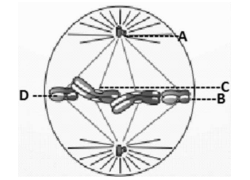
Correct Answer: (a)
Based on the mitotic diagram: (i) is the pole/centriole, (ii) is the whole chromosome, (iii) is the centromere junction, (iv) is an individual chromatid arm.
Based on the mitotic diagram: (i) is the pole/centriole, (ii) is the whole chromosome, (iii) is the centromere junction, (iv) is an individual chromatid arm.
Q5. Which of the following events are not characteristic features of telophase?
A. Chromosome material condenses to form compact mitotic chromosomes.
B. Nucleolus, Golgi complex and ER reform.
C. Nuclear envelope assembles around the chromosome clusters.
D. Chromosomes split and chromatids separate.
E. Chromosomes cluster at opposite, spindle poles and their identity as discrete element is lost.
A. Chromosome material condenses to form compact mitotic chromosomes.
B. Nucleolus, Golgi complex and ER reform.
C. Nuclear envelope assembles around the chromosome clusters.
D. Chromosomes split and chromatids separate.
E. Chromosomes cluster at opposite, spindle poles and their identity as discrete element is lost.
Correct Answer: (b)
Condensation (A) occurs in Prophase. Splitting (D) occurs in Anaphase. Events B, C, and E are specific to Telophase.
Condensation (A) occurs in Prophase. Splitting (D) occurs in Anaphase. Events B, C, and E are specific to Telophase.
Q6. A somatic cell that has just completed the S phase of its cell cycle, as compared to gamete of the same species, has
Correct Answer: (b)
Gamete = n chromosomes, 1C DNA. $ somatic = 2n, 2C. After S-phase ($), somatic = 2n chromosomes, 4C DNA. Thus, 2x chromosomes and 4x DNA compared to gamete.
Gamete = n chromosomes, 1C DNA. $ somatic = 2n, 2C. After S-phase ($), somatic = 2n chromosomes, 4C DNA. Thus, 2x chromosomes and 4x DNA compared to gamete.
Q7. 'X' ensures the production of 'Y' phase in the life cycle of sexually reproducing organisms whereas fertilization restores the 'Z' phase. Identify X, Y and Z.
Correct Answer: (c)
Meiosis (X) produces haploid (Y) gametes, and fertilization restores the diploid (Z) state in the zygote.
Meiosis (X) produces haploid (Y) gametes, and fertilization restores the diploid (Z) state in the zygote.
Q8. In which stage, the chromosomes appear thin and long thread-like ?
Correct Answer: (b)
During the leptotene stage, chromosomes start to condense but still appear as very thin, long threads.
During the leptotene stage, chromosomes start to condense but still appear as very thin, long threads.
Q9. In mitosis, nucleolus and nuclear membrane disappear at
Correct Answer: (b)
During late prophase, the nuclear envelope, nucleolus, Golgi complex, and ER disappear as chromosomes finish condensing.
During late prophase, the nuclear envelope, nucleolus, Golgi complex, and ER disappear as chromosomes finish condensing.
Q10. Condensation of chromosomes occurs in
Correct Answer: (a)
The process of chromosome condensation begins at the start of mitosis or meiosis in the prophase stage.
The process of chromosome condensation begins at the start of mitosis or meiosis in the prophase stage.
Q11. You are provided with floral buds of Chrysanthemum in your class and are asked to count the chromosomes, then which of the following stages would you prefer to look into?
Correct Answer: (b)
Metaphase is universally the best stage for chromosome counting because they are at their maximum state of condensation.
Metaphase is universally the best stage for chromosome counting because they are at their maximum state of condensation.
Q12. Which of the following pair is correctly matched ?
Correct Answer: (d)
G0 phase is known as the quiescent stage where cells remain metabolically active but no longer proliferate unless called on to do so.
G0 phase is known as the quiescent stage where cells remain metabolically active but no longer proliferate unless called on to do so.
Q13. How many times does DNA replicate?
Correct Answer: (b)
Regardless of whether the cell undergoes mitosis or meiosis, DNA is replicated only once during the S-phase of the interphase.
Regardless of whether the cell undergoes mitosis or meiosis, DNA is replicated only once during the S-phase of the interphase.
Q14. In cell cycle, DNA replication takes place in ______
Correct Answer: (d)
DNA replication or synthesis occurs during the S (Synthesis) phase of the cell cycle, leading to the doubling of DNA content per cell.
DNA replication or synthesis occurs during the S (Synthesis) phase of the cell cycle, leading to the doubling of DNA content per cell.
Q15. DNA replication in bacteria occurs
Correct Answer: (b)
Bacteria divide by binary fission. DNA replication occurs in the cytoplasm just before the cell splits into two.
Bacteria divide by binary fission. DNA replication occurs in the cytoplasm just before the cell splits into two.
Q16. What does (i) and (ii) represent in the given flowchart?
Parent cell -M-I→ 2 daughter cells -M-II→ 4 daughter cell
(2n) (i) (ii)
Parent cell -M-I→ 2 daughter cells -M-II→ 4 daughter cell
(2n) (i) (ii)
Correct Answer: (b)
Meiosis I is reductional ($2n → n$). Meiosis II is equational ( → n$). Resulting cells are all haploid (n).
Meiosis I is reductional ($2n → n$). Meiosis II is equational ( → n$). Resulting cells are all haploid (n).
Q17. At which stage of meiosis does the genetic constitution of gametes is finally decided.
Correct Answer: (d)
The independent assortment of maternal and paternal chromosomes at Anaphase I determines the final chromosomal combination in the resulting gametes.
The independent assortment of maternal and paternal chromosomes at Anaphase I determines the final chromosomal combination in the resulting gametes.
Q18. Dissolution of the synaptonemal complex occurs during
Correct Answer: (b)
The beginning of diplotene is marked by the breakdown of the synaptonemal complex that held homologous pairs together.
The beginning of diplotene is marked by the breakdown of the synaptonemal complex that held homologous pairs together.
Q19. In meiosis, division is
Correct Answer: (a)
Meiosis I reduces the chromosome number by half (reductional). Meiosis II is similar to mitosis and separates sister chromatids (equational).
Meiosis I reduces the chromosome number by half (reductional). Meiosis II is similar to mitosis and separates sister chromatids (equational).
Q20. In human females, meiosis-II is not complete until?
Correct Answer: (a)
In humans, the secondary oocyte completes Meiosis II only upon the entry of a sperm (fertilization).
In humans, the secondary oocyte completes Meiosis II only upon the entry of a sperm (fertilization).
Q21. During which phase(s) of cell cycle, amount of DNA in a cell remains at 4C level if the initial amount is denoted as 2C?
Correct Answer: (c)
DNA content is 2C in G1, increases in S, reaches 4C by the end of S, stays 4C throughout G2, and drops during M-phase division.
DNA content is 2C in G1, increases in S, reaches 4C by the end of S, stays 4C throughout G2, and drops during M-phase division.
Q22. Which of the following is responsible for the formation of the new cell wall and also represents the middle lamella between the walls of two adjacent cells?
Correct Answer: (a)
The cell plate formed during plant cytokinesis develops into the middle lamella, which provides the foundation for the primary cell walls of the daughter cells.
The cell plate formed during plant cytokinesis develops into the middle lamella, which provides the foundation for the primary cell walls of the daughter cells.
Q23. The separation of two chromatids of each chromosome at early anaphase is initiated by
Correct Answer: (a)
Spindle fibers (microtubules) pulling on the kinetochores at the centromere provide the force necessary to separate the sister chromatids.
Spindle fibers (microtubules) pulling on the kinetochores at the centromere provide the force necessary to separate the sister chromatids.
Q24. It is important that the centromere should not divide till the end of metaphase because it
Correct Answer: (c)
The centromere keeps the two sister chromatids (identical replicated DNA) together until they are properly aligned and ready for equal segregation.
The centromere keeps the two sister chromatids (identical replicated DNA) together until they are properly aligned and ready for equal segregation.
Q25. In the somatic cell cycle
Correct Answer: (b)
In somatic cells, the DNA replication occurs during the S-phase, resulting in two identical sets of DNA for the future daughter cells.
In somatic cells, the DNA replication occurs during the S-phase, resulting in two identical sets of DNA for the future daughter cells.
Q26. In meiosis crossing over is initiated at
Correct Answer: (a)
Recombination nodules form and crossing over occurs during the pachytene stage.
Recombination nodules form and crossing over occurs during the pachytene stage.
Q27. Which one is correct about crossing over/genetic recombination?
(i) It occurs in tetrad stage which occurs in pachytene of prophase I of meiosis I.
(ii) It occurs between non-sister chromatids of homologous chromosomes.
(iii) It is recombinase enzyme mediated process.
(iv) It is also the reciprocal transfer of genes between the non-homologous chromosomes
(i) It occurs in tetrad stage which occurs in pachytene of prophase I of meiosis I.
(ii) It occurs between non-sister chromatids of homologous chromosomes.
(iii) It is recombinase enzyme mediated process.
(iv) It is also the reciprocal transfer of genes between the non-homologous chromosomes
Correct Answer: (b)
Crossing over happens between homologous chromosomes, not non-homologous ones. Statements (i), (ii), and (iii) are correct.
Crossing over happens between homologous chromosomes, not non-homologous ones. Statements (i), (ii), and (iii) are correct.
Q28. The major events that occur during the anaphase of mitosis, which brings about the equal distribution of chromosome, is
Correct Answer: (c)
The physical separation of sister chromatids is triggered by the simultaneous splitting of the centromeres.
The physical separation of sister chromatids is triggered by the simultaneous splitting of the centromeres.
Q29. The stage during which separation of the paired homologous chromosomes begins is
Correct Answer: (b)
Diplotene begins with the dissolution of the synaptonemal complex, allowing homologs to move apart except at chiasmata.
Diplotene begins with the dissolution of the synaptonemal complex, allowing homologs to move apart except at chiasmata.
Q30. If you are provided with root-tips of onion in your class and are asked to count the chromosomes, which of the following stages can you most conveniently look into?
Correct Answer: (a)
Metaphase chromosomes are most highly condensed and spread out at the equator, providing the easiest view for counting.
Metaphase chromosomes are most highly condensed and spread out at the equator, providing the easiest view for counting.
Q31. The synaptonemal complex appears
Correct Answer: (d)
The synaptonemal complex is a protein structure that facilitates synapsis between homologous chromosomes during zygotene.
The synaptonemal complex is a protein structure that facilitates synapsis between homologous chromosomes during zygotene.
Q32. Electron micrographs of which stage indicate that chromosomes accompanied by the formation of complex structure called synaptonemal complex?
Correct Answer: (a)
Synapsis and the formation of the synaptonemal complex occur during the second stage of Prophase I, Zygotene.
Synapsis and the formation of the synaptonemal complex occur during the second stage of Prophase I, Zygotene.
Q33. Chiasmata are first seen in ______
Correct Answer: (d)
As the synaptonemal complex dissolves in diplotene, the homologous chromosomes remain attached at X-shaped sites called chiasmata.
As the synaptonemal complex dissolves in diplotene, the homologous chromosomes remain attached at X-shaped sites called chiasmata.
Q34. Find out the wrongly matched pair of the stage of prophase I with their feature.
Correct Answer: (b)
Pachytene is characterized by crossing over and recombination, not primary mutation.
Pachytene is characterized by crossing over and recombination, not primary mutation.
Q35. A plant cell has 12 chromosomes at the end of mitosis. How many chromosomes would it have in the G2-phase of its next cell cycle?
Correct Answer: (c)
Mitosis maintains chromosome number. If a cell has 12 chromosomes after division ($), it will still have 12 chromosomes (each having two sister chromatids) after S-phase ($).
Mitosis maintains chromosome number. If a cell has 12 chromosomes after division ($), it will still have 12 chromosomes (each having two sister chromatids) after S-phase ($).
Q36. In anaphase of mitosis,
Correct Answer: (d)
Anaphase involves the migration of sister chromatids (now individual chromosomes) toward the opposite poles of the cell.
Anaphase involves the migration of sister chromatids (now individual chromosomes) toward the opposite poles of the cell.
Q37. Chromosome number can be doubled by using which of the following?
Correct Answer: (d)
Colchicine inhibits spindle formation during mitosis, resulting in the failure of sister chromatid separation and thus doubling the chromosome number (polyploidy).
Colchicine inhibits spindle formation during mitosis, resulting in the failure of sister chromatid separation and thus doubling the chromosome number (polyploidy).
Q38. The chromosomes in which centromere is situated close to one end are:
Correct Answer: (a)
In an acrocentric chromosome, the centromere is located near one end, resulting in one very short and one very long arm.
In an acrocentric chromosome, the centromere is located near one end, resulting in one very short and one very long arm.
Q39. Which of the events listed below is not observed during mitosis?
Correct Answer: (d)
Crossing over is unique to the pachytene stage of prophase I in Meiosis.
Crossing over is unique to the pachytene stage of prophase I in Meiosis.
Q40. Which of the following serves as mitotic spindle poison ?
Correct Answer: (d)
Colchicine prevents the formation of the mitotic spindle, arresting the cell in metaphase; hence it is called a spindle poison.
Colchicine prevents the formation of the mitotic spindle, arresting the cell in metaphase; hence it is called a spindle poison.
Q41. Identify the meiotic stage in which the homologous chromosomes separate while the sister chromatids remain associated at their centromeres.
Correct Answer: (c)
Anaphase I is the stage where homologous chromosomes move to opposite poles, while sister chromatids stay together.
Anaphase I is the stage where homologous chromosomes move to opposite poles, while sister chromatids stay together.
Q42. A cell division time is 1 minute. In 20 minutes, a culture tube (culture medium) is 1/8th filled with cells. When the tube will be fully filled?
Correct Answer: (b)
If the population doubles every minute: at 20m it's 1/8. At 21m it's 1/4. At 22m it's 1/2. At 23m it's fully filled (1).
If the population doubles every minute: at 20m it's 1/8. At 21m it's 1/4. At 22m it's 1/2. At 23m it's fully filled (1).
Q43. In eukaryotic cell cycle, cell fusion experiments show that
Correct Answer: (a)
Fusion of an S-phase cell with a G1 cell induces DNA replication in the G1 nucleus, indicating that S-phase cytoplasm contains 'S-phase promoting factors'.
Fusion of an S-phase cell with a G1 cell induces DNA replication in the G1 nucleus, indicating that S-phase cytoplasm contains 'S-phase promoting factors'.
Q44. In ‘S’ phase of the cell cycle
Correct Answer: (a)
S-phase is defined by the replication of DNA, resulting in a doubling of the total DNA per nucleus.
S-phase is defined by the replication of DNA, resulting in a doubling of the total DNA per nucleus.
Q45. The microtubules of the mitotic spindle attach to a specializes structure in the centromere region of each chromosome called the __________.
Correct Answer: (d)
Kinetochores are small disc-shaped structures at the surface of the centromeres that serve as attachment sites for spindle microtubules.
Kinetochores are small disc-shaped structures at the surface of the centromeres that serve as attachment sites for spindle microtubules.
Q46. Interphase includes all of the following except ______
Correct Answer: (b)
Interphase consists of G1, S, and G2 phases. Anaphase is a stage of the M (Mitotic) phase.
Interphase consists of G1, S, and G2 phases. Anaphase is a stage of the M (Mitotic) phase.
Q47. Match the terms (given in column I) with their explanation (given in column II) and choose the correct combination from the options given below.
| Column I (Terms) | Column II (Explanation) |
|---|---|
| A. Terminalization | I. Pairing of homologous chromosomes. |
| B. Synapsis | II. Point of attachment between homologous chromosomes. |
| C. Chiasmata | III. Nuclear protein complex that helps in adherence of sister chromatids and then homologous chromosomes. |
| D. Synaptonemal complex | IV. Shifting of chiasmata outwards towards the ends of a bivalent. |
Correct Answer: (a)
A matches IV; B matches I; C matches II; D matches III based on biological definitions.
A matches IV; B matches I; C matches II; D matches III based on biological definitions.
Q48. Cell division cannot be stopped in which phase of the cell cycle?
Correct Answer: (d)
Once the cell enters the M-phase (starting with Prophase), the physical process of chromosome condensation and spindle formation is generally irreversible and continues to completion.
Once the cell enters the M-phase (starting with Prophase), the physical process of chromosome condensation and spindle formation is generally irreversible and continues to completion.
Q49. Four daughter cells formed after meiosis are
Correct Answer: (b)
Due to crossing over and independent assortment of homologous chromosomes, the four daughter cells are genetically unique.
Due to crossing over and independent assortment of homologous chromosomes, the four daughter cells are genetically unique.
Q50. Which of the following phase follows S and G2 phases of interphase?
Correct Answer: (a)
The M-phase starts with nuclear division, and its first stage is Prophase, which follows the interphase.
The M-phase starts with nuclear division, and its first stage is Prophase, which follows the interphase.
Q51. The correct sequence of phases of cell cycle is:
Correct Answer: (d)
The interphase sequence is G1 (gap 1) → S (synthesis) → G2 (gap 2), followed by the M (mitotic) phase.
The interphase sequence is G1 (gap 1) → S (synthesis) → G2 (gap 2), followed by the M (mitotic) phase.
Q52. Match the following with respect to meiosis
Select the correct option from the following
| (A) Zygotene | (i) Terminalization |
|---|---|
| (B) Pachytene | (ii) Chiasmata |
| (C) Diplotene | (iii) Crossing over |
| (D) Diakinesis | (iv) Synapsis |
Select the correct option from the following
Correct Answer: (a)
Matching: Zygotene=Synapsis, Pachytene=Crossing over, Diplotene=Chiasmata, Diakinesis=Terminalization.
Matching: Zygotene=Synapsis, Pachytene=Crossing over, Diplotene=Chiasmata, Diakinesis=Terminalization.
Q53. Crossing over takes place between which chromatids and in which stage of the cell cycle?
Correct Answer: (b)
Crossing over specifically occurs between the non-sister chromatids of a homologous pair during the Pachytene stage.
Crossing over specifically occurs between the non-sister chromatids of a homologous pair during the Pachytene stage.
Q54. Find out correctly matched pairs and choose the correct option:
A. Leptotene - The chromosomes become visible
B. Zygotene - Pairing of homologous chromosomes
C. Diplotene - Bivalent chromosomes appear as tetrads
D. Diakinesis - Terminalisation of chiasmata takes place
A. Leptotene - The chromosomes become visible
B. Zygotene - Pairing of homologous chromosomes
C. Diplotene - Bivalent chromosomes appear as tetrads
D. Diakinesis - Terminalisation of chiasmata takes place
Correct Answer: (a)
Wait, checking the skill enhancer key. For question 2, it says (c) which in some versions corresponds to A, B, and D being correct. A, B, and D are standard facts. C is wrong because tetrads are visible in Pachytene.
Wait, checking the skill enhancer key. For question 2, it says (c) which in some versions corresponds to A, B, and D being correct. A, B, and D are standard facts. C is wrong because tetrads are visible in Pachytene.
Q55. Select the correct statement about G1 phase
Correct Answer: (b)
DNA replication only occurs in the S-phase. G1 is a phase of intense metabolic activity and growth.
DNA replication only occurs in the S-phase. G1 is a phase of intense metabolic activity and growth.
Q56. The major event that occurs during the anaphase of mitosis, which brings about the equal distribution of chromosomes is
Correct Answer: (c)
The splitting of the centromere allows the two sister chromatids to separate and move toward opposite poles as independent chromosomes.
The splitting of the centromere allows the two sister chromatids to separate and move toward opposite poles as independent chromosomes.
Q57. Which of the following is the correct sequence of meiosis prophase I?
Correct Answer: (c)
The correct chronological order of Prophase I sub-stages is Leptotene, Zygotene, Pachytene, Diplotene, and Diakinesis.
The correct chronological order of Prophase I sub-stages is Leptotene, Zygotene, Pachytene, Diplotene, and Diakinesis.
Q58. Crossing over occurs between
Correct Answer: (b)
Crossing over is the exchange of genetic material between the non-sister chromatids of two homologous chromosomes.
Crossing over is the exchange of genetic material between the non-sister chromatids of two homologous chromosomes.
Q59. Syncytium formation occurs if
Correct Answer: (a)
A syncytium is a single large cell with multiple nuclei, formed when multiple rounds of nuclear division (karyokinesis) occur without cell splitting (cytokinesis).
A syncytium is a single large cell with multiple nuclei, formed when multiple rounds of nuclear division (karyokinesis) occur without cell splitting (cytokinesis).
Q60. Select the correct statement with respect to mitosis.
Correct Answer: (d)
Alignment at the equatorial plate is the hallmark of metaphase. Chromatids separate in anaphase, and organelles disappear by the end of prophase.
Alignment at the equatorial plate is the hallmark of metaphase. Chromatids separate in anaphase, and organelles disappear by the end of prophase.
Q61. A bivalent meiosis-I consists of
Correct Answer: (c)
A bivalent is a pair of homologous chromosomes. Since each chromosome has 2 chromatids and 1 centromere, the pair has 4 chromatids and 2 centromeres.
A bivalent is a pair of homologous chromosomes. Since each chromosome has 2 chromatids and 1 centromere, the pair has 4 chromatids and 2 centromeres.
Q62. Which of the following is not a characteristic feature during mitosis in somatic cells?
Correct Answer: (d)
Synapsis (pairing of homologous chromosomes) is exclusive to Meiosis I and does not occur in mitosis.
Synapsis (pairing of homologous chromosomes) is exclusive to Meiosis I and does not occur in mitosis.
Q63. Match the description (given in column I) with correct stage of prophase I (given column II) and choose the correct option.
| Column I | Column II |
|---|---|
| A. Chromosomes are moved to spindle equator | I. Pachytene |
| B. Centromere splits and chromatids move apart | II. Zygotene |
| C. Pairing between homologous chromosomes takes place | III. Anaphase |
| D. Crossing between homologous chromosomes | IV. Metaphase |
Correct Answer: (c)
Equator alignment = Metaphase. Centromere split = Anaphase. Pairing (Synapsis) = Zygotene. Crossing over = Pachytene.
Equator alignment = Metaphase. Centromere split = Anaphase. Pairing (Synapsis) = Zygotene. Crossing over = Pachytene.
Q64. Number of bivalents are 8 in prophase I. What is the number of chromosomes during anaphase II ?
Correct Answer: (a)
8 bivalents = 16 chromosomes. After Meiosis I, each cell has 8 chromosomes. In Anaphase II, sister chromatids separate, so the cell temporarily has 8 chromosomes at each pole (total 8 in the dividing cell).
8 bivalents = 16 chromosomes. After Meiosis I, each cell has 8 chromosomes. In Anaphase II, sister chromatids separate, so the cell temporarily has 8 chromosomes at each pole (total 8 in the dividing cell).
Q65. A stage in mitosis that starts towards the middle of anaphase and is completed with the telophase is
Correct Answer: (a)
Cytokinesis, the division of the cytoplasm, often begins during late anaphase and concludes along with the end of telophase.
Cytokinesis, the division of the cytoplasm, often begins during late anaphase and concludes along with the end of telophase.
Q66. Choose the correct option for the following events of meiosis in correct sequence
(A) Crossing over
(B) Synapsis
(C) Terminalisation of chiasmata
(D) Disappearance of nucleolus
(A) Crossing over
(B) Synapsis
(C) Terminalisation of chiasmata
(D) Disappearance of nucleolus
Correct Answer: (a)
The correct sequence within Prophase I is pairing (Synapsis) → exchange (Crossing over) → end-movement (Terminalization) → nuclear breakdown (Diakinesis/Disappearance).
The correct sequence within Prophase I is pairing (Synapsis) → exchange (Crossing over) → end-movement (Terminalization) → nuclear breakdown (Diakinesis/Disappearance).
Q67. During mitosis, nuclear envelope, nucleolous begin to form and ER to reappear at ______
Correct Answer: (d)
Telophase is the final stage where the nuclear envelope reforms around chromosome clusters, and the nucleolus, Golgi, and ER reappear.
Telophase is the final stage where the nuclear envelope reforms around chromosome clusters, and the nucleolus, Golgi, and ER reappear.
Q68. Select the correct statement related to mitosis.
Correct Answer: (b)
In mitosis, DNA content doubles in S-phase and then is equally split into two daughter cells, maintaining the parent cell's DNA level (2C).
In mitosis, DNA content doubles in S-phase and then is equally split into two daughter cells, maintaining the parent cell's DNA level (2C).
Q69. “G0” state of cells in eukaryotic cell cycle denotes
Correct Answer: (d)
Cells that do not divide further exit the G1 phase to enter an inactive stage called quiescent stage (G0) of the cell cycle.
Cells that do not divide further exit the G1 phase to enter an inactive stage called quiescent stage (G0) of the cell cycle.
Q70. In an organism, if the normal diploid number of chromosomes is 8, how many chromatids are present in each daughter cell at the end of meiosis I
Correct Answer: (c)
If 2n=8, then n=4. At the end of Meiosis I, the cell has 4 chromosomes, each consisting of 2 sister chromatids. Total chromatids = 8.
If 2n=8, then n=4. At the end of Meiosis I, the cell has 4 chromosomes, each consisting of 2 sister chromatids. Total chromatids = 8.
Q71. Match the description given in column-I with their steps given in column-II and identify the correct answer.
| Column-I | Column-II |
|---|---|
| A. Initiation of the assembly of mitotic spindle | I. Anaphase |
| B. Proteins are synthesized in preparation for mitosis while cell growth continues. | II. Prophase |
| C. Spindle fibres attach to kinetochores of chromosomes. | III. Interphase |
| D. Movement of chromatids towards opposite poles | IV. Metaphase |
Correct Answer: (a)
Assembly begins in Prophase. Preparation/Growth occurs in Interphase ($). Kinetochore attachment happens in Metaphase (Prometaphase). Migration occurs in Anaphase.
Assembly begins in Prophase. Preparation/Growth occurs in Interphase ($). Kinetochore attachment happens in Metaphase (Prometaphase). Migration occurs in Anaphase.
Q72. Identify the correct statement with regard to G1 phase (Gap 1) of interphase.
Correct Answer: (b)
G1 is a growth phase where the cell is very active and preparing for S-phase, but DNA replication hasn't started yet.
G1 is a growth phase where the cell is very active and preparing for S-phase, but DNA replication hasn't started yet.
Q73. During which stages (or prophase I substages) of meiosis do you expect to find the bivalents and DNA replication respectively?
Correct Answer: (c)
Bivalents are clearly visible in pachytene. DNA replication must occur before meiosis begins, during the S-phase of the preceding interphase.
Bivalents are clearly visible in pachytene. DNA replication must occur before meiosis begins, during the S-phase of the preceding interphase.
Q74. Cell would normally proceed to mitosis without interruption
Correct Answer: (a)
Once a cell passes the G1/S checkpoint and enters the S phase, it is committed to finishing DNA replication and proceeding through G2 into mitosis.
Once a cell passes the G1/S checkpoint and enters the S phase, it is committed to finishing DNA replication and proceeding through G2 into mitosis.
Q75. The enzyme recombinase is required at which stage of meiosis:
Correct Answer: (a)
Pachytene is the stage where crossing over occurs, requiring the enzyme recombinase for the exchange of genetic segments.
Pachytene is the stage where crossing over occurs, requiring the enzyme recombinase for the exchange of genetic segments.
Q76. Mitosis is the process by which eukaryotic cells
Correct Answer: (c)
Mitosis is primarily a mechanism for cell multiplication, ensuring that the daughter cells receive a complete and identical set of genetic material.
Mitosis is primarily a mechanism for cell multiplication, ensuring that the daughter cells receive a complete and identical set of genetic material.
Q77. In Meiosis,
Correct Answer: (a)
Meiosis involves two successive nuclear divisions (Meiosis I and II) but only a single round of DNA replication in the preceding interphase.
Meiosis involves two successive nuclear divisions (Meiosis I and II) but only a single round of DNA replication in the preceding interphase.
Q78. Which of the following pair is correctly matched ?
Correct Answer: (a)
Anaphase I specifically involves the separation and poleward movement of homologous chromosomes.
Anaphase I specifically involves the separation and poleward movement of homologous chromosomes.
Q79. Which of the following is the result when karyokinesis is not followed by cytokinesis?
Correct Answer: (b)
Failure of cytokinesis after nuclear division results in a multinucleate condition known as a syncytium (e.g., liquid endosperm in coconut).
Failure of cytokinesis after nuclear division results in a multinucleate condition known as a syncytium (e.g., liquid endosperm in coconut).
Q80. Which of the following statement is not true for homologous chromosome pairs ?
Correct Answer: (a)
Homologous pairs consist of one paternal and one maternal chromosome, each inherited from a different parent.
Homologous pairs consist of one paternal and one maternal chromosome, each inherited from a different parent.
Q81. The number of chromosome groups at the equatorial plate in metaphase-I of meiosis in a plant with 2n = 50 shall be
Correct Answer: (b)
In Metaphase I, chromosomes align as homologous pairs (bivalents). If 2n = 50, there are 25 bivalents arranged at the equator.
In Metaphase I, chromosomes align as homologous pairs (bivalents). If 2n = 50, there are 25 bivalents arranged at the equator.
Q82. An egg cell has 5 pico gram of DNA in its nucleus. How much amount of DNA will be at the end of G2-phase of mitosis?
Correct Answer: (d)
An egg cell is haploid (n), so DNA = 5pg (1C). A somatic cell in G1 (2n) has 10pg (2C). After S-phase ($), DNA content doubles to 20pg (4C).
An egg cell is haploid (n), so DNA = 5pg (1C). A somatic cell in G1 (2n) has 10pg (2C). After S-phase ($), DNA content doubles to 20pg (4C).
Q83. Cell plate grows from
Correct Answer: (b)
In plant cells, cytokinesis begins with the formation of a cell plate in the center of the cell, which then grows centrifugally toward the lateral walls.
In plant cells, cytokinesis begins with the formation of a cell plate in the center of the cell, which then grows centrifugally toward the lateral walls.
Q84. Mitosis is characterised by
Correct Answer: (b)
Mitosis is equational division, resulting in daughter cells with the same number and type of chromosomes as the parent.
Mitosis is equational division, resulting in daughter cells with the same number and type of chromosomes as the parent.
Q85. Which of the following statements (events) is/are correct for mitotic telophase?
Correct Answer: (d)
Telophase includes chromosome decondensation, reappearance of organelles, and reformation of the nuclear envelope at both poles.
Telophase includes chromosome decondensation, reappearance of organelles, and reformation of the nuclear envelope at both poles.
Q86. Cells in G0 phase :
Correct Answer: (c)
Cells in G0 have suspended their progress through the active cell cycle, remaining in a quiescent but metabolically functional state.
Cells in G0 have suspended their progress through the active cell cycle, remaining in a quiescent but metabolically functional state.
Q87. In which stage of the cell cycle, histone proteins are synthesized in a eukaryotic cell?
Correct Answer: (b)
Since histones are required for the packaging of newly replicated DNA, their synthesis is synchronized with DNA replication in the S-phase.
Since histones are required for the packaging of newly replicated DNA, their synthesis is synchronized with DNA replication in the S-phase.
Q88. Which one is correct about bivalent ?
(i) Bivalent are tetrads.
(ii) A bivalent means 4 chromatids and 2 centromere.
(iii) One bivalent consists of 2 homologous chromosomes each and sister chromatids.
(iv) Bivalents formation occurs in zygotene.
(i) Bivalent are tetrads.
(ii) A bivalent means 4 chromatids and 2 centromere.
(iii) One bivalent consists of 2 homologous chromosomes each and sister chromatids.
(iv) Bivalents formation occurs in zygotene.
Correct Answer: (a)
A bivalent (formed in zygotene) is a pair of homologous chromosomes. Since each has 2 chromatids, it's also called a tetrad (4 chromatids).
A bivalent (formed in zygotene) is a pair of homologous chromosomes. Since each has 2 chromatids, it's also called a tetrad (4 chromatids).
Q89. Match the following column I with column II.
| Column - I | Column - II |
|---|---|
| A. Carcinogen | I. Tumour |
| B. Anaphase-I | II. Disjunction |
| C. Mitosis | III. Synapse |
| D. Zygotene | IV. Plectonemic coiling |
Correct Answer: (a)
Carcinogens cause tumors. Anaphase I involves disjunction. Mitosis shows plectonemic coiling (tight twisting). Zygotene involves synapse.
Carcinogens cause tumors. Anaphase I involves disjunction. Mitosis shows plectonemic coiling (tight twisting). Zygotene involves synapse.
Q90. Which of the following carry the same genetic information?
Correct Answer: (a)
Sister chromatids are identical copies of the same chromosome produced during DNA replication in S-phase.
Sister chromatids are identical copies of the same chromosome produced during DNA replication in S-phase.
Q91. Mitosis and meiosis take place respectively in
Correct Answer: (a)
Mitosis occurs in vegetative/growth tissues like meristems. Meiosis occurs in reproductive structures (gametangia) to form gametes.
Mitosis occurs in vegetative/growth tissues like meristems. Meiosis occurs in reproductive structures (gametangia) to form gametes.
Q92. Crossing over occurs during ______
Correct Answer: (b)
Crossing over is initiated and completed during the pachytene stage of prophase I.
Crossing over is initiated and completed during the pachytene stage of prophase I.
Q93. Meiosis occurs in organisms during
Correct Answer: (a)
Meiosis is strictly associated with the sexual phase of a life cycle, where chromosome reduction is necessary prior to fusion.
Meiosis is strictly associated with the sexual phase of a life cycle, where chromosome reduction is necessary prior to fusion.
Q94. A stage of mitosis is shown in the given diagram. Identify stage with its characteristics?
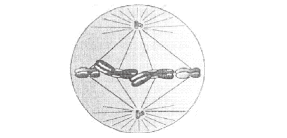
Correct Answer: (d)
The diagram shows sister chromatids having split at the centromere and being pulled toward opposite poles, signifying anaphase.
The diagram shows sister chromatids having split at the centromere and being pulled toward opposite poles, signifying anaphase.
Q95. Which one of the following precedes re-formation of the nuclear envelope during M-phase of the cell cycle?
Correct Answer: (a)
Decondensation and lamina reassembly are the prerequisites for the re-establishment of a functional nucleus in Telophase.
Decondensation and lamina reassembly are the prerequisites for the re-establishment of a functional nucleus in Telophase.
Q96. Identify the phases from the graph given below that shows the change in DNA content during various phases (A to D) of mitotic cell cycle.
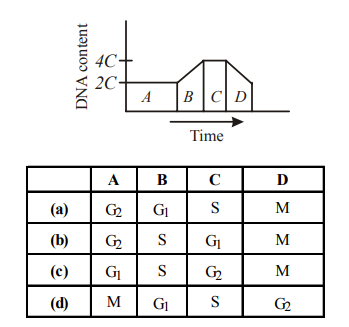
| A | B | C | D | |
|---|---|---|---|---|
| (a) | G2 | G1 | S | M |
| (b) | G2 | S | G1 | M |
| (c) | G1 | S | G2 | M |
| (d) | M | G1 | S | G2 |
Correct Answer: (c)
A is G1 (2C DNA), B is S (DNA increasing to 4C), C is G2 (4C DNA), and D is M (DNA dropping back to 2C).
A is G1 (2C DNA), B is S (DNA increasing to 4C), C is G2 (4C DNA), and D is M (DNA dropping back to 2C).
Q97. What is the stage of mitosis in which chromosomes are arranged on the equator of spindle?
Correct Answer: (c)
Metaphase is characterized by all chromosomes coming to lie at the equator (metaphase plate) with spindle fibers attached to kinetochores.
Metaphase is characterized by all chromosomes coming to lie at the equator (metaphase plate) with spindle fibers attached to kinetochores.
Q98. Cells which are not dividing are likely to be at
Correct Answer: (c)
G0 is the quiescent stage where cells exit the active cell cycle and stop dividing.
G0 is the quiescent stage where cells exit the active cell cycle and stop dividing.
Q99. The following events occur during the process of meiosis. Arrange the following events of meiosis in the correct sequence.
I. Terminalization II. Crossing over
III. Synapsis IV. Disjunction of genomes
I. Terminalization II. Crossing over
III. Synapsis IV. Disjunction of genomes
Correct Answer: (c)
The sequence is Synapsis (Zygotene) → Crossing over (Pachytene) → Terminalization (Diplotene/Diakinesis) → Disjunction (Anaphase I).
The sequence is Synapsis (Zygotene) → Crossing over (Pachytene) → Terminalization (Diplotene/Diakinesis) → Disjunction (Anaphase I).
Q100. Which of the following does not lead to genetic variability?
Correct Answer: (c)
Mitosis is an equational division that produces identical daughter cells; it does not introduce genetic variation.
Mitosis is an equational division that produces identical daughter cells; it does not introduce genetic variation.
Q101. Anaphase Promoting Complex (APC) is a protein degradation machinery necessary for proper mitosis of animal cells. If APC is defective in a human cell, which of the following is expected to occur?
Correct Answer: (b)
APC triggers the degradation of cohesins holding sister chromatids together. If defective, chromatids cannot separate (segregate) in anaphase.
APC triggers the degradation of cohesins holding sister chromatids together. If defective, chromatids cannot separate (segregate) in anaphase.
Q102. A stage in cell division is shown in the figure. Select the answer which gives correct identification of the stage with its characteristics.
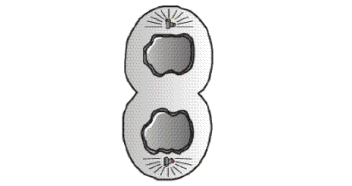
Correct Answer: (d)
The diagram shows two nuclei forming at the poles with the nuclear envelopes reappearing, which is the definitive event of telophase.
The diagram shows two nuclei forming at the poles with the nuclear envelopes reappearing, which is the definitive event of telophase.
Q103. Which of the following statement(s) is/are correct about S-phase (synthetic phase) ?
(i) It occurs between G1 and G2 phase.
(ii) It marks the period during which DNA replicates.
(iii) At the end of this phase, DNA is doubled but the number of chromosomes remains unchanged.
(iv) As the DNA is doubled in this phase number of chromosomes is also doubled.
(v) Centrioles replicate in this phase.
(vi) Amount of DNA changes from 2C to 4C.
(i) It occurs between G1 and G2 phase.
(ii) It marks the period during which DNA replicates.
(iii) At the end of this phase, DNA is doubled but the number of chromosomes remains unchanged.
(iv) As the DNA is doubled in this phase number of chromosomes is also doubled.
(v) Centrioles replicate in this phase.
(vi) Amount of DNA changes from 2C to 4C.
Correct Answer: (b)
In S-phase, DNA replicates and centrioles duplicate. Importantly, while DNA content doubles (2C to 4C), the chromosome number remains the same (e.g., 2n remains 2n).
In S-phase, DNA replicates and centrioles duplicate. Importantly, while DNA content doubles (2C to 4C), the chromosome number remains the same (e.g., 2n remains 2n).
Q104. Best stage to observe shape, size and number of chromosomes is ______
Correct Answer: (b)
At metaphase, chromosomes are most condensed and clearly visible, making it the ideal stage for karyotyping and studying morphology.
At metaphase, chromosomes are most condensed and clearly visible, making it the ideal stage for karyotyping and studying morphology.
Q105. Recombination involves
Correct Answer: (a)
Genetic recombination is the outcome of the crossing over process between homologous chromosomes.
Genetic recombination is the outcome of the crossing over process between homologous chromosomes.
Q106. Terminalization occurs during ______
Correct Answer: (b)
Terminalization is the final stage of prophase I (diakinesis) where chiasmata move toward the ends of the chromosomes.
Terminalization is the final stage of prophase I (diakinesis) where chiasmata move toward the ends of the chromosomes.
Q107. Identify the given figures (A, B & C) showing meiotic phases and select the correct option.
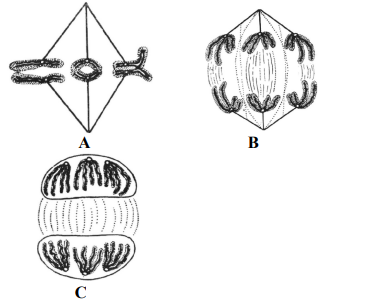
Correct Answer: (b)
Figure A shows bivalents at equator (Metaphase I); B shows homologous chromosomes separating (Anaphase I); C shows nuclei reforming (Telophase I).
Figure A shows bivalents at equator (Metaphase I); B shows homologous chromosomes separating (Anaphase I); C shows nuclei reforming (Telophase I).
Q108. Mark the incorrect pair.
Correct Answer: (d)
Diakinesis is the final stage of Prophase I (Meiosis I). Meiosis II has its own stages (Prophase II, etc.) but not Diakinesis.
Diakinesis is the final stage of Prophase I (Meiosis I). Meiosis II has its own stages (Prophase II, etc.) but not Diakinesis.
Q109. Spindle fibres attach on to
Correct Answer: (b)
Spindle fibers physically bind to the kinetochores, which are protein complexes located on the centromeres.
Spindle fibers physically bind to the kinetochores, which are protein complexes located on the centromeres.
Q110. In animal cells, cytokinesis involves
Correct Answer: (b)
Animal cell cytokinesis occurs by the formation of a cleavage furrow, driven by the contraction of a ring made of actin and myosin filaments.
Animal cell cytokinesis occurs by the formation of a cleavage furrow, driven by the contraction of a ring made of actin and myosin filaments.
Q111. Microtubule depolymerising drug such as colchicine is expected to
Correct Answer: (a)
Colchicine acts as a mitotic poison by preventing the polymerization of tubulin into microtubules, thus halting spindle assembly.
Colchicine acts as a mitotic poison by preventing the polymerization of tubulin into microtubules, thus halting spindle assembly.
Q112. Synapsis occurs between
Correct Answer: (d)
Synapsis is the pairing of homologous chromosomes during the zygotene stage of prophase I.
Synapsis is the pairing of homologous chromosomes during the zygotene stage of prophase I.
Q113. Which CdKs and cyclins comes under G2 check point?
Correct Answer: (a)
Regulation of the G2/M transition primarily involves the activation of the Cdk1/Cyclin B complex (also historically associated with Cdk4/Cdk2 variants in some texts).
Regulation of the G2/M transition primarily involves the activation of the Cdk1/Cyclin B complex (also historically associated with Cdk4/Cdk2 variants in some texts).
Q114. Visible expression of the genetic phenomenon of crossing over is called
Correct Answer: (c)
Chiasmata are the X-shaped physical manifestations of the points where crossing over occurred between non-sister chromatids.
Chiasmata are the X-shaped physical manifestations of the points where crossing over occurred between non-sister chromatids.
Q115. Which of these feature marks diplotene stage of cell cycle?
Correct Answer: (a)
The defining event of diplotene is the dissolution of the synaptonemal complex and the resulting partial separation of homologous chromosomes.
The defining event of diplotene is the dissolution of the synaptonemal complex and the resulting partial separation of homologous chromosomes.
Q116. Mitosis occurs in
Correct Answer: (c)
Mitosis is common in diploid somatic cells but also occurs in haploid cells of certain lower plants and some social insects.
Mitosis is common in diploid somatic cells but also occurs in haploid cells of certain lower plants and some social insects.
Q117. Select the correctly matched pair.
I. S phase – DNA replication
II. Zygotene – Synapsis
III. Diplotene – Crossing over
IV. Meiosis – Both haploid and diploid cells
I. S phase – DNA replication
II. Zygotene – Synapsis
III. Diplotene – Crossing over
IV. Meiosis – Both haploid and diploid cells
Correct Answer: (a)
S-phase is for DNA replication and Zygotene is for Synapsis. Crossing over occurs in Pachytene.
S-phase is for DNA replication and Zygotene is for Synapsis. Crossing over occurs in Pachytene.
Q118. A triploid nucleus cannot undergo meiosis because
Correct Answer: (d)
Meiosis requires homologous chromosomes to pair up. In a triploid (3n), the third set of chromosomes has no partners to synapse with, leading to infertility.
Meiosis requires homologous chromosomes to pair up. In a triploid (3n), the third set of chromosomes has no partners to synapse with, leading to infertility.
Q119. Which of the following options gives the correct sequence of events during mitosis?
Correct Answer: (a)
Sequence: Prophase (Condensation/Breakdown) → Metaphase (Equator) → Anaphase (Division/Segregation) → Telophase.
Sequence: Prophase (Condensation/Breakdown) → Metaphase (Equator) → Anaphase (Division/Segregation) → Telophase.
Q120. Given below is a schematic break-up of the phases / stages of cell cycle with few parts labelled as A, B, C & D. Which one of the following is the correct indication of the stage/phase in the cell cycle?
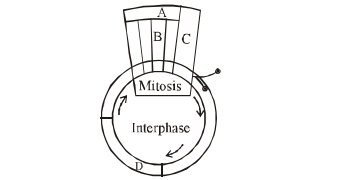
Correct Answer: (b)
In the standard diagram of the cell cycle, 'D' represents the S (Synthetic) phase, where DNA content increases.
In the standard diagram of the cell cycle, 'D' represents the S (Synthetic) phase, where DNA content increases.
Q121. Match the description given in column-I with their stepes given in column-II and identify the correct answer.
| Column-I | Column-II |
|---|---|
| A. Synapsis aligns homologous chromosomes | I. Anaphase-II |
| B. Synthesis of RNA and protein | II. Zygotene |
| C. Action of enzyme recombinase | III. G2-phase |
| D. Centromeres do not separate but chromatids move towards opposite poles | IV. Anaphase-I |
| V. Pachytene |
Correct Answer: (a)
Synapsis = Zygotene. RNA/Protein prep = G2. Recombinase = Pachytene. Homolog separation without centromere split = Anaphase I.
Synapsis = Zygotene. RNA/Protein prep = G2. Recombinase = Pachytene. Homolog separation without centromere split = Anaphase I.
Q122. Which stages of cell division do the following figures A and B represent respectively?
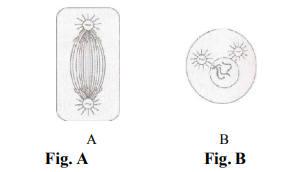
Correct Answer: (c)
Fig A shows chromosomes clearly separated and moving to poles (Late Anaphase); Fig B shows a cell with a dissolving nuclear envelope and condensing chromatin (Prophase).
Fig A shows chromosomes clearly separated and moving to poles (Late Anaphase); Fig B shows a cell with a dissolving nuclear envelope and condensing chromatin (Prophase).
Q123. Which of the following statements related to G0 stage of the cell cycle are correct?
(i) It is a quiescent stage.
(ii) In this phase, cell cycle is stopped.
(iii) G0 cells do not grow or proliferate but metabolically active.
(iv) G0 cells can divide in response to some stimulus.
(i) It is a quiescent stage.
(ii) In this phase, cell cycle is stopped.
(iii) G0 cells do not grow or proliferate but metabolically active.
(iv) G0 cells can divide in response to some stimulus.
Correct Answer: (d)
G0 is an inactive phase regarding proliferation, but cells are metabolically active and can re-enter the cell cycle if specific triggers (like injury) occur.
G0 is an inactive phase regarding proliferation, but cells are metabolically active and can re-enter the cell cycle if specific triggers (like injury) occur.
Q124. During Anaphase-I of meiosis
Correct Answer: (a)
In Anaphase I, homologous pairs are pulled apart, while sister chromatids remain joined at the centromere.
In Anaphase I, homologous pairs are pulled apart, while sister chromatids remain joined at the centromere.
Q125. Which one of the following precedes re-formation of the nuclear envelope during M phase of the cell cycle ?
Correct Answer: (a)
Before the nuclear envelope can reform in telophase, the chromosomes must begin to decondense and the nuclear lamina must reassemble around the chromatin.
Before the nuclear envelope can reform in telophase, the chromosomes must begin to decondense and the nuclear lamina must reassemble around the chromatin.
Q126. Which of the following will show simple cell division?
Correct Answer: (d)
In the context of the cell cycle text, these cells are actively dividing diploid cells which initially undergo mitotic expansion before entering meiosis.
In the context of the cell cycle text, these cells are actively dividing diploid cells which initially undergo mitotic expansion before entering meiosis.
Q127. Match the items in column I with those in column II, and choose the correct answer:
| Column I | Column II |
|---|---|
| P. Mitosis | (i) Occurs in diploid cells only |
| Q. Meiosis | (ii) Occurs in both haploid and diploid cells |
| (iii) Daughter and parent cells have same chromosome numbers | |
| (iv) Synapsis of homologous chromosomes |
Correct Answer: (c)
Mitosis preserves chromosome number (iii). Meiosis involves synapsis of homologous pairs (iv). Meiosis is typically restricted to diploid cells (i).
Mitosis preserves chromosome number (iii). Meiosis involves synapsis of homologous pairs (iv). Meiosis is typically restricted to diploid cells (i).
Q128. At which stage, the homologous chromosomes separate due to repulsion, but are yet held by chiasmata ?
Correct Answer: (c)
In diplotene, the homologous chromosomes repel each other and separate except at the chiasmata.
In diplotene, the homologous chromosomes repel each other and separate except at the chiasmata.
Q129. Given below is the representation of a certain event at a particular stage of a type of cell division. Which stage is shown by the given figure?
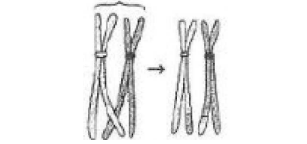
Correct Answer: (a)
The figure shows crossing over (exchange of segments) between homologous chromosomes, which only happens in Prophase I of Meiosis.
The figure shows crossing over (exchange of segments) between homologous chromosomes, which only happens in Prophase I of Meiosis.
Q130. In telophase of mitosis, the mitotic spindle breaks down and nuclear membranes form. This is essentially the opposite of what happens in
Correct Answer: (a)
Prophase involves the breakdown of the nuclear envelope and the assembly of the spindle, whereas telophase reverses these processes.
Prophase involves the breakdown of the nuclear envelope and the assembly of the spindle, whereas telophase reverses these processes.
Q131. Significance of meiosis lies in
Correct Answer: (d)
Meiosis ensures the maintenance of species-specific chromosome number across generations and generates variation for evolution.
Meiosis ensures the maintenance of species-specific chromosome number across generations and generates variation for evolution.
Q132. If for a species 2n = 16, then during Ist prophase and IInd prophase of meiotic division of a cell, how many tetrads and diads will be formed
Correct Answer: (c)
Tetrads (bivalents) in Meiosis I = n = 8. After Meiosis I, each chromosome is a diad (two chromatids). In Prophase II, each of the two cells has 8 diads.
Tetrads (bivalents) in Meiosis I = n = 8. After Meiosis I, each chromosome is a diad (two chromatids). In Prophase II, each of the two cells has 8 diads.
Q133. How many meiotic divisions are required to produce 100 pollen grains ?
Correct Answer: (a)
Each meiotic division of a microspore mother cell produces 4 pollen grains. Thus, $100 / 4 = 25$ divisions are needed.
Each meiotic division of a microspore mother cell produces 4 pollen grains. Thus, $100 / 4 = 25$ divisions are needed.
Q134. In meiosis, the daughter cells differ from parent cell as well as amongst themselves due to
Correct Answer: (a)
The genetic variation in gametes is caused by crossing over (prophase I) and the independent segregation and assortment of homologous pairs (anaphase I).
The genetic variation in gametes is caused by crossing over (prophase I) and the independent segregation and assortment of homologous pairs (anaphase I).
Q135. Some dividing cells exit the cell cycle and enter vegetative inactive stage. This is called quiescent stage (G0). This process occurs at the end of
Correct Answer: (a)
Cells that do not further divide exit the cycle at the G1 phase to enter the G0 stage.
Cells that do not further divide exit the cycle at the G1 phase to enter the G0 stage.
Q136. Which of the following cellular structures always disappears during mitosis and meiosis?
Correct Answer: (b)
The nuclear envelope and nucleolus consistently break down during the prophase stage of both mitosis and meiosis I/II.
The nuclear envelope and nucleolus consistently break down during the prophase stage of both mitosis and meiosis I/II.