Q1. Organisms of which of the following kingdom do not have nuclear membrane ?
Correct Answer: (c)
Kingdom Monera consists of prokaryotes, which lack a well-defined nucleus and nuclear membrane.
Kingdom Monera consists of prokaryotes, which lack a well-defined nucleus and nuclear membrane.
Q2. Members of phycomycetes are found in
(i) Aquatic habitats
(ii) On decaying wood
(iii) Moist and damp places
(iv) As obligate parasites on plants
(i) Aquatic habitats
(ii) On decaying wood
(iii) Moist and damp places
(iv) As obligate parasites on plants
Correct Answer: (d)
Phycomycetes are found in aquatic habitats, on decaying wood in moist/damp places, and as obligate parasites on plants.
Phycomycetes are found in aquatic habitats, on decaying wood in moist/damp places, and as obligate parasites on plants.
Q3. Which of the following was the criterion used for classifying organisms by the earliest human beings?
Correct Answer: (c)
In early times, classification was based on the basic uses of organisms—food, shelter, and clothing.
In early times, classification was based on the basic uses of organisms—food, shelter, and clothing.
Q4. The given statements are some characters of a particular group of Kingdom protista.
(i) Most of them are fresh water organisms found in standing water.
(ii) They have a protein rich layer (called pellicle) which makes their body flexible.
(iii) They have two flagella, a short and a long one.
(iv) Though they are photosynthetic in the presence of sunlight, but in the absence of sunlight they behave like heterotrophs by predating on other smaller organisms.
Identify the correct group on the basis of these characters.
(i) Most of them are fresh water organisms found in standing water.
(ii) They have a protein rich layer (called pellicle) which makes their body flexible.
(iii) They have two flagella, a short and a long one.
(iv) Though they are photosynthetic in the presence of sunlight, but in the absence of sunlight they behave like heterotrophs by predating on other smaller organisms.
Identify the correct group on the basis of these characters.
Correct Answer: (d)
These features (fresh water, pellicle, two flagella, mixotrophic nutrition) are characteristic of Euglenoids like Euglena.
These features (fresh water, pellicle, two flagella, mixotrophic nutrition) are characteristic of Euglenoids like Euglena.
Q5. Which among the following is not a prokaryote?
Correct Answer: (a)
Saccharomyces (Yeast) is a eukaryote belonging to Kingdom Fungi. The others are bacteria.
Saccharomyces (Yeast) is a eukaryote belonging to Kingdom Fungi. The others are bacteria.
Q6. Which of the following statements is incorrect ?
Correct Answer: (a)
TMV (Tobacco Mosaic Virus) has a single-stranded RNA molecule.
TMV (Tobacco Mosaic Virus) has a single-stranded RNA molecule.
Q7. Ustilago causes plant diseases (called smuts) because
Correct Answer: (c)
The name 'smut' refers to the thick-walled, black, sooty teliospores produced by fungi like Ustilago.
The name 'smut' refers to the thick-walled, black, sooty teliospores produced by fungi like Ustilago.
Q8. Refer to the given figures of bacteria cell and Nostoc and choose the option which shows correct label for the structures marked as A, B, C, D and E ?
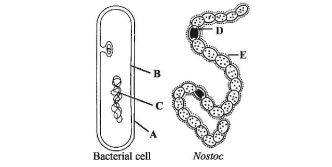
Correct Answer: (b)
In the bacterial cell: A is Cell Wall, B is Cell Membrane, C is DNA. In Nostoc: D is Heterocyst (specialized cell for N2 fixation), E is Mucilagenous sheath.
In the bacterial cell: A is Cell Wall, B is Cell Membrane, C is DNA. In Nostoc: D is Heterocyst (specialized cell for N2 fixation), E is Mucilagenous sheath.
Q9. Match the type of protozoans given in column-I with their examples given in column-II and choose the correct option.
| Column-I (Type of Protozoans) | Column-II (Examples) |
|---|---|
| A. Amoeboid protozoans | I. Paramecium |
| B. Ciliated protozoans | II. Plasmodium |
| C. Flagellated protozoans | III. Amoeba |
| D. Sporozoans | IV. Trypanosoma |
Correct Answer: (c)
Amoeboid: Amoeba; Ciliated: Paramecium; Flagellated: Trypanosoma; Sporozoans: Plasmodium.
Amoeboid: Amoeba; Ciliated: Paramecium; Flagellated: Trypanosoma; Sporozoans: Plasmodium.
Q10. In which group of organisms the cell walls form two thin overlapping shells which fit together?
Correct Answer: (d)
In Chrysophytes (specifically diatoms), the cell walls form two thin overlapping shells that fit together like a soap box.
In Chrysophytes (specifically diatoms), the cell walls form two thin overlapping shells that fit together like a soap box.
Q11. Which of the following statement(s) is/ are correct for bacteria?
Correct Answer: (d)
Bacteria are the sole members of Kingdom Monera, are found almost everywhere (including extreme environments), and as a group, they show high metabolic diversity.
Bacteria are the sole members of Kingdom Monera, are found almost everywhere (including extreme environments), and as a group, they show high metabolic diversity.
Q12. Viroids differ from viruses in having
Correct Answer: (c)
Viroids consist only of free RNA without a protein coat (capsid).
Viroids consist only of free RNA without a protein coat (capsid).
Q13. Plasmogamy is the fusion of
Correct Answer: (b)
Plasmogamy is the first step of sexual reproduction in fungi, where the protoplasms of two motile or non-motile gametes fuse without their nuclei fusing immediately.
Plasmogamy is the first step of sexual reproduction in fungi, where the protoplasms of two motile or non-motile gametes fuse without their nuclei fusing immediately.
Q14. Match column-I (Characters/feature) with column-II (examples) and choose the correct option.
| Column-I (Characters/features) | Column-II (Examples) |
|---|---|
| A. Red dinoflagellates | I. Rhizopus |
| B. Unicellular fungi used to make bread and beer | II. Gonyaulax |
| C. Source of antibiotics | III. Yeast |
| D. Bread mould | IV. Penicillium |
Correct Answer: (c)
A - Gonyaulax (Red dinoflagellate); B - Yeast (Unicellular fungus); C - Penicillium (Antibiotic source); D - Rhizopus (Bread mould).
A - Gonyaulax (Red dinoflagellate); B - Yeast (Unicellular fungus); C - Penicillium (Antibiotic source); D - Rhizopus (Bread mould).
Q15. Bacteria are found to be primitive organisms because they
Correct Answer: (d)
Bacteria are primitive (prokaryotic) because they lack a well-defined nucleus (incipient nucleus/nucleoid) and reproduce by simple fission (amitotic division).
Bacteria are primitive (prokaryotic) because they lack a well-defined nucleus (incipient nucleus/nucleoid) and reproduce by simple fission (amitotic division).
Q16. Choose the correct names of the different bacteria given below according to their shapes.
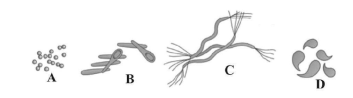
Correct Answer: (a)
Bacteria are categorized by shape: spherical (Cocci - A), rod-shaped (Bacilli - B), spiral (Spirilla - C), and comma-shaped (Vibrio - D).
Bacteria are categorized by shape: spherical (Cocci - A), rod-shaped (Bacilli - B), spiral (Spirilla - C), and comma-shaped (Vibrio - D).
Q17. Match the column I and II:
| Column-I | Column-II |
|---|---|
| (A) K.C. Mehta | (i) Fluid mosaic model |
| (B) P. Maheshwari | (ii) First recombinant plasmid. |
| (C) Cohen and Boyer | (iii) Haploid culture |
| (D) Singer and Nicolson | (iv) Rust disease |
Correct Answer: (b)
K.C. Mehta - Wheat Rust; P. Maheshwari - Embryology/Haploid culture; Cohen & Boyer - rDNA; Singer & Nicolson - Fluid mosaic model.
K.C. Mehta - Wheat Rust; P. Maheshwari - Embryology/Haploid culture; Cohen & Boyer - rDNA; Singer & Nicolson - Fluid mosaic model.
Q18. Viruses are non-cellular organisms, but replicate themselves once they infect the host cell. To which of the following kingdom do viruses belong to?
Correct Answer: (d)
Viruses are not included in any kingdom of classification because they are not truly 'living' in a cellular sense.
Viruses are not included in any kingdom of classification because they are not truly 'living' in a cellular sense.
Q19. Which of the following is used extensively in biochemical and genetic work ?
Correct Answer: (c)
Neurospora crassa (Drosophila of plant kingdom) is widely used in genetic and biochemical research.
Neurospora crassa (Drosophila of plant kingdom) is widely used in genetic and biochemical research.
Q20. Which of the following was/were the problem(s) associated with the Linnaean System of biological classification?
(1) It gave only three kingdom system which left many organisms.
(2) It did not distinguish between the eukaryotes and prokaryotes.
(3) If did not distinguish between photosynthetic algae and fungi.
Select the correct answer using the codes given below:
(1) It gave only three kingdom system which left many organisms.
(2) It did not distinguish between the eukaryotes and prokaryotes.
(3) If did not distinguish between photosynthetic algae and fungi.
Select the correct answer using the codes given below:
Correct Answer: (c)
Linnaeus gave a two-kingdom system (Plantae and Animalia). It failed to distinguish between prokaryotes/eukaryotes, unicellular/multicellular, and photosynthetic/non-photosynthetic organisms.
Linnaeus gave a two-kingdom system (Plantae and Animalia). It failed to distinguish between prokaryotes/eukaryotes, unicellular/multicellular, and photosynthetic/non-photosynthetic organisms.
Q21. Which of the following is not a viral disease ?
Correct Answer: (d)
Cholera is a bacterial disease caused by Vibrio cholerae. AIDS, mumps, smallpox, herpes, and influenza are viral.
Cholera is a bacterial disease caused by Vibrio cholerae. AIDS, mumps, smallpox, herpes, and influenza are viral.
Q22. In Phycomycetes, asexual reproduction takes place try zoospores or by aplanospores. Regarding these spores, read the following statements and choose the correct option.
(i) Zoospores are motile and aplanospores are non-motile in nature.
(ii) These spores are endogeneously produced in sporangia.
Which of the statements are true and false?
(i) Zoospores are motile and aplanospores are non-motile in nature.
(ii) These spores are endogeneously produced in sporangia.
Which of the statements are true and false?
Correct Answer: (c)
In Phycomycetes, zoospores (motile) and aplanospores (non-motile) are both produced endogenously within a sporangium.
In Phycomycetes, zoospores (motile) and aplanospores (non-motile) are both produced endogenously within a sporangium.
Q23. Which of the following pairs is not correctly matched ?
Correct Answer: (d)
Albugo is a parasitic fungus belonging to Phycomycetes, not a Chrysophyte (which are protists like diatoms).
Albugo is a parasitic fungus belonging to Phycomycetes, not a Chrysophyte (which are protists like diatoms).
Q24. Match column-I with column-II and select the option.
| Column-I (Classes of fungi) | Column-II (Common name) |
|---|---|
| A. Phycomycetes | I. Sac fungi |
| B. Ascomycetes | II. Algal fungi |
| C. Basidiomycetes | III. Fungi imperfecti |
| D. Deuteromycetes | IV. Club fungi |
Correct Answer: (a)
Phycomycetes: Algal fungi; Ascomycetes: Sac fungi; Basidiomycetes: Club fungi; Deuteromycetes: Fungi imperfecti.
Phycomycetes: Algal fungi; Ascomycetes: Sac fungi; Basidiomycetes: Club fungi; Deuteromycetes: Fungi imperfecti.
Q25. An "X" reproduces in such a great numbers that the water may appear, producing a red tides and kills large marine animals like "Z". "X" belongs to "Y". Identify "X", "Y" and "Z".
Correct Answer: (a)
Red dinoflagellates like Gonyaulax undergo rapid multiplication causing 'red tides' and release toxins that can kill marine animals such as fishes.
Red dinoflagellates like Gonyaulax undergo rapid multiplication causing 'red tides' and release toxins that can kill marine animals such as fishes.
Q26. The figure given below shows the structure of a bacteriophage. Identify its parts labelled as A, B, C and D.
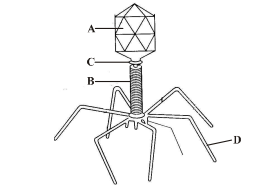
Correct Answer: (c)
In a bacteriophage: A is the Head (containing DNA), B is the Collar, C is the Sheath, and D represents the Tail fibres used for attachment.
In a bacteriophage: A is the Head (containing DNA), B is the Collar, C is the Sheath, and D represents the Tail fibres used for attachment.
Q27. Which of the following statement are correct to describe viruses?
(i) It is simple and unicellular organisms.
(ii) It contains DNA or RNA and enclosed by protein coat.
(iii) It possesses own metabolic system and respond to stimuli.
(iv) It maintains genetic continuity and undergo mutations.
(i) It is simple and unicellular organisms.
(ii) It contains DNA or RNA and enclosed by protein coat.
(iii) It possesses own metabolic system and respond to stimuli.
(iv) It maintains genetic continuity and undergo mutations.
Correct Answer: (b)
Viruses are non-cellular (acellular), lack their own metabolic system, but contain genetic material (DNA/RNA) and can mutate.
Viruses are non-cellular (acellular), lack their own metabolic system, but contain genetic material (DNA/RNA) and can mutate.
Q28. The structures that help some bacteria t-o attach to rocks and/or host tissues are
Correct Answer: (a)
Fimbriae are small bristle-like fibers sprouting out of the bacterial cell surface used for attachment.
Fimbriae are small bristle-like fibers sprouting out of the bacterial cell surface used for attachment.
Q29. Which one of the following statements concerning the algae is wrong?
Correct Answer: (c)
Algae are not all filamentous; they can be unicellular (Chlorella), colonial (Volvox), or massive (Kelps).
Algae are not all filamentous; they can be unicellular (Chlorella), colonial (Volvox), or massive (Kelps).
Q30. Clamp connection is found in
Correct Answer: (a)
Clamp connections are specialized hyphal structures used to ensure that each cell of the dikaryotic mycelium contains two nuclei of different strains in Basidiomycetes.
Clamp connections are specialized hyphal structures used to ensure that each cell of the dikaryotic mycelium contains two nuclei of different strains in Basidiomycetes.
Q31. The genetic material of virus includes
Correct Answer: (d)
A virus contains either DNA or RNA, but never both in the same virus particle.
A virus contains either DNA or RNA, but never both in the same virus particle.
Q32. Which scientist classified plants into trees, shrubs and herbs and animals into two groups based on absence or presence red blood cells?
Correct Answer: (a)
Aristotle was the earliest to attempt a scientific basis for classification, using simple morphological characters to classify plants and the presence/absence of red blood (Enaima/Anaima) for animals.
Aristotle was the earliest to attempt a scientific basis for classification, using simple morphological characters to classify plants and the presence/absence of red blood (Enaima/Anaima) for animals.
Q33. Which one one of the following matches is correct ?
| (a) Alternaria | Sexual reproduction absent | Deuteromycetes |
| (b) Mucor | Reproduction by Conjugation | Ascomycetes |
| (c) Agaricus | Parasitic fungus | Basidiomycetes |
| (d) Phytophthora | Aseptate mycelium | Basidiomycetes |
Correct Answer: (a)
Alternaria belongs to Deuteromycetes, where sexual stages are absent. Mucor is a Phycomycete. Agaricus is a saprophytic Basidiomycete. Phytophthora is a Phycomycete.
Alternaria belongs to Deuteromycetes, where sexual stages are absent. Mucor is a Phycomycete. Agaricus is a saprophytic Basidiomycete. Phytophthora is a Phycomycete.
Q34. Which of the following is correct about viroids?
Correct Answer: (a)
Viroids are infectious particles made of free RNA without a capsid protein coat.
Viroids are infectious particles made of free RNA without a capsid protein coat.
Q35. Which of the following characteristic(s) is/are used by Whittaker for the classification of organisms ?
Correct Answer: (d)
R.H. Whittaker's five-kingdom classification was based on cell structure, thallus organization, mode of nutrition, reproduction, and phylogenetic relationships.
R.H. Whittaker's five-kingdom classification was based on cell structure, thallus organization, mode of nutrition, reproduction, and phylogenetic relationships.
Q36. Match column I (containing fungus name) with column II (common name) and choose the correct options.
| Column-I (Fungus name) | Column-II (Commonly called) |
|---|---|
| A. Puccinia | I. Yeast |
| B. Ustilago | II. Mushroom |
| C. Agaricus | III. Smut fungus |
| D. Saccharomyces | IV. Rust fungus |
Correct Answer: (d)
Puccinia - Rust; Ustilago - Smut; Agaricus - Mushroom; Saccharomyces - Yeast.
Puccinia - Rust; Ustilago - Smut; Agaricus - Mushroom; Saccharomyces - Yeast.
Q37. Difference between virus and viroid is:
Correct Answer: (a)
Viroids are infectious agents composed only of RNA, lacking the protein coat (capsid) of a virus.
Viroids are infectious agents composed only of RNA, lacking the protein coat (capsid) of a virus.
Q38. With respect to fungal sexual cycle, choose the correct sequence of events.
Correct Answer: (c)
Fungal sexual reproduction follows the order: fusion of cytoplasm (plasmogamy), fusion of nuclei (karyogamy), and meiosis.
Fungal sexual reproduction follows the order: fusion of cytoplasm (plasmogamy), fusion of nuclei (karyogamy), and meiosis.
Q39. An association between roots of higher plants and fungi is called
Correct Answer: (c)
Mycorrhiza is a symbiotic association between a fungus and the roots of higher plants (e.g., Pinus).
Mycorrhiza is a symbiotic association between a fungus and the roots of higher plants (e.g., Pinus).
Q40. All eukaryotic unicellular organisms belong to
Correct Answer: (b)
In the five-kingdom system, all unicellular eukaryotes are grouped under Kingdom Protista.
In the five-kingdom system, all unicellular eukaryotes are grouped under Kingdom Protista.
Q41. Which group of fungi is commonly known as imperfect fungi ?
Correct Answer: (d)
Deuteromycetes are called imperfect fungi because only their asexual or vegetative phases are known; sexual stages are either absent or not yet discovered.
Deuteromycetes are called imperfect fungi because only their asexual or vegetative phases are known; sexual stages are either absent or not yet discovered.
Q42. Which of the following pairs come under the group chrysophytes?
Correct Answer: (c)
Kingdom Protista: Chrysophytes include diatoms and golden algae (desmids).
Kingdom Protista: Chrysophytes include diatoms and golden algae (desmids).
Q43. Which one of the following fungi contains hallucinogens?
Correct Answer: (b)
Amanita muscaria is a poisonous fungus known for its hallucinogenic properties.
Amanita muscaria is a poisonous fungus known for its hallucinogenic properties.
Q44. Refer to the statement and answer the question. "Once the sexual stage of members of deuteromycetes were discovered, they were often moved to X and Y." Identify X and Y.
Correct Answer: (c)
Deuteromycetes are 'imperfect fungi'. When sexual forms are identified, they are reclassified into Ascomycetes or Basidiomycetes based on their characteristics.
Deuteromycetes are 'imperfect fungi'. When sexual forms are identified, they are reclassified into Ascomycetes or Basidiomycetes based on their characteristics.
Q45. Match Column-I with Column-II.
| Column-I | Column-II |
|---|---|
| (A) Saprophyte | (i) Symbiotic association of fungi with plant roots |
| (B) Parasite | (ii) Decomposition of dead organic materials |
| (C) Lichens | (iii) Living on living plants or animals |
| (D) Mycorrhiza | (iv) Symbiotic association of algae and fungi |
Correct Answer: (a)
Saprophyte - decomposer; Parasite - lives on host; Lichen - algae+fungi; Mycorrhiza - roots+fungi.
Saprophyte - decomposer; Parasite - lives on host; Lichen - algae+fungi; Mycorrhiza - roots+fungi.
Q46. Naked cytoplasm, multinucleated and saprophytic are the characteristics of
Correct Answer: (d)
Slime molds are saprophytic protists that form a multinucleated mass of protoplasm called plasmodium.
Slime molds are saprophytic protists that form a multinucleated mass of protoplasm called plasmodium.
Q47. A dikaryon is formed when
Correct Answer: (b)
A dikaryon (n+n) stage results when plasmogamy occurs but karyogamy is delayed.
A dikaryon (n+n) stage results when plasmogamy occurs but karyogamy is delayed.
Q48. Which of the following shows coiled RNA strand and capsomeres?
Correct Answer: (b)
TMV is a rod-shaped virus with a protein coat (capsid) made of capsomeres and a single-stranded RNA coiled within.
TMV is a rod-shaped virus with a protein coat (capsid) made of capsomeres and a single-stranded RNA coiled within.
Q49. Contagium vivum fluidum was proposed by
Correct Answer: (b)
M.W. Beijernek demonstrated that the extract of infected tobacco plants could infect healthy plants and called the fluid 'Contagium vivum fluidum' (living infectious fluid).
M.W. Beijernek demonstrated that the extract of infected tobacco plants could infect healthy plants and called the fluid 'Contagium vivum fluidum' (living infectious fluid).
Q50. Analyse the following statements.
A. In this group, the plasmodium differentiates and forms fruiting bodies, bearing spores at their tips.
B. Spores possess true walls.
C. The spores are dispersed by air currents.
D. The spores are extremely resistant and survive for many years even under adverse conditions.
The above statements refers to
A. In this group, the plasmodium differentiates and forms fruiting bodies, bearing spores at their tips.
B. Spores possess true walls.
C. The spores are dispersed by air currents.
D. The spores are extremely resistant and survive for many years even under adverse conditions.
The above statements refers to
Correct Answer: (b)
These are characteristic reproductive features of slime molds during unfavorable conditions.
These are characteristic reproductive features of slime molds during unfavorable conditions.
Q51. With respect to fungal sexual cycle, choose the correct sequence of events.
Correct Answer: (c)
The sexual cycle involves fusion of protoplasm (plasmogamy), followed by fusion of nuclei (karyogamy), and finally meiosis to produce haploid spores.
The sexual cycle involves fusion of protoplasm (plasmogamy), followed by fusion of nuclei (karyogamy), and finally meiosis to produce haploid spores.
Q52. Ciliates differ from all other protozoans in
Correct Answer: (c)
Ciliates like Paramecium are unique in having nuclear dimorphism (a macronucleus and a micronucleus).
Ciliates like Paramecium are unique in having nuclear dimorphism (a macronucleus and a micronucleus).
Q53. Read the following statements and answer the question.
(i) Some members are saprophytes or parasites while a large number of them are decomposers of litter and help in mineral cycling.
(ii) They reproduce only by asexual spores known as conidia.
(iii) Mycelium is septate and branched.
(iv) Alternaria, Colletotrichum and Trichoderma are examples of this class.
Which of the following class of fungi is being described by the above statements ?
(i) Some members are saprophytes or parasites while a large number of them are decomposers of litter and help in mineral cycling.
(ii) They reproduce only by asexual spores known as conidia.
(iii) Mycelium is septate and branched.
(iv) Alternaria, Colletotrichum and Trichoderma are examples of this class.
Which of the following class of fungi is being described by the above statements ?
Correct Answer: (b)
Deuteromycetes (Imperfect fungi) are major decomposers and reproduce only via asexual conidia.
Deuteromycetes (Imperfect fungi) are major decomposers and reproduce only via asexual conidia.
Q54. Which of the following organisms is\are correctly assigned its/their taxonomic group?
Correct Answer: (c)
Yeast (Saccharomyces) is a unicellular fungus. Paramecium/Plasmodium are Protists, while Penicillium is a fungus. Lichens involve algae and fungi. Nostoc/Anabaena are Monerans.
Yeast (Saccharomyces) is a unicellular fungus. Paramecium/Plasmodium are Protists, while Penicillium is a fungus. Lichens involve algae and fungi. Nostoc/Anabaena are Monerans.
Q55. Organisms living in salty areas are called as
Correct Answer: (b)
Archaebacteria that thrive in extremely salty areas (like the Dead Sea) are called halophiles.
Archaebacteria that thrive in extremely salty areas (like the Dead Sea) are called halophiles.
Q56. Assume that two normal hyphal cells of different fungal mating types unite. After a period of time, the cell between these cells will dissolve producing a
Correct Answer: (d)
When two haploid hyphae fuse in certain fungi, the nuclei do not immediately fuse, resulting in a dikaryotic (n+n) cell with nuclei from two different strains (heterokaryotic).
When two haploid hyphae fuse in certain fungi, the nuclei do not immediately fuse, resulting in a dikaryotic (n+n) cell with nuclei from two different strains (heterokaryotic).
Q57. Match the following :
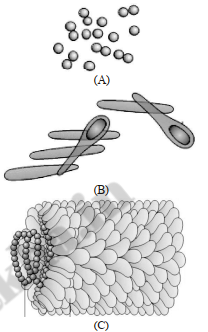
Correct Answer: (b)
Figure (A) shows spherical bacteria (Coccus), (B) shows rod-shaped bacteria (Bacillus), and (C) shows the Tobacco Mosaic Virus (TMV).
Figure (A) shows spherical bacteria (Coccus), (B) shows rod-shaped bacteria (Bacillus), and (C) shows the Tobacco Mosaic Virus (TMV).
Q58. Which of the following is/are example(s) of deuteromycetes?
Correct Answer: (d)
All three (Alternaria, Colletotrichum, and Trichoderma) are members of Deuteromycetes (imperfect fungi).
All three (Alternaria, Colletotrichum, and Trichoderma) are members of Deuteromycetes (imperfect fungi).
Q59. Which of the following is true regarding the phage lambda, a virus which infects bacteria?
Correct Answer: (b)
In the lysogenic cycle, the viral genome (prophage) integrates into the host's chromosome and is replicated along with host DNA during cell division.
In the lysogenic cycle, the viral genome (prophage) integrates into the host's chromosome and is replicated along with host DNA during cell division.
Q60. Which of the following are most suitable indicators of SO2 pollution in the environment?
Correct Answer: (d)
Lichens do not grow in areas polluted with sulfur dioxide, making them excellent bio-indicators of air quality.
Lichens do not grow in areas polluted with sulfur dioxide, making them excellent bio-indicators of air quality.
Q61. Which of the following statements is not correct for viruses?
Correct Answer: (c)
Viruses are extremely small and can pass through bacterial-proof filters; this was how Ivanowsky discovered them.
Viruses are extremely small and can pass through bacterial-proof filters; this was how Ivanowsky discovered them.
Q62. Select the correct match from the given option.
Correct Answer: (a)
Ascomycetes and Basidiomycetes have a distinct dikaryotic phase. Saprophytes are heterotrophic, not autotrophic. Plasmogamy/Karyogamy/Meiosis are steps of the sexual cycle, not asexual.
Ascomycetes and Basidiomycetes have a distinct dikaryotic phase. Saprophytes are heterotrophic, not autotrophic. Plasmogamy/Karyogamy/Meiosis are steps of the sexual cycle, not asexual.
Q63. How many bacteria are produced in four hours if a bacterium divides once in half an hour?
Correct Answer: (d)
In 4 hours, there are 8 half-hour intervals (divisions). Starting with 1 bacterium, the total number produced is 2^8 = 256.
In 4 hours, there are 8 half-hour intervals (divisions). Starting with 1 bacterium, the total number produced is 2^8 = 256.
Q64. True nucleus is absent in
Correct Answer: (d)
Anabaena is a cyanobacterium (prokaryote), which lacks a true membrane-bound nucleus.
Anabaena is a cyanobacterium (prokaryote), which lacks a true membrane-bound nucleus.
Q65. Viruses have
Correct Answer: (a)
A virus consists of a genetic material (either DNA or RNA) enclosed in a protein coat called a capsid.
A virus consists of a genetic material (either DNA or RNA) enclosed in a protein coat called a capsid.
Q66. Analyse the given statements:
(i) kingdom Protista forms a link between monerans and the other organisms like plants, animal and fungi.
(ii) Protists reproduce asexually and sexually by a process involvind cell fusion and zygote formation.
(iii) Being eukaryotes, the protistan cell body contains a well-defined nucleus and other membrane-bound organelles.
Find out the statements that are correct:
(i) kingdom Protista forms a link between monerans and the other organisms like plants, animal and fungi.
(ii) Protists reproduce asexually and sexually by a process involvind cell fusion and zygote formation.
(iii) Being eukaryotes, the protistan cell body contains a well-defined nucleus and other membrane-bound organelles.
Find out the statements that are correct:
Correct Answer: (d)
All statements correctly describe the characteristics and taxonomic position of Kingdom Protista.
All statements correctly describe the characteristics and taxonomic position of Kingdom Protista.
Q67. Food can be kept for a longer time in cold house than in normal conditions because
Correct Answer: (c)
Low temperatures in a refrigerator or cold house inhibit the growth and metabolic activity of bacteria, thus reducing their multiplication rate.
Low temperatures in a refrigerator or cold house inhibit the growth and metabolic activity of bacteria, thus reducing their multiplication rate.
Q68. Which of the following organisms are known as chief producers in the oceans?
Correct Answer: (b)
Diatoms are the chief producers in the ocean due to their high photosynthetic activity.
Diatoms are the chief producers in the ocean due to their high photosynthetic activity.
Q69. Consider the following statements:
(1) Aristotle was the first to attempt biological classification based on physiological attributes of the organisms.
(2) Linnaeus classified all organisms into five kingdoms.
Which of the statement(s) given above is/are in correct?
(1) Aristotle was the first to attempt biological classification based on physiological attributes of the organisms.
(2) Linnaeus classified all organisms into five kingdoms.
Which of the statement(s) given above is/are in correct?
Correct Answer: (d)
Aristotle used morphological characters, not physiological. Linnaeus used a two-kingdom system, not five.
Aristotle used morphological characters, not physiological. Linnaeus used a two-kingdom system, not five.
Q70. Lichens indicate SO2 pollution because they
Correct Answer: (c)
Lichens are highly sensitive to atmospheric pollutants, particularly sulfur dioxide (SO2), and do not grow in polluted areas.
Lichens are highly sensitive to atmospheric pollutants, particularly sulfur dioxide (SO2), and do not grow in polluted areas.
Q71. Choose the wrong statements
Correct Answer: (b)
Morels and truffles are edible delicacies, not poisonous.
Morels and truffles are edible delicacies, not poisonous.
Q72. Consider the following statements about three domain system of classification:
(1) It divided kingdom protista into two domains.
(2) A seven kingdom classification was created after the division from the earlier five kingdom system.
(3) The new domain Archaea included primitive bacteria which show more similarities with members of eukaryota.
Which of the statement(s) given above is/are correct?
(1) It divided kingdom protista into two domains.
(2) A seven kingdom classification was created after the division from the earlier five kingdom system.
(3) The new domain Archaea included primitive bacteria which show more similarities with members of eukaryota.
Which of the statement(s) given above is/are correct?
Correct Answer: (c)
The Three Domain system divided Kingdom Monera into two domains (Archaea and Bacteria) and placed all eukaryotes into Eukarya. Archaea are unique but share some molecular similarities with Eukaryotes.
The Three Domain system divided Kingdom Monera into two domains (Archaea and Bacteria) and placed all eukaryotes into Eukarya. Archaea are unique but share some molecular similarities with Eukaryotes.
Q73. Consider the following statements with respect to characteristic features of the kingdoms.
(i) In animalia, the mode of nutrition is autotrophic.
(ii) In monera, the nuclear membrane is present.
(iii) In protista, the cell type is prokaryotic.
(iv) In plantae, the cell wall is present.
Of the above statements, which one is correct ?
(i) In animalia, the mode of nutrition is autotrophic.
(ii) In monera, the nuclear membrane is present.
(iii) In protista, the cell type is prokaryotic.
(iv) In plantae, the cell wall is present.
Of the above statements, which one is correct ?
Correct Answer: (d)
In Plantae, the cell wall is present and made of cellulose. Other statements are false: Animals are heterotrophic, Monerans are prokaryotic (no nuclear membrane), and Protists are eukaryotic.
In Plantae, the cell wall is present and made of cellulose. Other statements are false: Animals are heterotrophic, Monerans are prokaryotic (no nuclear membrane), and Protists are eukaryotic.
Q74. Which of the following statement(s) is/are correct ?
(i) Reproduction in fungi can take place by vegetative means – fragmentation, fission and budding.
(ii) Fusion of two nuclei is called plasmogamy.
(iii) Fusion of protoplasms between two motile or non-motile gametes is called karyogamy.
(iv) Meiosis in zygote results in diploid spores.
(i) Reproduction in fungi can take place by vegetative means – fragmentation, fission and budding.
(ii) Fusion of two nuclei is called plasmogamy.
(iii) Fusion of protoplasms between two motile or non-motile gametes is called karyogamy.
(iv) Meiosis in zygote results in diploid spores.
Correct Answer: (a)
Statement (i) is correct. Statement (ii) is incorrect (fusion of nuclei is karyogamy). (iii) is incorrect (fusion of protoplasm is plasmogamy). (iv) is incorrect (meiosis results in haploid spores).
Statement (i) is correct. Statement (ii) is incorrect (fusion of nuclei is karyogamy). (iii) is incorrect (fusion of protoplasm is plasmogamy). (iv) is incorrect (meiosis results in haploid spores).
Q75. Archaebacteria differ from eubacteria in
Correct Answer: (a)
Archaebacteria have a different cell membrane structure (branched chain lipids), which allows them to live in extreme environments.
Archaebacteria have a different cell membrane structure (branched chain lipids), which allows them to live in extreme environments.
Q76. Which of the following processes are involved in the reproduction of protists?
Correct Answer: (d)
Protists reproduce asexually through fission, budding, or spore formation, and sexually by a process involving cell fusion and zygote formation.
Protists reproduce asexually through fission, budding, or spore formation, and sexually by a process involving cell fusion and zygote formation.
Q77. Identify the basis of classification of fungi into phycomycetes, ascomycetes, basidiomycetes and deuteromycetes.
i. Fruiting bodies
ii. Nature of habitat
iii. Morphology of mycelium
iv. Mode of spore formation
i. Fruiting bodies
ii. Nature of habitat
iii. Morphology of mycelium
iv. Mode of spore formation
Correct Answer: (c)
Fungi are classified based on mycelium morphology, the mode of spore formation, and the type of fruiting bodies.
Fungi are classified based on mycelium morphology, the mode of spore formation, and the type of fruiting bodies.
Q78. Yeast is not included in protozoans but are placed fungi because
Correct Answer: (b)
Yeasts are classified as fungi because they share fungal characteristics such as chitinous cell walls and the ability to form chains of cells called pseudomycelium during budding.
Yeasts are classified as fungi because they share fungal characteristics such as chitinous cell walls and the ability to form chains of cells called pseudomycelium during budding.
Q79. With regard to bacteria, consider the following statements:
(1) They are the only members of kingdom Monera.
(2) They are the most abundant microorganisms.
(3) Being the primitive group of organisms, they exhibit least diversity in metabolism.
Which of the statements given above are correct?
(1) They are the only members of kingdom Monera.
(2) They are the most abundant microorganisms.
(3) Being the primitive group of organisms, they exhibit least diversity in metabolism.
Which of the statements given above are correct?
Correct Answer: (c)
Bacteria show the most extensive metabolic diversity among organisms, not the least.
Bacteria show the most extensive metabolic diversity among organisms, not the least.
Q80. Match the terms given in column-I with their examples given in column-II and choose the correct option
| Column-I (Terms) | Column-II (Examples) |
|---|---|
| A. Ascus | I. Spirulina |
| B. Basidium | II. Penicillium |
| C. Protista | III. Agaricus |
| D. Cyanobacteria | IV. Euglena |
| E. Animalia | V. Sponges |
Correct Answer: (d)
Ascus is in Penicillium (Ascomycete); Basidium in Agaricus (Basidiomycete); Euglena is Protista; Spirulina is Cyanobacteria; Sponges are Animalia.
Ascus is in Penicillium (Ascomycete); Basidium in Agaricus (Basidiomycete); Euglena is Protista; Spirulina is Cyanobacteria; Sponges are Animalia.
Q81. Two bacteria found to be very useful in genetic engineering experiments are
Correct Answer: (a)
E. coli is a primary host for gene cloning, and Agrobacterium tumefaciens is used as a vector for plant genetic engineering.
E. coli is a primary host for gene cloning, and Agrobacterium tumefaciens is used as a vector for plant genetic engineering.
Q82. A virus can be considered a living organism because it
Correct Answer: (c)
Reproduction is a defining characteristic of life, and although viruses require a host to do so, they exhibit genetic replication.
Reproduction is a defining characteristic of life, and although viruses require a host to do so, they exhibit genetic replication.
Q83. Which of the following are found in extreme saline conditions?
Correct Answer: (d)
Archaebacteria like halophiles thrive in extremely saline environments.
Archaebacteria like halophiles thrive in extremely saline environments.
Q84. Which of the following component enables archaebacteria to survive in extreme conditions?
Correct Answer: (a)
Archaebacteria differ from other bacteria in having a different cell wall structure, which is responsible for their survival in extreme conditions.
Archaebacteria differ from other bacteria in having a different cell wall structure, which is responsible for their survival in extreme conditions.
Q85. When a moist bread is kept exposed in air, it becomes mouldy and black because
Correct Answer: (c)
Fungal spores like those of Rhizopus (bread mould) are ubiquitous in the air and germinate when they land on a suitable moist substrate.
Fungal spores like those of Rhizopus (bread mould) are ubiquitous in the air and germinate when they land on a suitable moist substrate.
Q86. Five kingdom system of classification suggested by R.H. Whittaker is not based on
Correct Answer: (a)
While cell type is a factor, the fundamental distinction between prokaryotes and eukaryotes (nucleus presence) was already used; the unique focus of his system was the criteria of nutrition, body organization, and reproduction.
While cell type is a factor, the fundamental distinction between prokaryotes and eukaryotes (nucleus presence) was already used; the unique focus of his system was the criteria of nutrition, body organization, and reproduction.
Q87. Fungi show asexual reproduction by all of the following kinds of spores except:
Correct Answer: (b)
Conidia, sporangiospores, and zoospores are asexual spores. Oospores (along with ascospores and basidiospores) are sexual spores.
Conidia, sporangiospores, and zoospores are asexual spores. Oospores (along with ascospores and basidiospores) are sexual spores.
Q88. Chrysophytes, Euglenoids, Dinoflagellates and Slime moulds are included in the kingdom
Correct Answer: (b)
These are all groups of unicellular eukaryotic organisms categorized under Kingdom Protista.
These are all groups of unicellular eukaryotic organisms categorized under Kingdom Protista.
Q89. Which among the following are the smallest living cells, known without a definite cell wall, pathogenic to plants as well as animals and can survive without oxygen?
Correct Answer: (b)
This is the standard description of Mycoplasma.
This is the standard description of Mycoplasma.
Q90. Which of the following statements is incorrect?
Correct Answer: (c)
The infective constituent in viruses is the genetic material (DNA or RNA), not the protein coat.
The infective constituent in viruses is the genetic material (DNA or RNA), not the protein coat.
Q91. Which of the following groups of protozoan is not correctly matched with its feature?
Correct Answer: (d)
Sporozoans do not have locomotory organelles like pseudopodia; they are infectious endoparasites with a spore-like stage in their life cycle. False feet (pseudopodia) belong to amoeboid protozoans.
Sporozoans do not have locomotory organelles like pseudopodia; they are infectious endoparasites with a spore-like stage in their life cycle. False feet (pseudopodia) belong to amoeboid protozoans.
Q92. Which of the following statements is wrong for viroids?
Correct Answer: (d)
Viroids have RNA of low molecular weight.
Viroids have RNA of low molecular weight.
Q93. A fungus contains cells with two nuclei from different genomes. The nuclei do not fuse but divide independently and simultaneously as new cells are formed. This fungus belongs to
Correct Answer: (d)
This describes the dikaryotic phase (n+n) which is prolonged in Basidiomycetes (and Ascomycetes).
This describes the dikaryotic phase (n+n) which is prolonged in Basidiomycetes (and Ascomycetes).
Q94. Which of the following is the smallest living cell and can live without oxygen?
Correct Answer: (a)
Mycoplasma are organisms that completely lack a cell wall, are the smallest living cells known, and can survive without oxygen.
Mycoplasma are organisms that completely lack a cell wall, are the smallest living cells known, and can survive without oxygen.
Q95. T. O. Diener discovered a new infectious agent that was smaller than viruses and have the following characteristics.
(i) It causes potato spindle tuber disease.
(ii) It has free RNA.
(iii) Molecular weight of RNA is low.
Identify the infections agent.
(i) It causes potato spindle tuber disease.
(ii) It has free RNA.
(iii) Molecular weight of RNA is low.
Identify the infections agent.
Correct Answer: (b)
Viroids, discovered by Diener in 1971, are infectious agents smaller than viruses consisting only of low-molecular-weight free RNA without a protein coat.
Viroids, discovered by Diener in 1971, are infectious agents smaller than viruses consisting only of low-molecular-weight free RNA without a protein coat.
Q96. The subunit of capsid is called
Correct Answer: (d)
The protein coat of a virus is called the capsid, which is made up of small subunits called capsomeres.
The protein coat of a virus is called the capsid, which is made up of small subunits called capsomeres.
Q97. The most abundant prokaryotes helpful to humans in making curd from milk and in production of antibiotics are categorised as
Correct Answer: (d)
Heterotrophic bacteria include the decomposers and those useful to humans, such as Lactobacillus (curd making) and antibiotic producers.
Heterotrophic bacteria include the decomposers and those useful to humans, such as Lactobacillus (curd making) and antibiotic producers.
Q98. The vast majority of bacteria are:
Correct Answer: (c)
While some bacteria are autotrophic, the vast majority are heterotrophs, depending on other organisms or dead organic matter for food.
While some bacteria are autotrophic, the vast majority are heterotrophs, depending on other organisms or dead organic matter for food.
Q99. Fungi are filamentous with the exception of "X" which is unicellular. Identify X.
Correct Answer: (a)
While most fungi are filamentous (made of hyphae), Yeast (Saccharomyces) is a notable unicellular exception.
While most fungi are filamentous (made of hyphae), Yeast (Saccharomyces) is a notable unicellular exception.
Q100. About Cyanobacteria, consider the following statements:
(1) They are unicellular organisms and never form colonial structures.
(2) As they are good indicators of water pollution, they do not grow in polluted water bodies.
Which of the statement(s) given above is/are correct?
(1) They are unicellular organisms and never form colonial structures.
(2) As they are good indicators of water pollution, they do not grow in polluted water bodies.
Which of the statement(s) given above is/are correct?
Correct Answer: (d)
Cyanobacteria can be colonial or filamentous. They thrive in polluted water bodies, often forming massive blooms.
Cyanobacteria can be colonial or filamentous. They thrive in polluted water bodies, often forming massive blooms.
Q101. Read the given statements and answer the question.
(i) It includes unicellular as well as multicellular fungi.
(ii) In multicellular forms, hyphae are branched and septate.
(iii) Conidiophore produces conidia (spores) exogenously in chain.
(iv) Sexual spores are ascospores produced endogenously in chain.
(v) Fruiting body is called ascocarp.
Identify the correct class of fungi which have all the above given characteristics.
(i) It includes unicellular as well as multicellular fungi.
(ii) In multicellular forms, hyphae are branched and septate.
(iii) Conidiophore produces conidia (spores) exogenously in chain.
(iv) Sexual spores are ascospores produced endogenously in chain.
(v) Fruiting body is called ascocarp.
Identify the correct class of fungi which have all the above given characteristics.
Correct Answer: (b)
Sac fungi (Ascomycetes) produce ascospores in asci (endogenous) and conidia exogenously on conidiophores.
Sac fungi (Ascomycetes) produce ascospores in asci (endogenous) and conidia exogenously on conidiophores.
Q102. Which class of fungi lacks sex organs but the process of plasmogamy is brought about by fusion of two vegetative or somatic cells of different strains or genotypes?
Correct Answer: (b)
Bracket fungi belong to Basidiomycetes, which lack sex organs. Plasmogamy occurs through the fusion of vegetative/somatic cells.
Bracket fungi belong to Basidiomycetes, which lack sex organs. Plasmogamy occurs through the fusion of vegetative/somatic cells.
Q103. The symbiotic association between fungi and algae is called
Correct Answer: (a)
Lichens are symbiotic associations between algae (phycobiont) and fungi (mycobiont).
Lichens are symbiotic associations between algae (phycobiont) and fungi (mycobiont).
Q104. Which one is wrong statement?
Correct Answer: (a)
Mucor (Phycomycetes) produces non-motile aplanospores or motile zoospores, but Mucor specifically produces non-motile spores.
Mucor (Phycomycetes) produces non-motile aplanospores or motile zoospores, but Mucor specifically produces non-motile spores.
Q105. A specimen of fungus is brought by a student for identification. Upon close examination, he discovered that its hyphae are completely septate and it has gills on the underside of the pileus. To which fungal group does it most likely belong?
Correct Answer: (a)
Gills under a pileus (cap) and septate hyphae are characteristic of mushrooms, which belong to Basidiomycetes.
Gills under a pileus (cap) and septate hyphae are characteristic of mushrooms, which belong to Basidiomycetes.
Q106. Pick up the wrong statement
Correct Answer: (c)
Monerans are prokaryotes and lack a nuclear membrane.
Monerans are prokaryotes and lack a nuclear membrane.
Q107. Bladderwort and Venus fly trap are examples of
Correct Answer: (a)
Bladderwort and Venus fly trap are heterotrophic plants that trap insects to meet their nitrogen requirements.
Bladderwort and Venus fly trap are heterotrophic plants that trap insects to meet their nitrogen requirements.
Q108. Which of the following statements is incorrect?
Correct Answer: (d)
Yeasts are unicellular and do not have filamentous hyphae (though they can form pseudomycelia).
Yeasts are unicellular and do not have filamentous hyphae (though they can form pseudomycelia).
Q109. Which of the following is an example of amoeboid protozoans?
Correct Answer: (d)
Amoeboid protozoans use pseudopodia (false feet) to move and capture prey. Examples include Amoeba and Entamoeba.
Amoeboid protozoans use pseudopodia (false feet) to move and capture prey. Examples include Amoeba and Entamoeba.
Q110. Which of the following components provides sticky character to the bacterial cell?
Correct Answer: (c)
The glycocalyx (capsule or slime layer) is the outermost layer that can provide a sticky surface for bacteria.
The glycocalyx (capsule or slime layer) is the outermost layer that can provide a sticky surface for bacteria.
Q111. The motile bacteria are able to move by
Correct Answer: (b)
Flagella are long, thin, filamentous appendages of the cell wall that provide motility to bacterial cells.
Flagella are long, thin, filamentous appendages of the cell wall that provide motility to bacterial cells.
Q112. Which of the following structures is not found in a prokaryotic cell?
Correct Answer: (d)
Prokaryotes lack membrane-bound organelles, including a nuclear envelope.
Prokaryotes lack membrane-bound organelles, including a nuclear envelope.
Q113. Which of the following statements regarding cyanobacteria is incorrect?
Correct Answer: (b)
Cyanobacteria are photosynthetic autotrophs (possessing chlorophyll a), not chemosynthetic autotrophs.
Cyanobacteria are photosynthetic autotrophs (possessing chlorophyll a), not chemosynthetic autotrophs.
Q114. Consider the following statements:
(1) Aristotle divided animals, based on presence or absence of body hairs.
(2) Aristotle classified plants into vascular and non-vascular plants.
Which of the statement(s) given above is/are correct?
(1) Aristotle divided animals, based on presence or absence of body hairs.
(2) Aristotle classified plants into vascular and non-vascular plants.
Which of the statement(s) given above is/are correct?
Correct Answer: (d)
Aristotle divided animals based on the presence/absence of red blood. He classified plants into trees, shrubs, and herbs based on height/morphology.
Aristotle divided animals based on the presence/absence of red blood. He classified plants into trees, shrubs, and herbs based on height/morphology.
Q115. Dikaryon formation is the characteristic feature of
Correct Answer: (a)
In Ascomycetes and Basidiomycetes, an intervening dikaryotic stage (n+n) occurs before the nuclei fuse.
In Ascomycetes and Basidiomycetes, an intervening dikaryotic stage (n+n) occurs before the nuclei fuse.
Q116. The given characters are seen in which of the following group?
(i) Unicellular, colonial, filamentous, marine or terrestrial forms.
(ii) The colonies are surrounded by a gelatinous sheath.
(iii) Some can fix atmospheric nitrogen in specialized cells called heterocysts.
(iv) They often form blooms in polluted water bodies.
(i) Unicellular, colonial, filamentous, marine or terrestrial forms.
(ii) The colonies are surrounded by a gelatinous sheath.
(iii) Some can fix atmospheric nitrogen in specialized cells called heterocysts.
(iv) They often form blooms in polluted water bodies.
Correct Answer: (b)
These features (gelatinous sheath, heterocysts for N2 fixation, and water blooms) are characteristic of Cyanobacteria (blue-green algae) like Nostoc and Anabaena.
These features (gelatinous sheath, heterocysts for N2 fixation, and water blooms) are characteristic of Cyanobacteria (blue-green algae) like Nostoc and Anabaena.
Q117. Association between mycobiont and phycobiont are found in
Correct Answer: (c)
Lichens are symbiotic associations between a fungus (mycobiont) and an alga (phycobiont).
Lichens are symbiotic associations between a fungus (mycobiont) and an alga (phycobiont).
Q118. The imperfect fungi which are decomposer of litter and help in mineral cycling belong to
Correct Answer: (d)
Deuteromycetes are known as fungi imperfecti and play a vital role in decomposing organic matter.
Deuteromycetes are known as fungi imperfecti and play a vital role in decomposing organic matter.
Q119. Select the wrong statement :
Correct Answer: (d)
Pseudopodia are features of amoeboid protozoans, not sporozoans (which lack locomotory structures).
Pseudopodia are features of amoeboid protozoans, not sporozoans (which lack locomotory structures).
Q120. Choose the correct statements (i – v) regarding mycoplasma:
(i) Mycoplasma has no cell wall.
(ii) Mycoplasma is the smallest living organism known.
(iii) Mycoplasma cannot survive without O2.
(iv) Mycoplasma are pathogenic in animals and plants.
(v) A sort of sexual reproduction occurs in bacterium by adopting a primitive DNA transfer from one bacterium to the other.
(i) Mycoplasma has no cell wall.
(ii) Mycoplasma is the smallest living organism known.
(iii) Mycoplasma cannot survive without O2.
(iv) Mycoplasma are pathogenic in animals and plants.
(v) A sort of sexual reproduction occurs in bacterium by adopting a primitive DNA transfer from one bacterium to the other.
Correct Answer: (c)
Statement (iii) is incorrect because Mycoplasma can survive without oxygen. Statements (i), (ii), (iv), and (v) are correct.
Statement (iii) is incorrect because Mycoplasma can survive without oxygen. Statements (i), (ii), (iv), and (v) are correct.
Q121. Bacteria and yeast are similar in all the following features except that
Correct Answer: (b)
Bacteria are prokaryotes, whereas yeast (a fungus) is a eukaryote.
Bacteria are prokaryotes, whereas yeast (a fungus) is a eukaryote.
Q122. Which one of the following statements is wrong?
Correct Answer: (c)
Eubacteria are known as 'true bacteria', not false bacteria.
Eubacteria are known as 'true bacteria', not false bacteria.
Q123. Identify the figures A, B and C given below.
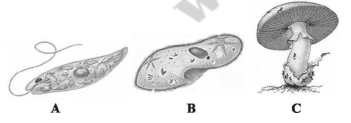
Correct Answer: (a)
A shows Euglena (flagellate protist), B shows Paramecium (ciliate protist), and C shows Agaricus (mushroom/basidiomycete fungus).
A shows Euglena (flagellate protist), B shows Paramecium (ciliate protist), and C shows Agaricus (mushroom/basidiomycete fungus).
Q124. Paramecium
(i) is a ciliated protozoan.
(ii) has a cavity that opens to the outside the cell surface.
(iii) shows water current maintained by cilia which helps the food to be steared into gullet.
Which of the statement given above are correct?
(i) is a ciliated protozoan.
(ii) has a cavity that opens to the outside the cell surface.
(iii) shows water current maintained by cilia which helps the food to be steared into gullet.
Which of the statement given above are correct?
Correct Answer: (d)
Paramecium uses its cilia for locomotion and to direct food into its cytostome (gullet) via the oral groove.
Paramecium uses its cilia for locomotion and to direct food into its cytostome (gullet) via the oral groove.
Q125. Match the column I and II.
| Column I | Column II |
|---|---|
| (A) Potato spindle | (i) Virus |
| (B) Cr-Jacob disease (CJD) | (ii) Viroid |
| (C) Cholera | (iii) Prion |
| (D) Leaf rolling and curling | (iv) Bacteria |
Correct Answer: (c)
Potato spindle tuber disease is caused by a viroid; CJD is caused by a prion; Cholera is caused by bacteria; Leaf rolling/curling in plants is caused by a virus.
Potato spindle tuber disease is caused by a viroid; CJD is caused by a prion; Cholera is caused by bacteria; Leaf rolling/curling in plants is caused by a virus.
Q126. Which of the following statement(s) is correct for both blue-green algae and bacteria ?
Correct Answer: (c)
Both blue-green algae (Cyanobacteria) and bacteria are prokaryotes, meaning they lack a true nucleus and membrane-bound organelles.
Both blue-green algae (Cyanobacteria) and bacteria are prokaryotes, meaning they lack a true nucleus and membrane-bound organelles.
Q127. The five kingdom classification was proposed by
Correct Answer: (a)
R.H. Whittaker proposed the Five Kingdom Classification in 1969.
R.H. Whittaker proposed the Five Kingdom Classification in 1969.
Q128. One of the major components of cell wall of most fungi is
Correct Answer: (a)
The cell wall of most fungi is composed of chitin and polysaccharides.
The cell wall of most fungi is composed of chitin and polysaccharides.
Q129. Which of the following statement(s) is/are correct about class basidiomycetes?
(i) They are commonly known as imperfect fungi because only the asexual or vegetative phases of these fungi are known.
(ii) They grow in soil, on logs and tree stumps and in living plant bodies as parasites, e.g., rusts and smuts.
(iii) The mycelium is branched and septate.
(iv) Some common members are Agaricus, Ustilago and Puccinia.
(i) They are commonly known as imperfect fungi because only the asexual or vegetative phases of these fungi are known.
(ii) They grow in soil, on logs and tree stumps and in living plant bodies as parasites, e.g., rusts and smuts.
(iii) The mycelium is branched and septate.
(iv) Some common members are Agaricus, Ustilago and Puccinia.
Correct Answer: (c)
Statement (i) is incorrect (describes Deuteromycetes). Statements (ii), (iii), and (iv) correctly describe Basidiomycetes.
Statement (i) is incorrect (describes Deuteromycetes). Statements (ii), (iii), and (iv) correctly describe Basidiomycetes.
Q130. The bacteria which oxidize various inorganic substances and use the released energy for the synthesis of food are called _______________.
Correct Answer: (d)
Chemosynthetic autotrophs obtain energy by oxidizing inorganic substances like nitrates, nitrites, and ammonia, and use this energy for ATP production.
Chemosynthetic autotrophs obtain energy by oxidizing inorganic substances like nitrates, nitrites, and ammonia, and use this energy for ATP production.
Q131. Which of the following are the characters of dinoflagellates?
(i) They are planktonic golden yellow algae with soap box like structure.
(ii) They are marine red biflagellated protista.
(iii) They appear yellow, green, brown, blue and red in colour.
(iv) They are biflagellated organisms with pellicle.
(v) They are saprophytic (or) parasitic unicellular forms.
(i) They are planktonic golden yellow algae with soap box like structure.
(ii) They are marine red biflagellated protista.
(iii) They appear yellow, green, brown, blue and red in colour.
(iv) They are biflagellated organisms with pellicle.
(v) They are saprophytic (or) parasitic unicellular forms.
Correct Answer: (a)
Dinoflagellates are mostly marine, photosynthetic, and appear in various colors. (i) describes diatoms, (iv) describes euglenoids.
Dinoflagellates are mostly marine, photosynthetic, and appear in various colors. (i) describes diatoms, (iv) describes euglenoids.
Q132. Difference between virus and viroid is
Correct Answer: (a)
Viroids lack the protein coat (capsid) that is characteristic of viruses.
Viroids lack the protein coat (capsid) that is characteristic of viruses.
Q133. Which of the following class of fungi is being described by the given statements?
(i) They are found in aquatic habitats and on decaying wood in moist and damp places.
(ii) Mycelium is aseptate and coenocytic.
(iii) Asexual reproduction takes place by zoospores (motile) or by aplanospores (non-motile).
(iv) Some common examples are Mucor, Rhizopus and Albugo.
(i) They are found in aquatic habitats and on decaying wood in moist and damp places.
(ii) Mycelium is aseptate and coenocytic.
(iii) Asexual reproduction takes place by zoospores (motile) or by aplanospores (non-motile).
(iv) Some common examples are Mucor, Rhizopus and Albugo.
Correct Answer: (b)
Phycomycetes are characterized by coenocytic (non-septate) mycelium and aquatic/moist habitats. Examples include Rhizopus and Mucor.
Phycomycetes are characterized by coenocytic (non-septate) mycelium and aquatic/moist habitats. Examples include Rhizopus and Mucor.
Q134. Which of the following is a parasitic fungi on the mustard plant ?
Correct Answer: (a)
Albugo candida is an obligate parasite on mustard, causing white rust disease.
Albugo candida is an obligate parasite on mustard, causing white rust disease.
Q135. In some viruses, RNA is present instead of DNA indicating that
Correct Answer: (d)
In RNA viruses, RNA acts as the carrier of genetic/hereditary information.
In RNA viruses, RNA acts as the carrier of genetic/hereditary information.
Q136. Which of the following statements is not correct for methanogens?
Correct Answer: (c)
Methanogens produce methane as a metabolic byproduct in anaerobic conditions; methane is the output, not their 'preferred carbon source'.
Methanogens produce methane as a metabolic byproduct in anaerobic conditions; methane is the output, not their 'preferred carbon source'.
Q137. Match column I (Kingdom) with column II (Class) and select the correct options
| Column-I (Kingdom) | Column-II (Class) |
|---|---|
| A. Plantae | I. Archaebacteria |
| B. Fungi | II. Euglenoids |
| C. Protista | III. Phycomycetes |
| D. Monera | IV. Algae |
Correct Answer: (a)
Plantae includes Algae; Fungi includes Phycomycetes; Protista includes Euglenoids; Monera includes Archaebacteria.
Plantae includes Algae; Fungi includes Phycomycetes; Protista includes Euglenoids; Monera includes Archaebacteria.