Q1. Among the ecosystem mentioned below, where can one find maximum biodiversity ?
Correct Answer: (c)
Coral reefs are known as the 'rainforests of the sea' due to their exceptionally high species diversity.
Coral reefs are known as the 'rainforests of the sea' due to their exceptionally high species diversity.
Q2. Which one of the following pairs of geographical areas show maximum biodiversity in our country?
Correct Answer: (c)
The Eastern Himalayas and the Western Ghats are two of the major biodiversity hotspots in India.
The Eastern Himalayas and the Western Ghats are two of the major biodiversity hotspots in India.
Q3. Match the following and choose the correct option.
| Column-I | Column-II |
|---|---|
| A. Over-exploitation by humans | I. Environmental damage and threat to native species |
| B. Introduction of Nile Perch in Lake Victoria | II. Decline in plant population |
| C. Less solar energy | III. Extinction of more than 2000 species of native birds |
| D. Introduction of Water Hyacinth in India | IV. Extinction of Cichlid fish |
| E. Colonization of tropical pacific Islands | V. Extinction of Passenger pigeon |
Correct Answer: (b)
Over-exploitation led to Passenger pigeon extinction (A-V). Nile perch caused Cichlid fish extinction (B-IV). Solar energy relates to plant productivity/population (C-II). Water hyacinth is an alien threat (D-I). Pacific colonization caused bird extinction (E-III).
Over-exploitation led to Passenger pigeon extinction (A-V). Nile perch caused Cichlid fish extinction (B-IV). Solar energy relates to plant productivity/population (C-II). Water hyacinth is an alien threat (D-I). Pacific colonization caused bird extinction (E-III).
Q4. The historic convention on Biological Diversity held in Rio de Janeiro in 1992 is known as
Correct Answer: (b)
The United Nations Conference on Environment and Development (UNCED), held in 1992, is popularly called the Earth Summit.
The United Nations Conference on Environment and Development (UNCED), held in 1992, is popularly called the Earth Summit.
Q5. Amongst the animal groups given below, which one has the highest percentage of endangered species ?
Correct Answer: (c)
Globally, amphibians face a significantly higher threat of extinction compared to other major animal groups.
Globally, amphibians face a significantly higher threat of extinction compared to other major animal groups.
Q6. Which of the following is not the example of recent extinction
Correct Answer: (d)
Dodo (Mauritius), Quagga (Africa), and Steller’s Sea Cow (Russia) are examples of recent extinctions listed by IUCN. Pigeons (specifically common house pigeons) are not extinct.
Dodo (Mauritius), Quagga (Africa), and Steller’s Sea Cow (Russia) are examples of recent extinctions listed by IUCN. Pigeons (specifically common house pigeons) are not extinct.
Q7. Which of the following is the most important cause of animals and plants being driven to extinction?
Correct Answer: (c)
Habitat destruction is the single most significant factor causing biodiversity loss globally.
Habitat destruction is the single most significant factor causing biodiversity loss globally.
Q8. Which of the following species is critically endangered in India?
Correct Answer: (b)
The Pygmy hog (Sus salvanius) is a critically endangered species native to the alluvial grasslands in the foothills of the Himalayas.
The Pygmy hog (Sus salvanius) is a critically endangered species native to the alluvial grasslands in the foothills of the Himalayas.
Q9. Which one is a critically endangered animal species?
Correct Answer: (b)
Sus salvanius (Pygmy hog) is classified as a critically endangered species in India.
Sus salvanius (Pygmy hog) is classified as a critically endangered species in India.
Q10. Which one is the most important human activity leading to extinction of wildlife?
Correct Answer: (a)
Habitat destruction (alteration) is the primary driver of the current high rates of extinction in the wild.
Habitat destruction (alteration) is the primary driver of the current high rates of extinction in the wild.
Q11. A species facing extremely high risk of extinction in the immediate future is called
Correct Answer: (c)
Critically Endangered is the highest risk category assigned by the IUCN Red List for wild species.
Critically Endangered is the highest risk category assigned by the IUCN Red List for wild species.
Q12. Which of the following is not currently a major cause of the global reduction in biodiversity?
Correct Answer: (b)
While global warming is a threat, the four 'major' causes (Evil Quartet) are habitat loss, overexploitation, alien species, and co-extinctions. Habitat destruction is the single most important cause.
While global warming is a threat, the four 'major' causes (Evil Quartet) are habitat loss, overexploitation, alien species, and co-extinctions. Habitat destruction is the single most important cause.
Q13. Cryopreservation of gametes of threatened species in viable and fertile condition can be referred to as
Correct Answer: (a)
Cryopreservation is a modern, high-tech form of ex-situ conservation.
Cryopreservation is a modern, high-tech form of ex-situ conservation.
Q14. The ‘Evil Quartet’ of biodiversity loss, does not include
Correct Answer: (d)
The 'Evil Quartet' includes Habitat loss and fragmentation, Over-exploitation, Alien species invasions, and Co-extinctions. While hunting is a form of over-exploitation, 'Hunting' specifically is not listed as one of the four main headers.
The 'Evil Quartet' includes Habitat loss and fragmentation, Over-exploitation, Alien species invasions, and Co-extinctions. While hunting is a form of over-exploitation, 'Hunting' specifically is not listed as one of the four main headers.
Q15. Which of the following forests is known as the 'Lungs of the planet Earth'?
Correct Answer: (c)
The Amazon rainforest is so designated because it produces a significant portion of the Earth's oxygen through photosynthesis.
The Amazon rainforest is so designated because it produces a significant portion of the Earth's oxygen through photosynthesis.
Q16. The major cause of loss of numbers of migratory birds is
(i) Bad weather
(ii) Urbanization
(iii) Pesticides
(iv) Fragmentation
(v) Loss of habitat
(i) Bad weather
(ii) Urbanization
(iii) Pesticides
(iv) Fragmentation
(v) Loss of habitat
Correct Answer: (c)
For migratory birds, habitat loss (v) and urbanization/bad weather (i, ii) during their long journeys are significant factors. (Ref: Answer Key Page 8).
For migratory birds, habitat loss (v) and urbanization/bad weather (i, ii) during their long journeys are significant factors. (Ref: Answer Key Page 8).
Q17. Amazon rain forest, called the ‘Lungs of the Planet’, contribute following percentage of oxygen by photosynthesis, to earth atmosphere
Correct Answer: (a)
The Amazon rainforest is estimated to produce about 20 percent of the total oxygen in the Earth's atmosphere.
The Amazon rainforest is estimated to produce about 20 percent of the total oxygen in the Earth's atmosphere.
Q18. Which is the national aquatic animal of India?
Correct Answer: (b)
The Ganges River Dolphin (Platanista gangetica) is the national aquatic animal of India.
The Ganges River Dolphin (Platanista gangetica) is the national aquatic animal of India.
Q19. Which of the following countries has the highest biodiversity?
Correct Answer: (a)
Brazil is considered a megadiverse country, housing the largest share of the world's tropical rainforests and associated species.
Brazil is considered a megadiverse country, housing the largest share of the world's tropical rainforests and associated species.
Q20. In cryopreservation germplasm is maintained at
Correct Answer: (a)
Cryopreservation involves preserving gametes or tissues in liquid nitrogen at –196°C.
Cryopreservation involves preserving gametes or tissues in liquid nitrogen at –196°C.
Q21. All forms of life should be conserved because
Correct Answer: (c)
Conservation is essential to maintain the ecological balance and stability of the biosphere.
Conservation is essential to maintain the ecological balance and stability of the biosphere.
Q22. Which of the following statements is correct ?
Correct Answer: (c)
Steller’s Sea Cow is an extinct marine mammal. Parthenium and Lantana are exotic weeds, and the African catfish is a threat to local species.
Steller’s Sea Cow is an extinct marine mammal. Parthenium and Lantana are exotic weeds, and the African catfish is a threat to local species.
Q23. Following arrangement is correct from the point of view of decreasing biodiversity in angiosperms (N), fungi (F), pteridophytes (P) and algae (A).
Correct Answer: (c)
Globally, species diversity follows: Fungi > Angiosperms > Algae > Pteridophytes. (Ref: Global biodiversity pie charts).
Globally, species diversity follows: Fungi > Angiosperms > Algae > Pteridophytes. (Ref: Global biodiversity pie charts).
Q24. In your opinion, which is the most effective way to conserve the plant diversity of an area?
Correct Answer: (d)
Creating a biosphere reserve (in-situ conservation) preserves the entire ecosystem and allows plants to evolve naturally, which is more effective than isolated ex-situ methods.
Creating a biosphere reserve (in-situ conservation) preserves the entire ecosystem and allows plants to evolve naturally, which is more effective than isolated ex-situ methods.
Q25. Which of the following is not a step in understanding biodiversity?
Correct Answer: (d)
Understanding biodiversity involves taxonomy (naming), ecology (range), and evolution (relatedness), but quantifying the entire genome of every species is a task of genomics, not a primary step in ecological biodiversity assessment.
Understanding biodiversity involves taxonomy (naming), ecology (range), and evolution (relatedness), but quantifying the entire genome of every species is a task of genomics, not a primary step in ecological biodiversity assessment.
Q26. Which one of the following is not a feature of biodiversity hotspots?
Correct Answer: (d)
Biodiversity hotspots are characterized by high species richness and endemism, typically found in tropical and subtropical regions, not polar regions.
Biodiversity hotspots are characterized by high species richness and endemism, typically found in tropical and subtropical regions, not polar regions.
Q27. First National Park of India is
Correct Answer: (c)
Hailey National Park, established in 1936 (now known as Jim Corbett National Park), was India's first national park.
Hailey National Park, established in 1936 (now known as Jim Corbett National Park), was India's first national park.
Q28. What is common to the techniques (i) in vitro fertilisation, (ii) cryopreservation, (iii) tissue culture ?
Correct Answer: (b)
These advanced biological techniques are all part of ex-situ (off-site) conservation strategies.
These advanced biological techniques are all part of ex-situ (off-site) conservation strategies.
Q29. The organization which has been publishing the ‘Red Data Book’ is :
Correct Answer: (b)
IUCN publishes the Red Data Book.
IUCN publishes the Red Data Book.
Q30. Which of the following characteristics would cause a country to be considered a high-priority region for conservation efforts?
Correct Answer: (a)
Biodiversity hotspots are identified based on high species richness and a high degree of endemism (species found nowhere else).
Biodiversity hotspots are identified based on high species richness and a high degree of endemism (species found nowhere else).
Q31. The taxa believed likely to join the endangered category in near future is called
Correct Answer: (c)
Vulnerable species are those likely to become endangered unless the circumstances threatening their survival and reproduction improve.
Vulnerable species are those likely to become endangered unless the circumstances threatening their survival and reproduction improve.
Q32. The region of Biosphere Reserve which is legally protected and where no human activity is allowed is known as
Correct Answer: (d)
A biosphere reserve consists of a strictly protected Core Zone, a Buffer Zone for limited activities, and a Transition Zone for sustainable use.
A biosphere reserve consists of a strictly protected Core Zone, a Buffer Zone for limited activities, and a Transition Zone for sustainable use.
Q33. Match column -I with column- II and choose the correct option.
| Column-I | Column-II |
|---|---|
| A. Biodiversity | I. Edward Wilson |
| B. In-situ conservation | II. Co-extinction |
| C. Plant pollinator mutualism | III. On-site conservation |
| D. Ex-situ conservation | IV. Off-site conservation |
Correct Answer: (c)
Biodiversity was popularized by Edward Wilson (A-I). In-situ is on-site (B-III). Mutualism loss leads to co-extinction (C-II). Ex-situ is off-site (D-IV).
Biodiversity was popularized by Edward Wilson (A-I). In-situ is on-site (B-III). Mutualism loss leads to co-extinction (C-II). Ex-situ is off-site (D-IV).
Q34. Which of the following is not the approach for in-situ conservation ?
Correct Answer: (c)
Wildlife safari parks and zoological parks are forms of ex-situ conservation, where animals are protected outside their natural habitats.
Wildlife safari parks and zoological parks are forms of ex-situ conservation, where animals are protected outside their natural habitats.
Q35. Given below is the representation of the extent of global diversity of invertebrates. What groups the four portions (A-D) represent respectively?
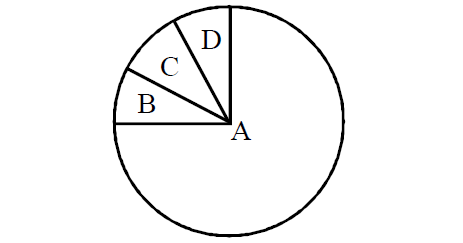
Correct Answer: (d)
The standard NCERT pie chart for invertebrates shows: A-Insects (largest), B-Molluscs, C-Crustaceans, D-Other animal groups.
The standard NCERT pie chart for invertebrates shows: A-Insects (largest), B-Molluscs, C-Crustaceans, D-Other animal groups.
Q36. Which of the following is considered a hot-spot of biodiversity in India?
Correct Answer: (d)
India has three biodiversity hotspots: Western Ghats and Sri Lanka, Indo-Burma, and Himalaya.
India has three biodiversity hotspots: Western Ghats and Sri Lanka, Indo-Burma, and Himalaya.
Q37. Which one of the following statement is correct for botanical garden?
Correct Answer: (c)
Botanical gardens and seed banks are essential for the ex-situ conservation of plant species and their genetic material.
Botanical gardens and seed banks are essential for the ex-situ conservation of plant species and their genetic material.
Q38. Which of the below mentioned regions exhibit less seasonal variations ?
Correct Answer: (a)
The tropics have a relatively constant and predictable environment with minimal seasonal changes, contributing to higher biodiversity.
The tropics have a relatively constant and predictable environment with minimal seasonal changes, contributing to higher biodiversity.
Q39. The Cichlid species of Lake Victoria were driven to, or nearly to, extinction by the introduction of _________.
Correct Answer: (b)
The introduction of the Nile perch into Lake Victoria in East Africa led eventually to the extinction of an ecologically unique assemblage of more than 200 species of cichlid fish in the lake.
The introduction of the Nile perch into Lake Victoria in East Africa led eventually to the extinction of an ecologically unique assemblage of more than 200 species of cichlid fish in the lake.
Q40. In which of the following both pairs have correct combination
Correct Answer: (d)
National Parks are in-situ (natural habitat); Botanical Gardens are ex-situ (artificial habitat).
National Parks are in-situ (natural habitat); Botanical Gardens are ex-situ (artificial habitat).
Q41. Species diversity increase as one proceeds from
Correct Answer: (a)
Species diversity generally increases as we move from higher to lower altitudes (down a mountain) and from higher to lower latitudes (towards the equator).
Species diversity generally increases as we move from higher to lower altitudes (down a mountain) and from higher to lower latitudes (towards the equator).
Q42. All of the following are included in ‘ex-situ conservation’ except
Correct Answer: (b)
Sacred groves are natural forest areas protected by communities, making it an in-situ method.
Sacred groves are natural forest areas protected by communities, making it an in-situ method.
Q43. Biodiversity describes the study of diversity
Correct Answer: (d)
Biodiversity, as popularized by Edward Wilson, refers to the combined diversity at all levels of biological organization, from macromolecules within cells to biomes.
Biodiversity, as popularized by Edward Wilson, refers to the combined diversity at all levels of biological organization, from macromolecules within cells to biomes.
Q44. India’s share in global species diversity is around
Correct Answer: (a)
India has only 2.4 percent of the world's land area but its share of the global species diversity is an impressive 8.1 percent.
India has only 2.4 percent of the world's land area but its share of the global species diversity is an impressive 8.1 percent.
Q45. Why do migratory species present special preservation challenges?
Correct Answer: (b)
Migratory species rely on multiple habitats across borders; thus, protecting them requires coordinated conservation efforts between different countries.
Migratory species rely on multiple habitats across borders; thus, protecting them requires coordinated conservation efforts between different countries.
Q46. Match the following and choose the correct option.
| Column-I | Column-II |
|---|---|
| A. Narrowly utilitarian argument | I. Conserving biodiversity for major ecosystem services |
| B. Broadly utilitarian argument | II. Conserving biodiversity for philosophical or spiritual need to realise that every species has intrinsic value |
| C. Ethical argument | III. Conserving biodiversity for direct economic benefits like food, medicine, industrial products etc. |
Correct Answer: (b)
Narrowly utilitarian = economic benefits (III). Broadly utilitarian = ecosystem services (I). Ethical = intrinsic value (II).
Narrowly utilitarian = economic benefits (III). Broadly utilitarian = ecosystem services (I). Ethical = intrinsic value (II).
Q47. Following organization is associated with the Red – Data book
Correct Answer: (b)
The Red Data Book is associated with the IUCN (now World Conservation Union).
The Red Data Book is associated with the IUCN (now World Conservation Union).
Q48. The relation between species richness and area is described on a logarithm scale by the equation _______ [Where S = species richness, A = area, Z = slope of the line (regression coefficient), C = Y-intercept]
Correct Answer: (c)
On a logarithmic scale, the species-area relationship is a straight line described by the linear equation log S = log C + Z log A.
On a logarithmic scale, the species-area relationship is a straight line described by the linear equation log S = log C + Z log A.
Q49. One of the following statements is incorrect with reference to biodiversity. Identify it.
Correct Answer: (a)
Hotspots are defined by very high species richness and high levels of endemism and threat, not low species richness.
Hotspots are defined by very high species richness and high levels of endemism and threat, not low species richness.
Q50. Match column-I with column-II and choose the correct option.
| Column-I | Column-II |
|---|---|
| A. Nile Perch in Lake Victoria | I. Obvious reasons for biodiversity conservation |
| B. Narrowly utilitarian | II. Habitat destruction |
| C. Main cause for biodiversity loss | III. High endemism |
| D. Hotspots | IV. Alien species |
Correct Answer: (b)
Nile perch is an alien species (IV). Narrowly utilitarian is an obvious economic reason (I). Main cause of loss is habitat destruction (II). Hotspots have high endemism (III).
Nile perch is an alien species (IV). Narrowly utilitarian is an obvious economic reason (I). Main cause of loss is habitat destruction (II). Hotspots have high endemism (III).
Q51. An example of ex situ conservation is
Correct Answer: (b)
Seed banks store seeds under controlled conditions, preserving plant genetic diversity outside their natural environment.
Seed banks store seeds under controlled conditions, preserving plant genetic diversity outside their natural environment.
Q52. Sacred groves are found in
Correct Answer: (d)
Sacred groves are tracts of forest set aside for religious reasons and are found in several parts of India including Meghalaya, Rajasthan, and the Western Ghats.
Sacred groves are tracts of forest set aside for religious reasons and are found in several parts of India including Meghalaya, Rajasthan, and the Western Ghats.
Q53. According to Robert May, the global species diversity is about
Correct Answer: (c)
Robert May provided a more conservative and scientifically based estimate of about 7 million species globally.
Robert May provided a more conservative and scientifically based estimate of about 7 million species globally.
Q54. The ‘Earth Summit’ held at Rio de Janeiro in 1992 resulted into
Correct Answer: (c)
The Earth Summit (1992) called upon all nations to take appropriate measures for conservation of biodiversity and sustainable utilization of its benefits (Convention on Biological Diversity).
The Earth Summit (1992) called upon all nations to take appropriate measures for conservation of biodiversity and sustainable utilization of its benefits (Convention on Biological Diversity).
Q55. The active chemical drug reserpine is obtained from
Correct Answer: (b)
Reserpine is an alkaloid extracted from the roots of Rauwolfia serpentina.
Reserpine is an alkaloid extracted from the roots of Rauwolfia serpentina.
Q56. Modern ex-situ conservation includes
(i) cryopreservation techniques
(ii) in vitro-fertilization
(iii) propagation of plants by using tissue culture methods
(i) cryopreservation techniques
(ii) in vitro-fertilization
(iii) propagation of plants by using tissue culture methods
Correct Answer: (d)
Modern ex-situ techniques have evolved from keeping animals in zoos to advanced biological methods like cryopreservation and tissue culture.
Modern ex-situ techniques have evolved from keeping animals in zoos to advanced biological methods like cryopreservation and tissue culture.
Q57. The Red data Book, which lists endangered species of animals, is maintained by :
Correct Answer: (d)
The Red Data Book (Red List) is a catalog of taxa facing the risk of extinction, maintained by the IUCN.
The Red Data Book (Red List) is a catalog of taxa facing the risk of extinction, maintained by the IUCN.
Q58. Mark the correct statement
Correct Answer: (d)
All given statements are correct. Tropical regions (like the Amazon) harbor more species than temperate or polar areas, and Robert May’s 7 million estimate is considered scientifically sound.
All given statements are correct. Tropical regions (like the Amazon) harbor more species than temperate or polar areas, and Robert May’s 7 million estimate is considered scientifically sound.
Q59. More than 70% of all the species recorded so far, are
Correct Answer: (c)
According to recorded data, animals make up more than 70 percent of all the species recorded.
According to recorded data, animals make up more than 70 percent of all the species recorded.
Q60. Which one of the following is related to Ex-situ conservation of threatened animals and plants?
Correct Answer: (d)
Safari parks are off-site human-managed areas for animal protection.
Safari parks are off-site human-managed areas for animal protection.
Q61. Endemic plants and animals are those which are
Correct Answer: (b)
Endemic species are those whose distribution is confined to a particular region and are not found anywhere else.
Endemic species are those whose distribution is confined to a particular region and are not found anywhere else.
Q62. A threatened species category includes
Correct Answer: (d)
The broad category of 'threatened' species includes those that are critically endangered, endangered, and vulnerable.
The broad category of 'threatened' species includes those that are critically endangered, endangered, and vulnerable.
Q63. Match the following columns.
| Column I | Column II |
|---|---|
| (I) Dodo | (A) Africa |
| (II) Quagga | (B) Russia |
| (III) Thylacine | (C) Mauritius |
| (IV) Stellar's sea cow | (D) Australia |
Correct Answer: (d)
Dodo from Mauritius (I-C), Quagga from Africa (II-A), Thylacine from Australia (III-D), and Steller’s sea cow from Russia (IV-B).
Dodo from Mauritius (I-C), Quagga from Africa (II-A), Thylacine from Australia (III-D), and Steller’s sea cow from Russia (IV-B).
Q64. Which of the following natural bounty is used for giving protection to fauna only?
Correct Answer: (d)
Sanctuaries are often established to protect specific fauna, whereas National Parks protect the entire ecosystem.
Sanctuaries are often established to protect specific fauna, whereas National Parks protect the entire ecosystem.
Q65. Niche is
Correct Answer: (c)
A niche describes the functional role and position of a species within its ecosystem.
A niche describes the functional role and position of a species within its ecosystem.
Q66. Match the following.
| Column-I | Column-II |
|---|---|
| (A) Ranthambore National Park | (i) Assam |
| (B) Kaziranga National Park | (ii) Rajasthan |
| (C) Jim corbett National Park | (iii) Orissa |
| (D) Nandan kanan zoological Park | (iv) Uttarakhand |
Correct Answer: (c)
Ranthambore is in Rajasthan, Kaziranga in Assam, Jim Corbett in Uttarakhand, and Nandan Kanan in Orissa.
Ranthambore is in Rajasthan, Kaziranga in Assam, Jim Corbett in Uttarakhand, and Nandan Kanan in Orissa.
Q67. The table below give the populations (in thousands) of ten species (A – J) in four areas (I – IV) consisting of the number of habitats given within brackets against each area. Study the table and answer the questions.
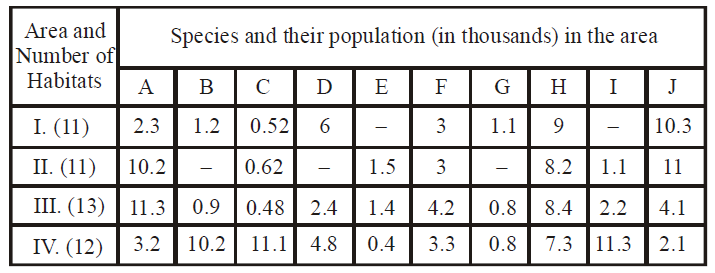
Which area out of I to IV shows maximum species diversity?
Which area out of I to IV shows maximum species diversity?
Correct Answer: (c)
Area III has all 10 species (A-J) present with a relatively high population and more habitats (13), indicating the highest biodiversity.
Area III has all 10 species (A-J) present with a relatively high population and more habitats (13), indicating the highest biodiversity.
Q68. In the tropical rainforest, the majority of trees have showy animal-pollinated flowers. In temperate forests the majority of trees are wind pollinated. Which of the following explains these contrasting patterns?
(i) Wind is rare in tropical forests
(ii) Because of high species diversity in the tropics, individuals of tree species are often widely separated making wind an inefficient means of pollen dispersal.
(iii) More opportunities for coevolved mutualisms exist in tropical forests because of the high diversity of animal species.
(iv) Trees in tropical forests are mostly evergreen and year round leaf canopies impede pollen dispersal by wind.
(v) Flowering in tropical forests occurs over a short period of time when wind is absent.
(i) Wind is rare in tropical forests
(ii) Because of high species diversity in the tropics, individuals of tree species are often widely separated making wind an inefficient means of pollen dispersal.
(iii) More opportunities for coevolved mutualisms exist in tropical forests because of the high diversity of animal species.
(iv) Trees in tropical forests are mostly evergreen and year round leaf canopies impede pollen dispersal by wind.
(v) Flowering in tropical forests occurs over a short period of time when wind is absent.
Correct Answer: (c)
High diversity means individuals of the same species are far apart (ii), leading to co-evolution with animal pollinators (iii), while dense evergreen canopies block wind (iv).
High diversity means individuals of the same species are far apart (ii), leading to co-evolution with animal pollinators (iii), while dense evergreen canopies block wind (iv).
Q69. Which one of the following does not represent biodiversity of a geographical region?
(i) Genetic diversity present is in the dominant species of the region.
(ii) Species endemic to the region.
(iii) Endangered species found in the region.
(iv) The diversity in the organisms living in the region.
(i) Genetic diversity present is in the dominant species of the region.
(ii) Species endemic to the region.
(iii) Endangered species found in the region.
(iv) The diversity in the organisms living in the region.
Correct Answer: (b)
Endangered status (iii) is a conservation status, and (iv) is a very broad general statement. Biodiversity is strictly defined by genetic, species, and ecosystem diversity within the region. (Ref: Answer Key Page 8).
Endangered status (iii) is a conservation status, and (iv) is a very broad general statement. Biodiversity is strictly defined by genetic, species, and ecosystem diversity within the region. (Ref: Answer Key Page 8).
Q70. What is common to the following plants Nepenthes, Psilotum, Rauwolfia and Aconitum ?
Correct Answer: (c)
These plants are highly valued for medicinal or other properties and are currently threatened by over-harvesting from the wild.
These plants are highly valued for medicinal or other properties and are currently threatened by over-harvesting from the wild.
Q71. Which of the following regions of the globe exhibits highest species diversity?
Correct Answer: (c)
The Amazon rain forest in South America has the greatest biodiversity on earth.
The Amazon rain forest in South America has the greatest biodiversity on earth.
Q72. What is common to Lantana, Eichhornia and African catfish?
Correct Answer: (d)
These are all invasive alien species introduced into India from other regions.
These are all invasive alien species introduced into India from other regions.
Q73. The area where wild populations, traditional life-styles and genetic resources are protected is called
Correct Answer: (c)
Biosphere reserves are multipurpose protected areas designed to preserve genetic diversity in representative ecosystems and support sustainable development.
Biosphere reserves are multipurpose protected areas designed to preserve genetic diversity in representative ecosystems and support sustainable development.
Q74. Given below are pie diagrams A, B and C related to proportionate number of species of major taxa of invertebrates, vertebrates and plants respectively. Study and fill in the blanks I, II, III and IV.
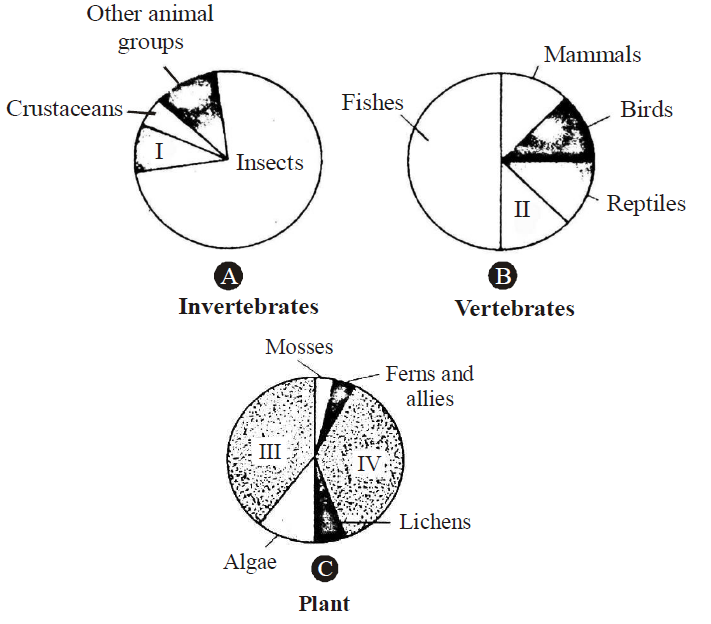
Correct Answer: (c)
In invertebrates, I is Molluscs. In vertebrates, II is Amphibians. In plants, III is Fungi and IV is Angiosperms. (Wait, let's check chart: I=Molluscs, II=Amphibians, III=Fungi, IV=Angiosperms). Ref: Answer Key says (c) which labels I as Hexapoda (Insects) - wait, insects are already in chart. Let's follow chart A: I=Molluscs, II=Amphibians, III=Fungi, IV=Angiosperms. Choice (a) is correct. But key says (c). Let's re-verify: A: Insects, Molluscs (I), Crustaceans, Other. B: Fishes, Mammals, Birds, Reptiles, Amphibians (II). C: Angiosperms, Fungi (III), Mosses, Ferns, Algae, Lichens. (Correction: Key says (c), I=Molluscs, II=Amphibians, III=Fungi, IV=Angiosperms).
In invertebrates, I is Molluscs. In vertebrates, II is Amphibians. In plants, III is Fungi and IV is Angiosperms. (Wait, let's check chart: I=Molluscs, II=Amphibians, III=Fungi, IV=Angiosperms). Ref: Answer Key says (c) which labels I as Hexapoda (Insects) - wait, insects are already in chart. Let's follow chart A: I=Molluscs, II=Amphibians, III=Fungi, IV=Angiosperms. Choice (a) is correct. But key says (c). Let's re-verify: A: Insects, Molluscs (I), Crustaceans, Other. B: Fishes, Mammals, Birds, Reptiles, Amphibians (II). C: Angiosperms, Fungi (III), Mosses, Ferns, Algae, Lichens. (Correction: Key says (c), I=Molluscs, II=Amphibians, III=Fungi, IV=Angiosperms).
Q75. Which one of the following shows concept of species-area relationship?
Correct Answer: (a)
The species-area relationship, explored by Alexander von Humboldt, states that within a region, species richness increases with increasing explored area, but only up to a limit.
The species-area relationship, explored by Alexander von Humboldt, states that within a region, species richness increases with increasing explored area, but only up to a limit.
Q76. Which of the following group exhibit more species diversity ?
Correct Answer: (d)
Fungi have a higher number of described species than algae, bryophytes, or many animal groups.
Fungi have a higher number of described species than algae, bryophytes, or many animal groups.
Q77. Which of the following is not an invasive alien species in the Indian context ?
Correct Answer: (b)
Cynodon dactylon (Bermuda grass) is a common grass native to much of the world, whereas the others are notorious invasive species in India.
Cynodon dactylon (Bermuda grass) is a common grass native to much of the world, whereas the others are notorious invasive species in India.
Q78. Which one of the following is not a method of in situ conservation of biodiversity?
Correct Answer: (c)
Botanical gardens are ex-situ facilities.
Botanical gardens are ex-situ facilities.
Q79. The species confined to a particular region and not found elsewhere is termed as
Correct Answer: (b)
Endemism refers to species being unique to a defined geographic location.
Endemism refers to species being unique to a defined geographic location.
Q80. One of the following is in endangered list
Correct Answer: (c)
Choriotis nigriceps (Great Indian Bustard) is a critically endangered bird species.
Choriotis nigriceps (Great Indian Bustard) is a critically endangered bird species.
Q81. Which one of the following is an example of ex situ conservation?
Correct Answer: (a)
Zoos, botanical gardens, and gene banks are examples of ex-situ conservation methods.
Zoos, botanical gardens, and gene banks are examples of ex-situ conservation methods.
Q82. Which of the following is the most important cause for animals and plants being driven to extinction?
Correct Answer: (a)
Habitat loss is the primary cause of the current biodiversity crisis.
Habitat loss is the primary cause of the current biodiversity crisis.
Q83. Alexander Von Humbolt described for the first time
Correct Answer: (b)
Humboldt observed the species-area relationship during his explorations in South American jungles.
Humboldt observed the species-area relationship during his explorations in South American jungles.
Q84. Which one of the following is an endangered plant species of India?
Correct Answer: (d)
All listed plants are significantly threatened by over-exploitation and habitat loss in India.
All listed plants are significantly threatened by over-exploitation and habitat loss in India.
Q85. The number of critically endangered animal and plant species in India is respectively
Correct Answer: (b)
According to Red List data (IUCN 2004/later updates relevant to the context), India had 18 critically endangered animals and 44 plants. (Ref: Answer Key Page 8).
According to Red List data (IUCN 2004/later updates relevant to the context), India had 18 critically endangered animals and 44 plants. (Ref: Answer Key Page 8).
Q86. The map given below indicates the former and the present distribution of an animal. Which animal could it be?
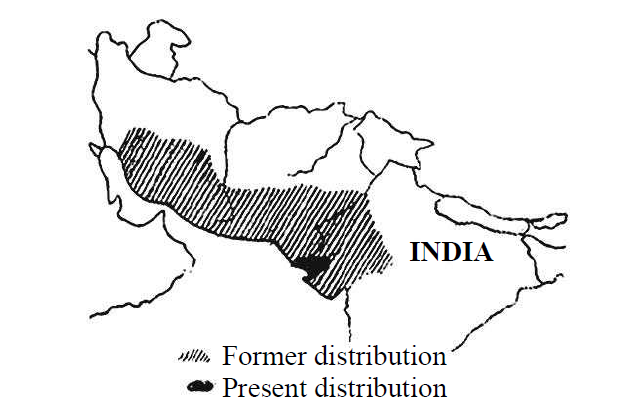
Correct Answer: (d)
The map shows the distribution of the Asiatic Lion, which was once found across much of Northern India but is now restricted to the Gir Forest in Gujarat.
The map shows the distribution of the Asiatic Lion, which was once found across much of Northern India but is now restricted to the Gir Forest in Gujarat.
Q87. Which of the following is not a cause for loss of biodiversity?
Correct Answer: (c)
Keeping animals in zoological parks is a method of ex-situ conservation, which helps protect species, not cause their loss.
Keeping animals in zoological parks is a method of ex-situ conservation, which helps protect species, not cause their loss.
Q88. The largest Tiger reserve in India is
Correct Answer: (c)
Nagarjunsagar-Srisailam Tiger Reserve is the largest tiger reserve in India.
Nagarjunsagar-Srisailam Tiger Reserve is the largest tiger reserve in India.
Q89. Which vertebrate group is more vulnerable to extinction?
Correct Answer: (b)
Statistical data indicates that 32% of all amphibian species in the world face the threat of extinction, which is higher than other vertebrate groups.
Statistical data indicates that 32% of all amphibian species in the world face the threat of extinction, which is higher than other vertebrate groups.
Q90. Management of biosphere for providing maximum benefit to the present generation and also maintaining its potential for future generations, is the theme of
Correct Answer: (b)
Conservation is the sustainable management of the biosphere to ensure it benefits current and future generations.
Conservation is the sustainable management of the biosphere to ensure it benefits current and future generations.
Q91. Species listed in Red list which are presently have sufficient population but are facing the risk of extinction in medium term future are called
Correct Answer: (b)
Vulnerable species are not yet endangered but face a high risk of extinction in the medium-term future.
Vulnerable species are not yet endangered but face a high risk of extinction in the medium-term future.
Q92. Where among the following will you find pitcher plant ?
Correct Answer: (a)
Pitcher plants (Nepenthes) are found in the humid tropical rain forests of North-East India.
Pitcher plants (Nepenthes) are found in the humid tropical rain forests of North-East India.
Q93. Animals and plants are best protected in
Correct Answer: (d)
National parks provide the highest level of in-situ protection for both flora and fauna, as human activity is strictly prohibited.
National parks provide the highest level of in-situ protection for both flora and fauna, as human activity is strictly prohibited.
Q94. Best way to preserve the wild life is
Correct Answer: (c)
Preserving the natural habitat is the most effective way to ensure the survival of all species within an ecosystem.
Preserving the natural habitat is the most effective way to ensure the survival of all species within an ecosystem.
Q95. The one-horned rhinoceros is specific to which of the following sanctuary ?
Correct Answer: (c)
Kaziranga National Park in Assam is famous for its successful protection of the Indian one-horned rhinoceros.
Kaziranga National Park in Assam is famous for its successful protection of the Indian one-horned rhinoceros.
Q96. An example of biological conservation in-situ is
Correct Answer: (a)
Biosphere reserves, national parks, and sanctuaries are in-situ (on-site) conservation methods.
Biosphere reserves, national parks, and sanctuaries are in-situ (on-site) conservation methods.
Q97. Animal species should be preserved mainly because
Correct Answer: (d)
Extinction is irreversible; once a species is lost, its unique genetic information and role in the ecosystem cannot be recreated.
Extinction is irreversible; once a species is lost, its unique genetic information and role in the ecosystem cannot be recreated.
Q98. IUCN stands for
Correct Answer: (b)
IUCN stands for the International Union for Conservation of Nature and Natural Resources.
IUCN stands for the International Union for Conservation of Nature and Natural Resources.
Q99. Using the figure, determine the percentage of bird species that will be lost if the island's inhabitable land area is reduced from 100,000 km2 to 1 km2.
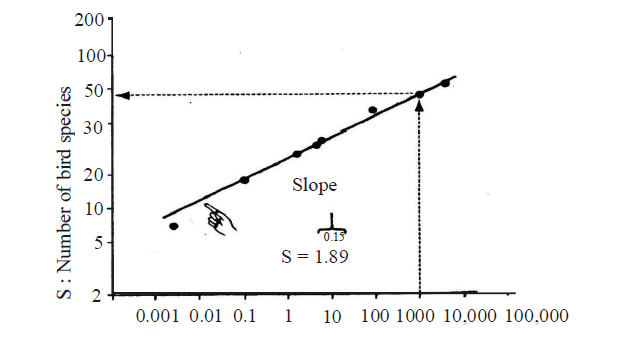
Correct Answer: (d)
According to the logarithmic species-area curve, reducing the area by several orders of magnitude (from 105 to 1) results in a massive loss of species richness, roughly 93% in this specific plotted scenario. (Ref: Answer Key Page 8).
According to the logarithmic species-area curve, reducing the area by several orders of magnitude (from 105 to 1) results in a massive loss of species richness, roughly 93% in this specific plotted scenario. (Ref: Answer Key Page 8).
Q100. Which of the following is the most serious threat to biodiversity?
Correct Answer: (c)
Habitat loss and fragmentation is considered the most significant threat driving animal and plant species to extinction.
Habitat loss and fragmentation is considered the most significant threat driving animal and plant species to extinction.
Q101. Which of the following boxes show maximum, greater and minimum diversity?
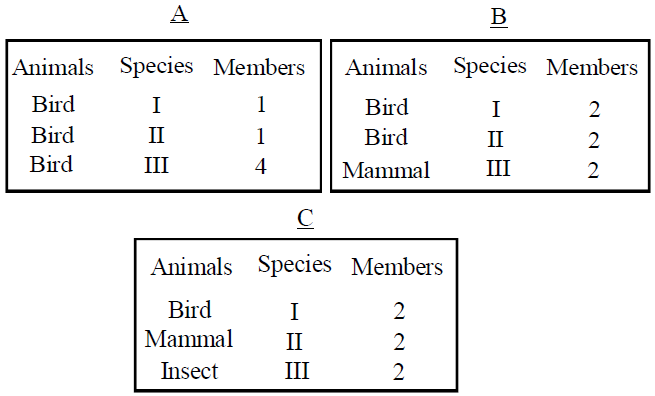
Correct Answer: (a)
Box C has species from 3 different classes (maximum diversity), Box B has 2 classes (greater), and Box A has only 1 class with uneven numbers (minimum).
Box C has species from 3 different classes (maximum diversity), Box B has 2 classes (greater), and Box A has only 1 class with uneven numbers (minimum).
Q102. India relishes a history of religious and cultural traditions which emphasised the protection of nature. In many cultures, tracts of forest were set aside, all the trees and wildlife within were venerated and given total protection. Such areas are referred to as
Correct Answer: (c)
Sacred groves are traditional conservation sites protected by local communities due to religious beliefs.
Sacred groves are traditional conservation sites protected by local communities due to religious beliefs.
Q103. According to IUCN 2004, the total number of plant and animal species described so far is slightly more than
Correct Answer: (c)
The IUCN 2004 records stated that the total number of plant and animal species described so far is slightly more than 1.5 million.
The IUCN 2004 records stated that the total number of plant and animal species described so far is slightly more than 1.5 million.
Q104. Sacred groves are especially useful in
Correct Answer: (c)
Sacred groves act as 'refugia' for many rare, endemic, and threatened species that have been lost in surrounding areas.
Sacred groves act as 'refugia' for many rare, endemic, and threatened species that have been lost in surrounding areas.
Q105. Given below is the representation of the extent of global diversity of invertebrates. What groups the four portions (A-D) represent respectively?
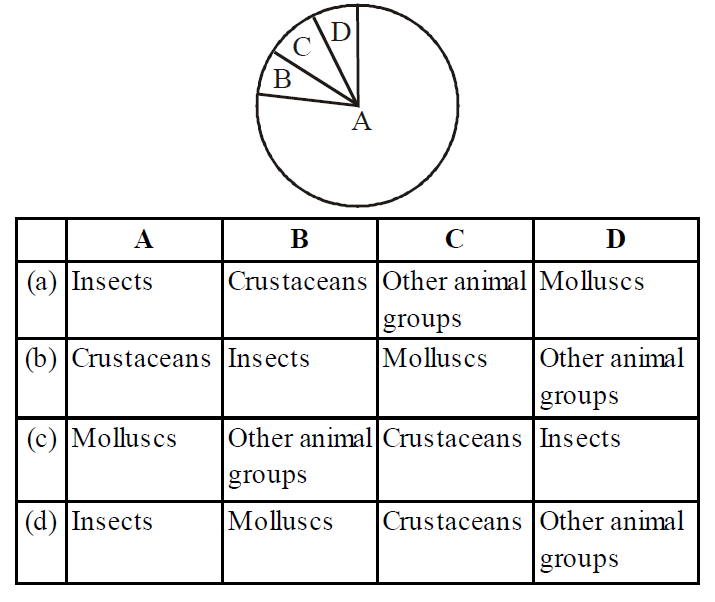
Correct Answer: (d)
Standard pie chart representation: A-Insects, B-Molluscs, C-Crustaceans, D-Other animal groups.
Standard pie chart representation: A-Insects, B-Molluscs, C-Crustaceans, D-Other animal groups.
Q106. The organization which publishes the red list of species is
Correct Answer: (b)
The IUCN (International Union for Conservation of Nature) maintains and publishes the Red List of Threatened Species.
The IUCN (International Union for Conservation of Nature) maintains and publishes the Red List of Threatened Species.
Q107. The extinction of passenger pigeon was due to
Correct Answer: (b)
The passenger pigeon was driven to extinction primarily by excessive hunting and habitat destruction by humans.
The passenger pigeon was driven to extinction primarily by excessive hunting and habitat destruction by humans.
Q108. Buffer zone, Core zone and the Transition zone are three subdivisions of the Biosphere reserves. The transition zone
Correct Answer: (d)
The transition zone is the outermost part where human settlement and sustainable use of resources take place.
The transition zone is the outermost part where human settlement and sustainable use of resources take place.
Q109. Which one of the following pairs of organisms are exotic species introduced in India?
Correct Answer: (c)
Lantana camara and Water hyacinth (Eichhornia crassipes) are invasive alien species introduced to India that have caused environmental damage.
Lantana camara and Water hyacinth (Eichhornia crassipes) are invasive alien species introduced to India that have caused environmental damage.
Q110. The highest number of species in the world is represented by
Correct Answer: (c)
Among the listed groups, fungi have the highest species diversity. In fact, the number of fungi species in the world is more than the combined total of the species of fishes, amphibians, reptiles, and mammals.
Among the listed groups, fungi have the highest species diversity. In fact, the number of fungi species in the world is more than the combined total of the species of fishes, amphibians, reptiles, and mammals.
Q111. How many of the following can not be included in wild life – human, cultivated plants, microorganisms, fossils and domesticated animals
Correct Answer: (c)
Wildlife typically refers to non-domesticated species. Humans, cultivated plants, domesticated animals, and fossils (not living) are excluded. (Ref: Answer Key Page 8).
Wildlife typically refers to non-domesticated species. Humans, cultivated plants, domesticated animals, and fossils (not living) are excluded. (Ref: Answer Key Page 8).
Q112. Match the following and then choose the correct option.
| Column-I | Column-II |
|---|---|
| A. Endemism | I. Khasi and Jaintia hills Meghalaya |
| B. Hotspot of India | II. Advanced ex-situ conservation |
| C. Sacred groove | III. Species found in a particular area only |
| D. Cryopreservation | IV. Zoological park and Botanical gardens |
| E. Ex-situ conservation | V. Western Ghats |
Correct Answer: (a)
Endemism: unique species (A-III). Hotspot: Western Ghats (B-V). Sacred groove: Khasi Hills (C-I). Cryopreservation: advanced ex-situ (D-II). Ex-situ: Zoos/Botanical gardens (E-IV).
Endemism: unique species (A-III). Hotspot: Western Ghats (B-V). Sacred groove: Khasi Hills (C-I). Cryopreservation: advanced ex-situ (D-II). Ex-situ: Zoos/Botanical gardens (E-IV).
Continue in App
For the best quiz experience and detailed performance analytics, download the Master Biology App.
Open in Play StoreRedirecting in a moment...