Q1. Read the following statements and answer the question.
(i) They are exclusively marine, radially symmetrical, diploblastic organisms with tissue level of organisation.
(ii) Body bears eight external rows of ciliated comb plates, which help in locomotion.
(iii) Digestion is both extracellular and intracellular.
(iv) Reproduction takes place only by sexual means.
Which of the following phylum is being described by above statements?
(i) They are exclusively marine, radially symmetrical, diploblastic organisms with tissue level of organisation.
(ii) Body bears eight external rows of ciliated comb plates, which help in locomotion.
(iii) Digestion is both extracellular and intracellular.
(iv) Reproduction takes place only by sexual means.
Which of the following phylum is being described by above statements?
Correct Answer: (d)
The description fits Phylum Ctenophora.
The description fits Phylum Ctenophora.
Q2. Match the following.
| Column-I | Column-II |
|---|---|
| (A) Siliqua | (i) Lycopersicon esculentum |
| (B) Caryopsis | (ii) Triticum aestivum |
| (C) Berry | (iii) Helianthus annuus |
| (D) Cypsela | (iv) Brassica campestris |
Correct Answer: (c)
A-iv; B-ii; C-i; D-iii.
A-iv; B-ii; C-i; D-iii.
Q3. From the following statements select the wrong one.
Correct Answer: (d)
While most sponges are marine, some species like Spongilla (freshwater sponge) are found in fresh water. Hence, Phylum Porifera is not exclusively marine.
While most sponges are marine, some species like Spongilla (freshwater sponge) are found in fresh water. Hence, Phylum Porifera is not exclusively marine.
Q4. Which of the following pairs of animals comprises ‘jawless fishes’?
Correct Answer: (b)
Lampreys and hag fishes belong to class Cyclostomata (jawless).
Lampreys and hag fishes belong to class Cyclostomata (jawless).
Q5. Meandrina (brain coral) belongs to phylum
Correct Answer: (b)
Corals belong to Phylum Coelenterata (Cnidaria).
Corals belong to Phylum Coelenterata (Cnidaria).
Q6. Match the organisms given in column-I with their common name given in column-II and choose the correct option.
| Column-I (Organisms) | Column-II (Common name) |
|---|---|
| A. Pennatula | I. Sea-lily |
| B. Antedon | II. Sea-pen |
| C. Echinus | III. Sea-urchin |
| D. Cucumaria | IV. Sea-cucumber |
Correct Answer: (a)
A-II; B-I; C-III; D-IV. (Option A uses letters C, D which matches the table rows).
A-II; B-I; C-III; D-IV. (Option A uses letters C, D which matches the table rows).
Q7. Which of the following traits is not shared by both sea anemones and jellyfish?
Correct Answer: (a)
Sea anemones (polyps) do not have a medusa stage.
Sea anemones (polyps) do not have a medusa stage.
Q8. Select the incorrect feature of mollusca from the given statements.
(i) Terrestrial or aquatic animals having cellular system level of organization.
(ii) Radial symmetrical and acoelomate animals and possesses two germinal layers.
(iii) A file like rasping organ called radula is present.
(iv) Usually dioecious and viviparous animals.
(v) Examples include Pila, Octopus, and Dentalium.
(i) Terrestrial or aquatic animals having cellular system level of organization.
(ii) Radial symmetrical and acoelomate animals and possesses two germinal layers.
(iii) A file like rasping organ called radula is present.
(iv) Usually dioecious and viviparous animals.
(v) Examples include Pila, Octopus, and Dentalium.
Correct Answer: (c)
Molluscs have organ-system level, are bilateral/coelomate/triploblastic, and usually oviparous.
Molluscs have organ-system level, are bilateral/coelomate/triploblastic, and usually oviparous.
Q9. Aristotle Lantern is present in
Correct Answer: (a)
Aristotle's Lantern is a masticatory apparatus in sea urchins (Echinus).
Aristotle's Lantern is a masticatory apparatus in sea urchins (Echinus).
Q10. Which of the following animal contains respiratory organs like, gills, book gills, book lungs or tracheal system?
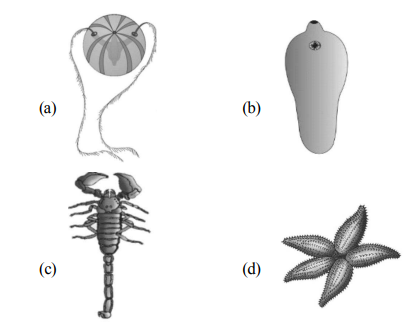
Correct Answer: (c)
Figure (c) is a scorpion (Arthropod) which has book lungs.
Figure (c) is a scorpion (Arthropod) which has book lungs.
Q11. Which of the following is a living fossil?
Correct Answer: (d)
Limulus (King crab) is a living fossil.
Limulus (King crab) is a living fossil.
Q12. Which of the following statements (i – v) are incorrect?
(i) Circulatory system in arthropods is of closed type.
(ii) Parapodia in annelids helps in swimming.
(iii) Phylum mollusca is the second largest animal phylum.
(iv) Aschelminthes are dioecious.
(i) Circulatory system in arthropods is of closed type.
(ii) Parapodia in annelids helps in swimming.
(iii) Phylum mollusca is the second largest animal phylum.
(iv) Aschelminthes are dioecious.
Correct Answer: (a)
Arthropods have an open circulatory system.
Arthropods have an open circulatory system.
Q13. Blood of Pheretima is
Correct Answer: (d)
In earthworms, hemoglobin is dissolved in the blood plasma.
In earthworms, hemoglobin is dissolved in the blood plasma.
Q14. Match the phylum given in column - I with the special features present in them given in column - II and choose the correct option.
| Column -I (Phylum) | Column- II (Special features present) |
|---|---|
| A. Porifera | I. Mammary glands |
| B. Mollusca | II. Cloaca |
| C. Ctenophora | III. Choanocytes |
| D. Amphibia | IV. Radula |
| E. Mammalia | V. Comb plates |
Correct Answer: (a)
A-III; B-IV; C-V; D-II; E-I.
A-III; B-IV; C-V; D-II; E-I.
Q15. Which of the following phylum is being described by the given statements?
(i) These are primitive multicellular animals and have cellular level of organization.
(ii) Digestion is intracellular.
(iii) They have a water transport or canal system.
(iv) They reproduce asexually by fragmentation and sexually by formation of gametes.
(i) These are primitive multicellular animals and have cellular level of organization.
(ii) Digestion is intracellular.
(iii) They have a water transport or canal system.
(iv) They reproduce asexually by fragmentation and sexually by formation of gametes.
Correct Answer: (a)
These are characteristics of sponges (Phylum Porifera).
These are characteristics of sponges (Phylum Porifera).
Q16. In which one of the following, the genus name, its two characters and its class/phylum are correctly matched?
| Genus name | Two characters | Class/phylum |
|---|---|---|
| (a) Ascaris | (i) Body segmented (ii) Males and females distinct | Annelida |
| (b) Salamandra | (i) A tympanum represents ear (ii) Fertilization is external | Amphibia |
| (c) Pteropus | (i) Skin possesses hair (ii) Oviparous | Mammalia |
| (d) Aurelia | (i) Cnidoblasts (ii) Organ level of organization | Coelenterata |
Correct Answer: (b)
Only (b) is correct for Salamandra. Pteropus is viviparous; Ascaris is aschelminthes; Aurelia has tissue-level organization.
Only (b) is correct for Salamandra. Pteropus is viviparous; Ascaris is aschelminthes; Aurelia has tissue-level organization.
Q17. Which of the following is not a chordate character?
Correct Answer: (c)
Chordates have a dorsal, hollow nerve cord, not a ventral one.
Chordates have a dorsal, hollow nerve cord, not a ventral one.
Q18. Polyp phase is absent in
Correct Answer: (b)
In Aurelia (Jellyfish), the medusa phase is dominant and the polyp phase is reduced or absent.
In Aurelia (Jellyfish), the medusa phase is dominant and the polyp phase is reduced or absent.
Q19. Refer the following animals and identify those which have a fluid filled body cavity with a complete lining derived from mesoderm.
(i) Sycon (ii) Butterfly
(iii) Nereis (iv) Sea fan
(v) Scorpion (vi) Pila
(i) Sycon (ii) Butterfly
(iii) Nereis (iv) Sea fan
(v) Scorpion (vi) Pila
Correct Answer: (c)
A true coelom (fluid filled cavity lined by mesoderm) is found in Annelids (Nereis), Arthropods (Butterfly, Scorpion), and Molluscs (Pila). Sycon and Sea fan are acoelomate/diploblastic.
A true coelom (fluid filled cavity lined by mesoderm) is found in Annelids (Nereis), Arthropods (Butterfly, Scorpion), and Molluscs (Pila). Sycon and Sea fan are acoelomate/diploblastic.
Q20. Which of the following is not a characteristic feature of kingdom animalia ?
Correct Answer: (a)
Animals store carbohydrates as glycogen and fat, not starch. Starch is the storage polysaccharide of plants.
Animals store carbohydrates as glycogen and fat, not starch. Starch is the storage polysaccharide of plants.
Q21. Which of the following belong to phylum arthropoda?
Correct Answer: (d)
All mentioned organisms belong to Phylum Arthropoda.
All mentioned organisms belong to Phylum Arthropoda.
Q22. In ctenophora, the body bears _______ external rows of ciliated comb plates, which help in locomotion.
Correct Answer: (d)
Ctenophores possess eight rows of ciliated comb plates.
Ctenophores possess eight rows of ciliated comb plates.
Q23. Refer the figures A, B, C and D given below. Which of the following options shows the correct name of the animals shown by the figures A, B, C and D ?
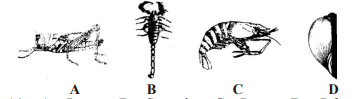
Correct Answer: (a)
A: Locust, B: Scorpion, C: Prawn, D: Pila.
A: Locust, B: Scorpion, C: Prawn, D: Pila.
Q24. Animals like annelids, arthropods, etc. where the body can be divided into identical left and right halves in only one plane, exhibit ___________ symmetry.
Correct Answer: (b)
Bilateral symmetry is defined as division into identical left and right halves in only one plane.
Bilateral symmetry is defined as division into identical left and right halves in only one plane.
Q25. Choose the correct difference from the following.
| Pristis | Catla |
|---|---|
| (a) 3-chambered heart | 2- chambered heart |
| (b) Small placoid scales | Large placoid scales |
| (c) Ventral mouth | Terminal mouth |
| (d) Swim bladder present | Swim bladder absent |
Correct Answer: (c)
Pristis is a cartilaginous fish with a ventral mouth; Catla is a bony fish with a terminal mouth.
Pristis is a cartilaginous fish with a ventral mouth; Catla is a bony fish with a terminal mouth.
Q26. Identify the figure with its correct name and phylum.
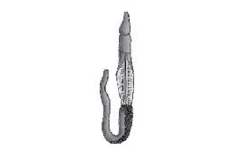
Correct Answer: (c)
Figure shows Balanoglossus (Acorn worm).
Figure shows Balanoglossus (Acorn worm).
Q27. Which of the following statement(s) is/are correct regarding phylum mollusca?
Correct Answer: (d)
All statements correctly describe Phylum Mollusca.
All statements correctly describe Phylum Mollusca.
Q28. Which one of the following statement regarding coelom of given animals is correct?
Correct Answer: (a)
Roundworms are pseudocoelomates. Molluscs and Insects are coelomates. Flatworms are acoelomates.
Roundworms are pseudocoelomates. Molluscs and Insects are coelomates. Flatworms are acoelomates.
Q29. __________ is responsible for maintaining the current of water in sponge.
Correct Answer: (d)
Choanocytes (collar cells) maintain the water current in sponges.
Choanocytes (collar cells) maintain the water current in sponges.
Q30. Which of the following is correct
Correct Answer: (a)
Option (a) correctly describes a mammal (Macropus).
Option (a) correctly describes a mammal (Macropus).
Q31. Identify the figure with its correct name and phylum.
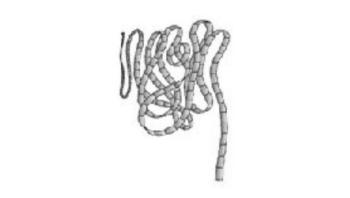
Correct Answer: (d)
The figure is of a tapeworm belonging to Phylum Platyhelminthes.
The figure is of a tapeworm belonging to Phylum Platyhelminthes.
Q32. Which of the following is a chordate feature and not shared by the non-chordates?
Correct Answer: (d)
Pharyngeal gill slits are unique to chordates.
Pharyngeal gill slits are unique to chordates.
Q33. One of the following is a very unique feature of the mammalian body:
Correct Answer: (b)
The presence of a diaphragm is a characteristic unique to mammals.
The presence of a diaphragm is a characteristic unique to mammals.
Q34. Which one of the following groups of animals is correctly matched with its characteristic feature without even a single exception ?
Correct Answer: (c)
All Chondrichthyes have cartilaginous skeletons. Exceptions: Crocodiles have 4-chambered hearts; Hagfishes lack jaws; Platypus lays eggs.
All Chondrichthyes have cartilaginous skeletons. Exceptions: Crocodiles have 4-chambered hearts; Hagfishes lack jaws; Platypus lays eggs.
Q35. Which of the following animals are bilaterally symmetrical?
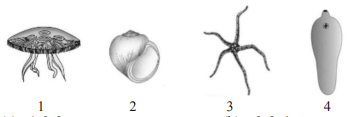
Correct Answer: (b)
2 (mollusc) and 4 (flatworm) show bilateral symmetry. 1 (jellyfish) and 3 (starfish) show radial symmetry.
2 (mollusc) and 4 (flatworm) show bilateral symmetry. 1 (jellyfish) and 3 (starfish) show radial symmetry.
Q36. A student was given a specimen to identify on the basis of the characteristics given below.
(i) They are metamerically segmented.
(ii) They have closed circulatory system.
(iii) They have circular and longitudinal muscles for locomotion.
Identify the specimen.
(i) They are metamerically segmented.
(ii) They have closed circulatory system.
(iii) They have circular and longitudinal muscles for locomotion.
Identify the specimen.
Correct Answer: (b)
Description fits earthworms (Pheretima).
Description fits earthworms (Pheretima).
Q37. Which one of the following phyla is correctly matched with its two general characteristics?
Correct Answer: (a)
Match (a) is correct. Chordates share a common opening (cloaca) in some; echinoderms have external fertilization; many molluscs have indirect development.
Match (a) is correct. Chordates share a common opening (cloaca) in some; echinoderms have external fertilization; many molluscs have indirect development.
Q38. Flame cells present in platyhelminthes are specialized in
Correct Answer: (d)
Flame cells are excretory structures involved in osmoregulation and excretion.
Flame cells are excretory structures involved in osmoregulation and excretion.
Q39. Which one of the following categories of animals is correctly described with no single exception in it?
Correct Answer: (a)
Persistent notochord is universal in Chondrichthyes. Platypus lays eggs; Spongilla is freshwater; Crocodiles have 4-chambered hearts.
Persistent notochord is universal in Chondrichthyes. Platypus lays eggs; Spongilla is freshwater; Crocodiles have 4-chambered hearts.
Q40. Choose the correct match :
Correct Answer: (a)
Birds possess pneumatic (hollow) bones.
Birds possess pneumatic (hollow) bones.
Q41. In phylum arthropoda, excretion takes place through
Correct Answer: (c)
Arthropods use Malpighian tubules for excretion.
Arthropods use Malpighian tubules for excretion.
Q42. Sharks and dogfishes differ from skates and rays by
Correct Answer: (a)
Shark bodies are cylindrical with pectoral fins distinct, unlike the widened flattened bodies of rays.
Shark bodies are cylindrical with pectoral fins distinct, unlike the widened flattened bodies of rays.
Q43. Match the following Columns.
| Column - I (Organism) | Column - II (Connecting link) |
|---|---|
| A. Echidna | I. between Annelida and Mollusca |
| B. Peripatus | II. between Reptiles and Mammals |
| C. Neopilina | III. between Annelida and Arthropoda |
| D. Protopterus | IV. between Pisces and Amphibian |
Correct Answer: (b)
A-II; B-III; C-I; D-IV.
A-II; B-III; C-I; D-IV.
Q44. Which of the following is an incorrect statement regarding flatworms?
Correct Answer: (d)
Flatworms lack a circulatory system.
Flatworms lack a circulatory system.
Q45. In which of the phylum, excretory organ like proboscis gland is present?
Correct Answer: (a)
Hemichordates possess a proboscis gland for excretion.
Hemichordates possess a proboscis gland for excretion.
Q46. Which of the following statements (i – v) are incorrect?
(i) Parapodia are lateral appendages in arthropods used for swimming.
(ii) Radula in molluscs are structures involved in excretion.
(iii) Aschelminthes are dioecious.
(iv) Echinoderm adults show radial symmetry.
(v) Ctenophorans are diploblastic.
(i) Parapodia are lateral appendages in arthropods used for swimming.
(ii) Radula in molluscs are structures involved in excretion.
(iii) Aschelminthes are dioecious.
(iv) Echinoderm adults show radial symmetry.
(v) Ctenophorans are diploblastic.
Correct Answer: (a)
Parapodia are in annelids, not arthropods. Radula is for feeding, not excretion.
Parapodia are in annelids, not arthropods. Radula is for feeding, not excretion.
Q47. Which of the following group of animals belongs to the same phylum?
Correct Answer: (b)
Prawn, scorpion, and Locusta are all arthropods.
Prawn, scorpion, and Locusta are all arthropods.
Q48. Which one of the following is the true description about an animal concerned?
Correct Answer: (d)
Cockroaches have 10 pairs of spiracles. Earthworms lack a stomach; frogs lack a neck.
Cockroaches have 10 pairs of spiracles. Earthworms lack a stomach; frogs lack a neck.
Q49. Refer the following statement and answer the question. 'Name of "X" is derived from stinging capsules. It exhibits metagenesis containing two body forms in which sessile and cylindrical form is called "Y" and umbrella shaped and free swimming is called "Z". Identify X, Y, and Z.
| X | Y | Z |
|---|---|---|
| (a) Coelenterate | Polyp | Medusa |
| (b) Cnidarian | Medusa | Polyp |
| (c) Ctenophora | Radula | Hypostome |
| (d) Porifera | Osculum | Radula |
Correct Answer: (a)
X is Coelenterata (Cnidaria), Y is Polyp, and Z is Medusa.
X is Coelenterata (Cnidaria), Y is Polyp, and Z is Medusa.
Q50. Which of the following phylum is being described by the given statements?
(i) They are bilaterally symmetrical, triploblastic, segmented and coelomate animals.
(ii) The body consists of head, thorax, abdomen and have jointed appendages.
(iii) Circulatory system is of open type.
(iv) Excretion takes place through malphigian tubules.
(i) They are bilaterally symmetrical, triploblastic, segmented and coelomate animals.
(ii) The body consists of head, thorax, abdomen and have jointed appendages.
(iii) Circulatory system is of open type.
(iv) Excretion takes place through malphigian tubules.
Correct Answer: (a)
Description matches Phylum Arthropoda.
Description matches Phylum Arthropoda.
Q51. Which of the following is not a characteristic of phylum echinodermata ?
Correct Answer: (c)
Echinoderms are deuterostomes, not protostomes.
Echinoderms are deuterostomes, not protostomes.
Q52. Which of the following statement(s) is/are correct for class amphibia?
(i) Body is divisible into head and trunk.
(ii) Respiration is through gills only.
(iii) The heart is two chambered i.e. one auricle and one ventricle.
(iv) Fertilization is internal.
(i) Body is divisible into head and trunk.
(ii) Respiration is through gills only.
(iii) The heart is two chambered i.e. one auricle and one ventricle.
(iv) Fertilization is internal.
Correct Answer: (a)
Only (i) is correct. Amphibians breathe through skin/lungs as well; have 3-chambered hearts; fertilization is usually external.
Only (i) is correct. Amphibians breathe through skin/lungs as well; have 3-chambered hearts; fertilization is usually external.
Q53. Which of the following statement is incorrect?
Correct Answer: (c)
Nereis is dioecious, while earthworms and leeches are monoecious.
Nereis is dioecious, while earthworms and leeches are monoecious.
Q54. Identify the correct characteristic feature shown by the given figure?
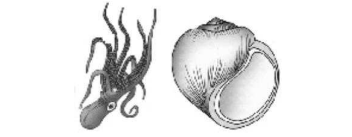
Correct Answer: (d)
The snail (Pila) has sensory tentacles on its anterior head region.
The snail (Pila) has sensory tentacles on its anterior head region.
Q55. Which of the following sets of animals give birth to young ones?
Correct Answer: (c)
Kangaroo, Hedgehog, Dolphin, and Loris are all viviparous mammals.
Kangaroo, Hedgehog, Dolphin, and Loris are all viviparous mammals.
Q56. The given figure shows some characteristic features marked as chordates. Identify the correct labelling A, B, C and D.
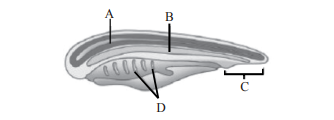
Correct Answer: (b)
A: Nerve cord (dorsal/hollow); B: Notochord; C: Post-anal tail; D: Gill slits.
A: Nerve cord (dorsal/hollow); B: Notochord; C: Post-anal tail; D: Gill slits.
Q57. In amphibians, respiration occurs through
Correct Answer: (d)
Amphibians use gills (larval), lungs, and skin for respiration.
Amphibians use gills (larval), lungs, and skin for respiration.
Q58. Which of the following animal's body is covered by calcareous shell and unsegmented with a distinct head, muscular foot, and visceral hump?
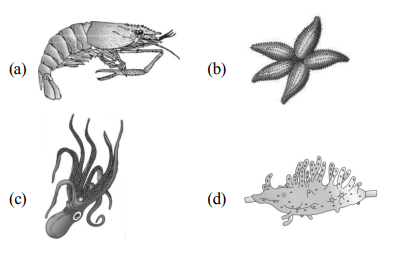
Correct Answer: (c)
Figure (c) shows Pila (Mollusc), which matches the description.
Figure (c) shows Pila (Mollusc), which matches the description.
Q59. Choose the correct option–
Correct Answer: (a)
Macropus (Kangaroo) is a mammal, possessing hair and pinna.
Macropus (Kangaroo) is a mammal, possessing hair and pinna.
Q60. The transition from aquatic to terrestrial lifestyles required many adaptations in the vertebrate lineage. Which of the following is not one of those adaptations ?
Correct Answer: (d)
Feathers are specific to birds, not a general terrestrial adaptation.
Feathers are specific to birds, not a general terrestrial adaptation.
Q61. The following statement are associated with the occurrence of notochord. Identify the incorrect statement.
Correct Answer: (c)
In humans, the notochord is present during the embryonic stage and is later replaced by the vertebral column.
In humans, the notochord is present during the embryonic stage and is later replaced by the vertebral column.
Q62. In amphibians, heart is ________ chambered.
Correct Answer: (b)
Amphibians have a three-chambered heart.
Amphibians have a three-chambered heart.
Q63. Which of the following features in birds indicates their reptilian ancestory ?
Correct Answer: (b)
Birds retain scales on their hind limbs from their reptilian ancestors.
Birds retain scales on their hind limbs from their reptilian ancestors.
Q64. Identify the correct characteristics of porifera.
(i) Commonly known as sea walnuts.
(ii) Presence of ostia and collar cells.
(iii) Exhibit tissue level of characteristics.
(iv) It is the largest phylum of animal kingdom.
(v) The body is supported by spicules and sponging fibers.
(vi) Contains cnidocytes which is used for defense, anchorage and capturing of prey.
(i) Commonly known as sea walnuts.
(ii) Presence of ostia and collar cells.
(iii) Exhibit tissue level of characteristics.
(iv) It is the largest phylum of animal kingdom.
(v) The body is supported by spicules and sponging fibers.
(vi) Contains cnidocytes which is used for defense, anchorage and capturing of prey.
Correct Answer: (a)
Characteristics of Porifera include (ii) ostia/collar cells and (v) spicules/spongin fibers. (i) refers to Ctenophora, (iii) is tissue level (Cnidaria), (iv) is Arthropoda, (vi) is Cnidaria.
Characteristics of Porifera include (ii) ostia/collar cells and (v) spicules/spongin fibers. (i) refers to Ctenophora, (iii) is tissue level (Cnidaria), (iv) is Arthropoda, (vi) is Cnidaria.
Q65. Which of the following class is being described by the given statements (i - iv)?
(i) They are found in a variety of habitats- polar ice caps, deserts, mountains, forests, grasslands and dark caves.
(ii) Most unique mammalian characteristic is the presence of mammary glands by which the young ones are nourished.
(iii) Heart is four-chambered.
(iv) Sexes are separate and fertilization is internal.
(i) They are found in a variety of habitats- polar ice caps, deserts, mountains, forests, grasslands and dark caves.
(ii) Most unique mammalian characteristic is the presence of mammary glands by which the young ones are nourished.
(iii) Heart is four-chambered.
(iv) Sexes are separate and fertilization is internal.
Correct Answer: (c)
Description fits Class Mammalia.
Description fits Class Mammalia.
Q66. In which class of Echinodermata, Pluteus larva is formed
Correct Answer: (b)
Pluteus larva is found in class Echinoidea.
Pluteus larva is found in class Echinoidea.
Q67. Which of the following animals has well developed nervous tissue but no brain :
Correct Answer: (c)
Hydra has a nerve net but lacks a centralized brain.
Hydra has a nerve net but lacks a centralized brain.
Q68. Which of the following pairs of animals are similar to each other pertaining to the feature stated against them?
Correct Answer: (d)
Both are fishes and are poikilothermic. Ornithorhynchus is oviparous; crocodile has 4-chambered heart; aschelminthes are unsegmented.
Both are fishes and are poikilothermic. Ornithorhynchus is oviparous; crocodile has 4-chambered heart; aschelminthes are unsegmented.
Q69. Which of the following pairs are correctly matched ?
| Animals | Morphological features |
|---|---|
| (i) Crocodile | 4-chambered heart |
| (ii) Sea urchin | Parapodia |
| (iii) Obelia | Thecodont |
| (iv) Lemur | Thecodont |
Correct Answer: (b)
Crocodiles have 4-chambered hearts. Lemur (mammal) has thecodont teeth.
Crocodiles have 4-chambered hearts. Lemur (mammal) has thecodont teeth.
Q70. Which of the following characteristics is correct for reptilia?
Correct Answer: (a)
Reptilian skin is dry and cornified with epidermal scales; they lack external ears.
Reptilian skin is dry and cornified with epidermal scales; they lack external ears.
Q71. In which one of the following the genus name, its two characters and phylum are not correctly matched?
| Genus name | Two characters | Phylum |
|---|---|---|
| (a) Pila | (i) Body Segmented, Mouth with radula | Mollusca |
| (b) Asterias | (ii) Spin skinned, Water vascular system | Echinodermata |
| (c) Sycon | (iii) Pore bearing, Canal system | Porifera |
| (d) Periplaneta | (iv) Jointed appendages, Chitinous exoskeleton | Arthropoda |
Correct Answer: (a)
Pila is unsegmented.
Pila is unsegmented.
Q72. Which of the following characters is absent in all chordates?
Correct Answer: (a)
The diaphragm is a mammalian feature, not a chordate feature.
The diaphragm is a mammalian feature, not a chordate feature.
Q73. Which of the following represents the correct combination without any exception?
| Characteristics | Class |
|---|---|
| (a) Mouth ventral, gills without operculum; skin with placoid scales; persistent notochord | Chondrichthyes |
| (b) Sucking and circular mouth; jaws absent, integument without scales; paired appendages | Cyclostomata |
| (c) Body covered with feathers; skin moist and glandular; fore-limbs form wings; lungs with air sacs | Aves |
| (d) Mammary gland; hair on body; pinnae; two pairs of Limbs | Mammalia |
Correct Answer: (a)
Combination (a) is correct without exceptions. Cyclostomes can lack paired appendages; birds have air sacs but not 'moist skin'; some mammals lack pinnae.
Combination (a) is correct without exceptions. Cyclostomes can lack paired appendages; birds have air sacs but not 'moist skin'; some mammals lack pinnae.
Q74. A file like rasping organ for feeding, called radula, present in the phylum __________.
Correct Answer: (b)
The radula is an organ found in Molluscs.
The radula is an organ found in Molluscs.
Q75. Column I contains zoological names of animals and column II contains their common name. Match the following and choose the correct option.
| Column-I | Column-II |
|---|---|
| A. Physalia | I. Sea anemone |
| B. Meandrina | II. Brain coral |
| C. Gorgonia | III. Sea fan |
| D. Adamsia | IV. Portuguese man-of-war |
Correct Answer: (c)
A-IV, B-II, C-III, D-I.
A-IV, B-II, C-III, D-I.
Q76. Which of the following statements (i - v) are correct ?
(i) The pelvic fins of female sharks bear claspers.
(ii) In Obelia, polyps produce medusae sexually and medusae form the polyps asexually.
(iii) Flame cells in platyhelminthes help in osmoregulation and excretion.
(iv) In non-chordates, central nervous system is ventral, solid and double.
(v) Pinnae are present in mammals.
(i) The pelvic fins of female sharks bear claspers.
(ii) In Obelia, polyps produce medusae sexually and medusae form the polyps asexually.
(iii) Flame cells in platyhelminthes help in osmoregulation and excretion.
(iv) In non-chordates, central nervous system is ventral, solid and double.
(v) Pinnae are present in mammals.
Correct Answer: (c)
Statement (i) is false (males have claspers). (ii) is false (polyp to medusa is asexual). (iii), (iv), (v) are correct.
Statement (i) is false (males have claspers). (ii) is false (polyp to medusa is asexual). (iii), (iv), (v) are correct.
Q77. Examine the figures A, B and C. In which one of the four options all the items A, B and C are correctly identified ?
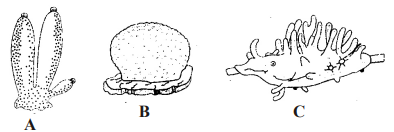
Correct Answer: (a)
A: Sycon, B: Euspongia, C: Spongilla.
A: Sycon, B: Euspongia, C: Spongilla.
Q78. Which of the following feature is not correct regarding the figure given below?
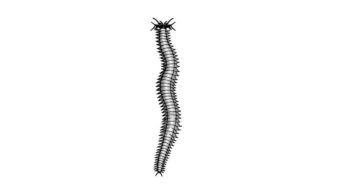
Correct Answer: (b)
The figure is Nereis (Annelid), which has a closed circulatory system.
The figure is Nereis (Annelid), which has a closed circulatory system.
Q79. A common characteristic of all vertebrates without exception is
Correct Answer: (d)
All vertebrates (Craniata) possess a cranium/skull.
All vertebrates (Craniata) possess a cranium/skull.
Q80. Which of the following statement(s) is/are correct regarding phylum aschelminthes?
(i) The body is circular in cross-section hence the name roundworms.
(ii) Alimentary canal is complete with a well-developed muscular pharynx.
(iii) Sexes are separate (dioecious), i.e., males and females are distinct.
(iv) Nephridia help in osmoregulation and excretion.
(i) The body is circular in cross-section hence the name roundworms.
(ii) Alimentary canal is complete with a well-developed muscular pharynx.
(iii) Sexes are separate (dioecious), i.e., males and females are distinct.
(iv) Nephridia help in osmoregulation and excretion.
Correct Answer: (c)
Statement (iv) is incorrect; nephridia are characteristic of Annelids.
Statement (iv) is incorrect; nephridia are characteristic of Annelids.
Q81. Column I contains the characteristics features and column II contains the function/ location. Select the correct match from the option given below.
| Column -I (Characteristic feature) | Column- II (Function/Location) |
|---|---|
| A. Water canal system | (I) Sponges |
| B. Comb plates | (II) Help in swimming |
| C. Nephridia | (III) Present in mollusca |
| D. Jointed appendages | (IV) Characteristics of roundworm |
| E. Muscular foot | (V) A body part of arthropoda |
Correct Answer: (a)
Based on the functions: Water canal-Sponges; Comb plates-locomotion; Nephridia-osmoregulation/excretion; Jointed appendages-Arthropods; Muscular foot-Molluscs. Match (a) represents these correctly provided IX/VIII map to these.
Based on the functions: Water canal-Sponges; Comb plates-locomotion; Nephridia-osmoregulation/excretion; Jointed appendages-Arthropods; Muscular foot-Molluscs. Match (a) represents these correctly provided IX/VIII map to these.
Q82. Match the types of animals given in column I with their examples given in column II and choose the correct option.
| Column -I (Types of animals) | Column -II (Examples) |
|---|---|
| A. Limbless reptiles | I. Elephant |
| B. Jawless vertebrates | II. Lamprey |
| C. Flightless bird | III. Ichthyophis |
| D. Largest terrestrial animal | IV. Ostrich |
| E. Limbless amphibia | V. Cobra |
Correct Answer: (b)
A-V; B-II; C-IV; D-I; E-III.
A-V; B-II; C-IV; D-I; E-III.
Q83. When any plane passing through the central axis of the body divides the organism into two identical halves, the organism is called ___________.
Correct Answer: (a)
This is the definition of radial symmetry.
This is the definition of radial symmetry.
Q84. Match the characteristic feature/terms given in column I with the phylum to which they belong given in column II and choose the correct option.
| Column-I (Characteristic feature/term) | Column-II (Phylum) |
|---|---|
| A. Choanocytes | I. Platyhelminthes |
| B. Cnidoblasts | II. Ctenophora |
| C. Flame cells | III. Porifera |
| D. Nephridia | IV. Coelenterata |
| E. Comb plates | V. Annelida |
Correct Answer: (d)
A-III; B-IV; C-I; D-V; E-II.
A-III; B-IV; C-I; D-V; E-II.
Q85. Refer the figures A, B and C and choose the correct option which shows animals that regulate buoyancy with the help of air bladder.
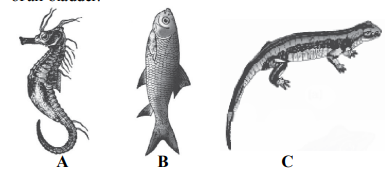
Correct Answer: (a)
A and B are bony fishes (Osteichthyes) which possess air bladders. C is a cartilaginous fish.
A and B are bony fishes (Osteichthyes) which possess air bladders. C is a cartilaginous fish.
Q86. A student brought home a strange animal which he found outside under a rock. It had moist skin, a complete digestive tract, a ventral nerve cord, and had gone through torsion. Identify the phylum of the animal.
Correct Answer: (c)
Torsion is a unique characteristic of gastropod molluscs.
Torsion is a unique characteristic of gastropod molluscs.
Q87. Column-I contains organisms and column-II contains their excretory structures. Choose the correct match form the options given below.
| Column- I (Organism) | Column -II (Excretory structures) |
|---|---|
| A. Cockroach | I. Nephridia |
| B. Cat fish | II. Malpighian tubules |
| C. Earthworm | III. Kidneys |
| D. Balanoglossus | IV. Flame cells |
| E. Flatworm | V. Proboscis gland |
Correct Answer: (d)
A-II; B-III; C-I; D-V; E-IV.
A-II; B-III; C-I; D-V; E-IV.
Q88. Which of the following option is correct?
Correct Answer: (a)
Bony fishes (Osteichthyes) have 4 pairs of gills and an operculum. Chondrichthyes have 5-7 pairs.
Bony fishes (Osteichthyes) have 4 pairs of gills and an operculum. Chondrichthyes have 5-7 pairs.
Q89. Identify the animals shown in the given figures A, B and C from options given below.
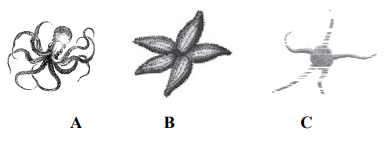
Correct Answer: (a)
A: Octopus, B: Asterias (starfish), C: Ophiura (brittle star).
A: Octopus, B: Asterias (starfish), C: Ophiura (brittle star).
Q90. Which of the following possesses electric organs and belongs to class chondrichthyes?
Correct Answer: (a)
Torpedo (Electric ray) has electric organs.
Torpedo (Electric ray) has electric organs.
Q91. Which of the following statements is incorrect ?
Correct Answer: (d)
Porifera includes fresh water species like Spongilla.
Porifera includes fresh water species like Spongilla.
Q92. Which of the following class is being correctly described by given statements (i - iv)?
(i) All living members of this class are ectoparasites on some fishes.
(ii) They have a sucking and circular mouth without jaws.
(iii) Circulation is of closed type.
(iv) They are marine but migrate for spawning to fresh water. After spawning, within a few days they die.
(i) All living members of this class are ectoparasites on some fishes.
(ii) They have a sucking and circular mouth without jaws.
(iii) Circulation is of closed type.
(iv) They are marine but migrate for spawning to fresh water. After spawning, within a few days they die.
Correct Answer: (a)
Description matches class Cyclostomata.
Description matches class Cyclostomata.
Q93. Column-I contains organisms and column-II contains their excretory structures. Choose the correct match from the options given below.
| Column- I (Organism) | Column -II (Excretory structures) |
|---|---|
| A. Cockroach | I. Nephridia |
| B. Cat fish | II. Malpighian tubules |
| C. Earthworm | III. Kidneys |
| D. Balanoglossus | IV. Flame cells |
| E. Flatworm | V. Proboscis gland |
Correct Answer: (d)
A-II; B-III; C-I; D-V; E-IV.
A-II; B-III; C-I; D-V; E-IV.
Q94. Which of the following statement(s) is/are correct?
(i) Organ systems in different group of animals show various patterns of complexities.
(ii) The digestive system in platyhelminthes has only a single opening to the outside of the body that serve as both mouth and anus, and is hence called complete.
(iii) In open type of circulatory system, the blood is pumped out of the heart and the cells and tissues are directly bathed in it.
(iv) In closed type, the blood is circulated through a series of vessels of varying diameters (arteries, veins and capillaries).
(i) Organ systems in different group of animals show various patterns of complexities.
(ii) The digestive system in platyhelminthes has only a single opening to the outside of the body that serve as both mouth and anus, and is hence called complete.
(iii) In open type of circulatory system, the blood is pumped out of the heart and the cells and tissues are directly bathed in it.
(iv) In closed type, the blood is circulated through a series of vessels of varying diameters (arteries, veins and capillaries).
Correct Answer: (c)
Statement (ii) is incorrect because a digestive system with a single opening is called 'incomplete', not complete.
Statement (ii) is incorrect because a digestive system with a single opening is called 'incomplete', not complete.
Q95. Which of the following group of animals reproduces only by sexual means?
Correct Answer: (a)
Ctenophores reproduce only through sexual reproduction.
Ctenophores reproduce only through sexual reproduction.
Q96. Which of the following statement(s) is/are correct regarding class aves?
(i) The forelimbs are modified into wings and the hindlimbs generally have scales and are modified for walking, swimming or clasping the tree branches.
(ii) Heart is completely four-chambered.
(iii) They are warm-blooded (homoiothermous) animals i.e., they are able to maintain a constant body temperature.
(iv) They are oviparous and development is direct.
(i) The forelimbs are modified into wings and the hindlimbs generally have scales and are modified for walking, swimming or clasping the tree branches.
(ii) Heart is completely four-chambered.
(iii) They are warm-blooded (homoiothermous) animals i.e., they are able to maintain a constant body temperature.
(iv) They are oviparous and development is direct.
Correct Answer: (d)
All statements correctly describe Class Aves.
All statements correctly describe Class Aves.
Q97. Dicondylic skull with 10-pairs of cranial nerves occur in
Correct Answer: (b)
Amphibians possess a dicondylic skull and 10 pairs of cranial nerves.
Amphibians possess a dicondylic skull and 10 pairs of cranial nerves.
Q98. The figure given below is the characteristic structure of the phylum in which animals are aquatic, free swimming or sessile, mostly marine, radially symmetrical. Identify the phylum and correct function of the structure.
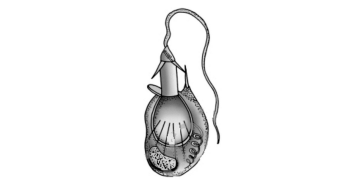
Correct Answer: (c)
The structure is a cnidocyte/cnidoblast, used by Cnidarians for defense and prey capture.
The structure is a cnidocyte/cnidoblast, used by Cnidarians for defense and prey capture.
Q99. Refer the given figures A, B, C and D and identify the option which shows their correct name.
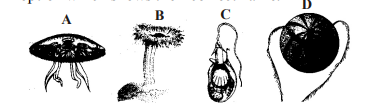
Correct Answer: (a)
A: Pleurobrachia, B: Cnidoblast, C: Aurelia, D: Adamsia.
A: Pleurobrachia, B: Cnidoblast, C: Aurelia, D: Adamsia.
Q100. In which one of the following, the genus name, its two characters and its class/phylum are correctly matched?
| Genus name | Two characters | Class/phylum |
|---|---|---|
| (a) Ascaris | (i) Body segmented (ii) Males and females distinct | Annelida |
| (b) Salamandra | (i) A tympanum represents ear (ii) Fertilization is internal | Amphibia |
| (c) Pteropus | (i) Skin possesses hair (ii) Viviparous | Mammalia |
| (d) Aurelia | (i) Cnidoblasts (ii) Organ level of organization | Coelenterata |
Correct Answer: (c)
Pteropus (bat) is a viviparous mammal with hair. Ascaris is unsegmented Aschelminthes; Salamander fertilization is usually internal but the tympanum is correct; Aurelia has tissue-level organization.
Pteropus (bat) is a viviparous mammal with hair. Ascaris is unsegmented Aschelminthes; Salamander fertilization is usually internal but the tympanum is correct; Aurelia has tissue-level organization.
Q101. Which of the following possesses poison sting and belongs to class chondrichthyes?
Correct Answer: (d)
Trygon (Stingray) possesses a poison sting.
Trygon (Stingray) possesses a poison sting.
Q102. The combination of a true coelom and repeating body segmentation allows the annelids to do which of the following?
Correct Answer: (a)
A fluid-filled coelom acting as a hydrostatic skeleton combined with metamerism allows precise movement.
A fluid-filled coelom acting as a hydrostatic skeleton combined with metamerism allows precise movement.
Q103. Which one of the following animals is correctly matched with its one characteristics and the taxon?
| Animal | Characteristic | Taxon |
|---|---|---|
| (a) Duckbilled platypus | Oviparous | Mammalian |
| (b) Millipede | Ventral nerve cord | Arachnida |
| (c) Sea Anemone | Triploblastic | Cnidaria |
| (d) Silverfish | Pectoral and Pelvic fins | Chordata |
Correct Answer: (a)
Duckbilled platypus is an oviparous mammal. Millipedes are Arthropods; Sea anemones are diploblastic; Silverfish is an insect (Arthropod).
Duckbilled platypus is an oviparous mammal. Millipedes are Arthropods; Sea anemones are diploblastic; Silverfish is an insect (Arthropod).
Q104. Few cnidarians like corals have a skeleton composed of
Correct Answer: (c)
Corals possess skeletons made of calcium carbonate.
Corals possess skeletons made of calcium carbonate.
Q105. Match the phylum given in column - I with their example given in column - II and choose the correct option.
| Column -I (Phylum) | Column- II (Examples) |
|---|---|
| A. Echinodermata | I. Ascidia, Doliolum |
| B. Hemichordata | II. Asterias, Ophiura |
| C. Urochordata | III. Branchiostoma |
| D. Cephalochordata | IV. Balanoglossus, Saccoglossus |
Correct Answer: (b)
A-II; B-IV; C-I; D-III.
A-II; B-IV; C-I; D-III.
Q106. Which of the following is a fresh water sponge?
Correct Answer: (c)
Spongilla is a freshwater sponge.
Spongilla is a freshwater sponge.
Q107. Which of the following features distinguish mammals from other vertebrates ?
Correct Answer: (b)
Mammary glands and hair are unique mammalian traits.
Mammary glands and hair are unique mammalian traits.
Q108. The given figures of animals (A & B) are distinguished on the basis of symmetry. Select the correct option which shows the type of symmetry and its description against the animals.
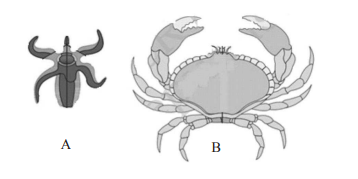
Correct Answer: (b)
The crab (B) shows bilateral symmetry where the body is divided into identical halves in only one plane.
The crab (B) shows bilateral symmetry where the body is divided into identical halves in only one plane.
Q109. Identify the figures A, B and C and choose the correct option.
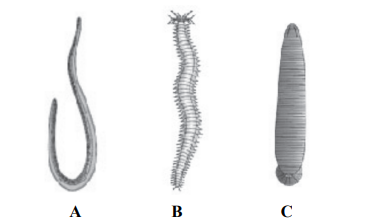
Correct Answer: (b)
A is a female Ascaris (straight tail), B is Nereis (with parapodia), C is leech (Hirudinaria).
A is a female Ascaris (straight tail), B is Nereis (with parapodia), C is leech (Hirudinaria).
Q110. Hemichordates have now been placed with the non chordates, close to echinoderms, because true
Correct Answer: (a)
They lack a true notochord (they have a stomochord).
They lack a true notochord (they have a stomochord).
Q111. In phylum echinodermata, the adult echinoderms are ______A_________ but larvae are _______B______ .
Correct Answer: (a)
Adult echinoderms are radial, while their larvae are bilateral.
Adult echinoderms are radial, while their larvae are bilateral.
Q112. Which one of the following is a matching pair of a body feature and the animal possessing it?
Correct Answer: (a)
Leech (Annelid) has a ventral nerve cord. Chordates have pharyngeal gill slits in embryo; Arthropods have dorsal hearts; Octopus lacks a post-anal tail.
Leech (Annelid) has a ventral nerve cord. Chordates have pharyngeal gill slits in embryo; Arthropods have dorsal hearts; Octopus lacks a post-anal tail.
Q113. Which one of the following features is common in silverfish, scorpion, dragonfly and prawn?
Correct Answer: (c)
All these arthropods share jointed appendages and chitinous exoskeletons.
All these arthropods share jointed appendages and chitinous exoskeletons.
Q114. Assertion: Biofortified crop is a source of higher protein, minerals and healthier fats.
Reason: Azolla is biofertiliser.
Reason: Azolla is biofertiliser.
Correct Answer: (b)
Both are true statements, but the biofertilizer status of Azolla doesn't explain the protein content of biofortified crops.
Both are true statements, but the biofertilizer status of Azolla doesn't explain the protein content of biofortified crops.
Q115. Which of the following characteristic is probably most responsible for the great diversification of insects on land?
Correct Answer: (d)
The chitinous exoskeleton provides protection and prevents desiccation on land.
The chitinous exoskeleton provides protection and prevents desiccation on land.
Q116. Hemichordates have now been placed with the non chordates, close to echinoderms, because true
Correct Answer: (a)
Hemichordates lack a true notochord (they have a stomochord).
Hemichordates lack a true notochord (they have a stomochord).
Q117. Which of the following statement(s) is/are correct?
(i) Animals in which the cells are arranged in two embryonic layers, an external ectoderm and an internal endoderm, are called diploblastic animals.
(ii) Notochord is an ectodermally derived rod like structure formed on the ventral side during embryonic development in some animals.
(iii) In some animals, the body cavity is not lined by mesoderm, instead, the mesoderm is present as scattered pouches in between the ectoderm and endoderm and such a body cavity is called pseudocoelom.
(i) Animals in which the cells are arranged in two embryonic layers, an external ectoderm and an internal endoderm, are called diploblastic animals.
(ii) Notochord is an ectodermally derived rod like structure formed on the ventral side during embryonic development in some animals.
(iii) In some animals, the body cavity is not lined by mesoderm, instead, the mesoderm is present as scattered pouches in between the ectoderm and endoderm and such a body cavity is called pseudocoelom.
Correct Answer: (c)
Statement (ii) is incorrect; notochord is mesodermally derived and formed on the dorsal side.
Statement (ii) is incorrect; notochord is mesodermally derived and formed on the dorsal side.
Q118. The given figures A, B, C and D are the examples of first true land vertebrates. They are dominant in mesozoic era and belong to phylum ‘X’. Identify ‘X’ and the animals which have four chambered heart.
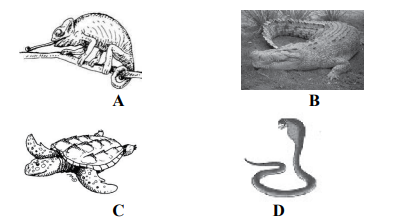
Correct Answer: (a)
X is Reptile. Animal B is a crocodile, which has a four-chambered heart.
X is Reptile. Animal B is a crocodile, which has a four-chambered heart.
Q119. Which of the following statements is without exception in sponges?
Correct Answer: (b)
High regenerative power is universal in sponges. Exceptions exist for others (Spongilla is fresh water, many are asymmetrical).
High regenerative power is universal in sponges. Exceptions exist for others (Spongilla is fresh water, many are asymmetrical).
Q120. Which of the following is not the common fundamental feature for animal classification?
Correct Answer: (b)
Pathway of water transport (water vascular system) is specific to certain phyla like Porifera and Echinodermata, not a common fundamental feature for all animals.
Pathway of water transport (water vascular system) is specific to certain phyla like Porifera and Echinodermata, not a common fundamental feature for all animals.
Q121. Which of the following is a poisonous snake?
Correct Answer: (d)
All listed are venomous snakes.
All listed are venomous snakes.
Q122. Which of the following is a connecting link between invertebrates and non-invertebrates?
Correct Answer: (b)
Balanoglossus (Hemichordata) is a link between non-chordates and chordates.
Balanoglossus (Hemichordata) is a link between non-chordates and chordates.
Q123. Match the animal name (column-I), with its characteristics (column-II), and the phylum/class (column-III) to which it belongs.
| Column- I | Column- II | Column -III |
|---|---|---|
| (a) Ichthyophis | Terrestrial | Reptilia |
| (b) Limulus | Body covered by chitinous exoskeleton | Pisces |
| (c) Adamsia | Radially symmetrical | Porifera |
| (d) Petromyzon | Ectoparasite | Cyclostomata |
Correct Answer: (d)
Petromyzon is an ectoparasite belonging to Cyclostomata.
Petromyzon is an ectoparasite belonging to Cyclostomata.
Q124. Which of the following statement(s) is/are correct regarding phylum coelenterata?
(i) They are aquatic, mostly marine, sessile or free swimming, radially symmetrical animals.
(ii) They have a central gastro-vascular cavity with a single opening called hypostome.
(iii) Digestion is extracellular and intracellular.
(iv) Examples are Sycon, Spongilla and Euspongia.
(i) They are aquatic, mostly marine, sessile or free swimming, radially symmetrical animals.
(ii) They have a central gastro-vascular cavity with a single opening called hypostome.
(iii) Digestion is extracellular and intracellular.
(iv) Examples are Sycon, Spongilla and Euspongia.
Correct Answer: (c)
Statement (iv) is incorrect as those are examples of Phylum Porifera.
Statement (iv) is incorrect as those are examples of Phylum Porifera.
Q125. Neopilina is a connecting link between Annelida and Mollusca and belongs to the class:
Correct Answer: (c)
Neopilina belongs to class Monoplacophora.
Neopilina belongs to class Monoplacophora.
Q126. Which of the following characteristic distinguish arthropoda from annelids and molluscs?
Correct Answer: (d)
Jointed appendages and chitinous exoskeletons are unique to arthropods.
Jointed appendages and chitinous exoskeletons are unique to arthropods.
Q127. Identify the figures and select the correct option.
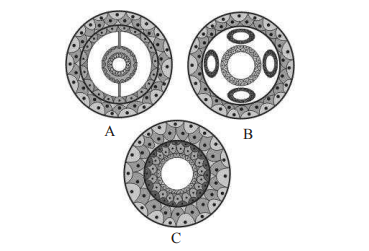
Correct Answer: (b)
A is a coelomate (lined by mesoderm), B is pseudocoelomate (scattered pouches), and C is acoelomate.
A is a coelomate (lined by mesoderm), B is pseudocoelomate (scattered pouches), and C is acoelomate.
Q128. Aquatic annelids (like Nereis) possess lateral appendages called ______________, which help in swimming.
Correct Answer: (b)
Annelids like Nereis use parapodia for swimming.
Annelids like Nereis use parapodia for swimming.
Q129. Heart is three - chambered in reptiles, except
Correct Answer: (d)
Crocodiles have a four-chambered heart.
Crocodiles have a four-chambered heart.
Q130. Match the features given in column I with their examples given in column II and choose the correct match from the option given below.
| Column-I (Features) | Column-II (Examples) |
|---|---|
| A. Pseudocoelomates | (I) Hydra, Adamsia |
| B. Diploblastic | (II) Ctenoplana, Aurelia |
| C. Cellular level of organization | (III) Ascaris, Wuchereria |
| D. Radial symmetry | (IV) Sycon, Spongilla |
| E. Metamerism | (V) Pheretima, Neries |
Correct Answer: (d)
A-III; B-II; C-IV; D-I; E-V.
A-III; B-II; C-IV; D-I; E-V.
Q131. Which of the following is a correct match of a phylum with its three examples?
Correct Answer: (b)
Loligo, Sepia, and Octopus are all molluscs. Match (a) has Enterobius (Aschelminthes); (c) has Pennatula (Cnidaria); (d) has Bonellia (Annelida).
Loligo, Sepia, and Octopus are all molluscs. Match (a) has Enterobius (Aschelminthes); (c) has Pennatula (Cnidaria); (d) has Bonellia (Annelida).
Q132. Match the following and select the correct option.
| List-I | List-II |
|---|---|
| A. Cyclostomes | I. Hemichordata |
| B. Aves | II. Urochordata |
| C. Tunicates | III. Agnatha |
| D. Balanoglossus | IV. Pisces |
| E. Osteichthyes | V. Tetrapod |
Correct Answer: (a)
A-III; B-V; C-II; D-I; E-IV.
A-III; B-V; C-II; D-I; E-IV.
Q133. Match the terms/feature given in column I with their examples given in column II and select the correct match from the option given below.
| Column-I (Term/Feature) | Column-II (Examples) |
|---|---|
| A. Gregarious pest | (I) Hirudinaria |
| B. Vector | (II) Planaria |
| C. Oviparous with indirect development | (III) Sepia |
| D. Metameres | (IV) Aedes |
| E. High regeneration capacity | (V) Locust |
Correct Answer: (d)
A-V; B-IV; C-III; D-I; E-II.
A-V; B-IV; C-III; D-I; E-II.