1. Loss of Biodiversity: The Great Simplification
Loss of biodiversity refers to the alarming decline in the variety of life at all levels—genes, species, and ecosystems—across our planet. It is not just about the disappearance of individual species, but the erosion of the complex, interconnected web of life that sustains Earth’s ecological balance.
This loss is primarily driven by human activities, often summarized by the acronym HIPPO:
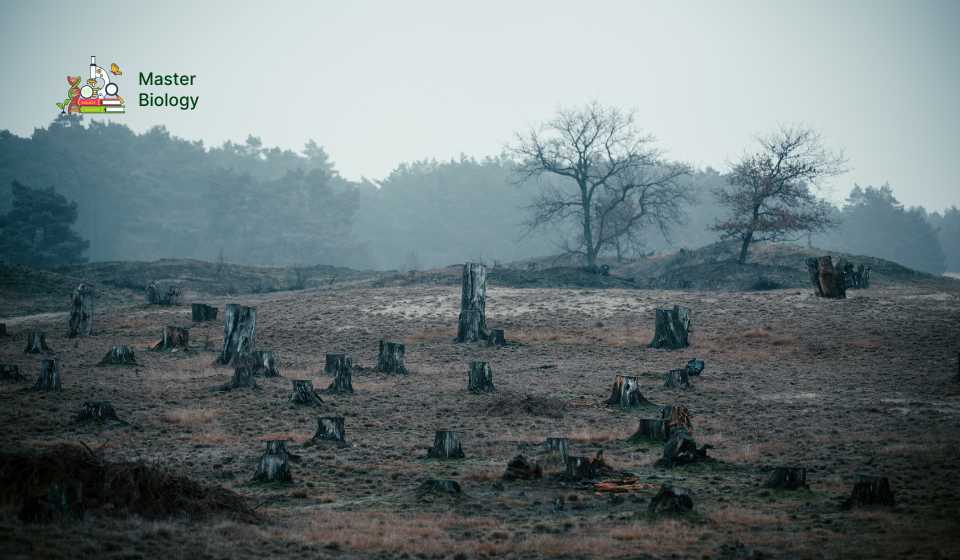
- H – Habitat Loss and Fragmentation: This is the single greatest cause. Forests are cleared for agriculture and urban development, wetlands are drained, and rivers are dammed. This destroys the homes of countless species and slices remaining habitats into small, isolated patches that are too small to support viable populations.
- I – Invasive Species: When non-native species are introduced (intentionally or accidentally), they can outcompete, prey upon, or bring diseases to native species that have no defenses against them. Examples include the brown tree snake devastating bird populations in Guam, or water hyacinth choking lakes and rivers in Africa.
- P – Pollution: Chemical pollutants from industry and agriculture, plastic waste in oceans and rivers, and excess nutrients causing algal “dead zones” all poison ecosystems and make them uninhabitable for many species.
- P – Population Growth (Human): The expanding human population increases the demand for resources, leading to greater conversion of wild spaces for housing, food, and energy production.
- O – Overexploitation: This involves harvesting species from the wild at rates faster than they can naturally replenish. This includes overfishing, illegal wildlife trade (poaching for ivory, rhino horn, and exotic pets), and unsustainable logging.
Climate Change is now a pervasive and accelerating threat multiplier, exacerbating all the factors above by altering temperatures, rainfall patterns, and sea levels, pushing species beyond their limits of adaptation.
2. Extinction: The Final End
Extinction is the complete and permanent disappearance of a species from Earth. It is a natural process; over 99% of all species that have ever lived are now extinct. However, the current rate of extinction is 100 to 1,000 times higher than the natural background rate, leading scientists to declare that we are in the midst of a sixth mass extinction event—the first one caused by a single species: humans.
There are different types of extinction:
- Background Extinction: The standard, low-rate of species loss that occurs naturally over geological time.
- Mass Extinction: A catastrophic, widespread event where a large percentage of all life forms go extinct in a relatively short geological period.
- Local Extinction: When a species disappears from a specific area or region but still exists elsewhere.
- Ecological Extinction: When a species’ population is so reduced that it no longer interacts significantly with other species in its ecosystem.
- Functional Extinction: When so few individuals of a species remain that it can no longer perform its ecological role (e.g., a predator that no longer controls prey populations).
3. Threatened Organisms: On the Brink
To categorize the risk of extinction for specific species, the International Union for Conservation of Nature (IUCN) has developed a set of quantitative criteria. Species facing a high risk of extinction in the wild are collectively known as Threatened Species. This category is comprised of three main groups:
- Critically Endangered (CR): These species face an extremely high risk of extinction in the immediate future. They are often reduced to a few small, fragmented populations. Examples include the Javan Rhino, the Sumatran Orangutan, and the Vaquita (a porpoise).
- Endangered (EN): These species face a very high risk of extinction in the near future. They are not Critically Endangered but are still in grave danger. Examples include the Blue Whale, the Asian Elephant, and the Snow Leopard.
- Vulnerable (VU): These species face a high risk of extinction in the medium-term future. They are often suffering from population decline or habitat loss. Examples include the Polar Bear, the Giant Panda, and the African Penguin.
Two other crucial categories are:
- Extinct in the Wild (EW): Species that only survive in captivity, cultivation, or as a naturalized population outside its historic range. The only hope for these species is reintroduction. Example: The Scimitar-Horned Oryx (though reintroduction efforts are underway).
- Near Threatened (NT): Species that are close to qualifying for a threatened category and may be considered threatened in the near future without conservation efforts.
- Least Concern (LC): Species that are widespread and abundant.
4. The Red Data Book: The Barometer of Life
The Red Data Book is a comprehensive inventory and a vital tool for conservation. It is a public document, created and maintained by the IUCN, that catalogues the global conservation status of biological species. Its official title is the IUCN Red List of Threatened Species.
Its Purpose and Importance:
- Identification and Tracking: It identifies which species are threatened with extinction and tracks changes in their status over time. This allows scientists to measure the health of the world’s biodiversity.
- A Guide for Conservation Action: It provides a scientific basis to inform and prioritize conservation policies and actions. Governments, NGOs, and funding agencies use the Red List to decide where to focus their efforts and resources.
- Raising Public Awareness: The stark categories of “Endangered” and “Critically Endangered” serve as a powerful communication tool to educate the public and policymakers about the plight of species.
- Informing Policy: The data from the Red List is used to implement international agreements like the Convention on International Trade in Endangered Species (CITES), which regulates the wildlife trade.
How it Works:
The IUCN uses a rigorous, scientific process to assess species against a set of precise criteria, including:
- Population size and rate of decline.
- Geographic range size and fragmentation.
- Number of mature, reproducing individuals.
Based on how a species scores against these criteria, it is placed into one of the threatened categories (CR, EN, VU) or other categories.
From “Red Lists” to “Red Data Books”:
While the IUCN Red List is the global standard, many individual countries and states create their own Red Data Books. These national lists focus on the species within a particular political boundary, which is crucial for national conservation planning. For example, a species that is “Least Concern” globally might be “Critically Endangered” in a specific country where it is at the edge of its range.
In summary, the Loss of Biodiversity is a critical crisis driven by human activity, leading to a dramatic acceleration in the rate of Extinction. To understand and combat this, scientists use systems like the IUCN’s threatened categories to identify species at risk, with the Red Data Book (IUCN Red List) serving as the essential, authoritative source that guides global conservation efforts and sounds the alarm for life on Earth.