Of the countless stories written into the fabric of life on Earth, few are as compelling as those of diversification, adaptation, and the improbable rise of a species that would come to question its own origins. The narrative of evolution is not a simple, linear tale but a complex tapestry woven from threads of chance, necessity, and environmental change. By examining the grand pattern of adaptive radiation and the specific, intricate case study of human evolution, we can glimpse the profound processes that shape the living world.
The Engine of Diversity: Adaptive Radiation
Imagine a single ancestor, a generalist species, arriving in a landscape of vacant opportunity—a chain of newly formed islands, a lake system, or a world recovering from a mass extinction. What follows is often an evolutionary explosion known as adaptive radiation.
Adaptive radiation is the process in which organisms diversify rapidly from an ancestral species into a multitude of new forms, particularly when a change in the environment makes new resources available, creates new challenges, or opens new environmental niches.
Key Characteristics of Adaptive Radiation:
- Common Ancestry: All the species in the radiation share a recent common ancestor.
- Phenotype-Environment Correlation: There is a strong link between the physical characteristics (morphology) of the organisms and the environments they inhabit or the resources they use.
- Trait Utility: The adaptive traits (e.g., beak shape, limb structure) are functionally suited to the niche the organism occupies.
- Rapid Speciation: The process involves a relatively fast burst of speciation events.
The Classic Example: Darwin’s Finches
No discussion of adaptive radiation is complete without the finches of the Galápagos Islands. A single species of finch likely arrived from the South American mainland millions of years ago. With no competing bird species and a variety of unoccupied niches—different islands with different food sources—the finches diversified.
- Seed-eaters evolved strong, crushing beaks for cracking hard nuts.
- Insect-eaters developed slender, pointed beaks for probing crevices.
- Cactus-feeders grew long, sharp beaks to access fruit and flowers.
- One even uses twigs as tools!
This divergence in beak morphology is a direct outcome of natural selection acting on heritable variation, driven by competition and the specific dietary opportunities on each island. It is a stunningly clear example of how a single lineage can branch out to exploit a wide range of ecological roles.
Other Notable Radiations:
- The Cichlid Fishes of the African Great Lakes: In Lakes Victoria, Malawi, and Tanganyika, hundreds of cichlid species have evolved from a few founders, with spectacular diversity in color, body shape, and feeding habits (scale-eaters, snail-crushers, eye-biters).
- The Hawaiian Honeycreepers: These birds radiated to fill niches occupied by other bird families elsewhere, evolving a breathtaking array of beak shapes for sipping nectar, cracking seeds, or digging for insects.
- The Marsupials of Australia: Isolated from placental mammals, marsupials underwent their own adaptive radiation, producing wolf-like predators (Tasmanian tiger), burrowing grazers (wombats), and gliding possums—all ecological equivalents to placental mammals on other continents.
The Uniquely Reflective Lineage: Human Evolution
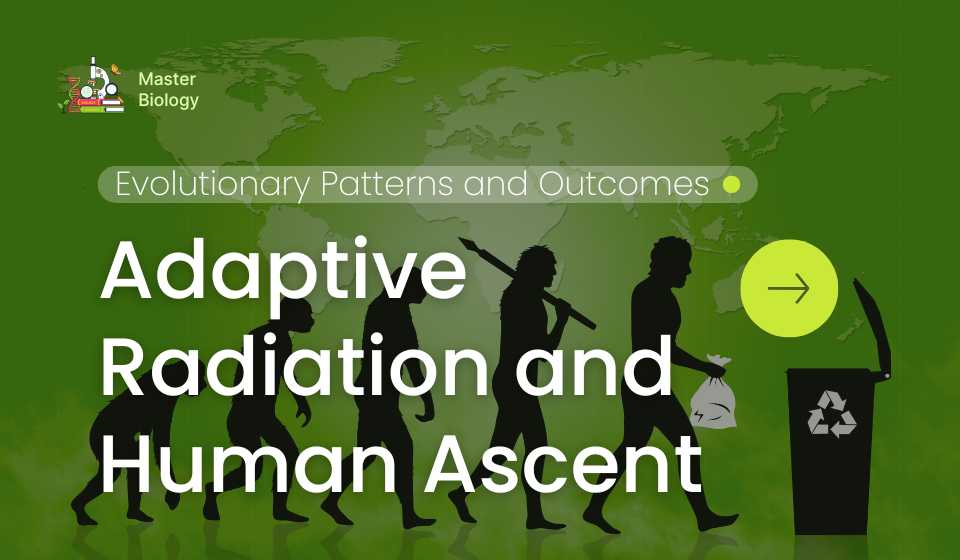
Human evolution is, in many ways, a specialized and deeply intricate adaptive radiation within the primate lineage. It is the story of a branch that diverged from our closest living relatives, the chimpanzees and bonobos, around 6-7 million years ago, and embarked on a path defined by a unique suite of adaptations.
Major Transitions in the Hominin Lineage:
Hominins are the group consisting of modern humans, extinct human species, and our immediate ancestors.
- Bipedalism: The First Step
The most fundamental defining feature of early hominins was the shift to habitual bipedalism—walking upright on two legs. This adaptation, evident in fossils like Ardipithecus and Australopithecus (e.g., the famous “Lucy”), freed the hands for carrying food and tools, improved visibility over tall grasses, and may have been more energetically efficient for long-distance travel. The skeletal changes—a bowl-shaped pelvis, angled femur, and forward-placed foramen magnum (where the spine connects to the skull)—are clear hallmarks in the fossil record. - Encephalization: The Growth of the Brain
While early hominins walked upright, their brain size was still ape-like. A significant increase in cranial capacity began with the genus Homo around 2.4 million years ago. Homo habilis, the “handy man,” had a larger brain and is associated with the first stone tools (Oldowan industry). This trend accelerated with Homo erectus, who had a brain size approaching that of modern humans. This encephalization was likely driven by complex social interaction, tool use, and the cognitive demands of hunting and gathering. - Tool Technology: The Extension of the Body
The progression of tool technology provides a tangible record of our cognitive evolution. From simple, sharpened stone flakes (Oldowan) to sophisticated, symmetrical hand-axes (Acheulean) associated with Homo erectus, and eventually to the specialized blades and projectile points of later Homo sapiens, tools became more complex and efficient. This technological arms race was a key factor in allowing hominins to process a wider range of foods and spread across the globe. - Control of Fire and Social Cooperation
The ability to control fire, strong evidence for which appears with Homo erectus, was a revolutionary step. It provided warmth, protection from predators, a means to cook food (which made it more digestible and may have further fueled brain growth), and a social focal point for communities. - The Rise of Homo sapiens and Symbolic Thought
Anatomically modern humans, Homo sapiens, appeared in Africa around 300,000 years ago. What truly sets our species apart is the explosion of symbolic thought and cultural complexity, evident from around 100,000 years ago. This “cognitive revolution” is marked by:- Complex Language: The ability to communicate abstract concepts.
- Art and Ornamentation: Cave paintings (like those at Chauvet and Lascaux), carved figurines, and jewelry.
- Ritual and Belief: Intentional burial of the dead with grave goods.
- Innovative Technology: Sewing needles for clothing, sophisticated weaponry.
This cultural capacity allowed Homo sapiens to adapt to virtually every terrestrial environment on Earth, outcompeting other hominin species like the Neanderthals and Denisovans, with whom we also interbred.
Convergent Themes and Divergent Outcomes
While adaptive radiation and human evolution may seem like distinct topics, they are governed by the same evolutionary principles:
- Natural Selection: In both cases, the environment acts as a filtering mechanism. For the finches, it was seed hardness; for hominins, it was the challenges of the savanna, climate change, and social competition.
- Adaptation: Form follows function. The finch’s beak and the human’s bipedal skeleton are both exquisite adaptations to specific ecological pressures.
- Speciation and Extinction: Both narratives are filled with branching lineages and dead ends. Most hominin species, like most branches in any adaptive radiation, went extinct. We are the sole survivors of our particular radiated branch.
The outcomes, however, are profoundly different. A typical adaptive radiation fills available ecological space with morphologically diverse species. The human evolutionary pathway resulted in a different kind of dominance: not through physical specialization, but through cognitive and cultural generalization. Our “niche” is not defined by a specific food source or habitat, but by our ability to manipulate the environment itself through technology, culture, and cooperation.
Conclusion
The study of evolutionary patterns reveals a world of dynamic change and relentless innovation. Adaptive radiation demonstrates life’s remarkable ability to explode into diversity when given the opportunity. Human evolution, a singular chapter in this grand story, highlights a different but equally powerful evolutionary strategy: the rise of intelligence, culture, and technology as primary adaptive tools. Together, they illustrate that evolution is not a march toward “progress,” but a continuous, branching experiment in survival—an experiment that, in our case, produced a species capable of unraveling the very story of its own creation.