Q1. The bonds that hold two complementary strands of DNA together are
Correct Answer: (a)
The two strands of the DNA double helix are held together by hydrogen bonds between the complementary nitrogenous bases (two between A and T, and three between G and C). Phosphodiester bonds, in contrast, link the sugars and phosphates within a single strand.
The two strands of the DNA double helix are held together by hydrogen bonds between the complementary nitrogenous bases (two between A and T, and three between G and C). Phosphodiester bonds, in contrast, link the sugars and phosphates within a single strand.
Q2. The synthesis of telomeres
Correct Answer: (d)
Telomerase is a specialized reverse transcriptase. It prevents chromosome shortening by extending the ends of chromosomes (telomeres) using its own internal RNA molecule as a template to add repetitive DNA sequences.
Telomerase is a specialized reverse transcriptase. It prevents chromosome shortening by extending the ends of chromosomes (telomeres) using its own internal RNA molecule as a template to add repetitive DNA sequences.
Q3. The genome of the frog Xenopus tropicalis is tetraploid. What challenges might this present for genome sequencing and assembly?
Correct Answer: (a)
Tetraploidy means the organism has four copies of each chromosome. During the assembly of shotgun sequences, it becomes extremely difficult to distinguish between very similar alleles on different homologous chromosomes or to correctly identify duplicated regions, leading to complex 'mismatches' in the computer assembly.
Tetraploidy means the organism has four copies of each chromosome. During the assembly of shotgun sequences, it becomes extremely difficult to distinguish between very similar alleles on different homologous chromosomes or to correctly identify duplicated regions, leading to complex 'mismatches' in the computer assembly.
Q4. The enzyme ________ adds new nucleotides to both the lagging and leading strand, and the enzyme ________ joins the discontinuous segments synthesized on the lagging strand.
Correct Answer: (c)
(C) DNA polymerase adds new nucleotides to the growing DNA strand, and ligase joins the discontinuous segments of DNA on the lagging strand together. Choice (A) is incorrect because helicase unwinds the DNA double helix and topoisomerase relieves the supercoiling created by this unwinding. Since topoisomerase relieves supercoiling, choice (B) is also incorrect. Choice (D) is incorrect because helicase is responsible for unwinding the DNA double helix, not adding new nucleotides.
(C) DNA polymerase adds new nucleotides to the growing DNA strand, and ligase joins the discontinuous segments of DNA on the lagging strand together. Choice (A) is incorrect because helicase unwinds the DNA double helix and topoisomerase relieves the supercoiling created by this unwinding. Since topoisomerase relieves supercoiling, choice (B) is also incorrect. Choice (D) is incorrect because helicase is responsible for unwinding the DNA double helix, not adding new nucleotides.
Q5. An open reading frame (ORF) is distinguished by the presence of
Correct Answer: (d)
An ORF is a portion of a DNA sequence that has the potential to be translated into a protein. It is identified by computer algorithms looking for a start codon (AUG), followed by a sequence of triplets representing amino acids, and ending with a stop codon (UAA, UAG, or UGA).
An ORF is a portion of a DNA sequence that has the potential to be translated into a protein. It is identified by computer algorithms looking for a start codon (AUG), followed by a sequence of triplets representing amino acids, and ending with a stop codon (UAA, UAG, or UGA).
Q6. The genome of a newly discovered virus has the following nucleotide composition: 22% guanine, 16% cytosine, 34% adenine, and 28% uracil. Based on the nucleotide composition, the genome of this virus is most likely made of which of the following?
Correct Answer: (c)
(C) Since the question states that the virus’s genome contains uracil, choices (C) and (D) are possibilities since RNA contains uracil and DNA does not; thus, rule out choices (A) and (B). However, since the percentage of guanine does not equal the percentage of cytosine and the percentage of adenine does not equal the percentage of uracil, it cannot be a double-stranded virus, so choice (C) is the best answer.
(C) Since the question states that the virus’s genome contains uracil, choices (C) and (D) are possibilities since RNA contains uracil and DNA does not; thus, rule out choices (A) and (B). However, since the percentage of guanine does not equal the percentage of cytosine and the percentage of adenine does not equal the percentage of uracil, it cannot be a double-stranded virus, so choice (C) is the best answer.
Q7. Repression in the trp operon and induction in the lac operon are both mechanisms that
Correct Answer: (b)
Operon systems function as sophisticated feedback loops. They allow bacteria to sense their chemical environment and adjust enzyme production accordingly—turning off biosynthetic pathways when the product is abundant (repression) or turning on catabolic pathways when a nutrient source is available (induction).
Operon systems function as sophisticated feedback loops. They allow bacteria to sense their chemical environment and adjust enzyme production accordingly—turning off biosynthetic pathways when the product is abundant (repression) or turning on catabolic pathways when a nutrient source is available (induction).
Q8. Which of the following processes is most similar in prokaryotes and eukaryotes?
Correct Answer: (d)
(D) Both prokaryotes and eukaryotes use RNA polymerase for transcription. Only eukaryotes have alternative splicing of exons and the addition of a 3′ poly-A tail and a 5′ GTP cap to mRNA, so choices (A), (B), and (C) are incorrect.
(D) Both prokaryotes and eukaryotes use RNA polymerase for transcription. Only eukaryotes have alternative splicing of exons and the addition of a 3′ poly-A tail and a 5′ GTP cap to mRNA, so choices (A), (B), and (C) are incorrect.
Q9. Which of the following is a key difference between inducible operons and repressible operons?
Correct Answer: (c)
(C) In inducible operons, repressor proteins can bind to the operator without the assistance of a corepressor. In repressible operons, the presence of a corepressor is required in order for the repressor protein to bind to the operator sequence. Choice (A) is incorrect because both inducible and repressible operons have promoter sequences. Operator sequences are present in both inducible and repressible operons, so choice (B) is incorrect. RNA polymerase does not require a corepressor in order to bind to the promoter in both inducible and repressible operons, so choice (D) is incorrect.
(C) In inducible operons, repressor proteins can bind to the operator without the assistance of a corepressor. In repressible operons, the presence of a corepressor is required in order for the repressor protein to bind to the operator sequence. Choice (A) is incorrect because both inducible and repressible operons have promoter sequences. Operator sequences are present in both inducible and repressible operons, so choice (B) is incorrect. RNA polymerase does not require a corepressor in order to bind to the promoter in both inducible and repressible operons, so choice (D) is incorrect.
Q10. In the cell cycle, cyclin proteins are produced in concert with the cycle. This likely involves
Correct Answer: (a)
Cyclin levels must change rapidly. This is achieved by timing the transcription of cyclin genes at specific checkpoints and, once their task is complete, marking the proteins with ubiquitin for rapid destruction by the proteasome.
Cyclin levels must change rapidly. This is achieved by timing the transcription of cyclin genes at specific checkpoints and, once their task is complete, marking the proteins with ubiquitin for rapid destruction by the proteasome.
Q11. Approximately how many genes are there in the human genome?
Correct Answer: (c)
The completion of the Human Genome Project revealed that humans have far fewer genes than previously estimated. The consensus is that the human genome contains approximately 20,000 to 25,000 protein-coding genes.
The completion of the Human Genome Project revealed that humans have far fewer genes than previously estimated. The consensus is that the human genome contains approximately 20,000 to 25,000 protein-coding genes.
Q12. Eukaryotic mRNAs differ from prokaryotic mRNAs in that they
Correct Answer: (c)
Eukaryotic genes contain non-coding introns that are interspersed between coding exons. Because these introns are removed during RNA processing, the mature mRNA sequence is not a direct linear match of the genomic DNA sequence, making it non-collinear.
Eukaryotic genes contain non-coding introns that are interspersed between coding exons. Because these introns are removed during RNA processing, the mature mRNA sequence is not a direct linear match of the genomic DNA sequence, making it non-collinear.
Q13. What information can be obtained from a DNA microarray?
Correct Answer: (c)
A DNA microarray (gene chip) is used to monitor the expression levels of thousands of genes simultaneously. By hybridizing labeled cDNA from a sample to the chip, researchers can determine which genes are 'on' or 'off' in a particular cell type or under specific conditions.
A DNA microarray (gene chip) is used to monitor the expression levels of thousands of genes simultaneously. By hybridizing labeled cDNA from a sample to the chip, researchers can determine which genes are 'on' or 'off' in a particular cell type or under specific conditions.
Q14. Which of the following is NOT part of the Watson–Crick model of the structure of DNA?
Correct Answer: (b)
A fundamental aspect of the Watson-Crick model is that the two strands of the double helix are antiparallel, meaning they run in opposite directions (one 5′-to-3′ and the other 3′-to-5′).
A fundamental aspect of the Watson-Crick model is that the two strands of the double helix are antiparallel, meaning they run in opposite directions (one 5′-to-3′ and the other 3′-to-5′).
Q15. Comparative proteomics involves comparing the proteomes from two different cells or tissues... In some cancer cells the retinoblastoma protein often appears to have a slightly higher molecular mass... even though the proteins have identical amino acid sequences. What might explain this difference?
Correct Answer: (a)
If the amino acid sequence is identical, the core polypeptide is the same. An increase in molecular mass is typically caused by post-translational modifications, where chemical groups (like phosphates or carbohydrate chains) are covalently added to the protein after it has been synthesized on the ribosome.
If the amino acid sequence is identical, the core polypeptide is the same. An increase in molecular mass is typically caused by post-translational modifications, where chemical groups (like phosphates or carbohydrate chains) are covalently added to the protein after it has been synthesized on the ribosome.
Q16. The splicing process
Correct Answer: (c)
Splicing involves the removal of non-coding introns and the joining of coding exons. Through alternative splicing, different combinations of exons can be joined, allowing a single eukaryotic gene to code for multiple distinct mRNA transcripts and, consequently, multiple different proteins.
Splicing involves the removal of non-coding introns and the joining of coding exons. Through alternative splicing, different combinations of exons can be joined, allowing a single eukaryotic gene to code for multiple distinct mRNA transcripts and, consequently, multiple different proteins.
Q17. If the activity of DNA ligase were removed from replication, this would have a greater effect on
Correct Answer: (a)
DNA ligase is essential for joining the Okazaki fragments produced during discontinuous synthesis on the lagging strand. Without ligase, the leading strand might still be synthesized as a long continuous piece, but the lagging strand would remain as a series of disconnected fragments.
DNA ligase is essential for joining the Okazaki fragments produced during discontinuous synthesis on the lagging strand. Without ligase, the leading strand might still be synthesized as a long continuous piece, but the lagging strand would remain as a series of disconnected fragments.
Q18. In comparing gene expression in prokaryotes and eukaryotes
Correct Answer: (d)
Eukaryotes can produce multiple proteins from a single gene through alternative splicing. Additionally, in both domains, the mRNA is colinear with the protein, meaning the linear sequence of nucleotides in the mRNA (post-splicing in eukaryotes) corresponds directly to the linear sequence of amino acids in the protein.
Eukaryotes can produce multiple proteins from a single gene through alternative splicing. Additionally, in both domains, the mRNA is colinear with the protein, meaning the linear sequence of nucleotides in the mRNA (post-splicing in eukaryotes) corresponds directly to the linear sequence of amino acids in the protein.
Q19. If genomics found that the same mutation was present in all cancer patients that failed to respond to a particular treatment, what might be concluded?
Correct Answer: (a)
A consistent correlation between a specific genetic mutation and a physiological outcome (like drug resistance) strongly suggests a causative link. Identifying such mutations is the basis for pharmacogenomics, allowing doctors to tailor treatments to a patient's specific genetic profile.
A consistent correlation between a specific genetic mutation and a physiological outcome (like drug resistance) strongly suggests a causative link. Identifying such mutations is the basis for pharmacogenomics, allowing doctors to tailor treatments to a patient's specific genetic profile.
Q20. The basic mechanism of DNA replication is semiconservative with two new molecules,
Correct Answer: (c)
Semiconservative replication means that when the DNA double helix is copied, the two parental strands separate. Each original strand then serves as a template for the synthesis of a new complementary strand, resulting in two daughter molecules that each consist of one old and one new strand.
Semiconservative replication means that when the DNA double helix is copied, the two parental strands separate. Each original strand then serves as a template for the synthesis of a new complementary strand, resulting in two daughter molecules that each consist of one old and one new strand.
Q21. What would be the minimum number of nucleotides required to code for a protein made of 12 amino acids?
Correct Answer: (c)
(C) Each amino acid is coded by a three base pair codon, so a protein made of 12 amino acids would require a minimum of 12 × 3 = 36 nucleotides. Choice (A) is incorrect because 6 nucleotides would only contain two codons. Since 3 nucleotides are required to make a codon, 12 nucleotides would only be sufficient to code for four amino acids, so choice (B) is incorrect. While 48 nucleotides might code for 12 amino acids if there were introns to be removed, 48 is not the minimum number of nucleotides required, so choice (D) is incorrect.
(C) Each amino acid is coded by a three base pair codon, so a protein made of 12 amino acids would require a minimum of 12 × 3 = 36 nucleotides. Choice (A) is incorrect because 6 nucleotides would only contain two codons. Since 3 nucleotides are required to make a codon, 12 nucleotides would only be sufficient to code for four amino acids, so choice (B) is incorrect. While 48 nucleotides might code for 12 amino acids if there were introns to be removed, 48 is not the minimum number of nucleotides required, so choice (D) is incorrect.
Q22. Under which of the following conditions will transcription of the lac operon be at its highest level?
Correct Answer: (b)
(B) Lactose is an inducer for the lac operon, so high levels of lactose would pull the repressor protein off of the operator, increasing expression of the lac operon. Low levels of glucose would cause higher levels of cyclic AMP, which would activate the catabolite activator protein, upregulating the expression of the lac operon. Low levels of lactose would not result in high levels of lac operon expression, so choices (A) and (C) are incorrect. Glucose is the preferred food source for bacteria, so if high levels of glucose were present, the bacteria would not express the lac operon at a high level until all of the glucose was metabolized. Therefore, choice (D) is incorrect.
(B) Lactose is an inducer for the lac operon, so high levels of lactose would pull the repressor protein off of the operator, increasing expression of the lac operon. Low levels of glucose would cause higher levels of cyclic AMP, which would activate the catabolite activator protein, upregulating the expression of the lac operon. Low levels of lactose would not result in high levels of lac operon expression, so choices (A) and (C) are incorrect. Glucose is the preferred food source for bacteria, so if high levels of glucose were present, the bacteria would not express the lac operon at a high level until all of the glucose was metabolized. Therefore, choice (D) is incorrect.
Q23. Why do retroviruses have a high mutation rate?
Correct Answer: (d)
(D) Retroviruses use reverse transcriptase to make a DNA copy of their RNA genome. Reverse transcriptase has a very high error rate, so many mutations occur.
(D) Retroviruses use reverse transcriptase to make a DNA copy of their RNA genome. Reverse transcriptase has a very high error rate, so many mutations occur.
Q24. An inversion will
Correct Answer: (b)
An inversion reverses the orientation of a segment of a chromosome. If the breaks that allow the inversion to happen occur between genes, the genes themselves remain intact and functional. However, if a breakpoint occurs within a coding sequence, it will disrupt the gene and likely result in a mutant phenotype.
An inversion reverses the orientation of a segment of a chromosome. If the breaks that allow the inversion to happen occur between genes, the genes themselves remain intact and functional. However, if a breakpoint occurs within a coding sequence, it will disrupt the gene and likely result in a mutant phenotype.
Q25. Hershey and Chase used radioactive phosphorus and sulfur to
Correct Answer: (b)
Hershey and Chase used radioactive isotopes to distinguish between DNA and protein in bacteriophages. 32P specifically labels DNA because protein contains almost no phosphorus, while 35S specifically labels proteins because DNA contains no sulfur.
Hershey and Chase used radioactive isotopes to distinguish between DNA and protein in bacteriophages. 32P specifically labels DNA because protein contains almost no phosphorus, while 35S specifically labels proteins because DNA contains no sulfur.
Q26. You have mutants that all affect the same biochemical pathway. If feeding an intermediate in the pathway supports growth, this tells you that the enzyme encoded by the affected gene
Correct Answer: (b)
If providing a specific intermediate allows the mutant organism to grow, it indicates that the metabolic machinery downstream of that intermediate is intact. Therefore, the genetic block (the faulty enzyme) must occur at a step prior to the synthesis of that intermediate.
If providing a specific intermediate allows the mutant organism to grow, it indicates that the metabolic machinery downstream of that intermediate is intact. Therefore, the genetic block (the faulty enzyme) must occur at a step prior to the synthesis of that intermediate.
Q27. The enzyme ________ unwinds the double helix of DNA, and the enzyme ________ relieves the supercoiling created by this unwinding.
Correct Answer: (a)
(A) Helicase unwinds the double helix of DNA, and topoisomerase relieves the stress caused by the supercoiling (created when helicase unwinds the DNA). Choices (B) and (C) are incorrect because DNA polymerase adds new nucleotides; it does not have an unwinding function. Choices (C) and (D) are incorrect because ligase joins together short segments of DNA created on the lagging strand by discontinuous replication.
(A) Helicase unwinds the double helix of DNA, and topoisomerase relieves the stress caused by the supercoiling (created when helicase unwinds the DNA). Choices (B) and (C) are incorrect because DNA polymerase adds new nucleotides; it does not have an unwinding function. Choices (C) and (D) are incorrect because ligase joins together short segments of DNA created on the lagging strand by discontinuous replication.
Q28. A mechanism of control in E. coli ... involves pausing of ribosomes, allowing a transcription terminator to form in the mRNA. In eukaryotic fission yeast, this mechanism should
Correct Answer: (c)
The mechanism described is attenuation, which relies on the simultaneous occurrence of transcription and translation (coupling). In eukaryotes, these processes are separated in space and time by the nuclear envelope; transcription must be completed and processed in the nucleus before translation can begin in the cytoplasm.
The mechanism described is attenuation, which relies on the simultaneous occurrence of transcription and translation (coupling). In eukaryotes, these processes are separated in space and time by the nuclear envelope; transcription must be completed and processed in the nucleus before translation can begin in the cytoplasm.
Q29. What is the central dogma of molecular biology?
Correct Answer: (c)
The central dogma, first articulated by Francis Crick, describes the fundamental flow of genetic information within a biological system. It states that DNA is transcribed into RNA, which is then translated into a functional protein sequence.
The central dogma, first articulated by Francis Crick, describes the fundamental flow of genetic information within a biological system. It states that DNA is transcribed into RNA, which is then translated into a functional protein sequence.
Q30. The lac repressor, the trp repressor, and CAP are all
Correct Answer: (c)
These regulatory proteins are allosteric, meaning they change their conformation and DNA-binding affinity when they bind to a specific small effector molecule (like lactose, tryptophan, or cAMP). This allows the proteins to toggle between 'on' and 'off' states in response to environmental conditions.
These regulatory proteins are allosteric, meaning they change their conformation and DNA-binding affinity when they bind to a specific small effector molecule (like lactose, tryptophan, or cAMP). This allows the proteins to toggle between 'on' and 'off' states in response to environmental conditions.
Q31. What is an STS?
Correct Answer: (a)
A Sequence Tagged Site (STS) is a short DNA sequence that occurs only once in the genome and whose location and base sequence are known. Because they are unique landmarks, they can be easily identified by PCR and used to orient and align different genomic clones during mapping.
A Sequence Tagged Site (STS) is a short DNA sequence that occurs only once in the genome and whose location and base sequence are known. Because they are unique landmarks, they can be easily identified by PCR and used to orient and align different genomic clones during mapping.
Q32. What is a proteome?
Correct Answer: (c)
While the genome is the complete set of genetic material, the proteome is the entire set of proteins expressed by a cell, tissue, or organism at a given time under specific conditions. It is much more complex and dynamic than the genome.
While the genome is the complete set of genetic material, the proteome is the entire set of proteins expressed by a cell, tissue, or organism at a given time under specific conditions. It is much more complex and dynamic than the genome.
Q33. Why is repetitive DNA a problem in shotgun sequencing and genome assembly?
Correct Answer: (b)
Shotgun sequencing involves breaking the genome into random fragments and then using a computer to find overlaps. Repetitive DNA sequences (like transposons) appear identical, making it impossible for the assembly software to determine which specific location in the genome a particular fragment belongs to.
Shotgun sequencing involves breaking the genome into random fragments and then using a computer to find overlaps. Repetitive DNA sequences (like transposons) appear identical, making it impossible for the assembly software to determine which specific location in the genome a particular fragment belongs to.
Q34. Which of the following is NOT a component of DNA?
Correct Answer: (a)
DNA nucleotides consist of a phosphate group, a 5-carbon sugar (deoxyribose), and one of four nitrogenous bases: adenine, thymine, cytosine, or guanine. Uracil is a pyrimidine found specifically in RNA, where it replaces thymine.
DNA nucleotides consist of a phosphate group, a 5-carbon sugar (deoxyribose), and one of four nitrogenous bases: adenine, thymine, cytosine, or guanine. Uracil is a pyrimidine found specifically in RNA, where it replaces thymine.
Q35. Regulatory proteins interact with DNA by
Correct Answer: (d)
Most regulatory proteins possess specific structural motifs (such as the helix-turn-helix or leucine zipper) that allow them to fit into the major groove of the DNA. This allows the protein to recognize and bind to specific sequences of base pairs through hydrogen bonding without having to unzip the DNA strands.
Most regulatory proteins possess specific structural motifs (such as the helix-turn-helix or leucine zipper) that allow them to fit into the major groove of the DNA. This allows the protein to recognize and bind to specific sequences of base pairs through hydrogen bonding without having to unzip the DNA strands.
Q36. Which of the following catalyzes the formation of peptide bonds during translation?
Correct Answer: (c)
(C) rRNA catalyzes the formation of peptide bonds during translation. Choice (A) is incorrect because RNA polymerase performs transcription, not translation. mRNA brings the genetic information from the nucleus to the ribosome but does not catalyze the formation of peptide bonds, so choice (B) is incorrect. Choice (D) is incorrect because tRNA serves as an “adaptor” molecule that brings the amino acids that correspond to each codon to the ribosome.
(C) rRNA catalyzes the formation of peptide bonds during translation. Choice (A) is incorrect because RNA polymerase performs transcription, not translation. mRNA brings the genetic information from the nucleus to the ribosome but does not catalyze the formation of peptide bonds, so choice (B) is incorrect. Choice (D) is incorrect because tRNA serves as an “adaptor” molecule that brings the amino acids that correspond to each codon to the ribosome.
Q37. One common feature of all DNA polymerases is that they
Correct Answer: (b)
DNA polymerases can only add new nucleotides to the 3′ hydroxyl group of a pre-existing chain. Consequently, DNA synthesis always occurs in the 5′-to-3′ direction. They also require a primer to initiate synthesis.
DNA polymerases can only add new nucleotides to the 3′ hydroxyl group of a pre-existing chain. Consequently, DNA synthesis always occurs in the 5′-to-3′ direction. They also require a primer to initiate synthesis.
Q38. The antibiotic tetracycline inhibits bacterial growth by blocking the binding of tRNAs to the ribosome. Which of the following processes is most directly affected by tetracycline?
Correct Answer: (c)
(C) If tRNAs could not bind to the ribosome, the initiation of translation could not occur. Choices (A) and (B) are incorrect because transcription and exon splicing do not involve the ribosome, so an antibiotic that interferes with ribosomes would not affect those processes. The export of proteins from the cell involves the Golgi bodies and vesicles, so choice (D) is incorrect.
(C) If tRNAs could not bind to the ribosome, the initiation of translation could not occur. Choices (A) and (B) are incorrect because transcription and exon splicing do not involve the ribosome, so an antibiotic that interferes with ribosomes would not affect those processes. The export of proteins from the cell involves the Golgi bodies and vesicles, so choice (D) is incorrect.
Q39. In eukaryotes, binding of RNA polymerase to a promoter requires the action of
Correct Answer: (b)
Eukaryotic RNA polymerase cannot bind to a promoter on its own. It requires a set of general (or basal) transcription factors to assemble a transcription initiation complex at the TATA box, which then recruits and positions the polymerase correctly.
Eukaryotic RNA polymerase cannot bind to a promoter on its own. It requires a set of general (or basal) transcription factors to assemble a transcription initiation complex at the TATA box, which then recruits and positions the polymerase correctly.
Q40. N-15, also known as heavy nitrogen, is an isotope of nitrogen that is heavier than the isotope that is typically found in nature, N-14. Meselson and Stahl allowed parent DNA (containing N-15) to replicate in the presence of N-14.
After two rounds of DNA replication, which of the following results would support the statement “DNA replication is semiconservative”?
After two rounds of DNA replication, which of the following results would support the statement “DNA replication is semiconservative”?
Correct Answer: (d)
(D) As shown in Figure 15.3, after two rounds of DNA replication, 50% of the DNA molecules would contain strands with only N-14. The other 50% of the DNA molecules would contain one strand with only N-15 and one strand with only N-14. Choice (A) describes the result of only one round of DNA replication if DNA replication was semiconservative, not the result of two rounds of DNA replication. So (A) is incorrect. Conservative DNA replication would produce the result described in choice (B), so (B) is incorrect. Choice (C) is incorrect because it describes the result if no replication was happening at all.
(D) As shown in Figure 15.3, after two rounds of DNA replication, 50% of the DNA molecules would contain strands with only N-14. The other 50% of the DNA molecules would contain one strand with only N-15 and one strand with only N-14. Choice (A) describes the result of only one round of DNA replication if DNA replication was semiconservative, not the result of two rounds of DNA replication. So (A) is incorrect. Conservative DNA replication would produce the result described in choice (B), so (B) is incorrect. Choice (C) is incorrect because it describes the result if no replication was happening at all.
Q41. What is the relationship between mutations and evolution?
Correct Answer: (b)
Mutations are the ultimate source of genetic variation. By altering DNA sequences, they create new alleles within a population. While most mutations are neutral or harmful, occasionally some provide an advantage, and these variations serve as the raw material for natural selection and evolution to act upon.
Mutations are the ultimate source of genetic variation. By altering DNA sequences, they create new alleles within a population. While most mutations are neutral or harmful, occasionally some provide an advantage, and these variations serve as the raw material for natural selection and evolution to act upon.
Q42. If one strand of a DNA is 5′ ATCGTTAAGCGAGTCA 3′, then the complementary strand would be:
Correct Answer: (c)
The complementary strand must be antiparallel and follow base-pairing rules (A-T, C-G). For 5′ ATCGTTAAGCGAGTCA 3′, the complement is 3′ TAGCAATTCGCTCAGT 5′, which is written as 5′ TGACTCGCTTAACGAT 3′.
The complementary strand must be antiparallel and follow base-pairing rules (A-T, C-G). For 5′ ATCGTTAAGCGAGTCA 3′, the complement is 3′ TAGCAATTCGCTCAGT 5′, which is written as 5′ TGACTCGCTTAACGAT 3′.
Q43. Humans can generate over 1012 different antibody proteins, but humans have fewer than 25,000 genes. Which of the following best explains how this is possible?
Correct Answer: (b)
(B) Eukaryotes can use alternative splicing of exons to generate multiple mRNA transcripts from one gene, which can lead to the production of multiple proteins from one gene. Humans do not acquire new genes when infected with pathogens, so choice (A) is incorrect. The error rate of RNA polymerase is not responsible for generating new transcripts for antibody proteins, so choice (C) is incorrect. Choice (D) is incorrect because Golgi bodies modify proteins, not RNA transcripts.
(B) Eukaryotes can use alternative splicing of exons to generate multiple mRNA transcripts from one gene, which can lead to the production of multiple proteins from one gene. Humans do not acquire new genes when infected with pathogens, so choice (A) is incorrect. The error rate of RNA polymerase is not responsible for generating new transcripts for antibody proteins, so choice (C) is incorrect. Choice (D) is incorrect because Golgi bodies modify proteins, not RNA transcripts.
Q44. The following figure depicts steps in the flow of genetic information in a eukaryotic cell.
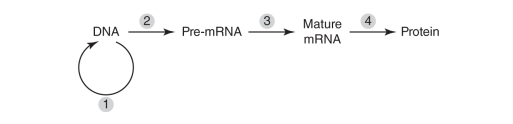
During which step will spliceosomes remove introns?
During which step will spliceosomes remove introns?
Correct Answer: (c)
(C) Introns are removed from the pre-mRNA to help form the mature mRNA, which is represented by step 3. Step 1 represents DNA replication, so choice (A) is incorrect. Transcription is represented by step 2, so choice (B) is incorrect. Choice (D) is incorrect because step 4 represents translation.
(C) Introns are removed from the pre-mRNA to help form the mature mRNA, which is represented by step 3. Step 1 represents DNA replication, so choice (A) is incorrect. Transcription is represented by step 2, so choice (B) is incorrect. Choice (D) is incorrect because step 4 represents translation.
Q45. ENCODE defines function in a biochemical way. Which of the following genomics approaches could increase the accuracy of ENCODE’s estimate of genome functionality in humans?
Correct Answer: (a)
Functional genomics involves the large-scale study of gene expression (transcriptomics) and protein function (proteomics). By observing which parts of the 'non-coding' DNA are actually biochemically active or transcribed, researchers can refine estimates of how much of the genome is truly functional.
Functional genomics involves the large-scale study of gene expression (transcriptomics) and protein function (proteomics). By observing which parts of the 'non-coding' DNA are actually biochemically active or transcribed, researchers can refine estimates of how much of the genome is truly functional.
Q46. In eukaryotes, the regulation of gene expression occurs
Correct Answer: (c)
Eukaryotic gene expression is highly complex and regulated at multiple stages. This includes chromatin remodeling, the regulation of transcription initiation, and extensive post-transcriptional mechanisms such as alternative splicing, mRNA degradation, and translational control.
Eukaryotic gene expression is highly complex and regulated at multiple stages. This includes chromatin remodeling, the regulation of transcription initiation, and extensive post-transcriptional mechanisms such as alternative splicing, mRNA degradation, and translational control.
Q47. What is a BLAST search?
Correct Answer: (b)
BLAST (Basic Local Alignment Search Tool) is a computer algorithm used to compare a primary biological sequence (DNA or protein) with a library or database of sequences. It identifies homologous sequences in other species, which helps researchers infer the function of a new gene based on known genes.
BLAST (Basic Local Alignment Search Tool) is a computer algorithm used to compare a primary biological sequence (DNA or protein) with a library or database of sequences. It identifies homologous sequences in other species, which helps researchers infer the function of a new gene based on known genes.
Q48. The lac operon is controlled by two main proteins. These proteins
Correct Answer: (c)
The lac operon uses dual control. The lac repressor provides negative control (inhibiting transcription when lactose is absent), while the Catabolite Activator Protein (CAP) provides positive control (enhancing transcription when glucose levels are low and cAMP levels are high).
The lac operon uses dual control. The lac repressor provides negative control (inhibiting transcription when lactose is absent), while the Catabolite Activator Protein (CAP) provides positive control (enhancing transcription when glucose levels are low and cAMP levels are high).
Q49. A scientist inserts a eukaryotic gene directly into a bacteria’s genome. However, the protein produced by the bacteria from the eukaryotic gene does not have the same amino acid sequence as the protein produced from the gene in eukaryotic cells. Which of the following best explains this?
Correct Answer: (b)
(B) Eukaryotic genes contain introns; prokaryotic genes do not. Prokaryotes do not have the spliceosomes required to remove introns. So if a eukaryotic gene was directly inserted into a bacterial genome, the bacteria would likely try to translate the introns and produce a different protein. Choice (A) is incorrect because prokaryotes and eukaryotes do use the same genetic code. While prokaryotes do not have a nucleus, they do contain RNA polymerase and can perform transcription, so choice (C) is incorrect. Choice (D) is incorrect because rough endoplasmic reticulum is not required for the translation of all proteins.
(B) Eukaryotic genes contain introns; prokaryotic genes do not. Prokaryotes do not have the spliceosomes required to remove introns. So if a eukaryotic gene was directly inserted into a bacterial genome, the bacteria would likely try to translate the introns and produce a different protein. Choice (A) is incorrect because prokaryotes and eukaryotes do use the same genetic code. While prokaryotes do not have a nucleus, they do contain RNA polymerase and can perform transcription, so choice (C) is incorrect. Choice (D) is incorrect because rough endoplasmic reticulum is not required for the translation of all proteins.
Q50. The codon CCA could be mutated to produce
Correct Answer: (a)
The codon CCA codes for the amino acid proline. Because of the redundancy of the genetic code, a mutation that changes the third base (e.g., to CCC, CCU, or CCG) will still result in the insertion of proline. This is called a silent mutation because it does not alter the resulting protein sequence.
The codon CCA codes for the amino acid proline. Because of the redundancy of the genetic code, a mutation that changes the third base (e.g., to CCC, CCU, or CCG) will still result in the insertion of proline. This is called a silent mutation because it does not alter the resulting protein sequence.
Q51. The Meselson and Stahl experiment used a density label to be able to
Correct Answer: (c)
By growing bacteria in heavy nitrogen (15N) and then switching them to light nitrogen (14N), Meselson and Stahl could distinguish original parental DNA from newly synthesized DNA based on their different densities when centrifuged in a cesium chloride gradient.
By growing bacteria in heavy nitrogen (15N) and then switching them to light nitrogen (14N), Meselson and Stahl could distinguish original parental DNA from newly synthesized DNA based on their different densities when centrifuged in a cesium chloride gradient.
Q52. What was the key finding from Griffith’s experiments using live and heat-killed pathogenic bacteria?
Correct Answer: (d)
Griffith discovered the phenomenon of transformation. He observed that when non-pathogenic (rough) bacteria were mixed with heat-killed pathogenic (smooth) bacteria, some 'transforming principle' from the dead cells converted the live non-pathogenic cells into lethal pathogenic ones.
Griffith discovered the phenomenon of transformation. He observed that when non-pathogenic (rough) bacteria were mixed with heat-killed pathogenic (smooth) bacteria, some 'transforming principle' from the dead cells converted the live non-pathogenic cells into lethal pathogenic ones.
Q53. Energy is required to separate the two strands of the DNA double helix because of the hydrogen bonds between the base pairs. Based on the base pair content, which of the following would require the least amount of energy to separate the strands of DNA?
Correct Answer: (a)
(A) Since it has the lowest G-C content and since each G-C pair has three hydrogen bonds between them (instead of the two hydrogen bonds that are between each A-T pair), choice (A) would require the least amount of energy to break those hydrogen bonds and separate the DNA strands. Choices (B), (C), and (D) are all incorrect because they have higher G-C contents than choice (A).
(A) Since it has the lowest G-C content and since each G-C pair has three hydrogen bonds between them (instead of the two hydrogen bonds that are between each A-T pair), choice (A) would require the least amount of energy to break those hydrogen bonds and separate the DNA strands. Choices (B), (C), and (D) are all incorrect because they have higher G-C contents than choice (A).
Q54. Successful DNA synthesis requires all of the following except
Correct Answer: (b)
Replication requires helicase to unwind DNA, primase to create RNA primers, and ligase to seal fragments. Endonucleases, which cut DNA in the middle of a strand, are primarily involved in DNA repair and recombination rather than the fundamental process of replication.
Replication requires helicase to unwind DNA, primase to create RNA primers, and ligase to seal fragments. Endonucleases, which cut DNA in the middle of a strand, are primarily involved in DNA repair and recombination rather than the fundamental process of replication.
Q55. The difference in leading- versus lagging-strand synthesis is a consequence of
Correct Answer: (c)
DNA is antiparallel and polymerase can only synthesize in the 5′-to-3′ direction. As the replication fork opens, one strand (leading) can be synthesized continuously, while the other (lagging) must be made in short fragments (Okazaki fragments) moving away from the fork.
DNA is antiparallel and polymerase can only synthesize in the 5′-to-3′ direction. As the replication fork opens, one strand (leading) can be synthesized continuously, while the other (lagging) must be made in short fragments (Okazaki fragments) moving away from the fork.
Q56. Adding a methyl group to a DNA nucleotide is a type of ________ and will make a DNA sequence much less likely to be transcribed.
Correct Answer: (b)
(B) Methylating nucleotides is a type of epigenetic change to DNA. Choice (A) is incorrect because mutations change the DNA sequences and do not involve methylation. An aneuploidy is an atypical number of chromosomes, so choice (C) is incorrect. Choice (D) is incorrect because transposition involves the movement or rearrangement of pieces of DNA and does not involve methylation.
(B) Methylating nucleotides is a type of epigenetic change to DNA. Choice (A) is incorrect because mutations change the DNA sequences and do not involve methylation. An aneuploidy is an atypical number of chromosomes, so choice (C) is incorrect. Choice (D) is incorrect because transposition involves the movement or rearrangement of pieces of DNA and does not involve methylation.
Q57. Which of the following is true regarding microarray technology and cancer?
Correct Answer: (d)
Microarrays allow for 'molecular profiling' of tumors. They can identify the specific tissue of origin, distinguish between subtypes of cancer that look identical under a microscope, track how gene expression changes during treatment, and identify expression patterns associated with metastasis (spreading).
Microarrays allow for 'molecular profiling' of tumors. They can identify the specific tissue of origin, distinguish between subtypes of cancer that look identical under a microscope, track how gene expression changes during treatment, and identify expression patterns associated with metastasis (spreading).
Q58. If I synthesized a protein by chemically linking amino acids together and added a few extra amino acids that made the protein more stable and therefore better at treating a disease, what argument would support a patent for the protein?
Correct Answer: (b)
While natural DNA sequences cannot be patented, synthetic biological products that are modified by human intervention to have new utility (like increased stability) are generally considered patentable inventions because they do not occur naturally in that specific form.
While natural DNA sequences cannot be patented, synthetic biological products that are modified by human intervention to have new utility (like increased stability) are generally considered patentable inventions because they do not occur naturally in that specific form.
Q59. Which sequences in bacterial operons are noncoding sequences?
Correct Answer: (a)
(A) The operators and promoters of operons both serve as noncoding sequences to which regulatory proteins bind. Repressor proteins bind to the operator, and RNA polymerase binds to the promoter. Genes for both regulatory proteins and structural proteins contain sequences that code for proteins, so choices (B), (C), and (D) are incorrect.
(A) The operators and promoters of operons both serve as noncoding sequences to which regulatory proteins bind. Repressor proteins bind to the operator, and RNA polymerase binds to the promoter. Genes for both regulatory proteins and structural proteins contain sequences that code for proteins, so choices (B), (C), and (D) are incorrect.
Q60. Regulation by small RNAs and alternative splicing are similar in that both
Correct Answer: (d)
Both alternative splicing and small RNA regulation (like miRNA) are post-transcriptional events. Splicing involves the spliceosome (an RNA/protein complex), and small RNAs function as part of a larger protein complex (such as RISC) to inhibit gene expression.
Both alternative splicing and small RNA regulation (like miRNA) are post-transcriptional events. Splicing involves the spliceosome (an RNA/protein complex), and small RNAs function as part of a larger protein complex (such as RISC) to inhibit gene expression.
Q61. When mutations that affected DNA replication were isolated, two kinds were found. One class put an immediate halt to replication, whereas the other put a much slower stop to the process. The first class affects functions at the replication fork. The second class affects functions necessary for
Correct Answer: (c)
Mutation in elongation factors (like polymerase) stops replication immediately because the fork can no longer move. Mutations in initiation factors allow the cell to finish the round of replication it has already started but prevent it from beginning any subsequent rounds, leading to a slower cessation of the process in a population.
Mutation in elongation factors (like polymerase) stops replication immediately because the fork can no longer move. Mutations in initiation factors allow the cell to finish the round of replication it has already started but prevent it from beginning any subsequent rounds, leading to a slower cessation of the process in a population.
Q62. The enzyme that forms peptide bonds is called peptidyl transferase because it transfers
Correct Answer: (b)
During the elongation phase of translation, peptidyl transferase (a ribozyme) catalyzes the formation of a peptide bond. It does this by transferring the entire growing polypeptide chain from the tRNA in the P site to the single amino acid attached to the tRNA in the A site.
During the elongation phase of translation, peptidyl transferase (a ribozyme) catalyzes the formation of a peptide bond. It does this by transferring the entire growing polypeptide chain from the tRNA in the P site to the single amino acid attached to the tRNA in the A site.
Q63. Which of the following does not affect the phenotype of an organism?
Correct Answer: (d)
(D) The phenotype of an organism is determined by the genes that are expressed, the level of expression of those genes, and the timing of the expression of those genes. The phenotype is not affected by the number of genes in the organism, so choice (D) is the only choice that does not affect the phenotype of an organism.
(D) The phenotype of an organism is determined by the genes that are expressed, the level of expression of those genes, and the timing of the expression of those genes. The phenotype is not affected by the number of genes in the organism, so choice (D) is the only choice that does not affect the phenotype of an organism.
Q64. Prokaryotic genomes are packaged into ________ chromosomes in the ________.
Correct Answer: (a)
(A) Prokaryotes have circular chromosomes in the nucleoid region of their cells. Choice (B) is incorrect because prokaryotes do not have a nucleus. Choices (C) and (D) are incorrect because prokaryotes do not have linear chromosomes; eukaryotes have linear chromosomes.
(A) Prokaryotes have circular chromosomes in the nucleoid region of their cells. Choice (B) is incorrect because prokaryotes do not have a nucleus. Choices (C) and (D) are incorrect because prokaryotes do not have linear chromosomes; eukaryotes have linear chromosomes.
Q65. What is the amino acid sequence that would be translated from the following gene? (Use Figure 16.4 to answer this question.)
3′ AAT CGT TTC AAT CAA 5′
3′ AAT CGT TTC AAT CAA 5′
Correct Answer: (b)
(B) The mRNA transcribed from the DNA sequence in the problem would be 5′ UUA GCA AAG UUA GUU 3′. Using Figure 16.4 (a standard codon chart), the amino acid sequence that would be translated from that mRNA would be Leu-Ala-Lys-Leu-Val.
(B) The mRNA transcribed from the DNA sequence in the problem would be 5′ UUA GCA AAG UUA GUU 3′. Using Figure 16.4 (a standard codon chart), the amino acid sequence that would be translated from that mRNA would be Leu-Ala-Lys-Leu-Val.
Q66. Which of the following are small, circular pieces of extranuclear DNA that can be found in either prokaryotes or eukaryotes?
Correct Answer: (c)
(C) Plasmids are small, circular pieces of DNA outside of the nucleus that can be found in prokaryotes and eukaryotes. Okazaki fragments are the short segments of DNA created by discontinuous replication on the lagging strand of DNA, so choice (A) is incorrect. Choice (B) is incorrect because RNA primers are used to give DNA polymerase a place to start adding nucleotides to on the growing DNA strand. Linear chromosomes are found in eukaryotes, not prokaryotes, and they are in the nucleus (they are not extranuclear). Thus, choice (D) is also incorrect.
(C) Plasmids are small, circular pieces of DNA outside of the nucleus that can be found in prokaryotes and eukaryotes. Okazaki fragments are the short segments of DNA created by discontinuous replication on the lagging strand of DNA, so choice (A) is incorrect. Choice (B) is incorrect because RNA primers are used to give DNA polymerase a place to start adding nucleotides to on the growing DNA strand. Linear chromosomes are found in eukaryotes, not prokaryotes, and they are in the nucleus (they are not extranuclear). Thus, choice (D) is also incorrect.
Q67. Which of the following correctly represents the mRNA sequence that would be transcribed from the DNA sequence 3′ ACC GGT AAG TTC 5′?
Correct Answer: (d)
(D) The transcribed mRNA would be antiparallel to the given DNA sequence, so it would start with the 5′ end. Also, in RNA, uracil replaces thymine, and the other base-pairing rules are the same as those found in DNA. Choices (A) and (B) are incorrect because the mRNA is not antiparallel to the DNA sequence. Choices (A) and (C) are incorrect because they contain thymine, which does not appear in RNA.
(D) The transcribed mRNA would be antiparallel to the given DNA sequence, so it would start with the 5′ end. Also, in RNA, uracil replaces thymine, and the other base-pairing rules are the same as those found in DNA. Choices (A) and (B) are incorrect because the mRNA is not antiparallel to the DNA sequence. Choices (A) and (C) are incorrect because they contain thymine, which does not appear in RNA.
Q68. Which of the following are proteins in eukaryotes that bind to regulatory switches and upregulate gene expression?
Correct Answer: (a)
(A) Activators are proteins in eukaryotes that bind to regulatory switches and upregulate gene expression. Choice (B) is incorrect because repressors downregulate gene expression. Transcription factors help RNA polymerase bind to the promoter and do not bind to regulatory switches, so choice (C) is incorrect. Mediators are proteins that allow communication between the regulatory proteins involved in gene expression; they do not bind to regulatory switches, so choice (D) is incorrect.
(A) Activators are proteins in eukaryotes that bind to regulatory switches and upregulate gene expression. Choice (B) is incorrect because repressors downregulate gene expression. Transcription factors help RNA polymerase bind to the promoter and do not bind to regulatory switches, so choice (C) is incorrect. Mediators are proteins that allow communication between the regulatory proteins involved in gene expression; they do not bind to regulatory switches, so choice (D) is incorrect.
Q69. RNA polymerase binds to a _________ to initiate _________.
Correct Answer: (b)
Transcription begins when the enzyme RNA polymerase identifies and binds to a specific regulatory sequence on the DNA called a promoter. This binding signals the start of the gene and allows the enzyme to begin synthesizing an RNA copy.
Transcription begins when the enzyme RNA polymerase identifies and binds to a specific regulatory sequence on the DNA called a promoter. This binding signals the start of the gene and allows the enzyme to begin synthesizing an RNA copy.
Q70. In the genetic code, one codon
Correct Answer: (d)
The genetic code is based on triplets of nucleotides known as codons. Each codon consists of three bases and is highly specific, meaning that one particular codon specifies exactly one amino acid (though multiple different codons may specify the same amino acid, a property known as degeneracy).
The genetic code is based on triplets of nucleotides known as codons. Each codon consists of three bases and is highly specific, meaning that one particular codon specifies exactly one amino acid (though multiple different codons may specify the same amino acid, a property known as degeneracy).
Q71. A repressible operon in bacteria codes for the genes required to produce the amino acid serine. Serine functions as a corepressor for the operon. If serine is present in the bacteria’s environment, which of the following is most likely?
Correct Answer: (d)
(D) Corepressors help the repressor protein bind to the operator. Since serine is a corepressor, its presence would result in increased binding of the repressor protein to the operator. Choice (A) is incorrect because repressible operons are usually anabolic, not catabolic, in function and thus they would not be involved in the digestion of serine. Since serine functions as a corepressor, the presence of serine would reduce the expression of the operon and would not result in increased levels of serine. Thus, choice (B) is incorrect. The presence of the corepressor does not affect the production of the repressor protein, so choice (C) is incorrect.
(D) Corepressors help the repressor protein bind to the operator. Since serine is a corepressor, its presence would result in increased binding of the repressor protein to the operator. Choice (A) is incorrect because repressible operons are usually anabolic, not catabolic, in function and thus they would not be involved in the digestion of serine. Since serine functions as a corepressor, the presence of serine would reduce the expression of the operon and would not result in increased levels of serine. Thus, choice (B) is incorrect. The presence of the corepressor does not affect the production of the repressor protein, so choice (C) is incorrect.
Q72. Eukaryotic transcription differs from prokaryotic in that
Correct Answer: (b)
Unlike prokaryotes, which typically use a single type of RNA polymerase to transcribe all classes of RNA, eukaryotes possess three distinct RNA polymerases (I, II, and III). Each is specialized for transcribing different sets of genes, such as mRNA, rRNA, and tRNA.
Unlike prokaryotes, which typically use a single type of RNA polymerase to transcribe all classes of RNA, eukaryotes possess three distinct RNA polymerases (I, II, and III). Each is specialized for transcribing different sets of genes, such as mRNA, rRNA, and tRNA.
Q73. A genetic map provides
Correct Answer: (b)
Genetic maps are constructed based on recombination frequencies between genes. They illustrate the relative order of genes and the distances between them on a chromosome, rather than providing the actual nucleotide sequence or physical distance in base pairs.
Genetic maps are constructed based on recombination frequencies between genes. They illustrate the relative order of genes and the distances between them on a chromosome, rather than providing the actual nucleotide sequence or physical distance in base pairs.
Q74. In prokaryotes, control of gene expression usually occurs at the
Correct Answer: (c)
In prokaryotic organisms, the most efficient point of regulation is the initiation of transcription. By controlling whether or not an RNA polymerase can bind to a promoter and begin synthesis, the cell avoids the metabolic cost of producing unnecessary mRNA and protein molecules.
In prokaryotic organisms, the most efficient point of regulation is the initiation of transcription. By controlling whether or not an RNA polymerase can bind to a promoter and begin synthesis, the cell avoids the metabolic cost of producing unnecessary mRNA and protein molecules.
Q75. In E. coli, induction in the lac operon and repression in the trp operon are both examples of
Correct Answer: (a)
Both systems are classified as negative control because the primary regulatory protein is a repressor that acts as an 'off-switch.' In the lac operon, the system is induced when the inducer removes the repressor; in the trp operon, it is repressed when the corepressor activates the repressor.
Both systems are classified as negative control because the primary regulatory protein is a repressor that acts as an 'off-switch.' In the lac operon, the system is induced when the inducer removes the repressor; in the trp operon, it is repressed when the corepressor activates the repressor.
Q76. The experiments with nutritional mutants in Neurospora by Beadle and Tatum provided evidence that
Correct Answer: (d)
Beadle and Tatum used X-rays to create mutations in Neurospora crassa and observed that these mutations caused deficiencies in specific metabolic pathways. Their work established the 'one gene-one enzyme' hypothesis, demonstrating that the primary function of a gene is to dictate the production of a specific enzyme.
Beadle and Tatum used X-rays to create mutations in Neurospora crassa and observed that these mutations caused deficiencies in specific metabolic pathways. Their work established the 'one gene-one enzyme' hypothesis, demonstrating that the primary function of a gene is to dictate the production of a specific enzyme.
Q77. Not every change in the DNA sequence results in a change in the amino acid sequence of a protein. Which of the following explains this?
Correct Answer: (b)
(B) The genetic code contains more than one codon for most amino acids, so a change in a codon does not necessarily result in a change in the amino acid for which it codes. While changes in the environment can affect the expression of genes, the statement in choice (A) does not explain why changes in the DNA sequence may not result in changes in the amino acid found in the final protein. Thus, choice (A) is incorrect. Ribosomes do not have a proofreading function, so choice (C) is incorrect. Differential gene expression results in cell differentiation but not changes in the DNA sequence, so choice (D) is incorrect.
(B) The genetic code contains more than one codon for most amino acids, so a change in a codon does not necessarily result in a change in the amino acid for which it codes. While changes in the environment can affect the expression of genes, the statement in choice (A) does not explain why changes in the DNA sequence may not result in changes in the amino acid found in the final protein. Thus, choice (A) is incorrect. Ribosomes do not have a proofreading function, so choice (C) is incorrect. Differential gene expression results in cell differentiation but not changes in the DNA sequence, so choice (D) is incorrect.
Q78. The arabinose operon is an inducible operon that codes for the genes required to digest the sugar arabinose. Arabinose functions as an inducer molecule for the operon. If arabinose is present in the bacteria’s environment, which of the following is most likely?
Correct Answer: (a)
(A) In inducible operons, the inducer molecule binds to the repressor protein, which prevents the repressor protein from binding to the operator, increasing the level of expression of the operon. Choice (B) is incorrect because inducible operons are usually catabolic, not anabolic, and would not be involved in the production of arabinose. The presence of the inducer does not affect the production of the repressor protein, so choice (C) is incorrect. The presence of the inducer results in decreased binding of the repressor protein to the operator, so choice (D) is also incorrect.
(A) In inducible operons, the inducer molecule binds to the repressor protein, which prevents the repressor protein from binding to the operator, increasing the level of expression of the operon. Choice (B) is incorrect because inducible operons are usually catabolic, not anabolic, and would not be involved in the production of arabinose. The presence of the inducer does not affect the production of the repressor protein, so choice (C) is incorrect. The presence of the inducer results in decreased binding of the repressor protein to the operator, so choice (D) is also incorrect.
Q79. During translation, the codon in mRNA is actually “read” by
Correct Answer: (c)
The 'reading' of the genetic code during translation is a physical interaction. The mRNA codon is recognized by the complementary anticodon of a charged tRNA molecule through hydrogen bonding, which brings the specific amino acid into position for protein synthesis.
The 'reading' of the genetic code during translation is a physical interaction. The mRNA codon is recognized by the complementary anticodon of a charged tRNA molecule through hydrogen bonding, which brings the specific amino acid into position for protein synthesis.
Q80. Which of the following correctly describes a structural difference between DNA and RNA?
Correct Answer: (b)
(B) Only DNA contains thymine, and only RNA contains uracil. Choice (A) is incorrect because RNA has a five-carbon sugar (ribose), not a four-carbon sugar. Both DNA and RNA contain adenine and cytosine, so choice (C) is incorrect. Choice (D) is incorrect because DNA is typically double-stranded and RNA is typically single-stranded.
(B) Only DNA contains thymine, and only RNA contains uracil. Choice (A) is incorrect because RNA has a five-carbon sugar (ribose), not a four-carbon sugar. Both DNA and RNA contain adenine and cytosine, so choice (C) is incorrect. Choice (D) is incorrect because DNA is typically double-stranded and RNA is typically single-stranded.
Q81. Which of the following methods of horizontal transmission of genetic material would be most likely to lead to new variants of the COVID-19 virus?
Correct Answer: (b)
(B) Transduction involves the transfer of genetic material by viral transmission. Transformation, transposition, and conjugation do not involve viruses, so choices (A), (C), and (D) are incorrect.
(B) Transduction involves the transfer of genetic material by viral transmission. Transformation, transposition, and conjugation do not involve viruses, so choices (A), (C), and (D) are incorrect.
Q82. Chargaff studied the composition of DNA from different sources and found that
Correct Answer: (c)
Chargaff’s rules established that in any double-stranded DNA molecule, the concentration of adenine is always equal to thymine, and the concentration of guanine is always equal to cytosine. This regularity provided a vital clue for the Watson-Crick model of base pairing.
Chargaff’s rules established that in any double-stranded DNA molecule, the concentration of adenine is always equal to thymine, and the concentration of guanine is always equal to cytosine. This regularity provided a vital clue for the Watson-Crick model of base pairing.
Q83. In the trp operon, the repressor binds to DNA
Correct Answer: (b)
The trp operon is a repressible system that manages biosynthesis. Tryptophan acts as a corepressor. When tryptophan is abundant in the cell, it binds to the repressor protein, enabling it to bind to the operator and shut down the production of more tryptophan.
The trp operon is a repressible system that manages biosynthesis. Tryptophan acts as a corepressor. When tryptophan is abundant in the cell, it binds to the repressor protein, enabling it to bind to the operator and shut down the production of more tryptophan.
Q84. Specific transcription factors in eukaryotes interact with enhancers, which may be a long distance from the promoter. These transcription factors then
Correct Answer: (c)
Enhancers are distal regulatory elements. Transcription factors bound to these enhancers interact with the general transcription machinery at the promoter by triggering a change in DNA architecture; the intervening DNA loops out, bringing the distant enhancer-bound proteins into physical contact with the initiation complex.
Enhancers are distal regulatory elements. Transcription factors bound to these enhancers interact with the general transcription machinery at the promoter by triggering a change in DNA architecture; the intervening DNA loops out, bringing the distant enhancer-bound proteins into physical contact with the initiation complex.
Q85. Why does DNA replication proceed continuously on one strand of the double helix but discontinuously on the other strand of the double helix?
Correct Answer: (d)
(D) Because the two strands of DNA are antiparallel and because DNA polymerase can only add new nucleotides in the 5′ to 3′ direction, replication must occur differently on the two strands of DNA. On the strand of the double helix that is oriented in the 3′ to 5′ direction, DNA polymerase can perform replication continuously, adding a new antiparallel strand one nucleotide at a time in the 5′ to 3′ direction. On the opposite strand of the double helix that is oriented in the 5′ to 3′ direction, DNA polymerase must work in the opposite direction, performing replication discontinuously. Choices (A), (B), and (C) are all incorrect statements.
(D) Because the two strands of DNA are antiparallel and because DNA polymerase can only add new nucleotides in the 5′ to 3′ direction, replication must occur differently on the two strands of DNA. On the strand of the double helix that is oriented in the 3′ to 5′ direction, DNA polymerase can perform replication continuously, adding a new antiparallel strand one nucleotide at a time in the 5′ to 3′ direction. On the opposite strand of the double helix that is oriented in the 5′ to 3′ direction, DNA polymerase must work in the opposite direction, performing replication discontinuously. Choices (A), (B), and (C) are all incorrect statements.
Q86. Why can the transcriptome not be used to predict the proteome with complete accuracy?
Correct Answer: (d)
The relationship between mRNA and protein is not 1:1 in eukaryotes. Mechanisms like alternative splicing allow one gene to produce multiple different mRNA isoforms, and post-translational modifications further diversify the resulting proteins, meaning the mRNA pool does not perfectly reflect the protein pool.
The relationship between mRNA and protein is not 1:1 in eukaryotes. Mechanisms like alternative splicing allow one gene to produce multiple different mRNA isoforms, and post-translational modifications further diversify the resulting proteins, meaning the mRNA pool does not perfectly reflect the protein pool.
Q87. N-15, also known as heavy nitrogen, is an isotope of nitrogen that is heavier than the isotope that is typically found in nature, N-14. Meselson and Stahl allowed parent DNA (containing N-15) to replicate in the presence of N-14.
After one round of DNA replication, which of the following results would support the statement “DNA replication is semiconservative”?
After one round of DNA replication, which of the following results would support the statement “DNA replication is semiconservative”?
Correct Answer: (a)
(A) After one round of DNA replication, every molecule of DNA would contain one parent strand (containing N-15) and one newly synthesized strand (containing N-14). Choice (B) is incorrect because it describes the expected result from conservative DNA replication, not semiconservative replication. Choices (C) and (D) are both incorrect because after one round of DNA replication, no DNA molecules would contain solely N-15 or N-14.
(A) After one round of DNA replication, every molecule of DNA would contain one parent strand (containing N-15) and one newly synthesized strand (containing N-14). Choice (B) is incorrect because it describes the expected result from conservative DNA replication, not semiconservative replication. Choices (C) and (D) are both incorrect because after one round of DNA replication, no DNA molecules would contain solely N-15 or N-14.
Q88. An anticodon would be found on which of the following types of RNA?
Correct Answer: (c)
The anticodon is a three-nucleotide sequence found on a tRNA molecule. Its role is to recognize and base-pair with the complementary codon on the mRNA strand during the process of translation, ensuring the correct amino acid is added to the growing peptide chain.
The anticodon is a three-nucleotide sequence found on a tRNA molecule. Its role is to recognize and base-pair with the complementary codon on the mRNA strand during the process of translation, ensuring the correct amino acid is added to the growing peptide chain.