Q1. Many factors can limit the ability of natural selection to cause evolutionary change, including
Correct Answer: (d)
Natural selection is not an all-powerful force. It is constrained by the raw material available (genetic variation). Furthermore, evolutionary trade-offs exist, such as a trait that increases mating success but decreases lifespan. Pleiotropy also acts as a constraint because a beneficial change in one trait might be linked to a harmful change in another trait controlled by the same gene.
Natural selection is not an all-powerful force. It is constrained by the raw material available (genetic variation). Furthermore, evolutionary trade-offs exist, such as a trait that increases mating success but decreases lifespan. Pleiotropy also acts as a constraint because a beneficial change in one trait might be linked to a harmful change in another trait controlled by the same gene.
Q2. Some species of birds have unique bird songs that only attract members of the same species. This is an example of which type of reproductive isolation?
Correct Answer: (a)
(A) Bird songs are an example of behavioral isolation. Choice (B) is incorrect because gametic isolation occurs when gametes are incompatible and cannot form a zygote. Habitat isolation involves separation by area, so choice (C) is incorrect. Mechanical isolation occurs when the genitalia of the male and female cannot successfully copulate, so choice (D) is incorrect.
(A) Bird songs are an example of behavioral isolation. Choice (B) is incorrect because gametic isolation occurs when gametes are incompatible and cannot form a zygote. Habitat isolation involves separation by area, so choice (C) is incorrect. Mechanical isolation occurs when the genitalia of the male and female cannot successfully copulate, so choice (D) is incorrect.
Q3. Prezygotic isolating mechanisms include all of the following except
Correct Answer: (a)
Prezygotic isolating mechanisms are those that prevent the formation of a zygote. Courtship rituals (behavioral), habitat separation (ecological), and seasonal reproduction (temporal) all act before fertilization. Hybrid sterility occurs after a zygote has formed and developed into an adult, making it a postzygotic isolating mechanism.
Prezygotic isolating mechanisms are those that prevent the formation of a zygote. Courtship rituals (behavioral), habitat separation (ecological), and seasonal reproduction (temporal) all act before fertilization. Hybrid sterility occurs after a zygote has formed and developed into an adult, making it a postzygotic isolating mechanism.
Q4. Statement:
Drs. Peter and Rosemary Grant have studied the rate of evolutionary change in the finch populations of the Galápagos Islands. Beak size in these finches determines which types of seeds the finch populations feed on. Finches with larger beaks eat thick-walled seeds, while finches with smaller beaks eat thin-walled seeds. During a drought from 1981 to 1987, the number of plants that produced thin-walled seeds decreased. It was determined that the average beak size (both length and mass) of finches increased dramatically during the drought.
Which type of selection most likely led to the change in beak size during the drought?
Drs. Peter and Rosemary Grant have studied the rate of evolutionary change in the finch populations of the Galápagos Islands. Beak size in these finches determines which types of seeds the finch populations feed on. Finches with larger beaks eat thick-walled seeds, while finches with smaller beaks eat thin-walled seeds. During a drought from 1981 to 1987, the number of plants that produced thin-walled seeds decreased. It was determined that the average beak size (both length and mass) of finches increased dramatically during the drought.
Which type of selection most likely led to the change in beak size during the drought?
Correct Answer: (a)
(A) Directional selection occurs when one end, or extreme, of the range of phenotypes has a survival advantage. In this example, birds with larger beaks were more likely to survive. Disruptive selection occurs when both extremes of the range of phenotypes increase in frequency; since only large beaks increased in frequency and small beaks decreased in frequency, choice (B) is incorrect. Choice (C) is incorrect because stabilizing selection favors the middle range of the phenotype, which did not occur in this case. There is no evidence in the question that suggests that mate preference is dependent on beak size, so choice (D) is incorrect.
(A) Directional selection occurs when one end, or extreme, of the range of phenotypes has a survival advantage. In this example, birds with larger beaks were more likely to survive. Disruptive selection occurs when both extremes of the range of phenotypes increase in frequency; since only large beaks increased in frequency and small beaks decreased in frequency, choice (B) is incorrect. Choice (C) is incorrect because stabilizing selection favors the middle range of the phenotype, which did not occur in this case. There is no evidence in the question that suggests that mate preference is dependent on beak size, so choice (D) is incorrect.
Q5. Statement:
Drs. Peter and Rosemary Grant have studied the rate of evolutionary change in the finch populations of the Galápagos Islands. Beak size in these finches determines which types of seeds the finch populations feed on. Finches with larger beaks eat thick-walled seeds, while finches with smaller beaks eat thin-walled seeds. During a drought from 1981 to 1987, the number of plants that produced thin-walled seeds decreased. It was determined that the average beak size (both length and mass) of finches increased dramatically during the drought.
During the years 1988 to 1995, the average beak size of the finches decreased. Which of the following is the most likely explanation for this change?
Drs. Peter and Rosemary Grant have studied the rate of evolutionary change in the finch populations of the Galápagos Islands. Beak size in these finches determines which types of seeds the finch populations feed on. Finches with larger beaks eat thick-walled seeds, while finches with smaller beaks eat thin-walled seeds. During a drought from 1981 to 1987, the number of plants that produced thin-walled seeds decreased. It was determined that the average beak size (both length and mass) of finches increased dramatically during the drought.
During the years 1988 to 1995, the average beak size of the finches decreased. Which of the following is the most likely explanation for this change?
Correct Answer: (b)
(B) Before the drought, there were more thin-walled seeds and therefore more food available for finches with smaller beaks. Therefore, the end of the drought would increase food availability for finches with smaller beaks and allow more finches with smaller beaks to survive. There is no evidence in the question that suggests females have a mate preference that is dependent on beak size, so choice (A) is incorrect. Choice (C) is incorrect because there is no evidence for predators killing more finches of either beak size. The question does not give any information about disease susceptibility or resistance, so choice (D) is incorrect.
(B) Before the drought, there were more thin-walled seeds and therefore more food available for finches with smaller beaks. Therefore, the end of the drought would increase food availability for finches with smaller beaks and allow more finches with smaller beaks to survive. There is no evidence in the question that suggests females have a mate preference that is dependent on beak size, so choice (A) is incorrect. Choice (C) is incorrect because there is no evidence for predators killing more finches of either beak size. The question does not give any information about disease susceptibility or resistance, so choice (D) is incorrect.
Q6. Stabilizing selection differs from directional selection because
Correct Answer: (a)
Stabilizing selection acts against extreme phenotypes and favors the intermediate, 'average' individuals, which reduces the overall variance of the population without shifting the mean. Directional selection favors one extreme over the other, causing the population mean to shift in that direction over generations.
Stabilizing selection acts against extreme phenotypes and favors the intermediate, 'average' individuals, which reduces the overall variance of the population without shifting the mean. Directional selection favors one extreme over the other, causing the population mean to shift in that direction over generations.
Q7. The elaborate tail feathers of a male peacock evolved because they
Correct Answer: (d)
Elaborate traits like the peacock's tail evolve via sexual selection, specifically female choice. While these traits improve the reproductive success of the male, they often come at a cost to survival (making the male more visible to predators). Option (a) is incorrect because it mentions both males and females; option (b) is incorrect because it reduces survival; option (c) describes an effect but not the evolutionary reason for the trait. Thus, 'None of the choices is correct' is selected based on the specific wording of the other options.
Elaborate traits like the peacock's tail evolve via sexual selection, specifically female choice. While these traits improve the reproductive success of the male, they often come at a cost to survival (making the male more visible to predators). Option (a) is incorrect because it mentions both males and females; option (b) is incorrect because it reduces survival; option (c) describes an effect but not the evolutionary reason for the trait. Thus, 'None of the choices is correct' is selected based on the specific wording of the other options.
Q8. Which of the following assertions (about how evolution by natural selection occurs) is incorrect?
Correct Answer: (c)
(C) Variations that individuals acquire during their lifetime are called acquired characteristics and are not passed on to the individual’s offspring. There are variations among individuals of a species, so choice (A) is not the answer. Choice (B) is not the answer because some variations do provide a survival advantage. Over time, natural selection will increase the frequency of individuals who possess variations that give them a survival advantage, so choice (D) is also not the answer.
(C) Variations that individuals acquire during their lifetime are called acquired characteristics and are not passed on to the individual’s offspring. There are variations among individuals of a species, so choice (A) is not the answer. Choice (B) is not the answer because some variations do provide a survival advantage. Over time, natural selection will increase the frequency of individuals who possess variations that give them a survival advantage, so choice (D) is also not the answer.
Q9. Natural selection can lead to speciation
Correct Answer: (b)
Speciation is often an incidental byproduct of adaptive divergence. As two populations adapt to different environmental conditions or niches, they accumulate different genetic changes. These changes may eventually result in reproductive barriers, such as different mating times or incompatible gametes.
Speciation is often an incidental byproduct of adaptive divergence. As two populations adapt to different environmental conditions or niches, they accumulate different genetic changes. These changes may eventually result in reproductive barriers, such as different mating times or incompatible gametes.
Q10. Character displacement
Correct Answer: (a)
Character displacement occurs when two similar species compete for the same resources in the same area (sympatry). Natural selection favors individuals in each species that use different resources, leading to the divergence of physical traits, which can further enhance reproductive isolation.
Character displacement occurs when two similar species compete for the same resources in the same area (sympatry). Natural selection favors individuals in each species that use different resources, leading to the divergence of physical traits, which can further enhance reproductive isolation.
Q11. Adaptive radiation
Correct Answer: (b)
Adaptive radiation occurs when a single ancestral species rapidly evolves into a variety of different forms that occupy different ecological niches. This is often triggered by the colonization of a new environment (like an island chain) with many unoccupied resources.
Adaptive radiation occurs when a single ancestral species rapidly evolves into a variety of different forms that occupy different ecological niches. This is often triggered by the colonization of a new environment (like an island chain) with many unoccupied resources.
Q12. When the environment changes from year to year and different phenotypes have different fitness in different environments,
Correct Answer: (b)
This scenario describes oscillating selection. Because the environmental conditions are not constant, the direction of selection fluctuates. Phenotypes that are advantageous during a wet year may be disadvantageous during a dry year, leading to a balanced maintenance of genetic variation within the population over time.
This scenario describes oscillating selection. Because the environmental conditions are not constant, the direction of selection fluctuates. Phenotypes that are advantageous during a wet year may be disadvantageous during a dry year, leading to a balanced maintenance of genetic variation within the population over time.
Q13. Which of the following is an example of mechanical reproductive isolation?
Correct Answer: (b)
(B) Since their copulating organs do not align, these snails cannot exchange gametes, so this is an example of mechanical isolation. Choice (A) is an example of gametic isolation. Choice (C) is an example of temporal isolation. Choice (D) is an example of reduced hybrid viability.
(B) Since their copulating organs do not align, these snails cannot exchange gametes, so this is an example of mechanical isolation. Choice (A) is an example of gametic isolation. Choice (C) is an example of temporal isolation. Choice (D) is an example of reduced hybrid viability.
Q14. Darwin’s finches are a noteworthy case study of evolution by natural selection because evidence suggests
Correct Answer: (b)
Molecular and morphological evidence indicates that all 13–14 species of finches on the Galápagos Islands descended from a single ancestral species from the mainland. This process, where one species rapidly diversifies into many to fill different ecological niches, is known as adaptive radiation.
Molecular and morphological evidence indicates that all 13–14 species of finches on the Galápagos Islands descended from a single ancestral species from the mainland. This process, where one species rapidly diversifies into many to fill different ecological niches, is known as adaptive radiation.
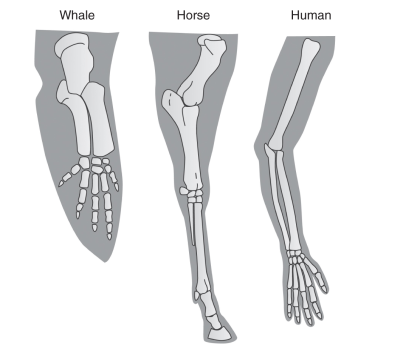
Q15. The following figure shows the bone structures of the limbs of a whale, a horse, and a human.
These are examples of which types of structures?
These are examples of which types of structures?
Correct Answer: (c)
(C) Homologous structures indicate common ancestry but may have different functions. Whales, horses, and humans are all mammals and share common ancestry, but their limbs have different functions. Analogous structures have similar functions. However, whale limbs are used for swimming, horse limbs are used for trotting or running, and human arms are used for reaching and grasping; they do not have similar functions, so choice (A) is incorrect. Choice (B) is incorrect because convergent evolution results in analogous structures and does not indicate common ancestry. Vestigial structures are structures in an organism that have no current function but may have had a function in an ancestral species, so choice (D) is incorrect.
(C) Homologous structures indicate common ancestry but may have different functions. Whales, horses, and humans are all mammals and share common ancestry, but their limbs have different functions. Analogous structures have similar functions. However, whale limbs are used for swimming, horse limbs are used for trotting or running, and human arms are used for reaching and grasping; they do not have similar functions, so choice (A) is incorrect. Choice (B) is incorrect because convergent evolution results in analogous structures and does not indicate common ancestry. Vestigial structures are structures in an organism that have no current function but may have had a function in an ancestral species, so choice (D) is incorrect.
Q16. Problems with the biological species concept include the fact that
Correct Answer: (a)
The biological species concept relies on the criteria of interbreeding and sexual reproduction. Because asexual organisms do not interbreed, the concept cannot be applied to them. Furthermore, it is often difficult to apply to fossils or to populations that are geographically separated (allopatric).
The biological species concept relies on the criteria of interbreeding and sexual reproduction. Because asexual organisms do not interbreed, the concept cannot be applied to them. Furthermore, it is often difficult to apply to fossils or to populations that are geographically separated (allopatric).
Q17. Which of the following pieces of evidence best supports the hypothesis that birds are more closely related to reptiles than to other animals?
Correct Answer: (d)
(D) DNA evidence strongly supports a degree of ancestry of organisms. The location of fossils in rock layers can change due to geological events, so choice (A) is not the best answer. Choice (B) is incorrect because habitats and trophic levels do not necessarily indicate common ancestry. Mammals also have amniotic eggs, so choice (C) is incorrect.
(D) DNA evidence strongly supports a degree of ancestry of organisms. The location of fossils in rock layers can change due to geological events, so choice (A) is not the best answer. Choice (B) is incorrect because habitats and trophic levels do not necessarily indicate common ancestry. Mammals also have amniotic eggs, so choice (C) is incorrect.
Q18. Snakes feed on toads. Cane toads (Rhinella marina) excrete a toxic substance on their skin that is poisonous to many, but not all, snake species. If cane toads are introduced to a new environment, predict the most likely effect on the snake species in that environment.
Correct Answer: (b)
(B) Snakes that are resistant to the cane toads’ toxin would be more likely to survive and reproduce, so their relative numbers would be expected to increase over time. Choice (A) is incorrect because not all snakes are susceptible to the cane toads’ toxin, so all the snakes would die. Individual snakes cannot acquire resistance to the cane toads’ toxin, so choice (C) is incorrect. Choice (D) is incorrect because there is no evidence in the question that snakes would learn to avoid eating cane toads.
(B) Snakes that are resistant to the cane toads’ toxin would be more likely to survive and reproduce, so their relative numbers would be expected to increase over time. Choice (A) is incorrect because not all snakes are susceptible to the cane toads’ toxin, so all the snakes would die. Individual snakes cannot acquire resistance to the cane toads’ toxin, so choice (C) is incorrect. Choice (D) is incorrect because there is no evidence in the question that snakes would learn to avoid eating cane toads.
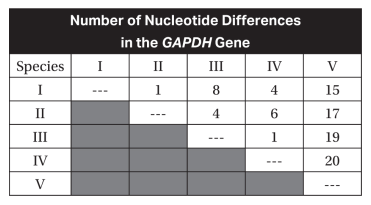
Q19. Five new bacterial species were discovered in the Mariana Trench in the Pacific Ocean. The glyceraldehyde 3-phosphate dehydrogenase (GAPDH) gene was sequenced in all five species, and the number of nucleotide differences in the GAPDH gene among the five species is shown in the table.
Based on the data in the table, which species is the outgroup?
Based on the data in the table, which species is the outgroup?
Correct Answer: (d)
(D) Species V is the outgroup because it has the greatest number of amino acid differences from the other four species.
(D) Species V is the outgroup because it has the greatest number of amino acid differences from the other four species.
Q20. Founder effects and bottlenecks are
Correct Answer: (d)
Genetic drift is the change in allele frequencies due to random chance. Both the founder effect (a small group starts a new population) and bottlenecks (a large population is drastically reduced) involve small sample sizes that do not accurately represent the original gene pool, leading to significant random fluctuations in allele frequency.
Genetic drift is the change in allele frequencies due to random chance. Both the founder effect (a small group starts a new population) and bottlenecks (a large population is drastically reduced) involve small sample sizes that do not accurately represent the original gene pool, leading to significant random fluctuations in allele frequency.
Q21. In Darwin’s finches,
Correct Answer: (a)
Long-term studies (like those by the Grants) show that selective pressures oscillate. Dry years favor larger beaks for cracking tough seeds, while wet years may favor smaller beaks for different food sources. This fluctuation prevents any one beak size from being permanently eliminated, thereby preserving genetic variation.
Long-term studies (like those by the Grants) show that selective pressures oscillate. Dry years favor larger beaks for cracking tough seeds, while wet years may favor smaller beaks for different food sources. This fluctuation prevents any one beak size from being permanently eliminated, thereby preserving genetic variation.
Q22. The human TAS2R38 gene encodes a cell membrane protein that influences the ability to taste bitter compounds. Individuals who possess at least one TAS2R38 allele have the “taster” phenotype and can taste certain types of bitter compounds. It is estimated that about 70% of humans have the taster phenotype. Which of the following best explains the frequency of the taster phenotype?
Correct Answer: (a)
(A) Since TAS2R38 is present in the population at a higher frequency, it probably did provide a survival advantage and allowed individuals who possessed this allele to survive and reproduce at a greater rate than individuals who did not possess the allele. Choice (B) is incorrect because TAS2R38 does not cause individuals to consume bitter foods; it just influences their ability to taste bitter foods. Bitter foods do not necessarily have a higher nutrient content than other foods, so choice (C) is incorrect. There is no evidence in the question that the TAS2R38 allele lowered an individual’s chance of survival, so choice (D) is incorrect.
(A) Since TAS2R38 is present in the population at a higher frequency, it probably did provide a survival advantage and allowed individuals who possessed this allele to survive and reproduce at a greater rate than individuals who did not possess the allele. Choice (B) is incorrect because TAS2R38 does not cause individuals to consume bitter foods; it just influences their ability to taste bitter foods. Bitter foods do not necessarily have a higher nutrient content than other foods, so choice (C) is incorrect. There is no evidence in the question that the TAS2R38 allele lowered an individual’s chance of survival, so choice (D) is incorrect.
Q23. The evolution of modern horses (Equus) is best described as
Correct Answer: (b)
The fossil record of horses shows a bushy, branching evolutionary tree rather than a straight line. Many different lineages coexisted, evolved different adaptations (e.g., for size or diet), and eventually went extinct, leaving only the genus Equus today.
The fossil record of horses shows a bushy, branching evolutionary tree rather than a straight line. Many different lineages coexisted, evolved different adaptations (e.g., for size or diet), and eventually went extinct, leaving only the genus Equus today.
Q24. Triclosan is an antibacterial chemical that is used in some household products to reduce bacteria levels. Which of the following is the most likely result of increased use of products that contain triclosan over time?
Correct Answer: (b)
(B) Increased use of products that contain triclosan will create an environment in which triclosan-resistant bacteria have a survival advantage, so over time the relative numbers of triclosan-resistant bacteria will increase. Choice (A) is incorrect because there is no evidence that triclosan kills all bacteria. Individuals do not evolve, populations evolve, so choice (C) is incorrect. Choice (D) is incorrect because there is no evidence in the question that the use of triclosan increases the frequency of mutations in bacteria.
(B) Increased use of products that contain triclosan will create an environment in which triclosan-resistant bacteria have a survival advantage, so over time the relative numbers of triclosan-resistant bacteria will increase. Choice (A) is incorrect because there is no evidence that triclosan kills all bacteria. Individuals do not evolve, populations evolve, so choice (C) is incorrect. Choice (D) is incorrect because there is no evidence in the question that the use of triclosan increases the frequency of mutations in bacteria.
Q25. Convergent evolution is often seen among species on different islands because
Correct Answer: (d)
When a species colonizes a new island with many vacant ecological niches, it undergoes adaptive radiation. If different lineages on different islands encounter similar niches (e.g., a specific type of forest floor), natural selection will often lead them to evolve similar morphological solutions independently.
When a species colonizes a new island with many vacant ecological niches, it undergoes adaptive radiation. If different lineages on different islands encounter similar niches (e.g., a specific type of forest floor), natural selection will often lead them to evolve similar morphological solutions independently.
Q26. Assortative mating
Correct Answer: (a)
Assortative mating is a form of non-random mating where individuals with similar phenotypes mate with one another more frequently than would be expected under a random mating pattern. While this does not change the overall allele frequencies (p and q) in the population, it does shift the genotype frequencies (p2, 2pq, q2) away from Hardy–Weinberg expectations, typically increasing homozygosity.
Assortative mating is a form of non-random mating where individuals with similar phenotypes mate with one another more frequently than would be expected under a random mating pattern. While this does not change the overall allele frequencies (p and q) in the population, it does shift the genotype frequencies (p2, 2pq, q2) away from Hardy–Weinberg expectations, typically increasing homozygosity.
Q27. Orchids that belong to the genus Dendrobium will flower in response to certain weather stimuli. One species of Dendrobium flowers on the 8th day and closes on the 9th day after the weather stimuli, while another species of Dendrobium flowers on the 10th day and closes on the 11th day after the weather stimuli. This is an example of which type of reproductive isolation?
Correct Answer: (c)
(C) Temporal isolation is separation by time. Since the two species flower and are ready for pollination at different times, this is an example of temporal isolation. Habitat isolation is separation by area, so choice (A) is incorrect. Choice (B) is incorrect because mechanical isolation occurs when the male and female genitalia are incompatible. Hybrid breakdown occurs when two species can produce a viable and fertile offspring but each successive generation of the hybrid becomes weaker and weaker, so choice (D) is incorrect.
(C) Temporal isolation is separation by time. Since the two species flower and are ready for pollination at different times, this is an example of temporal isolation. Habitat isolation is separation by area, so choice (A) is incorrect. Choice (B) is incorrect because mechanical isolation occurs when the male and female genitalia are incompatible. Hybrid breakdown occurs when two species can produce a viable and fertile offspring but each successive generation of the hybrid becomes weaker and weaker, so choice (D) is incorrect.
Q28. Artificial selection experiments in the laboratory such as in figure 21.5 are an example of
Correct Answer: (d)
According to the provided answer key, these experiments represent disruptive selection. In the context of the Drosophila experiments mentioned (selecting for both very high and very low bristle counts simultaneously), the population is being pushed toward two extreme phenotypes, which is the definition of disruptive selection.
According to the provided answer key, these experiments represent disruptive selection. In the context of the Drosophila experiments mentioned (selecting for both very high and very low bristle counts simultaneously), the population is being pushed toward two extreme phenotypes, which is the definition of disruptive selection.
Q29. For natural selection to result in evolutionary change,
Correct Answer: (d)
Evolution by natural selection requires three fundamental conditions: 1) Individuals within a population must vary in their traits. 2) These traits must be heritable (passed from parents to offspring). 3) Some individuals must be more successful at surviving and reproducing than others due to those specific traits.
Evolution by natural selection requires three fundamental conditions: 1) Individuals within a population must vary in their traits. 2) These traits must be heritable (passed from parents to offspring). 3) Some individuals must be more successful at surviving and reproducing than others due to those specific traits.
Q30. Gradualism and punctuated equilibrium are
Correct Answer: (a)
Gradualism suggests that evolutionary change occurs slowly and steadily over long periods. Punctuated equilibrium suggests that species experience long periods of little change (stasis) interrupted by brief bursts of rapid evolutionary divergence. They are not mutually exclusive but represent different tempos at which evolution can occur.
Gradualism suggests that evolutionary change occurs slowly and steadily over long periods. Punctuated equilibrium suggests that species experience long periods of little change (stasis) interrupted by brief bursts of rapid evolutionary divergence. They are not mutually exclusive but represent different tempos at which evolution can occur.
Q31. If reinforcement is weak and hybrids are not completely infertile,
Correct Answer: (a)
If the reproductive barriers are not absolute and the hybrids are viable, gene flow can continue between the two populations. If this gene flow is sufficient, it can counteract the effects of genetic divergence and prevent the two groups from becoming separate species.
If the reproductive barriers are not absolute and the hybrids are viable, gene flow can continue between the two populations. If this gene flow is sufficient, it can counteract the effects of genetic divergence and prevent the two groups from becoming separate species.
Q32. Rock pocket mice (Chaetodipus intermedius) are found in rocky outcrops in the desert of the southwestern United States. Some rock pocket mice have light-colored fur, while others have dark-colored fur. A population of rock pocket mice lives in a desert with both light-colored sand dunes and dark-colored rocks. Owls and hawks prey on the rock pocket mice they see. The initial ratio of light-colored to dark-colored mice in this population is approximately 1:1. A sandstorm occurs in the habitat of this population of rock pocket mice, and it covers all of the habitat in a thick layer of light-colored sand. Predict the most likely effect of this on the rock pocket mouse population.
Correct Answer: (b)
(B) The light-colored mice will blend in with the sandy background and be less visible to predators, so their numbers would increase. Choice (A) is incorrect because dark-colored mice would be more visible to predators against the sandy background, and their numbers would decrease. Choices (C) and (D) are incorrect because the sandy background would increase the survival of light-colored mice and decrease the survival of dark-colored mice.
(B) The light-colored mice will blend in with the sandy background and be less visible to predators, so their numbers would increase. Choice (A) is incorrect because dark-colored mice would be more visible to predators against the sandy background, and their numbers would decrease. Choices (C) and (D) are incorrect because the sandy background would increase the survival of light-colored mice and decrease the survival of dark-colored mice.
Q33. Leopard frogs from different geographic populations of the Rana pipiens complex
Correct Answer: (b)
Although they appear morphologically similar, the various populations within the Rana pipiens complex exhibit different mating calls (prezygotic isolation) and their hybrids often fail to develop properly (postzygotic isolation), classifying them as distinct biological species.
Although they appear morphologically similar, the various populations within the Rana pipiens complex exhibit different mating calls (prezygotic isolation) and their hybrids often fail to develop properly (postzygotic isolation), classifying them as distinct biological species.
Q34. Tigers (Panthera tigris) and leopards (Panthera pardus) can mate and produce a zygote. The zygote will undergo cell division a few times, but this fails to result in the production of a viable embryo. This is an example of which type of reproductive isolation?
Correct Answer: (b)
(B) Since tigers and leopards can mate and produce a zygote, but doing so does not result in any viable offspring, this is an example of reduced hybrid viability. It is not gametic isolation since their gametes can form a zygote, so choice (A) is incorrect. There is no infertile adult hybrid in this scenario, so choice (C) is also incorrect. No viable hybrid was produced, so there is no chance of hybrid breakdown, making choice (D) incorrect.
(B) Since tigers and leopards can mate and produce a zygote, but doing so does not result in any viable offspring, this is an example of reduced hybrid viability. It is not gametic isolation since their gametes can form a zygote, so choice (A) is incorrect. There is no infertile adult hybrid in this scenario, so choice (C) is also incorrect. No viable hybrid was produced, so there is no chance of hybrid breakdown, making choice (D) incorrect.
Q35. Hybridization between incompletely isolated populations
Correct Answer: (b)
When populations that are beginning to diverge meet and hybridize, the resulting gene flow can serve as a 'genetic glue' that keeps the populations unified. Unless selection against the hybrids is strong enough to trigger reinforcement, this gene flow will typically prevent speciation.
When populations that are beginning to diverge meet and hybridize, the resulting gene flow can serve as a 'genetic glue' that keeps the populations unified. Unless selection against the hybrids is strong enough to trigger reinforcement, this gene flow will typically prevent speciation.
Q36. Genetic drift and natural selection can both lead to rapid rates of evolution. However,
Correct Answer: (d)
Gene flow (migration) involves the movement of alleles between populations. It acts as a homogenizing force that can counteract the effects of local natural selection (by introducing alleles from a different environment) or genetic drift (by replenishing alleles lost by chance), thereby slowing the rate of evolutionary divergence between populations.
Gene flow (migration) involves the movement of alleles between populations. It acts as a homogenizing force that can counteract the effects of local natural selection (by introducing alleles from a different environment) or genetic drift (by replenishing alleles lost by chance), thereby slowing the rate of evolutionary divergence between populations.
Q37. The Aztecs were some of the first humans to slowly change teosinte, also known as wild corn, into the current form of corn eaten today. Which process did the Aztecs most likely use?
Correct Answer: (a)
(A) Artificial selection occurs when humans selectively breed organisms for desired traits. Frequency-dependent selection occurs when the survival of an organism depends on its frequency in an environment, so choice (B) is incorrect. Choice (C) is incorrect because in natural selection, the environment selects for which individuals survive and reproduce. There is no evidence for mate choice in the question; plants usually depend on the wind or animal pollinators to exchange gametes, so choice (D) is incorrect.
(A) Artificial selection occurs when humans selectively breed organisms for desired traits. Frequency-dependent selection occurs when the survival of an organism depends on its frequency in an environment, so choice (B) is incorrect. Choice (C) is incorrect because in natural selection, the environment selects for which individuals survive and reproduce. There is no evidence for mate choice in the question; plants usually depend on the wind or animal pollinators to exchange gametes, so choice (D) is incorrect.
Q38. Speciation by allopolyploidy
Correct Answer: (d)
Allopolyploidy is a type of polyploidy that results from the contribution of different sets of chromosomes from two different species through hybridization. This can lead to instantaneous speciation, particularly in plants, because the offspring may have a different chromosome number than either parent.
Allopolyploidy is a type of polyploidy that results from the contribution of different sets of chromosomes from two different species through hybridization. This can lead to instantaneous speciation, particularly in plants, because the offspring may have a different chromosome number than either parent.
Q39. Convergent evolution
Correct Answer: (b)
Convergent evolution occurs when unrelated or distantly related organisms independently evolve similar traits because they are subjected to similar selective pressures in their environments, such as the streamlined bodies of dolphins (mammals) and sharks (fish).
Convergent evolution occurs when unrelated or distantly related organisms independently evolve similar traits because they are subjected to similar selective pressures in their environments, such as the streamlined bodies of dolphins (mammals) and sharks (fish).
Q40. Generally, which type of data is considered most reliable when constructing phylogenies?
Correct Answer: (d)
(D) The DNA sequence of an organism is not affected by its environment or geological events, so it provides reliable evidence for ancestry of organisms. Fossils do not necessarily show when a species originated, so choice (A) is incorrect. Habitats and morphological characteristics can change during an organism’s lifetime, so choices (B) and (C) are incorrect.
(D) The DNA sequence of an organism is not affected by its environment or geological events, so it provides reliable evidence for ancestry of organisms. Fossils do not necessarily show when a species originated, so choice (A) is incorrect. Habitats and morphological characteristics can change during an organism’s lifetime, so choices (B) and (C) are incorrect.
Q41. Which of the following best supports the existence of a common ancestor of all three domains of living organisms (Archaea, Bacteria, and Eukarya)?
Correct Answer: (a)
(A) All living organisms perform glycolysis in their cytoplasm, indicating a common ancestor of all life-forms. Choice (B) is incorrect because not all living organisms have membrane-bound organelles. Prokaryotes do not have linear chromosomes or introns, so choices (C) and (D) are incorrect.
(A) All living organisms perform glycolysis in their cytoplasm, indicating a common ancestor of all life-forms. Choice (B) is incorrect because not all living organisms have membrane-bound organelles. Prokaryotes do not have linear chromosomes or introns, so choices (C) and (D) are incorrect.
Q42. In the 1950s, Stanley Miller performed an experiment to investigate the possible origin of the molecules required for life on Earth. Water vapor, methane, hydrogen gas, and ammonia were placed in a flask, and electric charges were applied to the system to simulate atmospheric conditions that were thought to be prevalent at the time. After many weeks, amino acids were produced in the system. Which of the following hypotheses is best supported by the results of this experiment?
Correct Answer: (b)
(B) Miller used molecules thought to have been present in Earth’s early atmosphere, so the experiment supports this answer. Choice (A) is incorrect because there was no evidence from Miller’s experiment that supports this theory about a meteorite. The molecules formed in Miller’s experiment were amino acids, not RNA or carbohydrates, so choices (C) and (D) are incorrect.
(B) Miller used molecules thought to have been present in Earth’s early atmosphere, so the experiment supports this answer. Choice (A) is incorrect because there was no evidence from Miller’s experiment that supports this theory about a meteorite. The molecules formed in Miller’s experiment were amino acids, not RNA or carbohydrates, so choices (C) and (D) are incorrect.
Q43. Homologous structures
Correct Answer: (a)
Homology refers to structural similarities that result from shared ancestry. For example, the forelimbs of humans, cats, and bats are homologous because they are derived from the same ancestral limb structure, even if they have evolved to serve different purposes (grasping, walking, flying).
Homology refers to structural similarities that result from shared ancestry. For example, the forelimbs of humans, cats, and bats are homologous because they are derived from the same ancestral limb structure, even if they have evolved to serve different purposes (grasping, walking, flying).
Q44. Prezygotic isolation
Correct Answer: (d)
Reinforcement is the process by which natural selection increases reproductive isolation. If two diverging populations come back into contact and produce hybrids with lower fitness, selection will favor individuals that do not mate with the other group, thereby strengthening prezygotic barriers.
Reinforcement is the process by which natural selection increases reproductive isolation. If two diverging populations come back into contact and produce hybrids with lower fitness, selection will favor individuals that do not mate with the other group, thereby strengthening prezygotic barriers.
Q45. The possession of fine fur in 5-month human embryos indicates
Correct Answer: (b)
The development of a temporary coat of fine hair (lanugo) in human embryos is an embryological remnant that suggests an evolutionary history involving hairy ancestors. Such developmental similarities across different species are strong evidence for shared ancestry.
The development of a temporary coat of fine hair (lanugo) in human embryos is an embryological remnant that suggests an evolutionary history involving hairy ancestors. Such developmental similarities across different species are strong evidence for shared ancestry.
Q46. Gaps in the fossil record
Correct Answer: (b)
Fossilization is a rare event. It requires specific conditions, such as rapid burial in sediment and the presence of hard parts (bones/shells), that most organisms do not meet. Therefore, gaps are a predictable result of the low probability of an organism being preserved and later discovered.
Fossilization is a rare event. It requires specific conditions, such as rapid burial in sediment and the presence of hard parts (bones/shells), that most organisms do not meet. Therefore, gaps are a predictable result of the low probability of an organism being preserved and later discovered.
Q47. Which of the following would best determine whether two species of birds have a recent common ancestor?
Correct Answer: (a)
(A) DNA sequences are generally considered stronger pieces of evidence of evolution because environmental factors are far less likely to change the DNA sequence of a fossil. Choice (B) is incorrect because geological events can change the relative positions of fossils in rock layers and make the original location of the fossil position less certain. Birds can fly and move to new habitats, so choice (C) is incorrect. Choice (D) is incorrect because mating behaviors of birds may be influenced by their environments or by learning these behaviors from other birds.
(A) DNA sequences are generally considered stronger pieces of evidence of evolution because environmental factors are far less likely to change the DNA sequence of a fossil. Choice (B) is incorrect because geological events can change the relative positions of fossils in rock layers and make the original location of the fossil position less certain. Birds can fly and move to new habitats, so choice (C) is incorrect. Choice (D) is incorrect because mating behaviors of birds may be influenced by their environments or by learning these behaviors from other birds.
Q48. In a population of red (dominant allele) or white flowers in Hardy–Weinberg equilibrium, the frequency of red flowers is 91%. What is the frequency of the red allele?
Correct Answer: (d)
In a population with two alleles (R and r), the frequency of red flowers (dominant phenotype) is p2 + 2pq = 0.91. Therefore, the frequency of white flowers (homozygous recessive, q2) is 1.0 – 0.91 = 0.09. Solving for q: q = √0.09 = 0.3. Since p + q = 1, the frequency of the dominant red allele (p) is 1.0 – 0.3 = 0.7, or 70%.
In a population with two alleles (R and r), the frequency of red flowers (dominant phenotype) is p2 + 2pq = 0.91. Therefore, the frequency of white flowers (homozygous recessive, q2) is 1.0 – 0.91 = 0.09. Solving for q: q = √0.09 = 0.3. Since p + q = 1, the frequency of the dominant red allele (p) is 1.0 – 0.3 = 0.7, or 70%.
Q49. Allopatric speciation
Correct Answer: (b)
Allopatric speciation occurs when a population is split into two or more geographically isolated groups by a physical barrier, such as a mountain range or a river. This isolation prevents gene flow, allowing the populations to diverge genetically over time until they can no longer interbreed.
Allopatric speciation occurs when a population is split into two or more geographically isolated groups by a physical barrier, such as a mountain range or a river. This isolation prevents gene flow, allowing the populations to diverge genetically over time until they can no longer interbreed.
Q50. Relative fitness
Correct Answer: (a)
Fitness is a measure of the relative ability of an individual (or a specific phenotype/genotype) to survive and reproduce in a given environment. It is usually expressed relative to the most successful phenotype in the population, which is assigned a fitness value of 1.0.
Fitness is a measure of the relative ability of an individual (or a specific phenotype/genotype) to survive and reproduce in a given environment. It is usually expressed relative to the most successful phenotype in the population, which is assigned a fitness value of 1.0.
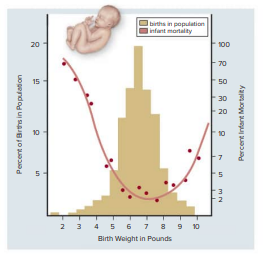
Q51. Suppose that the relationship between birth weight and infant mortality, instead of being at a minimum at intermediate sizes, changed such that babies born at 5 or 10 pounds had the lowest mortality, with an increase in between such that 7.5-pound babies had higher mortality. How would you expect the distribution of birth weights to change over time?
Correct Answer: (d)
The scenario describes disruptive selection, where both extremes (5 lbs and 10 lbs) are favored over the intermediate (7.5 lbs). This causes the distribution to split into two distinct peaks (bimodal). The provided answer key indicates a shift of the mean to the right, possibly suggesting a stronger survival advantage or higher frequency for the heavier (10 lb) extreme over time.
The scenario describes disruptive selection, where both extremes (5 lbs and 10 lbs) are favored over the intermediate (7.5 lbs). This causes the distribution to split into two distinct peaks (bimodal). The provided answer key indicates a shift of the mean to the right, possibly suggesting a stronger survival advantage or higher frequency for the heavier (10 lb) extreme over time.
Q52. Natural selection can
Correct Answer: (d)
Natural selection plays a central role in speciation. It can drive populations to adapt to different environments (divergence), favor traits that prevent mating between groups (reinforcement of isolation), and select against hybrids if they are less fit than the parent species.
Natural selection plays a central role in speciation. It can drive populations to adapt to different environments (divergence), favor traits that prevent mating between groups (reinforcement of isolation), and select against hybrids if they are less fit than the parent species.
Q53. During the history of life on Earth
Correct Answer: (a)
The fossil record provides evidence of five major mass extinction events in Earth's history, during which a large percentage of the world's species died out in a relatively short geological timeframe. These events are typically followed by periods of rapid adaptive radiation.
The fossil record provides evidence of five major mass extinction events in Earth's history, during which a large percentage of the world's species died out in a relatively short geological timeframe. These events are typically followed by periods of rapid adaptive radiation.
Q54. Reproductive isolation is
Correct Answer: (c)
The biological species concept defines a species as a group of actually or potentially interbreeding natural populations that are reproductively isolated from other such groups. Therefore, reproductive isolation is the primary criterion for defining species boundaries under this concept.
The biological species concept defines a species as a group of actually or potentially interbreeding natural populations that are reproductively isolated from other such groups. Therefore, reproductive isolation is the primary criterion for defining species boundaries under this concept.
Q55. Artificial selection is different from natural selection because
Correct Answer: (d)
The fundamental difference between artificial and natural selection is the agent of selection. In artificial selection, humans (breeders) determine which individuals will contribute to the next generation based on specific desired traits, whereas in natural selection, the environment determines which individuals are best suited to survive and reproduce.
The fundamental difference between artificial and natural selection is the agent of selection. In artificial selection, humans (breeders) determine which individuals will contribute to the next generation based on specific desired traits, whereas in natural selection, the environment determines which individuals are best suited to survive and reproduce.
Q56. Five new bacterial species were discovered in the Mariana Trench in the Pacific Ocean. The glyceraldehyde 3-phosphate dehydrogenase (GAPDH) gene was sequenced in all five species, and the number of nucleotide differences in the GAPDH gene among the five species is shown in the table.
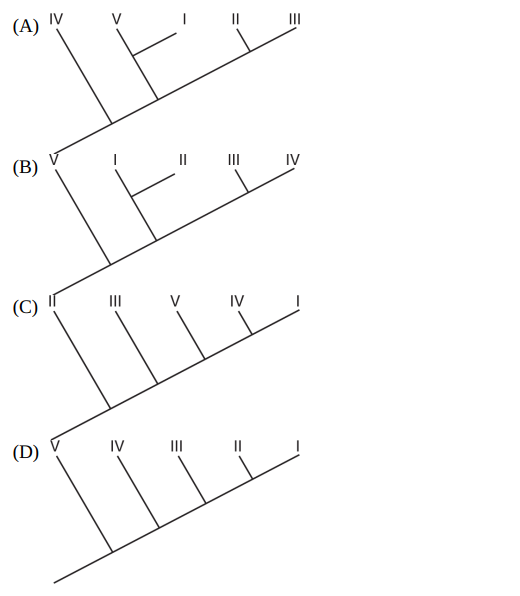
Which of the following cladograms is best supported by the data in the table?
Which of the following cladograms is best supported by the data in the table?
Correct Answer: (b)
(B) Species V is the outgroup because it has the greatest number of amino acid differences from the other species. Species I and II have only one amino acid difference between them and are therefore closely related. Species III and IV have only one amino acid difference between them and are therefore closely related. Choice (A) is incorrect because species I is more closely related to species II (one amino acid difference) than species V (15 amino acid differences). Species II has fewer amino acid differences from the other species than does species V, so species II is not the outgroup. Thus, choice (C) is incorrect. Choice (D) is incorrect because species I has only four amino acid differences from species IV but eight amino acid differences from species III, so species IV should share a more recent common ancestor with species I.
(B) Species V is the outgroup because it has the greatest number of amino acid differences from the other species. Species I and II have only one amino acid difference between them and are therefore closely related. Species III and IV have only one amino acid difference between them and are therefore closely related. Choice (A) is incorrect because species I is more closely related to species II (one amino acid difference) than species V (15 amino acid differences). Species II has fewer amino acid differences from the other species than does species V, so species II is not the outgroup. Thus, choice (C) is incorrect. Choice (D) is incorrect because species I has only four amino acid differences from species IV but eight amino acid differences from species III, so species IV should share a more recent common ancestor with species I.