Q1. Bottom-up effects on trophic structure result from
Correct Answer: (a)
Bottom-up control occurs when energy or nutrient availability at lower trophic levels limits population sizes at higher trophic levels.
Bottom-up control occurs when energy or nutrient availability at lower trophic levels limits population sizes at higher trophic levels.
Q2. Why is it unlikely that a food web would contain more than five trophic levels?
Correct Answer: (b)
(B) On average, 90% of the energy at a given trophic level is used in metabolic processes at that level or is lost as heat and is not transferred to the next trophic level. Choice (A) is incorrect because most nutrients are transferred to the next trophic level when food is consumed. Decomposers can efficiently recycle nutrients for up to four trophic levels, so choice (C) is incorrect. The biomass at the producer level must be larger than the biomass at the primary consumer level, so choice (D) is incorrect.
(B) On average, 90% of the energy at a given trophic level is used in metabolic processes at that level or is lost as heat and is not transferred to the next trophic level. Choice (A) is incorrect because most nutrients are transferred to the next trophic level when food is consumed. Decomposers can efficiently recycle nutrients for up to four trophic levels, so choice (C) is incorrect. The biomass at the producer level must be larger than the biomass at the primary consumer level, so choice (D) is incorrect.
Q3. Why are the metabolic rates of smaller organisms generally higher than those of larger organisms?
Correct Answer: (b)
(B) Smaller organisms do have a greater surface area to volume ratio than larger organisms and lose more heat to their environment per gram of body weight, so smaller organisms need a higher metabolism to help mitigate the heat loss. Not all small organisms have a shorter life span than larger organisms, so choice (A) is incorrect. Choice (C) is incorrect because not all small organisms are ectothermic. Also, ectothermic animals cannot internally control their metabolic rate; ectotherms are dependent upon environmental temperatures to influence their metabolic rate. Smaller organisms do not necessarily consume less food per gram of body weight; in fact, the higher metabolic rate of smaller organisms may require that these small organisms consume more food per gram of body weight, so choice (D) is incorrect.
(B) Smaller organisms do have a greater surface area to volume ratio than larger organisms and lose more heat to their environment per gram of body weight, so smaller organisms need a higher metabolism to help mitigate the heat loss. Not all small organisms have a shorter life span than larger organisms, so choice (A) is incorrect. Choice (C) is incorrect because not all small organisms are ectothermic. Also, ectothermic animals cannot internally control their metabolic rate; ectotherms are dependent upon environmental temperatures to influence their metabolic rate. Smaller organisms do not necessarily consume less food per gram of body weight; in fact, the higher metabolic rate of smaller organisms may require that these small organisms consume more food per gram of body weight, so choice (D) is incorrect.
Q4. Coyotes are a predator of skunks. Coyote urine has a strong scent and is marketed as a skunk repellent. Which type of signal is coyote urine?
Correct Answer: (b)
(B) Scent is a chemical signal. Choices (A), (C), and (D) are incorrect because audible, tactile, and visual signals depend on sound, touch, and sight, respectively.
(B) Scent is a chemical signal. Choices (A), (C), and (D) are incorrect because audible, tactile, and visual signals depend on sound, touch, and sight, respectively.
Q5. Nitrogen is often a limiting nutrient in many ecosystems because
Correct Answer: (d)
Although nitrogen is abundant in the atmosphere, most organisms cannot use nitrogen gas directly. Only certain microbes can fix it, making nitrogen frequently limiting in ecosystems.
Although nitrogen is abundant in the atmosphere, most organisms cannot use nitrogen gas directly. Only certain microbes can fix it, making nitrogen frequently limiting in ecosystems.
Q6. Species diversity
Correct Answer: (a)
Species diversity is highest near the equator and declines toward the poles, a well-established ecological pattern known as the latitudinal diversity gradient.
Species diversity is highest near the equator and declines toward the poles, a well-established ecological pattern known as the latitudinal diversity gradient.
Q7. According to the trophic cascade hypothesis, the removal of carnivores from an ecosystem may result in
Correct Answer: (d)
Removing carnivores releases herbivores from predation pressure, allowing their populations to increase and leading to overconsumption of vegetation.
Removing carnivores releases herbivores from predation pressure, allowing their populations to increase and leading to overconsumption of vegetation.
Q8. Refer to the following food web. The arrows show the direction of the flow of energy, and species are represented by Roman numerals.
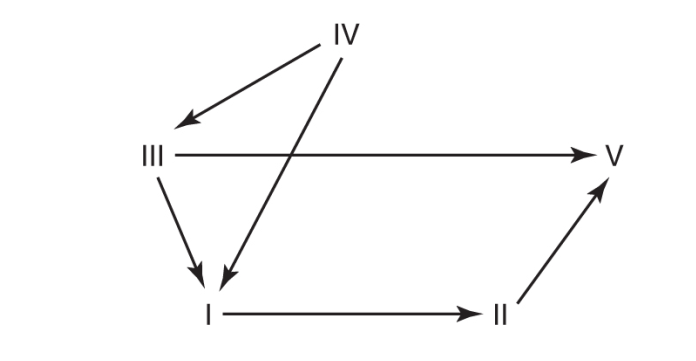
Which species is both a primary consumer and a secondary consumer?
Which species is both a primary consumer and a secondary consumer?
Correct Answer: (a)
(A) Primary consumers get energy from producers, and secondary consumers get energy from primary consumers (herbivores). In this food web, IV is a producer, I and III are both primary consumers, and I, II, and V are secondary consumers. Choice (A) is the only member of this food web that is both a primary and secondary consumer.
(A) Primary consumers get energy from producers, and secondary consumers get energy from primary consumers (herbivores). In this food web, IV is a producer, I and III are both primary consumers, and I, II, and V are secondary consumers. Choice (A) is the only member of this food web that is both a primary and secondary consumer.
Q9. The respiration rate (as measured by oxygen consumption per gram of body weight per minute) was measured in rats, grasshoppers, and newly discovered species animal X. Data are shown in the table:
Which of the following conclusions about species X is best supported by the data?
| Organism | Average Respiration Rate at 5°C (mL O2/min/g) | Average Respiration Rate at 30°C (mL O2/min/g) |
|---|---|---|
| Rat | 0.158 | 0.076 |
| Grasshopper | 0.011 | 0.033 |
| Species X | 0.024 | 0.069 |
Which of the following conclusions about species X is best supported by the data?
Correct Answer: (a)
(A) Ectothermic animals have a higher metabolism at higher environmental temperatures. Since species X’s consumption of oxygen is greater at 30°C than at 5°C, it is most likely ectothermic. Choice (B) correctly states that species X is ectothermic but gives incorrect reasoning; ectothermic animals have an increased respiration rate at higher, not lower, temperatures. Choice (C) is incorrect because while species X’s oxygen consumption at 30°C is closer to that of the rat than to that of the grasshopper, that does not determine whether or not species X is endothermic. Endothermic animals have higher metabolic rates at lower temperatures (so they can maintain a constant internal temperature). Therefore, choice (D) is also incorrect.
(A) Ectothermic animals have a higher metabolism at higher environmental temperatures. Since species X’s consumption of oxygen is greater at 30°C than at 5°C, it is most likely ectothermic. Choice (B) correctly states that species X is ectothermic but gives incorrect reasoning; ectothermic animals have an increased respiration rate at higher, not lower, temperatures. Choice (C) is incorrect because while species X’s oxygen consumption at 30°C is closer to that of the rat than to that of the grasshopper, that does not determine whether or not species X is endothermic. Endothermic animals have higher metabolic rates at lower temperatures (so they can maintain a constant internal temperature). Therefore, choice (D) is also incorrect.
Q10. Refer to the following food web.
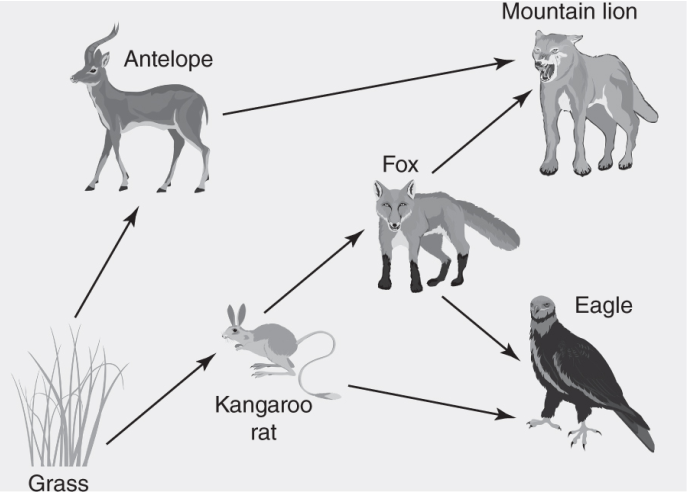
What is a role of the fox in this food web?
What is a role of the fox in this food web?
Correct Answer: (c)
(C) The fox is a secondary consumer because it gets its energy from a primary consumer (the kangaroo rat). Choice (A) is incorrect because the producer in this food web is grass; foxes are not photosynthetic and cannot be producers. Since the fox shown in this food web does not consume the producer, the fox cannot be a primary consumer, so choice (B) is incorrect. Tertiary consumers get their energy from secondary consumers. In the food web shown, the mountain lion and the eagle are tertiary consumers; the fox is not a tertiary consumer, so choice (D) is incorrect.
(C) The fox is a secondary consumer because it gets its energy from a primary consumer (the kangaroo rat). Choice (A) is incorrect because the producer in this food web is grass; foxes are not photosynthetic and cannot be producers. Since the fox shown in this food web does not consume the producer, the fox cannot be a primary consumer, so choice (B) is incorrect. Tertiary consumers get their energy from secondary consumers. In the food web shown, the mountain lion and the eagle are tertiary consumers; the fox is not a tertiary consumer, so choice (D) is incorrect.
Q11. Photosynthetic organisms
Correct Answer: (d)
Photosynthetic organisms fix carbon dioxide during photosynthesis but also release carbon dioxide during cellular respiration. Therefore, both processes occur in these organisms.
Photosynthetic organisms fix carbon dioxide during photosynthesis but also release carbon dioxide during cellular respiration. Therefore, both processes occur in these organisms.
Q12. The equilibrium model of island biogeography suggests all of the following except
Correct Answer: (c)
Smaller islands actually have higher extinction rates due to limited resources and smaller population sizes, not lower extinction rates.
Smaller islands actually have higher extinction rates due to limited resources and smaller population sizes, not lower extinction rates.
Q13. The respiration rate (as measured by oxygen consumption per gram of body weight per minute) was measured in rats, grasshoppers, and newly discovered species animal X. Data are shown in the table:
This experiment is repeated with the same animals at a temperature of 37°C. Which of the following is the most likely result?
| Organism | Average Respiration Rate at 5°C (mL O2/min/g) | Average Respiration Rate at 30°C (mL O2/min/g) |
|---|---|---|
| Rat | 0.158 | 0.076 |
| Grasshopper | 0.011 | 0.033 |
| Species X | 0.024 | 0.069 |
This experiment is repeated with the same animals at a temperature of 37°C. Which of the following is the most likely result?
Correct Answer: (d)
(D) At a higher temperature, the respiration rate of ectotherms (the grasshopper and species X, in this example) increases and the respiration rate of endotherms (the rat, in this example) decreases. Choice (A) is incorrect because rats are endothermic. Species X is most likely ectothermic, so choice (B) is incorrect. Choice (C) is incorrect because rats are endothermic, not ectothermic, and species X is most likely ectothermic.
(D) At a higher temperature, the respiration rate of ectotherms (the grasshopper and species X, in this example) increases and the respiration rate of endotherms (the rat, in this example) decreases. Choice (A) is incorrect because rats are endothermic. Species X is most likely ectothermic, so choice (B) is incorrect. Choice (C) is incorrect because rats are endothermic, not ectothermic, and species X is most likely ectothermic.
Q14. Which of the following statements about the phosphorus cycle is correct?
Correct Answer: (a)
Plants and algae assimilate inorganic phosphate from soil or water, effectively ‘fixing’ phosphorus into organic molecules that then move through food webs.
Plants and algae assimilate inorganic phosphate from soil or water, effectively ‘fixing’ phosphorus into organic molecules that then move through food webs.
Q15. Refer to the following food web.
The application of rat poison in the area results in the elimination of the kangaroo rat population. Which of the following is the most likely effect of this event?
The application of rat poison in the area results in the elimination of the kangaroo rat population. Which of the following is the most likely effect of this event?
Correct Answer: (a)
(A) Kangaroo rats eat grass. If the kangaroo rat population was eliminated, less grass would be consumed, and the biomass of the producers (the grass) would most likely increase. The foxes feed on the kangaroo rats, so the elimination of the kangaroo rats would result in less food for the foxes. In that case, the number of foxes would likely decrease, not increase, so choice (B) is incorrect. Choice (C) is incorrect because fewer kangaroo rats would mean more grass for the antelopes, not less. Mountain lions do not eat eagles in this food web, so choice (D) is incorrect.
(A) Kangaroo rats eat grass. If the kangaroo rat population was eliminated, less grass would be consumed, and the biomass of the producers (the grass) would most likely increase. The foxes feed on the kangaroo rats, so the elimination of the kangaroo rats would result in less food for the foxes. In that case, the number of foxes would likely decrease, not increase, so choice (B) is incorrect. Choice (C) is incorrect because fewer kangaroo rats would mean more grass for the antelopes, not less. Mountain lions do not eat eagles in this food web, so choice (D) is incorrect.
Q16. Which of the statements about groundwater is NOT accurate?
Correct Answer: (d)
Groundwater pollution is extremely difficult to remediate once contaminants enter aquifers. Pollutants often persist for long periods because groundwater moves slowly, making cleanup neither easy nor rapid.
Groundwater pollution is extremely difficult to remediate once contaminants enter aquifers. Pollutants often persist for long periods because groundwater moves slowly, making cleanup neither easy nor rapid.
Q17. Based on results from studies at Hubbard Brook Experimental Forest, what would be the predicted effect of clearing trees from a watershed?
Correct Answer: (a)
Tree removal reduces nutrient uptake and water retention, leading to increased runoff and nutrient loss from the ecosystem.
Tree removal reduces nutrient uptake and water retention, leading to increased runoff and nutrient loss from the ecosystem.
Q18. Some bacteria have the ability to “fix” nitrogen. This means
Correct Answer: (b)
Nitrogen fixation refers specifically to the conversion of inert atmospheric nitrogen (N₂) into biologically usable forms such as ammonia, which can then enter food webs.
Nitrogen fixation refers specifically to the conversion of inert atmospheric nitrogen (N₂) into biologically usable forms such as ammonia, which can then enter food webs.
Q19. Refer to the following food web. The arrows show the direction of the flow of energy, and species are represented by Roman numerals.
Which species in this food web is most likely a producer?
Which species in this food web is most likely a producer?
Correct Answer: (d)
(D) Producers transfer energy to other trophic levels and do not receive energy from any trophic level. IV is the only member of this food web that sends energy to other members but does not receive energy from other members of the food web.
(D) Producers transfer energy to other trophic levels and do not receive energy from any trophic level. IV is the only member of this food web that sends energy to other members but does not receive energy from other members of the food web.
Q20. Inverted ecological pyramids of real systems usually involve
Correct Answer: (b)
Biomass pyramids can be inverted, especially in aquatic ecosystems where phytoplankton have low standing biomass but high turnover rates compared to consumers.
Biomass pyramids can be inverted, especially in aquatic ecosystems where phytoplankton have low standing biomass but high turnover rates compared to consumers.
Q21. As a general rule, how much energy is lost in the transmission of energy from one trophic level to the one immediately above it?
Correct Answer: (c)
Only about 10% of energy is transferred to the next trophic level, meaning approximately 90% is lost as heat, metabolism, and waste during energy transfer.
Only about 10% of energy is transferred to the next trophic level, meaning approximately 90% is lost as heat, metabolism, and waste during energy transfer.
Q22. Which of the following is an example of a physiological response to a stimulus?
Correct Answer: (c)
(C) Adjusting metabolism in response to changing environmental conditions is a physiological response to a stimulus. Choices (A), (B), and (D) are examples of behaviors or behavioral responses.
(C) Adjusting metabolism in response to changing environmental conditions is a physiological response to a stimulus. Choices (A), (B), and (D) are examples of behaviors or behavioral responses.
Q23. At Cedar Creek Natural History Area, experimental plots showed reduced numbers of invaders as species diversity increased,
Correct Answer: (d)
The findings support the idea that higher species diversity enhances resistance to invasion, but none of the listed statements accurately describes this conclusion.
The findings support the idea that higher species diversity enhances resistance to invasion, but none of the listed statements accurately describes this conclusion.