Q1. Structurally, meiotic cohesins have different components than mitotic cohesins. This leads to the following functional difference:
Correct Answer: (b)
In meiosis I, a specific protection mechanism (involving shugoshin) prevents the breakdown of cohesin proteins at the centromere. This ensures that sister chromatids remain attached to each other during anaphase I, allowing only the homologous pairs to separate.
In meiosis I, a specific protection mechanism (involving shugoshin) prevents the breakdown of cohesin proteins at the centromere. This ensures that sister chromatids remain attached to each other during anaphase I, allowing only the homologous pairs to separate.
Q2. The metaphase to anaphase transition involves
Correct Answer: (d)
During metaphase, sister chromatids are already being pulled toward opposite poles by the spindle, but they are held together by cohesin. The transition to anaphase is triggered solely by the degradation of these cohesin proteins, allowing the existing spindle forces to pull the sisters apart.
During metaphase, sister chromatids are already being pulled toward opposite poles by the spindle, but they are held together by cohesin. The transition to anaphase is triggered solely by the degradation of these cohesin proteins, allowing the existing spindle forces to pull the sisters apart.
Q3. The kinetochore is a structure that functions to
Correct Answer: (a)
The kinetochore is a complex protein assembly that forms on the centromeric region of each sister chromatid. Its primary function is to serve as the physical attachment site for spindle microtubules, allowing the spindle to exert the force necessary to move and segregate the chromosomes.
The kinetochore is a complex protein assembly that forms on the centromeric region of each sister chromatid. Its primary function is to serve as the physical attachment site for spindle microtubules, allowing the spindle to exert the force necessary to move and segregate the chromosomes.
Q4. In comparing somatic cells and gametes, somatic cells are
Correct Answer: (c)
Somatic cells are the regular diploid (2n) body cells of an organism, containing two full sets of chromosomes. Gametes are haploid (n) reproductive cells produced through meiosis, containing only one set. Consequently, somatic cells have twice the total chromosome count compared to gametes.
Somatic cells are the regular diploid (2n) body cells of an organism, containing two full sets of chromosomes. Gametes are haploid (n) reproductive cells produced through meiosis, containing only one set. Consequently, somatic cells have twice the total chromosome count compared to gametes.
Q5. Which of the following does NOT contribute to genetic diversity?
Correct Answer: (c)
Genetic diversity is primarily generated in Meiosis I through crossing over (prophase I) and independent assortment (metaphase I). Metaphase II involves the alignment of individual chromosomes (sister chromatids), which does not inherently introduce new genetic variation at that stage.
Genetic diversity is primarily generated in Meiosis I through crossing over (prophase I) and independent assortment (metaphase I). Metaphase II involves the alignment of individual chromosomes (sister chromatids), which does not inherently introduce new genetic variation at that stage.
Q6. In animal cells, cytokinesis is accomplished by a contractile ring containing actin. The related process in bacteria is
Correct Answer: (d)
Bacterial cell division (septation) is organized by a protein called FtsZ. While it forms a ring structure analogous to the actin contractile ring in animal cells, FtsZ is molecularly more similar (homologous) to the eukaryotic protein tubulin.
Bacterial cell division (septation) is organized by a protein called FtsZ. While it forms a ring structure analogous to the actin contractile ring in animal cells, FtsZ is molecularly more similar (homologous) to the eukaryotic protein tubulin.
Q7. The process of nuclear reprogramming
Correct Answer: (b)
Nuclear reprogramming involves resetting the epigenetic state of a differentiated nucleus (like a skin cell) back to a pluripotent or totipotent state, essentially 'undifferentiating' the cell without changing its DNA sequence.
Nuclear reprogramming involves resetting the epigenetic state of a differentiated nucleus (like a skin cell) back to a pluripotent or totipotent state, essentially 'undifferentiating' the cell without changing its DNA sequence.
Q8. MADS box and Hox genes
Correct Answer: (c)
These gene families represent an example of convergent evolution in developmental logic. Hox genes provide positional identity for segments in animals, while MADS box genes provide positional identity for floral organs in plants.
These gene families represent an example of convergent evolution in developmental logic. Hox genes provide positional identity for segments in animals, while MADS box genes provide positional identity for floral organs in plants.
Q9. Chromatin is composed of
Correct Answer: (b)
Chromatin is the fundamental complex found in the eukaryotic nucleus, consisting of roughly equal parts of double-stranded DNA and small, basic proteins called histones. This structure allows for the compact packaging of the genome.
Chromatin is the fundamental complex found in the eukaryotic nucleus, consisting of roughly equal parts of double-stranded DNA and small, basic proteins called histones. This structure allows for the compact packaging of the genome.
Q10. What is the common theme in cell determination by induction or cytoplasmic determinants?
Correct Answer: (d)
Whether a cell receives internal signals (cytoplasmic determinants) or external signals (induction), the final outcome is the activation of specific transcription factors that trigger a permanent change in the cell's gene expression profile.
Whether a cell receives internal signals (cytoplasmic determinants) or external signals (induction), the final outcome is the activation of specific transcription factors that trigger a permanent change in the cell's gene expression profile.
Q11. Which of the following is NOT a distinct feature of meiosis?
Correct Answer: (b)
The attachment of kinetochores to spindle microtubules is a fundamental requirement for both mitosis and meiosis. Features unique to meiosis include the pairing of homologs (synapsis), crossing over, and the suppression of DNA replication between the first and second meiotic divisions.
The attachment of kinetochores to spindle microtubules is a fundamental requirement for both mitosis and meiosis. Features unique to meiosis include the pairing of homologs (synapsis), crossing over, and the suppression of DNA replication between the first and second meiotic divisions.
Q12. What is a nucleosome?
Correct Answer: (b)
The nucleosome is the basic structural unit of chromatin. It consists of a specific length of DNA (about 147 base pairs) wrapped around a core octamer of histone proteins, often described as 'beads on a string' when viewed under an electron microscope.
The nucleosome is the basic structural unit of chromatin. It consists of a specific length of DNA (about 147 base pairs) wrapped around a core octamer of histone proteins, often described as 'beads on a string' when viewed under an electron microscope.
Q13. Chiasmata form
Correct Answer: (a)
Chiasmata are the visible X-shaped structures that represent the points where genetic material has been exchanged (crossing over) between non-sister chromatids of homologous chromosomes during prophase I of meiosis.
Chiasmata are the visible X-shaped structures that represent the points where genetic material has been exchanged (crossing over) between non-sister chromatids of homologous chromosomes during prophase I of meiosis.
Q14. A researcher measures the number of cells in each phase of the cell cycle. The data are shown in the following table. Approximately, what percentage of these cells are in interphase?
| Phase of Cell Cycle | Number of Cells |
|---|---|
| G1 | 73 |
| S | 89 |
| G2 | 68 |
| M | 43 |
Correct Answer: (d)
Interphase consists of G1, S, and G2. Therefore, the number of cells in interphase is 73 + 89 + 68 = 230 cells. The total number of cells in the study is 73 + 89 + 68 + 43 = 273. So the percentage of cells in interphase is 230/273 ≈ 84%. The value 16% represents the cells in mitosis (M phase), 33% is the percentage in S stage alone, and 52% is the approximate percentage of cells in G1 and G2.
Interphase consists of G1, S, and G2. Therefore, the number of cells in interphase is 73 + 89 + 68 = 230 cells. The total number of cells in the study is 73 + 89 + 68 + 43 = 273. So the percentage of cells in interphase is 230/273 ≈ 84%. The value 16% represents the cells in mitosis (M phase), 33% is the percentage in S stage alone, and 52% is the approximate percentage of cells in G1 and G2.
Q15. Aneuploidies occasionally occur during which stage of meiosis?
Correct Answer: (c)
(C) Pairs of homologous chromosomes separate during anaphase I and ultimately end up in different cells at the end of telophase I. If a pair of homologous chromosomes did not separate in anaphase I, one of the two cells at the end of telophase I would have both members of the pair of homologous chromosomes and the other cell would have neither member of the pair of homologous chromosomes. The resulting gametes would have an incorrect number of chromosomes (either one too many or one too few), which results in an aneuploidy. Choices (A), (B), and (D) are incorrect because chromosomes do not separate in those stages, so those stages would not result in an atypical number of chromosomes.
(C) Pairs of homologous chromosomes separate during anaphase I and ultimately end up in different cells at the end of telophase I. If a pair of homologous chromosomes did not separate in anaphase I, one of the two cells at the end of telophase I would have both members of the pair of homologous chromosomes and the other cell would have neither member of the pair of homologous chromosomes. The resulting gametes would have an incorrect number of chromosomes (either one too many or one too few), which results in an aneuploidy. Choices (A), (B), and (D) are incorrect because chromosomes do not separate in those stages, so those stages would not result in an atypical number of chromosomes.
Q16. The following figure is a karyotype, a picture that shows the chromosomes found in a somatic human cell.
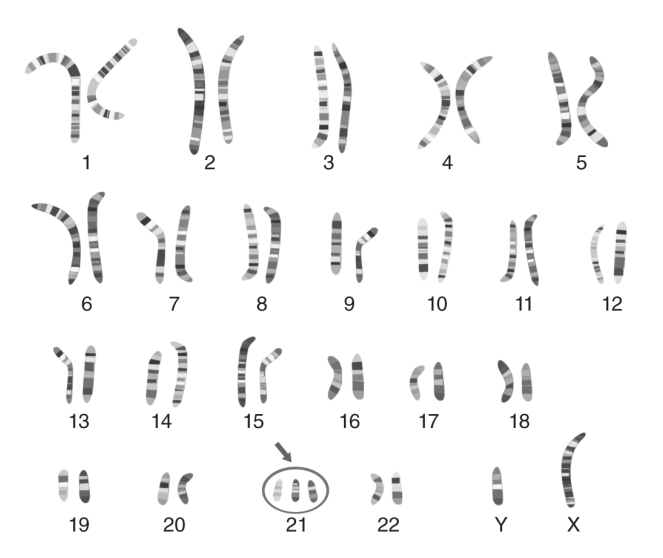
Which of the following was the most likely cause of the condition shown in the circle?
Which of the following was the most likely cause of the condition shown in the circle?
Correct Answer: (c)
(C) Nondisjunction is when two homologous chromosomes do not separate during meiosis. If a nondisjunction event occurs, the resulting gamete will have an extra copy of that chromosome. If that gamete is fertilized by a haploid gamete, the resulting cell will have three copies of the chromosome, as shown in the figure. Translocation describes mutations that are the result of genetic recombination between nonhomologous chromosomes, so choice (A) is incorrect. Choice (B) is incorrect because independent assortment is the independent alignment of pairs of homologous chromosomes in metaphase I; this does not affect the number of chromosomes found in a cell. Choice (D) is incorrect because genetic recombination describes the exchange of genetic material between chromosomes; this would not result in the presence of three copies of a chromosome.
(C) Nondisjunction is when two homologous chromosomes do not separate during meiosis. If a nondisjunction event occurs, the resulting gamete will have an extra copy of that chromosome. If that gamete is fertilized by a haploid gamete, the resulting cell will have three copies of the chromosome, as shown in the figure. Translocation describes mutations that are the result of genetic recombination between nonhomologous chromosomes, so choice (A) is incorrect. Choice (B) is incorrect because independent assortment is the independent alignment of pairs of homologous chromosomes in metaphase I; this does not affect the number of chromosomes found in a cell. Choice (D) is incorrect because genetic recombination describes the exchange of genetic material between chromosomes; this would not result in the presence of three copies of a chromosome.
Q17. Plant meristems
Correct Answer: (b)
Meristems are specialized regions in plants that provide a continuous supply of new cells throughout the plant's life. They contain undifferentiated stem cells that allow for indeterminate growth.
Meristems are specialized regions in plants that provide a continuous supply of new cells throughout the plant's life. They contain undifferentiated stem cells that allow for indeterminate growth.
Q18. Crossing over involves each of the following with the exception of
Correct Answer: (b)
Crossing over specifically describes the reciprocal exchange of DNA between non-sister chromatids within a homologous pair. Since sister chromatids are identical copies produced by replication, an exchange between them would not result in new genetic combinations and is not part of meiotic recombination.
Crossing over specifically describes the reciprocal exchange of DNA between non-sister chromatids within a homologous pair. Since sister chromatids are identical copies produced by replication, an exchange between them would not result in new genetic combinations and is not part of meiotic recombination.
Q19. During development, cells become
Correct Answer: (b)
Determination is the stage where a cell's developmental fate is irreversibly set, even if it doesn't look different yet. Differentiation is the subsequent process where the cell actually undergoes structural and functional changes to become a specialized cell type.
Determination is the stage where a cell's developmental fate is irreversibly set, even if it doesn't look different yet. Differentiation is the subsequent process where the cell actually undergoes structural and functional changes to become a specialized cell type.
Q20. The process of reproductive cloning
Correct Answer: (a)
Reproductive cloning (such as the case of Dolly the sheep) proved that the nucleus of a fully differentiated adult cell could be reprogrammed by the egg's cytoplasm to support the complete development of a new organism.
Reproductive cloning (such as the case of Dolly the sheep) proved that the nucleus of a fully differentiated adult cell could be reprogrammed by the egg's cytoplasm to support the complete development of a new organism.
Q21. How does the frequency of recombination events between genes that are close together on the same chromosome compare to the frequency of recombination events between genes that are far apart on the same chromosome?
Correct Answer: (a)
(A) Genes that are close together on the same chromosome have fewer opportunities for recombination than genes that are farther apart on the same chromosome. Thus, recombination events between genes that are close together on the same chromosome occur less frequently than recombination events between genes that are farther apart on the same chromosome. Choice (B) is the opposite of the correct answer. The distance between genes does affect the frequency of recombination events, so choice (C) cannot be the answer. Typically, recombination events do occur between genes on the same chromosome, so choice (D) is not correct.
(A) Genes that are close together on the same chromosome have fewer opportunities for recombination than genes that are farther apart on the same chromosome. Thus, recombination events between genes that are close together on the same chromosome occur less frequently than recombination events between genes that are farther apart on the same chromosome. Choice (B) is the opposite of the correct answer. The distance between genes does affect the frequency of recombination events, so choice (C) cannot be the answer. Typically, recombination events do occur between genes on the same chromosome, so choice (D) is not correct.
Q22. For pattern formation to occur, the cells in the developing embryo must
Correct Answer: (a)
Positional information is the core of pattern formation. Cells must interpret their location relative to body axes (often via morphogen gradients) to determine which specialized tissues or organs they should become.
Positional information is the core of pattern formation. Cells must interpret their location relative to body axes (often via morphogen gradients) to determine which specialized tissues or organs they should become.
Q23. A cell has reached full maturity, is fully differentiated, and no longer divides. Which of the following describes this stage of the cell cycle?
Correct Answer: (a)
During G0, the cell is not dividing and has exited the cell cycle. G1, G2, and S are all stages that prepare the cell to divide, so they do not describe a fully differentiated, non-dividing cell.
During G0, the cell is not dividing and has exited the cell cycle. G1, G2, and S are all stages that prepare the cell to divide, so they do not describe a fully differentiated, non-dividing cell.
Q24. Separation of the sister chromatids occurs during
Correct Answer: (c)
Anaphase is the phase of mitosis characterized by the sudden cleavage of cohesin proteins. This allows the sister chromatids to separate and be pulled toward opposite poles of the cell by the shortening of kinetochore microtubules.
Anaphase is the phase of mitosis characterized by the sudden cleavage of cohesin proteins. This allows the sister chromatids to separate and be pulled toward opposite poles of the cell by the shortening of kinetochore microtubules.
Q25. Which of the following is a correct statement?
Correct Answer: (b)
Many somatic cells in organs and tissues exhibit density-dependent inhibition, meaning they stop dividing when they become crowded. Cancer cells do not exhibit anchorage dependence nor do they exhibit density-dependent inhibition. Noncancerous somatic cells spend most of their time in interphase, not mitosis.
Many somatic cells in organs and tissues exhibit density-dependent inhibition, meaning they stop dividing when they become crowded. Cancer cells do not exhibit anchorage dependence nor do they exhibit density-dependent inhibition. Noncancerous somatic cells spend most of their time in interphase, not mitosis.
Q26. Production of anterior–posterior and dorsal–ventral axes in the fruit fly Drosophila
Correct Answer: (b)
While both axes rely on positional information, the molecular details differ. For example, the A/P axis is initially set by maternal mRNA gradients, whereas the D/V axis involves the nuclear localization gradient of the protein Dorsal.
While both axes rely on positional information, the molecular details differ. For example, the A/P axis is initially set by maternal mRNA gradients, whereas the D/V axis involves the nuclear localization gradient of the protein Dorsal.
Q27. During which process are the cytoplasm (and its cellular contents) divided between daughter cells?
Correct Answer: (d)
Cytokinesis is the division of the cytoplasm. Apoptosis is programmed cell death. DNA replication occurs during the S stage of the cell cycle, and mitosis is the process of nuclear division involving the equal distribution of replicated chromosomes between daughter nuclei.
Cytokinesis is the division of the cytoplasm. Apoptosis is programmed cell death. DNA replication occurs during the S stage of the cell cycle, and mitosis is the process of nuclear division involving the equal distribution of replicated chromosomes between daughter nuclei.
Q28. During which phase of the cell cycle is a cleavage furrow or cell plate formed?
Correct Answer: (c)
Cytokinesis is the physical division of the cytoplasm. In animal cells, a cleavage furrow is formed to pinch the cell in two. In plant cells, a cell plate is formed to separate the daughter cells. Mitosis refers specifically to the distribution of genetic material, whereas G0 is the nondividing phase of the cell cycle.
Cytokinesis is the physical division of the cytoplasm. In animal cells, a cleavage furrow is formed to pinch the cell in two. In plant cells, a cell plate is formed to separate the daughter cells. Mitosis refers specifically to the distribution of genetic material, whereas G0 is the nondividing phase of the cell cycle.
Q29. What would be the likely result of a mutation of the bcl-2 gene on the level of apoptosis?
Correct Answer: (c)
The bcl-2 gene produces a protein that acts as an inhibitor of apoptosis (programmed cell death). A mutation that reduces or eliminates bcl-2 function would remove this 'brake,' leading to an increase in cell death.
The bcl-2 gene produces a protein that acts as an inhibitor of apoptosis (programmed cell death). A mutation that reduces or eliminates bcl-2 function would remove this 'brake,' leading to an increase in cell death.
Q30. A mutation that removes the gradient necessary for the A/P morphogen gradient in Drosophila would be expected to
Correct Answer: (c)
The anterior-posterior (A/P) gradient is established by maternal effect genes. If this fundamental positional information is missing, the embryo cannot correctly organize its segments, resulting in catastrophic developmental failure and death.
The anterior-posterior (A/P) gradient is established by maternal effect genes. If this fundamental positional information is missing, the embryo cannot correctly organize its segments, resulting in catastrophic developmental failure and death.
Q31. The main difference between bacterial cell division and eukaryotic cell division is that
Correct Answer: (c)
In bacteria, chromosome segregation begins almost as soon as DNA replication starts (they are concerted processes). In eukaryotes, these processes are temporally separated into S phase (replication) and M phase (segregation).
In bacteria, chromosome segregation begins almost as soon as DNA replication starts (they are concerted processes). In eukaryotes, these processes are temporally separated into S phase (replication) and M phase (segregation).
Q32. Which of the following correctly describes the products of meiosis?
Correct Answer: (d)
(D) Meiosis produces four genetically different haploid cells. Choice (A) is incorrect because it describes the products of mitosis. Choice (B) is incorrect because meiosis produces four cells, not two cells, and those four cells are haploid, not diploid. Choice (C) is incorrect because meiosis produces genetically different cells, not genetically identical cells.
(D) Meiosis produces four genetically different haploid cells. Choice (A) is incorrect because it describes the products of mitosis. Choice (B) is incorrect because meiosis produces four cells, not two cells, and those four cells are haploid, not diploid. Choice (C) is incorrect because meiosis produces genetically different cells, not genetically identical cells.
Q33. Independent assortment of chromosomes occurs during which stage of meiosis?
Correct Answer: (a)
(A) Pairs of homologous chromosomes assort independently during metaphase I. Choice (B) is incorrect because individual chromosomes line up on the metaphase plate in metaphase II, and no independent assortment of chromosomes occurs. In both telophase I and telophase II, new nuclear membranes are formed. No assortment of chromosomes occurs during those stages, so choices (C) and (D) are incorrect.
(A) Pairs of homologous chromosomes assort independently during metaphase I. Choice (B) is incorrect because individual chromosomes line up on the metaphase plate in metaphase II, and no independent assortment of chromosomes occurs. In both telophase I and telophase II, new nuclear membranes are formed. No assortment of chromosomes occurs during those stages, so choices (C) and (D) are incorrect.
Q34. What occurs during anaphase of meiosis II?
Correct Answer: (b)
Meiosis II behaves similarly to a mitotic division. In anaphase II, the centromeres finally divide, allowing the sister chromatids to separate and be pulled toward opposite poles of the daughter cells.
Meiosis II behaves similarly to a mitotic division. In anaphase II, the centromeres finally divide, allowing the sister chromatids to separate and be pulled toward opposite poles of the daughter cells.
Q35. Determination can occur by
Correct Answer: (d)
Both internal signals (cytoplasmic determinants inherited from the egg) and external signals (induction from neighboring cells) are fundamental mechanisms that trigger the determination process in embryonic cells.
Both internal signals (cytoplasmic determinants inherited from the egg) and external signals (induction from neighboring cells) are fundamental mechanisms that trigger the determination process in embryonic cells.
Q36. Binary fission in prokaryotes does not require the
Correct Answer: (d)
Prokaryotic cells (bacteria and archaea) lack a nucleus and membrane-bound organelles. Therefore, the process of binary fission involves the replication and segregation of DNA without the need for the assembly or disassembly of a nuclear envelope, which is a hallmark of eukaryotic mitosis.
Prokaryotic cells (bacteria and archaea) lack a nucleus and membrane-bound organelles. Therefore, the process of binary fission involves the replication and segregation of DNA without the need for the assembly or disassembly of a nuclear envelope, which is a hallmark of eukaryotic mitosis.
Q37. Which phase of meiosis I is most similar to the comparable phase in mitosis?
Correct Answer: (d)
Meiosis I involves many unique processes like homologous pairing and recombination. However, telophase I is structurally very similar to mitotic telophase, as both involve the decondensation of chromosomes and the reformation of the nuclear envelope around the newly separated nuclear material.
Meiosis I involves many unique processes like homologous pairing and recombination. However, telophase I is structurally very similar to mitotic telophase, as both involve the decondensation of chromosomes and the reformation of the nuclear envelope around the newly separated nuclear material.
Q38. During anaphase I
Correct Answer: (b)
A defining event of Meiosis I is the separation of homologous pairs. During anaphase I, the homologous chromosomes are pulled toward opposite poles of the cell, while the sister chromatids remain attached at their centromeres.
A defining event of Meiosis I is the separation of homologous pairs. During anaphase I, the homologous chromosomes are pulled toward opposite poles of the cell, while the sister chromatids remain attached at their centromeres.
Q39. Which of the following statements correctly describes a difference between mitosis and meiosis?
Correct Answer: (c)
(C) Mitosis produces somatic (body) cells, whereas meiosis produces gametes. Choice (A) is incorrect because mitosis produces two cells, whereas meiosis produces four cells. Mitosis produces genetically identical cells, whereas meiosis produces genetically different cells, so choice (B) is incorrect. Haploid gametes are produced by meiosis, whereas diploid cells are produced by mitosis. So choice (D) is incorrect.
(C) Mitosis produces somatic (body) cells, whereas meiosis produces gametes. Choice (A) is incorrect because mitosis produces two cells, whereas meiosis produces four cells. Mitosis produces genetically identical cells, whereas meiosis produces genetically different cells, so choice (B) is incorrect. Haploid gametes are produced by meiosis, whereas diploid cells are produced by mitosis. So choice (D) is incorrect.
Q40. An organism’s diploid number is 28. Which of the following is a correct statement about this organism?
Correct Answer: (b)
(B) Somatic (body) cells have the diploid number of chromosomes (which is 28, based on the question), and gametes have the haploid number of chromosomes (which, in this case, is 14). Choice (A) is incorrect because it assigns the haploid number of chromosomes to the somatic cells and the diploid number of chromosomes to the gametic cells. Choices (C) and (D) are both incorrect because somatic cells and gametes have different numbers of chromosomes, not the same number of chromosomes.
(B) Somatic (body) cells have the diploid number of chromosomes (which is 28, based on the question), and gametes have the haploid number of chromosomes (which, in this case, is 14). Choice (A) is incorrect because it assigns the haploid number of chromosomes to the somatic cells and the diploid number of chromosomes to the gametic cells. Choices (C) and (D) are both incorrect because somatic cells and gametes have different numbers of chromosomes, not the same number of chromosomes.
Q41. The rapid divisions that occur early in development are made possible by shortening
Correct Answer: (c)
In many early embryos, the cell cycle consists almost entirely of DNA synthesis (S phase) and mitosis (M phase). By skipping or greatly shortening the growth phases (G1 and G2), the embryo can quickly partition the large volume of the egg into many smaller cells.
In many early embryos, the cell cycle consists almost entirely of DNA synthesis (S phase) and mitosis (M phase). By skipping or greatly shortening the growth phases (G1 and G2), the embryo can quickly partition the large volume of the egg into many smaller cells.
Q42. Cyclin-dependent kinases (Cdks) are regulated by
Correct Answer: (a)
Cdk activity depends on the presence of regulatory proteins called cyclins. The cell cycle is driven forward by the periodic synthesis of specific cyclins and their rapid, targeted destruction via the proteasome once their specific phase is complete.
Cdk activity depends on the presence of regulatory proteins called cyclins. The cell cycle is driven forward by the periodic synthesis of specific cyclins and their rapid, targeted destruction via the proteasome once their specific phase is complete.
Q43. Mutations that affect DNA repair often also affect the accuracy of meiosis. This is because
Correct Answer: (a)
The process of meiotic recombination (crossing over) is initiated by the cell deliberately creating double-strand breaks in the DNA. The cell then uses its existing DNA repair machinery to repair these breaks using the homologous chromosome as a template, which facilitates the exchange of genetic information.
The process of meiotic recombination (crossing over) is initiated by the cell deliberately creating double-strand breaks in the DNA. The cell then uses its existing DNA repair machinery to repair these breaks using the homologous chromosome as a template, which facilitates the exchange of genetic information.
Q44. What are homologous chromosomes?
Correct Answer: (d)
Homologous chromosomes are pairs of chromosomes that correspond in size, shape, and gene positions. One member of the pair is inherited from the mother and the other from the father. While they carry the same genes, they are genetically similar rather than identical because they may possess different alleles.
Homologous chromosomes are pairs of chromosomes that correspond in size, shape, and gene positions. One member of the pair is inherited from the mother and the other from the father. While they carry the same genes, they are genetically similar rather than identical because they may possess different alleles.
Q45. What is the role of cohesin proteins in cell division?
Correct Answer: (b)
Following DNA replication in the S phase, sister chromatids must remain physically associated to ensure they are accurately distributed during mitosis. Cohesin proteins form ring-like complexes that encircle and hold these sister chromatids together until they are cleaved at the onset of anaphase.
Following DNA replication in the S phase, sister chromatids must remain physically associated to ensure they are accurately distributed during mitosis. Cohesin proteins form ring-like complexes that encircle and hold these sister chromatids together until they are cleaved at the onset of anaphase.
Q46. At metaphase I the kinetochores of sister chromatids are
Correct Answer: (a)
In meiosis I, sister kinetochores exhibit monopolar attachment, meaning they attach to spindle fibers from the same pole. This ensures that the sister chromatids travel together as a unit to one pole, allowing the homologous partners to separate.
In meiosis I, sister kinetochores exhibit monopolar attachment, meaning they attach to spindle fibers from the same pole. This ensures that the sister chromatids travel together as a unit to one pole, allowing the homologous partners to separate.
Q47. Genetically, proto-oncogenes act in a dominant fashion. This is because
Correct Answer: (b)
Proto-oncogenes are normal genes that promote cell growth. Mutations that turn them into oncogenes are usually 'gain-of-function' mutations. Because having just one overactive allele is sufficient to promote uncontrolled cell division, the phenotype is genetically dominant.
Proto-oncogenes are normal genes that promote cell growth. Mutations that turn them into oncogenes are usually 'gain-of-function' mutations. Because having just one overactive allele is sufficient to promote uncontrolled cell division, the phenotype is genetically dominant.
Q48. A pluripotent cell is one that can
Correct Answer: (a)
Pluripotent cells, such as embryonic stem cells, have the ability to differentiate into any of the cell types that make up the adult body (derived from the three germ layers: ectoderm, mesoderm, and endoderm).
Pluripotent cells, such as embryonic stem cells, have the ability to differentiate into any of the cell types that make up the adult body (derived from the three germ layers: ectoderm, mesoderm, and endoderm).
Q49. The following figure is a karyotype, a picture that shows the chromosomes found in a somatic human cell.
Which of the following best describes the condition shown in the circle?
Which of the following best describes the condition shown in the circle?
Correct Answer: (a)
(A) Trisomy describes the condition where there are three copies of a given chromosome when there would typically be two copies. Choice (B) is incorrect because haploidy describes the conditions where there is only one copy of each chromosome. Monosomy is when there is one copy of a given chromosome, so choice (C) is incorrect. Choice (D) is incorrect because diploidy describes the conditions where there are two copies of each chromosome.
(A) Trisomy describes the condition where there are three copies of a given chromosome when there would typically be two copies. Choice (B) is incorrect because haploidy describes the conditions where there is only one copy of each chromosome. Monosomy is when there is one copy of a given chromosome, so choice (C) is incorrect. Choice (D) is incorrect because diploidy describes the conditions where there are two copies of each chromosome.
Q50. The bacterial SMC proteins, eukaryotic cohesin proteins, and condensin proteins share a similar structure. Functionally they all
Correct Answer: (c)
SMC (Structural Maintenance of Chromosomes) proteins are a conserved family of proteins that use ATP-driven mechanisms to manipulate the architecture of DNA, whether it is linking sister chromatids (cohesin) or facilitating the heavy condensation required for mitosis (condensin).
SMC (Structural Maintenance of Chromosomes) proteins are a conserved family of proteins that use ATP-driven mechanisms to manipulate the architecture of DNA, whether it is linking sister chromatids (cohesin) or facilitating the heavy condensation required for mitosis (condensin).
Q51. Which stage of mitosis has twice as many chromosomes at its end as it had at its beginning?
Correct Answer: (c)
At the beginning of anaphase, each chromosome consists of two sister chromatids. During anaphase, these chromatids separate, and at the end of anaphase, each of these chromatids is considered a separate chromosome. Thus, anaphase ends with twice as many chromosomes as it had at its beginning. In prophase and metaphase, the number of chromosomes remains the same. In telophase, the cell is finalizing the formation of two nuclei, and the chromosome count per resulting cell will ultimately match the original parent cell.
At the beginning of anaphase, each chromosome consists of two sister chromatids. During anaphase, these chromatids separate, and at the end of anaphase, each of these chromatids is considered a separate chromosome. Thus, anaphase ends with twice as many chromosomes as it had at its beginning. In prophase and metaphase, the number of chromosomes remains the same. In telophase, the cell is finalizing the formation of two nuclei, and the chromosome count per resulting cell will ultimately match the original parent cell.
Q52. How does DNA replication differ between mitosis and meiosis?
Correct Answer: (b)
While the actual process of DNA synthesis is similar, the scheduling differs. Meiosis consists of two rounds of nuclear division (Meiosis I and II) preceded by only a single round of DNA replication in S-phase, resulting in a reduction of the chromosome number by half.
While the actual process of DNA synthesis is similar, the scheduling differs. Meiosis consists of two rounds of nuclear division (Meiosis I and II) preceded by only a single round of DNA replication in S-phase, resulting in a reduction of the chromosome number by half.
Q53. Which of the following stages of meiosis generates genetic diversity?
Correct Answer: (a)
(A) Genetic recombination (crossing-over), which generates genetic diversity, occurs during prophase I. Choices (B), (C), and (D) are incorrect because genetic diversity is not generated in prophase II, anaphase I, or anaphase II. (Note that genetic diversity is generated in metaphase I of meiosis, but that is not one of the choices in this question.)
(A) Genetic recombination (crossing-over), which generates genetic diversity, occurs during prophase I. Choices (B), (C), and (D) are incorrect because genetic diversity is not generated in prophase II, anaphase I, or anaphase II. (Note that genetic diversity is generated in metaphase I of meiosis, but that is not one of the choices in this question.)
Q54. Which of the following best describes a role of mitosis?
Correct Answer: (d)
Mitosis is the distribution of genetic material between the daughter nuclei. Cytokinesis is responsible for the distribution of cytosol. Replication of DNA occurs during the S stage of interphase, and replication of cell organelles primarily occurs during the G1 and G2 stages.
Mitosis is the distribution of genetic material between the daughter nuclei. Cytokinesis is responsible for the distribution of cytosol. Replication of DNA occurs during the S stage of interphase, and replication of cell organelles primarily occurs during the G1 and G2 stages.
Q55. A chemotherapy drug stops the replication of DNA. During which stage of the cell cycle would this drug have the greatest effect?
Correct Answer: (d)
DNA is replicated during the S stage of the cell cycle, so a drug that blocks the replication of DNA would have the greatest effect during the S stage. DNA does not replicate during G0, G1, or G2, so those stages would not be directly affected by a drug targeting the replication process.
DNA is replicated during the S stage of the cell cycle, so a drug that blocks the replication of DNA would have the greatest effect during the S stage. DNA does not replicate during G0, G1, or G2, so those stages would not be directly affected by a drug targeting the replication process.
Q56. During which stage of mitosis do the centromeres of chromosomes attach to spindle fibers and line up in a single column in the center of the cell?
Correct Answer: (b)
During metaphase, chromosomes line up in the center of the cell on the metaphase plate. Prophase is when chromosomes condense and become visible, anaphase is when sister chromatids separate and begin to move to opposite ends of the cell, and telophase is when two new nuclei are formed.
During metaphase, chromosomes line up in the center of the cell on the metaphase plate. Prophase is when chromosomes condense and become visible, anaphase is when sister chromatids separate and begin to move to opposite ends of the cell, and telophase is when two new nuclei are formed.
Q57. What steps in the cell cycle represent irreversible commitments?
Correct Answer: (d)
The cell cycle contains several 'points of no return.' Passing the G1/S checkpoint commits the cell to DNA replication, and the initiation of anaphase involves the irreversible destruction of cohesin, committing the cell to segregating its genetic material.
The cell cycle contains several 'points of no return.' Passing the G1/S checkpoint commits the cell to DNA replication, and the initiation of anaphase involves the irreversible destruction of cohesin, committing the cell to segregating its genetic material.
Q58. Which process best describes what occurs when soft tissue between the fingers dies during embryonic development?
Correct Answer: (a)
Apoptosis is programmed cell death, and it can occur during embryonic development when the soft tissue between the fingers dies to allow the fingers to separate. While DNA replication, mitosis, and cytokinesis are involved in growth and division, apoptosis is the most specific to the programmed destruction of tissue during embryonic development.
Apoptosis is programmed cell death, and it can occur during embryonic development when the soft tissue between the fingers dies to allow the fingers to separate. While DNA replication, mitosis, and cytokinesis are involved in growth and division, apoptosis is the most specific to the programmed destruction of tissue during embryonic development.
Q59. Which of the following is a correct statement about meiosis?
Correct Answer: (c)
(C) DNA is replicated once before meiosis I starts, and meiosis is comprised of two rounds of cell division. Choice (A) is incorrect because it describes what happens during mitosis, not meiosis. Choice (B) is incorrect because DNA replication only occurs once in meiosis, and there are two rounds of cell division in meiosis. Choice (D) is incorrect because DNA replication only occurs once in meiosis.
(C) DNA is replicated once before meiosis I starts, and meiosis is comprised of two rounds of cell division. Choice (A) is incorrect because it describes what happens during mitosis, not meiosis. Choice (B) is incorrect because DNA replication only occurs once in meiosis, and there are two rounds of cell division in meiosis. Choice (D) is incorrect because DNA replication only occurs once in meiosis.
Q60. Why is cytokinesis an important part of cell division?
Correct Answer: (b)
Mitosis is the division of the nucleus (karyokinesis), whereas cytokinesis is the physical division of the cell itself. Cytokinesis ensures that the cytoplasm, organelles, and newly formed nuclei are partitioned into two distinct daughter cells.
Mitosis is the division of the nucleus (karyokinesis), whereas cytokinesis is the physical division of the cell itself. Cytokinesis ensures that the cytoplasm, organelles, and newly formed nuclei are partitioned into two distinct daughter cells.
Q61. Pattern formation involves cells determining their position in the embryo. One mechanism that can accomplish this is
Correct Answer: (c)
Morphogens are signaling molecules that spread from a source to form a concentration gradient. Depending on the concentration of the morphogen a cell perceives, it 'reads' its position and activates the appropriate set of developmental genes.
Morphogens are signaling molecules that spread from a source to form a concentration gradient. Depending on the concentration of the morphogen a cell perceives, it 'reads' its position and activates the appropriate set of developmental genes.