Q1. Which of the following cell layers is not necessary to be considered a eumetazoan?
Correct Answer: (c)
Eumetazoans are defined by having true tissues. While all possess ectoderm and endoderm (making them at least diploblastic), only triploblastic eumetazoans possess a mesoderm. Therefore, mesoderm is not a requirement for the group (e.g., Cnidarians lack it).
Eumetazoans are defined by having true tissues. While all possess ectoderm and endoderm (making them at least diploblastic), only triploblastic eumetazoans possess a mesoderm. Therefore, mesoderm is not a requirement for the group (e.g., Cnidarians lack it).
Q2. The following diagram is of the blastopore stage of embryonic development. Based on the information in the diagram, which of the following statements is correct?
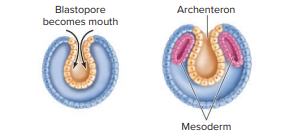
Correct Answer: (d)
The diagram illustrates protostome development (blastopore becoming the mouth). Protostomes typically undergo spiral cleavage and determinate development, and they represent the majority of animal species.
The diagram illustrates protostome development (blastopore becoming the mouth). Protostomes typically undergo spiral cleavage and determinate development, and they represent the majority of animal species.
Q3. Nematodes once were thought to be closely related to rotifers due to the presence of a pseudocoelom, but are now considered closer to the arthropods due to
Correct Answer: (a)
While nematodes were once grouped by their body cavity type, molecular data and the shared characteristic of ecdysis (periodic molting of the cuticle) now place them in the clade Ecdysozoa along with arthropods.
While nematodes were once grouped by their body cavity type, molecular data and the shared characteristic of ecdysis (periodic molting of the cuticle) now place them in the clade Ecdysozoa along with arthropods.
Q4. Why was the evolution of the pulmonary veins important for amphibians?
Correct Answer: (a)
Pulmonary veins are essential for terrestrial life as they allow oxygenated blood to return directly from the lungs to the heart. This ensures that oxygen-rich blood can be pumped efficiently to the rest of the body's tissues.
Pulmonary veins are essential for terrestrial life as they allow oxygenated blood to return directly from the lungs to the heart. This ensures that oxygen-rich blood can be pumped efficiently to the rest of the body's tissues.
Q5. In the figure, item A is the ______ and item B is the _______.
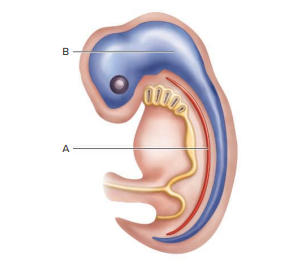
Correct Answer: (c)
In the basic chordate body plan, the dorsal hollow nerve cord (B) is located dorsally to the notochord (A). The notochord provides flexible structural support, while the nerve cord develops into the central nervous system.
In the basic chordate body plan, the dorsal hollow nerve cord (B) is located dorsally to the notochord (A). The notochord provides flexible structural support, while the nerve cord develops into the central nervous system.
Q6. Serial segmentation is a key characteristic of which of the following phyla?
Correct Answer: (d)
Annelids, or segmented worms, are defined by metamerism, which is the division of the body into a series of repeating segments. This serial segmentation allows for more efficient movement and the evolution of redundant organ systems.
Annelids, or segmented worms, are defined by metamerism, which is the division of the body into a series of repeating segments. This serial segmentation allows for more efficient movement and the evolution of redundant organ systems.
Q7. In terms of numbers of species, the most successful phylum on the planet is the
Correct Answer: (b)
Arthropoda is the most species-rich phylum in the animal kingdom, accounting for more than 80% of all described animal species. Their success is attributed to their versatile exoskeleton, jointed appendages, and highly developed sensory systems.
Arthropoda is the most species-rich phylum in the animal kingdom, accounting for more than 80% of all described animal species. Their success is attributed to their versatile exoskeleton, jointed appendages, and highly developed sensory systems.
Q8. With regard to classification of animals, the study of which of the following is changing our understanding of how animals are organized?
Correct Answer: (a)
Molecular systematics, which compares DNA, RNA, and protein sequences, has provided a more accurate evolutionary timeline and revealed relationships that were not apparent through physical morphology alone.
Molecular systematics, which compares DNA, RNA, and protein sequences, has provided a more accurate evolutionary timeline and revealed relationships that were not apparent through physical morphology alone.
Q9. In the rainforest you discover a new species that is terrestrial, has determinate development, molts during its lifetime, and possesses jointed appendages. To which phylum of animals should it be assigned?
Correct Answer: (c)
Jointed appendages and ecdysis (molting) are the hallmark characteristics of the phylum Arthropoda. Determinate development further confirms its placement within the protostome lineage.
Jointed appendages and ecdysis (molting) are the hallmark characteristics of the phylum Arthropoda. Determinate development further confirms its placement within the protostome lineage.
Q10. Intelligence and complex behaviors are characteristics of the
Correct Answer: (a)
Among invertebrates, cephalopods (such as octopuses and squids) exhibit the most complex nervous systems and high levels of intelligence. They are capable of learning, problem-solving, and displaying sophisticated behaviors related to hunting and communication.
Among invertebrates, cephalopods (such as octopuses and squids) exhibit the most complex nervous systems and high levels of intelligence. They are capable of learning, problem-solving, and displaying sophisticated behaviors related to hunting and communication.
Q11. Which of the following classes of arthropod possess chelicerae?
Correct Answer: (d)
Members of the subphylum Chelicerata, which includes spiders, scorpions, and horseshoe crabs, are distinguished by having chelicerae as their first pair of appendages. These are often modified into fangs or pincers used for feeding.
Members of the subphylum Chelicerata, which includes spiders, scorpions, and horseshoe crabs, are distinguished by having chelicerae as their first pair of appendages. These are often modified into fangs or pincers used for feeding.
Q12. Which of the following characteristics would not apply to a species in the Ecdysozoa?
Correct Answer: (b)
Ecdysozoans are protostomes. Indeterminate cleavage is a characteristic of deuterostomes; protostomes typically exhibit determinate cleavage, where the fate of embryonic cells is fixed very early.
Ecdysozoans are protostomes. Indeterminate cleavage is a characteristic of deuterostomes; protostomes typically exhibit determinate cleavage, where the fate of embryonic cells is fixed very early.
Q13. Which of the following structures is not a component of the water-vascular system of an echinoderm?
Correct Answer: (a)
Ossicles are small calcareous elements that form the endoskeleton of echinoderms. While they provide structural support, they are not part of the hydraulic water-vascular system, which includes the madreporite, canals, and ampullae used for locomotion and feeding.
Ossicles are small calcareous elements that form the endoskeleton of echinoderms. While they provide structural support, they are not part of the hydraulic water-vascular system, which includes the madreporite, canals, and ampullae used for locomotion and feeding.
Q14. Which of the following characteristics is NOT found in the arthropods?
Correct Answer: (c)
Arthropods possess an open circulatory system, in which a fluid called hemolymph is pumped by a heart into a body cavity (hemocoel) to bathe the organs directly. They lack the closed vessels found in annelids or vertebrates.
Arthropods possess an open circulatory system, in which a fluid called hemolymph is pumped by a heart into a body cavity (hemocoel) to bathe the organs directly. They lack the closed vessels found in annelids or vertebrates.
Q15. A fluid-filled cavity that develops completely within mesodermal tissue is a characteristic of a
Correct Answer: (a)
A true coelom is defined as a body cavity that is entirely lined by peritoneum derived from the mesoderm. This allows for complex organ systems to be supported and buffered from the outer body wall.
A true coelom is defined as a body cavity that is entirely lined by peritoneum derived from the mesoderm. This allows for complex organ systems to be supported and buffered from the outer body wall.
Q16. Which of the following evolutionary adaptations allows the birds to become efficient at flying?
Correct Answer: (d)
Flight is an energy-demanding activity that requires a combination of adaptations. These include light yet strong feathers for lift, endothermy (high metabolic temperatures) for sustained energy, and a highly efficient one-way respiratory system with air sacs.
Flight is an energy-demanding activity that requires a combination of adaptations. These include light yet strong feathers for lift, endothermy (high metabolic temperatures) for sustained energy, and a highly efficient one-way respiratory system with air sacs.
Q17. The fact that monotremes lay eggs
Correct Answer: (b)
Laying eggs is an ancestral (plesiomorphic) trait for all amniotes. Monotremes, such as the platypus and echidna, are primitive mammals that have retained this ancestral reproductive method, whereas other mammalian lineages evolved live birth.
Laying eggs is an ancestral (plesiomorphic) trait for all amniotes. Monotremes, such as the platypus and echidna, are primitive mammals that have retained this ancestral reproductive method, whereas other mammalian lineages evolved live birth.
Q18. Which of the following groups lacks a four-chambered heart?
Correct Answer: (d)
Amphibians possess a three-chambered heart consisting of two atria and one ventricle, where some mixing of oxygenated and deoxygenated blood occurs. In contrast, birds, mammals, and crocodilians have evolved a four-chambered heart that completely separates these blood flows.
Amphibians possess a three-chambered heart consisting of two atria and one ventricle, where some mixing of oxygenated and deoxygenated blood occurs. In contrast, birds, mammals, and crocodilians have evolved a four-chambered heart that completely separates these blood flows.
Q19. Which of the following cell types of a sponge possesses a flagellum?
Correct Answer: (a)
Choanocytes (or collar cells) possess a central flagellum. The coordinated beating of these flagella creates a water current that brings food and oxygen into the sponge while carrying away waste.
Choanocytes (or collar cells) possess a central flagellum. The coordinated beating of these flagella creates a water current that brings food and oxygen into the sponge while carrying away waste.
Q20. The evolution of bilateral symmetry was a necessary precursor for the evolution of
Correct Answer: (d)
Bilateral symmetry establishes a definite anterior (front) and posterior (back) end. This organization led to cephalization, the concentration of sensory organs and nervous tissues at the anterior end to form a head.
Bilateral symmetry establishes a definite anterior (front) and posterior (back) end. This organization led to cephalization, the concentration of sensory organs and nervous tissues at the anterior end to form a head.
Q21. Which of the following statements regarding all species of chordates is false?
Correct Answer: (c)
While all chordates possess a notochord at some point in their life cycle, only the subphylum Vertebrata has a notochord that is replaced or surrounded by a vertebral column made of bone or cartilage. Invertebrate chordates, such as lancelets and tunicates, never develop these bony structures.
While all chordates possess a notochord at some point in their life cycle, only the subphylum Vertebrata has a notochord that is replaced or surrounded by a vertebral column made of bone or cartilage. Invertebrate chordates, such as lancelets and tunicates, never develop these bony structures.
Q22. During embryonic development, a neural crest would be found in all of the following chordates, except
Correct Answer: (a)
The neural crest is a collection of cells that appears during vertebrate development and gives rise to many unique vertebrate structures. Cephalochordates, such as Amphioxus, are invertebrate chordates and do not possess this feature.
The neural crest is a collection of cells that appears during vertebrate development and gives rise to many unique vertebrate structures. Cephalochordates, such as Amphioxus, are invertebrate chordates and do not possess this feature.
Q23. Which of the following characteristics is used to distinguish between a parazoan and a eumetazoan?
Correct Answer: (d)
Parazoans (sponges) lack true tissues and symmetry, whereas Eumetazoans have well-defined tissues organized into germ layers and exhibit some form of symmetry.
Parazoans (sponges) lack true tissues and symmetry, whereas Eumetazoans have well-defined tissues organized into germ layers and exhibit some form of symmetry.
Q24. Which of the following characteristics is unique to all animals?
Correct Answer: (c)
While multicellularity and heterotrophy are characteristics of animals, they are also found in other kingdoms (like Fungi). However, the absence of a rigid cell wall is a structural characteristic unique to animal cells among multicellular organisms.
While multicellularity and heterotrophy are characteristics of animals, they are also found in other kingdoms (like Fungi). However, the absence of a rigid cell wall is a structural characteristic unique to animal cells among multicellular organisms.
Q25. The distinguishing feature of the Bryozoa and Brachiopoda is
Correct Answer: (d)
Bryozoans and Brachiopods are known as lophophorates because they possess a lophophore. This is a specialized circular or U-shaped fold of the body wall with ciliated tentacles that surround the mouth and are used for filter feeding and respiration.
Bryozoans and Brachiopods are known as lophophorates because they possess a lophophore. This is a specialized circular or U-shaped fold of the body wall with ciliated tentacles that surround the mouth and are used for filter feeding and respiration.
Q26. In the flatworm, flame cells are involved in what metabolic process?
Correct Answer: (d)
Flame cells are specialized excretory cells found in the simplest freshwater invertebrates, such as flatworms. They function like a kidney, regulated by the beating of cilia that look like a flickering flame, to filter and remove excess water and waste from the body, a process known as osmoregulation.
Flame cells are specialized excretory cells found in the simplest freshwater invertebrates, such as flatworms. They function like a kidney, regulated by the beating of cilia that look like a flickering flame, to filter and remove excess water and waste from the body, a process known as osmoregulation.
Q27. Which of the following nematodes cause disease?
Correct Answer: (d)
Nematodes include many human pathogens. Filarial worms cause lymphatic filariasis (elephantiasis), pinworms are common intestinal parasites (especially in children), and Trichinella (trichina worms) cause trichinosis through the consumption of undercooked pork.
Nematodes include many human pathogens. Filarial worms cause lymphatic filariasis (elephantiasis), pinworms are common intestinal parasites (especially in children), and Trichinella (trichina worms) cause trichinosis through the consumption of undercooked pork.
Q28. Which of the following statements is NOT true regarding segmentation?
Correct Answer: (b)
While many segmented animals (like annelids) have closed circulatory systems, segmentation is not a biological requirement for it. For example, cephalopod mollusks have closed circulatory systems but lack traditional body segmentation.
While many segmented animals (like annelids) have closed circulatory systems, segmentation is not a biological requirement for it. For example, cephalopod mollusks have closed circulatory systems but lack traditional body segmentation.
Q29. Examples of decapods are
Correct Answer: (d)
Decapods are an order of crustaceans that have five pairs of walking legs (ten legs total). This group includes economically and ecologically important species like lobsters, crabs, shrimp, and crayfish.
Decapods are an order of crustaceans that have five pairs of walking legs (ten legs total). This group includes economically and ecologically important species like lobsters, crabs, shrimp, and crayfish.
Q30. In animal sexual reproduction the gametes are formed by the process of
Correct Answer: (a)
In animals, specialized diploid germ cells undergo meiosis to produce haploid gametes (sperm and eggs). This is distinct from plants, where mitosis often produces gametes from a haploid gametophyte.
In animals, specialized diploid germ cells undergo meiosis to produce haploid gametes (sperm and eggs). This is distinct from plants, where mitosis often produces gametes from a haploid gametophyte.
Q31. All of the following are characteristics of reptiles, except
Correct Answer: (a)
Cutaneous respiration (breathing through the skin) is a characteristic of amphibians, which have moist, permeable skin. Reptiles have evolved dry, watertight skin covered in scales to prevent water loss, making them reliant on thoracic breathing via lungs.
Cutaneous respiration (breathing through the skin) is a characteristic of amphibians, which have moist, permeable skin. Reptiles have evolved dry, watertight skin covered in scales to prevent water loss, making them reliant on thoracic breathing via lungs.
Q32. The coelom
Correct Answer: (a)
The presence of a coelom (or its secondary loss) is a shared derived characteristic (synapomorphy) that distinguishes the Bilateria clade, which includes both protostomes and deuterostomes.
The presence of a coelom (or its secondary loss) is a shared derived characteristic (synapomorphy) that distinguishes the Bilateria clade, which includes both protostomes and deuterostomes.
Q33. The ___ of the bony fish evolved to counter the effects of increased bone density.
Correct Answer: (c)
Bony fish have skeletons made of heavy bone, unlike the lighter cartilaginous skeletons of sharks. The swim bladder evolved as a gas-filled buoyancy organ that allows these fish to maintain their position in the water column without sinking due to their increased density.
Bony fish have skeletons made of heavy bone, unlike the lighter cartilaginous skeletons of sharks. The swim bladder evolved as a gas-filled buoyancy organ that allows these fish to maintain their position in the water column without sinking due to their increased density.
Q34. Animals are unique in the fact that they possess _______ for movement and _______ for conducting signals between cells.
Correct Answer: (b)
The evolution of specialized muscle tissue for contraction and nervous tissue for rapid electrical signaling is a defining feature of the kingdom Animalia, enabling complex behaviors and movement.
The evolution of specialized muscle tissue for contraction and nervous tissue for rapid electrical signaling is a defining feature of the kingdom Animalia, enabling complex behaviors and movement.
Q35. A coelomate organism may have which of the following characteristics?
Correct Answer: (d)
The evolution of a coelom provided the internal space and structural support necessary for the development of complex circulatory systems, internal skeletons, and larger overall body sizes.
The evolution of a coelom provided the internal space and structural support necessary for the development of complex circulatory systems, internal skeletons, and larger overall body sizes.
Q36. The reason that birds and crocodilians both build nests might be because they
Correct Answer: (c)
Birds and crocodilians are both members of the Archosauria clade. Their shared behaviors, such as building nests and providing parental care, are likely homologous traits inherited from a common archosaurian ancestor.
Birds and crocodilians are both members of the Archosauria clade. Their shared behaviors, such as building nests and providing parental care, are likely homologous traits inherited from a common archosaurian ancestor.
Q37. Acoel flatworms
Correct Answer: (d)
Molecular evidence suggests that Acoela are basal bilaterians and represent the sister group to all other Bilateria (the Nephrozoa, which includes protostomes and deuterostomes), rather than being closely related to typical Platyhelminthes.
Molecular evidence suggests that Acoela are basal bilaterians and represent the sister group to all other Bilateria (the Nephrozoa, which includes protostomes and deuterostomes), rather than being closely related to typical Platyhelminthes.
Q38. The larval stage of a cnidarian is known as a
Correct Answer: (b)
A planula is the free-swimming, ciliated, elongated larval stage of most cnidarians. It eventually settles on a substrate to develop into a polyp.
A planula is the free-swimming, ciliated, elongated larval stage of most cnidarians. It eventually settles on a substrate to develop into a polyp.
Q39. Which of the following is most closely related to lobsters and what characteristics are significant in determining this relationship?
Correct Answer: (c)
Lobsters and centipedes are both arthropods. They share fundamental evolutionary traits including an exoskeleton made of chitin, jointed appendages, and distinct body segmentation, placing them in the same phylum.
Lobsters and centipedes are both arthropods. They share fundamental evolutionary traits including an exoskeleton made of chitin, jointed appendages, and distinct body segmentation, placing them in the same phylum.
Q40. To which of the following groups would a species that does not molt, possesses a coelom, and has a trochophore larva belong?
Correct Answer: (d)
Lophotrochozoans are a major group of protostomes that include phyla like Mollusca and Annelida. They are characterized by having a trochophore larval stage and growing by increasing body mass rather than molting (ecdysis).
Lophotrochozoans are a major group of protostomes that include phyla like Mollusca and Annelida. They are characterized by having a trochophore larval stage and growing by increasing body mass rather than molting (ecdysis).
Q41. The _______ of a mollusk is a highly efficient respiratory structure.
Correct Answer: (c)
A ctenidium is a comb-like structure or gill found in many mollusks. This structure is highly efficient for gas exchange because it allows for a large surface area where oxygen from the water can enter the circulatory system while carbon dioxide is released.
A ctenidium is a comb-like structure or gill found in many mollusks. This structure is highly efficient for gas exchange because it allows for a large surface area where oxygen from the water can enter the circulatory system while carbon dioxide is released.
Q42. Which of the following is the closest relative of lungfish?
Correct Answer: (c)
Lungfish belong to the Sarcopterygii (lobe-finned fish). While they share a more recent common ancestor with tetrapods (like mammals) than with other fish, among the aquatic groups listed, they are most closely related to the ray-finned fish (Actinopterygii).
Lungfish belong to the Sarcopterygii (lobe-finned fish). While they share a more recent common ancestor with tetrapods (like mammals) than with other fish, among the aquatic groups listed, they are most closely related to the ray-finned fish (Actinopterygii).