
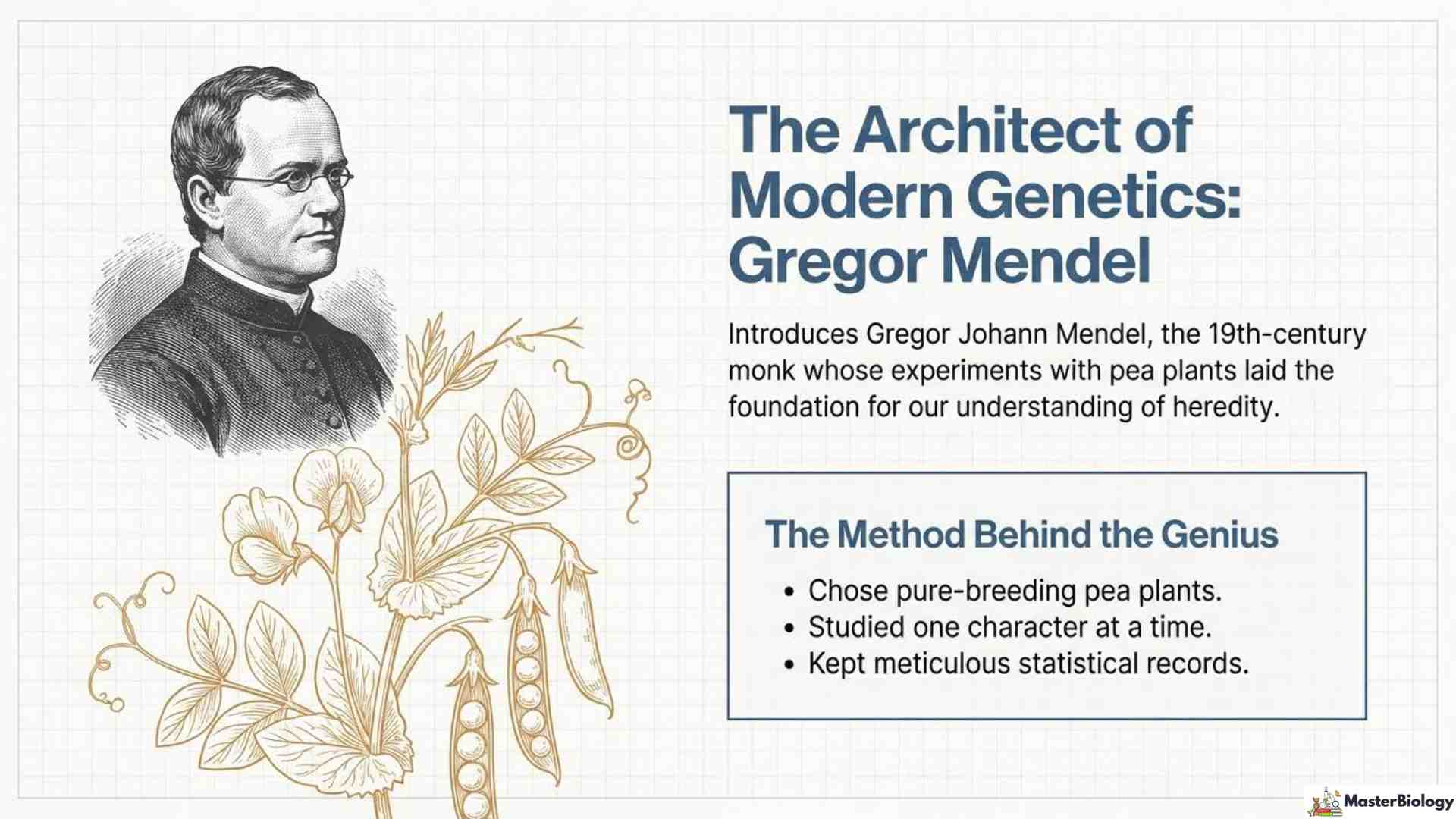
Genetics is the bedrock of modern medicine, and it all began with the pioneering work of an Austrian monk, Gregor Johann Mendel. His experiments with pea plants in the 19th century laid down the fundamental principles of heredity, now known as Mendelian Genetics. For a medical aspirant, mastering these concepts is not just about clearing an exam; it’s the first step towards understanding human diseases, inheritance patterns, and genetic counseling.
Part 1: Core Principles of Mendelian Inheritance
Mendel succeeded where others failed because of his systematic approach: he chose pure-breeding pea plants, studied one character at a time, and kept meticulous statistical records.
Key Terminologies:
- Factor (Gene): The unit of heredity; a segment of DNA that codes for a specific polypeptide. Mendel called them ‘factors’.
- Allele: Alternative forms of a gene that occupy the same locus on homologous chromosomes. (e.g., the gene for height has alleles
Tfor tall andtfor dwarf). - Homozygous: An individual with two identical alleles for a character (e.g.,
TTortt). - Heterozygous: An individual with two different alleles for a character (e.g.,
Tt). - Genotype: The genetic constitution of an individual (e.g.,
TT,Tt,tt). - Phenotype: The observable or external characteristic of an individual (e.g., Tall, Dwarf).
- Monohybrid Cross: A cross between two individuals studying the inheritance of a single contrasting trait.
- Dihybrid Cross: A cross between two individuals studying the inheritance of two different traits simultaneously.
Mendel’s Laws of Inheritance
1. Law of Dominance:
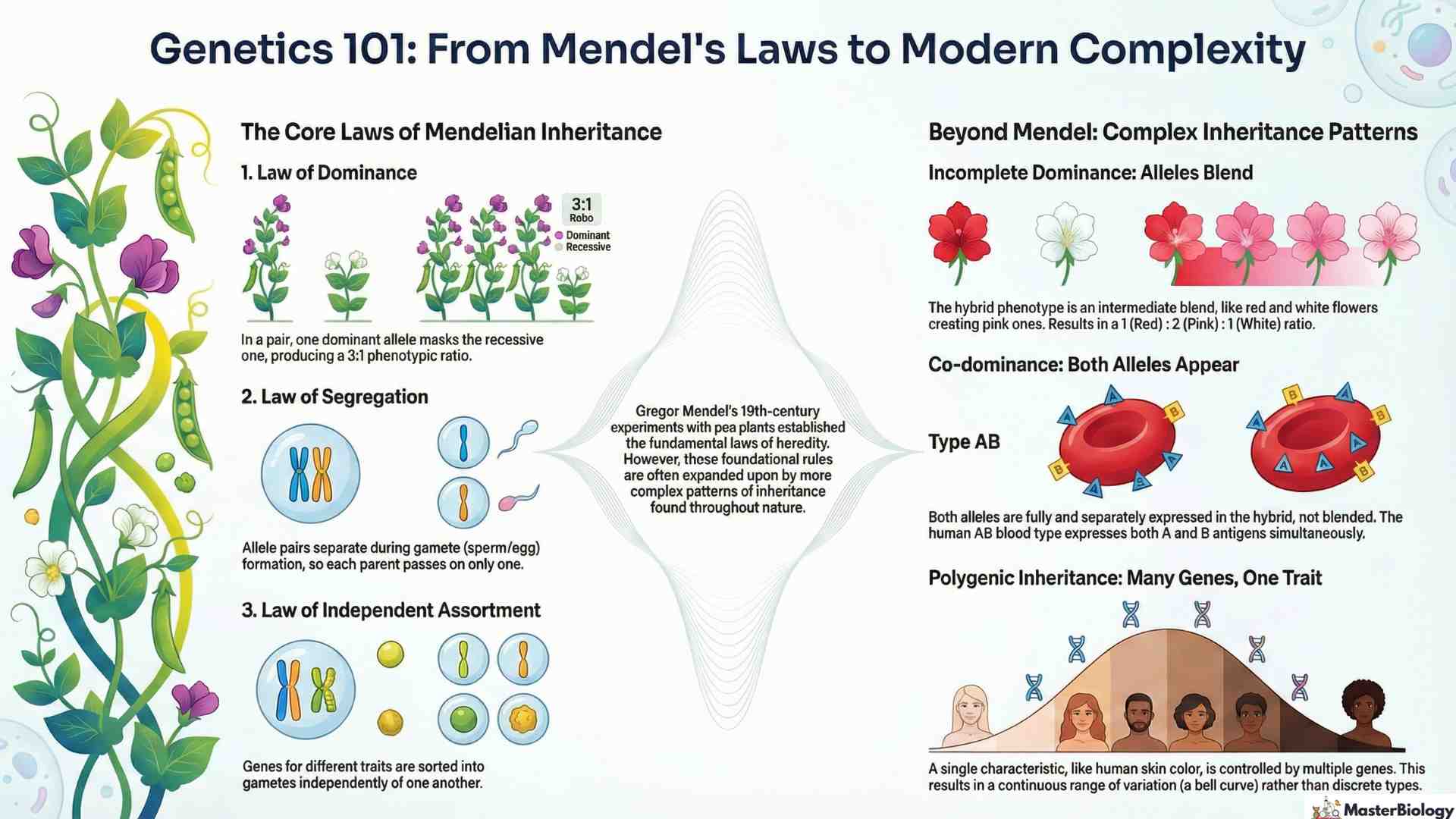
- Characters are controlled by discrete units (factors/genes) that occur in pairs.
- In a heterozygous individual, one allele expresses itself, while the other remains unexpressed.
- The allele that expresses is called the Dominant allele (e.g.,
Tfor tall), and the one that remains unexpressed is the Recessive allele (e.g.,tfor dwarf). - Phenotypic Ratio in F₂ Generation of a Monohybrid Cross: 3 (Dominant) : 1 (Recessive)
2. Law of Segregation (Purity of Gametes):
- This is the most critical law. It states that during the formation of gametes (meiosis), the two alleles for a character segregate (separate) from each other so that each gamete carries only one allele for each character.
- A heterozygous (
Tt) individual produces two types of gametes: 50% withTand 50% witht.
3. Law of Independent Assortment:
- This law deals with the inheritance of two or more characters simultaneously.
- It states that during gamete formation, the segregation of alleles for one gene occurs independently of the segregation of alleles for another gene, provided the genes are located on different chromosomes (non-linked).
- Phenotypic Ratio in F₂ Generation of a Dihybrid Cross: 9 : 3 : 3 : 1
Part 2: Deviations from Mendelism
While Mendel’s laws are foundational, nature is more complex. Several patterns of inheritance do not follow the simple dominant-recessive ratio. These are crucial from an exam perspective.
1. Incomplete Dominance
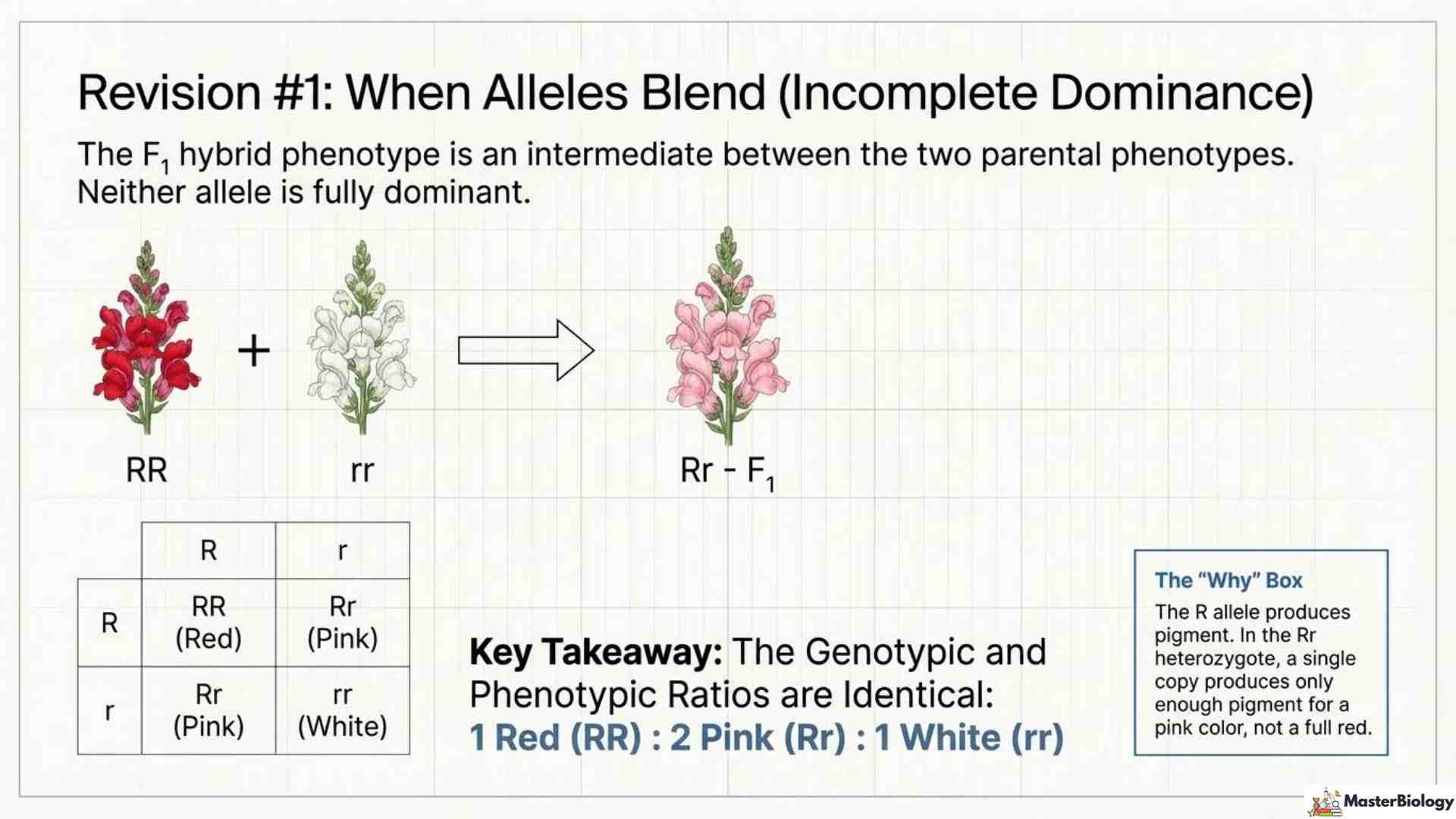
- Concept: It is a post-Mendelian discovery where the F₁ hybrid phenotype is intermediate between the phenotypes of the two parents. Neither allele is dominant; they “blend”.
- Classic Example: Flower color in Mirabilis jalapa (4 o’clock plant) or Snapdragon.
- Cross: Red flower (RR) × White flower (rr)
- F₁ Generation: All Pink flowers (Rr) — an intermediate colour.
- F₂ Generation: Genotypic Ratio (1 RR : 2 Rr : 1 rr) = Phenotypic Ratio (1 Red : 2 Pink : 1 White). The 1:2:1 ratio is a key identifier.
- Why it happens: The dominant allele produces a functional protein, but a single copy (in heterozygote) produces insufficient amount to show the full trait, leading to an intermediate effect.
2. Co-dominance
- Concept: Both alleles in a heterozygous individual are fully expressed independently. Neither is dominant over the other; they are “co-dominant”.
- Best Example:ABO Blood Group System in Humans. This is a favorite for entrance exams.
- The gene ‘I’ has three alleles: Iᴬ, Iᴮ, and i.
- Iᴬ and Iᴮ are co-dominant, and both are dominant over i.
- Genotypes and Phenotypes:
- IᴬIᴬ, Iᴬi → Blood Group A
- IᴮIᴮ, Iᴮi → Blood Group B
- IᴬIᴮ → Blood Group AB (Here, both A and B antigens are expressed on RBCs)
- ii → Blood Group O
- Key Takeaway: In co-dominance, the heterozygote shows the phenotypes of both homozygotes simultaneously, unlike the blended intermediate in incomplete dominance.
3. Multiple Alleles
- Concept: When a gene has more than two alternative forms (alleles) in a population, it is said to have multiple alleles. However, a diploid individual can possess only two of these alleles at a time.
- Classic Example: The ABO Blood Group system, as described above, is governed by three alleles (Iᴬ, Iᴮ, i). This is the most important example you must remember.
- Another Example: Coat colour in rabbits.
4. Pleiotropy
- Concept: A single gene influences multiple, seemingly unrelated phenotypic traits. The gene has multiple effects.
- Medical Example:Phenylketonuria (PKU) in humans.
- A single mutation in the gene for the enzyme phenylalanine hydroxylase.
- This one defect leads to multiple consequences: mental retardation, reduced hair and skin pigmentation, and eczema.
- Another Example: Marfan syndrome, where a single gene defect affects the skeleton, eyes, and cardiovascular system.
5. Polygenic Inheritance (Quantitative Inheritance)
- Concept: When a single phenotypic character is controlled by two or more genes, it is called polygenic inheritance. The effect of each gene is additive or cumulative.
- Characteristics:
- The traits are quantitative (e.g., height, skin colour, weight) as opposed to qualitative (e.g., tall/dwarf).
- The F₁ generation is intermediate between the two parents.
- The F₂ generation shows a continuous variation (a bell-shaped curve in a population) rather than discrete ratios.
- Classic Example: Human Skin Colour. It is controlled by at least three pairs of genes (A, B, C). The dominant alleles (A, B, C) contribute to dark pigmentation. A person with genotype AABBCC would be very dark, and aabbcc would be very light. The F₂ offspring show a wide range of skin colours from very dark to very light, with most being intermediate.
Summary Table for Quick Revision
| Concept | Key Feature | Classic Example | Phenotypic Ratio (F₂) |
|---|---|---|---|
| Law of Dominance | One allele masks the other | Tall vs Dwarf pea plant | 3 : 1 |
| Incomplete Dominance | F₁ hybrid is a blend of parents | Flower color in Snapdragon | 1 : 2 : 1 |
| Co-dominance | Both alleles are fully expressed | ABO Blood Group (AB type) | 1 : 1 (in a specific cross) |
| Multiple Alleles | Gene has >2 allele forms in a population | ABO Blood Group (Iᴬ, Iᴮ, i) | – |
| Pleiotropy | One gene affects multiple traits | Phenylketonuria (PKU) | – |
| Polygenic Inheritance | Many genes control one trait | Human Skin Colour | Continuous Variation |
Exam Focus & Tips:
- Blood Groups are High-Yield: Be thorough with the genotypes and the possible crosses for ABO blood groups. Questions often ask about the parentage of a child with a particular blood group.
- Distinguish Clearly: Make sure you can explain the difference between Incomplete Dominance and Co-dominance with clarity.
- Link to Diseases: Relate concepts like Pleiotropy to real genetic disorders (PKU, Sickle-cell anemia). This shows a deeper understanding.
- Practice Crosses: Don’t just read. Draw Punnett Squares for monohybrid, dihybrid, and crosses for incomplete dominance and blood groups.